
Psalms 136:10

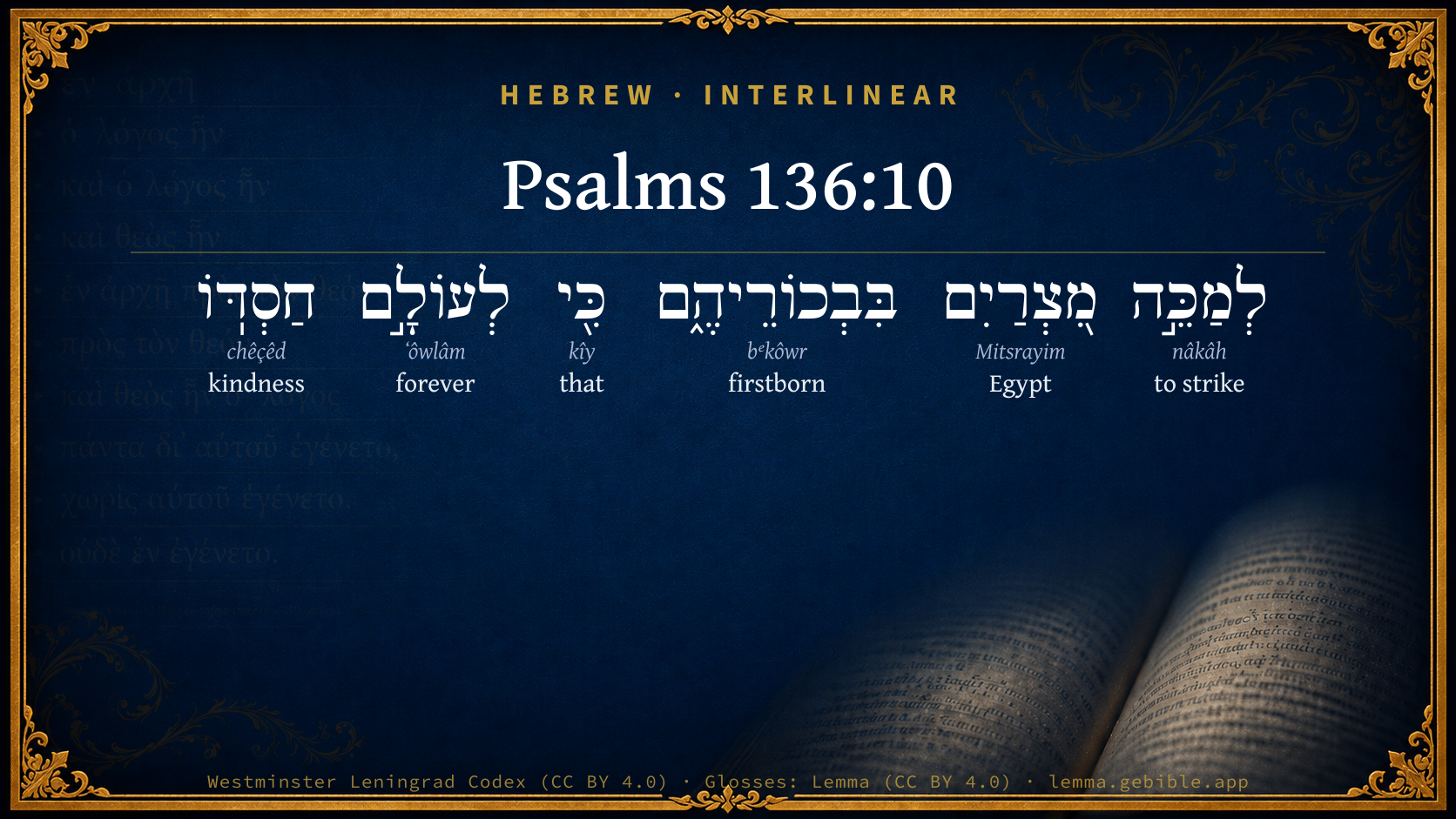
Hebrew (Westminster Leningrad Codex) Psalms 136:10 appears in the Hebrew Old Testament. The text above is from the Westminster Leningrad Codex. Each word links to its Strong’s number, a concise gloss, and parsing drawn from the Open Scriptures Hebrew Bible morphology. Click any word for its full Brown-Driver-Briggs (BDB) entry.
Download image
Cite this verse

Psalms 136:10 (World English Bible). Public Domain. Lemma interlinear Bible study tool, https://lemma.gebible.app/v/psalms/136/10.

Show BibTeX & RIS
BibTeX
RIS
English Translation
To him who struck down the Egyptian firstborn; For his loving kindness endures forever;
World English Bible · Public Domain
Download a study sheet

One document with this verse’s original text, its word-by-word gloss line, the meaning frame, cross-references with their text, attributed commentary, and full source and license credits — printable, and it pastes into notes with its structure intact.

This verse Autodidact and up

Study sheet (.html) Plain text (.txt)

A passage Seminary Student

Up to 50 verses in one chapter. A passage sheet keeps up to 6 commentary sources and 12 cross-references per verse, in the order this page ranks them, and says so on the sheet whenever that leaves anything out. Ask for a single verse and you get the Autodidact verse sheet above.

Everything on this page stays free to read, with no account — the sheet is a download of what is already on screen, not access to it.

Want to remove ads? Support Godless Engineer
Compare translations 3

The same verse in 3 English versions, stacked beneath the original-language interlinear above. Click any original word for its lexicon entry.

Each is an independent rendering of the whole verse — the interlinear is not word-aligned to these translations.

Highlighted words mark where these versions differ — a whole-verse word diff, not a word-by-word alignment.

  • World English Bible Public Domain
    To him who struck down the Egyptian firstborn; For his loving kindness endures forever;
  • King James Version Public Domain
    To him that smote Egypt in their firstborn: for his mercy endureth for ever:
  • unfoldingWord Literal Text CC BY-SA 4.0
    To the striker of Egypt in their firstborn, for his covenant faithfulness to forever.

unfoldingWord Literal Text — © unfoldingWord, licensed CC BY-SA 4.0. Word-aligned USFM3 via Door43 (git.door43.org/unfoldingWord/en_ult).

Versions to compare (up to 4)

3 of 4 selected

Show all 18 translations

Every available English version of this verse, each an independent rendering of the whole verse.

  • World English Bible Public Domain
    To him who struck down the Egyptian firstborn; For his loving kindness endures forever;
  • Berean Standard Bible Public Domain
    He struck down the firstborn of Egypt His loving devotion endures forever.
  • Majority Standard Bible Public Domain
    He struck down the firstborn of Egypt His loving devotion endures forever.
  • King James Version Public Domain
    To him that smote Egypt in their firstborn: for his mercy endureth for ever:
  • American Standard Version (1901) Public Domain
    To him that smote Egypt in their first-born; For his lovingkindness `endureth' for ever;
  • Revised Version (1885) Public Domain
    To him that smote Egypt in their firstborn: for his mercy endureth for ever:
  • Geneva Bible (1599) Public Domain
    Which smote Egypt with their first borne, (for his mercie endureth for euer)
  • Douay-Rheims (1899) Public Domain
    He smote many nations, and slew mighty kings:
  • Young's Literal Translation Public Domain
    To Him smiting Egypt in their first-born, For to the age `is' His kindness.
  • Literal Standard Version CC BY-SA 4.0
    To Him striking Egypt in their firstborn, || For His kindness [is] for all time.
  • Unlocked Literal Bible CC BY-SA 4.0
    Give thanks to him who killed the firstborn of Egypt, for his covenant faithfulness endures forever—
  • unfoldingWord Literal Text CC BY-SA 4.0
    To the striker of Egypt in their firstborn, for his covenant faithfulness to forever.
  • Darby Bible Public Domain
    To him that smote Egypt in their firstborn, for his loving-kindness [endureth] for ever,
  • World Messianic Bible Public Domain
    to him who struck down the Egyptian firstborn, for his loving kindness endures forever;
  • Webster's Bible Public Domain
    To him that smote Egypt in their first-born: for his mercy endureth for ever:
  • Free Bible Version CC BY-SA 4.0
    To him who struck down the firstborn in Egypt. For his trustworthy love lasts forever.
  • Bible in Basic English Public Domain
    To him who put to death the first-fruits of Egypt: for his mercy is unchanging for ever:
  • JPS Tanakh (1917) Public Domain
    To Him that smote Egypt in their first-born, for His mercy endureth for ever;

Literal Standard Version (2020), Covenant Press — licensed CC BY-SA 4.0. Text via the HelloAO Bible API (eBible.org). Unlocked Literal Bible (unfoldingWord) — licensed CC BY-SA 4.0. Text via the HelloAO Bible API (eBible.org). unfoldingWord Literal Text — © unfoldingWord, licensed CC BY-SA 4.0. Word-aligned USFM3 via Door43 (git.door43.org/unfoldingWord/en_ult). Free Bible Version, Dr. Jonathan Gallagher — licensed CC BY-SA 4.0. Text via the HelloAO Bible API (eBible.org).

Word by word

More ways to search: Search by grammar → Find every occurrence → Compare this word →

Practice this passage: Drill this verse → Learn its vocabulary →

About this verse

These counts appear in no published source. They are computed here, from the morphology-tagged text and Lemma’s own curated glosses. What Lemma adds →

6
words
6
distinct lemmas
Wisdom
section

Grammatical profile

  • 1 verb
  • 4 nouns
  • 1 conjunction

Verb forms

  • לְמַכֵּ֣ה Hiphil · Participle Active

Hebrew & Septuagint length

In English translation the verse runs 14 words from the Hebrew and 14 from the Septuagint (LXX English) — the same length.

A rough comparison of the two English renderings, which tokenize alike — not a word-level alignment.

Word counts can differ between the Hebrew and the Greek without any difference in meaning — e.g. the Hebrew direct-object marker אֵת has no separate Greek word, and Greek often adds the article ὁ.

Cross-references

7

Topical passages linked to Psalms 136:10 in the Treasury of Scripture Knowledge — connected by theme and wording, ordered by reader-vote popularity; previews shown in the World English Bible.

  • Exodus 12:29 It happened at midnight, that Yahweh struck all the firstborn in the land of Egypt, from the firstborn of Pharaoh who sat on his throne to the firstborn of the captive who was in the dungeon; and all the firstborn of cattle.
  • Psalms 78:51 And struck all the firstborn in Egypt, The chief of their strength in the tents of Ham.
  • Psalms 135:8 Who struck the firstborn of Egypt, Both of man and animal;
  • Exodus 12:12 For I will go through the land of Egypt in that night, and will strike all the firstborn in the land of Egypt, both man and animal. Against all the gods of Egypt I will execute judgments: I am Yahweh.
  • Psalms 105:36 He struck also all the firstborn in their land, The first fruits of all their manhood.
  • Exodus 11:5–6 and all the firstborn in the land of Egypt shall die, from the firstborn of Pharaoh who sits on his throne, even to the firstborn of the maid-servant who is behind the mill; and all the firstborn of cattle.
  • Hebrews 11:28 By faith, he kept the Passover, and the sprinkling of the blood, that the destroyer of the firstborn should not touch them.

Cross-references courtesy of OpenBible.info (CC BY 4.0).

Hebrew and Greek witnesses Masoretic Hebrew ↔ Greek Septuagint

The same verse in the two great witnesses to the Old Testament, shown verse-for-verse.

You’re reading Greek Psalm 135 (Hebrew Psalm 136). The Septuagint counts the superscription, so verse numbers can differ from the Hebrew — chapter-level alignment, not verse-by-verse. Numbering follows Rahlfs.

These are two independent witnesses, not word-aligned to each other, and the Septuagint is shown in lemma (dictionary) form.

Hebrew Psalms 136:10 Masoretic · Westminster Leningrad Codex

לְמַכֵּ֣ה מִ֭צְרַיִם בִּבְכוֹרֵיהֶ֑ם כִּ֖י לְעוֹלָ֣ם חַסְדּֽוֹ

To him who struck down the Egyptian firstborn; For his loving kindness endures forever;

World English Bible · Public Domain

Greek LXX Greek Psalm 135:10 Septuagint · lemma form

ὁ πατάσσω αἴγυπτος σύν ὁ πρωτότοκος αὐτός ὅτι εἰς ὁ αἰών ὁ ἔλεος αὐτός

To him who struck Egypt with their firstborn; for his mercy endures for ever.

LXX2012 (modern English Septuagint) · Public Domain

Hebrew: Westminster Leningrad Codex (CC BY 4.0). Greek: Septuagint (public domain); English from LXX2012 (modern English Septuagint) (Public Domain). How the Septuagint differs from the Hebrew →

Commentary

Notes on Psalms 136:10 from classic Christian and Jewish commentators (each source and its license shown beneath its notes). The classic Christian expositions comment on the surrounding passage and are grouped to its opening verse, so a note may address several verses; the Jewish commentaries on the Tanakh (Rashi and others) are per-verse, so they appear only where the commentator wrote on this verse.

Lemma curates 59 commentaries, every one of them public domain or Creative Commons licensed, each selected and text-cleaned for this edition rather than reprinted as found. About our sources →

Matthew Henry's Commentary

The great things God for Israel, when he first formed them into a people, and set up his kingdom among them, are here mentioned, as often elsewhere in the psalms, as instances both of the power of God and of the particular kindness he had for Israel. See Psa 135:8, etc. 1. He brought them out of Egypt, Psa 136:10-12. That was a mercy which endured long to them, and our redemption by Christ, which was typified by that, does indeed endure for ever, for it is an eternal redemption. Of all the plagues of Egypt, none is mentioned but the death of the first-born, because that was the conquering plague; by that God, who in all the plagues distinguished the Israelites from the Egyptians, brought them at last from among them, not by a wile, but with a strong hand and an arm stretched out to reach far and do great things. These miracles of mercy, as they proved Moses's commission to give law to Israel, so they laid Israel under lasting obligations to obey that law, Exo 20:2. 2. He forced them a way through the Red Sea, which obstructed them at their first setting out. By the power he has to control the common course of nature he divided the sea into two parts, between which he opened a path, and made Israel to pass between the parts, now that they were to enter into covenant with him; see Jer 34:18. He not only divided the sea, but gave his people courage to go through it when it was divided, which was an instance of God's power over men's hearts, as the former of his power over the waters. And, to make it a miracle of justice as well as mercy, the same Red Sea that was a lane to the Israelites was a grave to their pursuers. There he shook off Pharaoh and his host. 3. He conducted them through a vast howling wilderness (Psa 136:16); there he led them and fed them. Their camp was victualled and fortified by a constant series of miracles for forty years; though they loitered and wandered there, they were not lost. And in this the mercy of God, and the constancy of that mercy, were the more observable because they often provoked him in the wilderness and grieved him in the desert. 4. He destroyed kings before them, to make room for them (Psa 136:17, Psa 136:18), not deposed and banished them, but smote and slew them, in which appeared his wrath against them, but his mercy, his never-failing mercy, to Israel. And that which magnified it was that they were great kings and famous kings, yet God subdued them as easily as if they had been the least, and weakest, and meanest, of the children of men. They were wicked kings, and then their grandeur and lustre would not secure them from the justice of God. The more great and famous they were the more did God's mercy to Israel appear in giving such kings for them. Sihon and Og are particularly mentioned, because they were the first two that were conquered on the other side Jordan, Psa 136:19, Psa 136:20. It is good to enter into the detail of God's favours and not to view them in the gross, and in each instance to observe, and own, that God's mercy endureth for ever. 5. He put them in possession of a good land, Psa 136:21, Psa 136:22. He whose the earth is, and the fulness thereof, the world and those that dwell therein, took land from one people and gave it to another, as pleased him. The iniquity of the Amorites was now full, and therefore it was taken from them. Israel was his servant, and, though they had been provoking in the wilderness, yet he intended to have some service out of them, for to them pertained the service of God. As he said to the Egyptians, Let my people go, so to the Canaanites, Let my people in, that they may serve me. In this God's mercy to them endureth for ever, because it was a figure of the heavenly Canaan, the mercy of our Lord Jesus Christ unto eternal life.

Matthew Henry's Commentary on the Whole Bible (1708–1710) — public domain (CC PDM 1.0). Text via the HelloAO Bible API.

Trapp's Complete Commentary

John Trapp

Psa 136:10 To him that smote Egypt in their firstborn: for his mercy [endureth] for ever:

Ver. 10. To him that smote Egypt] See Psa 135:8.

John Trapp, A Commentary or Exposition upon All the Books of the Old and New Testament (1647–1656) — public domain. Text from a community e-Sword module.

Joseph Benson's Commentary

Psa 136:10-16. To him who smote Egypt, &c. — “From the works of creation the psalmist proceeds to those of providence and grace; and celebrates that mercy which rescued Israel from oppression; brought them out of the house of bondage; divided the sea to make a way for them; supported and conducted them through a waste, howling wilderness; crushed the might and power of those who opposed them; and, at length, settled them in the inheritance promised to their fathers.” Two or three expressions in these verses we shall just notice. Which divided the Red sea into parts — Into two parts, between which he opened a path, giving his people courage to pass through, as without danger so without fear: which latter was an instance of his power over men’s hearts, as the former was of his power over the waters. But overthrew — Hebrew, ונפר, et excussit, and shook off, Pharaoh, &c. — “This translation gives an image of locusts. They fell into the sea like a swarm of locusts:” see Mudge. Which led his people through the wilderness — Through that vast howling wilderness where there was neither way nor provision; through which none but Almighty God could have safely conducted them.

Joseph Benson's Commentary on the Old and New Testaments (1811–1818) — public domain. Text from a community e-Sword module.

Whedon's Commentary on the Bible

Daniel D. Whedon

10-15 are a rehearsal of the exodus from Egypt. Compare Psa_136:10 and Psa_135:8. See, also, notes on Psalms 78, 105.

Overthrew Pharaoh—Hebrew, Shook out, or tossed “Pharaoh” into the sea. Same word Neh_5:13, and Psa_109:23

Daniel D. Whedon (gen. ed.), Commentary on the Old and New Testaments (1874–1909) — public domain. Text from a community e-Sword module.

J. A. Alexander on Psalms

Joseph Addison Alexander

10. (Psa 136:10) To him that smote Egypt in their first-born--for unto eternity (is) his mercy. We have here the transition from nature to history, as in Psa 135:8. Him that smote (or the smiler of) Egypt, i.e. the Egyptians. Hence the plural pronoun, their first-born.

Joseph Addison Alexander, The Psalms Translated and Explained (1850) — public domain. Text from a community e-Sword module.

Tyndale Open Study Notes

Tyndale Open Resources

136:10-22 The psalmist recounts the early history of Israel’s redemption.

Tyndale Open Study Notes — © Tyndale Open Resources, licensed CC BY-SA 4.0. Text via the HelloAO Bible API.

Adam Clarke's Commentary

Verse 10. Smote Egypt in their first-born] This was one of the heaviest of strokes: a great part of the rising generation was cut off; few but old persons and children left remaining.

Adam Clarke's Commentary on the Bible (1810–1826) — public domain. Text from a community e-Sword/MySword module.

John Calvin's Commentaries

10. Who smote the Egyptians in, their first-born Some read with their first-born, but the other rendering reads better. As we do not mean to sermonize upon the passage, it is unnecessary to detain the reader here with many words, as nothing is mentioned but what has been treated elsewhere. Only we may notice that the Egyptians are well said to have been smitten in their first-born, because they continued in their outrageous obstinacy under the other plagues, though occasionally terrified by them, but were broken and subdued by this last plague, and submitted. As it was not intended to recount all the wonders successively done in Egypt, the whole is summed up in one word when it is said, that he led his people forth from the midst of it with a mighty and a stretched out arm. For pressed down as they were on every side, it was only by a wonderful display of divine power that they could effect an escape. The figure of an outstretched arm is appropriate, for we stretch out the arm when any great effort is required; so that this implies that God put forth an extraordinary and not a common or slight display of his power in redeeming his people. “Dieu en deliverant son peuple n’a point monstre une petite puissance,” etc. — Fr.

John Calvin's Commentaries (1540-1563) — public domain. Text from the Calvin Translation Society English edition (1840s-50s) via the Christian Classics Ethereal Library (ccel.org). Calvin's coverage is partial (roughly two-thirds of the Bible); uncommented books and verses are honest gaps, never fabricated. The 19th-century editor's footnotes and remarks are omitted so the notes are faithfully Calvin's own voice.

Ellicott's Commentary for English Readers

(10) For his mercy.—Here the refrain, after the mention of the destruction of the Egyptian first-born, and subsequently after that of war and slaughter, sounds harsh to Christian ears. But the word mercy (khesed) in the Hebrew motto implies distinctly covenant grace, that special favour of Jehovah in which the heathen did not share, and which was often most signally shown in their destruction.

A Bible Commentary for English Readers, edited by Charles John Ellicott (1878–1897) — public domain. Text from a community e-Sword module.

The Cambridge Bible for Schools and Colleges

gen. ed. J. J. S. Perowne

10. O give thanks unto the Shield of Abraham (Gen_15:1), for &c.

10–15. Jehovah the Deliverer of Israel. Cp. Psa_135:8 ff.

The Cambridge Bible for Schools and Colleges (gen. ed. J. J. S. Perowne; Cambridge University Press, 1878–1918) — public domain. Text from a community e-Sword module.

John Gill's Exposition

To him that smote Egypt in their firstborn,.... In a tender part, in the dear part of themselves, in their sons and heirs, and who were to inherit their lands and estates, and perpetuate their names; this was an act of justice for using ill the Lord's firstborn, the people of Israel, slaying their sons, and refusing to let them go, Exo 1:13; and yet there was mercy in it, for which thanks were to be given to God;

for his mercy endureth for ever; the Israelites, in a very merciful manner, were distinguished by the blood sprinkled on their door posts, when the destroying angel passed through the land of Egypt to destroy their firstborn; and when they were destroyed, it was owing to the kind providence of God that the Egyptians did not rise as one man to cut off the Israelites in vengeance; and yet not a dog was suffered to move his tongue against them when the dismal cry was made; yea, this was the means of their deliverance, which could not be obtained by all the other plagues; but now they not only bid them go, but were urgent upon them to be gone, Exo 11:5.

John Gill's Exposition of the Whole Bible (1746–1763) — public domain (CC PDM 1.0). Text via the HelloAO Bible API.

Albert Barnes' Notes on the Bible

To him that smote Egypt in their first-born - Exo 12:29. That is, he struck them down, or destroyed them, by his own direct power.

For his mercy ... - It was in mercy to his people. It was the means of their deliverance from bondage, for the Egyptians would not otherwise have suffered them to depart. By all the results of their deliverance both to themselves and to mankind, the act was seen to be an act of mercy to the world. It was better for mankind that the Hebrews should be delivered even at this sacrifice than it would have been that they should not be brought into the promised land.

Albert Barnes' Notes on the Bible (1834–1885) — public domain. Text from a community e-Sword/MySword module.

The Treasury of David

Charles H. Spurgeon

Ver. 10. We have heard of the glory of the world's creation, we are now to praise the Lord for the creation of his favoured nation by their Exodus from Egypt. Because the monarch of Egypt stood in the way of the Lord's gracious purposes it became needful for the Lord to deal with him in justice; but the great design was mercy to Israel, and through Israel mercy to succeeding ages, and to all the world.

To him that smote Egypt in their firstborn. The last and greatest of the plagues struck all Egypt to the heart. The sorrow and the terror which it caused throughout the nation it is hardly possible to exaggerate. From king to slave each one was wounded in the most tender point. The joy and hope of every household was struck down in one moment, and each family had its own wailing. The former blows had missed their aim compared with the last; but that "smote Egypt." The Lord's firstborn had been oppressed by Egypt, and at last the Lord fulfilled his threatening, "I will slay thy son, even thy firstborn." Justice lingered but it struck home at last. "For his mercy endureth for ever." Yes, even to the extremity of vengeance upon a whole nation the Lord's mercy to his people endured. He is slow to anger, and judgment is his strange work; but when mercy to men demands severe punishments he will not hold back his hand from the needful surgery. What were all the firstborn of Egypt compared with those divine purposes of mercy to all generations of men which were wrapped up in the deliverance of the elect people? Let us even when the Lord's judgments are abroad in the earth continue to sing of his unfailing grace.

"For evermore his love shall last,

For ever sure, for ever fast."

Ver. 10. To him that smote Egypt in their firstborn. The Egyptians are well said to have been smitten in their firstborn; because they continued in their outrageous obstinacy under the other plagues, though occasionally terrified by them, but were broken and subdued by this last plague, and submitted. John Calvin.

Ver. 10. To him that smote Egypt in their firstborn, for his mercy, etc. Remember his sovereign grace, when righteousness would show itself upon the guilty. There was mercy even then to Israel drops of that mercy that for ever endurethat the very time when judgment fell on others. Should not this give emphasis to our praises? The dark background makes the figures in the foreground more prominent. Andrew A. Bonar.

Ver. 10. Mercy and judgment. In the stroke that filled Egypt with anguish there was conspicuous mercy.

1. Even to Egypt; the sharp stroke should have wrought repentance. So God still strives with men.

2. Evidently to Israel; they being thus delivered; their firstborn saved.

3. Emphatically to the who world: power made known, Christ foreshadowed, an important link in the chain of redemption. W.B.H.

Psalms 136:11*

Charles H. Spurgeon's The Treasury of David (1869–1885) — public domain. Psalms only. Text from a community e-Sword/MySword module.

The Pulpit Commentary

To him that smote Egypt in their firstborn. The parallelism with Ps 135, here becomes very close, and so continues till the end of ver. 22. Five verses, however, are expanded into thirteen. For his mercy, etc.

Vers. 10-25. From Egypt to Canaan.

Almost every reader of Israel"s history has seen, as surely it was intended that there should be seen, the pattern and picture of the soul"s journey cut of the misery and bondage of sin into the glorious liberty wherewith Christ doth make his people free. It is a long and arduous journey, but blessed are they which take it. These verses imply or state its chief stages.

I THE PREPARATION FOR THIS JOURNEY. This is not stated, but implied. We know the weariness and distress, the hard bondage and the cruel oppression, which led Israel to cry out unto the Lord. And the like of it the soul knows in its more than Egyptian bondage and oppression through sin. And ere the actual deliverance comes there has been the cry unto the Lord.

II ITS DIFFERENT STEPS.

1. Believing in God. This was shown by their obedience to the command as to the Passover. Unbelief might have caviled and objected, but the spirit of faith was given, and all Israel kept the Passover. And ere deliverance comes to the soul, there is and must be faith in Christ our Passover; the definite trust in him as our Savior.

2. The breaking of the oppressors power. (Ver. 10) That which in the consciousness of the redeemed soul corresponds to what this verse tells of is the suspension of the power of sin. Whether permanently or not, for a time that power seems paralyzed, as was the power of Pharaoh when the firstborn were smitten. We are under its cruel compulsion no longer.

3. The actual deliverance. (Vers. 12, 13) They went out of Egypt; so does the soul abandon its old ways, and start for the promised possession.

4. Complete consecration. It seemed as if Israel were to be dragged back again into slavery there at Pihahiroth as if the old misery were to come over again. How often the soul has found the like of that! But the command came to Israel to "go forward." It seemed impossible, but they obeyed, and lo! the Red Sea parted asunder (vers. 13, 14). St. Paul speaks of this as their being "baptized unto Moses in the cloud and in the sea." It was the type of the soul"s complete consecration. It will obey God, cost what it will; though it be like plunging into the sea, yet it will obey. That is what we must do. Then comes:

5. Further and complete deliverance. (Ver. 15) When the soul thus resolves to obey God at all costs, even if it be like going straight to death, then, behold! the way will be opened, and what seemed like death will prove to be life, and our enemies trouble us no more. The soul"s self-surrender to God is the destruction of its foes.

6. The wilderness trial and training. (Ver. 16) The Law was given, and then came the tests of obedience. Israel was tried by providential circumstances, by evil example, by fierce attacks of mighty kings. The redeemed life must be a tried life; but, if we be really of God"s Israel, it will be an overcoming life.

III ITS BLESSED END. (Vers. 21, 22) And so the soul shall come into its heavenly places in Christ (see the Epistle to the Ephesians). It shall gain its inheritance and keep it, in the rest which remaineth for the people of God, of which Canaan was the earthly type. S.C.

Vers. 10, 11. God"s judgments are two-sided.

"To him that smote Egypt in their firstborn; ... and brought out Israel from among them." Much misapprehension of the Divine dealings follows from fixing attention too exclusively on one side of the Divine judgments. We readily see what they are to those who suffer under them, but we do not sufficiently see what they are to those who are delivered through them. God smote Egypt, but the smiting was a delivering of his people; and if we would understand his doing we must see it on both its sides. Suppose that God designs to discipline a particular race for a great world-mission which he purposes to entrust to it, then the presence of Israel in Egypt is explained. And when the time has come for that race to go forth and accomplish its mission, the ordinary difficulties of getting a great part of a nation"s population safely away had to be dealt with, and the special complications arising had to be mastered. So deliverance had to take the form of judgment. There are two possible explanations of Divine judgments.

I THE EASIER EXPLANATION: THEY VINDICATE THE DIVINE RIGHTEOUSNESS IN THE PUNISHMENT OF WRONGDOERS. This is familiar truth. Some time or other the cup of a man"s, or a family"s, or a city"s, or a nation"s iniquity becomes full, and then the Divine judgments must descend. The world before the Flood, the cities of the plain, the Egyptians, the Israelites, Nineveh, and Babylon illustrate this. Egypt was smitten for its national sins. We see one special feature of that sin; it was Pharaoh Menephthah"s treatment of God"s people, in spite of all warnings that were given him. "Is God righteous who taketh vengeance?" Certainly he is. He would be no righteous God if he did not.

II THE PEEPER EXPLANATION: THE LAW OF VICARIOUS SUFFERING APPLIES EVEN IN THE CASE OF DIVINE JUDGMENTS. We have yet to apprehend that all moral and spiritual laws are as absolute, universal, and unchangeable as all natural laws. Vicarious suffering is absolutely universal. Nobody ever gets any good without somebody suffering loss. Egypt must suffer if Israel is to be delivered. An adequate impression of the Divine power must be made on Israel as a basis of its belief in God, and Egypt must suffer that God"s power may be shown. It is a thrillingly interesting view of one of the supreme mysteries of human life, that on one side of them God"s judgments should be apprehended as vicarious sufferings for the sake of others. R.T.

The Pulpit Commentary (1880–1919), ed. H.D.M. Spence-Jones & Joseph S. Exell — public domain. Text from a community e-Sword module.

Keil & Delitzsch

C. F. Keil & F. Delitzsch

Up to this point it is God the absolute in general, the Creator of all things, to the celebration of whose praise they are summoned; and from this point onwards the God of the history of salvation. In Psa 136:13 גּזר (instead of בּקע, Psa 78:13; Exo 14:21; Neh 9:11) of the dividing of the Red Sea is peculiar; גּזרים (Gen 15:17, side by side with בּתרים) are the pieces or parts of a thing that is cut up into pieces. נער is a favourite word taken from Exo 14:27. With reference to the name of the Egyptian ruler Pharaoh (Herodotus also, ii. 111, calls the Pharaoh of the Exodus the son of Sesostris-Rameses Miumun, not Μενόφθας, as he is properly called, but absolutely Φερῶν), vid., on Psa 73:22. After the God to whom the praise is to be ascribed has been introduced with ל by always fresh attributes, the ל before the names of Sihon and of Og is perplexing. The words are taken over, as are the six lines of Psa 136:17-22 in the main, from Psa 135:10-12, with only a slight alteration in the expression. In Psa 136:23 the continued influence of the construction הודוּ ל is at an end. The connection by means of שׁ (cf. Psa 135:8, Psa 135:10) therefore has reference to the preceding "for His goodness endureth for ever." The language here has the stamp of the latest period. It is true זכר with Lamed of the object is used even in the earliest Hebrew, but שׁפל is only authenticated by Ecc 10:6, and פּרק, to break loose = to rescue (the customary Aramaic word for redemption), by Lam 5:8, just as in the closing verse, which recurs to the beginning, "God of heaven" is a name for God belonging to the latest literature, Neh 1:4; Neh 2:4. In Psa 136:23 the praise changes suddenly to that which has been experienced very recently. The attribute in Psa 136:25 (cf. Psa 147:9; Psa 145:15) leads one to look back to a time in which famine befell them together with slavery.

Keil & Delitzsch — Biblical Commentary on the Old Testament (1861–1891) — public domain (CC PDM 1.0). Text via the HelloAO Bible API. (Old Testament only.)

unfoldingWord translationNotes

Door43 World Missions Community

for his covenant faithfulness endures forever

The abstract noun "faithfulness" can be translated with an adjective. See how you translated this in Psalms 136:1. AT: "because he remains faithful to his covenant forever" (See: Abstract Nouns)

from among them

"from among the people of Egypt"

with a strong hand and a raised arm

Here "hand" and "arm" represent power. AT: "with great power" (See: Metaphor)

translationWords

firstborn

Egypt

Israel

hand

raise

unfoldingWord translationNotes — © Distant Shores Media and the Door43 World Missions Community, licensed CC BY-SA 4.0. Source: git.door43.org/Door43/en_tn.

Rashi

Rabbi Shlomo Yitzchaki (Rashi)

To Him Who smote the Egyptians with their firstborn It does not say, “their firstborn,” but “with their firstborn.” The firstborn arose and beat their fathers’ legs because they detained Israel, when they heard about the tenth plague from Moses.

Rashi on the Tanakh — English translations: “The Judaica Press complete Tanach with Rashi, translated by A. J. Rosenberg” (CC BY 4.0); “Pentateuch with Rashi's commentary by M. Rosenbaum and A.M. Silbermann, 1929-1934” (public domain); “The Metsudah Tanach series, Lakewood, N.J” (CC BY 4.0); and “The Book of Joshua, Metsudah Publications, 1997” (CC BY 4.0). Text via Sefaria.

Lesson kit

Teaching starters — assembled from the data on this page, not authored interpretation. Every prompt links to the verse data it draws on. Edit before teaching.

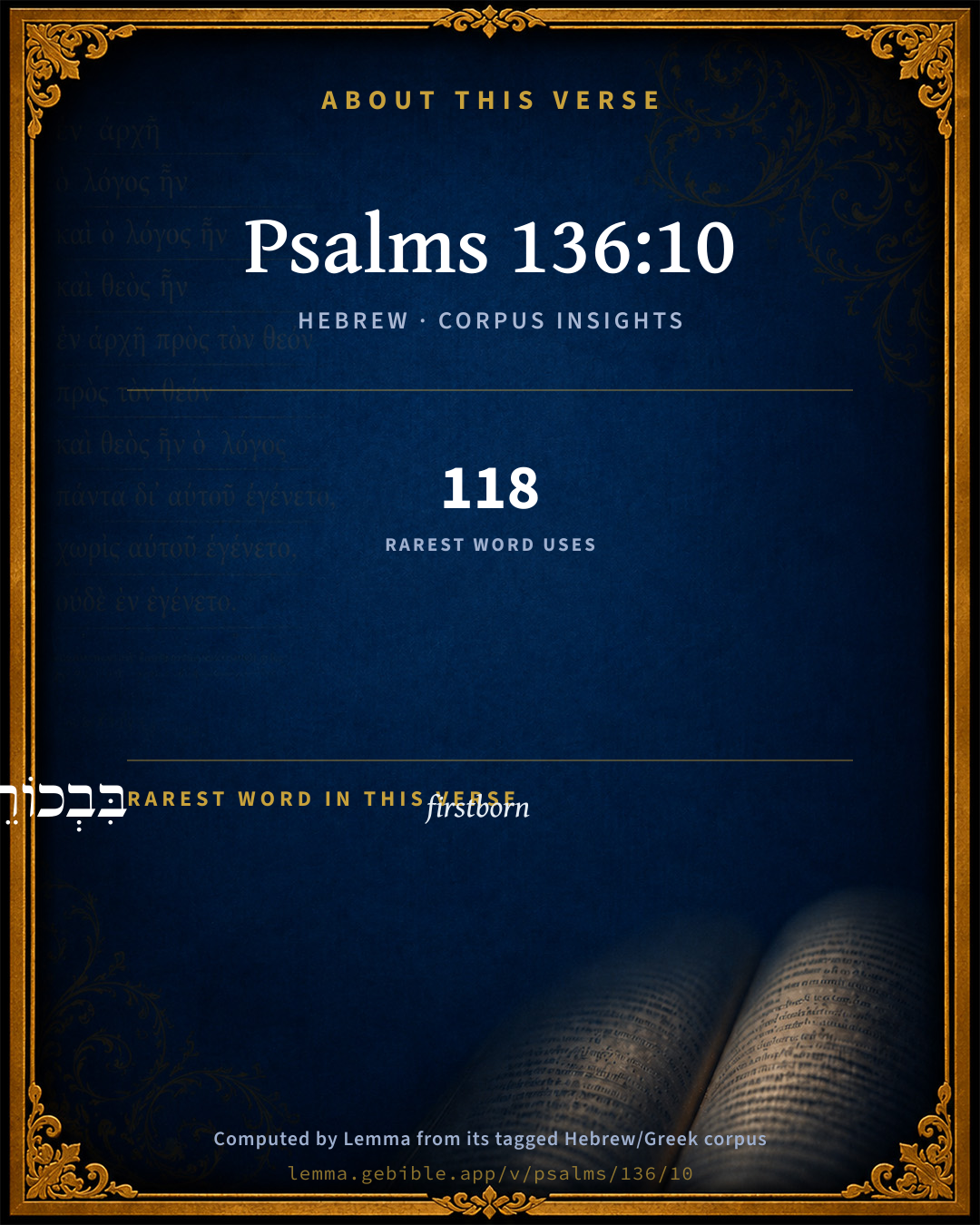
Psalms, in the Wisdom, opens this verse with 6 words (6 distinct Hebrew lemmas). Its most distinctive word is bᵉkôwr (“firstborn”). A historical commentator’s framing appears above. Read the whole chapter for the surrounding context.

Discussion questions

  1. The word bᵉkôwr carries the sense “firstborn.” How does it shape the verse?
  2. How does Exodus 12:29, which shares this passage’s theme, read alongside this verse?
  3. These translations render this verse differently. What is at stake in choosing one wording over another?
  4. «לְמַכֵּ֣ה» is a Hiphil Participle Active verb. How does that grammatical form shape the action described?
  5. Compare how Matthew Henry's Commentary and Trapp's Complete Commentary read this verse. Where do they agree or differ?

Things to notice

Reading settings

Reading text

Shown beneath each verse's original-language words.

Old Testament
Old Testament edition

Read the OT as the Masoretic Hebrew (MT) or the Greek Septuagint (LXX).

English shown for the Greek Septuagint (in the Hebrew ↔ Greek comparison).

Comparing translations? Open the Compare panel on any verse page to stack up to four side by side.