
Isaiah 19:14

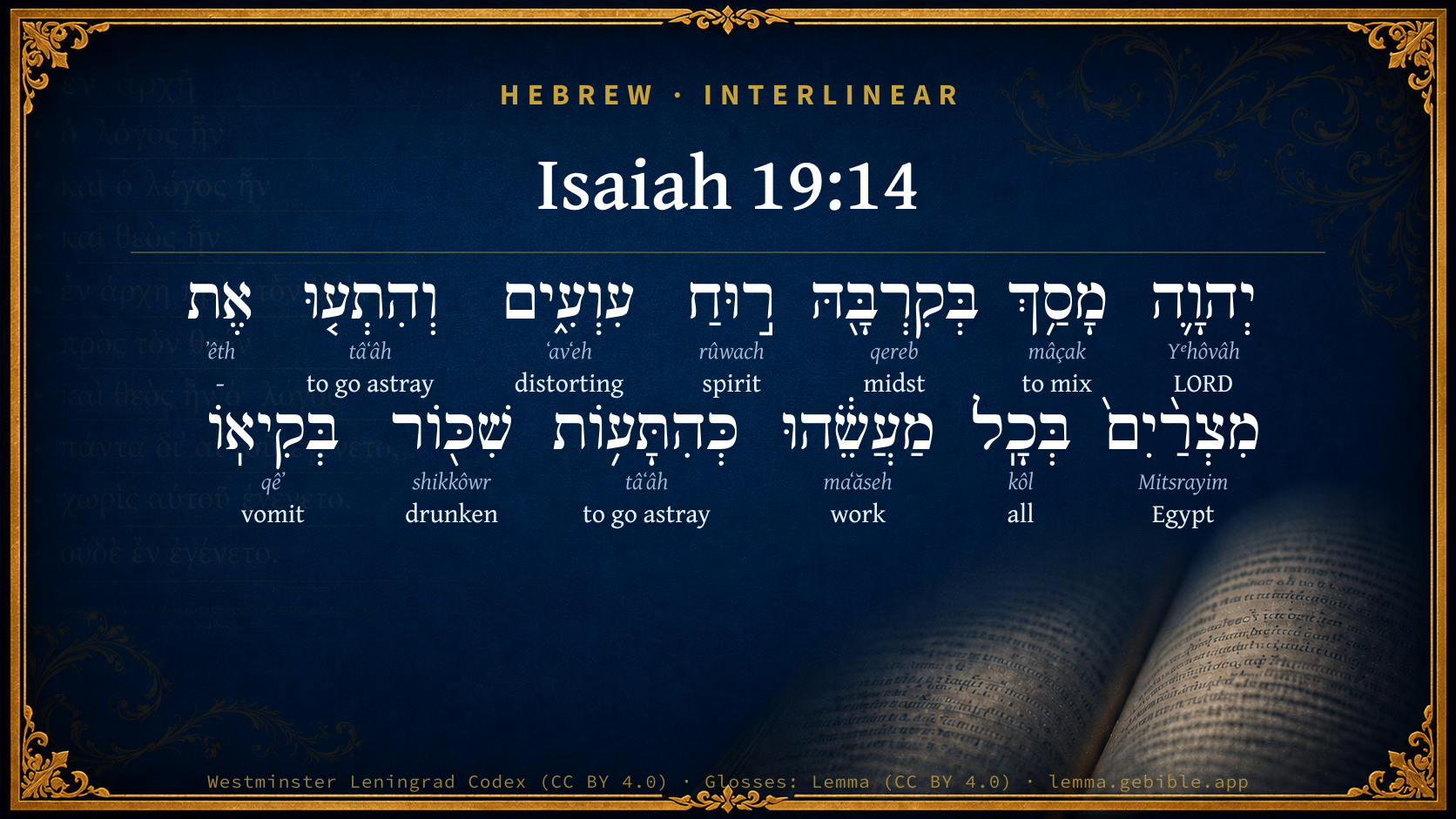
Hebrew (Westminster Leningrad Codex) Isaiah 19:14 appears in the Hebrew Old Testament. The text above is from the Westminster Leningrad Codex. Each word links to its Strong’s number, a concise gloss, and parsing drawn from the Open Scriptures Hebrew Bible morphology. Click any word for its full Brown-Driver-Briggs (BDB) entry.
Download image
Cite this verse

Isaiah 19:14 (World English Bible). Public Domain. Lemma interlinear Bible study tool, https://lemma.gebible.app/v/isaiah/19/14.

Show BibTeX & RIS
BibTeX
RIS
English Translation
Yahweh has mixed a spirit of perverseness in the midst of her; and they have caused Egypt to go astray in every work of it, as a drunken man staggers in his vomit.
World English Bible · Public Domain
Highlights
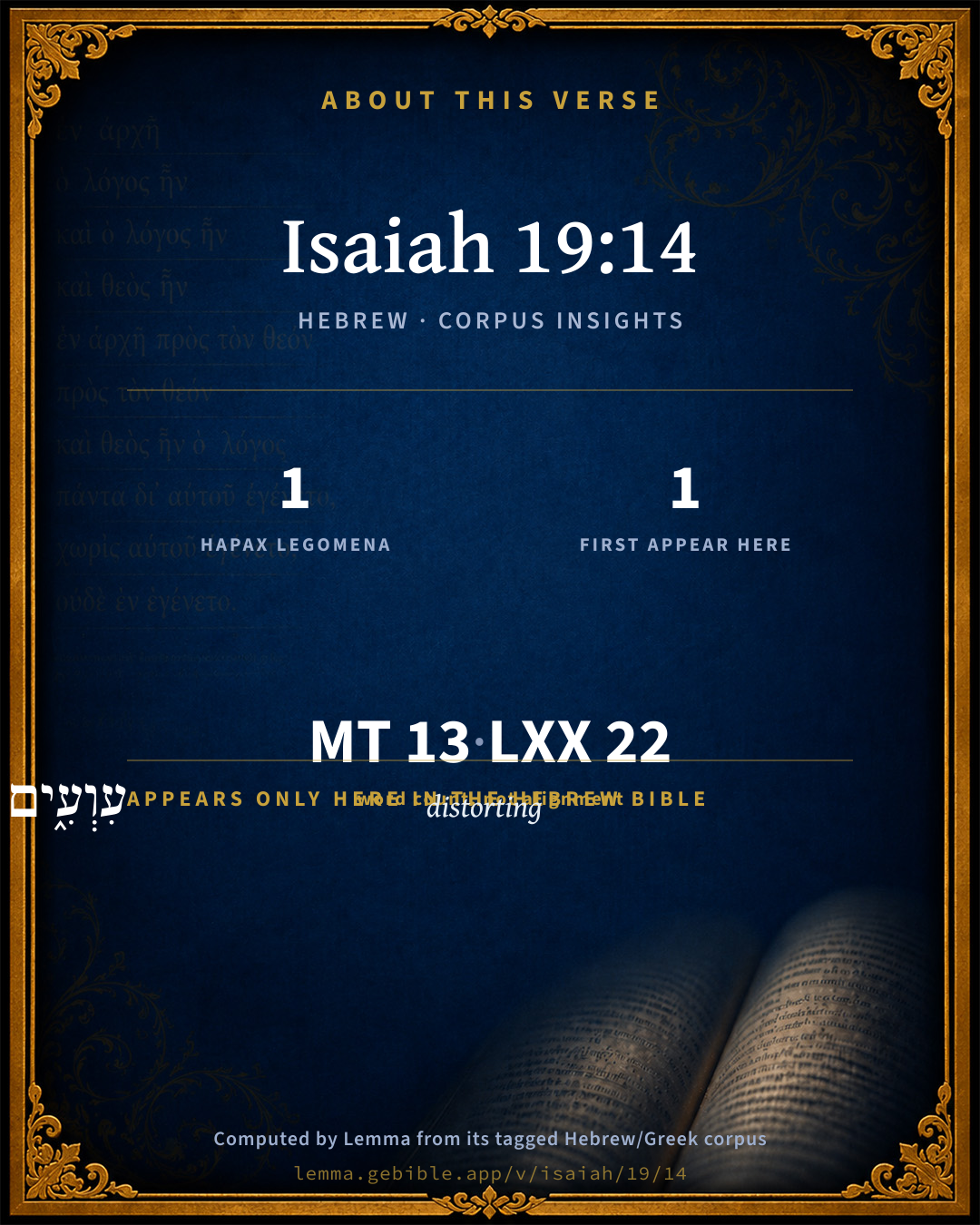
  • 1 hapax legomenon — only here in the Hebrew Bible
  • 1 first appearance in the Hebrew Bible
Full analysis ↓
Download a study sheet

One document with this verse’s original text, its word-by-word gloss line, the meaning frame, cross-references with their text, attributed commentary, and full source and license credits — printable, and it pastes into notes with its structure intact.

This verse Autodidact and up

Study sheet (.html) Plain text (.txt)

A passage Seminary Student

Up to 50 verses in one chapter. A passage sheet keeps up to 6 commentary sources and 12 cross-references per verse, in the order this page ranks them, and says so on the sheet whenever that leaves anything out. Ask for a single verse and you get the Autodidact verse sheet above.

Everything on this page stays free to read, with no account — the sheet is a download of what is already on screen, not access to it.

Want to remove ads? Support Godless Engineer
Compare translations 3

The same verse in 3 English versions, stacked beneath the original-language interlinear above. Click any original word for its lexicon entry.

Each is an independent rendering of the whole verse — the interlinear is not word-aligned to these translations.

Highlighted words mark where these versions differ — a whole-verse word diff, not a word-by-word alignment.

  • World English Bible Public Domain
    Yahweh has mixed a spirit of perverseness in the midst of her; and they have caused Egypt to go astray in every work of it, as a drunken man staggers in his vomit.
  • King James Version Public Domain
    The LORD hath mingled a perverse spirit in the midst thereof: and they have caused Egypt to err in every work thereof, as a drunken man staggereth in his vomit.
  • unfoldingWord Literal Text CC BY-SA 4.0
    Yahweh has mixed in its midst a spirit of confusion, and they have led Egypt astray in all of its doing, like the staggering of a drunkard in his vomit.

unfoldingWord Literal Text — © unfoldingWord, licensed CC BY-SA 4.0. Word-aligned USFM3 via Door43 (git.door43.org/unfoldingWord/en_ult).

Versions to compare (up to 4)

3 of 4 selected

Show all 18 translations

Every available English version of this verse, each an independent rendering of the whole verse.

  • World English Bible Public Domain
    Yahweh has mixed a spirit of perverseness in the midst of her; and they have caused Egypt to go astray in every work of it, as a drunken man staggers in his vomit.
  • Berean Standard Bible Public Domain
    The LORD has poured into her a spirit of confusion. Egypt has been led astray in all she does, as a drunkard staggers through his own vomit.
  • Majority Standard Bible Public Domain
    The LORD has poured into her a spirit of confusion. Egypt has been led astray in all she does, as a drunkard staggers through his own vomit.
  • King James Version Public Domain
    The LORD hath mingled a perverse spirit in the midst thereof: and they have caused Egypt to err in every work thereof, as a drunken man staggereth in his vomit.
  • American Standard Version (1901) Public Domain
    Jehovah hath mingled a spirit of perverseness in the midst of her; and they have caused Egypt to go astray in every work thereof, as a drunken man staggereth in his vomit.
  • Revised Version (1885) Public Domain
    The LORD hath mingled a spirit of perverseness in the midst of her: and they have caused Egypt to go astray in every work thereof, as a drunken man staggereth in his vomit.
  • Geneva Bible (1599) Public Domain
    The Lord hath mingled among them the spirite of errours: and they haue caused Egypt to erre in euery worke thereof, as a drunken man erreth in his vomite.
  • Douay-Rheims (1899) Public Domain
    The Lord hath mingled in the midst thereof the spirit of giddiness: and they have caused Egypt to err in all its works, as a drunken man staggereth and vomiteth.
  • Young's Literal Translation Public Domain
    Jehovah hath mingled in her midst A spirit of perverseness, And they have caused Egypt to err in all its work, As a drunkard erreth in his vomit.
  • Literal Standard Version CC BY-SA 4.0
    YHWH has mingled in her midst || A spirit of perverseness, || And they have caused Egypt to err in all its work, || As a drunkard errs in his vomit.
  • Unlocked Literal Bible CC BY-SA 4.0
    Yahweh has mixed a spirit of distortion into her midst, and they have led Egypt astray in all she does, like a drunk staggering in his vomit.
  • unfoldingWord Literal Text CC BY-SA 4.0
    Yahweh has mixed in its midst a spirit of confusion, and they have led Egypt astray in all of its doing, like the staggering of a drunkard in his vomit.
  • Darby Bible Public Domain
    Jehovah hath mingled a spirit of perverseness in the midst thereof; and they have caused Egypt to err in every work thereof, as a drunkard staggereth in his vomit.
  • World Messianic Bible Public Domain
    The LORD has mixed a spirit of perverseness in the middle of her; and they have caused Egypt to go astray in all of its works, like a drunken man staggers in his vomit.
  • Webster's Bible Public Domain
    The LORD hath mingled a perverse spirit in the midst of it: and they have caused Egypt to err in every work of it, as a drunken man staggereth in his vomit.
  • Free Bible Version CC BY-SA 4.0
    The Lord has mixed up a spirit of confusion for them to drink, making the Egyptians stagger around in everything they do, like a drunk slipping up on his own vomit.
  • Bible in Basic English Public Domain
    The Lord has sent among them a spirit of error: and by them Egypt is turned out of the right way in all her doings, as a man overcome by wine is uncertain in his steps.
  • JPS Tanakh (1917) Public Domain
    The LORD hath mingled within her a spirit of dizziness; and they have caused Egypt to stagger in every work thereof, as a drunken man staggereth in his vomit.

Literal Standard Version (2020), Covenant Press — licensed CC BY-SA 4.0. Text via the HelloAO Bible API (eBible.org). Unlocked Literal Bible (unfoldingWord) — licensed CC BY-SA 4.0. Text via the HelloAO Bible API (eBible.org). unfoldingWord Literal Text — © unfoldingWord, licensed CC BY-SA 4.0. Word-aligned USFM3 via Door43 (git.door43.org/unfoldingWord/en_ult). Free Bible Version, Dr. Jonathan Gallagher — licensed CC BY-SA 4.0. Text via the HelloAO Bible API (eBible.org).

Word by word

More ways to search: Search by grammar → Find every occurrence → Compare this word →

Practice this passage: Drill this verse → Learn its vocabulary →

עִוְעִ֑ים
ʻavʻeh
H5773
“distortions”
Noun, Common, Masculine, Plural, Absolute
Part of Speech
Noun
Type
Common
Gender
Masculine
Number
Plural
State
Absolute
Full BDB Definition

Origin: from H5753

TWOT: 1577c

distorting, perverting, warping
  1. יְהוָ֛ה Yᵉhôvâh H3068 “LORD” Noun, Proper
  2. מָסַ֥ךְ mâçak H4537 “to mix” Verb, Qal, Perfect, 3rd Person, Masculine, Singular
  3. בְּקִרְבָּ֖הּ qereb H7130 “in/at · midst · her” Preposition + Noun, Common, Masculine, Singular, Construct + Suffix, Personal, 3rd Person, Feminine, Singular
  4. ר֣וּחַ rûwach H7307 “spirit of” Noun, Common, Both, Singular, Construct
  5. וְהִתְע֤וּ tâʻâh H8582 “and · to go astray” Conjunction + Verb, Hiphil, Sequential Perfect, 3rd Person, Common, Plural
  6. אֶת ʼêth H853 “-” Particle, Direct Object
  7. מִצְרַ֨יִם֙ Mitsrayim H4714 “Egypt” Noun, Proper
  8. בְּכָֽל kôl H3605 “in/at · all of” Preposition + Noun, Common, Masculine, Singular, Construct
  9. מַעֲשֵׂ֔הוּ maʻăseh H4639 “work · his” Noun, Common, Masculine, Singular, Construct + Suffix, Personal, 3rd Person, Masculine, Singular
  10. כְּהִתָּע֥וֹת tâʻâh H8582 “like/as · to go astray” Preposition + Verb, Niphal, Infinitive Construct
  11. שִׁכּ֖וֹר shikkôwr H7910 “drunken” Adjective, Adjective, Masculine, Singular, Absolute
  12. בְּקִיאֽוֹ qêʼ H6892 “in/at · vomit · his” Preposition + Noun, Common, Masculine, Singular, Construct + Suffix, Personal, 3rd Person, Masculine, Singular

About this verse

These counts appear in no published source. They are computed here, from the morphology-tagged text and Lemma’s own curated glosses. What Lemma adds →

13
words
12
distinct lemmas
Prophets
section

Notable vocabulary

1 hapax legomenon — a word that appears only here in the entire Hebrew Bible:

  • עִוְעִ֑ים distorting H5773

First appearance in Scripture

This word makes its first canonical appearance in the Hebrew Bible here:

  • עִוְעִ֑ים distorting H5773

Shared distinctive vocabulary

בְּקִיאֽוֹ vomit H6892 occurs in 4 verses of the Hebrew Bible. Also found in:

Grammatical profile

  • 3 verbs
  • 8 nouns
  • 1 adjective
  • 1 particle

Verb forms

  • מָסַ֥ךְ Qal · Perfect
  • וְהִתְע֤וּ Hiphil · Sequential Perfect
  • כְּהִתָּע֥וֹת Niphal · Infinitive Construct

Repetition

A word recurs within this verse — often emphatic in Hebrew:

  • וְהִתְע֤וּ to go astray H8582 ×2

Hebrew & Septuagint length

In English translation the verse runs 33 words from the Hebrew and 31 from the Septuagint (LXX English) — closely comparable.

A rough comparison of the two English renderings, which tokenize alike — not a word-level alignment.

Word counts can differ between the Hebrew and the Greek without any difference in meaning — e.g. the Hebrew direct-object marker אֵת has no separate Greek word, and Greek often adds the article ὁ.

In the original languages it is 13 Hebrew tokens and 22 Greek tokens — but the two are counted differently (Hebrew bundles its prefixes and suffixes into one token; the Greek is in lemma form), so that isn’t a like-for-like length.

Cross-references

14

Topical passages linked to Isaiah 19:14 in the Treasury of Scripture Knowledge — connected by theme and wording, ordered by reader-vote popularity; previews shown in the World English Bible.

  • 1 Kings 22:20–23 Yahweh said, Who shall entice Ahab, that he may go up and fall at Ramoth-gilead? One said on this manner; and another said on that manner.
  • Ezekiel 14:7–9 For everyone of the house of Israel, or of the strangers who sojourn in Israel, who separates himself from me, and takes his idols into his heart, and puts the stumbling block of his iniquity before his face, and comes to the prophet to inquire for himself of me; I Yahweh will answer him by myself:
  • 2 Thessalonians 2:11 Because of this, God sends them a working of error, that they should believe a lie;
  • Job 12:25 They grope in the dark without light. He makes them stagger like a drunken man.
  • Isaiah 47:10–11 For you have trusted in your wickedness; you have said, None sees me; your wisdom and your knowledge, it has perverted you, and you have said in your heart, I am, and there is none else besides me.
  • Jeremiah 25:27 You shall tell them, Thus says Yahweh of Hosts, the God of Israel: Drink you, and be drunken, and spew, and fall, and rise no more, because of the sword which I will send among you.
  • Job 12:16 With him is strength and wisdom; The deceived and the deceiver are his.
  • Isaiah 19:2 I will stir up the Egyptians against the Egyptians: and they shall fight everyone against his brother, and everyone against his neighbor; city against city, [and] kingdom against kingdom.
  • Isaiah 28:7–8 Even these reel with wine, and stagger with strong drink; the priest and the prophet reel with strong drink, they are swallowed up of wine, they stagger with strong drink; they err in vision, they stumble in judgment.
  • Isaiah 29:9–10 Stay you and wonder; take your pleasure and be blind: they are drunken, but not with wine; they stagger, but not with strong drink.
  • Isaiah 29:14 therefore, behold, I will proceed to do a marvelous work among this people, even a marvelous work and a wonder; and the wisdom of their wise men shall perish, and the understanding of their prudent men shall be hid.
  • Jeremiah 25:15–16 For thus says Yahweh, the God of Israel, to me: take this cup of the wine of wrath at my hand, and cause all the nations, to whom I send you, to drink it.
  • Jeremiah 48:26 Make you him drunken; for he magnified himself against Yahweh: and Moab shall wallow in his vomit, and he also shall be in derision.
  • Matthew 17:17 Jesus answered, "Faithless and perverse generation! How long will I be with you? How long will I bear with you? Bring him here to me."

Cross-references courtesy of OpenBible.info (CC BY 4.0).

Hebrew and Greek witnesses Masoretic Hebrew ↔ Greek Septuagint

The same verse in the two great witnesses to the Old Testament, shown verse-for-verse.

These are two independent witnesses, not word-aligned to each other, and the Septuagint is shown in lemma (dictionary) form.

Hebrew Isaiah 19:14 Masoretic · Westminster Leningrad Codex

יְהוָ֛ה מָסַ֥ךְ בְּקִרְבָּ֖הּ ר֣וּחַ עִוְעִ֑ים וְהִתְע֤וּ אֶת מִצְרַ֨יִם֙ בְּכָֽל מַעֲשֵׂ֔הוּ כְּהִתָּע֥וֹת שִׁכּ֖וֹר בְּקִיאֽוֹ

Yahweh has mixed a spirit of perverseness in the midst of her; and they have caused Egypt to go astray in every work of it, as a drunken man staggers in his vomit.

World English Bible · Public Domain

Greek LXX Isaiah 19:14 Septuagint · lemma form

κύριος γάρ κεράννυμι αὐτός πνεῦμα πλανήσις καί πλανάω αἴγυπτος ἐν πᾶς ὁ ἔργον αὐτός ὡς πλανάω ὁ μεθύω καί ὁ ἐμός ἅμα

For the Lord has prepared for them a spirit of error, and they have caused Egypt to err in all their works, as one staggers who is drunken and vomits also.

LXX2012 (modern English Septuagint) · Public Domain

On this verse, Adam Clarke's Commentary discusses the Septuagint’s reading. Read the note in Commentary ↓

Hebrew: Westminster Leningrad Codex (CC BY 4.0). Greek: Septuagint (public domain); English from LXX2012 (modern English Septuagint) (Public Domain). How the Septuagint differs from the Hebrew →

Targum (Aramaic paraphrase)

1

The Targum is the ancient Jewish Aramaic paraphrase of the Hebrew Scriptures — an interpretive translation, not the Hebrew text itself. Onkelos (literal) and Pseudo-Jonathan (expansive) render the Torah, and Jonathan the Prophets. Coverage is partial: where no permissively-licensed English translation exists for a verse, only the Aramaic is shown. This is verse-level text, not a word-by-word alignment to the Hebrew.

  1. Targum Jonathan Prophets (Joshua–Malachi)
    יְיָ רָמָא בֵינֵיהוֹן רוּחַ דְטָעוּ וְאַטְעִיאוּ יַת מִצְרַיִם בְּכָל עוֹבְדֵיהוֹן כְּמָא דְטָעֵי רַוְיָא וּמִדַשְׁדֵשׁ בְּתִיוּבֵהּ:

    The Lord hath sent among them a spirit of error, and they have caused the Egyptians to err in all their works, as a drunkard staggereth, and tramples in his vomit.

    Targum Jonathan — Aramaic: “Mikraot Gedolot” (public domain). English: “Sefaria Community Translation” (CC0 1.0 (public-domain dedication)); “London "Chaldee Paraphrase," 1871” (public domain). Text via Sefaria.

Commentary

Notes on Isaiah 19:14 from classic Christian and Jewish commentators (each source and its license shown beneath its notes). The classic Christian expositions comment on the surrounding passage and are grouped to its opening verse, so a note may address several verses; the Jewish commentaries on the Tanakh (Rashi and others) are per-verse, so they appear only where the commentator wrote on this verse.

Lemma curates 59 commentaries, every one of them public domain or Creative Commons licensed, each selected and text-cleaned for this edition rather than reprinted as found. About our sources →

Trapp's Complete Commentary

John Trapp

Isa 19:14 The LORD hath mingled a perverse spirit in the midst thereof: and they have caused Egypt to err in every work thereof, as a drunken [man] staggereth in his vomit.

Ver. 14. The Lord hath mingled a perverse spirit.] Or, Given them to drink a spirit of giddiness. Heb., A spirit of extreme perversities; he hath stupified, and as it were intoxicated them with the "efficacy of error."

And they have caused Egypt to err in every work.] Psammeticus their king was twenty-eight years in besieging Azotus ere he could take it; and other things went on with them accordingly. {a}

{a} Herod., Euterp.

John Trapp, A Commentary or Exposition upon All the Books of the Old and New Testament (1647–1656) — public domain. Text from a community e-Sword module.

Keil & Delitzsch

C. F. Keil & F. Delitzsch

In Isa 19:14 and Isa 19:15 this state of confusion is more minutely described: "Jehovah hath poured a spirit of giddiness into the heart of Egypt, so that they have led Egypt astray in all its doing, as a drunken man wandereth about in his vomit. And there does not occur of Egypt any work, which worked, of head and tail, palm-branch and rush." The spirit which God pours out (as it also said elsewhere) is not only a spirit of salvation, but also a spirit of judgment. The judicial, penal result which He produces is here called עועים, which is formed from עועו (root עו, to curve), and is either contracted from עועוים, or points back to a supposed singular עועה (vid., Ewald, 158, b). The suffix in b'kribâh points to Egypt. The divine spirit of judgment makes use of the imaginary wisdom of the priestly caste, and thereby plunges the people, as it were, into the giddiness of intoxication. The prophet employs the hiphil התעה to denote the carefully considered actions of the leaders of the nation, and the niphal נתעה to denote the constrained actions of a drunken man, who has lost all self-control. The nation has been so perverted by false counsels and hopes, that it lies there like a drunken man in his own vomit, and gropes and rolls about, without being able to find any way of escape. "No work that worked," i.e., that averted trouble (עשׂה is as emphatic as in Dan 8:24), was successfully carried out by any one, either by the leaders of the nation or by the common people and their flatterers, either by the upper classes or by the mob.

Keil & Delitzsch — Biblical Commentary on the Old Testament (1861–1891) — public domain (CC PDM 1.0). Text via the HelloAO Bible API. (Old Testament only.)

Geneva Bible (1599)

Geneva Bible translators

For the spirit of wisdom he hath made them drunken and giddy with the spirit of error.

Geneva Bible (1599) marginal notes — public domain. Text via Bolls.life.

Jamieson, Fausset & Brown

Robert Jamieson, A. R. Fausset & David Brown

err in every work thereof--referring to the anarchy arising from their internal feuds. HORSLEY translates, "with respect to all His (God's) work"; they misinterpreted God's dealings at every step. "Mingled" contains the same image as "drunken"; as one mixes spices with wine to make it intoxicating (Isa 5:22; Pro 9:2, Pro 9:5), so Jehovah has poured among them a spirit of giddiness, so that they are as helpless as a "drunken man."

Jamieson, Fausset & Brown — Commentary Critical and Explanatory on the Whole Bible (1871) — public domain (CC PDM 1.0). Text via the HelloAO Bible API.

Adam Clarke's Commentary

Verse 14. In the midst thereof] בקרבם bekirbam; so the Septuagint, and perhaps more correctly." - Secker. So likewise the Chaldee.

Adam Clarke's Commentary on the Bible (1810–1826) — public domain. Text from a community e-Sword/MySword module.

Ellicott's Commentary for English Readers

(14) The Lord hath mingled a perverse spirit.—Better, hath poured a spirit of giddiness. As in 1Ki_22:22; 1Sa_16:14, the infatuation of the Egyptian rulers is thought of as a judicial blindness. Prostrate or vacillating amid the wrecks of frustrated hopes and plans, they are as the drunkard staggering in his foulness. (Comp. Isa_29:9.)

A Bible Commentary for English Readers, edited by Charles John Ellicott (1878–1897) — public domain. Text from a community e-Sword module.

The Cambridge Bible for Schools and Colleges

gen. ed. J. J. S. Perowne

14. Their intellectual confusion is caused by “a spirit” from Jehovah (but not personified as in 1Ki_22:21 f.) a perverse spirit] Better a spirit of perverseness (R.V.). Cf. “spirit of deep slumber,” ch. Isa_29:10.

err … staggereth] The same verb should be used in both places—“wander” or “stray.” The strong figure has a parallel in ch. Isa_28:7. Cf. Job_12:25.

The Cambridge Bible for Schools and Colleges (gen. ed. J. J. S. Perowne; Cambridge University Press, 1878–1918) — public domain. Text from a community e-Sword module.

John Gill's Exposition

The Lord hath mingled a perverse spirit in the midst thereof,.... A spirit of error, as the Targum, Septuagint, and Arabic versions; or of giddiness, as the Vulgate Latin: this he mingled in a cup for them, and poured it out, and gave them it to drink; and an intoxicating cup it was, such as men are made drunk with; to which the allusion is, as the last clause of the verse shows; so that the infatuation and want of wisdom in their counsels were from the Lord; who, because of the vain boasts of their wisdom in righteous judgment, gave them up to judicial blindness, stupidity, and folly:

and they have caused Egypt to err in every work thereof; both in religious and civil affairs, leading them into superstition and idolatry, to which they were of old inclined and addicted, and forming such schemes and projects, and putting them upon such works, as were very detrimental to the nation. Some think this refers to the twelve tyrants, who disagreeing among themselves, being actuated by a perverse spirit, greatly distracted the people; though rather it may refer to the times of Necho, and to his project in cutting a canal for the bringing of the Nile to the Red sea before mentioned, in which he lost several thousands of men without accomplishing it; and of his predecessor, in besieging Ashdod twenty nine years ere he took it (w):

as a drunken man staggereth in his vomit; who is so very drunk, that his head is quite giddy, and cannot walk upright, but staggers as he goes, and vomits as he staggers, and falls down, and is rolled in it, as the Targum; just like such a man were the princes and governors of the Egyptian provinces.

(w) Herodot. l. 2. c. 157, 158.

John Gill's Exposition of the Whole Bible (1746–1763) — public domain (CC PDM 1.0). Text via the HelloAO Bible API.

Albert Barnes' Notes on the Bible

The Lord hath mingled - The word מסך mâsak, “to mingle,” is used commonly to denote the act of mixing spices with wine to make it more intoxicating Pro 9:2, Pro 9:5; Isa 5:22. Here it means that Yahweh has poured out into the midst of them a spirit of giddiness; that is, has produced consternation among them. National commotions and calamities are often thus traced to the overruling providence of God (see the note at Isa 19:2; compare Isa 10:5-6).

A perverse spirit - Hebrew, ‘A spirit of perverseness.’ The word rendered ‘perverse’ is derived from עוה ‛âvâh, “to be crooked or perverted.” Here it means, that their counsels were unwise, land such as tended to error and ruin.

To err as a drunken man ... - This is a very striking figure. The whole nation was reeling to and fro, and unsettled in their counsels, as a man is who is so intoxicated as to reel and to vomit. Nothing could more strikingly express, first, the “fact” of their perverted counsels and plans, and secondly, God’s deep abhorrence of the course which they were pursuing.

Albert Barnes' Notes on the Bible (1834–1885) — public domain. Text from a community e-Sword/MySword module.

Matthew Poole's English Annotations

Hath mingled; or, hath poured out or given them to drink as appears from their drunkenness, expressed in the end of the verse; which also suits with the Scripture phrase whereby a cup signifies God’s judgments, as Isa 51:17,21-22; Jer 25:15.

A perverse spirit, Heb. a spirit of perversities or crookednesses; or, as the LXX. and Chaldee render it, of error or delusion; a disposition of mind very apt to mistake, and to mislead them into foolish and crooked counsels and courses; which God could easily effect, partly by laying occasions of stumbling in their way, and partly by withdrawing or darkening that wisdom which he had infused, by which alone men can discern their way.

In every work thereof; in all their designs and undertakings.

Staggereth in his vomit; when he is so excessively drunk, that he reels to and fro, and vomits up his drink.

Matthew Poole's English Annotations on the Holy Bible (1683–1685) — public domain. Text from a community e-Sword/MySword module.

Whedon's Commentary on the Bible

Daniel D. Whedon

14. Perverse spirit — All such acts attributed to God are but declarations of the general fact, that if men will dash their heads against a stone wall their brains will come out. This is the part God performs in his sending moral infatuation among men. His laws cannot be broken with impunity. God was no further responsible than this for the bad counsel which caused Egypt to err.

Daniel D. Whedon (gen. ed.), Commentary on the Old and New Testaments (1874–1909) — public domain. Text from a community e-Sword module.

The Pulpit Commentary

The Lord hath mingled a perverse spirit, etc. "Shall there be evil in a city, and the Lord hath not done it?". (Amo_3:6) To bring Egypt into so distracted a state, the hand of God had been necessary. He had introduced into the nation "a spirit of perverseness." Those in whom this spirit was had then "led Egypt astray in all her doings." They had made her "like a drunken man," who "staggers" along his path, and slips in "his own vomit." Long-continued success and prosperity produces often a sort of intoxication in a nation.

Men"s minds a sphere in which God"s judgments may work.

"The Lord hath mingled a perverse spirit in the midst thereof." Failure in recognizing men"s minds and wills, as spheres of Divine operation, makes difficult to us such cases as that of Pharaoh, whose heart the Lord is said to have hardened; or that of the prophets in the time of Ahab, amongst whom God had sent a "lying spirit." But the apostle distinctly taught that all the sides and all the forces of man"s nature are in God"s control, and that he can work his purposes through them all, Writing to the Romans, (Rom_1:28) Paul says of the Gentiles, "God gave them over to a reprobate mind, to do those things which are not convenient." And the heathen have a motto which embodies the same truth, "Whom the gods would destroy they first dement a sentence involving a belief in the control of the gods over men"s minds. A further illustration may be found in the prayer offered by David in the time of his extreme peril: "O Lord, I pray thee, turn the counsel of Ahithophel into foolishness". (2Sa_15:31) This truth we can clearly see and fully accept.

I GOD HAS CONTROL OVER MAN"S CIRCUMSTANCES. These are, undoubtedly, the usual spheres of Divine operation. Life in the midst of varying circumstances, arid subject to the influence of circumstances, is our present lot. God"s providence we assume to have its sphere in things and events; and too easily we may come to limit God"s working to the incidents of life, and keep him entirely in the external spheres, reaching us only through our senses. So we need to have set before us the further and more searching truth, that

II GOD HAS CONTROL OVER MAN"S MIND AND HEART. This may be difficult to harmonize with our notions of man"s free-will and independence. But man"s free-will is not an absolute thing; it is set within careful and precise limitations. Man has liberty within a tether; and he cannot be trusted beyond the tether. God never looses his hold on him. The point, however, which especially cans for illustration and enforcement here is, that God may execute his judgments on man in the sphere of his mini. A state of stubbornness, perversity, and hardening may be traced by man as the natural response of certain minds to certain circumstances. We are taught to look deeper, and see in bad mental states and moods not Divine permissions only, but Divine operations and Divine judgments. The mental blindness and deafness, the narrow-mindedness, the skeptical tendency, of a particular age, we view aright when we regard as Divine judgment working towards humility. R.T.

The Pulpit Commentary (1880–1919), ed. H.D.M. Spence-Jones & Joseph S. Exell — public domain. Text from a community e-Sword module.

John Wesley's Explanatory Notes

Mingled - Or, hath poured out or given them to drink. To err - In all their designs and undertakings. Staggereth - When he is so drunk, that he reels to and fro, and vomits up his drink.

John Wesley, Explanatory Notes Upon the Whole Bible (1754–1765) — public domain. Text via the GEBible commentary corpus.

J. A. Alexander on Isaiah

Joseph Addison Alexander

“Jehovah hath mingled in the midst of her a spirit of confusion, and they have misled Egypt in all its work, like the misleading of a drunkard in his vomit.” This verse describes the folly before mentioned as the effect, not of natural causes or of accident, but of a judicial infliction. Spirit here means a supernatural influence. By work we are to understand affairs and interests. The last verb in Hebrew is used elsewhere in reference to the unsteady motions of a drunken man (Job 12:25; Isa 28:7).

Joseph Addison Alexander, The Prophecies of Isaiah (1846–1847; New York: Scribner, 1870–1878) — public domain. Text from a community e-Sword module.

Rashi

Rabbi Shlomo Yitzchaki (Rashi)

The Lord has poured into its midst He mixed a drink for them in its midst, which perverted their spirit, an expression similar to (Prov. 9:2), “She mixed (מָסְכָה) her wine.” Mixing a beverage in a cask until he blends it to its proper flavor is called מֶסֶךְ.

perverseness Heb. עִוְעִים, the name of a malady of confusion.

Rashi on the Tanakh — English translations: “The Judaica Press complete Tanach with Rashi, translated by A. J. Rosenberg” (CC BY 4.0); “Pentateuch with Rashi's commentary by M. Rosenbaum and A.M. Silbermann, 1929-1934” (public domain); “The Metsudah Tanach series, Lakewood, N.J” (CC BY 4.0); and “The Book of Joshua, Metsudah Publications, 1997” (CC BY 4.0). Text via Sefaria.

Ibn Ezra

Rabbi Abraham ibn Ezra

נסך ═ מסך Hath mingled. The two roots have the same meaning, namely, to mingle.

עועים Perverseness. An irregular form of עוה to overturn. Comp. עַוָּה Overturned (Ez. 21:32)

Ibn Ezra on the Tanakh — English translations: “Sefaria Community Translation” (CC0 1.0 (public-domain dedication)); “Yalkut, Sifsei Chachomim Chumash, Metsudah Publications, 2009” (CC BY 4.0); and “Commentary of Ibn Ezra on Isaiah - trans. by M. Friedlander, 1873” (public domain). Text via Sefaria.

Lesson kit

Teaching starters — assembled from the data on this page, not authored interpretation. Every prompt links to the verse data it draws on. Edit before teaching.

Isaiah, in the Prophets, opens this verse with 13 words (12 distinct Hebrew lemmas). Its most distinctive word is ʻavʻeh (“distorting”). A historical commentator’s framing appears above. Read the whole chapter for the surrounding context.

Discussion questions

  1. How does “distorting” (ʻavʻeh) shape what this verse is saying?
  2. This verse holds 1 word here found nowhere else in the Hebrew Bible. What might the rare word draw attention to?
  3. The word “distorting” first appears here in Scripture. What is being introduced at this debut?
  4. Proverbs 26:11 shares the word «vomit» with this verse. How do the two illuminate each other?
  5. “to go astray” occurs 2× in this one verse. What is the effect of the repetition?
  6. These translations render this verse differently. What is at stake in choosing one wording over another?
  7. The verb «מָסַ֥ךְ» is Qal Perfect. How does its form color the action?
  8. Reading how Trapp's Complete Commentary and Keil & Delitzsch read this verse, where do the two commentators agree and where do they part?

Things to notice

  • 1 word in this verse appears nowhere else in the Hebrew Bible.
  • 1 word makes its first canonical appearance in Scripture here.
  • This verse counts 13 Hebrew ↔ 22 Greek words.
  • These translations choose different wording for 25 words in this verse.
  • “to go astray” occurs 2× in this single verse.

Reading settings

Reading text

Shown beneath each verse's original-language words.

Old Testament
Old Testament edition

Read the OT as the Masoretic Hebrew (MT) or the Greek Septuagint (LXX).

English shown for the Greek Septuagint (in the Hebrew ↔ Greek comparison).

Comparing translations? Open the Compare panel on any verse page to stack up to four side by side.