
Ezekiel 32:2

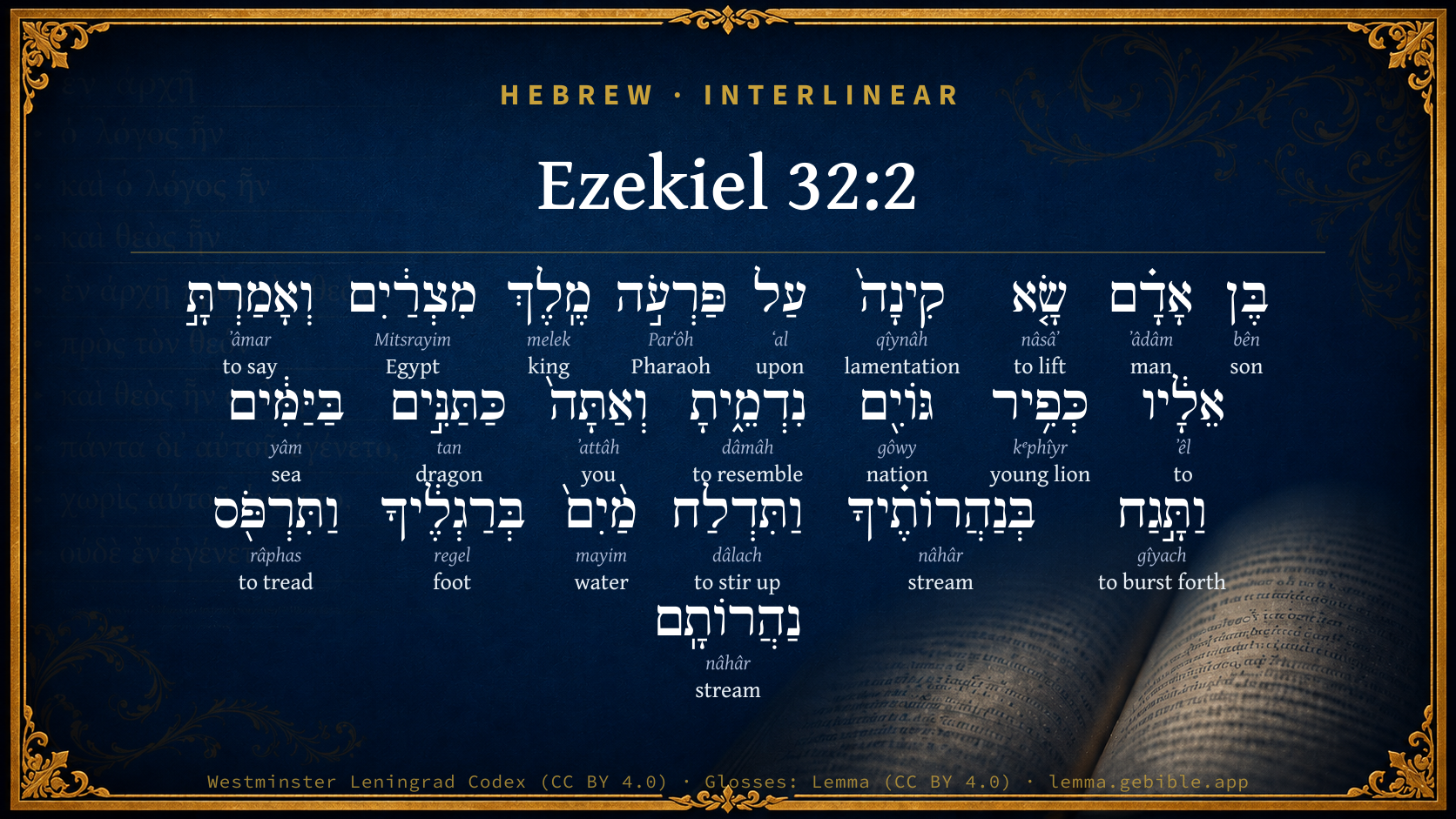
Hebrew (Westminster Leningrad Codex) Ezekiel 32:2 appears in the Hebrew Old Testament. The text above is from the Westminster Leningrad Codex. Each word links to its Strong’s number, a concise gloss, and parsing drawn from the Open Scriptures Hebrew Bible morphology. Click any word for its full Brown-Driver-Briggs (BDB) entry.
Download image
Cite this verse

Ezekiel 32:2 (World English Bible). Public Domain. Lemma interlinear Bible study tool, https://lemma.gebible.app/v/ezekiel/32/2.

Show BibTeX & RIS
BibTeX
RIS
English Translation
Son of man, take up a lamentation over Pharaoh king of Egypt, and tell him, You were likened to a young lion of the nations: yet are you as a monster in the seas; and you did break forth with your rivers, and troubled the waters with your feet, and fouled their rivers.
World English Bible · Public Domain
Highlights
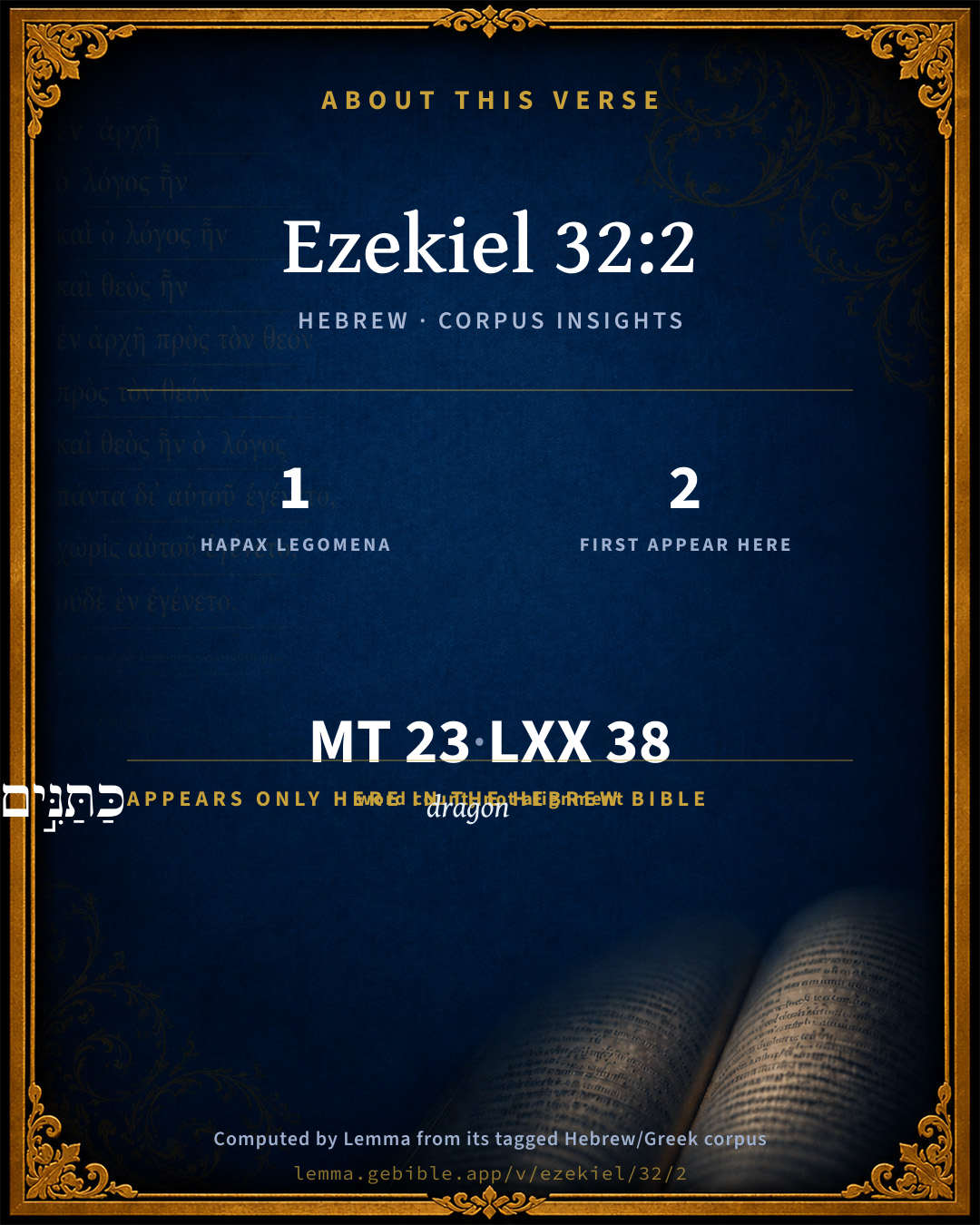
  • 1 hapax legomenon — only here in the Hebrew Bible
  • 2 first appearances in the Hebrew Bible
Full analysis ↓
Download a study sheet

One document with this verse’s original text, its word-by-word gloss line, the meaning frame, cross-references with their text, attributed commentary, and full source and license credits — printable, and it pastes into notes with its structure intact.

This verse Autodidact and up

Study sheet (.html) Plain text (.txt)

A passage Seminary Student

Up to 50 verses in one chapter. A passage sheet keeps up to 6 commentary sources and 12 cross-references per verse, in the order this page ranks them, and says so on the sheet whenever that leaves anything out. Ask for a single verse and you get the Autodidact verse sheet above.

Everything on this page stays free to read, with no account — the sheet is a download of what is already on screen, not access to it.

Want to remove ads? Support Godless Engineer
Compare translations 3

The same verse in 3 English versions, stacked beneath the original-language interlinear above. Click any original word for its lexicon entry.

Each is an independent rendering of the whole verse — the interlinear is not word-aligned to these translations.

Highlighted words mark where these versions differ — a whole-verse word diff, not a word-by-word alignment.

  • World English Bible Public Domain
    Son of man, take up a lamentation over Pharaoh king of Egypt, and tell him, You were likened to a young lion of the nations: yet are you as a monster in the seas; and you did break forth with your rivers, and troubled the waters with your feet, and fouled their rivers.
  • King James Version Public Domain
    Son of man, take up a lamentation for Pharaoh king of Egypt, and say unto him, Thou art like a young lion of the nations, and thou art as a whale in the seas: and thou camest forth with thy rivers, and troubledst the waters with thy feet, and fouledst their rivers.
  • unfoldingWord Literal Text CC BY-SA 4.0
    “Son of man, lift up a lament concerning Pharaoh the king of Egypt; say to him, ‘You are like a young lion among the nations, but you are like a monster in the seas; you churn up the water, you stir up the waters with your feet and muddy their waters.

unfoldingWord Literal Text — © unfoldingWord, licensed CC BY-SA 4.0. Word-aligned USFM3 via Door43 (git.door43.org/unfoldingWord/en_ult).

Versions to compare (up to 4)

3 of 4 selected

Show all 18 translations

Every available English version of this verse, each an independent rendering of the whole verse.

  • World English Bible Public Domain
    Son of man, take up a lamentation over Pharaoh king of Egypt, and tell him, You were likened to a young lion of the nations: yet are you as a monster in the seas; and you did break forth with your rivers, and troubled the waters with your feet, and fouled their rivers.
  • Berean Standard Bible Public Domain
    “Son of man, take up a lament for Pharaoh king of Egypt and say to him: ‘You are like a lion among the nations; you are like a monster in the seas. You thrash about in your rivers, churning up the waters with your feet and muddying the streams.’
  • Majority Standard Bible Public Domain
    “Son of man, take up a lament for Pharaoh king of Egypt and say to him: ‘You are like a lion among the nations; you are like a monster in the seas. You thrash about in your rivers, churning up the waters with your feet and muddying the streams.’
  • King James Version Public Domain
    Son of man, take up a lamentation for Pharaoh king of Egypt, and say unto him, Thou art like a young lion of the nations, and thou art as a whale in the seas: and thou camest forth with thy rivers, and troubledst the waters with thy feet, and fouledst their rivers.
  • American Standard Version (1901) Public Domain
    Son of man, take up a lamentation over Pharaoh king of Egypt, and say unto him, Thou wast likened unto a young lion of the nations: yet art thou as a monster in the seas; and thou didst break forth with thy rivers, and troubledst the waters with thy feet, and fouledst their rivers.
  • Revised Version (1885) Public Domain
    Son of man, take up a lamentation for Pharaoh king of Egypt, and say unto him, Thou wast likened unto a young lion of the nations: yet art thou as a dragon in the seas; and thou brakest forth with thy rivers, and troubledst the waters with thy feet, and fouledst their rivers.
  • Geneva Bible (1599) Public Domain
    Sonne of man, take vp a lamentation for Pharaoh King of Egypt, and say vnto him, Thou art like a lyon of the nations and art as a dragon in the sea: thou castedst out thy riuers and troubledst the waters with thy feete, and stampedst in their riuers.
  • Douay-Rheims (1899) Public Domain
    Son of man, take up a lamentation for Pharao the king of Egypt, and say to him: Thou art like the lion of the nations, and the dragon that is in the sea: and thou didst push with the horn in thy rivers, and didst trouble the waters with thy feet, and didst trample upon their streams.
  • Young's Literal Translation Public Domain
    `Son of man, lift up a lamentation for Pharaoh king of Egypt, and thou hast said unto him: A young lion of nations thou hast been like, And thou `art' as a dragon in the seas, And thou comest forth with thy flowings, And dost trouble the waters with thy feet, And thou dost foul their flowings.
  • Literal Standard Version CC BY-SA 4.0
    “Son of man, lift up a lamentation for Pharaoh king of Egypt, and you have said to him: You have been like a young lion of nations, || And you [are] as a dragon in the seas, || And you come forth with your flowings, || And trouble the waters with your feet, || And you foul their flowings.
  • Unlocked Literal Bible CC BY-SA 4.0
    “Son of man, lift up a lament concerning Pharaoh the king of Egypt; say to him, 'You are like a young lion among the nations, but you are like a monster in the seas; you churn up the water, you stir up the waters with your feet and muddy their waters.
  • unfoldingWord Literal Text CC BY-SA 4.0
    “Son of man, lift up a lament concerning Pharaoh the king of Egypt; say to him, ‘You are like a young lion among the nations, but you are like a monster in the seas; you churn up the water, you stir up the waters with your feet and muddy their waters.
  • Darby Bible Public Domain
    Son of man, take up a lamentation for Pharaoh king of Egypt, and say unto him, Thou wast like a young lion among the nations, and thou wast as a monster in the seas; and thou didst break forth in thy rivers, and troubledst the waters with thy feet, and fouledst their rivers.
  • World Messianic Bible Public Domain
    “Son of man, take up a lamentation over Pharaoh king of Egypt, and tell him, ‘You were likened to a young lion of the nations; yet you are as a monster in the seas. You broke out with your rivers, and troubled the waters with your feet, and fouled their rivers.’”
  • Webster's Bible Public Domain
    Son of man, take up a lamentation for Pharaoh king of Egypt, and say to him, Thou art like a young lion of the nations, and thou art as a whale in the seas: and thou didst come forth with thy rivers, and disturb the waters with thy feet, and render their rivers foul.
  • Free Bible Version CC BY-SA 4.0
    “Son of man, sing a funeral song for Pharaoh king of Egypt and tell him: You think you're like a lion among the nations but in reality you're like a sea monster. You roll around in your rivers, stirring up the waters with your feet, making the water muddy.
  • Bible in Basic English Public Domain
    Son of man, make a song of grief for Pharaoh, king of Egypt, and say to him, Young lion of the nations, destruction has come on you; and you were like a sea-beast in the seas, sending out bursts of water, troubling the waters with your feet, making their streams dirty.
  • JPS Tanakh (1917) Public Domain
    'Son of man, take up a lamentation for Pharaoh king of Egypt, and say unto him: thou didst liken thyself unto a young lion of the nations; whereas thou art as a dragon in the seas; and thou didst gush forth with thy rivers, and didst trouble the waters with thy feet, and foul their rivers.

Literal Standard Version (2020), Covenant Press — licensed CC BY-SA 4.0. Text via the HelloAO Bible API (eBible.org). Unlocked Literal Bible (unfoldingWord) — licensed CC BY-SA 4.0. Text via the HelloAO Bible API (eBible.org). unfoldingWord Literal Text — © unfoldingWord, licensed CC BY-SA 4.0. Word-aligned USFM3 via Door43 (git.door43.org/unfoldingWord/en_ult). Free Bible Version, Dr. Jonathan Gallagher — licensed CC BY-SA 4.0. Text via the HelloAO Bible API (eBible.org).

Word by word

More ways to search: Search by grammar → Find every occurrence → Compare this word →

Practice this passage: Drill this verse → Learn its vocabulary →

כַּתַּנִּ֣ים
tan
H8565
“like/as the · dragon”
Preposition, Determined + Noun, Common, Masculine, Singular, Absolute
Part of Speech
Preposition + Noun
Type
Common
Gender
Masculine
Number
Singular
State
Absolute
Full BDB Definition

Origin: from an unused root probably meaning to elongate

TWOT: 2528a

dragon, maybe the extinct dinosaur the plesiosaurus, whale
  1. בֶּן bên H1121 “son of” Noun, Common, Masculine, Singular, Construct
  2. אָדָ֗ם ʼâdâm H120 “man” Noun, Common, Masculine, Singular, Absolute
  3. שָׂ֤א nâsâʼ H5375 “lift” Verb, Qal, Imperative, 2nd Person, Masculine, Singular
  4. קִינָה֙ qîynâh H7015 “lamentation” Noun, Common, Feminine, Singular, Absolute
  5. עַל ʻal H5921 “upon” Preposition
  6. פַּרְעֹ֣ה Parʻôh H6547 “Pharaoh” Noun, Proper
  7. מֶֽלֶךְ melek H4428 “king of” Noun, Common, Masculine, Singular, Construct
  8. מִצְרַ֔יִם Mitsrayim H4714 “Egypt” Noun, Proper
  9. וְאָמַרְתָּ֣ ʼâmar H559 “and · to say” Conjunction + Verb, Qal, Perfect, 2nd Person, Masculine, Singular
  10. אֵלָ֔יו ʼêl H413 “to · him” Preposition + Suffix, Personal, 3rd Person, Masculine, Singular
  11. כְּפִ֥יר kᵉphîyr H3715 “young lion of” Noun, Common, Masculine, Singular, Construct
  12. גּוֹיִ֖ם gôwy H1471 “nations” Noun, Common, Masculine, Plural, Absolute
  13. נִדְמֵ֑יתָ dâmâh H1819 “to resemble” Verb, Niphal, Perfect, 2nd Person, Masculine, Singular
  14. וְאַתָּה֙ ʼattâh H859 “and · you” Conjunction + Pronoun, Personal, 2nd Person, Masculine, Singular
  15. בַּיַּמִּ֔ים yâm H3220 “in/at the · seas” Preposition, Determined + Noun, Common, Masculine, Plural, Absolute
  16. וַתָּ֣גַח gîyach H1518 “and · to burst forth” Conjunction + Verb, Hiphil, Sequential Imperfect, 2nd Person, Masculine, Singular
  17. בְּנַהֲרוֹתֶ֗יךָ nâhâr H5104 “in/at · streams · your” Preposition + Noun, Common, Masculine, Plural, Construct + Suffix, Personal, 2nd Person, Masculine, Singular
  18. וַתִּדְלַח dâlach H1804 “and · to stir up” Conjunction + Verb, Qal, Sequential Imperfect, 2nd Person, Masculine, Singular
  19. מַ֨יִם֙ mayim H4325 “water(s)” Noun, Common, Masculine, Plural, Absolute
  20. בְּרַגְלֶ֔יךָ regel H7272 “in/at · feet · your” Preposition + Noun, Common, Feminine, Dual, Construct + Suffix, Personal, 2nd Person, Masculine, Singular
  21. וַתִּרְפֹּ֖ס râphas H7515 “and · to tread” Conjunction + Verb, Qal, Sequential Imperfect, 2nd Person, Masculine, Singular
  22. נַהֲרוֹתָֽם nâhâr H5104 “streams · their” Noun, Common, Masculine, Plural, Construct + Suffix, Personal, 3rd Person, Masculine, Plural

About this verse

These counts appear in no published source. They are computed here, from the morphology-tagged text and Lemma’s own curated glosses. What Lemma adds →

23
words
22
distinct lemmas
Prophets
section

Notable vocabulary

1 hapax legomenon — a word that appears only here in the entire Hebrew Bible:

  • כַּתַּנִּ֣ים dragon H8565

First appearance in Scripture

These words make their first canonical appearance in the Hebrew Bible here:

  • כַּתַּנִּ֣ים dragon H8565
  • וַתִּדְלַח to stir up H1804

Shared distinctive vocabulary

וַתִּדְלַח to stir up H1804 occurs in 2 verses of the Hebrew Bible. Also found in:

Grammatical profile

  • 6 verbs
  • 14 nouns
  • 1 pronoun
  • 2 prepositions

Verb forms

  • שָׂ֤א Qal · Imperative
  • וְאָמַרְתָּ֣ Qal · Perfect
  • נִדְמֵ֑יתָ Niphal · Perfect
  • וַתָּ֣גַח Hiphil · Sequential Imperfect
  • וַתִּדְלַח Qal · Sequential Imperfect
  • וַתִּרְפֹּ֖ס Qal · Sequential Imperfect

Repetition

A word recurs within this verse — often emphatic in Hebrew:

  • בְּנַהֲרוֹתֶ֗יךָ stream H5104 ×2

Hebrew & Septuagint length

In English translation the verse runs 53 words from the Hebrew and 55 from the Septuagint (LXX English) — closely comparable.

A rough comparison of the two English renderings, which tokenize alike — not a word-level alignment.

Word counts can differ between the Hebrew and the Greek without any difference in meaning — e.g. the Hebrew direct-object marker אֵת has no separate Greek word, and Greek often adds the article ὁ.

In the original languages it is 23 Hebrew tokens and 38 Greek tokens — but the two are counted differently (Hebrew bundles its prefixes and suffixes into one token; the Greek is in lemma form), so that isn’t a like-for-like length.

Cross-references

19

Topical passages linked to Ezekiel 32:2 in the Treasury of Scripture Knowledge — connected by theme and wording, ordered by reader-vote popularity; previews shown in the World English Bible.

  • Ezekiel 29:3 speak, and say, Thus says the Lord Yahweh: Behold, I am against you, Pharaoh king of Egypt, the great monster that lies in the midst of his rivers, that has said, My river is my own, and I have made it for myself.
  • Nahum 2:11–13 Where is the den of the lions, and the feeding-place of the young lions, where the lion and the lioness walked, the lion's cubs, and no one made them afraid?
  • Ezekiel 27:2 You, son of man, take up a lamentation over Tyre;
  • Isaiah 27:1 In that day Yahweh with his hard and great and strong sword will punish leviathan the swift serpent, and leviathan the crooked serpent; and he will kill the monster that is in the sea.
  • Jeremiah 4:7 A lion is gone up from his thicket, and a destroyer of nations; he is on his way, he is gone forth from his place, to make your land desolate, that your cities be laid waste, without inhabitant.
  • Ezekiel 19:1–6 Moreover, take up a lamentation for the princes of Israel,
  • Ezekiel 28:12 Son of man, take up a lamentation over the king of Tyre, and tell him, Thus says the Lord Yahweh: You seal up the sum, full of wisdom, and perfect in beauty.
  • Ezekiel 32:16 This is the lamentation with which they shall lament; the daughters of the nations shall lament therewith; over Egypt, and over all her multitude, shall they lament therewith, says the Lord Yahweh.
  • Ezekiel 34:18 Seems it a small thing to you to have fed on the good pasture, but you must tread down with your feet the residue of your pasture? and to have drunk of the clear waters, but you must foul the residue with your feet?
  • Ezekiel 38:13 Sheba, and Dedan, and the merchants of Tarshish, with all the young lions of it, shall tell you, Are you come to take the spoil? have you assembled your company to take the prey? to carry away silver and gold, to take away cattle and goods, to take great spoil?
  • Genesis 49:9 Judah is a lion's cub. From the prey, my son, you have gone up. He stooped down, he crouched as a lion, As a lioness. Who will rouse him up?
  • Numbers 24:9 He couched, he lay down as a lion, As a lioness; who shall rouse him up? Blessed be everyone who blesses you, Cursed be everyone who curses you.
  • Psalms 74:13–14 You divided the sea by your strength. You broke the heads of the sea monsters in the waters.
  • Proverbs 28:15 As a roaring lion or a charging bear, So is a wicked ruler over helpless people.
  • Isaiah 51:9 Awake, awake, put on strength, arm of Yahweh; awake, as in the days of old, the generations of ancient times. Isn't it you who did cut Rahab in pieces, who pierced the monster?
  • Jeremiah 9:18 and let them make haste, and take up a wailing for us, that our eyes may run down with tears, and our eyelids gush out with waters.
  • Jeremiah 46:8 Egypt rises up like the Nile, and his waters toss themselves like the rivers: and he says, I will rise up, I will cover the earth; I will destroy cities and the inhabitants of it.
  • Ezekiel 27:32 In their wailing they shall take up a lamentation for you, and lament over you, [saying], Who is there like Tyre, like her who is brought to silence in the midst of the sea?
  • Ezekiel 32:18 Son of man, wail for the multitude of Egypt, and cast them down, even her, and the daughters of the famous nations, to the lower parts of the earth, with those who go down into the pit.

Cross-references courtesy of OpenBible.info (CC BY 4.0).

Hebrew and Greek witnesses Masoretic Hebrew ↔ Greek Septuagint

The same verse in the two great witnesses to the Old Testament, shown verse-for-verse.

These are two independent witnesses, not word-aligned to each other, and the Septuagint is shown in lemma (dictionary) form.

Hebrew Ezekiel 32:2 Masoretic · Westminster Leningrad Codex

בֶּן אָדָ֗ם שָׂ֤א קִינָה֙ עַל פַּרְעֹ֣ה מֶֽלֶךְ מִצְרַ֔יִם וְאָמַרְתָּ֣ אֵלָ֔יו כְּפִ֥יר גּוֹיִ֖ם נִדְמֵ֑יתָ וְאַתָּה֙ כַּתַּנִּ֣ים בַּיַּמִּ֔ים וַתָּ֣גַח בְּנַהֲרוֹתֶ֗יךָ וַתִּדְלַח מַ֨יִם֙ בְּרַגְלֶ֔יךָ וַתִּרְפֹּ֖ס נַהֲרוֹתָֽם

Son of man, take up a lamentation over Pharaoh king of Egypt, and tell him, You were likened to a young lion of the nations: yet are you as a monster in the seas; and you did break forth with your rivers, and troubled the waters with your feet, and fouled their rivers.

World English Bible · Public Domain

Greek LXX Ezekiel 32:2 Septuagint · lemma form

υἱός ἄνθρωπος λαμβάνω θρῆνος ἐπί φαραώ βασιλεύς αἴγυπτος καί εἶπον αὐτός λέων ἔθνος ὁμοιόω καί σύ ὡς δράκων ὁ ἐν ὁ θάλασσα καί κερατίζω ὁ ποταμός σύ καί ταράσσω ὕδωρ ὁ πούς σύ καί καταπατέω ὁ ποταμός σύ

Son of man, take up a lamentation for Pharao king of Egypt, and say to him, You are become like a lion of the nations, and as a serpent that is in the sea: and you did make assaults with your rivers, and did disturb the water with your feet, and did trample your rivers.

LXX2012 (modern English Septuagint) · Public Domain

Hebrew: Westminster Leningrad Codex (CC BY 4.0). Greek: Septuagint (public domain); English from LXX2012 (modern English Septuagint) (Public Domain). How the Septuagint differs from the Hebrew →

Targum (Aramaic paraphrase)

1

The Targum is the ancient Jewish Aramaic paraphrase of the Hebrew Scriptures — an interpretive translation, not the Hebrew text itself. Onkelos (literal) and Pseudo-Jonathan (expansive) render the Torah, and Jonathan the Prophets. Coverage is partial: where no permissively-licensed English translation exists for a verse, only the Aramaic is shown. This is verse-level text, not a word-by-word alignment to the Hebrew.

  1. Targum Jonathan Prophets (Joshua–Malachi)
    בַּר אָדָם טוֹל אִלְיָא עַל פַּרְעֹה מַלְכָּא דְמִצְרַיִם וְתֵימַר לֵיהּ תַּקִיף בְּעַמְמַיָא הֲוֵיתָא וְאַתְּ כְּתַנִינָא בְּיַמַיָא וְאַגַחְתָּא בְּמַשְׁרִיתָךְ וַאֲזַעְתָּא עַמְמַיָא בְּסוּמְכְוָתָךְ וְאַחֲרֵיבְתָּא מְדִינַתְהוֹן:

    (no public-domain English translation for this verse)

    Targum Jonathan — Aramaic: “Mikraot Gedolot” (public domain). English: “Sefaria Community Translation” (CC0 1.0 (public-domain dedication)); “London "Chaldee Paraphrase," 1871” (public domain). Text via Sefaria.

Commentary

Notes on Ezekiel 32:2 from classic Christian and Jewish commentators (each source and its license shown beneath its notes). The classic Christian expositions comment on the surrounding passage and are grouped to its opening verse, so a note may address several verses; the Jewish commentaries on the Tanakh (Rashi and others) are per-verse, so they appear only where the commentator wrote on this verse.

Lemma curates 59 commentaries, every one of them public domain or Creative Commons licensed, each selected and text-cleaned for this edition rather than reprinted as found. About our sources →

Trapp's Complete Commentary

John Trapp

Eze 32:2 Son of man, take up a lamentation for Pharaoh king of Egypt, and say unto him, Thou art like a young lion of the nations, and thou [art] as a whale in the seas: and thou camest forth with thy rivers, and troubledst the waters with thy feet, and fouledst their rivers.

Ver. 2. Take up a lamentation,] i.e., A lamentable prophecy, destructive to the Egyptians; and it is very likely that they heard of it but heeded it not; tanquam monstra marina Dei verba praetereuntes.

Thou art like a young lion.] For pride, fierceness, and cruelty.

And thou art as a whale.] Or, Crocodile; thou domineerest over sea and land, far and wide; thou playest rex.

Thou camest forth with thy rivers.] With the arms of thy Nile into the midland sea, insanis bellis inquietans omnia, breeding a great bustle in the countries near adjoining.

John Trapp, A Commentary or Exposition upon All the Books of the Old and New Testament (1647–1656) — public domain. Text from a community e-Sword module.

Tyndale Open Study Notes

Tyndale Open Resources

32:2-3 Ezekiel returns to the image of Pharaoh as a mighty beast (29:3). • Egypt’s pharaohs used the lion and the sea monster (or crocodile) as images of strength, yet both creatures could be hunted and killed, and that is what would happen to Pharaoh. God, through his agents (32:11-12), would hunt Pharaoh, catch him, and haul him in.

Tyndale Open Study Notes — © Tyndale Open Resources, licensed CC BY-SA 4.0. Text via the HelloAO Bible API.

Geneva Bible (1599)

Geneva Bible translators

Thus the scriptures compare tyrants to cruel and huge beasts which devour all that be weaker than they, and such as they may overcome.

Thou preparest great armies.

Or, whale.

Geneva Bible (1599) marginal notes — public domain. Text via Bolls.life.

Jamieson, Fausset & Brown

Robert Jamieson, A. R. Fausset & David Brown

Pharaoh--"Phra" in Burmah, signifies the king, high priest, and idol.

whale--rather, any monster of the waters; here, the crocodile of the Nile. Pharaoh is as a lion on dry land, a crocodile in the waters; that is, an object of terror everywhere.

camest forth with thy rivers--"breakest forth" [FAIRBAIRN]. The antithesis of "seas" and "rivers" favors GROTIUS rendering, "Thou camest forth from the sea into the rivers"; that is, from thy own empire into other states. However, English Version is favored by the "thy": thou camest forth with thy rivers (that is, with thy forces) and with thy feet didst fall irrecoverably; so Israel, once desolate, troubles the waters (that is, neighboring states).

Jamieson, Fausset & Brown — Commentary Critical and Explanatory on the Whole Bible (1871) — public domain (CC PDM 1.0). Text via the HelloAO Bible API.

Adam Clarke's Commentary

Verse 2. Thou art like a young lion - and thou art as a whale in the seas] Thou mayest be likened to two of the fiercest animals in the creation; to a lion, the fiercest on the land; to a crocodile, תנים tannin, (see Eze 29:3,) the fiercest in the waters. It may, however, point out the hippopotamus, as there seems to be a reference to his mode of feeding. He walks deliberately into the water over head, and pursues his way in the same manner; still keeping on his feet, and feeding on the plants, &c., that grow at the bottom. Thus he fouls the water with his feet.

Adam Clarke's Commentary on the Bible (1810–1826) — public domain. Text from a community e-Sword/MySword module.

Ellicott's Commentary for English Readers

(2) As a whale.—Rather, a crocodile. (See Note on Eze_29:3, where the same word is used.) A striking contrast is brought out in this verse which is lost in our translation. “Thou wast compared to a young lion of the nations,” i.e., their leader and glory; “but thou wast (really) like a crocodile in the seas,” stirring up and fouling the rivers, the sources of their prosperity.

Thou carmest forth with.—Better, thou didst break forth in thy rivers, referring to the crocodile basking upon the bank, and suddenly plunging into the stream and stirring up its mud.

A Bible Commentary for English Readers, edited by Charles John Ellicott (1878–1897) — public domain. Text from a community e-Sword module.

The Cambridge Bible for Schools and Colleges

gen. ed. J. J. S. Perowne

2. art like a young lion] Perhaps: wast likened to, though the construction is exceedingly hard (cf. Eze_31:18). So far as the form of words goes the meaning might rather be: O lion of the nations thou art undone (Isa_6:5; Hos_10:15), the root being another. The prophet has a fondness, however, for using the Niph. (Cf. Eze_14:4; Eze_14:7, Eze_19:5, Eze_33:30, Eze_36:3.) The words can hardly mean: thou thoughtest thyself a young lion. Cf. Eze_38:13.

and thou art] whereas thou wast as a dragon (monster) in the rivers, lit. seas; cf. Isa_19:5; Isa_27:1; Job_41:23. The construction seems to imply an antithesis between this clause and the previous one.

camest forth with] didst break forth in thy rivers. The term “break forth” is used of coming forth out of the womb (Psa_22:9; cf. Job_38:8), and also of those in ambush breaking out of their hiding-place (Jdg_20:33). The term describes not the origin of the monster but his activity; cf. “didst foul.” Ew. conjectured for “in thy rivers,” with thy nostrils—thou didst spout (cause spray) with thy nostrils; cf. Job_41:18-20. The object of the verb is wanting here, however, and the verb though used of Jordan (Job_40:23) is employed intransitively. Cf. however, Mic_4:10.

their rivers] Or, streams—those of the waters. The vitality of the monster and his violent activity are suggested by his troubling the waters and fouling the streams. Cf. the opposite idea, Eze_32:13-14.

The Cambridge Bible for Schools and Colleges (gen. ed. J. J. S. Perowne; Cambridge University Press, 1878–1918) — public domain. Text from a community e-Sword module.

John Gill's Exposition

Son of man, take up a lamentation for Pharaoh king of Egypt,.... Pharaohhophra, or Apries; say a funeral dirge for him; this is ordered, not out of honour and respect to him, or in compassion for his misery and ruin, but to assure him of it:

and say unto him, thou art like a young lion of the nations; for strength and fierceness, for cruelty and tyranny, which he exercised, not in one nation only, but in many; a lively emblem of the beast of Rome, spiritually called Egypt and Sodom, compared to a leopard, bear, and lion, Rev 11:8,

and thou art as a whale in the seas; or rather "like a crocodile" (u), which was common in the rivers of Egypt, but not the whale; which also has not scales, nor does it go upon land, nor is it taken in a net; all which is said of this creature here, and in Eze 29:3 and to the crocodile there is an allusion in the name of Pharaoh, in the Arabic language, as Noldius from Camius observes (w); see Eze 29:3,

and thou camest forth with thy rivers; or, "by thy rivers" (x); as the crocodile in the river Nile, by the arms of it, or canals made out of it, sometimes went out from thence to other parts: or, "out of thy rivers" (y) upon the land, as the crocodile does; so the king of Egypt went forth with his armies out of his own land, into other countries, to disturb them, as follows: or rather, "camest forth in thy rivers" (z); as the crocodile puts forth its head out of the water for respiration:

and thou troublest the waters with thy feet, and foulest their rivers; just as the feet of men or beasts, in shallow waters, raise up the mud or clay at the bottom, and so foul them; this best agrees with the crocodile, which has feet; Grotius thinks, for this reason, the sea horse is intended; the meaning is, that Pharaoh with his soldiers entered other nations, made war upon them, and disturbed their peace and tranquillity. The Targum is,

"thou hast been strong among the people, as a whale in the seas, thou hast fought with thine army; and thou hast moved the people with thine auxiliaries, and thou hast wasted their provinces.''

(u) "similis es crocodile", Noldius, Ebr. Concord. Part. p. 375. (w) Ibid. No. 1306. (x) "per flumina tua", Vatablus, Junius & Tremellius, Polanus. (y) "Ex fluminibus tuis", Starckius. (z) "In fluviis tuis", V. L. Piscator; "in fluminibus tuis", Cocceius.

John Gill's Exposition of the Whole Bible (1746–1763) — public domain (CC PDM 1.0). Text via the HelloAO Bible API.

Albert Barnes' Notes on the Bible

Thou art like ... - Rather, Thou wouldest be like to (others, “wast likened unto”) a young lion.

And thou art - In contrast to what thou wouldest be.

A whale - Rather, crocodile (marginal reference note). Pharaoh should have been like the king of beasts, but he is a mere sea-monster. There is strong irony here, because the Egyptian king was proud of the comparison between himself and the mighty crocodile.

Seas - The word is often used of the waters of a great river, like the Nile.

Thou camest forth with thy rivers - Rather, thou didst burst forth in “thy rivers” as the crocodile does from the water into which he has plunged.

Albert Barnes' Notes on the Bible (1834–1885) — public domain. Text from a community e-Sword/MySword module.

Haydock's Catholic Bible Commentary

Dragon, or crocodile; two of the most terrible creatures. --- With the horn is not expressed in Hebrew and the crocodile has nothing like a horn. It has four feet, with which it makes the water muddy. (Calmet)

George Leo Haydock (1774–1849), Haydock's Catholic Family Bible and Commentary, 1859 edition — public domain. Excludes Psalms (Douay-Rheims chapter numbering differs from Protestant) and Deuterocanonical books (Catholic canon only).

Matthew Poole's English Annotations

Take a lamentation: see Eze 19:1; 27:2.

Pharaoh; Hophra.

Like a young lion: of this hieroglyphic see Eze 19:3,6.

Of the nations; among, or to, the nations round about thee, spoiling all thou canst, a cruel devourer abroad.

A whale; a crocodile, a devouring dragon in thy rivers at home, for there the crocodiles lay and did mischief, though sometimes they went down the river to the sea.

In the seas; that comes forth to seek prey and devour, so a lion at land, a whale, or crocodile rather, at sea, ravenous every where.

Camest forth with thy rivers; raisedst mighty armies, and didst lead them out against thy neighbours, as in particular, Eze 29:3,4.

The waters; the people, kingdoms, and kings near thee.

With thy feet; with thy soldiers.

Fouledst their rivers; disturbed and muddied their pleasant clearness, and made them unfit to drink, i.e. did spoil all the pleasant and useful conveniences of thy neighbours.

Matthew Poole's English Annotations on the Holy Bible (1683–1685) — public domain. Text from a community e-Sword/MySword module.

Whedon's Commentary on the Bible

Daniel D. Whedon

2. R.V., “Thou wast likened unto a young lion… yet art thou as a dragon.” Pharaoh had thought himself to be the king of beasts, able to roam for prey in far-off countries; but he was in reality only a crocodile, confined to his own Nile stream. This was peculiarly cutting, since the Pharaoh loved to call himself “ruler of all lands,” and yet often in his inscriptions likened himself to a crocodile. (See also note Eze_29:3.)

Camest forth with thy rivers — R.V., “breakest forth.” The Hebrew can almost mean didst spurt out [spray] with thy nostrils (Job_41:19-20). In either case the expression refers to the vain struggles of the monster, which can indeed foul his own stream, but which cannot harm those who are upon the shore.

Daniel D. Whedon (gen. ed.), Commentary on the Old and New Testaments (1874–1909) — public domain. Text from a community e-Sword module.

The Pulpit Commentary

Thou art like a young lion; rather, with the Revised Version, thou wast likened unto a young lion. The two clauses of the verse stand in direct contrast to each other. Flatterers, orators, courtiers, had used the usual symbolism of the animal world. The King of Egypt was as the king of beasts. Ezekiel rejects that comparison, and likens him rather to the whale, the dragon (Revised Version), in the seas, i.e. to the crocodile of his own river (compare the use of the "dragon" for the King of Egypt, in Eze_29:3; Isa_51:9) Ewald and Smend, however, translate, "young lion of the nations, thou art brought to naught;" but there is no adequate reason for abandoning the Revised translation. Troubledst the waters. As in Eze_34:18, the act is used as the symbol of all selfish and aggressive rule, defiling the streams of righteousness and judgment. Thou camest forth with thy rivers. Ewald and Smend translate, "Thou didst spurt out the water," as describing the act of the crocodile when it raises its head out of the water as in the "neesings," or "sneezings" of Job_41:12, Hebrew English version, 18.

Vers. 2, 3. The lion in a net.

Pharaoh is compared both to a young lien and to a whale. The young lion has left his mark at the watering-place of the cattle. Therefore a net is spread for him, and he is entrapped.

I THE GREATEST ERE UNDER THE POWER OF GOD. The lion is the king of beasts; the whale is the greatest sea-monster. Yet both are under the power of their Creator. Kings are subject to God. Successful rich men have not grown out of his reach. Men of great intellect are not able to outwit Heaven. The raging of the wicked will not save them. They may roar like lions; they may plunge like whales; but they cannot escape God"s net and hook. We are all entirely in the hands of God. It is a miserable thing that this thought should inspire terror, a happy thing when it only encourages confidence. The lions, fierce and strong as they are, cannot save themselves from the net; but the most helpless lambs of the flock are safe under their shepherd"s care. It is better to be God"s feeblest sheep than as the mightiest lions of the forest in opposition to God.

II GOD CANNOT ENDURE THE SPIRIT OF DESTRUCTION. The lion ravages the flock; even when he is not doing this deadly work, he is represented as fouling the rivers. He is in all respects a mischief-maker. Then his lordly mien will not protect him. The great heathen empires incurred the wrath of Heaven for their rapacious destructiveness. If a man is injuring his fellow-men in body or soul, he will be treated by God as a beast of prey, hunted and netted and destroyed.

III SIN MUST BE RESTRAINED. The lion is caught in a net. There he may rage and roar to his heart"s content, but he can do no more mischief. The best treatment of evil is to change the lion into the lamb. This is Christ"s method. The wild demoniac sits at the feet of Jesus, clothed and in his right mind. But men will not always yield to the influence of Christ. They cannot then be left at large forever. There are two nets a gospel (Mat_13:47) and a net of judgment. The latter is for those who have escaped the meshes of the former.

IV SINNERS MAY BE ENTRAPPED UNAWARES. The lion would not enter the net knowingly. "Surely in vain the net is spread in the sight of any bird". (Pro_1:17) But the net is hidden, and it ensnares its victim before he is aware of his danger. Souls are entrapped by their own sins. They fall into danger before they observe it. We cannot say that sin will go on unchecked and unpunished simply because we do not perceive any immediate signs of Divine interference. God has his hidden nets, fine as gossamer thread, strong as steel.

V THE WORLD CONCURS IN THE OVERTHROW OF EVILDOERS. All the peoples help to ensnare the lion. The nations assist at the down-casting of Egypt. The selfish, cruel man may be thronged with flatterers in his prosperity. In his adversity he will be equally thronged with revengeful victims. It is a terrible thing to prepare hatred for the day of calamity. No fate excites less commiseration than that of a proud, selfish, heartless soul.

HOMILIES BY J.R. THOMSON

The noxiousness of a sinful nation.

In order to justify the humiliation and the calamities appointed for Egypt, the prophet mentions the evil which the king and people of that land have committed, and which an omniscient and righteous Ruler cannot possibly pass unnoticed and unrebuked. According to his metaphorical habit, Ezekiel pictures Egypt as a young and ravening lion, seizing and devouring prey; as a dragon or crocodile, troubling the waters with its feet, and fouling the rivers. Such creatures are regarded by men as noxious, and as fit to be seized and destroyed.

I THE CAUSE OF A NATION"S MORAL NOXIOUSNESS. The ultimate cause, recognized by inquirers who penetrate beneath the surface, is estrangement from God, a spirit of rebelliousness against God, leading to the violation of Divine Law and defiance of Divine authority.

II THE MANIFESTATIONS OF A NATION"S MORAL NOXIOUSNESS.

1. An ungodly people is its own enemy. Its irreligiousness reacts upon itself, and saps the springs of national life.

2. Its example is injurious to surrounding peoples, who are in danger of being corrupted thereby; for "evil communications corrupt good manners.

3. Mischief is done by unprincipled states by fostering discord, suspicion, and war. The weak are oppressed, and powerful rivals are provoked to hostilities. The peace of the world is ever threatened by ambitious, aggressive, and quarrelsome nations.

III THE PUNISHMENT OF A NATION"S NOXIOUSNESS. In the figurative language of Ezekiel, the dragon is captured, dragged to the shore, and suffered to die, so that its flesh is left to be consumed by birds and beasts, and its blood is mingled with the waters of the rivers. By this it is intimated that Egypt, as a punishment for the evil and mischief it has wrought, shall be brought low, its power crippled, and its glory dimmed. T.

The Pulpit Commentary (1880–1919), ed. H.D.M. Spence-Jones & Joseph S. Exell — public domain. Text from a community e-Sword module.

John Wesley's Explanatory Notes

Like a young lion - Spoiling all thou canst. Crocodile - The crocodiles lay in the rivers, though sometimes they went down the river to the sea. With thy rivers - Raisedst mighty armies, and didst lead them out against thy neighbours. The waters - The people, and kings near thee. Thy feet - With thy soldiers. Fouledst - Didst spoil all the conveniences of thy neighbours.

John Wesley, Explanatory Notes Upon the Whole Bible (1754–1765) — public domain. Text via the GEBible commentary corpus.

Rashi

Rabbi Shlomo Yitzchaki (Rashi)

You resembled a young lion among the nations, but you are like a crocodile in the seas You should have lain in the midst of your rivers, as is the custom of the fish, and not gone out to the dry land; but you were haughty in your heart, and you compared yourself to a young lion, which dominates the dry land and goes forth to tear prey.

and you went out with your rivers [Heb. וַתָּגַח,] and you went out with your rivers, the same meaning as in (Ps. 22:10): “You drew me (גֹחִי) from the womb”; (Job 40:23), “he will draw (יָגִיחַ) the Jordan into his mouth”; Jud. 20:33), “And the liers in wait of Israel drew forth (מֵגִיחַ).” [This is] an expression for something flowing and going out of a hidden place.

and you sullied [Heb. וַתִּדְלַח,] an expression of making something murky.

with your feet You had no feet, but I made for you feet like the beasts of the earth, to cross the waters of the lands and to tread their rivers. The symbolism is like Targum Jonathan: and you waged war with your camps and you caused the peoples to quake with your supporters, and you destroyed their countries.

Rashi on the Tanakh — English translations: “The Judaica Press complete Tanach with Rashi, translated by A. J. Rosenberg” (CC BY 4.0); “Pentateuch with Rashi's commentary by M. Rosenbaum and A.M. Silbermann, 1929-1934” (public domain); “The Metsudah Tanach series, Lakewood, N.J” (CC BY 4.0); and “The Book of Joshua, Metsudah Publications, 1997” (CC BY 4.0). Text via Sefaria.

Lesson kit

Teaching starters — assembled from the data on this page, not authored interpretation. Every prompt links to the verse data it draws on. Edit before teaching.

Ezekiel, in the Prophets, opens this verse with 23 words (22 distinct Hebrew lemmas). Its most distinctive word is tan (“dragon”). A historical commentator’s framing appears above. Read the whole chapter for the surrounding context.

Discussion questions

  1. What does “dragon” (tan) contribute to the verse as a whole?
  2. This verse holds 1 word here found nowhere else in the Hebrew Bible. What might the rare word draw attention to?
  3. 2 words here appear for the first time in Scripture. What is being introduced at this debut?
  4. Ezekiel 32:13 shares the word «to stir up» with this verse. How do the two illuminate each other?
  5. “stream” occurs 2× in this one verse. What is the effect of the repetition?
  6. The translations on this page render this verse differently — a whole-verse word diff, not a word-by-word alignment. What might account for the different wordings?
  7. The verb «שָׂ֤א» is Qal Imperative. How does its form color the action?
  8. Reading how Trapp's Complete Commentary and Tyndale Open Study Notes read this verse, where do the two commentators agree and where do they part?

Things to notice

  • 1 word in this verse appears nowhere else in the Hebrew Bible.
  • 2 words make their first canonical appearance in Scripture here.
  • This verse counts 23 Hebrew ↔ 38 Greek words.
  • These translations choose different wording for 27 words in this verse.
  • “stream” occurs 2× in this single verse.

Reading settings

Reading text

Shown beneath each verse's original-language words.

Old Testament
Old Testament edition

Read the OT as the Masoretic Hebrew (MT) or the Greek Septuagint (LXX).

English shown for the Greek Septuagint (in the Hebrew ↔ Greek comparison).

Comparing translations? Open the Compare panel on any verse page to stack up to four side by side.