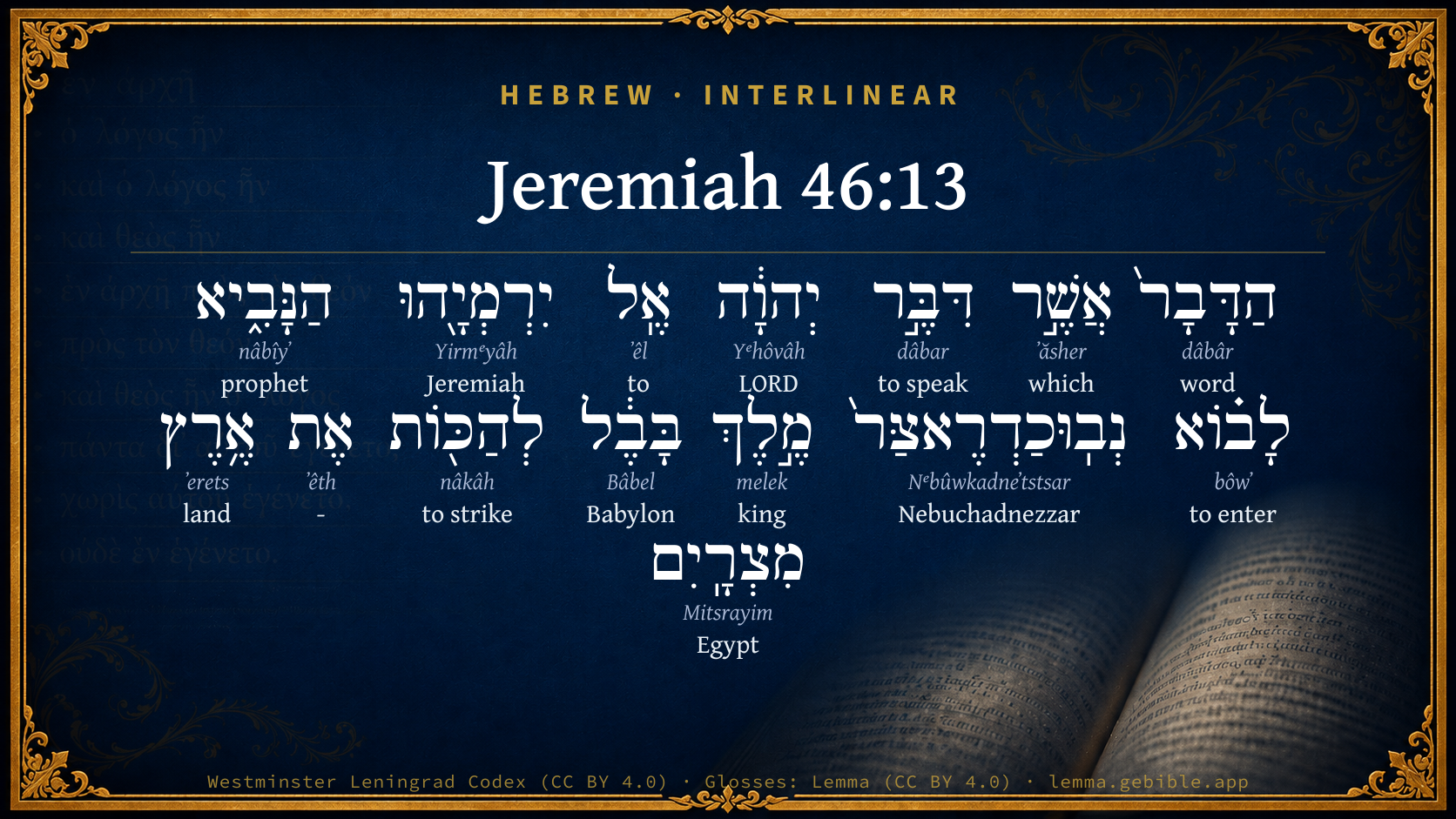
Jeremiah 46:13

Hebrew (Westminster Leningrad Codex) Jeremiah 46:13 appears in the Hebrew Old Testament. The text above is from the Westminster Leningrad Codex. Each word links to its Strong’s number, a concise gloss, and parsing drawn from the Open Scriptures Hebrew Bible morphology. Click any word for its full Brown-Driver-Briggs (BDB) entry.
Download image
Cite this verse

Jeremiah 46:13 (World English Bible). Public Domain. Lemma interlinear Bible study tool, https://lemma.gebible.app/v/jeremiah/46/13.

Show BibTeX & RIS
BibTeX
RIS
English Translation
The word that Yahweh spoke to Jeremiah the prophet, how that Nebuchadrezzar king of Babylon should come and strike the land of Egypt.
World English Bible · Public Domain
Download a study sheet

One document with this verse’s original text, its word-by-word gloss line, the meaning frame, cross-references with their text, attributed commentary, and full source and license credits — printable, and it pastes into notes with its structure intact.

This verse Autodidact and up

Study sheet (.html) Plain text (.txt)

A passage Seminary Student

Up to 50 verses in one chapter. A passage sheet keeps up to 6 commentary sources and 12 cross-references per verse, in the order this page ranks them, and says so on the sheet whenever that leaves anything out. Ask for a single verse and you get the Autodidact verse sheet above.

Everything on this page stays free to read, with no account — the sheet is a download of what is already on screen, not access to it.

Want to remove ads? Support Godless Engineer
Compare translations 3

The same verse in 3 English versions, stacked beneath the original-language interlinear above. Click any original word for its lexicon entry.

Each is an independent rendering of the whole verse — the interlinear is not word-aligned to these translations.

Highlighted words mark where these versions differ — a whole-verse word diff, not a word-by-word alignment.

  • World English Bible Public Domain
    The word that Yahweh spoke to Jeremiah the prophet, how that Nebuchadrezzar king of Babylon should come and strike the land of Egypt.
  • King James Version Public Domain
    The word that the LORD spake to Jeremiah the prophet, how Nebuchadrezzar king of Babylon should come and smite the land of Egypt.
  • unfoldingWord Literal Text CC BY-SA 4.0
    This is the word that Yahweh told Jeremiah the prophet when Nebuchadnezzar king of Babylon came and attacked the land of Egypt:

unfoldingWord Literal Text — © unfoldingWord, licensed CC BY-SA 4.0. Word-aligned USFM3 via Door43 (git.door43.org/unfoldingWord/en_ult).

Versions to compare (up to 4)

3 of 4 selected

Show all 18 translations

Every available English version of this verse, each an independent rendering of the whole verse.

  • World English Bible Public Domain
    The word that Yahweh spoke to Jeremiah the prophet, how that Nebuchadrezzar king of Babylon should come and strike the land of Egypt.
  • Berean Standard Bible Public Domain
    This is the word that the LORD spoke to Jeremiah the prophet about the coming of Nebuchadnezzar king of Babylon to strike the land of Egypt:
  • Majority Standard Bible Public Domain
    This is the word that the LORD spoke to Jeremiah the prophet about the coming of Nebuchadnezzar king of Babylon to strike the land of Egypt:
  • King James Version Public Domain
    The word that the LORD spake to Jeremiah the prophet, how Nebuchadrezzar king of Babylon should come and smite the land of Egypt.
  • American Standard Version (1901) Public Domain
    The word that Jehovah spake to Jeremiah the prophet, how that Nebuchadrezzar king of Babylon should come and smite the land of Egypt.
  • Revised Version (1885) Public Domain
    The word that the LORD spake to Jeremiah the prophet, how that Nebuchadrezzar king of Babylon should come and smite the land of Egypt.
  • Geneva Bible (1599) Public Domain
    The woorde that the Lord spake to Ieremiah the Prophet, howe Nebuchad-nezzar king of Babel shoulde come and smite the lande of Egypt.
  • Douay-Rheims (1899) Public Domain
    The word that the Lord spoke to Jeremias the prophet, how Nabuchodonosor king of Babylon should come and strike the land of Egypt:
  • Young's Literal Translation Public Domain
    The word that Jehovah hath spoken unto Jeremiah the prophet concerning the coming in of Nebuchadrezzar king of Babylon, to smite the land of Egypt:
  • Literal Standard Version CC BY-SA 4.0
    The word that YHWH has spoken to Jeremiah the prophet concerning the coming in of Nebuchadnezzar king of Babylon, to strike the land of Egypt:
  • Unlocked Literal Bible CC BY-SA 4.0
    This is the word that Yahweh told Jeremiah the prophet when Nebuchadnezzar king of Babylon came and attacked the land of Egypt:
  • unfoldingWord Literal Text CC BY-SA 4.0
    This is the word that Yahweh told Jeremiah the prophet when Nebuchadnezzar king of Babylon came and attacked the land of Egypt:
  • Darby Bible Public Domain
    The word that Jehovah spoke to Jeremiah the prophet, concerning the coming of Nebuchadrezzar king of Babylon to smite the land of Egypt:
  • World Messianic Bible Public Domain
    The word that the LORD spoke to Jeremiah the prophet, how that Nebuchadnezzar king of Babylon should come and strike the land of Egypt:
  • Webster's Bible Public Domain
    The word that the LORD spoke to Jeremiah the prophet, how Nebuchadrezzar king of Babylon should come and smite the land of Egypt.
  • Free Bible Version CC BY-SA 4.0
    This is the message that the Lord gave to Jeremiah the prophet about the attack by Nebuchadnezzar king of Babylon on Egypt:
  • Bible in Basic English Public Domain
    The word which the Lord said to Jeremiah the prophet, of how Nebuchadrezzar, king of Babylon, would come and make war on the land of Egypt.
  • JPS Tanakh (1917) Public Domain
    The word that the LORD spoke to Jeremiah the prophet, how that Nebuchadrezzar king of Babylon should come and smite the land of Egypt.

Literal Standard Version (2020), Covenant Press — licensed CC BY-SA 4.0. Text via the HelloAO Bible API (eBible.org). Unlocked Literal Bible (unfoldingWord) — licensed CC BY-SA 4.0. Text via the HelloAO Bible API (eBible.org). unfoldingWord Literal Text — © unfoldingWord, licensed CC BY-SA 4.0. Word-aligned USFM3 via Door43 (git.door43.org/unfoldingWord/en_ult). Free Bible Version, Dr. Jonathan Gallagher — licensed CC BY-SA 4.0. Text via the HelloAO Bible API (eBible.org).

Word by word

More ways to search: Search by grammar → Find every occurrence → Compare this word →

Practice this passage: Drill this verse → Learn its vocabulary →

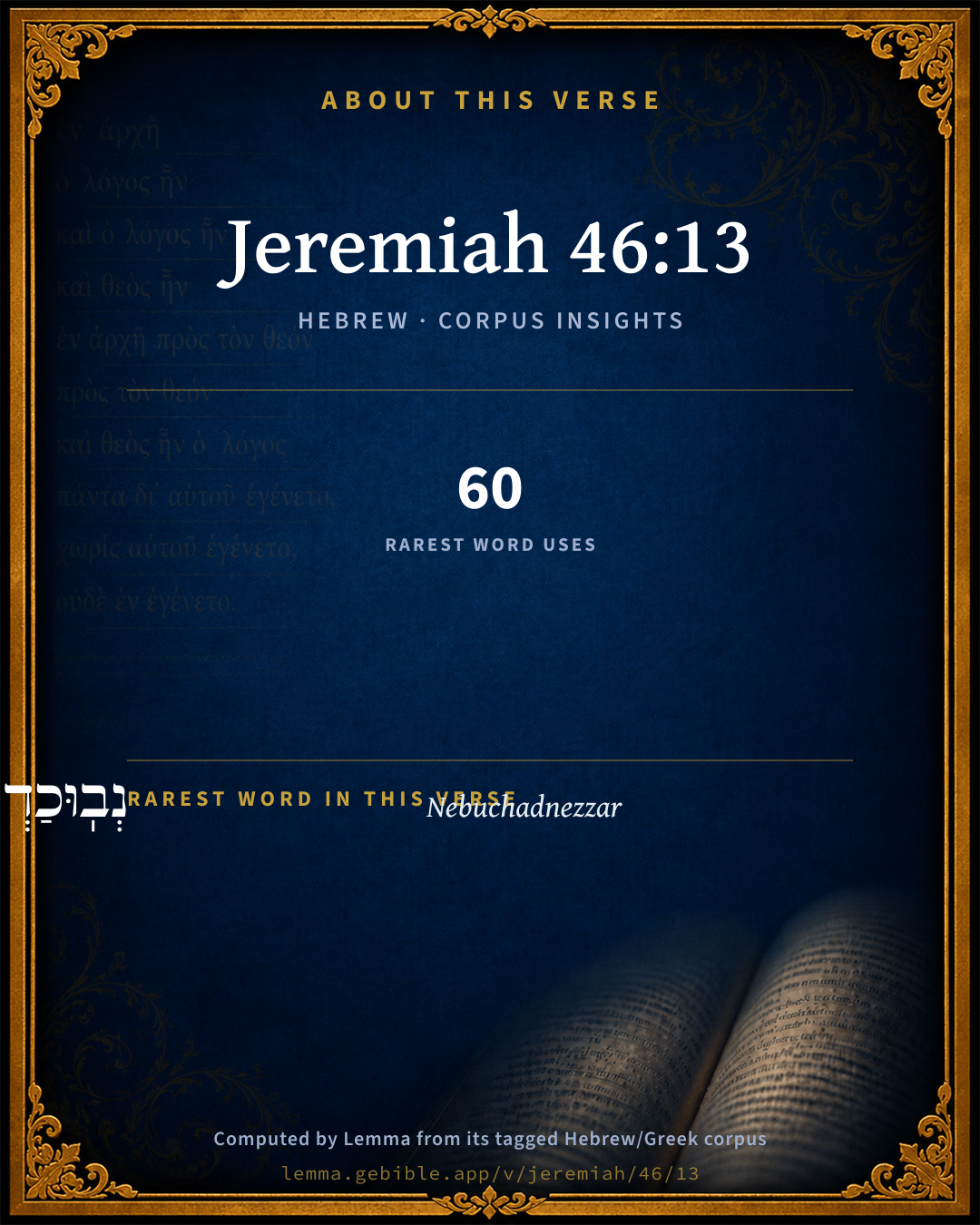
נְבֽוּכַדְרֶאצַּר֙
Nᵉbûwkadneʼtstsar
H5019
“Nebuchadnezzar”
Noun, Proper
Part of Speech
Noun
Type
Proper
Full BDB Definition

Origin: of foreign derivation

TWOT: None

Nebuchadnezzar or Nebuchadrezzar = "may Nebo protect the crown" - the great king of Babylon who captured Jerusalem and carried Judah captive
  1. הַדָּבָר֙ dâbâr H1697 “the · word” Particle, Definite Article + Noun, Common, Masculine, Singular, Absolute
  2. אֲשֶׁ֣ר ʼăsher H834 “which” Particle, Relative
  3. דִּבֶּ֣ר dâbar H1696 “to speak” Verb, Piel, Perfect, 3rd Person, Masculine, Singular
  4. יְהוָ֔ה Yᵉhôvâh H3068 “LORD” Noun, Proper
  5. אֶֽל ʼêl H413 “to” Preposition
  6. יִרְמְיָ֖הוּ Yirmᵉyâh H3414 “Jeremiah” Noun, Proper
  7. הַנָּבִ֑יא nâbîyʼ H5030 “the · prophet” Particle, Definite Article + Noun, Common, Masculine, Singular, Absolute
  8. לָב֗וֹא bôwʼ H935 “to enter” Preposition + Verb, Qal, Infinitive Construct
  9. מֶ֣לֶךְ melek H4428 “king of” Noun, Common, Masculine, Singular, Construct
  10. בָּבֶ֔ל Bâbel H894 “Babylon” Noun, Proper
  11. לְהַכּ֖וֹת nâkâh H5221 “to strike” Preposition + Verb, Hiphil, Infinitive Construct
  12. אֶת ʼêth H853 “-” Particle, Direct Object
  13. אֶ֥רֶץ ʼerets H776 “land of” Noun, Common, Both, Singular, Construct
  14. מִצְרָֽיִם Mitsrayim H4714 “Egypt” Noun, Proper

About this verse

These counts appear in no published source. They are computed here, from the morphology-tagged text and Lemma’s own curated glosses. What Lemma adds →

15
words
15
distinct lemmas
Prophets
section

Shared distinctive vocabulary

נְבֽוּכַדְרֶאצַּר֙ Nebuchadnezzar H5019 occurs in 58 verses of the Hebrew Bible. Also found in:

Grammatical profile

  • 3 verbs
  • 9 nouns
  • 1 preposition
  • 2 particles

Verb forms

  • דִּבֶּ֣ר Piel · Perfect
  • לָב֗וֹא Qal · Infinitive Construct
  • לְהַכּ֖וֹת Hiphil · Infinitive Construct

Cross-references

4

Topical passages linked to Jeremiah 46:13 in the Treasury of Scripture Knowledge — connected by theme and wording, ordered by reader-vote popularity; previews shown in the World English Bible.

  • Jeremiah 43:10–13 and tell them, Thus says Yahweh of Hosts, the God of Israel: Behold, I will send and take Nebuchadrezzar the king of Babylon, my servant, and will set his throne on these stones that I have hidden; and he shall spread his royal pavilion over them.
  • Jeremiah 44:30 Thus says Yahweh, Behold, I will give Pharaoh Hophra king of Egypt into the hand of his enemies, and into the hand of those who seek his life; as I gave Zedekiah king of Judah into the hand of Nebuchadrezzar king of Babylon, who was his enemy, and sought his life.
  • Isaiah 19:1–25 The burden of Egypt. Behold, Yahweh rides on a swift cloud, and comes to Egypt: and the idols of Egypt shall tremble at his presence; and the heart of Egypt shall melt in the midst of it.
  • Isaiah 29:1–24 Ho Ariel, Ariel, the city where David encamped! add you year to year; let the feasts come round:

Cross-references courtesy of OpenBible.info (CC BY 4.0).

Hebrew and Greek witnesses Masoretic Hebrew ↔ Greek Septuagint

The same verse in the two great witnesses to the Old Testament, shown verse-for-verse.

These are two independent witnesses, not word-aligned to each other, and the Septuagint is shown in lemma (dictionary) form.

Hebrew Jeremiah 46:13 Masoretic · Westminster Leningrad Codex

הַדָּבָר֙ אֲשֶׁ֣ר דִּבֶּ֣ר יְהוָ֔ה אֶֽל יִרְמְיָ֖הוּ הַנָּבִ֑יא לָב֗וֹא נְבֽוּכַדְרֶאצַּר֙ מֶ֣לֶךְ בָּבֶ֔ל לְהַכּ֖וֹת אֶת אֶ֥רֶץ מִצְרָֽיִם

The word that Yahweh spoke to Jeremiah the prophet, how that Nebuchadrezzar king of Babylon should come and strike the land of Egypt.

World English Bible · Public Domain

Greek LXX Structure differs

In the Septuagint, Jeremiah is about an eighth shorter than the Hebrew and arranges its material differently — the Oracles Against the Nations (Hebrew chapters 46–51) appear in the middle of the Greek book, after 25:13. Because the chapter and verse boundaries do not line up, a verse-for-verse comparison with the Hebrew is not shown.

A verse-for-verse comparison isn’t shown here because the chapters and verses don’t line up. Switch to the LXX edition with the MT / LXX toggle above to read the Greek directly.

On this verse, Keil & Delitzsch discusses the Septuagint’s reading. Read the note in Commentary ↓

Hebrew: Westminster Leningrad Codex (CC BY 4.0). Greek: Septuagint (public domain); English from a public-domain English Septuagint. How the Septuagint differs from the Hebrew →

Targum (Aramaic paraphrase)

1

The Targum is the ancient Jewish Aramaic paraphrase of the Hebrew Scriptures — an interpretive translation, not the Hebrew text itself. Onkelos (literal) and Pseudo-Jonathan (expansive) render the Torah, and Jonathan the Prophets. Coverage is partial: where no permissively-licensed English translation exists for a verse, only the Aramaic is shown. This is verse-level text, not a word-by-word alignment to the Hebrew.

  1. Targum Jonathan Prophets (Joshua–Malachi)
    פִּתְגַם נְבוּאָה דְמַלֵיל יְיָ עִם יִרְמְיָה נְבִיָא לְמֵיתֵי נְבוּכַדְרֶאצַר מַלְכָּא דְבָבֶל לְמִמְחֵי יַת אַרְעָא דְמִצְרָיִם:

    (no public-domain English translation for this verse)

    Targum Jonathan — Aramaic: “Mikraot Gedolot” (public domain). English: “Sefaria Community Translation” (CC0 1.0 (public-domain dedication)); “London "Chaldee Paraphrase," 1871” (public domain). Text via Sefaria.

Commentary

Notes on Jeremiah 46:13 from classic Christian and Jewish commentators (each source and its license shown beneath its notes). The classic Christian expositions comment on the surrounding passage and are grouped to its opening verse, so a note may address several verses; the Jewish commentaries on the Tanakh (Rashi and others) are per-verse, so they appear only where the commentator wrote on this verse.

Lemma curates 59 commentaries, every one of them public domain or Creative Commons licensed, each selected and text-cleaned for this edition rather than reprinted as found. About our sources →

Matthew Henry's Commentary

In these verses we have,

I. Confusion and terror spoken to Egypt. The accomplishment of the prediction in the former part of the chapter disabled the Egyptians from making any attempts upon other nations; for what could they do when their army was routed? But still they remained strong at home, and none of their neighbours durst make any attempts upon them. Though the kings of Egypt came no more out of their land (Kg2 24:7), yet they kept safe and easy in their land; and what would they desire more than peaceably to enjoy their own? One would think all men should be content to do this, and not covet to invade their neighbours. But the measure of Egypt's iniquity is full, and now they shall not long enjoy their own; those that encroached on others shall not be themselves encroached on. The scope of the prophecy here is to show how the king of Babylon should shortly come and smite the land of Egypt, and bring the war into their own bosoms which they had formerly carried into his borders, Jer 46:13. This was fulfilled by the same hand with the former, even Nebuchadnezzar's, but many years after, twenty at least, and probably the prediction of it was long after the former prediction, and perhaps much about the same time with that other prediction of the same event which we had Jer 43:10.

1. Here is the alarm of war sounded in Egypt, to their great amazement (Jer 46:14), notice given to the country that the enemy is approaching, the sword is devouring round about in the neighbouring countries, and therefore it is time for the Egyptians to put themselves in a posture of defence, to prepare for war, that they may give the enemy a warm reception. This must be proclaimed in all parts of Egypt, particularly in Migdol, Noph, and Tahpanhes, because in these places especially the Jewish refugees, or fugitives rather, had planted themselves, in contempt of God's command (Jer 44:1), and let them hear what a sorry shelter Egypt is likely to be to them.

2. The retreat hereupon of the forces of other nations which the Egyptians had in their pay is here foretold. Some considerable number of those troops, it is probable, were posted upon the frontiers to guard them, where they were beaten off by the invaders and put to flights. Then were the valiant men swept away (Jer 46:15) as with a sweeping rain (it is the word that is used Pro 28:3); they can none of them stand their ground, because the Lord drives them from their respective posts; he drives them by his terrors; he drives them by enabling the Chaldeans to drive them. It is not possible that those should fix whom the wrath of God chases. He it was (Jer 46:16) that made many to fall, yea, when their day shall come to fall, the enemy needs not throw them down, they shall fall one upon another, every man shall be a stumbling-block to his fellow, to his follower; nay, if God please, they shall be made to fall upon one another, they shall be made to fall upon one another, every man's sword shall be against his fellow. Her hired men, the troops Egypt has in he service, are indeed in the midst of her like fatted bullocks, lusty men, able bodied and high spirited, who were likely for action and promised to make their part good against the enemy; but they are turned back; their hearts failed them, and, instead of fighting, they have fled away together. How could they withstand their fate when the day of their calamity had come, the day in which God will visit them in wrath? Some think they are compared to fatted bullocks for their luxury; they had wantoned in pleasures, so that they were very unfit for hardships, and therefore turned back and could not stand. In this consternation, (1.) They all made homeward towards their own country (Jer 46:16): They said, "Arise, and let us go again to our own people, where we may be safe from the oppressing sword of the Chaldeans, that bears down all before it." In times of exigence little confidence is to be put in mercenary troops, that fight purely for pay, and have no interest in theirs whom they fight for. (2.) They exclaimed vehemently against Pharaoh, to whose cowardice or bad management, it is probably, their defeat was owing. When he posted them there upon the borders of his country it is probably that he told them he would within such a time come himself with a gallant army of his own subjects to support them; but he failed them, and, when the enemy advanced, they found they had none to back them, so that they were perfectly abandoned to the fury of the invaders. No marvel then that they quitted their post and deserted the service, crying out, Pharaoh king of Egypt is but a noise (Jer 46:17); he can hector, and talk big of the mighty things he would do, but that is all; he brings nothing to pass. All his promises to those in alliance with him, or that are employed for him, vanish into smoke. He brings not the succours he engaged to bring, or not till it is too late: He has passed the time appointed; he did not keep his word, nor keep his day, and therefore they bid him farewell, they will never serve under him any more. Note, Those that make most noise in any business are frequently but a noise. Great talkers are little doers.

3. The formidable power of the Chaldean army is here described as bearing down all before it. The King of kings, whose name is the Lord of hosts, and before whom the mightiest kings on earth, though gods to us, are but as grasshoppers, he hath said it, he hath sworn it, As I live, saith this king, as Tabor overtops the mountains and Carmel overlooks the sea, so shall the king of Babylon overpower all the force of Egypt, such a command shall he have, such a sway shall he bear, Jer 46:18. He and his army shall come against Egypt with axes, as hewers of wood (Jer 46:22), and the Egyptians shall be no more able to resist them than the tree is to resist the man that comes with an axe to cut it down; so that Egypt shall be felled as a forest is by the hewers of wood, which (if there by many of them, and those well provided with instruments for the purpose) will be done in a little time. Egypt is very populous, full of towns and cities, like a forest, the trees of which cannot be searched or numbered, and very rich, full of hidden treasures, many of which will escape the searching eye of the Chaldean soldiers; but they shall make a great spoil in the country, for they are more than the locusts, that come in vast swarms and overrun a country, devouring every green thing (Joe 1:6, Joe 1:7), so shall the Chaldeans do, for they are innumerable. Note, The Lord of hosts hath numberless hosts at his command.

4. The desolation of Egypt hereby is foretold, and the waste that should be made of that rich country. Egypt is now like a very fair heifer, or calf (Jer 46:20), fat and shining, and not accustomed to the yoke of subjection, wanton as a heifer that is well fed, and very sportful. Some think here is an allusion to Apis, the bull or calf which the Egyptians worshipped, from whom the children of Israel learned to worship the golden calf. Egypt is as fair as a goddess, and adores herself, but destruction comes; cutting up comes (so some read it); it comes out of the north; thence the Chaldean soldiers shall come, as so many butchers or sacrificers, to kill and cut up this fair heifer. (1.) The Egyptians shall be brought down, shall be tamed, and their tune changed: The daughters of Egypt shall be confounded (Jer 46:24), shall be filled with astonishment. Their voice shall go like a serpent, that is, it shall be very low and submissive; they shall not low like a fair heifer, that makes a great noise, but hiss out of their holes like serpents. They shall not dare to make loud complaints of the cruelty of the conquerors, but vent their griefs in silent murmurs. They shall not now, as they used to do, answer roughly, but, with the poor, use entreaties and beg for their lives. (2.) They shall be carried away prisoners into their enemy's land (Jer 46:19): "O thou daughter! dwelling securely and delicately in Egypt, that fruitful pleasant country, do not think this will last always, but furnish thyself to go into captivity; instead of rich clothes, which will but tempt the enemy to strip thee, get plain and warm clothes; instead of fine shoes, provide strong ones; and inure thyself to hardship, that thou mayest bear it the better." Note, It concerns us, among all our preparations, to prepare for trouble. We provide for the entertainment of our friends, let us not neglect to provide for the entertainment of our enemies, nor among all our furniture omit furniture for captivity. The Egyptians must prepare to flee; for their cities shall be evacuated. Noph particularly shall be desolate, without an inhabitant, so general shall the slaughter and the captivity be. There are some penalties which, we say, the king and the multitude are exempted from, but here even these are obnoxious: The multitude of No shall be punished: it is called populous No, Nah 3:8. Though hand join in hand, yet they shall not escape; nor can any think to go off in the crowd. Be they ever so many, they shall find God will be too many for them. Their kings and all their petty princes shall fall; and their gods too (Jer 43:12, Jer 43:13), their idols and their great men. Those which they call their tutelar deities shall be no protection to them. Pharaoh shall be brought down, and all those that trust in him (Jer 46:25), particularly the Jews that came to sojourn in his country, trusting in him rather than in God. All these shall be delivered into the hands of the northern nations (Jer 46:24), into the hand not only of Nebuchadnezzar that mighty potentate, but into the hands of his servants, according to the curse on Ham's posterity, of which the Egyptians were, that they should be the servants of servants. These seek their lives, and into their hands they shall be delivered.

5. An intimation is given that in process of time Egypt shall recover itself again (Jer 46:26): Afterwards it shall be inhabited, shall be peopled again, whereas by this destruction it was almost dispeopled. Ezekiel foretels that this should be at the end of forty years, Eze 29:13. See what changes the nations of the earth are subject to, how they are emptied and increased again; and let not nations that prosper be secure, nor those that for the present are in thraldom despair.

II. Comfort and peace are here spoken to the Israel of God, Jer 46:27, Jer 46:28. Some understand it of those whom the king of Egypt had carried into captivity with Jehoahaz, but we read not of any that were carried away captives with him; it may therefore rather refer to the captives in Babylon, whom God had mercy in store for, or, more generally, to all the people of God, designed for their encouragement in the most difficult times, when the judgments of God are abroad among the nations. We had these words of comfort before, Jer 30:10, Jer 30:11. 1. Let the wicked of the earth tremble, they have cause for it; but fear not thou, O my servant Jacob! and be not dismayed, O Israel! and again, Fear thou not, O Jacob! God would not have his people to be a timorous people. 2. The wicked of the earth shall be put away like dross, not be looked after any more; but God's people, in order to their being saved, shall be found out and gathered though they be far off, shall be redeemed though they be held fast in captivity, and shall return. 3. The wicked is like the troubled sea when it cannot rest; they flee when none pursues. But Jacob, being at home in God, shall be at rest and at ease, and none shall make him afraid; for what time he is afraid he has a God to trust to. 4. The wicked God beholds afar off; but, wherever thou art, O Jacob! I am with thee, a very present help. 5. A full end shall be made of the nations that oppressed God's Israel, as Egypt and Babylon; but mercy shall be kept in store for the Israel of God: they shall be corrected, but not cast off; the correction shall be in measure, in respect of degree and continuance. Nations have their periods; the Jewish nation itself has come to an end as a nation; but the gospel church, God's spiritual Israel, still continues, and will to the end of time; in that this promise is to have its full accomplishment, that, though God correct it, he will never make a full end of it.

Matthew Henry's Commentary on the Whole Bible (1708–1710) — public domain (CC PDM 1.0). Text via the HelloAO Bible API.

Trapp's Complete Commentary

John Trapp

Jer 46:13 The word that the LORD spake to Jeremiah the prophet, how Nebuchadrezzar king of Babylon should come [and] smite the land of Egypt.

Ver. 13. The word that the Lord spake.] Another prophecy, but against Egypt also. God had yet a further quarrel to that country for the death of good Josiah; their delivering up Uriah, God’s faithful servant, to the sword of Jehoiakim; their idolatry, pride, perfidy, &c.

How Nebuchadnezzar … should come and smite the land of Egypt.] In the twentieth-fifth year of his reign, as Jeremiah also had set forth by a sign. {Jer 44:30}

John Trapp, A Commentary or Exposition upon All the Books of the Old and New Testament (1647–1656) — public domain. Text from a community e-Sword module.

Joseph Benson's Commentary

Jer 46:13. The word that the Lord spake, &c. — Here begins the second prophecy against Egypt, the exact time of the delivery of which we have no means of ascertaining; but the desolation foretold in it is undoubtedly the same with that predicted by Ezekiel, chaps. 29., 30., 31., 32. And this came to pass in the twenty-seventh year of Jehoiachin’s captivity, that is, the sixteenth year after the destruction of Jerusalem, as may be collected from Eze 29:17, where Nebuchadnezzar’s army is spoken of as having at that time suffered a great deal at the siege of Tyre; on which account the spoils of Egypt are promised them for their wages and indemnification: and the promise was accordingly made good that same year. — Jos. Ant., lib. 10. cap. 9.

Joseph Benson's Commentary on the Old and New Testaments (1811–1818) — public domain. Text from a community e-Sword module.

Whedon's Commentary on the Bible

Daniel D. Whedon

Not be cured — The blow is irreparable. PROPHECY AGAINST EGYPT, Jer_46:13-26.

13. Here begins the second prophecy of Egypt. Like the former, it is poetic in form, but differs in that the scene of it is laid in Egypt, and not on the distant Euphrates.

Daniel D. Whedon (gen. ed.), Commentary on the Old and New Testaments (1874–1909) — public domain. Text from a community e-Sword module.

Keil & Delitzsch

C. F. Keil & F. Delitzsch

The second prophecy regarding Egypt, with a message for Israel attached to it, was uttered after the preceding. This is evident even from the superscription, Jer 46:13 : "The word which Jahveh spake to Jeremiah the prophet of the coming of Nebuchadrezzar the king of Babylon to smite the land of Egypt." The formula, "The word which," etc., agrees with that in Jer 50:1; and דּבר, in contrast with היה, the word usually met with in headings, perhaps means that this prophecy, like that concerning Babylon, was not uttered in public by Jeremiah, but only written down. לבוא is used in reference to the coming of Nebuchadrezzar to smite the land. Graf puts down this heading as an addition, not made till a late edition of the prophecies was brought out, and even then added through a mistake on the part of the compiler. In support of this, he urges that the announcement in Jer 46:14-26 does not form an independent prophecy, but merely constitutes the second portion of the description given in Jer 46:3-12 of the defeat of the Egyptians. But the ground assigned for this view, viz., that if this prophecy formed a separate and distinct piece, written at another time, then Jeremiah would have predicted the conquest of the other countries, Philistia, Moab, Ammon, etc., in consequence of the battle of Carchemish; and as regards Egypt, would have contented himself with a triumphal song over its fall - which is in itself unlikely: this argument is utterly null. It has no meaning whatever; for Jer 46:3-12 contain, not a triumphal song over a defeat that had already taken place, but a prophecy regarding the defeat about to take place. To this the prophet added a second prophecy, in which he once more announces beforehand to Egypt that it shall be conquered. In this way, more is foretold regarding Egypt than the neighbouring countries, because Egypt was of much greater consequence, in relation to the theocracy, than Philistia, Moab, etc. According to the superscription, this second prophecy refers to the conquest of Egypt by Nebuchadnezzar. According to Jer 37:5, this did not take place so long as Zedekiah was king; and according to Jer 43:8., it was foretold by Jeremiah, after the destruction of Jerusalem, when the Jews were fleeing to Egypt after the murder of Gedaliah. From this, one might conclude, with Ngelsbach, that the piece now before us is contemporaneous with Jer 43:8. But this inference is not a valid one. The threat uttered in Jer 43:8. of a conquest to befall Egypt had a special occasion of its own, and we cannot well regard it in any other light than as a repetition of the prophecy now before us, for the Jews; for its contents seem to show that it was composed not long after that in Jer 46:3-12, or soon after the defeat of the Egyptians at Carchemish. This address also falls into two strophes, Jer 46:14-19 and Jer 46:20-26, while Jer 46:27, Jer 46:28 form an additional message for Israel. The line of thought is this: Egypt may arm herself as she chooses, but her power shall fall, and her auxiliaries shall flee (Jer 46:14-16). Pharaoh's fall is certain; the enemy shall come in force, and turn all Egypt into a desert (Jer 46:17-19). The destroyer comes from the north, the mercenaries flee, and the enemy hews down countless hosts of men like trees in a forest (Jer 46:20-23). Egypt will be given into the hand of the people out of the north; for Jahveh will punish gods, princes, and people, and deliver up Egypt to the king of Babylon. But afterwards, Egypt will again be inhabited as it was before (Jer 46:24-26). On the other hand, Israel need fear nothing, for their God will lead them back out of their captivity (Jer 46:27, Jer 46:28).

Jer 46:14

"Tell ye it in Egypt, and make it to be heard in Migdol, and make it be heard in Noph and Tahpanhes: say, Stand firm, and prepare thee; for the sword hath devoured around thee. Jer 46:15. Why hath thy strong one been swept away? he stood not, for Jahveh pushed him down. Jer 46:16. He made many stumble, yea, one fell on another; and they said, Arise, and let us return to our own people, and to the land of our birth, from before the oppressing sword. Jer 46:17. They cried there, Pharaoh the king of Egypt is undone; he hath let the appointed time pass. Jer 46:18. As I live, saith the King, whose name is Jahveh of hosts, Surely as Tabor among the mountains, and as Carmel by the sea, shall he come. Jer 46:19. Prepare thee things for exile, O daughter dwelling in Egypt: for Noph will become a desolation, and be destroyed by fire, without an inhabitant."

Like the last prophecy, this one also begins with the summons to arms (Jer 46:14), in order to prepare the way for the description given immediately afterwards of the defeat (Jer 46:15.). The summons to make the proclamation is addressed to some persons not named, who are to announce through the country, particularly in the frontier towns and in the northern capital of Egypt, that the foe, in his devastating career, has advanced to the borders of the land. This is evident from the clause which states the reason: "The sword hath devoured what lay round thee." Regarding Migdol, i.e., Magdolos, and Tahpanhes, i.e., Daphne, the two frontier towns in the north, and Noph, i.e., Memphis, the northern capital of the kingdom, see on Jer 2:16 and 54:1. התיצּב, to take up one's position for the fight; cf. Jer 46:4. סביביך, "thy surroundings," are the frontier countries, but especially those on the north, - Judah, Philistia, Edom, - since the enemy comes from the north. However, we cannot with certainty infer from this, that by that time the kingdom of Judah had already fallen, and Jerusalem been laid waste. Immediately after Necho had been vanquished at the Euphrates, Nebuchadnezzar marched after the fugitive foe, pursuing him as far as the borders of Egypt; hence we read, in Kg2 24:7, "The king of Egypt went no more out of his land; for the king of Babylon had taken all that had belonged to the king of Egypt, from the river of Egypt to the river Euphrates." Even at that time, in the fourth and fifth years of Jehoiakim, it could be said, "His sword hath devoured the countries contiguous to Egypt." And Nebuchadnezzar was prevented on that occasion from advancing farther, and penetrating into Egypt itself, only by hearing of his father's death at Babylon, in consequence of which he was compelled to return to Babylon as speedily as possible, for the purpose of assuming the reins of government, and to let his army with the prisoners follow him at their leisure (Berosus in Josephus, contra Ap. i. 19).

Jer 46:15

The prophet in spirit looks on the power of Egypt as already broken. This is shown by the question of astonishment, מדּוּע נסחף אבּיריך, which has been variously rendered. אבּירים .deredner ylsuoirav neeb sa, "strong ones," is used in Jer 8:16; Jer 47:3, and Jer 50:11, of stallions, but elsewhere as an epithet of bulls, especially the strong bulls of Bashan; see on Jer 8:16. In the present passage the reference may be to the mighty men of war, who do not maintain their position (Chald. and most of the old interpreters); the verb in the singular forms no sufficient objection to this view, the irregularity being due to the fact that the verb precedes its subject see Ewald, 316, t; Gesenius, 147]. It is more difficult to combine with this the singulars of the verbs עמד and הדפו which follow; these, and especially the suffix in the singular, appear to indicate that אבּידיך really refers to a noun in the singular. But the form of this noun seems against such a view; for the words adduced in support of the position that singular nouns sometimes assume plural suffixes, are insufficient for the purpose: thus, תּהלּתיך, Psa 9:15, and שׂנאתיך, Eze 35:11, are plainly nouns in the singular. And in support of the averment that, in pausal forms with Segol, the י is a mere mater lectionis, only כּפּיך, Pro 6:1, can be adduced: the other instances brought forward by Hitzig fail to establish his position. For איביך, Deu 28:48, may be plural; בּיני, Gen 16:5, is far from being a case in point, for the preposition often takes plural suffixes; and even in the case of חסידיך, Psa 16:10, the י is marked in the Qeri as superfluous; most codices, too, rather give the form חסידך. But even in the verse now before us, many codices, according to Kennicott and de Rossi, read אבּירך, so that the word should perhaps be taken as a singular. The singulars, however, which occur in the following clauses do not form conclusive proofs of this, since they may be taken in a distributive sense; and more generally the address often suddenly changes from the plural to the singular. In connection with the possibility of taking אבּיריך as a singular, the paraphrase of the lxx deserves mention and consideration, ὁ μόσχος ὁ ἔκλετός σου, to which a gloss adds ὁ But we cannot agree with Kennicott, J. D. Michaelis, Ewald, Hitzig, Graf, and Nδgelsbach, in holding this as certainly the correct rendering; nor can we give to אבּיר the sense of "bull," for this meaning is not made out for the singular simply because the plural is used of strong bulls: this holds especially in Jeremiah, who constantly applies the plural to strong steeds. Still less ground is there for appealing to the fact that Jahveh is repeatedly called אבּיר ישׂראל or אבּיר יעקוב, Gen 49:24, Isa 1:24; Isa 39:1-8 :26 etc.; for this epithet of Jahveh (who shows Himself in or towards Israel as the Mighty One) cannot be applied to the helpless images of Apis. In Psa 68:31, אבּירים means "strong ones" - bulls as emblems of kings. If the word be used here with such a reference, it may be singular or plural. In the former case it would mean the king; in the latter, the king with his princes and magnates. Against the application of the word to the images of Apis, there is the fact that Apis, a symbol of Osiris, was neither the only nor the chief god of Egypt, but was worshipped nowhere except in Memphis (Herodotus, ii. 153); hence it was not suited to be the representative of the gods or the power of Egypt, as the context of the present passage requires.

Jer 46:16

As the mighty one of Egypt does not stand, but is thrust down by God, so Jahveh makes many stumble and fall over one another, so that the strangers return to their own home in order to escape the violence of the sword. The subject of ויּאמרוּ is indefinite; the speakers, however, are not merely the hired soldiers or mercenaries (Jer 46:11), or the allied nations (Eze 30:5), but strangers generally, who had been living in Egypt partly for the sake of commerce, partly for other reasons (Hitzig, Graf). As to חרב היּונה, see on Jer 25:38.

Jer 46:17-19

In Jer 46:17, "they cry there" is not to be referred to those who fled to their native land; the subject is undefined, and "there" refers to the place where one falls over the other, viz., Egypt. "There they cry, 'Pharaoh the king of Egypt is שׁאון, desolation, destruction, ruin:' " for this meaning, cf. Jer 25:31; Psa 40:3; the signification "noise, bustle," is unsuitable here.

(Note: The word שׁם has been read by the lxx and the Vulgate as if it had been שׁם, ὄνομα, nomen; accordingly the lxx render, καλέσατε τὸ ὄνομα Φαραὼ Νεχαὼ βασίλεως Αἰγύπτου Σαὼν ̓Εσβεὶ ̓Εμωήδ (or ̓Εσβειὲ Μωὴδe'd); Vulgate, vocate nomen Pharaonis regis Aegypti: Tumultum adduxit tempus. This reading is preferred by J. D. Michaelis, Ewald, Hitzig, and Graf, with this difference, that Hitzig and Graf take only שׁאון as a name. Hence Ewald translates, "They call Pharaoh's name 'Noise-which-a-wink-can-hush.' " This rendering is decidedly false, for מועד nowhere has the sense of "wink, nod," not even in Jdg 20:38, where it means an agreement made. For the reading שׁם instead of שׁם there are no sufficient grounds, although such passages as Jer 20:3 and Isa 30:7 may be adduced in support of the idea obtained by such a change in the word. The translation of the lxx is merely a reproduction of the Hebrew words by Greek letters, and shows that the translator did not know how to interpret them. The Vulgate rendering, tumultum adduxit tempus, is also devoid of meaning. Moreover, these translators have read קראוּ as the imperative קראוּ; if we reject this reading, as all moderns do, then we may also lay no weight on שׁם instead of שׁם. Besides, the meaning is not materially affected by this reading, for the giving of a name to a person merely expresses what he is or will be.)

The meaning of העביר המּועד also is disputed; it is quite inadmissible, however, to join the words with שׁאון, as Ewald does, for the purpose of making out a name. No suitable meaning can be extracted from them. Neither שׁאון nor המּועד can be the subject of העביר; the translation given by Schnurrer, "devastation that goes beyond all bounds," is still more arbitrary than that of Ewald given in the note. Since the Hiphil העביר is never used except with a transitive meaning, the subject can be none else than Pharaoh; and the words העביר המּועד must be intended to give the reason for this becoming a desolation: they are thus to be rendered, "he has allowed המּועד to pass by," not "the precise place," as Rosenmller explains it ("he did not stop in his flight at the place where the army could be gathered again, on the return"), but "the precise time." The reference, however, is not to the suitable time for action, for self-defence and for driving off the enemy (Grotius, C. B. Michaelis, Maurer, Umbreit), because the word does not mean suitable, convenient time, but appointed time. As Hitzig rightly perceived, the time meant is that within which the desolation might still be averted, and after which the judgment of God fell on him (Isa 10:25; Isa 30:18), - the time of grace which God had vouchsafed to him, so that Nebuchadnezzar did not at once, after the victory at Carchemish, invade and conquer Egypt. Pharaoh let this time pass by; because, instead of seeing in that defeat a judgment from God, he provoked the anger of Nebuchadnezzar by his repeated attacks on the Chaldean power, and brought on the invasion of Egypt by the king of Babylon (see above, p. 354). - In Jer 46:18. there is laid down a more positive foundation for the threat uttered in Jer 46:17. With an oath, the Lord announces the coming of the destroyer into Egypt. Like Tabor, which overtops all the mountains round about, and like Carmel, which looks out over the sea as if it were a watch-tower, so will he come, viz., he from whom proceeds the devastation of Egypt, the king of Babylon. the power of Nebuchadnezzar, in respect of its overshadowing all other kings, forms the point of comparison. Tabor has the form of a truncated cone. Its height is given at 1805 feet above the level of the sea, or 1350 from the surface of the plain below; it far surpasses in height all the hills in the vicinity, ad affords a wide prospect on every side; cf. Robinson's Phys. Geogr. of Palestine, p. 26f. Carmel stretches out in the form of a long ridge more than three miles wide, till it terminates on the shore of the Mediterranean Sea, as a bold, lofty promontory, which rises in an imposing manner at least 500 feet above the sea; cf. Robinson, p. 26f. Then the inhabitants of Egypt will be driven into exile. כּלי גולה .e, "vessels of wandering;" outfit for an exile, as in Eze 12:3. "Daughter of Egypt" is not a personification of the country, whose inhabitants are the people, but of the population, which is viewed as the daughter of the country; it stands in apposition to יושׁבת, like בּתוּלת בּת מצרי, Jer 46:11. For Noph, i.e., Memphis, the capital, is laid waste and burned, so as to lose its inhabitants. With Jer 46:20 begins the second strophe, in which the fate impending on Egypt is still more plainly predicted.

Jer 46:20-26

"Egypt is a very beautiful young heifer; a gadfly from the north comes - comes. Jer 46:21. Her mercenaries, too, in her midst, are like fatted calves; for they also turn their backs, they flee together: they do not stand, for the day of her destruction is some on her, the time of her visitation. Jer 46:22. Its sound is like [that of] the serpent [as it] goes; for they go with an army, and come against her with axes, like hewers of trees. Jer 46:23. They cut down her forest, saith Jahveh, for it is not to be searched; for they are more numerous than locusts, and they cannot be numbered. Jer 46:24. The daughter of Egypt is disgraced; she is given into the hand of the people of the north. Jer 46:25. Jahveh of hosts, the God of Israel, saith, Behold, I will visit Amon of No, and Pharaoh, and Egypt, her gods, and her kings; Pharaoh, and all those who trust in him. Jer 46:26. And I will give them into the hand of those who seek their life, even into the hand of Nebuchadnezzar the king of Babylon, and into the hand of his servants; but afterwards it shall be inhabited, as in the days of old, saith Jahveh."

Jer 46:20

In Jer 46:20 the address begins afresh, in order to carry out further, under new images, the description of the desolation already threatened. Egypt is a very beautiful עגלה; this feminine is chosen with a regard to "the daughter of Egypt." יפה־פיּה is an adjective formed from the Peal of יפה, "very beautiful," not "coquetting" (Hitzig, who follows the κεκαλλωπισμένη of the lxx). A very beautiful heifer is the people when carefully and abundantly fed in their beautiful and fertile land (Hitzig). Upon this heifer there comes from the north קרץ. This ἁπ. λεγ. is variously rendered. קרץ means, in the Hebrew, to pinch, nip (Job 33:6), to compress together, as in winking (Psa 35:19), to bring the lips closely together (Pro 16:30), and to nip off; cf. Arab. qaras[a to pinch, nip, cut off. Hence A. Schultens (Orig. Heb. ii. 34ff.), after Cocceius, and with a reference to Virgil, Georg. iii. 147, has rendered קרץ by morsus vellicans oestri. Hitzig (with whom Roediger, in his additions to Gesenius' Thesaurus, agrees) takes Arab. qârṣ, insectum cimici simile as his warrant for rendering it by oestrus, "the gadfly," which gives a more suitable meaning. Ewald, on the contrary, compares קרץ with Arab. qrs], and translates it "whale," a huge sea-monster; but this is quite arbitrary, for קרץ does not correspond to the Arabic qrs], and the whale or shark does not afford any figure that would be suitable for the context: e.g., Jer 46:21, "her mercenaries also flee," shows that the subject treated of is not the devouring or destruction, but the expulsion of the Egyptians out of their land; this is put as an addition to what is said about exile in Jer 46:19. Still less suitable is the general rendering excidium, destruction (Rabbins, Gesenius, Umbreit); and there is no lexical foundation for the Vulgate translation stimulator, nor for "taskmaster," the rendering of J. D. Michaelis and Rosenmller. The old translators have only made guesses from the context. The figure of the gadfly corresponds to the bee in the land of Assyria, Isa 7:18. The repetition of בּא gives emphasis, and points either to the certainty of the coming, or its continuance.

Jer 46:21

The mercenaries, also, of the daughter of Egypt, well fed, like fatted calves, betake themselves to flight. שׂכרים are "mercenaries," as distinguished from the allies mentioned in Jer 46:9. It was Carians and Ionians through whom Psammetichus attained the supremacy over all Egypt: these had settled down in στρατόπεδα of their own, between Bubastis and Pelusium, on both banks of the eastern arm of the Nile (Herodotus, ii. 152, 154), and were very well cared for, since the king relied on them (Herod. ii. 152, 163). Hence the comparison with fatted calves, which, moreover, are co-ordinated with the subject, as is shown by the resumption of the subject in גּם המּה. כּי stands in the middle of the sentence, with an asseverative meaning: "Yea, these also turn their back, they flee together, do not stand; for the day of their destruction is come." "The day of their destruction" is used as in Jer 18:17. On "the time of their visitation" (which stands in apposition to the preceding expression (cf. Jer 11:23; Jer 23:12 : it is not an accusative of time (Graf), for this always expresses the idea of continuance during a space of time.

Jer 46:22-23

In Jer 46:22, Jer 46:23, the annihilation of the power of Egypt is portrayed under another figure. A difficult expression is קולהּ כּנּחשׁ ילך, "her (viz., that of the daughter of Egypt) voice is like (the voice of) the serpent (which) goes." ילך must be taken as part of a relative sentence, since this verb is nowhere used of a voice or sound; hence it cannot be so joined here. Ewald, following the συρίζοντος of the lxx, would read שׁרק, "hissing," instead of ילך, and translates, "it makes a noise like the hissing serpent." He more fully defines the meaning thus: "Even though Egypt were hidden like a serpent in a thicket, yet it would be heard in its flight, like a nasty serpent hissing fiercely, while it hurries away from the axe of the wood-cutter." But, apart from the arbitrary change of ילך into שׁרק (the former word is used in Gen 3:14 of the going, i.e., crawling, of a serpent), Ewald puts into the words an idea altogether foreign to them. The nasty, fierce hissing of the serpent that is forced to flee, is quite unsuitable; for there is no further mention made of the flight of the Egyptians, but Egypt is hewn down like a forest by woodcutters. Moreover, as Graf has already well remarked, Egypt is not compared to a serpent, but only its voice to the voice or hiss of a serpent. For קול signifies, not merely the voice, but any sound, even the rustling and rattling of leaves (cf. Gen 3:8; Lev 26:36; Sa2 5:24); hence it may denote the noise caused by a serpent crawling on its belly in the thicket. The comparison, as Graf has correctly observed, is like that in Isa 29:4. There it is the daughter of Zion, but here it is the daughter of Egypt that lies on the ground, deeply humbled; weeping softly and moaning, making a sound like that of a serpent in a moss among fallen leaves, fleeing before the woodcutters.

(Note: The old translators have quite misunderstood these words, and attempted to apply them, each one according to his own fancy, to the enemy. Thus the lxx translate: Φωνὴ αὐτῶνקולם( ) ὡς ὄφεοως συρίζοντος, ὅτι ἐν ἄμμῳבּחול( for בּחיל) πορεύσονται, κ.τ.λ. Chald.: vox collisionis armorum eorum est sicut vox serpentum repentium; and similarly the Syriac. The Vulgate is: vox ejus quasi aerisנחשׁת( for נחשׁ) sonabit, quoniam cum exercitu properabunt et cum securibus venient. The translator of the Vulgate has thus read קולהּ, and referred the suffix to קרץ, which he renders stimulator. Luther follows the Vulgate: "Sie faren daher, das der Harnisch brasselt, und kommen mit Heeres Krafft." Hitzig also seeks to change the text, after the lxx, turning קולהּ into קולם, and בּחיל into בּחול. But this alteration disturbs the order of the sentence. Not only in Jer 46:20 and Jer 46:21, but also in Jer 46:23, Jer 46:24, the first clause always treats of Egypt, and what befalls her is only stated in the clauses which follow: so is it in Jer 46:22. Thus the alteration made affords a very trivial result, viz., that the enemy advancing on Egypt march through the very sandy desert between Gaza and Egypt, and make slow progress, like serpents, because they wade through the sand; so that they make their appearance suddenly and unexpectedly.)

Thus she lies on the ground, for the enemy comes in force, with axes like woodcutters, to hew down the forest of men in Egypt. The mention of the axes is occasioned by the comparison of the foe to woodcutters; we are not to think of battle-axes as weapons of the Massagetae, Scythians, Persians, and other nations (Herodotus, i. 215, iv. 70, vii. 64; Xenophon, Cyroped. i. 2, 9). Axes here form the type of murderous weapons generally. On the comparison of a multitude of people to a forest, cf. Jer 21:14; Isa 10:18., Isa 10:33. The clause כּי לא יחקר is referred by L. de Dieu, J. D. Michaelis, Hitzig, Ngelsbach, etc., to the wood, "for it cannot be explored or penetrated;" thus a road must be made in order to get through it. However, the question is not about the enemy going or marching through Egypt, but about the destruction of Egypt and her powers. Rosenmller and Graf, with Raschi, are more correct in referring the clause to the hostile army, "for it cannot be investigated," i.e., it is impossible to learn the number of them. It is no great objection to this interpretation that the verb occurs in the singular: this must be retained as it is, since it is not the individual enemies that cannot be searched out, but it is the number of the whole army that cannot be reckoned. On the employment of חקר in the Niphal in connection with the impossibility of counting a multitude, cf. Kg1 7:47, and the expression לא in Job 5:9; Job 9:10; 36:36. The clauses which follow, and conclude Jer 46:23, explain the thought further: "more numerous than grasshoppers," i.e., innumerable.

Jer 46:24-26

In Jer 46:24. the result of the overthrow of Egypt, which has hitherto been set forth in figurative language, is stated in words which describe the exact realities: Egypt will be given up to ignominy, delivered into the power of a people from the north, i.e., the Chaldeans. The Lord of hosts, the Almighty God of Israel, punishes it for its sins. He visits, i.e., punishes, Amon of No, the chief idol of Egypt; Pharaoh, and the land, with all its gods and its kings, and with Pharaoh, all those who place their trust in his power. Words are accumulated for the purpose of showing that the judgment will be one which shall befall the whole land, together with its gods, its rulers, and its inhabitants. First of all is mentioned Amon of No, as in Eze 30:14. נא is an abbreviation of נא אמון , i.e., dwelling of Amon, the sacred name of the royal city in Upper Egypt, famous in antiquity, which the Greeks called Διὸς πόλις, or Θήβη, or Θῆβαι it is supposed, after the vulgar Egyptian name Tapet or Tape (Throne or Seat); see on Nah 3:8. Amon - in Greek ̓Αμμοῦν (Herodotus, ii. 42), ̓Αμοῦν (Plutarch, de Is. Ch. 9), ̓Αμῶν (Jamblichus, de myst. 5, 8) - was a sun-god (Amon-R), probably a symbol of the sun as it appears in the spring, in the sign of the Ram; hence he was represented with rams' horns. By the Greeks he was compared to Jupiter, or Zeus, and named Jupiter Ammon. The chief seat of his worship was Thebes, where he had a temple, with a numerous learned priesthood and a famous oracle (cf. Strabo, xvii. 1. 43; Justin. xi. 11), which Cambyses destroyed (Diodorus, Siculus, Fragm. Lib. x.). Under the expression "kings of Egypt" we are not to include governors or vassal-kings, but all the kings who ever ruled Egypt; for in the judgment now falling on Egypt, all the kings it ever had, together with all its gods, are punished. In the last part of the verse the name of Pharaoh is once more given, for the purpose of attaching to it the words "and all who trust in him;" these are intended for the Jews who expected help from Egypt. The punishment consists in their being all given into the hand of their enemies, namely (ו explic.) into the hand of Nebuchadnezzar and his servants. This defeat, however, is not to be the end of the Egyptian kingdom. The threat of judgment concludes, in Jer 46:26, with a promise for the future. "Afterwards, it shall be inhabited, as in the days of yore." שׁכן is used in a neuter sense, as in Jer 17:6; Jer 33:16, etc. Since this verb also signifies to settle down, be encamped (Num 24:2), and to lie quiet, to rest, or keep oneself quiet, inactive (Jdg 5:17; Pro 7:11), Hitzig and Graf, with Kimchi, give the explanation: "because the power of Egypt shall be broken, it will keep quiet, and remain at home in its own country, instead of marching forth and fighting other nations, as it has lately begun again to do (Jer 46:7) after centuries of peace." But although, in support of this view, we are pointed to Eze 29:13, where the restoration of Egypt is predicted, with the further remark, "it will be an abject kingdom," yet this idea is not contained in the words of our verse. To render שׁכן by "to keep quiet, be inactive," does not suit the words "as in the days of old." In former days, Egypt was neither inactive nor remained at home in peace in its own land. From the remotest antiquity, the Pharaohs made wars, and sought to enlarge their dominions by conquest. Add to this, that we must view the concluding portion of this prophecy in a manner analogous to the closing thought of the prophecies regarding Moab (Jer 48:47), Ammon (Jer 49:6), and Elam (Jer 49:39), where the turning of the captivity in the last times is given in prospect to these nations, and "afterwards," in Jer 49:6, alternates with "in the latter days" found in Jer 48:47 and Jer 49:39. From this it follows that, in the verse now before us also, it is not the future in general, but the last time, i.e., the Messianic future, that is pointed out; hence שׁכן does not express the peaceful condition of the land, but its being inhabited, in contrast with its depopulation in the immediate future, in consequence of its inhabitants being killed or carried away. On the fulfilment of this threatening, see p. 351ff.

Jer 46:27-28

A promise for Israel. - Jer 46:27. "But fear not thou, O my servant Jacob, nor be dismayed: for, behold, I will save thee from afar, and thy seed from the land of their captivity; and Jacob shall return, and be at rest and secure, and no one shall make him afraid. Jer 46:28. Fear thou not, my servant Jacob, saith Jahveh, for I am with thee; for I will make complete destruction of all the nations whither I have driven thee, but of thee will I not make complete destruction: yet I will correct thee in a proper manner, and I will not leave thee wholly unpunished." These verses certainly form no integral portion of the prophecy, but an epilogue; yet they are closely connected with the preceding, and are occasioned by the declaration in Jer 46:26, that the Lord, when He visits Pharaoh, shall also visit all those who trust in Him. This word, which is directed to Judah, might be understood to declare that it is Judah chiefly which will share the fate of Egypt. In order to prevent such a misconception, Jeremiah adds a word for Israel, which shows how the true Israel has another destiny to hope for. Their deliverer is Jahveh, their God, who certainly punishes them for their sins, gives them up to the power of the heathen, but will also gather them gain after their dispersion, and then grant them uninterrupted prosperity. This promise of salvation at the close of the announcement of judgment on Egypt is similar to the promise of salvation for Israel inserted in the threat of judgment against Babylon, Jer 50:4-7 and Jer 50:19, Jer 50:20, Jer 51:5-6, Jer 51:10, Jer 51:35-36, Jer 51:45-46, Jer 51:50; and this similarity furnishes a proof in behalf of the genuineness of the verse, which is denied by modern critics. For, although what Ngelsbach remarks is quite correct, viz., that the fall of the kingdom of Babylon, through its conquest by Cyrus, directly brought about the deliverance of Israel, while the same cannot be said regarding the conquest of Egypt, yet even Egypt had a much greater importance, in relation to Judah, than the smaller neighbouring nations, against which the oracles in Jer 47-49 are directed; hence there is no ground for the inference that, because there is nothing said in these three chapters of such a connection between Egypt and Israel, it did not really exist. But when Ngelsbach further asks, "How does this agree with the fact that Jeremiah, on other occasions, while in Egypt, utters only the strongest threats against the Israelites - Jer 42-44?" - there is the ready answer, that the expressions in Jer 42-44 do not apply to the whole covenant people, but only to the rabble of Judah that was ripe for the sentence of destruction, that had fled to Egypt against the will of God. What Hitzig and Graf have further urged in another place against the genuineness of the verses now before us, is scarcely worth mention. The assertion that the verses do not accord with the time of the foregoing prophecy, and rather presuppose the exile, can have weight only with those who priori deny that the prophet could make any prediction. But if Jeremiah, in the fourth year of Jehoiakim, distinctly announces not merely the carrying away of Judah to Babylon, but also fixes the duration of the exile at seventy years, then he might well speak at the same time, or later, of the restoration of Israel from their captivity.

But there are two other considerations which support the ge

Keil & Delitzsch — Biblical Commentary on the Old Testament (1861–1891) — public domain (CC PDM 1.0). Text via the HelloAO Bible API. (Old Testament only.)

Lange's Commentary on the Holy Scriptures

3. The Second Prophecy Against Egypt

Jer_46:13-26

With an Appendix, Jer_46:27-28

13          The word that the Lord [Jehovah] spake to Jeremiah the prophet, how [concerning the coming of] Nebuchadnezzar, king of Babylon, should come and [to] smite the land of Egypt.

14          Proclaim ye it in Egypt and publish it in Migdol,

Publish it also in Noph and Tahpanhes.

Say ye, Stand fast15 and prepare thyself;16

For the sword hath devoured thy neighbors.

15     Wherefore is thy bull17 dragged away?

He stood not, for Jehovah thrust him away

16     He causeth many to totter;

One also falleth upon another:

And they say, Up! let us return to our own people,

And to the land of our birth, from the murderous sword.

17     There they cry:18 Pharaoh, king of Egypt, is lost;19

He hath lost the time through neglect!

18     As truly as I live, saith the king,

Jehovah Zebaoth is his Name;

As Tabor among the mountains,

And as Carmel by the sea, shall he come.

Make thyself preparations [apparatus] for journeying,

Thou inhabitant, daughter of Egypt;

19     For Noph shall become a wilderness,

And destroyed without an inhabitant.

20     A finely formed heifer is Egypt;

A gad-fly20 from the north is coming, is coming.21

21     Her hirelings also in her midst are like fatted calves

For they also turn and flee away together.

They stand not, for the day of their destruction is come upon them,—

The time of their visitation.

22     Her sound22 goeth like the sound of serpents;

For with power they advance,

And are come to her with axes as hewers of wood.

23     They have cut down her forest, saith Jehovah.

For it is not to be searched;

For they are many, more than the locusts,

And of them there is no number.

24     The daughter of Egypt has been put to shame,

Delivered into the hand of a people from the North.

25     Saith Jehovah Zebaoth, the God of Israel,

Behold, I visit the Amon of No,

And Pharaoh and Egypt, and its gods and its kings,

And Pharaoh and those that trust in him.

26     And I give them into the hand of those that seek their lives,

And into the hand of Nebuchadnezzar, the king of Babylon,

And into the hand of his servants:

And afterwards it shall be inhabited23

As in the days of old, saith Jehovah.

EXEGETICAL AND CRITICAL

This prophecy cannot be regarded as an immediate contemporaneous continuation of the previous one. 1. The title announces it as an independent passage. There is not the slightest ground for regarding this as a later addition, for it contains nothing which Jeremiah could not himself have written. 2. In Jer_46:26 Nebuchadnezzar is mentioned by name. Jeremiah never does this before the battle of Carchemish. As now we must assign the passage Jer_46:1-12 to the period immediately before that battle, it follows that the present passage must have originated at a later period. 3. If the superscription in Jer_46:13 expresses nothing with regard to the time of composition, but only states the main purport of the passage, it is yet clear that a prophecy concerning the coming of Nebuchadnezzar more probably originated at a time in which Jeremiah demonstrably expected this coming than at a time of which we have no trace that the prophet cherished this expectation. The prophet does not express the definite expectation that Nebuchadnezzar will come to Egypt, before Jer_43:8-13. Previously, indeed, we have a general declaration, that Egypt will succumb to him (Jer_15:19; Jer_46:11-12). but none purporting that he will himself enter the country. It is therefore much more probable that this passage is contemporaneous with Jer_43:8-13 than that it belongs to the time of Jer_46:8-12. The reason, which Graf urges against this hypothesis, that Jeremiah there prophesies the conquest of Moab, Edom, Ammon, etc., in consequence of the battle of Carchemish, but with respect to Egypt, had contented himself with a song of triumph over its defeat, is not of weight; for evidently Egypt is the most important of all the countries, against which chh. 46–49 contain prophecies. It is hence no matter of surprise, if we have two prophecies against it, of which the first (Jer_46:3-12) treats of the defeat and destruction of Egypt in general (Jer_46:11-12), the second specially of the latter.

This prophecy, like the preceding one, evidently consists of two halves. In the first the Egyptian cities are summoned to equip themselves against the approaching enemy (Jer_46:14); then the thought is expressed, that all, which is great in Egypt, Apis (Jer_46:15) the foreign auxiliaries (Jer_46:16), Pharaoh (Jer_46:17) must bow before the greatness of the Chaldean prince, who approaches like Tabor among the mountains and Carmel in the sea, in order to carry away the Egyptians into captivity (Jer_46:18-19). In the second half the quantitative conception seems to prevail. Egypt is a fair, fat cow, but a gad-fly from the North brings destruction to it (Jer_46:20). Their mercenaries also, who are here compared to fatted calves, flee (Jer_46:21). Egypt is further compared to a forest, in which stand innumerable trees. Yet there is only a hissing like a snako in a thicket, while the enemies proceed to cut down the trees (Jer_46:22-23). Finally it is proclaimed in blunt words, without a figure, that Egypt with its gods, its kings, and all who trust in them, must be given into the hand of Nebuchadnezzar, but that a time will come, in which Egypt will be inhabited as quietly and undisturbed as of old (Jer_46:24-26). The two halves are distinguished thus: 1. The Egyptian power is described from its intensive and qualitative, in the second from its intensive or quantitative side. 2. The first half closes with the prospect of exile, the second with a consolatory outlook into a distant but happy future.

Jer_46:13. The word … Egypt. The superscription is of the larger kind, but in the form which occurs besides only in Jer_45:1 and Jer_50:1. It is indubitable that such a superscription introduces a specifically new passage. The only question is, Who composed this, the prophet himself or a later writer, who had no right to do it? No reasons can be urged against its composition by the prophet, either general or special. The form לָבוֹא, both alone and with a second infinitive depending on it, is very common in Jeremiah; it is found more frequently in him than in any other book of the Old Testament. (Comp. Jer_36:5; Jer_40:4; Jer_41:17; Jer_42:15; Jer_42:17; Jer_42:22; Jer_44:12; Jer_48:16). לְalso after a verb. dicendi is Jeremian. Comp. Jer_28:8-9.

Jer_46:14. Proclaim … thy neighbors. Egypt is alarmed, before all the boundary-cities. On Migdol, Noph and Tahpanhes, comp. rems. on Jer_2:16; Jer_44:1.—Immediate preparations are necessary, since the surrounding countries, the neighbors, have already been devastated by the hostile sword. Comp. Jer_21:14; Jer_48:17; Jer_48:39; Jer_49:5.

Jer_46:15-19. Wherefore … without an inhabitant. The three heads of Egypt are Apis, the army consisting of foreigners, and the king. The overthrow of this triad is here described. With respect to the form it is noteworthy that the transition is made with the same turn from the summons to prepare and the description of the defeat as in Jer_46:5.—The Apis, which had hitherto in divine majesty enjoyed most undisturbed existence in his temple, is now dragged away like a common ox to the slaughter, and can make no resistance, for it is Jehovah who thrusts him on, as it were, from behind. Num_35:20; Eze_34:21. It is Jehovah, likewise, who causes great defeat among those upon whom the power of Egypt in war depended. Since the time of Psammetichus foreign mercenaries (עֶרֶב25:20; Eze_30:5) composed the main strength of the Egyptian forces. (Comp. Duncker, I., S. 922); but they are unable to resist the enemy whom God sends against them. They therefore flee to their homes.—Falleth upon another. Comp. Jer_29:9; Jer_29:26.—Murderous sword. Comp. rems. on Jer_25:38.—The king himself finally, whom the Egyptians adored as an incarnation of the deity (comp. Duncker, I., S. 150, “The Egyptians went further in their exaltation of their rulers than any other nation, even according divine worship to their despots”) becomes an object of ridicule.—Lost the time. These words signify that he has allowed the time to pass by. What time? The gracious respite appointed by Jehovah? Not impossibly. The prophet then places the confession in the mouth of the Egyptians, that they have not followed the advice given them in Jer_25:15 coll. Jer_27:8. In contrast to this humiliation of the Egyptian king the prophet exalts (verse 18) the greatness of the true king, the King of all kings, the Lord of hosts, Jehovah, and that of His chosen servant and instrument (Jer_25:9; Jer_27:6), the king of Babylon. Jehovah, who is called king also in Jer_48:15; Jer_51:57, swears solemnly by Himself (Jer_22:5; Jer_22:24; Jer_44:26), that he, who is not indeed here mentioned by name, but is plainly recognized from the connection, viz. the king of Babylon, will on his expedition to the other kings be as Tabor to the mountains rising to the north of it (comp. Raumer, Pal. S. 37) and will present himself as Carmel seen from the sea, for this “looks like a watch-tower westward over the Mediterranean” (Raumer, S. 45). In such circumstances should it fare better with Egypt than with Judah? No, the former also cannot escape captivity. He is therefore called upon to prepare himself for this. —כְּלֵי גוֹלָה (comp. Eze_12:3 sqq.) are a very necessary equipment, such as exiles are allowed to take with them. As the capital of Judah was not spared, so the capital of Egypt, Memphis, shall be destroyed (comp. Jer_2:15).

Jer_46:20-23. A finely formed heifer … no number. In a new double picture Egypt’s destruction is here portrayed. These pictures refer, as already remarked, more to the extent and quantity of the Egyptian forces, the first setting forth their volume, the second their numerical strength. Accordingly Egypt is first compared to a state-cow, which is of course to be regarded as well kept. We are involuntarily reminded of Pharaoh’s fat kine in Gen_41:18. עֶגְלָה is moreover a young cow, but one which has attained its full vigor, for it may be three years old (Jer_48:34; Isa_15:5; Gen_15:9), give milk (Isa_7:21-22), be already trained (Hos_10:11), draw the plough (Jdg_14:18), but also may still rejoice in the untamed wildness of its life (Jer_31:18).—This cow is to be attacked by a gad-fly coming from the north, from whence Jeremiah is accustomed to see the Chaldeans coming (comp. Jer_1:14, etc). [Blayney and Wordsworth find here a probable allusion to the legend of Io, who was transformed into a heifer, and driven by a gad-fly into Egypt, where she was worshipped as Isis. Comp Virg. Georg., III., 147; Ovid, Metam. Lib., I.—S. R. A.]

The double is coming portrays the vehemence of the assault. Comp. Eze_7:6; Psa_96:13. The same fulness and breadth are seen in the well-kept mercenaries as in Egypt itself. (Comp. Herod., II. 158; Duncker, I., S. 922). They are fatted calves, and consequently lazy, as is seen in their fleeing instead of fighting.—Turn. Comp. rems. on Jer_46:5.—Day of destruction. Comp. Deu_32:35; Jer_18:17.—Time of visitation. Comp. Jer_10:15; Jer_50:27.—In a second picture it is described how the forces of the Egyptians, though so great in number, are overcome. Egypt is in this behalf compared to a forest, which serves for the abode of a serpent. The serpent has retired into a thicket. It is only heard to hiss. Thus the ancient power of Egypt, which led Ezekiel to compare it to a crocodile (Jer_29:3; Jer_32:2), as come to an end. It is only a serpent hissing with impotent rage in a thicket. It no longer attacks nor bites, for it is afraid. There is also reason for this. For the enemies rush upon it with power (בְּחַיִל, comp. Zec_4:6); they come upon it with axes (comp. Jer_49:9) as hewers of wood. Whether this figure is occasioned by the circumstance that the Persians, Massagetes, and Scythians made use of battle-axes, as Graf supposes, or whether it has no connection with this, must be left undecided.

Jer_46:23. With their axes the enemies hew down the forest, i.e. they kill the warriors, destroy the fortifications and supplies. This forest is not to be otherwise come at, for it is unsearchable, impenetrable. A thin forest may be taken possession of by going through it, but a thick, impenetrable one must be cut down tree by tree. The enemies can do this, for they are more numerous than the locusts.—Not to be searched(יֵהָקֵר) I would not refer to the enemies, 1. on account of the sing number; 2. because then the same thought would be expressed three times.—In the following context the thought of Egypt’s subjugation is expressed without a figure.

Jer_46:24-26. The daughter … saith Jehovah.—Put to shame. Comp. Jer_2:26; Jer_6:15; Jer_48:1; Jer_50:2, etc.—The God of Israel, who is more powerful than the gods of the Egyptians, declares that He will visit the Amon of No (the highest deity of the Egyptians, comp. Herzog, R.-Enc. I., S. 286, which had its seat in Thebes, hence called נאֹ אנוֹן, Nah_3:8; comp. 1b. X., S. 392), Pharaoh and the land itself, and further all the other kings (i.e. those entitled to be so) and gods, and finally Pharaoh and the entire mass of those who trust in him as a god. (Comp. remsּ on Jer_46:17). The style is here very broad and verbose, in order to express the completeness of the destruction. All these shall fall into the hands of those who seek their life (comp. rems, on Jer_44:30), and be given into the hand of Nebuchadnezzar and his servants.—And afterwards, etc. If we compare on the one hand Jer_46:19, and on the other passages like Jer_48:47; Jer_49:6; Jer_49:39, it appears in the highest degree probable, that here at the close a favorable prospect, is to be opened up to the Egyptians. In the days of old, ancient Thebes, of which no one knows when it was built, was peaceful, unassailed and prosperous. A remembrancer of this condition can be understood only as a word of blessed promise.

EXEGETICAL AND CRITICAL

It is acknowledged that these words stand in the original and suitable connection in Jeremiah 30, as well as that they are not necessary to Jeremiah 46, and would not be missed if they were omitted. Still it may be said that every injury befalling the enemies of the theocracy is a corroboration of the latter, and that it cannot be unsuitable also to express in words this mutual relation founded in the nature of the case, the two going constantly hand in hand in chh. 50, 51. (Comp. Jer_50:4-6; Jer_50:17-19; Jer_50:28; Jer_50:33; Jer_51:5-6; Jer_51:10; Jer_51:35; Jer_51:45; Jer_51:50). But the overthrow of the Babylonian kingdom by Cyrus bore the deliverance of Judah immediately in its womb. This can be said of the conquest of Egypt no more than of that of the other small nations against which chh. 47–49 are directed. Hence in these three chapters there is no trace of that mutual relation. Why then just here? And how does it agree with the fact that elsewhere in Egypt Jeremiah pronounces only the severest threatenings against the Israelites (chh. 42–44)? There is much then that is opposed to the genuineness of the passage, while on the other hand it is easy to suppose that a later seer saw fit to oppose this light to the former shadow. Moreover, as we have said, the words are not absolutely unsuitable here, and we cannot therefore deny the possibility, that Jeremiah, who, as is well known, is very fond of quoting himself, himself felt the need of causing the light of Israel to shine brightly on the dark background of their ancient enemy, Egypt.

DOCTRINAL AND ETHICAL

1. Förster states four reasons why the prophets had to proclaim judgment on the heathen nations also. The first is διδασκαλικός: it is to be known that the prosperity of the heathen is not lasting, but that heathendom has no basis of true prosperity. The second reason is παρηγορικός: the pious are not to fear that the heathen will get the upper hand and suppress the church. The third is ἐπανορθωτικός: God’s people are to guard against forming alliances with the heathen and trusting in their help. The fourth is ἐλεγκτικός: a conclusion is to be drawn a minori ad majus: if God does not spare the heathen who are deprived of His light, how much less will He spare His people, if they despise the light of His word.

2. “Jeremiah’s God is also the Lord of all the heathen and makes their destinies. They find it so according to their words and especially their posture towards the chosen people Israel. They haste to their destruction, for one nation only is eternal; this, however, is the nation which has been passed through a thousand sieves and in comparison with others is no nation. That which is in Israel, as in other nations, passes away, and only that which it has above other nations remains eternal. Jeremiah prophesies most against Egypt, Moab and Babylon, in which the wealth, the jealous, scoffing manner of the mean world, and the cavalier spirit of great states is rebuked. … He who rightly understands this sees here not sermons addressed to generations long since passed away, but to the natural humanity streaming through this world, as it is continually presented with new names and yet always with the same carnal impulses and based on the same unreason. To him, who thus understands Jeremiah, he is again alive, and the Jewish legend is fulfilled, that Jeremiah must come again before the Messianic kingdom can bloom up again in glory. Yea, let Jeremiah rise truly for thee to mourn, and Christ, with the hosannas of His eternal hosts of disciples, will not longer be hidden from thee, and in Him thou wilt have all things.” Diedrich.

3. On Jer_46:6. “The race is not to the swift. Ecc_9:11. Therefore let not the strong man glory in his strength. Jer_9:22. Also are horses and chariots and such like things of no avail: for to those who have not God on their side, all is lost.” Cramer.

4. On Jer_46:10. “God may long delay His reckoning. This Pharaoh-necho had killed the pious Josiah, conquered his son Jehoahaz and laid the land of Judah under tribute. But guilt rusts not, however old, and though God comes slowly He comes surely.” Cramer.

5. On Jer_46:10. “Although the ungodly go free for a long time and rejoice with timbrel and harp and are glad with pipes and spend their days in wealth (Job_21:12), yet he lets them go free like sheep for the slaughter, and spares them for the day of slaughter (Jer_12:3).” Cramer.

6. On Jer_46:25. “Bonum confidere in Domino et non in principibus (Psalms 146). When their help is most needed they lie down and die.” Förster.

7. On Jer_46:27-28. “When God turns things upside down and takes care that neither root nor branch remains, His little flock must be preserved. The punishments which redound to the destruction of the ungodly redound to the amelioration of the godly. For from these He takes the eternal punishment, and the temporal must also redound to their advantage, but the ungodly drink it to the dregs.” Cramer.

Footnotes:

[15]Jer_46:14.—התיצב comp. Jer_46:4.

[16]Jer_46:14.—והכן לך. Comp. Eze_38:7. It is a direct causative Hiphil: make preparation, equipment for thyself. Naegelsb. Gr., § 69, 1,. Anm. 2.

[17]Jer_46:15.—Jeremiah uses the plural אַבִּירִים elsewhere only in the meaning of “strong horses” (Jer_8:16; Jer_47:3; Jer_50:11). But neither this meaning nor that of “strong men, heroes” גִבּוֹרִים suits the connection. For apart from נִסְחַף (besides here in Pro_28:3 only) which as a foregoing predicate may certainly stand in the singular, the singulars עָמַד and הֲדָפֹוֹ show that אַבִּירֶיךָ is to be taken as singular. Then, however, nothing is more natural than, with the LXX., to think of the Apis. This is the LXX. translation: διατί ἐ̓φυγεν από σου ὁ Ἅπις ; ὁ μόσχος ὁ ἐκλεκτός σου οὐκ ἐ̓μεινεν. אֶבִֹּר both in the singular and plural is frequently used for bulls: Isa_34:7; Psa_22:13; Psa_50:13; Psa_68:31. But who but Apis is the bull of Egypt? The plural suffix has been explained as an abnormal pausal pronunciation (comp. תִּהְלָּתֶיךָ Psa_9:15; שִׂנְאָתֶיךָ Eze_35:11—בֵינֶיךָ [Gen_16:5; 1Ki_15:19] which Graf adduces, does not belong here), comp. Olsh., § 39, c, Anm.; § 131, k, but this is unnecessary. אַבִּיר (observe that Jehovah also is called אַבִּיר יִשְׂרַאֵל or אי יְַעַקב, Isa_1:24; Isa_49:26, etc.) stands in the plural as a name of God, according to the analogy of קְדשִׁים ,תְּרַפִים ,בַּעַל ,אָדוֹן, which again themselves follow the analogy of אֱלֹחַים. Comp. Naegelsb. Gr., § 61, 2, Anm.; Olsh., § 122, g; Gesen., § 108, 2, Anm., b.

[18]Jer_46:17.—קראו שׁם. LXX., Vulg., Syr., and after them many modern commentators read these words קַרְאוּ שֵׁם (comp. Jer_20:3; Isa. 8:3; 20:7), but, as it appears to me, unnecessarily. The nominative of קָרְאוּ is not the auxiliaries, and שָׁם need not be referred to their home. It may very well be referred to the place where Apis was maltreated, and the warriors were killed, thus generally to the place of the previously described defeat. It might even be referred to the time, for שָׁם has also a temporal signification. Comp. Psa_14:5; Psa_53:6; Job_35:12; Hos_2:17; Jer_1:9. The subject of קָרְאוּ may be an indefinite number:—they call. Comp. Jer_3:16-17; Naegelsb. Gr., § 101, 2, a.

[19]Jer_46:17.—The meaning of שָׁאוֹן is strepitus, tumultus (Isa_5:14; Isa_13:14; Jer_25:31; Jer_48:45; Jer_51:55, etc.). With the idea of tumult and confusion is connected that of destruction and ruin (comp. בּוֹר שָׁאוֹן, Psa_40:3). The word would then be used as abstr. pro concreto: Pharaoh is ruin, i.e., ruined, (Comp. Naegelsb. Gr., § 59, 1) and there is no need to read שָׁאוּז with Maurer. We know not why the prophet chose this particular word, but there is probably an allusion in it to some Egyptian word unknown to us. Why Pharaoh is ruined the prophet proceeds to tell us. מוֹעֵד is the appointed season (Gen_1:14; Gen_17:21; Gen_21:2, etc.) עָבַר of passing over a time is quite usual (comp. ex. gr., Jer_8:20; Job_30:15).

[20]Jer_46:20.—קרץ. The word occurs here only. The root קָרַץ signifies “to pinch, press together” (of the eyes Pro_6:13; Pro_10:11; 35:19, of the lips Pro_16:30) then “to pinch off” (Job_33:6). קֶרֶץ is then pinching, pinching off, or that which pinches. The old translations are vacillating: LXX. ἀπόσπασμα; Chald. עַמְמִין קָטֹלין populi interfectores; Syr. exercitus; Vulg. stimulator. Attaching himself to the last Rosenmueller translates stimulus; Cocceius, Schultens, Eichhorn, Hitzig, Graf, Meier, gad-fly [Bremse], comparing the Arabic quarasa, pupugit (pulex), quâris, insectum cimici simile, or quirs, a kind of small fly. Much more unsuitably Ewald adduces quarsh, and understands by it a great, fearful monster. The meaning excidium, which the Rabbis, Gesenius, Umbreit and others attribute to the word, does not correspond very exactly to the specific radical signification. Following this and the Arabic analogies I regard the meaning gad-fly as correct, which suits the connection admirably. Comp. Exo_23:28; Deu_1:44; Deu_7:20; Isa_7:18; Psa_118:12. [Blayney translates “breeze” though he admits the radical meaning and the Arabic analogies: Noyes has “destruction” as the A. V., Neumann, Fuerst, etc.—S. R. A.]

[21]Jer_46:20.—The reading בָּא בָהּ in the LXX., Chald., Syr., Arab., and many codd. of Kennicott and De Rossi is only a weak correction.

[22]Jer_46:22.—I do not approve of the reading קוֹלָם followed by the ancient translators and by Hitzig. קוֹלָם refers to Egypt. The feminine suffix (comp. שְׂכִירֶיהָ בְקִרְבָּהּ ver.21) is to be referred, if not to עֶנְלָה, yet to בַּת מִצְרַיִם (Jer_46:19). The construction of the sentence is as Jer_1:9; Nah_2:5. Comp. Naegelsb. Gr., § 65, 3, Ann. There is, it is true, no passage in which הָלַךְ is used expressly of the voice; but why may not the voice be described as- going? לְשׁוֹנָם תִּהֲלַךְ Psa_73:9 is at least related. If we take יֵלֵךְ as a relative sentence (like a serpent, which goes) the expression is very feeble, and the meaning “creeps,” which Graf substitutes, either declares nothing, or must have an artificial meaning to it.

[23]Jer_46:26.—שָׁכַן is used here in the neutral sense, as in Isa_13:20; Jer_17:6; Jer_17:25; Jer_30:18; Jer_1:13.

Lange's Commentary on the Holy Scriptures (Critical, Doctrinal, and Homiletical), ed. John Peter Lange, English translation edited by Philip Schaff (1864–1880) — public domain. Text from a community e-Sword module.

Tyndale Open Study Notes

Tyndale Open Resources

46:13-24 The defeat at Carchemish created chaos in Egypt and among its armies. The Lord was executing judgment on Egypt.

Tyndale Open Study Notes — © Tyndale Open Resources, licensed CC BY-SA 4.0. Text via the HelloAO Bible API.

Jamieson, Fausset & Brown

Robert Jamieson, A. R. Fausset & David Brown

Prophecy of the invasion of Egypt by Nebuchadnezzar, which took place sixteen years after the taking of Jerusalem. Having spent thirteen years in the siege of Tyre, and having obtained nothing for his pains, he is promised by God Egypt for his reward in humbling Tyre (Eze 29:17-20; Eze. 30:1-31:18). The intestine commotions between Amasis and Pharaoh-hophra prepared his way (compare Note, see on Isa 19:1, &c.).

Jamieson, Fausset & Brown — Commentary Critical and Explanatory on the Whole Bible (1871) — public domain (CC PDM 1.0). Text via the HelloAO Bible API.

Adam Clarke's Commentary

Verse 13. How Nebuchadrezzar - should come and smite the land of Egypt.] See on Jer 44:29; Jer 44:30. This was after Amasis had driven Pharaoh-necho into Upper Egypt. See Jer 44:30.

Adam Clarke's Commentary on the Bible (1810–1826) — public domain. Text from a community e-Sword/MySword module.

John Calvin's Commentaries

The former prophecy was respecting the slaughter of the Egyptian army, when Pharaoh came to assist the Assyrians, with whom he was then confederate. But this prophecy extends farther; for Jeremiah declares that the Egyptians themselves would have their turn; for we know even from other Prophets, that punishment had been denounced on them, (and Ezekiel pursues this subject through many chapters,) because they had, by their allurements, deceived the people of God. And God punished them not only for the evils by which they had themselves provoked his wrath, but because they had corrupted the Jews and confirmed them more and more in their obstinacy.

We now then perceive the design of the Prophet: the meaning is, that God, after having executed his judgment on the Israelites and the Jews, would become also the judge of the Egyptians and of other nations. We must further observe, that this prophecy was announced before the city was taken. At the time, then, that the Egyptians were secure, and that the Jews, relying on their aid, thought themselves safe from the violence of Nebuchadnezzar, it was then that this prophecy was delivered. But we see again, that the order of time is not observed as to these prophecies; for he had spoken of the slaughter of the army, in the fourth year of Jehoiakim. And it is probable, though the time is not pointed out here, that the destruction of Egypt had then been predicted; for before Jeremiah began to discharge his prophetic office, Isaiah had spoken against Egypt. Ezekiel, also, when an exile in Chaldea, at the same time confirmed the prophecies of Jeremiah, and said many more things against Egypt. We must however remark, that Jeremiah had not once only prophesied of the ruin of Egypt; for after he was forcibly led there, he confirmed, as we have before seen, what he had said previously.

Jeremiah then had predicted what we read here many years before the taking of the city. But as the Jews disregarded what he had said before, he again confirmed it, when he was in Egypt, though it was not without great danger to his life, for he spared neither the king nor the nation.

He then says, that the word came to him respecting the coming of Nebuchadnezzar to smite the land of Egypt Hitherto he has spoken of the punishment which God inflicted on the Egyptians, beyond their own kingdom, on the bank of the Euphrates; but, now he records the punishment of Egypt itself, when Nebuchadnezzar not only went to meet the Egyptians, to drive them from his own borders, but when he made an irruption into their kingdom, and plundered many cities, and so afflicted the whole kingdom, that the Egyptian king afterwards reigned only, as it were, by his permission. It follows, —

John Calvin's Commentaries (1540-1563) — public domain. Text from the Calvin Translation Society English edition (1840s-50s) via the Christian Classics Ethereal Library (ccel.org). Calvin's coverage is partial (roughly two-thirds of the Bible); uncommented books and verses are honest gaps, never fabricated. The 19th-century editor's footnotes and remarks are omitted so the notes are faithfully Calvin's own voice.

Ellicott's Commentary for English Readers

(13) The word that the Lord spake . . .—The opening words clearly point to this as a distinct prophecy from the preceding, pointing to subsequent events, and it was probably delivered much later, possibly in connexion with Jer_43:10, and placed where it is as belonging to the series of predictions which had Egypt as their subject.

A Bible Commentary for English Readers, edited by Charles John Ellicott (1878–1897) — public domain. Text from a community e-Sword module.

The Cambridge Bible for Schools and Colleges

gen. ed. J. J. S. Perowne

13–26. See introd. note to the ch. and summary. Gi. rejects as later all that follows Jer_46:12 as involving repetitions, looseness of structure, and vagueness in style, criticisms which (see note on Jer_46:2-12) he also brings to bear on the earlier part of the ch. Co. on the other hand fully accepts this later portion. Even if it be genuine, we cannot be certain of the date. It may belong to the fourth year of Jehoiakim, or to Jeremiah’s residence in Egypt, when (see Jer_43:8-13) the Babylonian invader was expected. See further on Jer_46:17.

The Cambridge Bible for Schools and Colleges (gen. ed. J. J. S. Perowne; Cambridge University Press, 1878–1918) — public domain. Text from a community e-Sword module.

John Gill's Exposition

The word that the Lord spake to Jeremiah the prophet,.... This is a new and distinct prophecy from the former, though concerning Egypt as that; but in this they differ; the former prophecy respects only the overthrow of the Egyptian army at a certain place; this latter the general destruction of the land; and was fulfilled some years after the other; Jarchi says, according to their chronicles (g), in the twenty seventh year of Nebuchadnezzar's reign:

how Nebuchadrezzar king of Babylon should come; or, "concerning the coming (h) of Nebuchadrezzar king of Babylon",

to smite the land of Egypt; who was to come, and did come, out of his country, into the land of Egypt, to smite the inhabitants of it with the sword, take their cities, plunder them of their substance, and make them tributary to him.

(g) Seder Olam Rabba, c. 26. p. 77. (h) "de venturo Nebuchadretzare", Junius & Tremellius; "de adventu Nebuchadretsaris", Calvin, Munster, Piscator; "de veniendo", Vatablus, Montanus.

John Gill's Exposition of the Whole Bible (1746–1763) — public domain (CC PDM 1.0). Text via the HelloAO Bible API.

Albert Barnes' Notes on the Bible

A new prophecy, foretelling the successful invasion of Egypt by Nebuchadnezzar, has been appended to the hymn of triumph, because they both relate to the same kingdom. This prophecy was probably spoken in Egypt to warn the Jews there, that the country which they were so obstinately determined to make their refuge would share the fate of their native land.

How ... should come - Or, concerning the coming “of Nebuchadrezzar.”

Albert Barnes' Notes on the Bible (1834–1885) — public domain. Text from a community e-Sword/MySword module.

Haydock's Catholic Bible Commentary

Egypt, under Apries, about thirty-five years after the former expedition, chap. xliv. 30., and Ezechiel xxix., and xxxi. This country was invaded the last, ver. 14.

George Leo Haydock (1774–1849), Haydock's Catholic Family Bible and Commentary, 1859 edition — public domain. Excludes Psalms (Douay-Rheims chapter numbering differs from Protestant) and Deuterocanonical books (Catholic canon only).

Matthew Poole's English Annotations

A revelation different from the former in this, that the former only foretold the overthrow of the king of Egypt in a particular battle in Carchemish near Euphrates, of which we read that the thing was done, 2Ki 24:7. This foretells the king of Babylon’s overrunning all the land of Egypt, and was not fulfilled till some years after Zedekiah was carried away captive, but prophesied of Jer 43:10; 44:30, to come to pass in the time of Pharaoh-hophra, as we heard before, and more largely foretold by the prophet Ezekiel, Eze 29; Eze 30; Eze 32, to happen after the overthrow of Tyrus, Eze 29:18,19.

Matthew Poole's English Annotations on the Holy Bible (1683–1685) — public domain. Text from a community e-Sword/MySword module.

The Pulpit Commentary

The word, etc. This verse is the heading of a new prophecy, which, however, for the reason already mentioned (see introduction to this chapter), is not to be regarded as entirely independent of the preceding prophecy, but rather as a supplement. (just as Isa 18, though not in strict sequence to Isa_17:12-14, is yet a supplement to it) The heading does not expressly state when the prophecy was written, but from the mention of Nebuchadnezzar, both in the heading and in the prophecy itself, we may assume a date subsequent to the battle of Carchemish, for the earlier prophecies contain no reference to that redoubtable name. An important question now arises When did Nebuchadnezzar invade and conquer Egypt? and what would be the consequences of admitting that a Babylonian subjugation of that country is historically not proven? There can be no doubt that Jeremiah did hold out such a prospect; for he not only says so here, but also in Jer_43:8-13 and Jer_44:30. In the latter prophecy it is not Necho, but Hophra, in whose reign the blow is to fall. But no monumental evidence has as yet been found see, however, postscript to this note of anything approaching to an invasion of Egypt by Nebuchadnezzar; nor do the accounts of Herodotus (2:159, etc.) at all supply the deficiency (on this, however, see further at end of note). It is true that Josephus quotes passages from Berosus, the Babylonian historian, to the effect that Nabopolassar had set a Chaldean governor over Egypt, but that this governor had revolted, and that Nabopolassar"s son, Nebuchadnezzar, crushed the rebellion and incorporated Egypt into his empire. But these events happened, according to the quotation from Berosus, partly before, partly immediately after, the death of Nabopolassar, and was consequently earlier than the prophecy in this chapter. Another fact of importance must be mentioned in this connection, viz. that Ezekiel repeats the announcement of the Babylonian conquest of Egypt, of which he speaks as if it were to happen at the close of the thirteen years of Nebuchadnezzar"s siege of Tyre. (Eze_29:17-21) Thus there is a gradual increase in the definiteness of the announcement. Looking at our chapter by itself, we might suppose that the conquest was to take place soon after the decisive battle at Carchemish. After the murder of Gedaliah, when Jeremiah had removed to Egypt, we find him foretelling the sore punishment of Egypt in greater detail, and the name of Hophra (instead of Necho) is introduced as that of the deposed king. Finally, Ezekiel (as we have seen) specifies a definite time. Now, it is true that our knowledge of this period is somewhat incomplete. We have not the direct historical proof that could be wished as to the result of Nebuchadnezzar"s siege of Tyre, though it would be fastidious to scruple at the evidence which satisfied so cool a judgment as that of George Grote. The great historian denies, however, that Tyre at this time suffered such a terrific desolation as is suggested by a literal interpretation of Eze 26, and continues in these remarkable terms: "Still less can it be believed that that king conquered Egypt and Libya, as Megasthenes, and even Berosus so far as Egypt is concerned, would have us believe the argument of Latchet, "Ad Herodot.," 2:168, is anything but satisfactory. The defeat of the Egyptian king at Carchemish, and the stripping him of his foreign possessions in Judaea and Syria, have been exaggerated into a conquest of Egypt itself" ("Hist. of Greece," vol. 3. p. 445, note 1). Supposing Mr. Grote"s view of the facts of the siege of Tyre to be correct, it is clear that the prophet"s reproduction of the Divine revelation made to him was defective; that it presents traces of a stronger human element than we are accustomed to admit. Tyre had to suffer a fall; but the fall was not as yet to be so complete a one as Ezekiel, reasoning upon his revelation, supposed. It is equally possible that Jeremiah and Ezekiel, reasoning upon the revelation of the inevitable fall of Egypt, mistook the time when, in its fulness, the Divine judgment was to take place. The case may, perhaps, turn out to be analogous to that of an apparently but not really unfulfilled prophecy in Isa_43:3. A literal interpretation of that passage would give the conquest of Egypt to Cyrus; as a matter of fact, we know that it was Cambyses, and not Cyrus, who fulfilled the prophecy. It would not be surprising if we should have to admit that it was Cambyses, and not any earlier monarch, who fulfilled the prophecy of Jeremiah. Certain great principles of God"s moral government had to be affirmed; it was of no moment whatever whether Nebuchadnezzar, Cyrus, or Cambyses was the instrument of their affirmation. A parallel from Isaiah may again be adduced. The shameful captivity of Egypt, and perhaps Ethiopia, which Isaiah foresaw in the time of Sargon, (Isa_20:3) was not realized in fact until Esar-haddon despoiled Tithakah, King of Egypt and Ethiopia, of the whole of Upper Egypt. There are cases in which a literal fulfilment of prophecy may be abandoned without detriment to Divine revelation, and this seems to be one of them. And yet we must always remember that even the letter of the prophecy may some day turn out to be more nearly in harmony with facts than we have supposed, our knowledge of this period being in several respects so very imperfect. It has been acutely pointed out that the oracle given to Necho (Herod., 2:158), "that he was labouring for the barbarian," seems to imply a current expectation of an invasion of Egypt by Nebuchadnezzar, and that the gradual conquest by that king of one neighbouring country after another suggests that the invasion of Egypt was at any rate the object at which he aimed. The silence of Herodotus as to a Chaldean invasion is, perhaps, not very important. He does not mention Necho"s defeat by Nebuchadnezzar at Carchemish, nor does he ever refer to the victories over Egypt of any King of Assyria.

POSTSCRIPT. The above note is left precisely as it was written, February, 1881, in ignorance of Wiedemann"s then recent discovery of a contemporary hieroglyphic inscription which, as the report of the German Oriental Society expresses it, "ratifies the hitherto universally doubted fact of an invasion of Egypt by Nebuchadnezzar." The hieroglyphic narrative is supplemented and confirmed by two cuneiform records, and the combined results are as follows. In the thirty-seventh year of his reign, Hophra or Apries being King of Egypt, Nebuchadnezzar undertook an expedition against Egypt, and penetrated as far as the island of Elephantine, and damaged the temple of Chnum, which stood there. His army could not, however, pass the cataracts. At Syene the Egyptian troops, under Neshor, met and repelled the invaders. Two years later, however, the Babylonians came again, were victorious over the Egyptian host under Amasis, and compelled the whole land to pay tribute. Thus we have a remarkable confirmation of Ezekiel"s prophecy that Egypt should be "waste and desolate from Migdol unto Syene, even unto the border of Ethiopia". (Eze_29:10) It should be mentioned that the Babylonians are not described in the hieroglyphics by their proper name, but as "the Syrians(?), the peoples of the north, the Asiatics;" it is from a terra-cotta cuneiform tablet that we learn that, in Nebuchadnezzar"s thirty-seventh year (B.C. 568-7), a war arose between him and the King of Egypt, which ended with the payment of tribute to the former (Wiedemann, in "A Egyptische Zeitschrift," 1878, pp. 2-6 and 87-89; "Geschichte Aegyptens," 1880, pp. 168-170). The value of prophecy does not, happily, depend on the minuteness of its correspondence with history, and the evidential value of the argument from such a correspondence is but secondary. Still, as long as such a correspondence can be proved, even in part, by facts such as Wiedemann has discovered, the apologist is perfectly justified in using it in confirmation of the authority of Scripture. The second prophecy falls into two parts vers. 14-19 and 20-26 respectively.

The Pulpit Commentary (1880–1919), ed. H.D.M. Spence-Jones & Joseph S. Exell — public domain. Text from a community e-Sword module.

Kretzmann's Popular Commentary

Paul E. Kretzmann

The Second Prophecy Against Egypt

v. 13. The word that the Lord spake to Jeremiah, the prophet, how Nebuchadnezzar, king of Babylon, should come and smite the land of Egypt, this prophecy belonging to a later period than that of the first part of the chapter.

v. 14. Declare ye in Egypt, in a formal proclamation throughout the country, and publish in Migdol and publish in Noph and in Tahpanhes, that is, in the regions along the northeastern boundary and in Memphis, the capital of the northern part of the country; say ye, Stand fast and prepare thee, for the sword shall devour round about thee, the prophet even then seeing the surrounding nations devastated by the advancing Chaldeans.

v. 15. Why are thy valiant men swept away? Why this complete overthrow of Egypt’s ruler? They stood not because the Lord did drive them, the king with all his mighty men was powerless against the attack of the Lord, against the punishment meted out by Him through the Chaldean king.

v. 16. He made many to fall, yea, one fell upon another, Jehovah Himself causing them to stumble and to sink to the ground; and they said, Arise and let us go again to our own people, since they were but visitors and strangers in Egypt, and to the land of our nativity, from the oppressing sword, to escape its murderous fierceness. Thus the confederates and mercenaries of Egypt would make ready to save their own lives in the general destruction.

v. 17. They did cry there, namely, the people who were in Egypt at the time of this great calamity, Pharaoh, king of Egypt, is but a noise, or "is destruction, ruin," since his overthrow was evidently a matter of only a short time; he hath passed the time appointed, it was now too late to avert the Lord’s judgment.

v. 18. As I live, saith the King, whose name is the Lord of hosts, the supreme Ruler of the universe, in a most solemn oath by His own life, Surely as Tabor is among the mountains, looking down upon all the lower hills, and as Carmel by the sea, standing out as a bold promontory, so shall he come, namely, the destroyer of Egypt, the Chaldean conqueror.

v. 19. O thou daughter dwelling in Egypt, the entire Egyptian people, furnish thyself to go into captivity, by getting ready vessels and containers for food on the journey into exile; for Noph shall be waste and desolate without an inhabitant, such being the fate of the proud capital according to the judgment of God upon it.

v. 20. Egypt is like a very fair heifer, occupying a fine and fertile land and therefore well nourished, but destruction cometh; it cometh out of the North, the direction from which the Chaldeans would approach, like stinging gad-flies.

v. 21. Also her hired men, the mercenaries in her employ, are in the midst of her like fatted bullocks, provided with the best of everything, in order to keep them favorably inclined; for they also are turned back, even they lost all their former courage, and are fled away together; they did not stand because the day of their calamity was come upon them and the time of their visitation, when God would visit His anger upon them.

v. 22. The voice thereof, of the daughter of Egypt, shall go like a serpent, hissing from her thicket as she hears some one approaching; for they shall march with an army and come against her with axes, as hewers of wood. As the human forest of Egypt would be hewn down, she would flee with a noise as that of rustling leaves, weakly hissing out her protest, but without power effectually to resent it.

v. 23. They shall cut down her forest, saith the Lord, though it cannot be searched, it was impossible to estimate the number of the enemy; because they are more than the grasshoppers, whose swarms contain countless insects, and are innumerable. The gist of the prophecy is now given without pictures.

v. 24. The daughter of Egypt shall be confounded; she shall be delivered into the hand of the people of the North, of the Chaldean hordes.

v. 25. The Lord of hosts, the God of Israel, saith, Behold, I will punish the multitude of No, literally, "the Amon of No," the chief idol of Egypt, and Pharaoh, and Egypt with their gods and their kings, all the people of the country, great and small, together with their idols; even Pharaoh and all them that trust in him;

v. 26. and I will deliver them into the hand of those that seek their lives and into the hand of Nebuchadnezzar, king of Babylon, and into the hand of his servants; and afterward, when its power would be broken and its ambition for world influence would no longer be in evidence, it shall be inhabited as in the days of old, saith the Lord, the Messianic idea finding its expression at this point. This is evident especially from the concluding verses of the chapter, which are addressed to the spiritual Israel.

v. 27. But fear not thou, O My servant Jacob, and be not dismayed, O Israel, both expressions referring to the Lord’s people in the highest and best sense of the term; for, behold, I will save thee from afar off, bringing back His own children from the far distances to which they had been carried, and thy seed from the land of their captivity, this word finding its application particularly in the spiritual sense; and Jacob shall return and be in rest and at ease, and none shall make him afraid, since he would be entirely in the care and under the protection of Jehovah.

v. 28. Fear thou not, O Jacob, My servant, saith the Lord, for I am with thee; for I will make a full end of all the nations whither I have driven thee, the world-powers of that day being symbolical of the powers of evil which beset the believers of all times. But I will not make a full end of thee, but correct thee in measure, with a chastisement of mercy, not tempting His children above that they are able; yet will I not leave thee wholly unpunished, for the visitation of the Lord is intended to lead men to repentance. All this is figurative of the one great deliverance by which the Lord saved His people from all their enemies and established His Church of the New Testament.

Paul E. Kretzmann, Popular Commentary of the Bible (1921–1924) — public domain. Text from a community e-Sword module.

unfoldingWord translationNotes

Door43 World Missions Community

when Nebuchadnezzar king of Babylon

Here Nebuchadnezzar represents his army. AT: "when the army of Nebuchadnezzar king of Babylon" (See: Metonymy)

the land of Egypt

Here "land" represents the people. AT: "the people of Egypt" or "the Egyptians" (See: Metonymy)

Migdol

Translate the name of this city as you did in Jeremiah 44:1. (See: How to Translate Names)

Memphis ... Tahpanhes

Translate the names of these cities as you did in Jeremiah 2:16. (See: How to Translate Names)

the sword will devour those around you

The word "sword" here represents soldiers carrying weapons. The enemy soliders killing people is spoken of as if their swords were devouring people. AT: "your enemies will kill people all around you" (See: Metonymy and Personification)

translationWords

word

Yahweh

Jeremiah

prophet

Nebuchadnezzar

king

Babylon

Egypt

sword

devour

unfoldingWord translationNotes — © Distant Shores Media and the Door43 World Missions Community, licensed CC BY-SA 4.0. Source: git.door43.org/Door43/en_tn.

Rashi

Rabbi Shlomo Yitzchaki (Rashi)

concerning the coming of Nebuchadnezzar This was a second blow, [viz.] that Nebuchadnezzar laid Egypt waste in the twenty-seventh year of his reign (Ezek. 29:17), as we learned in Seder Olam (ch. 26).

Rashi on the Tanakh — English translations: “The Judaica Press complete Tanach with Rashi, translated by A. J. Rosenberg” (CC BY 4.0); “Pentateuch with Rashi's commentary by M. Rosenbaum and A.M. Silbermann, 1929-1934” (public domain); “The Metsudah Tanach series, Lakewood, N.J” (CC BY 4.0); and “The Book of Joshua, Metsudah Publications, 1997” (CC BY 4.0). Text via Sefaria.

Lesson kit

Teaching starters — assembled from the data on this page, not authored interpretation. Every prompt links to the verse data it draws on. Edit before teaching.

Jeremiah, in the Prophets, opens this verse with 15 words (15 distinct Hebrew lemmas). Its most distinctive word is Nᵉbûwkadneʼtstsar (“Nebuchadnezzar”). A historical commentator’s framing appears above. Read the whole chapter for the surrounding context.

Discussion questions

  1. The word Nᵉbûwkadneʼtstsar carries the sense “Nebuchadnezzar.” How does it shape the verse?
  2. How does 2 Kings 24:1, which shares the word «Nebuchadnezzar», read alongside this verse?
  3. The translations on this page render this verse differently — a whole-verse word diff, not a word-by-word alignment. What might account for the different wordings?
  4. «דִּבֶּ֣ר» is a Piel Perfect verb. How does that grammatical form shape the action described?
  5. Compare how Matthew Henry's Commentary and Trapp's Complete Commentary read this verse. Where do they agree or differ?

Things to notice

Reading settings

Reading text

Shown beneath each verse's original-language words.

Old Testament
Old Testament edition

Read the OT as the Masoretic Hebrew (MT) or the Greek Septuagint (LXX).

English shown for the Greek Septuagint (in the Hebrew ↔ Greek comparison).

Comparing translations? Open the Compare panel on any verse page to stack up to four side by side.