Isaiah 19:13

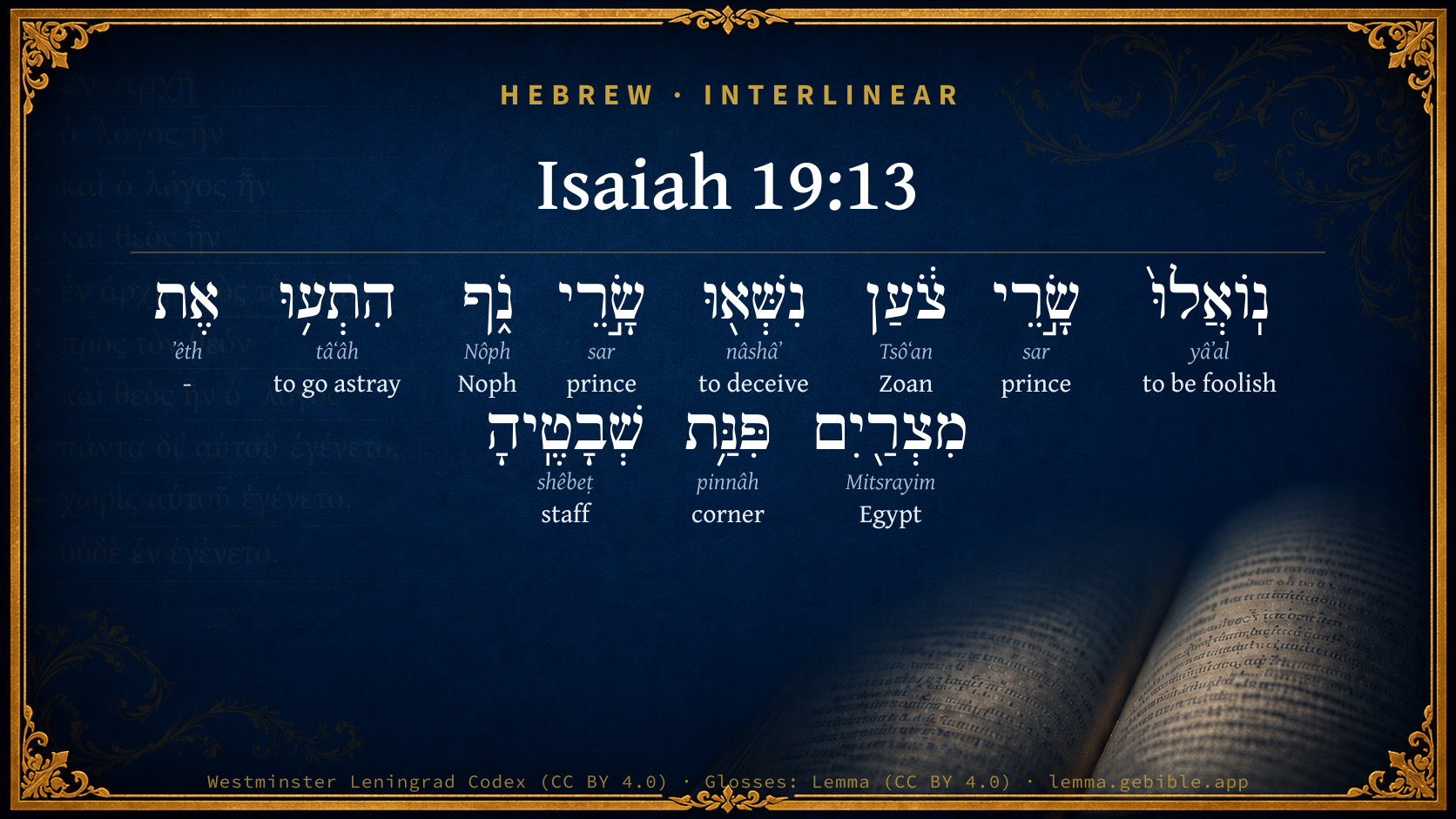
Hebrew (Westminster Leningrad Codex) Isaiah 19:13 appears in the Hebrew Old Testament. The text above is from the Westminster Leningrad Codex. Each word links to its Strong’s number, a concise gloss, and parsing drawn from the Open Scriptures Hebrew Bible morphology. Click any word for its full Brown-Driver-Briggs (BDB) entry.
Download image
Cite this verse

Isaiah 19:13 (World English Bible). Public Domain. Lemma interlinear Bible study tool, https://lemma.gebible.app/v/isaiah/19/13.

Show BibTeX & RIS
BibTeX
RIS
English Translation
The princes of Zoan are become fools, the princes of Memphis are deceived; they have caused Egypt to go astray, who are the corner-stone of her tribes.
World English Bible · Public Domain
Highlights
  • 1 first appearance in the Hebrew Bible
Full analysis ↓
Download a study sheet

One document with this verse’s original text, its word-by-word gloss line, the meaning frame, cross-references with their text, attributed commentary, and full source and license credits — printable, and it pastes into notes with its structure intact.

This verse Autodidact and up

Study sheet (.html) Plain text (.txt)

A passage Seminary Student

Up to 50 verses in one chapter. A passage sheet keeps up to 6 commentary sources and 12 cross-references per verse, in the order this page ranks them, and says so on the sheet whenever that leaves anything out. Ask for a single verse and you get the Autodidact verse sheet above.

Everything on this page stays free to read, with no account — the sheet is a download of what is already on screen, not access to it.

Want to remove ads? Support Godless Engineer
Compare translations 3

The same verse in 3 English versions, stacked beneath the original-language interlinear above. Click any original word for its lexicon entry.

Each is an independent rendering of the whole verse — the interlinear is not word-aligned to these translations.

Highlighted words mark where these versions differ — a whole-verse word diff, not a word-by-word alignment.

  • World English Bible Public Domain
    The princes of Zoan are become fools, the princes of Memphis are deceived; they have caused Egypt to go astray, who are the corner-stone of her tribes.
  • King James Version Public Domain
    The princes of Zoan are become fools, the princes of Noph are deceived; they have also seduced Egypt, even they that are the stay of the tribes thereof.
  • unfoldingWord Literal Text CC BY-SA 4.0
    The princes of Zoan have made themselves foolish; the princes of Noph have deceived themselves. They have led Egypt astray, the cornerstone of its tribes.

unfoldingWord Literal Text — © unfoldingWord, licensed CC BY-SA 4.0. Word-aligned USFM3 via Door43 (git.door43.org/unfoldingWord/en_ult).

Versions to compare (up to 4)

3 of 4 selected

Show all 18 translations

Every available English version of this verse, each an independent rendering of the whole verse.

  • World English Bible Public Domain
    The princes of Zoan are become fools, the princes of Memphis are deceived; they have caused Egypt to go astray, who are the corner-stone of her tribes.
  • Berean Standard Bible Public Domain
    The princes of Zoan have become fools; the princes of Memphis are deceived. The cornerstones of her tribes have led Egypt astray.
  • Majority Standard Bible Public Domain
    The princes of Zoan have become fools; the princes of Memphis are deceived. The cornerstones of her tribes have led Egypt astray.
  • King James Version Public Domain
    The princes of Zoan are become fools, the princes of Noph are deceived; they have also seduced Egypt, even they that are the stay of the tribes thereof.
  • American Standard Version (1901) Public Domain
    The princes of Zoan are become fools, the princes of Memphis are deceived; they have caused Egypt to go astray, that are the corner-stone of her tribes.
  • Revised Version (1885) Public Domain
    The princes of Zoan are become fools, the princes of Noph are deceived; they have caused Egypt to go astray, that are the corner stone of her tribes.
  • Geneva Bible (1599) Public Domain
    The princes of Zoan are become fooles: the princes of Noph are deceiued, they haue deceiued Egypt, euen the corners of the tribes thereof.
  • Douay-Rheims (1899) Public Domain
    The princes of Tanis are become fools, the princes of Memphis are gone astray, they have deceived Egypt, the stay of the people thereof.
  • Young's Literal Translation Public Domain
    Foolish have been princes of Zoan, Lifted up have been princes of Noph, And they have caused Egypt to err, The chief of her tribes.
  • Literal Standard Version CC BY-SA 4.0
    Princes of Zoan have been foolish, || Princes of Noph have been lifted up, || And they have caused Egypt to err, || The chief of her tribes.
  • Unlocked Literal Bible CC BY-SA 4.0
    The princes of Zoan have become fools, the princes of Memphis are deceived; they have made Egypt go astray, who are the cornerstones of her tribes.
  • unfoldingWord Literal Text CC BY-SA 4.0
    The princes of Zoan have made themselves foolish; the princes of Noph have deceived themselves. They have led Egypt astray, the cornerstone of its tribes.
  • Darby Bible Public Domain
    The princes of Zoan are become foolish, the princes of Noph are deceived; and the corner-stones of its tribes have caused Egypt to err.
  • World Messianic Bible Public Domain
    The princes of Zoan have become fools. The princes of Memphis are deceived. They have caused Egypt to go astray, those who are the cornerstone of her tribes.
  • Webster's Bible Public Domain
    The princes of Zoan are become fools, the princes of Noph are deceived; they have also seduced Egypt, even they that are the support of its tribes.
  • Free Bible Version CC BY-SA 4.0
    The leaders of Zoan have become stupid; the leaders of Memphis have been fooled; the important leaders of Egypt have misled their people.
  • Bible in Basic English Public Domain
    The chiefs of Zoan have become foolish, the chiefs of Noph are tricked, the heads of her tribes are the cause of Egypt's wandering out of the way.
  • JPS Tanakh (1917) Public Domain
    The princes of Zoan are become fools, the princes of Noph are deceived; they have caused Egypt to go astray, that are the corner-stone of her tribes.

Literal Standard Version (2020), Covenant Press — licensed CC BY-SA 4.0. Text via the HelloAO Bible API (eBible.org). Unlocked Literal Bible (unfoldingWord) — licensed CC BY-SA 4.0. Text via the HelloAO Bible API (eBible.org). unfoldingWord Literal Text — © unfoldingWord, licensed CC BY-SA 4.0. Word-aligned USFM3 via Door43 (git.door43.org/unfoldingWord/en_ult). Free Bible Version, Dr. Jonathan Gallagher — licensed CC BY-SA 4.0. Text via the HelloAO Bible API (eBible.org).

Word by word

More ways to search: Search by grammar → Find every occurrence → Compare this word →

Practice this passage: Drill this verse → Learn its vocabulary →

נֽוֹאֲלוּ֙
yâʼal
H2973
“to be foolish”
Verb, Niphal, Perfect, 3rd Person, Common, Plural
Part of Speech
Verb
Stem
Niphal
Form
Perfect
Person
3rd Person
Gender
Common
Number
Plural
Full BDB Definition

Origin: a primitive root

TWOT: 830

to be foolish, become fools, act foolishly, show wicked folly - (Niphal) - to show wicked folly - to become fools
  1. שָׂ֣רֵי sar H8269 “princes of” Noun, Common, Masculine, Plural, Construct
  2. צֹ֔עַן Tsôʻan H6814 “Zoan” Noun, Proper
  3. נִשְּׁא֖וּ nâshâʼ H5377 “to deceive” Verb, Niphal, Perfect, 3rd Person, Common, Plural
  4. שָׂ֣רֵי sar H8269 “princes of” Noun, Common, Masculine, Plural, Construct
  5. נֹ֑ף Nôph H5297 “Noph” Noun, Proper
  6. הִתְע֥וּ tâʻâh H8582 “to go astray” Verb, Hiphil, Perfect, 3rd Person, Common, Plural
  7. אֶת ʼêth H853 “-” Particle, Direct Object
  8. מִצְרַ֖יִם Mitsrayim H4714 “Egypt” Noun, Proper
  9. פִּנַּ֥ת pinnâh H6438 “corner of” Noun, Common, Feminine, Singular, Construct
  10. שְׁבָטֶֽיהָ shêbeṭ H7626 “staffs · her” Noun, Common, Masculine, Plural, Construct + Suffix, Personal, 3rd Person, Feminine, Singular

About this verse

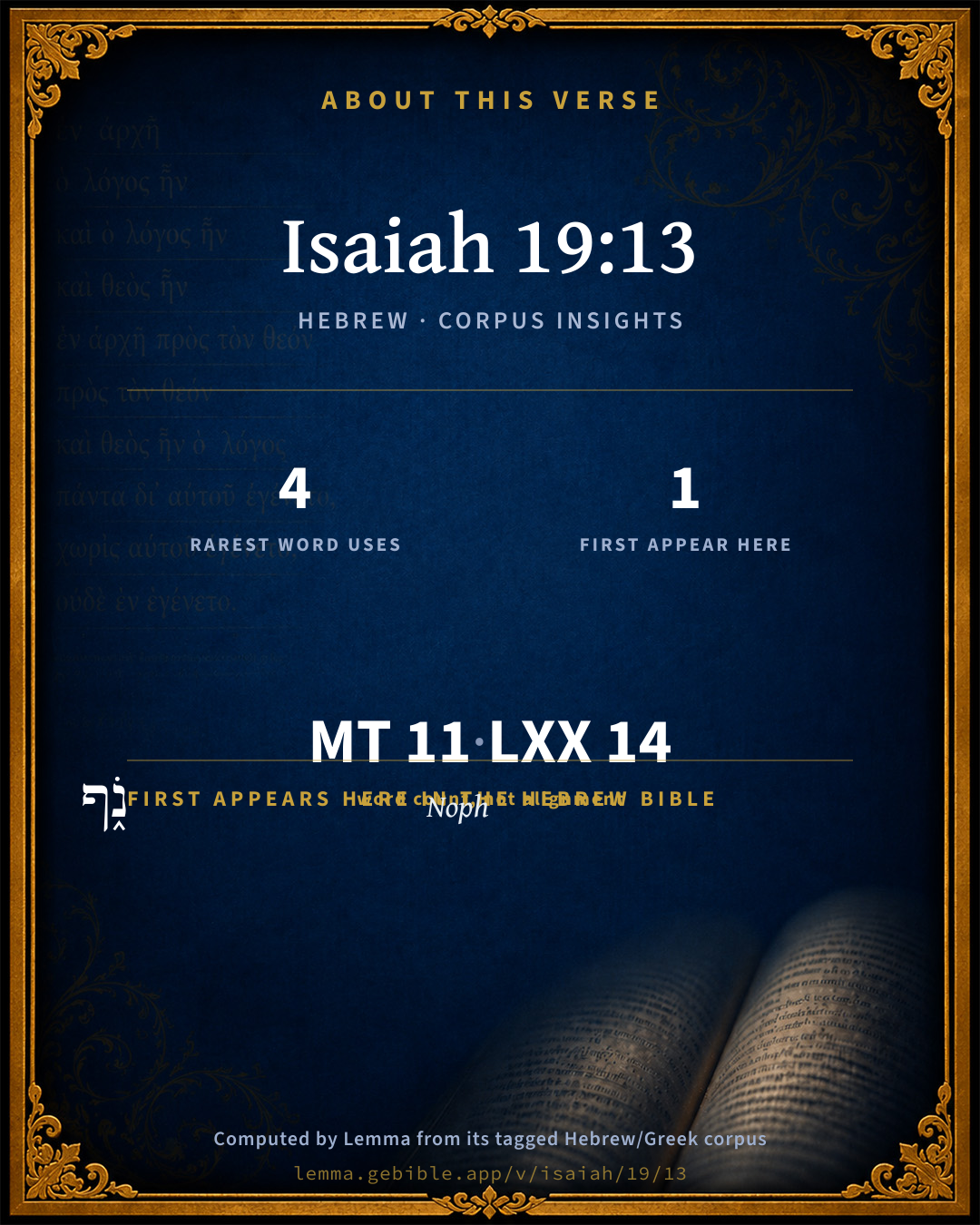
These counts appear in no published source. They are computed here, from the morphology-tagged text and Lemma’s own curated glosses. What Lemma adds →

11
words
10
distinct lemmas
Prophets
section

Notable vocabulary

The rarest word here is נֽוֹאֲלוּ֙ to be foolish H2973 — appearing just 4 times in the whole Hebrew Bible.

First appearance in Scripture

This word makes its first canonical appearance in the Hebrew Bible here:

Shared distinctive vocabulary

נֽוֹאֲלוּ֙ to be foolish H2973 occurs in 4 verses of the Hebrew Bible. Also found in:

Grammatical profile

  • 3 verbs
  • 7 nouns
  • 1 particle

Verb forms

  • נֽוֹאֲלוּ֙ Niphal · Perfect
  • נִשְּׁא֖וּ Niphal · Perfect
  • הִתְע֥וּ Hiphil · Perfect

Repetition

A word recurs within this verse — often emphatic in Hebrew:

  • שָׂ֣רֵי prince H8269 ×2

Hebrew & Septuagint length

In English translation the verse runs 27 words from the Hebrew and 25 from the Septuagint (LXX English) — closely comparable.

A rough comparison of the two English renderings, which tokenize alike — not a word-level alignment.

Word counts can differ between the Hebrew and the Greek without any difference in meaning — e.g. the Hebrew direct-object marker אֵת has no separate Greek word, and Greek often adds the article ὁ.

In the original languages it is 11 Hebrew tokens and 14 Greek tokens — but the two are counted differently (Hebrew bundles its prefixes and suffixes into one token; the Greek is in lemma form), so that isn’t a like-for-like length.

Cross-references

11

Topical passages linked to Isaiah 19:13 in the Treasury of Scripture Knowledge — connected by theme and wording, ordered by reader-vote popularity; previews shown in the World English Bible.

  • Jeremiah 2:16 The children also of Memphis and Tahpanhes have broken the crown of your head.
  • Ezekiel 30:13 Thus says the Lord Yahweh: I will also destroy the idols, and I will cause the images to cease from Memphis; and there shall be no more a prince from the land of Egypt: and I will put a fear in the land of Egypt.
  • Jeremiah 46:14 Declare you in Egypt, and publish in Migdol, and publish in Memphis and in Tahpanhes: say you, Stand forth, and prepare you; for the sword has devoured round about you.
  • Jeremiah 46:19 You daughter who dwell in Egypt, furnish yourself to go into captivity; for Memphis shall become a desolation, and shall be burnt up, without inhabitant.
  • Zechariah 10:4 From him will come forth the corner-stone, From him the nail, From him the battle bow, From him every ruler together.
  • Isaiah 19:11 The princes of Zoan are utterly foolish; the counsel of the wisest counselors of Pharaoh is become brutish: how do you say to Pharaoh, I am the son of the wise, the son of ancient kings?
  • Numbers 24:17 I see him, but not now; I see him, but not near: There shall come forth a star out of Jacob, A scepter shall rise out of Israel, Shall strike through the corners of Moab, Break down all the sons of tumult.
  • 1 Samuel 14:38 Saul said, Draw near here, all you chiefs of the people; and know and see in which this sin has been this day.
  • Ezekiel 30:16 I will set a fire in Egypt: Sin shall be in great anguish, and No shall be broken up; and Memphis [shall have] adversaries in the day-time.
  • Romans 1:22 Professing themselves to be wise, they became fools,
  • 1 Peter 2:7 For you therefore who believe is the honor, but for such as are disobedient, "The stone which the builders rejected, Has become the chief cornerstone,"

Cross-references courtesy of OpenBible.info (CC BY 4.0).

Hebrew and Greek witnesses Masoretic Hebrew ↔ Greek Septuagint

The same verse in the two great witnesses to the Old Testament, shown verse-for-verse.

These are two independent witnesses, not word-aligned to each other, and the Septuagint is shown in lemma (dictionary) form.

Hebrew Isaiah 19:13 Masoretic · Westminster Leningrad Codex

נֽוֹאֲלוּ֙ שָׂ֣רֵי צֹ֔עַן נִשְּׁא֖וּ שָׂ֣רֵי נֹ֑ף הִתְע֥וּ אֶת מִצְרַ֖יִם פִּנַּ֥ת שְׁבָטֶֽיהָ

The princes of Zoan are become fools, the princes of Memphis are deceived; they have caused Egypt to go astray, who are the corner-stone of her tribes.

World English Bible · Public Domain

Greek LXX Isaiah 19:13 Septuagint · lemma form

ἐκλείπω ὁ ἄρχων τάνις καί ὑψόω ὁ ἄρχων μέμφις καί πλανάω αἴγυπτος κατά φυλή

The princes of Tanis have failed, and the princes of Memphis are lifted up with pride, and they shall cause Egypt to wander by tribes.

LXX2012 (modern English Septuagint) · Public Domain

On this verse, Ellicott's Commentary for English Readers discusses the Septuagint’s reading. Read the note in Commentary ↓

Hebrew: Westminster Leningrad Codex (CC BY 4.0). Greek: Septuagint (public domain); English from LXX2012 (modern English Septuagint) (Public Domain). How the Septuagint differs from the Hebrew →

Targum (Aramaic paraphrase)

1

The Targum is the ancient Jewish Aramaic paraphrase of the Hebrew Scriptures — an interpretive translation, not the Hebrew text itself. Onkelos (literal) and Pseudo-Jonathan (expansive) render the Torah, and Jonathan the Prophets. Coverage is partial: where no permissively-licensed English translation exists for a verse, only the Aramaic is shown. This is verse-level text, not a word-by-word alignment to the Hebrew.

  1. Targum Jonathan Prophets (Joshua–Malachi)
    אִטְפַּשׁוּ רַבְרְבֵי טָאנֵס טְעוֹ אֱנָשׁ מַפִיס אַטְעַיוּ יַת מִצְרָאֵי רַבָּנֵי פַלְכָהָא:

    The princes of Tanes have become foolish, the men of Memphis have erred; they caused the Egyptians, the lords of the provinces, to err.

    Targum Jonathan — Aramaic: “Mikraot Gedolot” (public domain). English: “Sefaria Community Translation” (CC0 1.0 (public-domain dedication)); “London "Chaldee Paraphrase," 1871” (public domain). Text via Sefaria.

Commentary

Notes on Isaiah 19:13 from classic Christian and Jewish commentators (each source and its license shown beneath its notes). The classic Christian expositions comment on the surrounding passage and are grouped to its opening verse, so a note may address several verses; the Jewish commentaries on the Tanakh (Rashi and others) are per-verse, so they appear only where the commentator wrote on this verse.

Lemma curates 59 commentaries, every one of them public domain or Creative Commons licensed, each selected and text-cleaned for this edition rather than reprinted as found. About our sources →

Trapp's Complete Commentary

John Trapp

Isa 19:13 The princes of Zoan are become fools, the princes of Noph are deceived; they have also seduced Egypt, [even they that are] the stay of the tribes thereof.

Ver. 13. The princes of Zoan are become fools.] Wilful fools; this they are told twice over, because hardly persuaded to it. See Isa 19:11.

The princes of Noph.] Called also Moph, {Hos 9:6} and therehence Memphis, now Grand Cairo, famous once for the pyramids and monuments of the Egyptian kings.

Even they that are the stay of the tribes thereof.] Heb., The corners {a} of the tribes or rectories - that is, either the king and chieftains, as some sense it; or, as others, all the inhabitants of the country, from one corner thereof unto another. How these wise men of Egypt deceived others is not expressed; but probably they did it by approving and cherishing the superstition, impiety, and carnal security of the princes and people.

{a} The free states of Switzerland are called cantons - i.e., corners.

John Trapp, A Commentary or Exposition upon All the Books of the Old and New Testament (1647–1656) — public domain. Text from a community e-Sword module.

Tyndale Open Study Notes

Tyndale Open Resources

19:13 Memphis was an ancient capital in Egypt located south of the Nile delta. It was destroyed by Esarhaddon in 671 BC.

Tyndale Open Study Notes — © Tyndale Open Resources, licensed CC BY-SA 4.0. Text via the HelloAO Bible API.

Geneva Bible (1599)

Geneva Bible translators

The principal upholders thereof are the chiefest cause of their destruction.

Or, Memphis, others Alexandria, and now called the great Cairo.

Geneva Bible (1599) marginal notes — public domain. Text via Bolls.life.

Jamieson, Fausset & Brown

Robert Jamieson, A. R. Fausset & David Brown

Noph--called also Moph; Greek, Memphis (Hos 9:6); on the western bank of the Nile, capital of Lower Egypt, second only to Thebes in all Egypt: residence of the kings, until the Ptolemies removed to Alexandria; the word means the "port of the good" [PLUTARCH]. The military caste probably ruled in it: "they also are deceived," in fancying their country secure from Assyrian invasion.

stay of . . . tribes--rather, "corner-stone of her castes" [MAURER], that is, the princes, the two ruling castes, the priests and the warriors: image from a building which rests mainly on its corner-stones (see on Isa 19:10; Isa 28:16; Psa 118:22; Num 24:17, Margin; Jdg 20:2; Sa1 14:28, Margin; Zac 10:4).

Jamieson, Fausset & Brown — Commentary Critical and Explanatory on the Whole Bible (1871) — public domain (CC PDM 1.0). Text via the HelloAO Bible API.

Adam Clarke's Commentary

Verse 13. Are deceived - "They have caused," &c.] The text has וחתעו vehithu, AND they have caused to err. Fifty of Kennicott's MSS., fifty-three of De Rossi's, and one of my own, ancient, thirty-two editions, and the Vulgate and Chaldee. omit the ו vau, and.

Stay - "Pillars"] פנת pinnath, to be pointed as plural pinnoth, without doubt. So Grotius, and so the Chaldee.

Adam Clarke's Commentary on the Bible (1810–1826) — public domain. Text from a community e-Sword/MySword module.

Ellicott's Commentary for English Readers

(13) The princes of Noph.—Probably, as in the LXX., Noph is the same as Memphis. The name has been derived (1) from Ma-m-pthah (“the house of Pthah,” an Egyptian deity of the Hephæstos, or Yulcan type); or (2), and more correctly, from Men-nepher (“place of the good”). This also was, as in Hos_9:6 (where we have the form Moph), one of the chief royal cities of Lower Egypt, and the seat of the Ethiopian dynasty then ruling.

Even they that are the stay of the tribes thereof.—Better, the corner-stone of the castes. The word is the same as the “corner” of Zec_10:4, the “chief” of Jdg_20:2; 1Sa_14:38, and describes the position of superiority among the Egyptian castes claimed by the priest-rulers of Zoan and Noph.

A Bible Commentary for English Readers, edited by Charles John Ellicott (1878–1897) — public domain. Text from a community e-Sword module.

The Cambridge Bible for Schools and Colleges

gen. ed. J. J. S. Perowne

13. are become fools] Better are befooled—“stultified.” Noph is Memphis, the capital of Lower Egypt, and an ancient seat of Egyptian religion and learning. An older form of the Hebrew name is apparently Moph (Hos_9:6); both forms are perhaps contracted from Mnoph (hieroglyphic Mennofer). The city was situated in the southern corner of the Delta, near Cairo, which was largely built from its ruins.

even they that are the stay of the tribes thereof] Render the corner-stone of her tribes, i.e. her ruling caste. For the metaphor, cf. Jdg_20:2; 1Sa_14:38; Zec_10:4. The “tribes” may be either the castes or the nomes (cantons).

The Cambridge Bible for Schools and Colleges (gen. ed. J. J. S. Perowne; Cambridge University Press, 1878–1918) — public domain. Text from a community e-Sword module.

John Gill's Exposition

The princes of Zoan are become fools,.... Or infatuated, in their counsels to Pharaoh, and by giving heed to the magicians and diviners; See Gill on Isa 19:11,

the princes of Noph are deceived; called Moph, in Hos 9:6 where our translation renders it Memphis; and so do the Septuagint and Vulgate Latin versions here; the Arabic version has it Menphis; the Syriac version Mophis; and the Targum Mephes; the city of Memphis is no doubt intended, which was the chief of the first of the nomes or provinces of Egypt, from whence it was called Memphites: it was the metropolis of upper Egypt, and the seat of their kings and princes; it was built by their first king Menes (t), or Mizraim, and had in it the famous temple of Vulcan; it continues to this day, and goes by the name of Alkair, or Grand Cairo:

they have also seduced Egypt; the princes of the above places, being deceived themselves by the diviners and astrologers, deceived the common people that inhabited the nomes and provinces where they dwelt; it being usual with such to follow their superiors in principle and practice:

even they that are the stay of the tribes thereof; or, "who are the corner of its tribes" (u); meaning the nomes or provinces of Egypt, especially the Tanitic and Memphitic nomes, whose provinces are mentioned; these are called tribes by the prophet, in the language of the Jews, which land were divided into tribes, as the land of Egypt was divided into nomes; and about this time it was divided into twelve kingdoms, as Israel was into twelve tribes: now, the princes of these tribes and kingdoms, who should have been as cornerstones, to which civil magistrates are compared, see Psa 118:22 the stay and support of the people, and should have kept them right, these led them wrong, into mistakes and errors.

(t) Ib. (Herodot. l. 2.) c. 99. (u) "angulus vel tribuum ejus"; so some in Vatablus.

John Gill's Exposition of the Whole Bible (1746–1763) — public domain (CC PDM 1.0). Text via the HelloAO Bible API.

Albert Barnes' Notes on the Bible

The princes of Zoan - (the note at Isa 19:11). This “repetition” is intensive and emphatic, and shows the deep conviction of the prophet of their folly. The design is to show that “all” the counselors on which the Egyptians depended were fools.

The princes of Noph - The Vulgate, the Septuagint, and the Chaldee, render this ‘Memphis,’ and there is no doubt that this is the city intended. The name Memphis may have easily arisen from Noph. It was written also “Moph,” and hence, Memphis. It is called “Menouf” by the Copts and Arabians. According to Plutarch, the name Memphis means “the port of the good.” The situation of Memphis has been a subject of considerable dispute, and has afforded matter for long and laborious investigation. Sicard and Shaw fix its site at Djezeh or Ghizeh, opposite to old Cairo. Pococke, D’Anville, Niebuhr, and other writers and travelers, place Memphis more in the direction of Mitraheny, about fifteen miles further south, on the banks of the Nile, at the entrance of the plain of the mummies, at the north of which the pyramids are placed. It was the residence of the ancient kings of Egypt until the time of the Ptolemies, who commonly resided at Alexandria. Memphis retained its splendor until it was conquered by the Arabians, about 641 a.d. At the supposed site of Memphis south of Ghizeh, there are large mounds of rubbish, a colossal statue sunk in the ground, and a few fragments of granite, which remain to test the existence of this renowned capital. In Strabo’s time, although partly in ruins, it was yet a populous city, second only to Alexandria. The total disappearance of the ancient edifices of Memphis is easily accounted for by the circumstance, that the materials were employed for the building of adjacent cities. Fostal rose out of the ruins, and when that city was again deserted, these ruins migrated again to the more modern Cairo (see Robinson’s “Bib. Researches,” vol. i. p. 40).

They have also seduced Egypt - That is, they have by their counsels caused it to err, and have led it into its present embarrassment.

The stay ... - Hebrew, פנה pinnâh - the “corner; that is, those who should have been the support. So the word is used to denote the head or leader of a people in Jdg 20:2, Jdg 20:14; 1Sa 14:38; Psa 118:22; Isa 28:16; Zec 10:4.

Albert Barnes' Notes on the Bible (1834–1885) — public domain. Text from a community e-Sword/MySword module.

Haydock's Catholic Bible Commentary

Memphis. The seat of many kings, and a very ancient city. Hebrew, "Hoph." --- Stay. Literally, "angle," denoting the chiefs, or all the land, Judges xx. 2.

George Leo Haydock (1774–1849), Haydock's Catholic Family Bible and Commentary, 1859 edition — public domain. Excludes Psalms (Douay-Rheims chapter numbering differs from Protestant) and Deuterocanonical books (Catholic canon only).

Matthew Poole's English Annotations

Noph; another chief city, and one of the king’s seats, so called also Jer 2:16; 44:1; called also Moph in the Hebrew text, Hos 9:6; and by other and later authors, Memphis.

Even they that are the stay, Heb. even the corner, or the corner-stone, which is the chief support of the building. Whereby he may design either,

1. The king; or,

2. Some eminent statesman of that age, upon, whose counsels both king and people depended; or

3. Their chief counsellors, the, singular number being then put collectively, as it is in many other places. The tribes of the provinces, which he calls by a title borrowed from the Hebrews, in whose language he spake and wrote this prophecy.

Matthew Poole's English Annotations on the Holy Bible (1683–1685) — public domain. Text from a community e-Sword/MySword module.

The Pulpit Commentary

The princes of Noph. There are no grounds for changing "Noph" into "Moph." "Noph" is probably "Napata," known as "Nap" in the hieroglyphic inscriptions the original capital of the Ethiopian kings, and, when Memphis had become their capital, still probably regarded as the second city of the empire. The "princes of Noph" would be Tirhakah"s counselors. They have also, etc. Translate, Even they have led Egypt astray, who are the corner-stone of her tribes. Strictly speaking, there were no "tribes" in Egypt, much less "castes," but only classes, marked out by strong lines of demarcation the one from the other. Herodotus gives seven of them (2. 164) priests, soldiers, herdsmen, swineherds, tradesmen, interpreters, and boatmen. But there were several others also, e.g. agricultural laborers, fishermen, artisans, official employee, etc.

The Pulpit Commentary (1880–1919), ed. H.D.M. Spence-Jones & Joseph S. Exell — public domain. Text from a community e-Sword module.

John Wesley's Explanatory Notes

Noph - Another chief city, and one of the kings seats, called also Moph, and by latter authors, Memphis. The stay - Their chief counsellors. Tribes - Of the provinces, which he calls by a title borrowed from the Hebrew, in whose language he spake and wrote this prophecy.

John Wesley, Explanatory Notes Upon the Whole Bible (1754–1765) — public domain. Text via the GEBible commentary corpus.

J. A. Alexander on Isaiah

Joseph Addison Alexander

“Infatuated are the chiefs of Zoan, deceived are the chiefs of Noph, and they have misled Egypt, the corner (or corner-stone) of her tribes.” Noph is the Memphis of the Greek geographers, called Noph (Hos 9:6). It was one of the chief cities of ancient Egypt, the royal seat of Psammetichus. After Alexandria was built it declined. Arabian writers in the twelfth and thirteenth centuries speak of its extensive and magnificent ruins, which have now almost wholly disappeared.

Joseph Addison Alexander, The Prophecies of Isaiah (1846–1847; New York: Scribner, 1870–1878) — public domain. Text from a community e-Sword module.

unfoldingWord translationNotes

Door43 World Missions Community

they have made Egypt go astray, who are the cornerstones of her tribes

The princes of Zoan and Memphis are spoken of as if they are the cornerstones of buildings because they are an important part of the community. AT: "the leaders have made Egypt go astray" (See: Metaphor)

princes of Zoan

Zoan is a city in northern Egypt. See how you translated this in Isaiah 19:11.

Memphis

This is a city in the northern part of Egypt. (See: How to Translate Names)

made Egypt go astray

The word "Egypt" represents the people of Egypt. Going astray represents doing what is wrong. AT: "made the people of Egypt go astray" or "made the people of Egypt do what is wrong" (See: Metonymy and Metaphor)

Yahweh has mixed a spirit of distortion into her midst

Isaiah speaks of Yahweh's judgment as if Egypt was a cup of wine. He speaks of Yahweh causing the leaders' thoughts to be distorted as if their distorted thoughts were a liquid that Yahweh mixed in with the wine. AT: "Yahweh has judged them by distorting their thoughts" or "Yahweh has judged Egypt by distorting its leaders' thoughts, as intoxicating drinks confuse people's thoughts" (See: Metaphor)

distortion

"perverseness" or "confusion"

into her midst

Here "her" refers to Egypt. Nations are sometimes spoken of as if they were women. AT: "within Egypt" (See: Personification)

they have led Egypt astray

Here, "they" refers to the leaders described in the previous verses. The word "Egypt" represents the people of Egypt. AT: "the princes have led the people of Egypt astray" (See: Metonymy)

have led Egypt astray

Leading people astray represents influencing them to do what is wrong. (See: Metaphor)

like a drunk staggering in his vomit

Isaiah speaks of the people of Egypt doing what is wrong as if they were made to wander about like a drunken person. (See: Simile)

whether head or tail

The "head," the part of an animal a person would want to be, represents the leader. The "tail" is the opposite and represents people who follow. AT: "whether leader or follower" (See: Metaphor)

palm branch or reed

The "palm branch" grows high on the tree and represents people who are wealthy and important. The "reed" grows in shallow water and represents people who are poor and unimportant. See how you translated similar phrases in Isaiah 9:14. AT: "whether they are important or unimportant" or "whether rich or poor" (See: Metaphor)

translationWords

prince

fool

deceive

Egypt

astray

cornerstone

tribe

Yahweh

spirit

unfoldingWord translationNotes — © Distant Shores Media and the Door43 World Missions Community, licensed CC BY-SA 4.0. Source: git.door43.org/Door43/en_tn.

Rashi

Rabbi Shlomo Yitzchaki (Rashi)

have become foolish Heb. נוֹאֲלוּ, an expression related to אֱלִילִים, fools.

have been misled Heb. נָשְּׁאוּ, have been misled. Comp. (Gen. 3:13) “The snake misled me (הִשִּׁיאַנִּי) and I ate.”

Rashi on the Tanakh — English translations: “The Judaica Press complete Tanach with Rashi, translated by A. J. Rosenberg” (CC BY 4.0); “Pentateuch with Rashi's commentary by M. Rosenbaum and A.M. Silbermann, 1929-1934” (public domain); “The Metsudah Tanach series, Lakewood, N.J” (CC BY 4.0); and “The Book of Joshua, Metsudah Publications, 1997” (CC BY 4.0). Text via Sefaria.

Ibn Ezra

Rabbi Abraham ibn Ezra

נואלו Are become fools. Comp. נואלנו we acted foolishly (Num. 12:11).

נשאו They are deceived. Comp. השיאני hath beguiled me (Gen. 3:13); it is Niphal.

פנת The stay. The nobles. Comp. פנות the chiefs (Judges 20:2).

שבטיה The tribes thereof, that is, her families.

Ibn Ezra on the Tanakh — English translations: “Sefaria Community Translation” (CC0 1.0 (public-domain dedication)); “Yalkut, Sifsei Chachomim Chumash, Metsudah Publications, 2009” (CC BY 4.0); and “Commentary of Ibn Ezra on Isaiah - trans. by M. Friedlander, 1873” (public domain). Text via Sefaria.

Lesson kit

Teaching starters — assembled from the data on this page, not authored interpretation. Every prompt links to the verse data it draws on. Edit before teaching.

Isaiah, in the Prophets, opens this verse with 11 words (10 distinct Hebrew lemmas). Its most distinctive word is yâʼal (“to be foolish”). A historical commentator’s framing appears above. Read the whole chapter for the surrounding context.

Discussion questions

  1. What does “to be foolish” (yâʼal) contribute to the verse as a whole?
  2. This is the first place “Noph” appears in Scripture (first appears here). What does its debut here establish?
  3. How does Numbers 12:11, which shares the word «to be foolish», read alongside this verse?
  4. What does the repetition of “prince” (2× in this one verse) do in this verse?
  5. These translations render this verse differently; the difference is in the English rendering, not the original. What questions does that raise?
  6. «נֽוֹאֲלוּ֙» is a Niphal Perfect verb. How does that grammatical form shape the action described?
  7. Compare how Trapp's Complete Commentary and Tyndale Open Study Notes read this verse. Where do they agree or differ?

Things to notice

Reading settings

Reading text

Shown beneath each verse's original-language words.

Old Testament
Old Testament edition

Read the OT as the Masoretic Hebrew (MT) or the Greek Septuagint (LXX).

English shown for the Greek Septuagint (in the Hebrew ↔ Greek comparison).

Comparing translations? Open the Compare panel on any verse page to stack up to four side by side.