
Jeremiah 9:26

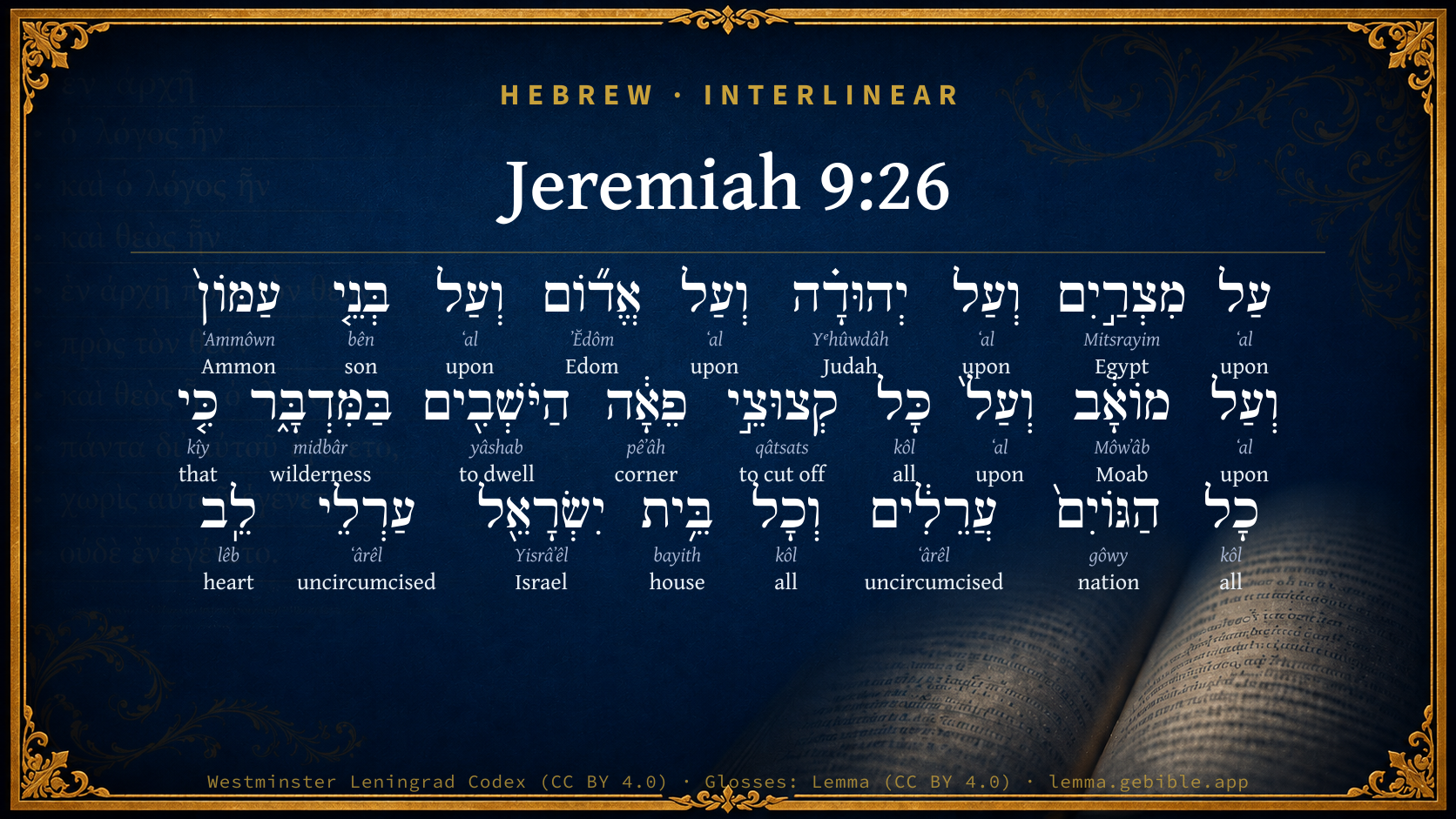
Hebrew (Westminster Leningrad Codex) Jeremiah 9:26 appears in the Hebrew Old Testament. The text above is from the Westminster Leningrad Codex. Each word links to its Strong’s number, a concise gloss, and parsing drawn from the Open Scriptures Hebrew Bible morphology. Click any word for its full Brown-Driver-Briggs (BDB) entry.
Download image
Cite this verse

Jeremiah 9:26 (World English Bible). Public Domain. Lemma interlinear Bible study tool, https://lemma.gebible.app/v/jeremiah/9/26.

Show BibTeX & RIS
BibTeX
RIS
English Translation
Egypt, and Judah, and Edom, and the children of Ammon, and Moab, and all that have the corners [of their hair] cut off, who dwell in the wilderness; for all the nations are uncircumcised, and all the house of Israel are uncircumcised in heart.
World English Bible · Public Domain
Download a study sheet

One document with this verse’s original text, its word-by-word gloss line, the meaning frame, cross-references with their text, attributed commentary, and full source and license credits — printable, and it pastes into notes with its structure intact.

This verse Autodidact and up

Study sheet (.html) Plain text (.txt)

A passage Seminary Student

Up to 50 verses in one chapter. A passage sheet keeps up to 6 commentary sources and 12 cross-references per verse, in the order this page ranks them, and says so on the sheet whenever that leaves anything out. Ask for a single verse and you get the Autodidact verse sheet above.

Everything on this page stays free to read, with no account — the sheet is a download of what is already on screen, not access to it.

Want to remove ads? Support Godless Engineer
Compare translations 3

The same verse in 3 English versions, stacked beneath the original-language interlinear above. Click any original word for its lexicon entry.

Each is an independent rendering of the whole verse — the interlinear is not word-aligned to these translations.

Highlighted words mark where these versions differ — a whole-verse word diff, not a word-by-word alignment.

  • World English Bible Public Domain
    Egypt, and Judah, and Edom, and the children of Ammon, and Moab, and all that have the corners [of their hair] cut off, who dwell in the wilderness; for all the nations are uncircumcised, and all the house of Israel are uncircumcised in heart.
  • King James Version Public Domain
    Egypt, and Judah, and Edom, and the children of Ammon, and Moab, and all that are in the utmost corners, that dwell in the wilderness: for all these nations are uncircumcised, and all the house of Israel are uncircumcised in the heart.
  • unfoldingWord Literal Text CC BY-SA 4.0
    upon Egypt and upon Judah, and upon Edom and upon the sons of Ammon, and upon Moab and upon all of those being cut off of corner, those dwelling in the desert, for all of the nations uncircumcised, and all of the house of Israel uncircumcised of heart.”

unfoldingWord Literal Text — © unfoldingWord, licensed CC BY-SA 4.0. Word-aligned USFM3 via Door43 (git.door43.org/unfoldingWord/en_ult).

Versions to compare (up to 4)

3 of 4 selected

Show all 18 translations

Every available English version of this verse, each an independent rendering of the whole verse.

  • World English Bible Public Domain
    Egypt, and Judah, and Edom, and the children of Ammon, and Moab, and all that have the corners [of their hair] cut off, who dwell in the wilderness; for all the nations are uncircumcised, and all the house of Israel are uncircumcised in heart.
  • Berean Standard Bible Public Domain
    Egypt, Judah, Edom, Ammon, Moab, and all the inhabitants of the desert who clip the hair of their temples. For all these nations are uncircumcised, and the whole house of Israel is uncircumcised in heart.”
  • Majority Standard Bible Public Domain
    Egypt, Judah, Edom, Ammon, Moab, and all the inhabitants of the desert who clip the hair of their temples. For all these nations are uncircumcised, and the whole house of Israel is uncircumcised in heart.”
  • King James Version Public Domain
    Egypt, and Judah, and Edom, and the children of Ammon, and Moab, and all that are in the utmost corners, that dwell in the wilderness: for all these nations are uncircumcised, and all the house of Israel are uncircumcised in the heart.
  • American Standard Version (1901) Public Domain
    Egypt, and Judah, and Edom, and the children of Ammon, and Moab, and all that have the corners `of their hair' cut off, that dwell in the wilderness; for all the nations are uncircumcised, and all the house of Israel are uncircumcised in heart.
  • Revised Version (1885) Public Domain
    Egypt, and Judah, and Edom, and the children of Ammon, and Moab, and all that have the corners of their hair polled, that dwell in the wilderness: for all the nations are uncircumcised, and all the house of Israel are uncircumcised in heart.
  • Geneva Bible (1599) Public Domain
    Egypt and Iudah, and Edom, and the children of Ammon, and Moab, and all the vtmost corners of them that dwell in the wildernesse: for all these nations are vncircumcised, and al the house of Israel are vncircumcised in the heart.
  • Douay-Rheims (1899) Public Domain
    Upon Egypt, and upon Juda, and upon Edom, and upon the children of Ammon, and upon Moab, and upon all that have their hair polled round, that dwell in the desert: for all the nations are uncircumcised in the flesh, but all the house of Israel are uncircumcised in the heart.
  • Young's Literal Translation Public Domain
    On Egypt, and on Judah, and on Edom, And on the sons of Ammon, and on Moab, And on all cutting the corner `of the beard', Who are dwelling in the wilderness, For all the nations `are' uncircumcised, And all the house of Israel `are' uncircumcised in heart!
  • Literal Standard Version CC BY-SA 4.0
    On Egypt, and on Judah, and on Edom, || And on the sons of Ammon, and on Moab, || And on all cutting the corner [of the beard], || Who are dwelling in the wilderness, || For all the nations [are] uncircumcised, || And all the house of Israel [are] uncircumcised in heart!”
  • Unlocked Literal Bible CC BY-SA 4.0
    I will punish Egypt and Judah, Edom, the people of Ammon, Moab, and all the people who cut the hair on their heads very short. For all these nations are uncircumcised, and all the house of Israel has an uncircumcised heart.”
  • unfoldingWord Literal Text CC BY-SA 4.0
    upon Egypt and upon Judah, and upon Edom and upon the sons of Ammon, and upon Moab and upon all of those being cut off of corner, those dwelling in the desert, for all of the nations uncircumcised, and all of the house of Israel uncircumcised of heart.”
  • Darby Bible Public Domain
    Egypt, and Judah, and Edom, and the children of Ammon, and Moab, and all that have the corners [of their beard] cut off, that dwell in the wilderness: for all the nations are uncircumcised, and all the house of Israel are uncircumcised in heart.
  • World Messianic Bible Public Domain
    Egypt, Judah, Edom, the children of Ammon, Moab, and all who have the corners of their hair cut off, who dwell in the wilderness, for all the nations are uncircumcised, and all the house of Israel are uncircumcised in heart.”
  • Webster's Bible Public Domain
    Egypt, and Judah, and Edom, and the children of Ammon, and Moab, and all that are in the utmost corners, that dwell in the wilderness: for all these nations are uncircumcised, and all the house of Israel are uncircumcised in the heart.
  • Free Bible Version CC BY-SA 4.0
    Egypt, Judah, Edom, Ammon, Moab, and all the desert people who trim their hair on the sides of their heads—all these nations are uncircumcised, and all the Israelites are spiritually uncircumcised.
  • Bible in Basic English Public Domain
    On Egypt and on Judah and on Edom and on the children of Ammon and on Moab and on all who have the ends of their hair cut, who are living in the waste land: for all these nations and all the people of Israel are without circumcision in their hearts.
  • JPS Tanakh (1917) Public Domain
    (9-25) Egypt, and Judah, and Edom, and the children of Ammon, and Moab, and all that have the corners of their hair polled, that dwell in the wilderness; for all the nations are uncircumcised, but all the house of Israel are uncircumcised in the heart.

Literal Standard Version (2020), Covenant Press — licensed CC BY-SA 4.0. Text via the HelloAO Bible API (eBible.org). Unlocked Literal Bible (unfoldingWord) — licensed CC BY-SA 4.0. Text via the HelloAO Bible API (eBible.org). unfoldingWord Literal Text — © unfoldingWord, licensed CC BY-SA 4.0. Word-aligned USFM3 via Door43 (git.door43.org/unfoldingWord/en_ult). Free Bible Version, Dr. Jonathan Gallagher — licensed CC BY-SA 4.0. Text via the HelloAO Bible API (eBible.org).

Word by word

More ways to search: Search by grammar → Find every occurrence → Compare this word →

Practice this passage: Drill this verse → Learn its vocabulary →

קְצוּצֵ֣י
qâtsats
H7112
“cut off”
Verb, Qal, Participle Passive, Masculine, Plural, Construct
Part of Speech
Verb
Stem
Qal
Form
Participle Passive
Gender
Masculine
Number
Plural
State
Construct
Full BDB Definition

Origin: a primitive root

TWOT: 2060

to cut off - (Qal) to cut off - (Piel) to cut or hew off, cut in two, cut in pieces - (Pual) to be cut or hewn off
  1. עַל ʻal H5921 “upon” Preposition
  2. מִצְרַ֣יִם Mitsrayim H4714 “Egypt” Noun, Proper
  3. וְעַל ʻal H5921 “and · upon” Conjunction + Preposition
  4. יְהוּדָ֗ה Yᵉhûwdâh H3063 “Judah” Noun, Proper
  5. וְעַל ʻal H5921 “and · upon” Conjunction + Preposition
  6. אֱד֞וֹם ʼĔdôm H123 “Edom” Noun, Proper
  7. וְעַל ʻal H5921 “and · upon” Conjunction + Preposition
  8. בְּנֵ֤י bên H1121 “sons of” Noun, Common, Masculine, Plural, Construct
  9. עַמּוֹן֙ ʻAmmôwn H5983 “Ammon” Noun, Proper
  10. וְעַל ʻal H5921 “and · upon” Conjunction + Preposition
  11. מוֹאָ֔ב Môwʼâb H4124 “Moab” Noun, Proper
  12. וְעַל֙ ʻal H5921 “and · upon” Conjunction + Preposition
  13. כָּל kôl H3605 “all of” Noun, Common, Masculine, Singular, Construct
  14. פֵאָ֔ה pêʼâh H6285 “corner” Noun, Common, Feminine, Singular, Absolute
  15. הַיֹּשְׁבִ֖ים yâshab H3427 “the · dwelling” Particle, Definite Article + Verb, Qal, Participle Active, Masculine, Plural, Absolute
  16. בַּמִּדְבָּ֑ר midbâr H4057 “in/at the · wilderness” Preposition, Determined + Noun, Common, Masculine, Singular, Absolute
  17. כִּ֤י kîy H3588 “that” Conjunction
  18. כָל kôl H3605 “all of” Noun, Common, Masculine, Singular, Construct
  19. הַגּוֹיִם֙ gôwy H1471 “the · nations” Particle, Definite Article + Noun, Common, Masculine, Plural, Absolute
  20. עֲרֵלִ֔ים ʻârêl H6189 “uncircumcised” Adjective, Adjective, Masculine, Plural, Absolute
  21. וְכָל kôl H3605 “and · all of” Conjunction + Noun, Common, Masculine, Singular, Construct
  22. בֵּ֥ית bayith H1004 “house of” Noun, Common, Masculine, Singular, Construct
  23. יִשְׂרָאֵ֖ל Yisrâʼêl H3478 “Israel” Noun, Proper
  24. עַרְלֵי ʻârêl H6189 “uncircumcised of” Adjective, Adjective, Masculine, Plural, Construct
  25. לֵֽב lêb H3820 “heart” Noun, Common, Masculine, Singular, Absolute

About this verse

These counts appear in no published source. They are computed here, from the morphology-tagged text and Lemma’s own curated glosses. What Lemma adds →

26
words
18
distinct lemmas
Prophets
section

Notable vocabulary

The rarest word here is קְצוּצֵ֣י to cut off H7112 — appearing just 14 times in the whole Hebrew Bible.

Shared distinctive vocabulary

קְצוּצֵ֣י to cut off H7112 occurs in 14 verses of the Hebrew Bible. Also found in:

Grammatical profile

  • 2 verbs
  • 15 nouns
  • 2 adjectives
  • 6 prepositions
  • 1 conjunction

Verb forms

  • קְצוּצֵ֣י Qal · Participle Passive
  • הַיֹּשְׁבִ֖ים Qal · Participle Active

Repetition

Words recur within this verse — often emphatic in Hebrew:

  • עַל upon H5921 ×6
  • כָּל all H3605 ×3
  • עֲרֵלִ֔ים uncircumcised H6189 ×2

Cross-references

16

Topical passages linked to Jeremiah 9:26 in the Treasury of Scripture Knowledge — connected by theme and wording, ordered by reader-vote popularity; previews shown in the World English Bible.

  • Leviticus 26:41 I also walked contrary to them, and brought them into the land of their enemies: if then their uncircumcised heart is humbled, and they then accept the punishment of their iniquity;
  • Jeremiah 4:4 Circumcise yourselves to Yahweh, and take away the foreskins of your heart, you men of Judah and inhabitants of Jerusalem; lest my wrath go forth like fire, and burn so that none can quench it, because of the evil of your doings.
  • Isaiah 19:24–25 In that day shall Israel be the third with Egypt and with Assyria, a blessing in the midst of the earth;
  • Ezekiel 44:7 in that you have brought in foreigners, uncircumcised in heart and uncircumcised in flesh, to be in my sanctuary, to profane it, even my house, when you offer my bread, the fat and the blood, and they have broken my covenant, [to add] to all your abominations.
  • Romans 2:28–29 For he is not a Jew who is one outwardly, neither is that circumcision which is outward in the flesh;
  • Deuteronomy 30:6 Yahweh your God will circumcise your heart, and the heart of your seed, to love Yahweh your God with all your heart, and with all your soul, that you may live.
  • Isaiah 13:1–22 The burden of Babylon, which Isaiah the son of Amoz did see.
  • Jeremiah 25:9–26 behold, I will send and take all the families of the north, says Yahweh, and [I will send] to Nebuchadrezzar the king of Babylon, my servant, and will bring them against this land, and against the inhabitants of it, and against all these nations round about; and I will utterly destroy them, and make them an astonishment, and a hissing, and perpetual desolations.
  • Jeremiah 49:32 Their camels shall be a booty, and the multitude of their cattle a spoil: and I will scatter to all winds those who have the corners [of their hair] cut off; and I will bring their calamity from every side of them, says Yahweh.
  • Ezekiel 24:1–27 Again, in the ninth year, in the tenth month, in the tenth [day] of the month, the word of Yahweh came to me, saying,
  • Acts 7:51 "You stiff-necked and uncircumcised in heart and ears, you always resist the Holy Spirit! As your fathers did, so you do.
  • Jeremiah 27:3–7 and send them to the king of Edom, and to the king of Moab, and to the king of the children of Ammon, and to the king of Tyre, and to the king of Sidon, by the hand of the messengers who come to Jerusalem to Zedekiah king of Judah;
  • Jeremiah 46:1–28 The word of Yahweh which came to Jeremiah the prophet concerning the nations.
  • Ezekiel 44:9 Thus says the Lord Yahweh, No foreigner, uncircumcised in heart and uncircumcised in flesh, shall enter into my sanctuary, of any foreigners who are among the children of Israel.
  • Amos 1:1–2 The words of Amos, who was among the herdsmen of Tekoa, which he saw concerning Israel in the days of Uzziah king of Judah, and in the days of Jeroboam the son of Joash king of Israel, two years before the earthquake.
  • Zephaniah 1:1–2 The word of Yahweh which came to Zephaniah, the son of Cushi, the son of Gedaliah, the son of Amariah, the son of Hezekiah, in the days of Josiah, the son of Amon, king of Judah.

Cross-references courtesy of OpenBible.info (CC BY 4.0).

Hebrew and Greek witnesses Masoretic Hebrew ↔ Greek Septuagint

The same verse in the two great witnesses to the Old Testament, shown verse-for-verse.

These are two independent witnesses, not word-aligned to each other, and the Septuagint is shown in lemma (dictionary) form.

Hebrew Jeremiah 9:26 Masoretic · Westminster Leningrad Codex

עַל מִצְרַ֣יִם וְעַל יְהוּדָ֗ה וְעַל אֱד֞וֹם וְעַל בְּנֵ֤י עַמּוֹן֙ וְעַל מוֹאָ֔ב וְעַל֙ כָּל קְצוּצֵ֣י פֵאָ֔ה הַיֹּשְׁבִ֖ים בַּמִּדְבָּ֑ר כִּ֤י כָל הַגּוֹיִם֙ עֲרֵלִ֔ים וְכָל בֵּ֥ית יִשְׂרָאֵ֖ל עַרְלֵי לֵֽב

Egypt, and Judah, and Edom, and the children of Ammon, and Moab, and all that have the corners [of their hair] cut off, who dwell in the wilderness; for all the nations are uncircumcised, and all the house of Israel are uncircumcised in heart.

World English Bible · Public Domain

Greek LXX Structure differs

In the Septuagint, Jeremiah is about an eighth shorter than the Hebrew and arranges its material differently — the Oracles Against the Nations (Hebrew chapters 46–51) appear in the middle of the Greek book, after 25:13. Because the chapter and verse boundaries do not line up, a verse-for-verse comparison with the Hebrew is not shown.

A verse-for-verse comparison isn’t shown here because the chapters and verses don’t line up. Switch to the LXX edition with the MT / LXX toggle above to read the Greek directly.

On this verse, Adam Clarke's Commentary discusses the Septuagint’s reading. Read the note in Commentary ↓

Hebrew: Westminster Leningrad Codex (CC BY 4.0). Greek: Septuagint (public domain); English from a public-domain English Septuagint. How the Septuagint differs from the Hebrew →

Commentary

Notes on Jeremiah 9:26 from classic Christian and Jewish commentators (each source and its license shown beneath its notes). The classic Christian expositions comment on the surrounding passage and are grouped to its opening verse, so a note may address several verses; the Jewish commentaries on the Tanakh (Rashi and others) are per-verse, so they appear only where the commentator wrote on this verse.

Lemma curates 59 commentaries, every one of them public domain or Creative Commons licensed, each selected and text-cleaned for this edition rather than reprinted as found. About our sources →

Trapp's Complete Commentary

John Trapp

Jer 9:26 Egypt, and Judah, and Edom, and the children of Ammon, and Moab, and all [that are] in the utmost corners, that dwell in the wilderness: for all [these] nations [are] uncircumcised, and all the house of Israel [are] uncircumcised in the heart.

Ver. 26. That are in the utmost corners.] Heb., Praecisos in lateribus, polled by the corner; {a} which was the Arabian fashion, saith Herodotus. See Jer 49:32.

For all these nations are uncircumcised,] scil., In heart, though circumcised in the flesh, as now also the Turks are.

{a} Tempora circumradunt.

John Trapp, A Commentary or Exposition upon All the Books of the Old and New Testament (1647–1656) — public domain. Text from a community e-Sword module.

Tyndale Open Study Notes

Tyndale Open Resources

9:26 The Egyptians lived to the southwest on both sides of the Nile River. The Edomites lived to the south and southeast of Judah. The Ammonites lived east of the Jordan River. The Moabites lived east of the Dead Sea. These nations practiced circumcision but had uncircumcised hearts because all of them worshiped many false deities.

Tyndale Open Study Notes — © Tyndale Open Resources, licensed CC BY-SA 4.0. Text via the HelloAO Bible API.

Jamieson, Fausset & Brown

Robert Jamieson, A. R. Fausset & David Brown

Egypt--put first to degrade Judah, who, though in privileges above the Gentiles, by unfaithfulness sank below them . . . Egypt, too, was the power in which the Jews were so prone to trust, and by whose instigation they, as well as the other peoples specified, revolted from Babylon.

in the utmost corners--rather, "having the hair shaven (or clipped) in angles," that is, having the beard on the cheek narrowed or cut: a Canaanitish custom, forbidden to the Israelites (Lev 19:27; Lev 21:5). The Arabs are hereby referred to (compare Jer 25:23; Jer 49:32), as the words in apposition show, "that dwell in the wilderness."

uncircumcised . . . uncircumcised in the heart--The addition of "in the heart" in Israel's case marks its greater guilt in proportion to its greater privileges, as compared with the rest.

Next: Jeremiah Chapter 10

Jamieson, Fausset & Brown — Commentary Critical and Explanatory on the Whole Bible (1871) — public domain (CC PDM 1.0). Text via the HelloAO Bible API.

Adam Clarke's Commentary

Verse 26. All that are in the utmost corners] כל קצוצי פאה col ketsutsey pheah. These words have been variously understood. The Vulgate translates: Omnes qui attonsi sunt in comam; "All who have their hair cut short." The Targum, Septuagint, Syriac, and Arabic have understood it nearly in the same way; and so our margin. Others think that the insular or peninsular situation of the people is referred to. Dr. Blayney thinks the Arabians are meant, who dwelt in the great desert, between Mesopotamia and Palestine. I really think our marginal reading should be preferred, as expressing the sense of all the ancient Versions.

Adam Clarke's Commentary on the Bible (1810–1826) — public domain. Text from a community e-Sword/MySword module.

John Calvin's Commentaries

However this may be, the Prophet here denounces ruin, not only on the Jews, but also on the Egyptians and on other neighboring nations; but he yet speaks to his own people, for his word was not destined for the Egyptians, nor for the Idumeans and the Moabites. But as the Jews were wont to have recourse to the Egyptians, when any danger arose from the Assyrians and Chaldeans, the Prophet here connects the Egyptians with the Jews, and for the same reason, the other nations. We indeed know that the Idumeans and the Moabites were most hostile enemies to the Jews; but as the state of things changed, they were at one time their enemies, at another their friends; and when they saw that the Chaldeans extended their power, they saw also that they were exposed to plunder, and hence it happened that they willingly helped the Jews. Since then the Hebrews hoped that their neighbors on every side would aid them, the Prophet says that a visitation was nigh them all: and hence is confirmed what I have already said; for he distinguishes not the Jews from the Egyptians and other nations; but, on the contrary, as they had made alliances with them, he intends to unite them in one body: I will visit, he says, the circumcised with the uncircumcision For the Jews did not bear in mind that God was the protector of their safety, and that they had been set apart by him from other nations. He names the circumcised together with the uncircumcision, because the Egyptians, the Idumeans, the Ammonites, and the Moabites, were deemed circumcised on account of the covenant they had made with the Jews; and the Jews were deemed uncircumcised, because they had forsaken God, and thus profarted themselves.

It is indeed true that the Idumeans were circumcised, for they were the descendants of Esau, and had no doubt retained this external symbol; but their circumcision was altogether a mockery, as Esau had departed from the Church of God. The circumcision of the elect people was in itself efficacious; but as they had alike fallen into superstitions, they were like the uncircumcised, according to what Paul says, — that the letter of the circumcision, that is, the external rite, was nothing. We hence see that there is no common propriety in the Prophet’s words, when he denounces vengeance on the Jews as well as on the Egyptians, and names the circumcised with the uneircumcision; for the latter had uncircumcision, the former circumcision, and thus they had blended profane and sacred things together, so that there was nothing pure or uncorrupted: and hence he mentions Egypt, Judah, Edom, the children of Ammon, and Moab We have before stated why he enumerated all these nations; he did so, because they expected help from one another, so that they all despised God.

He afterwards adds, And all the extreme ones in a corner The word קף, kots, means the end; hence they take קצוצים, kotsutsim, here for extremities: and פאה pae, signifies a corner, and an end. We might then, if propriety of language would bear it, render the words thus, “the cornered in the corner.” But the meaning is by no means ambiguous, which is, that though the Moabites and others had hidden recesses, they could not be exempt from the calamity. God’s vengeance shall come, says Jeremiah, into their farthest corners, where they think that they dwell in safety. And what follows is explanatory, the inhabitants of the wilderness, or, those who dwell in the wilderness. He thus shews what he meant by קצוצי פאה kotsutsi pae, the extremities, of the corner. For when people inhabit remote places, they regard themselves on that account safer, being secure in their hiding — places: this confidence the Prophet derides; and he says that punishment would reach them also.

He then adds, For all the nations are uncircumcised, and the whole house of Israel is uncircumcised in heart By saying, that all nations were uncircumcised, he doubtless includes the Israelites, and thus by way of reproach he takes away from the chosen people their peculiar distinction; as though he had said, that Israel was so mixed with the nations, that they only made a part of them: the Jews would have otherwise denied, that they deserved to be classed with the Gentiles; but the Prophet deprives them of every excuse, and says that they were but one nation, having no difference: All these nations then are uncircumcised And so ה He, before גוים guim, nations, may be taken as a demonstrative pronoun, and not a relative, “All these nations.” He had spoken not only of the Egyptians and the Idumeans and of other neighboring nations, but had also mentioned Judah. He then says, “All these nations are uncircumcised:” and as I have already said, he condemns Israel, because they differed nothing from the nations, though God had consecrated them to himself; for there was an entire mingling, which made them all equal.

But as some objection might still be alleged, he says, the Jews are uncircumcised in heart He had indeed already included them in the nations; but it was necessary to insist more on this point, for circumcision might have been pleaded by them. Hence the Prophet says, that though they had the visible symbol in the flesh, they were yet uncircumcised in heart, and ought therefore to be classed with the nations. We see how sharply he reproves them: though he separates them from other nations, he yet shews that they justly deserved to be numbered with them; for God cares not for the external symbol, but regards the chief thing, the circumcision of the heart.

It is a common thing with Moses and the Prophets to call an unrenewed heart, uncircumcision, and to say that the people are uncircumcised in heart: for circumcision, while an evidence of free salvation in Christ, at the same time initiated the Jews into the worship and service of God, and proved the necessity of a new life; it was in short a sign both of repentance and of faith. When, therefore, the Jews presented only the sign, they were justly derided by Moses and the prophets; for they seemed as though they sought to pacify God by a thing of nought, without regarding the end. The same is the case now when we boast of baptism alone, and are at the same time destitute of repentance and faith: our boasting is absurd and ridiculous. And hence Paul calls the external rite, when the sign is separated from its reality and substance, the letter of the circumcision; and on the other hand he calls that the true circumcision, which is in secret and in the spirit. We may also say the same of baptism, — that the literal baptism avails hypocrites nothing, for they receive only the naked sign: and therefore we must come to the spirit of baptism, to the thing itself; for the interior power is renovation, when our old man is crucified in us, and when we rise again with Christ into newness of life.

John Calvin's Commentaries (1540-1563) — public domain. Text from the Calvin Translation Society English edition (1840s-50s) via the Christian Classics Ethereal Library (ccel.org). Calvin's coverage is partial (roughly two-thirds of the Bible); uncommented books and verses are honest gaps, never fabricated. The 19th-century editor's footnotes and remarks are omitted so the notes are faithfully Calvin's own voice.

Ellicott's Commentary for English Readers

(26) Egypt, and Judah . . .—The nations enumerated were all alike, the Egyptians certainly (Herod. ii. 36, 37), and the others, as belonging to the same race as Judah, probably, in the fact of circumcision, and are apparently brought together not without some touch of scornful humour. How could Israel pride itself in that which it had in common with some of the nations that it most abhorred. The later Idumaeans seem to have abandoned the practice till it was forced upon them by John Hyrcanus (Joseph., Ant. xi. 9, 15:7). Jerome (in loc.) affirms that the nations named practised circumcision in his time, and its adoption by Islam indicates its prevalence among the Arabs in that of Mahomet.

All that are in the utmost corners.—Better, all that have the corners (of their temples) shorn. The epithet, like our “cross-eared” or “round-head,” was obviously one of scorn, and was applied (as again in Jer_25:23; Jer_49:32) to a wild Arabian tribe who, as described by Herodotus (3:8), shaved their temples and let their hair grow long behind. The “wilderness” is the Arabian desert to the east of Palestine, inhabited by the Ishmaelites and other kindred races. As if to complete the contempt which he pours on circumcision, the prophet speaks of the barbarous people, whose customs were specially forbidden to Israel (Lev_19:27), as in this respect standing on the same level with Israel. If circumcision by itself were enough to secure immunity from judgment, they too, as practising a rite analogous though not identical, might claim it.

All these nations are uncircumcised.—The English Version makes the prophet say exactly the opposite of what he really said. All the heathen (not “these nations”) are in God’s sight as uncircumcised, whether they practise the outward rite or not—and the state of Israel was not a whit better than theirs, for she too was uncircumcised in heart. Once again Jeremiah is the forerunner of St. Paul’s Rom_2:25-29. It may be noted that the same nations are enumerated afterwards as coming under Nebuchadnezzar’s conquests (Jer_25:23).

A Bible Commentary for English Readers, edited by Charles John Ellicott (1878–1897) — public domain. Text from a community e-Sword module.

John Gill's Exposition

Egypt, and Judah, and Edom, and the children of Ammon, and Moab,.... Places and people among which the Jews were dispersed, and whose punishment is predicted in Jeremiah chapters forty six through forty nine, and whose countries are now under the dominion of the Turks: (h).

and all that are in the utmost corners, that dwell in the wilderness; who dwelt in the desert of Arabia; these, according to Kimchi, were the Kedarenes, and the kingdoms of Hazor, a people that dwelt in the utmost corners, whom Nebuchadnezzar smote, as Jeremiah foretold, Jer 49:28. Jarchi's note is,

"them that are cut off in a corner of the wilderness;''

that live by themselves, and have no communication with other people; were at the greatest distance, and secure; dwelt alone, and had neither gates nor bars, as is said of the same people, Jer 49:31. The Septuagint version is, "upon everyone that shaves what is about his face, that dwells in the wilderness"; and so the Syriac and Arabic versions; to which agrees the Targum,

"upon all that round the corners of the head, that dwell in habitations in the wilderness,''

The Arabians used to shave the extreme hairs of the head round about, as the forehead, temples, and behind the ears, which are the corners of the head; so Herodotus (i) reports of them, who seem to be meant here; though some think the Jews are intended, to whom this was forbidden, Lev 19:27,

for all these nations are uncircumcised; in the flesh; though they were not punished on this account, because it was not commanded them, as Kimchi observes; but is mentioned to show that the Jews were no better than they, though circumcised, and that they should be punished together:

and all the house of Israel are uncircumcised in the heart; had not the circumcision made without hands; or were not circumcised in heart, to love the Lord, fear and serve him; the foreskin of their flesh taken off availed not so long as that on their heart remained, and they were stupid, impenitent, and disobedient.

(h) Written about 1750. Editor. (i) In Thalia, vel l. 3. c. 8.

Next: Jeremiah Chapter 10

John Gill's Exposition of the Whole Bible (1746–1763) — public domain (CC PDM 1.0). Text via the HelloAO Bible API.

Albert Barnes' Notes on the Bible

All that are in the utmost corners - Really, all who have the corners of their hair shorn. The people meant are those Arabs who cut the hair close upon the forehead and temples, but let it grow long behind. See Lev 19:27.

For all these nations are uncircumcised - Or, “for all the pagan are uncircumcised.” circumcision probably prevailed partially in the pagan mysteries as a sign of special sanctity, but to the Jews alone it represented their covenant-relation to God.

Albert Barnes' Notes on the Bible (1834–1885) — public domain. Text from a community e-Sword/MySword module.

Haydock's Catholic Bible Commentary

Egypt. the uncircumcised shall be punished as well as Juda, if they transgress. Only the Jewish nation properly observed the right of circumcision generally, or at first. Others imitated them, but with various ceremonies. (Calmet, Diss.) (Ezechiel xxxi. 18., and Judith xiv. 6.) --- Hyrcan obliged the Idumeans to receive circumcision. (Josephus, Antiquities xiii. 17.) --- Round. The Arabs, &c., Leviticus xix. 27. (Calmet) --- Heart. All then became guilty, Romans ii. 25. (Menochius) --- Neither these nations nor Juda was circumcised in heart, and of course were hypocrites. (Worthington)

George Leo Haydock (1774–1849), Haydock's Catholic Family Bible and Commentary, 1859 edition — public domain. Excludes Psalms (Douay-Rheims chapter numbering differs from Protestant) and Deuterocanonical books (Catholic canon only).

Matthew Poole's English Annotations

In the utmost corners: some refer this to the place of their habitation, as in corners, and remote parts of the wilderness, as it were separated from other nations, and therefore might think themselves furthest remote from danger; but some rather choose to refer it to their manners, as in cutting the corners of their hair, which was forbidden the Jews, Lev 19:27. The like description in Jer 25:23.

Uncircumcised in the heart: see the foregoing verse. God regards not the outward sign, but principally respects the circumcision of the heart. Here ends that sermon that began at Jer. vii.

Matthew Poole's English Annotations on the Holy Bible (1683–1685) — public domain. Text from a community e-Sword/MySword module.

Whedon's Commentary on the Bible

Daniel D. Whedon

26. Egypt… Judah, etc. — Many commentators, and among them Ewald and Nagelsbach, understand from this passage that all the peoples enumerated practised the rite of circumcision. But there is not sufficient historical proof of this; indeed there is positive evidence to the contrary. For instance. Josephus (Ant., Jer_13:9; Jer_13:1) tells how John Hyrcanus offered the Edomites the alternative of circumcision, which they accepted. We conclude, then, that the statement, all these nations are uncircumcised, means all nations besides Israel, and that the word “these,” which the translators have inserted, should be thrown out.

All that are in the utmost corners — Rather, all who have the corners of their hair shorn. The allusion is to certain Arabian tribes who were accustomed to crop the edges of the beard, and to cut off the hair from the temples, a practice forbidden to the Israelites. Lev_19:27.

Daniel D. Whedon (gen. ed.), Commentary on the Old and New Testaments (1874–1909) — public domain. Text from a community e-Sword module.

The Pulpit Commentary

All that are in the utmost corners; rather, all that are corner-clipped; i.e. that have the hair cut off about the ears and temples. Herodotus tells us, speaking of the Arabs, "Their practice is to cut the hair in a ring, away from the temples"; (Jer_3:8) and among the representatives of various nations, colored figures of whom are given in the tomb of Rameses III, we find some with a square place shaved just above the temples. The hair below this shaven place was allowed to grow long, and then plaited into a leek. It is to such customs that Jeremiah alludes here and in Jer_25:23 Jer_49:32. A prohibition is directed against them in the Levitical Law. (Lev_19:27 Lev_21:5) For all these nations are uncircumcised; rather, all the nations, etc. Another obscure expression. Does it mean (taken together with the following clause), "The Gentile peoples are uncircumcised in the flesh, and the people of Israel is equally so in heart?" But this does not agree with facts (see above, on Ver. 25). It is safer, therefore, to assume that "uncircumcised" is equivalent to "circumcised in uncircumcision" (Ver. 25). The next clause will then simply give the most conspicuous instance of this unspiritual obedience to a mere form.

The Pulpit Commentary (1880–1919), ed. H.D.M. Spence-Jones & Joseph S. Exell — public domain. Text from a community e-Sword module.

Lesson kit

Teaching starters — assembled from the data on this page, not authored interpretation. Every prompt links to the verse data it draws on. Edit before teaching.

Jeremiah, in the Prophets, opens this verse with 26 words (18 distinct Hebrew lemmas). Its most distinctive word is qâtsats (“to cut off”). A historical commentator’s framing appears above. Read the whole chapter for the surrounding context.

Discussion questions

  1. The word qâtsats carries the sense “to cut off.” How does it shape the verse?
  2. Exodus 39:3 shares the word «to cut off» with this verse. How do the two illuminate each other?
  3. “upon” occurs 6× in this one verse. What is the effect of the repetition?
  4. The translations on this page render this verse differently — a whole-verse word diff, not a word-by-word alignment. What might account for the different wordings?
  5. The verb «קְצוּצֵ֣י» is Qal Participle Passive. How does its form color the action?
  6. Reading how Trapp's Complete Commentary and Tyndale Open Study Notes read this verse, where do the two commentators agree and where do they part?

Things to notice

Reading settings

Reading text

Shown beneath each verse's original-language words.

Old Testament
Old Testament edition

Read the OT as the Masoretic Hebrew (MT) or the Greek Septuagint (LXX).

English shown for the Greek Septuagint (in the Hebrew ↔ Greek comparison).

Comparing translations? Open the Compare panel on any verse page to stack up to four side by side.