Ezekiel 20:36

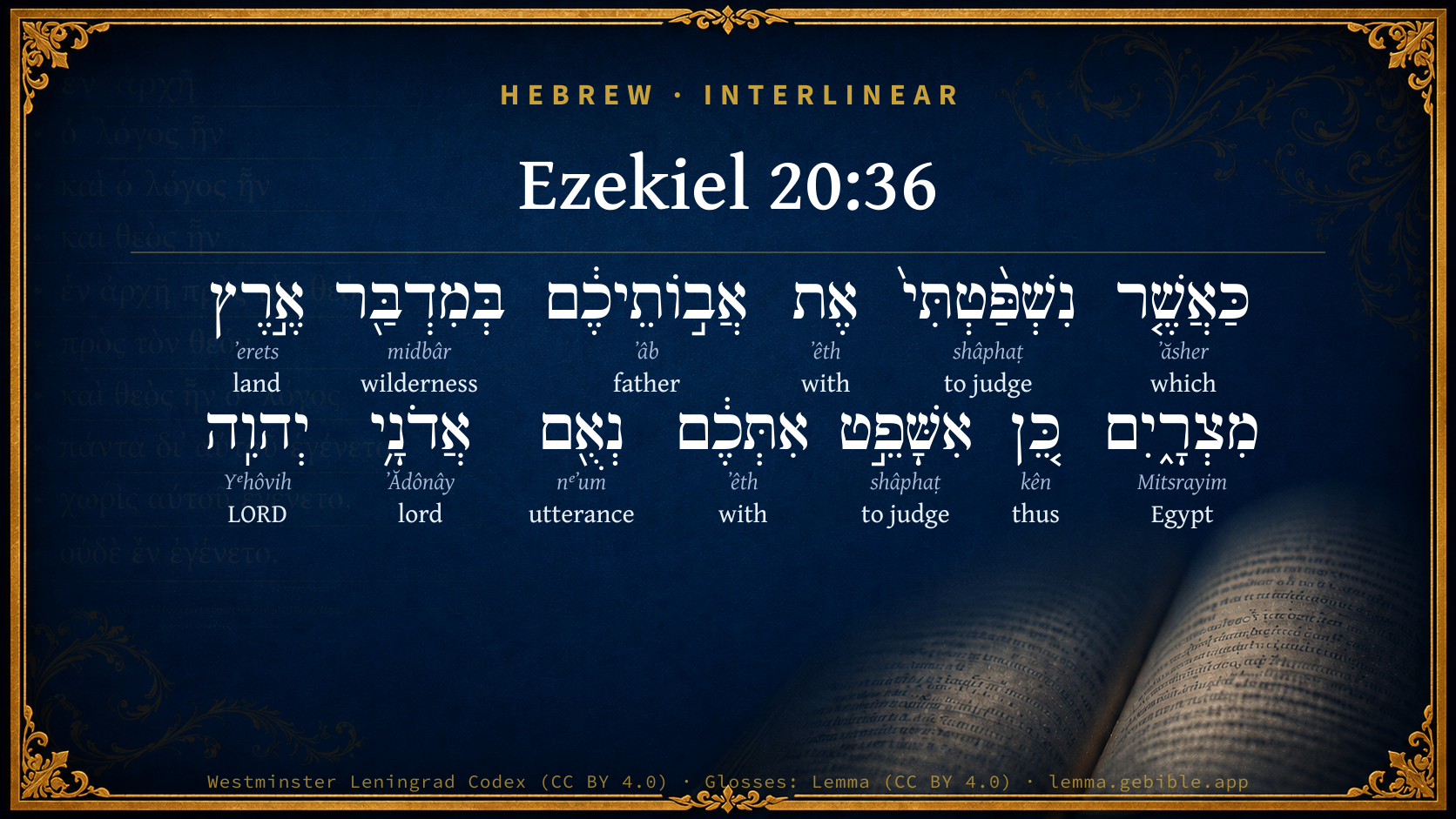
Hebrew (Westminster Leningrad Codex) Ezekiel 20:36 appears in the Hebrew Old Testament. The text above is from the Westminster Leningrad Codex. Each word links to its Strong’s number, a concise gloss, and parsing drawn from the Open Scriptures Hebrew Bible morphology. Click any word for its full Brown-Driver-Briggs (BDB) entry.
Download image
Cite this verse

Ezekiel 20:36 (World English Bible). Public Domain. Lemma interlinear Bible study tool, https://lemma.gebible.app/v/ezekiel/20/36.

Show BibTeX & RIS
BibTeX
RIS
English Translation
Like as I entered into judgment with your fathers in the wilderness of the land of Egypt, so will I enter into judgment with you, says the Lord Yahweh.
World English Bible · Public Domain
Download a study sheet

One document with this verse’s original text, its word-by-word gloss line, the meaning frame, cross-references with their text, attributed commentary, and full source and license credits — printable, and it pastes into notes with its structure intact.

This verse Autodidact and up

Study sheet (.html) Plain text (.txt)

A passage Seminary Student

Up to 50 verses in one chapter. A passage sheet keeps up to 6 commentary sources and 12 cross-references per verse, in the order this page ranks them, and says so on the sheet whenever that leaves anything out. Ask for a single verse and you get the Autodidact verse sheet above.

Everything on this page stays free to read, with no account — the sheet is a download of what is already on screen, not access to it.

Want to remove ads? Support Godless Engineer
Compare translations 3

The same verse in 3 English versions, stacked beneath the original-language interlinear above. Click any original word for its lexicon entry.

Each is an independent rendering of the whole verse — the interlinear is not word-aligned to these translations.

Highlighted words mark where these versions differ — a whole-verse word diff, not a word-by-word alignment.

  • World English Bible Public Domain
    Like as I entered into judgment with your fathers in the wilderness of the land of Egypt, so will I enter into judgment with you, says the Lord Yahweh.
  • King James Version Public Domain
    Like as I pleaded with your fathers in the wilderness of the land of Egypt, so will I plead with you, saith the Lord GOD.
  • unfoldingWord Literal Text CC BY-SA 4.0
    As I judged your fathers in the wilderness of the land of Egypt, so also I will judge you—this is the Lord Yahweh’s declaration.

unfoldingWord Literal Text — © unfoldingWord, licensed CC BY-SA 4.0. Word-aligned USFM3 via Door43 (git.door43.org/unfoldingWord/en_ult).

Versions to compare (up to 4)

3 of 4 selected

Show all 18 translations

Every available English version of this verse, each an independent rendering of the whole verse.

  • World English Bible Public Domain
    Like as I entered into judgment with your fathers in the wilderness of the land of Egypt, so will I enter into judgment with you, says the Lord Yahweh.
  • Berean Standard Bible Public Domain
    Just as I entered into judgment with your fathers in the wilderness of the land of Egypt, so I will enter into judgment with you, declares the Lord GOD.
  • Majority Standard Bible Public Domain
    Just as I entered into judgment with your fathers in the wilderness of the land of Egypt, so I will enter into judgment with you, declares the Lord GOD.
  • King James Version Public Domain
    Like as I pleaded with your fathers in the wilderness of the land of Egypt, so will I plead with you, saith the Lord GOD.
  • American Standard Version (1901) Public Domain
    Like as I entered into judgment with your fathers in the wilderness of the land of Egypt, so will I enter into judgment with you, saith the Lord Jehovah.
  • Revised Version (1885) Public Domain
    Like as I pleaded with your fathers in the wilderness of the land of Egypt, so will I plead with you, saith the Lord GOD.
  • Geneva Bible (1599) Public Domain
    Like as I pleaded with your fathers in the wildernes of the lande of Egypt, so will I pleade with you, saith the Lord God.
  • Douay-Rheims (1899) Public Domain
    As I pleaded against your fathers in the desert of the land of Egypt; even so will I judge you, saith the Lord God.
  • Young's Literal Translation Public Domain
    As I was judged with your fathers, In the wilderness of the land of Egypt, So I am judged with you, An affirmation of the Lord Jehovah.
  • Literal Standard Version CC BY-SA 4.0
    As I was judged with your fathers, || In the wilderness of the land of Egypt, || So I am judged with you, || A declaration of Lord YHWH.
  • Unlocked Literal Bible CC BY-SA 4.0
    As I judged your fathers in the wilderness of the land of Egypt, so also I will judge you—this is the Lord Yahweh's declaration.
  • unfoldingWord Literal Text CC BY-SA 4.0
    As I judged your fathers in the wilderness of the land of Egypt, so also I will judge you—this is the Lord Yahweh’s declaration.
  • Darby Bible Public Domain
    Like as I entered into judgment with your fathers in the wilderness of the land of Egypt, so will I enter into judgment with you, saith the Lord Jehovah.
  • World Messianic Bible Public Domain
    Just as I entered into judgment with your fathers in the wilderness of the land of Egypt, so I will enter into judgment with you,” says the Lord GOD.
  • Webster's Bible Public Domain
    As I pleaded with your fathers in the wilderness of the land of Egypt, so will I plead with you, saith the Lord GOD.
  • Free Bible Version CC BY-SA 4.0
    In the same way I judged your forefathers in the Egyptian desert after I'd led them out of Egypt, so I will judge you, declares the Lord God.
  • Bible in Basic English Public Domain
    As I took up the cause with your fathers in the waste land of the land of Egypt, so will I take up the cause with you says the Lord.
  • JPS Tanakh (1917) Public Domain
    Like as I pleaded with your fathers in the wilderness of the land of Egypt, so will I plead with you, saith the Lord GOD.

Literal Standard Version (2020), Covenant Press — licensed CC BY-SA 4.0. Text via the HelloAO Bible API (eBible.org). Unlocked Literal Bible (unfoldingWord) — licensed CC BY-SA 4.0. Text via the HelloAO Bible API (eBible.org). unfoldingWord Literal Text — © unfoldingWord, licensed CC BY-SA 4.0. Word-aligned USFM3 via Door43 (git.door43.org/unfoldingWord/en_ult). Free Bible Version, Dr. Jonathan Gallagher — licensed CC BY-SA 4.0. Text via the HelloAO Bible API (eBible.org).

Word by word

More ways to search: Search by grammar → Find every occurrence → Compare this word →

Practice this passage: Drill this verse → Learn its vocabulary →

נִשְׁפַּ֨טְתִּי֙
shâphaṭ
H8199
“to judge”
Verb, Niphal, Perfect, 1st Person, Common, Singular
Part of Speech
Verb
Stem
Niphal
Form
Perfect
Person
1st Person
Gender
Common
Number
Singular
Full BDB Definition

Origin: a primitive root

TWOT: 2443

to judge, govern, vindicate, punish - (Qal) - to act as law-giver or judge or governor (of God, man) - to rule, govern, judge - to decide controversy (of God, man) - to execute judgment - discriminating (of man) - vindicating - condemning and punishing - at theophanic advent for final judgment - (Niphal) - to enter into controversy, plead, have controversy together - to be judged - (Poel) judge, opponent-at-law (participle)
  1. כַּאֲשֶׁ֤ר ʼăsher H834 “like/as · which” Preposition + Particle, Relative
  2. אֶת ʼêth H854 “with” Preposition
  3. אֲב֣וֹתֵיכֶ֔ם ʼâb H1 “fathers · your” Noun, Common, Masculine, Plural, Construct + Suffix, Personal, 2nd Person, Masculine, Plural
  4. בְּמִדְבַּ֖ר midbâr H4057 “in/at · wilderness of” Preposition + Noun, Common, Masculine, Singular, Construct
  5. אֶ֣רֶץ ʼerets H776 “land of” Noun, Common, Both, Singular, Construct
  6. מִצְרָ֑יִם Mitsrayim H4714 “Egypt” Noun, Proper
  7. כֵּ֚ן kên H3651 “thus” Particle, Demonstrative
  8. אִשָּׁפֵ֣ט shâphaṭ H8199 “to judge” Verb, Niphal, Imperfect, 1st Person, Common, Singular
  9. אִתְּכֶ֔ם ʼêth H854 “with · you” Preposition + Suffix, Personal, 2nd Person, Masculine, Plural
  10. נְאֻ֖ם nᵉʼum H5002 “utterance of” Noun, Common, Masculine, Singular, Construct
  11. אֲדֹנָ֥י ʼĂdônây H136 “Lord · my” Noun, Common, Masculine, Plural, Construct + Suffix, Personal, 1st Person, Common, Singular
  12. יְהוִֽה Yᵉhôvih H3069 “LORD” Noun, Proper

About this verse

These counts appear in no published source. They are computed here, from the morphology-tagged text and Lemma’s own curated glosses. What Lemma adds →

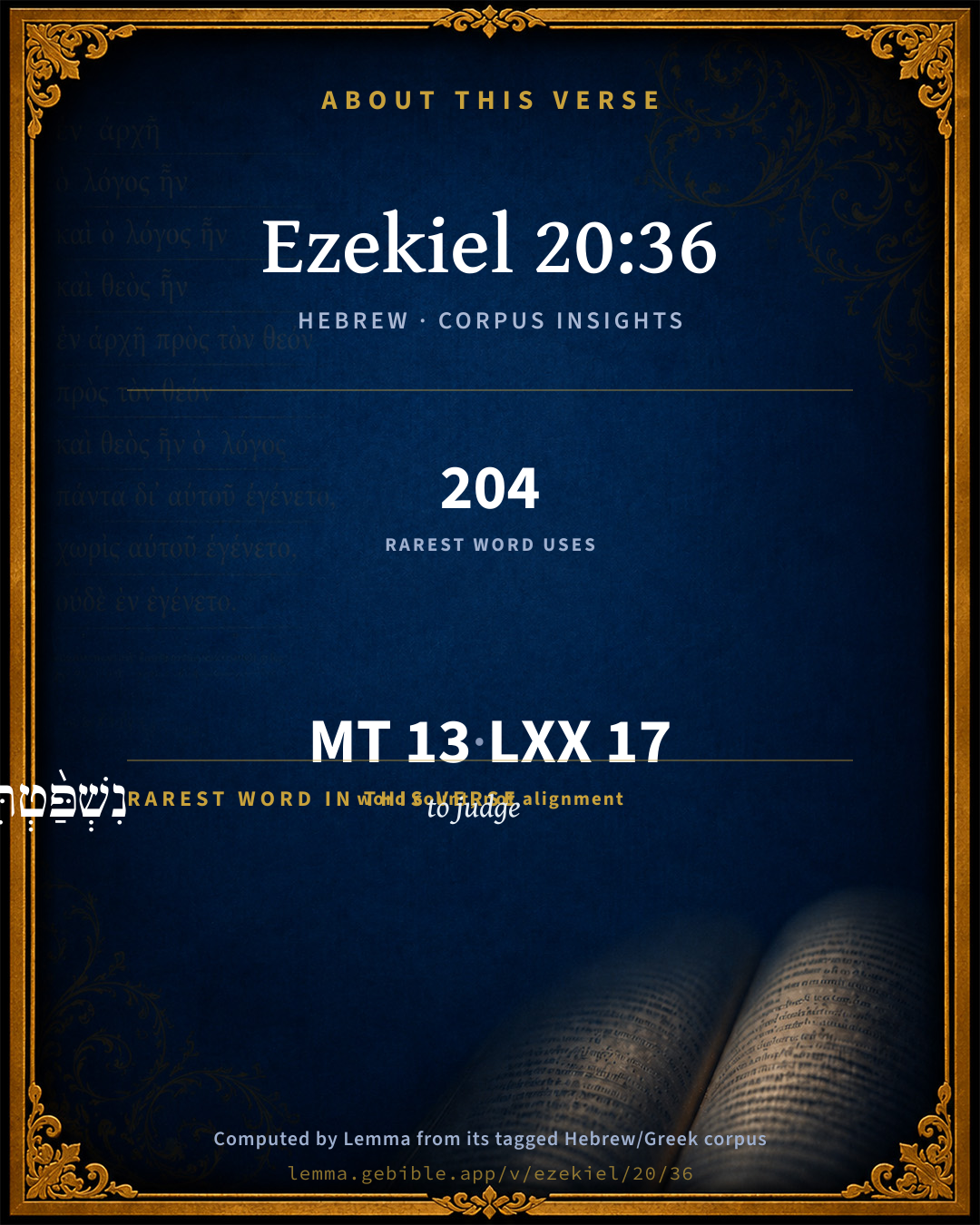
13
words
11
distinct lemmas
Prophets
section

Grammatical profile

  • 2 verbs
  • 7 nouns
  • 2 prepositions
  • 2 particles

Verb forms

  • נִשְׁפַּ֨טְתִּי֙ Niphal · Perfect
  • אִשָּׁפֵ֣ט Niphal · Imperfect

Repetition

Words recur within this verse — often emphatic in Hebrew:

  • נִשְׁפַּ֨טְתִּי֙ to judge H8199 ×2
  • אֶת with H854 ×2

Hebrew & Septuagint length

In English translation the verse runs 29 words from the Hebrew and 22 from the Septuagint (LXX English) — closely comparable.

A rough comparison of the two English renderings, which tokenize alike — not a word-level alignment.

Word counts can differ between the Hebrew and the Greek without any difference in meaning — e.g. the Hebrew direct-object marker אֵת has no separate Greek word, and Greek often adds the article ὁ.

In the original languages it is 13 Hebrew tokens and 17 Greek tokens — but the two are counted differently (Hebrew bundles its prefixes and suffixes into one token; the Greek is in lemma form), so that isn’t a like-for-like length.

Cross-references

9

Topical passages linked to Ezekiel 20:36 in the Treasury of Scripture Knowledge — connected by theme and wording, ordered by reader-vote popularity; previews shown in the World English Bible.

  • Numbers 11:1–35 The people were as murmurers, [speaking] evil in the ears of Yahweh: and when Yahweh heard it, his anger was kindled; and the fire of Yahweh burnt among them, and devoured in the uttermost part of the camp.
  • 1 Corinthians 10:5–10 However with most of them, God was not well pleased, for they were overthrown in the wilderness.
  • Ezekiel 20:13 But the house of Israel rebelled against me in the wilderness: they didn't walk in my statutes, and they rejected my ordinances, which if a man keep, he shall live in them; and my Sabbaths they greatly profaned. Then I said I would pour out my wrath on them in the wilderness, to consume them.
  • Ezekiel 20:21 But the children rebelled against me; they didn't walk in my statutes, neither kept my ordinances to do them, which if a man do, he shall live in them; they profaned my Sabbaths. Then I said I would pour out my wrath on them, to accomplish my anger against them in the wilderness.
  • Exodus 32:7–35 Yahweh spoke to Moses, "Go, get down; for your people, who you brought up out of the land of Egypt, have corrupted themselves!
  • Numbers 14:1–45 All the congregation lifted up their voice, and cried; and the people wept that night.
  • Numbers 16:1–50 Now Korah, the son of Izhar, the son of Kohath, the son of Levi, with Dathan and Abiram, the sons of Eliab, and On, the son of Peleth, sons of Reuben, took [men]:
  • Numbers 25:1–18 Israel abode in Shittim; and the people began to play the prostitute with the daughters of Moab:

Cross-references courtesy of OpenBible.info (CC BY 4.0).

Hebrew and Greek witnesses Masoretic Hebrew ↔ Greek Septuagint

The same verse in the two great witnesses to the Old Testament, shown verse-for-verse.

These are two independent witnesses, not word-aligned to each other, and the Septuagint is shown in lemma (dictionary) form.

Hebrew Ezekiel 20:36 Masoretic · Westminster Leningrad Codex

כַּאֲשֶׁ֤ר נִשְׁפַּ֨טְתִּי֙ אֶת אֲב֣וֹתֵיכֶ֔ם בְּמִדְבַּ֖ר אֶ֣רֶץ מִצְרָ֑יִם כֵּ֚ן אִשָּׁפֵ֣ט אִתְּכֶ֔ם נְאֻ֖ם אֲדֹנָ֥י יְהוִֽה

Like as I entered into judgment with your fathers in the wilderness of the land of Egypt, so will I enter into judgment with you, says the Lord Yahweh.

World English Bible · Public Domain

Greek LXX Ezekiel 20:36 Septuagint · lemma form

ὅς τρόπος διακρίνω πρός ὁ πατήρ σύ ἐν ὁ ἔρημος γῆ αἴγυπτος οὕτως κρίνω σύ λέγω κύριος

As I pleaded with your fathers in the wilderness of the land of Egypt, so will I judge you, says the Lord.

LXX2012 (modern English Septuagint) · Public Domain

Hebrew: Westminster Leningrad Codex (CC BY 4.0). Greek: Septuagint (public domain); English from LXX2012 (modern English Septuagint) (Public Domain). How the Septuagint differs from the Hebrew →

Targum (Aramaic paraphrase)

1

The Targum is the ancient Jewish Aramaic paraphrase of the Hebrew Scriptures — an interpretive translation, not the Hebrew text itself. Onkelos (literal) and Pseudo-Jonathan (expansive) render the Torah, and Jonathan the Prophets. Coverage is partial: where no permissively-licensed English translation exists for a verse, only the Aramaic is shown. This is verse-level text, not a word-by-word alignment to the Hebrew.

  1. Targum Jonathan Prophets (Joshua–Malachi)
    כְּמָא דְאִתְפְּרָעֵית מִן אֲבָהַתְכוֹן בְּמַדְבְּרָא אַרְעָא דְמִצְרָיִם כֵּן אִתְפְּרַע מִנְכוֹן אֲמַר יְיָ אֱלֹהִים:

    (no public-domain English translation for this verse)

    Targum Jonathan — Aramaic: “Mikraot Gedolot” (public domain). English: “Sefaria Community Translation” (CC0 1.0 (public-domain dedication)); “London "Chaldee Paraphrase," 1871” (public domain). Text via Sefaria.

Commentary

Notes on Ezekiel 20:36 from classic Christian and Jewish commentators (each source and its license shown beneath its notes). The classic Christian expositions comment on the surrounding passage and are grouped to its opening verse, so a note may address several verses; the Jewish commentaries on the Tanakh (Rashi and others) are per-verse, so they appear only where the commentator wrote on this verse.

Lemma curates 59 commentaries, every one of them public domain or Creative Commons licensed, each selected and text-cleaned for this edition rather than reprinted as found. About our sources →

Trapp's Complete Commentary

John Trapp

Eze 20:36 Like as I pleaded with your fathers in the wilderness of the land of Egypt, so will I plead with you, saith the Lord GOD.

Ver. 36. Like as I pleaded with your fathers in the wilderness.] Where their carcases fell thick and threefold, till they were all consumed. "Behold we die, we perish, we all perish," said they once to Moses in a pet; "shall we be consumed with dying?" {Num 17:12-13}

John Trapp, A Commentary or Exposition upon All the Books of the Old and New Testament (1647–1656) — public domain. Text from a community e-Sword module.

Jamieson, Fausset & Brown

Robert Jamieson, A. R. Fausset & David Brown

(Num 14:21-29). Though God saved them out of Egypt, He afterwards destroyed in the wilderness them that believed not (Jde 1:5); so, though He brought the exiles out of Babylon, yet their wilderness state of chastening discipline continued even after they were again in Canaan.

Jamieson, Fausset & Brown — Commentary Critical and Explanatory on the Whole Bible (1871) — public domain (CC PDM 1.0). Text via the HelloAO Bible API.

John Gill's Exposition

And I will cause you to pass under the rod,.... That is, such whom God will not take vengeance on, and shall not die in the wilderness of the people; but whom he will have mercy on, and show favour to, and bring at length into their own land; these he indeed will bring under the rod of correction and chastisement, by which they shall be brought to a sense of sin, a confession of it, humiliation for it, and to seek to Christ for salvation from it; or under the rod of his word, the rod of his strength, he sends out of Zion the Gospel, the power of God unto salvation; by which they shall be brought to agree unto and comply with the way of salvation by Christ; to submit to his righteousness; to embrace the doctrines of the Gospel, and be subject to the ordinances of it: or the allusion is to shepherds, in taking an account of their flocks, or at the tithing of them, who strike and mark them with their rod, Lev 27:32, and thus, as the Lord has in election distinguished his sheep from others, taken an exact account of them, and set his seal or mark of foreknowledge on them; so in effectual calling he separates them from others, takes special knowledge of them, and sets his mark of sanctification on them. This will be the case of the converted Jews in the latter day:

and I will bring you into the bond of the covenant: or, "the discipline of the covenant", as the Syriac Version; the same with the rod of correction, being what is provided in covenant for the good of the covenant ones. This covenant is the covenant of grace; the bond of which are not faith, repentance, and new obedience; for these are parts and blessings of the covenant; nor any outward ordinance; not circumcision formerly, nor baptism and the Lord's supper now; which persons may submit to, and yet not be in the covenant: but it designs that which makes the covenant firm, sure, and lasting; which are the everlasting love of God, from whence it springs; his unchangeable counsel, according to which it proceeds; his solemn oath, that it shall never be removed; his faithfulness, which will not suffer it to be made void; and his power, which will accomplish every article of it; and the blood of Christ, which ratifies and confirms it. So Kimchi interprets it, "I will bind you in a covenant, that ye shall not go out of it for ever": or it is that which binds persons, or lays them under obligation to love, fear, and serve the Lord; and that is the love of God and Christ, and the exceeding great and precious promises of the covenant; and now into this sure, firm, and obliging covenant the Lord has brought all his chosen ones in eternity, when it was first made with Christ; and into which he may be said to bring them in time; as he will the converted Jews, when he manifests it to them, and applies the blessings and promises of it; shows them it, and their interest in it.

John Gill's Exposition of the Whole Bible (1746–1763) — public domain (CC PDM 1.0). Text via the HelloAO Bible API.

Matthew Poole's English Annotations

With your fathers, who died there, and never entered Canaan.

In the wilderness; which lay on the further side of the Red Sea, over against the land of Egypt, and is from it called, as here, though it be Arabia Deserta; in which, within the space of less than forty years, all the rebellious murmurers died.

Matthew Poole's English Annotations on the Holy Bible (1683–1685) — public domain. Text from a community e-Sword/MySword module.

John Wesley's Explanatory Notes

Your fathers - Who died there, and never entered Canaan.

John Wesley, Explanatory Notes Upon the Whole Bible (1754–1765) — public domain. Text via the GEBible commentary corpus.

unfoldingWord translationNotes

Door43 World Missions Community

General Information:

Yahweh continues giving Ezekiel his message to the house of Israel.

I will cause you to pass under my rod

This refers to the practice of a shepherd counting and inspecting his sheep as the sheep walked under his staff. Possible meanings are 1) Yahweh will count his people whom he gathers from the nations to ensure that they are all present. AT: "I will count you carefully as a shepherd counts his sheep" or 2) Yahweh will inspect each person as they pass under his staff in order to separate the faithful from the unfaithful. AT: "I will inspect you carefully as a shepherd inspects his sheep" (See: Metaphor)

translationWords

judge

ancestor

desert

Egypt

rod

covenant

rebel

send

alien

unfoldingWord translationNotes — © Distant Shores Media and the Door43 World Missions Community, licensed CC BY-SA 4.0. Source: git.door43.org/Door43/en_tn.

Lesson kit

Teaching starters — assembled from the data on this page, not authored interpretation. Every prompt links to the verse data it draws on. Edit before teaching.

Ezekiel, in the Prophets, opens this verse with 13 words (11 distinct Hebrew lemmas). Its most distinctive word is shâphaṭ (“to judge”). A historical commentator’s framing appears above. Read the whole chapter for the surrounding context.

Discussion questions

  1. How does “to judge” (shâphaṭ) shape what this verse is saying?
  2. Numbers 11:1–35 shares this passage’s theme. How do the two illuminate each other?
  3. “to judge” occurs 2× in this one verse. What is the effect of the repetition?
  4. These translations render this verse differently; the difference is in the English rendering, not the original. What questions does that raise?
  5. The verb «נִשְׁפַּ֨טְתִּי֙» is Niphal Perfect. How does its form color the action?
  6. Reading how Trapp's Complete Commentary and Jamieson, Fausset & Brown read this verse, where do the two commentators agree and where do they part?

Things to notice

Reading settings

Reading text

Shown beneath each verse's original-language words.

Old Testament
Old Testament edition

Read the OT as the Masoretic Hebrew (MT) or the Greek Septuagint (LXX).

English shown for the Greek Septuagint (in the Hebrew ↔ Greek comparison).

Comparing translations? Open the Compare panel on any verse page to stack up to four side by side.