
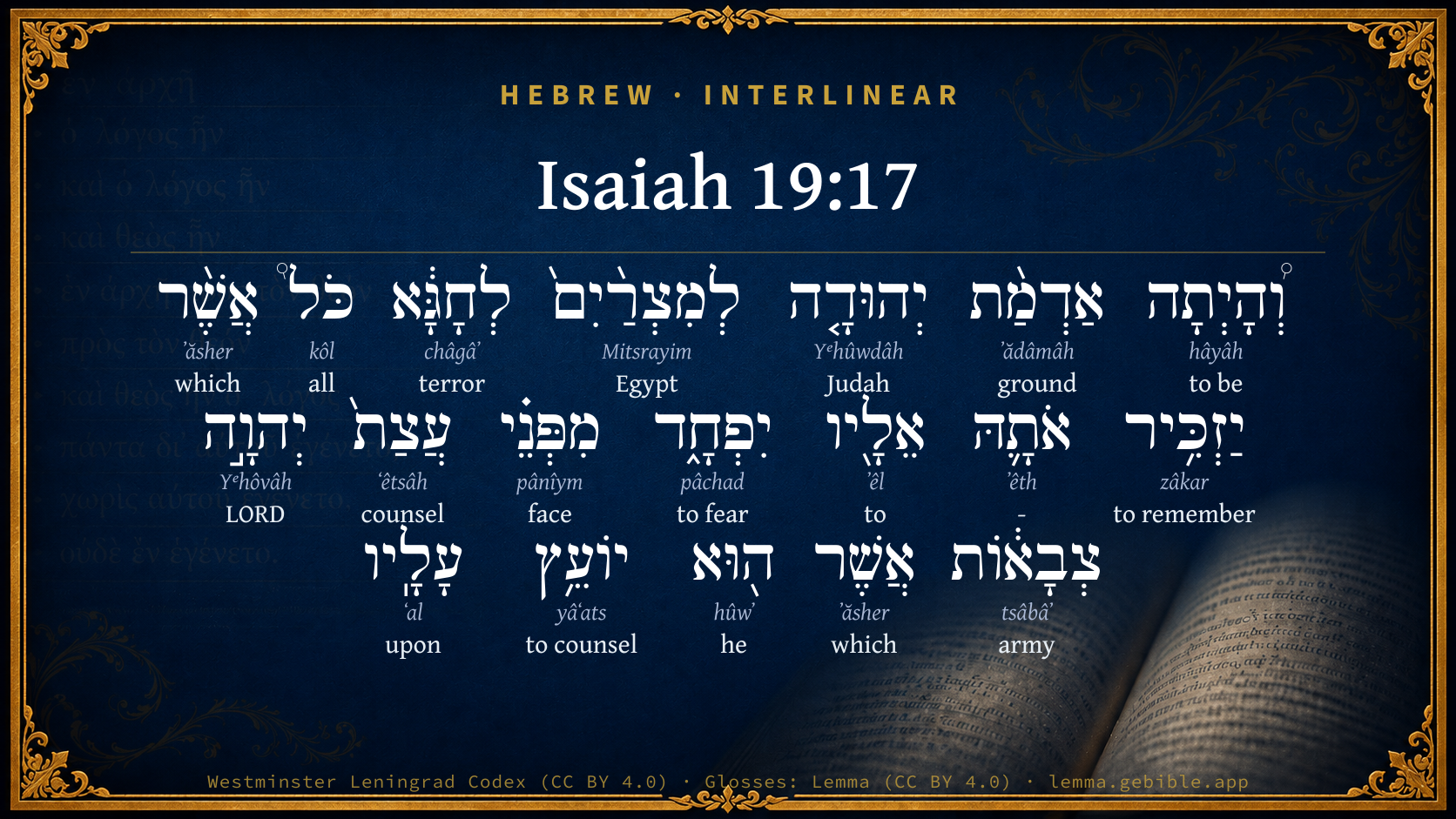
Isaiah 19:17

Hebrew (Westminster Leningrad Codex) Isaiah 19:17 appears in the Hebrew Old Testament. The text above is from the Westminster Leningrad Codex. Each word links to its Strong’s number, a concise gloss, and parsing drawn from the Open Scriptures Hebrew Bible morphology. Click any word for its full Brown-Driver-Briggs (BDB) entry.
Download image
Cite this verse

Isaiah 19:17 (World English Bible). Public Domain. Lemma interlinear Bible study tool, https://lemma.gebible.app/v/isaiah/19/17.

Show BibTeX & RIS
BibTeX
RIS
English Translation
The land of Judah shall become a terror to Egypt; everyone to whom mention is made of it shall be afraid, because of the purpose of Yahweh of Hosts, which he purposes against it.
World English Bible · Public Domain
Highlights
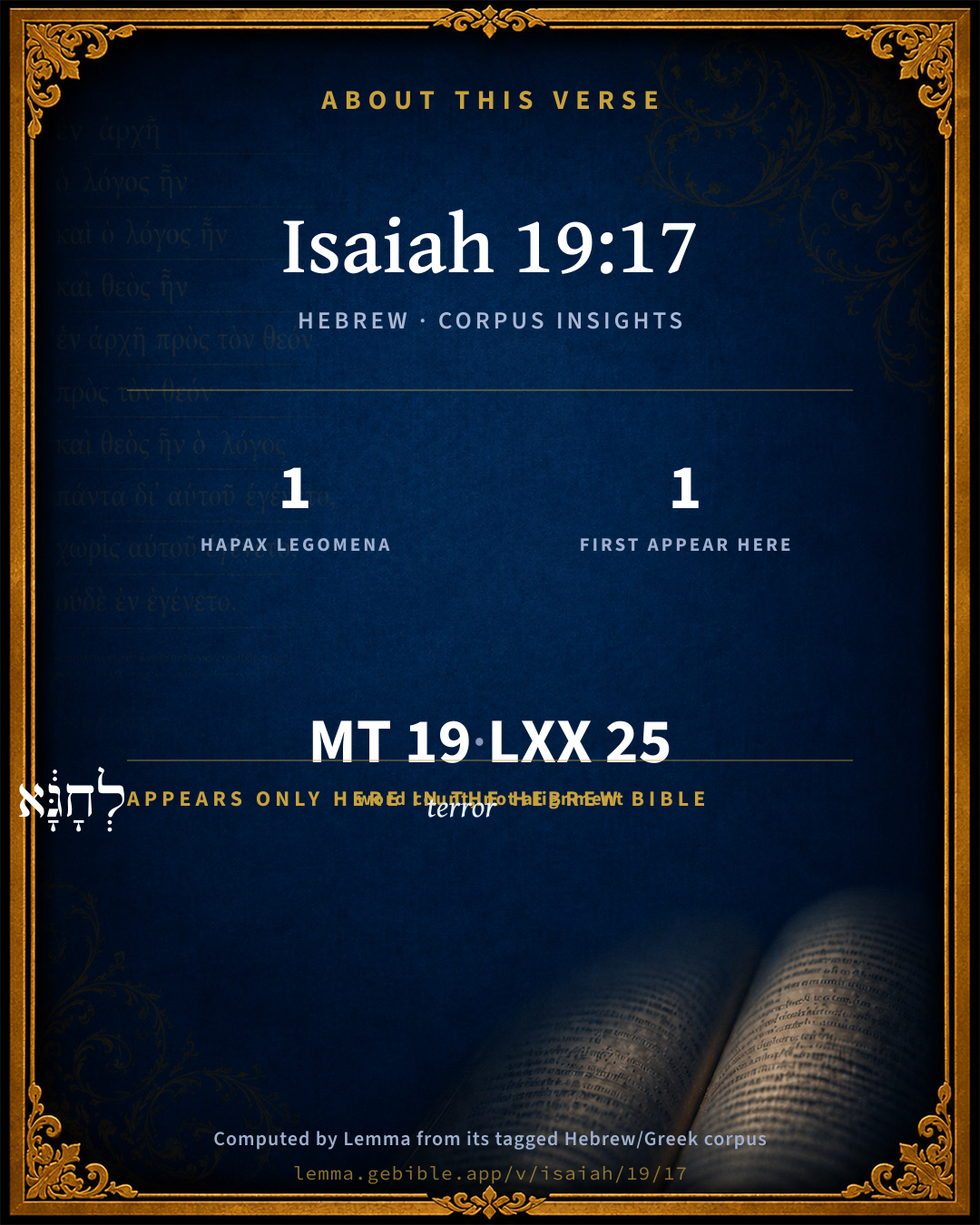
  • 1 hapax legomenon — only here in the Hebrew Bible
  • 1 first appearance in the Hebrew Bible
Full analysis ↓
Download a study sheet

One document with this verse’s original text, its word-by-word gloss line, the meaning frame, cross-references with their text, attributed commentary, and full source and license credits — printable, and it pastes into notes with its structure intact.

This verse Autodidact and up

Study sheet (.html) Plain text (.txt)

A passage Seminary Student

Up to 50 verses in one chapter. A passage sheet keeps up to 6 commentary sources and 12 cross-references per verse, in the order this page ranks them, and says so on the sheet whenever that leaves anything out. Ask for a single verse and you get the Autodidact verse sheet above.

Everything on this page stays free to read, with no account — the sheet is a download of what is already on screen, not access to it.

Want to remove ads? Support Godless Engineer
Compare translations 3

The same verse in 3 English versions, stacked beneath the original-language interlinear above. Click any original word for its lexicon entry.

Each is an independent rendering of the whole verse — the interlinear is not word-aligned to these translations.

Highlighted words mark where these versions differ — a whole-verse word diff, not a word-by-word alignment.

  • World English Bible Public Domain
    The land of Judah shall become a terror to Egypt; everyone to whom mention is made of it shall be afraid, because of the purpose of Yahweh of Hosts, which he purposes against it.
  • King James Version Public Domain
    And the land of Judah shall be a terror unto Egypt, every one that maketh mention thereof shall be afraid in himself, because of the counsel of the LORD of hosts, which he hath determined against it.
  • unfoldingWord Literal Text CC BY-SA 4.0
    And the land of Judah will become a terror to Egypt. Everyone who makes remember it, one will dread from the face of the determination of Yahweh of Armies that he is determining against it.

unfoldingWord Literal Text — © unfoldingWord, licensed CC BY-SA 4.0. Word-aligned USFM3 via Door43 (git.door43.org/unfoldingWord/en_ult).

Versions to compare (up to 4)

3 of 4 selected

Show all 18 translations

Every available English version of this verse, each an independent rendering of the whole verse.

  • World English Bible Public Domain
    The land of Judah shall become a terror to Egypt; everyone to whom mention is made of it shall be afraid, because of the purpose of Yahweh of Hosts, which he purposes against it.
  • Berean Standard Bible Public Domain
    The land of Judah will bring terror to Egypt; whenever Judah is mentioned, Egypt will tremble over what the LORD of Hosts has planned against it.
  • Majority Standard Bible Public Domain
    The land of Judah will bring terror to Egypt; whenever Judah is mentioned, Egypt will tremble over what the LORD of Hosts has planned against it.
  • King James Version Public Domain
    And the land of Judah shall be a terror unto Egypt, every one that maketh mention thereof shall be afraid in himself, because of the counsel of the LORD of hosts, which he hath determined against it.
  • American Standard Version (1901) Public Domain
    And the land of Judah shall become a terror unto Egypt; every one to whom mention is made thereof shall be afraid, because of the purpose of Jehovah of hosts, which he purposeth against it.
  • Revised Version (1885) Public Domain
    And the land of Judah shall become a terror unto Egypt, every one to whom mention is made thereof shall be afraid, because of the purpose of the LORD of hosts, which he purposeth against it.
  • Geneva Bible (1599) Public Domain
    And the land of Iudah shall be a feare vnto Egypt: euery one that maketh mention of it, shalbe afraid thereat, because of ye counsell of the Lord of hostes, which he hath determined vpon it.
  • Douay-Rheims (1899) Public Domain
    And the land of Juda shall be a terror to Egypt: every one that shall remember it shall tremble because of the counsel of the Lord of hosts, which he hath determined concerning it.
  • Young's Literal Translation Public Domain
    And the land of Judah hath been to Egypt for a cause of staggering, Every one who doth mention it, for himself feareth, Because of the counsel of Jehovah of Hosts, That He is counselling against it.
  • Literal Standard Version CC BY-SA 4.0
    And the land of Judah has been to Egypt for a cause of staggering, || Everyone who mentions it, fears for himself, || Because of the counsel of YHWH of Hosts, || That He is counseling against it.
  • Unlocked Literal Bible CC BY-SA 4.0
    The land of Judah will become a cause of staggering to Egypt. Whenever anyone reminds them of her, they will be afraid, because of the plan of Yahweh, that he is planning against them.
  • unfoldingWord Literal Text CC BY-SA 4.0
    And the land of Judah will become a terror to Egypt. Everyone who makes remember it, one will dread from the face of the determination of Yahweh of Armies that he is determining against it.
  • Darby Bible Public Domain
    And the land of Judah shall be a dismay unto Egypt: every one that thinketh of it shall be afraid for himself, because of the counsel of Jehovah of hosts, which he hath purposed against it.
  • World Messianic Bible Public Domain
    The land of Judah will become a terror to Egypt. Everyone to whom mention is made of it will be afraid, because of the plans of the LORD of Hosts, which he determines against it.
  • Webster's Bible Public Domain
    And the land of Judah shall be a terror to Egypt, every one that maketh mention of it shall be afraid in himself, because of the counsel of the LORD of hosts, which he hath determined against it.
  • Free Bible Version CC BY-SA 4.0
    The land of Judah will be a source of terror to Egypt for whenever Judah is mentioned, all Egyptians will tremble over what the Lord Almighty has planned to do to them.
  • Bible in Basic English Public Domain
    And the land of Judah will become a cause of great fear to Egypt; whenever its name comes to mind, Egypt will be in fear before the Lord of armies because of his purpose against it.
  • JPS Tanakh (1917) Public Domain
    And the land of Judah shall become a terror unto Egypt, whensoever one maketh mention thereof to it; it shall be afraid, because of the purpose of the LORD of hosts, which He purposeth against it.

Literal Standard Version (2020), Covenant Press — licensed CC BY-SA 4.0. Text via the HelloAO Bible API (eBible.org). Unlocked Literal Bible (unfoldingWord) — licensed CC BY-SA 4.0. Text via the HelloAO Bible API (eBible.org). unfoldingWord Literal Text — © unfoldingWord, licensed CC BY-SA 4.0. Word-aligned USFM3 via Door43 (git.door43.org/unfoldingWord/en_ult). Free Bible Version, Dr. Jonathan Gallagher — licensed CC BY-SA 4.0. Text via the HelloAO Bible API (eBible.org).

Word by word

More ways to search: Search by grammar → Find every occurrence → Compare this word →

Practice this passage: Drill this verse → Learn its vocabulary →

לְחָגָּ֔א
châgâʼ
H2283
“to/for · terror”
Preposition + Noun, Common, Feminine, Singular, Absolute
Part of Speech
Preposition + Noun
Type
Common
Gender
Feminine
Number
Singular
State
Absolute
Full BDB Definition

Origin: from an unused root meaning to revolve [compare H2287 ]

TWOT: 602b

terror, a reeling (in terror)
  1. וְ֠הָיְתָה hâyâh H1961 “and · to be” Conjunction + Verb, Qal, Sequential Perfect, 3rd Person, Feminine, Singular
  2. אַדְמַ֨ת ʼădâmâh H127 “ground of” Noun, Common, Feminine, Singular, Construct
  3. יְהוּדָ֤ה Yᵉhûwdâh H3063 “Judah” Noun, Proper
  4. לְמִצְרַ֨יִם֙ Mitsrayim H4714 “to/for · Egypt” Preposition + Noun, Proper
  5. כֹּל֩ kôl H3605 “all” Noun, Common, Masculine, Singular, Absolute
  6. אֲשֶׁ֨ר ʼăsher H834 “which” Particle, Relative
  7. יַזְכִּ֥יר zâkar H2142 “to remember” Verb, Hiphil, Imperfect, 3rd Person, Masculine, Singular
  8. אֹתָ֛הּ ʼêth H853 “- · her” Particle, Direct Object + Suffix, Personal, 3rd Person, Feminine, Singular
  9. אֵלָ֖יו ʼêl H413 “to · him” Preposition + Suffix, Personal, 3rd Person, Masculine, Singular
  10. יִפְחָ֑ד pâchad H6342 “to fear” Verb, Qal, Imperfect, 3rd Person, Masculine, Singular
  11. מִפְּנֵ֗י pânîym H6440 “from · face(s) of” Preposition + Noun, Common, Both, Plural, Construct
  12. עֲצַת֙ ʻêtsâh H6098 “counsel of” Noun, Common, Feminine, Singular, Construct
  13. יְהוָ֣ה Yᵉhôvâh H3068 “LORD” Noun, Proper
  14. צְבָא֔וֹת tsâbâʼ H6635 “armies” Noun, Common, Both, Plural, Absolute
  15. אֲשֶׁר ʼăsher H834 “which” Particle, Relative
  16. ה֖וּא hûwʼ H1931 “he” Pronoun, Personal, 3rd Person, Masculine, Singular
  17. יוֹעֵ֥ץ yâʻats H3289 “counseling” Verb, Qal, Participle Active, Masculine, Singular, Absolute
  18. עָלָֽיו ʻal H5921 “upon · him” Preposition + Suffix, Personal, 3rd Person, Masculine, Singular

About this verse

These counts appear in no published source. They are computed here, from the morphology-tagged text and Lemma’s own curated glosses. What Lemma adds →

19
words
18
distinct lemmas
Prophets
section

Notable vocabulary

1 hapax legomenon — a word that appears only here in the entire Hebrew Bible:

  • לְחָגָּ֔א terror H2283

First appearance in Scripture

This word makes its first canonical appearance in the Hebrew Bible here:

  • לְחָגָּ֔א terror H2283

Shared distinctive vocabulary

יִפְחָ֑ד to fear H6342 occurs in 25 verses of the Hebrew Bible. Also found in:

Grammatical profile

  • 4 verbs
  • 9 nouns
  • 1 pronoun
  • 2 prepositions
  • 3 particles

Verb forms

  • וְ֠הָיְתָה Qal · Sequential Perfect
  • יַזְכִּ֥יר Hiphil · Imperfect
  • יִפְחָ֑ד Qal · Imperfect
  • יוֹעֵ֥ץ Qal · Participle Active

Repetition

A word recurs within this verse — often emphatic in Hebrew:

  • אֲשֶׁ֨ר which H834 ×2

Hebrew & Septuagint length

In English translation the verse runs 34 words from the Hebrew and 36 from the Septuagint (LXX English) — closely comparable.

A rough comparison of the two English renderings, which tokenize alike — not a word-level alignment.

Word counts can differ between the Hebrew and the Greek without any difference in meaning — e.g. the Hebrew direct-object marker אֵת has no separate Greek word, and Greek often adds the article ὁ.

In the original languages it is 19 Hebrew tokens and 25 Greek tokens — but the two are counted differently (Hebrew bundles its prefixes and suffixes into one token; the Greek is in lemma form), so that isn’t a like-for-like length.

Cross-references

11

Topical passages linked to Isaiah 19:17 in the Treasury of Scripture Knowledge — connected by theme and wording, ordered by reader-vote popularity; previews shown in the World English Bible.

  • Isaiah 14:24 Yahweh of Hosts has sworn, saying, Surely, as I have thought, so shall it happen; and as I have purposed, so shall it stand:
  • Daniel 4:35 All the inhabitants of the earth are reputed as nothing; and he does according to his will in the army of heaven, and among the inhabitants of the earth; and none can stay his hand, or tell him, What do you?
  • Isaiah 14:26–27 This is the purpose that is purposed on the whole earth; and this is the hand that is stretched out on all the nations.
  • Isaiah 20:2–5 at that time Yahweh spoke by Isaiah the son of Amoz, saying, Go, and loose the sackcloth from off your loins, and put your shoe from off your foot. He did so, walking naked and barefoot.
  • Isaiah 36:1 Now it happened in the fourteenth year of king Hezekiah, that Sennacherib king of Assyria came up against all the fortified cities of Judah, and took them.
  • Isaiah 46:10–11 declaring the end from the beginning, and from ancient times things that are not [yet] done; saying, My counsel shall stand, and I will do all my pleasure;
  • Jeremiah 25:19 Pharaoh king of Egypt, and his servants, and his princes, and all his people;
  • Jeremiah 25:27–31 You shall tell them, Thus says Yahweh of Hosts, the God of Israel: Drink you, and be drunken, and spew, and fall, and rise no more, because of the sword which I will send among you.
  • Jeremiah 43:8–13 Then came the word of Yahweh to Jeremiah in Tahpanhes, saying,
  • Jeremiah 44:28–30 Those who escape the sword shall return out of the land of Egypt into the land of Judah, few in number; and all the remnant of Judah, who have gone into the land of Egypt to sojourn there, shall know whose word shall stand, mine, or theirs.
  • Ezekiel 29:6–7 All the inhabitants of Egypt shall know that I am Yahweh, because they have been a staff of reed to the house of Israel.

Cross-references courtesy of OpenBible.info (CC BY 4.0).

Hebrew and Greek witnesses Masoretic Hebrew ↔ Greek Septuagint

The same verse in the two great witnesses to the Old Testament, shown verse-for-verse.

These are two independent witnesses, not word-aligned to each other, and the Septuagint is shown in lemma (dictionary) form.

Hebrew Isaiah 19:17 Masoretic · Westminster Leningrad Codex

וְ֠הָיְתָה אַדְמַ֨ת יְהוּדָ֤ה לְמִצְרַ֨יִם֙ לְחָגָּ֔א כֹּל֩ אֲשֶׁ֨ר יַזְכִּ֥יר אֹתָ֛הּ אֵלָ֖יו יִפְחָ֑ד מִפְּנֵ֗י עֲצַת֙ יְהוָ֣ה צְבָא֔וֹת אֲשֶׁר ה֖וּא יוֹעֵ֥ץ עָלָֽיו

The land of Judah shall become a terror to Egypt; everyone to whom mention is made of it shall be afraid, because of the purpose of Yahweh of Hosts, which he purposes against it.

World English Bible · Public Domain

Greek LXX Isaiah 19:17 Septuagint · lemma form

καί εἰμί ὁ χώρα ὁ ἰουδαῖος ὁ αἰγύπτιος εἰς φόβητρον πᾶς ὅς ἐάν ὀνομάζω αὐτός αὐτός φοβέω διά ὁ βουλή ὅς βουλεύω κύριος ἐπί αὐτός

And the land of the Jews shall be for a terror to the Egyptians: whoever shall name it to them, they shall fear, because of the counsel which the Lord of hosts has purposed concerning it.

LXX2012 (modern English Septuagint) · Public Domain

Hebrew: Westminster Leningrad Codex (CC BY 4.0). Greek: Septuagint (public domain); English from LXX2012 (modern English Septuagint) (Public Domain). How the Septuagint differs from the Hebrew →

Targum (Aramaic paraphrase)

1

The Targum is the ancient Jewish Aramaic paraphrase of the Hebrew Scriptures — an interpretive translation, not the Hebrew text itself. Onkelos (literal) and Pseudo-Jonathan (expansive) render the Torah, and Jonathan the Prophets. Coverage is partial: where no permissively-licensed English translation exists for a verse, only the Aramaic is shown. This is verse-level text, not a word-by-word alignment to the Hebrew.

  1. Targum Jonathan Prophets (Joshua–Malachi)
    וּתְהֵי אַרְעָא דְבֵית יְהוּדָה לְמִצְרַיִם לְדַחֲלָא כָּל דְיִדְכַּר יָתָהּ לֵיהּ יְזוּעַ מִן קֳדָם מַלְכָא דַייָ צְבָאוֹת דְהוּא מְלִיךְ עֲלֵיהוֹן:

    And the land of the house of Judah shall be a terror unto Egypt; if anyone mention it unto them, they shall tremble because of the counsel of the Lord of hosts, which he hath counselled against them.

    Targum Jonathan — Aramaic: “Mikraot Gedolot” (public domain). English: “Sefaria Community Translation” (CC0 1.0 (public-domain dedication)); “London "Chaldee Paraphrase," 1871” (public domain). Text via Sefaria.

Commentary

Notes on Isaiah 19:17 from classic Christian and Jewish commentators (each source and its license shown beneath its notes). The classic Christian expositions comment on the surrounding passage and are grouped to its opening verse, so a note may address several verses; the Jewish commentaries on the Tanakh (Rashi and others) are per-verse, so they appear only where the commentator wrote on this verse.

Lemma curates 59 commentaries, every one of them public domain or Creative Commons licensed, each selected and text-cleaned for this edition rather than reprinted as found. About our sources →

Trapp's Complete Commentary

John Trapp

Isa 19:17 And the land of Judah shall be a terror unto Egypt, every one that maketh mention thereof shall be afraid in himself, because of the counsel of the LORD of hosts, which he hath determined against it.

Ver. 17. And the land of Judah shall be a terror unto Egypt.] For how should Egypt hope to speed better than Judea had done? How Sethon, King of Egypt, was put to his trumps, as we say, when Sennacherib invaded Egypt, imploring the aid of his god Vulcan, whose priest he was, see Herodotus, lib. ii.

John Trapp, A Commentary or Exposition upon All the Books of the Old and New Testament (1647–1656) — public domain. Text from a community e-Sword module.

Geneva Bible (1599)

Geneva Bible translators

Considering that through their occasion the Jews made not God their defense: but put their trust in them, and were therefore now punished, they shall fear lest the like light upon them.

Geneva Bible (1599) marginal notes — public domain. Text via Bolls.life.

Jamieson, Fausset & Brown

Robert Jamieson, A. R. Fausset & David Brown

Judah . . . terror unto Egypt--not by itself: but at this time Hezekiah was the active subordinate ally of Assyria in its invasion of Egypt under Sargon. Similarly to the alliance of Judah with Assyria here is Kg2 23:29, where Josiah takes the field against Pharaoh-nechoh of Egypt, probably as ally of Assyria against Egypt [G. V. SMITH]. VITRINGA explains it that Egypt in its calamities would remember that prophets of Judah had foretold them, and so Judah would be "a terror unto Egypt."

thereof--of Judah.

it--Egypt.

Jamieson, Fausset & Brown — Commentary Critical and Explanatory on the Whole Bible (1871) — public domain (CC PDM 1.0). Text via the HelloAO Bible API.

Adam Clarke's Commentary

Verse 17. And the land of Judah] The threatening hand of God will be held out and shaken over Egypt, from the side of Judea; through which the Assyrians will march to invade it. It signifies that kind of terror that drives one to his wit's end, that causes him to reel like a drunken man, to be giddy through astonishment. Such is the import of חג chag, and חגה chagah. Five MSS. and two editions have לחגה lechagah.

Adam Clarke's Commentary on the Bible (1810–1826) — public domain. Text from a community e-Sword/MySword module.

The Cambridge Bible for Schools and Colleges

gen. ed. J. J. S. Perowne

17. By association of ideas the fear of Jehovah becomes fear of the land which is His dwelling-place. The verse is intelligible only in this connexion.

every one that maketh … himself] Either “every (Egyptian) to whom one mentions it, shall fear,” or “whenever any one mentions it to him (Egypt) he shall fear.”

the counsel of the Lord of hosts] see Isa_19:11.

The Cambridge Bible for Schools and Colleges (gen. ed. J. J. S. Perowne; Cambridge University Press, 1878–1918) — public domain. Text from a community e-Sword module.

John Gill's Exposition

And the land of Judah shall be a terror unto Egypt,.... Not by reason of war breaking out between them, they being in strict alliance with each other at this time; but on account of what they should hear had befallen the land of Judea, and the cities of it, by the invasion of Sennacherib's army, which had taken and laid them waste; the tidings of which being brought them a panic would seize them, fearing that they should next fall a sacrifice to them, because of their alliance with them, and nearness to them, there being only the land of the Philistines between them and Egypt; and Judea being invaded and overrun, the way was open for the Assyrian army into their country; and besides they might reflect, that if the judgments of God fell so heavy on his own people, what might they not expect? and the rather, as they had been the means of drawing them into idolatry, which had provoked the Lord to come out against them; as well as at the remembrance of the injuries they had formerly done them. Jarchi and Kimchi understand this of the fall and ruin of Sennacherib's army, at the siege of Jerusalem, the rumour of which reaching, Egypt would fill them with terror; or as fearing that the hand of the Lord, which was seen in that affair, would be next lifted up against them; which sense is not probable; the former is best. The word used for terror signifies "dancing", such as is not through joy, but fear, see Psa 107:27,

everyone that maketh mention thereof; or calls to mind, or thinks of it, or speaks of it to others, what was done in the land of Judea by the Assyrian army:

shall be afraid in himself; that this will be their case quickly in Egypt:

because of the counsel of the Lord of hosts, which he hath determined against it; or "upon it", or "concerning it" (x); meaning either Judea, which was known by the prophets he sent unto it; or Egypt, who might conclude this from what happened to a neighbouring nation.

(x) , Sept.; "supra eum", V. L.; "super eum", Pagninus, Montanus.

John Gill's Exposition of the Whole Bible (1746–1763) — public domain (CC PDM 1.0). Text via the HelloAO Bible API.

Albert Barnes' Notes on the Bible

And the land of Judah - The fear and consternation of Egypt shall be increased when they learn what events are occurring there, and what Yahweh has purposed in regard to it.

Shall be a terror - This cannot be understood to mean that they were in danger from an invasion by the Jews, for at that time they were not at war, and Judah had no power to overrun Egypt. Jarchi and Kimchi suppose that the passage means that the Egyptians would hear what had occurred to the army of Sennacherib on its overthrow, and that they would be alarmed as if a similar fate was about to come upon them. But the more probable interpretation is that which refers it to the “invasion” of Judah by Sennacherib. The Egyptians would know of that. Indeed, the leading design of Sennacherib was to invade Egypt, and Judah and Jerusalem were to be destroyed only “in the way” to Egypt. And when the Egyptians heard of the great preparations of Sennacherib, and of his advance upon Judah (see Isa 10:28-31), and knew that his design was to invade them, ‘the land of Judah’ would be ‘a terror,’ because they apprehended that he would make a rapid descent upon them. Vitringa, however, supposes that the sense is, that the Egyptians in their calamities would remember the prophecies of Jeremiah and others, of which they had heard, respecting their punishment; that they would remember that the prophecies respecting Judah had been fulfilled, and that thus Judah would be a terror to them “because” those predictions had come out of Judah. This is plausible, and it may be the correct explanation.

Which he hath determined against it - Either against Judah, or Egypt. The Hebrew will bear either. It may mean that they were alarmed at the counsel which had been formed by Yahweh against Judah, and which was apparently about to be executed by the invasion of Sennacherib, and that thus they feared an invasion themselves, or that they learned that a purpose of destruction was formed by Yahweh against themselves, and that Judah became thus an object of terror, because the prophecies which were spoken there were certain of being fulfilled. The latter is the interpretation given by Vitringa, and perhaps is the moss probable.

Albert Barnes' Notes on the Bible (1834–1885) — public domain. Text from a community e-Sword/MySword module.

Haydock's Catholic Bible Commentary

Terror. Hebrew also, "a rejoicing," (St. Jerome) on account of Sennacherib’s defeat there, chap. xviii. 7.

George Leo Haydock (1774–1849), Haydock's Catholic Family Bible and Commentary, 1859 edition — public domain. Excludes Psalms (Douay-Rheims chapter numbering differs from Protestant) and Deuterocanonical books (Catholic canon only).

Matthew Poole's English Annotations

The land of Judah shall be a terror unto Egypt; either,

1. Because of Judah’s calamities and desolations; for Judah was their bulwark against the Assyrians and Babylonians; and when this bulwark was removed, the Egyptians, their neighbours and confederates, had just cause to fear. Or,

2. Because of their manifold both former and later injuries against Judah, for which they now apprehend that God is calling them to an account; which interpretation seems to be favoured by the following words; for their fear of mentioning Judah’s name seems to have proceeded partly from the sense of their guilt and miscarriages towards Judah, and partly from their apprehensions and experience of the irresistible power and justice of the God of Judah, whom they had provoked, and who was now marching to plead his own and Judah’s cause against them. Compare Jer 23:34, &c.

Which he hath determined; because God is now about to execute his appointed judgment.

Against it; against Egypt.

Matthew Poole's English Annotations on the Holy Bible (1683–1685) — public domain. Text from a community e-Sword/MySword module.

Whedon's Commentary on the Bible

Daniel D. Whedon

17. Land of Judah… terror unto Egypt — Not because of possible invasion from Judah; the Jews were never equal to this; besides, at this time they were at peace with Egypt; but because the author of the calamities of Egypt was the God of Judah.

Thereof — Judah.

It — Egypt.

Daniel D. Whedon (gen. ed.), Commentary on the Old and New Testaments (1874–1909) — public domain. Text from a community e-Sword module.

The Pulpit Commentary

The land of Judah shall be a terror unto Egypt. In Manasseh"s reign Judaea became subject to Assyria, (2Ch_33:11; G. Smith, "Eponym Canon," p. 139, 1. 13) and had to take part in the hostile expeditions, which both Esarhaddon and his son, Asshurbanipal, conducted against Egypt. Egypt had to keep her eye on Judaea continually, to see when danger was approaching her. If is not likely that Isaiah"s prophecies caused the "terror" here spoken of. Every one that maketh mention thereof shall be afraid; rather, when any one maketh mention thereof, they shall turn to him in fear. The very mention of Judaea by any one shall cause fear, because they will expect to hear that an expedition has started, or is about to start, from that country. Because of the counsel of the Lord of hosts. This is how Isaiah views the Assyrian attacks on Egypt, not how the Egyptians viewed them. The fear felt by the Egyptians was not a religious fear. They simply dreaded the Assyrian armies, and Judaea as the country from which the expeditions seemed to issue.

The Pulpit Commentary (1880–1919), ed. H.D.M. Spence-Jones & Joseph S. Exell — public domain. Text from a community e-Sword module.

John Wesley's Explanatory Notes

A terror - Because of their manifold injuries against Judah, for which they now apprehend God is calling them to account. Determined - Because God is now about to execute his appointed judgments. It - Against Egypt.

John Wesley, Explanatory Notes Upon the Whole Bible (1754–1765) — public domain. Text via the GEBible commentary corpus.

J. A. Alexander on Isaiah

Joseph Addison Alexander

“And the land of Judah shall be for a terror (or become a terror) unto Egypt; every person to whom one mentions it (or every one who recalls it to his own mind) shall fear before the purpose of Jehovah of Hosts which He is purposing against it.” This verse relates to the new feelings which would be entertained by the Egyptians towards the God of the Jews and the true religion. Judah, in a political and military sense, might still appear contemptible; but in another aspect, and for other reasons, it would be an object of respect and even fear to the Egyptians.

Joseph Addison Alexander, The Prophecies of Isaiah (1846–1847; New York: Scribner, 1870–1878) — public domain. Text from a community e-Sword module.

Rashi

Rabbi Shlomo Yitzchaki (Rashi)

And the land of Judah shall be to Egypt for a dread When those remaining in Egypt from the captivity of Sennacherib hear of his downfall, that he will fall in the land of Judah without any physical warfare, they will know that the Divine Presence is manifest in Israel and that their Savior is mighty, and they will fear and be frightened of the land of Judah.

a dread Heb. לְחָגָּא, an expression of a breach and fear and fright, similar to (Psalms 107:27): “They were frightened (יָחוֹגוּ) and wander like a drunkard,” similarly (Song 2:14), “In the cracks of (בְּחַגְוֵי) the rock.”

because of the plan of the Lord of Hosts which he planned against him to cause him to fall into the hands of Sennacherib, and Judah will escape from his hand.

Rashi on the Tanakh — English translations: “The Judaica Press complete Tanach with Rashi, translated by A. J. Rosenberg” (CC BY 4.0); “Pentateuch with Rashi's commentary by M. Rosenbaum and A.M. Silbermann, 1929-1934” (public domain); “The Metsudah Tanach series, Lakewood, N.J” (CC BY 4.0); and “The Book of Joshua, Metsudah Publications, 1997” (CC BY 4.0). Text via Sefaria.

Ibn Ezra

Rabbi Abraham ibn Ezra

לחגא For a terror. Comp. יחגו they reel to and fro (Ps. 107:27). ובמחוגה and with the compass (44:13).

The land of Jehudah. The glory of God, which is manifested in that land, is meant.

Ibn Ezra on the Tanakh — English translations: “Sefaria Community Translation” (CC0 1.0 (public-domain dedication)); “Yalkut, Sifsei Chachomim Chumash, Metsudah Publications, 2009” (CC BY 4.0); and “Commentary of Ibn Ezra on Isaiah - trans. by M. Friedlander, 1873” (public domain). Text via Sefaria.

Lesson kit

Teaching starters — assembled from the data on this page, not authored interpretation. Every prompt links to the verse data it draws on. Edit before teaching.

Isaiah, in the Prophets, opens this verse with 19 words (18 distinct Hebrew lemmas). Its most distinctive word is châgâʼ (“terror”). A historical commentator’s framing appears above. Read the whole chapter for the surrounding context.

Discussion questions

  1. How does “terror” (châgâʼ) shape what this verse is saying?
  2. 1 word here appears nowhere else in the Hebrew Bible. Why might the author reach for such rare wording?
  3. This is the first place “terror” appears in Scripture (first appears here). What does its debut here establish?
  4. How does Deuteronomy 28:66, which shares the word «to fear», read alongside this verse?
  5. What does the repetition of “which” (2× in this one verse) do in this verse?
  6. These translations render this verse differently; the difference is in the English rendering, not the original. What questions does that raise?
  7. «וְ֠הָיְתָה» is a Qal Sequential Perfect verb. How does that grammatical form shape the action described?
  8. Compare how Trapp's Complete Commentary and Geneva Bible (1599) read this verse. Where do they agree or differ?

Things to notice

  • 1 word in this verse appears nowhere else in the Hebrew Bible.
  • 1 word makes its first canonical appearance in Scripture here.
  • This verse counts 19 Hebrew ↔ 25 Greek words.
  • These translations choose different wording for 30 words in this verse.
  • “which” occurs 2× in this single verse.

Reading settings

Reading text

Shown beneath each verse's original-language words.

Old Testament
Old Testament edition

Read the OT as the Masoretic Hebrew (MT) or the Greek Septuagint (LXX).

English shown for the Greek Septuagint (in the Hebrew ↔ Greek comparison).

Comparing translations? Open the Compare panel on any verse page to stack up to four side by side.