
Jeremiah 44:8

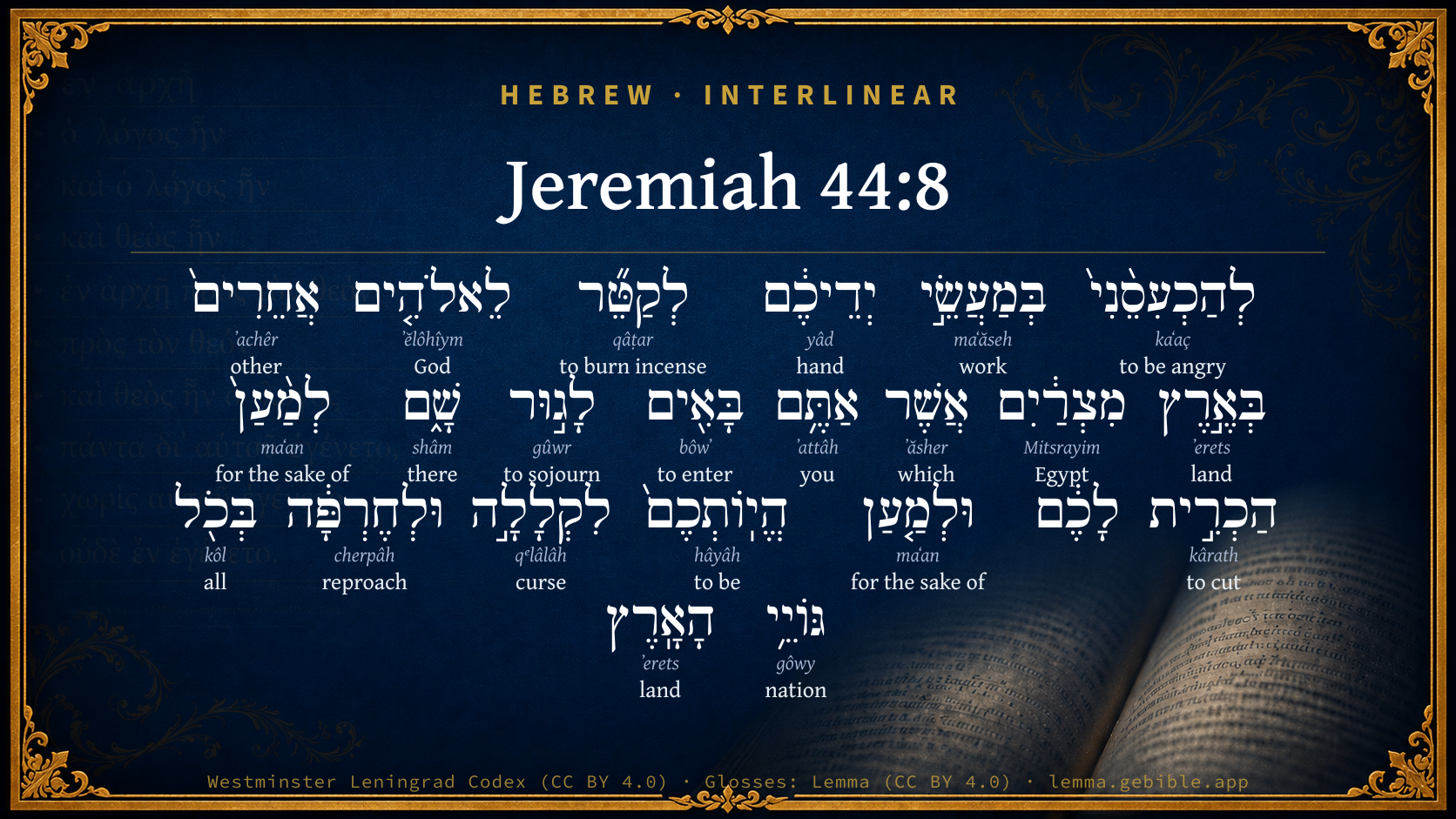
Hebrew (Westminster Leningrad Codex) Jeremiah 44:8 appears in the Hebrew Old Testament. The text above is from the Westminster Leningrad Codex. Each word links to its Strong’s number, a concise gloss, and parsing drawn from the Open Scriptures Hebrew Bible morphology. Click any word for its full Brown-Driver-Briggs (BDB) entry.
Download image
Cite this verse

Jeremiah 44:8 (World English Bible). Public Domain. Lemma interlinear Bible study tool, https://lemma.gebible.app/v/jeremiah/44/8.

Show BibTeX & RIS
BibTeX
RIS
English Translation
in that you provoke me to anger with the works of your hands, burning incense to other gods in the land of Egypt, where you are gone to sojourn; that you may be cut off, and that you may be a curse and a reproach among all the nations of the earth?
World English Bible · Public Domain
Download a study sheet

One document with this verse’s original text, its word-by-word gloss line, the meaning frame, cross-references with their text, attributed commentary, and full source and license credits — printable, and it pastes into notes with its structure intact.

This verse Autodidact and up

Study sheet (.html) Plain text (.txt)

A passage Seminary Student

Up to 50 verses in one chapter. A passage sheet keeps up to 6 commentary sources and 12 cross-references per verse, in the order this page ranks them, and says so on the sheet whenever that leaves anything out. Ask for a single verse and you get the Autodidact verse sheet above.

Everything on this page stays free to read, with no account — the sheet is a download of what is already on screen, not access to it.

Want to remove ads? Support Godless Engineer
Compare translations 3

The same verse in 3 English versions, stacked beneath the original-language interlinear above. Click any original word for its lexicon entry.

Each is an independent rendering of the whole verse — the interlinear is not word-aligned to these translations.

Highlighted words mark where these versions differ — a whole-verse word diff, not a word-by-word alignment.

  • World English Bible Public Domain
    in that you provoke me to anger with the works of your hands, burning incense to other gods in the land of Egypt, where you are gone to sojourn; that you may be cut off, and that you may be a curse and a reproach among all the nations of the earth?
  • King James Version Public Domain
    In that ye provoke me unto wrath with the works of your hands, burning incense unto other gods in the land of Egypt, whither ye be gone to dwell, that ye might cut yourselves off, and that ye might be a curse and a reproach among all the nations of the earth?
  • unfoldingWord Literal Text CC BY-SA 4.0
    By your wickedness you have offended me with the deeds of your hands, by burning incense to other gods in the land of Egypt, where you have gone to live. You have gone there so that you will be destroyed, so that you will be a curse and a reproach among all the nations of the earth.

unfoldingWord Literal Text — © unfoldingWord, licensed CC BY-SA 4.0. Word-aligned USFM3 via Door43 (git.door43.org/unfoldingWord/en_ult).

Versions to compare (up to 4)

3 of 4 selected

Show all 18 translations

Every available English version of this verse, each an independent rendering of the whole verse.

  • World English Bible Public Domain
    in that you provoke me to anger with the works of your hands, burning incense to other gods in the land of Egypt, where you are gone to sojourn; that you may be cut off, and that you may be a curse and a reproach among all the nations of the earth?
  • Berean Standard Bible Public Domain
    Why are you provoking Me to anger by the work of your hands by burning incense to other gods in the land of Egypt, where you have gone to reside? As a result, you will be cut off and will become an object of cursing and reproach among all the nations of the earth.
  • Majority Standard Bible Public Domain
    Why are you provoking Me to anger by the work of your hands by burning incense to other gods in the land of Egypt, where you have gone to reside? As a result, you will be cut off and will become an object of cursing and reproach among all the nations of the earth.
  • King James Version Public Domain
    In that ye provoke me unto wrath with the works of your hands, burning incense unto other gods in the land of Egypt, whither ye be gone to dwell, that ye might cut yourselves off, and that ye might be a curse and a reproach among all the nations of the earth?
  • American Standard Version (1901) Public Domain
    in that ye provoke me unto anger with the works of your hands, burning incense unto other gods in the land of Egypt, whither ye are gone to sojourn; that ye may be cut off, and that ye may be a curse and a reproach among all the nations of the earth?
  • Revised Version (1885) Public Domain
    in that ye provoke me unto anger with the works of your hands, burning incense unto other gods in the land of Egypt, whither ye be gone to sojourn; that ye may be cut off, and that ye may be a curse and a reproach among all the nations of the earth?
  • Geneva Bible (1599) Public Domain
    In that yee prouoke mee vnto wrath with the woorkes of your hands, burning incense vnto other Gods in the lande of Egypt whither yee be gone to dwell: that yee might bring destruction vnto your selues, and that ye might be a curse and a reproch among all nations of the earth.
  • Douay-Rheims (1899) Public Domain
    In that you provoke me to wrath with the works of your hands, by sacrificing to other gods in the land of Egypt, into which you are come to dwell there: and that you should perish, and be a curse, and a reproach to all the nations of the earth?
  • Young's Literal Translation Public Domain
    by provoking Me to anger by the works of your hands, by making perfume to other gods in the land of Egypt, whither ye are going in to sojourn, so as to cut yourselves off, and so as to your being for a reviling and for a reproach among all nations of the earth?
  • Literal Standard Version CC BY-SA 4.0
    by provoking Me to anger by the works of your hands, by making incense to other gods in the land of Egypt, to where you are going to sojourn, so as to cut yourselves off, and so as to your being for a reviling and for a reproach among all nations of the earth?
  • Unlocked Literal Bible CC BY-SA 4.0
    By your wickedness you have offended me with the deeds of your hands, by burning incense to other gods in the land of Egypt, where you have gone to live. You have gone there so that you will be destroyed, so that you will be a curse and a reproach among all the nations of the earth.
  • unfoldingWord Literal Text CC BY-SA 4.0
    By your wickedness you have offended me with the deeds of your hands, by burning incense to other gods in the land of Egypt, where you have gone to live. You have gone there so that you will be destroyed, so that you will be a curse and a reproach among all the nations of the earth.
  • Darby Bible Public Domain
    provoking me to anger with the works of your hands, burning incense unto other gods in the land of Egypt, whither ye are come to sojourn, that ye should be cut off, and that ye should be a curse and a reproach among all the nations of the earth?
  • World Messianic Bible Public Domain
    in that you provoke me to anger with the works of your hands, burning incense to other gods in the land of Egypt where you have gone to live, that you may be cut off, and that you may be a curse and a reproach among all the nations of the earth?
  • Webster's Bible Public Domain
    In that ye provoke me to wrath with the works of your hands, burning incense to other gods in the land of Egypt, whither ye are gone to dwell, that ye may cut yourselves off, and that ye may be a curse and a reproach among all the nations of the earth?
  • Free Bible Version CC BY-SA 4.0
    Why are you making me angry by what you do, burning incense to other gods in Egypt where you have come to live? Because of this you will be destroyed, and you will become a curse word, an expression of condemnation among all the nations on earth.
  • Bible in Basic English Public Domain
    Moving me to wrath with the work of your hands, burning perfumes to other gods in the land of Egypt, where you have gone to make a place for yourselves, so that you may become a curse and a name of shame among all the nations of the earth?
  • JPS Tanakh (1917) Public Domain
    in that ye provoke Me with the works of your hands, offering unto other gods in the land of Egypt, whither ye are gone to sojourn; that ye may be cut off, and that ye may be a curse and a reproach among all the nations of the earth?

Literal Standard Version (2020), Covenant Press — licensed CC BY-SA 4.0. Text via the HelloAO Bible API (eBible.org). Unlocked Literal Bible (unfoldingWord) — licensed CC BY-SA 4.0. Text via the HelloAO Bible API (eBible.org). unfoldingWord Literal Text — © unfoldingWord, licensed CC BY-SA 4.0. Word-aligned USFM3 via Door43 (git.door43.org/unfoldingWord/en_ult). Free Bible Version, Dr. Jonathan Gallagher — licensed CC BY-SA 4.0. Text via the HelloAO Bible API (eBible.org).

Word by word

More ways to search: Search by grammar → Find every occurrence → Compare this word →

Practice this passage: Drill this verse → Learn its vocabulary →

לִקְלָלָ֣ה
qᵉlâlâh
H7045
“to/for · curse”
Preposition + Noun, Common, Feminine, Singular, Absolute
Part of Speech
Preposition + Noun
Type
Common
Gender
Feminine
Number
Singular
State
Absolute
Full BDB Definition

Origin: from H7043

TWOT: 2028d

curse, vilification, execration
  1. לְהַכְעִסֵ֨נִי֙ kaʻaç H3707 “to be angry · me” Preposition + Verb, Hiphil, Infinitive Construct + Suffix, Personal, 1st Person, Common, Singular
  2. בְּמַעֲשֵׂ֣י maʻăseh H4639 “in/at · works of” Preposition + Noun, Common, Masculine, Plural, Construct
  3. יְדֵיכֶ֔ם yâd H3027 “hands · your” Noun, Common, Both, Dual, Construct + Suffix, Personal, 2nd Person, Masculine, Plural
  4. לְקַטֵּ֞ר qâṭar H6999 “to burn incense” Preposition + Verb, Piel, Infinitive Construct
  5. לֵאלֹהִ֤ים ʼĕlôhîym H430 “to/for · God(s)” Preposition + Noun, Common, Masculine, Plural, Absolute
  6. אֲחֵרִים֙ ʼachêr H312 “other” Adjective, Adjective, Masculine, Plural, Absolute
  7. בְּאֶ֣רֶץ ʼerets H776 “in/at · land of” Preposition + Noun, Common, Both, Singular, Construct
  8. מִצְרַ֔יִם Mitsrayim H4714 “Egypt” Noun, Proper
  9. אֲשֶׁר ʼăsher H834 “which” Particle, Relative
  10. אַתֶּ֥ם ʼattâh H859 “you” Pronoun, Personal, 2nd Person, Masculine, Plural
  11. בָּאִ֖ים bôwʼ H935 “entering” Verb, Qal, Participle Active, Masculine, Plural, Absolute
  12. לָג֣וּר gûwr H1481 “to sojourn” Preposition + Verb, Qal, Infinitive Construct
  13. שָׁ֑ם shâm H8033 “there” Adverb
  14. לְמַ֨עַן֙ maʻan H4616 “for the sake of” Preposition
  15. הַכְרִ֣ית kârath H3772 “to cut” Verb, Hiphil, Infinitive Construct
  16. וּלְמַ֤עַן maʻan H4616 “and · for the sake of” Conjunction + Preposition
  17. הֱיֽוֹתְכֶם֙ hâyâh H1961 “to be · you” Verb, Qal, Infinitive Construct + Suffix, Personal, 2nd Person, Masculine, Plural
  18. וּלְחֶרְפָּ֔ה cherpâh H2781 “and · to/for · reproach” Conjunction + Preposition + Noun, Common, Feminine, Singular, Absolute
  19. בְּכֹ֖ל kôl H3605 “in/at · all of” Preposition + Noun, Common, Masculine, Singular, Construct
  20. גּוֹיֵ֥י gôwy H1471 “nations of” Noun, Common, Masculine, Plural, Construct
  21. הָאָֽרֶץ ʼerets H776 “the · land” Particle, Definite Article + Noun, Common, Both, Singular, Absolute

About this verse

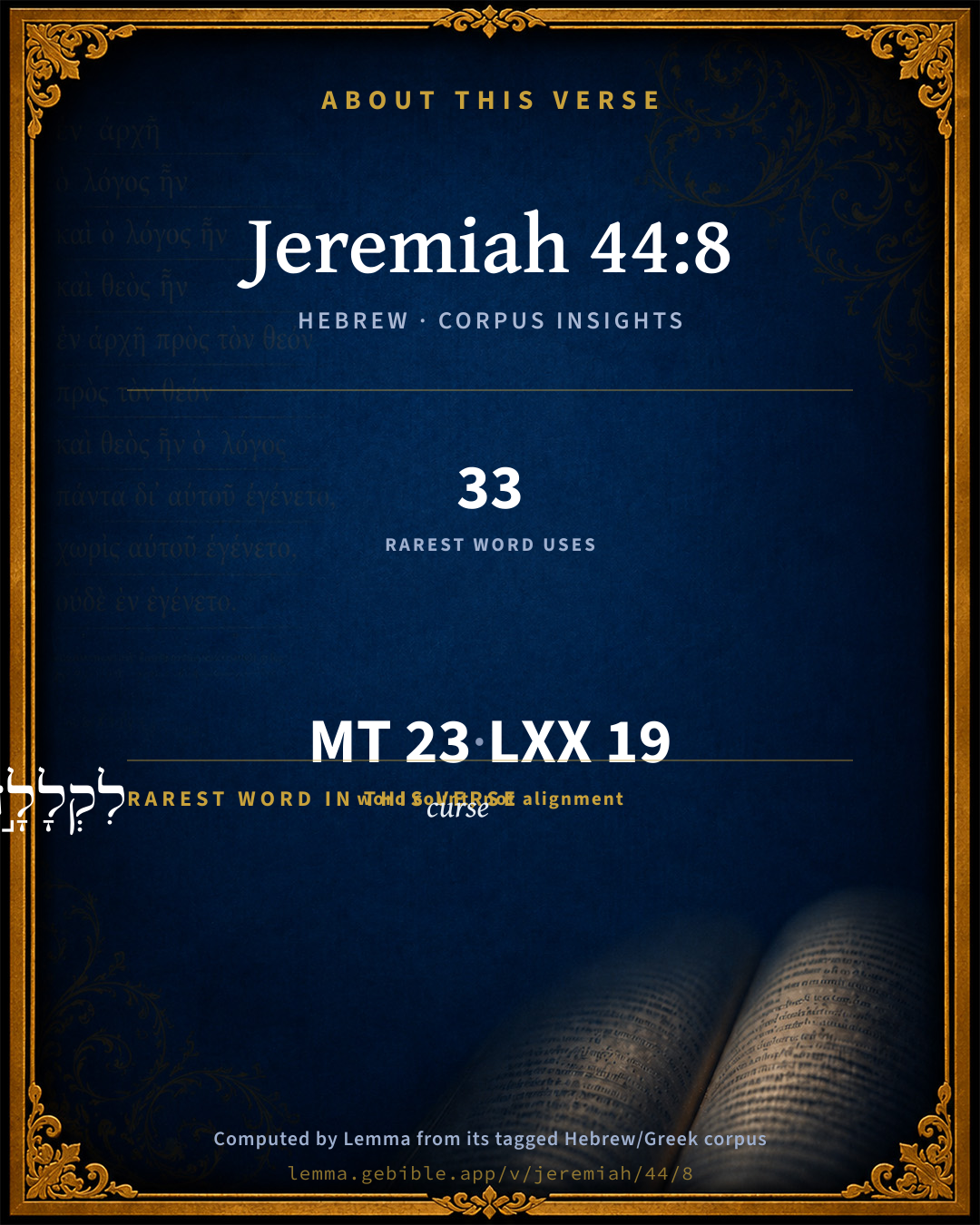
These counts appear in no published source. They are computed here, from the morphology-tagged text and Lemma’s own curated glosses. What Lemma adds →

23
words
20
distinct lemmas
Prophets
section

Shared distinctive vocabulary

לִקְלָלָ֣ה curse H7045 occurs in 33 verses of the Hebrew Bible. Also found in:

Grammatical profile

  • 6 verbs
  • 10 nouns
  • 1 adjective
  • 1 pronoun
  • 3 prepositions
  • 1 adverb
  • 1 particle

Verb forms

  • לְהַכְעִסֵ֨נִי֙ Hiphil · Infinitive Construct
  • לְקַטֵּ֞ר Piel · Infinitive Construct
  • בָּאִ֖ים Qal · Participle Active
  • לָג֣וּר Qal · Infinitive Construct
  • הַכְרִ֣ית Hiphil · Infinitive Construct
  • הֱיֽוֹתְכֶם֙ Qal · Infinitive Construct

Repetition

Words recur within this verse — often emphatic in Hebrew:

  • בְּאֶ֣רֶץ land H776 ×2
  • לְמַ֨עַן֙ for the sake of H4616 ×2

Hebrew & Septuagint length

In the original languages it is 23 Hebrew tokens and 19 Greek tokens — but the two are counted differently (Hebrew bundles its prefixes and suffixes into one token; the Greek is in lemma form), so that isn’t a like-for-like length.

Cross-references

19

Topical passages linked to Jeremiah 44:8 in the Treasury of Scripture Knowledge — connected by theme and wording, ordered by reader-vote popularity; previews shown in the World English Bible.

  • Jeremiah 42:18 For thus says Yahweh of Hosts, the God of Israel: As my anger and my wrath has been poured forth on the inhabitants of Jerusalem, so shall my wrath be poured forth on you, when you shall enter into Egypt; and you shall be an object of horror, and an astonishment, and a curse, and a reproach; and you shall see this place no more.
  • Jeremiah 25:6–7 and don't go after other gods to serve them or worship them, and don't provoke me to anger with the work of your hands; and I will do you no harm.
  • Jeremiah 44:3 because of their wickedness which they have committed to provoke me to anger, in that they went to burn incense, [and] to serve other gods, that they didn't know, neither they, nor you, nor your fathers.
  • 1 Kings 9:7–8 then will I cut off Israel out of the land which I have given them; and this house, which I have made holy for my name, will I cast out of my sight; and Israel shall be a proverb and a byword among all peoples.
  • 2 Kings 17:15–17 They rejected his statutes, and his covenant that he made with their fathers, and his testimonies which he testified to them; and they followed vanity, and became vain, and [went] after the nations that were round about them, concerning whom Yahweh had charged those who they should not do like them.
  • 2 Chronicles 7:20 then will I pluck them up by the roots out of my land which I have given them; and this house, which I have made holy for my name, will I cast out of my sight, and I will make it a proverb and a byword among all peoples.
  • Jeremiah 18:16 to make their land an astonishment, and a perpetual hissing; everyone who passes thereby shall be astonished, and shake his head.
  • 1 Corinthians 10:21–22 You can't both drink the cup of the Lord and the cup of demons. You can't both partake of the table of the Lord, and of the table of demons.
  • Deuteronomy 32:16–17 They moved him to jealousy with strange [gods]; With abominations provoked they him to anger.
  • Isaiah 3:8 For Jerusalem is ruined, and Judah is fallen; Because their tongue and their doings are against Yahweh, To provoke the eyes of his glory.
  • Isaiah 65:15 You shall leave your name for a curse to my chosen; and the Lord Yahweh will kill you; and he will call his servants by another name:
  • Jeremiah 24:9 I will even give them up to be tossed back and forth among all the kingdoms of the earth for evil; to be a reproach and a proverb, a taunt and a curse, in all places where I shall drive them.
  • Jeremiah 26:6 then will I make this house like Shiloh, and will make this city a curse to all the nations of the earth.
  • Jeremiah 29:18 I will pursue after them with the sword, with the famine, and with the pestilence, and will deliver them to be tossed back and forth among all the kingdoms of the earth, to be an object of horror, and an astonishment, and a hissing, and a reproach, among all the nations where I have driven them;
  • Jeremiah 44:7 Therefore now thus says Yahweh, the God of hosts, the God of Israel: Why commit you [this] great evil against your own souls, to cut off from you man and woman, infant and suckling, out of the midst of Judah, to leave you none remaining;
  • Jeremiah 44:12 I will take the remnant of Judah, that have set their faces to go into the land of Egypt to sojourn there, and they shall all be consumed; in the land of Egypt shall they fall; they shall be consumed by the sword and by the famine; they shall die, from the least even to the greatest, by the sword and by the famine; and they shall be an object of horror, [and] an astonishment, and a curse, and a reproach.
  • Ezekiel 18:31–32 Cast away from you all your transgressions, in which you have transgressed; and make you a new heart and a new spirit: for why will you die, house of Israel?
  • Hebrews 3:16 For who, when they heard, rebelled? No, didn't all those who came out of Egypt by Moses?
  • Lamentations 2:15–16 All that pass by clap their hands at you; They hiss and wag their head at the daughter of Jerusalem, [saying], Is this the city that men called The perfection of beauty, The joy of the whole earth?

Cross-references courtesy of OpenBible.info (CC BY 4.0).

Hebrew and Greek witnesses Masoretic Hebrew ↔ Greek Septuagint

The same verse in the two great witnesses to the Old Testament, shown verse-for-verse.

These are two independent witnesses, not word-aligned to each other, and the Septuagint is shown in lemma (dictionary) form.

Hebrew Jeremiah 44:8 Masoretic · Westminster Leningrad Codex

לְהַכְעִסֵ֨נִי֙ בְּמַעֲשֵׂ֣י יְדֵיכֶ֔ם לְקַטֵּ֞ר לֵאלֹהִ֤ים אֲחֵרִים֙ בְּאֶ֣רֶץ מִצְרַ֔יִם אֲשֶׁר אַתֶּ֥ם בָּאִ֖ים לָג֣וּר שָׁ֑ם לְמַ֨עַן֙ הַכְרִ֣ית לָכֶ֔ם וּלְמַ֤עַן הֱיֽוֹתְכֶם֙ לִקְלָלָ֣ה וּלְחֶרְפָּ֔ה בְּכֹ֖ל גּוֹיֵ֥י הָאָֽרֶץ

in that you provoke me to anger with the works of your hands, burning incense to other gods in the land of Egypt, where you are gone to sojourn; that you may be cut off, and that you may be a curse and a reproach among all the nations of the earth?

World English Bible · Public Domain

Greek LXX Structure differs

In the Septuagint, Jeremiah is about an eighth shorter than the Hebrew and arranges its material differently — the Oracles Against the Nations (Hebrew chapters 46–51) appear in the middle of the Greek book, after 25:13. Because the chapter and verse boundaries do not line up, a verse-for-verse comparison with the Hebrew is not shown.

A verse-for-verse comparison isn’t shown here because the chapters and verses don’t line up. Switch to the LXX edition with the MT / LXX toggle above to read the Greek directly.

Hebrew: Westminster Leningrad Codex (CC BY 4.0). Greek: Septuagint (public domain); English from a public-domain English Septuagint. How the Septuagint differs from the Hebrew →

Targum (Aramaic paraphrase)

1

The Targum is the ancient Jewish Aramaic paraphrase of the Hebrew Scriptures — an interpretive translation, not the Hebrew text itself. Onkelos (literal) and Pseudo-Jonathan (expansive) render the Torah, and Jonathan the Prophets. Coverage is partial: where no permissively-licensed English translation exists for a verse, only the Aramaic is shown. This is verse-level text, not a word-by-word alignment to the Hebrew.

  1. Targum Jonathan Prophets (Joshua–Malachi)
    לְאַרְגָזָא קֳדָמַי בְּעוֹבְדֵי יְדֵיכוֹן לְאַסְקָא בּוּסְמִין לְטַעֲוַת פַּלְחֵי כּוֹכְבַיָא בְּאַרְעָא דְמִצְרַיִם דְאַתּוּן אָתָן לְאִתּוֹתָבָא תַמָן בְּדִיל לְשֵׁיצָאָה לְכוֹן וּבְדִין לְמֶהֱוֵיכוֹן לְלוּטָא וּלְחִסוּדִין בְּכָל עַמְמֵי אַרְעָא:

    (no public-domain English translation for this verse)

    Targum Jonathan — Aramaic: “Mikraot Gedolot” (public domain). English: “Sefaria Community Translation” (CC0 1.0 (public-domain dedication)); “London "Chaldee Paraphrase," 1871” (public domain). Text via Sefaria.

Commentary

Notes on Jeremiah 44:8 from classic Christian and Jewish commentators (each source and its license shown beneath its notes). The classic Christian expositions comment on the surrounding passage and are grouped to its opening verse, so a note may address several verses; the Jewish commentaries on the Tanakh (Rashi and others) are per-verse, so they appear only where the commentator wrote on this verse.

Lemma curates 59 commentaries, every one of them public domain or Creative Commons licensed, each selected and text-cleaned for this edition rather than reprinted as found. About our sources →

Trapp's Complete Commentary

John Trapp

Jer 44:8 In that ye provoke me unto wrath with the works of your hands, burning incense unto other gods in the land of Egypt, whither ye be gone to dwell, that ye might cut yourselves off, and that ye might be a curse and a reproach among all the nations of the earth?

Ver. 8. In that ye provoke me to wrath.] This is a most pithy and piercing sermon all along, not unlike that preached by Stephen, for the which he was stoned, {Act 7:54; Act 7:57-58} and likely enough that this was Jeremiah’s last sermon also.

John Trapp, A Commentary or Exposition upon All the Books of the Old and New Testament (1647–1656) — public domain. Text from a community e-Sword module.

Joseph Benson's Commentary

Jer 44:8-10. Ye provoke me unto wrath with the works of your hands — By making and setting up idols to worship. That ye might cut yourselves off, &c. — This is not to be so taken as if they did these things with a design to cut off themselves and their posterity: but only as signifying that their utter ruin would be the certain consequence of their continuing so to act. Have ye forgotten the wickedness of your fathers? &c. — Have you forgotten what great wickedness your fathers committed, and what great punishments were in consequence thereof inflicted upon them? We may be truly said to have forgotten that the sight of which, or reflection thereon, makes no such impression upon us as produces a suitable practice. Which they have committed in the land of Judah, &c. — To have practised these things in any place would have been to contract great guilt; but to have done them in the land of Judah, and in the streets of Jerusalem, in the valley of vision, and in the holy city, where there were such means of information and such helps to piety, was still more aggravated and inexcusable wickedness. They are not humbled even unto this day — Neither they nor you are yet properly humbled, and prepared for receiving mercy. Neither have they feared, nor walked in my law — Hence we learn, that reformation and obedience are the proper fruit of true contrition and humiliation; God does not account those to be humbled, but hardened, who are not reformed and made obedient, let their pretended contrition or humiliation be, in outward appearance, what it may.

Joseph Benson's Commentary on the Old and New Testaments (1811–1818) — public domain. Text from a community e-Sword module.

Jamieson, Fausset & Brown

Robert Jamieson, A. R. Fausset & David Brown

in . . . Egypt--where they polluted themselves to ingratiate themselves with the Egyptians.

ye be gone--not compelled by fear, but of your own accord, when I forbade you, and when it was free to you to stay in Judea.

that ye might cut yourselves off--They, as it were, purposely courted their own ruin.

Jamieson, Fausset & Brown — Commentary Critical and Explanatory on the Whole Bible (1871) — public domain (CC PDM 1.0). Text via the HelloAO Bible API.

John Calvin's Commentaries

I was in the last Lecture obliged to cut short the subject of the Prophet; for this verse depends on the foregoing, and is to be read together with it. The Prophet asked why the Jew’s willingly cut off from themselves every hope of safety, and were seeking their own ruin. He now expresses the matter more fully, even that they were provoking God’s wrath by their superstitions. He then points out the cause of all evils, — the pollution of God’s true worship by idolatries.

We here see that there is no end of sinning, when men despise God and allow themselves every license in doing evil: God was unwilling that the Jews should go to Egypt; for he had promised to cherish them as it were under his own wings; and thus he intended to shew them mercy, so that they might remain in safety, though in a country then miserable and desolate. But against his command they went into Egypt. When they came there, in order to gain favor with the Egyptians, they polluted themselves with vain superstitions. They might in the land of Judah have worshipped God in purity without any danger. Distrusting the favor of God they fled into Egypt; and the fear of men led them to deny their religion. We hence see how one evil proceeds from another; when the Jews coveted the favor of that heathen nation, they polluted themselves with many ungodly superstitions.

This is the sin which the Prophet now refers to, — To provoke me, he says, by the works of your hands There is here to be understood a contrast between the works which God had commanded, and those which men had devised for themselves. The altar and the whole Temple were indeed works done by the hand and art of men; but as God had commanded the altar to be made and the Temple to be built, the Temple was not, properly speaking, a human but a divine work, it having been commanded. But whatever men devise of themselves for the purpose of worshipping God, is what is called the work of their hands; for they invent things themselves, and follow only their own fancies; they attend not to what pleases God, but give license to their own imaginations, so that according to their own will they mingle together any sort of worship they please. This, then, is the reason, and according to this sense it is, that the Prophet says, that the Jews provoked God by the works of their hands: they corrupted his lawful worship and departed from true religion, when they attached themselves to heathen Actions and corruptions.

He then adds, To offer incense to alien gods Under one particular thing, as it has been already said, the Prophet includes what is general, for the Jews did not only sin by offering incense, but also through various other superstitions. But by stating a part for the whole, he clearly intimates that they denied the true God when they worshipped idols. And then he adds, in the land of Egypt, into which ye have entered, that ye might dwell there. he takes away the excuse which they might have made, that they were constrained by fear, because they were unhappy exiles, and saw that their own religion would not be tolerated by that proud nation. The Prophet says that they had come into Egypt when God commanded them to remain in the land of Judah. That plea, then, could not have been admitted, that being terrified by danger they sought to please the Egyptians, for they brought themselves into that bondage, when they might have been at liberty in the land of Judah to worship God in purity. This is the reason why he says that they came into Egypt to sojourn there.

He at length adds, to cut you off. The construction is indeed different, but the meaning is clear. He intimates, in short, as he said in the last verse, that they willingly, and as it were designedly, rushed headlong into their own ruin. He then adds, and ye shall be a curse and a reproach among all nations By which words he means that their destruction would be memorable; and this was harder than if their memory was buried with their life. But the Prophet says that their death would be such an example as that they would be deemed execrable by all. In short, he declares that they would be exposed to all kinds of reproaches even after their death. It follows, —

John Calvin's Commentaries (1540-1563) — public domain. Text from the Calvin Translation Society English edition (1840s-50s) via the Christian Classics Ethereal Library (ccel.org). Calvin's coverage is partial (roughly two-thirds of the Bible); uncommented books and verses are honest gaps, never fabricated. The 19th-century editor's footnotes and remarks are omitted so the notes are faithfully Calvin's own voice.

Ellicott's Commentary for English Readers

(8) Burning incense unto other gods in the land of Egypt.—The words imply that the exiles were not only carrying on the old idolatrous practices with which they had been familiar in their own lands, but had adopted those of the Egyptians. This was the evil which the prophet had all along dreaded, and which had made him from the first, like his predecessor, Isaiah (Isa_30:2; Isa_31:1), hostile to every plan of an alliance with Egypt.

A Bible Commentary for English Readers, edited by Charles John Ellicott (1878–1897) — public domain. Text from a community e-Sword module.

The Cambridge Bible for Schools and Colleges

gen. ed. J. J. S. Perowne

8. the works of your hands] your idols.

The Cambridge Bible for Schools and Colleges (gen. ed. J. J. S. Perowne; Cambridge University Press, 1878–1918) — public domain. Text from a community e-Sword module.

John Gill's Exposition

In that ye provoke me unto wrath with the works of your hands,.... Their sinful actions, particularly their idolatry, by worshipping images, the works of men's hands; and though it was the queen of heaven they worshipped, which their hands made not, yet it was before images they did that; besides, the things they did to her were the worlds of their hands, as sacrificing, pouring out drink offerings, and as follows:

burning incense; which they did, not only to her, but

to other gods in the land of Egypt; where they were very numerous:

whither ye be gone to dwell; against the express will and command of God:

that ye might cut yourselves off; as from the worship of God, so from being his people, and from being under his care and protection, and from all privileges temporal and spiritual:

and that ye might be a curse and a reproach among all the nations of the earth? not that this was their view, end, and design, but this was the event so it was, that they were looked upon as an accursed people of God and man, and their names were taken up for a proverb and a reproach everywhere.

John Gill's Exposition of the Whole Bible (1746–1763) — public domain (CC PDM 1.0). Text via the HelloAO Bible API.

Albert Barnes' Notes on the Bible

Cut yourselves off - Rather, cut (them, Jer 44:7) off from you.

Albert Barnes' Notes on the Bible (1834–1885) — public domain. Text from a community e-Sword/MySword module.

Haydock's Catholic Bible Commentary

Gods. Their blindness and malice was inconceivable. They attribute their past miseries to the neglect of worshipping the moon! ver. 18. They may be compared to a mixture of iron and brass, which is put through the crucible in vain, chap. vi. 29., and Ezechiel xxii. 18.

George Leo Haydock (1774–1849), Haydock's Catholic Family Bible and Commentary, 1859 edition — public domain. Excludes Psalms (Douay-Rheims chapter numbering differs from Protestant) and Deuterocanonical books (Catholic canon only).

Matthew Poole's English Annotations

Idols are usually thus defamed, and indeed nothing can argue a greater stupidity than for any to pay a homage (confessedly due to the Supreme Being) to what is the work of men’s hands, and therefore must be made by one superior to that order of beings in which idols are. But how doth the prophet say that they worshipped the works of men’s hands? for it is apparent, from Jer 44:17, that they paid this homage to the queen of heaven, which is not the work of men’s hands.

Solut. It was before images, which are but the works of men’s hands. And this certainly was the idolatry of the generality of the heathens, they worshipped an unknown Divine Being before a creature, either as representing it, or rather putting them in mind of it.

That ye might be a curse and a reproach among all the nations of the earth; the term that doth not denote the idolater’s end of intention, for none ever did any act intentionally to ruin themselves, it only signifies the end of their work, that their utter ruin would be the certain consequent of their work.

Matthew Poole's English Annotations on the Holy Bible (1683–1685) — public domain. Text from a community e-Sword/MySword module.

The Pulpit Commentary

Vers. 8-13. Prophetic stones.

Jeremiah planting stones at the entrance of Pharaoh"s palace was prophesying by act. The stones were mute prophecies interpreted by the verbal prophecies which in turn they were to confirm in the future. These prophetic stones have their lessons for us.

I DIVINE PURPOSES ARE FIRM AND PERMANENT. They are like the great stones. Words are but air waves; to the incredulous the strongest words may be mere sound and fury, signifying nothing; they melt as they fall. But in the stone we have weight, massiveness, persistence, something that cannot be blown aside with a breath, which will not fade with time, which may be handled, and which remains after it is forgotten, and can be exhumed after being buried. Such is a Divine purpose thus solid and thus enduring.

II DIVINE PURPOSES MAY BE HIDDEN UNTIL THE TIME FOR THE EXECUTION OF THEM. Jeremiah hides the stones. There are prophecies which have been uttered once, and the method of executing them kept secret from us until they are fulfilled. But many Divine purposes are never known till they are accomplished.

III EARTHLY THRONES ABE SET UP ON FOUNDATIONS OF DIVINE APPOINTMENT. Jeremiah lays the foundation of a throne (ver. 10), and he does this as a servant of God executing his will. All earthly power rests ultimately upon a Divine sanction. Yet this fact does not diminish the human responsibility of those who exercise it. The prophet planted the stones; he did not erect the throne. Nebuchadnezzar would be responsible for the throne he set up, the way he established it, and the use he made of it.

IV GOD EMPLOYS HUMAN INSTRUMENTS IN THE EXECUTION OF HIS JUDGMENTS. Nebuchadnezzar is God"s servant. There is a Divine economy in this. If evil cannot be stayed without the withdrawal of those liberties that God sees it to be right to leave intact, the harm of it may be mitigated by making it self-counteractive, the wickedness of one hindering or punishing that of another.

V FLIGHT FROM THE JUDGMENT OF GOD IS IMPOSSIBLE. The Babylonian yoke was a Divine chastisement upon the Jews. They were urged by inspired prophets to submit to it as appointed by God. Some refused and fled to Egypt. But in Egypt they were neither out of the reach of God nor beyond the power of his instrument Nebuchadnezzar. There is no escape from God but by fleeing to God, no deliverance from the doom of sin but in submission to him against whom we have sinned.

VI COMPANIONS IN GUILT WILL BE COMPANIONS IN DOOM. The Jews who fled to Egypt were to share the punishment of that nation. The Egyptians who harboured the Jews were to bring upon themselves the fate that followed the refugees.

HOMILIES BY A.F. MUIR Vers. 8-13. The stones of Tahpanhes.

Great uncertainty as to the fulfilment of this prophetic parable. Are we bound to assume that it was actually carried out? It is possible, according to some critics, (but see Exposition on Jer_46:13) that the accomplishment of the prediction, as of many others, was only contingent. It is very vivid and definite, but that is quite consistent with the intermediate occurrence of circumstances in the spiritual state of the Jewish sojourners that enabled God to cancel it. Just as at this time their disposition may have been alarmingly idolatrous and worldly, so at a later stage it may have changed.

I WHAT THE PARABLE MAY HAVE SUGGESTED.

1. The contingent certainty of Divine judgment. The action may have represented, not only the sequence of events, but that of principles. If, then, the events did not occur, it would still remain true that, in the kingdom of God. such a dependence of principles is eternal; sin is ever nigh to cursing. So much is this the case, that it may be said to contain the elements of its own punishment, like the stones hidden in the clay.

(1) The stones are hidden in the clay with which, although heterogeneous, they stand in a divinely appointed relation.

(2) The interpretation given by the prophet further strengthened this impression in the minds of the spectators. It was the same power, viz. the Chaldean, which had already scourged Judah, that was to follow the remnant into distant Egypt. The continuity of the judgment with those which preceded it is thus forcibly set forth. Nebuchadnezzar, if or when he came, could not be mistaken for other than a divinely ordained instrument of vengeance. The advantage of such an understanding of the prophecy is obvious it ceases to have a particular and transitory significance, and becomes at once necessary and universal. We need that lesson graven upon our hearts today: "The soul that sinneth it shall die;" "He that soweth to the flesh," etc.

2. That dependence upon any earthly power is utterly vain. Egypt is dreamt of as a refuge from their woes. Its power, typified by the clay of the kiln or brick field, only overlies the power of God, typified by the Stones. They would be in his hands still, although they knew it not. Through the clay of worldly dependence they must needs fall upon the stones of Divine judgment. Man cannot flee from his Maker. There is no earthly security from the consequences of sin. If the remnant of Judah, pursuing its tendency towards worldly mindedness and idolatry to the hitter end, should persist in putting its trust in the Egyptian power, to whose religion and life it was in such imminent danger of assimilating itself, woe to it! Through Pharaoh even will they be confronted with Nebuchadnezzar yet again. God is the only true Helper and Saviour, and in the practice of holiness and the precepts of true religion is security alone to be found. What assurance company can shield the sinner from the consequences of his misdeeds? And if God be for any man, who can he against him?

II WHAT THE PARABLE MAY HAVE EFFECTED. It has been conjectured (by Naegelsbach and others) that the symbolic action of Jeremiah and its interpretation so forcibly appealed to the imagination and conscience of the Jews as to change their hearts. That some such consequence as this was intended seems very probable. If it resulted as they suppose, then the judgment was averted which depended upon their misconduct and worldliness. "God repented him of the evil." This is one of the great aims of such teaching so to affect the heart through the imagination as to subdue its evil tendencies and lead it to the pursuit of righteousness and truth. The crowded Jewish colony of Alexandria may then be taken, not as a refutation of the words of Jeremiah, but as a proof that these words produced their legitimate impression, and brought about a deep and lasting reformation. The lesson of all which is that the relation between sin and its punishment, and the futility of earthly securities and screens from Divine vengeance, cannot be too forcibly represented. God will bless the faithful preaching of his Word, and is infinitely more willing to have mercy than to prove his predictions by allowing men to harden their hearts. M.

Vers. 8-13. Building on the sand.

The Jews trusted in the strength of Pharaoh. They had done this before, but to no purpose. The prophets of God always protested against such trust. (cf. Isa 31) Here, in spite of all warning, they are resolving upon such reliance again. But they were building on sand. The destruction came; the very destruction they thought, by their acting as they had done, they had certainly escaped. Thus do and shall be done by all who are like them. Such are

I They that think to establish themselves by wicked ways.

II Those that rely upon men and not on God.

III Those that trust to uncertain riches.

IV Those that think saying "Lord, Lord," whilst living ungodly lives, will save them. C.

Vers. 8-13. The visitation upon Egypt.

Here again is one of the symbolic acts which the prophets were commanded at times to perform. So the hiding of the girdle by Euphrates (ch. 13), the commanded celibacy of the prophet (ch. 16), the dashing of the potter s bottle to pieces (ch. 19). But while these symbolic acts are described in terms which make them perfectly clear, the hiding of the great stones mentioned here needs more full explanation than we can reach to get the significance it. Still, this much of the drift of the action we perceive that Jehovah will make quite manliest, that Nebuchadnezzar"s conquest of Egypt is one divinely ordained and sustained. Not, of course, that Egypt is to suffer simply because these men have gone there; its idolatries are the deepest ground of its calamities. But the delusion of the men of Judah must be looked at in the light of the sufferings of Egypt. In all this experience of death and captivity and slaughter, of temple burning and image breaking; in all this entire appropriation of Egypt by the Babylonian king, these men of Judah must not expect to escape. There is no second land of Goshen for them a place of immunity and peace. If only they had stayed where they thought there would be no safety, then they would have been safe; and going where they made sure of safety, they found the worst of ruin. It reads as if Egypt was to come under Babylon more even than Jerusalem had done. Y. That ye might cut yourselves off; rather, that ye might cut (them) off from you. Who are meant is clear from ver. 7.

The Pulpit Commentary (1880–1919), ed. H.D.M. Spence-Jones & Joseph S. Exell — public domain. Text from a community e-Sword module.

Lesson kit

Teaching starters — assembled from the data on this page, not authored interpretation. Every prompt links to the verse data it draws on. Edit before teaching.

Jeremiah, in the Prophets, opens this verse with 23 words (20 distinct Hebrew lemmas). Its most distinctive word is qᵉlâlâh (“curse”). A historical commentator’s framing appears above. Read the whole chapter for the surrounding context.

Discussion questions

  1. How does “curse” (qᵉlâlâh) shape what this verse is saying?
  2. How does Genesis 27:12, which shares the word «curse», read alongside this verse?
  3. What does the repetition of “land” (2× in this one verse) do in this verse?
  4. These translations render this verse differently. What is at stake in choosing one wording over another?
  5. «לְהַכְעִסֵ֨נִי֙» is a Hiphil Infinitive Construct verb. How does that grammatical form shape the action described?
  6. Compare how Trapp's Complete Commentary and Joseph Benson's Commentary read this verse. Where do they agree or differ?

Things to notice

Reading settings

Reading text

Shown beneath each verse's original-language words.

Old Testament
Old Testament edition

Read the OT as the Masoretic Hebrew (MT) or the Greek Septuagint (LXX).

English shown for the Greek Septuagint (in the Hebrew ↔ Greek comparison).

Comparing translations? Open the Compare panel on any verse page to stack up to four side by side.