
2 Chronicles 1:17

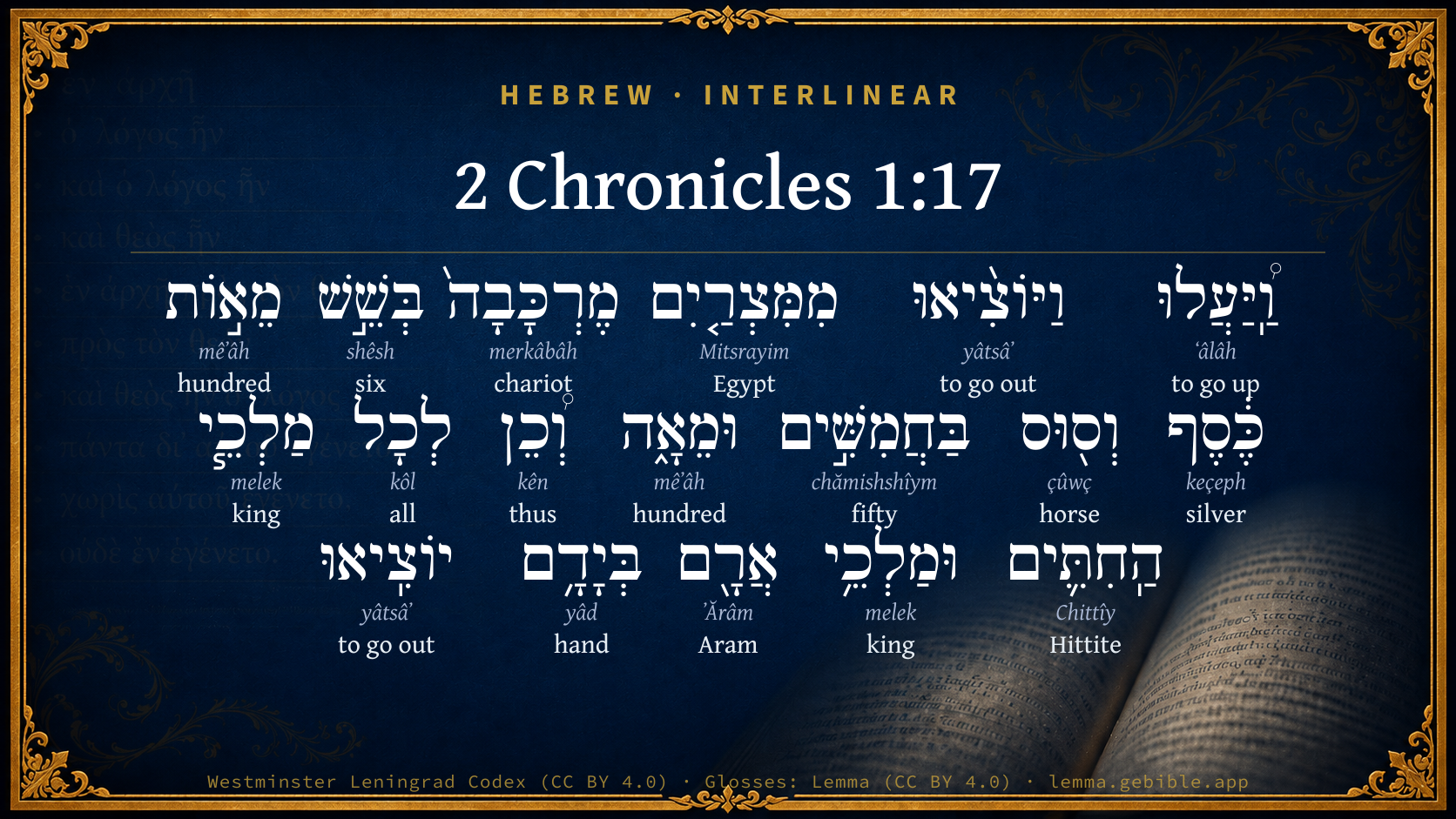
Hebrew (Westminster Leningrad Codex) 2 Chronicles 1:17 appears in the Hebrew Old Testament. The text above is from the Westminster Leningrad Codex. Each word links to its Strong’s number, a concise gloss, and parsing drawn from the Open Scriptures Hebrew Bible morphology. Click any word for its full Brown-Driver-Briggs (BDB) entry.
Download image
Cite this verse

2 Chronicles 1:17 (World English Bible). Public Domain. Lemma interlinear Bible study tool, https://lemma.gebible.app/v/2-chronicles/1/17.

Show BibTeX & RIS
BibTeX
RIS
English Translation
They brought up and brought out of Egypt a chariot for six hundred pieces of silver, and a horse for one hundred fifty: and so for all the kings of the Hittites, and the kings of Syria, did they bring them out by their means.
World English Bible · Public Domain
Download a study sheet

One document with this verse’s original text, its word-by-word gloss line, the meaning frame, cross-references with their text, attributed commentary, and full source and license credits — printable, and it pastes into notes with its structure intact.

This verse Autodidact and up

Study sheet (.html) Plain text (.txt)

A passage Seminary Student

Up to 50 verses in one chapter. A passage sheet keeps up to 6 commentary sources and 12 cross-references per verse, in the order this page ranks them, and says so on the sheet whenever that leaves anything out. Ask for a single verse and you get the Autodidact verse sheet above.

Everything on this page stays free to read, with no account — the sheet is a download of what is already on screen, not access to it.

Want to remove ads? Support Godless Engineer
Compare translations 3

The same verse in 3 English versions, stacked beneath the original-language interlinear above. Click any original word for its lexicon entry.

Each is an independent rendering of the whole verse — the interlinear is not word-aligned to these translations.

Highlighted words mark where these versions differ — a whole-verse word diff, not a word-by-word alignment.

  • World English Bible Public Domain
    They brought up and brought out of Egypt a chariot for six hundred pieces of silver, and a horse for one hundred fifty: and so for all the kings of the Hittites, and the kings of Syria, did they bring them out by their means.
  • King James Version Public Domain
    And they fetched up, and brought forth out of Egypt a chariot for six hundred shekels of silver, and an horse for an hundred and fifty: and so brought they out horses for all the kings of the Hittites, and for the kings of Syria, by their means.
  • unfoldingWord Literal Text CC BY-SA 4.0
    And they brought up and brought out from Egypt a chariot for 600 silver, and a horse for 150. And thus, according to all the kings of the Hittites and the kings of Aram, by their hands, they brought out.

unfoldingWord Literal Text — © unfoldingWord, licensed CC BY-SA 4.0. Word-aligned USFM3 via Door43 (git.door43.org/unfoldingWord/en_ult).

Versions to compare (up to 4)

3 of 4 selected

Show all 18 translations

Every available English version of this verse, each an independent rendering of the whole verse.

  • World English Bible Public Domain
    They brought up and brought out of Egypt a chariot for six hundred pieces of silver, and a horse for one hundred fifty: and so for all the kings of the Hittites, and the kings of Syria, did they bring them out by their means.
  • Berean Standard Bible Public Domain
    A chariot could be imported from Egypt for six hundred shekels of silver, and a horse for a hundred and fifty. Likewise, they exported them to all the kings of the Hittites and to the kings of Aram.
  • Majority Standard Bible Public Domain
    A chariot could be imported from Egypt for six hundred shekels of silver, and a horse for a hundred and fifty. Likewise, they exported them to all the kings of the Hittites and to the kings of Aram.
  • King James Version Public Domain
    And they fetched up, and brought forth out of Egypt a chariot for six hundred shekels of silver, and an horse for an hundred and fifty: and so brought they out horses for all the kings of the Hittites, and for the kings of Syria, by their means.
  • American Standard Version (1901) Public Domain
    And they fetched up and brought out of Egypt a chariot for six hundred `shekels' of silver, and a horse for a hundred and fifty: and so for all the kings of the Hittites, and the kings of Syria, did they bring them out by their means.
  • Revised Version (1885) Public Domain
    And they fetched up, and brought out of Egypt a chariot for six hundred shekels of silver, and an horse for an hundred and fifty: and so for all the kings of the Hittites, and the kings of Syria, did they bring them out by their means.
  • Geneva Bible (1599) Public Domain
    They came vp also and brought out of Egypt some charet, worth sixe hundreth shekels of siluer, that is an horse for an hundreth and fiftie: and thus they brought horses to all the Kings of the Hittites, and to the Kings of Aram by their meanes.
  • Douay-Rheims (1899) Public Domain
    A chariot of four horses for six hundred pieces of silver, and a horse for a hundred and fifty: in like manner market was made in all the kingdoms of the Hethites, and of the kings of Syria.
  • Young's Literal Translation Public Domain
    and they come up, and bring out from Egypt a chariot for six hundred silverlings, and a horse for fifty and a hundred, and so for all the kings of the Hittites, and the kings of Aram -- by their hand they bring out.
  • Literal Standard Version CC BY-SA 4.0
    and they come up, and bring out a chariot from Egypt for six hundred pieces of silver, and a horse for one hundred and fifty, and so for all the kings of the Hittites and the kings of Aram—they bring [them] out by their hand.
  • Unlocked Literal Bible CC BY-SA 4.0
    They imported a chariot from Egypt for six hundred shekels of silver, and a horse for 150 shekels. They also exported them to the kings of the Hittites and the Arameans.
  • unfoldingWord Literal Text CC BY-SA 4.0
    And they brought up and brought out from Egypt a chariot for 600 silver, and a horse for 150. And thus, according to all the kings of the Hittites and the kings of Aram, by their hands, they brought out.
  • Darby Bible Public Domain
    And they fetched up and brought forth out of Egypt a chariot for six hundred [shekels] of silver, and a horse for a hundred and fifty; and so they brought [them] by their means, for all the kings of the Hittites and for the kings of Syria.
  • World Messianic Bible Public Domain
    They imported from Egypt then exported a chariot for six hundred pieces of silver and a horse for one hundred fifty. They also exported them to the Hittite kings and the Syrian kings.
  • Webster's Bible Public Domain
    And they fetched up, and brought out of Egypt a chariot for six hundred shekels of silver, and a horse for a hundred and fifty: and so they brought out horses for all the kings of the Hittites, and for the kings of Syria, by their means.
  • Free Bible Version CC BY-SA 4.0
    A chariot could be imported from Egypt for six hundred silver shekels, and a horse for a hundred and fifty. In the same way they exported them to all the Hittite kings and the Aramean kings.
  • Bible in Basic English Public Domain
    A war-carriage might be got from Egypt for six hundred shekels of silver, and a horse for a hundred and fifty: they got them at the same rate for all the kings of the Hittites and the kings of Aram.
  • JPS Tanakh (1917) Public Domain
    And they fetched up, and brought out of Egypt a chariot for six hundred shekels of silver, and a horse for a hundred and fifty; and so for all the kings of the Hittites, and the kings of Aram, did they bring them out by their means.

Literal Standard Version (2020), Covenant Press — licensed CC BY-SA 4.0. Text via the HelloAO Bible API (eBible.org). Unlocked Literal Bible (unfoldingWord) — licensed CC BY-SA 4.0. Text via the HelloAO Bible API (eBible.org). unfoldingWord Literal Text — © unfoldingWord, licensed CC BY-SA 4.0. Word-aligned USFM3 via Door43 (git.door43.org/unfoldingWord/en_ult). Free Bible Version, Dr. Jonathan Gallagher — licensed CC BY-SA 4.0. Text via the HelloAO Bible API (eBible.org).

Word by word

More ways to search: Search by grammar → Find every occurrence → Compare this word →

Practice this passage: Drill this verse → Learn its vocabulary →

מֶרְכָּבָה֙
merkâbâh
H4818
“chariot”
Noun, Common, Feminine, Singular, Absolute
Part of Speech
Noun
Type
Common
Gender
Feminine
Number
Singular
State
Absolute
Full BDB Definition

Origin: from H4817

TWOT: 2163f

chariot
  1. וַֽ֠יַּעֲלוּ ʻâlâh H5927 “and · to go up” Conjunction + Verb, Hiphil, Sequential Imperfect, 3rd Person, Masculine, Plural
  2. וַיּוֹצִ֨יאוּ yâtsâʼ H3318 “and · to go out” Conjunction + Verb, Hiphil, Sequential Imperfect, 3rd Person, Masculine, Plural
  3. מִמִּצְרַ֤יִם Mitsrayim H4714 “from · Egypt” Preposition + Noun, Proper
  4. בְּשֵׁ֣שׁ shêsh H8337 “in/at · six” Preposition + Adjective, Cardinal number, Feminine, Singular, Absolute
  5. מֵא֣וֹת mêʼâh H3967 “hundred” Adjective, Cardinal number, Both, Plural, Absolute
  6. כֶּ֔סֶף keçeph H3701 “silver” Noun, Common, Masculine, Singular, Absolute
  7. וְס֖וּס çûwç H5483 “and · horse” Conjunction + Noun, Common, Masculine, Singular, Absolute
  8. בַּחֲמִשִּׁ֣ים chămishshîym H2572 “in/at the · fifty” Preposition, Determined + Adjective, Cardinal number, Both, Plural, Absolute
  9. וּמֵאָ֑ה mêʼâh H3967 “and · hundred” Conjunction + Adjective, Cardinal number, Both, Singular, Absolute
  10. וְ֠כֵן kên H3651 “and · thus” Conjunction + Particle, Demonstrative
  11. לְכָל kôl H3605 “to/for · all of” Preposition + Noun, Common, Masculine, Singular, Construct
  12. מַלְכֵ֧י melek H4428 “kings of” Noun, Common, Masculine, Plural, Construct
  13. הַֽחִתִּ֛ים Chittîy H2850 “the · Hittites” Particle, Definite Article + Noun, Gentilic, Masculine, Plural, Absolute
  14. וּמַלְכֵ֥י melek H4428 “and · kings of” Conjunction + Noun, Common, Masculine, Plural, Construct
  15. אֲרָ֖ם ʼĂrâm H758 “Aram” Noun, Proper
  16. בְּיָדָ֥ם yâd H3027 “in/at · hand · their” Preposition + Noun, Common, Both, Singular, Construct + Suffix, Personal, 3rd Person, Masculine, Plural
  17. יוֹצִֽיאוּ yâtsâʼ H3318 “to go out” Verb, Hiphil, Imperfect, 3rd Person, Masculine, Plural

About this verse

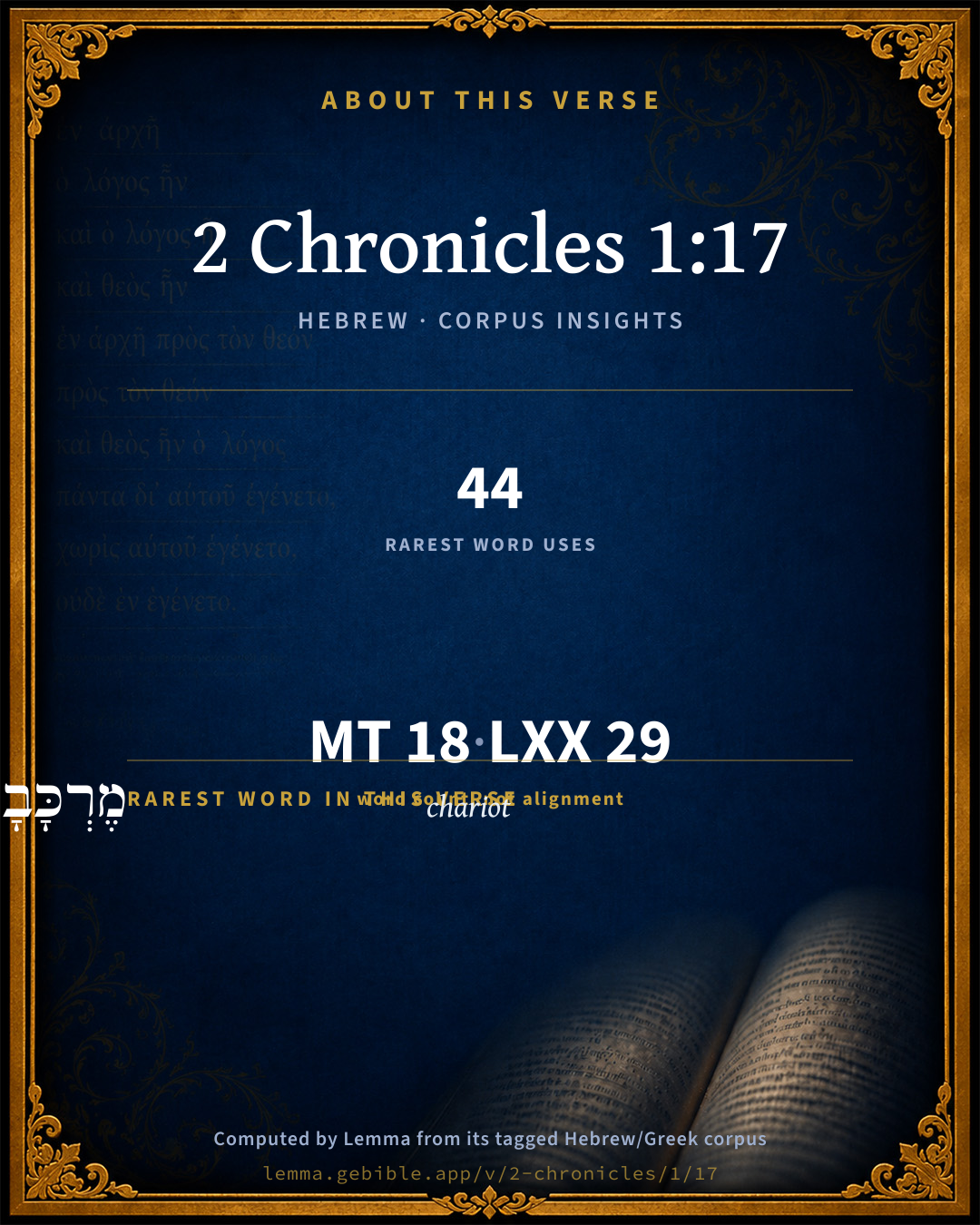
These counts appear in no published source. They are computed here, from the morphology-tagged text and Lemma’s own curated glosses. What Lemma adds →

18
words
15
distinct lemmas
Historical
section

Shared distinctive vocabulary

מֶרְכָּבָה֙ chariot H4818 occurs in 41 verses of the Hebrew Bible. Also found in:

Grammatical profile

  • 3 verbs
  • 10 nouns
  • 4 adjectives
  • 1 particle

Verb forms

  • וַֽ֠יַּעֲלוּ Hiphil · Sequential Imperfect
  • וַיּוֹצִ֨יאוּ Hiphil · Sequential Imperfect
  • יוֹצִֽיאוּ Hiphil · Imperfect

Repetition

Words recur within this verse — often emphatic in Hebrew:

  • וַיּוֹצִ֨יאוּ to go out H3318 ×2
  • מֵא֣וֹת hundred H3967 ×2
  • מַלְכֵ֧י king H4428 ×2

Hebrew & Septuagint length

In English translation the verse runs 45 words from the Hebrew and 46 from the Septuagint (LXX English) — closely comparable.

A rough comparison of the two English renderings, which tokenize alike — not a word-level alignment.

Word counts can differ between the Hebrew and the Greek without any difference in meaning — e.g. the Hebrew direct-object marker אֵת has no separate Greek word, and Greek often adds the article ὁ.

In the original languages it is 18 Hebrew tokens and 29 Greek tokens — but the two are counted differently (Hebrew bundles its prefixes and suffixes into one token; the Greek is in lemma form), so that isn’t a like-for-like length.

Cross-references

1

Topical passages linked to 2 Chronicles 1:17 in the Treasury of Scripture Knowledge — connected by theme and wording, ordered by reader-vote popularity; previews shown in the World English Bible.

  • 2 Kings 10:29 However from the sins of Jeroboam the son of Nebat, with which he made Israel to sin, Jehu didn't depart from after them, [to wit], the golden calves that were in Bethel, and that were in Dan.

Cross-references courtesy of OpenBible.info (CC BY 4.0).

Hebrew and Greek witnesses Masoretic Hebrew ↔ Greek Septuagint

The same verse in the two great witnesses to the Old Testament, shown verse-for-verse.

These are two independent witnesses, not word-aligned to each other, and the Septuagint is shown in lemma (dictionary) form.

Hebrew 2 Chronicles 1:17 Masoretic · Westminster Leningrad Codex

וַֽ֠יַּעֲלוּ וַיּוֹצִ֨יאוּ מִמִּצְרַ֤יִם מֶרְכָּבָה֙ בְּשֵׁ֣שׁ מֵא֣וֹת כֶּ֔סֶף וְס֖וּס בַּחֲמִשִּׁ֣ים וּמֵאָ֑ה וְ֠כֵן לְכָל מַלְכֵ֧י הַֽחִתִּ֛ים וּמַלְכֵ֥י אֲרָ֖ם בְּיָדָ֥ם יוֹצִֽיאוּ

They brought up and brought out of Egypt a chariot for six hundred pieces of silver, and a horse for one hundred fifty: and so for all the kings of the Hittites, and the kings of Syria, did they bring them out by their means.

World English Bible · Public Domain

Greek LXX 2 Chronicles 1:17 Septuagint · lemma form

καί ἀναβαίνω καί ἐκἄγω ἐκ αἴγυπτος ἅρμα εἷς ἑξακόσιοι ἀργύριον καί ἵππος ἑκατόν καί πεντήκοντα καί οὕτως πᾶς ὁ βασιλεύς ὁ χετταῖος καί βασιλεύς συρία ἐν χείρ αὐτός φέρω

and went and brought out of Egypt a chariot for six hundred pieces of silver, and a horse for one hundred and fifty pieces of silver: and so they brought for all the kings of the Chettites, and for the kings of Syria by their means.

LXX2012 (modern English Septuagint) · Public Domain

Hebrew: Westminster Leningrad Codex (CC BY 4.0). Greek: Septuagint (public domain); English from LXX2012 (modern English Septuagint) (Public Domain). How the Septuagint differs from the Hebrew →

Commentary

Notes on 2 Chronicles 1:17 from classic Christian and Jewish commentators (each source and its license shown beneath its notes). The classic Christian expositions comment on the surrounding passage and are grouped to its opening verse, so a note may address several verses; the Jewish commentaries on the Tanakh (Rashi and others) are per-verse, so they appear only where the commentator wrote on this verse.

Lemma curates 59 commentaries, every one of them public domain or Creative Commons licensed, each selected and text-cleaned for this edition rather than reprinted as found. About our sources →

Adam Clarke's Commentary

Verse 17. A horse for a hundred and fifty] Suppose we take the shekel at the utmost value at which it has been rated, three shillings; then the price of a horse was about twenty-two pounds ten shillings.

ON Solomon's multiplying horses, Bishop Warburton has made some judicious remarks: -

"Moses had expressly prohibited the multiplying of horses, De 17:16, by which the future king was forbidden to establish a body of cavalry, because this could not be effected without sending into Egypt, with which people God had forbidden any communication, as this would be dangerous to religion. When Solomon had violated this law, and multiplied horses to excess, 1Kg 4:26, it was soon attended with those fatal consequences that the law foretold: for this wisest of kings having likewise, in violation of another law, married Pharaoh's daughter, (the early fruits of this commerce,) and then, by a repetition of the same crime, but a transgression of another law, having espoused more strange women, 1Kg 11:1; they first, in defiance of a fourth law, persuaded him to build them idol temples for their use, and afterwards, against a fifth law, brought him to erect other temples for his own. Now the original of all this mischief was the forbidden traffic with Egypt for horses; for thither were the agents of Solomon sent to mount his cavalry. Nay, this great king even turned factor for the neighbouring monarchs, 2Ch 1:17, and this opprobrious commerce was kept up by his successors and attended with the same pernicious consequences. Isaiah denounces the mischiefs of this traffic; and foretells that one of the good effects of leaving it would be the forsaking of their idolatries, Isa 31:1; Isa 31:4; Isa 31:6-7." - See Divine Legation, vol. iii., p. 289 and Dr. Dodd's Notes.

Adam Clarke's Commentary on the Bible (1810–1826) — public domain. Text from a community e-Sword/MySword module.

Trapp's Complete Commentary

John Trapp

2Ch 1:17 And they fetched up, and brought forth out of Egypt a chariot for six hundred [shekels] of silver, and an horse for an hundred and fifty: and so brought they out [horses] for all the kings of the Hittites, and for the kings of Syria, by their means.

Ver. 17. And Solomon had horses, &c.] See 1Ki 10:28-29.

John Trapp, A Commentary or Exposition upon All the Books of the Old and New Testament (1647–1656) — public domain. Text from a community e-Sword module.

Geneva Bible (1599)

Geneva Bible translators

Hebrew, hands.

Geneva Bible (1599) marginal notes — public domain. Text via Bolls.life.

Jamieson, Fausset & Brown

Robert Jamieson, A. R. Fausset & David Brown

brought . . . for all the kings of the Hittites--A branch of this powerful tribe, when expelled from Palestine, had settled north of Lebanon, where they acquired large possessions contiguous to the Syrians.

Next: 2 Chronicles Chapter 2

Jamieson, Fausset & Brown — Commentary Critical and Explanatory on the Whole Bible (1871) — public domain (CC PDM 1.0). Text via the HelloAO Bible API.

Ellicott's Commentary for English Readers

(17) And they fetched up, and brought forth out of Egypt.—Literally, And they caused to come up and to come out. Kings has: “And there came up and came out a chariot from Egypt.” The rest of the verse is identical there and here.

A Bible Commentary for English Readers, edited by Charles John Ellicott (1878–1897) — public domain. Text from a community e-Sword module.

The Cambridge Bible for Schools and Colleges

gen. ed. J. J. S. Perowne

17. and so brought they out horses … by their means] i.e. by means of Solomon’s merchants horses were exported for the kings of the Hittites and of Syria.

The Cambridge Bible for Schools and Colleges (gen. ed. J. J. S. Perowne; Cambridge University Press, 1878–1918) — public domain. Text from a community e-Sword module.

The Pulpit Commentary

Six hundred shekels of silver. Some add up in this amount the vehicle itself, harness, horse or horses necessary to it, and the expense of carriage of the whole. Whether or no horses are included may be doubtful. The amount added up reaches, according to various estimates, or If we take the silver shekel at 3s. 4d. according to one of the later authorities (Conder"s "Handbook to the Bible," p. 81, 2nd edit.), the amount will be and so for a horse For all the kings of the Hittites, and the kings of Syria; see 2Ch_8:7, 8 9:14, 23, 24, 1Ki_4:21, 1Ki_4:24; 2Ki_7:6; which last place in particular suggests that Solomon would be the more willing to assist neighbouring peoples in the purchase of horses, etc., who might be already tributary to him, or even vassals, or who might in future be in the better position to help him, when either required or hired to do so.

The Pulpit Commentary (1880–1919), ed. H.D.M. Spence-Jones & Joseph S. Exell — public domain. Text from a community e-Sword module.

Lesson kit

Teaching starters — assembled from the data on this page, not authored interpretation. Every prompt links to the verse data it draws on. Edit before teaching.

2 Chronicles, in the Historical, opens this verse with 18 words (15 distinct Hebrew lemmas). Its most distinctive word is merkâbâh (“chariot”). A historical commentator’s framing appears above. Read the whole chapter for the surrounding context.

Discussion questions

  1. How does “chariot” (merkâbâh) shape what this verse is saying?
  2. How does Genesis 41:43, which shares the word «chariot», read alongside this verse?
  3. What does the repetition of “to go out” (2× in this one verse) do in this verse?
  4. These translations render this verse differently. What is at stake in choosing one wording over another?
  5. «וַֽ֠יַּעֲלוּ» is a Hiphil Sequential Imperfect verb. How does that grammatical form shape the action described?
  6. Compare how Adam Clarke's Commentary and Trapp's Complete Commentary read this verse. Where do they agree or differ?

Things to notice

Reading settings

Reading text

Shown beneath each verse's original-language words.

Old Testament
Old Testament edition

Read the OT as the Masoretic Hebrew (MT) or the Greek Septuagint (LXX).

English shown for the Greek Septuagint (in the Hebrew ↔ Greek comparison).

Comparing translations? Open the Compare panel on any verse page to stack up to four side by side.