Isaiah 52:4

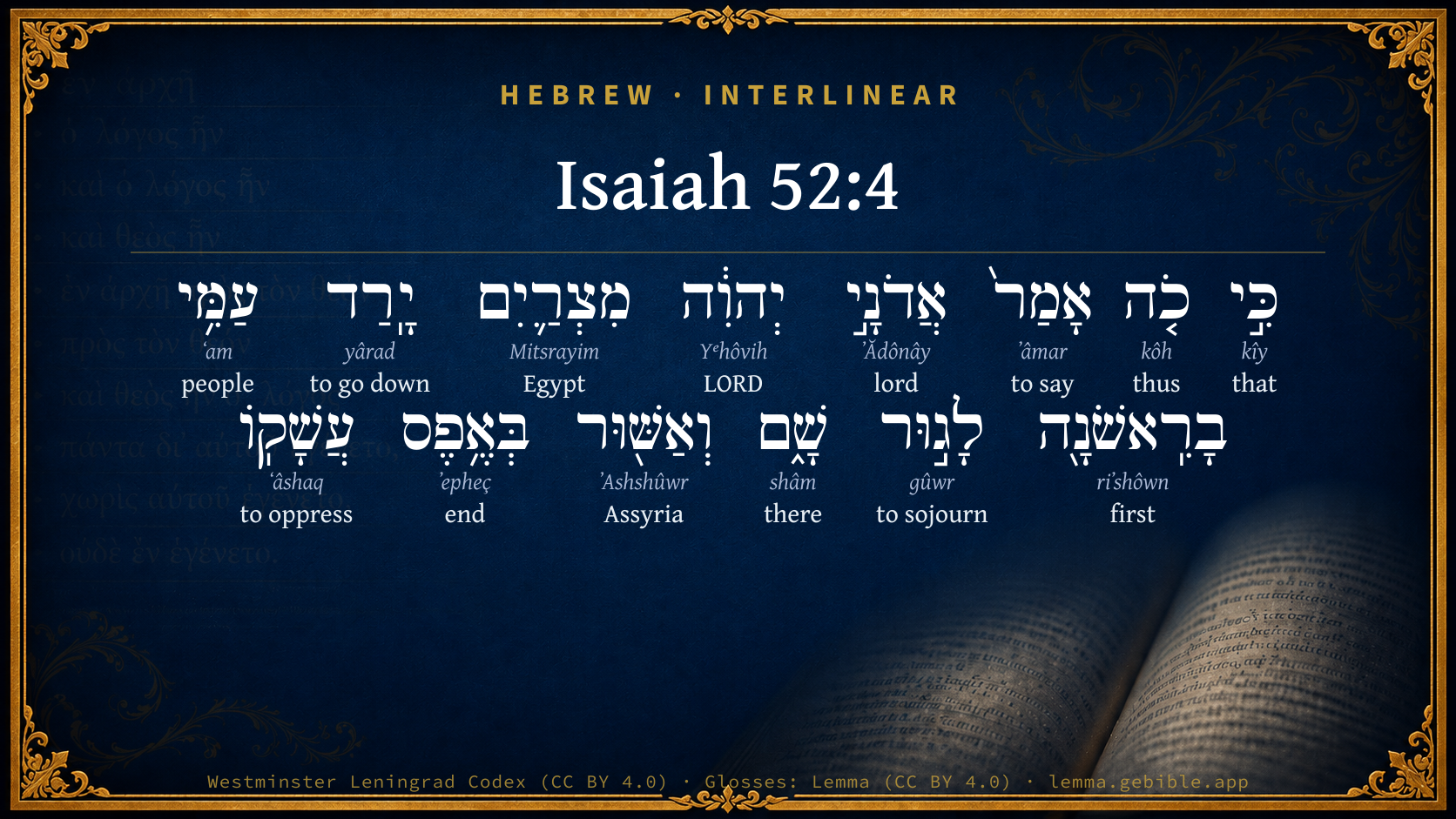
Hebrew (Westminster Leningrad Codex) Isaiah 52:4 appears in the Hebrew Old Testament. The text above is from the Westminster Leningrad Codex. Each word links to its Strong’s number, a concise gloss, and parsing drawn from the Open Scriptures Hebrew Bible morphology. Click any word for its full Brown-Driver-Briggs (BDB) entry.
Download image
Cite this verse

Isaiah 52:4 (World English Bible). Public Domain. Lemma interlinear Bible study tool, https://lemma.gebible.app/v/isaiah/52/4.

Show BibTeX & RIS
BibTeX
RIS
English Translation
For thus says the Lord Yahweh, My people went down at the first into Egypt to sojourn there: and the Assyrian has oppressed them without cause.
World English Bible · Public Domain
Download a study sheet

One document with this verse’s original text, its word-by-word gloss line, the meaning frame, cross-references with their text, attributed commentary, and full source and license credits — printable, and it pastes into notes with its structure intact.

This verse Autodidact and up

Study sheet (.html) Plain text (.txt)

A passage Seminary Student

Up to 50 verses in one chapter. A passage sheet keeps up to 6 commentary sources and 12 cross-references per verse, in the order this page ranks them, and says so on the sheet whenever that leaves anything out. Ask for a single verse and you get the Autodidact verse sheet above.

Everything on this page stays free to read, with no account — the sheet is a download of what is already on screen, not access to it.

Want to remove ads? Support Godless Engineer
Compare translations 3

The same verse in 3 English versions, stacked beneath the original-language interlinear above. Click any original word for its lexicon entry.

Each is an independent rendering of the whole verse — the interlinear is not word-aligned to these translations.

Highlighted words mark where these versions differ — a whole-verse word diff, not a word-by-word alignment.

  • World English Bible Public Domain
    For thus says the Lord Yahweh, My people went down at the first into Egypt to sojourn there: and the Assyrian has oppressed them without cause.
  • King James Version Public Domain
    For thus saith the Lord GOD, My people went down aforetime into Egypt to sojourn there; and the Assyrian oppressed them without cause.
  • unfoldingWord Literal Text CC BY-SA 4.0
    For thus says the Lord Yahweh, “My people went down to Egypt at the first to sojourn there, and Assyria oppressed him for nothing.

unfoldingWord Literal Text — © unfoldingWord, licensed CC BY-SA 4.0. Word-aligned USFM3 via Door43 (git.door43.org/unfoldingWord/en_ult).

Versions to compare (up to 4)

3 of 4 selected

Show all 18 translations

Every available English version of this verse, each an independent rendering of the whole verse.

  • World English Bible Public Domain
    For thus says the Lord Yahweh, My people went down at the first into Egypt to sojourn there: and the Assyrian has oppressed them without cause.
  • Berean Standard Bible Public Domain
    For this is what the Lord GOD says: “At first My people went down to Egypt to live, then Assyria oppressed them without cause.
  • Majority Standard Bible Public Domain
    For this is what the Lord GOD says: “At first My people went down to Egypt to live, then Assyria oppressed them without cause.
  • King James Version Public Domain
    For thus saith the Lord GOD, My people went down aforetime into Egypt to sojourn there; and the Assyrian oppressed them without cause.
  • American Standard Version (1901) Public Domain
    For thus saith the Lord Jehovah, My people went down at the first into Egypt to sojourn there: and the Assyrian hath oppressed them without cause.
  • Revised Version (1885) Public Domain
    For thus saith the Lord GOD, My people went down at the first into Egypt to sojourn there: and the Assyrian oppressed them without cause.
  • Geneva Bible (1599) Public Domain
    For thus saith the Lord God, My people went downe afore time into Egypt to soiourne there, and Asshur oppressed them without cause.
  • Douay-Rheims (1899) Public Domain
    For thus saith the Lord God: My people went down into Egypt at the beginning to sojourn there: and the Assyrian hath oppressed them without any cause at all.
  • Young's Literal Translation Public Domain
    For thus said the Lord Jehovah: `To Egypt My people went down at first to sojourn there, And Asshur -- for nought he hath oppressed it.
  • Literal Standard Version CC BY-SA 4.0
    For thus said Lord YHWH: “My people went down at first || To Egypt to sojourn there, || And Asshur—he has oppressed it for nothing.
  • Unlocked Literal Bible CC BY-SA 4.0
    For this is what the Lord Yahweh says, “In the beginning my people went down to live temporarily in Egypt; and Assyria has oppressed them for no good reason.
  • unfoldingWord Literal Text CC BY-SA 4.0
    For thus says the Lord Yahweh, “My people went down to Egypt at the first to sojourn there, and Assyria oppressed him for nothing.
  • Darby Bible Public Domain
    For thus saith the Lord Jehovah: My people went down at the first into Egypt to sojourn there, and Assyria oppressed them without cause;
  • World Messianic Bible Public Domain
    For the Lord GOD says: “My people went down at the first into Egypt to live there; and the Assyrian has oppressed them without cause.
  • Webster's Bible Public Domain
    For thus saith the Lord GOD, My people went down formerly into Egypt to sojourn there; and the Assyrian oppressed them without cause.
  • Free Bible Version CC BY-SA 4.0
    This is what the Lord God says: First of all, my people went to live in Egypt, then Assyria conquered them for no reason.
  • Bible in Basic English Public Domain
    For the Lord God says, My people went down at first into Egypt, to get a place for themselves there: and the Assyrian put a cruel yoke on them without cause.
  • JPS Tanakh (1917) Public Domain
    For thus saith the Lord GOD: My people went down aforetime into Egypt to sojourn there; and the Assyrian oppressed them without cause.

Literal Standard Version (2020), Covenant Press — licensed CC BY-SA 4.0. Text via the HelloAO Bible API (eBible.org). Unlocked Literal Bible (unfoldingWord) — licensed CC BY-SA 4.0. Text via the HelloAO Bible API (eBible.org). unfoldingWord Literal Text — © unfoldingWord, licensed CC BY-SA 4.0. Word-aligned USFM3 via Door43 (git.door43.org/unfoldingWord/en_ult). Free Bible Version, Dr. Jonathan Gallagher — licensed CC BY-SA 4.0. Text via the HelloAO Bible API (eBible.org).

Word by word

More ways to search: Search by grammar → Find every occurrence → Compare this word →

Practice this passage: Drill this verse → Learn its vocabulary →

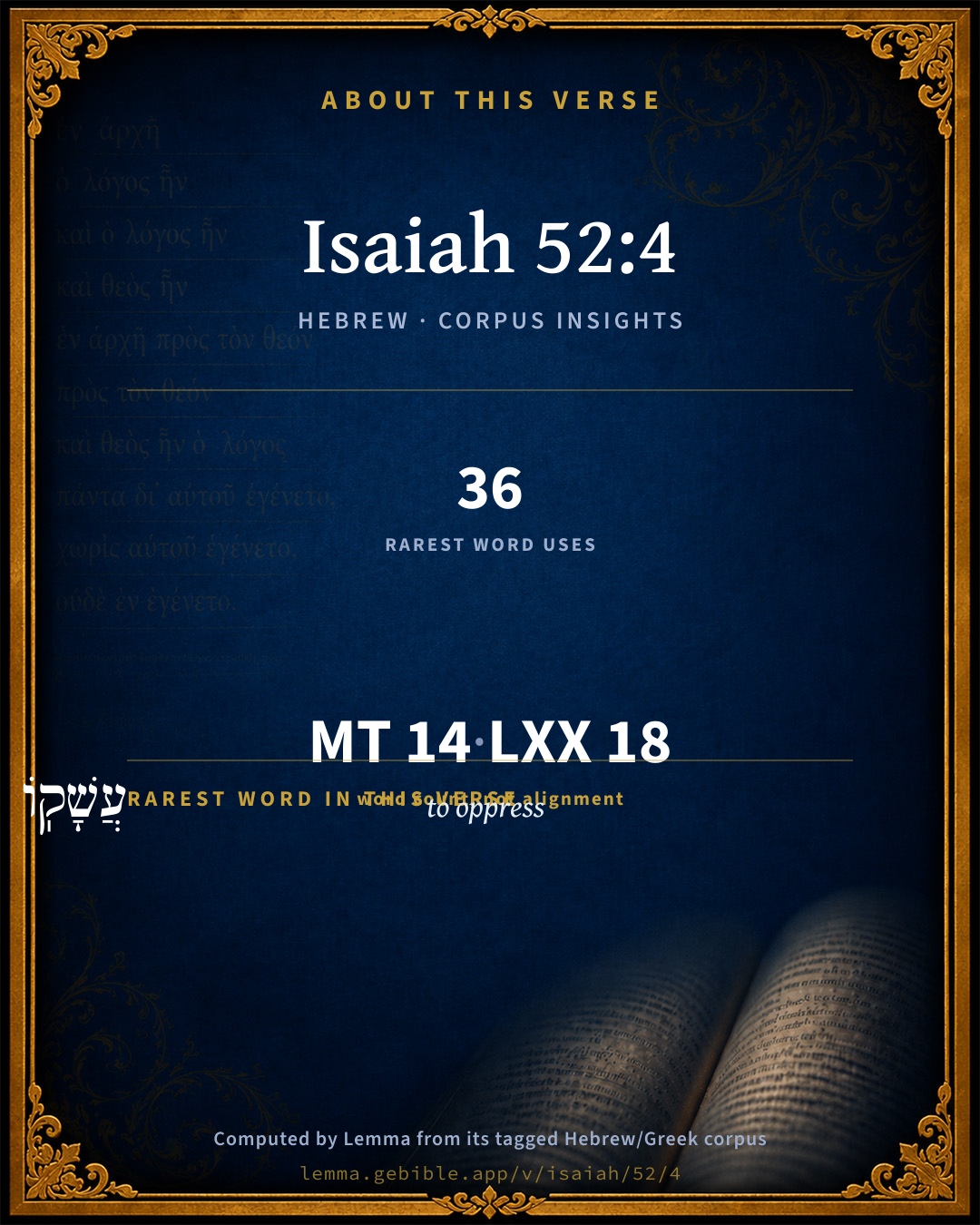
עֲשָׁקֽוֹ
ʻâshaq
H6231
“to oppress · him”
Verb, Qal, Perfect, 3rd Person, Masculine, Singular + Suffix, Personal, 3rd Person, Masculine, Singular
Part of Speech
Verb
Stem
Qal
Form
Perfect
Person
3rd Person
Gender
Masculine
Number
Singular
Full BDB Definition

Origin: a primitive root (comp. H6229 )

TWOT: 1713

to press upon, oppress, violate, defraud, do violence, get deceitfully, wrong, extort - (Qal) - to oppress, wrong, extort - to oppress - (Pual) to be exploited, be crushed
  1. כִּ֣י kîy H3588 “that” Conjunction
  2. כֹ֤ה kôh H3541 “thus” Adverb
  3. אָמַר֙ ʼâmar H559 “to say” Verb, Qal, Perfect, 3rd Person, Masculine, Singular
  4. אֲדֹנָ֣י ʼĂdônây H136 “Lord · my” Noun, Common, Masculine, Plural, Construct + Suffix, Personal, 1st Person, Common, Singular
  5. יְהוִ֔ה Yᵉhôvih H3069 “LORD” Noun, Proper
  6. מִצְרַ֛יִם Mitsrayim H4714 “Egypt” Noun, Proper
  7. יָֽרַד yârad H3381 “to go down” Verb, Qal, Perfect, 3rd Person, Masculine, Singular
  8. עַמִּ֥י ʻam H5971 “people · my” Noun, Common, Masculine, Singular, Construct + Suffix, Personal, 1st Person, Common, Singular
  9. בָרִֽאשֹׁנָ֖ה riʼshôwn H7223 “in/at the · first” Preposition, Determined + Adjective, Adjective, Feminine, Singular, Absolute
  10. לָג֣וּר gûwr H1481 “to sojourn” Preposition + Verb, Qal, Infinitive Construct
  11. שָׁ֑ם shâm H8033 “there” Adverb
  12. וְאַשּׁ֖וּר ʼAshshûwr H804 “and · Assyria” Conjunction + Noun, Proper
  13. בְּאֶ֥פֶס ʼepheç H657 “in/at · end” Preposition + Noun, Common, Masculine, Singular, Absolute

About this verse

These counts appear in no published source. They are computed here, from the morphology-tagged text and Lemma’s own curated glosses. What Lemma adds →

14
words
14
distinct lemmas
Prophets
section

Shared distinctive vocabulary

עֲשָׁקֽוֹ to oppress H6231 occurs in 35 verses of the Hebrew Bible. Also found in:

Grammatical profile

  • 4 verbs
  • 6 nouns
  • 1 adjective
  • 1 conjunction
  • 2 adverbs

Verb forms

  • אָמַר֙ Qal · Perfect
  • יָֽרַד Qal · Perfect
  • לָג֣וּר Qal · Infinitive Construct
  • עֲשָׁקֽוֹ Qal · Perfect

Hebrew & Septuagint length

In English translation the verse runs 26 words from the Hebrew and 22 from the Septuagint (LXX English) — closely comparable.

A rough comparison of the two English renderings, which tokenize alike — not a word-level alignment.

Word counts can differ between the Hebrew and the Greek without any difference in meaning — e.g. the Hebrew direct-object marker אֵת has no separate Greek word, and Greek often adds the article ὁ.

In the original languages it is 14 Hebrew tokens and 18 Greek tokens — but the two are counted differently (Hebrew bundles its prefixes and suffixes into one token; the Greek is in lemma form), so that isn’t a like-for-like length.

Cross-references

9

Topical passages linked to Isaiah 52:4 in the Treasury of Scripture Knowledge — connected by theme and wording, ordered by reader-vote popularity; previews shown in the World English Bible.

  • Genesis 46:6 They took their cattle, and their goods, which they had gotten in the land of Canaan, and came into Egypt-- Jacob, and all his seed with him,
  • Psalms 69:4 Those who hate me without a cause are more than the hairs of my head. Those who want to cut me off, being my enemies wrongfully, are mighty. I have to restore what I didn't take away.
  • Job 2:3 Yahweh said to Satan, "Have you considered my servant Job? For there is none like him in the earth, a blameless and an upright man, one who fears God, and turns away from evil. He still maintains his integrity, although you incited me against him, to ruin him without cause."
  • Acts 7:14–15 Joseph sent, and summoned Jacob, his father, and all his relatives, seventy-five souls.
  • Psalms 25:3 Yes, no one who waits for you shall be shamed. They shall be shamed who deal treacherously without cause.
  • Isaiah 14:25 that I will break the Assyrian in my land, and on my mountains tread him under foot: then shall his yoke depart from off them, and his burden depart from off their shoulder.
  • Isaiah 36:1–22 Now it happened in the fourteenth year of king Hezekiah, that Sennacherib king of Assyria came up against all the fortified cities of Judah, and took them.
  • Jeremiah 50:17 Israel is a hunted sheep; the lions have driven him away: first, the king of Assyria devoured him; and now at last Nebuchadrezzar king of Babylon has broken his bones.
  • John 15:25 But this happened so that the word may be fulfilled which was written in their law, 'They hated me without a cause.'

Cross-references courtesy of OpenBible.info (CC BY 4.0).

Hebrew and Greek witnesses Masoretic Hebrew ↔ Greek Septuagint

The same verse in the two great witnesses to the Old Testament, shown verse-for-verse.

These are two independent witnesses, not word-aligned to each other, and the Septuagint is shown in lemma (dictionary) form.

Hebrew Isaiah 52:4 Masoretic · Westminster Leningrad Codex

כִּ֣י כֹ֤ה אָמַר֙ אֲדֹנָ֣י יְהוִ֔ה מִצְרַ֛יִם יָֽרַד עַמִּ֥י בָרִֽאשֹׁנָ֖ה לָג֣וּר שָׁ֑ם וְאַשּׁ֖וּר בְּאֶ֥פֶס עֲשָׁקֽוֹ

For thus says the Lord Yahweh, My people went down at the first into Egypt to sojourn there: and the Assyrian has oppressed them without cause.

World English Bible · Public Domain

Greek LXX Isaiah 52:4 Septuagint · lemma form

οὕτως λέγω κύριος εἰς αἴγυπτος καταβαίνω ὁ λαός ἐγώ ὁ πρότερος παραοἰκέω ἐκεῖ καί εἰς ἀσσύριος βία ἄγω

Thus says the Lord, My people went down before to Egypt to sojourn there; and were carried away forcibly to the Assyrians.

LXX2012 (modern English Septuagint) · Public Domain

On this verse, Adam Clarke's Commentary discusses the Septuagint’s reading. Read the note in Commentary ↓

Hebrew: Westminster Leningrad Codex (CC BY 4.0). Greek: Septuagint (public domain); English from LXX2012 (modern English Septuagint) (Public Domain). How the Septuagint differs from the Hebrew →

Targum (Aramaic paraphrase)

1

The Targum is the ancient Jewish Aramaic paraphrase of the Hebrew Scriptures — an interpretive translation, not the Hebrew text itself. Onkelos (literal) and Pseudo-Jonathan (expansive) render the Torah, and Jonathan the Prophets. Coverage is partial: where no permissively-licensed English translation exists for a verse, only the Aramaic is shown. This is verse-level text, not a word-by-word alignment to the Hebrew.

  1. Targum Jonathan Prophets (Joshua–Malachi)
    אֲרֵי כִדְנַן אֲמַר יְיָ אֱלֹהִים לְמִצְרַיִם נְחַת עַמִי בְקַדְמֵיתָא לְאִתּוֹתָבָא תַמָן וְאַתּוּרָאָה בִּלְמָא אַנְסֵיהּ:

    For thus saith the Lord God, My people went down aforetime into Egypt to sojourn there; and the Assyrian oppressed them without cause.

    Targum Jonathan — Aramaic: “Mikraot Gedolot” (public domain). English: “Sefaria Community Translation” (CC0 1.0 (public-domain dedication)); “London "Chaldee Paraphrase," 1871” (public domain). Text via Sefaria.

Commentary

Notes on Isaiah 52:4 from classic Christian and Jewish commentators (each source and its license shown beneath its notes). The classic Christian expositions comment on the surrounding passage and are grouped to its opening verse, so a note may address several verses; the Jewish commentaries on the Tanakh (Rashi and others) are per-verse, so they appear only where the commentator wrote on this verse.

Lemma curates 59 commentaries, every one of them public domain or Creative Commons licensed, each selected and text-cleaned for this edition rather than reprinted as found. About our sources →

Trapp's Complete Commentary

John Trapp

Isa 52:4 For thus saith the Lord GOD, My people went down aforetime into Egypt to sojourn there; and the Assyrian oppressed them without cause.

Ver. 4. And the Assyrian oppressed them without cause.] Nulla iniuria lacessitus. So did the primitive persecutors, the Christians of those times, though they were non aliunde noscibiles quam ex vitae integritate, saith Justin Martyr; eminent for their innocence, as Pliny also in his epistle to Trajan the emperor testifieth. What hurt had the Israelites ever done to malicious Moab that he was irked at them? {Num 22:3} or the Hebrews to the Assyrians, that they should oppress them?

John Trapp, A Commentary or Exposition upon All the Books of the Old and New Testament (1647–1656) — public domain. Text from a community e-Sword module.

Joseph Benson's Commentary

Isa 52:4-6. My people went down into Egypt — Where they had protection and sustenance, and therefore owed subjection to the king of Egypt. And yet when he oppressed them I punished him severely, and delivered them out of his hands. And the Assyrian oppressed them — The king of Babylon, who is called the king of Assyria, (2Ki 23:29,) as also the Persian emperor is called, (Ezr 6:22,) because it was one and the same empire which was possessed, first by the Assyrians, then by the Babylonians, and afterward by the Persians. Without cause — Without any real ground or colour, by mere force invading their land, and carrying them away into captivity, Now therefore what have I here — Why (speaking after the manner of men) do I sit still here, and not go to Babylon to punish the Babylonians, and to deliver my people? Or, What honour have I by suffering this injury to be done to my people? That my people is taken away for naught — Were carried away captive by the Babylonians, without any provocation or pretence of right? They that rule over them make them to howl — By their tyrannical and unmerciful usage of them; and my name continually is blasphemed — The Babylonians blaspheme me, as if I wanted either power or goodwill to save my people out of their hands. Therefore my people shall know my name — They shall have sensible experience of my infinite power and goodness in fighting for them. They shall know in that day — When I shall redeem them; which work was begun by the return of the Jews from Babylon, and afterward carried on, and at last perfected, by the coming of the Messiah; that I am he that doth speak — That these promises are not the words of a weak, or fickle, or deceitful man, but of him who is omnipotent, unchangeable, and a covenant-keeping God.

Joseph Benson's Commentary on the Old and New Testaments (1811–1818) — public domain. Text from a community e-Sword module.

Tyndale Open Study Notes

Tyndale Open Resources

52:4 in Egypt . . . oppressed by Assyria: The exodus from exile would be like Israel’s past exodus from Egypt.

Tyndale Open Study Notes — © Tyndale Open Resources, licensed CC BY-SA 4.0. Text via the HelloAO Bible API.

Geneva Bible (1599)

Geneva Bible translators

When Jacob went thither in time of famine.

The Egyptians might pretend some cause to oppress my people because they went thither, and remained among them, but the Assyrians have no title to excuse their tyranny by, and therefore will I punish them more than I did the Egyptians.

Geneva Bible (1599) marginal notes — public domain. Text via Bolls.life.

Jamieson, Fausset & Brown

Robert Jamieson, A. R. Fausset & David Brown

My people--Jacob and his sons.

went down--Judea was an elevated country compared with Egypt.

sojourn--They went there to stay only till the famine in Canaan should have ceased.

Assyrian--Sennacherib. Remember how I delivered you from Egypt and the Assyrian; what, then, is to prevent Me from delivering you out of Babylon (and the mystical Babylon and the Antichrist in the last days)?

without cause--answering to "for naught" in Isa 52:5; it was an act of gratuitous oppression in the present case, as in that case.

Jamieson, Fausset & Brown — Commentary Critical and Explanatory on the Whole Bible (1871) — public domain (CC PDM 1.0). Text via the HelloAO Bible API.

Adam Clarke's Commentary

Verse 4. Thus saith the Lord God] אדני יהוה Adonai Jehovah; but Adonai is wanting in twelve of Kennicott's, five of De Rossi's, and two of my own MSS.; and by the Septuagint and Arabic. Some MSS. have יהוה צבאות Jehovah tsebaoth, "Lord of hosts;" and others have יהוה אלהים Yehovah Elohim, "Lord God."

Adam Clarke's Commentary on the Bible (1810–1826) — public domain. Text from a community e-Sword/MySword module.

Ellicott's Commentary for English Readers

(4) My people went down . . .—Stress is laid on the unprovoked character of the oppression in the case both of Egypt and the Assyrian invaders Sargon and Sennacherib. It is possible that Assyria may be used in its wider sense as including Babylon. If so, the fact tends to the conclusion that the book was written at a time when the kings of Assyria included Babylon in their titles. Probably, however, the prophet refers to the deliverance from the army of Sennacherib as a pledge of the deliverance from Babylon.

A Bible Commentary for English Readers, edited by Charles John Ellicott (1878–1897) — public domain. Text from a community e-Sword module.

The Cambridge Bible for Schools and Colleges

gen. ed. J. J. S. Perowne

4. For aforetime render with R.V. at the first, at the outset of its history.

without cause] i.e. probably, “for nought,” without having acquired any right over Israel by services rendered to Jehovah. The meaning can hardly be that Israel suffered innocently.

The Cambridge Bible for Schools and Colleges (gen. ed. J. J. S. Perowne; Cambridge University Press, 1878–1918) — public domain. Text from a community e-Sword module.

John Gill's Exposition

For thus saith the Lord God,.... The Lord confirms what he had before said of redeeming his people without money, who had been sold for nothing, by past instances of his deliverance of them:

my people went down aforetime into Egypt to sojourn there; Jacob and his family went down there of their own accord, where they were supplied with food in a time of famine, and settled in a very fruitful part of it; but when they were oppressed, and cried to the Lord, he appeared for them, and delivered them:

and the Assyrian oppressed them without cause; which some understand of Pharaoh, king of Egypt, who they say was an Assyrian, or so called, because of his power and cruelty; or it being usual to call any enemy of the Jews an Assyrian: or rather the words may be rendered, "but the Assyrian", &c. Pharaoh had some pretence for what he did; the Israelites came into his country, he did not carry them captive; they received many benefits and favours there, and were settled in a part of his dominions, so that he might claim them as his subjects, and refuse to dismiss them; but the Assyrians had nothing to do with them; could not make any pretence why they should invade them, and oppress them; and therefore if the Lord had delivered them from the one, he would also deliver them from the other. This may be understood of the several invasions and captivities by Pul, Tiglathpileser, Shalmaneser, Sennacherib, and even Nebuchadnezzar king of Babylon; Babylon having been the metropolis of Assyria, and a branch of the Assyrian empire, though now translated to the Chaldeans: or the sense is, and the Assyrians also oppressed Israel, as well as the Egyptians, without any just reason, and I delivered them out of their hands; and so I will redeem my church and people out of antichristian bondage and slavery.

John Gill's Exposition of the Whole Bible (1746–1763) — public domain (CC PDM 1.0). Text via the HelloAO Bible API.

Albert Barnes' Notes on the Bible

For thus saith the Lord God - In order to show them that he could redeem them without money, God reminds them of what had been done in former times. The numerous captives in Egypt, whose services were so valuable to the Egyptians, and whom the Egyptians were so unwilling to suffer to depart, he had rescued by his own power, and had delivered for ever from that bondage. The idea here is, that with the same ease he could rescue the captives in Babylon, and restore them to their own land without a price.

My people went down - That is, Jacob and his sons. The phrase ‘went down,’ is applied to a journey to Egypt, because Judea was a mountainous and elevated country compared with Egypt, and a journey there was in fact a descent to a more level and lower country.

To sojourn there - Not to dwell there permanently, but to remain there only for a time. They went in fact only to remain until the severity of the famine should have passed by, and until they could return with safety to the land of Canaan.

And the Assyrians oppressed them without cause - A considerable variety has existed in the interpretation of this passage. The Septuagint renders it, ‘And to the Assyrians they were carried by force.’ Some have supposed that this refers to the oppressions that they experienced in Egypt, and that the name ‘Assyrian’ is here given to Pharaoh. So Forerius and Cajetan understand it. They suppose that the name, ‘the Assyrian,’ became, in the apprehension of the Jews, the common name of that which was proud, oppressive, and haughty, and might therefore be used to designate Pharaoh. But there are insuperable objections to this. For the name ‘the Assyrian’ is not elsewhere given to Pharaoh in the Scriptures, nor can it be supposed to be given to him but with great impropriety. It is not true that Pharaoh was an Assyrian; nor is it true that the Israelites were oppressed by the Assyrians while they remained in Egypt. Others have supposed that this refers to Nebuchadnezzar and the Chaldeans in general, and that the name ‘the Assyrian’ is given them in a large and general sense, as ruling over that which constituted the empire of Assyria, and that the prophet here refers to the calamities which they were suffering in Babylon. But the objection to this is not the less decisive.

It is true that Babylon was formerly a part or province of Assyria, and true also that in the time of the Jewish captivity it was the capital of the kingdom of which the former empire of Assyria became a subject province. But the name Babylonian, in the Scriptures, is kept distinct from that of Assyrian, and they are not used interchangeably. Nor does the connection of the passage require us to understand it in this sense. The whole passage is in a high degree elliptical, and something must be supplied to make out the sense. The general design of it is, to show that God would certainly deliver the Jews from the captivity at Babylon without money. For this purpose, the prophet appeals to the former instances of his interposition when deliverance had been effected in that way. A paraphrase of the passage, and a filling up of the parts which are omitted in the brief and abrupt manner of the prophet, will show the sense. ‘Ye have been sold for nought, and ye shall be ransomed without price.

As a proof that I can do it, and will do it, remember that my people went down formerly to Egypt, and designed to sojourn there for a little time, and that they were there reduced to slavery, and oppressed by Pharaoh, but that I ransomed them without money, and brought them forth by my own power. Remember, further, how often the Assyrian has oppressed them also, without cause. Remember the history of Sennacherib, Tiglath-pileser, and Salmaneser, and how they have laid the land waste, and remember also how I have delivered it from these oppressions. With the same certainty, and the same ease, I can deliver the people from the captivity at Babylon.’ The prophet, therefore, refers to different periods and events; and the idea is, that God had delivered them when they had been oppressed alike by the Egyptian, and by the Assyrians, and that he who had so often interposed would also rescue them from their oppression in Babylon.

Albert Barnes' Notes on the Bible (1834–1885) — public domain. Text from a community e-Sword/MySword module.

Haydock's Catholic Bible Commentary

Assyrian. Pharao, (Sa; Tirinus) or rather Nabuchodonosor, (Calmet) and the princes of Assyria, who acted tyrannically. (Haydock)

George Leo Haydock (1774–1849), Haydock's Catholic Family Bible and Commentary, 1859 edition — public domain. Excludes Psalms (Douay-Rheims chapter numbering differs from Protestant) and Deuterocanonical books (Catholic canon only).

Matthew Poole's English Annotations

My people went down aforetime into Egypt to sojourn there; where they had protection and sustenance, and therefore owed subjection to the king of Egypt. And yet when he oppressed them I punished him severely, and delivered them out of his hands. Which is easily understood from the following words. And; or, but; for here is an opposition made between these two cases.

The Assyrian; the king of Babylon, who is called the king of Assyria, 2Ki 23:29, compared with Isa 24:7, as also the Persian emperor is called, Ezr 6:22, because it was one and the same empire, which was possessed, first by the Assyrians, then by the Babylonians, and afterwards by the Persians. Oppressed them without cause; without any such ground or valour, by mere force invading their land, and carrying them away into captivity. For although it be said that God gave this land and people into his hand, 2Ch 36:11, by his counsel and providence; yet that was neither known to nor regarded by the king of Babylon, nor was it a good and lawful title, God’s word, and not his providence, being the rule by which men’s rights are determined; otherwise a robber hath a right to my purse, which he cannot take from me upon the highway without God’s providence.

Matthew Poole's English Annotations on the Holy Bible (1683–1685) — public domain. Text from a community e-Sword/MySword module.

The Pulpit Commentary

My people went down... into Egypt ... the Assyrian oppressed them. Israel had experienced three captivities. They "went down" voluntarily into Egypt, on invitation, to sojourn, and were there cruelly and unjustly reduced to a servile condition. (Exo_1:13, Exo_1:14) They (or a great part of them) were violently carried into captivity by the Assyrian kings, Tiglath-Pileser, (2Ki_15:29) Sargon, (2Ki_17:6) and Sennacherib (2Ki_18:13; "Eponym Canon," p. 134), who, without cause, grievously "oppressed" them. Now they are suffering under a third captivity in Babylonia. What is to be the Divine action under these circumstances?

The Pulpit Commentary (1880–1919), ed. H.D.M. Spence-Jones & Joseph S. Exell — public domain. Text from a community e-Sword module.

John Wesley's Explanatory Notes

Egypt - Where they had protection and sustenance, and therefore owed subjection to the king of Egypt. And yet when he oppressed them, I punished him severely, and delivered them out of his hands. The Assyrian - The king of Babylon, who is called the king of Assyria, 2 Kings xxiii, 29, as also the Persian emperor is called, Ezra vi, 22, because it was one and the same empire which was possessed, first by the Assyrians, then by the Babylonians, and afterwards by the Persians. Without cause - Without any such ground or colour, by mere force invading their land, and carrying them away into captivity.

John Wesley, Explanatory Notes Upon the Whole Bible (1754–1765) — public domain. Text via the GEBible commentary corpus.

J. A. Alexander on Isaiah

Joseph Addison Alexander

“For thus saith the Lord Jehovah, Into Egypt went down my people at the first to sojourn there, and Assyria oppressed them for nothing.” The interpretation of this verse and the next has been not a little influenced by the assumption of one or more strongly marked antitheses. Thus some writers take it for granted that the Prophet here intended to contrast the Egyptian and Assyrian bondage. They accordingly explain the verse as meaning that the first introduction of Israel into Egypt was without any evil design upon the part of the Egyptians, who did not begin to oppress them until there arose a king who knew not Joseph (Exo 1:8), whereas the Assyrian deportation of Israel was from the beginning a high-handed act of tyranny. One commentator appears to exclude the supposition of a contrast altogether, and to understand the passage as a chronological enumeration of events, designed to show how much had been endured already as a reason why they should endure no more. (Compare Isa 40:2). In ancient times they were oppressed by the Egyptians, at a later period by Assyria, and later still by Babylonia, whose oppressions are supposed to be described in v. 5, either as already suffered, or as an object of prophetic foresight. This is the simplest and most natural interpretation, and is very strongly recommended by the difficulty of defining the antithesis intended on the other supposition. Most writers understand the last words as meaning for nothing or without cause, (i.e., unjustly). The explanation of Assyria as meaning or including Babylonia, though not without authority from usage, is as unnecessary here as in various other places where it has been proposed.

Joseph Addison Alexander, The Prophecies of Isaiah (1846–1847; New York: Scribner, 1870–1878) — public domain. Text from a community e-Sword module.

unfoldingWord translationNotes

Door43 World Missions Community

In the beginning

Here "beginning" refers to the start of Israel's history as they were first becoming a people.

went down to ... Egypt

"went to ... Egypt." It was common to use the phrase "went down" when speaking of traveling from Canaan to Egypt.

Assyria has oppressed them

Assyria refers to the people of Assyria. AT: "the people of Assyria have treated them badly" (See: Metonymy)

translationWords

Lord Yahweh

people of God

Egypt

Assyria

oppress

unfoldingWord translationNotes — © Distant Shores Media and the Door43 World Missions Community, licensed CC BY-SA 4.0. Source: git.door43.org/Door43/en_tn.

Rashi

Rabbi Shlomo Yitzchaki (Rashi)

My people first went down to Egypt The Egyptians had somewhat of a debt upon them, for they served for them as their hosts and sustained them, but Assyria oppressed them for nothing and without cause.

Rashi on the Tanakh — English translations: “The Judaica Press complete Tanach with Rashi, translated by A. J. Rosenberg” (CC BY 4.0); “Pentateuch with Rashi's commentary by M. Rosenbaum and A.M. Silbermann, 1929-1934” (public domain); “The Metsudah Tanach series, Lakewood, N.J” (CC BY 4.0); and “The Book of Joshua, Metsudah Publications, 1997” (CC BY 4.0). Text via Sefaria.

Ibn Ezra

Rabbi Abraham ibn Ezra

My people went down, etc. Many evils came over my people from the beginning; for when, long ago, they went down to Egypt to sojourn there, they were oppressed.

באפס Without cause. For nothing. And the Assyrian without cause oppressed them. This refers to the exile of the ten tribes.

Ibn Ezra on the Tanakh — English translations: “Sefaria Community Translation” (CC0 1.0 (public-domain dedication)); “Yalkut, Sifsei Chachomim Chumash, Metsudah Publications, 2009” (CC BY 4.0); and “Commentary of Ibn Ezra on Isaiah - trans. by M. Friedlander, 1873” (public domain). Text via Sefaria.

Lesson kit

Teaching starters — assembled from the data on this page, not authored interpretation. Every prompt links to the verse data it draws on. Edit before teaching.

Isaiah, in the Prophets, opens this verse with 14 words (14 distinct Hebrew lemmas). Its most distinctive word is ʻâshaq (“to oppress”). A historical commentator’s framing appears above. Read the whole chapter for the surrounding context.

Discussion questions

  1. How does “to oppress” (ʻâshaq) shape what this verse is saying?
  2. Leviticus 6:2 shares the word «to oppress» with this verse. How do the two illuminate each other?
  3. These translations render this verse differently. What is at stake in choosing one wording over another?
  4. The verb «אָמַר֙» is Qal Perfect. How does its form color the action?
  5. Reading how Trapp's Complete Commentary and Joseph Benson's Commentary read this verse, where do the two commentators agree and where do they part?

Things to notice

Reading settings

Reading text

Shown beneath each verse's original-language words.

Old Testament
Old Testament edition

Read the OT as the Masoretic Hebrew (MT) or the Greek Septuagint (LXX).

English shown for the Greek Septuagint (in the Hebrew ↔ Greek comparison).

Comparing translations? Open the Compare panel on any verse page to stack up to four side by side.