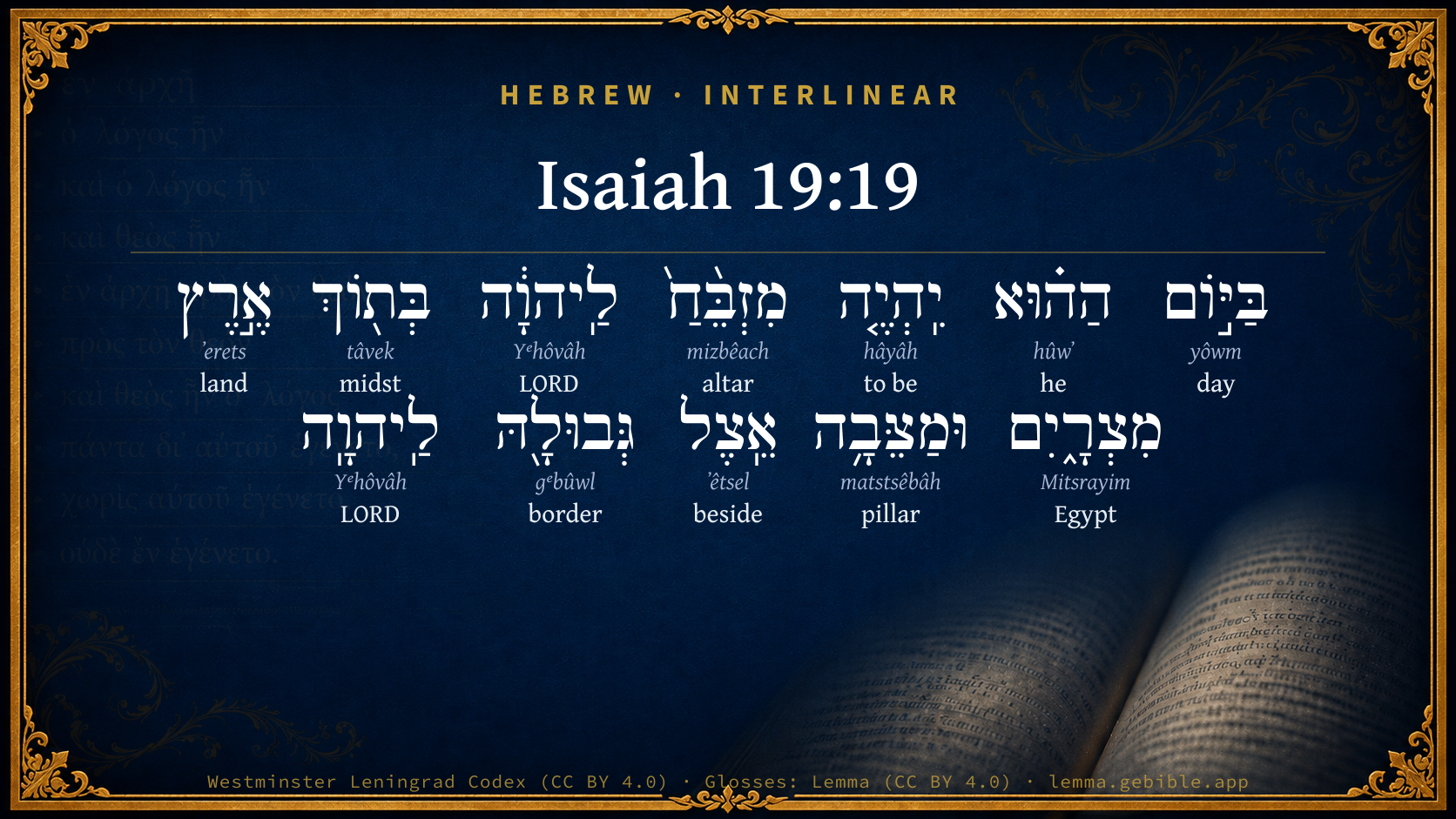
Isaiah 19:19

Hebrew (Westminster Leningrad Codex) Isaiah 19:19 appears in the Hebrew Old Testament. The text above is from the Westminster Leningrad Codex. Each word links to its Strong’s number, a concise gloss, and parsing drawn from the Open Scriptures Hebrew Bible morphology. Click any word for its full Brown-Driver-Briggs (BDB) entry.
Download image
Cite this verse

Isaiah 19:19 (World English Bible). Public Domain. Lemma interlinear Bible study tool, https://lemma.gebible.app/v/isaiah/19/19.

Show BibTeX & RIS
BibTeX
RIS
English Translation
In that day shall there be an altar to Yahweh in the midst of the land of Egypt, and a pillar at the border of it to Yahweh.
World English Bible · Public Domain
Download a study sheet

One document with this verse’s original text, its word-by-word gloss line, the meaning frame, cross-references with their text, attributed commentary, and full source and license credits — printable, and it pastes into notes with its structure intact.

This verse Autodidact and up

Study sheet (.html) Plain text (.txt)

A passage Seminary Student

Up to 50 verses in one chapter. A passage sheet keeps up to 6 commentary sources and 12 cross-references per verse, in the order this page ranks them, and says so on the sheet whenever that leaves anything out. Ask for a single verse and you get the Autodidact verse sheet above.

Everything on this page stays free to read, with no account — the sheet is a download of what is already on screen, not access to it.

Want to remove ads? Support Godless Engineer
Compare translations 3

The same verse in 3 English versions, stacked beneath the original-language interlinear above. Click any original word for its lexicon entry.

Each is an independent rendering of the whole verse — the interlinear is not word-aligned to these translations.

Highlighted words mark where these versions differ — a whole-verse word diff, not a word-by-word alignment.

  • World English Bible Public Domain
    In that day shall there be an altar to Yahweh in the midst of the land of Egypt, and a pillar at the border of it to Yahweh.
  • King James Version Public Domain
    In that day shall there be an altar to the LORD in the midst of the land of Egypt, and a pillar at the border thereof to the LORD.
  • unfoldingWord Literal Text CC BY-SA 4.0
    In that day an altar to Yahweh will be in the midst of the land of Egypt, and a pillar to Yahweh, at its border.

unfoldingWord Literal Text — © unfoldingWord, licensed CC BY-SA 4.0. Word-aligned USFM3 via Door43 (git.door43.org/unfoldingWord/en_ult).

Versions to compare (up to 4)

3 of 4 selected

Show all 18 translations

Every available English version of this verse, each an independent rendering of the whole verse.

  • World English Bible Public Domain
    In that day shall there be an altar to Yahweh in the midst of the land of Egypt, and a pillar at the border of it to Yahweh.
  • Berean Standard Bible Public Domain
    In that day there will be an altar to the LORD in the center of the land of Egypt, and a pillar to the LORD near her border.
  • Majority Standard Bible Public Domain
    In that day there will be an altar to the LORD in the center of the land of Egypt, and a pillar to the LORD near her border.
  • King James Version Public Domain
    In that day shall there be an altar to the LORD in the midst of the land of Egypt, and a pillar at the border thereof to the LORD.
  • American Standard Version (1901) Public Domain
    In that day shall there be an altar to Jehovah in the midst of the land of Egypt, and a pillar at the border thereof to Jehovah.
  • Revised Version (1885) Public Domain
    In that day shall there be an altar to the LORD in the midst of the land of Egypt, and a pillar at the border thereof to the LORD.
  • Geneva Bible (1599) Public Domain
    In that day shall the altar of the Lord be in the middes of the land of Egypt, and a pillar by the border thereof vnto the Lord.
  • Douay-Rheims (1899) Public Domain
    In that day there shall be an altar of the Lord in the midst of the land of Egypt, and a monument of the Lord at the borders thereof:
  • Young's Literal Translation Public Domain
    In that day there is an altar to Jehovah In the midst of the land of Egypt, And a standing pillar near its border to Jehovah,
  • Literal Standard Version CC BY-SA 4.0
    In that day there is an altar to YHWH || In the midst of the land of Egypt, || And a standing pillar to YHWH near its border,
  • Unlocked Literal Bible CC BY-SA 4.0
    In that day there will be an altar to Yahweh in the middle of the land of Egypt, and a stone pillar at the border to Yahweh.
  • unfoldingWord Literal Text CC BY-SA 4.0
    In that day an altar to Yahweh will be in the midst of the land of Egypt, and a pillar to Yahweh, at its border.
  • Darby Bible Public Domain
    In that day shall there be an altar to Jehovah in the midst of the land of Egypt, and a pillar at the border thereof to Jehovah:
  • World Messianic Bible Public Domain
    In that day, there will be an altar to the LORD in the middle of the land of Egypt, and a pillar to the LORD at its border.
  • Webster's Bible Public Domain
    In that day shall there be an altar to the LORD in the midst of the land of Egypt, and a pillar at its border to the LORD.
  • Free Bible Version CC BY-SA 4.0
    At that time there will be an altar to the Lord right in the middle of Egypt, and a stone monument to the Lord on its border.
  • Bible in Basic English Public Domain
    In that day there will be an altar to the Lord in the middle of the land of Egypt, and a pillar to the Lord at the edge of the land.
  • JPS Tanakh (1917) Public Domain
    In that day shall there be an altar to the LORD in the midst of the land of Egypt, and a pillar at the border thereof to the LORD.

Literal Standard Version (2020), Covenant Press — licensed CC BY-SA 4.0. Text via the HelloAO Bible API (eBible.org). Unlocked Literal Bible (unfoldingWord) — licensed CC BY-SA 4.0. Text via the HelloAO Bible API (eBible.org). unfoldingWord Literal Text — © unfoldingWord, licensed CC BY-SA 4.0. Word-aligned USFM3 via Door43 (git.door43.org/unfoldingWord/en_ult). Free Bible Version, Dr. Jonathan Gallagher — licensed CC BY-SA 4.0. Text via the HelloAO Bible API (eBible.org).

Word by word

More ways to search: Search by grammar → Find every occurrence → Compare this word →

Practice this passage: Drill this verse → Learn its vocabulary →

וּמַצֵּבָ֥ה
matstsêbâh
H4676
“and · pillar”
Conjunction + Noun, Common, Feminine, Singular, Absolute
Part of Speech
Conjunction + Noun
Type
Common
Gender
Feminine
Number
Singular
State
Absolute
Full BDB Definition

Origin: (causatively) participle of H5324

TWOT: 1398g

pillar, mastaba, stump - pillar - as monument, personal memorial - with an altar - (Hophal) stock, stump (of tree)
  1. בַּיּ֣וֹם yôwm H3117 “in/at the · day” Preposition, Determined + Noun, Common, Masculine, Singular, Absolute
  2. הַה֗וּא hûwʼ H1931 “the · he” Particle, Definite Article + Pronoun, Personal, 3rd Person, Masculine, Singular
  3. יִֽהְיֶ֤ה hâyâh H1961 “to be” Verb, Qal, Imperfect, 3rd Person, Masculine, Singular
  4. מִזְבֵּ֨חַ֙ mizbêach H4196 “altar” Noun, Common, Masculine, Singular, Absolute
  5. לַֽיהוָ֔ה Yᵉhôvâh H3068 “to/for · LORD” Preposition + Noun, Proper
  6. בְּת֖וֹךְ tâvek H8432 “in/at · midst of” Preposition + Noun, Common, Masculine, Singular, Construct
  7. אֶ֣רֶץ ʼerets H776 “land of” Noun, Common, Both, Singular, Construct
  8. מִצְרָ֑יִם Mitsrayim H4714 “Egypt” Noun, Proper
  9. אֵֽצֶל ʼêtsel H681 “beside” Preposition
  10. גְּבוּלָ֖הּ gᵉbûwl H1366 “border · her” Noun, Common, Masculine, Singular, Construct + Suffix, Personal, 3rd Person, Feminine, Singular
  11. לַֽיהוָֽה Yᵉhôvâh H3068 “to/for · LORD” Preposition + Noun, Proper

About this verse

These counts appear in no published source. They are computed here, from the morphology-tagged text and Lemma’s own curated glosses. What Lemma adds →

12
words
11
distinct lemmas
Prophets
section

Shared distinctive vocabulary

וּמַצֵּבָ֥ה pillar H4676 occurs in 31 verses of the Hebrew Bible. Also found in:

Grammatical profile

  • 1 verb
  • 9 nouns
  • 1 pronoun
  • 1 preposition

Verb forms

  • יִֽהְיֶ֤ה Qal · Imperfect

Repetition

A word recurs within this verse — often emphatic in Hebrew:

  • לַֽיהוָ֔ה LORD H3068 ×2

Hebrew & Septuagint length

In English translation the verse runs 28 words from the Hebrew and 26 from the Septuagint (LXX English) — closely comparable.

A rough comparison of the two English renderings, which tokenize alike — not a word-level alignment.

Word counts can differ between the Hebrew and the Greek without any difference in meaning — e.g. the Hebrew direct-object marker אֵת has no separate Greek word, and Greek often adds the article ὁ.

In the original languages it is 12 Hebrew tokens and 18 Greek tokens — but the two are counted differently (Hebrew bundles its prefixes and suffixes into one token; the Greek is in lemma form), so that isn’t a like-for-like length.

Cross-references

8

Topical passages linked to Isaiah 19:19 in the Treasury of Scripture Knowledge — connected by theme and wording, ordered by reader-vote popularity; previews shown in the World English Bible.

  • Genesis 28:18 Jacob rose up early in the morning, and took the stone that he had put under his head, and set it up for a pillar, and poured oil on the top of it.
  • Joshua 22:10 When they came to the region about the Jordan, that is in the land of Canaan, the children of Reuben and the children of Gad and the half-tribe of Manasseh built there an altar by the Jordan, a great altar to look on.
  • Exodus 24:4 Moses wrote all the words of Yahweh, and rose up early in the morning, and built an altar under the mountain, and twelve pillars for the twelve tribes of Israel.
  • Joshua 22:26 Therefore we said, Let us now prepare to build us an altar, not for burnt offering, nor for sacrifice:
  • Genesis 12:7 Yahweh appeared to Abram, and said, "I will give this land to your seed." He built an altar there to Yahweh, who appeared to him.
  • Isaiah 66:23 It shall happen, that from one new moon to another, and from one Sabbath to another, shall all flesh come to worship before me, says Yahweh.
  • Zechariah 6:15 Those who are far off shall come and build in the temple of Yahweh; and you shall know that Yahweh of hosts has sent me to you. This will happen, if you will diligently obey the voice of Yahweh your God."'"
  • Hebrews 13:10 We have an altar from which those who serve the holy tabernacle have no right to eat.

Cross-references courtesy of OpenBible.info (CC BY 4.0).

Hebrew and Greek witnesses Masoretic Hebrew ↔ Greek Septuagint

The same verse in the two great witnesses to the Old Testament, shown verse-for-verse.

These are two independent witnesses, not word-aligned to each other, and the Septuagint is shown in lemma (dictionary) form.

Hebrew Isaiah 19:19 Masoretic · Westminster Leningrad Codex

בַּיּ֣וֹם הַה֗וּא יִֽהְיֶ֤ה מִזְבֵּ֨חַ֙ לַֽיהוָ֔ה בְּת֖וֹךְ אֶ֣רֶץ מִצְרָ֑יִם וּמַצֵּבָ֥ה אֵֽצֶל גְּבוּלָ֖הּ לַֽיהוָֽה

In that day shall there be an altar to Yahweh in the midst of the land of Egypt, and a pillar at the border of it to Yahweh.

World English Bible · Public Domain

Greek LXX Isaiah 19:19 Septuagint · lemma form

ὁ ἡμέρα ἐκεῖνος εἰμί θυσιαστήριον ὁ κύριος ἐν χώρα αἰγύπτιος καί στήλη πρός ὁ ὅριον αὐτός ὁ κύριος

In that day there shall be an altar to the Lord in the land of the Egyptians, and a pillar to the Lord by its border.

LXX2012 (modern English Septuagint) · Public Domain

On this verse, Ellicott's Commentary for English Readers discusses the Septuagint’s reading. Read the note in Commentary ↓

Hebrew: Westminster Leningrad Codex (CC BY 4.0). Greek: Septuagint (public domain); English from LXX2012 (modern English Septuagint) (Public Domain). How the Septuagint differs from the Hebrew →

Targum (Aramaic paraphrase)

1

The Targum is the ancient Jewish Aramaic paraphrase of the Hebrew Scriptures — an interpretive translation, not the Hebrew text itself. Onkelos (literal) and Pseudo-Jonathan (expansive) render the Torah, and Jonathan the Prophets. Coverage is partial: where no permissively-licensed English translation exists for a verse, only the Aramaic is shown. This is verse-level text, not a word-by-word alignment to the Hebrew.

  1. Targum Jonathan Prophets (Joshua–Malachi)
    בְּעִדָנָא הַהִיא יְהֵי מַדְבְּחָא מְתַקֵן קֳדָם יְיָ בְּגוֹ אַרְעָא דְמִצְרַיִם וְקָמְתָא בִּסְטַר תְּחוּמָהּ קֳדָם יְיָ:

    At that time there shall be prepared an altar before the Lord in the midst of the land of Egypt; and a pillar by the border thereof before the Lord.

    Targum Jonathan — Aramaic: “Mikraot Gedolot” (public domain). English: “Sefaria Community Translation” (CC0 1.0 (public-domain dedication)); “London "Chaldee Paraphrase," 1871” (public domain). Text via Sefaria.

Commentary

Notes on Isaiah 19:19 from classic Christian and Jewish commentators (each source and its license shown beneath its notes). The classic Christian expositions comment on the surrounding passage and are grouped to its opening verse, so a note may address several verses; the Jewish commentaries on the Tanakh (Rashi and others) are per-verse, so they appear only where the commentator wrote on this verse.

Lemma curates 59 commentaries, every one of them public domain or Creative Commons licensed, each selected and text-cleaned for this edition rather than reprinted as found. About our sources →

The Cambridge Bible for Schools and Colleges

gen. ed. J. J. S. Perowne

19. It was to this verse, according to Josephus (and not to Isa_19:18), that Onias appealed in support of the legitimacy of his project. The statement is perfectly intelligible; it had never occurred to any one to think of Leontopolis in connexion with Isa_19:18; on the other hand, the promise of Isa_19:19 was warrant enough.

an altar to the Lord] evidently intended for sacrificial offerings, not a mere memorial (see Isa_19:21). The writer thus transcends the limits of the Mosaic legislation, which recognised but one altar of Jehovah. Some explain the prediction in a symbolical sense, of the spiritual worship of Jehovah maintained by the Jews and their proselytes. But this is hardly justifiable.

a pillar at the border thereof] The word maçççbâ usually denotes the sacred stones which stood by the idolatrous shrines of Canaan and whose destruction is enjoined in the Law (Deu_16:22; Exo_23:24, &c.). From its use here it has been inferred that the prophecy dates from a time anterior to the promulgation of the Deuteronomic Code in the reign of Josiah. But it is doubtful if even in the age of Isaiah the maçççbâ in this sense could have had positive value as an adjunct of Jehovah’s worship. The word is probably used in the general sense of a memorial pillar, and may have been suggested by the huge monoliths which were so characteristic of Egyptian civilisation. This one stands on the frontier of Egypt, as a sign to every one entering the country that Jehovah is known there.

The Cambridge Bible for Schools and Colleges (gen. ed. J. J. S. Perowne; Cambridge University Press, 1878–1918) — public domain. Text from a community e-Sword module.

Trapp's Complete Commentary

John Trapp

Isa 19:19 In that day shall there be an altar to the LORD in the midst of the land of Egypt, and a pillar at the border thereof to the LORD.

Ver. 19. In that day shall there be an altar to the Lord.] A spiritual altar for spiritual sacrifices. {as Isa 19:20 Heb 13:10} Onias, the Jewish priest, who hereupon went and built an altar at Heliopolis in Egypt, and sacrificed to God there, was as much mistaken as the Anabaptists of Germany were in their Munster, which they termed New Jerusalem, and acted accordingly, sending forth apostles, casting out orthodox ministers, &c.

And a pillar in the border thereof.] That is, saith one, the gospels and writings of the apostles, that pillar and ground of truth, or a public confession of the Christian, faith. {Rom 10:9} An allusion to Jos 22:10; Jos 22:25. See Zec 14:9; Zec 14:20-21.

John Trapp, A Commentary or Exposition upon All the Books of the Old and New Testament (1647–1656) — public domain. Text from a community e-Sword module.

Joseph Benson's Commentary

Isa 19:19. In that day shall there be an altar — For God’s worship; not a Levitical, but a spiritual and evangelical altar, as appears from hence, that the Levitical altar was confined to one place, Deu 12:13-14. The altar is here put for the worship of God, as it is in many places, both of the Old and New Testaments. And nothing is more common in the prophets than to speak of gospel worship in those phrases of the law which were suitable to their own age. And, accordingly, when they speak of the Gentiles coming into the church, they represent them as serving the true God by such acts of devotion as were most in use in their own time, and therefore could be best understood by those to whom they directed their discourses. And a pillar — A monument of the true religion; (he alludes to the ancient custom of erecting pillars to God;) at the border thereof — Of the land, as before in the midst of it. The meaning is, There shall be evidences of their piety in all places. This passage evidently implies that the temple-service, which was confined to Jerusalem, should be abolished, as it was by the introduction of Christianity, and that the God of Israel should be worshipped with the most solemn rites, even in the most abhorred and unsanctified places, such as the Jews esteemed Egypt to be. Such is the meaning of this prophecy, as it refers to the Christian dispensation, and such will be its more remote and ultimate accomplishment. But, in its primary sense, it seems to relate to the conversion of the Egyptians to the Jewish religion; which was brought about by the following progressive changes. “Alexander the Great transplanted many of the Jews to Alexandria, and allowed them extraordinary immunities, equal to those of the Macedonians themselves. Ptolemy Soter carried more of them into Egypt, who enjoyed such advantages that many of them were allured to settle there. Ptolemy Philadelphus redeemed and released the captive Jews; and in his and his father’s reign, the Jewish Scriptures were translated into Greek. Ptolemy Euergetes, having subdued Syria, did not sacrifice to the gods of Egypt in acknowledgment of his victory, but, coming to Jerusalem, made his oblations to God after the manner of the Jews. Ptolemy Philometer and his queen, Cleopatra, committed the whole management of the kingdom to two Jews, Onias and Dositheus, who were the chief ministers and generals. This Onias obtained a license to build a temple for the Jews in Egypt, alleging for that purpose this very prophecy; and the king and queen, in their rescript, make honourable mention of the law and of Isaiah, and express a dread of offending God. The place chosen for this temple was in the prefecture of Heliopolis, or the city of the sun, likewise mentioned in prophecy. It was built after the model of the temple of Jerusalem, but not so sumptuous. Onias himself was made high-priest; other priests and Levites were appointed for the ministration, and divine service was daily performed there in the same manner as at Jerusalem, and continued as long: for Vespasian, having destroyed the temple at Jerusalem, ordered this to be demolished also.” See Newton, Proph., vol. 1. p. 375.

Joseph Benson's Commentary on the Old and New Testaments (1811–1818) — public domain. Text from a community e-Sword module.

Tyndale Open Study Notes

Tyndale Open Resources

19:19-25 The new Egypt would receive a place in God’s purposes together with Assyria and Israel.

19:19 This altar or monument refers either to the temple that was built by Jews at Elephantine in Egypt (500 BC), to some other Jewish place of worship, or perhaps to a memorial the Egyptians constructed in devotion to the Lord.

Tyndale Open Study Notes — © Tyndale Open Resources, licensed CC BY-SA 4.0. Text via the HelloAO Bible API.

Geneva Bible (1599)

Geneva Bible translators

There shall be evident signs and tokens, that God’s religion is there: which manner of speech is taken of the Patriarchs and ancient times, when God hath not as yet appointed the place, and full manner how he would be worshipped.

Geneva Bible (1599) marginal notes — public domain. Text via Bolls.life.

Jamieson, Fausset & Brown

Robert Jamieson, A. R. Fausset & David Brown

altar--not for sacrifice, but as the "pillar" for memorial and worship (Jos 22:22-26). Isaiah does not contemplate a temple in Egypt: for the only legal temple was at Jerusalem; but, like the patriarchs, they shall have altars in various places.

pillar--such as Jacob reared (Gen 28:18; Gen 35:14); it was a common practice in Egypt to raise obelisks commemorating divine and great events.

at the border--of Egypt and Judah, to proclaim to both countries the common faith. This passage shows how the Holy Spirit raised Isaiah above a narrow-minded nationality to a charity anticipatory of gospel catholicity.

Jamieson, Fausset & Brown — Commentary Critical and Explanatory on the Whole Bible (1871) — public domain (CC PDM 1.0). Text via the HelloAO Bible API.

Adam Clarke's Commentary

Verse 19. An altar to the Lord] צבאות tsebaoth, "of hosts," or Yehovah tsebaoth, is added by eight MSS. of good repute, and the Syriac Version.

Adam Clarke's Commentary on the Bible (1810–1826) — public domain. Text from a community e-Sword/MySword module.

Ellicott's Commentary for English Readers

(19) In that day shall there be an altar to the Lord . . .—The words naturally tended to bring about their own fulfilment, as related in the preceding note. From the prophet’s own stand-point, however, the altar was probably thought of, not as the centre of a rival worship, but, like that erected by the trans-Jordanic tribes in the time of Joshua, as an altar of “witness” (Jos_22:27), and the words that follow supply a distinct confirmation of this view. Substantially the prophet saw in the distant future a time in which the connection between Judah and Egypt should be one influencing the latter for good, and not the former for evil. The admission of Egyptian and Ethiopian proselytes, already referred to, was as the first fruits of such an influence. It may not be without interest to note some of its later workings. (1) In the time of Manasseh, who gave to his son Amon a name singularly Egyptian in its sound, a body of Jewish settlers were invited by Psammetichus to station themselves on the frontiers of Upper Egypt (“Pseudo-Aristeas,” in Hudson’s Josephus). (2) Under Ptolemy I. large numbers of Jewish emigrants fixed themselves at Alexandria, with full toleration of their faith and worship. (3) Under Ptolemy Philadelphus the intercourse between the Palestinians and Egyptians led to the translation of the Old Testament Scriptures known as the LXX., and this was followed by the growth of a Hellenistic or a Græco-Jewish literature, of which we have the remains in the Apocrypha and in Philo. (4) There was the erection of the Leontopolis Temple, already spoken of, and this was followed by that of numerous synagogues, perhaps also of monasteries for communities of Jewish ascetics of the Essene type, such as that which Philo describes under the name of the Thera-pœutœ (Euseb. H.E. ii. 17).

A pillar at the border thereof . . .—The pillar was the familiar obelisk of the Egyptians, commonly associated with the worship of the sun. The point of Isaiah’s prediction was that the symbol should be rescued from its idolatrous uses, and stand on the border-land of Egypt and of Judah, as a witness that Jehovah, the Lord of hosts, was worshipped in both countries.

A Bible Commentary for English Readers, edited by Charles John Ellicott (1878–1897) — public domain. Text from a community e-Sword module.

John Gill's Exposition

In that day there shall be an altar to the Lord in the midst of the land of Egypt,.... Josephus (c), and other Jewish writers (d), suppose this to be fulfilled when Onias, the son of Simeon the just, fled into Egypt, and obtained leave of Ptolemy king of Egypt, and Queen Cleopatra, to build a temple and an altar there, like those at Jerusalem, in order to draw the Jews thither, which was about six hundred years after this prophecy; and who did build both a temple and an altar in the nome of Heliopolis, about twenty three miles from the city of Memphis, and which continued three hundred and forty three years; but not a material altar is here meant, but a figurative and spiritual one, and no other than Christ, who is the altar that sanctifies every gift, and upon which the spiritual sacrifices of prayer and praise being offered up are acceptable to God. The phrase denotes a public profession of Christ, and a setting up of his worship; it is used in allusion to the patriarchs, who, wherever they came, set up an altar to the Lord, and worshipped him:

and a pillar at the border thereof to the Lord; in like manner as the patriarchs used to do, Gen 28:18 it signifies not only that in the middle of the land, but upon the borders of it, the Christian religion should be embraced and professed; so that no sooner did a man step into it, but he should find that this was the religion professed there: it signifies that here would be placed ministers of the Gospel, who are as pillars to hold forth and support the doctrines of it; and a church state, which is the pillar and ground of it; and persons converted, that should be pillars in the house of God, that should never go out; see Pro 9:1.

(c) Antiqu. l. 13. c. 3. sect. 1. 3. & de Bello Jud. l. 7. c. 10. sect. 2, 3, 4. (d) T. Bab. Menachot, fol. 109. 2.

John Gill's Exposition of the Whole Bible (1746–1763) — public domain (CC PDM 1.0). Text via the HelloAO Bible API.

Albert Barnes' Notes on the Bible

In that day shall there be an altar - An “altar” is properly a place on which sacrifices are offered. According to the Mosaic law, but one great altar was to be erected for sacrifices. But the word ‘altar’ is often used in another sense to denote a place of “memorial;” or a place of worship in general (Jos 22:22-26. It is clear that Isaiah did not intend that this should be taken “literally,” or that there should be a rival temple and altar erected in Egypt, but his description is evidently taken in part from the account of the religion of the patriarchs who erected altars and pillars and monuments to mark the places of the worship of the true God. The parallelism here, where ‘pillars’ are mentioned, shows in what sense the word ‘altar’ is used. It means that the worship of the true God would be established in Egypt, and that certain “places” should be set apart to his service. “altars” were among the first places reared as connected with the worship of God (see Gen 8:20; Gen 12:7; Gen 35:1; Exo 17:15).

To the Lord - To Yahweh - the true God.

And a pillar - That is, a memorial to God. Thus Jacob set up the stone on which he had lain ‘for a pillar,’ and poured oil on it Gen 28:18. Again Gen 35:14, he set up a pillar to mark the place where God met him and talked with him (compare Gen 31:13; Lev 26:1; Deu 16:22). The word ‘pillar,’ when thus used, denotes a stone, or column of wood, erected as a monument or memorial; and especially a memorial of some manifestation of God or of his favor. Before temples were known, such pillars would naturally be erected; and the description here means simply that Yahweh would be worshipped in Egypt.

At the border thereof - Not in one place merely, but in all parts of Egypt. It is not improbable that the “name” of Yahweh, or some rude designation of the nature of his worship, would be inscribed on such pillars. It is known that the Egyptians were accustomed to rear pillars, monuments, obelisks, etc., to commemorate great events, and that the names and deeds of illustrious persons were engraven on them; and the prophet here says, that such monuments should be reared to Yahweh. In regard to the fulfillment of this prophecy, there can be no question. After the time of Alexander the Great, large numbers of Jews were settled in Egypt. They were favored by the Ptolemies, and they became so numerous that it was deemed necessary that their Scriptures should be translated into Greek for their use, and accordingly the translation called the Septuagint was made. See Introduction, Section 8, 1, (1).

Albert Barnes' Notes on the Bible (1834–1885) — public domain. Text from a community e-Sword/MySword module.

Haydock's Catholic Bible Commentary

Altar. If the Jews were forbidden to have any other than the one at Jerusalem, how can the prophet announce this as a blessing? Onias being excluded from the high priesthood, retired into Egypt, and obtained leave to build the temple Onion, in the Nome, though not in the city of Helipolis, above Bubaste, on the Nile, alleging that Isaias had foretold this event, and that one was already built at Leontopolis. (Josephus, Antiquities xii. 15., and xiii. 6.) --- But we must allow with the fathers and Jews in the days of St. Jerome, that this prediction regarded the Messias, when altars might be lawfully erected in every nation. See Misna, tr. Moneuth, xiii. 10. --- Monument. The cross is set up wherever Christ is adored. (Calmet) --- The Egyptians shall embrace Christianity, and St. Anthony of Thebes, &c., shall live a holy (Worthington) and austere life. (Haydock)

George Leo Haydock (1774–1849), Haydock's Catholic Family Bible and Commentary, 1859 edition — public domain. Excludes Psalms (Douay-Rheims chapter numbering differs from Protestant) and Deuterocanonical books (Catholic canon only).

Matthew Poole's English Annotations

An altar for God’s worship; not a Levitical, but a spiritual and evangelical altar, as appears from hence, because that was confined to one place, Deu 12:13,14. The altar is put for the worship of God, as it is in many places both of the Old and New Testament. And nothing is more common in the prophets than to speak of gospel worship in the phrases of the law.

A pillar; a monument of the true religion. Here also he alludes to the ancient custom of erecting pillars to God; of which See Poole "Gen 12:7", See Poole "Gen 28:18", See Poole "Jos 22:10", See Poole "Jos 24:26", See Poole "Jos 24:27".

At the border thereof; as before, in the midst of it. The meaning is, There shall be evidences of their piety in all places.

Matthew Poole's English Annotations on the Holy Bible (1683–1685) — public domain. Text from a community e-Sword/MySword module.

Whedon's Commentary on the Bible

Daniel D. Whedon

19. Altar — The word “altar” literally supposes the offering of sacrifices. Here, however, its meaning may have the confined sense of memorial, a memorial of the conversion of the Egyptians to the true religion.

Pillar — A monument of the same fact. In the prophet’s conception God (possibly) decrees to this end a conversion of the symbol of the obelisks so common in Egypt. Another illustration of this general meaning may be offered here. In this district or nome of Heliopolis, but in the city of Leontopolis, Onias IV, (see Josephus, Ant., xiii, chap. Isa_3:1-3,) disappointed in obtaining the highpriesthood at Jerusalem, B.C. 149, on fleeing to Ptolemy in Egypt, received permission to build a temple for Jewish worship resembling that at Jerusalem, but smaller and less splendid. Onias is said to have pleaded this very nineteenth verse as propriety and authority for his doing so. This temple and its worship lasted over two hundred years. The “altar” and “pillar” may have had exemplification here also. A sort of fulfilment of this verse may also be found in the fact of so many synagogues being erected in Egypt from Alexander’s time on, and in the fact, too, of the Hebrew Scriptures receiving a Greek version — the Septuagint — by command of Ptolemy.

Daniel D. Whedon (gen. ed.), Commentary on the Old and New Testaments (1874–1909) — public domain. Text from a community e-Sword module.

The Pulpit Commentary

There shall be an altar to the Lord. An altar to the Lord was undoubtedly erected by Onias in the temple which he obtained leave to build from Ptolemy Philometor. Josephus says that he persuaded Ptolemy by showing him this passage of Isaiah ("Ant. Jud:," 13:3; "Bell. Jud:," 7:10). And a pillar at the border thereof. It is not clear that any "pillar" was ever actually erected. The erection of pillars for religious purposes was forbidden by the Law. (Deu_16:22) But this would be a pillar of witness, (Gen_31:52) and would mark that the land was Jehovah"s. Dr. Kay suggests that "the Jewish synagogue first, and afterwards the Christian Church at Alexandria, standing like a lofty obelisk, with the name of Jehovah inscribed upon it, at the entrance of Egypt," sufficiently fulfilled the prophecy.

The cry of distress after the true God.

The erection of the altar and the pillar would be a sign of desire after God. "In Isaiah"s time it must have seemed incredible that the firmly organized idolatrous system of Egypt should ever be broken up. Yet such a result was brought about by a series of movements Assyrian, Babylonian, Persian, and Greek which commenced almost immediately after the date of the above prediction. In the district of Heliopolis, on the site of a ruined temple at Leontopolis (twenty miles north-east of Memphis), the high priest Onias IV built his temple, under a special license from Ptolemy Philometor (about B.C. 150)." The chapter deals with the corrective judgments which were to come upon Egypt, and gives this prophecy as the assurance that they will in measure prove efficient; and Egypt in her distress will cry after the true God; and the presence of Jews in her midst would give direction to her cry. We only suggest the following topics for illustration:

I THE MISSION OF ALL NATIONAL DISTRESS IS CONVINCEMENT OF THE CLAIMS OF GOD.

II THE PRESSURE OF NATIONAL DISTRESS IS A PERSUASION TO CALL UPON GOD. III THE ARRANGEMENTS OF GOD"S PROVIDENCE ALWAYS HELP MEN"S DESIRE TO SEEK GOD. Illustrated in the fact that Jews were settled in Egypt, and witnessing for Jehovah, when the people"s hearts were turning towards him. From this we may proceed to show how our establishing missions in various parts of heathendom proves to be providential help afforded to peoples who have begun to cry after God. Our "altar" and our "pillar" are thus for "a sign and for a witness unto the Lord of hosts. R.T.

The Pulpit Commentary (1880–1919), ed. H.D.M. Spence-Jones & Joseph S. Exell — public domain. Text from a community e-Sword module.

John Wesley's Explanatory Notes

An altar - The altar is put for the worship of God, as it is in many places both of the Old and New Testament. And nothing is more common in the prophets than to speak of gospel-worship in the phrases of the law. Pillar - A monument of the true religion. Here also he alludes to the ancient custom of erecting pillars to God. The border - As before, in the midst of it. The meaning is, There shall be evidences of their piety in all places.

John Wesley, Explanatory Notes Upon the Whole Bible (1754–1765) — public domain. Text via the GEBible commentary corpus.

Keil & Delitzsch

C. F. Keil & F. Delitzsch

The allusion to the sun-city, which had become the city of destruction, led to the mazzeboth or obelisks (see Jer 43:13), which were standing there on the spot where Ra was worshipped. "In that day there stands an altar consecrated to Jehovah in the midst of the land of Egypt, and an obelisk near the border of the land consecrated to Jehovah. And a sign and a witness for Jehovah of hosts is this in the land of Egypt: when they cry to Jehovah for oppressors, He will send them a helper and champion, and deliver them." This is the passage of Isaiah (not v. 18) to which Onias IV appealed, when he sought permission of Ptolemaeus Philometor to build a temple of Jehovah in Egypt. He built such a temple in the nomos of Heliopolis, 180 stadia (22 1/2 miles) to the north-east of Memphis (Josephus, Bell. vii. 10, 3), and on the foundation and soil of the ὀχύρωμα in Leontopolis, which was dedicated to Bubastis (Ant. xiii. 3, 1, 2).

(Note: We are acquainted with two cities called Leontopolis, viz., the capital of the nomos called by its name, which was situated between the Busiritic and the Tanitic nomoi; and a second between Herōōn-poils and Magdōlon (see Brugsch, Geogr. i. 262). The Leontopolis of Josephus, however, must have been another, or third. It may possibly have derived its name, as Lauth conjectures, from the fact that the goddess Bast (from which comes Boubastos, House of Bast) was called Pacht when regarded in her destructive character (Todtenbuch, 164, 12). The meaning of the name is "lioness," and, as her many statues show, she was represented with a lion's head. At the same time, the boundaries of the districts fluctuated, and the Heliopolitan Leontopolis of Josephus may have originally belonged to the Bubastic district.)

This temple, which was altogether unlike the temple of Jerusalem in its outward appearance, being built in the form of a castle, and which stood for more than two hundred years (from 160 b.c. to a.d. 71, when it was closed by command of Vespasian), was splendidly furnished and much frequented; but the recognition of it was strongly contested both in Palestine and Egypt. It was really situated "in the midst of the land of Egypt." But it is out of the question to seek in this temple for the fulfilment of the prophecy of Isaiah, from the simple fact that it was by Jews and for Jews that it was erected. And where, in that case, would the obelisk be, which, as Isaiah prophesies, was to stand on the border of Egypt, i.e., on the side towards the desert and Canaan? The altar was to be "a sign" ('oth) that there were worshippers of Jehovah in Egypt; and the obelisk a "witness" (‛ēd) that Jehovah had proved Himself, to Egypt's salvation, to be the God of the gods of Egypt. And now, if they who erected this place of worship and this monument cried to Jehovah, He would show Himself ready to help them; and they would no longer cry in vain, as they had formerly done to their own idols (Isa 19:3). Consequently it is the approaching conversion of the native Egyptians that is here spoken of. The fact that from the Grecian epoch Judaism became a power in Egypt, is certainly not unconnected with this. But we should be able to trace this connection more closely, if we had any information as to the extent to which Judaism had then spread among the natives, which we do know to have been by no means small. The therapeutae described by Philo, which were spread through all the nomoi of Egypt, were of a mixed Egypto-Jewish character (vid., Philo, Opp. ii. p. 474, ed. Mangey). It was a victory on the part of the religion of Jehovah, that Egypt was covered with Jewish synagogues and coenobia even in the age before Christ. And Alexandra was the place where the law of Jehovah was translated into Greek, and thus made accessible to the heathen world, and where the religion of Jehovah created for itself those forms of language and thought, under which it was to become, as Christianity, the religion of the world. And after the introduction of Christianity into the world, there were more than one mazzebah (obelisk) that were met with on the way from Palestine to Egypt, even by the end of the first century, and more than one mizbeach (altar) found in the heart of Egypt itself. The importance of Alexandria and of the monasticism and anachoretism of the peninsula of Sinai and also of Egypt, in connection with the history of the spread of Christianity, is very well known.

Keil & Delitzsch — Biblical Commentary on the Old Testament (1861–1891) — public domain (CC PDM 1.0). Text via the HelloAO Bible API. (Old Testament only.)

J. A. Alexander on Isaiah

Joseph Addison Alexander

“In that day there shall be an altar to Jehovah in the midst of the land of Egypt, and a pillar at (or near) its border to Jehovah.” It has been disputed whether we are here to understand an altar for sacrifice or an altar to serve as a memorial (Jos 22:26-27). It has also been disputed whether the prohibition of altars and consecrated pillars (Lev 26:1; Deu 12:5; Deu 16:22) was applicable only to the Jews or to Palestine, leaving foreign Jews or proselytes at liberty to rear these sacred structures as the Patriarchs did of old (Gen 28:18; Gen 35:14). The necessity of answering these questions is removed by a just view of the passage, as predicting the prevalence of the true religion and the practice of its rites, in language borrowed from the Mosaic or rather from the patriarchal institutions. As we might now speak of a missionary pitching his tent at Hebron or at Shechem, without intending to describe the precise form of his habitation, so the Prophet represents the converts to the true faith as erecting an altar and a pillar to the Lord in Egypt, as Abraham and Jacob did of old in Canaan. A still more exact illustration is afforded by the frequent use among ourselves of the word ‘altar’ to denote the practice of devotion, especially in families. There is a double propriety and beauty in the use of the word ‘pillar’, because while it instantly recalls to mind the patriarchal practice, it is at the same time finely descriptive of the obelisk, an object so characteristic of Egypt that it may be regarded as its emblem. Both the obelisk and the patriarchal pillar, being never in the human form, are to be carefully distinguished from statues or images, although the latter word is sometimes used to represent the Hebrew one in the English Version. (See 2Ki 3:2; 2Ki 10:26; Mic 5:13).

Joseph Addison Alexander, The Prophecies of Isaiah (1846–1847; New York: Scribner, 1870–1878) — public domain. Text from a community e-Sword module.

unfoldingWord translationNotes

Door43 World Missions Community

a stone pillar at the border to Yahweh

The phrase "the border" refers to the border of Egypt. AT: "a stone pillar to Yahweh at the border of Egypt" (See: Assumed Knowledge and Implicit Information)

It will be as a sign and a witness to Yahweh of hosts in the land of Egypt

The abstract nouns "sign" and "witness" can be expressed with the verbs "show" and prove." AT: "The altar will show and prove that Yahweh of hosts is in the land of Egypt" (See: Abstract Nouns)

to Yahweh of hosts in the land of Egypt

Yahweh being in the land of Egypt represents the people of Egypt worshiping him. AT: "that the people in the land of Egypt worship Yahweh of hosts" (See: Assumed Knowledge and Implicit Information)

When they cry

"When the Egyptians cry"

because of oppressors

"because people are treating them harshly" or "because others are causing them to suffer"

he will send them a savior and a defender

"Yahweh will send someone to save and defend the Egyptians"

he will deliver them

Who Yahweh will deliver them from can be made explicit. AT: "Yahweh will deliver the Egyptians from their oppressors" (See: Assumed Knowledge and Implicit Information)

translationWords

altar

Yahweh

column

sign

testimony

Yahweh of hosts

oppress

Savior

deliver

unfoldingWord translationNotes — © Distant Shores Media and the Door43 World Missions Community, licensed CC BY-SA 4.0. Source: git.door43.org/Door43/en_tn.

Ibn Ezra

Rabbi Abraham ibn Ezra

Shall there be an altar, etc. The explanation of the Midrash is known, that the altar refers to the slaughter of the Egyptians; but the verse can be explained literally. Comp. And they will worship with sacrifice and meat-offering (ver. 21)

Ibn Ezra on the Tanakh — English translations: “Sefaria Community Translation” (CC0 1.0 (public-domain dedication)); “Yalkut, Sifsei Chachomim Chumash, Metsudah Publications, 2009” (CC BY 4.0); and “Commentary of Ibn Ezra on Isaiah - trans. by M. Friedlander, 1873” (public domain). Text via Sefaria.

Lesson kit

Teaching starters — assembled from the data on this page, not authored interpretation. Every prompt links to the verse data it draws on. Edit before teaching.

Isaiah, in the Prophets, opens this verse with 12 words (11 distinct Hebrew lemmas). Its most distinctive word is matstsêbâh (“pillar”). A historical commentator’s framing appears above. Read the whole chapter for the surrounding context.

Discussion questions

  1. How does “pillar” (matstsêbâh) shape what this verse is saying?
  2. How does Genesis 28:18, which shares the word «pillar», read alongside this verse?
  3. What does the repetition of “LORD” (2× in this one verse) do in this verse?
  4. These translations render this verse differently. What is at stake in choosing one wording over another?
  5. «יִֽהְיֶ֤ה» is a Qal Imperfect verb. How does that grammatical form shape the action described?
  6. Compare how The Cambridge Bible for Schools and Colleges and Trapp's Complete Commentary read this verse. Where do they agree or differ?

Things to notice

Reading settings

Reading text

Shown beneath each verse's original-language words.

Old Testament
Old Testament edition

Read the OT as the Masoretic Hebrew (MT) or the Greek Septuagint (LXX).

English shown for the Greek Septuagint (in the Hebrew ↔ Greek comparison).

Comparing translations? Open the Compare panel on any verse page to stack up to four side by side.