
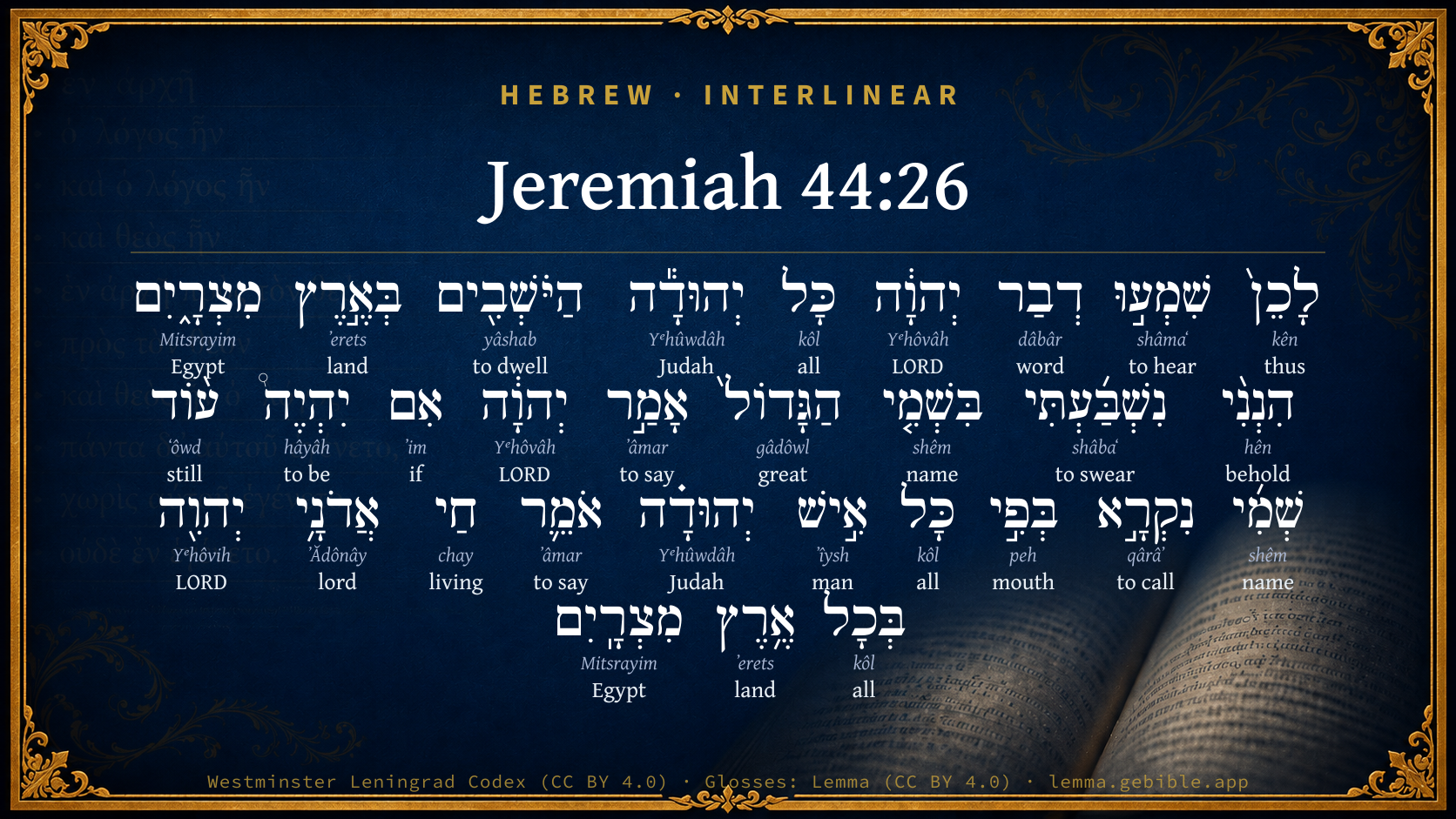
Jeremiah 44:26

Hebrew (Westminster Leningrad Codex) Jeremiah 44:26 appears in the Hebrew Old Testament. The text above is from the Westminster Leningrad Codex. Each word links to its Strong’s number, a concise gloss, and parsing drawn from the Open Scriptures Hebrew Bible morphology. Click any word for its full Brown-Driver-Briggs (BDB) entry.
Download image
Cite this verse

Jeremiah 44:26 (World English Bible). Public Domain. Lemma interlinear Bible study tool, https://lemma.gebible.app/v/jeremiah/44/26.

Show BibTeX & RIS
BibTeX
RIS
English Translation
Therefore hear the word of Yahweh, all Judah who dwell in the land of Egypt: Behold, I have sworn by my great name, says Yahweh, that my name shall no more be named in the mouth of any man of Judah in all the land of Egypt, saying, As the Lord Yahweh lives.
World English Bible · Public Domain
Download a study sheet

One document with this verse’s original text, its word-by-word gloss line, the meaning frame, cross-references with their text, attributed commentary, and full source and license credits — printable, and it pastes into notes with its structure intact.

This verse Autodidact and up

Study sheet (.html) Plain text (.txt)

A passage Seminary Student

Up to 50 verses in one chapter. A passage sheet keeps up to 6 commentary sources and 12 cross-references per verse, in the order this page ranks them, and says so on the sheet whenever that leaves anything out. Ask for a single verse and you get the Autodidact verse sheet above.

Everything on this page stays free to read, with no account — the sheet is a download of what is already on screen, not access to it.

Want to remove ads? Support Godless Engineer
Compare translations 3

The same verse in 3 English versions, stacked beneath the original-language interlinear above. Click any original word for its lexicon entry.

Each is an independent rendering of the whole verse — the interlinear is not word-aligned to these translations.

Highlighted words mark where these versions differ — a whole-verse word diff, not a word-by-word alignment.

  • World English Bible Public Domain
    Therefore hear the word of Yahweh, all Judah who dwell in the land of Egypt: Behold, I have sworn by my great name, says Yahweh, that my name shall no more be named in the mouth of any man of Judah in all the land of Egypt, saying, As the Lord Yahweh lives.
  • King James Version Public Domain
    Therefore hear ye the word of the LORD, all Judah that dwell in the land of Egypt; Behold, I have sworn by my great name, saith the LORD, that my name shall no more be named in the mouth of any man of Judah in all the land of Egypt, saying, The Lord GOD liveth.
  • unfoldingWord Literal Text CC BY-SA 4.0
    So then, hear the word of Yahweh, all of Judah who are staying in the land of Egypt, ‘See, I have sworn by my great name—says Yahweh. My name will no longer be called upon by the mouths of any of the men of Judah in all the land of Egypt, you who now say, “As the Lord Yahweh lives.”

unfoldingWord Literal Text — © unfoldingWord, licensed CC BY-SA 4.0. Word-aligned USFM3 via Door43 (git.door43.org/unfoldingWord/en_ult).

Versions to compare (up to 4)

3 of 4 selected

Show all 18 translations

Every available English version of this verse, each an independent rendering of the whole verse.

  • World English Bible Public Domain
    Therefore hear the word of Yahweh, all Judah who dwell in the land of Egypt: Behold, I have sworn by my great name, says Yahweh, that my name shall no more be named in the mouth of any man of Judah in all the land of Egypt, saying, As the Lord Yahweh lives.
  • Berean Standard Bible Public Domain
    Nevertheless, hear the word of the LORD, all you people of Judah living in Egypt: Behold, I have sworn by My great name, says the LORD, that never again will any man of Judah living in the land of Egypt invoke My name or say, ‘As surely as the Lord GOD lives.’
  • Majority Standard Bible Public Domain
    Nevertheless, hear the word of the LORD, all you people of Judah living in Egypt: Behold, I have sworn by My great name, says the LORD, that never again will any man of Judah living in the land of Egypt invoke My name or say, ‘As surely as the Lord GOD lives.’
  • King James Version Public Domain
    Therefore hear ye the word of the LORD, all Judah that dwell in the land of Egypt; Behold, I have sworn by my great name, saith the LORD, that my name shall no more be named in the mouth of any man of Judah in all the land of Egypt, saying, The Lord GOD liveth.
  • American Standard Version (1901) Public Domain
    Therefore hear ye the word of Jehovah, all Judah that dwell in the land of Egypt: Behold, I have sworn by my great name, saith Jehovah, that my name shall no more be named in the mouth of any man of Judah in all the land of Egypt, saying, As the Lord Jehovah liveth.
  • Revised Version (1885) Public Domain
    Therefore hear ye the word of the LORD, all Judah that dwell in the land of Egypt: Behold, I have sworn by my great name, saith the LORD, that my name shall no more be named in the mouth of any man of Judah in all the land of Egypt, saying, As the Lord GOD liveth.
  • Geneva Bible (1599) Public Domain
    Therefore heare the word of the Lord, all Iudah that dwel in the land of Egypt. Beholde, I haue sworne by my great Name, sayeth the Lord, that my Name shall no more be called vpon by the mouth of any man of Iudah, in all the lande of Egypt, saying, The Lord God liueth.
  • Douay-Rheims (1899) Public Domain
    Therefore hear ye the word of the Lord, all Juda, you that dwell in the land of Egypt: Behold I have sworn by my great name, saith the Lord: that my name shall no more be named in the mouth of any man of Juda, in the land of Egypt, saying: The Lord God liveth.
  • Young's Literal Translation Public Domain
    `Therefore, hear ye a word of Jehovah, all Judah who are dwelling in the land of Egypt: Lo, I -- I have sworn by My great name, said Jehovah, My name is no more proclaimed by the mouth of any man of Judah, saying, Live doth the Lord Jehovah -- in all the land of Egypt.
  • Literal Standard Version CC BY-SA 4.0
    Therefore, hear a word of YHWH, all Judah who are dwelling in the land of Egypt: Behold, I have sworn by My great Name, said YHWH, My Name is no longer proclaimed by the mouth of any man of Judah, saying, Lord YHWH lives—in all the land of Egypt.
  • Unlocked Literal Bible CC BY-SA 4.0
    So then, hear the word of Yahweh, all of Judah who are staying in the land of Egypt, 'See, I have sworn by my great name—says Yahweh. My name will no longer be called upon by the mouths of any of the men of Judah in all the land of Egypt, you who now say, “As the Lord Yahweh lives.”
  • unfoldingWord Literal Text CC BY-SA 4.0
    So then, hear the word of Yahweh, all of Judah who are staying in the land of Egypt, ‘See, I have sworn by my great name—says Yahweh. My name will no longer be called upon by the mouths of any of the men of Judah in all the land of Egypt, you who now say, “As the Lord Yahweh lives.”
  • Darby Bible Public Domain
    Therefore hear ye the word of Jehovah, all Judah that dwell in the land of Egypt: Behold, I have sworn by my great name, saith Jehovah, that my name shall no more be named in the mouth of any man of Judah in all the land of Egypt, saying, [As] the Lord Jehovah liveth.
  • World Messianic Bible Public Domain
    “Therefore hear the LORD’s word, all Judah who dwell in the land of Egypt: ‘Behold, I have sworn by my great name,’ says the LORD, ‘that my name will no more be named in the mouth of any man of Judah in all the land of Egypt, saying, “As the Lord GOD lives.”
  • Webster's Bible Public Domain
    Therefore hear ye the word of the LORD, all Judah that dwell in the land of Egypt; Behold, I have sworn by my great name, saith the LORD, that my name shall no more be named in the mouth of any man of Judah in all the land of Egypt, saying, The Lord GOD liveth.
  • Free Bible Version CC BY-SA 4.0
    But even so, listen to what the Lord says, all you people from Judah living here in Egypt: I guarantee by all that I am, says the Lord, that none of you living in Egypt will ever use my name or swear, ‘As the Lord God lives.’
  • Bible in Basic English Public Domain
    And now give ear to the word of the Lord, all you of Judah who are living in the land of Egypt: Truly, I have taken an oath by my great name, says the Lord, that my name is no longer to be named in the mouth of any man of Judah in all the land of Egypt, saying, By the life of the Lord God.
  • JPS Tanakh (1917) Public Domain
    Therefore hear ye the word of the LORD, all Judah that dwell in the land of Egypt: Behold, I have sworn by My great name, saith the LORD, that My name shall no more be named in the mouth of any man of Judah in all the land of Egypt saying: As the Lord GOD liveth.

Literal Standard Version (2020), Covenant Press — licensed CC BY-SA 4.0. Text via the HelloAO Bible API (eBible.org). Unlocked Literal Bible (unfoldingWord) — licensed CC BY-SA 4.0. Text via the HelloAO Bible API (eBible.org). unfoldingWord Literal Text — © unfoldingWord, licensed CC BY-SA 4.0. Word-aligned USFM3 via Door43 (git.door43.org/unfoldingWord/en_ult). Free Bible Version, Dr. Jonathan Gallagher — licensed CC BY-SA 4.0. Text via the HelloAO Bible API (eBible.org).

Word by word

More ways to search: Search by grammar → Find every occurrence → Compare this word →

Practice this passage: Drill this verse → Learn its vocabulary →

נִשְׁבַּ֜עְתִּי
shâbaʻ
H7650
“to swear”
Verb, Niphal, Perfect, 1st Person, Common, Singular
Part of Speech
Verb
Stem
Niphal
Form
Perfect
Person
1st Person
Gender
Common
Number
Singular
Full BDB Definition

Origin: a primitive root

TWOT: 2318

to swear, adjure - (Qal) sworn (participle) - (Niphal) - to swear, take an oath - to swear (of Jehovah by Himself) - to curse - (Hiphil) - to cause to take an oath - to adjure
  1. לָכֵן֙ kên H3651 “to/for · thus” Preposition + Adverb
  2. שִׁמְע֣וּ shâmaʻ H8085 “hear” Verb, Qal, Imperative, 2nd Person, Masculine, Plural
  3. דְבַר dâbâr H1697 “word of” Noun, Common, Masculine, Singular, Construct
  4. יְהוָ֔ה Yᵉhôvâh H3068 “LORD” Noun, Proper
  5. כָּל kôl H3605 “all of” Noun, Common, Masculine, Singular, Construct
  6. יְהוּדָ֕ה Yᵉhûwdâh H3063 “Judah” Noun, Proper
  7. הַיֹּשְׁבִ֖ים yâshab H3427 “the · dwelling” Particle, Definite Article + Verb, Qal, Participle Active, Masculine, Plural, Absolute
  8. בְּאֶ֣רֶץ ʼerets H776 “in/at · land of” Preposition + Noun, Common, Both, Singular, Construct
  9. מִצְרָ֑יִם Mitsrayim H4714 “Egypt” Noun, Proper
  10. הִנְנִ֨י hên H2005 “behold · me” Particle, Demonstrative + Suffix, Personal, 1st Person, Common, Singular
  11. בִּשְׁמִ֤י shêm H8034 “in/at · name · my” Preposition + Noun, Common, Masculine, Singular, Construct + Suffix, Personal, 1st Person, Common, Singular
  12. הַגָּדוֹל֙ gâdôwl H1419 “the · great” Particle, Definite Article + Adjective, Adjective, Masculine, Singular, Absolute
  13. אָמַ֣ר ʼâmar H559 “to say” Verb, Qal, Perfect, 3rd Person, Masculine, Singular
  14. יְהוָ֔ה Yᵉhôvâh H3068 “LORD” Noun, Proper
  15. אִם ʼim H518 “if” Conjunction
  16. יִהְיֶה֩ hâyâh H1961 “to be” Verb, Qal, Imperfect, 3rd Person, Masculine, Singular
  17. ע֨וֹד ʻôwd H5750 “still” Adverb
  18. שְׁמִ֜י shêm H8034 “name · my” Noun, Common, Masculine, Singular, Construct + Suffix, Personal, 1st Person, Common, Singular
  19. נִקְרָ֣א qârâʼ H7121 “called” Verb, Niphal, Participle Passive, Masculine, Singular, Absolute
  20. בְּפִ֣י peh H6310 “in/at · mouth of” Preposition + Noun, Common, Masculine, Singular, Construct
  21. כָּל kôl H3605 “all of” Noun, Common, Masculine, Singular, Construct
  22. אִ֣ישׁ ʼîysh H376 “man of” Noun, Common, Masculine, Singular, Construct
  23. יְהוּדָ֗ה Yᵉhûwdâh H3063 “Judah” Noun, Proper
  24. אֹמֵ֛ר ʼâmar H559 “saying” Verb, Qal, Participle Active, Masculine, Singular, Absolute
  25. חַי chay H2416 “living” Adjective, Adjective, Masculine, Singular, Absolute
  26. אֲדֹנָ֥י ʼĂdônây H136 “Lord · my” Noun, Common, Masculine, Plural, Construct + Suffix, Personal, 1st Person, Common, Singular
  27. יְהוִ֖ה Yᵉhôvih H3069 “LORD” Noun, Proper
  28. בְּכָל kôl H3605 “in/at · all of” Preposition + Noun, Common, Masculine, Singular, Construct
  29. אֶ֥רֶץ ʼerets H776 “land of” Noun, Common, Both, Singular, Construct
  30. מִצְרָֽיִם Mitsrayim H4714 “Egypt” Noun, Proper

About this verse

These counts appear in no published source. They are computed here, from the morphology-tagged text and Lemma’s own curated glosses. What Lemma adds →

31
words
23
distinct lemmas
Prophets
section

Grammatical profile

  • 7 verbs
  • 18 nouns
  • 2 adjectives
  • 1 conjunction
  • 2 adverbs
  • 1 particle

Verb forms

  • שִׁמְע֣וּ Qal · Imperative
  • הַיֹּשְׁבִ֖ים Qal · Participle Active
  • נִשְׁבַּ֜עְתִּי Niphal · Perfect
  • אָמַ֣ר Qal · Perfect
  • יִהְיֶה֩ Qal · Imperfect
  • נִקְרָ֣א Niphal · Participle Passive
  • אֹמֵ֛ר Qal · Participle Active

Repetition

Words recur within this verse — often emphatic in Hebrew:

  • כָּל all H3605 ×3
  • יְהוָ֔ה LORD H3068 ×2
  • יְהוּדָ֕ה Judah H3063 ×2
  • בְּאֶ֣רֶץ land H776 ×2
  • מִצְרָ֑יִם Egypt H4714 ×2
  • בִּשְׁמִ֤י name H8034 ×2
  • אָמַ֣ר to say H559 ×2

Cross-references

21

Topical passages linked to Jeremiah 44:26 in the Treasury of Scripture Knowledge — connected by theme and wording, ordered by reader-vote popularity; previews shown in the World English Bible.

  • Genesis 22:16 and said, "I have sworn by myself, says Yahweh, because you have done this thing, and have not withheld your son, your only son,
  • Psalms 50:16 But to the wicked God says, "What right do you have to declare my statutes, That you have taken my covenant on your lips,
  • Ezekiel 20:39 As for you, house of Israel, thus says the Lord Yahweh: Go you, serve everyone his idols, and hereafter also, if you will not listen to me; but my holy name shall you no more profane with your gifts, and with your idols.
  • Hebrews 6:13 For when God made a promise to Abraham, since he could swear by none greater, he swore by himself,
  • Isaiah 48:1–2 Hear you this, house of Jacob, who are called by the name of Israel, and are come forth out of the waters of Judah; who swear by the name of Yahweh, and make mention of the God of Israel, but not in truth, nor in righteousness
  • Jeremiah 4:2 and you shall swear, As Yahweh lives, in truth, in justice, and in righteousness; and the nations shall bless themselves in him, and in him shall they glory.
  • Jeremiah 5:2 Though they say, As Yahweh lives; surely they swear falsely.
  • Amos 6:8 "The Lord Yahweh has sworn by himself," says Yahweh, the God of hosts: "I abhor the pride of Jacob, And detest his fortresses. Therefore I will deliver up the city with all that is in it.
  • Numbers 14:21–23 but in very deed, as I live, and as all the earth shall be filled with the glory of Yahweh;
  • Numbers 14:28 Tell them, As I live, says Yahweh, surely as you have spoken in my ears, so will I do to you:
  • Deuteronomy 32:40–42 For I lift up my hand to heaven, And say, As I live forever,
  • Psalms 89:34 I will not break my covenant, Nor alter what my lips have uttered.
  • Isaiah 62:8 Yahweh has sworn by his right hand, and by the arm of his strength, Surely I will no more give your grain to be food for your enemies; and foreigners shall not drink your new wine, for which you have labored:
  • Jeremiah 7:9 Will you steal, murder, and commit adultery, and swear falsely, and burn incense to Baal, and walk after other gods that you have not known,
  • Jeremiah 22:5 But if you will not hear these words, I swear by myself, says Yahweh, that this house shall become a desolation.
  • Jeremiah 46:18 As I live, says the King, whose name is Yahweh of Hosts, surely like Tabor among the mountains, and like Carmel by the sea, so shall he come.
  • Amos 6:10 "When a man's relative carries him, even he who burns him, to bring bodies out of the house, and asks him who is in the innermost parts of the house, 'Is there yet any with you?' And he says, 'No;' then he will say, 'Hush! Indeed we must not mention the name of Yahweh.'
  • Amos 8:7 Yahweh has sworn by the pride of Jacob, "Surely I will never forget any of their works.
  • Zephaniah 1:4–5 I will stretch out my hand against Judah, and against all the inhabitants of Jerusalem. I will cut off the remnant of Baal from this place: the name of the idolatrous and pagan priests,
  • Hebrews 3:18 To whom did he swear that they wouldn't enter into his rest, but to those who were disobedient?
  • Hebrews 6:18 that by two immutable things, in which it is impossible for God to lie, we may have a strong encouragement, who have fled for refuge to take hold of the hope set before us.

Cross-references courtesy of OpenBible.info (CC BY 4.0).

Hebrew and Greek witnesses Masoretic Hebrew ↔ Greek Septuagint

The same verse in the two great witnesses to the Old Testament, shown verse-for-verse.

These are two independent witnesses, not word-aligned to each other, and the Septuagint is shown in lemma (dictionary) form.

Hebrew Jeremiah 44:26 Masoretic · Westminster Leningrad Codex

לָכֵן֙ שִׁמְע֣וּ דְבַר יְהוָ֔ה כָּל יְהוּדָ֕ה הַיֹּשְׁבִ֖ים בְּאֶ֣רֶץ מִצְרָ֑יִם הִנְנִ֨י נִשְׁבַּ֜עְתִּי בִּשְׁמִ֤י הַגָּדוֹל֙ אָמַ֣ר יְהוָ֔ה אִם יִהְיֶה֩ ע֨וֹד שְׁמִ֜י נִקְרָ֣א בְּפִ֣י כָּל אִ֣ישׁ יְהוּדָ֗ה אֹמֵ֛ר חַי אֲדֹנָ֥י יְהוִ֖ה בְּכָל אֶ֥רֶץ מִצְרָֽיִם

Therefore hear the word of Yahweh, all Judah who dwell in the land of Egypt: Behold, I have sworn by my great name, says Yahweh, that my name shall no more be named in the mouth of any man of Judah in all the land of Egypt, saying, As the Lord Yahweh lives.

World English Bible · Public Domain

Greek LXX Structure differs

In the Septuagint, Jeremiah is about an eighth shorter than the Hebrew and arranges its material differently — the Oracles Against the Nations (Hebrew chapters 46–51) appear in the middle of the Greek book, after 25:13. Because the chapter and verse boundaries do not line up, a verse-for-verse comparison with the Hebrew is not shown.

A verse-for-verse comparison isn’t shown here because the chapters and verses don’t line up. Switch to the LXX edition with the MT / LXX toggle above to read the Greek directly.

On this verse, Haydock's Catholic Bible Commentary discusses the Septuagint’s reading. Read the note in Commentary ↓

Hebrew: Westminster Leningrad Codex (CC BY 4.0). Greek: Septuagint (public domain); English from a public-domain English Septuagint. How the Septuagint differs from the Hebrew →

Targum (Aramaic paraphrase)

1

The Targum is the ancient Jewish Aramaic paraphrase of the Hebrew Scriptures — an interpretive translation, not the Hebrew text itself. Onkelos (literal) and Pseudo-Jonathan (expansive) render the Torah, and Jonathan the Prophets. Coverage is partial: where no permissively-licensed English translation exists for a verse, only the Aramaic is shown. This is verse-level text, not a word-by-word alignment to the Hebrew.

  1. Targum Jonathan Prophets (Joshua–Malachi)
    בְּכֵן קַבִּילוּ פִּתְגָמָא דַייָ כָּל דְבֵית יְהוּדָה דְיַתְבִין בְּאַרְעָא דְמִצְרַיִם הָא אֲנָא קַיְמִית בִּשְׁמִי רַבָּא אֲמָר יְיָ אִם יְהֵי עוֹד שְׁמִי מִתְקְרֵי בְּפוּם כָּל אֱנַשׁ יְהוּדָה אֲמַר קַיָם הוּא יְיָ אֱלֹהִים בְּכָל אַרְעָא דְמִצְרָיִם:

    (no public-domain English translation for this verse)

    Targum Jonathan — Aramaic: “Mikraot Gedolot” (public domain). English: “Sefaria Community Translation” (CC0 1.0 (public-domain dedication)); “London "Chaldee Paraphrase," 1871” (public domain). Text via Sefaria.

Commentary

Notes on Jeremiah 44:26 from classic Christian and Jewish commentators (each source and its license shown beneath its notes). The classic Christian expositions comment on the surrounding passage and are grouped to its opening verse, so a note may address several verses; the Jewish commentaries on the Tanakh (Rashi and others) are per-verse, so they appear only where the commentator wrote on this verse.

Lemma curates 59 commentaries, every one of them public domain or Creative Commons licensed, each selected and text-cleaned for this edition rather than reprinted as found. About our sources →

The Cambridge Bible for Schools and Colleges

gen. ed. J. J. S. Perowne

26. my name shall no more be named] The Jews in Egypt shall be exterminated.

26–28. As these vv. stand, there is, if we take them literally, a considerable amount of contradiction (cp. Jer_44:14). The Egyptian Jews are (Jer_44:26) to perish completely; but (Jer_44:27) some are to escape into Judah, while survivors in Egypt (Jer_44:28) shall know whose word shall stand. Du., Erbt and Co. consider that Jer_44:26 was originally a continuation of the irony of Jer_44:25 (“establish then, etc.”) and that it should accordingly read, “let my name be no more, etc.” (i.e. let my worship and with it all oaths taken in my name cease), while Jer_44:27 and the first part of Jer_44:28 are a subsequent addition, the second part of the latter remaining as genuine. At any rate we find from the Assuan papyri (see Introd. p. xix.) that the gloomy anticipations of the MT. were not in fact fulfilled; for the Egyptian Jews in the century following were a flourishing community and were worshippers of Jehovah and not idolaters.

The Cambridge Bible for Schools and Colleges (gen. ed. J. J. S. Perowne; Cambridge University Press, 1878–1918) — public domain. Text from a community e-Sword module.

Trapp's Complete Commentary

John Trapp

Jer 44:26 Therefore hear ye the word of the LORD, all Judah that dwell in the land of Egypt; Behold, I have sworn by my great name, saith the LORD, that my name shall no more be named in the mouth of any man of Judah in all the land of Egypt, saying, The Lord GOD liveth.

Ver. 26. Behold, I have sworn by my great name.] Jehovah, my incommunicable name, my proper name, or by myself, and that is no small oath.

John Trapp, A Commentary or Exposition upon All the Books of the Old and New Testament (1647–1656) — public domain. Text from a community e-Sword module.

Tyndale Open Study Notes

Tyndale Open Resources

44:26-28 The Judeans in Egypt were now forever free of covenant obligations to the Lord. They were also banned from covenant protection. They chose to sever their relationship with the one true God of Israel, so they retained no privileges—they could not pray or make oaths in God’s name. Still, the Lord would not be absent from their lives, because he would see to it that disaster plagued them. Those who individually turned to the Lord in repentance would enjoy salvation and blessings. Even in Egypt, a small remnant of people trusted in the Lord (e.g., Jeremiah and Baruch).

Tyndale Open Study Notes — © Tyndale Open Resources, licensed CC BY-SA 4.0. Text via the HelloAO Bible API.

Geneva Bible (1599)

Geneva Bible translators

This declareth an horrible plague toward idolaters, seeing that God will not vouchsafe to have his Name mentioned by such as have polluted it.

Geneva Bible (1599) marginal notes — public domain. Text via Bolls.life.

Jamieson, Fausset & Brown

Robert Jamieson, A. R. Fausset & David Brown

I have sworn--I, too have made a vow which I will fulfil. Since ye will not hear Me speaking and warning, hear Me swearing.

by my great name--that is, by Myself (Gen 22:16), the greatest by whom God can swear (Heb 6:13-14).

my name shall no more be named--The Jews, heretofore, amidst all their idolatry, had retained the form of appeal to the name of God and the law, the distinctive glory of their nation; God will allow this no more (Eze 20:39): there shall be none left there to profane His name thus any more.

Jamieson, Fausset & Brown — Commentary Critical and Explanatory on the Whole Bible (1871) — public domain (CC PDM 1.0). Text via the HelloAO Bible API.

John Calvin's Commentaries

Hear ye now, he says, the word of Jehovah, etc. By these words, as I have already hinted, he intimates, that they could gain nothing by their insolence, except that they would thereby provoke God, who on the other hand did set up his own power against them. Thus, then, saith Jehovah, Behold, I have sworn by my great name, etc. As they had so often disregarded God speaking to them, he confirmed by an oath what he was going to say. Had he only threatened, they might have as usual disregarded him, as though the Prophet spoke what was vain. This is the reason why he now introduces God as making an oath. And it ought to be observed, that whenever God confirms his words by an oath, this he does, either because he sees that he has to do with men who are like stones, who cannot be made to feel by simple truth; or when he is pleased to give aid to our infirmity and sloth: for God confirms threatenings as well as promises by an oath. When he thus confirms threatenings, then he indirectly condemns the obstinate wickedness of those whom he addresses. But when he promises anything by an oath, he shews how great our propensity is to indulge doubts, and what weakness there is in our faith; for were such faith in us as ought to be, we should be contented with one little word. As, then, God interposes his own name as a pledge, it hence appears, that we are naturally unbelieving, or that the weakness of our faith is such that it wants this support. But here, as God threatens, he shews that the Jews were so obstinate in their wickedness, that it was necessary to shake them by terror.

Now, God makes an oath by his own great name Men, as the Apostle says, swear by God, (Hebrews 6:16;) because he is called as a witness and a judge when his name is interposed. But it is no superfluous addition, when God not only swears by himself, but by his own great name For he thus intimated, that the Jews were greatly deceived, if they thought that God would not execute vengeance on them, because they indulged themselves. For it is a common thing with hypocrites to measure God by their own judgment; and when they extenuate his power, they think of him as of a child. In order, then, to divest the Jews of this false imagination, he says, by his own great name There is, then, implied here a contrast between the greatness of God’s name, which cannot be diminished at the will of man, and the presumption of the ancient people, who rendered God’s name contemptible.

He afterwards adds, If my name, etc. It is an imperfect sentence, which, as we have often said, was frequently used in order that a greater reverence may be observed by us, when we swear by God’s name. We must now come to what is said, There shall not be a Jew, who is to swear any more in my name God himself makes an oath, and what is the oath which he makes? that no one was to profane his name; for they thought that it was some evidence of religion when they swore by Jehovah. It was yet nothing but an awful profanation of God’s name. They contaminated themselves, as it appears, with Egyptian superstitions; but that they might differ from the Egyptians themselves and possess something special, that they, in short, might seem to be a holy nation, they still retained a form of swearing, distinct from what was common among the Gentiles. God declares that he would not suffer his name to be any more irreverently used in Egypt. Not invoked, he says, shall be my name any more by the mouth of a Jew And that he speaks of oaths we gather from the next verse, when he says, Live doth Jehovah in all the land of Egypt For, as it has been said, the Jews as yet boasted that they kept the Law, because God’s name was still in their mouth and on their tongue. But God says that it was to be taken away from them, because it was a disgraceful pollution of his name, when they mingled themselves with the Egyptians in all kinds of superstitions, and yet boasted that they were God’s people. It follows, —

John Calvin's Commentaries (1540-1563) — public domain. Text from the Calvin Translation Society English edition (1840s-50s) via the Christian Classics Ethereal Library (ccel.org). Calvin's coverage is partial (roughly two-thirds of the Bible); uncommented books and verses are honest gaps, never fabricated. The 19th-century editor's footnotes and remarks are omitted so the notes are faithfully Calvin's own voice.

John Gill's Exposition

Therefore hear ye the word of the Lord, all Judah that dwell in the land of Egypt,.... See Gill on Jer 44:24; since you have made your vows, and will perform them, I will take an oath, and abide by it:

behold, I have sworn by my great name, saith the Lord; by his name Jehovah, which is incommunicable, and expressive of his eternity and immutability; or by himself, his name being himself, and than which he can swear by no greater, Heb 6:13;

that my name shall no more be named in the mouth of any man of Judah in all the land of Egypt, saying, the Lord God liveth: this cannot be understood of the name of the Lord being called upon them, or of their being called by his name, and reckoned his people, which is the sense of Abarbinel; since this respects not a name by which they should be named, but which they should name; and intends their use of the divine name in an oath, of which this is a form, "the Lord God liveth": or as sure as the Lord lives, or by the living God, it is so and so; and especially as used in their vows to burn incense to the queen of heaven, they vowing by the living God that they would do so, which must be very abominable to him; and therefore he solemnly swears there should not be a Jew in all Egypt that should use it; the reason is, because everyone of them that did should be cut off, as follows:

John Gill's Exposition of the Whole Bible (1746–1763) — public domain (CC PDM 1.0). Text via the HelloAO Bible API.

Haydock's Catholic Bible Commentary

Liveth. They swore by his name as by that of idols. God could not abide such company. (Calmet) --- Not one of these obstinate Jews shall be spared, ver. 14. Others, like Jeremias, the Septuagint [translators], and the holy family, no doubt called upon the Lord in the land of Egypt. (Haydock)

George Leo Haydock (1774–1849), Haydock's Catholic Family Bible and Commentary, 1859 edition — public domain. Excludes Psalms (Douay-Rheims chapter numbering differs from Protestant) and Deuterocanonical books (Catholic canon only).

Matthew Poole's English Annotations

Seeing you are so fixed and peremptory, God is as resolved as you are; and as you think you must be religious to your wicked vows, so be assured God will be as religious to his oath; because he can swear by no greater, he hath sworn by himself, Heb 6:13,17, (for so name signifieth here,) There shall not any be left of the Jews that are in Egypt, to swear,

The Lord God liveth (for it should seem that the Jews yet retained something of the religion of their country, and sware by the name of the living God, according to the precept, Deu 6:13; 10:20). God threateneth there should be none of them left alive to do it; he would not have his holy name polluted by those mouths that had been used to bless idols.

Matthew Poole's English Annotations on the Holy Bible (1683–1685) — public domain. Text from a community e-Sword/MySword module.

Whedon's Commentary on the Bible

Daniel D. Whedon

26. My name shall no more be named — As this is Jehovah’s final sentence it is introduced by a formal oath. Jehovah repudiates his covenant relation to them. They are no longer his people, and he is no longer their God.

Daniel D. Whedon (gen. ed.), Commentary on the Old and New Testaments (1874–1909) — public domain. Text from a community e-Sword module.

The Pulpit Commentary

My Name shall no more be named. Because no Jews will be left alive in Egypt.

Vers. 26-28. The danger of corrupting true religion.

God has from the beginning been solicitous for the purity of his revelation and worship. He would never suffer his ordinances to be tampered with, or share his honour with other gods. "Thou shalt worship the Lord thy God, and him only shalt thou serve". (Deu_6:13 Luk_4:8)

I IT HAS BEEN GUARDED BY AWFUL SANCTIONS. Frequently in Old Testament history the death penalty was inflicted upon spiritual pretenders, false prophets, and idolatrous worshippers of Jehovah. The warning of the text is very significant; a time was to come when no Jew would any more swear by Jehovah in Egypt, for the very good reason that there would be none there. "In the form of asseveration the Name of Jehovah would be still retained, although they had long since been devoted to the service of other gods. But Jehovah, who is a jealous God, rejects honour and acknowledgment which he must share with others; and so his Name shall no longer be heard from the mouth of any Jews in Egypt" (Hitzig). In the New Testament men are warned of making the Word of God "a cloke for lasciviousness;" of "perishing in the gainsaying of Core;" of tasting of the powers of the world to come, and falling back; of making gain of godliness; of handling the Word of God deceitfully, and wresting it to their own destruction; or of adding aught to the revealed truth. (Rev_22:18, Rev_22:19)

II REASONS FOR THIS SEVERITY,

1. Objective.

a. The slow advance of truth.

b. The costliness of the Divine relation.

2. Subjective.

(1) Partly in the very nature of the ease moral simplicity being sacrificed in the self-consciousness of a corrupt worship.

(2) The necessity of inspiration by the truth in order to the spiritual welfare and true immortality of man. M.

The Pulpit Commentary (1880–1919), ed. H.D.M. Spence-Jones & Joseph S. Exell — public domain. Text from a community e-Sword module.

John Wesley's Explanatory Notes

The Lord liveth - There shall not any be left alive of the Jews that are in Egypt, to swear The Lord God liveth.

John Wesley, Explanatory Notes Upon the Whole Bible (1754–1765) — public domain. Text via the GEBible commentary corpus.

unfoldingWord translationNotes

Door43 World Missions Community

all of Judah

Here "Judah" represents the people. AT: "all the people of Judah" (See: Metonymy)

I have sworn by my great name

Yahweh's "great name" refers to his whole being and reputation. AT: "I have sworn upon myself" or "I have sworn by speaking my powerful name" (See: Metonymy)

My name will no longer be called upon by the mouths of any of the men of Judah in all the land of Egypt

Here "name" represents the whole being of Yahweh. And, "mouth" represents the whole person. This can be stated in active form. AT: "No person of Judah living in the land of Egypt will ever call upon me again" (See: Metonymy and Synecdoche and Active or Passive)

As the Lord Yahweh lives

"as surely as the Lord Yahweh is alive." The people use this expression to show that what they say next is certainly true. This is a way of making a solemn promise. See how you transited "As Yahweh lives" Jeremiah 4:2. AT: "I solemnly swear" or "I solemnly swear by the Lord Yahweh" (See: Idiom)

Every person of Judah in the land of Egypt will perish by sword and famine until they are all finished

Here "Every person" is a generalization that means "very many people." Also, "sword" represents enemies carrying weapons. AT: "Nearly every person of Judah in the land of Egypt will die. Enemies will kill many of them and many of them will starve to death until there is very few of them left" (See: Hyperbole and Generalization and Metonymy)

Then the survivors of the sword

Here "sword" represents enemies carrying weapons. AT: "Then those whom the enemies do not kill" (See: Metonymy)

translationWords

oath

name

Lord Yahweh

life

good

perish

sword

famine

remnant

know

true

unfoldingWord translationNotes — © Distant Shores Media and the Door43 World Missions Community, licensed CC BY-SA 4.0. Source: git.door43.org/Door43/en_tn.

Lesson kit

Teaching starters — assembled from the data on this page, not authored interpretation. Every prompt links to the verse data it draws on. Edit before teaching.

Jeremiah, in the Prophets, opens this verse with 31 words (23 distinct Hebrew lemmas). Its most distinctive word is shâbaʻ (“to swear”). A historical commentator’s framing appears above. Read the whole chapter for the surrounding context.

Discussion questions

  1. The word shâbaʻ carries the sense “to swear.” How does it shape the verse?
  2. How does Genesis 22:16, which shares this passage’s theme, read alongside this verse?
  3. What does the repetition of “all” (3× in this one verse) do in this verse?
  4. These translations render this verse differently; the difference is in the English rendering, not the original. What questions does that raise?
  5. «שִׁמְע֣וּ» is a Qal Imperative verb. How does that grammatical form shape the action described?
  6. Compare how The Cambridge Bible for Schools and Colleges and Trapp's Complete Commentary read this verse. Where do they agree or differ?

Things to notice

Reading settings

Reading text

Shown beneath each verse's original-language words.

Old Testament
Old Testament edition

Read the OT as the Masoretic Hebrew (MT) or the Greek Septuagint (LXX).

English shown for the Greek Septuagint (in the Hebrew ↔ Greek comparison).

Comparing translations? Open the Compare panel on any verse page to stack up to four side by side.