Jeremiah 2:36

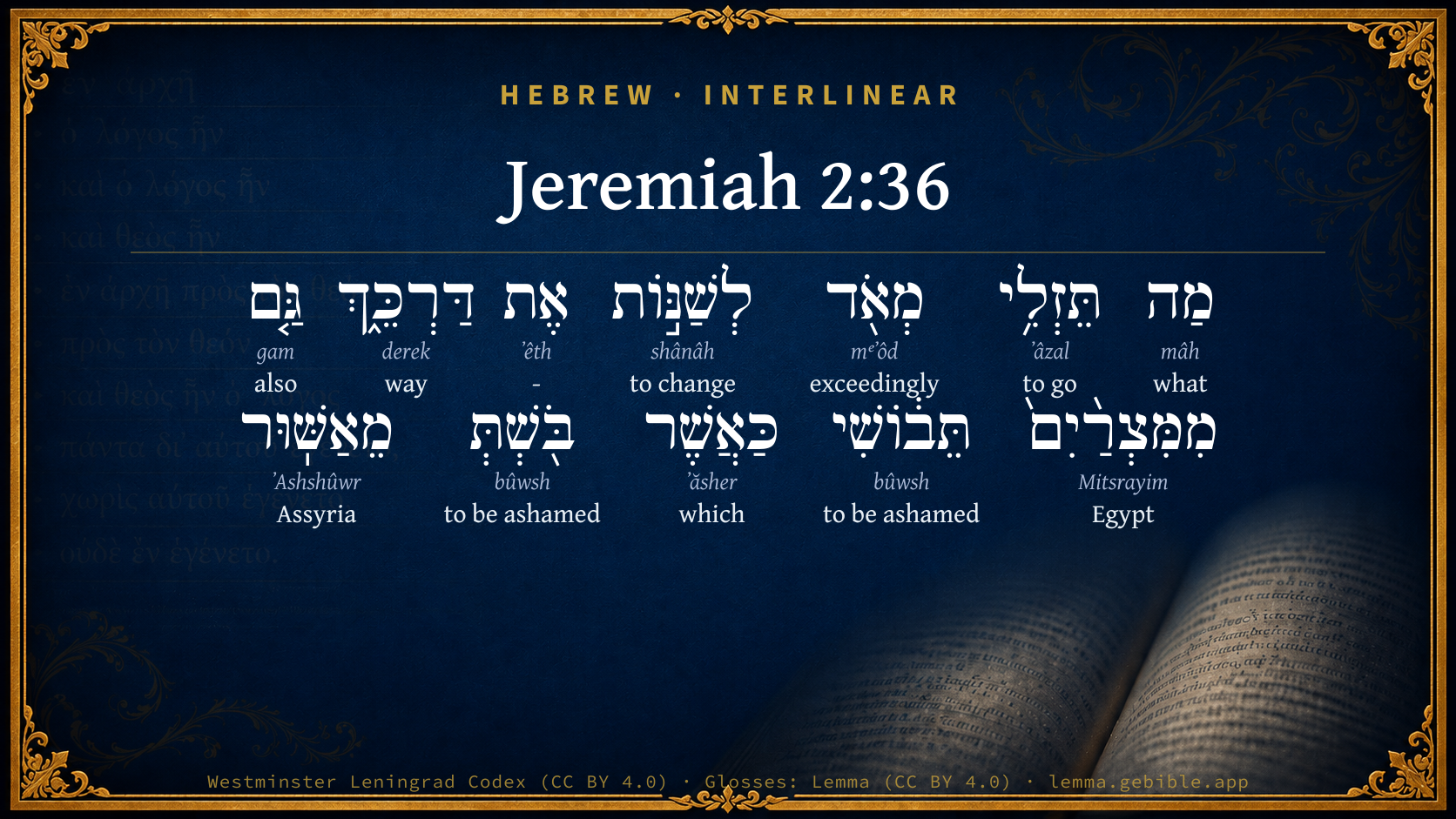
Hebrew (Westminster Leningrad Codex) Jeremiah 2:36 appears in the Hebrew Old Testament. The text above is from the Westminster Leningrad Codex. Each word links to its Strong’s number, a concise gloss, and parsing drawn from the Open Scriptures Hebrew Bible morphology. Click any word for its full Brown-Driver-Briggs (BDB) entry.
Download image
Cite this verse

Jeremiah 2:36 (World English Bible). Public Domain. Lemma interlinear Bible study tool, https://lemma.gebible.app/v/jeremiah/2/36.

Show BibTeX & RIS
BibTeX
RIS
English Translation
Why go you about so much to change your way? you shall be ashamed of Egypt also, as you were ashamed of Assyria.
World English Bible · Public Domain
Download a study sheet

One document with this verse’s original text, its word-by-word gloss line, the meaning frame, cross-references with their text, attributed commentary, and full source and license credits — printable, and it pastes into notes with its structure intact.

This verse Autodidact and up

Study sheet (.html) Plain text (.txt)

A passage Seminary Student

Up to 50 verses in one chapter. A passage sheet keeps up to 6 commentary sources and 12 cross-references per verse, in the order this page ranks them, and says so on the sheet whenever that leaves anything out. Ask for a single verse and you get the Autodidact verse sheet above.

Everything on this page stays free to read, with no account — the sheet is a download of what is already on screen, not access to it.

Want to remove ads? Support Godless Engineer
Compare translations 3

The same verse in 3 English versions, stacked beneath the original-language interlinear above. Click any original word for its lexicon entry.

Each is an independent rendering of the whole verse — the interlinear is not word-aligned to these translations.

Highlighted words mark where these versions differ — a whole-verse word diff, not a word-by-word alignment.

  • World English Bible Public Domain
    Why go you about so much to change your way? you shall be ashamed of Egypt also, as you were ashamed of Assyria.
  • King James Version Public Domain
    Why gaddest thou about so much to change thy way? thou also shalt be ashamed of Egypt, as thou wast ashamed of Assyria.
  • unfoldingWord Literal Text CC BY-SA 4.0
    Why do you treat very lightly to change your ways? You will also be shamed from Egypt, just as you were shamed from Assyria.

unfoldingWord Literal Text — © unfoldingWord, licensed CC BY-SA 4.0. Word-aligned USFM3 via Door43 (git.door43.org/unfoldingWord/en_ult).

Versions to compare (up to 4)

3 of 4 selected

Show all 18 translations

Every available English version of this verse, each an independent rendering of the whole verse.

  • World English Bible Public Domain
    Why go you about so much to change your way? you shall be ashamed of Egypt also, as you were ashamed of Assyria.
  • Berean Standard Bible Public Domain
    How unstable you are, constantly changing your ways! You will be disappointed by Egypt just as you were by Assyria.
  • Majority Standard Bible Public Domain
    How impulsive you are, constantly changing your ways! You will be disappointed by Egypt just as you were by Assyria.
  • King James Version Public Domain
    Why gaddest thou about so much to change thy way? thou also shalt be ashamed of Egypt, as thou wast ashamed of Assyria.
  • American Standard Version (1901) Public Domain
    Why gaddest thou about so much to change thy way? thou shalt be ashamed of Egypt also, as thou wast ashamed of Assyria.
  • Revised Version (1885) Public Domain
    Why gaddest thou about so much to change thy way? thou shalt be ashamed of Egypt also, as thou wast ashamed of Assyria.
  • Geneva Bible (1599) Public Domain
    Why runnest thou about so much to change thy waies? for thou shalt be confounded of Egypt, as thou art confounded of Asshur.
  • Douay-Rheims (1899) Public Domain
    How exceeding base art thou become, going the same ways over again! and thou shalt be ashamed of Egypt, as thou wast ashamed of Assyria.
  • Young's Literal Translation Public Domain
    What? thou art very vile to repeat thy way, Even of Egypt thou art ashamed, As thou hast been ashamed of Asshur,
  • Literal Standard Version CC BY-SA 4.0
    What? You are very vile to repeat your way, || You are even ashamed of Egypt, || As you have been ashamed of Asshur,
  • Unlocked Literal Bible CC BY-SA 4.0
    Why do you treat so very lightly this change in your ways? You will also be disappointed by Egypt, just as you were by Assyria.
  • unfoldingWord Literal Text CC BY-SA 4.0
    Why do you treat very lightly to change your ways? You will also be shamed from Egypt, just as you were shamed from Assyria.
  • Darby Bible Public Domain
    Why dost thou gad about so much, and change thy way? Thou shalt also be brought to shame by Egypt, as thou wast brought to shame by Assyria.
  • World Messianic Bible Public Domain
    Why do you go about so much to change your ways? You will be ashamed of Egypt also, as you were ashamed of Assyria.
  • Webster's Bible Public Domain
    Why dost thou go about so much to change thy way? thou also shalt be ashamed of Egypt, as thou wast ashamed of Assyria.
  • Free Bible Version CC BY-SA 4.0
    You're just so fickle—you keep on changing your mind! You will end up just as disappointed by your alliance with Egypt as you were with Assyria.
  • Bible in Basic English Public Domain
    Why do you go about so much for the purpose of changing your way? you will be shamed on account of Egypt, as you were shamed on account of Assyria.
  • JPS Tanakh (1917) Public Domain
    How greatly dost thou cheapen thyself to change thy way? Thou shalt be ashamed of Egypt also, as thou wast ashamed of Asshur.

Literal Standard Version (2020), Covenant Press — licensed CC BY-SA 4.0. Text via the HelloAO Bible API (eBible.org). Unlocked Literal Bible (unfoldingWord) — licensed CC BY-SA 4.0. Text via the HelloAO Bible API (eBible.org). unfoldingWord Literal Text — © unfoldingWord, licensed CC BY-SA 4.0. Word-aligned USFM3 via Door43 (git.door43.org/unfoldingWord/en_ult). Free Bible Version, Dr. Jonathan Gallagher — licensed CC BY-SA 4.0. Text via the HelloAO Bible API (eBible.org).

Word by word

More ways to search: Search by grammar → Find every occurrence → Compare this word →

Practice this passage: Drill this verse → Learn its vocabulary →

תֵּזְלִ֥י
ʼâzal
H235
“to go”
Verb, Qal, Imperfect, 2nd Person, Feminine, Singular
Part of Speech
Verb
Stem
Qal
Form
Imperfect
Person
2nd Person
Gender
Feminine
Number
Singular
Full BDB Definition

Origin: a primitive root

TWOT: 56

to go, to go away, to go about - (Qal) - to go away - to go about - to be used up, be exhausted, be gone, evaporated - (Pual) to go to and fro
  1. מַה mâh H4100 “what” Particle, Interrogative
  2. מְאֹ֖ד mᵉʼôd H3966 “exceedingly” Adverb
  3. לְשַׁנּ֣וֹת shânâh H8138 “to change” Preposition + Verb, Piel, Infinitive Construct
  4. אֶת ʼêth H853 “-” Particle, Direct Object
  5. דַּרְכֵּ֑ךְ derek H1870 “way · your” Noun, Common, Both, Singular, Construct + Suffix, Personal, 2nd Person, Feminine, Singular
  6. גַּ֤ם gam H1571 “also” Particle, Accusative
  7. מִמִּצְרַ֨יִם֙ Mitsrayim H4714 “from · Egypt” Preposition + Noun, Proper
  8. תֵּב֔וֹשִׁי bûwsh H954 “to be ashamed” Verb, Qal, Imperfect, 2nd Person, Feminine, Singular
  9. כַּאֲשֶׁר ʼăsher H834 “like/as · which” Preposition + Particle, Relative
  10. בֹּ֖שְׁתְּ bûwsh H954 “to be ashamed” Verb, Qal, Perfect, 2nd Person, Feminine, Singular
  11. מֵאַשּֽׁוּר ʼAshshûwr H804 “from · Assyria” Preposition + Noun, Proper

About this verse

These counts appear in no published source. They are computed here, from the morphology-tagged text and Lemma’s own curated glosses. What Lemma adds →

12
words
11
distinct lemmas
Prophets
section

Notable vocabulary

The rarest word here is תֵּזְלִ֥י to go H235 — appearing just 5 times in the whole Hebrew Bible.

Shared distinctive vocabulary

תֵּזְלִ֥י to go H235 occurs in 5 verses of the Hebrew Bible. Also found in:

Grammatical profile

  • 4 verbs
  • 3 nouns
  • 1 adverb
  • 4 particles

Verb forms

  • תֵּזְלִ֥י Qal · Imperfect
  • לְשַׁנּ֣וֹת Piel · Infinitive Construct
  • תֵּב֔וֹשִׁי Qal · Imperfect
  • בֹּ֖שְׁתְּ Qal · Perfect

Repetition

A word recurs within this verse — often emphatic in Hebrew:

  • תֵּב֔וֹשִׁי to be ashamed H954 ×2

Hebrew & Septuagint length

In the original languages it is 12 Hebrew tokens and 16 Greek tokens — but the two are counted differently (Hebrew bundles its prefixes and suffixes into one token; the Greek is in lemma form), so that isn’t a like-for-like length.

Cross-references

18

Topical passages linked to Jeremiah 2:36 in the Treasury of Scripture Knowledge — connected by theme and wording, ordered by reader-vote popularity; previews shown in the World English Bible.

  • Jeremiah 31:22 How long will you go here and there, you backsliding daughter? for Yahweh has created a new thing in the earth: a woman shall encompass a man.
  • Hosea 5:13 When Ephraim saw his sickness, And Judah his wound, Then Ephraim went to Assyria, And sent to king Jareb: But he is not able to heal you, Neither will he cure you of your wound.
  • 2 Chronicles 28:16 At that time did king Ahaz send to the kings of Assyria to help him.
  • 2 Chronicles 28:20–21 Tilgath Pilneser king of Assyria came to him, and distressed him, but didn't strengthen him.
  • Jeremiah 2:23 How can you say, I am not defiled, I have not gone after the Baals? see your way in the valley, know what you have done: [you are] a swift dromedary traversing her ways;
  • Hosea 12:1 Ephraim feeds on wind, And chases the east wind. He continually multiplies lies and desolation. They make a covenant with Assyria, And oil is carried into Egypt.
  • Isaiah 20:5 They shall be dismayed and confounded, because of Ethiopia their expectation, and of Egypt their glory.
  • Isaiah 30:1–7 Woe to the rebellious children, says Yahweh, who take counsel, but not of me; and who make a league, but not of my Spirit, that they may add sin to sin,
  • Jeremiah 2:18 Now what have you to do in the way to Egypt, to drink the waters of the Shihor? or what have you to do in the way to Assyria, to drink the waters of the River?
  • Jeremiah 2:33 How trimmest you your way to seek love! therefore even the wicked women have you taught your ways.
  • Jeremiah 37:7 Thus says Yahweh, the God of Israel, Thus shall you tell the king of Judah, who sent you to me to inquire of me: Behold, Pharaoh's army, which is come forth to help you, shall return to Egypt into their own land.
  • Lamentations 4:17 Our eyes do yet fail [in looking] for our vain help: In our watching we have watched for a nation that could not save.
  • Lamentations 5:6 We have given the hand to the Egyptians, To the Assyrians, to be satisfied with bread.
  • Ezekiel 29:7 When they took hold of you by your hand, you did break, and did tear all their shoulders; and when they leaned on you, you broke, and mad all their loins to be at a stand.
  • Hosea 7:11 "Ephraim is like an easily deceived dove, without understanding. They call to Egypt. They go to Assyria.
  • Hosea 10:6 It also will be carried to Assyria for a present to a great king. Ephraim will receive shame, And Israel will be ashamed of his own counsel.
  • Hosea 14:3 Assyria can't save us. We won't ride on horses; Neither will we say any more to the work of our hands, 'Our gods!' For in you the fatherless finds mercy."
  • Isaiah 31:1–3 Woe to those who go down to Egypt for help, and rely on horses, and trust in chariots because they are many, and in horsemen because they are very strong, but they don't look to the Holy One of Israel, neither seek Yahweh!

Cross-references courtesy of OpenBible.info (CC BY 4.0).

Hebrew and Greek witnesses Masoretic Hebrew ↔ Greek Septuagint

The same verse in the two great witnesses to the Old Testament, shown verse-for-verse.

These are two independent witnesses, not word-aligned to each other, and the Septuagint is shown in lemma (dictionary) form.

Hebrew Jeremiah 2:36 Masoretic · Westminster Leningrad Codex

מַה תֵּזְלִ֥י מְאֹ֖ד לְשַׁנּ֣וֹת אֶת דַּרְכֵּ֑ךְ גַּ֤ם מִמִּצְרַ֨יִם֙ תֵּב֔וֹשִׁי כַּאֲשֶׁר בֹּ֖שְׁתְּ מֵאַשּֽׁוּר

Why go you about so much to change your way? you shall be ashamed of Egypt also, as you were ashamed of Assyria.

World English Bible · Public Domain

Greek LXX Structure differs

In the Septuagint, Jeremiah is about an eighth shorter than the Hebrew and arranges its material differently — the Oracles Against the Nations (Hebrew chapters 46–51) appear in the middle of the Greek book, after 25:13. Because the chapter and verse boundaries do not line up, a verse-for-verse comparison with the Hebrew is not shown.

A verse-for-verse comparison isn’t shown here because the chapters and verses don’t line up. Switch to the LXX edition with the MT / LXX toggle above to read the Greek directly.

On this verse, The Cambridge Bible for Schools and Colleges discusses the Septuagint’s reading. Read the note in Commentary ↓

Hebrew: Westminster Leningrad Codex (CC BY 4.0). Greek: Septuagint (public domain); English from a public-domain English Septuagint. How the Septuagint differs from the Hebrew →

Targum (Aramaic paraphrase)

1

The Targum is the ancient Jewish Aramaic paraphrase of the Hebrew Scriptures — an interpretive translation, not the Hebrew text itself. Onkelos (literal) and Pseudo-Jonathan (expansive) render the Torah, and Jonathan the Prophets. Coverage is partial: where no permissively-licensed English translation exists for a verse, only the Aramaic is shown. This is verse-level text, not a word-by-word alignment to the Hebrew.

  1. Targum Jonathan Prophets (Joshua–Malachi)
    מַה אַתְּ מִסְתַּכְּלָא לַחֲדָא לְקַלְקָלָא יַת אוֹרְחַתַיִךְ אַף מִמִצְרַיִם תִּבְהֲתִין כְּמָא דִבְהַתְתְּ מֵאַתוּרָאָה:

    (no public-domain English translation for this verse)

    Targum Jonathan — Aramaic: “Mikraot Gedolot” (public domain). English: “Sefaria Community Translation” (CC0 1.0 (public-domain dedication)); “London "Chaldee Paraphrase," 1871” (public domain). Text via Sefaria.

Commentary

Notes on Jeremiah 2:36 from classic Christian and Jewish commentators (each source and its license shown beneath its notes). The classic Christian expositions comment on the surrounding passage and are grouped to its opening verse, so a note may address several verses; the Jewish commentaries on the Tanakh (Rashi and others) are per-verse, so they appear only where the commentator wrote on this verse.

Lemma curates 59 commentaries, every one of them public domain or Creative Commons licensed, each selected and text-cleaned for this edition rather than reprinted as found. About our sources →

Trapp's Complete Commentary

John Trapp

Jer 2:36 Why gaddest thou about so much to change thy way? thou also shalt be ashamed of Egypt, as thou wast ashamed of Assyria.

Ver. 36. Why gaddest thou {a} about so much to change thy way?] Or, Changing thy way; as hoping some way to mend thyself. Keep home, and trust God; go further, and fare worse. Creatures were never true to those that trusted them.

{a} Cur cursitas?

John Trapp, A Commentary or Exposition upon All the Books of the Old and New Testament (1647–1656) — public domain. Text from a community e-Sword module.

The Biblical Illustrator

Joseph S. Exell

Jer_2:36

Why gaddest thou about so much to change thy way?

Living to purpose

I. The importance of having an object in life. There is a vast difference between the state of a man when running a race, and when sauntering about to kill time. There is an equal difference between the men who pass through this city on business, and those who come to the metropolis merely to see sights. Plant yourself upon London Bridge, the city side, about nine oclock in the morning, and look into the faces of the men who are crossing that bridge. Go into the National Gallery, or into the British Museum, any day when these places are thronged, and look into the faces of the persons who are there. A very different state of thought and feeling you will find revealed by those faces. Now in this difference we see the importance of a well-defined and all-commanding object. An object in life sufficient for a man, brings him out, educates him. The prize calls out the school boy who contends for it; the honours of the university elicit the mind, and the scholarship of the man who wrangles for them--and any object has a similar effect, the pursuit of which fully calls out a mans powers. This is education. Instruction is not education. Education, as the very word implies, is the calling forth of what is within a man; and the objects and subjects of pursuit do more in our education than the mere reading and study of books. Desiring a particular end, and determining to obtain it, the man asks, What have I that I can use in order to reach this end? An object calls out a man. And an object keeps the man out. It calls him out, and maintains the manifestation and the development. He is not like the snail, but is like the bee, or as the ant. His powers are never withdrawn--in all working time they are outstretched. Neither is there incessant and useless change in his operations. He who gads about to change his way, having no fixed and definite object, but changing his object almost with the change from month to month, and from season to season, never lays hold of anything that is worth securing. But a man with a good object, with a commanding object, and a sufficient object, cannot afford to be unstable. Now, if a mans powers he called out, and kept out amid obstacles and conflicting circumstances, the education of the man is yet further advanced. He is opposed, say, in the pursuit of his object. Well, this opposition keeps the earnestness and the seriousness alive within him. It is a great advantage to be opposed in the pursuit of our object. If men will only take opposition with good temper, and be quiet, and of a meek and patient spirit, they will always be the better for it. Annoyances arise--he feels that if he yields to them he shall be unfitted for his pursuit. What does he? He keeps down his susceptibilities to fretfulness, and he learns quietness of heart. How soon the man learns this, who is in constant intercourse with the Saviour about all the objects of his pursuit, and who tells Him everything that dwells on his mind about everybody, and about every circumstance! He can see the invisible; he can assure his heart of what his hand does not now grasp--and thus he is educated by his object.

II. While it is important that every man should have some object, it is more important that the object of pursuit to every man should be good. Say that a man sets out with fame as his end. He means to be known; he means to get into every newspaper. Such a one does everything to be seen and to be spoken of. That which will not tell upon his reputation he will not do. He wishes the trumpet to call attention to everything which he executes; he wishes to be called the best scholar, or the noblest patriot, or the richest merchant, or the most devoted philanthropist of his day. He wishes to be called first; and he pursues that end. Now, such an end will make a man proud and vain. In all matters of morality and religion such a man will be most unsteady. Consider wealth a mans object. He plans and labours to get money--to get it for spending or for hoarding; and money is the mans goal. This will make him narrow-minded, and selfish in heart. Men will rise and fall in his estimation according to their possessions, and objects will be pursued as they secure to him money. Perhaps this was the goal of Judas; and see what effect it produced upon him. He lost his soul in running to it. Consider power a mans end. He lives and toils to subdue others to himself. This makes a man ungenerous, cruel, unjust, and often impious. Admit pleasure to be a mans object. This destroys the proportions of the human constitution, and throws out of their right and proper place the several parts of our human nature. Now, put in contrast with fame, money, power, as the chief end of man, the good of others. Say that men are living to effect some object in connection with the well-being of their fellows; then you have such a character as that of John Howard, Wilberforce, Elizabeth Fry, Buxton. Howards object, as you know, was the release and the relief of the prisoner; and while John Howards disposition led to the choice of this pursuit, that disposition to do good grew marvellously under the training influence of his object. Wilberforce was naturally sympathetic, but his efforts for the slave marvellously enlarged his heart. Buxton would have been a noble man anywhere, but his pursuit of the extinction of slavery made him grow like the palm tree, and flourish like the cedar in Lebanon. Many a female culprit would confess their obligations to Mrs. Fry; but Newgate was a school of grace to the prisoners friend and teacher: and if she could hear us talking of her now, she would say to us, Speak not of anything I did, but rather tell what all this did for me. It was far more blessed for me to communicate, and to give, and to strive in that prison to do good, than it ever was simply to receive. (S. Martin, M. A.)

As to gadabouts

The illustration by which this prophet of tears deplores the vacillation of the nation to whom he wrote, is a homely one. Now they wanted alliance with Egypt, and now with Assyria, and now with Babylon, and now they did not know what they wanted, and the behaviour of the nation reminded the prophet of a man or woman who, not satisfied with borne life, goes from place to place gadding about, as we say, never settled anywhere or in anything, and he cries out to them: Why gaddest thou about so much to change thy way? Well, the world has now as many gadabouts as it had in Bible times. Gadabouts among occupations, among religious theories, among churches, among neighbourhoods, and one of the greatest wants of the Church and the world is more steadfastness and more fixedness of purpose. It was no small question that Pharaoh put to Jacob and his sons when he asked, What is your occupation? Getting into the right occupation not only decides your temporal welfare, but may decide your eternal destiny. Last summer a man of great genius died. He had the talents of twenty men in surgical directions, but he did not like surgery, and he wanted to be a preacher. He could not preach. I told him so. He tried it on both sides of the sea, but he failed, because he turned his back on that magnificent profession of surgery, which has in our time made such wonderful achievement that it now heals a broken neck, and by the X-ray explores the temple of the human body, as if it were a lighted room. For forty years he was gadding about among the professions. Do not imitate him. Ask God what you ought to be, and He will tell you. It may not be as elegant a style of work as you would prefer. It may be callous and begrime your hands, and put you in suffocating atmosphere, and stand you shoulder to shoulder with the unrefined, but remember that if God calls you to do one thing you will never be happy in doing something else. All the great successes have been gained through opposition and struggle. Hard pounding, said Wellington at Waterloo,--hard pounding, gentlemen; but we will see who can pound the longest. Yes, my friends, that is the secret, not flight from obstacles in the way, but who can pound the longest. The gadabouts are failures for this life, to say nothing of the next. There are many who exhibit this frailty in matters of religion. They are not sure about anything that pertains to their soul or their eternal destiny. Now they are Unitarians, and now they are Universalists, and now they are Methodists, and now they are Presbyterians, and now they are nothing at all. They are not quite sure that the Bible was inspired, or, if inspired, whether the words or the ideas were inspired, or whether only part of the book was inspired. Gadding about among religious theories, and never satisfied. All the evidence is put before them, and why do they not render a verdict? If they cannot make up their mind with all the data put before them they never will. If it is a good book, your eternal happiness depends upon the adoption of its teachings. Once and forever make up your mind whether it is the book of God or the book of villainous pretenders. So, also, many are unfixed in regard to their spiritual condition, and day after day, and year after year go gadding about among hopes and fears and anxieties. Why do you not find out whether you are His or not? There are all the broad invitations of the Gospel. Accept them. There are all the assurances. Apply them. This moment you have all the information pointing to the road that terminates at the gate of the Golden City, and the voyage that anchors in the haven of eternal rest. Why go on guessing when you have all the facts before you? My text also addresses those who in search of happiness are going hither and yonder looking for that which they find not. Let all the gadabouts for happiness know that in kindness and usefulness and self-abnegation are to be found a satisfaction which all the gaieties of the world aggregated cannot afford. Among the race of gadabouts are those who neglect their homes in order that they may attend to institutions that are really excellent, and do not so much ask for help as demand it. One bad habit these gadabouts, masculine or feminine, are sure to get, and that is of scandal distribution. Such gadabouts have little prospect of heaven. If they got there they would try to create jealousy among the different ranks of celestials. Therefore let us resolve that we will concentrate upon what is right thought and right behaviour, and waste no time in vacillations and indecisions and uncertainties, running about in places where we have no business to be. Life is so short, we have no time to play with it the spendthrift. (T. De Witt Talmage.)

The Biblical Illustrator, edited by Joseph S. Exell (c. 1880s–1900s) — public domain. Text from a community e-Sword module.

Keil & Delitzsch

C. F. Keil & F. Delitzsch

Yet in spite of its proud security Judah seeks to assure itself against hostile attacks by the eager negotiation of alliances. This thought is the link between Jer 2:35 and the reproach of Jer 2:36. Why runnest thou to change thy way? תּזלּי for תּאזלי, from אזל, go, with מאד, go impetuously or with strength, i.e., go in haste, run; cf. Sa1 20:19. To change, shift (שׁנּות) one's way, is to take another way than that on which one has hitherto gone. The prophet's meaning is clear from the second half of the verse: "for Egypt, too, wilt thou come to shame, as for Assyria thou hast come to shame." Changing they way, is ceasing to seek help from Assyria in order to form close relations with Egypt. The verbs תּבשׁי and בּשׁתּ show that the intrigues for the favour of Assyria belong to the past, for the favour of Egypt to the present. Judah was put to shame in regard to Assyria under Ahaz, Ch2 28:21; and after the experience of Assyria it had had under Hezekiah and Manasseh, there could be little more thought of looking for help thence. But what could have made Judah under Josiah, in the earlier days of Jeremiah, to seek an alliance with Egypt, considering that Assyria was at that time already nearing its dissolution? Graf is therefore of opinion that the prophet is here keeping in view the political relations in the days of Jehoiakim, in which and for which time he wrote his book, rather than those of Josiah's times, when the alliance with Asshur was still in force; and that he has thus in passing cast a stray glance into a time influenced by later events. But the opinion that in Josiah's time the alliance with Asshur was still existing cannot be historically proved. Josiah's invitation to the passover of all those who remained in what had been the kingdom of the ten tribes, does not prove that he exercised a kind of sovereignty over the provinces that had formerly belonged to the kingdom of Israel, a thing he could have done only as vassal of Assyria; see against this view the remarks on Kg2 23:15. As little does his setting himself against the now mighty Pharaoh Necho at Mediggo show clearly that he remained faithful to the alliance with Asshur in spite of the disruption of the Assyrian empire; see against this the remarks on Kg2 23:29. Historically only thus much is certain, that Jehoiakim was raised to the throne by Pharaoh Necho, and that he was a vassal of Egypt. During the period of this subjection the formation of alliances with Egypt was for Judah out of the question. Such a case could happen only when Jehoiakim had become subject to the Chaldean king Nebuchadnezzar, and was cherishing the plan of throwing off the Chaldean yoke. But the reference of the words to this design is devoid of the faintest probability, Jer 2:35 and Jer 2:36; and the discourse throughout is far from giving the impression that Judah had already lost its political independence; they rather imply that the kingdom was under the sway neither of Assyrians nor Egyptians, but was still politically independent. We may very plausibly refer to Josiah's time the resolution to give up all trust in the assistance of Assyria and to court the favour of Egypt. We need not seek for the outward inducement to this in the recognition of the beginning decline of the Assyrian power; it might equally well lie in the growth of the Egyptian state. that the power of Egypt had made considerable progress in the reign of Josiah, is made clear by Pharaoh Necho's enterprise against Assyria in the last year of Josiah, from Necho's march towards the Euphrates. Josiah's setting himself in opposition to the advance of the Egyptians, which cost him his life at Megiddo, neither proves that Judah was then allied with Assyria nor excludes the possibility of intrigues for Egypt's favour having already taken place. It is perfectly possible that the taking of Manasseh a captive to Babylon by Assyrian generals may have shaken the confidence in Assyria of the idolatrous people of Judah, and that, their thoughts turning to Egypt, steps may have been taken for paving the way towards an alliance with this great power, even although the godly king Josiah took no part in these proceedings. The prophets' warning against confidence in Egypt and against courting its alliance, is given in terms so general that it is impossible to draw any certain conclusions either with regard to the principles of Josiah's government or with regard to the circumstances of the time which Jeremiah was keeping in view.

Keil & Delitzsch — Biblical Commentary on the Old Testament (1861–1891) — public domain (CC PDM 1.0). Text via the HelloAO Bible API. (Old Testament only.)

Tyndale Open Study Notes

Tyndale Open Resources

2:36 Judah, in its unfaithfulness to the Lord, chose unreliable and unfaithful allies. The leaders sought political help from neighbors such as Egypt—as false a friend as Assyria had been a century before.

Tyndale Open Study Notes — © Tyndale Open Resources, licensed CC BY-SA 4.0. Text via the HelloAO Bible API.

Geneva Bible (1599)

Geneva Bible translators

For the Assyrians had taken away the ten tribes out of Israel, and destroyed Judah even unto Jerusalem: and the Egyptians slew Josiah, and vexed the Jews in sundry sorts.

Geneva Bible (1599) marginal notes — public domain. Text via Bolls.life.

Jamieson, Fausset & Brown

Robert Jamieson, A. R. Fausset & David Brown

gaddest--runnest to and fro, now seeking help from Assyria (Ch2 28:16-21), now from Egypt (Jer 37:7-8; Isa 30:3).

Jamieson, Fausset & Brown — Commentary Critical and Explanatory on the Whole Bible (1871) — public domain (CC PDM 1.0). Text via the HelloAO Bible API.

Adam Clarke's Commentary

Verse 36. Why gaddest thou about] When they had departed from the Lord, they sought foreign alliances for support.

1. The Assyrians, 2Ch 28:13-21; but they injured instead of helping them.

2. The Egyptians: but in this they were utterly disappointed, and were ashamed of their confidence.

See Jer 37:7-8, for the fulfilment of this prediction.

Adam Clarke's Commentary on the Bible (1810–1826) — public domain. Text from a community e-Sword/MySword module.

John Calvin's Commentaries

The Prophet goes on with the same subject. He had said before that the people were like an unfaithful wife, who having left her husband rambles here and there to gratify her lusts. For this view he now gives the reason; for he might have appeared to treat the people too severely, had not the fact been pointed out as it were by the finger; and this he does now. He says, that they ran here and there, not in a common manner, but in a way to render evident their shameful levity, such as is seen in strumpets, who without any shame seek either adulterers or fornicators.

But I have already briefly shewn what the Prophet means: When any danger was nigh, the Jews sought aid, now in Egypt, then in Assyria. Yet they knew that this was forbidden them; not that it was in itself an evil or a bad thing to seek help from neighbors; but because it was God’s will that the safety and security of that people should be dependent on him only; for he had taken them under his safeguard. As then the Jews were God’s dependents, they ought to have acquiesced in his protection. When they wandered here and there, it was an evidence of unbelief; and what they attributed to the Egyptians or to Assyrians, they took away from their own God, who had promised that their safety would be the object of his care. Hence he compares these movements to wanton levity; they were like those of strumpets, who ramble in all directions. Now a strumpet must be wholly shameless, when she thus seeks the gratification of her lust: for harlots often wait for the coming of lovers; but when they ramble everywhere, they are altogether abominable. This then is what the Prophet now means, that is, that the Jews ran here and there; and thus it was, that they changed their ways

There remains indeed often in harlots some natural love; but it is a proof of a brutish, shameless, and monstrous lust, when a woman seeks the company of any one she may see, or when a man lusts after any woman he may meet with. When there is such a shamelessness as this, it appears that no modesty remains, nor even what is natural; for as I have already said, it ought to be deemed monstrous, when a woman is inflamed with lust at the sight of any one. And yet this lewdness is what the Prophet reprobates in the Jews when he says, that they ran here and there to change their ways: so that their love never continued, but they lusted after any they met with; nay, they went here and there to allure them. This subject is spoken of oftener and more at large by Ezekiel; and we shall find this comparison used also in other parts of this book. But it is enough for me to mention briefly the design of the Prophet.

He then adds, Ashamed shalt thou also be of the Egyptians, as ashamed thou hast been of the Assyrians Before the time of Hezekiah, the Jews had made a treaty with the Assyrians against the Syrians and the Israelites, as it is well known; and then against the Egyptians; for soon after a war arose between them and the Egyptians, who had been their confederates, and changing their policy, they went for help to Assyria. They afterwards reconciled themselves to their ancient enemies; but this second treaty also turned out unhappily. Hence the Prophet says, that the end would be the same with what they had before experienced. God had indeed chastised their ungodly defection when they went to Assyria. He now says, that no better success would attend the help of the Egyptians than what attended the help of the Assyrians. The Jews, we know, were ever subjected to plunder, and suffered more loss from their associates than from their open enemies. It was the just reward of their impiety and defection. God then declares that he would be the avenger of this second defection, as he had been of the former. It follows —

John Calvin's Commentaries (1540-1563) — public domain. Text from the Calvin Translation Society English edition (1840s-50s) via the Christian Classics Ethereal Library (ccel.org). Calvin's coverage is partial (roughly two-thirds of the Bible); uncommented books and verses are honest gaps, never fabricated. The 19th-century editor's footnotes and remarks are omitted so the notes are faithfully Calvin's own voice.

Ellicott's Commentary for English Readers

(36) Why gaddest thou . . .?—The vigorous English expresses well, perhaps even with some added force, the frequentative force of the Hebrew. What meant this perpetual change of policy, this shifting of alliances? Shame and confusion should follow from the alliance with Nechoh, as it had followed from that with Tiglath-pileser (2Ki_16:10; 2Ch_28:20).

A Bible Commentary for English Readers, edited by Charles John Ellicott (1878–1897) — public domain. Text from a community e-Sword module.

The Cambridge Bible for Schools and Colleges

gen. ed. J. J. S. Perowne

36. to change thy way] to turn from Assyria and seek the aid of Egypt. The negotiations here referred to are unknown. LXX, vocalising MT. differently, render, Why makest thou so light of changing thy way?

ashamed] See on Jer_2:26.

thou shalt be ashamed of Egypt also] This was literally fulfilled, when the Egyptians were expected to raise the siege of Jerusalem in the reign of Zedekiah, but failed to do so (Jer_37:5).

thou wast ashamed of Assyria] An instance of this occurred in the reign of Ahaz, when in spite of his presents to the king of Assyria, that monarch helped him not (2Ch_28:21. See also Isaiah 7, 8).

The Cambridge Bible for Schools and Colleges (gen. ed. J. J. S. Perowne; Cambridge University Press, 1878–1918) — public domain. Text from a community e-Sword module.

John Gill's Exposition

Yea, thou shalt go forth from him,.... From the Egyptian, without any help, and with shame; or, "from this" (u); that is, from this place, from Jerusalem, and from the land of Judea, into captivity; notwithstanding all the promised and expected help from Egypt,

Kg2 24:7,

and thine hands upon thine head; plucking and dishevelling the hair, as women in distress; so Tamar, when abused by her brother, laid her hand on her head, and went out crying, Sa2 13:19,

for the Lord hath rejected thy confidences; those in whom they trusted, as the Egyptians; so that they should be of no service to them; or them, because of their trust and confidence in men, when it ought to have been placed above in himself:

shalt not prosper in them; or because of them, as Kimchi; but shalt go into captivity.

(u) "ab hoc, sub. loco", Gataker; "ab ista", Munster, Grotius; "sub. terra, etiam hinc exibis", Cocceius.

Next: Jeremiah Chapter 3

John Gill's Exposition of the Whole Bible (1746–1763) — public domain (CC PDM 1.0). Text via the HelloAO Bible API.

Albert Barnes' Notes on the Bible

To change thy way - The rival parties at Jerusalem looked one to Assyria, the other to Egypt, for safety. As one or other for the time prevailed, the nation “changed its way,” sending its embassies now eastward to Nineveh, now westward to Memphis.

Thou also ... - literally, also of Egypt “shalt thou be ashamed.” This was literally fulfilled by the failure of the attempt to raise the siege of Jerusalem Jer 37:5.

Albert Barnes' Notes on the Bible (1834–1885) — public domain. Text from a community e-Sword/MySword module.

Matthew Poole's English Annotations

Thy way, i.e. thy actions; a metaphor. See Poole "Jer 2:33". Why dost thou shuffle thus with me, to seek auxiliaries any where, rather than to cleave to me, Jer 2:18; See Poole "Isa 52:9", See Poole "Isa 52:10". Or, like strumpets, whose love is never fixed, but sometimes set on one, sometimes on another.

Thou also shalt be ashamed of Egypt: thou hast run to Assyria, and then to Egypt, and they shall both make thee ashamed by their disappointing of thee; thou shalt be ashamed of Egypt, as others have been, Isa 36:6. Or rather, Egypt shall stand thee in no more stead than Assyria hath done, Isa 30:3,5. And how Tilgath-pilneser served them, see 2Ch 28:20. Before Hezekiah’s time the Jews made a league with the Assyrians against the Syrians and the Israelites, and then against the Egyptians; neither prospered. He tells them they must expect no better success from Egypt.

Matthew Poole's English Annotations on the Holy Bible (1683–1685) — public domain. Text from a community e-Sword/MySword module.

Whedon's Commentary on the Bible

Daniel D. Whedon

36. Why gaddest thou — What restlessness and inconstancy equals that of the unbeliever? From Egypt to Assyria, from Assyria to Babylon, from rationalism to spiritualism, from pantheism to atheism, from no religion to all religions — such a life is one weary go-round of fruitless toil and profitless speculation. Nothing in human history is more notable than the fickleness of infidelity.

Daniel D. Whedon (gen. ed.), Commentary on the Old and New Testaments (1874–1909) — public domain. Text from a community e-Sword module.

The Pulpit Commentary

Why gaddest thou about so much many render, Why runnest thou so quickly; but the verb simply means to go, and it is enough to refer to foreign embassies, such as are alluded to in this very chapter (ver. 18)to change thy way? The "way" or policy of Judah was "changed," according as the party in power favored an Egyptian or an Assyrian alliance. Thou also shalt be ashamed of; rather, thou shalt also be brought to shame through. As thou art ashamed of Assyria (correct rendering as before). This is certainly difficult, for in the reign of Josiah it would appear that the political connection with Assyria still continued, Is it possible that Jeremiah, in these words, has in view rather the circumstances of Jehoiakim than those of Josiah? Does he not appear to look back upon Judah"s final "putting to shame through Assyria" as a thing of the past? And to what event can this expression refer but to the overthrow of Josiah at Megiddo (so Graf)?

Vers. 36, 37. The restlessness of sin.

"Why gaddest thou about so much to change thy way?" etc.

I THIS IS A COMMON COURSE OF CONDUCT IN SINFUL MEN.

II THE REASONS FOR ADOPTING IT ARE OF VARIOUS KINDS.

1. Hope of larger gain.

2. Prospects of increased pleasure.

3. Disappointment with the way that has hitherto been tried.

4. Conscience will not be quiet in continuing the present way, etc.

III BUT IT IS ALL OF NO AVAIL. The same wretched result is reached whichever way is taken (vers. 36, 37).

IV GOD IN ALL THIS IS SAYING, "LET THE WICKED FORSAKE HIS WAY, AND THE UNRIGHTEOUS," ETC. (Isaiah 55) C.

The Pulpit Commentary (1880–1919), ed. H.D.M. Spence-Jones & Joseph S. Exell — public domain. Text from a community e-Sword module.

John Wesley's Explanatory Notes

Why - Why dost thou seek auxiliaries anywhere, rather than cleave to me? Ashamed - Egypt shall stand thee in no more stead than Assyria hath done.

John Wesley, Explanatory Notes Upon the Whole Bible (1754–1765) — public domain. Text via the GEBible commentary corpus.

Rashi

Rabbi Shlomo Yitzchaki (Rashi)

degrade yourself Heb. תזלי, an expression of degradation.

to change your way To leave Me and to rely on Egypt for aid in the days of Jehoiakim and Zedekiah (infra 37).

to change Heb. לשנות, an expression of change.

as you were ashamed through Assyria Upon whom Ahaz relied and “he oppressed him and did not strengthen him” (II Chron. 28:20).

Rashi on the Tanakh — English translations: “The Judaica Press complete Tanach with Rashi, translated by A. J. Rosenberg” (CC BY 4.0); “Pentateuch with Rashi's commentary by M. Rosenbaum and A.M. Silbermann, 1929-1934” (public domain); “The Metsudah Tanach series, Lakewood, N.J” (CC BY 4.0); and “The Book of Joshua, Metsudah Publications, 1997” (CC BY 4.0). Text via Sefaria.

Lesson kit

Teaching starters — assembled from the data on this page, not authored interpretation. Every prompt links to the verse data it draws on. Edit before teaching.

Jeremiah, in the Prophets, opens this verse with 12 words (11 distinct Hebrew lemmas). Its most distinctive word is ʼâzal (“to go”). A historical commentator’s framing appears above. Read the whole chapter for the surrounding context.

Discussion questions

  1. How does “to go” (ʼâzal) shape what this verse is saying?
  2. Deuteronomy 32:36 shares the word «to go» with this verse. How do the two illuminate each other?
  3. “to be ashamed” occurs 2× in this one verse. What is the effect of the repetition?
  4. The translations on this page render this verse differently — a whole-verse word diff, not a word-by-word alignment. What might account for the different wordings?
  5. The verb «תֵּזְלִ֥י» is Qal Imperfect. How does its form color the action?
  6. Reading how Trapp's Complete Commentary and The Biblical Illustrator read this verse, where do the two commentators agree and where do they part?

Things to notice

Reading settings

Reading text

Shown beneath each verse's original-language words.

Old Testament
Old Testament edition

Read the OT as the Masoretic Hebrew (MT) or the Greek Septuagint (LXX).

English shown for the Greek Septuagint (in the Hebrew ↔ Greek comparison).

Comparing translations? Open the Compare panel on any verse page to stack up to four side by side.