
Jeremiah 44:15

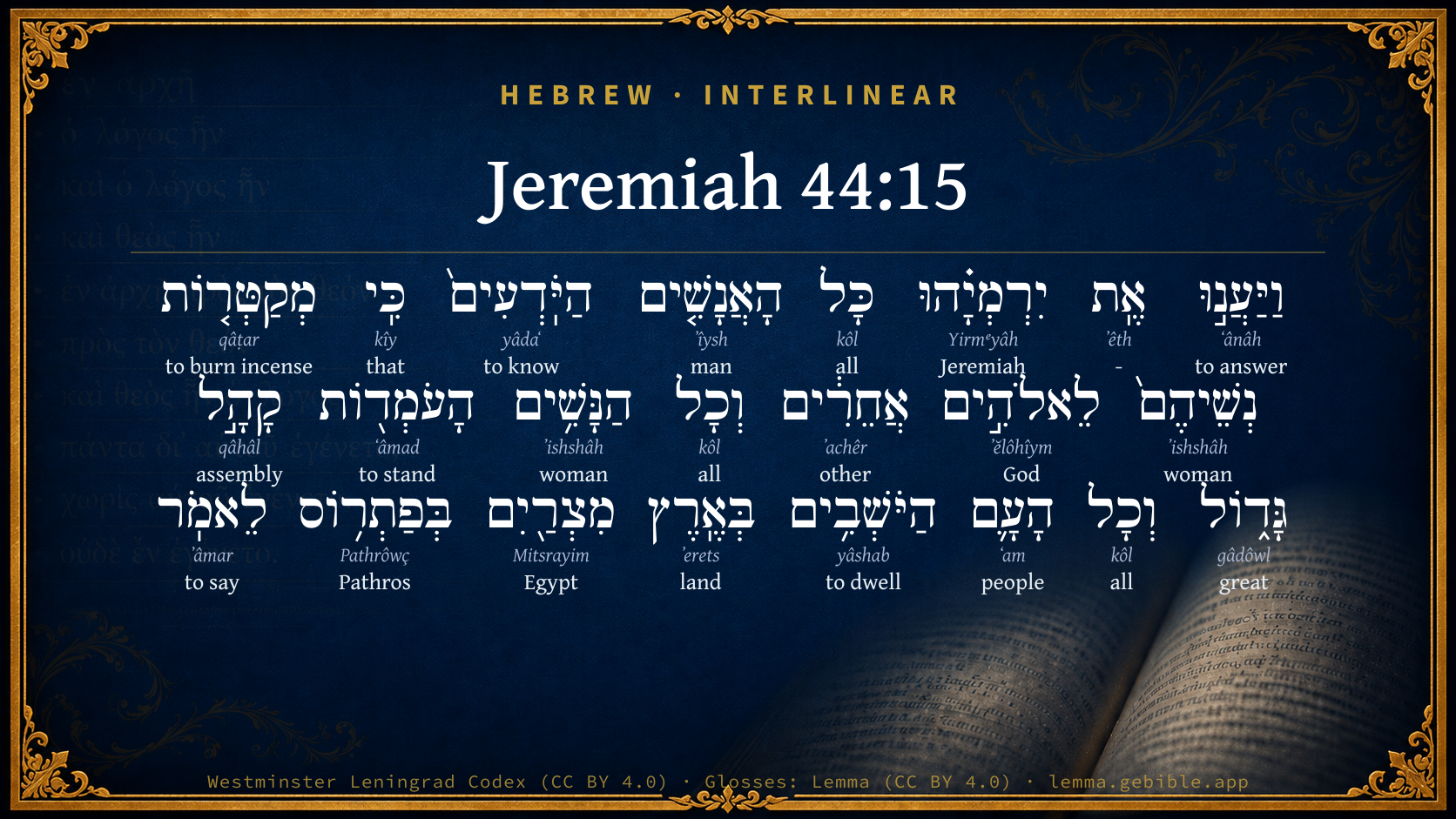
Hebrew (Westminster Leningrad Codex) Jeremiah 44:15 appears in the Hebrew Old Testament. The text above is from the Westminster Leningrad Codex. Each word links to its Strong’s number, a concise gloss, and parsing drawn from the Open Scriptures Hebrew Bible morphology. Click any word for its full Brown-Driver-Briggs (BDB) entry.
Download image
Cite this verse

Jeremiah 44:15 (World English Bible). Public Domain. Lemma interlinear Bible study tool, https://lemma.gebible.app/v/jeremiah/44/15.

Show BibTeX & RIS
BibTeX
RIS
English Translation
Then all the men who knew that their wives burned incense to other gods, and all the women who stood by, a great assembly, even all the people who lived in the land of Egypt, in Pathros, answered Jeremiah, saying,
World English Bible · Public Domain
Download a study sheet

One document with this verse’s original text, its word-by-word gloss line, the meaning frame, cross-references with their text, attributed commentary, and full source and license credits — printable, and it pastes into notes with its structure intact.

This verse Autodidact and up

Study sheet (.html) Plain text (.txt)

A passage Seminary Student

Up to 50 verses in one chapter. A passage sheet keeps up to 6 commentary sources and 12 cross-references per verse, in the order this page ranks them, and says so on the sheet whenever that leaves anything out. Ask for a single verse and you get the Autodidact verse sheet above.

Everything on this page stays free to read, with no account — the sheet is a download of what is already on screen, not access to it.

Want to remove ads? Support Godless Engineer
Compare translations 3

The same verse in 3 English versions, stacked beneath the original-language interlinear above. Click any original word for its lexicon entry.

Each is an independent rendering of the whole verse — the interlinear is not word-aligned to these translations.

Highlighted words mark where these versions differ — a whole-verse word diff, not a word-by-word alignment.

  • World English Bible Public Domain
    Then all the men who knew that their wives burned incense to other gods, and all the women who stood by, a great assembly, even all the people who lived in the land of Egypt, in Pathros, answered Jeremiah, saying,
  • King James Version Public Domain
    Then all the men which knew that their wives had burned incense unto other gods, and all the women that stood by, a great multitude, even all the people that dwelt in the land of Egypt, in Pathros, answered Jeremiah, saying,
  • unfoldingWord Literal Text CC BY-SA 4.0
    Then all the men who knew that their wives were burning incense to other gods, and all the women who were in the great assembly, and all the people who were living in Lower and Upper Egypt, answered Jeremiah.

unfoldingWord Literal Text — © unfoldingWord, licensed CC BY-SA 4.0. Word-aligned USFM3 via Door43 (git.door43.org/unfoldingWord/en_ult).

Versions to compare (up to 4)

3 of 4 selected

Show all 18 translations

Every available English version of this verse, each an independent rendering of the whole verse.

  • World English Bible Public Domain
    Then all the men who knew that their wives burned incense to other gods, and all the women who stood by, a great assembly, even all the people who lived in the land of Egypt, in Pathros, answered Jeremiah, saying,
  • Berean Standard Bible Public Domain
    Then all the men who knew that their wives were burning incense to other gods, and all the women standing by—a great assembly—along with all the people living in the land of Egypt and in Pathros, said to Jeremiah,
  • Majority Standard Bible Public Domain
    Then all the men who knew that their wives were burning incense to other gods, and all the women standing by—a great assembly—along with all the people living in the land of Egypt and in Pathros, said to Jeremiah,
  • King James Version Public Domain
    Then all the men which knew that their wives had burned incense unto other gods, and all the women that stood by, a great multitude, even all the people that dwelt in the land of Egypt, in Pathros, answered Jeremiah, saying,
  • American Standard Version (1901) Public Domain
    Then all the men who knew that their wives burned incense unto other gods, and all the women that stood by, a great assembly, even all the people that dwelt in the land of Egypt, in Pathros, answered Jeremiah, saying,
  • Revised Version (1885) Public Domain
    Then all the men which knew that their wives burned incense unto other gods, and all the women that stood by, a great assembly, even all the people that dwelt in the land of Egypt, in Pathros, answered Jeremiah, saying,
  • Geneva Bible (1599) Public Domain
    Then all the men which knewe that their wiues had burnt incense vnto other gods and all the women that stoode by, a great multitude, euen all the people that dwelt in the lande of Egypt in Pathros, answered Ieremiah, saying,
  • Douay-Rheims (1899) Public Domain
    Then all the men that knew that their wives sacrificed to other gods: and all the women of whom there stood by a great multitude, and all the people of them that dwelt in the land of Egypt in Phatures, answered Jeremias, saying:
  • Young's Literal Translation Public Domain
    And they answer Jeremiah -- all the men who are knowing that their wives are making perfume to other gods, and all the women who are remaining, a great assembly, even all the people who are dwelling in the land of Egypt, in Pathros -- saying:
  • Literal Standard Version CC BY-SA 4.0
    And they answer Jeremiah—all the men who are knowing that their wives are making incense to other gods, and all the women who are remaining, a great assembly, even all the people who are dwelling in the land of Egypt, in Pathros—saying:
  • Unlocked Literal Bible CC BY-SA 4.0
    Then all the men who knew that their wives were burning incense to other gods, and all the women who were in the great assembly, and all the people who were living in Lower and Upper Egypt, answered Jeremiah.
  • unfoldingWord Literal Text CC BY-SA 4.0
    Then all the men who knew that their wives were burning incense to other gods, and all the women who were in the great assembly, and all the people who were living in Lower and Upper Egypt, answered Jeremiah.
  • Darby Bible Public Domain
    Then all the men who knew that their wives burned incense to other gods, and all the women who stood by, a great assemblage, even all the people that dwelt in the land of Egypt, in Pathros, answered Jeremiah, saying,
  • World Messianic Bible Public Domain
    Then all the men who knew that their wives burned incense to other gods, and all the women who stood by, a great assembly, even all the people who lived in the land of Egypt, in Pathros, answered Jeremiah, saying,
  • Webster's Bible Public Domain
    Then all the men who knew that their wives had burned incense to other gods, and all the women that stood by, a great multitude, even all the people that dwelt in the land of Egypt, in Pathros, answered Jeremiah, saying,
  • Free Bible Version CC BY-SA 4.0
    All the men who knew that their wives were burning incense to other gods, and all the women who were there, a great crowd of people, those living in Egypt and Upper Egypt all told Jeremiah,
  • Bible in Basic English Public Domain
    Then all the men who had knowledge that their wives were burning perfumes to other gods, and all the women who were present, a great meeting, answering Jeremiah, said,
  • JPS Tanakh (1917) Public Domain
    Then all the men who knew that their wives offered unto other gods, and all the women that stood by, a great assembly, even all the people that dwelt in the land of Egypt, in Pathros, answered Jeremiah, saying:

Literal Standard Version (2020), Covenant Press — licensed CC BY-SA 4.0. Text via the HelloAO Bible API (eBible.org). Unlocked Literal Bible (unfoldingWord) — licensed CC BY-SA 4.0. Text via the HelloAO Bible API (eBible.org). unfoldingWord Literal Text — © unfoldingWord, licensed CC BY-SA 4.0. Word-aligned USFM3 via Door43 (git.door43.org/unfoldingWord/en_ult). Free Bible Version, Dr. Jonathan Gallagher — licensed CC BY-SA 4.0. Text via the HelloAO Bible API (eBible.org).

Word by word

More ways to search: Search by grammar → Find every occurrence → Compare this word →

Practice this passage: Drill this verse → Learn its vocabulary →

בְּפַתְר֥וֹס
Pathrôwç
H6624
“in/at · Pathros”
Preposition + Noun, Proper
Part of Speech
Preposition + Noun
Type
Proper
Full BDB Definition

Origin: of Egyptian derivation

TWOT: None

Pathros = "region of the south" - a part of Egypt and the home country of the Pathrusim people; probably located in upper Egypt
  1. וַיַּעֲנ֣וּ ʻânâh H6030 “and · to answer” Conjunction + Verb, Qal, Sequential Imperfect, 3rd Person, Masculine, Plural
  2. אֶֽת ʼêth H853 “-” Particle, Direct Object
  3. יִרְמְיָ֗הוּ Yirmᵉyâh H3414 “Jeremiah” Noun, Proper
  4. כָּל kôl H3605 “all of” Noun, Common, Masculine, Singular, Construct
  5. הָאֲנָשִׁ֤ים ʼîysh H376 “the · men” Particle, Definite Article + Noun, Common, Masculine, Plural, Absolute
  6. הַיֹּֽדְעִים֙ yâdaʻ H3045 “the · knowing” Particle, Definite Article + Verb, Qal, Participle Active, Masculine, Plural, Absolute
  7. כִּֽי kîy H3588 “that” Conjunction
  8. מְקַטְּר֤וֹת qâṭar H6999 “burning incense” Verb, Piel, Participle Active, Feminine, Plural, Absolute
  9. נְשֵׁיהֶם֙ ʼishshâh H802 “women · their” Noun, Common, Feminine, Plural, Construct + Suffix, Personal, 3rd Person, Masculine, Plural
  10. לֵאלֹהִ֣ים ʼĕlôhîym H430 “to/for · God(s)” Preposition + Noun, Common, Masculine, Plural, Absolute
  11. אֲחֵרִ֔ים ʼachêr H312 “other” Adjective, Adjective, Masculine, Plural, Absolute
  12. וְכָל kôl H3605 “and · all of” Conjunction + Noun, Common, Masculine, Singular, Construct
  13. הַנָּשִׁ֥ים ʼishshâh H802 “the · women” Particle, Definite Article + Noun, Common, Feminine, Plural, Absolute
  14. הָעֹמְד֖וֹת ʻâmad H5975 “the · standing” Particle, Definite Article + Verb, Qal, Participle Active, Feminine, Plural, Absolute
  15. קָהָ֣ל qâhâl H6951 “assembly” Noun, Common, Masculine, Singular, Absolute
  16. גָּד֑וֹל gâdôwl H1419 “great” Adjective, Adjective, Masculine, Singular, Absolute
  17. וְכָל kôl H3605 “and · all of” Conjunction + Noun, Common, Masculine, Singular, Construct
  18. הָעָ֛ם ʻam H5971 “the · people” Particle, Definite Article + Noun, Common, Masculine, Singular, Absolute
  19. הַיֹּשְׁבִ֥ים yâshab H3427 “the · dwelling” Particle, Definite Article + Verb, Qal, Participle Active, Masculine, Plural, Absolute
  20. בְּאֶֽרֶץ ʼerets H776 “in/at · land of” Preposition + Noun, Common, Both, Singular, Construct
  21. מִצְרַ֖יִם Mitsrayim H4714 “Egypt” Noun, Proper
  22. לֵאמֹֽר ʼâmar H559 “to say” Preposition + Verb, Qal, Infinitive Construct

About this verse

These counts appear in no published source. They are computed here, from the morphology-tagged text and Lemma’s own curated glosses. What Lemma adds →

23
words
20
distinct lemmas
Prophets
section

Notable vocabulary

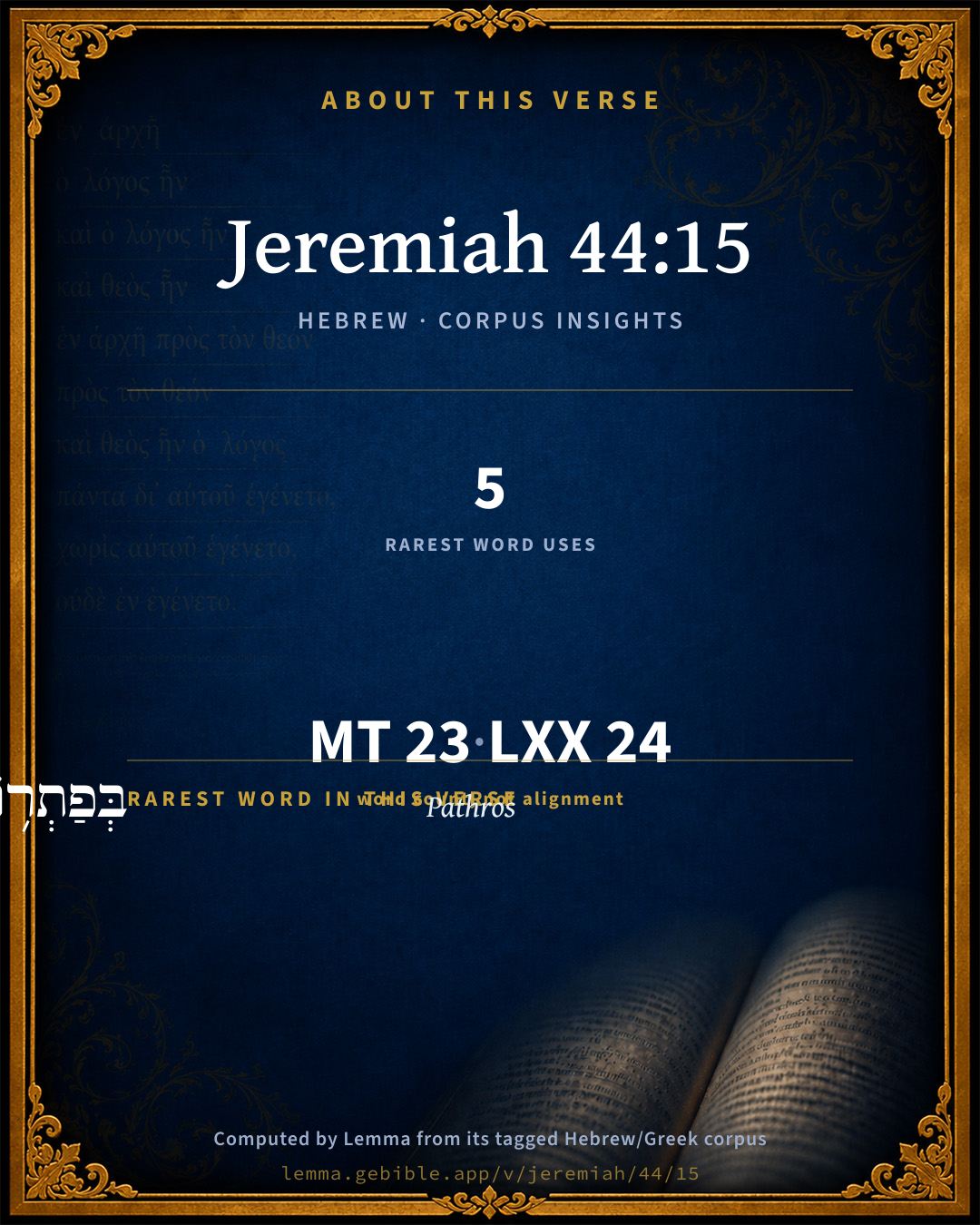
The rarest word here is בְּפַתְר֥וֹס Pathros H6624 — appearing just 5 times in the whole Hebrew Bible.

Shared distinctive vocabulary

בְּפַתְר֥וֹס Pathros H6624 occurs in 5 verses of the Hebrew Bible. Also found in:

Grammatical profile

  • 6 verbs
  • 13 nouns
  • 2 adjectives
  • 1 conjunction
  • 1 particle

Verb forms

  • וַיַּעֲנ֣וּ Qal · Sequential Imperfect
  • הַיֹּֽדְעִים֙ Qal · Participle Active
  • מְקַטְּר֤וֹת Piel · Participle Active
  • הָעֹמְד֖וֹת Qal · Participle Active
  • הַיֹּשְׁבִ֥ים Qal · Participle Active
  • לֵאמֹֽר Qal · Infinitive Construct

Repetition

Words recur within this verse — often emphatic in Hebrew:

  • כָּל all H3605 ×3
  • נְשֵׁיהֶם֙ woman H802 ×2

Hebrew & Septuagint length

In the original languages it is 23 Hebrew tokens and 24 Greek tokens — but the two are counted differently (Hebrew bundles its prefixes and suffixes into one token; the Greek is in lemma form), so that isn’t a like-for-like length.

Cross-references

7

Topical passages linked to Jeremiah 44:15 in the Treasury of Scripture Knowledge — connected by theme and wording, ordered by reader-vote popularity; previews shown in the World English Bible.

  • Proverbs 11:21 Most assuredly, the evil man will not be unpunished, But the seed of the righteous will be delivered.
  • Jeremiah 5:1–5 Run you back and forth through the streets of Jerusalem, and see now, and know, and seek in the broad places of it, if you can find a man, if there are any who does justly, who seeks truth; and I will pardon her.
  • Genesis 19:4 But before they lay down, the men of the city, the men of Sodom, surrounded the house, both young and old, all the people from every quarter.
  • Nehemiah 13:26 Did not Solomon king of Israel sin by these things? yet among many nations was there no king like him, and he was beloved of his God, and God made him king over all Israel: nevertheless even him did foreign women cause to sin.
  • Matthew 7:13 "Enter in by the narrow gate; for wide is the gate and broad is the way that leads to destruction, and many are those who enter in by it.
  • 2 Peter 2:1–2 But there also arose false prophets among the people, as among you also there will be false teachers, who will secretly bring in destructive heresies, denying even the Master who bought them, bringing on themselves swift destruction.
  • Isaiah 1:5 Why should you be beaten more, That you revolt more and more? The whole head is sick, And the whole heart faint.

Cross-references courtesy of OpenBible.info (CC BY 4.0).

Hebrew and Greek witnesses Masoretic Hebrew ↔ Greek Septuagint

The same verse in the two great witnesses to the Old Testament, shown verse-for-verse.

These are two independent witnesses, not word-aligned to each other, and the Septuagint is shown in lemma (dictionary) form.

Hebrew Jeremiah 44:15 Masoretic · Westminster Leningrad Codex

וַיַּעֲנ֣וּ אֶֽת יִרְמְיָ֗הוּ כָּל הָאֲנָשִׁ֤ים הַיֹּֽדְעִים֙ כִּֽי מְקַטְּר֤וֹת נְשֵׁיהֶם֙ לֵאלֹהִ֣ים אֲחֵרִ֔ים וְכָל הַנָּשִׁ֥ים הָעֹמְד֖וֹת קָהָ֣ל גָּד֑וֹל וְכָל הָעָ֛ם הַיֹּשְׁבִ֥ים בְּאֶֽרֶץ מִצְרַ֖יִם בְּפַתְר֥וֹס לֵאמֹֽר

Then all the men who knew that their wives burned incense to other gods, and all the women who stood by, a great assembly, even all the people who lived in the land of Egypt, in Pathros, answered Jeremiah, saying,

World English Bible · Public Domain

Greek LXX Structure differs

In the Septuagint, Jeremiah is about an eighth shorter than the Hebrew and arranges its material differently — the Oracles Against the Nations (Hebrew chapters 46–51) appear in the middle of the Greek book, after 25:13. Because the chapter and verse boundaries do not line up, a verse-for-verse comparison with the Hebrew is not shown.

A verse-for-verse comparison isn’t shown here because the chapters and verses don’t line up. Switch to the LXX edition with the MT / LXX toggle above to read the Greek directly.

Hebrew: Westminster Leningrad Codex (CC BY 4.0). Greek: Septuagint (public domain); English from a public-domain English Septuagint. How the Septuagint differs from the Hebrew →

Targum (Aramaic paraphrase)

1

The Targum is the ancient Jewish Aramaic paraphrase of the Hebrew Scriptures — an interpretive translation, not the Hebrew text itself. Onkelos (literal) and Pseudo-Jonathan (expansive) render the Torah, and Jonathan the Prophets. Coverage is partial: where no permissively-licensed English translation exists for a verse, only the Aramaic is shown. This is verse-level text, not a word-by-word alignment to the Hebrew.

  1. Targum Jonathan Prophets (Joshua–Malachi)
    וַאֲתִיבוּ יַת יִרְמְיָה כָּל גַבְרַיָא דְיָדְעִין אֲרֵי מַסְקָן בּוּסְמִין נְשֵׁיהוֹן לְטַעֲוַת פַּלְחֵי כּוֹכְבַיָא וְכָל נְשַׁיָא דְקַיְמִין קְהָלָא רַבָּא וְכָל עַמָא דְיַתְבִין בְּאַרְעָא דְמִצְרַיִם בְּפַתְרוֹס לְמֵימָר:

    (no public-domain English translation for this verse)

    Targum Jonathan — Aramaic: “Mikraot Gedolot” (public domain). English: “Sefaria Community Translation” (CC0 1.0 (public-domain dedication)); “London "Chaldee Paraphrase," 1871” (public domain). Text via Sefaria.

Commentary

Notes on Jeremiah 44:15 from classic Christian and Jewish commentators (each source and its license shown beneath its notes). The classic Christian expositions comment on the surrounding passage and are grouped to its opening verse, so a note may address several verses; the Jewish commentaries on the Tanakh (Rashi and others) are per-verse, so they appear only where the commentator wrote on this verse.

Lemma curates 59 commentaries, every one of them public domain or Creative Commons licensed, each selected and text-cleaned for this edition rather than reprinted as found. About our sources →

Matthew Henry's Commentary

We have here the people's obstinate refusal to submit to the power of the word of God in the mouth of Jeremiah. We have scarcely such an instance of downright daring contradiction to God himself as this, or such an avowed rebellion of the carnal mind. Observe,

I. The persons who thus set God and his judgments at defiance; it was not some one that was thus obstinate, but the generality of the Jews; and they were such as knew either themselves or their wives to be guilty of the idolatry Jeremiah had reproved, Jer 44:15. We find, 1. That the women had been more guilty of idolatry and superstition than the men, not because the men stuck closer to the true God and the true religion than the women, but, I fear, because they were generally atheists, and were for no God and no religion at all, and therefore could easily allow their wives to be of a false religion, and to worship false gods. 2. That it was consciousness of guilt that made them impatient of reproof: They knew that their wives had burnt incense to other gods, and that they had countenanced them in it, and the women that stood by knew that they had joined with them in their idolatrous usages; so that what Jeremiah said touched them in a sore place, which made them kick against the pricks, as children of Belial, that will not bear the yoke.

II. The reply which these persons made to Jeremiah, and in him to God himself; it is in effect the same with theirs who had the impudence to say to the Almighty, Depart from us; we desire not the knowledge of thy ways.

1. They declare their resolution not to do as God commanded them, but what they themselves had a mind to do; that is, they would go on to worship the moon, here called the queen of heaven; yet some understand it of the sun, which was much worshipped in Egypt (Jer 43:13) and had been so at Jerusalem (Kg2 23:11), and they say that the Hebrew word for the sun being feminine it may not unfitly be called the queen of heaven. And others understand it of all the host of heaven, or the frame of heaven, the whole machine, Jer 7:18. These daring sinners do not now go about to make excuses for their refusal to obey, nor suggest that Jeremiah spoke from himself and not from God (as before, Jer 43:2), but they own that he spoke to them in the name of the Lord, and yet tell him flatly, in so many words, "We will not hearken unto thee; we will do that which is forbidden and run the hazard of that which is threatened." Note, Those that live in disobedience to God commonly grow worse and worse, and the heart is more and more hardened by the deceitfulness of sin. Here is the genuine language of the rebellious heart: We will certainly do whatsoever thing goes forth out of our own mouth, let God and his prophets say what they please to the contrary. What they said many think who yet have not arrived at such a degree of impudence as to speak it out. It is that which the young man would be at in the days of his youth; he would walk in the way of his heart and the sight of his eyes, and would have and do every thing he has a mind to, Ecc 11:9.

2. They give some sort of reasons for their resolution; for the most absurd and unreasonably wicked men will have something to say for themselves, till the day comes when every mouth shall be stopped.

(1.) They plead many of those things which the advocates for Rome make the marks of a true church, and not only justify but magnify themselves with; and these Jews have as much right to them as the Romanists have. [1.] They plead antiquity: We are resolved to burn incense to the queen of heaven, for our fathers did so; it is a practice that pleads prescription; and why should we pretend to be wiser than our fathers? [2.] They plead authority. Those that had power practised it themselves and prescribed it to others: Our kings and our princes did it, whom God set over us, and who were of the seed of David. [3.] They plead unity. It was not here and there one that did it, but we, we all with one consent, we that are a great multitude (Jer 44:15), we did it. [4.] They plead universality. It was not done here and there, but in the cities of Judah. [5.] They plead visibility. It was not done in a corner, in dark and shady groves only, but in the streets, openly and publicly. [6.] They plead that it was the practice of the mother-church, the holy see; it was not now learned first in Egypt, but it had been done in Jerusalem. [7.] They plead prosperity: They had we plenty of bread, and of all good things; we were well and saw no evil. All the former pleas, I fear, were too true in fact; God's witnesses against their idolatry were few and hid; Elijah though that he was left alone: and this last might perhaps be true as to some particular persons, but, as to their nation, they were still under rebukes for their rebellions, and there was no peace to those that went out or came in, Ch2 15:5. But, supposing all to be true, yet this does not at all excuse them from idolatry; it is the law of God that we must be ruled and judged by, hot the practice of men.

(2.) They suggest that the judgments they had of late been under were brought upon them for leaving off to burn incense to the queen of heaven, Jer 44:18. So perversely did they misconstrue providence, though God, by his prophets, had so often explained it to them, and the thing itself spoke the direct contrary. Since we forsook our idolatries we have wanted all things, and have been consumed by the sword, the true reason of which was because they still retained their idols in their heart and an affection to their old sins; but they would have it thought that it was because they had forsaken the acts of sin. Thus the afflictions which should have been for their welfare, to separate between them and their sins, being misinterpreted did but confirm them in their sins. Thus, in the first ages of Christianity, when God chastised the nations by any public calamities for opposing the Christians and persecuting them, they put a contrary sense upon the calamities, as if they were sent to punish them for conniving at the Christians and tolerating them, and cried, Christianos ad leones - Throw the Christians to the lions. Yet, if it had been true, as they said here, that since they returned to the service of the true God, the God of Israel, they had been in want and trouble, was that a reason why they should revolt from him again? That was as much as to say that they served not him, but their own bellies. Those who know God, and put their trust in him, will serve him, though he starve them, though he slay them, though they never see a good day with him in this world, being well assured that they shall not lose by him in the end.

(3.) They plead that, though the women were most forward and active in their idolatries, yet they did it with the consent and approbation of their husbands; the women were busy to make cakes for meat-offerings to the queen of heaven and to prepare and pour out the drink-offerings, Jer 44:19. We found, before, that this was their work, Jer 7:18. "But did we do it without our husbands, privately and unknown to them, so as to give them occasion to be jealous of us? No; the fathers kindled the fire while the women kneaded the dough; the men that were our heads, whom we were bound to learn of and to be obedient to, taught us to do it by their example." Note, It is sad when those who are in the nearest relation to each other, who should quicken each other to that which is good and so help one another to heaven, harden each other in sin and so ripen one another for hell. Some understand this as spoken by the husbands (Jer 44:15), who plead that they did not do it without their men, that is, without their elders and rulers, their great men, and men in authority; but, because the making of the cakes and the pouring out of the drink-offerings are expressly spoken of as the women's work (Jer 7:18), it seems rather to be understood as their plea: but it was a frivolous plea. What would it avail them to be able to say that it was according to their husbands' mind, when they knew that it was contrary to their God's mind?

Matthew Henry's Commentary on the Whole Bible (1708–1710) — public domain (CC PDM 1.0). Text via the HelloAO Bible API.

Trapp's Complete Commentary

John Trapp

Jer 44:15 Then all the men which knew that their wives had burned incense unto other gods, and all the women that stood by, a great multitude, even all the people that dwelt in the land of Egypt, in Pathros, answered Jeremiah, saying,

Ver. 15. Then all the men which knew that their wives had burnt incense.] And by suffering them so to do had consented to what they had done; for qui non, cum potest, prohibet, iubet.

And all the women that stood by.] Mulieres quicquid volunt valde volunt. Women, as they have less of reason than men, so more of passion, being wilful in their way, and oft carrying their men along with them. {a}

“ Sicut ferrum trahit magnes:

Sic masculum suum trahit Agnes. ”

Answered Jeremiah, saying.] One of the women speaking for the rest; and that might well be one of Zedekiah’s daughters, the men conniving, and well content therewith. See Jer 44:19.

{a} Omne malum ex Gynaecio, All evil is from the women’s apartments.

John Trapp, A Commentary or Exposition upon All the Books of the Old and New Testament (1647–1656) — public domain. Text from a community e-Sword module.

Joseph Benson's Commentary

Jer 44:15. Then all the men and all the women that dwelt in Pathros — Which was Upper Egypt; answered Jeremiah, &c. — From this it appears with how much reason it was that God ordered Jeremiah to endeavour to prevent their going into Egypt, since the Israelitish women imitated the idolatry of the inhabitants of it, as soon as they came thither, and no people were immersed in a more absurd and shameful idolatry than the Egyptians. It is probable that when the Jewish women perceived the Egyptians to abound in riches and plenty, and to live in peace and security, they foolishly concluded that the gods which the Egyptians worshipped were more powerful, or more beneficent, than Jehovah, whom the Jews worshipped.

Joseph Benson's Commentary on the Old and New Testaments (1811–1818) — public domain. Text from a community e-Sword module.

Whedon's Commentary on the Bible

Daniel D. Whedon

REPLY OF THE JUDAHITES, THAT THEY WERE PROSPEROUS EVEN WHEN IDOLATROUS, Jer_44:15-19.

15. Had burned — Rather, burned, or were burning. The practice was even then going on.

A great multitude — It would seem probable that this was at a great religious feast or convocation, which accounts for a great congregation of women.

Answered Jeremiah, saying — The substance of this answer is, that worship of the queen of heaven, had in their experience been associated with prosperity, but the leaving off of this worship had been followed by calamity.

Daniel D. Whedon (gen. ed.), Commentary on the Old and New Testaments (1874–1909) — public domain. Text from a community e-Sword module.

Keil & Delitzsch

C. F. Keil & F. Delitzsch

The answer of the people to this threatening address. - Jer 44:15. "Then all the men who knew that their wives burned incense to other gods, and all the women standing [there], a great multitude, and all the people who dwelt in the land of Egypt, in Pathros, answered Jeremiah, saying, Jer 44:16. [As for] the word which thou hast spoken unto us in the name of Jahveh, we will not hearken unto thee: Jer 44:17. But we will certainly perform every word that has proceeded out of our own mouth, by burning incense to the queen of heaven, and pouring out libations to her, just as we have done, we and our fathers, our kings and our princes, in the cities of Judah, and in the streets of Jerusalem; and we were filled with bread, and became prosperous, and saw no evil. Jer 44:18. But since we ceased to offer incense to the queen of heaven, and to pour out libations to her, we have been in want of everything, and are consumed by sword and famine. Jer 44:19. And when we [women] have been burning incense to the queen of heaven, and poured out libations to her, have we made cakes to her without our husbands, making an image of her, and offering libations to her?" To the word of the prophet the men and women oppose their pretended experience, that the adoration of the queen of heaven has brought them comfort and prosperity, while the neglect of this worship, on the other hand, has brought want and misfortune. No doubt they inferred this, by the argument post hoc, ergo propter hoc, from the fact that, after idolatry had been rooted out by Josiah, adversity had befallen the land of Judah; while, up till that time, the kingdom of Judah had been independent, and, for more than a century before, had been spared the suffering of misfortune. Thus, through their blindness, peculiar to the natural man, they had overlooked the minor transient evils with which the Lord visits His people when they sin. Not till near the end of Josiah's reign did misfortune fall on Judah: this was when the Egyptian army, under Pharaoh-Necho, marched through Palestine; Josiah was slain in the battle he had lost, the land was laid waste by the enemy, and its inhabitants perished by sword and famine. In Jer 44:15, those who are represented speaking are all the men who knew of their wives' idolatry, i.e., who permitted it, and all the women, "a great company," i.e., gathered together in great numbers, and all the rest of the people who lived in Egypt. The specification "in Pathros" is not in apposition to the words "in the land of Egypt," but belongs to the verb ויּענוּ; it tells where the gathering took place, viz., in a district of Upper Egypt. From the presence of a large number of women, we may conclude that the assembly was a festival in honour of the queen of heaven. The former portion of Jer 44:16 forms an absolute clause, from הדּבר to בּשׁם, "as regards the word which...we will not listen to thee," i.e., with regard to this word we obey thee not. The expression, "the word which has gone forth out of our mouth," points to the uttering of vows: cf. Num 30:13; Deu 23:24. 'כּל־הדּבר means "all that we have uttered as a vow," every vow to offer incense, etc., i.e., to present meat and drink offerings to the queen of heaven, - that shall we keep, fulfil, as we and our fathers have done in the land of Judah. On this mode of worship, cf. Jer 7:17., and the remarks there made. "And we were satisfied with bread," i.e., in consequence of this worship we had amply sufficient food. Towbiym טובים, "good," well, comfortable; cf. Jer 22:16. מן אז, "from that time" = since. תּמנוּ is for תּמּנוּ, from תּמם, as in Num 17:1-13 :28; cf. Ewald, 197, a. To this statement on the part of the men, the women further add, Jer 44:19, that they do not engage in this sacrificial worship or prepare the sacrificial cakes without their husbands, i.e., without their knowledge and approval. This is put forward by the women in the way of self-vindication; for, according to the law, Num 30:9., the husband could annul, i.e., declare not binding, any vow which had been made by his wife without his knowledge. Although it is women who are speaking, the masc. מקטּרים is used as being the gender which most commonly occurs; it also pretty often stands for the feminine. The inf. constr. וּלהסּך (with ל) is here employed, in conformity with later usage, instead of the inf. abs., for the finite verb, by way of continuation; cf. Ewald, 351, c, where, however, many passages have been set down as falling under this rule that demand a different explanation. The meaning of להעצבה is disputed; the final ה is a suffix, written with Raphe, though Mappik also occurs in some MSS. The Hiphil of this verb is found elsewhere only in Psa 78:40, and there in the signification of vexing, grieving, like the Piel in Isa 63:10; Psa 66:6. Ewald translates "in order to move her," i.e., make her well-disposed, - but quite arbitrarily, for to provoke is the very opposite of rendering propitious. The verb עצּב also signifies "to form, shape," Job 10:8; and in this sense the Hiphil is used here, "in order to put them into shape," i.e., to form the moon-goddess (queen of heaven) in or on the sacrificial cakes (Kimchi, Raschi, Dahler, Maurer, Graf, etc.). The sacrificial cakes (כּוּנים, see on Jer 7:18) probably had the form of a crescent, or even of the full moon, like the σελῆναι of the Greeks, which used to be offered in Athens at the time of the full moon in the month of Munychion, to Artemis, as goddess of the moon; cf. Hermann, gottesdienstliche Alterthmer der Griechen, 2 Ausg. S. 146, Anm. 13, u. S. 414.

Keil & Delitzsch — Biblical Commentary on the Old Testament (1861–1891) — public domain (CC PDM 1.0). Text via the HelloAO Bible API. (Old Testament only.)

Lange's Commentary on the Holy Scriptures

b. The Replication of the People

Jer_44:15-19

15Then all the men which knew that their wives had burned incense unto other gods, and all the women that stood by a [there in the] great multitude [assembly], even all the people that dwelt in the land of Egypt, in Pathros answered Jeremiah , 16 saying, As for the word12 that thou hast spoken unto us in the name of the 17Lord, we will not hearken unto thee. But we will certainly do whatsoever thing [word] goeth forth [has gone forth] out of our own mouth, to burn incense unto the queen of heaven, and to pour out drink offerings unto her, as we have done, we, and our fathers, our kings, and our princes, in the cities of Judah, and in the streets of Jerusalem: for then had we plenty of victuals, and were well,13 and saw 18no evil. But since we left off to burn incense to the queen of heaven, and to pour out drink offerings unto her, we have wanted all things, and have been consumed1419by the sword and by the famine. And when we burned incense to the queen of heaven, and poured out drink offerings unto her, did we make her cakes to worship her,15 and pour out drink offerings unto her, without our men?

EXEGETICAL AND CRITICAL

From the purport of this passage it is manifest that the people had come together to celebrate a festival in honor of the queen of heaven, and to perform the vows they had made. The assembly consisted principally of women. Hence they were the chief speakers. They now declare to the prophet that they will not obey his words (Jer_44:16), but perform their vows, and make their offerings to the queen of heaven, as they had also done at home. It was then well with them (Jer_44:17), only since they neglected her worship, has it gone badly with them (Jer_44:18). In addition, they (the women) had devoted themselves to the service of this goddess only with the concurrence of their husbands.

Jer_44:15. Then all … saying. The assembly consisted (1) of men, who well knew that their wives offered incense to other gods (comp. rems. on Jer_44:3); (2) of women, who were a great multitude. From the circumstance that the “great assembly” is designated as consisting of women, it has been rightly concluded that they formed the majority, which explains the emphasis laid on the women in Jer_44:24-25.—The Jewish women thus appear to have come together from all parts of Egypt to a festival of the queen of heaven, which was held in a place of upper Egypt (Pathros), not more particularly designated, in order there to perform their vows made to this goddess. The men seem to have been both those who lived in the neighborhood and those who had come from a distance as husbands of a part of the women mentioned. The assembly consisted (3) of representatives of all the people, who were settled in Egypt, among whom we must suppose individuals, who were neither husbands nor wives—In Pathros accordingly designates the place of meeting, and is not to be connected with lived but with answered. The prophet had endeavored by his discourse, Jer_44:2-14, to hinder the observance of this idolatrous festival, but was not successful.

Jer_44:16-19. As for the word … without our men.—We will not hearken. Comp. Jer_7:16.—The expression whatsoever word has gone forth out of our mouth indicates vows that had been made (comp. Num_30:3; Num_30:13; Num_32:24; Jdg_11:36). On the queen of heaven comp. rems. on Jer_7:18—And when we burned. According to the apodosis this ought properly to be in the feminine instead of the masculine, as in Jer_44:15 (מקטרוֹת). The masculine form has not only a general justification, as being the chief form, and frequently occurring for the feminine (comp. Naegelsb. Gr., § 60, 5, 4), but also a special, since the speakers had in view the entire number who took part in the offering. According to Num_30:7 sqq., the women were responsible for the observance of their vows only when approved by their husbands (or fathers, comp. Jer_44:4). Hence they now declare, that in consequence of having obtained the concurrence of their husbands they are at any rate free from all personal responsibility. On cakes comp. rems. on Jer_7:18. It is evident from the latter passage, that this cult was not first adopted in Egypt, but imported from home.

Footnotes:

[12]Jer_44:16.—הַדָּבָר is to be regarded as accusative of restriction. Not generally, but only with respect to this particular word, do they declare that they will not obey the prophet. Comp. Naegelsb. Gr., § 70, f.

[13]Jer_44:17.—טובים felices. Comp. Isa_3:10, and Delitzsch ad loc.

[14]Jer_44:18.—On the form תַּמְנוּ, which is found only in the root תָּמַם, comp. Olsh., S. 483, f.

[15]Jer_44:19.—להעציבה. The Hiph. here only. The Piel only in Job_10:8 decidedly in the meaning of “to form, shape.” Compare further עֶצֶב,עֲצַבִּים (Jer_22:28), so the meaning of the Hiph. in this place cannot be other than “to form, copy,” with reference to the moon-shaped form of the cakes. Comp. rems. on Jer_7:18. The circumstance that the ה is written without Mappik (which however is found in some MSS.) does not stand in the way of this. (Comp. Olsh., § 96, e; Isa_21:2; Isa_23:17-18). [We must then render: make her cakes to copy her.—S. R. A.]

Lange's Commentary on the Holy Scriptures (Critical, Doctrinal, and Homiletical), ed. John Peter Lange, English translation edited by Philip Schaff (1864–1880) — public domain. Text from a community e-Sword module.

Tyndale Open Study Notes

Tyndale Open Resources

44:15-19 The people did not accept Jeremiah’s pronouncement of judgment; they had abandoned even the pretense of serving the Lord (42:1-3) and were completely committed to idolatry.

44:15 This group of Judeans had probably gathered to observe a pagan festival.

Tyndale Open Study Notes — © Tyndale Open Resources, licensed CC BY-SA 4.0. Text via the HelloAO Bible API.

Jamieson, Fausset & Brown

Robert Jamieson, A. R. Fausset & David Brown

their wives--The idolatry began with them (Kg1 11:4; Ti1 2:14). Their husbands' connivance implicated them in the guilt.

Jamieson, Fausset & Brown — Commentary Critical and Explanatory on the Whole Bible (1871) — public domain (CC PDM 1.0). Text via the HelloAO Bible API.

Adam Clarke's Commentary

Verse 15. Then all the men - and all the women] We have not seen the women in determined rebellion before. Here they make a common cause with their idolatrous husbands.

Adam Clarke's Commentary on the Bible (1810–1826) — public domain. Text from a community e-Sword/MySword module.

John Calvin's Commentaries

Here is more fully seen the irreclaimable obstinacy of that nation; for Jeremiah had given them more than sufficient evidences of his integrity. They ought then to have been fully convinced that he was a true Prophet of God. Though they had disregarded him for forty years and more, he had yet given full proof of his legation when he had constantly, even to the last, prophesied of the destruction of the city and the Temple. They had, then, learnt by their own calamities that Jeremiah was an instrument of the Holy Spirit, and a true interpreter of God’s will. And it hence appears how blind they were when they rejected all his admonitions, and counted his threatenings as fables. Thus, as in a mirror, the Holy Spirit of God sets before us how great the madness of men is when Satan once takes possession of their minds. But let us, at the same time, learn that this is the reward rendered to obstinacy, when God’s Prophets are despised. It was, indeed, a monstrous and most disgraceful thing, when they dared so insolently to repudiate the holy Prophet, while, at the same time, they had been reduced to the greatest extremities, and when spoiled of all things, had fled into Egypt, and lived there, as we have seen, in a servile and miserable condition. Inasmuch, then, as they were still ferocious and still arrogant towards God’s Prophet, it hence appears that they were untamable.

He then says, that all the men to whom the impiety of their wives was known, answered Jeremiah By these words the Prophet intimates that the beginning of idolatry was from the women. Things then had not as yet gone so far that all the men openly worshipped idols; but the women had taken this liberty, and the men readily indulged them. But why then did the Prophet before reprove them, as though they all made incense to idols? We doubtless learn from this passage, that they are not only guilty before God who openly do what is wicked, but also those who by connivance tolerate them; for the men ought to have interfered so as to restrain their wives from polluting themselves with ungodly superstitions; but this they patiently endured. Then their consent was the same as the deed, as we may rightly conclude from the words of the Prophet. He then says, that the men offered incense, not indeed openly and with their own hands, but that they knew of their wives, and that this impiety was done by the women with their consent. The rest I cannot now finish, I will proceed with it to-morrow.

John Calvin's Commentaries (1540-1563) — public domain. Text from the Calvin Translation Society English edition (1840s-50s) via the Christian Classics Ethereal Library (ccel.org). Calvin's coverage is partial (roughly two-thirds of the Bible); uncommented books and verses are honest gaps, never fabricated. The 19th-century editor's footnotes and remarks are omitted so the notes are faithfully Calvin's own voice.

Ellicott's Commentary for English Readers

(15) All the men which knew that their wives had burned incense.—The fact thus mentioned incidentally shows that the prophet’s words in Jer_44:9 had not missed their mark. As of old—as, we may add, in the Rome of the Empire (Juvenal, Sat. vi. 526–534)—the women practised a cultus in which their husbands acquiesced, even though they did not join in it.

A Bible Commentary for English Readers, edited by Charles John Ellicott (1878–1897) — public domain. Text from a community e-Sword module.

The Cambridge Bible for Schools and Colleges

gen. ed. J. J. S. Perowne

15. and all the women] It has been suggested that it is hardly likely that women would have come so far, and that “even … Pathros” is a gloss. Pathros was the S. part of what is now called Egypt, but was once politically separated from it, Ethiopia claiming its possession. It is identical with the Thebais of the Greeks, commencing a few miles S. of Memphis, and extending to Syene on the first cataract.

a great assembly] Du. followed by Co. reads (by a slight alteration in MT.) with a loud voice.

15–19. See introd. summary to the ch. This passage, unlike the preceding, apparently comes intact from Baruch’s memoirs.

The Cambridge Bible for Schools and Colleges (gen. ed. J. J. S. Perowne; Cambridge University Press, 1878–1918) — public domain. Text from a community e-Sword module.

John Gill's Exposition

Then all the men which knew that their wires had burnt incense unto other gods,.... Which was a rite God appointed to be used in his worship; and is here put for the whole of religious worship, which was given to idols by the Jewish women; this their husbands knew of, and winked at, and did not restrain them from it, as they should; they seem to be themselves irreligious persons, a sort of atheists, who had no regard for the true God, nor any other gods, and cared not who were worshipped:

and all the women that stood by; the wives of the men that stood by their husbands, and other women that stood and heard Jeremiah's sermon, and were conscious to themselves of being guilty of what they were charged with by him:

a great multitude, even all the people that dwelt in the land of Egypt,

in Pathros; in that part of Egypt so called, which was Thebais: here it seems Jeremiah was with that part of the people that took up their residence there; and by this it appears there was a large number of them, men and women, and who were all become idolaters, or connivers at, and encouragers of, such as were: these

answered Jeremiah, saying, one in the name of the rest made a reply, as follows:

John Gill's Exposition of the Whole Bible (1746–1763) — public domain (CC PDM 1.0). Text via the HelloAO Bible API.

Albert Barnes' Notes on the Bible

Had burned incence - Omit “had;” burned incense. This appeal of the prophet was made at a public festival held somewhere in Pathros, i. e., Upper Egypt: for the women are assembled in a great congregation (compare Jer 26:9), here formed for religious purposes. As they advance in regular procession to worship the moon-goddess, in accordance as it seems with a vow Jer 44:17, Jeremiah meets them, makes the procession halt upon its way, and pronounces in Yahweh’s name words of solemn warning. The reply that all the settlers in Egypt were formally putting themselves under the Queen of heaven’s protection was made by the heads of the congregation.

Albert Barnes' Notes on the Bible (1834–1885) — public domain. Text from a community e-Sword/MySword module.

Matthew Poole's English Annotations

The burning of incense was a religious rite, which God had appointed the Jews as a piece of Divine homage to be paid to him alone, and by an ordinary figure is put for worship; so as burning incense to other gods is the same with worshipping other gods. It should seem that all the Jews had not been thus far guilty, and those that did it were mostly women, or at least they were the leaders in this idolatry; and one would think the phrase implieth that those who were thus culpable did it with some privacy, so as all their husbands did not know of it; but those that did were as bad as their wives, conniving at them, and justifying them in their idolatry, and joining with them in the following peremptory answer to and contempt of the prophet.

Matthew Poole's English Annotations on the Holy Bible (1683–1685) — public domain. Text from a community e-Sword/MySword module.

The Pulpit Commentary

Vers. 15-19. The reply of the people. The special mention of the women suggests that the occasion of the gathering was a festival in honour of the Queen of Heaven.

Had burned incense; rather, were burning incense. The practice was still going on.

Vers. 15-23. Credentials of religion.

Very important to know why we prefer one religious system to another, and also why we ought to prefer it. A man is continually in need of having to give a reason for the hope that is in him. The higher religions find the field already occupied by many great systems, and have to vindicate themselves. The arguments employed here are those most commonly adduced, because most superficial. As appealing to the sensuous and material side of human nature, they are very influential.

I WORLDLY ARGUMENTS FOR A RELIGION. Here they are employed on behalf of a false religion, an idolatry; but they are often made use of in recommending true religion. They are generally of two classes, viz. pertaining:

1. To authority. The idolatry here defended was

a. general and fashionable;

b. ancient;

c. patronized by royalty;

d. practiced in the mother city of God"s people.

2. To tendency. It was alleged to have promoted prosperity and peace.

II THEIR INCONCLUSIVENESS.

1. Authority is only valuable as it helps to establish truth. Sin in its most flagrant forms, ignorance and inhumanity, have been more and longer prevalent than the greatest religions the world has seen. The most cruel and debasing religions are the most ancient in most countries. The only authority which can be admitted in such a connection is that of the best, i.e. the wisest and purest.

2. The tendency argument is open to similar objections. It is a great deal to say in favour of a religion that it has promoted the welfare and happiness of its supporters; but it is not so easy to prove it. Here the prophet alleges that it was their idolatry which lay at the root of all the misery of the people of Judah. It requires a very wide, varied, and lengthened induction of a people"s circumstances ere such a statement is legitimate either way. And even if it were made out to one"s satisfaction that a religious system had a beneficial effect upon the material condition of a people, it must still be remembered that man is a spiritual being, and that his moral and spiritual nature will sooner or later enter an imperious claim to attention and satisfaction. Only that which is right and true can meet the wants of the human spirit under all circumstances. And God is the one Being who can satisfy the spiritual aspirations and needs of his creatures. If the best and the holiest of men cannot be content with material advantages and comfort, but are ever yearning for something beyond, it is evident that utilitarianism must be interpreted in a very spiritual sense indeed ere it can pass muster as a tolerable criterion of any religion. It is chiefly because Christianity has revealed a Divine communion and a universal moral basis that it is destined to supplant all other creeds. But at the same time, it is also enforced by the test of utility in its more material aspect. No religion has so advanced the comfort, civilization, and peace of this world. M.

Vers. 15-19. Supposed and real reasons for calamity.

I A SUPPOSED REASON. What is the calamity? Sword and famine. Certainly a calamity to be removed and as far as possible averted for the future. And casting about to discover a reason for the calamity, the men of Judah, or rather the women, for it is they who appear most prominently in this declaration, discover that the reason is to be found in the discontinuance of their offerings to the queen of heaven. What a family matter this offering was is shown by Jer_7:18. The women kneaded dough to make cakes to the queen of heaven. These offerings must have been very generally given up when the migration into Egypt took place, and then, on the coming of the sword and famine, what was more natural than for these women to connect the calamity with the discontinued offerings? In one thing they were quite right; there was a supernatural reason for the calamity. Wrong as they were, it was well they did not rest in any mere natural reason. They were sure that a Divine Being of some sort or other had to do with their troubles. The direction of thought is different now. When calamity comes upon people, if they connect it with God at all, they very often do so in an arbitrary kind of way, as if nothing but a mere superior will, without reason or purpose of any sort, had sent calamity to them. It is easy to pity what we call the ignorance and superstition of this crowd of women, but always we can see the errors of other times far more easily than those of our own. The causes of suffering need to be inquired for very carefully, very patiently; for wrong conclusions only bring more suffering than ever.

II THE REAL REASON. They had forsaken Jehovah. Not that there is any necessary connection between the forsaking of Jehovah and the sword and famine. Nothing but our faith in the reality of a prophet"s predictions can enable us to see this connection. There is oftentimes an utter forsaking of God, yet neither sword nor famine follow. The true and necessary result of going after something else than God is found in the consequent misery and emptiness of the life. Continually we suffer from our inability to see things in their right proportions. Bad as sword and famine may be, there are things infinitely worse. The fact that this multitude was debasing itself by worshipping the queen of heaven pointed to a state of things far worse than any physical suffering could be. Physical suffering may at any time be removed, if desirable, by a miracle. But that darkness of the heart producing essential idolatry, a darkness so loved and cherished, who is to remove that? Nay, the very fulness of temporal comforts may become a veil between God and the soul. The very thing which helped to deceive the people here as to the real causes of things lay in this, that at the time when they were worshipping the queen of heaven they had plenty of victuals, and were well, and saw no evil. Y.

The Pulpit Commentary (1880–1919), ed. H.D.M. Spence-Jones & Joseph S. Exell — public domain. Text from a community e-Sword module.

John Wesley's Explanatory Notes

All the men - It should seem those that did it were mostly women, and that they did it with some privacy, so that all their husbands did not know of it.

John Wesley, Explanatory Notes Upon the Whole Bible (1754–1765) — public domain. Text via the GEBible commentary corpus.

Kretzmann's Popular Commentary

Paul E. Kretzmann

The Answer of the Jews and the Lord’s Prophecy of Punishment

v. 15. Then all the men which knew that their wives had burned incense unto other gods and all the women that stood by, a great multitude, the female contingent apparently being in the majority, from which many have concluded that the festival was one in honor of the Queen of Heaven herself, in whose service the women were very zealous, even all the people that dwelt in the land of Egypt, in Pathros, where this meeting was held, answered Jeremiah, saying,

v. 16. As for the word that thou hast spoken unto us in the name of the Lord, we will not hearken unto thee, they flatly refused to obey.

v. 17. But we will certainly do whatsoever thing goeth forth out of our own mouth, the vows which they had made when they embraced idolatry, to burn incense unto the Queen of Heaven, that is, Ashtaroth, or Astarte, and to pour out drink-offerings unto her, as we have done, we and our fathers, our kings and our princes, in the cities of Judah and in the streets of Jerusalem, this statement amounting to the worst form of self-accusation, with a tinge of revolting boastfulness; for then had we plenty of victuals, literally, "we were satisfied with bread," having food of every kind in sufficient amounts, and were well and saw no evil, they enjoyed good fortune and happiness, as they believed. Fools attribute what they consider prosperity to the fact that God connives at their sin, so that they finally deny His very existence.

v. 18. But since we left off to burn incense to the Queen of Heaven and to pour out drink-offerings unto her, very likely due to the reformation under Josiah, 2Ki 23:4-20, we have wanted all things, they had lacked those things which they had enumerated, and have been consumed by the sword and by the famine.

v. 19. And when we burned incense to the Queen of Heaven and poured out drink-offerings unto her, did we make her cakes, the customary cakes used with sacrifices, 7:18, to worship her and pour out drink-offerings unto her without our men? So the women, who made up the majority of the assembly, boldly stated that their husbands had not only connived at their idolatry, Cf Num 30:9 ff. but had even become guilty with them. The reference seems to be to the custom of giving their sacrificial cakes the form of a half-moon or even of the full moon, after the manner of other heathen cults. In this manner the demands of the Lord were met by a flat refusal on the part of the Jews.

v. 20. Then Jeremiah said unto all the people, to the men, and to the women, and to all the people "which had given him that answer, saying,

v. 21. The incense that ye burned in the cities of Judah and in the streets of Jerusalem, ye and your fathers, your kings and your princes, and the people of the land, of which they, in their wickedness, now presumed to boast, did not the Lord remember them, and came it not into His mind? Did not the present desolation of their homeland testify to the fact that the Lord was very well aware of their wickedness, and that He had repaid their evil-doing?

v. 22. So that the Lord could no longer bear because of the evil of your doing’s and because of the abominations which ye have committed, with all His long-suffering He could no longer endure it; therefore is your land a desolation and an astonishment and a curse, without an inhabitant, as at this day. The evidences of His wrath upon the Land of Promise were still evident, and all on account of their idolatry, as the prophet now repeats once more, for the sake of emphasis.

v. 23. Because ye have burned incense, and because ye have sinned against the Lord, chiefly in the customs connected with their idolatry, and have not obeyed the voice of the Lord nor walked in His Law, in following the precepts of the Moral Law, nor in His statutes, the ordinances of the Ceremonial Law, nor in His testimonies, the judicial sayings of the Lord throughout His Word, therefore this evil is happened unto you as at this day.

v. 24. Moreover, Jeremiah said unto all the people and to all the women, Hear the word of the Lord, all Judah that are in the land of Egypt, whom he now proceeds to admonish in a most solemn manner,

v. 25. Thus saith the Lord of hosts, the God of Israel, saying, Ye and your wives have both spoken with your mouths and fulfilled with your hand, saying, We will surely perform our vows that we have vowed to burn incense to the Queen of Heaven, and to pour out drink-offerings unto her; ye will surely accomplish your vows and surely perform your vows. Here is a bit of holy irony; for, as Jeremiah states, no one could accuse them of unsteadiness in keeping their idolatrous promises. If they had only been as steadfast toward Jehovah, the God of the covenant!

v. 20. Therefore hear ye the word of the Lord, all Judah that dwell in the land of Egypt, Behold, I have sworn by My great name, saith the Lord, by Himself as He has revealed Himself in His great and mighty acts, the most solemn oath which He could swear, that My name shall no more be named in the mouth of any man of Judah in all the land of Egypt, saying, The Lord God liveth. Since they had rejected Him, He would also reject them, He would bring about their destruction.

v. 27. Behold, I will watch over them for evil and not for good, the same God whose tender solicitude watches over His children to do them good would in this instance just as solicitously bring evil upon the rebellious Jews; and all the men of Judah that are in the land of Egypt shall be consumed by the sword and by the famine until there be an end of them. This is true in general; it presents the fulfillment of His threat.

v. 28. Yet a small number that escape the sword shall return out of the land of Egypt into the land of Judah, a band readily counted on account of its smallness, whereas the entire contingent had planned to return to their former homeland; and all the remnant of Judah that are gone into the land of Egypt to sojourn there shall know whose words shall stand, Mine or theirs, literally, "the word from Me or that from them," that by which the Lord had predicted ruin to them or that by which they had predicted good fortune to themselves.

v. 29. And this shall be a sign unto you, saith the Lord, that I will punish you in this place, that ye may know that My words shall surely stand against you for evil:

v. 30. thus saith the Lord, Behold, I will give Pharaoh-hophra, king of Egypt, into the hand of his enemies and into the hand of them that seek his life, as I gave Zedekiah, king of Judah, into the hand of Nebuchadnezzar, king of Babylon, his enemy, and that sought his life. Pharaoh-hophra lost his life in consequence of a revolt of the Egyptians, who caused him to be executed by strangulation about 570 B. C. If people persist in their opposition to God, He gives them up to the powers of evil to their complete destruction.

Paul E. Kretzmann, Popular Commentary of the Bible (1921–1924) — public domain. Text from a community e-Sword module.

unfoldingWord translationNotes

Door43 World Missions Community

in the great assembly

"in the large crowd"

Lower ... Egypt

"Lower Egypt" refers to the northern region of Egypt.

Upper Egypt

This refers to the southern region of Egypt. It is sometime called "Pathros."

About the word that you have told us in Yahweh's name—we will not listen to you

Here "in Yahweh's name" means "in Yahweh's authority" or "as Yahweh's representative." AT: "We will not obey this message that you say Yahweh told you to tell us" (See: Metonymy)

queen of heaven

This a title of a false goddess that the people of Judah worshiped. This goddess is also called "Asherah." (See: Assumed Knowledge and Implicit Information)

the streets of Jerusalem

Here "streets" represent the public places in Jerusalem. AT: "in the public places of Jerusalem" or "in Jerusalem" (See: Synecdoche)

Then we will be filled with food and will prosper, without experiencing any disaster

The people of Judah thought they would prosper because the queen of heaven would bless them if they worshiped her. (See: Assumed Knowledge and Implicit Information)

Then we will be filled with food

This can be stated in active form. AT: "Then we will have plenty of food" (See: Active or Passive)

translationWords

incense

false god

assembly

Egypt

Jeremiah

word

Yahweh

name

queen

heaven

drink offering

king

kingdom of Judah

Jerusalem

prosper

unfoldingWord translationNotes — © Distant Shores Media and the Door43 World Missions Community, licensed CC BY-SA 4.0. Source: git.door43.org/Door43/en_tn.

Lesson kit

Teaching starters — assembled from the data on this page, not authored interpretation. Every prompt links to the verse data it draws on. Edit before teaching.

Jeremiah, in the Prophets, opens this verse with 23 words (20 distinct Hebrew lemmas). Its most distinctive word is Pathrôwç (“Pathros”). A historical commentator’s framing appears above. Read the whole chapter for the surrounding context.

Discussion questions

  1. The word Pathrôwç carries the sense “Pathros.” How does it shape the verse?
  2. How does Isaiah 11:11, which shares the word «Pathros», read alongside this verse?
  3. What does the repetition of “all” (3× in this one verse) do in this verse?
  4. These translations render this verse differently. What is at stake in choosing one wording over another?
  5. «וַיַּעֲנ֣וּ» is a Qal Sequential Imperfect verb. How does that grammatical form shape the action described?
  6. Compare how Matthew Henry's Commentary and Trapp's Complete Commentary read this verse. Where do they agree or differ?

Things to notice

Reading settings

Reading text

Shown beneath each verse's original-language words.

Old Testament
Old Testament edition

Read the OT as the Masoretic Hebrew (MT) or the Greek Septuagint (LXX).

English shown for the Greek Septuagint (in the Hebrew ↔ Greek comparison).

Comparing translations? Open the Compare panel on any verse page to stack up to four side by side.