
Exodus 14:27

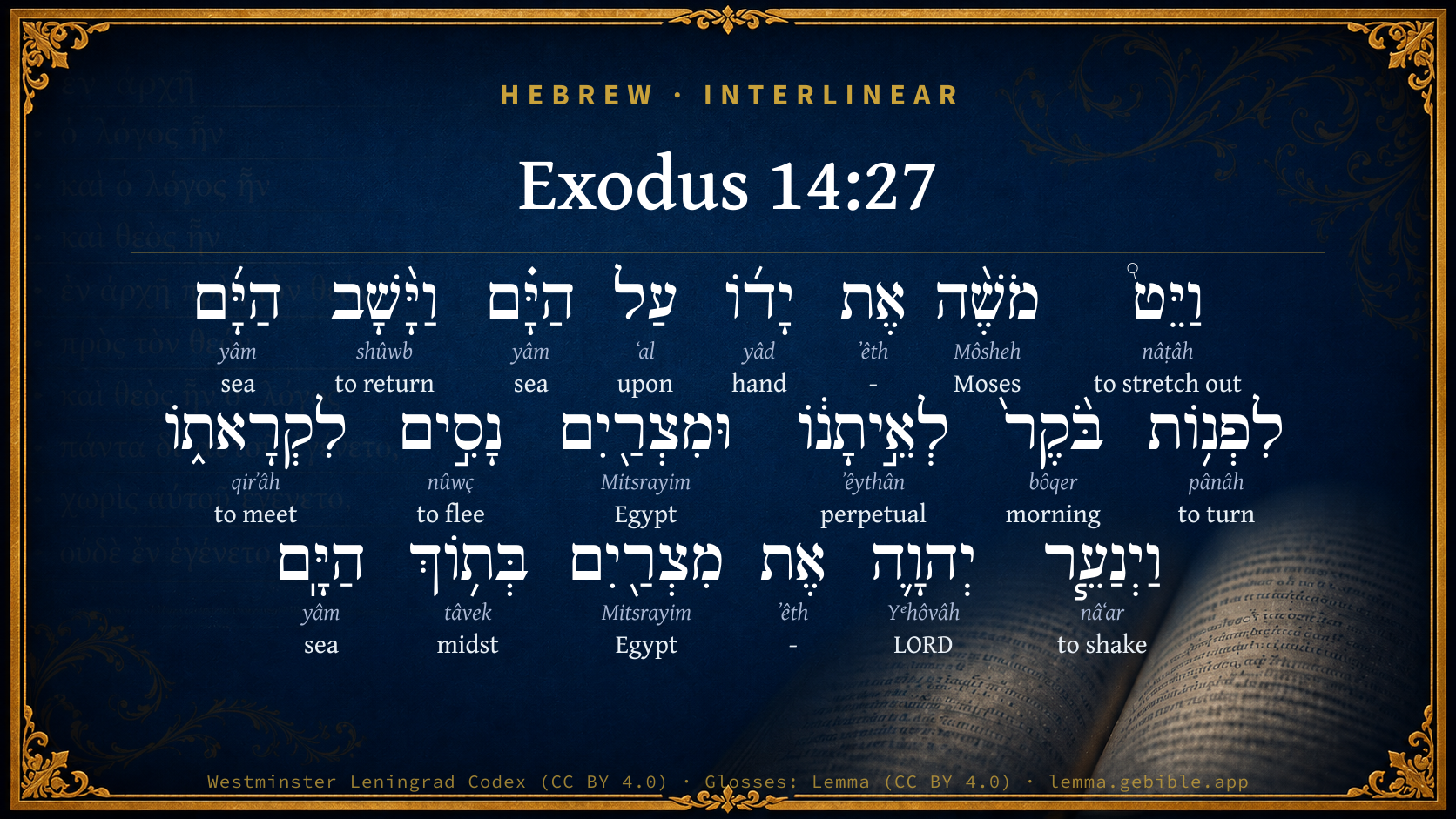
Hebrew (Westminster Leningrad Codex) Exodus 14:27 appears in the Hebrew Old Testament. The text above is from the Westminster Leningrad Codex. Each word links to its Strong’s number, a concise gloss, and parsing drawn from the Open Scriptures Hebrew Bible morphology. Click any word for its full Brown-Driver-Briggs (BDB) entry.
Download image
Cite this verse

Exodus 14:27 (World English Bible). Public Domain. Lemma interlinear Bible study tool, https://lemma.gebible.app/v/exodus/14/27.

Show BibTeX & RIS
BibTeX
RIS
English Translation
Moses stretched out his hand over the sea, and the sea returned to its strength when the morning appeared; and the Egyptians fled against it. Yahweh overthrew the Egyptians in the midst of the sea.
World English Bible · Public Domain
Highlights
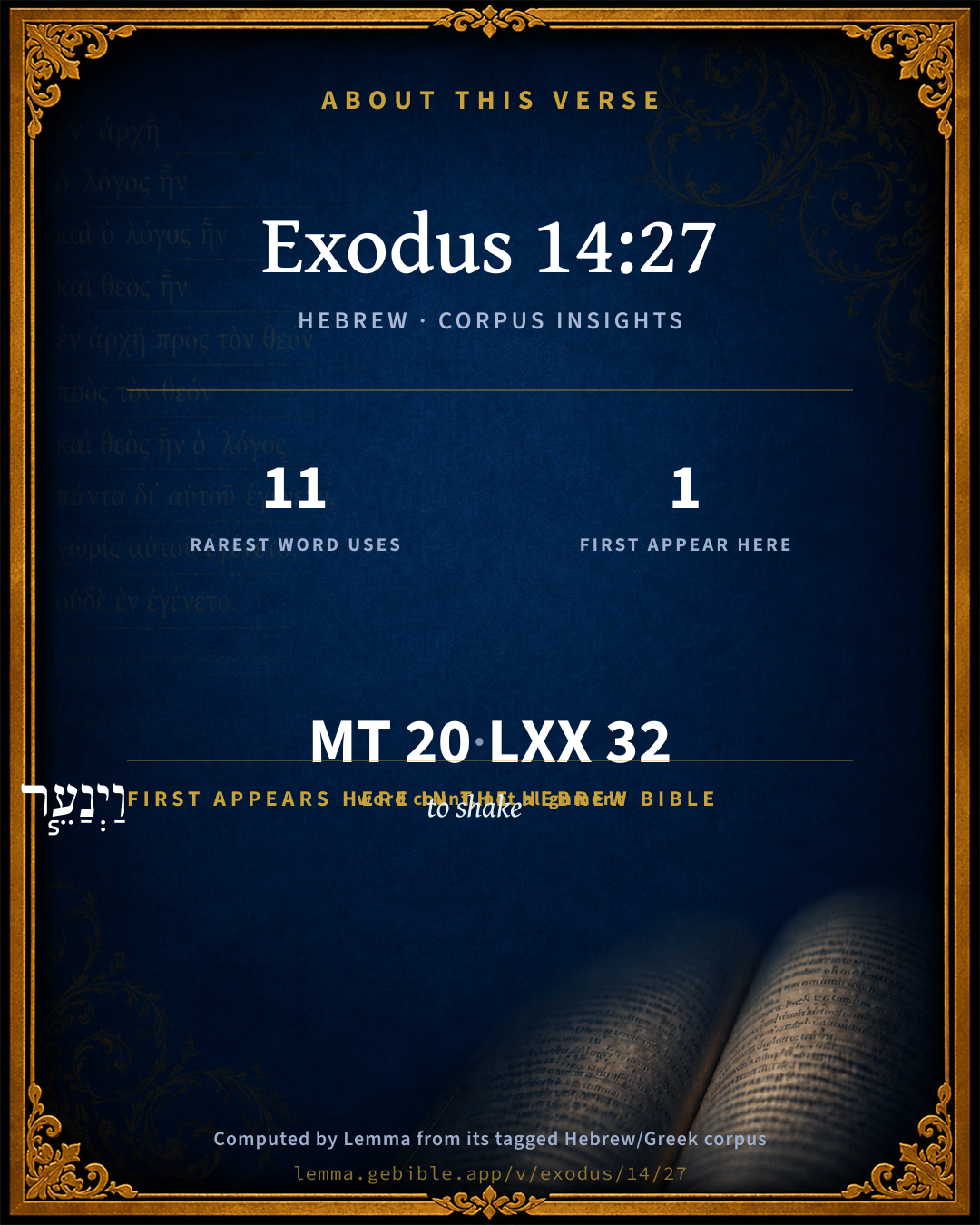
  • 1 first appearance in the Hebrew Bible
Full analysis ↓
Download a study sheet

One document with this verse’s original text, its word-by-word gloss line, the meaning frame, cross-references with their text, attributed commentary, and full source and license credits — printable, and it pastes into notes with its structure intact.

This verse Autodidact and up

Study sheet (.html) Plain text (.txt)

A passage Seminary Student

Up to 50 verses in one chapter. A passage sheet keeps up to 6 commentary sources and 12 cross-references per verse, in the order this page ranks them, and says so on the sheet whenever that leaves anything out. Ask for a single verse and you get the Autodidact verse sheet above.

Everything on this page stays free to read, with no account — the sheet is a download of what is already on screen, not access to it.

Want to remove ads? Support Godless Engineer
Compare translations 3

The same verse in 3 English versions, stacked beneath the original-language interlinear above. Click any original word for its lexicon entry.

Each is an independent rendering of the whole verse — the interlinear is not word-aligned to these translations.

Highlighted words mark where these versions differ — a whole-verse word diff, not a word-by-word alignment.

  • World English Bible Public Domain
    Moses stretched out his hand over the sea, and the sea returned to its strength when the morning appeared; and the Egyptians fled against it. Yahweh overthrew the Egyptians in the midst of the sea.
  • King James Version Public Domain
    And Moses stretched forth his hand over the sea, and the sea returned to his strength when the morning appeared; and the Egyptians fled against it; and the LORD overthrew the Egyptians in the midst of the sea.
  • unfoldingWord Literal Text CC BY-SA 4.0
    And Moses reached out his hand over the sea, and the sea returned before the face of the morning to its normal place, and the Egyptians fled before its impact. And Yahweh shook off the Egyptians in the middle of the sea.

unfoldingWord Literal Text — © unfoldingWord, licensed CC BY-SA 4.0. Word-aligned USFM3 via Door43 (git.door43.org/unfoldingWord/en_ult).

Versions to compare (up to 4)

3 of 4 selected

Show all 18 translations

Every available English version of this verse, each an independent rendering of the whole verse.

  • World English Bible Public Domain
    Moses stretched out his hand over the sea, and the sea returned to its strength when the morning appeared; and the Egyptians fled against it. Yahweh overthrew the Egyptians in the midst of the sea.
  • Berean Standard Bible Public Domain
    So Moses stretched out his hand over the sea, and at daybreak the sea returned to its normal state. As the Egyptians were retreating, the LORD swept them into the sea.
  • Majority Standard Bible Public Domain
    So Moses stretched out his hand over the sea, and at daybreak the sea returned to its normal state. As the Egyptians were retreating, the LORD swept them into the sea.
  • King James Version Public Domain
    And Moses stretched forth his hand over the sea, and the sea returned to his strength when the morning appeared; and the Egyptians fled against it; and the LORD overthrew the Egyptians in the midst of the sea.
  • American Standard Version (1901) Public Domain
    And Moses stretched forth his hand over the sea, and the sea returned to its strength when the morning appeared; and the Egyptians fled against it; and Jehovah overthrew the Egyptians in the midst of the sea.
  • Revised Version (1885) Public Domain
    And Moses stretched forth his hand over the sea, and the sea returned to its strength when the morning appeared; and the Egyptians fled against it; and the LORD overthrew the Egyptians in the midst of the sea.
  • Geneva Bible (1599) Public Domain
    Then Moses stretched forth his hand vpon the Sea, and the Sea returned to his force early in the morning, and the Egyptians fled against it: but the Lord ouerthrew the Egyptians in the mids of the Sea.
  • Douay-Rheims (1899) Public Domain
    And when Moses had stretched forth his hand towards the sea, it returned at the first break of day to the former place: and as the Egyptians were fleeing away, the waters came upon them, and the Lord shut them up in the middle of the waves.
  • Young's Literal Translation Public Domain
    And Moses stretcheth out his hand towards the sea, and the sea turneth back, at the turning of the morning, to its perennial flow, and the Egyptians are fleeing at its coming, and Jehovah shaketh off the Egyptians in the midst of the sea,
  • Literal Standard Version CC BY-SA 4.0
    And Moses stretches out his hand toward the sea, and the sea turns back, at the turning of the morning, to its perennial flow, and the Egyptians are fleeing at its coming, and YHWH shakes off the Egyptians in the midst of the sea,
  • Unlocked Literal Bible CC BY-SA 4.0
    So Moses reached out with his hand over the sea, and it returned to its normal course when the morning appeared. The Egyptians fled into the sea, and Yahweh drove the Egyptians into the middle of it.
  • unfoldingWord Literal Text CC BY-SA 4.0
    And Moses reached out his hand over the sea, and the sea returned before the face of the morning to its normal place, and the Egyptians fled before its impact. And Yahweh shook off the Egyptians in the middle of the sea.
  • Darby Bible Public Domain
    And Moses stretched out his hand over the sea, and the sea returned to its strength toward the morning; and the Egyptians fled against it; and Jehovah overturned the Egyptians into the midst of the sea.
  • World Messianic Bible Public Domain
    Moses stretched out his hand over the sea, and the sea returned to its strength when the morning appeared; and the Egyptians fled against it. The LORD overthrew the Egyptians in the middle of the sea.
  • Webster's Bible Public Domain
    And Moses stretched forth his hand over the sea, and the sea returned to its strength when the morning appeared; and the Egyptians fled against it; and the LORD overthrew the Egyptians in the midst of the sea.
  • Free Bible Version CC BY-SA 4.0
    So Moses held out his hand over the sea, and at dawn the sea returned to normal. As the Egyptians retreated, the Lord swept them into the sea.
  • Bible in Basic English Public Domain
    And when Moses' hand was stretched out over the sea, at dawn the sea came flowing back, meeting the Egyptians in their flight, and the Lord sent destruction on the Egyptians in the middle of the sea.
  • JPS Tanakh (1917) Public Domain
    And Moses stretched forth his hand over the sea, and the sea returned to its strength when the morning appeared; and the Egyptians fled against it; and the LORD overthrew the Egyptians in the midst of the sea.

Literal Standard Version (2020), Covenant Press — licensed CC BY-SA 4.0. Text via the HelloAO Bible API (eBible.org). Unlocked Literal Bible (unfoldingWord) — licensed CC BY-SA 4.0. Text via the HelloAO Bible API (eBible.org). unfoldingWord Literal Text — © unfoldingWord, licensed CC BY-SA 4.0. Word-aligned USFM3 via Door43 (git.door43.org/unfoldingWord/en_ult). Free Bible Version, Dr. Jonathan Gallagher — licensed CC BY-SA 4.0. Text via the HelloAO Bible API (eBible.org).

Word by word

More ways to search: Search by grammar → Find every occurrence → Compare this word →

Practice this passage: Drill this verse → Learn its vocabulary →

וַיְנַעֵ֧ר
nâʻar
H5287
“and · to shake”
Conjunction + Verb, Piel, Sequential Imperfect, 3rd Person, Masculine, Singular
Part of Speech
Conjunction + Verb
Stem
Piel
Form
Sequential Imperfect
Person
3rd Person
Gender
Masculine
Number
Singular
Full BDB Definition

Origin: a primitive root [probably identical with H5286 , through the idea of the rustling of mane, which usually accompanies the lion's roar]

TWOT: 1388

to shake, shake out or off - (Qal) to shake out, show emptiness - (Niphal) - to be shaken - to shake oneself - (Piel) to shake off or out - (Hithpael) to shake oneself
  1. וַיֵּט֩ nâṭâh H5186 “and · to stretch out” Conjunction + Verb, Qal, Sequential Imperfect, 3rd Person, Masculine, Singular
  2. מֹשֶׁ֨ה Môsheh H4872 “Moses” Noun, Proper
  3. אֶת ʼêth H853 “-” Particle, Direct Object
  4. יָד֜וֹ yâd H3027 “hand · his” Noun, Common, Both, Singular, Construct + Suffix, Personal, 3rd Person, Masculine, Singular
  5. עַל ʻal H5921 “upon” Preposition
  6. הַיָּ֗ם yâm H3220 “the · sea” Particle, Definite Article + Noun, Common, Masculine, Singular, Absolute
  7. וַיָּ֨שָׁב shûwb H7725 “and · to return” Conjunction + Verb, Qal, Sequential Imperfect, 3rd Person, Masculine, Singular
  8. הַיָּ֜ם yâm H3220 “the · sea” Particle, Definite Article + Noun, Common, Masculine, Singular, Absolute
  9. לִפְנ֥וֹת pânâh H6437 “to turn” Preposition + Verb, Qal, Infinitive Construct
  10. בֹּ֨קֶר֙ bôqer H1242 “morning” Noun, Common, Masculine, Singular, Absolute
  11. לְאֵ֣יתָנ֔וֹ ʼêythân H386 “to/for · perpetual · his” Preposition + Adjective, Adjective, Masculine, Singular, Construct + Suffix, Personal, 3rd Person, Masculine, Singular
  12. וּמִצְרַ֖יִם Mitsrayim H4714 “and · Egypt” Conjunction + Noun, Proper
  13. נָסִ֣ים nûwç H5127 “fleeing” Verb, Qal, Participle Active, Masculine, Plural, Absolute
  14. לִקְרָאת֑וֹ qirʼâh H7125 “to meet · him” Preposition + Verb, Qal, Infinitive Construct + Suffix, Personal, 3rd Person, Masculine, Singular
  15. יְהוָ֛ה Yᵉhôvâh H3068 “LORD” Noun, Proper
  16. אֶת ʼêth H853 “-” Particle, Direct Object
  17. מִצְרַ֖יִם Mitsrayim H4714 “Egypt” Noun, Proper
  18. בְּת֥וֹךְ tâvek H8432 “in/at · midst of” Preposition + Noun, Common, Masculine, Singular, Construct
  19. הַיָּֽם yâm H3220 “the · sea” Particle, Definite Article + Noun, Common, Masculine, Singular, Absolute

About this verse

These counts appear in no published source. They are computed here, from the morphology-tagged text and Lemma’s own curated glosses. What Lemma adds →

20
words
16
distinct lemmas
Pentateuch
section

Notable vocabulary

The rarest word here is וַיְנַעֵ֧ר to shake H5287 — appearing just 11 times in the whole Hebrew Bible.

First appearance in Scripture

This word makes its first canonical appearance in the Hebrew Bible here:

  • וַיְנַעֵ֧ר to shake H5287

Shared distinctive vocabulary

וַיְנַעֵ֧ר to shake H5287 occurs in 9 verses of the Hebrew Bible. Also found in:

Grammatical profile

  • 6 verbs
  • 10 nouns
  • 1 adjective
  • 1 preposition
  • 2 particles

Verb forms

  • וַיֵּט֩ Qal · Sequential Imperfect
  • וַיָּ֨שָׁב Qal · Sequential Imperfect
  • לִפְנ֥וֹת Qal · Infinitive Construct
  • נָסִ֣ים Qal · Participle Active
  • לִקְרָאת֑וֹ Qal · Infinitive Construct
  • וַיְנַעֵ֧ר Piel · Sequential Imperfect

Repetition

Words recur within this verse — often emphatic in Hebrew:

  • הַיָּ֗ם sea H3220 ×3
  • וּמִצְרַ֖יִם Egypt H4714 ×2

Hebrew & Septuagint length

In English translation the verse runs 35 words from the Hebrew and 38 from the Septuagint (LXX English) — closely comparable.

A rough comparison of the two English renderings, which tokenize alike — not a word-level alignment.

Word counts can differ between the Hebrew and the Greek without any difference in meaning — e.g. the Hebrew direct-object marker אֵת has no separate Greek word, and Greek often adds the article ὁ.

In the original languages it is 20 Hebrew tokens and 32 Greek tokens — but the two are counted differently (Hebrew bundles its prefixes and suffixes into one token; the Greek is in lemma form), so that isn’t a like-for-like length.

Cross-references

7

Topical passages linked to Exodus 14:27 in the Treasury of Scripture Knowledge — connected by theme and wording, ordered by reader-vote popularity; previews shown in the World English Bible.

  • Joshua 4:18 It happened, when the priests who bore the ark of the covenant of Yahweh were come up out of the midst of the Jordan, and the soles of the priests' feet were lifted up to the dry ground, that the waters of the Jordan returned to their place, and went over all its banks, as before.
  • Psalms 78:53 He led them safely, so that they weren't afraid, But the sea overwhelmed their enemies.
  • Deuteronomy 11:4 and what he did to the army of Egypt, to their horses, and to their chariots; how he made the water of the Red Sea to overflow them as they pursued after you, and how Yahweh has destroyed them to this day;
  • Hebrews 11:29 By faith, they passed through the Red sea as on dry land. When the Egyptians tried to do so, they were swallowed up.
  • Exodus 14:21–22 Moses stretched out his hand over the sea, and Yahweh caused the sea to go back by a strong east wind all the night, and made the sea dry land, and the waters were divided.
  • Exodus 15:1–21 Then Moses and the children of Israel sang this song to Yahweh, and said, "I will sing to Yahweh, for he has triumphed gloriously: The horse and his rider he has thrown into the sea.
  • Judges 5:20–21 From the sky the stars fought, From their courses they fought against Sisera.

Cross-references courtesy of OpenBible.info (CC BY 4.0).

Hebrew and Greek witnesses Masoretic Hebrew ↔ Greek Septuagint

The same verse in the two great witnesses to the Old Testament, shown verse-for-verse.

These are two independent witnesses, not word-aligned to each other, and the Septuagint is shown in lemma (dictionary) form.

Hebrew Exodus 14:27 Masoretic · Westminster Leningrad Codex

וַיֵּט֩ מֹשֶׁ֨ה אֶת יָד֜וֹ עַל הַיָּ֗ם וַיָּ֨שָׁב הַיָּ֜ם לִפְנ֥וֹת בֹּ֨קֶר֙ לְאֵ֣יתָנ֔וֹ וּמִצְרַ֖יִם נָסִ֣ים לִקְרָאת֑וֹ וַיְנַעֵ֧ר יְהוָ֛ה אֶת מִצְרַ֖יִם בְּת֥וֹךְ הַיָּֽם

Moses stretched out his hand over the sea, and the sea returned to its strength when the morning appeared; and the Egyptians fled against it. Yahweh overthrew the Egyptians in the midst of the sea.

World English Bible · Public Domain

Greek LXX Exodus 14:27 Septuagint · lemma form

ἐκτείνω δέ μωυσῆς ὁ χείρ ἐπί ὁ θάλασσα καί ἀπο καταἵστημι ὁ ὕδωρ πρός ἡμέρα ἐπί χώρα ὁ δέ αἰγύπτιος φεύγω ὑπό ὁ ὕδωρ καί ἐκτινάσσω κύριος ὁ αἰγύπτιος μέσος ὁ θάλασσα

And Moses stretched forth his hand over the sea, and the water returned to its place toward day; and the Egyptians fled from the water, and the Lord shook off the Egyptians in the midst of the sea.

LXX2012 (modern English Septuagint) · Public Domain

Hebrew: Westminster Leningrad Codex (CC BY 4.0). Greek: Septuagint (public domain); English from LXX2012 (modern English Septuagint) (Public Domain). How the Septuagint differs from the Hebrew →

Targum (Aramaic paraphrase)

2

The Targum is the ancient Jewish Aramaic paraphrase of the Hebrew Scriptures — an interpretive translation, not the Hebrew text itself. Onkelos (literal) and Pseudo-Jonathan (expansive) render the Torah, and Jonathan the Prophets. Coverage is partial: where no permissively-licensed English translation exists for a verse, only the Aramaic is shown. This is verse-level text, not a word-by-word alignment to the Hebrew.

  1. Targum Onkelos Torah (Genesis–Deuteronomy)
    וַאֲרֵים משֶׁה יָת יְדֵהּ עַל יַמָא וְתָב יַמָא לְעִדַן צַפְרָא לְתָקְפֵּהּ וּמִצְרָאֵי עָרְקִין לְקַדָמוּתֵהּ וְשַׁנִיק יְיָ יָת מִצְרָאֵי בְּגוֹ יַמָא:

    (no public-domain English translation for this verse)

    Targum Onkelos — Aramaic: “Onkelos Genesis” (public domain); “Onkelos Exodus” (public domain); “Onkelos Leviticus” (public domain); “Onkelos Numbers” (public domain); “Onkelos Deuteronomy” (public domain). English: “Sefaria Community Translation” (CC0 1.0 (public-domain dedication)); “J.W. Etheridge. The Targums of Onkelos and Jonathan Ben Uzziel on the Pentateuch. London: Longmans, Green, 1862” (public domain). Text via Sefaria.

  2. Targum Pseudo-Jonathan Torah (Genesis–Deuteronomy)
    וְאַרְכַן משֶׁה יַת יְדֵיהּ עַל יַמָא וְתַב יַמָא לְעִידוֹנֵי צַפְרָא לְתוּקְפֵיהּ וּמִצְרָאֵי עַרְקִין כָּל קְבֵיל גְּלָלוֹי וְעַלִּים יְיָ יַת מִצְרָאֵי בְּגוֹ יַמָא דְלָא יְמוּתוּן בְּמִצְעֵי מִן בִּגְלַל דִּיקַבְּלוּן פּוּרְעָנוּת דְּמִשְׁתַּלְחָא לְהוֹן

    And Mosheh stretched out his hand over the sea, and the sea returned at the time of the morning unto its strength; and the Mizraee fled from before its waves. And the Lord strengthened the Mizraee in the midst of the sea, that they should not (soon) die in the midst of it, that they might receive the punishment which had been sent to them.

    Targum Pseudo-Jonathan — Aramaic: “Targum Jonathan on Genesis” (public domain); “Targum Jonathan on Exodus” (public domain); “Targum Jonathan on Leviticus” (public domain); “Targum Jonathan on Numbers” (public domain); “Targum Jonathan on Deuteronomy” (public domain). English: “The Targum of Jonathan ben Uzziel, trans. J. W. Etheridge, London, 1862” (public domain). Text via Sefaria.

Commentary

Notes on Exodus 14:27 from classic Christian and Jewish commentators (each source and its license shown beneath its notes). The classic Christian expositions comment on the surrounding passage and are grouped to its opening verse, so a note may address several verses; the Jewish commentaries on the Tanakh (Rashi and others) are per-verse, so they appear only where the commentator wrote on this verse.

Lemma curates 59 commentaries, every one of them public domain or Creative Commons licensed, each selected and text-cleaned for this edition rather than reprinted as found. About our sources →

Trapp's Complete Commentary

John Trapp

Exo 14:27 And Moses stretched forth his hand over the sea, and the sea returned to his strength when the morning appeared; and the Egyptians fled against it; and the LORD overthrew the Egyptians in the midst of the sea.

Ver. 27. Returned to his strength.] For by being divided, it had been weakened. Si collidimur, frangimur. The daughter of dissension is dissolution.

John Trapp, A Commentary or Exposition upon All the Books of the Old and New Testament (1647–1656) — public domain. Text from a community e-Sword module.

Joseph Benson's Commentary

Exo 14:27. The sea returned to its strength — Its force had, as it were, been checked and held back by the reins of the divine power; but now full scope is given to its impetuous rage. The expression implies that the sea returned not leisurely, as in ordinary tides, but rushed upon them precipitately.

Joseph Benson's Commentary on the Old and New Testaments (1811–1818) — public domain. Text from a community e-Sword module.

Geneva Bible (1599)

Geneva Bible translators

So the Lord by the water saved his, and by the water drowned his enemies.

Geneva Bible (1599) marginal notes — public domain. Text via Bolls.life.

Jamieson, Fausset & Brown

Robert Jamieson, A. R. Fausset & David Brown

Moses stretched forth his hand over the sea, &c.--What circumstances could more clearly demonstrate the miraculous character of this transaction than that at the waving of Moses' rod, the dividing waters left the channel dry, and on his making the same motion on the opposite side, they returned, commingling with instantaneous fury? Is such the character of any ebb tide?

Jamieson, Fausset & Brown — Commentary Critical and Explanatory on the Whole Bible (1871) — public domain (CC PDM 1.0). Text via the HelloAO Bible API.

Ellicott's Commentary for English Readers

(27) When the morning appeared.—This would be about five o’clock. The light showed the Egyptian their danger. The white-crested waves were seen advancing on either side, and threatening to fill up the channel. The Egyptians had to race against them; but in vain. Their chariot wheels clogged, themselves and their horses encumbered with heavy armour, they made but slow way over the soft and slimy ground; and while they were still far from shore, the floods were upon them, and overwhelmed them. In this way God “overthrew the Egyptians in the midst of the sea.”

A Bible Commentary for English Readers, edited by Charles John Ellicott (1878–1897) — public domain. Text from a community e-Sword module.

John Gill's Exposition

And Moses stretched forth his hand over the sea,.... Or towards it, as he was ordered, the rod being in his hand, as before observed:

and the sea returned to his strength when the morning appeared; being no longer detained by a superior power, contrary to the nature of it, to stand still as an heap, and firm as a wall, its waves came down and rolled with their usual force and strength, or it returned to its usual course:

at the appearance of the morning in its strength; when the morning looked forth in its first light and brightness, when it was broad day:

and the Egyptians fled against it; against the waves that came rolling down upon them: or "at meeting it" (u), for as they turned their backs on the Israelites and fled, the waters of the sea met them, as well as fell on each side of them, or rather over them, and followed after them, and closed and shut them up on all sides; so that it was in vain for them to flee, for let them go which way they would, the sea was against them:

and the Lord overthrew the Egyptians in the midst of the sea; or shook them "off" or "out" (w); out of their chariots, blew them out with the wind; for as there was a wind made use of to divide the waters of the sea, and make the bottom of it dry, there was another to cause the waters to return to their former place; see Exo 15:10 or the waves of the sea dashed them out of their chariots, or through the force of them they were overturned in it.

(u) "in occursum ejus", Pagninus, Montanus, Drusius; "obviam mare", Junius & Tremellius, Piscator. (w) Sept. "et excussit", Pagninus, Montanus, Drusius; "sic excussit", Junius & Tremellius, Piscator.

John Gill's Exposition of the Whole Bible (1746–1763) — public domain (CC PDM 1.0). Text via the HelloAO Bible API.

Albert Barnes' Notes on the Bible

Overthrew the Egyptians - Better as in the margin, The Lord shook them off, hurled them from their chariots into the sea.

Albert Barnes' Notes on the Bible (1834–1885) — public domain. Text from a community e-Sword/MySword module.

Matthew Poole's English Annotations

The sea returned to his strength; to its natural and it ordinary course and motion, which is swift and strong, which had been hitherto restrained by a stronger hand, and rendered in a manner impotent and weak. But now, Samson-like, when its bonds are broken, it puts forth its former and natural strength. But indeed this word may belong to the morning, and so a learned man translates the place, and that very agreeably to the use and order of the Hebrew words, The sea returned, to wit, to its course, when the morning appeared according to, or in his strength, i.e. when it was full and clear morning; as we oft read of the strength of the day. See Gen 7:13; Job 21:23. So the strength of the morning is here opposed to the morning watch.

Against it; against the sea, for which way soever they fled the waters met them, and fought against them.

Matthew Poole's English Annotations on the Holy Bible (1683–1685) — public domain. Text from a community e-Sword/MySword module.

Whedon's Commentary on the Bible

Daniel D. Whedon

27. When the morning appeared — At the turning of the morning — approach of dawn. Then the entanglement of the bemired chariots and horses, the changing wind, which blew the blinding rain and spray directly into the faces of the Egyptians, now struggling towards their own shore, and the darkness, intensified by the lightnings, all conspired with the waters, suddenly returning in their overwhelming might, to make their destruction complete.

Daniel D. Whedon (gen. ed.), Commentary on the Old and New Testaments (1874–1909) — public domain. Text from a community e-Sword module.

Rashi

Rabbi Shlomo Yitzchaki (Rashi)

לפנות בקר AT THE TURNING OF THE MORNING at the time when the morning turns to come).

לאיתנו means TO ITS ORIGINAL STRENGTH (Mekhilta).

נסים לקראתו FLED TOWARDS IT — because they were thrown into confusion and were bewildered and on that account ran towards it.

וינער ה AND THE LORD OVERTHREW (or, shook out or emptied out) — as a person empties out a pot, turning what is on top underneath and what is underneath on top: thus they were emptied out of their chariots and they rose and fell till at last they were broken to pieces in the sea, and the Holy One, blessed be He, put vitality (strength) in them so that they could bear the pain (and thus their agony was protracted) (cf. Mekhilta).

וינער — Onkelos renders this by ושניק which is an expression for confounding in Aramaic, and there are many examples of it in the Agadic expositions.

Rashi on the Tanakh — English translations: “The Judaica Press complete Tanach with Rashi, translated by A. J. Rosenberg” (CC BY 4.0); “Pentateuch with Rashi's commentary by M. Rosenbaum and A.M. Silbermann, 1929-1934” (public domain); “The Metsudah Tanach series, Lakewood, N.J” (CC BY 4.0); and “The Book of Joshua, Metsudah Publications, 1997” (CC BY 4.0). Text via Sefaria.

Lesson kit

Teaching starters — assembled from the data on this page, not authored interpretation. Every prompt links to the verse data it draws on. Edit before teaching.

Exodus, in the Pentateuch, opens this verse with 20 words (16 distinct Hebrew lemmas). Its most distinctive word is nâʻar (“to shake”). A historical commentator’s framing appears above. Read the whole chapter for the surrounding context.

Discussion questions

  1. How does “to shake” (nâʻar) shape what this verse is saying?
  2. The word “to shake” first appears here in Scripture. What is being introduced at this debut?
  3. Judges 16:20 shares the word «to shake» with this verse. How do the two illuminate each other?
  4. “sea” occurs 3× in this one verse. What is the effect of the repetition?
  5. The translations on this page render this verse differently — a whole-verse word diff, not a word-by-word alignment. What might account for the different wordings?
  6. The verb «וַיֵּט֩» is Qal Sequential Imperfect. How does its form color the action?
  7. Reading how Trapp's Complete Commentary and Joseph Benson's Commentary read this verse, where do the two commentators agree and where do they part?

Things to notice

Reading settings

Reading text

Shown beneath each verse's original-language words.

Old Testament
Old Testament edition

Read the OT as the Masoretic Hebrew (MT) or the Greek Septuagint (LXX).

English shown for the Greek Septuagint (in the Hebrew ↔ Greek comparison).

Comparing translations? Open the Compare panel on any verse page to stack up to four side by side.