
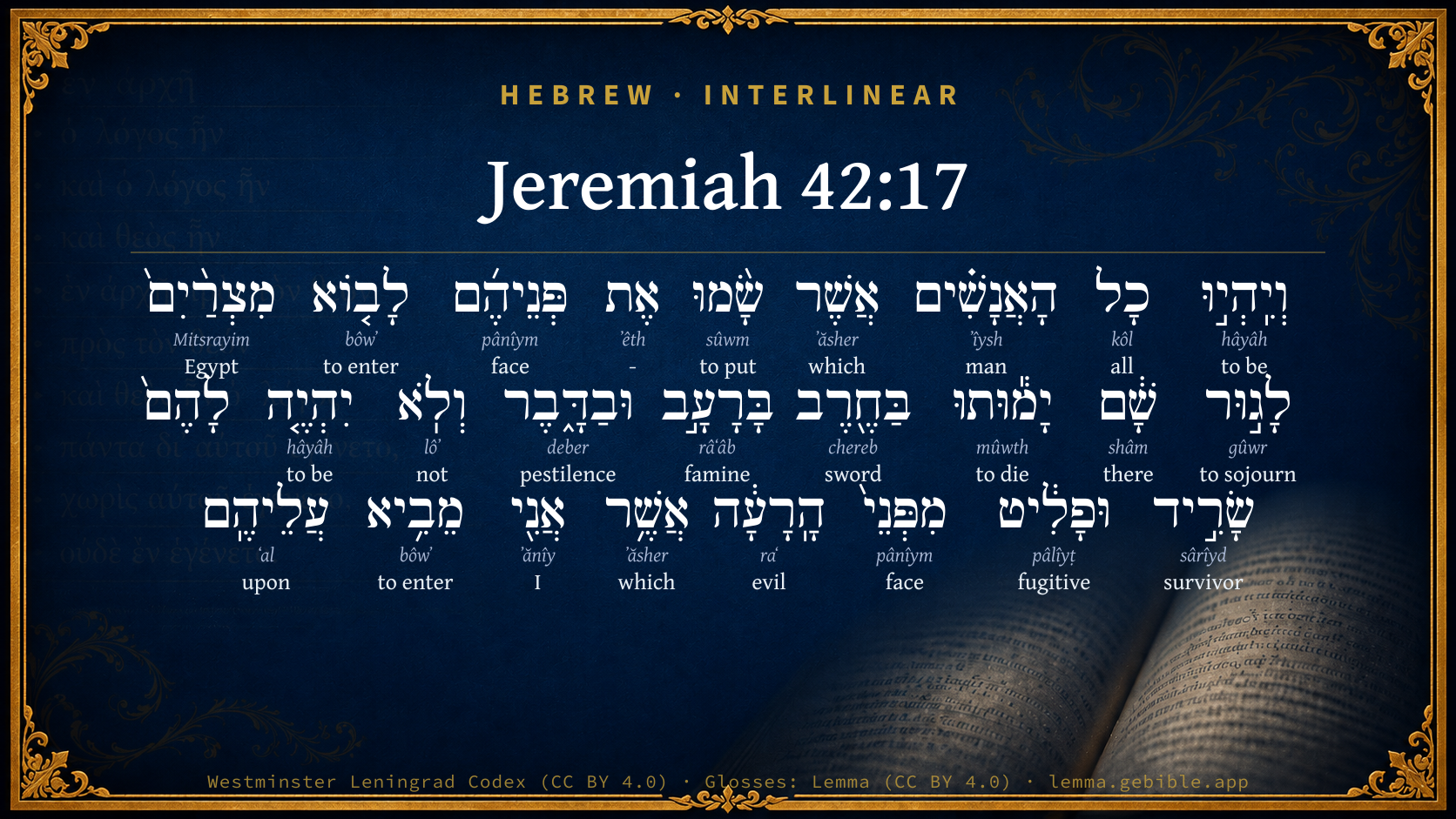
Jeremiah 42:17

Hebrew (Westminster Leningrad Codex) Jeremiah 42:17 appears in the Hebrew Old Testament. The text above is from the Westminster Leningrad Codex. Each word links to its Strong’s number, a concise gloss, and parsing drawn from the Open Scriptures Hebrew Bible morphology. Click any word for its full Brown-Driver-Briggs (BDB) entry.
Download image
Cite this verse

Jeremiah 42:17 (World English Bible). Public Domain. Lemma interlinear Bible study tool, https://lemma.gebible.app/v/jeremiah/42/17.

Show BibTeX & RIS
BibTeX
RIS
English Translation
So shall it be with all the men who set their faces to go into Egypt to sojourn there: they shall die by the sword, by the famine, and by the pestilence; and none of them shall remain or escape from the evil that I will bring on them.
World English Bible · Public Domain
Download a study sheet

One document with this verse’s original text, its word-by-word gloss line, the meaning frame, cross-references with their text, attributed commentary, and full source and license credits — printable, and it pastes into notes with its structure intact.

This verse Autodidact and up

Study sheet (.html) Plain text (.txt)

A passage Seminary Student

Up to 50 verses in one chapter. A passage sheet keeps up to 6 commentary sources and 12 cross-references per verse, in the order this page ranks them, and says so on the sheet whenever that leaves anything out. Ask for a single verse and you get the Autodidact verse sheet above.

Everything on this page stays free to read, with no account — the sheet is a download of what is already on screen, not access to it.

Want to remove ads? Support Godless Engineer
Compare translations 3

The same verse in 3 English versions, stacked beneath the original-language interlinear above. Click any original word for its lexicon entry.

Each is an independent rendering of the whole verse — the interlinear is not word-aligned to these translations.

Highlighted words mark where these versions differ — a whole-verse word diff, not a word-by-word alignment.

  • World English Bible Public Domain
    So shall it be with all the men who set their faces to go into Egypt to sojourn there: they shall die by the sword, by the famine, and by the pestilence; and none of them shall remain or escape from the evil that I will bring on them.
  • King James Version Public Domain
    So shall it be with all the men that set their faces to go into Egypt to sojourn there; they shall die by the sword, by the famine, and by the pestilence: and none of them shall remain or escape from the evil that I will bring upon them.
  • unfoldingWord Literal Text CC BY-SA 4.0
    So it will happen that all the men who set out to go to Egypt to live there will die by sword, famine, or plague. There will be no survivor of them, no one to escape the disaster that I will bring on them.

unfoldingWord Literal Text — © unfoldingWord, licensed CC BY-SA 4.0. Word-aligned USFM3 via Door43 (git.door43.org/unfoldingWord/en_ult).

Versions to compare (up to 4)

3 of 4 selected

Show all 18 translations

Every available English version of this verse, each an independent rendering of the whole verse.

  • World English Bible Public Domain
    So shall it be with all the men who set their faces to go into Egypt to sojourn there: they shall die by the sword, by the famine, and by the pestilence; and none of them shall remain or escape from the evil that I will bring on them.
  • Berean Standard Bible Public Domain
    So all who resolve to go to Egypt to reside there will die by sword and famine and plague. Not one of them will survive or escape the disaster I will bring upon them.’
  • Majority Standard Bible Public Domain
    So all who resolve to go to Egypt to reside there will die by sword and famine and plague. Not one of them will survive or escape the disaster I will bring upon them.’
  • King James Version Public Domain
    So shall it be with all the men that set their faces to go into Egypt to sojourn there; they shall die by the sword, by the famine, and by the pestilence: and none of them shall remain or escape from the evil that I will bring upon them.
  • American Standard Version (1901) Public Domain
    So shall it be with all the men that set their faces to go into Egypt to sojourn there: they shall die by the sword, by the famine, and by the pestilence; and none of them shall remain or escape from the evil that I will bring upon them.
  • Revised Version (1885) Public Domain
    So shall it be with all the men that set their faces to go into Egypt to sojourn there; they shall die by the sword, by the famine, and by the pestilence: and none of them shall remain or escape from the evil that I will bring upon them.
  • Geneva Bible (1599) Public Domain
    And all the men that set their faces to enter into Egypt to dwell there, shall die by ye sword, by the famine and by the pestilence, and none of them shall remaine nor escape from the plague, that I will bring vpon them.
  • Douay-Rheims (1899) Public Domain
    And all the men that set their faces to go into Egypt, to dwell there, shall die by the sword, and by famine, and by pestilence: none of them shall remain, nor escape from the face of the evil that I will bring upon them.
  • Young's Literal Translation Public Domain
    `Thus are all the men who have set their faces to enter Egypt to sojourn there; they die -- by sword, by hunger, and by pestilence, and there is not to them a remnant and an escaped one, because of the evil that I am bringing in upon them;
  • Literal Standard Version CC BY-SA 4.0
    Thus are all the men who have set their faces to enter Egypt to sojourn there; they die—by sword, by hunger, and by pestilence, and there is not a remnant and an escaped one to them, because of the calamity that I am bringing in on them;
  • Unlocked Literal Bible CC BY-SA 4.0
    So it will happen that all the men who set out to go to Egypt to live there will die by sword, famine, or plague. There will be no survivor of them, no one to escape the disaster that I will bring on them.
  • unfoldingWord Literal Text CC BY-SA 4.0
    So it will happen that all the men who set out to go to Egypt to live there will die by sword, famine, or plague. There will be no survivor of them, no one to escape the disaster that I will bring on them.
  • Darby Bible Public Domain
    And it shall be that all the men that have set their faces to go into Egypt to sojourn there shall die by the sword, by the famine, and by the pestilence; and none of them shall remain or escape from the evil that I will bring upon them.
  • World Messianic Bible Public Domain
    So will it be with all the men who set their faces to go into Egypt to live there. They will die by the sword, by the famine, and by the pestilence. None of them will remain or escape from the evil that I will bring on them.’
  • Webster's Bible Public Domain
    So shall it be with all the men that set their faces to go into Egypt to sojourn there; they shall die by the sword, by the famine, and by the pestilence: and none of them shall remain or escape from the evil that I will bring upon them.
  • Free Bible Version CC BY-SA 4.0
    Everyone who decides to go to Egypt and live there will die by war and famine and disease. Not a single one will survive or escape the disaster I will bring down on them.
  • Bible in Basic English Public Domain
    Such will be the fate of all the men whose minds are fixed on going into Egypt and stopping there; they will come to their end by the sword, by being short of food, and by disease: not one of them will keep his life or get away from the evil which I will send on them.
  • JPS Tanakh (1917) Public Domain
    So shall it be with all the men that set their faces to go into Egypt to sojourn there; they shall die by the sword, by the famine, and by the pestilence; and none of them shall remain or escape from the evil that I will bring upon them.

Literal Standard Version (2020), Covenant Press — licensed CC BY-SA 4.0. Text via the HelloAO Bible API (eBible.org). Unlocked Literal Bible (unfoldingWord) — licensed CC BY-SA 4.0. Text via the HelloAO Bible API (eBible.org). unfoldingWord Literal Text — © unfoldingWord, licensed CC BY-SA 4.0. Word-aligned USFM3 via Door43 (git.door43.org/unfoldingWord/en_ult). Free Bible Version, Dr. Jonathan Gallagher — licensed CC BY-SA 4.0. Text via the HelloAO Bible API (eBible.org).

Word by word

More ways to search: Search by grammar → Find every occurrence → Compare this word →

Practice this passage: Drill this verse → Learn its vocabulary →

וּפָלִ֔יט
pâlîyṭ
H6412
“and · fugitive”
Conjunction + Noun, Common, Masculine, Singular, Absolute
Part of Speech
Conjunction + Noun
Type
Common
Gender
Masculine
Number
Singular
State
Absolute
Full BDB Definition

Origin: from H6403

TWOT: 1774b , 1774c

refugee, fugitive, escaped one
  1. וְיִֽהְי֣וּ hâyâh H1961 “and · to be” Conjunction + Verb, Qal, Imperfect, 3rd Person, Masculine, Plural
  2. כָל kôl H3605 “all of” Noun, Common, Masculine, Singular, Construct
  3. הָאֲנָשִׁ֗ים ʼîysh H376 “the · men” Particle, Definite Article + Noun, Common, Masculine, Plural, Absolute
  4. אֲשֶׁר ʼăsher H834 “which” Particle, Relative
  5. שָׂ֨מוּ sûwm H7760 “to put” Verb, Qal, Perfect, 3rd Person, Common, Plural
  6. אֶת ʼêth H853 “-” Particle, Direct Object
  7. פְּנֵיהֶ֜ם pânîym H6440 “face(s) · their” Noun, Common, Both, Plural, Construct + Suffix, Personal, 3rd Person, Masculine, Plural
  8. לָב֤וֹא bôwʼ H935 “to enter” Preposition + Verb, Qal, Infinitive Construct
  9. מִצְרַ֨יִם֙ Mitsrayim H4714 “Egypt” Noun, Proper
  10. לָג֣וּר gûwr H1481 “to sojourn” Preposition + Verb, Qal, Infinitive Construct
  11. שָׁ֔ם shâm H8033 “there” Adverb
  12. יָמ֕וּתוּ mûwth H4191 “to die” Verb, Qal, Imperfect, 3rd Person, Masculine, Plural
  13. בַּחֶ֖רֶב chereb H2719 “in/at the · sword” Preposition, Determined + Noun, Common, Feminine, Singular, Absolute
  14. בָּרָעָ֣ב râʻâb H7458 “in/at the · famine” Preposition, Determined + Noun, Common, Masculine, Singular, Absolute
  15. וּבַדָּ֑בֶר deber H1698 “and · in/at the · pestilence” Conjunction + Preposition, Determined + Noun, Common, Masculine, Singular, Absolute
  16. וְלֹֽא lôʼ H3808 “and · not” Conjunction + Particle, Negative
  17. יִהְיֶ֤ה hâyâh H1961 “to be” Verb, Qal, Imperfect, 3rd Person, Masculine, Singular
  18. שָׂרִ֣יד sârîyd H8300 “survivor” Noun, Common, Masculine, Singular, Absolute
  19. מִפְּנֵי֙ pânîym H6440 “from · face(s) of” Preposition + Noun, Common, Both, Plural, Construct
  20. הָֽרָעָ֔ה raʻ H7451 “the · evil” Particle, Definite Article + Noun, Common, Feminine, Singular, Absolute
  21. אֲשֶׁ֥ר ʼăsher H834 “which” Particle, Relative
  22. אֲנִ֖י ʼănîy H589 “I” Pronoun, Personal, 1st Person, Common, Singular
  23. מֵבִ֥יא bôwʼ H935 “entering” Verb, Hiphil, Participle Active, Masculine, Singular, Absolute
  24. עֲלֵיהֶֽם ʻal H5921 “upon · them” Preposition + Suffix, Personal, 3rd Person, Masculine, Plural

About this verse

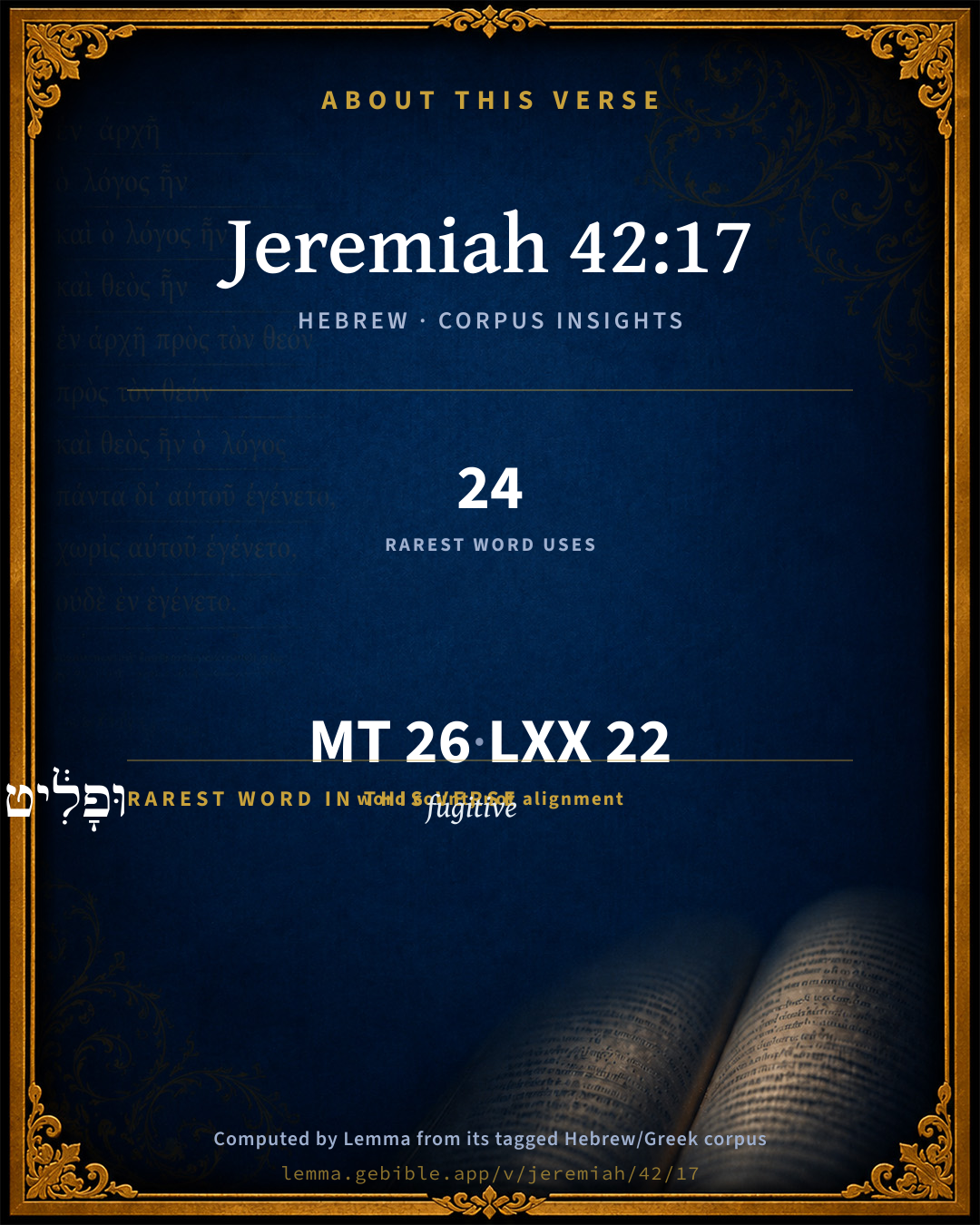
These counts appear in no published source. They are computed here, from the morphology-tagged text and Lemma’s own curated glosses. What Lemma adds →

26
words
21
distinct lemmas
Prophets
section

Notable vocabulary

The rarest word here is וּפָלִ֔יט fugitive H6412 — appearing just 24 times in the whole Hebrew Bible.

Shared distinctive vocabulary

וּפָלִ֔יט fugitive H6412 occurs in 23 verses of the Hebrew Bible. Also found in:

Grammatical profile

  • 7 verbs
  • 11 nouns
  • 1 pronoun
  • 2 prepositions
  • 1 adverb
  • 4 particles

Verb forms

  • וְיִֽהְי֣וּ Qal · Imperfect
  • שָׂ֨מוּ Qal · Perfect
  • לָב֤וֹא Qal · Infinitive Construct
  • לָג֣וּר Qal · Infinitive Construct
  • יָמ֕וּתוּ Qal · Imperfect
  • יִהְיֶ֤ה Qal · Imperfect
  • מֵבִ֥יא Hiphil · Participle Active

Repetition

Words recur within this verse — often emphatic in Hebrew:

  • וְיִֽהְי֣וּ to be H1961 ×2
  • פְּנֵיהֶ֜ם face H6440 ×2
  • לָב֤וֹא to enter H935 ×2
  • אֲשֶׁר which H834 ×2

Hebrew & Septuagint length

In the original languages it is 26 Hebrew tokens and 22 Greek tokens — but the two are counted differently (Hebrew bundles its prefixes and suffixes into one token; the Greek is in lemma form), so that isn’t a like-for-like length.

Cross-references

4

Topical passages linked to Jeremiah 42:17 in the Treasury of Scripture Knowledge — connected by theme and wording, ordered by reader-vote popularity; previews shown in the World English Bible.

  • Jeremiah 42:22 Now therefore know certainly that you shall die by the sword, by the famine, and by the pestilence, in the place where you desire to go to sojourn there.
  • Jeremiah 24:10 I will send the sword, the famine, and the pestilence, among them, until they be consumed from off the land that I gave to them and to their fathers.
  • Jeremiah 44:13–14 For I will punish those who dwell in the land of Egypt, as I have punished Jerusalem, by the sword, by the famine, and by the pestilence;
  • Jeremiah 44:28 Those who escape the sword shall return out of the land of Egypt into the land of Judah, few in number; and all the remnant of Judah, who have gone into the land of Egypt to sojourn there, shall know whose word shall stand, mine, or theirs.

Cross-references courtesy of OpenBible.info (CC BY 4.0).

Hebrew and Greek witnesses Masoretic Hebrew ↔ Greek Septuagint

The same verse in the two great witnesses to the Old Testament, shown verse-for-verse.

These are two independent witnesses, not word-aligned to each other, and the Septuagint is shown in lemma (dictionary) form.

Hebrew Jeremiah 42:17 Masoretic · Westminster Leningrad Codex

וְיִֽהְי֣וּ כָל הָאֲנָשִׁ֗ים אֲשֶׁר שָׂ֨מוּ אֶת פְּנֵיהֶ֜ם לָב֤וֹא מִצְרַ֨יִם֙ לָג֣וּר שָׁ֔ם יָמ֕וּתוּ בַּחֶ֖רֶב בָּרָעָ֣ב וּבַדָּ֑בֶר וְלֹֽא יִהְיֶ֤ה לָהֶם֙ שָׂרִ֣יד וּפָלִ֔יט מִפְּנֵי֙ הָֽרָעָ֔ה אֲשֶׁ֥ר אֲנִ֖י מֵבִ֥יא עֲלֵיהֶֽם

So shall it be with all the men who set their faces to go into Egypt to sojourn there: they shall die by the sword, by the famine, and by the pestilence; and none of them shall remain or escape from the evil that I will bring on them.

World English Bible · Public Domain

Greek LXX Structure differs

In the Septuagint, Jeremiah is about an eighth shorter than the Hebrew and arranges its material differently — the Oracles Against the Nations (Hebrew chapters 46–51) appear in the middle of the Greek book, after 25:13. Because the chapter and verse boundaries do not line up, a verse-for-verse comparison with the Hebrew is not shown.

A verse-for-verse comparison isn’t shown here because the chapters and verses don’t line up. Switch to the LXX edition with the MT / LXX toggle above to read the Greek directly.

Hebrew: Westminster Leningrad Codex (CC BY 4.0). Greek: Septuagint (public domain); English from a public-domain English Septuagint. How the Septuagint differs from the Hebrew →

Targum (Aramaic paraphrase)

1

The Targum is the ancient Jewish Aramaic paraphrase of the Hebrew Scriptures — an interpretive translation, not the Hebrew text itself. Onkelos (literal) and Pseudo-Jonathan (expansive) render the Torah, and Jonathan the Prophets. Coverage is partial: where no permissively-licensed English translation exists for a verse, only the Aramaic is shown. This is verse-level text, not a word-by-word alignment to the Hebrew.

  1. Targum Jonathan Prophets (Joshua–Malachi)
    וַהֲווֹ כָּל גַבְרַיָא דְשַׁוִיאוּ יַת אַפֵּיהוֹן לְמֵיעַל לְמִצְרַיִם לְאַתּוֹתָבָא תַמָן יִתְקַטְלוּן בְּחַרְבָּא בְּכַפְנָא וּבְמוֹתָא וְלָא יְהֵי לְהוֹן שְׁאָר וּמְשֵׁיזֵיב מִן קֳדָם בִּישָׁתָא דִי אֲנָא מַייְתֵי עֲלֵיהוֹן:

    (no public-domain English translation for this verse)

    Targum Jonathan — Aramaic: “Mikraot Gedolot” (public domain). English: “Sefaria Community Translation” (CC0 1.0 (public-domain dedication)); “London "Chaldee Paraphrase," 1871” (public domain). Text via Sefaria.

Commentary

Notes on Jeremiah 42:17 from classic Christian and Jewish commentators (each source and its license shown beneath its notes). The classic Christian expositions comment on the surrounding passage and are grouped to its opening verse, so a note may address several verses; the Jewish commentaries on the Tanakh (Rashi and others) are per-verse, so they appear only where the commentator wrote on this verse.

Lemma curates 59 commentaries, every one of them public domain or Creative Commons licensed, each selected and text-cleaned for this edition rather than reprinted as found. About our sources →

Trapp's Complete Commentary

John Trapp

Jer 42:17 So shall it be with all the men that set their faces to go into Egypt to sojourn there; they shall die by the sword, by the famine, and by the pestilence: and none of them shall remain or escape from the evil that I will bring upon them.

Ver. 17. They shall die by the sword, by the famine, and by the pestilence.] Three threats, answerable to those three promises, {Jer 42:10-12} in case of their obedience.

John Trapp, A Commentary or Exposition upon All the Books of the Old and New Testament (1647–1656) — public domain. Text from a community e-Sword module.

Jamieson, Fausset & Brown

Robert Jamieson, A. R. Fausset & David Brown

all the men--excepting the "small number" mentioned (Jer 44:14, Jer 44:28); namely, those who were forced into Egypt against their will, Jeremiah, Baruch, &c., and those who took Jeremiah's advice and fled from Egypt before the arrival of the Chaldeans.

Jamieson, Fausset & Brown — Commentary Critical and Explanatory on the Whole Bible (1871) — public domain (CC PDM 1.0). Text via the HelloAO Bible API.

Ellicott's Commentary for English Readers

(17) So shall it be with all the men . . .—The words possibly imply that others were taking the same course as those who had applied to Jeremiah. There was something like a “rush” from many nations—Moab, Edom, and others (Jer_27:3)—of fugitives, looking to Egypt as their one hope of safety against the Chaldæans, and joining with the Jews that had sought shelter in their respective territories (Jer_40:11). We note in the prophet’s warning the recurrence of the old familiar phrases, “by the sword, by the famine, by the pestilence” (Jer_24:10; Eze_6:11), of an “execration and an astonishment and a curse and a reproach” (Jer_24:9; Jer_26:6; Jer_29:18). They would involve themselves by rejecting his counsels in all the worst evils that he had prophesied before. What had been addressed to the mixed multitude is emphatically repeated in Jer_42:19 to the “remnant of Judah.”

A Bible Commentary for English Readers, edited by Charles John Ellicott (1878–1897) — public domain. Text from a community e-Sword module.

John Gill's Exposition

For thus saith the Lord of hosts, the God of Israel,.... See Gill on Jer 42:15;

as mine anger and my fury hath been poured forth upon the inhabitants of Jerusalem; like a large hasty shower of rain; or rather like melted metal, which suddenly and swiftly runs, and spreads itself, and burns and consumes with a violent heat; such was the wrath of God on Jerusalem, in the destruction of it by the Chaldeans:

so shall my fury be poured forth upon you, when ye shall enter into Egypt; as soon as they had well got there, quickly after they were settled there; for it was in the time of the then present king of Egypt, Pharaohhophra, and by the then present king of Babylon, Nebuchadnezzar, that the destruction of Egypt was, in which these Jews suffered:

and ye shall be an execration, and an astonishment, and a curse, and a reproach; men should be astonished at the hand of God upon them, reproach them for their sins; and when they made any imprecation on themselves, it would be in this form, if it be so, let the same calamities come upon me as upon the Jews in Egypt:

and ye shall see this place no more; and so their case would be worse than their brethren in Babylon; who, after a term of years were expired, would return to their own land, which these would never see any more.

John Gill's Exposition of the Whole Bible (1746–1763) — public domain (CC PDM 1.0). Text via the HelloAO Bible API.

Haydock's Catholic Bible Commentary

CHAPTER XLII.

George Leo Haydock (1774–1849), Haydock's Catholic Family Bible and Commentary, 1859 edition — public domain. Excludes Psalms (Douay-Rheims chapter numbering differs from Protestant) and Deuterocanonical books (Catholic canon only).

Matthew Poole's English Annotations

Those words,

that set their faces to go, may reasonably be interpreted as a limitation of the universal particle all; for as eventually we can hardly conceive that every individual person that went into Egypt did thus perish, so it can hardly be thought that the just God should order an equal punishment to those who were the ringleaders in this design, and those who were forced or overruled by them, or perhaps knew not how to live when the rest were gone. But, saith God, for those who drive on this design, and go with their whole heart resolvedly against the contrary revelation of my will, there shall none of them escape one or other of my sore judgments, sword, pestilence, or famine; they shall not be the lot of one or two, but of all such persons.

Matthew Poole's English Annotations on the Holy Bible (1683–1685) — public domain. Text from a community e-Sword/MySword module.

Whedon's Commentary on the Bible

Daniel D. Whedon

17. All the men — This universal expression is not to be pressed with mathematical exactness. The fact that some loyal and obedient men, like Jeremiah and Baruch, were carried to Egypt and afterward escaped does not stand against this passage. See Jer_44:28 : “Yet a small number… shall return out of the land of Egypt.”

Daniel D. Whedon (gen. ed.), Commentary on the Old and New Testaments (1874–1909) — public domain. Text from a community e-Sword module.

Keil & Delitzsch

C. F. Keil & F. Delitzsch

ויהיוּ, used instead of the impersonal והיה, is referred to the following subject by a rather unusual kind of attraction; cf. Ewald, 345, b. All the men who set their faces, i.e., intend, to go to Egypt shall perish; not a single one shall escape the evil; for the same judgment of wrath which has befallen Jerusalem shall also come on those who flee to Egypt; cf. Jer 7:20. On the expression "ye shall become a curse," etc., cf. Jer 24:9; Jer 25:18; Jer 29:18.

Taking for granted that the leaders of the people will not obey, Jeremiah appends to the word of the Lord an earnest address, in which several points are specially insisted on, viz., that the Lord had spoken to them, that He had forbidden them to go to Egypt, and that he (the prophet), by proclaiming the word of the Lord, had warned them (העיד בּ, to testify, bear witness against a person, i.e., warn him of something, cf. Jer 11:7). Thus he discloses to them the dangerous mistake they are in, when they first desire some expression of the mind of the Lord regarding their intentions, and, in the hope that He will accede to their request, promise unconditional obedience to whatever He may direct, but afterwards, when they have received a message from the Lord, will not obey it, because it is contrary to what they wish. The Kethib התעתים has been incorrectly written for התעיים, the Hiphil from תּעה, to err; here, as in Pro 10:17, it means to make a mistake. בּנפשׁותיכם, not, "you mislead your own selves," decepistis animas vestras (Vulg.), nor "in your souls," - meaning, in your thoughts and intentions (Ngelsbach), - but "at the risk of your souls," your life; cf. Jer 17:21. וּלכל אשׁר (Jer 42:21), "and that in regard to all that for which Jahveh has sent me to you," points back to their promise, Jer 42:5, that they would do "according to all the word." By employing the perfect in Jer 42:20, Jer 42:21, the thing is represented as quite certain, as if it had already taken place. Jer 42:22 concludes the warning with a renewed threat of the destruction which shall befall them for their disobedience.

Keil & Delitzsch — Biblical Commentary on the Old Testament (1861–1891) — public domain (CC PDM 1.0). Text via the HelloAO Bible API. (Old Testament only.)

Lesson kit

Teaching starters — assembled from the data on this page, not authored interpretation. Every prompt links to the verse data it draws on. Edit before teaching.

Jeremiah, in the Prophets, opens this verse with 26 words (21 distinct Hebrew lemmas). Its most distinctive word is pâlîyṭ (“fugitive”). A historical commentator’s framing appears above. Read the whole chapter for the surrounding context.

Discussion questions

  1. The word pâlîyṭ carries the sense “fugitive.” How does it shape the verse?
  2. How does Genesis 14:13, which shares the word «fugitive», read alongside this verse?
  3. What does the repetition of “to be” (2× in this one verse) do in this verse?
  4. The translations on this page render this verse differently — a whole-verse word diff, not a word-by-word alignment. What might account for the different wordings?
  5. «וְיִֽהְי֣וּ» is a Qal Imperfect verb. How does that grammatical form shape the action described?
  6. Compare how Trapp's Complete Commentary and Jamieson, Fausset & Brown read this verse. Where do they agree or differ?

Things to notice

Reading settings

Reading text

Shown beneath each verse's original-language words.

Old Testament
Old Testament edition

Read the OT as the Masoretic Hebrew (MT) or the Greek Septuagint (LXX).

English shown for the Greek Septuagint (in the Hebrew ↔ Greek comparison).

Comparing translations? Open the Compare panel on any verse page to stack up to four side by side.