
Hosea 12:13

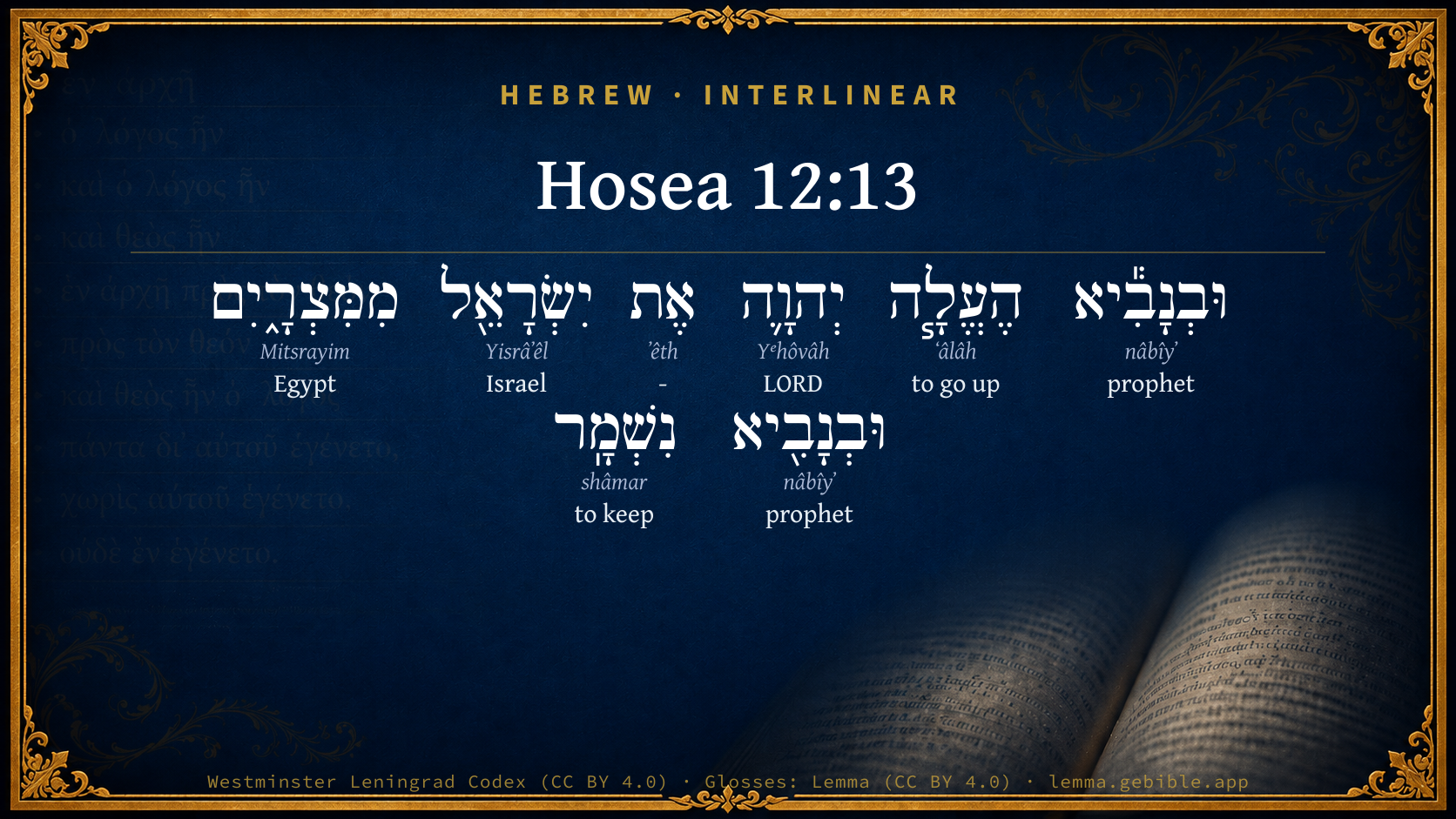
Hebrew (Westminster Leningrad Codex) Hosea 12:13 appears in the Hebrew Old Testament. The text above is from the Westminster Leningrad Codex. Each word links to its Strong’s number, a concise gloss, and parsing drawn from the Open Scriptures Hebrew Bible morphology. Click any word for its full Brown-Driver-Briggs (BDB) entry.
Download image
Cite this verse

Hosea 12:13 (World English Bible). Public Domain. Lemma interlinear Bible study tool, https://lemma.gebible.app/v/hosea/12/13.

Show BibTeX & RIS
BibTeX
RIS
English Translation
By a prophet Yahweh brought Israel up out of Egypt, And by a prophet he was preserved.
World English Bible · Public Domain
Download a study sheet

One document with this verse’s original text, its word-by-word gloss line, the meaning frame, cross-references with their text, attributed commentary, and full source and license credits — printable, and it pastes into notes with its structure intact.

This verse Autodidact and up

Study sheet (.html) Plain text (.txt)

A passage Seminary Student

Up to 50 verses in one chapter. A passage sheet keeps up to 6 commentary sources and 12 cross-references per verse, in the order this page ranks them, and says so on the sheet whenever that leaves anything out. Ask for a single verse and you get the Autodidact verse sheet above.

Everything on this page stays free to read, with no account — the sheet is a download of what is already on screen, not access to it.

Want to remove ads? Support Godless Engineer
Compare translations 3

The same verse in 3 English versions, stacked beneath the original-language interlinear above. Click any original word for its lexicon entry.

Each is an independent rendering of the whole verse — the interlinear is not word-aligned to these translations.

Highlighted words mark where these versions differ — a whole-verse word diff, not a word-by-word alignment.

  • World English Bible Public Domain
    By a prophet Yahweh brought Israel up out of Egypt, And by a prophet he was preserved.
  • King James Version Public Domain
    And by a prophet the LORD brought Israel out of Egypt, and by a prophet was he preserved.
  • unfoldingWord Literal Text CC BY-SA 4.0
    And by a prophet Yahweh brought Israel up from Egypt, and by a prophet he was kept.

unfoldingWord Literal Text — © unfoldingWord, licensed CC BY-SA 4.0. Word-aligned USFM3 via Door43 (git.door43.org/unfoldingWord/en_ult).

Versions to compare (up to 4)

3 of 4 selected

Show all 18 translations

Every available English version of this verse, each an independent rendering of the whole verse.

  • World English Bible Public Domain
    By a prophet Yahweh brought Israel up out of Egypt, And by a prophet he was preserved.
  • Berean Standard Bible Public Domain
    But by a prophet the LORD brought Israel out of Egypt, and by a prophet he was preserved.
  • Majority Standard Bible Public Domain
    But by a prophet the LORD brought Israel out of Egypt, and by a prophet he was preserved.
  • King James Version Public Domain
    And by a prophet the LORD brought Israel out of Egypt, and by a prophet was he preserved.
  • American Standard Version (1901) Public Domain
    And by a prophet Jehovah brought Israel up out of Egypt, and by a prophet was he preserved.
  • Revised Version (1885) Public Domain
    And by a prophet the LORD brought Israel up out of Egypt, and by a prophet was he preserved.
  • Geneva Bible (1599) Public Domain
    And by a Prophet the Lord brought Israel out of Egypt, and by a Prophet was he reserued.
  • Douay-Rheims (1899) Public Domain
    But the Lord by a prophet brought Israel out of Egypt: and he was pre- served by a prophet.
  • Young's Literal Translation Public Domain
    And by a prophet hath Jehovah brought up Israel out of Egypt, And by a prophet it hath been watched.
  • Literal Standard Version CC BY-SA 4.0
    And by a prophet has YHWH brought up Israel out of Egypt, || And by a prophet it has been watched.
  • Unlocked Literal Bible CC BY-SA 4.0
    Yahweh brought Israel out of Egypt by a prophet, and by a prophet he took care of them.
  • unfoldingWord Literal Text CC BY-SA 4.0
    And by a prophet Yahweh brought Israel up from Egypt, and by a prophet he was kept.
  • Darby Bible Public Domain
    And by a prophet Jehovah brought Israel out of Egypt, and by a prophet was he preserved.
  • World Messianic Bible Public Domain
    By a prophet the LORD brought Israel up out of Egypt, and by a prophet he was preserved.
  • Webster's Bible Public Domain
    \\12:12\\And Jacob fled into the country of Syria, and Israel served for a wife, and for a wife he kept sheep.
  • Free Bible Version CC BY-SA 4.0
    Through a prophet the Lord brought Israel up from Egypt, and by a prophet they were cared for.
  • Bible in Basic English Public Domain
    And Jacob went in flight into the field of Aram, and Israel became a servant for a wife, and for a wife he kept sheep.
  • JPS Tanakh (1917) Public Domain
    (12-14) And by a prophet the LORD brought Israel up out of Egypt, and by a prophet was he kept.

Literal Standard Version (2020), Covenant Press — licensed CC BY-SA 4.0. Text via the HelloAO Bible API (eBible.org). Unlocked Literal Bible (unfoldingWord) — licensed CC BY-SA 4.0. Text via the HelloAO Bible API (eBible.org). unfoldingWord Literal Text — © unfoldingWord, licensed CC BY-SA 4.0. Word-aligned USFM3 via Door43 (git.door43.org/unfoldingWord/en_ult). Free Bible Version, Dr. Jonathan Gallagher — licensed CC BY-SA 4.0. Text via the HelloAO Bible API (eBible.org).

Word by word

More ways to search: Search by grammar → Find every occurrence → Compare this word →

Practice this passage: Drill this verse → Learn its vocabulary →

About this verse

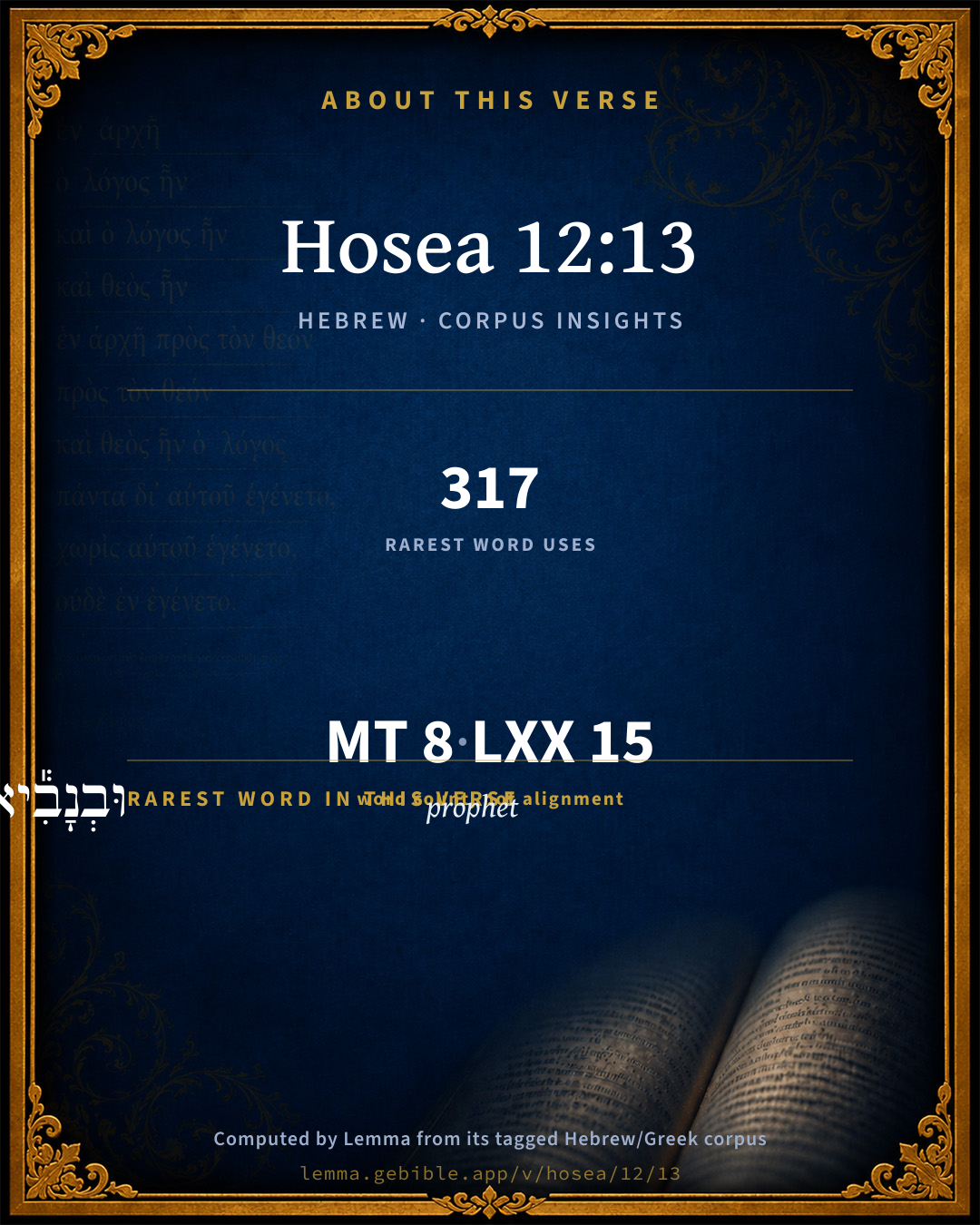
These counts appear in no published source. They are computed here, from the morphology-tagged text and Lemma’s own curated glosses. What Lemma adds →

8
words
7
distinct lemmas
Prophets
section

Grammatical profile

  • 2 verbs
  • 5 nouns
  • 1 particle

Verb forms

  • הֶעֱלָ֧ה Hiphil · Perfect
  • נִשְׁמָֽר Niphal · Perfect

Repetition

A word recurs within this verse — often emphatic in Hebrew:

  • וּבְנָבִ֕יא prophet H5030 ×2

Hebrew & Septuagint length

In English translation the verse runs 17 words from the Hebrew and 21 from the Septuagint (LXX English) — closely comparable.

A rough comparison of the two English renderings, which tokenize alike — not a word-level alignment.

Word counts can differ between the Hebrew and the Greek without any difference in meaning — e.g. the Hebrew direct-object marker אֵת has no separate Greek word, and Greek often adds the article ὁ.

In the original languages it is 8 Hebrew tokens and 15 Greek tokens — but the two are counted differently (Hebrew bundles its prefixes and suffixes into one token; the Greek is in lemma form), so that isn’t a like-for-like length.

Cross-references

10

Topical passages linked to Hosea 12:13 in the Treasury of Scripture Knowledge — connected by theme and wording, ordered by reader-vote popularity; previews shown in the World English Bible.

  • Acts 3:22–23 For Moses indeed said to the fathers, 'The Lord God will raise up a prophet for you from among your brothers, like me. You shall listen to him in all things whatever he says to you.
  • Exodus 12:50–51 Thus did all the children of Israel. As Yahweh commanded Moses and Aaron, so they did.
  • Psalms 77:20 You led your people like a flock, By the hand of Moses and Aaron.
  • Isaiah 63:11–14 Then he remembered the days of old, Moses [and] his people, [saying], Where is he who brought them up out of the sea with the shepherds of his flock? where is he who put his holy Spirit in the midst of them?
  • Acts 7:35–37 "This Moses, whom they refused, saying, 'Who made you a ruler and a judge?'--God has sent him as both a ruler and a deliverer by the hand of the angel who appeared to him in the bush.
  • Exodus 13:3 Moses said to the people, "Remember this day, in which you came out from Egypt, out of the house of bondage; for by strength of hand Yahweh brought you out from this place. No leavened bread shall be eaten.
  • Amos 2:11–12 I raised up some of your sons for prophets, And some of your young men for Nazirites. Isn't this true, You children of Israel?" says Yahweh.
  • Micah 6:4 For I brought you up out of the land of Egypt, And redeemed you out of the house of bondage. I sent before you Moses, Aaron, and Miriam.
  • 1 Samuel 12:8 When Jacob was come into Egypt, and your fathers cried to Yahweh, then Yahweh sent Moses and Aaron, who brought forth your fathers out of Egypt, and made them to dwell in this place.
  • Hosea 13:4–5 "Yet I am Yahweh your God from the land of Egypt; And you will know no god but me, And besides me there is no savior.

Cross-references courtesy of OpenBible.info (CC BY 4.0).

Hebrew and Greek witnesses Masoretic Hebrew ↔ Greek Septuagint

The same verse in the two great witnesses to the Old Testament, shown verse-for-verse.

These are two independent witnesses, not word-aligned to each other, and the Septuagint is shown in lemma (dictionary) form.

Hebrew Hosea 12:13 Masoretic · Westminster Leningrad Codex

וּבְנָבִ֕יא הֶעֱלָ֧ה יְהוָ֛ה אֶת יִשְׂרָאֵ֖ל מִמִּצְרָ֑יִם וּבְנָבִ֖יא נִשְׁמָֽר

By a prophet Yahweh brought Israel up out of Egypt, And by a prophet he was preserved.

World English Bible · Public Domain

Greek LXX Hosea 12:13 Septuagint · lemma form

καί ἀναχωρέω ἰακώβ εἰς πεδίον συρία καί δουλεύω ἰσραήλ ἐν γυνή καί ἐν γυνή φυλάσσω

And the Lord brought Israel out of the land of Egypt by a prophet, and by a prophet was he preserve.

LXX2012 (modern English Septuagint) · Public Domain

Hebrew: Westminster Leningrad Codex (CC BY 4.0). Greek: Septuagint (public domain); English from LXX2012 (modern English Septuagint) (Public Domain). How the Septuagint differs from the Hebrew →

Targum (Aramaic paraphrase)

1

The Targum is the ancient Jewish Aramaic paraphrase of the Hebrew Scriptures — an interpretive translation, not the Hebrew text itself. Onkelos (literal) and Pseudo-Jonathan (expansive) render the Torah, and Jonathan the Prophets. Coverage is partial: where no permissively-licensed English translation exists for a verse, only the Aramaic is shown. This is verse-level text, not a word-by-word alignment to the Hebrew.

  1. Targum Jonathan Prophets (Joshua–Malachi)
    נְבִיָא אֲמַר לְהוֹן הֲלָא יַעֲקֹב אֲבוּכוֹן אֲזַל לְחַקְלֵי אֲרַם וּפְלַח יִשְׂרָאֵל בְּאִתְּתָא וּבְאִתְּתָא נְטַר עָנָא:

    (no public-domain English translation for this verse)

    Targum Jonathan — Aramaic: “Mikraot Gedolot” (public domain). English: “Sefaria Community Translation” (CC0 1.0 (public-domain dedication)); “London "Chaldee Paraphrase," 1871” (public domain). Text via Sefaria.

Commentary

Notes on Hosea 12:13 from classic Christian and Jewish commentators (each source and its license shown beneath its notes). The classic Christian expositions comment on the surrounding passage and are grouped to its opening verse, so a note may address several verses; the Jewish commentaries on the Tanakh (Rashi and others) are per-verse, so they appear only where the commentator wrote on this verse.

Lemma curates 59 commentaries, every one of them public domain or Creative Commons licensed, each selected and text-cleaned for this edition rather than reprinted as found. About our sources →

The Cambridge Bible for Schools and Colleges

gen. ed. J. J. S. Perowne

13. by a prophet] i.e. Moses (comp. Deu_34:10). Hosea contrasts the helplessness and the hardships of Jacob-Israel with the wonderful deliverance and preservation of his descendants. Comp. Isa_51:2, ‘I called him alone, and blessed him, and increased him.’ Note the double use of the term Israel in Hos_12:12 and Hos_12:13.

The Cambridge Bible for Schools and Colleges (gen. ed. J. J. S. Perowne; Cambridge University Press, 1878–1918) — public domain. Text from a community e-Sword module.

Trapp's Complete Commentary

John Trapp

Hos 12:13 And by a prophet the LORD brought Israel out of Egypt, and by a prophet was he preserved.

Ver. 13. And by a prophet the Lord brought Israel out of Egypt] That is, Gilead served as a sanctuary unto Jacob, when he fled from Laban. In Gilgal also God by Joshua renewed his covenant with your fathers, after he had brought them out of Egypt, by the hand of Moses and Aaron. A horrible thing therefore it is, if well considered, that these two places should now be so impured with idolatry, and become the nurseries of evil, which heretofore were the means of so great comfort to God’s people. Thus Junius, Polanus, and others. A witty interpretation, but somewhat forced. By Moses, that prophet, by an excellency; as Aristotle is called the philosopher, Cicero the orator, Paul the apostle, Calvin the most learned interpreter, &c. Moses was a famous prophet indeed, and a type of Christ. Confer Deu 18:15; Deu 18:18; Deu 34:10-12 Act 3:22; Act 7:35-38. Theodoret calleth him the great ocean of divinity, τον της θεολογαις Wκεανον. Bellarmine, God’s special favourite, than whom antiquity had nihil sapientius, sanctius, mitius, none more wise, meek, and holy; indeed, titles of honour are not worthy of him. Howbeit he was but a mean man at first; Exo 4:20, "He took his wife and his son and set them upon an ass"; that was the best and the only beast that he had, for aught we read. It was not very likely that so poor a prophet should do so great a deed. But God loves to help his people with a little help, Dan 11:34, that through weaker means his greater strength may appear. His end here may seem to be the same as before, in setting forth Jacob’s meanness, to take down the haughtiness of the people, proud of their founders and forefathers. A prophet he is purposely called, and his name concealed: 1. To show that the work was done not by might nor by power, but by God’s Spirit, Zec 4:6 2. To show what God will do for his people by the prayers and for the sake of his prophets, when they are most shiftless and hopeless; 3. To let this unworthy people see how much God had done for them once by a prophet, how little soever now they set by such. This is Cyrus’ observation.

John Trapp, A Commentary or Exposition upon All the Books of the Old and New Testament (1647–1656) — public domain. Text from a community e-Sword module.

Tyndale Open Study Notes

Tyndale Open Resources

12:13 by a prophet: Moses’ faithful obedience to God contrasts with Israel’s disobedience.

Tyndale Open Study Notes — © Tyndale Open Resources, licensed CC BY-SA 4.0. Text via the HelloAO Bible API.

Geneva Bible (1599)

Geneva Bible translators

Meaning, Moses, whereby appeareth, that whatsoever they have, it cometh of God’s free goodness.

Geneva Bible (1599) marginal notes — public domain. Text via Bolls.life.

Jamieson, Fausset & Brown

Robert Jamieson, A. R. Fausset & David Brown

by a prophet--Moses (Num 12:6-8; Deu 18:15, Deu 18:18).

preserved--Translate, "kept"; there is an allusion to the same Hebrew word in Hos 12:12, "kept sheep"; Israel was kept by God as His flock, even as Jacob kept sheep (Psa 80:1; Isa 63:11).

Jamieson, Fausset & Brown — Commentary Critical and Explanatory on the Whole Bible (1871) — public domain (CC PDM 1.0). Text via the HelloAO Bible API.

Adam Clarke's Commentary

Verse 13. By a prophet (Moses) the Lord brought Israel out of Egypt, and by a prophet (Joshua) was he preserved.] Joshua succeeded Moses, and brought the Israelites into the promised land; and when they passed the Jordan at Gilgal, he received the covenant of circumcision; and yet this same place was now made by them the seat of idolatry! How blind and how ungrateful!

Adam Clarke's Commentary on the Bible (1810–1826) — public domain. Text from a community e-Sword/MySword module.

John Calvin's Commentaries

And God, he says, brought you up by a Prophet from Egypt, and by a Prophet you have been preserved This was, as it were, their second nativity. Some think that the comparison is between their first origin and their deliverance; as though Hosea had said, “Though you were born of a very poor and ignoble man, yet God has favoured you with singular privilege; for he gave Moses to be the minister of your liberation.” But in my judgement the Prophet speaks in a more simple way; for, first, he shows what was the first origin of the people, that they were from Jacob; and then he shows what was their second origin; for God had again begotten them when he brought them out of Egypt. And they were there, as it is well known, very miserable, and they did not come out by their own valour, they did not attain for themselves their liberty; but Moses alone extended his hand to them, having been sent for this end by God. Since the case was so, it was strange that they now provoked God, as he says in the last verse, by their altars.

And it very frequently occurs in the Prophets, that God reminds the Israelites whence or from what source they had arisen, “Look to your origin, to the stone from which ye were cut off; for Abraham was alone and childless, and his wife also was barren;” and yet God multiplied their race, (Isaiah 51:2.) This was said, because the Israelites did not look to God, but in their adversity despaired, when no way appeared by which they could be restored; but in their prosperity they became proud, and regarded as nothing the favour of God. We then see what the Prophet had in view. The Lord says, “Acknowledge what you owe to me; for I have chosen Jacob your father, and have not chosen him because he was eminent for his great dignity in the world; for he was a fugitive and a keeper of sheep, and served for his wife. I afterwards redeemed you from the land of Egypt; and in that coming forth there was nothing that you did; there is no reason why you should boast that liberation was obtained by your velour; for Moses alone was my servant in that deliverance. I did then beget you the second time, when I redeemed you. How great is your ingratitude, when you do not own and worship me as your Redeemer?” We now then see that the Prophet thus treated the people of Israel, that it might in every way appear that they were unworthy of so many and so great benefits bestowed on them by God; for they had perverted all the works of God, and so perverted them, that they did not think that any thing, belonged to him, and they returned no thanks to God; nay, they extolled themselves, as if God had never conferred on them any kindness.

But I will not dwell on the history of Jacob, for it is not necessary for elucidating the meaning of the Prophet, and it is well known: it is enough to refer only to what is suitable to this place. Jacob then fled into the country of Syria; and then he says, Israel served for a wife He mentions the name, Israel, after Jacob. The name, Israel, was noble and memorable; yea, it was given by God to the holy patriarch: but at the same time Jacob did not in himself or in his own person excel; he nevertheless served, and was in a most humble condition, and he served for a wife; that is, that he might have a wife; for we know how he made an agreement with his uncle Laban.

Further, By a Prophet he brought them out of Egypt This was their second nativity: and by a Prophet Israel was preserved There is an allusion here to the word שמר, shimer; for I take the word נשמר, nushimer, passively. He had said before that Jacob kept sheep; and he says now, נשמר, nushimer, kept was Israel by a Prophet; as though he said, “Ye now see that God has given you a reason for humility in your father, since he was suffered to be so miserably distressed; and shen he preserved you beyond the hope of men, and by no human means except by Moses, who was also a fugitives and who came forth as from a cave, for he was also a keeper of sheep. Since, then, ye have been thus kept by the favour of God, how comes it that your present condition fascinates you, and that ye consider not that you were once redeemed by the Lord for this end, that ye might be wholly devoted to him forever?” Now he adds — (I will also run over this verse, for there will be no lecture to-morrow, nor the day after) —

John Calvin's Commentaries (1540-1563) — public domain. Text from the Calvin Translation Society English edition (1840s-50s) via the Christian Classics Ethereal Library (ccel.org). Calvin's coverage is partial (roughly two-thirds of the Bible); uncommented books and verses are honest gaps, never fabricated. The 19th-century editor's footnotes and remarks are omitted so the notes are faithfully Calvin's own voice.

Ellicott's Commentary for English Readers

(13) A prophet.—Moses is here referred to, and there is, perhaps, a hint that the Lord would yet again save Israel from worse than Egyptian bondage by the words and warnings of a prophet.

A Bible Commentary for English Readers, edited by Charles John Ellicott (1878–1897) — public domain. Text from a community e-Sword module.

John Gill's Exposition

And by a prophet the Lord brought Israel out of Egypt,.... Or, "by the prophet"; the famous and most excellent prophet Moses, who, by way of eminency, is so called; him the Lord sent, and employed, and made use of him as an instrument to bring his people out of their bondage in Egypt; in which he was a type of Christ the great Prophet of the church, raised up like unto him, and the Redeemer of his people from sin, Satan, and the world, law, hell, and death, and all enemies:

and by a prophet he was preserved; by the same prophet Moses was Israel preserved at the Red sea, and in the wilderness; where they were kept as a flock of sheep from their powerful enemies, and brought to the borders of Canaan's land. Some understand this last clause of Joshua, by whom the Israelites were safely conducted through Jordan into the land of Canaan, and settled there; and particularly were brought by him to Gilgal, where the covenant of circumcision was renewed, and the first passover in the land kept, but now a place of idolatry, as before mentioned; and which sin was aggravated by this circumstance: but the design of this observation seems to be to put the Israelites in remembrance of their low estate in Egypt, and of the goodness of God to them in delivering them from thence, which they had sadly requited by their degeneracy and apostasy from him; and to him unto them how much they ought to have valued the prophets of the Lord, though they had despised them, since they had received such benefits and blessings by the means of a prophet.

John Gill's Exposition of the Whole Bible (1746–1763) — public domain (CC PDM 1.0). Text via the HelloAO Bible API.

Albert Barnes' Notes on the Bible

By a prophet was he preserved - Or “kept.” Jacob “kept sheep” out of love of God, sooner than unite himself with one, alien from God; his posterity “was kept” like a sheep by God, as the Psalmist said, “He led His people like sheep by the hand of Moses and Aaron” Psa 77:20. They were “kept” from all evil and want and danger, by the direct power of God; “kept” from all the might of Pharaoh in Egypt and the Red Sea , “not through any power of their own, but by the ministry of a single prophet; “kept, in that great and terrible wilderness” Deu 8:15, wherein were “fiery serpents and scorpions and drought, where” was “no water,” but what God brought out of the rock of flint; no bread, but what he sent them from heaven.” All this, God did for them “by “a single “prophet; they” had many prophets, early and late, calling upon them in the name of God, but they would not hearken unto them.”

Albert Barnes' Notes on the Bible (1834–1885) — public domain. Text from a community e-Sword/MySword module.

Haydock's Catholic Bible Commentary

Prophet. Josue put the people in possession of the country, and offered sacrifice at Galgal, where the rite of circumcision was performed. This place is now defiled. What perfidy (Haydock) and ingratitude. (Calmet)

George Leo Haydock (1774–1849), Haydock's Catholic Family Bible and Commentary, 1859 edition — public domain. Excludes Psalms (Douay-Rheims chapter numbering differs from Protestant) and Deuterocanonical books (Catholic canon only).

Matthew Poole's English Annotations

By a prophet, by Moses,

the Lord brought Israel, your forefathers, out of Egypt; where they had been bondmen two hundred and fifteen years, or near upon it, old slaves, or vassals for some descents.

By a prophet was he preserved in the wilderness: see Exo 2; Exo 3, &c. Now the drift of the prophet herein to me appears to be this, to prevent their vain pride and boasting of their ancestors, their raiser sheltering themselves under ancestors’ merits against God’s just displeasure on them for their sins, and the sottish plea of what their fathers did at Beth-el and Gilgal. There are many things which arise on consideration of what their fathers were, suffered, enjoyed, and did, to aggravate their sins and insure them of punishment; but nothing to secure them against judgment to come, or to lessen judgments when they come.

Matthew Poole's English Annotations on the Holy Bible (1683–1685) — public domain. Text from a community e-Sword/MySword module.

The Pulpit Commentary

The ministry of prophets.

The reference of this verse is obviously to Moses, who was indeed a great national leader and legislator, but who, it must not be forgotten, was the first and the greatest of the prophets. The remarkable fact here alluded to is, that God made choice and use of a prophet, not simply to teach, but to effect a great deliverance on behalf of the chosen nation.

I THE SELECTION OF S PROPHET AS THE INSTRUMENT FOR A GREAT WORK WAS HONORING TO GOD HIMSELF. If a warrior, a hero, had been employed for this purpose, the minds of the people might naturally have attributed their deliverance to his warlike prowess, his strategic genius. But when Moses, the meekest of men, the wisest of human teachers, was appointed, it was clear to all that, though the hand was that of Moses, the power was that of God.

II THE GREAT WORK WHICH WAS DONE BY THE AGENCY OF THE PROPHET AUTHENTICATED AND ENFORCED HIS RELIGIOUS TEACHING. It could not be otherwise than that the children of Israel should regard with reverence and confidence a man who had led them out from the bondage of Egypt, notwithstanding the opposition of the mighty monarch whom he had defied. His revelations of the Divine character, his declarations of the Divine will, came home to the people with tenfold power because he had been the means of making the presence of God known and felt among them in a way which the whole nation could appreciate. The same principle explains why it was ordained that signs and wonders should so usually accompany the ministry of inspired men.

III THE COMBINED MANIFESTATION OF DIVINE WISDOM AND DIVINE POWER RENDERS UNBELIEF AND IRRELIGION THE MORE CULPABLE. It was a reproach to Israel that, after experiencing manifestations of the Divine presence so unquestionable, they should have cherished an evil heart of unbelief. Considering that the Christian dispensation has been marked by an even more striking display of divinity than the Mosaic, it may well be asked, "How shall we escape, if we neglect so great salvation? T.

The Pulpit Commentary (1880–1919), ed. H.D.M. Spence-Jones & Joseph S. Exell — public domain. Text from a community e-Sword module.

John Wesley's Explanatory Notes

A prophet - By Moses. Israel - Your forefathers. Preserved - In the wilderness. The aim of the prophet seems to be this, to prevent their vain pride, and boasting of their ancestors.

John Wesley, Explanatory Notes Upon the Whole Bible (1754–1765) — public domain. Text via the GEBible commentary corpus.

unfoldingWord translationNotes

Door43 World Missions Community

General Information:

Hosea the prophet is speaking.

by a prophet

That is, Moses.

bitterly

The anger that the people have caused in Yahweh is extremely great.

So his Lord will leave his blood on him

Here "blood" refers to the guilt incurred by people who murder others. God will not forgive their sins. (See: Metonymy)

will turn back on him his disgrace

The idea of making someone suffer the results of his own actions is spoken of as if those actions were objects that were thrown back at him. AT: "will make him suffer from his own disgraceful actions" (See: Metaphor)

translationWords

Yahweh

Israel

Egypt

prophet

Ephraim

anger

lord

blood

unfoldingWord translationNotes — © Distant Shores Media and the Door43 World Missions Community, licensed CC BY-SA 4.0. Source: git.door43.org/Door43/en_tn.

Rashi

Rabbi Shlomo Yitzchaki (Rashi)

And Jacob fled to the field of Aram etc. Like a person who says, “Let us return to the previous topic,” for we spoke above (verse 5): And he strove with an angel, and moreover, I did this for him; when he was forced to flee to the field of Aram, you know how I guarded him.

and for a wife he guarded the flocks.

Rashi on the Tanakh — English translations: “The Judaica Press complete Tanach with Rashi, translated by A. J. Rosenberg” (CC BY 4.0); “Pentateuch with Rashi's commentary by M. Rosenbaum and A.M. Silbermann, 1929-1934” (public domain); “The Metsudah Tanach series, Lakewood, N.J” (CC BY 4.0); and “The Book of Joshua, Metsudah Publications, 1997” (CC BY 4.0). Text via Sefaria.

Lesson kit

Teaching starters — assembled from the data on this page, not authored interpretation. Every prompt links to the verse data it draws on. Edit before teaching.

Hosea, in the Prophets, opens this verse with 8 words (7 distinct Hebrew lemmas). Its most distinctive word is nâbîyʼ (“prophet”). A historical commentator’s framing appears above. Read the whole chapter for the surrounding context.

Discussion questions

  1. The word nâbîyʼ carries the sense “prophet.” How does it shape the verse?
  2. How does Acts 3:22–23, which shares this passage’s theme, read alongside this verse?
  3. What does the repetition of “prophet” (2× in this one verse) do in this verse?
  4. These translations render this verse differently; the difference is in the English rendering, not the original. What questions does that raise?
  5. «הֶעֱלָ֧ה» is a Hiphil Perfect verb. How does that grammatical form shape the action described?
  6. Compare how The Cambridge Bible for Schools and Colleges and Trapp's Complete Commentary read this verse. Where do they agree or differ?

Things to notice

Reading settings

Reading text

Shown beneath each verse's original-language words.

Old Testament
Old Testament edition

Read the OT as the Masoretic Hebrew (MT) or the Greek Septuagint (LXX).

English shown for the Greek Septuagint (in the Hebrew ↔ Greek comparison).

Comparing translations? Open the Compare panel on any verse page to stack up to four side by side.