
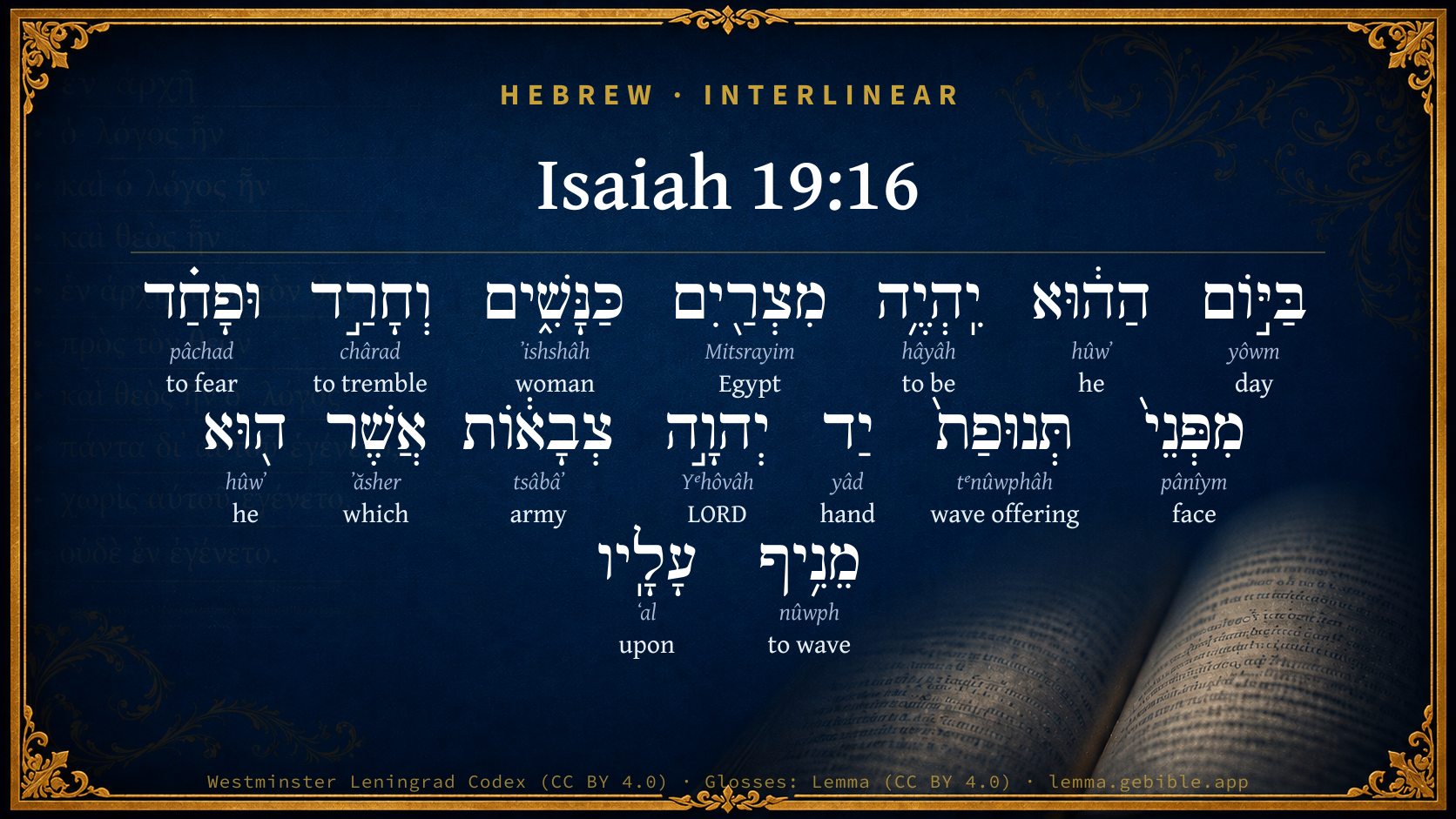
Isaiah 19:16

Hebrew (Westminster Leningrad Codex) Isaiah 19:16 appears in the Hebrew Old Testament. The text above is from the Westminster Leningrad Codex. Each word links to its Strong’s number, a concise gloss, and parsing drawn from the Open Scriptures Hebrew Bible morphology. Click any word for its full Brown-Driver-Briggs (BDB) entry.
Download image
Cite this verse

Isaiah 19:16 (World English Bible). Public Domain. Lemma interlinear Bible study tool, https://lemma.gebible.app/v/isaiah/19/16.

Show BibTeX & RIS
BibTeX
RIS
English Translation
In that day shall the Egyptians be like women; and they shall tremble and fear because of the shaking of the hand of Yahweh of Hosts, which he shakes over them.
World English Bible · Public Domain
Download a study sheet

One document with this verse’s original text, its word-by-word gloss line, the meaning frame, cross-references with their text, attributed commentary, and full source and license credits — printable, and it pastes into notes with its structure intact.

This verse Autodidact and up

Study sheet (.html) Plain text (.txt)

A passage Seminary Student

Up to 50 verses in one chapter. A passage sheet keeps up to 6 commentary sources and 12 cross-references per verse, in the order this page ranks them, and says so on the sheet whenever that leaves anything out. Ask for a single verse and you get the Autodidact verse sheet above.

Everything on this page stays free to read, with no account — the sheet is a download of what is already on screen, not access to it.

Want to remove ads? Support Godless Engineer
Compare translations 3

The same verse in 3 English versions, stacked beneath the original-language interlinear above. Click any original word for its lexicon entry.

Each is an independent rendering of the whole verse — the interlinear is not word-aligned to these translations.

Highlighted words mark where these versions differ — a whole-verse word diff, not a word-by-word alignment.

  • World English Bible Public Domain
    In that day shall the Egyptians be like women; and they shall tremble and fear because of the shaking of the hand of Yahweh of Hosts, which he shakes over them.
  • King James Version Public Domain
    In that day shall Egypt be like unto women: and it shall be afraid and fear because of the shaking of the hand of the LORD of hosts, which he shaketh over it.
  • unfoldingWord Literal Text CC BY-SA 4.0
    In that day Egypt will be like women, and it will tremble and fear from the face of the waving of the hand of Yahweh of Armies that he is waving over it.

unfoldingWord Literal Text — © unfoldingWord, licensed CC BY-SA 4.0. Word-aligned USFM3 via Door43 (git.door43.org/unfoldingWord/en_ult).

Versions to compare (up to 4)

3 of 4 selected

Show all 18 translations

Every available English version of this verse, each an independent rendering of the whole verse.

  • World English Bible Public Domain
    In that day shall the Egyptians be like women; and they shall tremble and fear because of the shaking of the hand of Yahweh of Hosts, which he shakes over them.
  • Berean Standard Bible Public Domain
    In that day the Egyptians will be like women. They will tremble with fear beneath the uplifted hand of the LORD of Hosts, when He brandishes it against them.
  • Majority Standard Bible Public Domain
    In that day the Egyptians will be like women. They will tremble with fear beneath the uplifted hand of the LORD of Hosts, when He brandishes it against them.
  • King James Version Public Domain
    In that day shall Egypt be like unto women: and it shall be afraid and fear because of the shaking of the hand of the LORD of hosts, which he shaketh over it.
  • American Standard Version (1901) Public Domain
    In that day shall the Egyptians be like unto women; and they shall tremble and fear because of the shaking of the hand of Jehovah of hosts, which he shaketh over them.
  • Revised Version (1885) Public Domain
    It In that day shall Egypt be like unto women: and it shall tremble and fear because of the shaking of the hand of the LORD of hosts, which he shaketh over it.
  • Geneva Bible (1599) Public Domain
    In that day shall Egypt be like vnto women: for it shall be afraide and feare because of the moouing of the hand of the Lord of hostes, which he shaketh ouer it.
  • Douay-Rheims (1899) Public Domain
    In that day Egypt shall be like unto women, and they shall be amazed, and afraid, because of the moving of the hand of the Lord of hosts, which he shall move over it.
  • Young's Literal Translation Public Domain
    In that day is Egypt like women, And it hath mourned, and been afraid, Because of the waving of the hand of Jehovah of Hosts, That He is waving over it.
  • Literal Standard Version CC BY-SA 4.0
    In that day Egypt is like women, || And it has mourned, and been afraid, || Because of the waving of the hand of YHWH of Hosts, || That He is waving over it.
  • Unlocked Literal Bible CC BY-SA 4.0
    In that day, the Egyptians will be like women. They will tremble and fear because of the upraised hand of Yahweh of hosts that he raises over them.
  • unfoldingWord Literal Text CC BY-SA 4.0
    In that day Egypt will be like women, and it will tremble and fear from the face of the waving of the hand of Yahweh of Armies that he is waving over it.
  • Darby Bible Public Domain
    In that day shall Egypt be like unto women; and it shall tremble and fear because of the shaking of the hand of Jehovah of hosts, which he shaketh over it.
  • World Messianic Bible Public Domain
    In that day the Egyptians will be like women. They will tremble and fear because of the shaking of the LORD of Hosts’s hand, which he shakes over them.
  • Webster's Bible Public Domain
    In that day shall Egypt be like women: and it shall be afraid and fear because of the shaking of the hand of the LORD of hosts, which he shaketh over it.
  • Free Bible Version CC BY-SA 4.0
    At that time the Egyptians will become like women. They will shake with fear when the Lord Almighty raises his arm against them.
  • Bible in Basic English Public Domain
    In that day the Egyptians will be like women: and the land will be shaking with fear because of the waving of the Lord's hand stretched out over it.
  • JPS Tanakh (1917) Public Domain
    In that day shall Egypt be like unto women; and it shall tremble and fear because of the shaking of the hand of the LORD of hosts, which He shaketh over it.

Literal Standard Version (2020), Covenant Press — licensed CC BY-SA 4.0. Text via the HelloAO Bible API (eBible.org). Unlocked Literal Bible (unfoldingWord) — licensed CC BY-SA 4.0. Text via the HelloAO Bible API (eBible.org). unfoldingWord Literal Text — © unfoldingWord, licensed CC BY-SA 4.0. Word-aligned USFM3 via Door43 (git.door43.org/unfoldingWord/en_ult). Free Bible Version, Dr. Jonathan Gallagher — licensed CC BY-SA 4.0. Text via the HelloAO Bible API (eBible.org).

Word by word

More ways to search: Search by grammar → Find every occurrence → Compare this word →

Practice this passage: Drill this verse → Learn its vocabulary →

וּפָחַ֗ד
pâchad
H6342
“and · to fear”
Conjunction + Verb, Qal, Sequential Perfect, 3rd Person, Masculine, Singular
Part of Speech
Conjunction + Verb
Stem
Qal
Form
Sequential Perfect
Person
3rd Person
Gender
Masculine
Number
Singular
Full BDB Definition

Origin: a primitive root

TWOT: 1756

to fear, tremble, revere, dread, be in awe or dread - (Qal) - to be in dread - to be in awe - (Piel) to be in great dread - (Hiphil) to cause to dread
  1. בַּיּ֣וֹם yôwm H3117 “in/at the · day” Preposition, Determined + Noun, Common, Masculine, Singular, Absolute
  2. הַה֔וּא hûwʼ H1931 “the · he” Particle, Definite Article + Pronoun, Personal, 3rd Person, Masculine, Singular
  3. יִֽהְיֶ֥ה hâyâh H1961 “to be” Verb, Qal, Imperfect, 3rd Person, Masculine, Singular
  4. מִצְרַ֖יִם Mitsrayim H4714 “Egypt” Noun, Proper
  5. כַּנָּשִׁ֑ים ʼishshâh H802 “like/as the · women” Preposition, Determined + Noun, Common, Feminine, Plural, Absolute
  6. וְחָרַ֣ד chârad H2729 “and · to tremble” Conjunction + Verb, Qal, Perfect, 3rd Person, Masculine, Singular
  7. מִפְּנֵי֙ pânîym H6440 “from · face(s) of” Preposition + Noun, Common, Both, Plural, Construct
  8. תְּנוּפַת֙ tᵉnûwphâh H8573 “wave offering of” Noun, Common, Feminine, Singular, Construct
  9. יַד yâd H3027 “hand of” Noun, Common, Both, Singular, Construct
  10. יְהוָ֣ה Yᵉhôvâh H3068 “LORD” Noun, Proper
  11. צְבָא֔וֹת tsâbâʼ H6635 “armies” Noun, Common, Both, Plural, Absolute
  12. אֲשֶׁר ʼăsher H834 “which” Particle, Relative
  13. ה֖וּא hûwʼ H1931 “he” Pronoun, Personal, 3rd Person, Masculine, Singular
  14. מֵנִ֥יף nûwph H5130 “waving” Verb, Hiphil, Participle Active, Masculine, Singular, Absolute
  15. עָלָֽיו ʻal H5921 “upon · him” Preposition + Suffix, Personal, 3rd Person, Masculine, Singular

About this verse

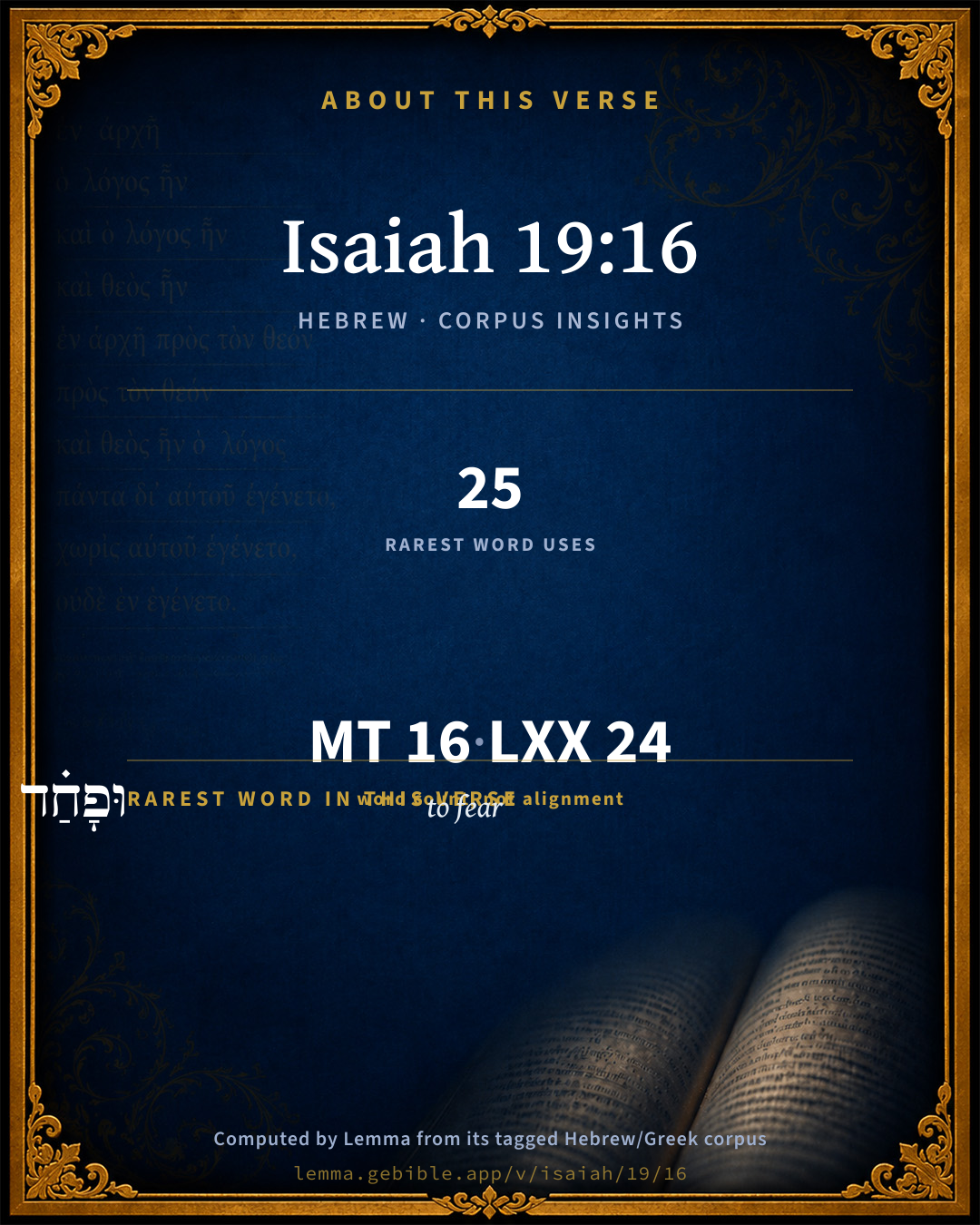
These counts appear in no published source. They are computed here, from the morphology-tagged text and Lemma’s own curated glosses. What Lemma adds →

16
words
15
distinct lemmas
Prophets
section

Notable vocabulary

The rarest word here is וּפָחַ֗ד to fear H6342 — appearing just 25 times in the whole Hebrew Bible.

Shared distinctive vocabulary

וּפָחַ֗ד to fear H6342 occurs in 25 verses of the Hebrew Bible. Also found in:

Grammatical profile

  • 4 verbs
  • 8 nouns
  • 2 pronouns
  • 1 preposition
  • 1 particle

Verb forms

  • יִֽהְיֶ֥ה Qal · Imperfect
  • וְחָרַ֣ד Qal · Perfect
  • וּפָחַ֗ד Qal · Sequential Perfect
  • מֵנִ֥יף Hiphil · Participle Active

Repetition

A word recurs within this verse — often emphatic in Hebrew:

  • הַה֔וּא he H1931 ×2

Hebrew & Septuagint length

In English translation the verse runs 31 words from the Hebrew and 30 from the Septuagint (LXX English) — closely comparable.

A rough comparison of the two English renderings, which tokenize alike — not a word-level alignment.

Word counts can differ between the Hebrew and the Greek without any difference in meaning — e.g. the Hebrew direct-object marker אֵת has no separate Greek word, and Greek often adds the article ὁ.

In the original languages it is 16 Hebrew tokens and 24 Greek tokens — but the two are counted differently (Hebrew bundles its prefixes and suffixes into one token; the Greek is in lemma form), so that isn’t a like-for-like length.

Cross-references

11

Topical passages linked to Isaiah 19:16 in the Treasury of Scripture Knowledge — connected by theme and wording, ordered by reader-vote popularity; previews shown in the World English Bible.

  • Jeremiah 51:30 The mighty men of Babylon have forborne to fight, they remain in their strongholds; their might has failed; they are become as women: her dwelling-places are set on fire; her bars are broken.
  • Nahum 3:13 Behold, your troops in your midst are women. The gates of your land are set wide open to your enemies. The fire has devoured your bars.
  • Isaiah 11:15 Yahweh will utterly destroy the tongue of the Egyptian sea; and with his scorching wind will he wave his hand over the River, and will strike it into seven streams, and cause men to march over in sandals.
  • Jeremiah 30:5–7 For thus says Yahweh: We have heard a voice of trembling, of fear, and not of peace.
  • Jeremiah 50:37 A sword is on their horses, and on their chariots, and on all the mixed people who are in the midst of her; and they shall become as women: a sword is on her treasures, and they shall be robbed.
  • Isaiah 10:32 This very day shall he halt at Nob: he shakes his hand at the mountain of the daughter of Zion, the hill of Jerusalem.
  • Zechariah 2:9 For, behold, I will shake my hand over them, and they will be a spoil to those who served them; and you will know that Yahweh of Hosts has sent me.
  • Psalms 48:6 Trembling took hold of them there, Pain, as of a woman in travail.
  • Isaiah 30:17 One thousand [shall flee] at the threat of one; at the threat of five shall you flee: until you be left as a beacon on the top of a mountain, and as an ensign on a hill.
  • Isaiah 30:30–32 Yahweh will cause his glorious voice to be heard, and will show the lighting down of his arm, with the indignation of [his] anger, and the flame of a devouring fire, with a blast, and tempest, and hailstones.
  • Hebrews 10:31 It is a fearful thing to fall into the hands of the living God.

Cross-references courtesy of OpenBible.info (CC BY 4.0).

Hebrew and Greek witnesses Masoretic Hebrew ↔ Greek Septuagint

The same verse in the two great witnesses to the Old Testament, shown verse-for-verse.

These are two independent witnesses, not word-aligned to each other, and the Septuagint is shown in lemma (dictionary) form.

Hebrew Isaiah 19:16 Masoretic · Westminster Leningrad Codex

בַּיּ֣וֹם הַה֔וּא יִֽהְיֶ֥ה מִצְרַ֖יִם כַּנָּשִׁ֑ים וְחָרַ֣ד וּפָחַ֗ד מִפְּנֵי֙ תְּנוּפַת֙ יַד יְהוָ֣ה צְבָא֔וֹת אֲשֶׁר ה֖וּא מֵנִ֥יף עָלָֽיו

In that day shall the Egyptians be like women; and they shall tremble and fear because of the shaking of the hand of Yahweh of Hosts, which he shakes over them.

World English Bible · Public Domain

Greek LXX Isaiah 19:16 Septuagint · lemma form

ὁ δέ ἡμέρα ἐκεῖνος εἰμί ὁ αἰγύπτιος ὡς γυνή ἐν φόβος καί ἐν τρόμος ἀπό πρόσωπον ὁ χείρ κύριος σαβαωθ ὅς αὐτός ἐπιβάλλω αὐτός

But in that day the Egyptians shall be as women, in fear and in trembling because of the hand of the Lord of hosts, which he shall bring upon them.

LXX2012 (modern English Septuagint) · Public Domain

On this verse, Adam Clarke's Commentary discusses the Septuagint’s reading. Read the note in Commentary ↓

Hebrew: Westminster Leningrad Codex (CC BY 4.0). Greek: Septuagint (public domain); English from LXX2012 (modern English Septuagint) (Public Domain). How the Septuagint differs from the Hebrew →

Targum (Aramaic paraphrase)

1

The Targum is the ancient Jewish Aramaic paraphrase of the Hebrew Scriptures — an interpretive translation, not the Hebrew text itself. Onkelos (literal) and Pseudo-Jonathan (expansive) render the Torah, and Jonathan the Prophets. Coverage is partial: where no permissively-licensed English translation exists for a verse, only the Aramaic is shown. This is verse-level text, not a word-by-word alignment to the Hebrew.

  1. Targum Jonathan Prophets (Joshua–Malachi)
    בְּעִדָנָא הַהִיא יְהוֹן מִצְרָאֵי חַלָשִׁין כְּנִשִׁין וִיזוּעוּן וְיִתַּבְּרוּן מִן קֳדָם אֱרָמוּת גְבוּרְתָּא דַייָ צְבָאוֹת דְהוּא מֵרִים עֲלֵיהוֹן:

    At that time the Egyptians shall be weak, they shall be afraid, and fear on account of the exultation of the power of the Lord of hosts, which He is lifting up against them.

    Targum Jonathan — Aramaic: “Mikraot Gedolot” (public domain). English: “Sefaria Community Translation” (CC0 1.0 (public-domain dedication)); “London "Chaldee Paraphrase," 1871” (public domain). Text via Sefaria.

Commentary

Notes on Isaiah 19:16 from classic Christian and Jewish commentators (each source and its license shown beneath its notes). The classic Christian expositions comment on the surrounding passage and are grouped to its opening verse, so a note may address several verses; the Jewish commentaries on the Tanakh (Rashi and others) are per-verse, so they appear only where the commentator wrote on this verse.

Lemma curates 59 commentaries, every one of them public domain or Creative Commons licensed, each selected and text-cleaned for this edition rather than reprinted as found. About our sources →

Trapp's Complete Commentary

John Trapp

Isa 19:16 In that day shall Egypt be like unto women: and it shall be afraid and fear because of the shaking of the hand of the LORD of hosts, which he shaketh over it.

Ver. 16. In that day shall Egypt be like unto women.] Feeble and faint-hearted, nihil mascule aut fortiter facturi, sed mulieribus meticulosiores. See Pro 28:1. {See Trapp on "Pro 28:1"}

Because of the shaking of the hand of the Lord.] When as yet he threateneth only; how much more when he striketh in good earnest? See Isa 30:32.

John Trapp, A Commentary or Exposition upon All the Books of the Old and New Testament (1647–1656) — public domain. Text from a community e-Sword module.

Joseph Benson's Commentary

Isa 19:16-17. In that day shall Egypt be like unto women — Feeble and fearful, as it follows. The cowardice and effeminacy of the people in general, joined with their fear and trepidation, are here set forth as a second cause of their calamity; and the reason of this, among other things, is drawn from a sense of the divine judgment. They shall be like women, and fear, because of the shaking of the hand of the Lord, &c. — Because they shall perceive that they do not fight with men only, but with the Lord of hosts, who now lifts up his hand against them, as he did against their forefathers. The land of Judah shall be a terror unto Egypt — That is, the calamities brought on the land of Judah by the Assyrians and Chaldeans. When the Egyptians shall hear of the ravages and desolations made in Judah, by the army of Sennacherib, and shall afterward be informed of its overthrow by Nebuchadnezzar, they shall be dreadfully afraid of suffering the same calamities themselves, considering both their near neighbourhood to Judah, and their strict alliance therewith. Indeed Judah was their bulwark against the Assyrians and Babylonians, and when this bulwark was removed they had just cause to fear. “The threatening hand of God,” says Bishop Lowth, “will be held out, and shaken over Egypt, from the side of Judea; through which the Assyrians will march to invade it.” Every one that makes mention thereof, &c. — Poole thinks their fear of mentioning Judah’s name might proceed partly from a sense of their guilt and misconduct toward Judah, and an apprehension that the God of Judah was calling them to an account for it. Perhaps, also, as the next clause seems to imply, they might have heard of the prophecies uttered in Judah concerning these very calamities coming upon them.

Joseph Benson's Commentary on the Old and New Testaments (1811–1818) — public domain. Text from a community e-Sword module.

Lange's Commentary on the Holy Scriptures

ב) The Transition: Egypt fears the LORD

Isa_19:16-17

16          In that day shall Egypt be like unto women:

And it shall be afraid and fear

33Because of the shaking of the hand of the Lord of hosts,

Which he shaketh over it.

17     And the land of Judah shall be a terror unto Egypt,

Every one that 34maketh mention thereof shall be afraid in himself,

Because of the counsel of the Lord of hosts,

Which he hath determined against it.

TEXTUAL AND GRAMMATICAL

Isa_19:16. חרד comp. Isa_10:29; Isa_32:16; Isa_41:5.——פחד Isa_12:2; Isa_33:14; Isa_44:8; Isa_44:11; Isa_60:5.——The verb הֵנִיף we have already read of the hand lifted up in threatening: Isa_11:15, comp. Isa_10:15; Isa_10:32; Isa_13:2; Isa_30:28.——תנופה, frequent in the Pentateuch, occurs in Isaiah only here and Isa_30:32.——Regarding the expression אדמת יהודה it is to be remarked that, apart from the frequent אדמת ישׂראל in Ezekiel, אדמה never occurs in connection with the name of a nation except here and Gen_47:20; Gen_47:26, in the expression אדמת מצרים——חָגָּא (from חָגַג, circulare, tripudiare), “the revolving movement of dizziness,” is ἅπ. λεγ.——The expression כֹּל אֲשֶר וגו׳, is a resolving of the otherwise usual participial construction, on which comp. Ewald, § 337, c, sq.—The Hiph. הִזְכִּיר is frequent in Isa_12:4; Isa_26:13; Isa_3:22; Isa_43:26; Isa_48:1; Isa_62:6, etc.

EXEGETICAL AND CRITICAL

1. The discourse is artistically arranged: according to the foregoing, Egypt still thinks it may be saved by its own wisdom. Now it has surrendered this hope. It trembles before the threatening gesture of Jehovah’s hand (Isa_19:16). In fact, whenever the land of Judah is thought of, Egypt quakes with fear lest the decree of Jehovah may be accomplished (Isa_19:17).

2. The expression of Isaiah “in that day” which is peculiar to the first part (in the second it occurs only Isa_52:6) appears with more frequency in the present chapter, than in any other passage: viz.: Isa_19:16; Isa_19:18-19; Isa_19:21; Isa_19:23-24. Comp. the remark at Isa_2:12. As often as one utters the name Judah, men turn affrighted to him, for they know but too well the power of the God of Judah. The counsel of Jehovah, then, of which Isa_19:12 speaks, must have been partly accomplished. Men fear its further and complete fulfilment.

Lange's Commentary on the Holy Scriptures (Critical, Doctrinal, and Homiletical), ed. John Peter Lange, English translation edited by Philip Schaff (1864–1880) — public domain. Text from a community e-Sword module.

Tyndale Open Study Notes

Tyndale Open Resources

19:16 An upraised fist (literally waving the hand) was a threatening motion.

Tyndale Open Study Notes — © Tyndale Open Resources, licensed CC BY-SA 4.0. Text via the HelloAO Bible API.

Jamieson, Fausset & Brown

Robert Jamieson, A. R. Fausset & David Brown

like . . . women--timid and helpless (Jer 51:30; Nah 3:13).

shaking of . . . hand--His judgments by means of the invaders (Isa 10:5, Isa 10:32; Isa 11:15).

Jamieson, Fausset & Brown — Commentary Critical and Explanatory on the Whole Bible (1871) — public domain (CC PDM 1.0). Text via the HelloAO Bible API.

Adam Clarke's Commentary

Verse 16. Shall Egypt be - "The Egyptians shall be"] יהיו yihyu, they shall be, plural, MS. Bodl. Septuagint, and Chaldee. This is not proposed as an emendation, for either form is proper.

Adam Clarke's Commentary on the Bible (1810–1826) — public domain. Text from a community e-Sword/MySword module.

Ellicott's Commentary for English Readers

(16) In that day shall Egypt be like unto “women.—This image of panic, terror, and weakness has been natural in the poetry of all countries (comp. Homer, “Achæan women, not Achæan men”), and appears in its strongest form in Jer_48:41. In such a state, even the land of Judah, once so despised, shall become a source of terror.

A Bible Commentary for English Readers, edited by Charles John Ellicott (1878–1897) — public domain. Text from a community e-Sword module.

The Cambridge Bible for Schools and Colleges

gen. ed. J. J. S. Perowne

16. like unto women] timid and faint-hearted (Nah_3:13).

be afraid] Better, tremble, as R.V. the shaking (or “swinging”) of the hand … which he shaketh] i.e. the repeated blows with which he smites them, cf. Isa_30:32, Isa_10:32, Isa_11:15.

16, 17. The terror of Jehovah on the Egyptians. There is an allusion to the effect of the plagues in the time of the Exodus. See Exo_10:7; Exo_11:3; Exo_12:33; Exo_12:36. Then, as in this prophecy, the people of God became an object of fear to their enemies, through the strokes of Jehovah’s hand.

The Cambridge Bible for Schools and Colleges (gen. ed. J. J. S. Perowne; Cambridge University Press, 1878–1918) — public domain. Text from a community e-Sword module.

John Gill's Exposition

In that day shall Egypt be like unto women,.... Weak and feeble, as the Targum; fearful and timorous, even their military force; and devoid of wisdom, even their princes and nobles:

and it shall be afraid and fear because of the shaking of the hand of the Lord of hosts, which he shaketh over it: which the Lord may be said to do, when he lifts up his rod, and holds it over a people, and threatens them with ruin and destruction; perhaps this may refer to what was done in Judea by Sennacherib's army, which was an intimation to the Egyptians that their turn was next; and if the shaking of the Lord's hand over a people is so terrible, what must the weight of it be? Some think there is an allusion to Moses's shaking his rod over the Red sea when the Egyptians were drowned, in which the hand or power of the Lord was so visibly seen, and which now might be called to mind. Ben Melech observes, that when one man calls to another, he waves his hand to him to come to him; so here it is as if the Lord waved with his hand to the enemy to come and fight against Egypt, which caused fear and dread.

John Gill's Exposition of the Whole Bible (1746–1763) — public domain (CC PDM 1.0). Text via the HelloAO Bible API.

Albert Barnes' Notes on the Bible

In that day shall Egypt be like unto women - Timid; fearful; alarmed. The Hebrews often, by this comparison, express great fear and consternation Jer 51:30; Nah 3:13.

Because of the shaking of the hand - The shaking of the hand is an indication of threatening or punishment (note, Isa 10:32; Isa 11:15).

Albert Barnes' Notes on the Bible (1834–1885) — public domain. Text from a community e-Sword/MySword module.

Matthew Poole's English Annotations

Like unto women; feeble and fearful, as it follows.

Because of the shaking of the hand of the Lord of hosts; because they shall perceive that they do not fight with men only, but with the Lord of hosts, who now lifts up his hand against them, as he did against their forefathers, Exo 14, the very remembrance whereof is very terrible to them.

Matthew Poole's English Annotations on the Holy Bible (1683–1685) — public domain. Text from a community e-Sword/MySword module.

Whedon's Commentary on the Bible

Daniel D. Whedon

16. In that day — The day when these calamities come.

Like unto women — A figure expressive of timidity and fear. Used also by other prophets. Jer_51:30; Nah_3:13.

Shaking of the hand — A gesture, not here of summons, but of menace — menace of judgments by invaders. Isa_10:5; Isa_10:32; Isa_11:15. Hopeful amendment appears at once from such gestures.

Daniel D. Whedon (gen. ed.), Commentary on the Old and New Testaments (1874–1909) — public domain. Text from a community e-Sword module.

The Pulpit Commentary

In that day; or, at that time; i.e. when the Assyrian invasion comes. Shall Egypt be like unto women. (comp. Jer_51:30) So Xerxes said of his fighting men at Salamis: "My men have become women" (Herod., 8:88). Because of the shaking of the hand of the Lord. (comp. Isa_11:15 and Isa_30:32) The Egyptians would scarcely recognize Jehovah as the Author of their calamities, but it would none the less be his hand which punished them.

Vers. 16-25. Mingled judgment and mercy.

I THE EFFECT OF JUDGMENT. The hind will be like timid and trembling women, for the mighty hand of Jehovah will be brandished aloft in judgment. Whenever it is felt that Divine power is working on the side of the foe, the most warlike nations lose heart. "God with us! a watchword that nerves the feeblest arm, and fills the faintest heart with courage. God against us! the hand of the bravest hangs down, the knees of the stoutest tremble. Judah, Jehovah"s seat of empire, will be a terror to the proud land of Egypt. The seeming weakest community, the most insignificant individual, will be a power if the truth is operating through it. It is not magnitude that is appalling; it is spiritual force. Men will shudder at the Name of Judah; it will be a symbol of a purpose never successfully resisted. But when thus the prospect is at its darkest for Egypt, a light of hope glimmers.

II PROMISES OF GOOD.

1. A view of Egypt"s conversion to the true religion here opens. There will be five cities speaking the tongue of Canaan, or Hebrew, the language of the worship of Jehovah. They will take the oath of loyalty to him. And it seems that the city known as "city of the sun" shall be called" city of the breaking down of idolatrous altars." And an altar of the true religion, with the pillar marking the holy place, will be seen, visibly witnessing to the Lord of hosts in the land. There is now a covenant between Jehovah and the repentant and restored land. He will no longer be their Foe, but their Friend; and when they cry to him, in the midst of distress and oppression, he will hearken, and send a Helper and Deliverer. The people will sacrifice to him, and he will make himself known; Whether in the land or at Jerusalem (comp. Zec_14:16-19) is not stated.

2. This cannot be without previous suffering. Never does conversion from evil, from obstinate persistence in it, occur without suffering. But the suffering is beneficent, inflicted by love. God smites to heal. It is a thought echoed back from many a page: "I kill, and I make alive; I wound, and heal; He has torn, and he will heal us; hath smitten, and will bind us up;" "He wounds, and his hands make whole". (Deu_32:39 Hos 6:1Jo Hos 5:18) The fire of his wrath consumes, but purifies. "Then will I turn to the people a pure language, that they may call upon the Name of Jehovah, to serve him with one consent". (Zep_3:8, Zep_3:9) There lives a fund of pity in the heart and constitution of nature compassion in Jehovah, the Hebrew prophet said. (Jer_12:14, Jer_12:15) "God does not punish that he may punish, but that he may humble; wherefore, when humility is produced, his punishments proceed no further. God is of too great mercy to triumph over a prostrate soul" (South).

III THE HAPPY RESULT. Peace replacing war, trust substituted for mutual hate. There is to be intercourse between Egypt and Assyria, a free highway between the two lands. Nay, there shall be a triple alliance, Israel being the third, and blessing is thus to be diffused over all the earth. Where Jehovah"s blessing is, there is and must be prosperity. Thus have the clouds dispersed, and the golden year seems to have begun, "peace lying like a lane of beams across the sea, like a shaft of light athwart the land.

PERSONAL APPLICATION. To avoid national judgment, to secure the Divine favor, let each inquire into his own sins. Personal sins bring down national judgments. If there were no personal, there could be no national sin. In punishing the many, God does not overlook the individual. There is no suffering of a nation without the suffering of its members, no repentance which is not that of men one by one, no prosperity and favor which is not reflected from a million faces and hearts. There is infinite ground of hope from the promises of God, and from their actual fulfillment. J.

The Pulpit Commentary (1880–1919), ed. H.D.M. Spence-Jones & Joseph S. Exell — public domain. Text from a community e-Sword module.

John Wesley's Explanatory Notes

Women - Feeble and fearful. Because - Because they shall perceive that they do not fight with men only, but with the Lord of hosts, who now lifts up his hand against them, as he did against their forefathers.

John Wesley, Explanatory Notes Upon the Whole Bible (1754–1765) — public domain. Text via the GEBible commentary corpus.

Keil & Delitzsch

C. F. Keil & F. Delitzsch

The result of all these plagues, which were coming upon Egypt, would be fear of Jehovah and of the people of Jehovah. "In that day will the Egyptians become like women, and tremble and be alarmed at the swinging of the hand of Jehovah of hosts, which He sets in motion against it. And the land of Judah becomes a shuddering for Egypt; as often as they mention this against Egypt, it is alarmed, because of the decree of Jehovah of hosts, that He suspendeth over it." The swinging (tenuphâh) of the hand (Isa 30:32) points back to the foregoing judgments, which have fallen upon Egypt blow after blow. These humiliations make the Egyptians as soft and timid as women (tert. compar., not as in Isa 13:7-8; Isa 21:3-4). And the sacred soil of Judah ('adâmâh, as in Isa 14:1-2; Isa 32:13), which Egypt has so often made the scene of war, throws them into giddiness, into agitation at the sight of terrors, whenever it is mentioned (אשׁר כּל, cf., Sa1 2:13, lit., "whoever," equivalent to "as often as any one," Ewald, 337, 3, f; חגּא is written according to the Aramaean form, with Aleph for He, like זרא) in Num 11:20, קרחא in Ezek. 37:31, compare כּלּא, Eze 36:5, and similar in form to חפה in Isa 4:5).

The author of the plagues is well known to them, their faith in the idols is shaken, and the desire arises in their heart to avert fresh plagues by presents to Jehovah.

Keil & Delitzsch — Biblical Commentary on the Old Testament (1861–1891) — public domain (CC PDM 1.0). Text via the HelloAO Bible API. (Old Testament only.)

J. A. Alexander on Isaiah

Joseph Addison Alexander

“In that day shall Egypt be like a woman, and shall fear and tremble from before the shaking of the hand of Jehovah of Hosts, which He (is) shaking over it.” The comparison in the first clause is a common one for terror and the loss of courage. The reference is not to the slaughter of Sennacherib’s army, but more generally to the indications of divine displeasure.

Joseph Addison Alexander, The Prophecies of Isaiah (1846–1847; New York: Scribner, 1870–1878) — public domain. Text from a community e-Sword module.

Kretzmann's Popular Commentary

Paul E. Kretzmann

A Promise of Blessing

v. 16. In that day shall Egypt be like unto women, on account of the greater timidity which usually characterizes the weaker sex; and it shall be afraid and fear because of the shaking of the hand of the Lord of hosts which He shaketh over it, His judgments and punishments thus being scattered by means of the invaders of Egypt.

v. 17. And the land of Judah shall be a terror unto Egypt, either because the mere mention of the name struck terror to their hearts at this time, or because Judah was now allied with Assyria against the king of Egypt, every one that maketh mention thereof, namely, of Judah, shall be afraid in himself because of the counsel of the Lord of hosts which He hath determined against it, for they all dreaded the punishment which they felt was now inevitable. But in the very midst of the threatened destruction a ray of hope shone upon those who turned to the Lord in true repentance.

v. 18. In that day shall five cities in the land of Egypt speak the language of Canaan, that is, accept the true, revealed religion, and swear to the Lord of hosts, pledging themselves to Him with a sacred oath; one shall be called The City of Destruction, literally, "Ir-ha-heres," which may have been the city of the sun, or Heliopolis. The prophecy of Jer 43:13, also means to point to the destruction of this or a similar city.

v. 19. In that day shall there be an altar to the Lord in the midst of the land of Egypt, and a pillar at the border thereof, probably an obelisk, to the Lord. The reference is either to the establishment of the religion of Jehovah in Egypt in the second century before Christ, when Alexandria became the center of Egyptian Jewry, or, better still, to the foothold which the Christian religion gained in Egypt at a very early date in the new era.

v. 20. And it shall be for a sign and for a witness unto the Lord of hosts in the land of Egypt, so that their contemporaries could see the evidence of their worship and their descendants have this proof of their religion; for they shall cry unto the Lord because of the oppressors, and He shall send them a savior, and a great one, a mighty warrior, and he shall deliver them, the reference probably being to Alexander the Great, whose coming was a deliverance to Egypt in various ways.

v. 21. And the Lord shall be known to Egypt, and the Egyptians shall know the Lord in that day, namely, when Jehovah would visit Egypt in mercy and cause the truth to be proclaimed to its people, and shall do sacrifice and oblation, perform the acts of true worship to the only God; yea, they shall vow a vow unto the Lord and perform it, pledging themselves to Jehovah and His service.

v. 22. And the Lord shall smite Egypt, in order to bring its people to repentance; He shall smite and heal it, for His purpose is always one of mercy; and they shall return even to the Lord, His punishment having taken the right effect, and He shall be intreated of them and shall heal them. Cf Lev 26:44; Deu 32:36.

v. 23. In that day shall there be a highway out of Egypt to Assyria, permitting free and friendly communication, and the Assyrian shall come into Egypt and the Egyptian into Assyria, and the Egyptians shall serve with the Assyrians, proselytes and Jews from both countries meeting at Jerusalem and elsewhere for the worship of Jehovah.

v. 24. In that day shall Israel be the third with Egypt and with Assyria, the believers of the three countries being joined by the one faith, even a blessing in the midst of the land, since blessings would go forth from them to the inhabitants of other countries all over the world;

v. 25. whom the Lord of hosts shall bless, saying, Blessed be Egypt, My people, admitted to all the spiritual privileges formerly held by Israel alone, and Assyria, the work of My hands, His workmanship in the spiritual sense, and Israel, Mine inheritance, still designated thus as the actual son of the household of God and head of His family. Altogether, we have here a splendid example of the spread of the true religion under the merciful direction of God, especially in Messianic times.

Paul E. Kretzmann, Popular Commentary of the Bible (1921–1924) — public domain. Text from a community e-Sword module.

unfoldingWord translationNotes

Door43 World Missions Community

Egyptians will be like women

This emphasizes that the people of Egypt will be afraid and helpless when God punishes them. (See: Simile)

because of the upraised hand of Yahweh of hosts that he raises over them

Here "hand" refers to God's power, and raising the hand against them represents punishing them. AT: "because Yahweh of hosts has raised his powerful hand to punish them" (See: Metonymy and Metaphor)

The land of Judah will become a cause of staggering to Egypt

The "land of Judah" and "Egypt" refer to the people in those places. The Egyptians will stagger because they are afraid. AT: "The people of Judah will cause the Egyptians to stagger" or "The people of Judah will cause the Egyptians to be terribly afraid" (See: Metonymy)

Whenever anyone reminds them of her, they will be afraid

Here, "them" and "they" refer to the Egyptians and "her" refers to the people of Judah. AT: "Whenever anyone reminds the Egyptians of the people of Judah, the Egyptians will be afraid"

translationWords

Egypt

fear

hand

Yahweh of hosts

Judah

unfoldingWord translationNotes — © Distant Shores Media and the Door43 World Missions Community, licensed CC BY-SA 4.0. Source: git.door43.org/Door43/en_tn.

Ibn Ezra

Rabbi Abraham ibn Ezra

And it shall be afraid, etc. When the Egyptians shall have heard these decrees of the Lord, and also witnessed their fulfilment, they will fear the Lord.

Ibn Ezra on the Tanakh — English translations: “Sefaria Community Translation” (CC0 1.0 (public-domain dedication)); “Yalkut, Sifsei Chachomim Chumash, Metsudah Publications, 2009” (CC BY 4.0); and “Commentary of Ibn Ezra on Isaiah - trans. by M. Friedlander, 1873” (public domain). Text via Sefaria.

Lesson kit

Teaching starters — assembled from the data on this page, not authored interpretation. Every prompt links to the verse data it draws on. Edit before teaching.

Isaiah, in the Prophets, opens this verse with 16 words (15 distinct Hebrew lemmas). Its most distinctive word is pâchad (“to fear”). A historical commentator’s framing appears above. Read the whole chapter for the surrounding context.

Discussion questions

  1. The word pâchad carries the sense “to fear.” How does it shape the verse?
  2. Deuteronomy 28:66 shares the word «to fear» with this verse. How do the two illuminate each other?
  3. “he” occurs 2× in this one verse. What is the effect of the repetition?
  4. These translations render this verse differently. What is at stake in choosing one wording over another?
  5. The verb «יִֽהְיֶ֥ה» is Qal Imperfect. How does its form color the action?
  6. Reading how Trapp's Complete Commentary and Joseph Benson's Commentary read this verse, where do the two commentators agree and where do they part?

Things to notice

Reading settings

Reading text

Shown beneath each verse's original-language words.

Old Testament
Old Testament edition

Read the OT as the Masoretic Hebrew (MT) or the Greek Septuagint (LXX).

English shown for the Greek Septuagint (in the Hebrew ↔ Greek comparison).

Comparing translations? Open the Compare panel on any verse page to stack up to four side by side.