
Ezekiel 30:21

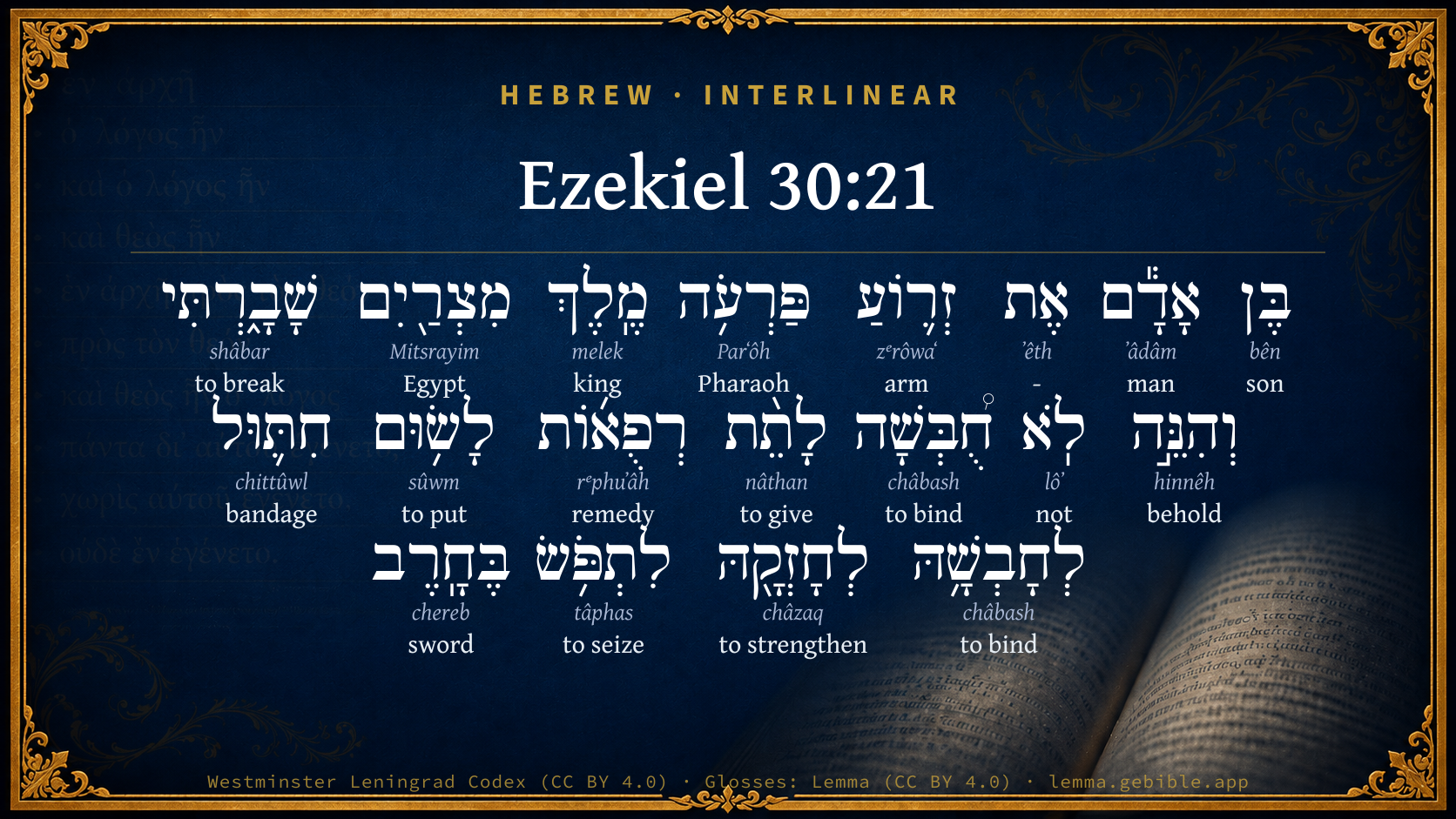
Hebrew (Westminster Leningrad Codex) Ezekiel 30:21 appears in the Hebrew Old Testament. The text above is from the Westminster Leningrad Codex. Each word links to its Strong’s number, a concise gloss, and parsing drawn from the Open Scriptures Hebrew Bible morphology. Click any word for its full Brown-Driver-Briggs (BDB) entry.
Download image
Cite this verse

Ezekiel 30:21 (World English Bible). Public Domain. Lemma interlinear Bible study tool, https://lemma.gebible.app/v/ezekiel/30/21.

Show BibTeX & RIS
BibTeX
RIS
English Translation
Son of man, I have broken the arm of Pharaoh king of Egypt; and, behold, it has not been bound up, to apply [healing] medicines, to put a bandage to bind it, that it be strong to hold the sword.
World English Bible · Public Domain
Highlights
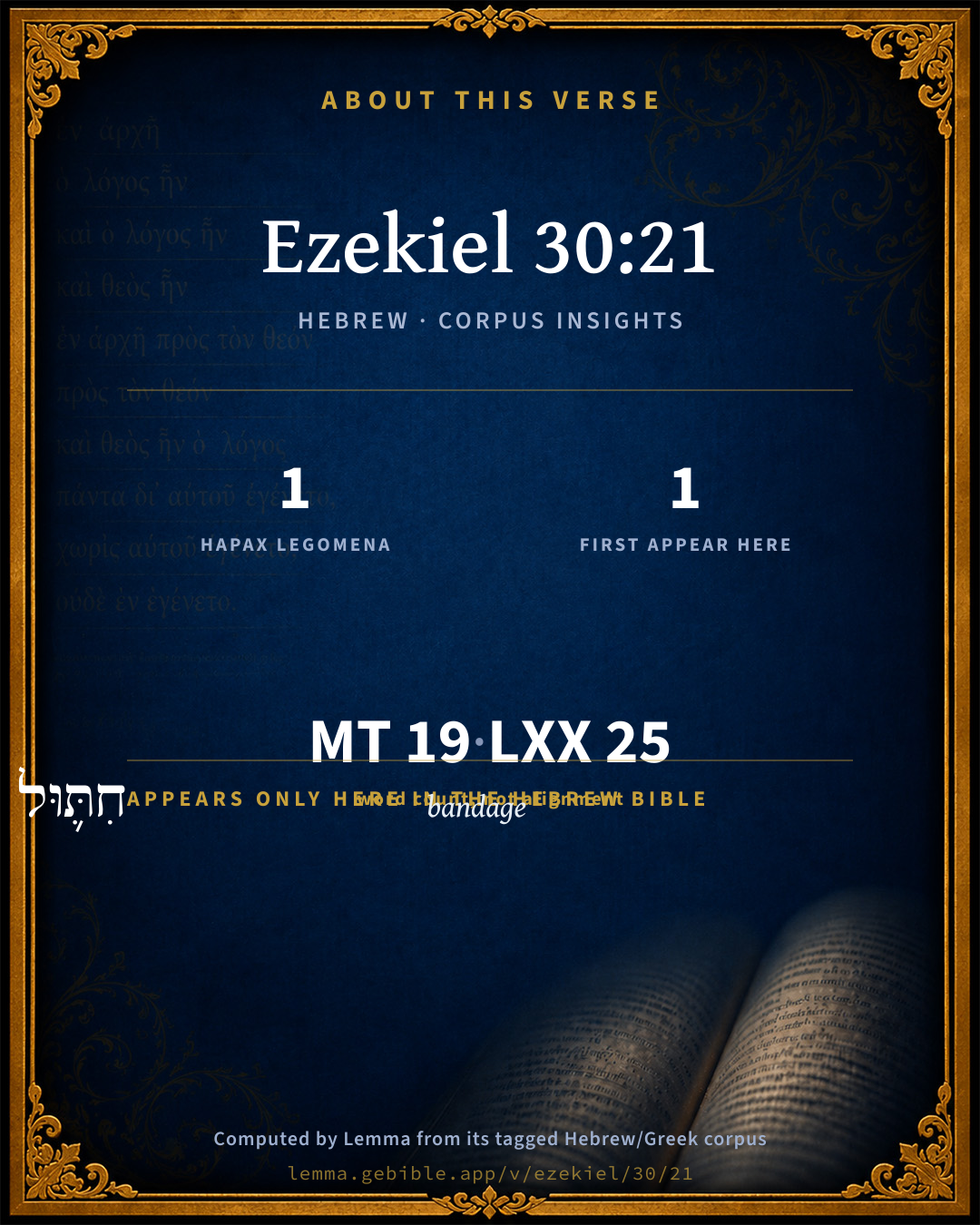
  • 1 hapax legomenon — only here in the Hebrew Bible
  • 1 first appearance in the Hebrew Bible
Full analysis ↓
Download a study sheet

One document with this verse’s original text, its word-by-word gloss line, the meaning frame, cross-references with their text, attributed commentary, and full source and license credits — printable, and it pastes into notes with its structure intact.

This verse Autodidact and up

Study sheet (.html) Plain text (.txt)

A passage Seminary Student

Up to 50 verses in one chapter. A passage sheet keeps up to 6 commentary sources and 12 cross-references per verse, in the order this page ranks them, and says so on the sheet whenever that leaves anything out. Ask for a single verse and you get the Autodidact verse sheet above.

Everything on this page stays free to read, with no account — the sheet is a download of what is already on screen, not access to it.

Want to remove ads? Support Godless Engineer
Compare translations 3

The same verse in 3 English versions, stacked beneath the original-language interlinear above. Click any original word for its lexicon entry.

Each is an independent rendering of the whole verse — the interlinear is not word-aligned to these translations.

Highlighted words mark where these versions differ — a whole-verse word diff, not a word-by-word alignment.

  • World English Bible Public Domain
    Son of man, I have broken the arm of Pharaoh king of Egypt; and, behold, it has not been bound up, to apply [healing] medicines, to put a bandage to bind it, that it be strong to hold the sword.
  • King James Version Public Domain
    Son of man, I have broken the arm of Pharaoh king of Egypt; and, lo, it shall not be bound up to be healed, to put a roller to bind it, to make it strong to hold the sword.
  • unfoldingWord Literal Text CC BY-SA 4.0
    “Son of man, I have broken the arm of Pharaoh, the king of Egypt. Behold! It has not been bound up, or set to heal with a bandage, so that it will become strong enough to grasp a sword.

unfoldingWord Literal Text — © unfoldingWord, licensed CC BY-SA 4.0. Word-aligned USFM3 via Door43 (git.door43.org/unfoldingWord/en_ult).

Versions to compare (up to 4)

3 of 4 selected

Show all 18 translations

Every available English version of this verse, each an independent rendering of the whole verse.

  • World English Bible Public Domain
    Son of man, I have broken the arm of Pharaoh king of Egypt; and, behold, it has not been bound up, to apply [healing] medicines, to put a bandage to bind it, that it be strong to hold the sword.
  • Berean Standard Bible Public Domain
    “Son of man, I have broken the arm of Pharaoh king of Egypt. See, it has not been bound up for healing, or splinted for strength to hold the sword.
  • Majority Standard Bible Public Domain
    “Son of man, I have broken the arm of Pharaoh king of Egypt. See, it has not been bound up for healing, or splinted for strength to hold the sword.
  • King James Version Public Domain
    Son of man, I have broken the arm of Pharaoh king of Egypt; and, lo, it shall not be bound up to be healed, to put a roller to bind it, to make it strong to hold the sword.
  • American Standard Version (1901) Public Domain
    Son of man, I have broken the arm of Pharaoh king of Egypt; and, lo, it hath not been bound up, to apply `healing' medicines, to put a bandage to bind it, that it be strong to hold the sword.
  • Revised Version (1885) Public Domain
    Son of man, I have broken the arm of Pharaoh king of Egypt; and, lo, it hath not been bound up to apply healing medicines, to put a roller to bind it, that it be strong to hold the sword.
  • Geneva Bible (1599) Public Domain
    Sonne of man, I haue broken the arme of Pharaoh King of Egypt: and lo, it shall not be boud vp to be healed, neither shall they put a roule to bind it, and so make it strong, to hold the sworde.
  • Douay-Rheims (1899) Public Domain
    Son of man, I have broken the arm of Pharao king of Egypt: and behold it is not bound up, to be healed, to be tied up with clothes, and swathed with linen, that it might recover strength, and hold the sword.
  • Young's Literal Translation Public Domain
    The arm of Pharaoh, king of Egypt, I have broken, And lo, it hath not been bound up to give healing, To put a bandage to bind it, To strengthen it -- to lay hold on the sword.
  • Literal Standard Version CC BY-SA 4.0
    I have broken the arm of Pharaoh, king of Egypt, || And behold, it has not been bound up to give healing, || To put a bandage to bind it, || To strengthen it—to lay hold on the sword.
  • Unlocked Literal Bible CC BY-SA 4.0
    “Son of man, I have broken the arm of Pharaoh, the king of Egypt. Behold! It has not been bound up, or set to heal with a bandage, so that it will become strong enough to grasp a sword.
  • unfoldingWord Literal Text CC BY-SA 4.0
    “Son of man, I have broken the arm of Pharaoh, the king of Egypt. Behold! It has not been bound up, or set to heal with a bandage, so that it will become strong enough to grasp a sword.
  • Darby Bible Public Domain
    Son of man, I have broken the arm of Pharaoh king of Egypt; and behold, it shall not be bound up to apply remedies, to put a bandage to bind it, to make it strong to hold the sword.
  • World Messianic Bible Public Domain
    “Son of man, I have broken the arm of Pharaoh king of Egypt. Behold, it has not been bound up, to apply medicines, to put a bandage to bind it, that it may become strong to hold the sword.
  • Webster's Bible Public Domain
    Son of man, I have broken the arm of Pharaoh king of Egypt; and lo, it shall not be bound up to be healed, to put a roller to bind it, to make it strong to hold the sword.
  • Free Bible Version CC BY-SA 4.0
    “Son of man, I have broken the arm of Pharaoh king of Egypt. You can see that it hasn't been bandaged up to heal it, or put in a splint to provide enough strength to hold a sword.
  • Bible in Basic English Public Domain
    Son of man, the arm of Pharaoh, king of Egypt, has been broken by me, and no band has been put round it to make it well, no band has been twisted round it to make it strong for gripping the sword.
  • JPS Tanakh (1917) Public Domain
    'Son of man, I have broken the arm of Pharaoh king of Egypt; and, lo, it hath not been bound up to be healed, to put a roller, that it be bound up and wax strong, that it hold the sword.

Literal Standard Version (2020), Covenant Press — licensed CC BY-SA 4.0. Text via the HelloAO Bible API (eBible.org). Unlocked Literal Bible (unfoldingWord) — licensed CC BY-SA 4.0. Text via the HelloAO Bible API (eBible.org). unfoldingWord Literal Text — © unfoldingWord, licensed CC BY-SA 4.0. Word-aligned USFM3 via Door43 (git.door43.org/unfoldingWord/en_ult). Free Bible Version, Dr. Jonathan Gallagher — licensed CC BY-SA 4.0. Text via the HelloAO Bible API (eBible.org).

Word by word

More ways to search: Search by grammar → Find every occurrence → Compare this word →

Practice this passage: Drill this verse → Learn its vocabulary →

חִתּ֛וּל
chittûwl
H2848
“bandage”
Noun, Common, Masculine, Singular, Absolute
Part of Speech
Noun
Type
Common
Gender
Masculine
Number
Singular
State
Absolute
Full BDB Definition

Origin: from H2853

TWOT: 779b

bandage
  1. בֶּן bên H1121 “son of” Noun, Common, Masculine, Singular, Construct
  2. אָדָ֕ם ʼâdâm H120 “man” Noun, Common, Masculine, Singular, Absolute
  3. אֶת ʼêth H853 “-” Particle, Direct Object
  4. זְר֛וֹעַ zᵉrôwaʻ H2220 “arm of” Noun, Common, Both, Singular, Construct
  5. פַּרְעֹ֥ה Parʻôh H6547 “Pharaoh” Noun, Proper
  6. מֶֽלֶךְ melek H4428 “king of” Noun, Common, Masculine, Singular, Construct
  7. מִצְרַ֖יִם Mitsrayim H4714 “Egypt” Noun, Proper
  8. שָׁבָ֑רְתִּי shâbar H7665 “to break” Verb, Qal, Perfect, 1st Person, Common, Singular
  9. וְהִנֵּ֣ה hinnêh H2009 “and · behold” Conjunction + Particle, Demonstrative
  10. לֹֽא lôʼ H3808 “not” Particle, Negative
  11. חֻ֠בְּשָׁה châbash H2280 “to bind” Verb, Pual, Perfect, 3rd Person, Feminine, Singular
  12. לָתֵ֨ת nâthan H5414 “to give” Preposition + Verb, Qal, Infinitive Construct
  13. רְפֻא֜וֹת rᵉphuʼâh H7499 “remedies” Noun, Common, Feminine, Plural, Absolute
  14. לָשׂ֥וּם sûwm H7760 “to put” Preposition + Verb, Qal, Infinitive Construct
  15. לְחָבְשָׁ֥הּ châbash H2280 “to bind · her” Preposition + Verb, Qal, Infinitive Construct + Suffix, Personal, 3rd Person, Feminine, Singular
  16. לְחָזְקָ֖הּ châzaq H2388 “to strengthen · her” Preposition + Verb, Qal, Infinitive Construct + Suffix, Personal, 3rd Person, Feminine, Singular
  17. לִתְפֹּ֥שׂ tâphas H8610 “to seize” Preposition + Verb, Qal, Infinitive Construct
  18. בֶּחָֽרֶב chereb H2719 “in/at the · sword” Preposition, Determined + Noun, Common, Feminine, Singular, Absolute

About this verse

These counts appear in no published source. They are computed here, from the morphology-tagged text and Lemma’s own curated glosses. What Lemma adds →

19
words
18
distinct lemmas
Prophets
section

Notable vocabulary

1 hapax legomenon — a word that appears only here in the entire Hebrew Bible:

  • חִתּ֛וּל bandage H2848

First appearance in Scripture

This word makes its first canonical appearance in the Hebrew Bible here:

  • חִתּ֛וּל bandage H2848

Shared distinctive vocabulary

רְפֻא֜וֹת remedy H7499 occurs in 3 verses of the Hebrew Bible. Also found in:

Grammatical profile

  • 7 verbs
  • 9 nouns
  • 3 particles

Verb forms

  • שָׁבָ֑רְתִּי Qal · Perfect
  • חֻ֠בְּשָׁה Pual · Perfect
  • לָתֵ֨ת Qal · Infinitive Construct
  • לָשׂ֥וּם Qal · Infinitive Construct
  • לְחָבְשָׁ֥הּ Qal · Infinitive Construct
  • לְחָזְקָ֖הּ Qal · Infinitive Construct
  • לִתְפֹּ֥שׂ Qal · Infinitive Construct

Repetition

A word recurs within this verse — often emphatic in Hebrew:

  • חֻ֠בְּשָׁה to bind H2280 ×2

Hebrew & Septuagint length

In English translation the verse runs 40 words from the Hebrew and 41 from the Septuagint (LXX English) — closely comparable.

A rough comparison of the two English renderings, which tokenize alike — not a word-level alignment.

Word counts can differ between the Hebrew and the Greek without any difference in meaning — e.g. the Hebrew direct-object marker אֵת has no separate Greek word, and Greek often adds the article ὁ.

In the original languages it is 19 Hebrew tokens and 25 Greek tokens — but the two are counted differently (Hebrew bundles its prefixes and suffixes into one token; the Greek is in lemma form), so that isn’t a like-for-like length.

Cross-references

10

Topical passages linked to Ezekiel 30:21 in the Treasury of Scripture Knowledge — connected by theme and wording, ordered by reader-vote popularity; previews shown in the World English Bible.

  • Jeremiah 30:13 There is none to plead your cause, that you may be bound up: you have no healing medicines.
  • Jeremiah 46:11 Go up into Gilead, and take balm, virgin daughter of Egypt: in vain do you use many medicines; there is no healing for you.
  • Psalms 37:17 For the arms of the wicked shall be broken, But Yahweh upholds the righteous.
  • Jeremiah 48:25 The horn of Moab is cut off, and his arm is broken, says Yahweh.
  • Psalms 10:15 Break the arm of the wicked. As for the evil man, seek out his wickedness until you find none.
  • Ezekiel 30:24 I will strengthen the arms of the king of Babylon, and put my sword in his hand: but I will break the arms of Pharaoh, and he shall groan before him with the groanings of a deadly wounded man.
  • Isaiah 1:6 From the sole of the foot even to the head there is no soundness in it: Wounds, welts, and open sores. They haven't been closed, neither bandaged, neither soothed with oil.
  • Jeremiah 51:8–9 Babylon is suddenly fallen and destroyed: wail for her; take balm for her pain, if so be she may be healed.
  • Nahum 3:16 You have increased your merchants more than the stars of the skies. The grasshopper strips, and flees away.
  • Revelation 18:21 A mighty angel took up a stone like a great millstone and cast it into the sea, saying, "Thus with violence will Babylon, the great city, be thrown down, and will be found no more at all.

Cross-references courtesy of OpenBible.info (CC BY 4.0).

Hebrew and Greek witnesses Masoretic Hebrew ↔ Greek Septuagint

The same verse in the two great witnesses to the Old Testament, shown verse-for-verse.

These are two independent witnesses, not word-aligned to each other, and the Septuagint is shown in lemma (dictionary) form.

Hebrew Ezekiel 30:21 Masoretic · Westminster Leningrad Codex

בֶּן אָדָ֕ם אֶת זְר֛וֹעַ פַּרְעֹ֥ה מֶֽלֶךְ מִצְרַ֖יִם שָׁבָ֑רְתִּי וְהִנֵּ֣ה לֹֽא חֻ֠בְּשָׁה לָתֵ֨ת רְפֻא֜וֹת לָשׂ֥וּם חִתּ֛וּל לְחָבְשָׁ֥הּ לְחָזְקָ֖הּ לִתְפֹּ֥שׂ בֶּחָֽרֶב

Son of man, I have broken the arm of Pharaoh king of Egypt; and, behold, it has not been bound up, to apply [healing] medicines, to put a bandage to bind it, that it be strong to hold the sword.

World English Bible · Public Domain

Greek LXX Ezekiel 30:21 Septuagint · lemma form

υἱός ἄνθρωπος ὁ βραχίων φαραώ βασιλεύς αἴγυπτος συντρίβω καί ἰδού οὐ καταδέω ὁ δίδωμι ἴασις ὁ δίδωμι ἐπί αὐτός μάλαγμα ὁ δίδωμι ἰσχύς ἐπιλαμβάνω μάχαιρα

Son of man, I have broken the arms of Pharao, king of Egypt; and, behold, it has not been bound up to be healed, to have a plaster put upon it, or to be strengthened to lay hold of the sword.

LXX2012 (modern English Septuagint) · Public Domain

Hebrew: Westminster Leningrad Codex (CC BY 4.0). Greek: Septuagint (public domain); English from LXX2012 (modern English Septuagint) (Public Domain). How the Septuagint differs from the Hebrew →

Targum (Aramaic paraphrase)

1

The Targum is the ancient Jewish Aramaic paraphrase of the Hebrew Scriptures — an interpretive translation, not the Hebrew text itself. Onkelos (literal) and Pseudo-Jonathan (expansive) render the Torah, and Jonathan the Prophets. Coverage is partial: where no permissively-licensed English translation exists for a verse, only the Aramaic is shown. This is verse-level text, not a word-by-word alignment to the Hebrew.

  1. Targum Jonathan Prophets (Joshua–Malachi)
    בַּר אָדָם יַת תְּקִיף פַּרְעֹה מַלְכָּא דְמִצְרַיִם תַּבְרֵית וְהָא לָא מִתַּקְפָא לְאִתַּסָאָה לְמִתַּן עֵיצָה לְמֶחְכַּם לְאִתַּקָפָא לְמֵיחַד מַלְכּוּ:

    (no public-domain English translation for this verse)

    Targum Jonathan — Aramaic: “Mikraot Gedolot” (public domain). English: “Sefaria Community Translation” (CC0 1.0 (public-domain dedication)); “London "Chaldee Paraphrase," 1871” (public domain). Text via Sefaria.

Commentary

Notes on Ezekiel 30:21 from classic Christian and Jewish commentators (each source and its license shown beneath its notes). The classic Christian expositions comment on the surrounding passage and are grouped to its opening verse, so a note may address several verses; the Jewish commentaries on the Tanakh (Rashi and others) are per-verse, so they appear only where the commentator wrote on this verse.

Lemma curates 59 commentaries, every one of them public domain or Creative Commons licensed, each selected and text-cleaned for this edition rather than reprinted as found. About our sources →

The Cambridge Bible for Schools and Colleges

gen. ed. J. J. S. Perowne

21. broken the arm] While the Chaldeans were besieging Jerusalem the army of Pharaoh Hophra (Apries) advanced and compelled them to raise the siege, Jer_37:5; cf. Jer_34:21. The Egyptians were repulsed and the siege renewed. It is possible that breaking the arm of Pharaoh refers to this circumstance. At all events the distinction between the two arms, and the threat that both the sound and the fractured one shall be altogether broken, suggest that an actual past occurrence is referred to in the figure of Eze_30:21.

a roller to bind it] i.e. a bandage. For the word cf. Eze_16:4, Job_38:9.

The Cambridge Bible for Schools and Colleges (gen. ed. J. J. S. Perowne; Cambridge University Press, 1878–1918) — public domain. Text from a community e-Sword module.

Trapp's Complete Commentary

John Trapp

Eze 30:21 Son of man, I have broken the arm of Pharaoh king of Egypt; and, lo, it shall not be bound up to be healed, to put a roller to bind it, to make it strong to hold the sword.

Ver. 21. I have broken the arm.] Ita ut nulla arte vel ope; so that by no means or medicines it can be made whole again. Losses received in war can hardly be repaired.

John Trapp, A Commentary or Exposition upon All the Books of the Old and New Testament (1647–1656) — public domain. Text from a community e-Sword module.

Tyndale Open Study Notes

Tyndale Open Resources

30:21-23 broken the arm of Pharaoh: The Lord had already shattered the Egyptians’ strength in the defeat of Pharaoh Hophra by Nebuchadnezzar (see Jer 37:5-11). Had Hophra succeeded in his mission, the pressure on Jerusalem would have been relieved, at least temporarily; now all hope of help from Egypt was gone. There was no prospect that the broken arm would heal or even be temporarily bound up so that Pharaoh could protect Jerusalem. Egypt would be totally helpless, unable even to hold a sword as it awaited the final death thrust.

Tyndale Open Study Notes — © Tyndale Open Resources, licensed CC BY-SA 4.0. Text via the HelloAO Bible API.

Geneva Bible (1599)

Geneva Bible translators

For Nebuchadnezzar destroyed Pharaoh Necho at Carchemish, Jer. 46:26.

Geneva Bible (1599) marginal notes — public domain. Text via Bolls.life.

Jamieson, Fausset & Brown

Robert Jamieson, A. R. Fausset & David Brown

broken . . . arm of Pharaoh-- (Psa 37:17; Jer 48:25). Referring to the defeat which Pharaoh-hophra sustained from the Chaldeans, when trying to raise the siege of Jerusalem (Jer 37:5, Jer 37:7); and previous to the deprivation of Pharaoh-necho of all his conquests from the river of Egypt to the Euphrates (Kg2 24:7; Jer 46:2); also to the Egyptian disaster in Cyrene.

Jamieson, Fausset & Brown — Commentary Critical and Explanatory on the Whole Bible (1871) — public domain (CC PDM 1.0). Text via the HelloAO Bible API.

Adam Clarke's Commentary

Verse 21. I have broken the arm of Pharaoh] Perhaps this may refer to his defeat by Nebuchadnezzar, when he was coming with the Egyptian army to succour Jerusalem.

Adam Clarke's Commentary on the Bible (1810–1826) — public domain. Text from a community e-Sword/MySword module.

Ellicott's Commentary for English Readers

(21) I have broken.—This is in the perfect tense, and refers to the breaking of the power of Egypt by the former conquests of Assyria, and perhaps especially to the great battle of Carchemish (about twenty years before), in which Egypt received a blow from which she never recovered. The word “roller” would be better understood now if translated bandage.

A Bible Commentary for English Readers, edited by Charles John Ellicott (1878–1897) — public domain. Text from a community e-Sword module.

John Gill's Exposition

Son of man, I have broken the arm of Pharaoh king of Egypt,.... Not Pharaohnecho, king of Egypt, whose army was overthrown at Carchemish by the king of Babylon, in the fourth year of Jehoiakim; when the latter took from the former all that belonged to him between the river of Egypt and the river Euphrates; by which he was so weakened and dispirited, that he could not stir any more out of his own land, Jer 46:2 and of him Jarchi and Kimchi interpret it; but Pharaohhophra, or Apries, who was defeated by the Cyreneans, and saved himself by flight; See Gill on Eze 29:4,

and, lo, it shall not be bound up to be healed, to put a roller to bind it; a metaphor taken from chirurgeons, who, having set broken bones, put on a bandage or rollers of linen, or such like stuff, to keep them tight; but nothing of this kind should be done; hereby suggesting that Egypt should receive such a blow or wound as would be incurable; see Jer 46:11,

to make it strong to hold the sword; which it should not be able to do, or to make war any more, at least with success, or to defend itself.

John Gill's Exposition of the Whole Bible (1746–1763) — public domain (CC PDM 1.0). Text via the HelloAO Bible API.

Haydock's Catholic Bible Commentary

CHAPTER XXX.

George Leo Haydock (1774–1849), Haydock's Catholic Family Bible and Commentary, 1859 edition — public domain. Excludes Psalms (Douay-Rheims chapter numbering differs from Protestant) and Deuterocanonical books (Catholic canon only).

Matthew Poole's English Annotations

I have often told thee I would break, now I tell thee

I have broken, partly by the victory of the Chaldean over Pharaoh-necho, partly by the victory the Cyreneaus got over Pharaoh-hophra to raise the siege, from which attempt he fell with shame and loss, but more by civil wars.

Pharaoh; Hophra or Apries.

It shall not be bound up to be healed; and this wound is incurable,

it shall never be bound up to be healed, his arm shall never be strong and fit to encounter a potent enemy, as once it was.

Matthew Poole's English Annotations on the Holy Bible (1683–1685) — public domain. Text from a community e-Sword/MySword module.

Whedon's Commentary on the Bible

Daniel D. Whedon

21. I have broken the arm of Pharaoh — The loss by Hophra of his dependencies, because of the failure of his attempt to resist the Chaldeans (Jer_34:21; Jer_37:5) is compared to a fractured arm. (See Eze_31:17.) This loss of power will never be regained. He will not even have time to apply healing medicines and to put a splint (roller) upon it before Jehovah, in the person of Nebuchadnezzar, shall be upon him to break the other arm also (Eze_30:22).

Daniel D. Whedon (gen. ed.), Commentary on the Old and New Testaments (1874–1909) — public domain. Text from a community e-Sword module.

The Pulpit Commentary

I have broken the arm. The metaphor was in itself one of the most familiar. (Eze_17:9 Eze_22:6; 1Sa_2:31; Jer_48:25) What is characteristic in Ezekiel is the way in which he follows the figure, so to speak, into its surgical details. A man with a broken arm might be cured and fight again; but it was not to be so with Pharaoh. His arm was not to be bound with a roller (the equivalent of the modern process of putting it in "splints"). The Hebrew word for "roller" is not found elsewhere, and Ezekiel"s use of it is one of the instances of his knowledge of surgery. The corresponding verb is used by him of the bandages or swaddling-clothes of infancy. (Eze_16:4)

Vers. 21, 22, 24. The broken and the strengthened arm.

have broken the arm of Pharaoh King of Egypt;" "I will strengthen the arms of the King of Babylon." These words suggest to us three things.

I GOD"S ACTION ON ALL THE NATIONS. God was in an especial sense "the God of Israel," but certainly not in an exclusive sense. He was, as he is, the God of all the nations. He was observing, directing, overruling everywhere. If Egypt fell, it was because he "broke the arm of Pharaoh;" if Babylon triumphed, it was because he made it strong in the day of battle. Statesmen and warriors were supposing that all events were the outcome of their policy and of their strategy; but, in fact, there was a power behind them and all their schemes, laying low or raising up, bringing into humiliation or causing to succeed. And there has been no age of the world, as there has been no part of the earth, in which the Divine hand has not been engaged either in breaking or in building.

II THE BROKEN ARM OF INIQUITY. We may truly say that God is continually occupied in "breaking the arm" of wrong and sin. He does so in one of two ways.

1. Either by his direct active interposition; so touching the chain of events at one of its links, as to bring about disaster; intervening at some point by the introduction of some factor which makes all the difference in the end.

2. Or by the steadfast action of his wise and holy laws those laws which compel all wrong-doing to others and all violation of what is due to ourself to lead down to weakness, to misery, to death. Iniquity often seems very strong; it is sustained by stone fortresses, by armies and navies, by high rank, by great wealth, by numbers, by deep-rooted customs, by venerable institutions. Nevertheless, it is on its way to overthrow and ruin. For God has designed to "break its arm." He may do so by unexpected means; he may take longer time than we wish he would take in the process; but he will accomplish it. He will bring Divine justice, Divine wisdom, Divine penalty, to bear upon and against it, and its power will be broken. It is a vain thing to be on the side of prevailing wrong; for if we are, God is against us, and, sooner or later, we shall "be confounded.

III THE STRENGTHENED ARM OF RECTITUDE. It may be that God will "strengthen the arm of Babylon," of some "power" or of some man who has no claim on the ground of righteousness, doing this for the accomplishment of some wise and holy purpose. But there is no promise to unrighteousness. Those who regard not the works nor the Word of the Lord need not expect that he will "build them up". (see Psa_28:5) It is those who fear him, who seek to do his will and to follow in the footsteps of his Son, it is they who may hope to have "their arm strengthened," their work crowned with success, their hopes fulfilled. Not, indeed, that all good men will receive from God all that they would like to have; for we cannot "choose our own inheritance" with any deep wisdom, and it is well for us that many things on which we set our heart should be, as they are, denied us of God. But, making all needful exceptions, the soul that earnestly seeks God"s face and strives to live his life will find that his Divine Lord will "strengthen his arm" by;

1. Directing his course in ways of competence and peace.

2. "Strengthening him with strength in his soul," and thus fitting him for all duty, trial, and temptation.

3. Making him the source of blessing to those whom he seeks to serve in the fields of sacred usefulness. C.

The Pulpit Commentary (1880–1919), ed. H.D.M. Spence-Jones & Joseph S. Exell — public domain. Text from a community e-Sword module.

John Wesley's Explanatory Notes

Have broken - Partly by the victory of the Chaldeans over Pharaoh-necho, partly by the victory of the Cyreneans over Pharaoh-hophra. The sword - None can heal the wounds that God gives but himself. They whom he disables, cannot again hold the sword.

John Wesley, Explanatory Notes Upon the Whole Bible (1754–1765) — public domain. Text via the GEBible commentary corpus.

Rashi

Rabbi Shlomo Yitzchaki (Rashi)

I have broken the arm of Pharaoh, the king of Egypt already another time, for I placed his army in the hands of Nebuchadnezzar in the fourth year of Jehoiakim, as it is said in the Book of Jeremiah (46:2): “Concerning Egypt, concerning the army of Pharaoh-neco, the king of Egypt, which was on the Euphrates in Carcemish, whom Nebuchadnezzar king smote, etc.”

and behold, it was not bound from that day on, as it is said at the end of the Book of Kings (II 24:7): “And the king of Egypt no longer went out of his land, for the king of Babylonia had taken from the river of Egypt,” and with this expression Jeremiah, too, prophesied concerning that blow, using the language “it has no cure,” as it is said (Jer. 46:11): “Go up to Gilead and take balm, O virgin daughter of Egypt; in vain you have increased medicines, you have no cure.”

חֻבָּשָּׁה is an expression of binding, for they bind the broken bone.

to place a bandage [Heb. חִתּוּל,] [a dressing] made of cloth and plaster, like (above 16: 44): “nor swaddled at all (והֳחְתֵּל לֹא חֻתָּלְתְּ).”

to grasp a sword that he should have more strength to wage war.

Rashi on the Tanakh — English translations: “The Judaica Press complete Tanach with Rashi, translated by A. J. Rosenberg” (CC BY 4.0); “Pentateuch with Rashi's commentary by M. Rosenbaum and A.M. Silbermann, 1929-1934” (public domain); “The Metsudah Tanach series, Lakewood, N.J” (CC BY 4.0); and “The Book of Joshua, Metsudah Publications, 1997” (CC BY 4.0). Text via Sefaria.

Lesson kit

Teaching starters — assembled from the data on this page, not authored interpretation. Every prompt links to the verse data it draws on. Edit before teaching.

Ezekiel, in the Prophets, opens this verse with 19 words (18 distinct Hebrew lemmas). Its most distinctive word is chittûwl (“bandage”). A historical commentator’s framing appears above. Read the whole chapter for the surrounding context.

Discussion questions

  1. The word chittûwl carries the sense “bandage.” How does it shape the verse?
  2. 1 word here appears nowhere else in the Hebrew Bible. Why might the author reach for such rare wording?
  3. This is the first place “bandage” appears in Scripture (first appears here). What does its debut here establish?
  4. How does Jeremiah 30:13, which shares the word «remedy», read alongside this verse?
  5. What does the repetition of “to bind” (2× in this one verse) do in this verse?
  6. These translations render this verse differently; the difference is in the English rendering, not the original. What questions does that raise?
  7. «שָׁבָ֑רְתִּי» is a Qal Perfect verb. How does that grammatical form shape the action described?
  8. Compare how The Cambridge Bible for Schools and Colleges and Trapp's Complete Commentary read this verse. Where do they agree or differ?

Things to notice

  • 1 word in this verse appears nowhere else in the Hebrew Bible.
  • 1 word makes its first canonical appearance in Scripture here.
  • This verse counts 19 Hebrew ↔ 25 Greek words.
  • These translations choose different wording for 21 words in this verse.
  • “to bind” occurs 2× in this single verse.

Reading settings

Reading text

Shown beneath each verse's original-language words.

Old Testament
Old Testament edition

Read the OT as the Masoretic Hebrew (MT) or the Greek Septuagint (LXX).

English shown for the Greek Septuagint (in the Hebrew ↔ Greek comparison).

Comparing translations? Open the Compare panel on any verse page to stack up to four side by side.