
Jeremiah 31:32

Hebrew (Westminster Leningrad Codex) Jeremiah 31:32 appears in the Hebrew Old Testament. The text above is from the Westminster Leningrad Codex. Each word links to its Strong’s number, a concise gloss, and parsing drawn from the Open Scriptures Hebrew Bible morphology. Click any word for its full Brown-Driver-Briggs (BDB) entry.
Download image
Cite this verse

Jeremiah 31:32 (World English Bible). Public Domain. Lemma interlinear Bible study tool, https://lemma.gebible.app/v/jeremiah/31/32.

Show BibTeX & RIS
BibTeX
RIS
English Translation
not according to the covenant that I made with their fathers in the day that I took them by the hand to bring them out of the land of Egypt; which my covenant they broke, although I was a husband to them, says Yahweh.
World English Bible · Public Domain
Download a study sheet

One document with this verse’s original text, its word-by-word gloss line, the meaning frame, cross-references with their text, attributed commentary, and full source and license credits — printable, and it pastes into notes with its structure intact.

This verse Autodidact and up

Study sheet (.html) Plain text (.txt)

A passage Seminary Student

Up to 50 verses in one chapter. A passage sheet keeps up to 6 commentary sources and 12 cross-references per verse, in the order this page ranks them, and says so on the sheet whenever that leaves anything out. Ask for a single verse and you get the Autodidact verse sheet above.

Everything on this page stays free to read, with no account — the sheet is a download of what is already on screen, not access to it.

Want to remove ads? Support Godless Engineer
Compare translations 3

The same verse in 3 English versions, stacked beneath the original-language interlinear above. Click any original word for its lexicon entry.

Each is an independent rendering of the whole verse — the interlinear is not word-aligned to these translations.

Highlighted words mark where these versions differ — a whole-verse word diff, not a word-by-word alignment.

  • World English Bible Public Domain
    not according to the covenant that I made with their fathers in the day that I took them by the hand to bring them out of the land of Egypt; which my covenant they broke, although I was a husband to them, says Yahweh.
  • King James Version Public Domain
    Not according to the covenant that I made with their fathers in the day that I took them by the hand to bring them out of the land of Egypt; which my covenant they brake, although I was an husband unto them, saith the LORD:
  • unfoldingWord Literal Text CC BY-SA 4.0
    It will not be like the covenant that I established with their fathers in the days when I took them by their hand to bring them out from the land of Egypt, because they broke my covenant, although I was a husband for them— this is Yahweh’s declaration.

unfoldingWord Literal Text — © unfoldingWord, licensed CC BY-SA 4.0. Word-aligned USFM3 via Door43 (git.door43.org/unfoldingWord/en_ult).

Versions to compare (up to 4)

3 of 4 selected

Show all 17 translations

Every available English version of this verse, each an independent rendering of the whole verse.

  • World English Bible Public Domain
    not according to the covenant that I made with their fathers in the day that I took them by the hand to bring them out of the land of Egypt; which my covenant they broke, although I was a husband to them, says Yahweh.
  • Berean Standard Bible Public Domain
    It will not be like the covenant I made with their fathers when I took them by the hand to lead them out of the land of Egypt—a covenant they broke, though I was a husband to them,” declares the LORD.
  • Majority Standard Bible Public Domain
    It will not be like the covenant I made with their fathers when I took them by the hand to lead them out of the land of Egypt—a covenant they broke, though I was a husband to them,” declares the LORD.
  • King James Version Public Domain
    Not according to the covenant that I made with their fathers in the day that I took them by the hand to bring them out of the land of Egypt; which my covenant they brake, although I was an husband unto them, saith the LORD:
  • American Standard Version (1901) Public Domain
    not according to the covenant that I made with their fathers in the day that I took them by the hand to bring them out of the land of Egypt; which my covenant they brake, although I was a husband unto them, saith Jehovah.
  • Revised Version (1885) Public Domain
    not according to the covenant that I made with their fathers in the day that I took them by the hand to bring them out of the land of Egypt; which my covenant they brake, although I was an husband unto them, saith the LORD.
  • Geneva Bible (1599) Public Domain
    Not according to ye couenant that I made with their fathers, when I tooke them by the hand to bring them out of the land of Egypt, the which my couenant they brake, although I was an husband vnto them, saith the Lord.
  • Young's Literal Translation Public Domain
    Not like the covenant that I made with their fathers, In the day of My laying hold on their hand, To bring them out of the land of Egypt, In that they made void My covenant, And I ruled over them -- an affirmation of Jehovah.
  • Literal Standard Version CC BY-SA 4.0
    Not like the covenant that I made with their fathers, || In the day of My laying hold on their hand, || To bring them out of the land of Egypt, || In that they made My covenant void, || And I ruled over them,” || A declaration of YHWH.
  • Unlocked Literal Bible CC BY-SA 4.0
    It will not be like the covenant that I established with their fathers in the days when I took them by their hand to bring them out from the land of Egypt, because they broke my covenant, although I was a husband for them. —this is Yahweh's declaration.
  • unfoldingWord Literal Text CC BY-SA 4.0
    It will not be like the covenant that I established with their fathers in the days when I took them by their hand to bring them out from the land of Egypt, because they broke my covenant, although I was a husband for them— this is Yahweh’s declaration.
  • Darby Bible Public Domain
    not according to the covenant that I made with their fathers, in the day of my taking them by the hand, to lead them out of the land of Egypt; which my covenant they broke, although I was a husband unto them, saith Jehovah.
  • World Messianic Bible Public Domain
    not according to the covenant that I made with their fathers in the day that I took them by the hand to bring them out of the land of Egypt, which covenant of mine they broke, although I was a husband to them,” says the LORD.
  • Webster's Bible Public Domain
    Not according to the covenant that I made with their fathers in the day that I took them by the hand to bring them out of the land of Egypt; which my covenant they broke, although I was a husband to them, saith the LORD:
  • Free Bible Version CC BY-SA 4.0
    It won't be like the agreement that I made with their forefathers when I held their hands and led them out of Egypt. They broke that agreement, even though I was faithful like a husband to them, declares the Lord.
  • Bible in Basic English Public Domain
    Not like the agreement which I made with their fathers, on the day when I took them by the hand to be their guide out of the land of Egypt; which agreement was broken by them, and I gave them up, says the Lord.
  • JPS Tanakh (1917) Public Domain
    not according to the covenant that I made with their fathers in the day that I took them by the hand to bring them out of the land of Egypt; forasmuch as they broke My covenant, although I was a lord over them, saith the LORD.

Literal Standard Version (2020), Covenant Press — licensed CC BY-SA 4.0. Text via the HelloAO Bible API (eBible.org). Unlocked Literal Bible (unfoldingWord) — licensed CC BY-SA 4.0. Text via the HelloAO Bible API (eBible.org). unfoldingWord Literal Text — © unfoldingWord, licensed CC BY-SA 4.0. Word-aligned USFM3 via Door43 (git.door43.org/unfoldingWord/en_ult). Free Bible Version, Dr. Jonathan Gallagher — licensed CC BY-SA 4.0. Text via the HelloAO Bible API (eBible.org).

Word by word

More ways to search: Search by grammar → Find every occurrence → Compare this word →

Practice this passage: Drill this verse → Learn its vocabulary →

בָּעַ֥לְתִּי
bâʻal
H1166
“to marry”
Verb, Qal, Perfect, 1st Person, Common, Singular
Part of Speech
Verb
Stem
Qal
Form
Perfect
Person
1st Person
Gender
Common
Number
Singular
Full BDB Definition

Origin: a primitive root

TWOT: 262

to marry, rule over, possess, own - (Qal) - to marry, be lord (husband) over - to rule over - (Niphal) to be married
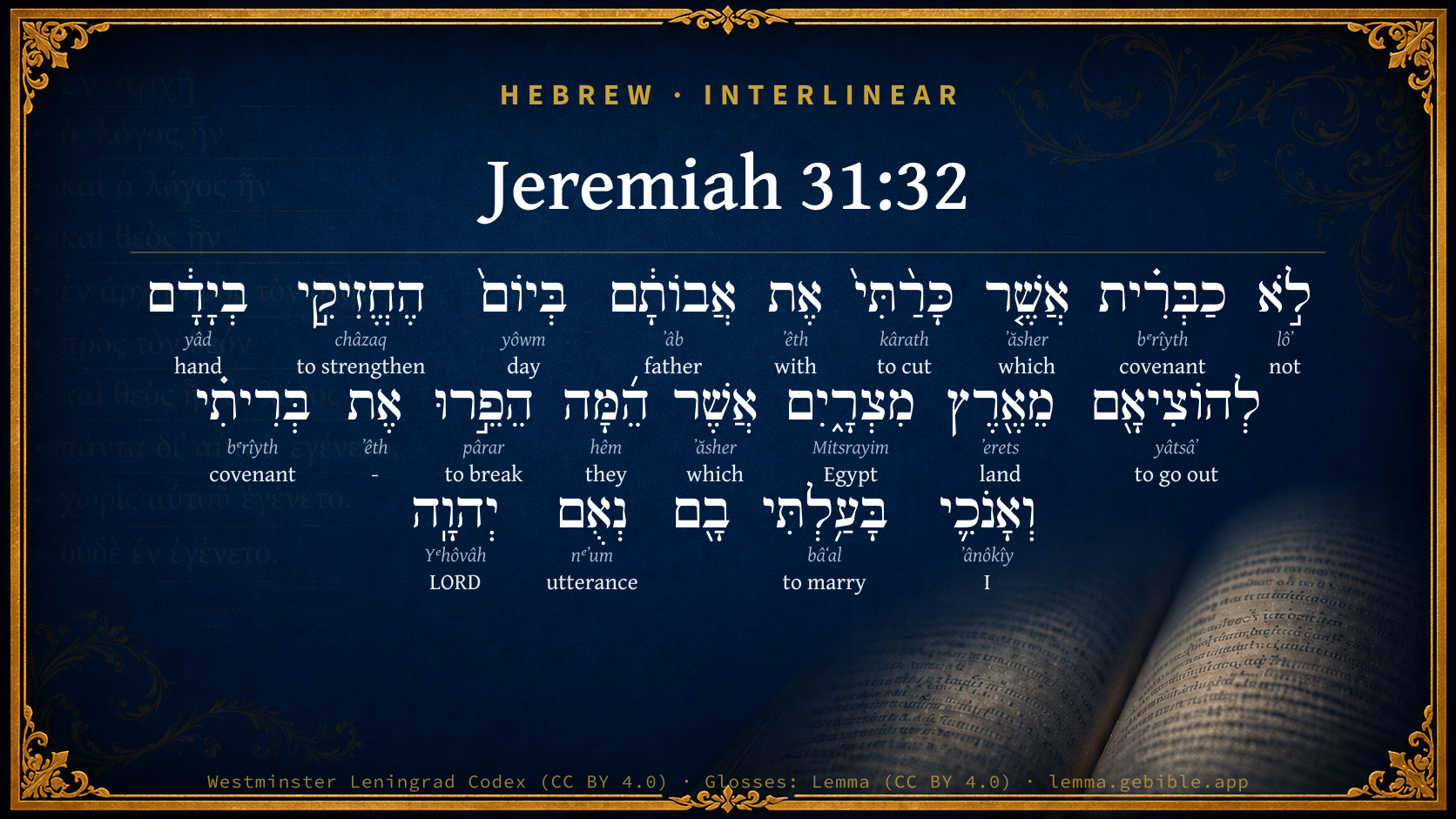
  1. לֹ֣א lôʼ H3808 “not” Particle, Negative
  2. כַבְּרִ֗ית bᵉrîyth H1285 “like/as the · covenant” Preposition, Determined + Noun, Common, Feminine, Singular, Absolute
  3. אֲשֶׁ֤ר ʼăsher H834 “which” Particle, Relative
  4. כָּרַ֨תִּי֙ kârath H3772 “to cut” Verb, Qal, Perfect, 1st Person, Common, Singular
  5. אֶת ʼêth H854 “with” Preposition
  6. אֲבוֹתָ֔ם ʼâb H1 “fathers · their” Noun, Common, Masculine, Plural, Construct + Suffix, Personal, 3rd Person, Masculine, Plural
  7. בְּיוֹם֙ yôwm H3117 “in/at · day of” Preposition + Noun, Common, Masculine, Singular, Construct
  8. הֶחֱזִיקִ֣י châzaq H2388 “to strengthen · me” Verb, Hiphil, Infinitive Construct + Suffix, Personal, 1st Person, Common, Singular
  9. בְיָדָ֔ם yâd H3027 “in/at · hand · their” Preposition + Noun, Common, Both, Singular, Construct + Suffix, Personal, 3rd Person, Masculine, Plural
  10. לְהוֹצִיאָ֖ם yâtsâʼ H3318 “to go out · them” Preposition + Verb, Hiphil, Infinitive Construct + Suffix, Personal, 3rd Person, Masculine, Plural
  11. מֵאֶ֖רֶץ ʼerets H776 “from · land of” Preposition + Noun, Common, Both, Singular, Construct
  12. מִצְרָ֑יִם Mitsrayim H4714 “Egypt” Noun, Proper
  13. אֲשֶׁר ʼăsher H834 “which” Particle, Relative
  14. הֵ֜מָּה hêm H1992 “they” Pronoun, Personal, 3rd Person, Masculine, Plural
  15. הֵפֵ֣רוּ pârar H6565 “to break” Verb, Hiphil, Perfect, 3rd Person, Common, Plural
  16. אֶת ʼêth H853 “-” Particle, Direct Object
  17. בְּרִיתִ֗י bᵉrîyth H1285 “covenant · my” Noun, Common, Feminine, Singular, Construct + Suffix, Personal, 1st Person, Common, Singular
  18. וְאָנֹכִ֛י ʼânôkîy H595 “and · I” Conjunction + Pronoun, Personal, 1st Person, Common, Singular
  19. נְאֻם nᵉʼum H5002 “utterance of” Noun, Common, Masculine, Singular, Construct
  20. יְהוָֽה Yᵉhôvâh H3068 “LORD” Noun, Proper

About this verse

These counts appear in no published source. They are computed here, from the morphology-tagged text and Lemma’s own curated glosses. What Lemma adds →

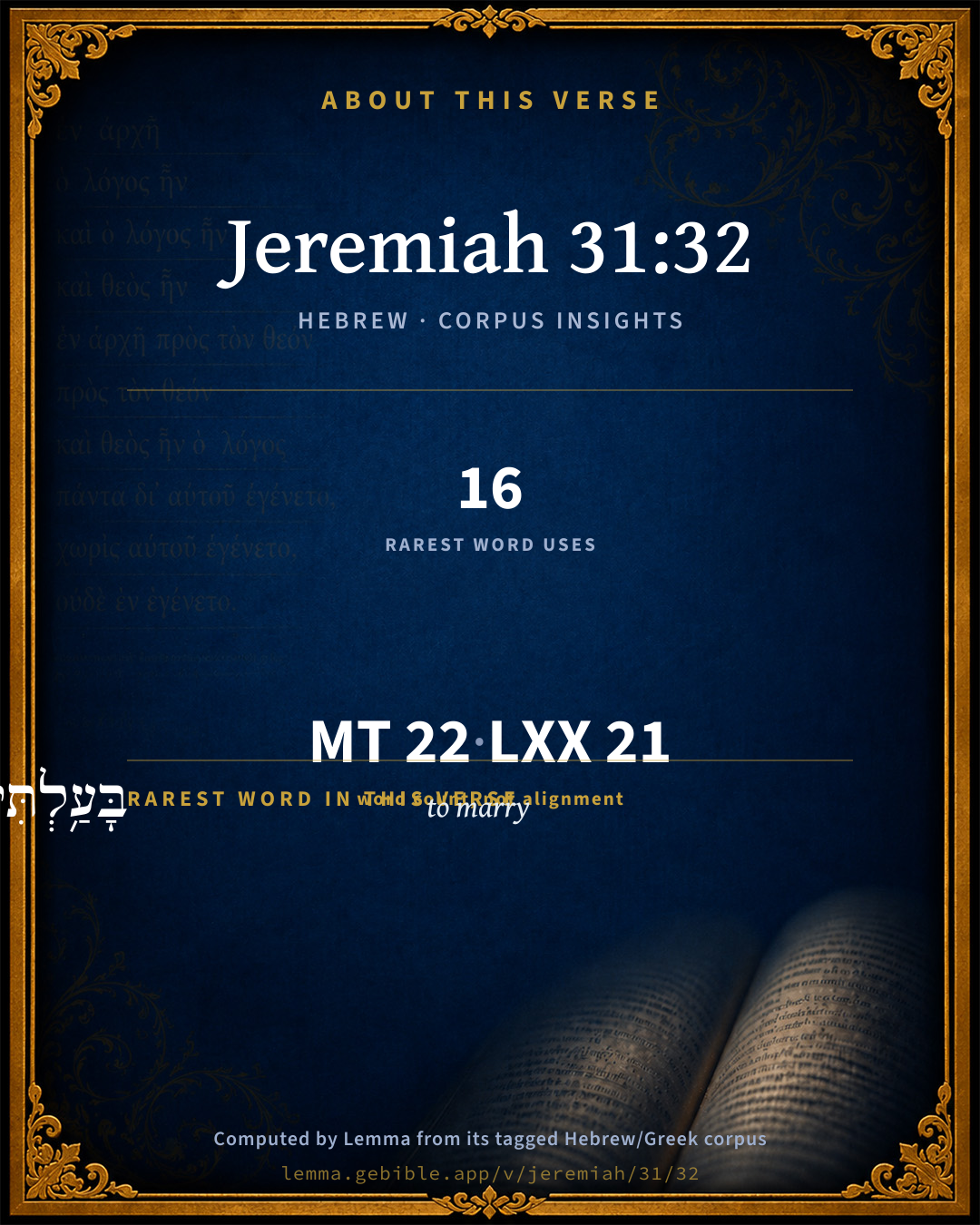
22
words
19
distinct lemmas
Prophets
section

Notable vocabulary

The rarest word here is בָּעַ֥לְתִּי to marry H1166 — appearing just 16 times in the whole Hebrew Bible.

Shared distinctive vocabulary

בָּעַ֥לְתִּי to marry H1166 occurs in 14 verses of the Hebrew Bible. Also found in:

Grammatical profile

  • 5 verbs
  • 9 nouns
  • 2 pronouns
  • 2 prepositions
  • 4 particles

Verb forms

  • כָּרַ֨תִּי֙ Qal · Perfect
  • הֶחֱזִיקִ֣י Hiphil · Infinitive Construct
  • לְהוֹצִיאָ֖ם Hiphil · Infinitive Construct
  • הֵפֵ֣רוּ Hiphil · Perfect
  • בָּעַ֥לְתִּי Qal · Perfect

Repetition

Words recur within this verse — often emphatic in Hebrew:

  • כַבְּרִ֗ית covenant H1285 ×2
  • אֲשֶׁ֤ר which H834 ×2

Hebrew & Septuagint length

In the original languages it is 22 Hebrew tokens and 21 Greek tokens — but the two are counted differently (Hebrew bundles its prefixes and suffixes into one token; the Greek is in lemma form), so that isn’t a like-for-like length.

Cross-references

34

Topical passages linked to Jeremiah 31:32 in the Treasury of Scripture Knowledge — connected by theme and wording, ordered by reader-vote popularity; previews shown in the World English Bible.

  • Exodus 24:6–8 Moses took half of the blood and put it in basins, and half of the blood he sprinkled on the altar.
  • Exodus 19:5 Now therefore, if you will indeed obey my voice, and keep my covenant, then you shall be my own possession from among all peoples; for all the earth is mine;
  • Deuteronomy 1:31 and in the wilderness, where you have seen how that Yahweh your God bore you, as a man does bear his son, in all the way that you went, until you came to this place.
  • Deuteronomy 5:3 Yahweh didn't make this covenant with our fathers, but with us, even us, who are all of us here alive this day.
  • John 3:29 He who has the bride is the bridegroom; but the friend of the bridegroom, who stands and hears him, rejoices greatly because of the bridegroom's voice. This, my joy, therefore is made full.
  • Leviticus 26:15 and if you shall reject my statutes, and if your soul abhors my ordinances, so that you will not do all my commandments, but break my covenant;
  • Jeremiah 3:14 Return, backsliding children, says Yahweh; for I am a husband to you: and I will take you one of a city, and two of a family, and I will bring you to Zion:
  • Jeremiah 11:7–10 For I earnestly protested to your fathers in the day that I brought them up out of the land of Egypt, even to this day, rising early and protesting, saying, Obey my voice.
  • Ezekiel 16:8 Now when I passed by you, and looked at you, behold, your time was the time of love; and I spread my skirt over you, and covered your nakedness: yes, I swore to you, and entered into a covenant with you, says the Lord Yahweh, and you became mine.
  • Ezekiel 16:59–62 For thus says the Lord Yahweh: I will also deal with you as you have done, who have despised the oath in breaking the covenant.
  • Hosea 3:1 Yahweh said to me, "Go again, love a woman loved by another, and an adulteress, even as Yahweh loves the children of Israel, though they turn to other gods, and love cakes of raisins."
  • Deuteronomy 29:1 These are the words of the covenant which Yahweh commanded Moses to make with the children of Israel in the land of Moab, besides the covenant which he made with them in Horeb.
  • Deuteronomy 31:16 Yahweh said to Moses, Behold, you shall sleep with your fathers; and this people will rise up, and play the prostitute after the strange gods of the land, where they go to be among them, and will forsake me, and break my covenant which I have made with them.
  • 1 Kings 8:9 There was nothing in the ark save the two tables of stone which Moses put there at Horeb, when Yahweh made a covenant with the children of Israel, when they came out of the land of Egypt.
  • Psalms 73:23 Nevertheless, I am continually with you. You have held my right hand.
  • Song of Solomon 8:5 Who is this who comes up from the wilderness, Leaning on her beloved? Under the apple tree I aroused you. There your mother conceived you. There she was in labor and bore you.
  • Isaiah 24:5 The earth also is polluted under the inhabitants of it; because they have transgressed the laws, violated the statutes, broken the everlasting covenant.
  • Isaiah 41:13 For I, Yahweh your God, will hold your right hand, saying to you, Don't be afraid; I will help you.
  • Isaiah 54:5 For your Maker is your husband; Yahweh of Hosts is his name: and the Holy One of Israel is your Redeemer; the God of the whole earth shall he be called.
  • Isaiah 63:12–14 who caused his glorious arm to go at the right hand of Moses? who divided the waters before them, to make himself an everlasting name?
  • Jeremiah 2:2 Go, and cry in the ears of Jerusalem, saying, Thus says Yahweh, I remember for you the kindness of your youth, the love of your weddings; how you went after me in the wilderness, in a land that was not sown.
  • Jeremiah 22:9 Then they shall answer, Because they forsook the covenant of Yahweh their God, and worshiped other gods, and served them.
  • Jeremiah 31:1 At that time, says Yahweh, will I be the God of all the families of Israel, and they shall be my people.
  • Jeremiah 34:14 At the end of seven years you shall let go every man his brother who is a Hebrew, who has been sold to you, and has served you six years, you shall let him go free from you: but your fathers didn't listen to me, neither inclined their ear.
  • Ezekiel 20:37 I will cause you to pass under the rod, and I will bring you into the bond of the covenant;
  • Ezekiel 23:4 The names of them were Oholah the elder, and Oholibah her sister: and they became mine, and they bore sons and daughters. As for their names, Samaria is Oholah, and Jerusalem Oholibah.
  • Hosea 2:2 Contend with your mother! Contend, for she is not my wife, Neither am I her husband; And let her put away her prostitution from her face, And her adulteries from between her breasts;
  • Hosea 11:1 "When Israel was a child, then I loved him, And called my son out of Egypt.
  • Mark 8:23 He took hold of the blind man by the hand, and brought him out of the village. When he had spit on his eyes, and laid his hands on him, he asked him if he saw anything.
  • 2 Corinthians 11:2 For I am jealous over you with a godly jealousy. For I married you to one husband, that I might present you as a pure virgin to Christ.
  • Hebrews 8:9 Not according to the covenant that I made with their fathers, In the day that I took them by the hand to lead them out of the land of Egypt; For they didn't continue in my covenant, And I disregarded them," says the Lord.
  • Hebrews 9:18–22 Therefore even the first covenant has not been dedicated without blood.
  • Deuteronomy 29:21 Yahweh will set him apart to evil out of all the tribes of Israel, according to all the curses of the covenant that is written in this book of the law.
  • Hosea 11:3–4 Yet I taught Ephraim to walk. I took them by his arms; But they didn't know that I healed them.

Cross-references courtesy of OpenBible.info (CC BY 4.0).

Hebrew and Greek witnesses Masoretic Hebrew ↔ Greek Septuagint

The same verse in the two great witnesses to the Old Testament, shown verse-for-verse.

These are two independent witnesses, not word-aligned to each other, and the Septuagint is shown in lemma (dictionary) form.

Hebrew Jeremiah 31:32 Masoretic · Westminster Leningrad Codex

לֹ֣א כַבְּרִ֗ית אֲשֶׁ֤ר כָּרַ֨תִּי֙ אֶת אֲבוֹתָ֔ם בְּיוֹם֙ הֶחֱזִיקִ֣י בְיָדָ֔ם לְהוֹצִיאָ֖ם מֵאֶ֖רֶץ מִצְרָ֑יִם אֲשֶׁר הֵ֜מָּה הֵפֵ֣רוּ אֶת בְּרִיתִ֗י וְאָנֹכִ֛י בָּעַ֥לְתִּי בָ֖ם נְאֻם יְהוָֽה

not according to the covenant that I made with their fathers in the day that I took them by the hand to bring them out of the land of Egypt; which my covenant they broke, although I was a husband to them, says Yahweh.

World English Bible · Public Domain

Greek LXX Structure differs

In the Septuagint, Jeremiah is about an eighth shorter than the Hebrew and arranges its material differently — the Oracles Against the Nations (Hebrew chapters 46–51) appear in the middle of the Greek book, after 25:13. Because the chapter and verse boundaries do not line up, a verse-for-verse comparison with the Hebrew is not shown.

A verse-for-verse comparison isn’t shown here because the chapters and verses don’t line up. Switch to the LXX edition with the MT / LXX toggle above to read the Greek directly.

On this verse, Jamieson, Fausset & Brown discusses the Septuagint’s reading. Read the note in Commentary ↓

Hebrew: Westminster Leningrad Codex (CC BY 4.0). Greek: Septuagint (public domain); English from a public-domain English Septuagint. How the Septuagint differs from the Hebrew →

Targum (Aramaic paraphrase)

1

The Targum is the ancient Jewish Aramaic paraphrase of the Hebrew Scriptures — an interpretive translation, not the Hebrew text itself. Onkelos (literal) and Pseudo-Jonathan (expansive) render the Torah, and Jonathan the Prophets. Coverage is partial: where no permissively-licensed English translation exists for a verse, only the Aramaic is shown. This is verse-level text, not a word-by-word alignment to the Hebrew.

  1. Targum Jonathan Prophets (Joshua–Malachi)
    לָא כִקְיָמָא דִגְזָרֵית עִם אֲבָהַתְהוֹן בְּיוֹמָא דְאַתְקְפֵית בִּידֵיהוֹן לְמִפַּקְהוֹן מֵאַרְעָא דְמִצְרַיִם דְאִינוּן אַשְׁנִיאוּ יַת קְיָמִי וַאֲנָא אִתְרְעֵיתִי בְהוֹן אֲמַר יְיָ:

    "Not like the covenant that I made with their ancestors on the day I took them by the hand to lead them out of the land of Egypt;...,..., says the Lord."

    Targum Jonathan — Aramaic: “Mikraot Gedolot” (public domain). English: “Sefaria Community Translation” (CC0 1.0 (public-domain dedication)); “London "Chaldee Paraphrase," 1871” (public domain). Text via Sefaria.

Commentary

Notes on Jeremiah 31:32 from classic Christian and Jewish commentators (each source and its license shown beneath its notes). The classic Christian expositions comment on the surrounding passage and are grouped to its opening verse, so a note may address several verses; the Jewish commentaries on the Tanakh (Rashi and others) are per-verse, so they appear only where the commentator wrote on this verse.

Lemma curates 59 commentaries, every one of them public domain or Creative Commons licensed, each selected and text-cleaned for this edition rather than reprinted as found. About our sources →

Trapp's Complete Commentary

John Trapp

Jer 31:32 Not according to the covenant that I made with their fathers in the day [that] I took them by the hand to bring them out of the land of Egypt; which my covenant they brake, although I was an husband unto them, saith the LORD:

Ver. 32. Not according to the covenant.] Not so, but a great deal better, in regard of larger measures of the Spirit now poured out upon all flesh: together with the efficacy thereof in the hearts of God’s covenanters, who have a duplicate of God’s law written within them. {Jer 31:33} Lex iubet, gratia iuvat: hence it is an "everlasting covenant," and the fruits of it are "sure mercies," "compassions that fail not," as is here set forth.

John Trapp, A Commentary or Exposition upon All the Books of the Old and New Testament (1647–1656) — public domain. Text from a community e-Sword module.

Tyndale Open Study Notes

Tyndale Open Resources

31:32-34 The key difference between the new covenant and the one God made with their ancestors is that the Lord would write his instructions deep within his people’s hearts (see Heb 10:16). The old covenant was external and legal, whereas the new covenant would be a vital, person-to-person relationship. The new covenant would emphasize the redeeming, transforming change of an individual’s spiritual nature.

Tyndale Open Study Notes — © Tyndale Open Resources, licensed CC BY-SA 4.0. Text via the HelloAO Bible API.

Geneva Bible (1599)

Geneva Bible translators

And so were the occasion of their own divorcement through their infidelity, Isa. 50:1.

Or, master.

Geneva Bible (1599) marginal notes — public domain. Text via Bolls.life.

Jamieson, Fausset & Brown

Robert Jamieson, A. R. Fausset & David Brown

Not . . . the covenant that I made with . . . fathers--the Old Testament covenant, as contrasted with our gospel covenant (Heb 8:8-12; Heb 10:16-17, where this prophecy is quoted to prove the abrogation of the law by the gospel), of which the distinguishing features are its securing by an adequate atonement the forgiveness of sins, and by the inworking of effectual grace ensuring permanent obedience. An earnest of this is given partially in the present eclectic or elect Church gathered out of Jews and Gentiles. But the promise here to Israel in the last days is national and universal, and effected by an extraordinary outpouring of the Spirit (Jer 31:33-34; Eze 11:17-20), independent of any merit on their part (Eze 36:25-32; Eze. 37:1-28; Eze 39:29; Joe 2:23-28; Zac 12:10; Co2 3:16).

took . . . by . . . hand-- (Deu 1:31; Hos 11:3).

although I was an husband--(compare Jer 3:14; Hos 2:7-8). But the Septuagint, Syriac, and St. Paul (Heb 8:9) translate, "I regarded them not"; and GESENIUS, &c., justify this rendering of the Hebrew from the Arabic. The Hebrews regarded not God, so God regarded them not.

Jamieson, Fausset & Brown — Commentary Critical and Explanatory on the Whole Bible (1871) — public domain (CC PDM 1.0). Text via the HelloAO Bible API.

John Calvin's Commentaries

He says that the covenant which he will make will not be such as he had made with their fathers Here he clearly distinguishes the new covenant from the Law. The contrast ought to be borne in mind; for no one of the Jews thought it possible that God would add anything better to the Law. For though they regarded the Law almost as nothing, yet we know that hypocrites pretended with great ardor of zeal that they were so devoted to the Law, that they thought that heaven and earth could sooner be blended together, than that any change should be made in the Law; and at the same time they held most tenaciously what God had only for a time instituted. It was therefore necessary that the Law should be here contrasted with the new covenant, that the Jews might know that the favor in reserve for them would be far more excellent than what had been formerly manifested to the fathers. This, then, is the reason why he says, not according to the covenant, etc.

He afterwards adds, which I made with their fathers when I laid hold of their hand, etc. Here he shows that they could never have a firm hope of salvation, unless God made a new covenant. Such was their pride, that they hardly would have received the favor of God, had they not been convinced of this truth: for this would have been always in their mouth, “Did not God shew himself a Father to his people when he redeemed them? was it not a testimony of his paternal favor? has he not elevated the condition of the Church, which he designs to be perpetual?” They would have therefore rejected the favor of God, had not the Prophet openly declared that the Law had been and would be still useless to them, and that there was therefore a necessity for a new covenant, otherwise they must have perished.

We now perceive the design of the Prophet; and this ought to be carefully observed; for it would not be enough to know what the Prophet says, except we also know why he says this or that. The meaning then is, that it ought not to appear strange that God makes a new covenant, because the first had been useless and was of no avail. Then he confirms this, because God made the first covenant when he stretched out his hand to his ancient people, and became their liberator; and yet they made void that covenant. The circumstance as to the time ought to be noticed, for the memory of a recent benefit ought to be a most powerful motive to obedience. For how base an ingratitude it was for those, who had been delivered by the wonderful power of God, to reject his covenant at a time when they had been anticipated by divine mercy? As then they had made void even at that time the covenant of God, it may with certainty be concluded, that there had been no time in which they had not manifested their impiety, and had not been covenant-breakers.

He adds, I however ruled over them, or was Lord over them. Though some confine the verb בעלתי bolti, to the rule exercised by a husband, and this would not be unsuitable, as God not only ruled then over his people, but was also their husband, a similitude which is often used; yet I know not whether this view can be satisfactorily sustained we ought therefore to be satisfied with the general truth, that God had the people under his own authority, as though he had said, that he only used his own right in ruling over them and prescribing to them the way in which they were to live. At the same time the word covenant, was more honorable to the people. For when a king enjoins anything on his people, it is called an edict; but God deals with his own people more kindly, for he descends and appears in the midst of them, that he may bind himself to his people, as he binds the people to himself. We hence see, in short, why God says that he ruled over the people, even because he had purchased them for himself, and yet he had not enjoyed his own right on account of the untameable and perverse disposition of the people.

It ought at the same time to be observed, that the fault is here cast on the people, that the Law was weak and not sufficiently valid, as we see that Paul teaches us in Romans 7:12. For as soon as the weakness of the Law is spoken of, the greater part lay hold of something they deem wrong in the Law, and thus the Law is rendered contemptible: hence the Prophet says here that they had made God’s covenant void, as though he had said, that the fault was not to be sought in the Law that there was need of a new covenant, for the Law was abundantly sufficient, but that the fault was in the levity and the unfaithfulness of the people. We now then see that nothing is detracted from the Law when it is said to be weak and ineffectual; for it is an accidental fault derived from men who do not observe nor keep their pledged faith. There are still more things to be said; but I now, as I have said, touch but briefly on the words of the Prophet. It then follows, —

John Calvin's Commentaries (1540-1563) — public domain. Text from the Calvin Translation Society English edition (1840s-50s) via the Christian Classics Ethereal Library (ccel.org). Calvin's coverage is partial (roughly two-thirds of the Bible); uncommented books and verses are honest gaps, never fabricated. The 19th-century editor's footnotes and remarks are omitted so the notes are faithfully Calvin's own voice.

Ellicott's Commentary for English Readers

(32) Not according to the covenant . . .—Our familiarity with the words hinders us, for the most part, from recognising what must have seemed their exceeding boldness. That the Covenant with Israel, given with all conceivable sanctions as coming directly from Jehovah (Exo_24:7-8), should thus be set aside, as man repeals an earthly law;—the man who could say this without trembling must indeed have been confident that he too was taught of God, and that the new teaching was higher than the old.

Although I was an husband unto them.—The words declare the ground on which Jehovah might well have looked for the allegiance of Israel. (See Notes on Jer_2:2; Jer_3:20.)

A Bible Commentary for English Readers, edited by Charles John Ellicott (1878–1897) — public domain. Text from a community e-Sword module.

The Cambridge Bible for Schools and Colleges

gen. ed. J. J. S. Perowne

32. in the day] See on Jer_7:22.

took them by the hand] with fostering care, as of a father guiding the faltering steps of a young child. Cp. Hos_11:1-4.

to bring them … Egypt] omitted by Co., as well as the last three words of the v., so restoring the Ḳinah measure.

which my covenant they brake] mg. forasmuch as they brake my covenant. The contrast between “they” and the “I” of the next clause is emphasized in the original.

although I was an husband unto them] mg. lord over them. We should, however, changing one Heb. letter, read (supported by LXX and Syr.) and I abhorred them. Cp. “and I regarded them not” in Heb_8:9. Jehovah’s rejection of them was a gradual process, culminating in the overthrow of the Northern and later of the Southern kingdom.

The Cambridge Bible for Schools and Colleges (gen. ed. J. J. S. Perowne; Cambridge University Press, 1878–1918) — public domain. Text from a community e-Sword module.

John Gill's Exposition

Not according to the covenant that I made with their fathers,.... Meaning not Abraham, Isaac, and Jacob; but the ancestors of the Jews that came out of Egypt, as appears by what follows. This was the covenant made at Sinai, which is here referred to; but the above covenant was not according to that; for, though it was not properly a covenant of works, but a typical one; yet it was in some sense faulty and deficient; or, however, the persons under it were faulty, and did not keep it; and besides, it was made with the Israelites; whereas this new covenant belongs both to Jews and Gentiles. That the Sinai covenant is intended is clear by the following circumstances:

in the day that I took them by the hand, to bring them out of the land of Egypt; that is, immediately after their being brought out of Egypt, the covenant was made with them; see Exo 19:1; at which time of their bringing out, the Lord took them by the hand, as being unable to deliver themselves, and to go out of themselves; which is expressive, as of their weakness, so of his power and goodness, kindness and tenderness to them; and is an aggravation of their ingratitude to him in breaking the covenant, made with them at such a time by the Lord, who was so kind and indulgent to them; and which is still more fully expressed in the following clause:

which my covenant they brake, although I was an husband unto them,

saith the Lord; they promised fair, but did not perform; their hearts were not right with God, nor were they steadfast in his covenant; though it was such a solemn transaction, and had the nature of a matrimonial contract; it was the day of their espousal; they were betrothed to the Lord, and he acted the part of a husband to them in nourishing and cherishing them in providing food and raiment for them; manna that continued with them, and clothes that waxed not old; and in protecting them from their enemies, and bringing them to a good settlement in the land of Canaan. The Septuagint version renders it, "and I regarded them not"; and so the apostle, Heb 8:9; for the reconciliation of which to the Hebrew text See Gill on Heb 8:9.

John Gill's Exposition of the Whole Bible (1746–1763) — public domain (CC PDM 1.0). Text via the HelloAO Bible API.

Haydock's Catholic Bible Commentary

Dominion. As a husband, (Hebrew; Calmet) or "Lord." (Haydock) --- "I despised them." (Septuagint) (Hebrews viii.)

George Leo Haydock (1774–1849), Haydock's Catholic Family Bible and Commentary, 1859 edition — public domain. Excludes Psalms (Douay-Rheims chapter numbering differs from Protestant) and Deuterocanonical books (Catholic canon only).

Matthew Poole's English Annotations

Not in substance differing from it, but in circumstances vastly differing, as was showed before, and is further declared afterward. The covenant which God made with the Jews when they came out of the land of Egypt, was on God’s part the law which he gave them, with the promises annexed to their observation of it; on their part (which made it a formal covenant) their promise of obedience to it, of which see Exo 24:7,8; Deu 26:17,18. This covenant God saith he made with them when they were an impotent, weak people, the care of whom he took upon him, and led them as a parent leadeth the feeble child by his hand. None must imagine that this covenant did not contain the promise of pardon, through the blood of the Messiah, upon their application to him, for to what purpose else was it confirmed by blood? Exo 24:8. Which covenant they are said to have broken, not because of every disobedience to the law of God, for so every one daily breaketh it, but by their gross and eminent sinnings, so oft repeated and continued in without repentance; and more particularly by their idolatry, which is compared to whoredom, which breaketh the covenant and bond of marriage, and causeth God to say unto a people, Lo Ammi, You are not my people. And this covenant-breaking is aggravated from God’s kindness to them, and care of them; who had for them the love, and declared the care, of a husband, and gave them no temptation to go a whoring from him.

Matthew Poole's English Annotations on the Holy Bible (1683–1685) — public domain. Text from a community e-Sword/MySword module.

The Pulpit Commentary

Although I was a husband unto them. The translation of the Septuagint kagw hmelhsa autwn , is undoubtedly wrong, though adopted for consistency"s sake by the author of Heb_8:9. The phrase is the same as in Jer_3:14, where even the Septuagint has egw katakurieusw umwn .

God the Husband of his people.

Cf. homily on Jer_3:14 C.

The Pulpit Commentary (1880–1919), ed. H.D.M. Spence-Jones & Joseph S. Exell — public domain. Text from a community e-Sword module.

John Wesley's Explanatory Notes

Not according - The covenant which God made with the Jews when they came out of the land of Egypt, was on God's part the law which he gave them, with the promises annexed; on their part (which made it a formal covenant) their promise of obedience to it.

John Wesley, Explanatory Notes Upon the Whole Bible (1754–1765) — public domain. Text via the GEBible commentary corpus.

Lesson kit

Teaching starters — assembled from the data on this page, not authored interpretation. Every prompt links to the verse data it draws on. Edit before teaching.

Jeremiah, in the Prophets, opens this verse with 22 words (19 distinct Hebrew lemmas). Its most distinctive word is bâʻal (“to marry”). A historical commentator’s framing appears above. Read the whole chapter for the surrounding context.

Discussion questions

  1. What does “to marry” (bâʻal) contribute to the verse as a whole?
  2. Genesis 20:3 shares the word «to marry» with this verse. How do the two illuminate each other?
  3. “covenant” occurs 2× in this one verse. What is the effect of the repetition?
  4. These translations render this verse differently; the difference is in the English rendering, not the original. What questions does that raise?
  5. The verb «כָּרַ֨תִּי֙» is Qal Perfect. How does its form color the action?
  6. Reading how Trapp's Complete Commentary and Tyndale Open Study Notes read this verse, where do the two commentators agree and where do they part?

Things to notice

Reading settings

Reading text

Shown beneath each verse's original-language words.

Old Testament
Old Testament edition

Read the OT as the Masoretic Hebrew (MT) or the Greek Septuagint (LXX).

English shown for the Greek Septuagint (in the Hebrew ↔ Greek comparison).

Comparing translations? Open the Compare panel on any verse page to stack up to four side by side.