
Ezekiel 30:8

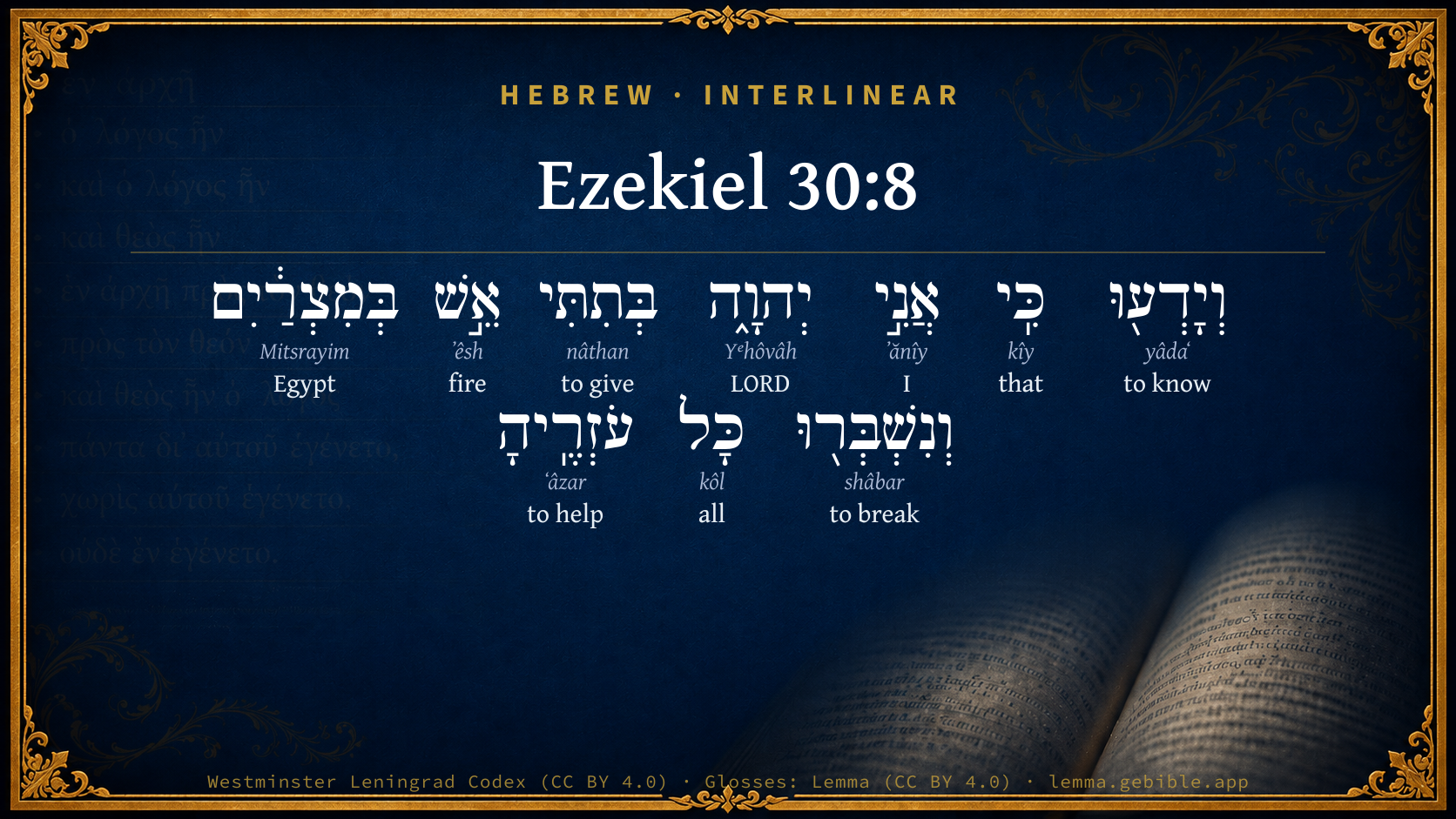
Hebrew (Westminster Leningrad Codex) Ezekiel 30:8 appears in the Hebrew Old Testament. The text above is from the Westminster Leningrad Codex. Each word links to its Strong’s number, a concise gloss, and parsing drawn from the Open Scriptures Hebrew Bible morphology. Click any word for its full Brown-Driver-Briggs (BDB) entry.
Download image
Cite this verse

Ezekiel 30:8 (World English Bible). Public Domain. Lemma interlinear Bible study tool, https://lemma.gebible.app/v/ezekiel/30/8.

Show BibTeX & RIS
BibTeX
RIS
English Translation
They shall know that I am Yahweh, when I have set a fire in Egypt, and all her helpers are destroyed.
World English Bible · Public Domain
Download a study sheet

One document with this verse’s original text, its word-by-word gloss line, the meaning frame, cross-references with their text, attributed commentary, and full source and license credits — printable, and it pastes into notes with its structure intact.

This verse Autodidact and up

Study sheet (.html) Plain text (.txt)

A passage Seminary Student

Up to 50 verses in one chapter. A passage sheet keeps up to 6 commentary sources and 12 cross-references per verse, in the order this page ranks them, and says so on the sheet whenever that leaves anything out. Ask for a single verse and you get the Autodidact verse sheet above.

Everything on this page stays free to read, with no account — the sheet is a download of what is already on screen, not access to it.

Want to remove ads? Support Godless Engineer
Compare translations 3

The same verse in 3 English versions, stacked beneath the original-language interlinear above. Click any original word for its lexicon entry.

Each is an independent rendering of the whole verse — the interlinear is not word-aligned to these translations.

Highlighted words mark where these versions differ — a whole-verse word diff, not a word-by-word alignment.

  • World English Bible Public Domain
    They shall know that I am Yahweh, when I have set a fire in Egypt, and all her helpers are destroyed.
  • King James Version Public Domain
    And they shall know that I am the LORD, when I have set a fire in Egypt, and when all her helpers shall be destroyed.
  • unfoldingWord Literal Text CC BY-SA 4.0
    Then they will know that I am Yahweh, when I set fire in Egypt, and when all of her helpers are destroyed.

unfoldingWord Literal Text — © unfoldingWord, licensed CC BY-SA 4.0. Word-aligned USFM3 via Door43 (git.door43.org/unfoldingWord/en_ult).

Versions to compare (up to 4)

3 of 4 selected

Show all 18 translations

Every available English version of this verse, each an independent rendering of the whole verse.

  • World English Bible Public Domain
    They shall know that I am Yahweh, when I have set a fire in Egypt, and all her helpers are destroyed.
  • Berean Standard Bible Public Domain
    Then they will know that I am the LORD when I set fire to Egypt and all her helpers are shattered.
  • Majority Standard Bible Public Domain
    Then they will know that I am the LORD when I set fire to Egypt and all her helpers are shattered.
  • King James Version Public Domain
    And they shall know that I am the LORD, when I have set a fire in Egypt, and when all her helpers shall be destroyed.
  • American Standard Version (1901) Public Domain
    And they shall know at I am Jehovah, when I have set a fire in Egypt, and all her helpers are destroyed.
  • Revised Version (1885) Public Domain
    And they shall know that I am the LORD, when I have set a fire in Egypt, and all her helpers are destroyed.
  • Geneva Bible (1599) Public Domain
    And they shall knowe that I am the Lord, when I haue set a fire in Egypt, and when all her helpers shall be destroyed.
  • Douay-Rheims (1899) Public Domain
    And they shall know that I am the Lord: when I shall have set a fire in Egypt, and all the helpers thereof shall be destroyed.
  • Young's Literal Translation Public Domain
    And they have known that I `am' Jehovah, In My giving fire against Egypt, And broken have been all her helpers.
  • Literal Standard Version CC BY-SA 4.0
    And they have known that I [am] YHWH, || In My giving fire against Egypt, || And all her helpers have been broken.
  • Unlocked Literal Bible CC BY-SA 4.0
    Then they will know that I am Yahweh, when I set fire in Egypt, and when all of her helpers are destroyed.
  • unfoldingWord Literal Text CC BY-SA 4.0
    Then they will know that I am Yahweh, when I set fire in Egypt, and when all of her helpers are destroyed.
  • Darby Bible Public Domain
    And they shall know that I [am] Jehovah, when I have set a fire in Egypt, and all her helpers shall be broken.
  • World Messianic Bible Public Domain
    They will know that I am the LORD when I have set a fire in Egypt, and all her helpers are destroyed.
  • Webster's Bible Public Domain
    And they shall know that I am the LORD, when I have set a fire in Egypt, and when all her helpers shall be destroyed.
  • Free Bible Version CC BY-SA 4.0
    Then they will acknowledge that I am the Lord when I set fire to Egypt and all its allies are crushed.
  • Bible in Basic English Public Domain
    And they will be certain that I am the Lord, when I have put a fire in Egypt and all her helpers are broken.
  • JPS Tanakh (1917) Public Domain
    And they shall know that I am the LORD, when I have set a fire in Egypt, and all her helpers are destroyed.

Literal Standard Version (2020), Covenant Press — licensed CC BY-SA 4.0. Text via the HelloAO Bible API (eBible.org). Unlocked Literal Bible (unfoldingWord) — licensed CC BY-SA 4.0. Text via the HelloAO Bible API (eBible.org). unfoldingWord Literal Text — © unfoldingWord, licensed CC BY-SA 4.0. Word-aligned USFM3 via Door43 (git.door43.org/unfoldingWord/en_ult). Free Bible Version, Dr. Jonathan Gallagher — licensed CC BY-SA 4.0. Text via the HelloAO Bible API (eBible.org).

Word by word

More ways to search: Search by grammar → Find every occurrence → Compare this word →

Practice this passage: Drill this verse → Learn its vocabulary →

עֹזְרֶֽיהָ
ʻâzar
H5826
“helping · her”
Verb, Qal, Participle Active, Masculine, Plural, Construct + Suffix, Personal, 3rd Person, Feminine, Singular
Part of Speech
Verb
Stem
Qal
Form
Participle Active
Gender
Masculine
Number
Plural
State
Construct
Full BDB Definition

Origin: a primitive root

TWOT: 1598

to help, succour, support - (Qal) to help - (Niphal) to be helped - (Hiphil) to help
  1. וְיָדְע֖וּ yâdaʻ H3045 “and · to know” Conjunction + Verb, Qal, Sequential Perfect, 3rd Person, Common, Plural
  2. כִּֽי kîy H3588 “that” Conjunction
  3. אֲנִ֣י ʼănîy H589 “I” Pronoun, Personal, 1st Person, Common, Singular
  4. יְהוָ֑ה Yᵉhôvâh H3068 “LORD” Noun, Proper
  5. בְּתִתִּי nâthan H5414 “in/at · to give · me” Preposition + Verb, Qal, Infinitive Construct + Suffix, Personal, 1st Person, Common, Singular
  6. אֵ֣שׁ ʼêsh H784 “fire” Noun, Common, Both, Singular, Absolute
  7. בְּמִצְרַ֔יִם Mitsrayim H4714 “in/at · Egypt” Preposition + Noun, Proper
  8. וְנִשְׁבְּר֖וּ shâbar H7665 “and · to break” Conjunction + Verb, Niphal, Sequential Perfect, 3rd Person, Common, Plural
  9. כָּל kôl H3605 “all of” Noun, Common, Masculine, Singular, Construct

About this verse

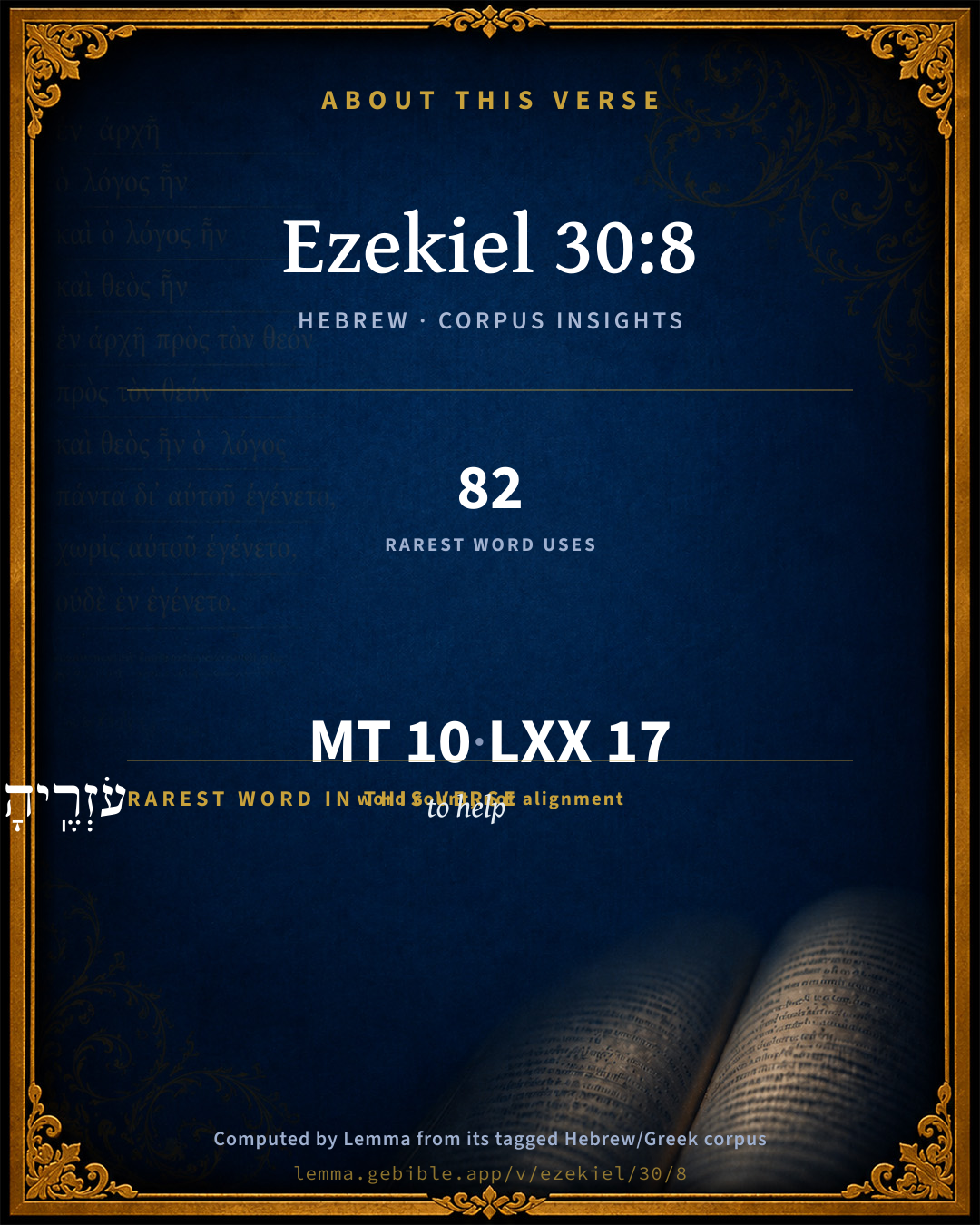
These counts appear in no published source. They are computed here, from the morphology-tagged text and Lemma’s own curated glosses. What Lemma adds →

10
words
10
distinct lemmas
Prophets
section

Grammatical profile

  • 4 verbs
  • 4 nouns
  • 1 pronoun
  • 1 conjunction

Verb forms

  • וְיָדְע֖וּ Qal · Sequential Perfect
  • בְּתִתִּי Qal · Infinitive Construct
  • וְנִשְׁבְּר֖וּ Niphal · Sequential Perfect
  • עֹזְרֶֽיהָ Qal · Participle Active

Hebrew & Septuagint length

In English translation the verse runs 21 words from the Hebrew and 25 from the Septuagint (LXX English) — closely comparable.

A rough comparison of the two English renderings, which tokenize alike — not a word-level alignment.

Word counts can differ between the Hebrew and the Greek without any difference in meaning — e.g. the Hebrew direct-object marker אֵת has no separate Greek word, and Greek often adds the article ὁ.

In the original languages it is 10 Hebrew tokens and 17 Greek tokens — but the two are counted differently (Hebrew bundles its prefixes and suffixes into one token; the Greek is in lemma form), so that isn’t a like-for-like length.

Cross-references

20

Topical passages linked to Ezekiel 30:8 in the Treasury of Scripture Knowledge — connected by theme and wording, ordered by reader-vote popularity; previews shown in the World English Bible.

  • Ezekiel 29:6 All the inhabitants of Egypt shall know that I am Yahweh, because they have been a staff of reed to the house of Israel.
  • Psalms 58:11 So that men shall say, "Most assuredly there is a reward for the righteous. Most assuredly there is a God who judges the earth."
  • Ezekiel 22:31 Therefore have I poured out my indignation on them; I have consumed them with the fire of my wrath: their own way have I brought on their heads, says the Lord Yahweh.
  • Ezekiel 29:9 The land of Egypt shall be a desolation and a waste; and they shall know that I am Yahweh. Because he has said, The river is mine, and I have made it;
  • Ezekiel 29:16 It shall be no more the confidence of the house of Israel, bringing iniquity to memory, when they turn to look after them: and they shall know that I am the Lord Yahweh.
  • Ezekiel 30:14 I will make Pathros desolate, and will set a fire in Zoan, and will execute judgments on No.
  • Ezekiel 30:16 I will set a fire in Egypt: Sin shall be in great anguish, and No shall be broken up; and Memphis [shall have] adversaries in the day-time.
  • Amos 1:4 But I will send a fire into the house of Hazael, And it will devour the palaces of Ben Hadad.
  • Amos 1:7 But I will send a fire on the wall of Gaza, And it will devour its palaces.
  • Amos 1:10 But I will send a fire on the wall of Tyre, And it will devour its palaces."
  • Amos 1:12 But I will send a fire on Teman, And it will devour the palaces of Bozrah."
  • Amos 1:14 But I will kindle a fire in the wall of Rabbah, And it will devour its palaces, With shouting in the day of battle, With a tempest in the day of the whirlwind;
  • Deuteronomy 32:22 For a fire is kindled in my anger, Burns to the lowest Sheol, Devours the earth with its increase, Sets on fire the foundations of the mountains.
  • Isaiah 42:25 Therefore he poured on him the fierceness of his anger, and the strength of battle; and it set him on fire round about, yet he didn't know; and it burned him, yet he didn't lay it to heart.
  • Lamentations 4:11 Yahweh has accomplished his wrath, he has poured out his fierce anger; He has kindled a fire in Zion, which has devoured the foundations of it.
  • Ezekiel 28:24 There shall be no more a pricking brier to the house of Israel, nor a hurting thorn of any that are round about them, that did despite to them; and they shall know that I am the Lord Yahweh.
  • Ezekiel 28:26 They shall dwell securely therein; yes, they shall build houses, and plant vineyards, and shall dwell securely, when I have executed judgments on all those who do them despite round about them; and they shall know that I am Yahweh their God.
  • Amos 2:2 But I will send a fire on Moab, And it will devour the palaces of Kerioth; And Moab will die with tumult, with shouting, and with the sound of the trumpet;
  • Amos 2:5 But I will send a fire on Judah, And it will devour the palaces of Jerusalem."
  • Nahum 1:5–6 The mountains quake before him, and the hills melt away. The earth trembles at his presence, yes, the world, and all who dwell in it.

Cross-references courtesy of OpenBible.info (CC BY 4.0).

Hebrew and Greek witnesses Masoretic Hebrew ↔ Greek Septuagint

The same verse in the two great witnesses to the Old Testament, shown verse-for-verse.

These are two independent witnesses, not word-aligned to each other, and the Septuagint is shown in lemma (dictionary) form.

Hebrew Ezekiel 30:8 Masoretic · Westminster Leningrad Codex

וְיָדְע֖וּ כִּֽי אֲנִ֣י יְהוָ֑ה בְּתִתִּי אֵ֣שׁ בְּמִצְרַ֔יִם וְנִשְׁבְּר֖וּ כָּל עֹזְרֶֽיהָ

They shall know that I am Yahweh, when I have set a fire in Egypt, and all her helpers are destroyed.

World English Bible · Public Domain

Greek LXX Ezekiel 30:8 Septuagint · lemma form

καί γιγνώσκω ὅτι ἐγώ εἰμί κύριος ὅταν δίδωμι πῦρ ἐπί αἴγυπτος καί συντρίβω πᾶς ὁ βοηθέω αὐτός

and they shall know that I am the Lord, when I shall send fire upon Egypt, and when all that help her shall be broken.

LXX2012 (modern English Septuagint) · Public Domain

Hebrew: Westminster Leningrad Codex (CC BY 4.0). Greek: Septuagint (public domain); English from LXX2012 (modern English Septuagint) (Public Domain). How the Septuagint differs from the Hebrew →

Targum (Aramaic paraphrase)

1

The Targum is the ancient Jewish Aramaic paraphrase of the Hebrew Scriptures — an interpretive translation, not the Hebrew text itself. Onkelos (literal) and Pseudo-Jonathan (expansive) render the Torah, and Jonathan the Prophets. Coverage is partial: where no permissively-licensed English translation exists for a verse, only the Aramaic is shown. This is verse-level text, not a word-by-word alignment to the Hebrew.

  1. Targum Jonathan Prophets (Joshua–Malachi)
    וְיֵדְעוּן אֲרֵי אֲנָא יְיָ בִּדְאֶתֵּן עַמְמַיָא דְתַקִיפִין כְּאֶשְׁתָּא עַל מִצְרַיִם וְיִתְּבְרוּן כָּל סְעִידָהָא:

    (no public-domain English translation for this verse)

    Targum Jonathan — Aramaic: “Mikraot Gedolot” (public domain). English: “Sefaria Community Translation” (CC0 1.0 (public-domain dedication)); “London "Chaldee Paraphrase," 1871” (public domain). Text via Sefaria.

Commentary

Notes on Ezekiel 30:8 from classic Christian and Jewish commentators (each source and its license shown beneath its notes). The classic Christian expositions comment on the surrounding passage and are grouped to its opening verse, so a note may address several verses; the Jewish commentaries on the Tanakh (Rashi and others) are per-verse, so they appear only where the commentator wrote on this verse.

Lemma curates 59 commentaries, every one of them public domain or Creative Commons licensed, each selected and text-cleaned for this edition rather than reprinted as found. About our sources →

Trapp's Complete Commentary

John Trapp

Eze 30:8 And they shall know that I [am] the LORD, when I have set a fire in Egypt, and [when] all her helpers shall be destroyed.

Ver. 8. And they shall know that I am the Lord.] Men will not take knowledge of this till they have paid for their learning, Vexatio dat intellectum. Smart makes wit. {a}

When I have set a fire in Egypt.] War is fitly compared to fire; it feeds upon the people. See Isa 9:19. {See Trapp on "Isa 9:19"}

{a} Non est perissologia: repetitur cum fructu. - Lavat.

John Trapp, A Commentary or Exposition upon All the Books of the Old and New Testament (1647–1656) — public domain. Text from a community e-Sword module.

The Cambridge Bible for Schools and Colleges

gen. ed. J. J. S. Perowne

8. “Fire” is a frequent figure for war and its desolations, Eze_30:14; Eze_30:16, ch. Eze_15:5, Eze_20:47, Eze_39:6.

The Cambridge Bible for Schools and Colleges (gen. ed. J. J. S. Perowne; Cambridge University Press, 1878–1918) — public domain. Text from a community e-Sword module.

John Gill's Exposition

And they shall know that I am the Lord,.... The Egyptians shall know the Lord to be the true God, and acknowledge him to be omniscient and omnipotent, that should so exactly foretell their destruction, and accomplish it:

when I have set a fire in Egypt: a war there; the heat of battle, very devouring and consuming, as well as very grievous and terrible, as fire is. The Targum is,

"when I shall give (or set) people that are strong as fire against Egypt;''

the army of the Chaldeans:

and when all her helpers shall be destroyed; her auxiliaries, the neighbouring nations in alliance with them, before mentioned.

John Gill's Exposition of the Whole Bible (1746–1763) — public domain (CC PDM 1.0). Text via the HelloAO Bible API.

Matthew Poole's English Annotations

They shall know; all that act, and all that suffer, in this tragedy, shall by the evidence of the things be enforced to own God’s hand, and ascribe justice, and truth, and glory to him.

A fire; that war, which like increasing fire consumeth all.

Shall be destroyed; the destruction of so many and powerful aids shall prove that it was God’s hand did it.

Matthew Poole's English Annotations on the Holy Bible (1683–1685) — public domain. Text from a community e-Sword/MySword module.

Whedon's Commentary on the Bible

Daniel D. Whedon

8. The day of the Lord is near — The day when accounts shall be settled and punishment or reward meted out to the nations; a day of darkness to the wicked and rebellious, a day of triumph to the righteous (Eze_7:7; Amo_5:8; Jeremiah 27). One of these times of divine settlement seemed near, and was near. (Compare Isaiah 2, 3, 13; Joe_2:1; Joe_2:12.)

Daniel D. Whedon (gen. ed.), Commentary on the Old and New Testaments (1874–1909) — public domain. Text from a community e-Sword module.

John Wesley's Explanatory Notes

Destroyed - The fire that consumes nations is of God's kindling: and when he sets fire to a kingdom, all they that go about to quench the fire, shall be consumed by it.

John Wesley, Explanatory Notes Upon the Whole Bible (1754–1765) — public domain. Text via the GEBible commentary corpus.

unfoldingWord translationNotes

Door43 World Missions Community

General Information:

These are Yahweh's words about Egypt.

Then they

Possible meanings are 1) "Then people" or 2) "Then the Egyptians."

they will know that I am Yahweh

Yahweh is implying that they will know that he is the one true God who has supreme authority and power. See how you translated as similar phrase in Ezekiel 6:7. AT: "they will understand that I am Yahweh, the one true God" or "they will realize that I, Yahweh, have supreme power and authority" (See: Assumed Knowledge and Implicit Information)

when I set fire in Egypt

Here "set fire in Egypt" represents sending an army to attack Egypt and set fires. AT: "when I send an army to burn Egypt with fire" (See: Metonymy)

all of her helpers are destroyed

This can be stated in active form. AT: "I destroy all of the allies of Egypt" or "when armies destroy all of those who help Egypt" (See: Active or Passive)

messengers will go out from before me in ships to terrorize a secure Cush

Messengers will bring the news of Egypt's destruction to Cush, who will be frightened by the news.

to terrorize a secure Cush

"in order to frighten Cush, who now feels safe from danger"

there will be anguish among them on the day of Egypt's doom

The abstract noun "anguish" and "doom" can be translated with the words "suffer" and "punish." AT: "the people of Cush will also suffer when I punish Egypt" (See: Abstract Nouns)

behold!

The word "behold" here adds emphasis to what follows. It can also be translated as "indeed!"

It is coming

"It" refers to the "great pain" or "great sorrow" that Cush will have when they are punished along with Egypt.

translationWords

know

fire

terror

Cush

doom

unfoldingWord translationNotes — © Distant Shores Media and the Door43 World Missions Community, licensed CC BY-SA 4.0. Source: git.door43.org/Door43/en_tn.

Rashi

Rabbi Shlomo Yitzchaki (Rashi)

when I have set a fire My fury, which is like fire.

Rashi on the Tanakh — English translations: “The Judaica Press complete Tanach with Rashi, translated by A. J. Rosenberg” (CC BY 4.0); “Pentateuch with Rashi's commentary by M. Rosenbaum and A.M. Silbermann, 1929-1934” (public domain); “The Metsudah Tanach series, Lakewood, N.J” (CC BY 4.0); and “The Book of Joshua, Metsudah Publications, 1997” (CC BY 4.0). Text via Sefaria.

Lesson kit

Teaching starters — assembled from the data on this page, not authored interpretation. Every prompt links to the verse data it draws on. Edit before teaching.

Ezekiel, in the Prophets, opens this verse with 10 words (10 distinct Hebrew lemmas). Its most distinctive word is ʻâzar (“to help”). A historical commentator’s framing appears above. Read the whole chapter for the surrounding context.

Discussion questions

  1. The word ʻâzar carries the sense “to help.” How does it shape the verse?
  2. Ezekiel 29:6 shares this passage’s theme. How do the two illuminate each other?
  3. These translations render this verse differently. What is at stake in choosing one wording over another?
  4. The verb «וְיָדְע֖וּ» is Qal Sequential Perfect. How does its form color the action?
  5. Reading how Trapp's Complete Commentary and The Cambridge Bible for Schools and Colleges read this verse, where do the two commentators agree and where do they part?

Things to notice

Reading settings

Reading text

Shown beneath each verse's original-language words.

Old Testament
Old Testament edition

Read the OT as the Masoretic Hebrew (MT) or the Greek Septuagint (LXX).

English shown for the Greek Septuagint (in the Hebrew ↔ Greek comparison).

Comparing translations? Open the Compare panel on any verse page to stack up to four side by side.