
Ezekiel 17:15

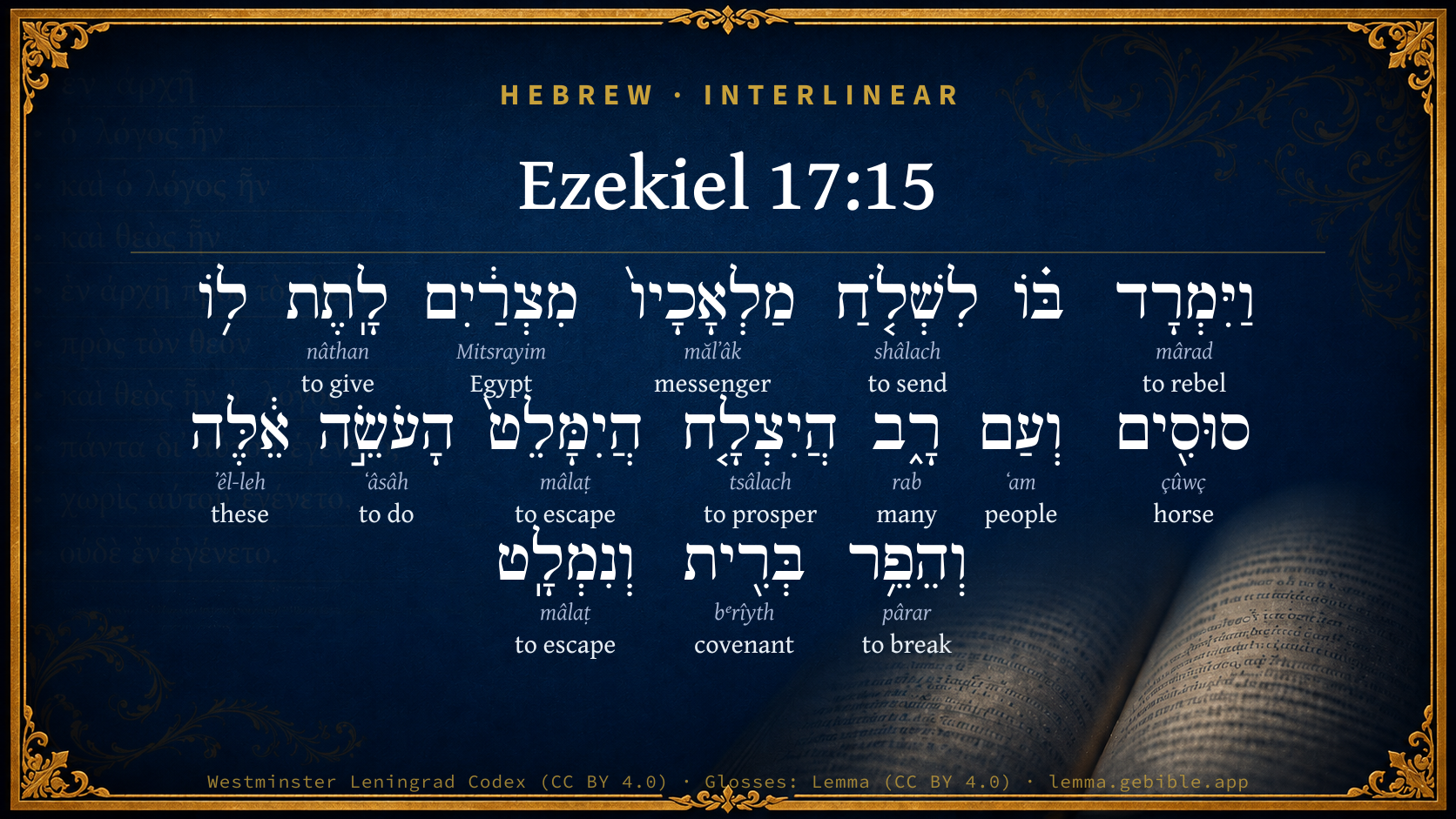
Hebrew (Westminster Leningrad Codex) Ezekiel 17:15 appears in the Hebrew Old Testament. The text above is from the Westminster Leningrad Codex. Each word links to its Strong’s number, a concise gloss, and parsing drawn from the Open Scriptures Hebrew Bible morphology. Click any word for its full Brown-Driver-Briggs (BDB) entry.
Download image
Cite this verse

Ezekiel 17:15 (World English Bible). Public Domain. Lemma interlinear Bible study tool, https://lemma.gebible.app/v/ezekiel/17/15.

Show BibTeX & RIS
BibTeX
RIS
English Translation
But he rebelled against him in sending his ambassadors into Egypt, that they might give him horses and much people. Shall he prosper? shall he escape who does such things? shall he break the covenant, and yet escape?
World English Bible · Public Domain
Download a study sheet

One document with this verse’s original text, its word-by-word gloss line, the meaning frame, cross-references with their text, attributed commentary, and full source and license credits — printable, and it pastes into notes with its structure intact.

This verse Autodidact and up

Study sheet (.html) Plain text (.txt)

A passage Seminary Student

Up to 50 verses in one chapter. A passage sheet keeps up to 6 commentary sources and 12 cross-references per verse, in the order this page ranks them, and says so on the sheet whenever that leaves anything out. Ask for a single verse and you get the Autodidact verse sheet above.

Everything on this page stays free to read, with no account — the sheet is a download of what is already on screen, not access to it.

Want to remove ads? Support Godless Engineer
Compare translations 3

The same verse in 3 English versions, stacked beneath the original-language interlinear above. Click any original word for its lexicon entry.

Each is an independent rendering of the whole verse — the interlinear is not word-aligned to these translations.

Highlighted words mark where these versions differ — a whole-verse word diff, not a word-by-word alignment.

  • World English Bible Public Domain
    But he rebelled against him in sending his ambassadors into Egypt, that they might give him horses and much people. Shall he prosper? shall he escape who does such things? shall he break the covenant, and yet escape?
  • King James Version Public Domain
    But he rebelled against him in sending his ambassadors into Egypt, that they might give him horses and much people. Shall he prosper? shall he escape that doeth such things? or shall he break the covenant, and be delivered?
  • unfoldingWord Literal Text CC BY-SA 4.0
    But the king of Jerusalem rebelled against him by sending his ambassadors to Egypt to acquire horses and an army. Will he succeed? Will the one doing these things escape? If he breaks the covenant, will he escape?

unfoldingWord Literal Text — © unfoldingWord, licensed CC BY-SA 4.0. Word-aligned USFM3 via Door43 (git.door43.org/unfoldingWord/en_ult).

Versions to compare (up to 4)

3 of 4 selected

Show all 18 translations

Every available English version of this verse, each an independent rendering of the whole verse.

  • World English Bible Public Domain
    But he rebelled against him in sending his ambassadors into Egypt, that they might give him horses and much people. Shall he prosper? shall he escape who does such things? shall he break the covenant, and yet escape?
  • Berean Standard Bible Public Domain
    But this king rebelled against Babylon by sending his envoys to Egypt to ask for horses and a large army. Will he flourish? Will the one who does such things escape? Can he break a covenant and yet escape?’
  • Majority Standard Bible Public Domain
    But this king rebelled against Babylon by sending his envoys to Egypt to ask for horses and a large army. Will he flourish? Will the one who does such things escape? Can he break a covenant and yet escape?’
  • King James Version Public Domain
    But he rebelled against him in sending his ambassadors into Egypt, that they might give him horses and much people. Shall he prosper? shall he escape that doeth such things? or shall he break the covenant, and be delivered?
  • American Standard Version (1901) Public Domain
    But he rebelled against him in sending his ambassadors into Egypt, that they might give him horses and much people. Shall he prosper? shall he escape that doeth such things? shall he break the covenant, and yet escape?
  • Revised Version (1885) Public Domain
    But he rebelled against him in sending his ambassadors into Egypt, that they might give him horses and much people. Shall he prosper? shall he escape that doeth such things? shall he break the covenant, and yet escape?
  • Geneva Bible (1599) Public Domain
    But he rebelled against him, and sent his ambassadours into Egypt, that they might giue him horses, and much people: shall hee prosper? shall he escape, that doeth such things? or shall he breake the couenant, and be deliuered?
  • Douay-Rheims (1899) Public Domain
    But he hath revolted from him and sent ambassadors to Egypt, that it might give him horses, and much people. And shall he that hath done thus prosper, or be saved? and shall he escape that hath broken the covenant?
  • Young's Literal Translation Public Domain
    And he rebelleth against him, To send his messengers to Egypt, To give to him horses, and much people, Doth he prosper? doth he escape who is doing these things? And hath he broken covenant and escaped?
  • Literal Standard Version CC BY-SA 4.0
    And he rebels against him, || To send his messengers to Egypt, || To give to him horses, and many people, || Does he prosper? Does he who is doing these things escape? And has he broken covenant and escaped?
  • Unlocked Literal Bible CC BY-SA 4.0
    But the king of Jerusalem rebelled against him by sending his ambassadors to Egypt to acquire horses and an army. Will he succeed? Will the one doing these things escape? If he breaks the covenant, will he escape?
  • unfoldingWord Literal Text CC BY-SA 4.0
    But the king of Jerusalem rebelled against him by sending his ambassadors to Egypt to acquire horses and an army. Will he succeed? Will the one doing these things escape? If he breaks the covenant, will he escape?
  • Darby Bible Public Domain
    But he rebelled against him in sending his ambassadors into Egypt, that they might give him horses and much people. Shall he prosper? shall he escape that doeth such things? shall he break the covenant, and yet escape?
  • World Messianic Bible Public Domain
    But he rebelled against him in sending his ambassadors into Egypt, that they might give him horses and many people. Will he prosper? Will he who does such things escape? Will he break the covenant, and still escape?
  • Webster's Bible Public Domain
    But he rebelled against him in sending his embassadors into Egypt, that they might give him horses and many people. Shall he prosper? shall he escape that doeth such things? or shall he break the covenant, and be delivered?
  • Free Bible Version CC BY-SA 4.0
    However, this king did rebel against Babylon, and sent ambassadors to Egypt to ask for help by supplying horses and many soldiers. Will he do well? Would someone who acts like this succeed? Could he break an agreement and not be punished?’
  • Bible in Basic English Public Domain
    But he went against his authority in sending representatives to Egypt to get from them horses and a great army. Will he do well? will he be safe who does such things? if the agreement is broken will he be safe?
  • JPS Tanakh (1917) Public Domain
    But he rebelled against him in sending his ambassadors into Egypt, that they might give him horses and much people. Shall he prosper? shall he escape that doeth such things? shall he break the covenant, and yet escape?

Literal Standard Version (2020), Covenant Press — licensed CC BY-SA 4.0. Text via the HelloAO Bible API (eBible.org). Unlocked Literal Bible (unfoldingWord) — licensed CC BY-SA 4.0. Text via the HelloAO Bible API (eBible.org). unfoldingWord Literal Text — © unfoldingWord, licensed CC BY-SA 4.0. Word-aligned USFM3 via Door43 (git.door43.org/unfoldingWord/en_ult). Free Bible Version, Dr. Jonathan Gallagher — licensed CC BY-SA 4.0. Text via the HelloAO Bible API (eBible.org).

Word by word

More ways to search: Search by grammar → Find every occurrence → Compare this word →

Practice this passage: Drill this verse → Learn its vocabulary →

וַיִּמְרָד
mârad
H4775
“and · to rebel”
Conjunction + Verb, Qal, Sequential Imperfect, 3rd Person, Masculine, Singular
Part of Speech
Conjunction + Verb
Stem
Qal
Form
Sequential Imperfect
Person
3rd Person
Gender
Masculine
Number
Singular
Full BDB Definition

Origin: a primitive root

TWOT: 1240

to rebel, revolt, be rebellious - (Qal) to rebel, revolt - against human king - against God - against light (poetic)
  1. לִשְׁלֹ֤חַ shâlach H7971 “to send” Preposition + Verb, Qal, Infinitive Construct
  2. מַלְאָכָיו֙ mălʼâk H4397 “messengers · his” Noun, Common, Masculine, Plural, Construct + Suffix, Personal, 3rd Person, Masculine, Singular
  3. מִצְרַ֔יִם Mitsrayim H4714 “Egypt” Noun, Proper
  4. לָֽתֶת nâthan H5414 “to give” Preposition + Verb, Qal, Infinitive Construct
  5. סוּסִ֖ים çûwç H5483 “horses” Noun, Common, Masculine, Plural, Absolute
  6. וְעַם ʻam H5971 “and · people” Conjunction + Noun, Common, Masculine, Singular, Absolute
  7. רָ֑ב rab H7227 “many” Adjective, Adjective, Masculine, Singular, Absolute
  8. הֲיִצְלָ֤ח tsâlach H6743 “to prosper” Particle, Interrogative + Verb, Qal, Imperfect, 3rd Person, Masculine, Singular
  9. הֲיִמָּלֵט֙ mâlaṭ H4422 “to escape” Particle, Interrogative + Verb, Niphal, Imperfect, 3rd Person, Masculine, Singular
  10. הָעֹשֵׂ֣ה ʻâsâh H6213 “the · doing” Particle, Definite Article + Verb, Qal, Participle Active, Masculine, Singular, Construct
  11. אֵ֔לֶּה ʼêl-leh H428 “these” Pronoun, Demonstrative, Common, Plural
  12. וְהֵפֵ֥ר pârar H6565 “and · to break” Conjunction + Verb, Hiphil, Perfect, 3rd Person, Masculine, Singular
  13. בְּרִ֖ית bᵉrîyth H1285 “covenant” Noun, Common, Feminine, Singular, Absolute
  14. וְנִמְלָֽט mâlaṭ H4422 “and · to escape” Conjunction + Verb, Niphal, Sequential Perfect, 3rd Person, Masculine, Singular

About this verse

These counts appear in no published source. They are computed here, from the morphology-tagged text and Lemma’s own curated glosses. What Lemma adds →

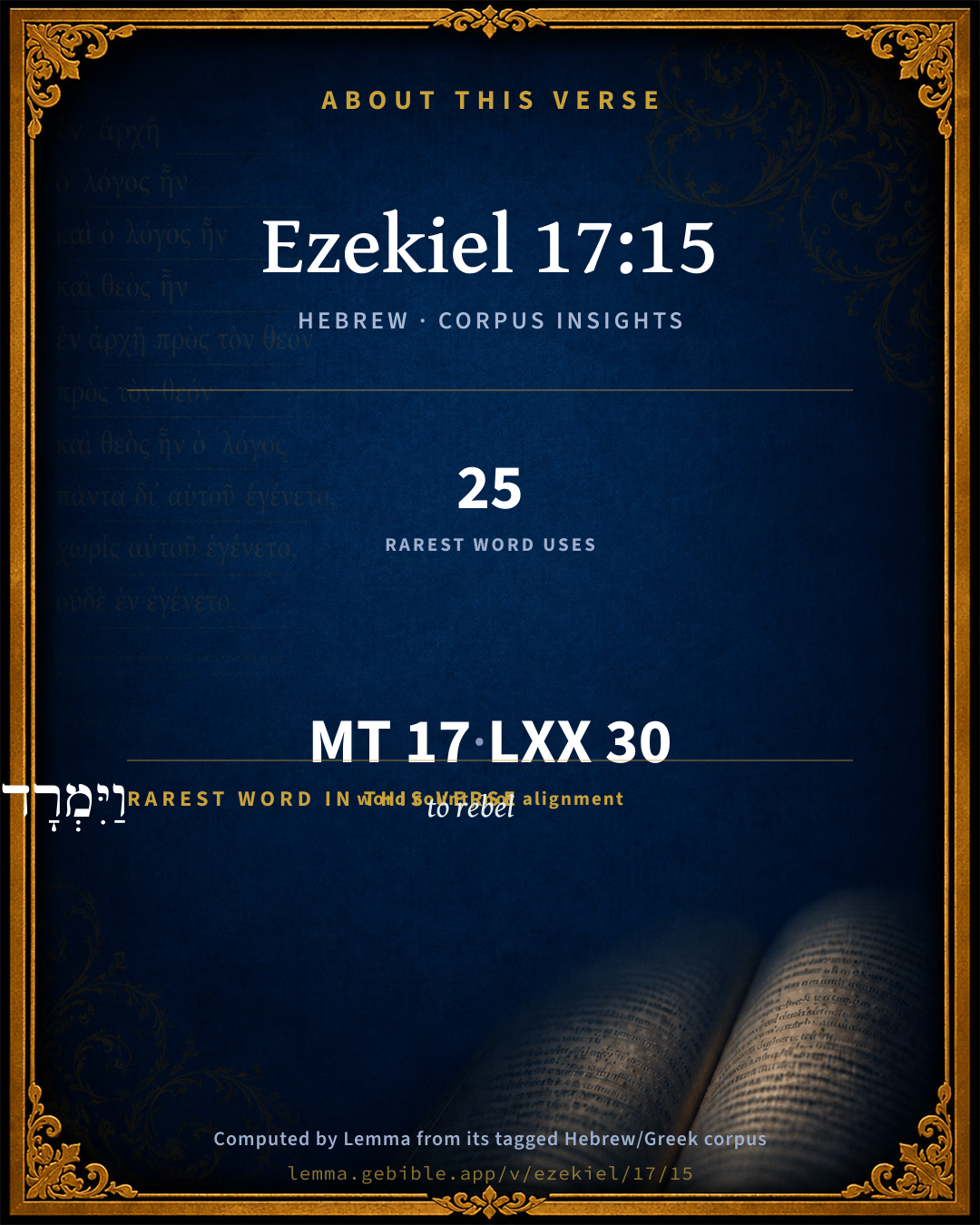
17
words
14
distinct lemmas
Prophets
section

Notable vocabulary

The rarest word here is וַיִּמְרָד to rebel H4775 — appearing just 25 times in the whole Hebrew Bible.

Shared distinctive vocabulary

וַיִּמְרָד to rebel H4775 occurs in 23 verses of the Hebrew Bible. Also found in:

Grammatical profile

  • 8 verbs
  • 5 nouns
  • 1 adjective
  • 1 pronoun
  • 2 prepositions

Verb forms

  • וַיִּמְרָד Qal · Sequential Imperfect
  • לִשְׁלֹ֤חַ Qal · Infinitive Construct
  • לָֽתֶת Qal · Infinitive Construct
  • הֲיִצְלָ֤ח Qal · Imperfect
  • הֲיִמָּלֵט֙ Niphal · Imperfect
  • הָעֹשֵׂ֣ה Qal · Participle Active
  • וְהֵפֵ֥ר Hiphil · Perfect
  • וְנִמְלָֽט Niphal · Sequential Perfect

Repetition

A word recurs within this verse — often emphatic in Hebrew:

  • הֲיִמָּלֵט֙ to escape H4422 ×2

Hebrew & Septuagint length

In English translation the verse runs 38 words from the Hebrew and 43 from the Septuagint (LXX English) — closely comparable.

A rough comparison of the two English renderings, which tokenize alike — not a word-level alignment.

Word counts can differ between the Hebrew and the Greek without any difference in meaning — e.g. the Hebrew direct-object marker אֵת has no separate Greek word, and Greek often adds the article ὁ.

In the original languages it is 17 Hebrew tokens and 30 Greek tokens — but the two are counted differently (Hebrew bundles its prefixes and suffixes into one token; the Greek is in lemma form), so that isn’t a like-for-like length.

Cross-references

22

Topical passages linked to Ezekiel 17:15 in the Treasury of Scripture Knowledge — connected by theme and wording, ordered by reader-vote popularity; previews shown in the World English Bible.

  • Deuteronomy 17:16 Only he shall not multiply horses to himself, nor cause the people to return to Egypt, to the end that he may multiply horses; because Yahweh has said to you, You shall henceforth return no more that way.
  • 2 Kings 24:20 For through the anger of Yahweh did it happen in Jerusalem and Judah, until he had cast them out from his presence. Zedekiah rebelled against the king of Babylon.
  • 2 Chronicles 36:13 He also rebelled against king Nebuchadnezzar, who had made him swear by God: but he stiffened his neck, and hardened his heart against turning to Yahweh, the God of Israel.
  • Jeremiah 34:3 and you shall not escape out of his hand, but shall surely be taken, and delivered into his hand; and your eyes shall see the eyes of the king of Babylon, and he shall speak with you mouth to mouth, and you shall go to Babylon.
  • Jeremiah 38:18 But if you will not go forth to the king of Babylon's princes, then shall this city be given into the hand of the Chaldeans, and they shall burn it with fire, and you shall not escape out of their hand.
  • Jeremiah 52:3 For through the anger of Yahweh did it happen in Jerusalem and Judah, until he had cast them out from his presence. Zedekiah rebelled against the king of Babylon.
  • Ezekiel 17:7 There was also another great eagle with great wings and many feathers: and, behold, this vine did bend its roots toward him, and shot forth its branches toward him, from the beds of its plantation, that he might water it.
  • Jeremiah 37:5–7 Pharaoh's army was come forth out of Egypt; and when the Chaldeans who were besieging Jerusalem heard news of them, they broke up from Jerusalem.
  • Jeremiah 38:23 They shall bring out all your wives and your children to the Chaldeans; and you shall not escape out of their hand, but shall be taken by the hand of the king of Babylon: and you shall cause this city to be burned with fire.
  • Ezekiel 17:9 Say you, Thus says the Lord Yahweh: Shall it prosper? shall he not pull up the roots of it, and cut off the fruit of it, that it may wither; that all its fresh springing leaves may wither? and not by a strong arm or much people can it be raised from the roots of it.
  • Ezekiel 17:18 For he has despised the oath by breaking the covenant; and behold, he had given his hand, and yet has done all these things; he shall not escape.
  • Deuteronomy 29:12–15 that you may enter into the covenant of Yahweh your God, and into his oath, which Yahweh your God makes with you this day;
  • Psalms 55:23 But you, God, will bring them down into the pit of destruction. Bloodthirsty and deceitful men shall not live out half their days, But I will trust in you.
  • Proverbs 19:5 A false witness shall not be unpunished. He who pours out lies shall not go free.
  • Isaiah 30:1–4 Woe to the rebellious children, says Yahweh, who take counsel, but not of me; and who make a league, but not of my Spirit, that they may add sin to sin,
  • Isaiah 31:1–3 Woe to those who go down to Egypt for help, and rely on horses, and trust in chariots because they are many, and in horsemen because they are very strong, but they don't look to the Holy One of Israel, neither seek Yahweh!
  • Isaiah 36:6–9 Behold, you trust on the staff of this bruised reed, even on Egypt, whereon if a man lean, it will go into his hand, and pierce it: so is Pharaoh king of Egypt to all who trust on him.
  • Jeremiah 22:29–30 O earth, earth, earth, hear the word of Yahweh.
  • Jeremiah 32:4 and Zedekiah king of Judah shall not escape out of the hand of the Chaldeans, but shall surely be delivered into the hand of the king of Babylon, and shall speak with him mouth to mouth, and his eyes shall see his eyes;
  • Ezekiel 21:25 You, deadly wounded wicked one, the prince of Israel, whose day is come, in the time of the iniquity of the end,
  • Matthew 23:33 You serpents, you offspring of vipers, how will you escape the judgment of Gehenna?
  • Hebrews 2:3 how will we escape if we neglect so great a salvation-- which at the first having been spoken through the Lord, was confirmed to us by those who heard;

Cross-references courtesy of OpenBible.info (CC BY 4.0).

Hebrew and Greek witnesses Masoretic Hebrew ↔ Greek Septuagint

The same verse in the two great witnesses to the Old Testament, shown verse-for-verse.

These are two independent witnesses, not word-aligned to each other, and the Septuagint is shown in lemma (dictionary) form.

Hebrew Ezekiel 17:15 Masoretic · Westminster Leningrad Codex

וַיִּמְרָד בּ֗וֹ לִשְׁלֹ֤חַ מַלְאָכָיו֙ מִצְרַ֔יִם לָֽתֶת ל֥וֹ סוּסִ֖ים וְעַם רָ֑ב הֲיִצְלָ֤ח הֲיִמָּלֵט֙ הָעֹשֵׂ֣ה אֵ֔לֶּה וְהֵפֵ֥ר בְּרִ֖ית וְנִמְלָֽט

But he rebelled against him in sending his ambassadors into Egypt, that they might give him horses and much people. Shall he prosper? shall he escape who does such things? shall he break the covenant, and yet escape?

World English Bible · Public Domain

Greek LXX Ezekiel 17:15 Septuagint · lemma form

καί ἀποἵστημι ἀπό αὐτός ὁ ἐκ ἀποστέλλω ἄγγελος ἑαυτοῦ εἰς αἴγυπτος ὁ δίδωμι αὐτός ἵππος καί λαός πολύς εἰ καταεὐθύνω εἰ διασώζω ὁ ποιέω ἐναντίος καί παραβαίνω διαθήκη εἰ σώζω

And if he shall revolt from him, to send his messengers into Egypt, that they may give him horses and much people; shall he prosper? shall he that acts as an adversary be preserved? and shall he that transgresses the covenant be preserved?

LXX2012 (modern English Septuagint) · Public Domain

Hebrew: Westminster Leningrad Codex (CC BY 4.0). Greek: Septuagint (public domain); English from LXX2012 (modern English Septuagint) (Public Domain). How the Septuagint differs from the Hebrew →

Targum (Aramaic paraphrase)

1

The Targum is the ancient Jewish Aramaic paraphrase of the Hebrew Scriptures — an interpretive translation, not the Hebrew text itself. Onkelos (literal) and Pseudo-Jonathan (expansive) render the Torah, and Jonathan the Prophets. Coverage is partial: where no permissively-licensed English translation exists for a verse, only the Aramaic is shown. This is verse-level text, not a word-by-word alignment to the Hebrew.

  1. Targum Jonathan Prophets (Joshua–Malachi)
    וּמְרַד בֵּיהּ לְשַׁלָחָא אִזְגַדוֹהִי לְמִצְרַיִם לְמִתַּן לֵיהּ סוּסְוָן וְעַם סַגִי הֲיִצְלַח הֲיִשְׁתֵּיזִיב דְעָבֵיד אִילֵין וּמְשַׁנֵי קַיֵם הֲיִשְׁתֵּיזֵיב:

    (no public-domain English translation for this verse)

    Targum Jonathan — Aramaic: “Mikraot Gedolot” (public domain). English: “Sefaria Community Translation” (CC0 1.0 (public-domain dedication)); “London "Chaldee Paraphrase," 1871” (public domain). Text via Sefaria.

Commentary

Notes on Ezekiel 17:15 from classic Christian and Jewish commentators (each source and its license shown beneath its notes). The classic Christian expositions comment on the surrounding passage and are grouped to its opening verse, so a note may address several verses; the Jewish commentaries on the Tanakh (Rashi and others) are per-verse, so they appear only where the commentator wrote on this verse.

Lemma curates 59 commentaries, every one of them public domain or Creative Commons licensed, each selected and text-cleaned for this edition rather than reprinted as found. About our sources →

Trapp's Complete Commentary

John Trapp

Eze 17:15 But he rebelled against him in sending his ambassadors into Egypt, that they might give him horses and much people. Shall he prosper? shall he escape that doeth such [things]? or shall he break the covenant, and be delivered?

Ver. 15. But he rebelled against him.] As Ottocarus, king of Bohemia, did against Rodolphus, the first emperor of Germany, by the instigation of his queen; and as Ladislaus, king of Hungary, did against Amurath, the Turkish emperor, by the encouragement of Capistranus, the Pope’s agent, to the very great reproach of the Christian religion.

John Trapp, A Commentary or Exposition upon All the Books of the Old and New Testament (1647–1656) — public domain. Text from a community e-Sword module.

Joseph Benson's Commentary

Eze 17:15. But he rebelled in sending into Egypt, that they might give him horses — Egypt was a country abounding in horses, of which there was great scarcity in Judea. This was not only a violation of his oath and covenant, but likewise a breach of that part of the Jewish law which forbade their king to fetch horses out of Egypt, or strengthen himself with the alliance of that nation. Shall he escape that doeth such things? — Shall not the divine vengeance overtake such ingratitude and perfidy? Shall he break the covenant and be delivered? — Can perjury and covenant- breaking be the way to any man’s deliverance? Can such notorious sinning end in any thing but misery? From what is said on this occasion we learn, that an oath ought not to be violated though it was taken under unfavourable circumstances, and though the things to which a man bound himself by it were very disagreeable to him.

Joseph Benson's Commentary on the Old and New Testaments (1811–1818) — public domain. Text from a community e-Sword module.

Jamieson, Fausset & Brown

Robert Jamieson, A. R. Fausset & David Brown

he rebelled--God permitted this because of His wrath against Jerusalem (Kg2 24:20).

horses--in which Egypt abounded and which were forbidden to Israel to seek from Egypt, or indeed to "multiply" at all (Deu 17:16; Isa 31:1, Isa 31:3; compare Isa 36:9). DIODORUS SICULUS [1.45] says that the whole region from Thebes to Memphis was filled with royal stalls, so that twenty thousand chariots with two horses in each could be furnished for war.

Shall he prosper?--The third time this question is asked, with an indignant denial understood (Eze 17:9-10). Even the heathen believed that breakers of an oath would not "escape" punishment.

Jamieson, Fausset & Brown — Commentary Critical and Explanatory on the Whole Bible (1871) — public domain (CC PDM 1.0). Text via the HelloAO Bible API.

Adam Clarke's Commentary

Verse 15. Sending his ambassadors into Egypt] Zedekiah must have sent his ambassadors into Egypt, between the sixth month of his sixth year, and the fifth month of his seventh year. Compare Eze 8:1, with Eze 20:1.-See Newcome.

Adam Clarke's Commentary on the Bible (1810–1826) — public domain. Text from a community e-Sword/MySword module.

Ellicott's Commentary for English Readers

(15) Shall he escape that doeth such things?—The faithlessness of Zedekiah and his court to his own sworn covenant was an act, in addition to all his other wickedness, especially abominable to God. The sanctity of an oath had always been most strongly insisted upon in Israelitish history. It must be remembered that even when, as in the case of the Gibeonites (Joshua , 9), the oath had been obtained by fraud, and centuries had passed since it was given, God yet sorely punished the land for its violation (2Sa_21:1-2); and in this case the king had been more than once Divinely warned through the prophet Jeremiah of the danger of his treachery. As Zedekiah’s intrigues with Egypt were just now going on, it was particularly important that they should be exposed, and their result foretold to the captives who were yet trusting in the safety of Jerusalem.

A Bible Commentary for English Readers, edited by Charles John Ellicott (1878–1897) — public domain. Text from a community e-Sword module.

The Cambridge Bible for Schools and Colleges

gen. ed. J. J. S. Perowne

15. Cf. 2Ki_24:20. The king of Egypt referred to was Pharaoh Hophra, Jer_44:30; Jer_37:5 seq. The indignation of Ezekiel against Zedekiah arises greatly from his regarding the subjection of Jerusalem to Babylon as a thing determined by Jehovah. Hence the covenant broken by Zedekiah is not merely the covenant of the king of Babylon but that of Jehovah (Eze_17:19). The prophet follows Jeremiah. He had possibly read the words of the latter spoken in the beginning of the reign of Zedekiah, ch. Eze_27:9-17, “serve the king of Babylon and live;” and probably he had heard his words to the same effect spoken in the fourth year of Jehoiakim, ch. 25. His advice to the exiles also was no doubt known to him, ch. Eze_29:4.

The Cambridge Bible for Schools and Colleges (gen. ed. J. J. S. Perowne; Cambridge University Press, 1878–1918) — public domain. Text from a community e-Sword module.

John Gill's Exposition

Neither shall Pharaoh, with his mighty army and great company,

make for him in the war,.... The king of Egypt, to whom Zedekiah applied for horses and men to help him; though he should come with a great army, and a large multitude of people, yet should be of no use to Zedekiah, nor do any hurt to Nebuchadnezzar, or hinder him from taking Jerusalem:

by casting up mounts, and building forts, to cut off many persons; that is, when Nebuchadnezzar should besiege Jerusalem, and raise mounts, and build fortifications, in order to take the city, and destroy its inhabitants; as he did, Jer 52:4; the Egyptian army should not be able to hinder him going on with the siege, and taking the city; for though the siege was broke up for a time, upon the approach of Pharaoh's army, yet Nebuchadnezzar, having conquered the Egyptians, returned again to the siege of Jerusalem, and took it; see Jer 37:5.

John Gill's Exposition of the Whole Bible (1746–1763) — public domain (CC PDM 1.0). Text via the HelloAO Bible API.

Matthew Poole's English Annotations

But Zedekiah rebelled; endeavoured to cast off the dominion of the conqueror Nebuchadnezzar, who had advanced him and obliged him.

Sending his ambassadors is called bending his roots toward the second eagle.

Egypt; an old bitter enemy, and an impotent and false friend.

That they might give him horses: beside the perjury, here was a cursed trusting to an arm of flesh, of which Isa 31:1.

Much people; Zedekiah had not men to set upon his hired horses; Egypt must help here too. How sottishly doth this unhappy Zedekiah act to run himself on the charge and hazard of a new war, in which, whoever is the gainer, he and his are sure to be the losers!

Shall he prosper? see Eze 17:9,10. Can it be likely vengeance should not overtake such ingratitude? Can perjury be the way for any man’s deliverance? Can such notorious sinning end in any thing but misery?

Matthew Poole's English Annotations on the Holy Bible (1683–1685) — public domain. Text from a community e-Sword/MySword module.

Whedon's Commentary on the Bible

Daniel D. Whedon

15. He rebelled against him — See the account in 2 Kings 24. The Egyptian king was Pharaoh Hophra (Jer_44:30; Jer_37:5.)

Egypt (Hebrews, Mitzraim). The Tel-el-Amarna tablets show that 1400 B.C. Egypt was called Misri (Assyr., Musri). It is now known that the Babylonians in later times changed the form and why they did so (Zeilschrift fur Assyria, 4:268). The Bible word is derived from the most ancient form. The chief military strength of Egypt lay in its cavalry and chariot force (Exo_14:7; 1Ki_10:28; Isa_31:1). The monuments and papyri abundantly sustain this proposition.

Daniel D. Whedon (gen. ed.), Commentary on the Old and New Testaments (1874–1909) — public domain. Text from a community e-Sword module.

The Pulpit Commentary

That they might give him horses. The "chariots and horses" of Egypt seem, throughout its whole history, to have been its chief element of strength. See for the time of Moses, (Exo_14:7) of Solomon, (1Ki_10:28, 1Ki_10:29) of Rehoboam, (2Ch_12:3) of Hezekiah. (Isa_31:1:36:9) Shall he prosper? What had been asked in the parable is asked also, in identical terms, in the interpretation. Ezekiel presses home the charge of perfidy as well as rebellion. Like Jeremiah, he looks on Nebuchadnezzar as reigning by a Divine right.

The Pulpit Commentary (1880–1919), ed. H.D.M. Spence-Jones & Joseph S. Exell — public domain. Text from a community e-Sword module.

John Wesley's Explanatory Notes

He - Zedekiah. Shall he break - Can perjury be the way for deliverance?

John Wesley, Explanatory Notes Upon the Whole Bible (1754–1765) — public domain. Text via the GEBible commentary corpus.

unfoldingWord translationNotes

Door43 World Missions Community

General Information:

Yahweh speaks about the king of Jerusalem rebelling against the king of Babylon.

Will he succeed?

Yahweh asks this leading question to emphasize the negative answer. This question can be translated as a statement. AT: "He will certainly not succeed." (See: Rhetorical Question)

Will the one doing these things escape?

Yahweh asks this leading question to emphasize the negative answer. This may be translated as a statement. AT: "The one doing these things will not escape." (See: Rhetorical Question)

If he breaks the covenant, will he escape?

Yahweh asks this leading question to emphasize the negative answer. This question can be translated as as statement. AT: "If he breaks the covenant, he will certainly not escape." (See: Rhetorical Question)

As I live

"As surely as I am alive." Yahweh uses this expression to show that what he says next is certainly true. This is a way of making a solemn promise. See how you translated this in Ezekiel 5:11. AT: "I solemnly swear" (See: Idiom)

this is the Lord Yahweh's declaration

Yahweh speaks of himself by name to express the certainty of what he is declaring. See how you translated this in Ezekiel 5:11. AT: "this is what the Lord Yahweh has declared" or "this is what I, the Lord Yahweh, have declared" (See: First, Second, or Third Person)

the land of the king who made him king, the king whose oath he despised

"the land of the king of Babylon who made him King of Judah, the king of Babylon whose oath he despised"

translationWords

king

Jerusalem

rebel

send

ambassador

Egypt

horse

covenant

life

Lord Yahweh

declare

die

oath

Babylon

unfoldingWord translationNotes — © Distant Shores Media and the Door43 World Missions Community, licensed CC BY-SA 4.0. Source: git.door43.org/Door43/en_tn.

Lesson kit

Teaching starters — assembled from the data on this page, not authored interpretation. Every prompt links to the verse data it draws on. Edit before teaching.

Ezekiel, in the Prophets, opens this verse with 17 words (14 distinct Hebrew lemmas). Its most distinctive word is mârad (“to rebel”). A historical commentator’s framing appears above. Read the whole chapter for the surrounding context.

Discussion questions

  1. How does “to rebel” (mârad) shape what this verse is saying?
  2. How does Genesis 14:4, which shares the word «to rebel», read alongside this verse?
  3. What does the repetition of “to escape” (2× in this one verse) do in this verse?
  4. These translations render this verse differently; the difference is in the English rendering, not the original. What questions does that raise?
  5. «וַיִּמְרָד» is a Qal Sequential Imperfect verb. How does that grammatical form shape the action described?
  6. Compare how Trapp's Complete Commentary and Joseph Benson's Commentary read this verse. Where do they agree or differ?

Things to notice

Reading settings

Reading text

Shown beneath each verse's original-language words.

Old Testament
Old Testament edition

Read the OT as the Masoretic Hebrew (MT) or the Greek Septuagint (LXX).

English shown for the Greek Septuagint (in the Hebrew ↔ Greek comparison).

Comparing translations? Open the Compare panel on any verse page to stack up to four side by side.