
Joshua 2:10

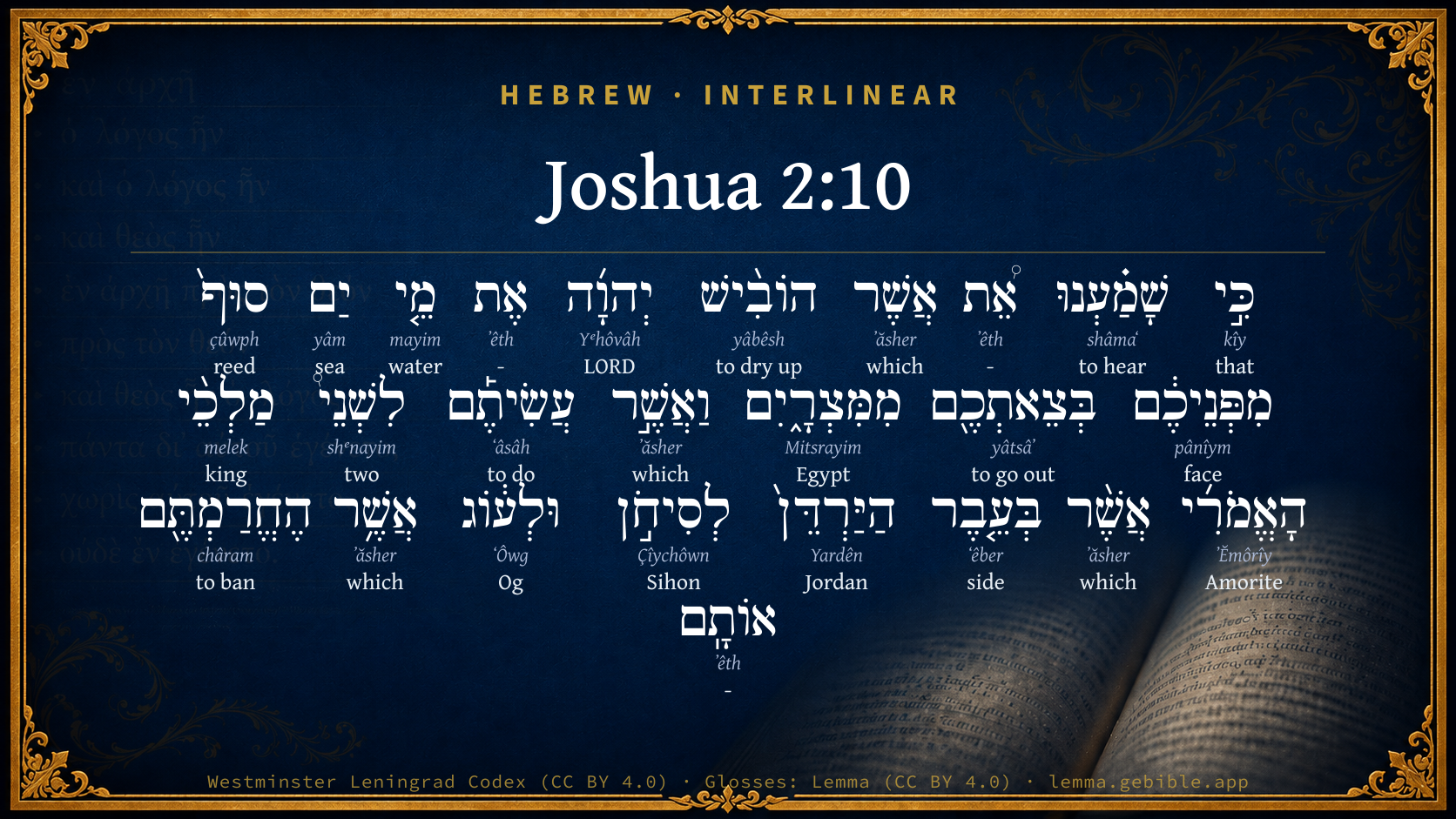
Hebrew (Westminster Leningrad Codex) Joshua 2:10 appears in the Hebrew Old Testament. The text above is from the Westminster Leningrad Codex. Each word links to its Strong’s number, a concise gloss, and parsing drawn from the Open Scriptures Hebrew Bible morphology. Click any word for its full Brown-Driver-Briggs (BDB) entry.
Download image
Cite this verse

Joshua 2:10 (World English Bible). Public Domain. Lemma interlinear Bible study tool, https://lemma.gebible.app/v/joshua/2/10.

Show BibTeX & RIS
BibTeX
RIS
English Translation
For we have heard how Yahweh dried up the water of the Red Sea before you, when you came out of Egypt; and what you did to the two kings of the Amorites, who were beyond the Jordan, to Sihon and to Og, whom you utterly destroyed.
World English Bible · Public Domain
Download a study sheet

One document with this verse’s original text, its word-by-word gloss line, the meaning frame, cross-references with their text, attributed commentary, and full source and license credits — printable, and it pastes into notes with its structure intact.

This verse Autodidact and up

Study sheet (.html) Plain text (.txt)

A passage Seminary Student

Up to 50 verses in one chapter. A passage sheet keeps up to 6 commentary sources and 12 cross-references per verse, in the order this page ranks them, and says so on the sheet whenever that leaves anything out. Ask for a single verse and you get the Autodidact verse sheet above.

Everything on this page stays free to read, with no account — the sheet is a download of what is already on screen, not access to it.

Want to remove ads? Support Godless Engineer
Compare translations 3

The same verse in 3 English versions, stacked beneath the original-language interlinear above. Click any original word for its lexicon entry.

Each is an independent rendering of the whole verse — the interlinear is not word-aligned to these translations.

Highlighted words mark where these versions differ — a whole-verse word diff, not a word-by-word alignment.

  • World English Bible Public Domain
    For we have heard how Yahweh dried up the water of the Red Sea before you, when you came out of Egypt; and what you did to the two kings of the Amorites, who were beyond the Jordan, to Sihon and to Og, whom you utterly destroyed.
  • King James Version Public Domain
    For we have heard how the LORD dried up the water of the Red sea for you, when ye came out of Egypt; and what ye did unto the two kings of the Amorites, that were on the other side Jordan, Sihon and Og, whom ye utterly destroyed.
  • unfoldingWord Literal Text CC BY-SA 4.0
    For we have heard that Yahweh dried up the water of the Sea of Reeds from your faces in your going out from Egypt, and what you did to two of the kings of the Amorite who on the other side of the Jordan, to Sihon and to Og, that you devoted them.

unfoldingWord Literal Text — © unfoldingWord, licensed CC BY-SA 4.0. Word-aligned USFM3 via Door43 (git.door43.org/unfoldingWord/en_ult).

Versions to compare (up to 4)

3 of 4 selected

Show all 17 translations

Every available English version of this verse, each an independent rendering of the whole verse.

  • World English Bible Public Domain
    For we have heard how Yahweh dried up the water of the Red Sea before you, when you came out of Egypt; and what you did to the two kings of the Amorites, who were beyond the Jordan, to Sihon and to Og, whom you utterly destroyed.
  • Berean Standard Bible Public Domain
    For we have heard how the LORD dried up the waters of the Red Sea before you when you came out of Egypt, and what you did to Sihon and Og, the two kings of the Amorites across the Jordan, whom you devoted to destruction.
  • Majority Standard Bible Public Domain
    For we have heard how the LORD dried up the waters of the Red Sea before you when you came out of Egypt, and what you did to Sihon and Og, the two kings of the Amorites across the Jordan, whom you devoted to destruction.
  • King James Version Public Domain
    For we have heard how the LORD dried up the water of the Red sea for you, when ye came out of Egypt; and what ye did unto the two kings of the Amorites, that were on the other side Jordan, Sihon and Og, whom ye utterly destroyed.
  • American Standard Version (1901) Public Domain
    For we have heard how Jehovah dried up the water of the Red Sea before you, when ye came out of Egypt; and what ye did unto the two kings of the Amorites, that were beyond the Jordan, unto Sihon and to Og, whom ye utterly destroyed.
  • Revised Version (1885) Public Domain
    For we have heard how the LORD dried up the water of the Red Sea before you, when ye came out of Egypt; and what ye did unto the two kings of the Amorites, that were beyond Jordan, unto Sihon and to Og, whom ye utterly destroyed.
  • Geneva Bible (1599) Public Domain
    For we haue heard, howe the Lord dried vp the water of the redde Sea before you, when you came out of Egypt, and what you did vnto the two Kings of the Amorites, that were on the other side Iorden, vnto Sihon and to Og, whom ye vtterly destroyed:
  • Young's Literal Translation Public Domain
    `For we have heard how Jehovah dried up the waters of the Red Sea at your presence, in your going out of Egypt, and that which ye have done to the two kings of the Amorite who `are' beyond the Jordan; to Sihon and to Og whom ye devoted.
  • Literal Standard Version CC BY-SA 4.0
    For we have heard how YHWH dried up the waters of the Red Sea at your presence, in your going out of Egypt, and that which you have done to the two kings of the Amorite who [are] beyond the Jordan; to Sihon and to Og whom you devoted.
  • Unlocked Literal Bible CC BY-SA 4.0
    We have heard how Yahweh dried up the water of the Sea of Reeds for you when you came out of Egypt. We also heard what you did to the two kings of the Amorites on other side of the Jordan—Sihon and Og—whom you completely destroyed.
  • unfoldingWord Literal Text CC BY-SA 4.0
    For we have heard that Yahweh dried up the water of the Sea of Reeds from your faces in your going out from Egypt, and what you did to two of the kings of the Amorite who on the other side of the Jordan, to Sihon and to Og, that you devoted them.
  • Darby Bible Public Domain
    For we have heard that Jehovah dried up the waters of the Red sea before you when ye came out of Egypt; and what ye did to the two kings of the Amorites that were beyond the Jordan, to Sihon and to Og, whom ye utterly destroyed.
  • World Messianic Bible Public Domain
    For we have heard how the LORD dried up the water of the Sea of Suf before you, when you came out of Egypt; and what you did to the two kings of the Amorites, who were beyond the Jordan, to Sihon and to Og, whom you utterly destroyed.
  • Webster's Bible Public Domain
    For we have heard how the LORD dried up the water of the Red sea for you, when ye came out of Egypt; and what ye did to the two kings of the Amorites, that were on the other side of Jordan, Sihon and Og, whom ye utterly destroyed.
  • Free Bible Version CC BY-SA 4.0
    We've heard how the Lord dried up the waters of the Red Sea before you when you left Egypt, and what you did to the two kings of the Amorites east of the Jordan, Sihon and Og, whom you completely destroyed.
  • Bible in Basic English Public Domain
    For we have had news of how the Lord made the Red Sea dry before you when you came out of Egypt; and what you did to the two kings of the Amorites, on the other side of Jordan, to Sihon and Og, whom you gave up to the curse.
  • JPS Tanakh (1917) Public Domain
    For we have heard how the LORD dried up the water of the Red Sea before you, when ye came out of Egypt; and what ye did unto the two kings of the Amorites, that were beyond the Jordan, unto Sihon and to Og, whom ye utterly destroyed.

Literal Standard Version (2020), Covenant Press — licensed CC BY-SA 4.0. Text via the HelloAO Bible API (eBible.org). Unlocked Literal Bible (unfoldingWord) — licensed CC BY-SA 4.0. Text via the HelloAO Bible API (eBible.org). unfoldingWord Literal Text — © unfoldingWord, licensed CC BY-SA 4.0. Word-aligned USFM3 via Door43 (git.door43.org/unfoldingWord/en_ult). Free Bible Version, Dr. Jonathan Gallagher — licensed CC BY-SA 4.0. Text via the HelloAO Bible API (eBible.org).

Word by word

More ways to search: Search by grammar → Find every occurrence → Compare this word →

Practice this passage: Drill this verse → Learn its vocabulary →

וּלְע֔וֹג
ʻÔwg
H5747
“and · to/for · Og”
Conjunction + Preposition + Noun, Proper
Part of Speech
Conjunction + Preposition + Noun
Type
Proper
Full BDB Definition

Origin: probably from H5746

TWOT: None

Og = "long-necked" - the Amorite king of Bashan and one of the last representatives of the giants of Rephaim
  1. כִּ֣י kîy H3588 “that” Conjunction
  2. שָׁמַ֗עְנוּ shâmaʻ H8085 “to hear” Verb, Qal, Perfect, 1st Person, Common, Plural
  3. אֵ֠ת ʼêth H853 “-” Particle, Direct Object
  4. אֲשֶׁר ʼăsher H834 “which” Particle, Relative
  5. הוֹבִ֨ישׁ yâbêsh H3001 “to dry up” Verb, Hiphil, Perfect, 3rd Person, Masculine, Singular
  6. יְהוָ֜ה Yᵉhôvâh H3068 “LORD” Noun, Proper
  7. אֶת ʼêth H853 “-” Particle, Direct Object
  8. מֵ֤י mayim H4325 “water(s) of” Noun, Common, Masculine, Plural, Construct
  9. יַם yâm H3220 “sea of” Noun, Common, Masculine, Singular, Construct
  10. סוּף֙ çûwph H5488 “reed” Noun, Common, Masculine, Singular, Absolute
  11. מִפְּנֵיכֶ֔ם pânîym H6440 “from · face(s) · your” Preposition + Noun, Common, Both, Plural, Construct + Suffix, Personal, 2nd Person, Masculine, Plural
  12. בְּצֵאתְכֶ֖ם yâtsâʼ H3318 “in/at · to go out · you” Preposition + Verb, Qal, Infinitive Construct + Suffix, Personal, 2nd Person, Masculine, Plural
  13. מִמִּצְרָ֑יִם Mitsrayim H4714 “from · Egypt” Preposition + Noun, Proper
  14. וַאֲשֶׁ֣ר ʼăsher H834 “and · which” Conjunction + Particle, Relative
  15. עֲשִׂיתֶ֡ם ʻâsâh H6213 “to do” Verb, Qal, Perfect, 2nd Person, Masculine, Plural
  16. לִשְׁנֵי֩ shᵉnayim H8147 “to/for · two” Preposition + Adjective, Cardinal number, Masculine, Dual, Construct
  17. מַלְכֵ֨י melek H4428 “kings of” Noun, Common, Masculine, Plural, Construct
  18. הָאֱמֹרִ֜י ʼĔmôrîy H567 “the · Amorite” Particle, Definite Article + Noun, Gentilic, Masculine, Singular, Absolute
  19. אֲשֶׁ֨ר ʼăsher H834 “which” Particle, Relative
  20. בְּעֵ֤בֶר ʻêber H5676 “in/at · side of” Preposition + Noun, Common, Masculine, Singular, Construct
  21. הַיַּרְדֵּן֙ Yardên H3383 “the · Jordan” Particle, Definite Article + Noun, Proper
  22. לְסִיחֹ֣ן Çîychôwn H5511 “to/for · Sihon” Preposition + Noun, Proper
  23. אֲשֶׁ֥ר ʼăsher H834 “which” Particle, Relative
  24. הֶחֱרַמְתֶּ֖ם châram H2763 “to ban” Verb, Hiphil, Perfect, 2nd Person, Masculine, Plural
  25. אוֹתָֽם ʼêth H853 “- · them” Particle, Direct Object + Suffix, Personal, 3rd Person, Masculine, Plural

About this verse

These counts appear in no published source. They are computed here, from the morphology-tagged text and Lemma’s own curated glosses. What Lemma adds →

26
words
21
distinct lemmas
Historical
section

Notable vocabulary

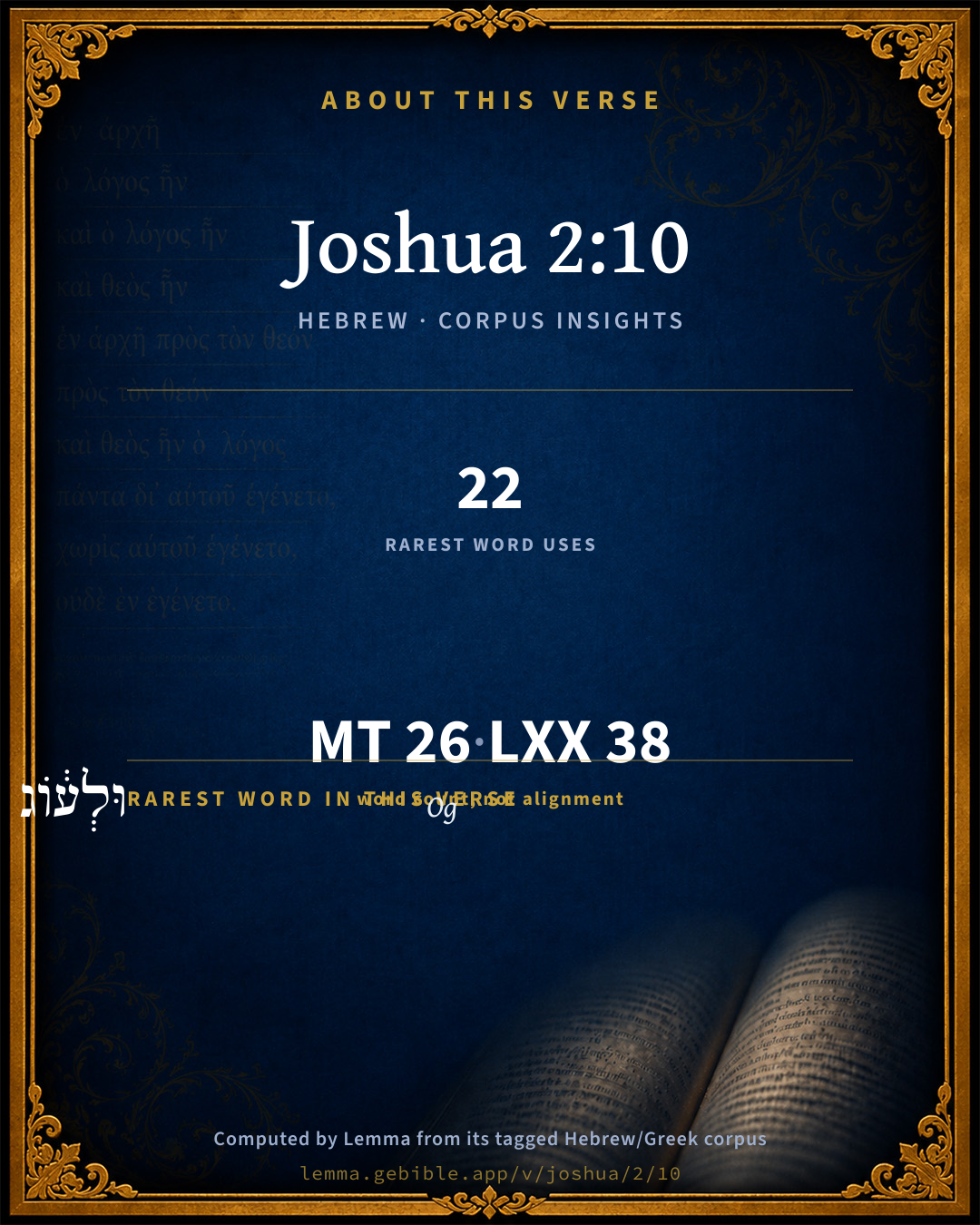
The rarest word here is וּלְע֔וֹג Og H5747 — appearing just 22 times in the whole Hebrew Bible.

Shared distinctive vocabulary

וּלְע֔וֹג Og H5747 occurs in 22 verses of the Hebrew Bible. Also found in:

Grammatical profile

  • 5 verbs
  • 12 nouns
  • 1 adjective
  • 1 conjunction
  • 7 particles

Verb forms

  • שָׁמַ֗עְנוּ Qal · Perfect
  • הוֹבִ֨ישׁ Hiphil · Perfect
  • בְּצֵאתְכֶ֖ם Qal · Infinitive Construct
  • עֲשִׂיתֶ֡ם Qal · Perfect
  • הֶחֱרַמְתֶּ֖ם Hiphil · Perfect

Repetition

A word recurs within this verse — often emphatic in Hebrew:

  • אֲשֶׁר which H834 ×4

Hebrew & Septuagint length

In English translation the verse runs 47 words from the Hebrew and 48 from the Septuagint (LXX English) — closely comparable.

A rough comparison of the two English renderings, which tokenize alike — not a word-level alignment.

Word counts can differ between the Hebrew and the Greek without any difference in meaning — e.g. the Hebrew direct-object marker אֵת has no separate Greek word, and Greek often adds the article ὁ.

In the original languages it is 26 Hebrew tokens and 38 Greek tokens — but the two are counted differently (Hebrew bundles its prefixes and suffixes into one token; the Greek is in lemma form), so that isn’t a like-for-like length.

Cross-references

6

Topical passages linked to Joshua 2:10 in the Treasury of Scripture Knowledge — connected by theme and wording, ordered by reader-vote popularity; previews shown in the World English Bible.

  • Numbers 21:21–35 Israel sent messengers to Sihon king of the Amorites, saying,
  • Exodus 14:21–31 Moses stretched out his hand over the sea, and Yahweh caused the sea to go back by a strong east wind all the night, and made the sea dry land, and the waters were divided.
  • Exodus 15:14–16 The peoples have heard. They tremble. Pangs have taken hold on the inhabitants of Philistia.
  • Numbers 23:22 God brings them forth out of Egypt; He has as it were the strength of the wild-ox.
  • Deuteronomy 2:30–3:8 But Sihon king of Heshbon would not let us pass by him; for Yahweh your God hardened his spirit, and made his heart obstinate, that he might deliver him into your hand, as at this day.
  • Joshua 4:24 that all the peoples of the earth may know the hand of Yahweh, that it is mighty; that you may fear Yahweh your God forever.

Cross-references courtesy of OpenBible.info (CC BY 4.0).

Hebrew and Greek witnesses Masoretic Hebrew ↔ Greek Septuagint

The same verse in the two great witnesses to the Old Testament, shown verse-for-verse.

These are two independent witnesses, not word-aligned to each other, and the Septuagint is shown in lemma (dictionary) form.

Hebrew Joshua 2:10 Masoretic · Westminster Leningrad Codex

כִּ֣י שָׁמַ֗עְנוּ אֵ֠ת אֲשֶׁר הוֹבִ֨ישׁ יְהוָ֜ה אֶת מֵ֤י יַם סוּף֙ מִפְּנֵיכֶ֔ם בְּצֵאתְכֶ֖ם מִמִּצְרָ֑יִם וַאֲשֶׁ֣ר עֲשִׂיתֶ֡ם לִשְׁנֵי֩ מַלְכֵ֨י הָאֱמֹרִ֜י אֲשֶׁ֨ר בְּעֵ֤בֶר הַיַּרְדֵּן֙ לְסִיחֹ֣ן וּלְע֔וֹג אֲשֶׁ֥ר הֶחֱרַמְתֶּ֖ם אוֹתָֽם

For we have heard how Yahweh dried up the water of the Red Sea before you, when you came out of Egypt; and what you did to the two kings of the Amorites, who were beyond the Jordan, to Sihon and to Og, whom you utterly destroyed.

World English Bible · Public Domain

Greek LXX Joshua 2:10 Septuagint · lemma form

ἀκούω γάρ ὅτι καταξηραίνω κύριος ὁ θεός ὁ ἐρυθρός θάλασσα ἀπό πρόσωπον σύ ὅτε ἐκπορεύομαι ἐκ γῆ αἴγυπτος καί ὅσος ποιέω ὁ δύο βασιλεύς ὁ ἀμορραῖος ὅς εἰμί πέραν ὁ ἰορδάνης ὁ σηων καί ωγ ὅς ἐκὀλεθρεύω αὐτός

For we have heard that the Lord God dried up the Red Sea before you, when you⌃ came out of the land of Egypt, and all that he did to the two kings of the Amorites, who were beyond Jordan, to Seon and Og, whom you⌃ utterly destroyed.

LXX2012 (modern English Septuagint) · Public Domain

On this verse, The Pulpit Commentary discusses the Septuagint’s reading. Read the note in Commentary ↓

Hebrew: Westminster Leningrad Codex (CC BY 4.0). Greek: Septuagint (public domain); English from LXX2012 (modern English Septuagint) (Public Domain). How the Septuagint differs from the Hebrew →

Targum (Aramaic paraphrase)

1

The Targum is the ancient Jewish Aramaic paraphrase of the Hebrew Scriptures — an interpretive translation, not the Hebrew text itself. Onkelos (literal) and Pseudo-Jonathan (expansive) render the Torah, and Jonathan the Prophets. Coverage is partial: where no permissively-licensed English translation exists for a verse, only the Aramaic is shown. This is verse-level text, not a word-by-word alignment to the Hebrew.

  1. Targum Jonathan Prophets (Joshua–Malachi)
    אֲרֵי שְׁמַעְנָא יַת דְיַבֵּשׁ יְיָ יַת מֵי יַמָא דְסוּף מִן קֳדָמֵיכוֹן בְּמִפַּקְכוֹן מִמִצְרַיִם וְדִי עֲבַדְתּוּן לִתְרֵין מַלְכֵי אֱמוֹרָאָה דִי בְּעַבְרָא דְיַרְדְנָא לְסִיחוֹן וּלְעוֹג דִי גְמַרְתּוּן יַתְהוֹן:

    (no public-domain English translation for this verse)

    Targum Jonathan — Aramaic: “Mikraot Gedolot” (public domain). English: “Sefaria Community Translation” (CC0 1.0 (public-domain dedication)); “London "Chaldee Paraphrase," 1871” (public domain). Text via Sefaria.

Commentary

Notes on Joshua 2:10 from classic Christian and Jewish commentators (each source and its license shown beneath its notes). The classic Christian expositions comment on the surrounding passage and are grouped to its opening verse, so a note may address several verses; the Jewish commentaries on the Tanakh (Rashi and others) are per-verse, so they appear only where the commentator wrote on this verse.

Lemma curates 59 commentaries, every one of them public domain or Creative Commons licensed, each selected and text-cleaned for this edition rather than reprinted as found. About our sources →

Trapp's Complete Commentary

John Trapp

Jos 2:10 For we have heard how the LORD dried up the water of the Red sea for you, when ye came out of Egypt; and what ye did unto the two kings of the Amorites, that [were] on the other side Jordan, Sihon and Og, whom ye utterly destroyed.

Ver. 10. For we have heard.] Historiae fidae monitrices. Succurrat illud … Mutato nomine de te fabula narratur.

John Trapp, A Commentary or Exposition upon All the Books of the Old and New Testament (1647–1656) — public domain. Text from a community e-Sword module.

John Calvin's Commentaries

10. For we have heard how, etc. She mentions, as the special cause of consternation, that the wide-spread rumor of miracles, hitherto without example, had impressed it on the minds of all that God was warring for the Israelites. For it was impossible to doubt that the way through the Red Sea had been miraculously opened up, as the water would never have changed its nature and become piled up in solid heaps, had not God, the author of nature, so ordered. The transmutation of the element, therefore, plainly showed that God was on the side of the people, to whom he had given a dry passage through the depths of the sea.

The signal victories also gained over Og and Bashan, were justly regarded as testimonies of the divine favor towards the Israelites. This latter conclusion, indeed, rested only on conjecture, whereas the passage of the sea was a full and irrefragable proof, as much so as if God had stretched forth his hand from heaven. All minds, therefore, were seized with a conviction that in the expedition of the Israelitish people God was principal leader; hence their terror and consternation. At the same time, it is probable that they were deceived by some vain imagination that the God of Israel had proved superior in the contest to the gods of Egypt; just as the poets feign that every god has taken some nation or other under his protection, and wars with others, and that thus conflicts take place among the gods themselves while they are protecting their favorites.

But the faith of Rahab takes a higher flight, while to the God of Israel alone she ascribes supreme power and eternity. These are the true attributes of Jehovah. She does not dream, according to the vulgar notion, that some one, out of a crowd of deities, is giving his assistance to the Israelites, but she acknowledges that He whose favor they were known to possess is the true and only God. We see, then, how in a case where all received the same intelligence, she, in the application of it, went far beyond her countrymen.

John Calvin's Commentaries (1540-1563) — public domain. Text from the Calvin Translation Society English edition (1840s-50s) via the Christian Classics Ethereal Library (ccel.org). Calvin's coverage is partial (roughly two-thirds of the Bible); uncommented books and verses are honest gaps, never fabricated. The 19th-century editor's footnotes and remarks are omitted so the notes are faithfully Calvin's own voice.

The Cambridge Bible for Schools and Colleges

gen. ed. J. J. S. Perowne

10. dried up the water] The inhabitants of the land had heard of two important events, which filled them with alarm; (a) the drying up of the Red Sea before the Israelites (cp. Psa_106:7; Psa_106:9; Psa_106:22; Psa_136:13); (b) the defeat at Jahaz of Sihon king of the Amorites, who refused the Israelites a passage through the territory between the Arnon and the Jabbok (Num_21:21-31; Deu_2:30-37), and at Edrei of Og, the giant king of the district which, under the name of “Bashan,” extended from the Jabbok up to the base of Hermon (Num_21:33-35; Deu_3:1-7).

whom ye utterly destroyed] Or, devoted. The word here used denotes (i) to separate for God, devote to Him (Lev_27:21; Lev_27:28; Jos_6:17-18; 1Sa_15:21), (ii) to devote to utter destruction, utterly destroy (Deu_4:26). The objects of such a doom might be (a) persons, as here (and comp. 1Ki_20:42; Rom_9:3; Gal_1:8-9; Gal_3:13), or (b) things (Jos_6:17-18; Jos_7:1).

The Cambridge Bible for Schools and Colleges (gen. ed. J. J. S. Perowne; Cambridge University Press, 1878–1918) — public domain. Text from a community e-Sword module.

John Gill's Exposition

For we have heard how the Lord dried up the waters of the Red sea for you, when ye came out of Egypt,.... To make a passage for them through it, to walk in as on dry land; this they had heard of and remembered, though it was forty years ago:

and what you did unto the kings of the Amorites that were on the other side Jordan: which were things more recent, done but a few months ago:

Sihon and Og, whom ye utterly destroyed; the history of which see in Num 21:21; who were destroyed by them under Moses and Joshua their commanders; and Hercules, who is thought to be the same with Joshua, is by Lucian (g) called Ogmius, from slaying Og, as is supposed (h).

(g) In Hercule. (h) Dickinson. Delph. Phoenic. c. 4. p. 44.

John Gill's Exposition of the Whole Bible (1746–1763) — public domain (CC PDM 1.0). Text via the HelloAO Bible API.

Whedon's Commentary on the Bible

Daniel D. Whedon

10. We have heard — An event so wonderful filled the world with amazement. Traders and caravans passing from Egypt through the deserts would frequently pass through Jericho, and spread the tidings of the Hebrews’ triumphs. Of all the miracles which attended the exodus from Egypt, none was capable of producing so profound an impression upon all surrounding nations as the drying up of the Red Sea, the safe passage of the Israelites, and the destruction of the Egyptian host by the rolling back of the parted surges. Exo_14:15-31. The lapse of forty years had not effaced that deep impression — an incidental proof of the magnitude of the miracle. Events more recent and nearer to them had increased their alarm.

The Amorites east of the Jordan, who had evinced their martial prowess by conquering the king of Moab and seizing his land, were in turn subdued by the resistless arms of the Israelites. The Amorites were the most powerful and distinguished of the Canaanitish nations, and occupied a tract on both sides of the Jordan. Those on the east side were under two kings, Sihon and Og. The former refused passage to the Hebrews through his territory, came to Jahaz, fought, and was defeated. Og also gave battle at Edrei, and was totally routed. See on Num_21:21-35.

Daniel D. Whedon (gen. ed.), Commentary on the Old and New Testaments (1874–1909) — public domain. Text from a community e-Sword module.

The Pulpit Commentary

For we have heard how the Lord dried up the water of the Red Sea for you. Rahab uses the word hwhoy. Whether this name were known to her or not, she knew what was signified by it, the one only self-existent God (since hwhy is clearly derived from hyh or hwh to be), the Author of all things, visible and invisible (see ver. 11). The Red Sea. Brugsch, in his "History of Egypt," denies that pWsA should be rendered "Red Sea," and affirms that this error of the LXX interpreters has been the source of endless misapprehensions. pWsA is an Egyptian word signifying flags or rushes, which abound not only in the Red Sea, but in the marshes on the shores of the Mediterranean, as, in fact, in all low-lying lands. It is here, according to Brugsch, in a treacherous and well-nigh impassable country, near that Serbonian bog, "where armies whole have sunk" (Milton, "Paradise Lost," Book H., line 594), that we are to look for the victorious passage of Moses, and the destruction of Pharaoh and his host. The pWs or rushes were to be found in the Nile, as Exo_2:9, 5 shows. (cf. Isa_19:6) So that pWsA by no means necessarily implies the Red Sea. Yet on the other hand we may remember, with the Edinburgh Reviewer (July, 1879), that the coastline of Palestine and of the delta of the Nile has undergone considerable changes during the historic period, and that the land has, during that period, largely encroached on the sea. Sihon and Og. As we read in Nu 21 and De 2 De 3. Whom ye utterly destroyed. Rather, devoted to utter destruction. (see Jos_6:21) Rahab seems to be aware that the extermination of these nations was in fulfilment of a Divine sentence.

The Pulpit Commentary (1880–1919), ed. H.D.M. Spence-Jones & Joseph S. Exell — public domain. Text from a community e-Sword module.

unfoldingWord translationNotes

Door43 World Missions Community

General Information:

Rahab continues to talk to the Israelite spies.

the Sea of Reeds

This is another name for the Red Sea.

Sihon ... Og

These are the names of the Amorite kings. (See: How to Translate Names)

our hearts melted and there was no courage left in anyone

These two phrases share similar meanings, combined for emphasis. The phrase "our hearts melted" compares the hearts of the fearful people of Jericho to ice melting and flowing away. (See: Doublet and Metaphor)

translationWords

Sea of Reeds

Egypt

Amorite

heart

God

heaven

unfoldingWord translationNotes — © Distant Shores Media and the Door43 World Missions Community, licensed CC BY-SA 4.0. Source: git.door43.org/Door43/en_tn.

Lesson kit

Teaching starters — assembled from the data on this page, not authored interpretation. Every prompt links to the verse data it draws on. Edit before teaching.

Joshua, in the Historical, opens this verse with 26 words (21 distinct Hebrew lemmas). Its most distinctive word is ʻÔwg (“Og”). A historical commentator’s framing appears above. Read the whole chapter for the surrounding context.

Discussion questions

  1. What does “Og” (ʻÔwg) contribute to the verse as a whole?
  2. How does Numbers 21:33, which shares the word «Og», read alongside this verse?
  3. What does the repetition of “which” (4× in this one verse) do in this verse?
  4. These translations render this verse differently; the difference is in the English rendering, not the original. What questions does that raise?
  5. «שָׁמַ֗עְנוּ» is a Qal Perfect verb. How does that grammatical form shape the action described?
  6. Compare how Trapp's Complete Commentary and John Calvin's Commentaries read this verse. Where do they agree or differ?

Things to notice

Reading settings

Reading text

Shown beneath each verse's original-language words.

Old Testament
Old Testament edition

Read the OT as the Masoretic Hebrew (MT) or the Greek Septuagint (LXX).

English shown for the Greek Septuagint (in the Hebrew ↔ Greek comparison).

Comparing translations? Open the Compare panel on any verse page to stack up to four side by side.