
Ezekiel 30:18

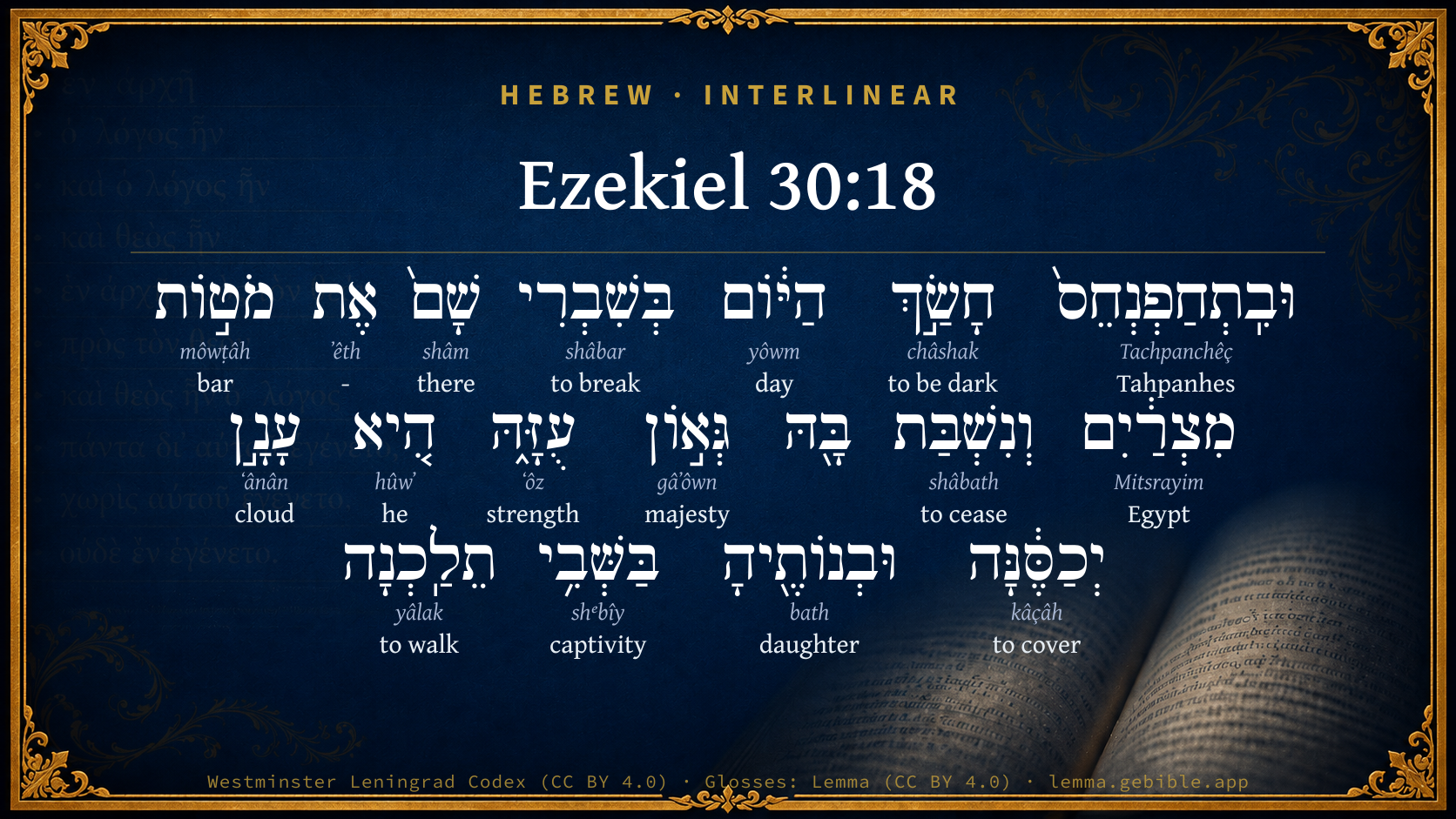
Hebrew (Westminster Leningrad Codex) Ezekiel 30:18 appears in the Hebrew Old Testament. The text above is from the Westminster Leningrad Codex. Each word links to its Strong’s number, a concise gloss, and parsing drawn from the Open Scriptures Hebrew Bible morphology. Click any word for its full Brown-Driver-Briggs (BDB) entry.
Download image
Cite this verse

Ezekiel 30:18 (World English Bible). Public Domain. Lemma interlinear Bible study tool, https://lemma.gebible.app/v/ezekiel/30/18.

Show BibTeX & RIS
BibTeX
RIS
English Translation
At Tehaphnehes also the day shall withdraw itself, when I shall break there the yokes of Egypt, and the pride of her power shall cease in her: as for her, a cloud shall cover her, and her daughters shall go into captivity.
World English Bible · Public Domain
Download a study sheet

One document with this verse’s original text, its word-by-word gloss line, the meaning frame, cross-references with their text, attributed commentary, and full source and license credits — printable, and it pastes into notes with its structure intact.

This verse Autodidact and up

Study sheet (.html) Plain text (.txt)

A passage Seminary Student

Up to 50 verses in one chapter. A passage sheet keeps up to 6 commentary sources and 12 cross-references per verse, in the order this page ranks them, and says so on the sheet whenever that leaves anything out. Ask for a single verse and you get the Autodidact verse sheet above.

Everything on this page stays free to read, with no account — the sheet is a download of what is already on screen, not access to it.

Want to remove ads? Support Godless Engineer
Compare translations 3

The same verse in 3 English versions, stacked beneath the original-language interlinear above. Click any original word for its lexicon entry.

Each is an independent rendering of the whole verse — the interlinear is not word-aligned to these translations.

Highlighted words mark where these versions differ — a whole-verse word diff, not a word-by-word alignment.

  • World English Bible Public Domain
    At Tehaphnehes also the day shall withdraw itself, when I shall break there the yokes of Egypt, and the pride of her power shall cease in her: as for her, a cloud shall cover her, and her daughters shall go into captivity.
  • King James Version Public Domain
    At Tehaphnehes also the day shall be darkened, when I shall break there the yokes of Egypt: and the pomp of her strength shall cease in her: as for her, a cloud shall cover her, and her daughters shall go into captivity.
  • unfoldingWord Literal Text CC BY-SA 4.0
    In Tahpanhes, the day will hold back its light when I break the yoke of Egypt there, and the pride of her strength will be finished. There will be a cloud covering her, and her daughters will walk into captivity.

unfoldingWord Literal Text — © unfoldingWord, licensed CC BY-SA 4.0. Word-aligned USFM3 via Door43 (git.door43.org/unfoldingWord/en_ult).

Versions to compare (up to 4)

3 of 4 selected

Show all 18 translations

Every available English version of this verse, each an independent rendering of the whole verse.

  • World English Bible Public Domain
    At Tehaphnehes also the day shall withdraw itself, when I shall break there the yokes of Egypt, and the pride of her power shall cease in her: as for her, a cloud shall cover her, and her daughters shall go into captivity.
  • Berean Standard Bible Public Domain
    The day will be darkened in Tahpanhes when I break the yoke of Egypt and her proud strength comes to an end. A cloud will cover her, and her daughters will go into captivity.
  • Majority Standard Bible Public Domain
    The day will be darkened in Tahpanhes when I break the yoke of Egypt and her proud strength comes to an end. A cloud will cover her, and her daughters will go into captivity.
  • King James Version Public Domain
    At Tehaphnehes also the day shall be darkened, when I shall break there the yokes of Egypt: and the pomp of her strength shall cease in her: as for her, a cloud shall cover her, and her daughters shall go into captivity.
  • American Standard Version (1901) Public Domain
    At Tehaphnehes also the day shall withdraw itself, when I shall break there the yokes of Egypt, and the pride of her power shall cease in her: as for her, a cloud shall cover her, and her daughters shall go into captivity.
  • Revised Version (1885) Public Domain
    At Tehaphnehes also the day shall withdraw itself, when I shall break there the yokes of Egypt, and the pride of her power shall cease in her: as for her, a cloud shall cover her, and her daughters shall go into captivity.
  • Geneva Bible (1599) Public Domain
    At Tehaphnehes the day shall restraine his light, when I shall breake there the barres of Egypt: and when the pompe of her power shall cease in her, the cloude shall couer her, and her daughters shall goe into captiuitie.
  • Douay-Rheims (1899) Public Domain
    And in Taphnis the day shall be darkened, when I shall break there the sceptres of Egypt, and the pride of her power shall cease in her: a cloud shall cover her, and her daughters shall be led into captivity.
  • Young's Literal Translation Public Domain
    And in Tehaphnehes hath the day been dark, In My breaking there the yokes of Egypt, And ceased in her hath the excellency of her strength, She -- a cloud doth cover her, And her daughters into captivity do go.
  • Literal Standard Version CC BY-SA 4.0
    And the day has been dark in Tehaphnehes, || In My breaking the yokes of Egypt there, || And the excellence of her strength has ceased in her, || Her! A cloud covers her, || And her daughters go into captivity.
  • Unlocked Literal Bible CC BY-SA 4.0
    In Tahpanhes, the day will hold back its light when I break the yoke of Egypt there, and the pride of her strength will be finished. There will be a cloud covering her, and her daughters will walk into captivity.
  • unfoldingWord Literal Text CC BY-SA 4.0
    In Tahpanhes, the day will hold back its light when I break the yoke of Egypt there, and the pride of her strength will be finished. There will be a cloud covering her, and her daughters will walk into captivity.
  • Darby Bible Public Domain
    And at Tehaphnehes the day shall be darkened, when I break there the yokes of Egypt, and the pride of her strength shall cease in her; as for her, a cloud shall cover her, and her daughters shall go into captivity.
  • World Messianic Bible Public Domain
    At Tehaphnehes also the day will withdraw itself, when I break the yokes of Egypt there. The pride of her power will cease in her. As for her, a cloud will cover her, and her daughters will go into captivity.
  • Webster's Bible Public Domain
    At Tehaphnehes also the day shall be darkened, when I shall break there the yokes of Egypt: and the pomp of her strength shall cease in her: as for her, a cloud shall cover her, and her daughters shall go into captivity.
  • Free Bible Version CC BY-SA 4.0
    It will be a dark day in Tahpanhes when I break Egypt's power and bring to an end their proud strength. It will be under a cloud as the people go into captivity.
  • Bible in Basic English Public Domain
    And at Tehaphnehes the day will become dark, when the yoke of Egypt is broken there, and the pride of her power comes to an end: as for her, she will be covered with a cloud, and her daughters will be taken away prisoners.
  • JPS Tanakh (1917) Public Domain
    At Tehaphnehes also the day shall withdraw itself, when I shall break there the yokes of Egypt, and the pride of her power shall cease in her; as for her, a cloud shall cover her, and her daughters shall go into captivity.

Literal Standard Version (2020), Covenant Press — licensed CC BY-SA 4.0. Text via the HelloAO Bible API (eBible.org). Unlocked Literal Bible (unfoldingWord) — licensed CC BY-SA 4.0. Text via the HelloAO Bible API (eBible.org). unfoldingWord Literal Text — © unfoldingWord, licensed CC BY-SA 4.0. Word-aligned USFM3 via Door43 (git.door43.org/unfoldingWord/en_ult). Free Bible Version, Dr. Jonathan Gallagher — licensed CC BY-SA 4.0. Text via the HelloAO Bible API (eBible.org).

Word by word

More ways to search: Search by grammar → Find every occurrence → Compare this word →

Practice this passage: Drill this verse → Learn its vocabulary →

וּבִֽתְחַפְנְחֵס֙
Tachpanchêç
H8471
“and · in/at · Tahpanhes”
Conjunction + Preposition + Noun, Proper
Part of Speech
Conjunction + Preposition + Noun
Type
Proper
Full BDB Definition

Origin: of Egyptian derivation

TWOT: None

Tahpanhes or Tahapanes or Tehaphnehes = "thou will fill hands with pity" - a city in Egypt; modern 'Tel Defenneh' or 'Tel Defneh' located approx 18 miles (29 kilometers) east southeast from Tanis
  1. חָשַׂ֣ךְ châshak H2821 “to be dark” Verb, Qal, Perfect, 3rd Person, Masculine, Singular
  2. הַיּ֔וֹם yôwm H3117 “the · day” Particle, Definite Article + Noun, Common, Masculine, Singular, Absolute
  3. בְּשִׁבְרִי shâbar H7665 “in/at · to break · me” Preposition + Verb, Qal, Infinitive Construct + Suffix, Personal, 1st Person, Common, Singular
  4. שָׁם֙ shâm H8033 “there” Adverb
  5. אֶת ʼêth H853 “-” Particle, Direct Object
  6. מֹט֣וֹת môwṭâh H4133 “bars of” Noun, Common, Feminine, Plural, Construct
  7. מִצְרַ֔יִם Mitsrayim H4714 “Egypt” Noun, Proper
  8. וְנִשְׁבַּת shâbath H7673 “and · to cease” Conjunction + Verb, Niphal, Sequential Perfect, 3rd Person, Masculine, Singular
  9. גְּא֣וֹן gâʼôwn H1347 “majesty of” Noun, Common, Masculine, Singular, Construct
  10. עֻזָּ֑הּ ʻôz H5797 “strength · her” Noun, Common, Masculine, Singular, Construct + Suffix, Personal, 3rd Person, Feminine, Singular
  11. הִ֚יא hûwʼ H1931 “he” Pronoun, Personal, 3rd Person, Feminine, Singular
  12. עָנָ֣ן ʻânân H6051 “cloud” Noun, Common, Masculine, Singular, Absolute
  13. יְכַסֶּ֔נָּה kâçâh H3680 “to cover · her” Verb, Piel, Imperfect, 3rd Person, Masculine, Singular + Suffix, Personal, 3rd Person, Feminine, Singular
  14. וּבְנוֹתֶ֖יהָ bath H1323 “and · daughters · her” Conjunction + Noun, Common, Feminine, Plural, Construct + Suffix, Personal, 3rd Person, Feminine, Singular
  15. בַּשְּׁבִ֥י shᵉbîy H7628 “in/at the · captivity” Preposition, Determined + Noun, Common, Both, Singular, Absolute
  16. תֵלַֽכְנָה yâlak H3212 “to walk” Verb, Qal, Imperfect, 3rd Person, Feminine, Plural

About this verse

These counts appear in no published source. They are computed here, from the morphology-tagged text and Lemma’s own curated glosses. What Lemma adds →

18
words
17
distinct lemmas
Prophets
section

Notable vocabulary

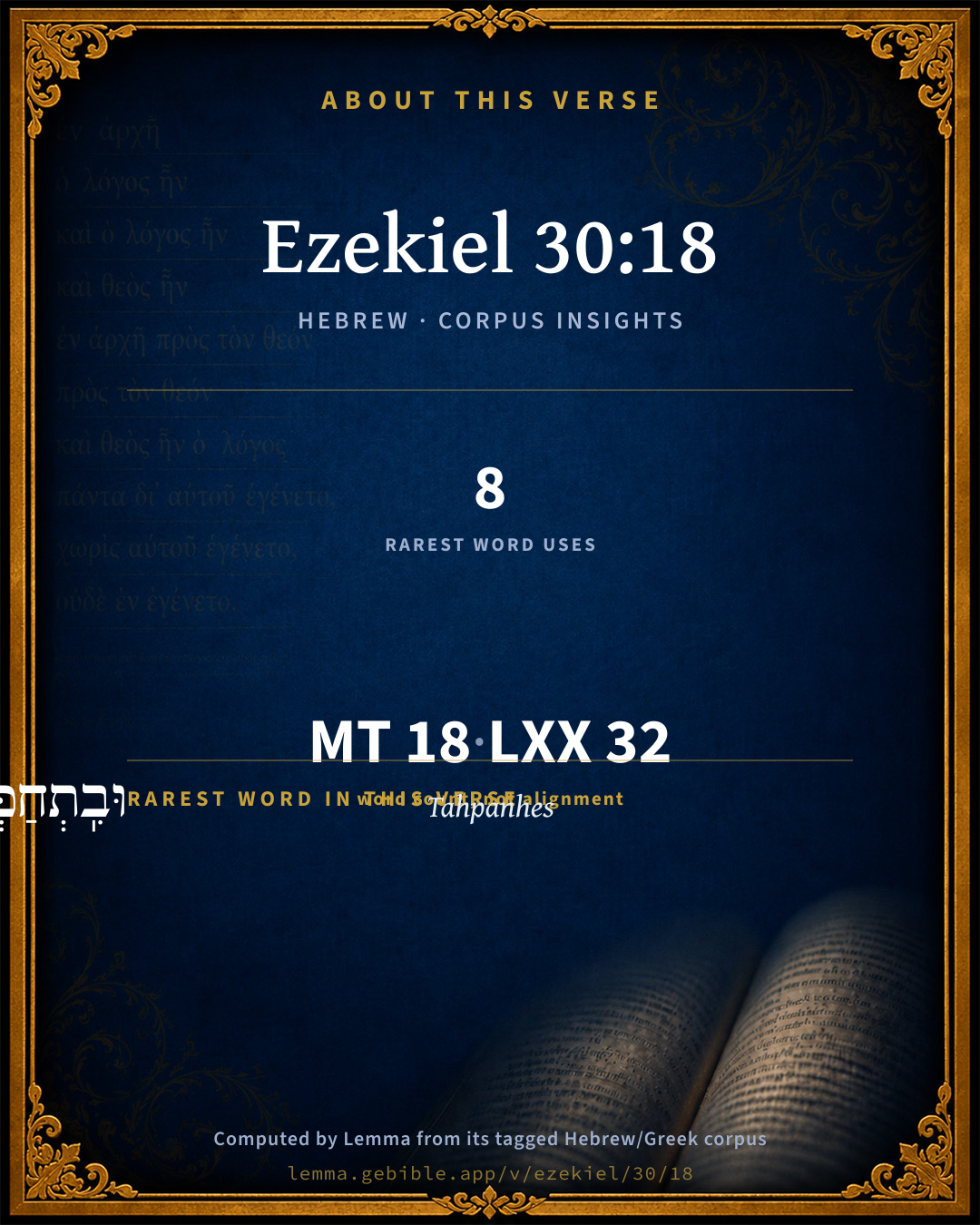
The rarest word here is וּבִֽתְחַפְנְחֵס֙ Tahpanhes H8471 — appearing just 8 times in the whole Hebrew Bible.

Shared distinctive vocabulary

וּבִֽתְחַפְנְחֵס֙ Tahpanhes H8471 occurs in 7 verses of the Hebrew Bible. Also found in:

Grammatical profile

  • 5 verbs
  • 9 nouns
  • 1 pronoun
  • 1 preposition
  • 1 adverb
  • 1 particle

Verb forms

  • חָשַׂ֣ךְ Qal · Perfect
  • בְּשִׁבְרִי Qal · Infinitive Construct
  • וְנִשְׁבַּת Niphal · Sequential Perfect
  • יְכַסֶּ֔נָּה Piel · Imperfect
  • תֵלַֽכְנָה Qal · Imperfect

Hebrew & Septuagint length

In English translation the verse runs 42 words from the Hebrew and 39 from the Septuagint (LXX English) — closely comparable.

A rough comparison of the two English renderings, which tokenize alike — not a word-level alignment.

Word counts can differ between the Hebrew and the Greek without any difference in meaning — e.g. the Hebrew direct-object marker אֵת has no separate Greek word, and Greek often adds the article ὁ.

In the original languages it is 18 Hebrew tokens and 32 Greek tokens — but the two are counted differently (Hebrew bundles its prefixes and suffixes into one token; the Greek is in lemma form), so that isn’t a like-for-like length.

Cross-references

20

Topical passages linked to Ezekiel 30:18 in the Treasury of Scripture Knowledge — connected by theme and wording, ordered by reader-vote popularity; previews shown in the World English Bible.

  • Ezekiel 30:3 For the day is near, even the day of Yahweh is near; it shall be a day of clouds, a time of the nations.
  • Isaiah 10:27 It shall happen in that day, that his burden shall depart from off your shoulder, and his yoke from off your neck, and the yoke shall be destroyed by reason of fatness.
  • Jeremiah 2:16 The children also of Memphis and Tahpanhes have broken the crown of your head.
  • Ezekiel 29:15 It shall be the base of the kingdoms; neither shall it any more lift itself up above the nations: and I will diminish them, that they shall no more rule over the nations.
  • Exodus 10:15 For they covered the surface of the whole earth, so that the land was darkened, and they ate every herb of the land, and all the fruit of the trees which the hail had left. There remained nothing green, either tree or herb of the field, through all the land of Egypt.
  • Leviticus 26:13 I am Yahweh your God, who brought you forth out of the land of Egypt, that you should not be their slaves; and I have broken the bars of your yoke, and made you go upright.
  • Isaiah 5:30 They will roar against them in that day like the roaring of the sea. If one looks to the land, behold, darkness and distress. The light is darkened in its clouds.
  • Isaiah 9:4 For the yoke of his burden, and the staff of his shoulder, the rod of his oppressor, you have broken as in the day of Midian.
  • Isaiah 9:19 Through the wrath of Yahweh of hosts is the land burnt up; and the people are as the fuel of fire: no man spares his brother.
  • Isaiah 13:10 For the stars of the sky and the constellations of it shall not give their light; the sun shall be darkened in its going forth, and the moon shall not cause its light to shine.
  • Isaiah 14:11 Your pomp is brought down to Sheol, [and] the noise of your viols: the worm is spread under you, and worms cover you.
  • Isaiah 14:25 that I will break the Assyrian in my land, and on my mountains tread him under foot: then shall his yoke depart from off them, and his burden depart from off their shoulder.
  • Isaiah 19:1 The burden of Egypt. Behold, Yahweh rides on a swift cloud, and comes to Egypt: and the idols of Egypt shall tremble at his presence; and the heart of Egypt shall melt in the midst of it.
  • Jeremiah 43:7–9 and they came into the land of Egypt; for they didn't obey the voice of Yahweh: and they came to Tahpanhes.
  • Jeremiah 46:14 Declare you in Egypt, and publish in Migdol, and publish in Memphis and in Tahpanhes: say you, Stand forth, and prepare you; for the sword has devoured round about you.
  • Jeremiah 46:20–26 Egypt is a very beautiful heifer; [but] destruction out of the north is come, it is come.
  • Ezekiel 31:18 To whom are you thus like in glory and in greatness among the trees of Eden? yet shall you be brought down with the trees of Eden to the lower parts of the earth: you shall lie in the midst of the uncircumcised, with those who are slain by the sword. This is Pharaoh and all his multitude, says the Lord Yahweh.
  • Ezekiel 32:18–32 Son of man, wail for the multitude of Egypt, and cast them down, even her, and the daughters of the famous nations, to the lower parts of the earth, with those who go down into the pit.
  • Joel 3:15 The sun and the moon are darkened, And the stars withdraw their shining."
  • Matthew 24:29 But immediately after the oppression of those days, the sun will be darkened, the moon will not give its light, the stars will fall from the sky, and the powers of the heavens will be shaken;

Cross-references courtesy of OpenBible.info (CC BY 4.0).

Hebrew and Greek witnesses Masoretic Hebrew ↔ Greek Septuagint

The same verse in the two great witnesses to the Old Testament, shown verse-for-verse.

These are two independent witnesses, not word-aligned to each other, and the Septuagint is shown in lemma (dictionary) form.

Hebrew Ezekiel 30:18 Masoretic · Westminster Leningrad Codex

וּבִֽתְחַפְנְחֵס֙ חָשַׂ֣ךְ הַיּ֔וֹם בְּשִׁבְרִי שָׁם֙ אֶת מֹט֣וֹת מִצְרַ֔יִם וְנִשְׁבַּת בָּ֖הּ גְּא֣וֹן עֻזָּ֑הּ הִ֚יא עָנָ֣ן יְכַסֶּ֔נָּה וּבְנוֹתֶ֖יהָ בַּשְּׁבִ֥י תֵלַֽכְנָה

At Tehaphnehes also the day shall withdraw itself, when I shall break there the yokes of Egypt, and the pride of her power shall cease in her: as for her, a cloud shall cover her, and her daughters shall go into captivity.

World English Bible · Public Domain

Greek LXX Ezekiel 30:18 Septuagint · lemma form

καί ἐν ταφνας συνσκοτάζω ὁ ἡμέρα ἐν ὁ συντρίβω ἐγώ ἐκεῖ ὁ σκῆπτρον αἴγυπτος καί ἀποὀλλύω ἐκεῖ ὁ ὕβρις ὁ ἰσχύς αὐτός καί αὐτός νεφέλη καλύπτω καί ὁ θυγάτηρ αὐτός αἰχμάλωτος ἄγω

And the day shall be darkened in Taphnae, when I have broken there the scepters of Egypt: and the pride of her strength shall perish there: and a cloud shall cover her, and her daughters shall be taken prisoners.

LXX2012 (modern English Septuagint) · Public Domain

On this verse, The Cambridge Bible for Schools and Colleges discusses the Septuagint’s reading. Read the note in Commentary ↓

Hebrew: Westminster Leningrad Codex (CC BY 4.0). Greek: Septuagint (public domain); English from LXX2012 (modern English Septuagint) (Public Domain). How the Septuagint differs from the Hebrew →

Targum (Aramaic paraphrase)

1

The Targum is the ancient Jewish Aramaic paraphrase of the Hebrew Scriptures — an interpretive translation, not the Hebrew text itself. Onkelos (literal) and Pseudo-Jonathan (expansive) render the Torah, and Jonathan the Prophets. Coverage is partial: where no permissively-licensed English translation exists for a verse, only the Aramaic is shown. This is verse-level text, not a word-by-word alignment to the Hebrew.

  1. Targum Jonathan Prophets (Joshua–Malachi)
    וְעַל תַּחְפַּנְחֵס אַיְתֵי חֲשׁוֹךְ בִּימָם כַּד אֶתְבַּר תַּמָן יַת תְּקוֹף מִצְרַיִם וִיבַטֵל בָּהּ יְקַר תּוּקְפָהּ מְלַךְ בְּמַשִׁרְיָתֵיהּ יַחְפִּינָהּ כַּעֲנָנָא דְסָלֵיק וְחָפֵי יַת אַרְעָא וְיַתְבֵי כַפְרָנָהָא בְּשִׁבְיָא יָהֲכוּן:

    (no public-domain English translation for this verse)

    Targum Jonathan — Aramaic: “Mikraot Gedolot” (public domain). English: “Sefaria Community Translation” (CC0 1.0 (public-domain dedication)); “London "Chaldee Paraphrase," 1871” (public domain). Text via Sefaria.

Commentary

Notes on Ezekiel 30:18 from classic Christian and Jewish commentators (each source and its license shown beneath its notes). The classic Christian expositions comment on the surrounding passage and are grouped to its opening verse, so a note may address several verses; the Jewish commentaries on the Tanakh (Rashi and others) are per-verse, so they appear only where the commentator wrote on this verse.

Lemma curates 59 commentaries, every one of them public domain or Creative Commons licensed, each selected and text-cleaned for this edition rather than reprinted as found. About our sources →

Trapp's Complete Commentary

John Trapp

Eze 30:18 At Tehaphnehes also the day shall be darkened, when I shall break there the yokes of Egypt: and the pomp of her strength shall cease in her: as for her, a cloud shall cover her, and her daughters shall go into captivity.

Ver. 18. At Tehaphnehes.] Or, Daphne, the gate of Egypt, at which the Chaldees entered.

A cloud shall cover her.] See Eze 30:3.

John Trapp, A Commentary or Exposition upon All the Books of the Old and New Testament (1647–1656) — public domain. Text from a community e-Sword module.

Tyndale Open Study Notes

Tyndale Open Resources

30:18 Tahpanhes was a fortress town on the northeastern frontier of Egypt. • dark day: Egypt would see its light turned to darkness when God came to judge it, as in the Exodus plague (Exod 10:21-23).

Tyndale Open Study Notes — © Tyndale Open Resources, licensed CC BY-SA 4.0. Text via the HelloAO Bible API.

Geneva Bible (1599)

Geneva Bible translators

That is, the strength and force.

Meaning, that there shall be great sorrow and affliction.

Geneva Bible (1599) marginal notes — public domain. Text via Bolls.life.

Jamieson, Fausset & Brown

Robert Jamieson, A. R. Fausset & David Brown

Tehaphnehes--called from the queen of Egypt mentioned in Kg1 11:19. The same as Daphne, near Pelusium, a royal residence of the Pharaohs (Jer 43:7, Jer 43:9). Called Hanes Isa 30:4).

break . . . the yokes of Egypt--that is, the tyrannical supremacy which she exercised over other nations. Compare "bands of their yoke" (Eze 34:7).

a cloud--namely, of calamity.

Jamieson, Fausset & Brown — Commentary Critical and Explanatory on the Whole Bible (1871) — public domain (CC PDM 1.0). Text via the HelloAO Bible API.

Adam Clarke's Commentary

Verse 18. Tehaphnehes] Called also Tahapanes, Jer 2:16. This is the Pelusian Daphne.

Break there the yokes] The sceptres. Nebuchadnezzar broke the sceptre of Egypt when he confirmed the kingdom to Amasis, who had rebelled against Apries.

Adam Clarke's Commentary on the Bible (1810–1826) — public domain. Text from a community e-Sword/MySword module.

Ellicott's Commentary for English Readers

(18) Tehaphnehes.—(Jer_2:16; Jer_43:7-9; Jer_44:1; Jer_46:14.) Otherwise called Tahpanhes; the city Daphne, also a frontier town near Pelusium, strongly fortified. It may be especially mentioned, because the Jews who fled from Palestine through fear of Nebuchadnezzar had taken refuge there (Jeremiah 43, 44).

The day shall be darkened.—This is a common prophetic form of describing coming calamity. (See Eze_30:3, Eze_32:8; Isa_13:10; Joe_2:10; Joe_2:31; Joe_3:15; Amo_8:9; Mat_24:29, &c.)

The yokes of Egypt.—Not the yokes placed upon Egypt, but the tyranny which she exercised over others. The fuller expression, “bands of a yoke,” occurs in Eze_34:27, and also in Lev_26:13, the latter in reference to the deliverance of Israel from the bondage of Egypt. It appears from Jer_43:9-10 that there was a royal palace at Tahpanhes, and it was foretold by the prophet that Nebuchadnezzar should there set up his pavilion, and thence smite Egypt. It is correspondingly foretold here that the power of Egypt should there be broken, because this and the neighbouring Pelusium were the frontier fortresses and keys of the land.

A Bible Commentary for English Readers, edited by Charles John Ellicott (1878–1897) — public domain. Text from a community e-Sword module.

The Cambridge Bible for Schools and Colleges

gen. ed. J. J. S. Perowne

18. Tehaphnehes, spelled somewhat differently Jer_2:16. Jer_43:8 speaks of a royal palace there, and Eze_46:14 it is named along with Memphis as a chief city in Egypt. Its site is probably the modern Tell Defenneh (Daphnae), near the Pelusiac arm of the Nile, south of lake Menzaleh, about 30 miles S.-W. of the ancient Pelusium.

the yokes of Egypt] must here be those imposed by Egypt, a sense not very suitable to the connexion. A different pointing would give sceptres (LXX.) or staves—but “staves” in the sense of supports is more than doubtful (cf. Isa_14:5).

her daughters] may be literal (cf. Eze_30:17, young men of On), or said figuratively of her towns.

The Cambridge Bible for Schools and Colleges (gen. ed. J. J. S. Perowne; Cambridge University Press, 1878–1918) — public domain. Text from a community e-Sword module.

John Gill's Exposition

At Tehaphnehes also the day shall be darkened,.... The same with Hanes in Isa 30:4 and Tahapanes in Jer 2:16 and Tahpanhes, Jer 43:7, it was a royal seat of the kings of Egypt: there was in Solomon's time a queen of Egypt of this name, and perhaps it might be so called from her, Kg1 11:19. It is generally thought to be the Daphne of Pelusium, it being near that city; though Junius takes it to be a place in another part of Egypt, at a great distance, which Herodotus (i) calls Tahcompso, an island encompassed by the Nile; and by Ptolemy (k) called Metacompso: now at this place the day should be darkened; or should "restrain" (l), as it may be rendered; that is, its light; it should be a calamitous and mournful time with the inhabitants of it:

when I shall break there the yokes of Egypt; the yokes they put upon the necks of others, who now should be freed from them: or, "the sceptres of Egypt", as the Vulgate Latin version renders it; the regalia of their kings, which might lie in this place; it being a royal seat where Pharaoh had a house, as appears from Jer 43:9,

and the pomp of her strength shall cease in her; all that grandeur and magnificence which appeared in the courts of the kings of Egypt in this place:

as for her, a cloud shall cover her; as for this city, a cloud of calamity shall cover it, so as its glory shall not be seen. The Targum is,

"a king with his army shall cover her as a cloud ascends and covers the earth:''

and her daughters shall go into captivity; which may be taken either in a literal sense for the daughters of the inhabitants of this place, which must be a great affliction to their tender parents, to have them forced away by rude soldiers, and carried captive into distant lands; or in a figurative sense, for the villages and the inhabitants of them round about this city; it being usual to represent a city as a mother, and its villages as daughters; and so the Targum, Jarchi, and Kimchi interpret it.

(i) Euterpe, sive l. 2. c. 29. (k) Geograph. l. 4. c. 5. (l) "prohibuit", Montanus; "vitavit", Munster; "cohibuit", Cocceius; "probibebit, arcebit", Vatablus; so Ben Melech.

John Gill's Exposition of the Whole Bible (1746–1763) — public domain (CC PDM 1.0). Text via the HelloAO Bible API.

Albert Barnes' Notes on the Bible

Tehaphnehes - See the marginal reference note. “break the yokes of Egypt” i. e., break the yokes imposed by Egypt, or break up the tyrannous dominion of Egypt over other lands.

Albert Barnes' Notes on the Bible (1834–1885) — public domain. Text from a community e-Sword/MySword module.

Haydock's Catholic Bible Commentary

Darkened: war and misery shall ensue. --- Sceptres, by dethroning Apries. --- Pride; overflowing of the Nile. See Jeremias xlix. 19.

George Leo Haydock (1774–1849), Haydock's Catholic Family Bible and Commentary, 1859 edition — public domain. Excludes Psalms (Douay-Rheims chapter numbering differs from Protestant) and Deuterocanonical books (Catholic canon only).

Matthew Poole's English Annotations

Tehaphnehes; a great and goodly city of Egypt. Tachapanes, Tachpanes, Tahapanes, Tahpanes, Chanes, and Hanes, Isa 30:4, are names given it, and this from a queen of Egypt of that name in Solomon’s time, 1Ki 11:19,20. It stood not far from Sin or Pelusium, and by the Greeks, a little softening the name, called Daphne Pelusiaca. It was a royal city, in it Pharaoh had a house; to it many Jews fled, when forbidden of the Lord by the prophet Jeremiah, Eze 44. It was one of the first cities you come to out of the desert of Sin, and was one of the keys of Egypt.

The day shall be darkened; a night shall come upon it, and such a night of sorrow as shall grow darker and darker till the day, i.e. their day, be

darkness; or else, word for word, darkness shall be the day, and may bear this sense, shall be more welcome, more useful, more desired, than the day, whose light would discover their flight, which the night concealed.

I shall break, as into shivers.

The yokes; the sceptres; for there was one of Pharaoh’s houses, and probably some sceptre and other regal ornaments: or, the bars, which kept enemies out, and secured the citizens and country; such was this frontier town. Or, when, by giving this strong place into Nebuchadnezzar’s hand, I shall break the kingdom of Egypt, that it no more oppress with yokes, i.e. burdens.

The pomp; the beauty and goodliness with which the strength of this city was set out in her buildings, towers, forts.

Shall cease in her; shall be buried in her own ruins.

A cloud; sorrow at the success of the Chaldeans against her, compared often to a cloud.

Her daughters; either metaphorically, i.e. the towns and villages about her, or literally, her children; her daughters only mentioned, because her sons were destroyed and slain.

Matthew Poole's English Annotations on the Holy Bible (1683–1685) — public domain. Text from a community e-Sword/MySword module.

Whedon's Commentary on the Bible

Daniel D. Whedon

18. Tehaphnehes — LXX., Tapne (Daphnae). Modern name, Tel Deppennuch. This was another fortress which had guarded the great highway into Syria from Solomon’s day or earlier. In Ezekiel’s era it was occupied largely by Greek mercenaries. It was naturally to this frontier city that Jeremiah and other Hebrews fled (Jer_43:5-11). Nebuchadnezzar’s invasion of Egypt may have been largely due to Egypt’s favorable reception of these refugees. Dr. Petrie has found the old Greek camp and fort, and uncovered the brickwork where Nebuchadnezzar spread his royal pavilion (Egyptian Exploration Fund, Fourth Memmoir). The largest building in the ruins is still called by the Arabs “the palace of the Jew’s daughter.”

The yokes of Egypt — LXX. and Vulgate translate scepters. If yokes is the correct reading, it cannot mean that the yokes that bind Egypt are broken (compare Eze_34:27), but the yokes which Egypt has heretofore placed upon others. (For the symbolic “darkness” see Eze_30:3; Eze_32:7; Amos 5:29; Joe_2:2; Joe_3:15.)

Daniel D. Whedon (gen. ed.), Commentary on the Old and New Testaments (1874–1909) — public domain. Text from a community e-Sword module.

The Pulpit Commentary

At Tehaphnehes; the Tabu-panes of; Jer_2:16 Jer_42:7 Jer_44:1 Jer_46:14; (where it appears as having a royal palace) the Taphnae of the LXX; the Daphne of Herod., 2:30. It was another frontier-fortress in the neighborhood of Pelusium, built by Psammetichus. It may, perhaps, be represented by the modern Tel-ed-Defenne, about twenty-seven miles southwest of Pelusium. The day shall be darkened. The normal image for the departure of the sunshine of prosperity, as in Ver. 3 and Eze_32:7 (comp. Amo_5:20 Amo_8:9; Isa_5:30; Jer_13:16, etc.) The yokes of Egypt. Commonly, as in Eze_34:27; Jer_27:2 Jer_28:10, Jer_28:12, the phrase would imply the deliverance of Egypt from the yoke of oppression suffered at the hand of others. Here that sense is clearly inappropriate. The LXX and Vulgate give "the scepters" of Egypt, which implies a different reading, and this is adopted in substance by Ewald and Smend, the latter preferring rendering it by "supports" or "props," the "red" being used as a "staff" rather than as a "scepter" (comp. Eze_19:14; Jer_43:8 Jer_48:17) The pomp of her strength. The phrase meets us again in Eze_33:28, and includes what we speak of as the parade of power, here probably with a view to the foreign forces that garrisoned both Daphne and Pelusium. The daughters may be literally the women of the city, who were to share the usual fate of their sex on the capture of a city; or as in Eze_26:6, Eze_26:8; or probably as in Eze_16:53, Eze_16:55, for the villages and towns dependent on the strong city. On the whole, looking to the mention of the "young men" in Ver. 17, the literal meaning seems preferable.

Broken yokes.

shall break there the yokes of Egypt." There are many yokes which are laid on men"s shoulders from which they may well wish to be freed; and there is one yoke concerning which no such thought need be cherished for a moment. There is the yoke of

I HUMAN OPPRESSION. The sad story of the human race is, to a very large extent, the history of human oppression. "Man"s inhumanity to man" may well "make us mourn" as we dwell upon it. And among his various cruelties and wrongs we have to give oppression a prominent place political, domestic, personal oppression. It includes the denial of the rights of manhood and of womanhood, the exacting of hard and burdensome labor, or of heavy and excessive tribute, or of a dishonoring and hurtful homage, the inflicting of pain and suffering of many kinds. It seems to be in the nature of sin to harden men"s hearts against one another, until they not only endure but positively enjoy the sight of the oppression they impose. Ezekiel speaks of" the yokes of Egypt." No doubt that country, in the plenitude of its power, exacted tribute, enforced labor, laid heavy burdens upon many of its own subjects or (as in an earlier time, when Israel was under its heel) on other peoples. But when the Babylonian power came up and subdued it, its hard hold on these had to be relaxed, its yoke was broken in twain. This, in the providence of God, has frequently happened. Power becomes wealthy; wealth leads to luxury and indulgence; indulgence leads to effeminacy and decline; weakness succumbs to some other power that has arisen; and then and thus its "yoke is broken.

II THE SERVITUDE OF SIN. Know ye not that to whom ye yield yourselves servants to obey, his servants slaves ye are to whom ye obey? Ye were the servants slaves of sin". (Rom_6:16, Rom_6:17) Sin conducts, by sure steps, to spiritual bondage; it lays a hard and heavy yoke upon the soul; it may be that of a grasping selfishness, or of an absorbing worldliness, or of a degrading vice, or of such a fatal habit as that of procrastination. But it is a hard bondage, a cruel yoke, which must be broken if there is to be spiritual liberty and eternal life. God, in the gospel of Jesus Christ, can and does break this deadly yoke.

1. He fills the soul with a sense of shame, and with a holy, renewing sorrow.

2. He leads the awakened soul to a Divine Savior, in whoso love and service the bond is broken.

3. He gives to the seeking, trustful soul the cleansing, liberating power of his Holy Spirit; and thus the yoke is broken and the man is freed. There is another yoke of an entirely different nature; it is in

III THE SERVICE OF JESUS CHRIST. "Take my yoke," he says; "my yoke is easy, and my burden is light." In that which is the service of love and of righteousness there is real liberty and lasting joy. C.

The Pulpit Commentary (1880–1919), ed. H.D.M. Spence-Jones & Joseph S. Exell — public domain. Text from a community e-Sword module.

John Wesley's Explanatory Notes

Tehaphnehes - A great and goodly city of Egypt; Tachapanes, Tachpanes, Tahapanes, Tahpanes, Chanes, and Hanes, are names given it, and this from a queen of Egypt of that name in Solomon's time. It stood not far from Sin, or Pelusium. Darkened - A night shall come upon it. Break - I shall break the kingdom of Egypt, that it no more oppress with yokes, that is, burdens. Her daughters - Her towns and villages.

John Wesley, Explanatory Notes Upon the Whole Bible (1754–1765) — public domain. Text via the GEBible commentary corpus.

Rashi

Rabbi Shlomo Yitzchaki (Rashi)

the day will withdraw itself [Heb. חָשָּׁך הַיוֹם,] the light will be withheld

a cloud will cover her Trouble will come upon her and cover her, and it will become dark [for her] like a day covered with clouds.

Rashi on the Tanakh — English translations: “The Judaica Press complete Tanach with Rashi, translated by A. J. Rosenberg” (CC BY 4.0); “Pentateuch with Rashi's commentary by M. Rosenbaum and A.M. Silbermann, 1929-1934” (public domain); “The Metsudah Tanach series, Lakewood, N.J” (CC BY 4.0); and “The Book of Joshua, Metsudah Publications, 1997” (CC BY 4.0). Text via Sefaria.

Lesson kit

Teaching starters — assembled from the data on this page, not authored interpretation. Every prompt links to the verse data it draws on. Edit before teaching.

Ezekiel, in the Prophets, opens this verse with 18 words (17 distinct Hebrew lemmas). Its most distinctive word is Tachpanchêç (“Tahpanhes”). A historical commentator’s framing appears above. Read the whole chapter for the surrounding context.

Discussion questions

  1. How does “Tahpanhes” (Tachpanchêç) shape what this verse is saying?
  2. How does Jeremiah 2:16, which shares the word «Tahpanhes», read alongside this verse?
  3. These translations render this verse differently. What is at stake in choosing one wording over another?
  4. «חָשַׂ֣ךְ» is a Qal Perfect verb. How does that grammatical form shape the action described?
  5. Compare how Trapp's Complete Commentary and Tyndale Open Study Notes read this verse. Where do they agree or differ?

Things to notice

Reading settings

Reading text

Shown beneath each verse's original-language words.

Old Testament
Old Testament edition

Read the OT as the Masoretic Hebrew (MT) or the Greek Septuagint (LXX).

English shown for the Greek Septuagint (in the Hebrew ↔ Greek comparison).

Comparing translations? Open the Compare panel on any verse page to stack up to four side by side.