Isaiah 19:12

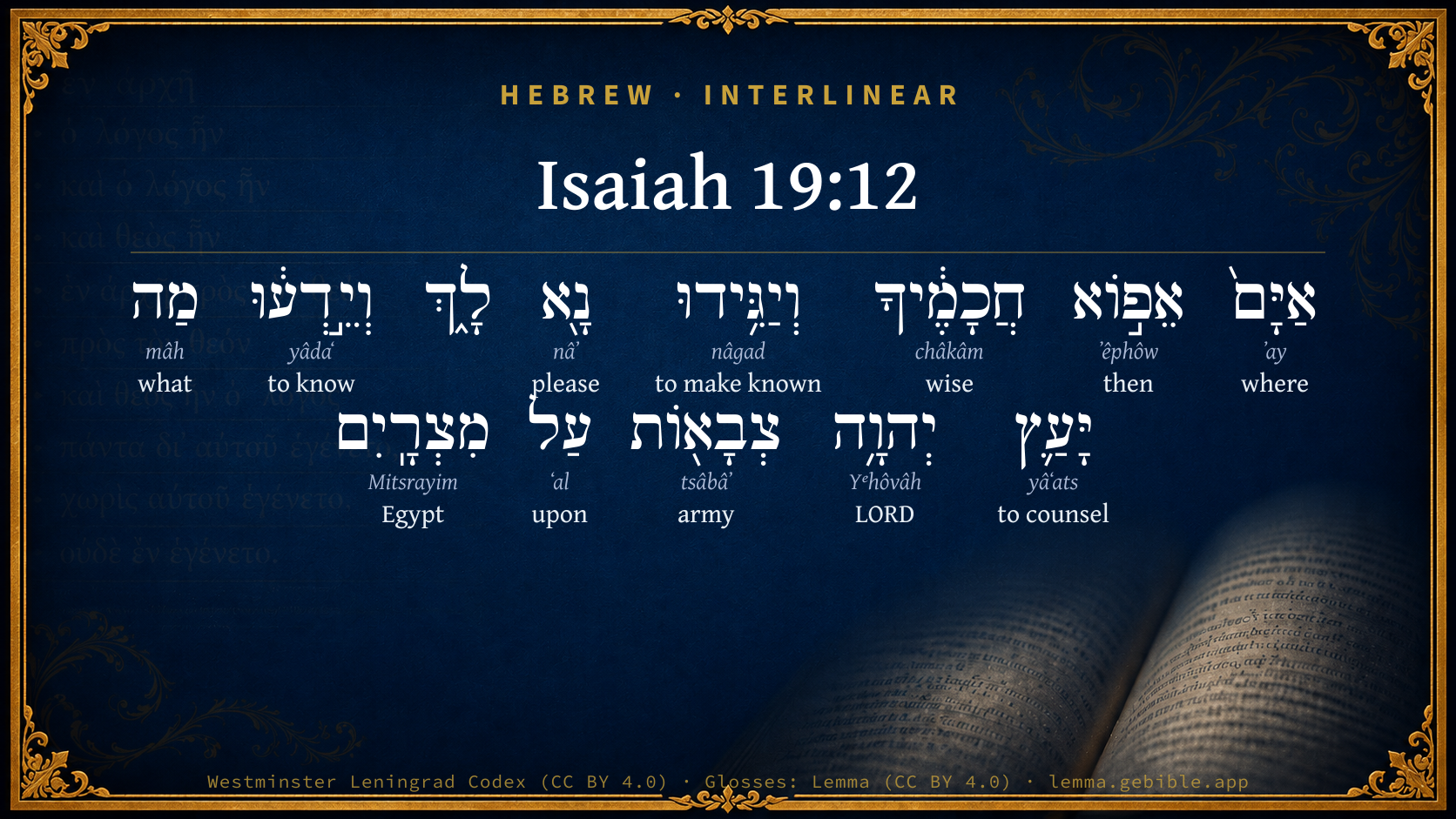
Hebrew (Westminster Leningrad Codex) Isaiah 19:12 appears in the Hebrew Old Testament. The text above is from the Westminster Leningrad Codex. Each word links to its Strong’s number, a concise gloss, and parsing drawn from the Open Scriptures Hebrew Bible morphology. Click any word for its full Brown-Driver-Briggs (BDB) entry.
Download image
Cite this verse

Isaiah 19:12 (World English Bible). Public Domain. Lemma interlinear Bible study tool, https://lemma.gebible.app/v/isaiah/19/12.

Show BibTeX & RIS
BibTeX
RIS
English Translation
Where then are your wise men? and let them tell you now; and let them know what Yahweh of Hosts has purposed concerning Egypt.
World English Bible · Public Domain
Download a study sheet

One document with this verse’s original text, its word-by-word gloss line, the meaning frame, cross-references with their text, attributed commentary, and full source and license credits — printable, and it pastes into notes with its structure intact.

This verse Autodidact and up

Study sheet (.html) Plain text (.txt)

A passage Seminary Student

Up to 50 verses in one chapter. A passage sheet keeps up to 6 commentary sources and 12 cross-references per verse, in the order this page ranks them, and says so on the sheet whenever that leaves anything out. Ask for a single verse and you get the Autodidact verse sheet above.

Everything on this page stays free to read, with no account — the sheet is a download of what is already on screen, not access to it.

Want to remove ads? Support Godless Engineer
Compare translations 3

The same verse in 3 English versions, stacked beneath the original-language interlinear above. Click any original word for its lexicon entry.

Each is an independent rendering of the whole verse — the interlinear is not word-aligned to these translations.

Highlighted words mark where these versions differ — a whole-verse word diff, not a word-by-word alignment.

  • World English Bible Public Domain
    Where then are your wise men? and let them tell you now; and let them know what Yahweh of Hosts has purposed concerning Egypt.
  • King James Version Public Domain
    Where are they? where are thy wise men? and let them tell thee now, and let them know what the LORD of hosts hath purposed upon Egypt.
  • unfoldingWord Literal Text CC BY-SA 4.0
    Where, then, your wise? And let them declare to you, please, and let them know what Yahweh of Armies has determined against Egypt.

unfoldingWord Literal Text — © unfoldingWord, licensed CC BY-SA 4.0. Word-aligned USFM3 via Door43 (git.door43.org/unfoldingWord/en_ult).

Versions to compare (up to 4)

3 of 4 selected

Show all 18 translations

Every available English version of this verse, each an independent rendering of the whole verse.

  • World English Bible Public Domain
    Where then are your wise men? and let them tell you now; and let them know what Yahweh of Hosts has purposed concerning Egypt.
  • Berean Standard Bible Public Domain
    Where are your wise men now? Let them tell you and reveal what the LORD of Hosts has planned against Egypt.
  • Majority Standard Bible Public Domain
    Where are your wise men now? Let them tell you and reveal what the LORD of Hosts has planned against Egypt.
  • King James Version Public Domain
    Where are they? where are thy wise men? and let them tell thee now, and let them know what the LORD of hosts hath purposed upon Egypt.
  • American Standard Version (1901) Public Domain
    Where then are thy wise men? and let them tell thee now; and let them know what Jehovah of hosts hath purposed concerning Egypt.
  • Revised Version (1885) Public Domain
    Where then are thy wise men? and let them tell thee now; and let them know what the LORD of hosts hath purposed concerning Egypt.
  • Geneva Bible (1599) Public Domain
    Where are nowe thy wise men, that they may tell thee, or may knowe what the Lord of hostes hath determined against Egypt?
  • Douay-Rheims (1899) Public Domain
    Where are now thy wise men? let them tell thee, and shew what the Lord of hosts hath purposed upon Egypt.
  • Young's Literal Translation Public Domain
    Where `are' they now, thy wise ones? Yea, let them tell to thee, I pray thee, And they know what Jehovah of Hosts hath counselled against Egypt!
  • Literal Standard Version CC BY-SA 4.0
    Where [are] they now, your wise ones? Indeed, let them now tell [it] to you, || And they know what YHWH of Hosts has counseled against Egypt!
  • Unlocked Literal Bible CC BY-SA 4.0
    Where then are your wise men? Let them tell you and make known what Yahweh of hosts plans concerning Egypt.
  • unfoldingWord Literal Text CC BY-SA 4.0
    Where, then, your wise? And let them declare to you, please, and let them know what Yahweh of Armies has determined against Egypt.
  • Darby Bible Public Domain
    Where are they then, thy wise [men]? Let them now tell thee, and let them make known what Jehovah of hosts hath purposed upon Egypt.
  • World Messianic Bible Public Domain
    Where then are your wise men? Let them tell you now; and let them know what the LORD of Hosts has purposed concerning Egypt.
  • Webster's Bible Public Domain
    Where are they? where are thy wise men? and let them tell thee now, and let them know what the LORD of hosts hath purposed upon Egypt.
  • Free Bible Version CC BY-SA 4.0
    So where are your wise counselors? Let them tell you so you can understand what the Lord Almighty has planned to do to Egypt.
  • Bible in Basic English Public Domain
    Where, then, are your wise men? let them make clear to you, let them give you knowledge of the purpose of the Lord of armies for Egypt.
  • JPS Tanakh (1917) Public Domain
    Where are they, then, thy wise men? And let them tell thee now; and let them know what the LORD of hosts hath purposed concerning Egypt.

Literal Standard Version (2020), Covenant Press — licensed CC BY-SA 4.0. Text via the HelloAO Bible API (eBible.org). Unlocked Literal Bible (unfoldingWord) — licensed CC BY-SA 4.0. Text via the HelloAO Bible API (eBible.org). unfoldingWord Literal Text — © unfoldingWord, licensed CC BY-SA 4.0. Word-aligned USFM3 via Door43 (git.door43.org/unfoldingWord/en_ult). Free Bible Version, Dr. Jonathan Gallagher — licensed CC BY-SA 4.0. Text via the HelloAO Bible API (eBible.org).

Word by word

More ways to search: Search by grammar → Find every occurrence → Compare this word →

Practice this passage: Drill this verse → Learn its vocabulary →

אֵפ֣וֹא
ʼêphôw
H645
“then”
Adverb
Part of Speech
Adverb
Full BDB Definition

Origin: from H6311

TWOT: 144

then, now, so - (who) then, (what) then (with interrogative) - then (with imperative - i.e. know then) - if...then (with adverb)
  1. אַיָּם֙ ʼay H335 “where · them” Particle, Interrogative + Suffix, Personal, 3rd Person, Masculine, Plural
  2. חֲכָמֶ֔יךָ châkâm H2450 “wise · your” Adjective, Adjective, Masculine, Plural, Construct + Suffix, Personal, 2nd Person, Masculine, Singular
  3. וְיַגִּ֥ידוּ nâgad H5046 “and · to make known” Conjunction + Verb, Hiphil, Jussive, 3rd Person, Masculine, Plural
  4. נָ֖א nâʼ H4994 “please” Particle, Exhortation
  5. וְיֵ֣דְע֔וּ yâdaʻ H3045 “and · to know” Conjunction + Verb, Qal, Imperfect, 3rd Person, Masculine, Plural
  6. מַה mâh H4100 “what” Particle, Interrogative
  7. יָּעַ֛ץ yâʻats H3289 “to counsel” Verb, Qal, Perfect, 3rd Person, Masculine, Singular
  8. יְהוָ֥ה Yᵉhôvâh H3068 “LORD” Noun, Proper
  9. צְבָא֖וֹת tsâbâʼ H6635 “armies” Noun, Common, Both, Plural, Absolute
  10. עַל ʻal H5921 “upon” Preposition
  11. מִצְרָֽיִם Mitsrayim H4714 “Egypt” Noun, Proper

About this verse

These counts appear in no published source. They are computed here, from the morphology-tagged text and Lemma’s own curated glosses. What Lemma adds →

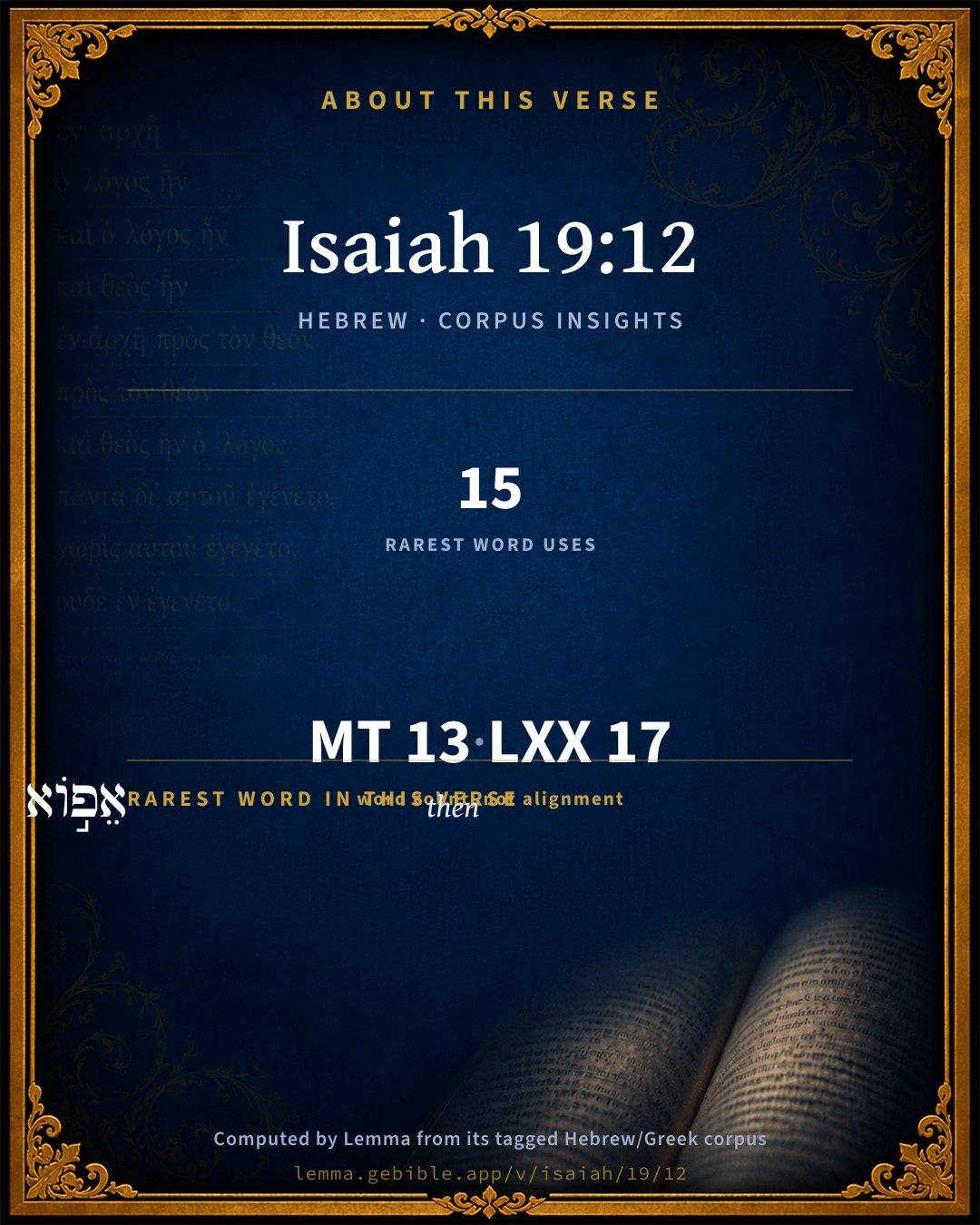
13
words
12
distinct lemmas
Prophets
section

Notable vocabulary

The rarest word here is אֵפ֣וֹא then H645 — appearing just 15 times in the whole Hebrew Bible.

Shared distinctive vocabulary

אֵפ֣וֹא then H645 occurs in 15 verses of the Hebrew Bible. Also found in:

Grammatical profile

  • 3 verbs
  • 3 nouns
  • 1 adjective
  • 2 prepositions
  • 1 adverb
  • 3 particles

Verb forms

  • וְיַגִּ֥ידוּ Hiphil · Jussive
  • וְיֵ֣דְע֔וּ Qal · Imperfect
  • יָּעַ֛ץ Qal · Perfect

Hebrew & Septuagint length

In English translation the verse runs 24 words from the Hebrew and 23 from the Septuagint (LXX English) — closely comparable.

A rough comparison of the two English renderings, which tokenize alike — not a word-level alignment.

Word counts can differ between the Hebrew and the Greek without any difference in meaning — e.g. the Hebrew direct-object marker אֵת has no separate Greek word, and Greek often adds the article ὁ.

In the original languages it is 13 Hebrew tokens and 17 Greek tokens — but the two are counted differently (Hebrew bundles its prefixes and suffixes into one token; the Greek is in lemma form), so that isn’t a like-for-like length.

Cross-references

12

Topical passages linked to Isaiah 19:12 in the Treasury of Scripture Knowledge — connected by theme and wording, ordered by reader-vote popularity; previews shown in the World English Bible.

  • 1 Corinthians 1:20 Where is the wise? Where is the scribe? Where is the lawyer of this world? Hasn't God made foolish the wisdom of this world?
  • Judges 9:38 Then said Zebul to him, Where is now your mouth, that you said, Who is Abimelech, that we should serve him? is not this the people that you have despised? go out now, I pray, and fight with them.
  • Job 11:6–7 That he would show you the secrets of wisdom! For true wisdom has two sides. Know therefore that God exacts of you less than your iniquity deserves.
  • Isaiah 5:21 Woe to those who are wise in their own eyes, And prudent in their own sight!
  • Isaiah 14:24 Yahweh of Hosts has sworn, saying, Surely, as I have thought, so shall it happen; and as I have purposed, so shall it stand:
  • Isaiah 40:13–14 Who has directed the Spirit of Yahweh, or being his counselor has taught him?
  • Isaiah 41:22–23 Let them bring forth, and declare to us what shall happen: declare you the former things, what they are, that we may consider them, and know the latter end of them; or show us things to come.
  • Isaiah 44:7 Who, as I, shall call, and shall declare it, and set it in order for me, since I established the ancient people? and the things that are coming, and that shall happen, let them declare.
  • Isaiah 47:10–13 For you have trusted in your wickedness; you have said, None sees me; your wisdom and your knowledge, it has perverted you, and you have said in your heart, I am, and there is none else besides me.
  • Jeremiah 2:28 But where are your gods that you have made you? let them arise, if they can save you in the time of your trouble: for according to the number of your cities are your gods, Judah.
  • Romans 9:17 For the Scripture says to Pharaoh, "For this very purpose I caused you to be raised up, that I might show in you my power, and that my name might be published abroad in all the earth."
  • Romans 11:33–34 Oh the depth of the riches both of the wisdom and the knowledge of God! How unsearchable are his judgments, and his ways past tracing out!

Cross-references courtesy of OpenBible.info (CC BY 4.0).

Hebrew and Greek witnesses Masoretic Hebrew ↔ Greek Septuagint

The same verse in the two great witnesses to the Old Testament, shown verse-for-verse.

These are two independent witnesses, not word-aligned to each other, and the Septuagint is shown in lemma (dictionary) form.

Hebrew Isaiah 19:12 Masoretic · Westminster Leningrad Codex

אַיָּם֙ אֵפ֣וֹא חֲכָמֶ֔יךָ וְיַגִּ֥ידוּ נָ֖א לָ֑ךְ וְיֵ֣דְע֔וּ מַה יָּעַ֛ץ יְהוָ֥ה צְבָא֖וֹת עַל מִצְרָֽיִם

Where then are your wise men? and let them tell you now; and let them know what Yahweh of Hosts has purposed concerning Egypt.

World English Bible · Public Domain

Greek LXX Isaiah 19:12 Septuagint · lemma form

ποῦ εἰμί νῦν ὁ σοφός σύ καί ἀναἀγγέλλω σύ καί εἶπον τίς βουλεύω κύριος σαβαωθ ἐπί αἴγυπτος

Where are now your wise men? and let them declare to you, and say, What has the Lord of hosts purposed upon Egypt?

LXX2012 (modern English Septuagint) · Public Domain

On this verse, Adam Clarke's Commentary discusses the Septuagint’s reading. Read the note in Commentary ↓

Hebrew: Westminster Leningrad Codex (CC BY 4.0). Greek: Septuagint (public domain); English from LXX2012 (modern English Septuagint) (Public Domain). How the Septuagint differs from the Hebrew →

Targum (Aramaic paraphrase)

1

The Targum is the ancient Jewish Aramaic paraphrase of the Hebrew Scriptures — an interpretive translation, not the Hebrew text itself. Onkelos (literal) and Pseudo-Jonathan (expansive) render the Torah, and Jonathan the Prophets. Coverage is partial: where no permissively-licensed English translation exists for a verse, only the Aramaic is shown. This is verse-level text, not a word-by-word alignment to the Hebrew.

  1. Targum Jonathan Prophets (Joshua–Malachi)
    אָן אִינוּן חַכִימָךְ וִיחַווּן כְּעַן לָךְ וְיֵדְעוּן מַה מְלַךְ יְיָ צְבָאוֹת עַל מִצְרָיִם:

    Where are thy wise men? Let them tell thee now, and let them know what the Lord of hosts has counselled against Egypt.

    Targum Jonathan — Aramaic: “Mikraot Gedolot” (public domain). English: “Sefaria Community Translation” (CC0 1.0 (public-domain dedication)); “London "Chaldee Paraphrase," 1871” (public domain). Text via Sefaria.

Commentary

Notes on Isaiah 19:12 from classic Christian and Jewish commentators (each source and its license shown beneath its notes). The classic Christian expositions comment on the surrounding passage and are grouped to its opening verse, so a note may address several verses; the Jewish commentaries on the Tanakh (Rashi and others) are per-verse, so they appear only where the commentator wrote on this verse.

Lemma curates 59 commentaries, every one of them public domain or Creative Commons licensed, each selected and text-cleaned for this edition rather than reprinted as found. About our sources →

Trapp's Complete Commentary

John Trapp

Isa 19:12 Where [are] they? where [are] thy wise [men]? and let them tell thee now, and let them know what the LORD of hosts hath purposed upon Egypt.

Ver. 12. Where are they? where are thy wise men?] q.d., Vile latens virtus: if they have that wisdom they pretend to, let them predict thy calamities and help to prevent them. Mihi hominun prudentia similis videtur talparum labori non sine dexteritate sub terra fodientium, sed ad lumen solis caecutientium, {a} The world’s wizards are like children, always standing on their heads and shaking their heels against heaven.

{a} Gasp. Ens.

John Trapp, A Commentary or Exposition upon All the Books of the Old and New Testament (1647–1656) — public domain. Text from a community e-Sword module.

Tyndale Open Study Notes

Tyndale Open Resources

19:12 Where are your wise counselors: Cp. 1 Cor 1:20.

Tyndale Open Study Notes — © Tyndale Open Resources, licensed CC BY-SA 4.0. Text via the HelloAO Bible API.

Jamieson, Fausset & Brown

Robert Jamieson, A. R. Fausset & David Brown

let them know--that is, How is it that, with all their boast of knowing the future [DIODORUS, 1.81], they do not know what Jehovah of hosts . . .

Jamieson, Fausset & Brown — Commentary Critical and Explanatory on the Whole Bible (1871) — public domain (CC PDM 1.0). Text via the HelloAO Bible API.

Adam Clarke's Commentary

Verse 12. "Let them come"] Here too a word seems to have been left out of the text. After חכמיך chochameycha, thy wise men, two MSS., one ancient, add יבאו yibu, let them come; which, if we consider the form and construction of the sentence, has very much the appearance of being genuine: otherwise the connective conjunction at the beginning of the next member is not only superfluous but embarrassing. See also the Version of the Septuagint, in which the same deficiency is manifest.

Let them tell thee now - "And let them declare"] For ידעו yidu, let them know, perhaps we ought to read יודיעו yodiu, let them make known. - Secker. The Septuagint and Vulgate favour this reading, ειπατωισαν, let them declare.

Adam Clarke's Commentary on the Bible (1810–1826) — public domain. Text from a community e-Sword/MySword module.

The Cambridge Bible for Schools and Colleges

gen. ed. J. J. S. Perowne

12. The Pharaoh is now addressed in turn. Where are they, pray, thy wise men? In face of this problem they are nowhere; they cannot “know,” far less “tell,” the purpose of Jehovah towards Egypt.

The Cambridge Bible for Schools and Colleges (gen. ed. J. J. S. Perowne; Cambridge University Press, 1878–1918) — public domain. Text from a community e-Sword module.

John Gill's Exposition

Where are they? where are thy wise men?.... The magicians and soothsayers, the diviners and astrologers, who pretended, by their magic art and skill in judicial astrology, to foretell things to come: this is an address to the king of Egypt, who had such persons about him, and encouraged them, by consulting them on occasion, and rewarding them:

and let them tell thee now, and let them know what the Lord of hosts hath purposed upon Egypt; or, "against it"; let them tell, if they can, and make known unto thee the purposes of God's heart, the things he has resolved upon, even the calamities and punishments he will shortly inflict upon the Egyptians, of which he has given notice by his prophets.

John Gill's Exposition of the Whole Bible (1746–1763) — public domain (CC PDM 1.0). Text via the HelloAO Bible API.

Albert Barnes' Notes on the Bible

Where are they? - This whole verse is an appeal by the prophet to the king of Egypt respecting the counselors and soothsayers of his kingdom. The sense is, ‘a time of distress and danger is evidently coming upon Egypt. They pretend to be wise; and there is now occasion for all their wisdom, and opportunity to evince it. Let them show it. Let them declare what is coming upon the nation, and take proper measures to meet and remove it; and they will then demonstrate that it would be proper for Pharaoh to repose confidence in them.’ But if they could not do this, then he should not suffer himself to be deluded, and his kingdom ruined, by their counsels.

Albert Barnes' Notes on the Bible (1834–1885) — public domain. Text from a community e-Sword/MySword module.

Matthew Poole's English Annotations

Thy wise men; who pretended that either by their deep policy, or by their skill in astrology or magic, they could certainly foresee things to come.

Matthew Poole's English Annotations on the Holy Bible (1683–1685) — public domain. Text from a community e-Sword/MySword module.

The Pulpit Commentary

Where are they? where, etc.? rather, Where, then, are thy wise men? If thou hast any, let them come forward anti predict the coming course of events, what Jehovah has determined to do. (compare similar challenges in the later chapters of the book, Isa_41:21-23 Isa_43:9 Isa_48:14, etc.)

The Pulpit Commentary (1880–1919), ed. H.D.M. Spence-Jones & Joseph S. Exell — public domain. Text from a community e-Sword module.

J. A. Alexander on Isaiah

Joseph Addison Alexander

“Where (are) they? Where (are) thy wise men? Pray let them tell thee, and (if that is too much) let them (at least) know, what Jehovah of Hosts hath purposed against (or concerning) Egypt.” It was a proof of their false pretensions that so far from being able to avert the evil, they could not even foresee it. The repetition of the interrogative ‘where’ is highly emphatic.

Joseph Addison Alexander, The Prophecies of Isaiah (1846–1847; New York: Scribner, 1870–1878) — public domain. Text from a community e-Sword module.

Ibn Ezra

Rabbi Abraham ibn Ezra

Where are thy wise men, etc. If they in reality be the sons of wise men, of royal family, why do they not know what God has decided for Egypt.

Ibn Ezra on the Tanakh — English translations: “Sefaria Community Translation” (CC0 1.0 (public-domain dedication)); “Yalkut, Sifsei Chachomim Chumash, Metsudah Publications, 2009” (CC BY 4.0); and “Commentary of Ibn Ezra on Isaiah - trans. by M. Friedlander, 1873” (public domain). Text via Sefaria.

Lesson kit

Teaching starters — assembled from the data on this page, not authored interpretation. Every prompt links to the verse data it draws on. Edit before teaching.

Isaiah, in the Prophets, opens this verse with 13 words (12 distinct Hebrew lemmas). Its most distinctive word is ʼêphôw (“then”). A historical commentator’s framing appears above. Read the whole chapter for the surrounding context.

Discussion questions

  1. The word ʼêphôw carries the sense “then.” How does it shape the verse?
  2. Genesis 27:33 shares the word «then» with this verse. How do the two illuminate each other?
  3. These translations render this verse differently. What is at stake in choosing one wording over another?
  4. The verb «וְיַגִּ֥ידוּ» is Hiphil Jussive. How does its form color the action?
  5. Reading how Trapp's Complete Commentary and Tyndale Open Study Notes read this verse, where do the two commentators agree and where do they part?

Things to notice

Reading settings

Reading text

Shown beneath each verse's original-language words.

Old Testament
Old Testament edition

Read the OT as the Masoretic Hebrew (MT) or the Greek Septuagint (LXX).

English shown for the Greek Septuagint (in the Hebrew ↔ Greek comparison).

Comparing translations? Open the Compare panel on any verse page to stack up to four side by side.