Jeremiah 41:17

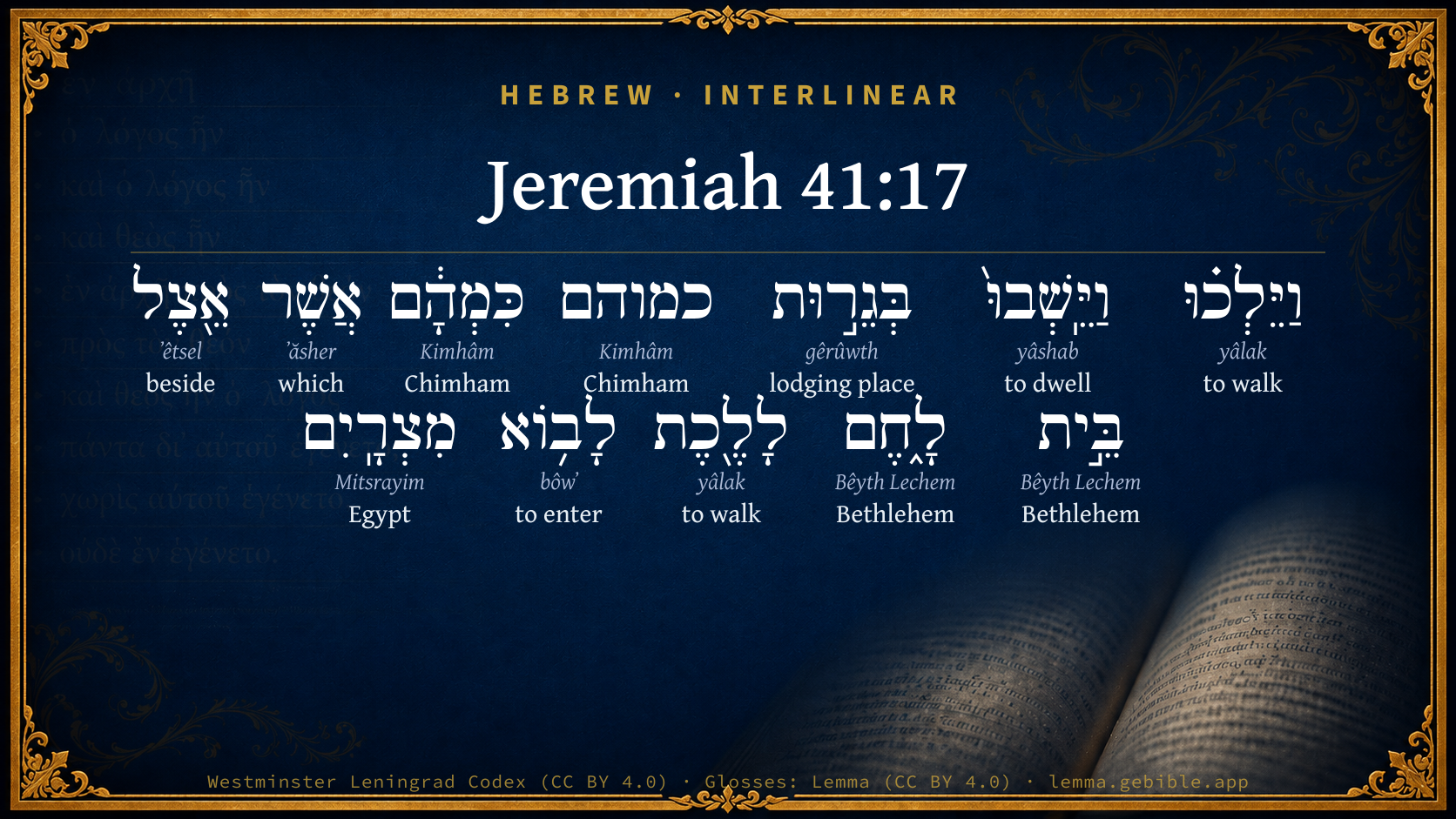
Hebrew (Westminster Leningrad Codex) Jeremiah 41:17 appears in the Hebrew Old Testament. The text above is from the Westminster Leningrad Codex. Each word links to its Strong’s number, a concise gloss, and parsing drawn from the Open Scriptures Hebrew Bible morphology. Click any word for its full Brown-Driver-Briggs (BDB) entry.
Download image
Cite this verse

Jeremiah 41:17 (World English Bible). Public Domain. Lemma interlinear Bible study tool, https://lemma.gebible.app/v/jeremiah/41/17.

Show BibTeX & RIS
BibTeX
RIS
English Translation
and they departed, and lived in Geruth Chimham, which is by Bethlehem, to go to enter into Egypt,
World English Bible · Public Domain
Highlights
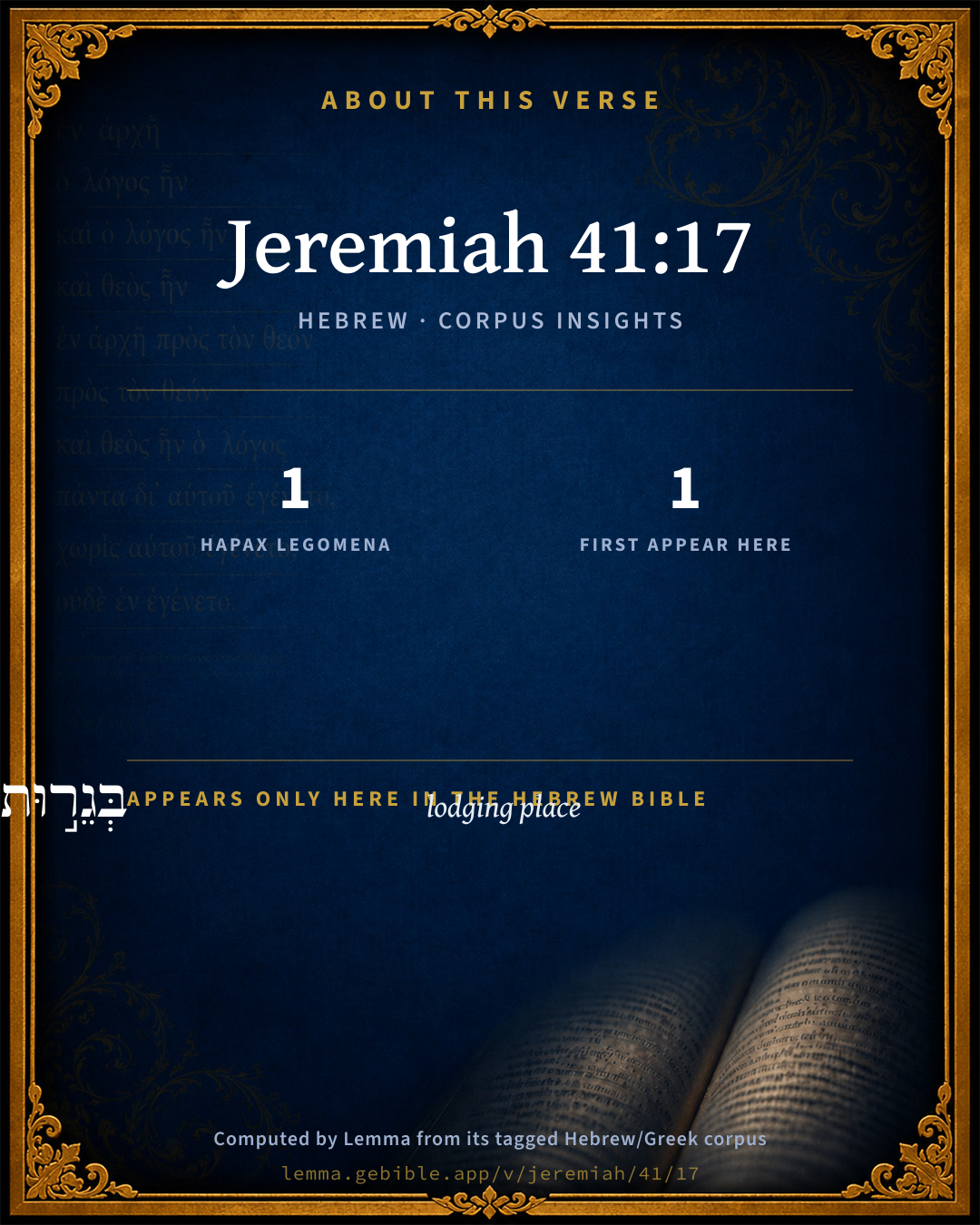
  • 1 hapax legomenon — only here in the Hebrew Bible
  • 1 first appearance in the Hebrew Bible
Full analysis ↓
Download a study sheet

One document with this verse’s original text, its word-by-word gloss line, the meaning frame, cross-references with their text, attributed commentary, and full source and license credits — printable, and it pastes into notes with its structure intact.

This verse Autodidact and up

Study sheet (.html) Plain text (.txt)

A passage Seminary Student

Up to 50 verses in one chapter. A passage sheet keeps up to 6 commentary sources and 12 cross-references per verse, in the order this page ranks them, and says so on the sheet whenever that leaves anything out. Ask for a single verse and you get the Autodidact verse sheet above.

Everything on this page stays free to read, with no account — the sheet is a download of what is already on screen, not access to it.

Want to remove ads? Support Godless Engineer
Compare translations 3

The same verse in 3 English versions, stacked beneath the original-language interlinear above. Click any original word for its lexicon entry.

Each is an independent rendering of the whole verse — the interlinear is not word-aligned to these translations.

Highlighted words mark where these versions differ — a whole-verse word diff, not a word-by-word alignment.

  • World English Bible Public Domain
    and they departed, and lived in Geruth Chimham, which is by Bethlehem, to go to enter into Egypt,
  • King James Version Public Domain
    And they departed, and dwelt in the habitation of Chimham, which is by Bethlehem, to go to enter into Egypt,
  • unfoldingWord Literal Text CC BY-SA 4.0
    Then they went and stayed for a while in Geruth Kimham, which is near Bethlehem. They were going to go to Egypt

unfoldingWord Literal Text — © unfoldingWord, licensed CC BY-SA 4.0. Word-aligned USFM3 via Door43 (git.door43.org/unfoldingWord/en_ult).

Versions to compare (up to 4)

3 of 4 selected

Show all 18 translations

Every available English version of this verse, each an independent rendering of the whole verse.

  • World English Bible Public Domain
    and they departed, and lived in Geruth Chimham, which is by Bethlehem, to go to enter into Egypt,
  • Berean Standard Bible Public Domain
    And they went and stayed in Geruth Chimham, near Bethlehem, in order to proceed into Egypt
  • Majority Standard Bible Public Domain
    And they went and stayed in Geruth Chimham, near Bethlehem, in order to proceed into Egypt
  • King James Version Public Domain
    And they departed, and dwelt in the habitation of Chimham, which is by Bethlehem, to go to enter into Egypt,
  • American Standard Version (1901) Public Domain
    and they departed, and dwelt in Geruth Chimham, which is by Beth-lehem, to go to enter into Egypt,
  • Revised Version (1885) Public Domain
    and they departed, and dwelt in Geruth Chimham, which is by Bethlehem, to go to enter into Egypt,
  • Geneva Bible (1599) Public Domain
    And they departed and dwelt in Geruth Chimham, which is by Beth-lehem, to goe and to enter into Egypt,
  • Douay-Rheims (1899) Public Domain
    And they departed, and sat as sojourners in Chamaam, which is near Bethlehem: in order to go forward, and enter into Egypt,
  • Young's Literal Translation Public Domain
    and they go and abide in the habitations of Chimham, that `are' near Beth-Lehem, to go to enter Egypt,
  • Literal Standard Version CC BY-SA 4.0
    and they go and abide in the habitations of Chimham, that [are] near Beth-Lehem, to go to enter Egypt,
  • Unlocked Literal Bible CC BY-SA 4.0
    Then they went and stayed for a while in Geruth Kimham, which is near Bethlehem. They were going to go to Egypt
  • unfoldingWord Literal Text CC BY-SA 4.0
    Then they went and stayed for a while in Geruth Kimham, which is near Bethlehem. They were going to go to Egypt
  • Darby Bible Public Domain
    and they departed, and dwelt at Geruth-Chimham, which is by Bethlehem, to go to enter into Egypt,
  • World Messianic Bible Public Domain
    They departed and lived in Geruth Chimham, which is by Bethlehem, to go to enter into Egypt
  • Webster's Bible Public Domain
    And they departed, and dwelt in the habitation of Chimham, which is by Beth-lehem, to go to enter into Egypt,
  • Free Bible Version CC BY-SA 4.0
    They set off for Geruth Chimham near Bethlehem and stayed there, before leaving for Egypt
  • Bible in Basic English Public Domain
    And they went and were living in the resting-place of Chimham, which is near Beth-lehem on the way into Egypt,
  • JPS Tanakh (1917) Public Domain
    and they departed, and dwelt in Geruth Chimham, which is by Beth-lehem, to go to enter into Egypt,

Literal Standard Version (2020), Covenant Press — licensed CC BY-SA 4.0. Text via the HelloAO Bible API (eBible.org). Unlocked Literal Bible (unfoldingWord) — licensed CC BY-SA 4.0. Text via the HelloAO Bible API (eBible.org). unfoldingWord Literal Text — © unfoldingWord, licensed CC BY-SA 4.0. Word-aligned USFM3 via Door43 (git.door43.org/unfoldingWord/en_ult). Free Bible Version, Dr. Jonathan Gallagher — licensed CC BY-SA 4.0. Text via the HelloAO Bible API (eBible.org).

Word by word

More ways to search: Search by grammar → Find every occurrence → Compare this word →

Practice this passage: Drill this verse → Learn its vocabulary →

בְּגֵר֣וּת
gêrûwth
H1628
“in/at · lodging place of”
Preposition + Noun, Common, Feminine, Singular, Construct
Part of Speech
Preposition + Noun
Type
Common
Gender
Feminine
Number
Singular
State
Construct
Full BDB Definition

Origin: from H1481

TWOT: 330b

lodging place
  1. וַיֵּלְכ֗וּ yâlak H3212 “and · to walk” Conjunction + Verb, Qal, Sequential Imperfect, 3rd Person, Masculine, Plural
  2. וַיֵּֽשְׁבוּ֙ yâshab H3427 “and · to dwell” Conjunction + Verb, Qal, Sequential Imperfect, 3rd Person, Masculine, Plural
  3. כמוהם Kimhâm H3643 “Chimham · them” Preposition + Suffix, Personal, 3rd Person, Masculine, Plural
  4. כִּמְהָ֔ם Kimhâm H3643 “Chimham” Noun, Proper
  5. אֲשֶׁר ʼăsher H834 “which” Particle, Relative
  6. אֵ֖צֶל ʼêtsel H681 “beside” Preposition
  7. בֵּ֣ית Bêyth Lechem H1035 “Bethlehem” Noun, Proper
  8. לָ֑חֶם Bêyth Lechem H1035 “Bethlehem” Noun, Proper
  9. לָלֶ֖כֶת yâlak H3212 “to walk” Preposition + Verb, Qal, Infinitive Construct
  10. לָב֥וֹא bôwʼ H935 “to enter” Preposition + Verb, Qal, Infinitive Construct
  11. מִצְרָֽיִם Mitsrayim H4714 “Egypt” Noun, Proper

About this verse

These counts appear in no published source. They are computed here, from the morphology-tagged text and Lemma’s own curated glosses. What Lemma adds →

12
words
9
distinct lemmas
Prophets
section

Notable vocabulary

1 hapax legomenon — a word that appears only here in the entire Hebrew Bible:

  • בְּגֵר֣וּת lodging place H1628

First appearance in Scripture

This word makes its first canonical appearance in the Hebrew Bible here:

  • בְּגֵר֣וּת lodging place H1628

Shared distinctive vocabulary

כמוהם Chimham H3643 occurs in 4 verses of the Hebrew Bible. Also found in:

Grammatical profile

  • 4 verbs
  • 5 nouns
  • 2 prepositions
  • 1 particle

Verb forms

  • וַיֵּלְכ֗וּ Qal · Sequential Imperfect
  • וַיֵּֽשְׁבוּ֙ Qal · Sequential Imperfect
  • לָלֶ֖כֶת Qal · Infinitive Construct
  • לָב֥וֹא Qal · Infinitive Construct

Repetition

Words recur within this verse — often emphatic in Hebrew:

  • וַיֵּלְכ֗וּ to walk H3212 ×2
  • כמוהם Chimham H3643 ×2
  • בֵּ֣ית Bethlehem H1035 ×2

Cross-references

5

Topical passages linked to Jeremiah 41:17 in the Treasury of Scripture Knowledge — connected by theme and wording, ordered by reader-vote popularity; previews shown in the World English Bible.

  • 2 Samuel 19:37–38 Please let your servant turn back again, that I may die in my own city, by the grave of my father and my mother. But behold, your servant Chimham; let him go over with my lord the king; and do to him what shall seem good to you.
  • Jeremiah 42:14 saying, No; but we will go into the land of Egypt, where we shall see no war, nor hear the sound of the trumpet, nor have hunger of bread; and there will we dwell:
  • Isaiah 30:2–3 that set out to go down into Egypt, and have not asked at my mouth; to strengthen themselves in the strength of Pharaoh, and to take refuge in the shadow of Egypt!
  • Jeremiah 42:19 Yahweh has spoken concerning you, remnant of Judah, Don't you go into Egypt: know certainly that I have testified to you this day.
  • Jeremiah 43:7 and they came into the land of Egypt; for they didn't obey the voice of Yahweh: and they came to Tahpanhes.

Cross-references courtesy of OpenBible.info (CC BY 4.0).

Hebrew and Greek witnesses Masoretic Hebrew ↔ Greek Septuagint

The same verse in the two great witnesses to the Old Testament, shown verse-for-verse.

These are two independent witnesses, not word-aligned to each other, and the Septuagint is shown in lemma (dictionary) form.

Hebrew Jeremiah 41:17 Masoretic · Westminster Leningrad Codex

וַיֵּלְכ֗וּ וַיֵּֽשְׁבוּ֙ בְּגֵר֣וּת כמוהם כִּמְהָ֔ם אֲשֶׁר אֵ֖צֶל בֵּ֣ית לָ֑חֶם לָלֶ֖כֶת לָב֥וֹא מִצְרָֽיִם

and they departed, and lived in Geruth Chimham, which is by Bethlehem, to go to enter into Egypt,

World English Bible · Public Domain

Greek LXX Structure differs

In the Septuagint, Jeremiah is about an eighth shorter than the Hebrew and arranges its material differently — the Oracles Against the Nations (Hebrew chapters 46–51) appear in the middle of the Greek book, after 25:13. Because the chapter and verse boundaries do not line up, a verse-for-verse comparison with the Hebrew is not shown.

A verse-for-verse comparison isn’t shown here because the chapters and verses don’t line up. Switch to the LXX edition with the MT / LXX toggle above to read the Greek directly.

Hebrew: Westminster Leningrad Codex (CC BY 4.0). Greek: Septuagint (public domain); English from a public-domain English Septuagint. How the Septuagint differs from the Hebrew →

Targum (Aramaic paraphrase)

1

The Targum is the ancient Jewish Aramaic paraphrase of the Hebrew Scriptures — an interpretive translation, not the Hebrew text itself. Onkelos (literal) and Pseudo-Jonathan (expansive) render the Torah, and Jonathan the Prophets. Coverage is partial: where no permissively-licensed English translation exists for a verse, only the Aramaic is shown. This is verse-level text, not a word-by-word alignment to the Hebrew.

  1. Targum Jonathan Prophets (Joshua–Malachi)
    וַאֲזַלוּ וִיתִיבוּ בְּנֵרוּת דִיהַב דָוִד לְכִמָהָם בַּר בַּרְזִילֵי גִלְעָדָאָה דִי בִסְטַר בֵּית לֶחֶם לְמֵיזַל לְמֵיעַל לְמִצְרַיִם:

    (no public-domain English translation for this verse)

    Targum Jonathan — Aramaic: “Mikraot Gedolot” (public domain). English: “Sefaria Community Translation” (CC0 1.0 (public-domain dedication)); “London "Chaldee Paraphrase," 1871” (public domain). Text via Sefaria.

Commentary

Notes on Jeremiah 41:17 from classic Christian and Jewish commentators (each source and its license shown beneath its notes). The classic Christian expositions comment on the surrounding passage and are grouped to its opening verse, so a note may address several verses; the Jewish commentaries on the Tanakh (Rashi and others) are per-verse, so they appear only where the commentator wrote on this verse.

Lemma curates 59 commentaries, every one of them public domain or Creative Commons licensed, each selected and text-cleaned for this edition rather than reprinted as found. About our sources →

Trapp's Complete Commentary

John Trapp

Jer 41:17 And they departed, and dwelt in the habitation of Chimham, which is by Bethlehem, to go to enter into Egypt,

Ver. 17. And they departed.] They rolled from place to place; but being out of God’s precincts they were also out of his protection, and could expect no good.

And they departed, and dwelt in the habitation of Chimham, which is by Bethlehem.] Where it seemeth that David, or Solomon, {1Ki 2:7} had given him some lands, which he called by his own name, as men love to do, {Psa 49:11} Goruth Chimham. Josephus saith there is a village near Bethlehem that is still so called. See 2Sa 19:38.

To go to enter into Egypt.] This was to go out of God’s blessing, as we use to say, into the world’s warm sunshine; this was to put themselves into the punishing hands of the living God.

John Trapp, A Commentary or Exposition upon All the Books of the Old and New Testament (1647–1656) — public domain. Text from a community e-Sword module.

The Biblical Illustrator

Joseph S. Exell

Jer_41:17

And dwelt in the habitation of Chimham.

Too near the edge

This is one of the reflections that come to us as we read of the place whither Johanan led his followers, and as we see the events that happened immediately after. This chapter is a record of disappointments. First the hopeful prospects of Gedaliahs governorship, which seemed starting so fairly and happily for all, these are shattered and overthrown by the villainous conduct of Ishmael. Then it is a grievous disappointment that we do not hear of Ishmaels death, only of his escape. That such a wretch should escape with his life seems a reflection upon that justice which generally follows on the track of wrong-doers such as he was, and metes out to them their due. Escape seems too lenient a dealing with them. And now here is another disappointment that Johanan, instead of seeking to follow in Gedaliahs footsteps, should be for leading the people down into Egypt. At the caravanserai of Chimham, in Bethlehem--the natural halting-place on the way to Egypt--Johanan held a council of war, and then, against the prophets advice, finally determined to abandon their homes, and to make for the refuge, to which the worldly Israelite always had recourse, across the Egyptian border. It was a bad place to halt at; it was too near that beguiling land, the witchery of which not a few of them had long been feeling and would now feel more than ever. Whenever Israel went thither, it was always a going down into Egypt. This was, more true morally and spiritually than even geographically, to which the word down, of course, refers. And the present was no exception. Looking at them there at Chimham, we note--

I. The resemblance they offer. Are they not like all those who tamper with temptation? They know, as Israel knew, that they are in a forbidden path, and yet they do not keep clear of it. Like moths fluttering around the flame, so men will dally with sin. They know that to yield would be both most wrong and ruinous, and yet they go close to the border.

II. The reasons which governed them. The Jews came to Chimham because their will had already consented to go further--on and down into Egypt. For like reasons men come to such places. There has been already the secret yielding of the will. There was no need of the Jews being at Chimham. It was not the way back from Gibeon. It was a deliberate going into temptation. So those who act like them have, as they, already consented in heart. And the causes of that consent are akin. They falsely feared what the Chaldeans might do, though there was no ground for such fear; and they falsely hoped for good--freedom from war and want--which they never realised. And such persons will ever magnify both the difficulties of the right path and the looked-for pleasures and advantages of the wrong. Thus would they persuade themselves that the right is wrong and the wrong is right.

III. The resistance they seemed to make. The Jews did not yield all at once. They appeal to the prophet. They ask his prayers. They, make repeated and loud--much too loud: Methinks he doth protest too much--professions. They wait patiently the prophets message. And yet all the while (verse 20) they were dissembling in their hearts, regarding iniquity there (history of Balaam). They would have God on their side, not themselves on Gods side. All this is most melancholy matter of fact with those who, of their own accord, go too near the edge.

IV. The results that followed. Of course they went over the edge; such people always do. They showed the insincerity of their prayers by their anger when they were denied (Jer_43:2, &c.). They escaped none of the evil they dreaded; they gained none of the good they expected. So disastrous did this step appear to the next and to all subsequent generations of Israel, that the day of Gedaliahs murder, which led to it, has been from that time forth and to this day observed as a national fast. It seemed to be the final revocation of the advantages of the Exodus. By this breach in their local continuity a chasm was made in the history, which for good or evil was never filled up. Yes; they who will go so near temptation will go into it, and be borne down by it to their sore hurt and harm.

V. The remedy recommended. Jeremiah urged them to return to their own land and stay there (Jer_42:8, &c.), promising them the blessing of God if they obeyed, and threatening His sore anger if they did not. This counsel ever wise. Get away from the border-land back into safety. Think of what will follow on your conduct--the blessing or the curse. Stay not in all the plain, but escape for thy life. As the angels hastened Lot so would we hasten all those who have foolishly and wrongly chosen to go too near temptations edge. (W. Clarkson, B. A.)

.

The Biblical Illustrator, edited by Joseph S. Exell (c. 1880s–1900s) — public domain. Text from a community e-Sword module.

Tyndale Open Study Notes

Tyndale Open Resources

41:17-18 The group led by Johanan headed south, past the ruins of Jerusalem to Geruth-kimham, a small village near Bethlehem. During this trip, the leaders decided that they would be safe from Babylonian reprisals if they fled to Egypt. The Babylonians were cruel, and no one trusted them to seek out the true culprit in Gedaliah’s death.

Tyndale Open Study Notes — © Tyndale Open Resources, licensed CC BY-SA 4.0. Text via the HelloAO Bible API.

Geneva Bible (1599)

Geneva Bible translators

Which place David of old had given to Chimham the son of Barzillai the Gileadite, 2 Sam. 19:38.

Geneva Bible (1599) marginal notes — public domain. Text via Bolls.life.

Jamieson, Fausset & Brown

Robert Jamieson, A. R. Fausset & David Brown

dwelt--for a time, until they were ready for their journey to Egypt (Jer. 42:1-22).

habitation to Chimham--his "caravanserai" close by Beth-lehem. David, in reward for Barzillai's loyalty, took Chimham his son under his patronage, and made over to him his own patrimony in the land of Beth-lehem. It was thence called the habitation of Chimham (Geruth-Chimham), though it reverted to David's heirs in the year of jubilee. "Caravanserais" (a compound Persian word, meaning "the house of a company of travellers") differ from our inns, in that there is no host to supply food, but each traveller must carry with him his own.

Jamieson, Fausset & Brown — Commentary Critical and Explanatory on the Whole Bible (1871) — public domain (CC PDM 1.0). Text via the HelloAO Bible API.

Adam Clarke's Commentary

Verse 17. Dwelt in the habitation of Chimham] The estate that David gave Chimham, the son of Barzillai. See 2Sa 19:37, c. He took this merely as a resting-place as he designed to carry all into Egypt, fearing the Chaldeans, who would endeavour to revenge the death of Gedaliah.

Adam Clarke's Commentary on the Bible (1810–1826) — public domain. Text from a community e-Sword/MySword module.

John Calvin's Commentaries

But the Prophet immediately adds what the purpose was which they had all formed. They dwelt, he says, in Geruth; some render it, “in the peregrination;” but it seems to me to be a proper name, and I agree with those who so render it. But it is called the Geruth of Chimham, of whom mention is made in 2 Samuel 19:31, 37. he was the son of Barzillai, who entertained David when a fugitive from his kingdom, and entertained him bountifully. When David wished to remunerate his kindness, the good man made his age as an excuse, and said, that he was old, so that he could not enjoy the things of this life; but he presented his son to David, and it is probable that this place was given to the son as a reward. It was hence called Geruth-Chimham, the name of its possessor being attached to it. And he says that it was nigh Bethlehem. It is also probable, that when David wished to remunerate his host, he chose a place nigh his own city, where he was born.

It is added, to go, etc. Then the Prophet shews that this was not a settled habitation, but that they intended to go into Egypt They knew that this was forbidden by the Law of God, and the Prophets had often pronounced a curse on such a design. Notwithstanding God’s prohibition, they prepared themselves for the journey. Fear was the cause; but how much so ever they might have justly feared, they ought yet to have considered what God permitted: for if a sick man takes poison instead of medicine, he must suffer the punishment that necessarily follows his own presumption and madness; so they who seek to provide for themselves contrary to God’s will, gain only their own destruction. This was done, as the Prophet tells us, by the remnant of the people.

John Calvin's Commentaries (1540-1563) — public domain. Text from the Calvin Translation Society English edition (1840s-50s) via the Christian Classics Ethereal Library (ccel.org). Calvin's coverage is partial (roughly two-thirds of the Bible); uncommented books and verses are honest gaps, never fabricated. The 19th-century editor's footnotes and remarks are omitted so the notes are faithfully Calvin's own voice.

Ellicott's Commentary for English Readers

(17) They departed, and dwelt in the habitation of Chimham.—The word translated “habitation “is not found elsewhere, but it is connected with one which means “stranger,” “foreigner,” and means probably a caravanserai, or hospitium for travellers. The name of Chimham throws us back on the history of Barzillai in 2Sa_19:37. When the Gileadite chief pleaded his age as a ground for not accepting David’s invitation to live at his court, the offer was transferred to his son Chimham. On the king’s death-bed he was specially commended to the care of Solomon (1Ki_2:7). It seems probable that some part of David’s personal patrimony, as distinct from his royal domains, had been bestowed on him, and that he had perpetuated his gratitude by erecting a resting-place for travellers, probably enough identical with the “inn” of the Nativity (Luk_2:7). The plan of the fugitives under Johanan took them to Bethlehem, as lying on the road to Egypt, where they hoped to find a refuge both from the anarchy in which the land had been left by the death of Gedaliah, and from the severe punishment which the Chaldæans were likely to inflict, without too careful an inquiry into the question who had been guilty of it, for the murder of the ruler whom they had appointed. The mere fact of their having remained with Ishmael might be construed into circumstantial evidence of complicity. There they halt, and take counsel.

A Bible Commentary for English Readers, edited by Charles John Ellicott (1878–1897) — public domain. Text from a community e-Sword module.

The Cambridge Bible for Schools and Colleges

gen. ed. J. J. S. Perowne

17. Geruth Chimham] For Chimham see 2Sa_19:37-40. Geruth occurs here only, and the mg. variant is a questionable rendering. Aquila and Josephus (Ant. X. ix. 5) read Gidroth (sheepfolds of) Chimham, while Gi. considers Gidroth to be probably a proper name.

to go to enter into Egypt] to prepare for the journey into Egypt, a journey which, according to the first words of the next verse, was undertaken from fear of the Chaldaeans. It seemed likely that the outbreak which had taken place in connexion with the overthrow and death of the governor appointed by the king of Babylon, might be revenged without much discrimination by that monarch.

The Cambridge Bible for Schools and Colleges (gen. ed. J. J. S. Perowne; Cambridge University Press, 1878–1918) — public domain. Text from a community e-Sword module.

John Gill's Exposition

And they departed,.... From Mizpah, Johanan, and the captains of the forces, and all the people rescued from Ishmael:

and dwelt in the habitation of Chimham, which is by Bethlehem: so called perhaps from Chimham, the son of Barzillai the Gileadite, to whom David or Solomon might give this place to dwell in, Sa2 19:37, Kg1 2:7. The Targum is express for the former, calling it

"the habitation which David gave to Chimham, the son of Barzillai the Gileadite;''

and as it was near Bethlehem, it might be a part of the patrimony which belonged to David, as a son of Jesse the Bethlehemite; which he might give to Chimham, out of respect to his father Barzillai, who showed kindness to him when he was obliged to flee from Absalom; which, though it returned to David's family in the year of jubilee, as all inheritances did, yet might continue to be called after the name of Chimham, in commemoration of the royal grant of it to him. Josephus (r) calls the name of the place Mandra. The reason why Johanan and those with him pitched on this place was, because it lay in the way

to go to enter into Egypt; where they had an inclination to go; having still a friendly regard to that people, and a confidence in them, as appears by some following chapters; and that they might be ready and at hand to flee thither, should the Chaldeans come against them, which they feared.

(r) Antiqu. l. 10. c. 9. sect. 5.

John Gill's Exposition of the Whole Bible (1746–1763) — public domain (CC PDM 1.0). Text via the HelloAO Bible API.

Albert Barnes' Notes on the Bible

The habitation of Chimham - The Hebrew text has Geruth-Chemoham, of which place nothing is known. The Masoretes read: Geruth-Chimham, the Khan or Caravanserai of Chimham, son of the rich Barzillai (marginal reference). The substitution is incapable now of proof or disproof, but it is possibly right.

Albert Barnes' Notes on the Bible (1834–1885) — public domain. Text from a community e-Sword/MySword module.

Haydock's Catholic Bible Commentary

As. Hebrew, "at the station or inn of Chamaam," the son of Berzellai. (Chaldean) Perhaps our Saviour was born in this (Calmet) "inn," (Eusebius, Dem. vii. 4.) which was then deserted. (Haydock) --- Egypt. These poor wretches find no repose. (Calmet)

George Leo Haydock (1774–1849), Haydock's Catholic Family Bible and Commentary, 1859 edition — public domain. Excludes Psalms (Douay-Rheims chapter numbering differs from Protestant) and Deuterocanonical books (Catholic canon only).

Matthew Poole's English Annotations

When Johanan had (as was before expressed) recovered the Jews whom Ishmael had carried away as prisoners, he came and dwelt with them in the

habitation of Chimham. Concerning this

Chimham, all that we read in Scripture is 2Sa 19:37,38,40; he was the son of Barzillai, whom David would have had to have gone along with him to his court; but he being eighty years old excused himself, and desired that his son Chimham might be accepted in his stead. David agreeth it, and promiseth to do for him whatsoever his father should desire on his behalf: possibly David, having an estate near thereabouts, might give a portion of it to him, which though it returned to the family of David in the year of jubilee, yet from Chimham’s house there might retain the name of the habitation of Chimham. Into those parts Johanan retired, with a further design to go into Egypt.

Matthew Poole's English Annotations on the Holy Bible (1683–1685) — public domain. Text from a community e-Sword/MySword module.

Whedon's Commentary on the Bible

Daniel D. Whedon

17. Departed, and dwelt — Temporarily, until ready for a journey into Egypt.

Habitation of Chimham — The inn of Chimham. The word translated “habitation” occurs nowhere else, but etymologically has the meaning of inn. Chimham was the founder of it. See 2Sa_19:38; 2Sa_19:40.

Daniel D. Whedon (gen. ed.), Commentary on the Old and New Testaments (1874–1909) — public domain. Text from a community e-Sword module.

The Pulpit Commentary

And dwelt in the habitation of Chimham. Chimham was the son of the rich Gileadite Barzillai, (2Sa_19:37-40) who probably founded this "habitation" or rather "hospice" ("khan," "caravanserai"), for the accommodation of travellers a characteristic mark of public-spirited liberality. Josephus and Aquila, however, appear to have read "by the hurdles of Chimham a very possible name for a locality in such a pastoral country.

Too near the edge.

This is one of the reflections that come to us as we read of the place whither Johanan led his followers, and as we see the events that happened immediately after. This chapter is a record of disappointments. First the hopeful prospects of Gedaliah"s governorship, which seemed starting so fairly and happily for all, these are shattered and overthrown by the villainous conduct of Ishmael. Then it is a grievous disappointment that we do not hear of Ishmael"s death, only of his escape. That such a wretch should escape with his life seems a reflection upon that justice which generally follows on the track of wrong doers such as he was, and metes out to them their due. Escape seems too lenient a dealing with him. And now here is another disappointment that Johanan, instead of seeking to follow in Gedaiiah"s footsteps, should be for leading the people down into Egypt. At the caravanserai of Chimham, in Bethlehem the natural halting place on the way to Egypt Johanan held a council of war, and then, against the prophet"s advice, finally determined to abandon their homes, and to make for the refuge, to which the worldly Israelite always had recourse, across the Egyptian border." It was a bad place to halt at; it was too near that beguiling land, the witchery of which not a few of them had long been feeling and would now feel mere than ever. Whenever Israel went thither, it was always a "going down into Egypt." This was more true morally and spiritually than even geographically, to which the word "down," of course, refers. And the present was no exception. Looking at them there at Chimham, we note

I THE RESEMBLANCE THEY OFFER. Are they not like all those who tamper with temptation? They know, as Israel knew, that they are in a forbidden path, and yet they do not keep clear of it. Like moths fluttering around the flame, so men will dally with sin. They know that to yield would be both most wrong and ruinous, and yet they go close to the border.

II THE REASONS WHICH GOVERNED THEM. The Jews came to Chimham because their will had already consented to go further on and down into Egypt. For like reasons men come to such places. There has been already the secret yielding of the will. There was no need of the Jews being at Chimham. It was not the way back from Gibeon. It was a deliberate going into temptation. So those who act like them have, as they, already consented in heart. And the causes of that consent are akin. They falsely feared what the Chaldeans might do, though there was no ground for such fear; and they falsely hoped for good freedom from war and want which they never realized. And such persons will ever magnify both the difficulties of the right path and. the looked-for pleasures and advantages of the wrong. Thus would they persuade themselves that the right is wrong and the wrong is right.

III THE RESISTANCE WHEY SEEMED TO MAKE. The Jews did not yield all at once. They appeal to the prophet. They ask his prayers. They make repeated and loud much too loud: "Methinks he doth protest too much professions. They wait patiently the prophet"s message. And yet all the while (ver. 20) they were dissembling in their hearts, "regarding iniquity" there (cf. history of Balsam). They would have God on their side, not themselves on God"s side. All this is most melancholy matter of fact with those who, of their own accord, go too near the edge.

IV THE RESULTS THAT FOLLOWED. Of course they went over the edge; such people always do. They showed the insincerity of their prayers by their anger when they were denied. (cf. Jer_43:2, etc.) They escaped none of the evil they dreaded; they gained none of the good they expected. "So disastrous did this step appear to the next and to all subsequent generations of Israel, that the day of Gedaliah"s murder, which led to it, has been from that time forth and to this day observed as a national fast. It seemed to be the final revocation of the advantages of the Exodus. By this breach in their local continuity a chasm was made in the history, which for good or evil was never filled up." Yes; they who will go so near temptation will go into it, and be borne down by it to their sore hurt and harm.

V THE REMEDY RECOMMENDED. Jeremiah urged them to return to their own land and stay there, (Jer_42:8, etc.) promising them the blessing of God if they obeyed, and threatening his sore anger if they did not. This counsel ever wise. Get away from the border land back into safety. Think of what will follow on your conduct the blessing or the curse. "Stay not in all the plain, but escape for thy life." As "the angels hastened Lot," so would we hasten all those who have foolishly and wrongly chosen to go too near temptation"s edge. C.

The Pulpit Commentary (1880–1919), ed. H.D.M. Spence-Jones & Joseph S. Exell — public domain. Text from a community e-Sword module.

Keil & Delitzsch

C. F. Keil & F. Delitzsch

"They marched and stopped (made a half) at the inn if Chimham, which is near Bethlehem." גּרוּת, ἅπ.λεγ., considered etymologically, must mean diversorium, hospitium, an inn, khan, or caravanserai. Instead of the Kethib כמוהם, many codices read כּמהם (like the Qeri); nor, have any of the old translators read וּ or וׁ in the word. The Qeri is evidently correct, and we are to read כּמהם, the name of a son of Barzillai the rich Gileadite, Sa2 19:38, Sa2 19:41, who is supposed to have built or founded this caravanserai for the convenience of travellers. The words "because of the Chaldeans" in the beginning of Jer 41:18 depend on "to go to Egypt" at the end of the preceding verse: "to go to Egypt for fear of the Chaldeans," on account of the murder of Gedaliah by Ishmael.

Keil & Delitzsch — Biblical Commentary on the Old Testament (1861–1891) — public domain (CC PDM 1.0). Text via the HelloAO Bible API. (Old Testament only.)

unfoldingWord translationNotes

Door43 World Missions Community

they went

"Johanan, his companions, and all the people they rescued went"

Geruth Kimham

This is the name of a place. (See: How to Translate Names)

because of the Chaldeans

It is implied that they were afraid that the Chaldeans would attack them. AT: "because they thought the Chaldeans may attack them" (See: Assumed Knowledge and Implicit Information)

in charge of the land

Here "land" represents the people. AT: "in charge of the people of Judah" (See: Metonymy)

translationWords

Bethlehem

Egypt

Chaldea

fear

king

Babylon

unfoldingWord translationNotes — © Distant Shores Media and the Door43 World Missions Community, licensed CC BY-SA 4.0. Source: git.door43.org/Door43/en_tn.

Rashi

Rabbi Shlomo Yitzchaki (Rashi)

in Geruth Chimham In the sojourning place that David gave to Chimham the son of Barzilai the Gileadite when he returned from the war of Absalom, as it is stated in the Book of Samuel (II 19: 39): “Chimham shall go over with me.”

Rashi on the Tanakh — English translations: “The Judaica Press complete Tanach with Rashi, translated by A. J. Rosenberg” (CC BY 4.0); “Pentateuch with Rashi's commentary by M. Rosenbaum and A.M. Silbermann, 1929-1934” (public domain); “The Metsudah Tanach series, Lakewood, N.J” (CC BY 4.0); and “The Book of Joshua, Metsudah Publications, 1997” (CC BY 4.0). Text via Sefaria.

Lesson kit

Teaching starters — assembled from the data on this page, not authored interpretation. Every prompt links to the verse data it draws on. Edit before teaching.

Jeremiah, in the Prophets, opens this verse with 12 words (9 distinct Hebrew lemmas). Its most distinctive word is gêrûwth (“lodging place”). A historical commentator’s framing appears above. Read the whole chapter for the surrounding context.

Discussion questions

  1. How does “lodging place” (gêrûwth) shape what this verse is saying?
  2. This verse holds 1 word here found nowhere else in the Hebrew Bible. What might the rare word draw attention to?
  3. The word “lodging place” first appears here in Scripture. What is being introduced at this debut?
  4. 2 Samuel 19:37 shares the word «Chimham» with this verse. How do the two illuminate each other?
  5. “to walk” occurs 2× in this one verse. What is the effect of the repetition?
  6. These translations render this verse differently; the difference is in the English rendering, not the original. What questions does that raise?
  7. The verb «וַיֵּלְכ֗וּ» is Qal Sequential Imperfect. How does its form color the action?
  8. Reading how Trapp's Complete Commentary and The Biblical Illustrator read this verse, where do the two commentators agree and where do they part?

Things to notice

  • 1 word in this verse appears nowhere else in the Hebrew Bible.
  • 1 word makes its first canonical appearance in Scripture here.
  • These translations choose different wording for 14 words in this verse.
  • “to walk” occurs 2× in this single verse.
  • 9 distinct Hebrew lemmas span 12 words in this verse.

Reading settings

Reading text

Shown beneath each verse's original-language words.

Old Testament
Old Testament edition

Read the OT as the Masoretic Hebrew (MT) or the Greek Septuagint (LXX).

English shown for the Greek Septuagint (in the Hebrew ↔ Greek comparison).

Comparing translations? Open the Compare panel on any verse page to stack up to four side by side.