Isaiah 19:22

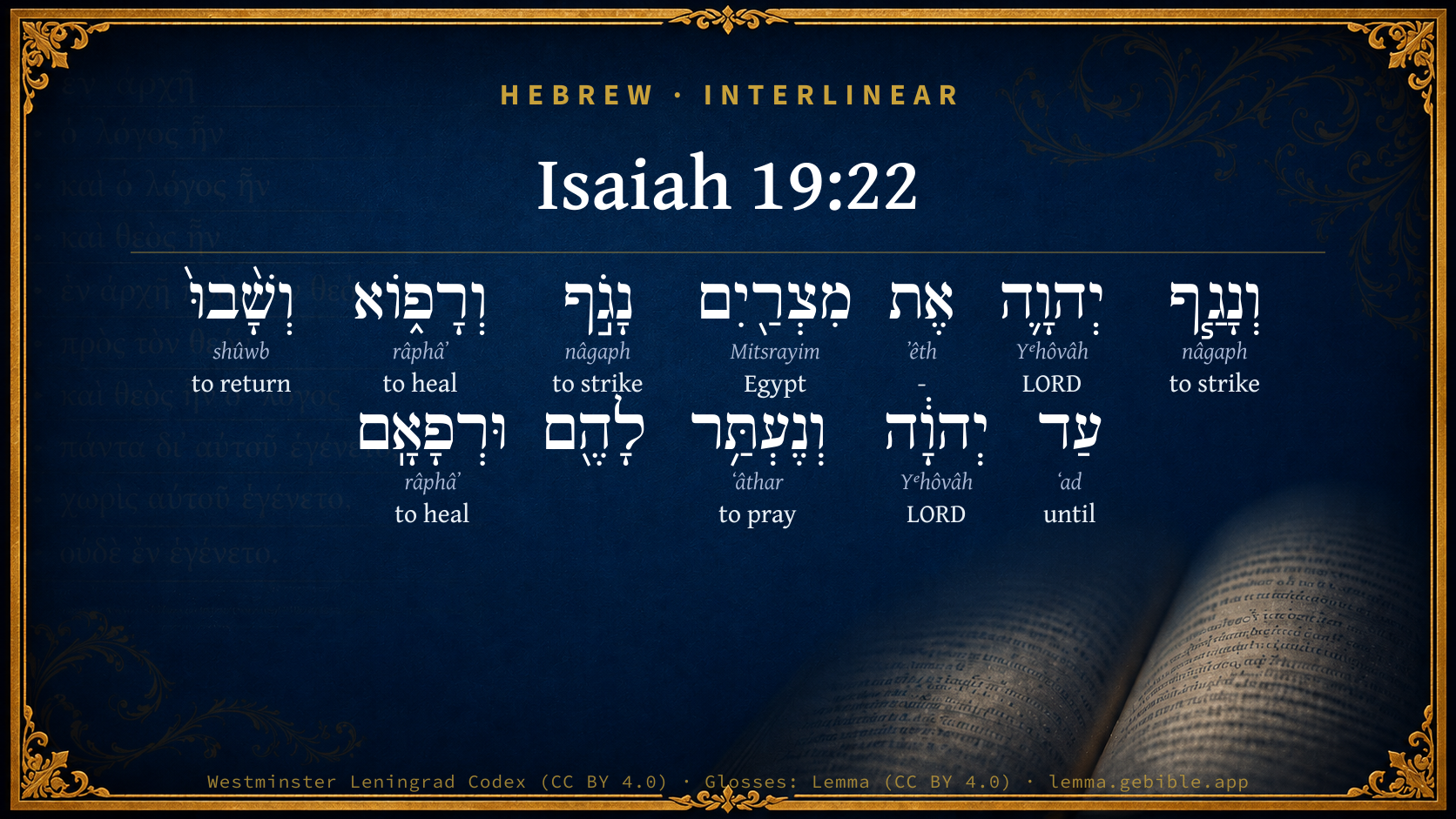
Hebrew (Westminster Leningrad Codex) Isaiah 19:22 appears in the Hebrew Old Testament. The text above is from the Westminster Leningrad Codex. Each word links to its Strong’s number, a concise gloss, and parsing drawn from the Open Scriptures Hebrew Bible morphology. Click any word for its full Brown-Driver-Briggs (BDB) entry.
Download image
Cite this verse

Isaiah 19:22 (World English Bible). Public Domain. Lemma interlinear Bible study tool, https://lemma.gebible.app/v/isaiah/19/22.

Show BibTeX & RIS
BibTeX
RIS
English Translation
Yahweh will strike Egypt, smiting and healing; and they shall return to Yahweh, and he will be entreated of them, and will heal them.
World English Bible · Public Domain
Download a study sheet

One document with this verse’s original text, its word-by-word gloss line, the meaning frame, cross-references with their text, attributed commentary, and full source and license credits — printable, and it pastes into notes with its structure intact.

This verse Autodidact and up

Study sheet (.html) Plain text (.txt)

A passage Seminary Student

Up to 50 verses in one chapter. A passage sheet keeps up to 6 commentary sources and 12 cross-references per verse, in the order this page ranks them, and says so on the sheet whenever that leaves anything out. Ask for a single verse and you get the Autodidact verse sheet above.

Everything on this page stays free to read, with no account — the sheet is a download of what is already on screen, not access to it.

Want to remove ads? Support Godless Engineer
Compare translations 3

The same verse in 3 English versions, stacked beneath the original-language interlinear above. Click any original word for its lexicon entry.

Each is an independent rendering of the whole verse — the interlinear is not word-aligned to these translations.

Highlighted words mark where these versions differ — a whole-verse word diff, not a word-by-word alignment.

  • World English Bible Public Domain
    Yahweh will strike Egypt, smiting and healing; and they shall return to Yahweh, and he will be entreated of them, and will heal them.
  • King James Version Public Domain
    And the LORD shall smite Egypt: he shall smite and heal it: and they shall return even to the LORD, and he shall be intreated of them, and shall heal them.
  • unfoldingWord Literal Text CC BY-SA 4.0
    And Yahweh will strike Egypt, striking and healing, and they will return to Yahweh, and he will be entreated by them, and he will heal them.

unfoldingWord Literal Text — © unfoldingWord, licensed CC BY-SA 4.0. Word-aligned USFM3 via Door43 (git.door43.org/unfoldingWord/en_ult).

Versions to compare (up to 4)

3 of 4 selected

Show all 18 translations

Every available English version of this verse, each an independent rendering of the whole verse.

  • World English Bible Public Domain
    Yahweh will strike Egypt, smiting and healing; and they shall return to Yahweh, and he will be entreated of them, and will heal them.
  • Berean Standard Bible Public Domain
    And the LORD will strike Egypt with a plague; He will strike them but heal them. They will turn to the LORD, and He will hear their prayers and heal them.
  • Majority Standard Bible Public Domain
    And the LORD will strike Egypt with a plague; He will strike them but heal them. They will turn to the LORD, and He will hear their prayers and heal them.
  • King James Version Public Domain
    And the LORD shall smite Egypt: he shall smite and heal it: and they shall return even to the LORD, and he shall be intreated of them, and shall heal them.
  • American Standard Version (1901) Public Domain
    And Jehovah will smite Egypt, smiting and healing; and they shall return unto Jehovah, and he will be entreated of them, and will heal them.
  • Revised Version (1885) Public Domain
    And the LORD shall smite Egypt, smiting and healing; and they shall return unto the LORD, and he shall be entreated of them, and shall heal them.
  • Geneva Bible (1599) Public Domain
    So ye Lord shall smite Egypt, he shall smite and heale it: for he shall returne vnto ye Lord, and he shall be intreated of them and shall heale them.
  • Douay-Rheims (1899) Public Domain
    And the Lord shall strike Egypt with a scourge, and shall heal it, and they shall return to the Lord, and he shall be pacified towards them, and heal them.
  • Young's Literal Translation Public Domain
    And Jehovah hath smitten Egypt, smiting and healing, And they have turned back unto Jehovah, And He hath been entreated of them, And hath healed them.
  • Literal Standard Version CC BY-SA 4.0
    And YHWH has struck Egypt, striking and healing, || And they have turned back to YHWH, || And He has accepted their plea, || And has healed them.
  • Unlocked Literal Bible CC BY-SA 4.0
    Yahweh will afflict Egypt, afflicting and healing. They will return to Yahweh; he will hear their prayer and will heal them.
  • unfoldingWord Literal Text CC BY-SA 4.0
    And Yahweh will strike Egypt, striking and healing, and they will return to Yahweh, and he will be entreated by them, and he will heal them.
  • Darby Bible Public Domain
    And Jehovah will smite Egypt; he will smite and heal: and they shall return to Jehovah, and he will be entreated of them, and will heal them.
  • World Messianic Bible Public Domain
    The LORD will strike Egypt, striking and healing. They will return to the LORD, and he will be entreated by them, and will heal them.
  • Webster's Bible Public Domain
    And the LORD will smite Egypt: he will smite and heal it: and they shall return even to the LORD, and he will be entreated by them, and will heal them.
  • Free Bible Version CC BY-SA 4.0
    The Lord will inflict a plague on Egypt. He will do this, but he will heal them. They will come back to the Lord. He will respond to their prayers and heal them.
  • Bible in Basic English Public Domain
    And the Lord will send punishment on Egypt, and will make them well again; and when they come back to the Lord he will give ear to their prayer and take away their disease.
  • JPS Tanakh (1917) Public Domain
    And the LORD will smite Egypt, smiting and healing; and they shall return unto the LORD, and He will be entreated of them, and will heal them.

Literal Standard Version (2020), Covenant Press — licensed CC BY-SA 4.0. Text via the HelloAO Bible API (eBible.org). Unlocked Literal Bible (unfoldingWord) — licensed CC BY-SA 4.0. Text via the HelloAO Bible API (eBible.org). unfoldingWord Literal Text — © unfoldingWord, licensed CC BY-SA 4.0. Word-aligned USFM3 via Door43 (git.door43.org/unfoldingWord/en_ult). Free Bible Version, Dr. Jonathan Gallagher — licensed CC BY-SA 4.0. Text via the HelloAO Bible API (eBible.org).

Word by word

More ways to search: Search by grammar → Find every occurrence → Compare this word →

Practice this passage: Drill this verse → Learn its vocabulary →

וְנֶעְתַּ֥ר
ʻâthar
H6279
“and · to pray”
Conjunction + Verb, Niphal, Sequential Perfect, 3rd Person, Masculine, Singular
Part of Speech
Conjunction + Verb
Stem
Niphal
Form
Sequential Perfect
Person
3rd Person
Gender
Masculine
Number
Singular
Full BDB Definition

Origin: a primitive root [rather denominative from H6281 ]

TWOT: 1722

to pray, entreat, supplicate - (Qal) to pray, entreat - (Niphal) to be supplicated, be entreated - (Hiphil) to make supplication, plead
  1. וְנָגַ֧ף nâgaph H5062 “and · to strike” Conjunction + Verb, Qal, Sequential Perfect, 3rd Person, Masculine, Singular
  2. יְהוָ֛ה Yᵉhôvâh H3068 “LORD” Noun, Proper
  3. אֶת ʼêth H853 “-” Particle, Direct Object
  4. מִצְרַ֖יִם Mitsrayim H4714 “Egypt” Noun, Proper
  5. נָגֹ֣ף nâgaph H5062 “to strike” Verb, Qal, Infinitive Absolute
  6. וְרָפ֑וֹא râphâʼ H7495 “and · to heal” Conjunction + Verb, Qal, Infinitive Absolute
  7. וְשָׁ֨בוּ֙ shûwb H7725 “and · to return” Conjunction + Verb, Qal, Sequential Perfect, 3rd Person, Common, Plural
  8. עַד ʻad H5704 “until” Preposition
  9. יְהוָ֔ה Yᵉhôvâh H3068 “LORD” Noun, Proper
  10. וּרְפָאָֽם râphâʼ H7495 “and · to heal · them” Conjunction + Verb, Qal, Sequential Perfect, 3rd Person, Masculine, Singular + Suffix, Personal, 3rd Person, Masculine, Plural

About this verse

These counts appear in no published source. They are computed here, from the morphology-tagged text and Lemma’s own curated glosses. What Lemma adds →

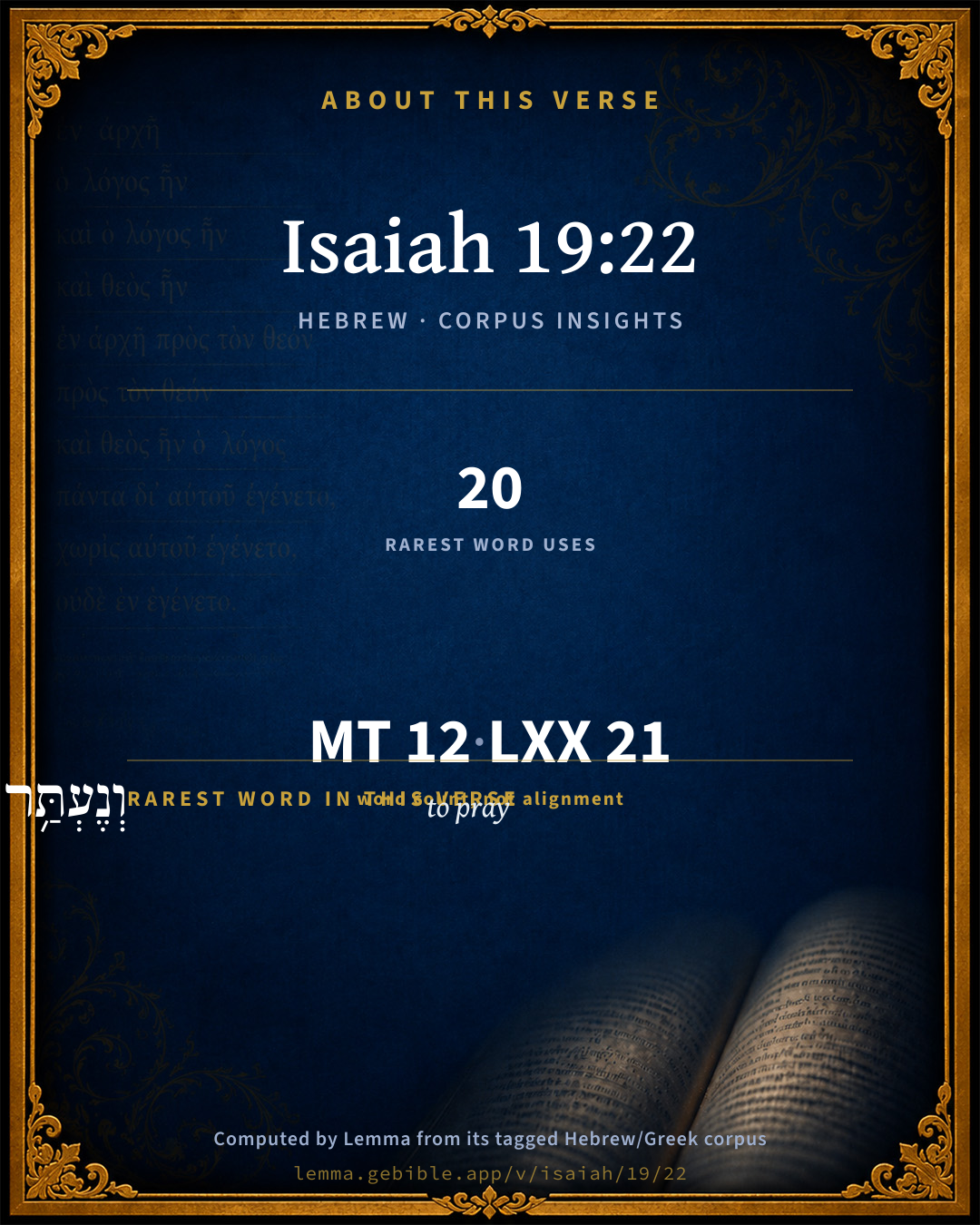
12
words
8
distinct lemmas
Prophets
section

Notable vocabulary

The rarest word here is וְנֶעְתַּ֥ר to pray H6279 — appearing just 20 times in the whole Hebrew Bible.

Shared distinctive vocabulary

וְנֶעְתַּ֥ר to pray H6279 occurs in 19 verses of the Hebrew Bible. Also found in:

Grammatical profile

  • 6 verbs
  • 3 nouns
  • 2 prepositions
  • 1 particle

Verb forms

  • וְנָגַ֧ף Qal · Sequential Perfect
  • נָגֹ֣ף Qal · Infinitive Absolute
  • וְרָפ֑וֹא Qal · Infinitive Absolute
  • וְשָׁ֨בוּ֙ Qal · Sequential Perfect
  • וְנֶעְתַּ֥ר Niphal · Sequential Perfect
  • וּרְפָאָֽם Qal · Sequential Perfect

Repetition

Words recur within this verse — often emphatic in Hebrew:

  • וְנָגַ֧ף to strike H5062 ×2
  • יְהוָ֛ה LORD H3068 ×2
  • וְרָפ֑וֹא to heal H7495 ×2

Hebrew & Septuagint length

In English translation the verse runs 24 words from the Hebrew and 31 from the Septuagint (LXX English) — closely comparable.

A rough comparison of the two English renderings, which tokenize alike — not a word-level alignment.

Word counts can differ between the Hebrew and the Greek without any difference in meaning — e.g. the Hebrew direct-object marker אֵת has no separate Greek word, and Greek often adds the article ὁ.

In the original languages it is 12 Hebrew tokens and 21 Greek tokens — but the two are counted differently (Hebrew bundles its prefixes and suffixes into one token; the Greek is in lemma form), so that isn’t a like-for-like length.

Cross-references

13

Topical passages linked to Isaiah 19:22 in the Treasury of Scripture Knowledge — connected by theme and wording, ordered by reader-vote popularity; previews shown in the World English Bible.

  • Deuteronomy 32:39 See now that I, even I, am he, There is no god with me: I kill, and I make alive; I wound, and I heal; There is none who can deliver out of my hand.
  • Hebrews 12:11 All chastening seems for the present to be not joyous but grievous; yet afterward it yields the peaceful fruit of righteousness to those who have been exercised thereby.
  • Hosea 14:1 Israel, return to Yahweh your God; For you have fallen because of your sin.
  • Job 5:18 For he wounds, and binds up; He injures, and his hands make whole.
  • Isaiah 6:10 Make the heart of this people fat; Make their ears heavy, and shut their eyes; Lest they see with their eyes, And hear with their ears, And understand with their heart, And turn again, and be healed."
  • Isaiah 19:1–15 The burden of Egypt. Behold, Yahweh rides on a swift cloud, and comes to Egypt: and the idols of Egypt shall tremble at his presence; and the heart of Egypt shall melt in the midst of it.
  • Isaiah 45:14 Thus says Yahweh: "The labor of Egypt, and the merchandise of Ethiopia, and the Sabeans, men of stature, shall come over to you, and they shall be yours. They shall go after you. In chains they shall come over; and they shall fall down to you. They shall make supplication to you: 'Surely God is in you; and there is none else, there is no other god.
  • Isaiah 55:7 let the wicked forsake his way, and the unrighteous man his thoughts; and let him return to Yahweh, and he will have mercy on him; and to our God, for he will abundantly pardon.
  • Hosea 5:15 I will go and return to my place, until they acknowledge their offense, And seek my face. In their affliction they will seek me earnestly."
  • Hosea 6:2 After two days will he revive us. On the third day he will raise us up, And we will live before him.
  • Amos 4:6–12 "I also have given you cleanness of teeth in all your cities, And lack of bread in every town; Yet you haven't returned to me," says Yahweh.
  • Acts 26:17–20 delivering you from the people, and from the Gentiles, to whom I send you,
  • Acts 28:26–27 saying, 'Go to this people, and say, In hearing, you will hear, But will in no way understand. In seeing, you will see, But will in no way perceive.

Cross-references courtesy of OpenBible.info (CC BY 4.0).

Hebrew and Greek witnesses Masoretic Hebrew ↔ Greek Septuagint

The same verse in the two great witnesses to the Old Testament, shown verse-for-verse.

These are two independent witnesses, not word-aligned to each other, and the Septuagint is shown in lemma (dictionary) form.

Hebrew Isaiah 19:22 Masoretic · Westminster Leningrad Codex

וְנָגַ֧ף יְהוָ֛ה אֶת מִצְרַ֖יִם נָגֹ֣ף וְרָפ֑וֹא וְשָׁ֨בוּ֙ עַד יְהוָ֔ה וְנֶעְתַּ֥ר לָהֶ֖ם וּרְפָאָֽם

Yahweh will strike Egypt, smiting and healing; and they shall return to Yahweh, and he will be entreated of them, and will heal them.

World English Bible · Public Domain

Greek LXX Isaiah 19:22 Septuagint · lemma form

καί πατάσσω κύριος ὁ αἰγύπτιος πληγή μέγας καί ἰάομαι αὐτός ἴασις καί ἐπιστρέφω πρός κύριος καί εἰςἀκούω αὐτός καί ἰάομαι αὐτός

And the Lord shall strike the Egyptians with a stroke, and shall completely heal them: and they shall return to the Lord, and he shall hear them, and thoroughly heal them.

LXX2012 (modern English Septuagint) · Public Domain

Hebrew: Westminster Leningrad Codex (CC BY 4.0). Greek: Septuagint (public domain); English from LXX2012 (modern English Septuagint) (Public Domain). How the Septuagint differs from the Hebrew →

Targum (Aramaic paraphrase)

1

The Targum is the ancient Jewish Aramaic paraphrase of the Hebrew Scriptures — an interpretive translation, not the Hebrew text itself. Onkelos (literal) and Pseudo-Jonathan (expansive) render the Torah, and Jonathan the Prophets. Coverage is partial: where no permissively-licensed English translation exists for a verse, only the Aramaic is shown. This is verse-level text, not a word-by-word alignment to the Hebrew.

  1. Targum Jonathan Prophets (Joshua–Malachi)
    וְיִמְחֵי יְיָ יַת מִצְרַיִם מְחָא וְיַסִנוּן וִיתוּבוּן לְפוּלְחָנָא דַייָ וִיקַבֵּל צְלוֹתֵיהוֹן וְיַסֵי יַתְהוֹן:

    And the Lord shall smite Egypt with a stroke, and shall heal them, and they shall return to the worship of the Lord, and He shall hear their prayers, and shall heal them.

    Targum Jonathan — Aramaic: “Mikraot Gedolot” (public domain). English: “Sefaria Community Translation” (CC0 1.0 (public-domain dedication)); “London "Chaldee Paraphrase," 1871” (public domain). Text via Sefaria.

Commentary

Notes on Isaiah 19:22 from classic Christian and Jewish commentators (each source and its license shown beneath its notes). The classic Christian expositions comment on the surrounding passage and are grouped to its opening verse, so a note may address several verses; the Jewish commentaries on the Tanakh (Rashi and others) are per-verse, so they appear only where the commentator wrote on this verse.

Lemma curates 59 commentaries, every one of them public domain or Creative Commons licensed, each selected and text-cleaned for this edition rather than reprinted as found. About our sources →

Trapp's Complete Commentary

John Trapp

Isa 19:22 And the LORD shall smite Egypt: he shall smite and heal [it]: and they shall return [even] to the LORD, and he shall be intreated of them, and shall heal them.

Ver. 22. And the Lord shall smite Egypt.] That he may bring it into the bond of the covenant. {Eze 20:37 Heb 12:9 Hos 6:1}

He shall smite and heal it.] Heb., Smiting and healing. Una eademque manus, &c. Una gerit bellum monstrat manus altera pacem; as it was said of Charles V. Facit opus alienum ut faciat proprium {Isa 28:20}

And shall heal them.] Pardon their sins, heal their natures, and make up all breaches in their outward estates.

John Trapp, A Commentary or Exposition upon All the Books of the Old and New Testament (1647–1656) — public domain. Text from a community e-Sword module.

The Preacher's Complete Homiletical Commentary

Joseph S. Exell (gen. ed.)

CHASTISEMENT

Isa_19:22. And the Lord shall smite Egypt, &c.

I. The benevolent design of God in chastisement. God smites in order to heal. Scripture teaches throughout that God’s dealings with men are—

1. Not capricious.

2. Not indiscriminate.

3. Not unjust. He does not impose burdens that cannot be borne, nor exact obedience which man cannot render, nor select favourites for preference or victims for vengeance, without any regard to the relations existing between man and Himself. Contrary to all this, God’s smiting is that—

(1) of a Rescuer, who inflicts blows upon our chains that He may set us free;

(2) of a Physician, who in mercy probes the wound that He may heal it;

(3) of a Father, who uses the rod for the salutary purposes of correction and reformation (H. E. I., 56–74).

II. The conduct befitting in men when under chastisement. “And they shall return,” &c. This return includes—

1. Submission (H. E. I., 143).

2. Entreaty for help. (See also Isa_19:20.) This involves humble confession of sin, and hearty reliance upon God (H. E. I., 145–147).

3. Sincerity of purpose, as manifested in the fulfilment of vows. (See also Isa_19:21.)—William Manning.

The Preacher's Complete Homiletical Commentary (gen. ed. Joseph S. Exell; Funk & Wagnalls, c. 1892) — public domain (pre-1929). A full-Bible homiletical/sermon-outline anthology covering 65 of 66 books (2 John is absent from the source module). Text from a community e-Sword module.

Tyndale Open Study Notes

Tyndale Open Resources

19:22 strike Egypt: The Hebrew verb used here is the same as the one used for the tenth plague (Exod 12:13, 23, 27), bringing up associations of what God did during the Exodus. • The Lord, who brings a plague, can also bring healing. • he will listen to their pleas and heal them: This expresses a covenantal relationship between the Lord and Egypt (see Isa 65:24).

Tyndale Open Study Notes — © Tyndale Open Resources, licensed CC BY-SA 4.0. Text via the HelloAO Bible API.

Jamieson, Fausset & Brown

Robert Jamieson, A. R. Fausset & David Brown

return--for heathen sin and idolatry are an apostasy from primitive truth.

heal--as described (Isa 19:18-20).

Jamieson, Fausset & Brown — Commentary Critical and Explanatory on the Whole Bible (1871) — public domain (CC PDM 1.0). Text via the HelloAO Bible API.

Ellicott's Commentary for English Readers

(22) And the Lord shall smite Egypt . . .—The tone of the preceding verses seems at first at variance with the stern prophecies of disaster with which the chapter opened. The prophet, however, is no eater of his words. What he has learnt is to look beyond the chastisement, and to see that it is as true of Egypt as of Israel, that “whom the Lord loveth He chasteneth.” The sword of Jehovah smote but to heal, and the healing could not come without the smiting. Through it they would be led to pray, and prayer was the condition of all spiritual recovery.

A Bible Commentary for English Readers, edited by Charles John Ellicott (1878–1897) — public domain. Text from a community e-Sword module.

The Cambridge Bible for Schools and Colleges

gen. ed. J. J. S. Perowne

22. he shall smite and heal it] lit. “with a smiting and a healing,” i.e. He will smite only in order to heal (Hos_6:1). be intreated] hear their supplications (Niph. tolerativum).

The Cambridge Bible for Schools and Colleges (gen. ed. J. J. S. Perowne; Cambridge University Press, 1878–1918) — public domain. Text from a community e-Sword module.

John Gill's Exposition

And the Lord shall smite Egypt,.... By one afflictive providence or another, which shall awaken them to a sense of sin and duty; or smite their consciences with convictions of sin, through the ministry of the word by his spirits:

he shall smite and heal it; or "smiting and healing" (f); as he smites he shall heal, by an application of pardoning grace and mercy, by sprinkling the blood of Christ on their wounded consciences, and by pouring in the oil and wine of divine love into the wounds made by sin:

and they shall return, even to the Lord: by faith and repentance; or to his worship, as the Targum; by an obedience to his will, and shall cleave unto him:

and he shall be entreated of them, and he shall heal them; when wounded with a sense of sin, and pricked to the heart, they shall cry unto him, and entreat his pardoning grace and mercy, which, being applied to them, heals; for healing diseases and forgiving iniquities are one and the same thing; see Psa 103:3.

(f) "percutiendo et sanando", Pagninus, Montanus, Piscator, Tigurine version.

John Gill's Exposition of the Whole Bible (1746–1763) — public domain (CC PDM 1.0). Text via the HelloAO Bible API.

Albert Barnes' Notes on the Bible

And the Lord shall smite Egypt - That is, in the manner described in the previous part of this prophecy Isa 19:2-10.

And heal it - Or restore it to more than its former splendor and prosperity, as described in the previous verses Isa 19:18-20. He shall send it a saviour; he shall open new sources of prosperity; and he shall cause the true religion to flourish there. These advantages would be more than a compensation for all the calamities that he would bring upon it.

And they shall return ... - These calamities shall be the means of their conversion to Yahweh.

Albert Barnes' Notes on the Bible (1834–1885) — public domain. Text from a community e-Sword/MySword module.

Haydock's Catholic Bible Commentary

Scourge. By means of Sennacherib, Cambyses, and Ochus. Afterwards the country was quietly subject to the kings of Persia, Alexander the Great, the Ptolemies, and the Romans. (Calmet)

George Leo Haydock (1774–1849), Haydock's Catholic Family Bible and Commentary, 1859 edition — public domain. Excludes Psalms (Douay-Rheims chapter numbering differs from Protestant) and Deuterocanonical books (Catholic canon only).

Matthew Poole's English Annotations

He shall smite and heal it; God will afflict them by oppressors, Isa 19:20, and otherwise; and by those afflictions he will convert and save them.

Matthew Poole's English Annotations on the Holy Bible (1683–1685) — public domain. Text from a community e-Sword/MySword module.

Whedon's Commentary on the Bible

Daniel D. Whedon

22. Smite Egypt — Egypt’s allegiance to Jehovah will still be very mixed, calling for smitings to amend and correct the people.

Daniel D. Whedon (gen. ed.), Commentary on the Old and New Testaments (1874–1909) — public domain. Text from a community e-Sword module.

The Pulpit Commentary

And Jehovah shall smite Egypt, smiting and healing; i.e. Jehovah shall indeed "smite Egypt," as already prophesied (vers. 1-16), but it shall be with a merciful object, in order, after smiting, to "heal." His smiting shall induce them to "return" to him, and when they return he will forgive and save. (comp. Zep_3:8, 9 Jer_12:14-16) Egypt was a Christian country from the third century to the seventh; and the Coptic Church (though very corrupt) still remains, knowing Jehovah, and offering the holy oblation of the Christian altar continually.

Smiting and healing closely connected in God"s counsels.

God"s smiting is no doubt twofold,

(1) remedial and

(2) penal; but by far the greater portion of it is of the former kind.

Once only has he visited mankind at large penalty at the Deluge; but a thousand times has he visited them remedially. Similarly with nations. He smote Egypt in Moses" time with the ten plagues, not to destroy, but to chasten. So again at the Red Sea. So now by the hands of Esarhaddon and his son. So by Nebuchadnezzar, Cambyses, Ochus. And at last he bowed their hearts and caused them to turn to him, first partially, when Judaism gained an influence over them; afterwards, as a nation, when they accepted Christianity. Former chastisements had doubtless some remedial force, or the nation would scarcely have been borne with so long; but they did not fully heal, and blow after blow became requisite. So God went on "smiting and healing." And the course of his providence is similar with individuals. Primarily he smites to heal. Each offence brings down his red, but the stroke is comparatively light at first, and intended to warn, admonish, call to amendment. If men persist in wrong courses, the blows become heavier. But still the intention is the same; it is sought to bring them to repentance. God has no pleasure in the death of him that dieth. Only after repeated trials, after blow upon blow, warning upon warning, if they will not repent, if they will not be healed, the penal sentence goes forth to "pluck up and destroy". (Jer_12:17)

God both Smiter and Healer.

"The meaning is not simply that the stroke should be followed by healing, nor is it simply that the stroke should possess a healing virtue; but both ideas seem to be included." The full thought is expressed by the Prophet, (Hos_6:1, Hos_6:2) "Come, and let us return unto the Lord: for he hath torn, and he will heal us; he hath smitten, and he will bind us up. After two days will he revive us: in the third day he will raise us up, and we shall live in his sight." Henderson says, "The doctrine here taught is, that when God has purposes of mercy towards a sinful people, he will continue to visit them with calamities till they are humbled, and thus brought into a fit state for appreciating the value of his mercies." For illustrations of the same view of God"s working, see Job_5:17-19 Isa_57:15-19 Hos_5:15. There are few conceptions of God which should seem so tender and so restfully satisfying as this to conscious sinners who long to be freed from their sins. God will not leave us alone; he will smite. God will watch the effects of his smiting, and take the first opportunity to heal. God never smites save with the prospect before him of healing, and with gracious intentions of making his healings an unspeakable blessing intention of healing is predominant throughout". (comp. Zep_3:8,jer Zeph 12:5-7)

I THESE TWO THINGS SMITING AND HEALING ARE OFTEN SEVERED IN MAN.

1. Some smite for others to heal.

2. Some smite in malice, and do not want us to be healed.

3. Some smite in willfulness, and do not care whether we are healed.

4. Some smite in kindness, but are unable to heal the wounds they make.

And so often men do not know how to smite, though they mean well, and so the wounds they make are mischievous, and only wounds, not really corrective agencies. Man"s bungling ways in smiting and healing, make us say, after David, "Let me fall into the hands of the Lord, and not into the hands of man.

II THESE TWO THINGS SMITING AND HEALING ARE ALWAYS UNITED IN GOD.

1. In God"s thought.

2. In God"s arrangement.

3. Given time enough, also in God"s action.

Because of the union God"s smitings can always be severe enough to be efficient. He can venture to smite harder than any man can ever do, But God"s wounds never go beyond his healing power. The most striking illustration is perhaps that set before us in the story of Job. In dealing with him we know not which to admire most God"s wonderful smitings, God"s wonderful healings, or the gracious way in which the smitings and the healings fitted in together. R.T.

The Pulpit Commentary (1880–1919), ed. H.D.M. Spence-Jones & Joseph S. Exell — public domain. Text from a community e-Sword module.

John Wesley's Explanatory Notes

Smite - God will afflict them and by those afflictions will convert and save them.

John Wesley, Explanatory Notes Upon the Whole Bible (1754–1765) — public domain. Text via the GEBible commentary corpus.

J. A. Alexander on Isaiah

Joseph Addison Alexander

“And Jehovah shall smite Egypt (or the Egyptians), smiting and healing, and they shall return unto Jehovah, and He shall be entreated of them and shall heal them.” Here again the second clause contains no advance upon the first, and the whole verse no advance upon the foregoing context, but an iteration of the same idea in another form. This verse may indeed be regarded as a recapitulation of the whole preceding prophecy, consisting as it does of an extended threatening (vs. 1-17) followed by an ample promise (vs. 18-21). As if he had said, ‘thus will God smite Egypt and then heal it.’ That great heathen power, with respect to which the Jews so often sinned both by undue confidence and undue dread, was to be broken and reduced; but in exchange for this political decline, and partly as a consequence of it, the Egyptians should experience benefits far greater than they ever before knew. Thus would Jehovah smite and heal, or smite but so as afterwards to heal, which seems to be the force of the reduplicated verb. The meaning is not simply that the stroke should be followed by healing, nor is it simply that the stroke should itself possess a healing virtue, but both ideas seem to be included. Returning to Jehovah is a common figure for repentance and conversion, even in reference to the heathen. (See Psa 22:27).

Joseph Addison Alexander, The Prophecies of Isaiah (1846–1847; New York: Scribner, 1870–1878) — public domain. Text from a community e-Sword module.

Rashi

Rabbi Shlomo Yitzchaki (Rashi)

And...shall plague Heb. נָגֹף. This is an expression of smiting.

plaguing and healing And after the plague, He will create a cure for them.

and He shall accept their prayer [lit.] and He shall be reconciled with them.

Rashi on the Tanakh — English translations: “The Judaica Press complete Tanach with Rashi, translated by A. J. Rosenberg” (CC BY 4.0); “Pentateuch with Rashi's commentary by M. Rosenbaum and A.M. Silbermann, 1929-1934” (public domain); “The Metsudah Tanach series, Lakewood, N.J” (CC BY 4.0); and “The Book of Joshua, Metsudah Publications, 1997” (CC BY 4.0). Text via Sefaria.

Ibn Ezra

Rabbi Abraham ibn Ezra

ורפאם רפא ═ ורפא And he will surely heal them.

ונעתר And he will be entreated. He will accept their prayer.

Ibn Ezra on the Tanakh — English translations: “Sefaria Community Translation” (CC0 1.0 (public-domain dedication)); “Yalkut, Sifsei Chachomim Chumash, Metsudah Publications, 2009” (CC BY 4.0); and “Commentary of Ibn Ezra on Isaiah - trans. by M. Friedlander, 1873” (public domain). Text via Sefaria.

Lesson kit

Teaching starters — assembled from the data on this page, not authored interpretation. Every prompt links to the verse data it draws on. Edit before teaching.

Isaiah, in the Prophets, opens this verse with 12 words (8 distinct Hebrew lemmas). Its most distinctive word is ʻâthar (“to pray”). A historical commentator’s framing appears above. Read the whole chapter for the surrounding context.

Discussion questions

  1. The word ʻâthar carries the sense “to pray.” How does it shape the verse?
  2. How does Genesis 25:21, which shares the word «to pray», read alongside this verse?
  3. What does the repetition of “to strike” (2× in this one verse) do in this verse?
  4. The translations on this page render this verse differently — a whole-verse word diff, not a word-by-word alignment. What might account for the different wordings?
  5. «וְנָגַ֧ף» is a Qal Sequential Perfect verb. How does that grammatical form shape the action described?
  6. Compare how Trapp's Complete Commentary and The Preacher's Complete Homiletical Commentary read this verse. Where do they agree or differ?

Things to notice

Reading settings

Reading text

Shown beneath each verse's original-language words.

Old Testament
Old Testament edition

Read the OT as the Masoretic Hebrew (MT) or the Greek Septuagint (LXX).

English shown for the Greek Septuagint (in the Hebrew ↔ Greek comparison).

Comparing translations? Open the Compare panel on any verse page to stack up to four side by side.