
Jeremiah 44:30

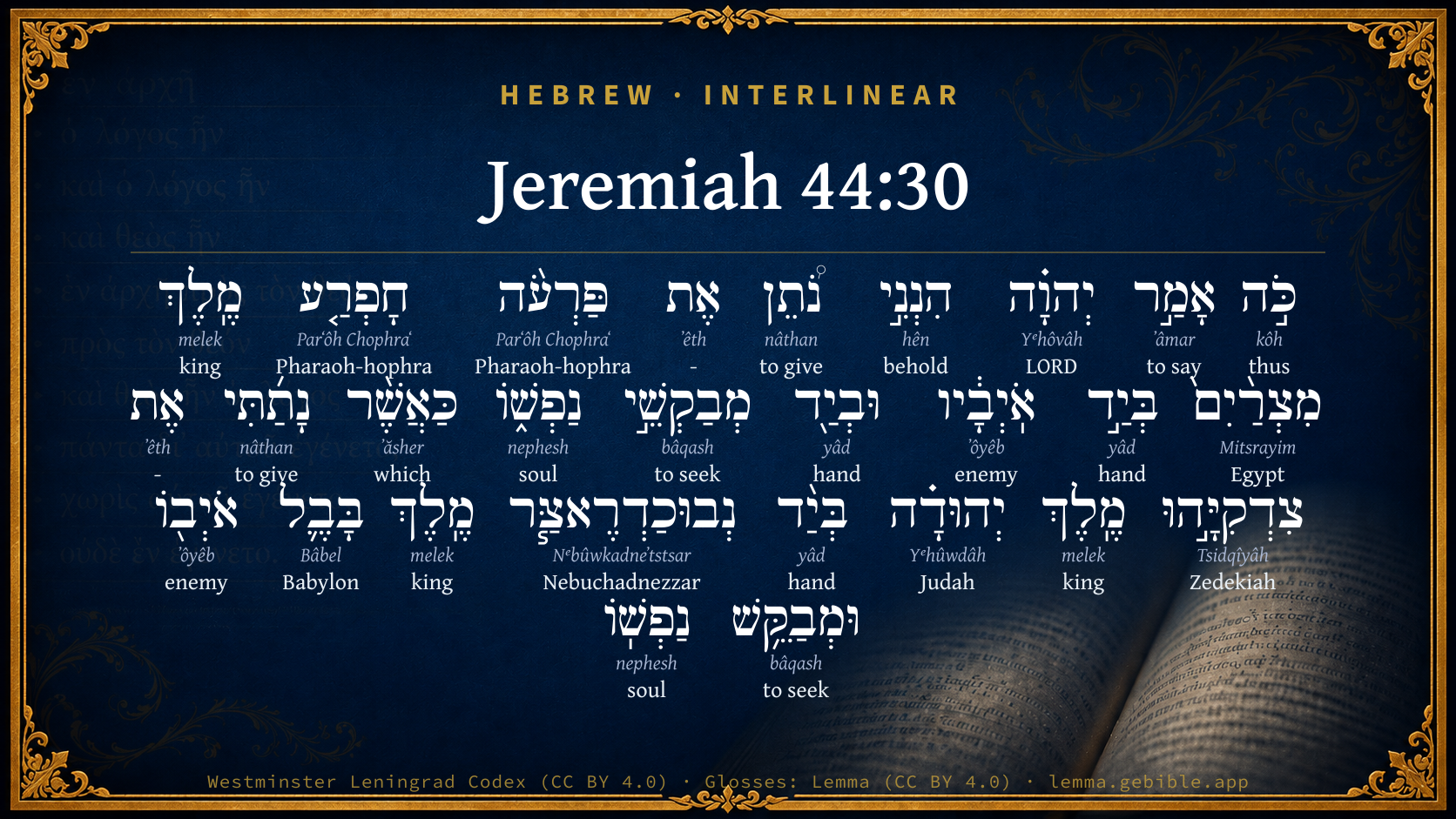
Hebrew (Westminster Leningrad Codex) Jeremiah 44:30 appears in the Hebrew Old Testament. The text above is from the Westminster Leningrad Codex. Each word links to its Strong’s number, a concise gloss, and parsing drawn from the Open Scriptures Hebrew Bible morphology. Click any word for its full Brown-Driver-Briggs (BDB) entry.
Download image
Cite this verse

Jeremiah 44:30 (World English Bible). Public Domain. Lemma interlinear Bible study tool, https://lemma.gebible.app/v/jeremiah/44/30.

Show BibTeX & RIS
BibTeX
RIS
English Translation
Thus says Yahweh, Behold, I will give Pharaoh Hophra king of Egypt into the hand of his enemies, and into the hand of those who seek his life; as I gave Zedekiah king of Judah into the hand of Nebuchadrezzar king of Babylon, who was his enemy, and sought his life.
World English Bible · Public Domain
Highlights
  • 1 first appearance in the Hebrew Bible
Full analysis ↓
Download a study sheet

One document with this verse’s original text, its word-by-word gloss line, the meaning frame, cross-references with their text, attributed commentary, and full source and license credits — printable, and it pastes into notes with its structure intact.

This verse Autodidact and up

Study sheet (.html) Plain text (.txt)

A passage Seminary Student

Up to 50 verses in one chapter. A passage sheet keeps up to 6 commentary sources and 12 cross-references per verse, in the order this page ranks them, and says so on the sheet whenever that leaves anything out. Ask for a single verse and you get the Autodidact verse sheet above.

Everything on this page stays free to read, with no account — the sheet is a download of what is already on screen, not access to it.

Want to remove ads? Support Godless Engineer
Compare translations 3

The same verse in 3 English versions, stacked beneath the original-language interlinear above. Click any original word for its lexicon entry.

Each is an independent rendering of the whole verse — the interlinear is not word-aligned to these translations.

Highlighted words mark where these versions differ — a whole-verse word diff, not a word-by-word alignment.

  • World English Bible Public Domain
    Thus says Yahweh, Behold, I will give Pharaoh Hophra king of Egypt into the hand of his enemies, and into the hand of those who seek his life; as I gave Zedekiah king of Judah into the hand of Nebuchadrezzar king of Babylon, who was his enemy, and sought his life.
  • King James Version Public Domain
    Thus saith the LORD; Behold, I will give Pharaohhophra king of Egypt into the hand of his enemies, and into the hand of them that seek his life; as I gave Zedekiah king of Judah into the hand of Nebuchadrezzar king of Babylon, his enemy, and that sought his life.
  • unfoldingWord Literal Text CC BY-SA 4.0
    Yahweh says this, ‘Look, I am about to give Pharaoh Hophra king of Egypt into the hand of his enemies and into the hand of those who seek to kill him. It will the same as when I gave Zedekiah king of Judah into the hand of Nebuchadnezzar king of Babylon, his enemy who sought his life.’”

unfoldingWord Literal Text — © unfoldingWord, licensed CC BY-SA 4.0. Word-aligned USFM3 via Door43 (git.door43.org/unfoldingWord/en_ult).

Versions to compare (up to 4)

3 of 4 selected

Show all 18 translations

Every available English version of this verse, each an independent rendering of the whole verse.

  • World English Bible Public Domain
    Thus says Yahweh, Behold, I will give Pharaoh Hophra king of Egypt into the hand of his enemies, and into the hand of those who seek his life; as I gave Zedekiah king of Judah into the hand of Nebuchadrezzar king of Babylon, who was his enemy, and sought his life.
  • Berean Standard Bible Public Domain
    This is what the LORD says: Behold, I will deliver Pharaoh Hophra king of Egypt into the hands of his enemies who seek his life, just as I delivered Zedekiah king of Judah into the hand of Nebuchadnezzar king of Babylon, the enemy who was seeking his life.”
  • Majority Standard Bible Public Domain
    This is what the LORD says: Behold, I will deliver Pharaoh Hophra king of Egypt into the hands of his enemies who seek his life, just as I delivered Zedekiah king of Judah into the hand of Nebuchadnezzar king of Babylon, the enemy who was seeking his life.”
  • King James Version Public Domain
    Thus saith the LORD; Behold, I will give Pharaohhophra king of Egypt into the hand of his enemies, and into the hand of them that seek his life; as I gave Zedekiah king of Judah into the hand of Nebuchadrezzar king of Babylon, his enemy, and that sought his life.
  • American Standard Version (1901) Public Domain
    Thus saith Jehovah, Behold, I will give Pharaoh Hophra king of Egypt into the hand of his enemies, and into the hand of them that seek his life; as I gave Zedekiah king of Judah into the hand of Nebuchadrezzar king of Babylon, who was his enemy, and sought his life.
  • Revised Version (1885) Public Domain
    Thus saith the LORD: Behold, I will give Pharaoh Hophra king of Egypt into the hand of his enemies, and into the hand of them that seek his life; as I gave Zedekiah king of Judah into the hand of Nebuchadrezzar king of Babylon, his enemy, and that sought his life.
  • Geneva Bible (1599) Public Domain
    Thus sayth the Lord, Beholde, I will giue Pharaoh Hophra King of Egypt into the hand of his enemies, and into the hand of them that seeke his life: as I gaue Zedekiah King of Iudah into the hand of Nebuchad-nezzar King of Babel his enemie, who also sought his life.
  • Douay-Rheims (1899) Public Domain
    Thus saith the Lord: Behold I will deliver Pharao Ephree king of Egypt into the hand of his enemies, and into the hand of them that seek his life: as I delivered Sedecias king of Juda into the hand of Nabuchodonosor the king of Babylon his enemy, and that sought his life.
  • Young's Literal Translation Public Domain
    Thus said Jehovah, Lo, I am giving Pharaoh-Hophra king of Egypt into the hand of his enemies, and into the hand of those seeking his life, as I have given Zedekiah king of Judah into the hand of Nebuchadrezzar king of Babylon, his enemy, and who is seeking his life.'
  • Literal Standard Version CC BY-SA 4.0
    thus said YHWH: Behold, I am giving Pharaoh-Hophra king of Egypt into the hand of his enemies, and into the hand of those seeking his life, as I have given Zedekiah king of Judah into the hand of Nebuchadnezzar king of Babylon, his enemy, and who is seeking his life.”
  • Unlocked Literal Bible CC BY-SA 4.0
    Yahweh says this, 'Look, I am about to give Pharaoh Hophra king of Egypt into the hand of his enemies and into the hand of those who seek to kill him. It will the same as when I gave Zedekiah king of Judah into the hand of Nebuchadnezzar king of Babylon, his enemy who sought his life.'”
  • unfoldingWord Literal Text CC BY-SA 4.0
    Yahweh says this, ‘Look, I am about to give Pharaoh Hophra king of Egypt into the hand of his enemies and into the hand of those who seek to kill him. It will the same as when I gave Zedekiah king of Judah into the hand of Nebuchadnezzar king of Babylon, his enemy who sought his life.’”
  • Darby Bible Public Domain
    thus saith Jehovah: Behold, I will give Pharaoh-Hophra king of Egypt into the hand of his enemies, and into the hand of them that seek his life; as I gave Zedekiah king of Judah into the hand of Nebuchadrezzar king of Babylon, his enemy, and that sought his life.
  • World Messianic Bible Public Domain
    The LORD says, ‘Behold, I will give Pharaoh Hophra king of Egypt into the hand of his enemies and into the hand of those who seek his life, just as I gave Zedekiah king of Judah into the hand of Nebuchadnezzar king of Babylon, who was his enemy and sought his life.’”
  • Webster's Bible Public Domain
    Thus saith the LORD; Behold, I will give Pharaoh-hophra king of Egypt into the hand of his enemies, and into the hand of them that seek his life; as I gave Zedekiah king of Judah into the hand of Nebuchadrezzar king of Babylon, his enemy, and that sought his life.
  • Free Bible Version CC BY-SA 4.0
    This is what the Lord says: Look! I'm going to hand over Pharaoh Hophra king of Egypt to his enemies who are trying to kill him, in the same way that I handed over Zedekiah king of Judah to Nebuchadnezzar king of Babylon, his enemy who was trying to kill him.”
  • Bible in Basic English Public Domain
    The Lord has said, See, I will give up Pharaoh Hophra, king of Egypt, into the hands of those who are fighting against him and desiring to take his life, as I gave Zedekiah, king of Judah, into the hands of Nebuchadrezzar, king of Babylon, his hater, who had designs against his life.
  • JPS Tanakh (1917) Public Domain
    thus saith the LORD: Behold, I will give Pharaoh Hophra king of Egypt into the hand of his enemies, and into the hand of them that seek his life; as I gave Zedekiah king of Judah into the hand of Nebuchadrezzar king of Babylon, his enemy, and that sought his life.'

Literal Standard Version (2020), Covenant Press — licensed CC BY-SA 4.0. Text via the HelloAO Bible API (eBible.org). Unlocked Literal Bible (unfoldingWord) — licensed CC BY-SA 4.0. Text via the HelloAO Bible API (eBible.org). unfoldingWord Literal Text — © unfoldingWord, licensed CC BY-SA 4.0. Word-aligned USFM3 via Door43 (git.door43.org/unfoldingWord/en_ult). Free Bible Version, Dr. Jonathan Gallagher — licensed CC BY-SA 4.0. Text via the HelloAO Bible API (eBible.org).

Word by word

More ways to search: Search by grammar → Find every occurrence → Compare this word →

Practice this passage: Drill this verse → Learn its vocabulary →

פַּרְעֹ֨ה
Parʻôh Chophraʻ
H6548
“Pharaoh-hophra”
Noun, Proper
Part of Speech
Noun
Type
Proper
Full BDB Definition

Origin: of Egyptian derivation

TWOT: None

Pharaoh-hophra = "the great house -covering evil" - the Pharaoh of Egypt at the time of the conquest by Nebuchadnezzar
  1. כֹּ֣ה kôh H3541 “thus” Adverb
  2. אָמַ֣ר ʼâmar H559 “to say” Verb, Qal, Perfect, 3rd Person, Masculine, Singular
  3. יְהוָ֗ה Yᵉhôvâh H3068 “LORD” Noun, Proper
  4. הִנְנִ֣י hên H2005 “behold · me” Particle, Demonstrative + Suffix, Personal, 1st Person, Common, Singular
  5. נֹ֠תֵן nâthan H5414 “giving” Verb, Qal, Participle Active, Masculine, Singular, Absolute
  6. אֶת ʼêth H853 “-” Particle, Direct Object
  7. חָפְרַ֤ע Parʻôh Chophraʻ H6548 “Pharaoh-hophra” Noun, Proper
  8. מֶֽלֶךְ melek H4428 “king of” Noun, Common, Masculine, Singular, Construct
  9. מִצְרַ֨יִם֙ Mitsrayim H4714 “Egypt” Noun, Proper
  10. בְּיַ֣ד yâd H3027 “in/at · hand of” Preposition + Noun, Common, Both, Singular, Construct
  11. אֹֽיְבָ֔יו ʼôyêb H341 “enemy · him” Verb, Qal, Participle Active, Masculine, Plural, Construct + Suffix, Personal, 3rd Person, Masculine, Singular
  12. וּבְיַ֖ד yâd H3027 “and · in/at · hand of” Conjunction + Preposition + Noun, Common, Both, Singular, Construct
  13. מְבַקְשֵׁ֣י bâqash H1245 “seeking” Verb, Piel, Participle Active, Masculine, Plural, Construct
  14. נַפְשׁ֑וֹ nephesh H5315 “soul · his” Noun, Common, Both, Singular, Construct + Suffix, Personal, 3rd Person, Masculine, Singular
  15. כַּאֲשֶׁ֨ר ʼăsher H834 “like/as · which” Preposition + Particle, Relative
  16. נָתַ֜תִּי nâthan H5414 “to give” Verb, Qal, Perfect, 1st Person, Common, Singular
  17. אֶת ʼêth H853 “-” Particle, Direct Object
  18. צִדְקִיָּ֣הוּ Tsidqîyâh H6667 “Zedekiah” Noun, Proper
  19. מֶֽלֶךְ melek H4428 “king of” Noun, Common, Masculine, Singular, Construct
  20. יְהוּדָ֗ה Yᵉhûwdâh H3063 “Judah” Noun, Proper
  21. בְּיַ֨ד yâd H3027 “in/at · hand of” Preposition + Noun, Common, Both, Singular, Construct
  22. נְבוּכַדְרֶאצַּ֧ר Nᵉbûwkadneʼtstsar H5019 “Nebuchadnezzar” Noun, Proper
  23. מֶֽלֶךְ melek H4428 “king of” Noun, Common, Masculine, Singular, Construct
  24. בָּבֶ֛ל Bâbel H894 “Babylon” Noun, Proper
  25. אֹיְב֖וֹ ʼôyêb H341 “enemy · him” Verb, Qal, Participle Active, Masculine, Singular, Construct + Suffix, Personal, 3rd Person, Masculine, Singular
  26. וּמְבַקֵּ֥שׁ bâqash H1245 “and · seeking” Conjunction + Verb, Piel, Participle Active, Masculine, Singular, Absolute
  27. נַפְשֽׁוֹ nephesh H5315 “soul · his” Noun, Common, Both, Singular, Construct + Suffix, Personal, 3rd Person, Masculine, Singular

About this verse

These counts appear in no published source. They are computed here, from the morphology-tagged text and Lemma’s own curated glosses. What Lemma adds →

28
words
18
distinct lemmas
Prophets
section

Notable vocabulary

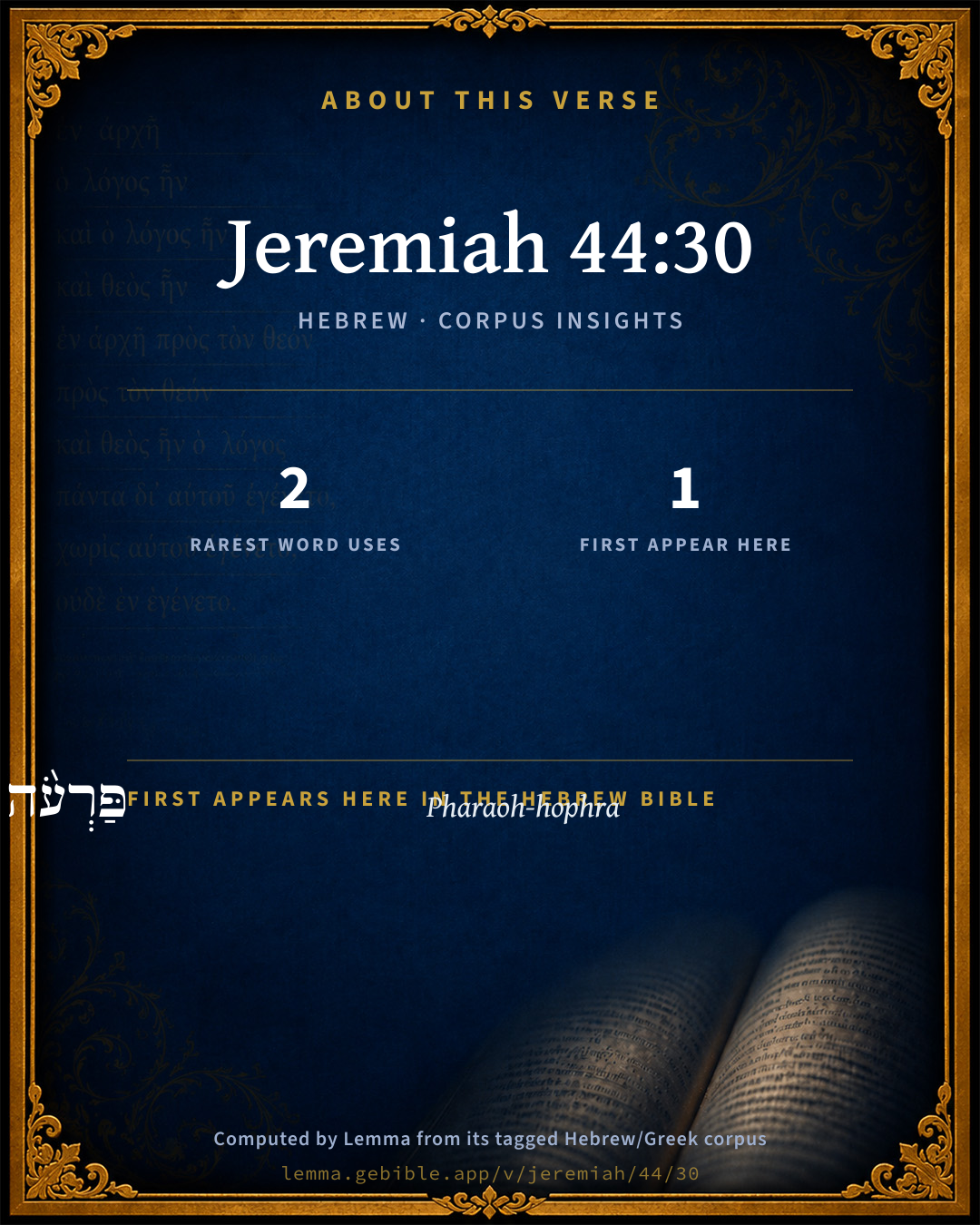
The rarest word here is פַּרְעֹ֨ה Pharaoh-hophra H6548 — appearing just 2 times in the whole Hebrew Bible.

First appearance in Scripture

This word makes its first canonical appearance in the Hebrew Bible here:

  • פַּרְעֹ֨ה Pharaoh-hophra H6548

Grammatical profile

  • 7 verbs
  • 16 nouns
  • 1 adverb
  • 4 particles

Verb forms

  • אָמַ֣ר Qal · Perfect
  • נֹ֠תֵן Qal · Participle Active
  • אֹֽיְבָ֔יו Qal · Participle Active
  • מְבַקְשֵׁ֣י Piel · Participle Active
  • נָתַ֜תִּי Qal · Perfect
  • אֹיְב֖וֹ Qal · Participle Active
  • וּמְבַקֵּ֥שׁ Piel · Participle Active

Repetition

Words recur within this verse — often emphatic in Hebrew:

  • מֶֽלֶךְ king H4428 ×3
  • בְּיַ֣ד hand H3027 ×3
  • נֹ֠תֵן to give H5414 ×2
  • פַּרְעֹ֨ה Pharaoh-hophra H6548 ×2
  • אֹֽיְבָ֔יו enemy H341 ×2
  • מְבַקְשֵׁ֣י to seek H1245 ×2
  • נַפְשׁ֑וֹ soul H5315 ×2

Cross-references

9

Topical passages linked to Jeremiah 44:30 in the Treasury of Scripture Knowledge — connected by theme and wording, ordered by reader-vote popularity; previews shown in the World English Bible.

  • 2 Kings 25:4–7 Then a breach was made in the city, and all the men of war [fled] by night by the way of the gate between the two walls, which was by the king's garden (now the Chaldeans were against the city round about); and [the king] went by the way of the Arabah.
  • Jeremiah 34:21 Zedekiah king of Judah and his princes will I give into the hand of their enemies, and into the hand of those who seek their life, and into the hand of the king of Babylon's army, who have gone away from you.
  • Jeremiah 39:5–7 But the army of the Chaldeans pursued after them, and overtook Zedekiah in the plains of Jericho: and when they had taken him, they brought him up to Nebuchadrezzar king of Babylon to Riblah in the land of Hamath; and he gave judgment on him.
  • Jeremiah 43:9–13 Take great stones in your hand, and hide them in mortar in the brick work, which is at the entry of Pharaoh's house in Tahpanhes, in the sight of the men of Judah;
  • Ezekiel 30:21 Son of man, I have broken the arm of Pharaoh king of Egypt; and, behold, it has not been bound up, to apply [healing] medicines, to put a bandage to bind it, that it be strong to hold the sword.
  • Jeremiah 52:8–11 But the army of the Chaldeans pursued after the king, and overtook Zedekiah in the plains of Jericho; and all his army was scattered from him.
  • Ezekiel 29:1–21 In the tenth year, in the tenth [month], in the twelfth [day] of the month, the word of Yahweh came to me, saying,
  • Ezekiel 31:18–32:32 To whom are you thus like in glory and in greatness among the trees of Eden? yet shall you be brought down with the trees of Eden to the lower parts of the earth: you shall lie in the midst of the uncircumcised, with those who are slain by the sword. This is Pharaoh and all his multitude, says the Lord Yahweh.
  • Jeremiah 46:13–26 The word that Yahweh spoke to Jeremiah the prophet, how that Nebuchadrezzar king of Babylon should come and strike the land of Egypt.

Cross-references courtesy of OpenBible.info (CC BY 4.0).

Hebrew and Greek witnesses Masoretic Hebrew ↔ Greek Septuagint

The same verse in the two great witnesses to the Old Testament, shown verse-for-verse.

These are two independent witnesses, not word-aligned to each other, and the Septuagint is shown in lemma (dictionary) form.

Hebrew Jeremiah 44:30 Masoretic · Westminster Leningrad Codex

כֹּ֣ה אָמַ֣ר יְהוָ֗ה הִנְנִ֣י נֹ֠תֵן אֶת פַּרְעֹ֨ה חָפְרַ֤ע מֶֽלֶךְ מִצְרַ֨יִם֙ בְּיַ֣ד אֹֽיְבָ֔יו וּבְיַ֖ד מְבַקְשֵׁ֣י נַפְשׁ֑וֹ כַּאֲשֶׁ֨ר נָתַ֜תִּי אֶת צִדְקִיָּ֣הוּ מֶֽלֶךְ יְהוּדָ֗ה בְּיַ֨ד נְבוּכַדְרֶאצַּ֧ר מֶֽלֶךְ בָּבֶ֛ל אֹיְב֖וֹ וּמְבַקֵּ֥שׁ נַפְשֽׁוֹ

Thus says Yahweh, Behold, I will give Pharaoh Hophra king of Egypt into the hand of his enemies, and into the hand of those who seek his life; as I gave Zedekiah king of Judah into the hand of Nebuchadrezzar king of Babylon, who was his enemy, and sought his life.

World English Bible · Public Domain

Greek LXX Structure differs

In the Septuagint, Jeremiah is about an eighth shorter than the Hebrew and arranges its material differently — the Oracles Against the Nations (Hebrew chapters 46–51) appear in the middle of the Greek book, after 25:13. Because the chapter and verse boundaries do not line up, a verse-for-verse comparison with the Hebrew is not shown.

A verse-for-verse comparison isn’t shown here because the chapters and verses don’t line up. Switch to the LXX edition with the MT / LXX toggle above to read the Greek directly.

On this verse, John Gill's Exposition discusses the Septuagint’s reading. Read the note in Commentary ↓

Hebrew: Westminster Leningrad Codex (CC BY 4.0). Greek: Septuagint (public domain); English from a public-domain English Septuagint. How the Septuagint differs from the Hebrew →

Targum (Aramaic paraphrase)

1

The Targum is the ancient Jewish Aramaic paraphrase of the Hebrew Scriptures — an interpretive translation, not the Hebrew text itself. Onkelos (literal) and Pseudo-Jonathan (expansive) render the Torah, and Jonathan the Prophets. Coverage is partial: where no permissively-licensed English translation exists for a verse, only the Aramaic is shown. This is verse-level text, not a word-by-word alignment to the Hebrew.

  1. Targum Jonathan Prophets (Joshua–Malachi)
    כִּדְנַן אֲמַר יְיָ הָא אֲנָא מָסַר יַת פַּרְעֹה תְבִירָא מַלְכָּא דְמִצְרַיִם בְּיַד בַעֲלֵי דְבָבוֹהִי וּבְיַד דְבָעָן לְמִקְטְלֵיהּ כְּמָא דִמְסָרֵית יַת צִדְקִיָהוּ מַלְכָּא דְשִׁבְטָא דְבֵית יְהוּדָה בְּיַד נְבוּכַדְרֶאצַר מַלְכָּא דְבָבֶל בְּעֵיל דְבָבֵיהּ וְדִבְעָא לְמִקְטְלֵיהּ:

    (no public-domain English translation for this verse)

    Targum Jonathan — Aramaic: “Mikraot Gedolot” (public domain). English: “Sefaria Community Translation” (CC0 1.0 (public-domain dedication)); “London "Chaldee Paraphrase," 1871” (public domain). Text via Sefaria.

Commentary

Notes on Jeremiah 44:30 from classic Christian and Jewish commentators (each source and its license shown beneath its notes). The classic Christian expositions comment on the surrounding passage and are grouped to its opening verse, so a note may address several verses; the Jewish commentaries on the Tanakh (Rashi and others) are per-verse, so they appear only where the commentator wrote on this verse.

Lemma curates 59 commentaries, every one of them public domain or Creative Commons licensed, each selected and text-cleaned for this edition rather than reprinted as found. About our sources →

Trapp's Complete Commentary

John Trapp

Jer 44:30 Thus saith the LORD; Behold, I will give Pharaohhophra king of Egypt into the hand of his enemies, and into the hand of them that seek his life; as I gave Zedekiah king of Judah into the hand of Nebuchadrezzar king of Babylon, his enemy, and that sought his life.

Ver. 30. Behold, I will give Pharaohhophra.] Called also Vaphres, and by Herodotus, Apries, being nephew to Necho, who slew Josiah. A very proud prince he saith Apries was, slain by Amasis, who succeeded him. But others gather from this text, and from Eze 29:19; Eze 31:11; Eze 31:15; Eze 31:18, that he was slain by Nebuchadnezzar. Josephus {a} also and Jerome say as much. {b}

{a} Antiq., lib. x. cap. 11.

{b} Jerome in Thren., cap. 4.

John Trapp, A Commentary or Exposition upon All the Books of the Old and New Testament (1647–1656) — public domain. Text from a community e-Sword module.

Tyndale Open Study Notes

Tyndale Open Resources

44:30 Pharaoh Hophra was killed by his enemies in Egypt in 570 BC. • This verse concludes the record of Jeremiah’s forty-year ministry. Nothing is known about where, when, or how Jeremiah died.

Tyndale Open Study Notes — © Tyndale Open Resources, licensed CC BY-SA 4.0. Text via the HelloAO Bible API.

Geneva Bible (1599)

Geneva Bible translators

He showeth the means whereby they should be destroyed to assure them of the certainty of the plague, and yet they remain still in their obstinacy till they perish: for Josephus, lib. 10, de Antiq., cap. 11, writeth that five years after the taking of Jerusalem, Nebuchadnezzar the younger having overcome the Moabites and the Ammonites, went against Egypt, and slew the king, and so brought these Jews and others into Babylon.

Geneva Bible (1599) marginal notes — public domain. Text via Bolls.life.

Jamieson, Fausset & Brown

Robert Jamieson, A. R. Fausset & David Brown

Hophra--in HERODOTUS called Apries. He succeeded Psammis, the successor of Pharaoh-necho, who was beaten by Nebuchadnezzar at Carchemish, on the Euphrates. Amasis rebelled against, and overcame him, in the city Sais.

them that seek his life--HERODOTUS, in curious accordance with this, records that Amasis, after treating Hophra well at first, was instigated, by persons who thought they could not be safe unless he were put to death, to strangle him. "His enemies" refer to Amasis, &c.; the words are accurately chosen, so as not to refer to Nebuchadnezzar, who is not mentioned till the end of the verse, and in connection with Zedekiah (Eze 20:3; Eze 30:21). Amasis' civil war with Hophra pioneered the way for Nebuchadnezzar's invasion in the twenty-third year of his reign [JOSEPHUS, Antiquities, 10.11].

After the completion of the prophecies and histories appertaining to the Jewish people and kings, Jeremiah subjoins one referring to an individual, Baruch; even as there are subjoined to the epistles of Paul addressed to churches, epistles to individuals, some of which were prior in date to the former. Afterwards follow the prophecies referring to other nations, closing the book [GROTIUS]. The date of the events here told is eighteen years before the taking of the city; this chapter in point of time follows the thirty-sixth chapter. Baruch seems to have been regularly employed by Jeremiah to commit his prophecies to writing (Jer 36:1, Jer 36:4, Jer 36:32).

Next: Jeremiah Chapter 45

Jamieson, Fausset & Brown — Commentary Critical and Explanatory on the Whole Bible (1871) — public domain (CC PDM 1.0). Text via the HelloAO Bible API.

Adam Clarke's Commentary

Verse 30. Behold I will give Pharaoh-hophra] That is, Pharaoh Apries. How this and the prophecies in the preceding chapter were fulfilled, we learn from ancient historians. The sum of such information is this: the subjects of Pharaoh Apries rebelling, he sent Amasis, one of his generals, to reduce them to their duty. But no sooner had Amasis begun to make his speech, than they fixed a helmet on his head, and proclaimed him king. Amasis accepted the title, and confirmed the Egyptians in their revolt; and the greater part of the nation declaring for him, Apries was obliged to retire into Upper Egypt; and the country being thus weakened by intestine war, was attacked and easily overcome by Nebuchadnezzar, who on quitting it left Amasis his viceroy. After Nebuchadnezzar's departure, Apries marched against Amasis; but, being defeated at Memphis, was taken prisoner, carried to Sais, and was strangled in his own palace, thus verifying this prophecy. See Herodotus in Euterpe.

Thus Nebuchadnezzar made an easy conquest of the land. He conquered it as easily as "a shepherd puts on his cloak: he went thence in peace," having clothed himself with its spoils; and left all quiet under a viceroy of his own choosing. The rebellion of Pharaoh's subjects was the "fire that God kindled in Egypt," Jer 43:12. And thus was he "delivered into the hands of his enemies," his revolted people; and "into the hand of him who sought his life," i.e., Amasis his general. And thus the whole prophecy was literally fulfilled.

Adam Clarke's Commentary on the Bible (1810–1826) — public domain. Text from a community e-Sword/MySword module.

John Calvin's Commentaries

This sign then had a reference to what was future. But the sign given to Moses was retrospective, for the people more clearly saw that God had been their deliverer, because it had been predicted to Moses when yet in the desert that the Israelites would come there; and that place, even Mount Sinai, had been already destined for that worship which afterwards was presented to God. The people at the time considered this, and by calling to mind what had been predicted, they were more and more confirmed as to their faith in God’s favor. Such was also the sign mentioned here, This shall be a sign, says Jeremiah, even that God would deliver Pharaoh-hophrah into the hand of Nebuchadnezzar his enemy

Had any one then asked the Prophet why he spoke of the king of Egypt, he would have said, “Now indeed this sign remains as it were buried, its use is not seen; but God will in due time shew that I have been entrusted with his commands, for whatever I predict of the king of Egypt shall be fulfilled.” This sign was also added, for the thing seemed incredible, that is, that Egypt could be conquered, which was strongly fortified on every side. As, then, there was no entrance open for enemies, especially from Pelusium, the Jews thought that they dwelt, as they say, within the circle of the moon, and that they were placed beyond the reach of danger. Since, then, they confided in the protection of Egypt, and thought the land unassailable, this their confidence was laughed to scorn.

And the Prophet expressly mentions the surname of Pharaoh, which was Hophra, the meaning of which is not known to me; and it is probably an Egyptic word, for there is no such word in Hebrew: and it is not known whence the word Pharaoh has come. We know that all the kings of Egypt had this name, as the emperors of Rome were called Caesars, in memory of Julius Caesar. The kings of Egypt were in the same manner called Pharaohs. But each had his own name to distinguish him from the rest; and this king was called Hophra.

Now what the Prophet predicted, if we believe Josephus, was fulfilled about the fourth year after they had departed into Egypt. For Nebuchadnezzar went down again into Egypt, after having spoiled the Moabites and the Ammonites, and at length took possession of that kingdom. But it was a hateful message, when Jeremiah predicted the ruin of the kingdom. Nor is there a doubt, but that danger appeared before his eyes, when he saw that he addressed ungodly men, who a hundred times wished him to be destroyed. When therefore he dared to prophesy against the king, the whole people, and the land, we hence see how great must have been his firmness and his courage, still boldly to discharge his office; for he was not terrified by danger, but promulgated whatever God had committed to him. We then have here a singular example of magnanimity; for the Prophet hesitated not to risk his own life while obeying God.

By saying, I will deliver the king of Egypt into the hands of his enemies, and of them who seek his life, he intimates that there would be fatal enemies, though he speaks only of one enemy, but he connects the army with its head: I will deliver Pharaoh then into the hand of Nebuchadnezzar, the king of Babylon, as I have delivered Zedekiah into the hand of his enemy and of him who sought his life; as though he had said, “The condition of the king of Egypt will not be better than that of Zedekiah.”: For Zedekiah occupied that sacred throne of which God had testified, “Here will I dwell;” and further, “On the throne of David shall one of his posterity ever continue.”

We hence see, that the Prophet reasons from the greater to the less; for if God had not spared King Zedekiah, who was, as it were, a sacred person, nothing better could be hoped for as to the king of Egypt, who reigned only in a manner usual and common. The sum of what is said then is, that the Jews had been already sufficiently taught by facts how true his prophecies were; for he had predicted what at length happened to Zedekiah; but his word was not believed. “It is now the time,” he says, “when the Jews must know that I am God’s faithful servant, as God had added a proof in the case of Zedekiah, which ought to have remained fixed in their memory.” Now, if they thought that the king of Egypt was beyond danger, they ascribed great injustice to God, who had not delivered Zedekiah, who had been anointed in his name, and by his command. This then is the import of the passage.

John Calvin's Commentaries (1540-1563) — public domain. Text from the Calvin Translation Society English edition (1840s-50s) via the Christian Classics Ethereal Library (ccel.org). Calvin's coverage is partial (roughly two-thirds of the Bible); uncommented books and verses are honest gaps, never fabricated. The 19th-century editor's footnotes and remarks are omitted so the notes are faithfully Calvin's own voice.

Ellicott's Commentary for English Readers

(30) Behold, I will give Pharaoh-hophra . . .—The fate of the Egyptian king is announced, coming, as it did, before that of the fugitives, as a “sign” that the prediction of their doom also would in due course be accomplished. The king thus named—the Apries of Herod. II., 161, 163, 169—was the son of Psammis, and reigned for twenty-five years. He attacked Sidon by land and Tyre by sea, presumably before Nebuchadnezzar’s invasion of Phœnicia, and then sent his armies against Cyrene. The issue of that campaign was disastrous, and his subjects revolted. His general, Amasis, who was sent to pacify the rebels, put himself at their head. Apries was deposed, kept in honourable imprisonment at Sais for a time, and afterwards strangled. His reign extended from B.C. 594 to 569. Jeremiah probably delivered his prediction circ. B.C. 580, and it is the last recorded event in his life. A late Christian tradition, resting probably on a Jewish one, states that then, or shortly afterwards, the Egyptian Jews, irritated by his reproaches, rose up against him and stoned him to death. (Tertull. Adv. Gnost, c. 8; Hieron. Adv. Jovin, ii. 37.) In Heb_11:37 (“they were stoned “) we may probably find a reference to his fate as one of the “noble army of martyrs.”

A Bible Commentary for English Readers, edited by Charles John Ellicott (1878–1897) — public domain. Text from a community e-Sword module.

John Gill's Exposition

Thus saith the Lord, behold, I will give Pharaohhophra king of Egypt,.... Pharaoh was a common name of the kings of Egypt, who usually had some surname, by which they were distinguished; and the surname of the then present king of Egypt was Hophra; whom the Septuagint and others call Vaphres; and, Herodotus (l) Apries. The Targum renders it Pharaoh the broken; and the Syriac version Pharaoh the lame: now it is here predicted as a sign of the destruction of the Jews in Egypt, which should follow after, that God would deliver this king

into the hand of his enemies, and into the hand of them that seek his life; either into the hands of his rebellious subjects, headed by Amasis, by whom he was kept alive for a while after taken, and then put to death, as Herodotus reports; or rather into the hands of Nebuchadnezzar; for Josephus says (m), that he, in the twenty third year of his reign, which was four or five years after the destruction of Jerusalem, having subdued the Syrians, Ammonites, and Moabites, entered Egypt in a hostile manner, and slew the then remaining king, and set up another; and this is confirmed by what follows:

as I gave Zedekiah king of Judah into the hand of Nebuchadnezzar king of Babylon, and that sought his life; in like manner, and as sure as he had done the one, he would do the other; and he puts the Jews in mind of what he had done by him, and which they had full and certain knowledge of; and might from hence conclude that this also would be accomplished, here given as a sign of their own ruin; and which, when they saw come to pass, might know that it was at hand; and, indeed, the king of Egypt, in whom they trusted, being taken by his enemies, and his country wasted, they must in course fall a prey to the conqueror.

(l) Euterpe, sive l. 2. c. 161, 162, 169. & Melpomene, sive l. 4. c. 159. (m) Antiqu. l. 10. c. 9. sect. 7.

Next: Jeremiah Chapter 45

John Gill's Exposition of the Whole Bible (1746–1763) — public domain (CC PDM 1.0). Text via the HelloAO Bible API.

Haydock's Catholic Bible Commentary

Enemies. Herodotus (ii. 161, 169.) informs us that Apries reigned fortunately twenty-five years, when he lost many of his men fighting against the Cyreneans, and was dethroned by Amasis, and strangled by his subjects. Usher (the year of the world 3433) suspects that Amasis was assisted and confirmed by Nabuchodonosor, and he might this fulfill the prophecies, chap. xliii. 11., &c., and Ezechiel xxix., &c. Josephus (Antiquities x. 11.) and Berosus (contra Apion i.) assert, that Nabuchodonosor defeated and slew the king of Egypt, though Herodotus is silent on this subject, his account being communicated by the Egyptian priests, and full of fables. (Calmet)

George Leo Haydock (1774–1849), Haydock's Catholic Family Bible and Commentary, 1859 edition — public domain. Excludes Psalms (Douay-Rheims chapter numbering differs from Protestant) and Deuterocanonical books (Catholic canon only).

Matthew Poole's English Annotations

Pharaoh was a name common to all the Egyptian kings, as may be learned from Gen 12:15; 41:1; Exo 1:8,11; but they had besides that name another peculiar to them. Whether this Hophra was Vaphres or Apries is not much material; nor is there any certainty when this prophecy was fulfilled; whether

Pharaoh-hophra were (as Herodotus saith) slain by Amasis, one of his subjects who rebelled against him and slew him, (as the aforementioned author tells us,) or Nebuchadnezzar, who Josephus saith came about five years after he had taken Jerusalem, and overran Egypt, and slew this Pharaoh-hophra, whose overthrow was a certain sign of the Jews’ destruction, it being not like that the king of Babylon should spare these Jews who had fled to this king of Egypt for shelter; considering also that the Jews had slain Gedaliah his deputy governor in Judea.

How God delivered Zedekiah into the hand of the king of Babylon, we read Jer 39. Here now ends the story of these Jews that had fled into Egypt.

Matthew Poole's English Annotations on the Holy Bible (1683–1685) — public domain. Text from a community e-Sword/MySword module.

The Pulpit Commentary

I will give Pharaoh-hophra, etc. The sign consists in the capture of Hophra by his deadly enemies. Henceforth he will live in constant alarm, for he is in the hands of those "that seek his life." All that we know of the fate of Hophra (Apries) is derived from Herodotus (2:169), who states that Amssis "gave Apries over into the hands of his former subjects, to deal with as they chose. Then the Egyptians took him and strangled him". (see further on Jer_46:13)

The Pulpit Commentary (1880–1919), ed. H.D.M. Spence-Jones & Joseph S. Exell — public domain. Text from a community e-Sword module.

Rashi

Rabbi Shlomo Yitzchaki (Rashi)

Pharaoh Hophra Heb. פרעה חפרע, rendered by Jonathan as פרעֹה תבירה, the broken Pharaoh, and this ‘heth’ serves instead of a ‘heh.’

Rashi on the Tanakh — English translations: “The Judaica Press complete Tanach with Rashi, translated by A. J. Rosenberg” (CC BY 4.0); “Pentateuch with Rashi's commentary by M. Rosenbaum and A.M. Silbermann, 1929-1934” (public domain); “The Metsudah Tanach series, Lakewood, N.J” (CC BY 4.0); and “The Book of Joshua, Metsudah Publications, 1997” (CC BY 4.0). Text via Sefaria.

Lesson kit

Teaching starters — assembled from the data on this page, not authored interpretation. Every prompt links to the verse data it draws on. Edit before teaching.

Jeremiah, in the Prophets, opens this verse with 28 words (18 distinct Hebrew lemmas). Its most distinctive word is Parʻôh Chophraʻ (“Pharaoh-hophra”). A historical commentator’s framing appears above. Read the whole chapter for the surrounding context.

Discussion questions

  1. How does “Pharaoh-hophra” (Parʻôh Chophraʻ) shape what this verse is saying?
  2. The word “Pharaoh-hophra” first appears here in Scripture. What is being introduced at this debut?
  3. 2 Kings 25:4–7 shares this passage’s theme. How do the two illuminate each other?
  4. “king” occurs 3× in this one verse. What is the effect of the repetition?
  5. The translations on this page render this verse differently — a whole-verse word diff, not a word-by-word alignment. What might account for the different wordings?
  6. The verb «אָמַ֣ר» is Qal Perfect. How does its form color the action?
  7. Reading how Trapp's Complete Commentary and Tyndale Open Study Notes read this verse, where do the two commentators agree and where do they part?

Things to notice

  • 1 word makes its first canonical appearance in Scripture here.
  • These translations choose different wording for 18 words in this verse.
  • “king” occurs 3× in this single verse.
  • 18 distinct Hebrew lemmas span 28 words in this verse.

Reading settings

Reading text

Shown beneath each verse's original-language words.

Old Testament
Old Testament edition

Read the OT as the Masoretic Hebrew (MT) or the Greek Septuagint (LXX).

English shown for the Greek Septuagint (in the Hebrew ↔ Greek comparison).

Comparing translations? Open the Compare panel on any verse page to stack up to four side by side.