
Jeremiah 46:14

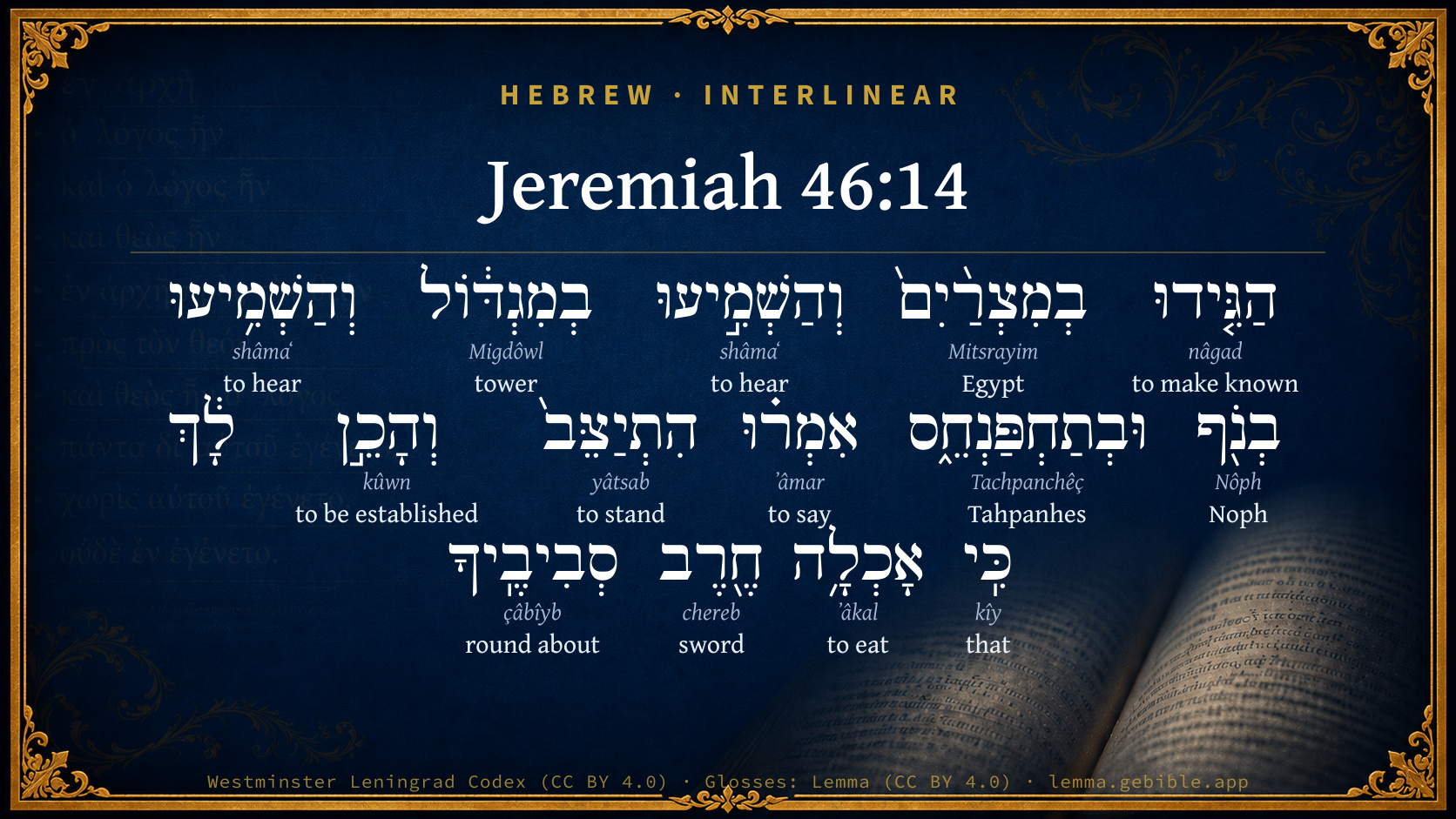
Hebrew (Westminster Leningrad Codex) Jeremiah 46:14 appears in the Hebrew Old Testament. The text above is from the Westminster Leningrad Codex. Each word links to its Strong’s number, a concise gloss, and parsing drawn from the Open Scriptures Hebrew Bible morphology. Click any word for its full Brown-Driver-Briggs (BDB) entry.
Download image
Cite this verse

Jeremiah 46:14 (World English Bible). Public Domain. Lemma interlinear Bible study tool, https://lemma.gebible.app/v/jeremiah/46/14.

Show BibTeX & RIS
BibTeX
RIS
English Translation
Declare you in Egypt, and publish in Migdol, and publish in Memphis and in Tahpanhes: say you, Stand forth, and prepare you; for the sword has devoured round about you.
World English Bible · Public Domain
Download a study sheet

One document with this verse’s original text, its word-by-word gloss line, the meaning frame, cross-references with their text, attributed commentary, and full source and license credits — printable, and it pastes into notes with its structure intact.

This verse Autodidact and up

Study sheet (.html) Plain text (.txt)

A passage Seminary Student

Up to 50 verses in one chapter. A passage sheet keeps up to 6 commentary sources and 12 cross-references per verse, in the order this page ranks them, and says so on the sheet whenever that leaves anything out. Ask for a single verse and you get the Autodidact verse sheet above.

Everything on this page stays free to read, with no account — the sheet is a download of what is already on screen, not access to it.

Want to remove ads? Support Godless Engineer
Compare translations 3

The same verse in 3 English versions, stacked beneath the original-language interlinear above. Click any original word for its lexicon entry.

Each is an independent rendering of the whole verse — the interlinear is not word-aligned to these translations.

Highlighted words mark where these versions differ — a whole-verse word diff, not a word-by-word alignment.

  • World English Bible Public Domain
    Declare you in Egypt, and publish in Migdol, and publish in Memphis and in Tahpanhes: say you, Stand forth, and prepare you; for the sword has devoured round about you.
  • King James Version Public Domain
    Declare ye in Egypt, and publish in Migdol, and publish in Noph and in Tahpanhes: say ye, Stand fast, and prepare thee; for the sword shall devour round about thee.
  • unfoldingWord Literal Text CC BY-SA 4.0
    “Announce in Egypt, and proclaim it in Migdol, Memphis, and Tahpanhes. ‘Take your station and prepare yourself, for the sword will devour those around you.’

unfoldingWord Literal Text — © unfoldingWord, licensed CC BY-SA 4.0. Word-aligned USFM3 via Door43 (git.door43.org/unfoldingWord/en_ult).

Versions to compare (up to 4)

3 of 4 selected

Show all 18 translations

Every available English version of this verse, each an independent rendering of the whole verse.

  • World English Bible Public Domain
    Declare you in Egypt, and publish in Migdol, and publish in Memphis and in Tahpanhes: say you, Stand forth, and prepare you; for the sword has devoured round about you.
  • Berean Standard Bible Public Domain
    “Announce it in Egypt, and proclaim it in Migdol; proclaim it in Memphis and Tahpanhes: ‘Take your positions and prepare yourself, for the sword devours those around you.’
  • Majority Standard Bible Public Domain
    “Announce it in Egypt, and proclaim it in Migdol; proclaim it in Memphis and Tahpanhes: ‘Take your positions and prepare yourself, for the sword devours those around you.’
  • King James Version Public Domain
    Declare ye in Egypt, and publish in Migdol, and publish in Noph and in Tahpanhes: say ye, Stand fast, and prepare thee; for the sword shall devour round about thee.
  • American Standard Version (1901) Public Domain
    Declare ye in Egypt, and publish in Migdol, and publish in Memphis and in Tahpanhes: say ye, Stand forth, and prepare thee; for the sword hath devoured round about thee.
  • Revised Version (1885) Public Domain
    Declare ye in Egypt, and publish in Migdol, and publish in Noph and in Tahpanhes: say ye, stand forth, and prepare thee; for the sword hath devoured round about thee.
  • Geneva Bible (1599) Public Domain
    Publish in Egypt and declare in Migdol, and proclaime in Noph, and in Tahpanhes, and say, Stand still, and prepare thee: for the sworde shall deuoure rounde about thee.
  • Douay-Rheims (1899) Public Domain
    Declare ye to Egypt, and publish it in Magdal, and let it be known in Memphis, and in Taphnis: say ye: Stand up, and prepare thyself: for the sword shall devour all round about thee.
  • Young's Literal Translation Public Domain
    `Declare ye in Egypt, and sound in Migdol, Yea, sound in Noph, and in Tahpanhes say: Station thyself, yea, prepare for thee, For a sword hath devoured around thee,
  • Literal Standard Version CC BY-SA 4.0
    “Declare in Egypt, and sound in Migdol, || And sound in Noph, and in Tahpanhes, say, || Stand firm and prepare yourself, || For a sword has devoured around you,
  • Unlocked Literal Bible CC BY-SA 4.0
    “Announce in Egypt, and proclaim it in Migdol, Memphis, and Tahpanhes. 'Take your station and prepare yourself, for the sword will devour those around you.'
  • unfoldingWord Literal Text CC BY-SA 4.0
    “Announce in Egypt, and proclaim it in Migdol, Memphis, and Tahpanhes. ‘Take your station and prepare yourself, for the sword will devour those around you.’
  • Darby Bible Public Domain
    Declare in Egypt, and publish in Migdol, and publish in Noph, and in Tahpanhes; say, Stand fast, and prepare thee; for the sword devoureth round about thee.
  • World Messianic Bible Public Domain
    “Declare in Egypt, publish in Migdol, and publish in Memphis and in Tahpanhes; say, ‘Stand up, and prepare, for the sword has devoured around you.’
  • Webster's Bible Public Domain
    Declare ye in Egypt, and publish in Migdol, and publish in Noph and in Tahpanhes: say ye, Stand fast, and prepare thee; for the sword shall devour around thee.
  • Free Bible Version CC BY-SA 4.0
    Shout a warning in Egypt! Tell everyone in Migdol, and in Memphis and Tahpanhes: Get ready to defend yourselves, because war is destroying everything around you.
  • Bible in Basic English Public Domain
    Give the news in Migdol, make it public in Noph: say, Take up your positions and make yourselves ready; for on every side of you the sword has made destruction.
  • JPS Tanakh (1917) Public Domain
    Declare ye in Egypt, and announce in Migdol, and announce in Noph and in Tahpanhes; say ye: 'Stand forth, and prepare thee, for the sword hath devoured round about thee.'

Literal Standard Version (2020), Covenant Press — licensed CC BY-SA 4.0. Text via the HelloAO Bible API (eBible.org). Unlocked Literal Bible (unfoldingWord) — licensed CC BY-SA 4.0. Text via the HelloAO Bible API (eBible.org). unfoldingWord Literal Text — © unfoldingWord, licensed CC BY-SA 4.0. Word-aligned USFM3 via Door43 (git.door43.org/unfoldingWord/en_ult). Free Bible Version, Dr. Jonathan Gallagher — licensed CC BY-SA 4.0. Text via the HelloAO Bible API (eBible.org).

Word by word

More ways to search: Search by grammar → Find every occurrence → Compare this word →

Practice this passage: Drill this verse → Learn its vocabulary →

בְמִגְדּ֔וֹל
Migdôwl
H4024
“in/at · tower”
Preposition + Noun, Proper
Part of Speech
Preposition + Noun
Type
Proper
Full BDB Definition

Origin: probably of Egyptian origin

TWOT: None

Migdol = "tower" - a fortified city on the Egyptian border (noun proper masculine) - tower (noun masculine)
  1. הַגִּ֤ידוּ nâgad H5046 “make known” Verb, Hiphil, Imperative, 2nd Person, Masculine, Plural
  2. בְמִצְרַ֨יִם֙ Mitsrayim H4714 “in/at · Egypt” Preposition + Noun, Proper
  3. וְהַשְׁמִ֣יעוּ shâmaʻ H8085 “and · hear” Conjunction + Verb, Hiphil, Imperative, 2nd Person, Masculine, Plural
  4. וְהַשְׁמִ֥יעוּ shâmaʻ H8085 “and · hear” Conjunction + Verb, Hiphil, Imperative, 2nd Person, Masculine, Plural
  5. בְנֹ֖ף Nôph H5297 “in/at · Noph” Preposition + Noun, Proper
  6. וּבְתַחְפַּנְחֵ֑ס Tachpanchêç H8471 “and · in/at · Tahpanhes” Conjunction + Preposition + Noun, Proper
  7. אִמְר֗וּ ʼâmar H559 “say” Verb, Qal, Imperative, 2nd Person, Masculine, Plural
  8. הִתְיַצֵּב֙ yâtsab H3320 “stand” Verb, Hithpael, Imperative, 2nd Person, Masculine, Singular
  9. וְהָכֵ֣ן kûwn H3559 “and · be established” Conjunction + Verb, Hiphil, Imperative, 2nd Person, Masculine, Singular
  10. כִּֽי kîy H3588 “that” Conjunction
  11. אָכְלָ֥ה ʼâkal H398 “to eat” Verb, Qal, Perfect, 3rd Person, Feminine, Singular
  12. חֶ֖רֶב chereb H2719 “sword” Noun, Common, Feminine, Singular, Absolute
  13. סְבִיבֶֽיךָ çâbîyb H5439 “surroundings · your” Noun, Common, Both, Plural, Construct + Suffix, Personal, 2nd Person, Masculine, Singular

About this verse

These counts appear in no published source. They are computed here, from the morphology-tagged text and Lemma’s own curated glosses. What Lemma adds →

15
words
13
distinct lemmas
Prophets
section

Notable vocabulary

The rarest word here is בְמִגְדּ֔וֹל tower H4024 — appearing just 7 times in the whole Hebrew Bible.

Shared distinctive vocabulary

בְמִגְדּ֔וֹל tower H4024 occurs in 7 verses of the Hebrew Bible. Also found in:

Grammatical profile

  • 7 verbs
  • 6 nouns
  • 1 preposition
  • 1 conjunction

Verb forms

  • הַגִּ֤ידוּ Hiphil · Imperative
  • וְהַשְׁמִ֣יעוּ Hiphil · Imperative
  • וְהַשְׁמִ֥יעוּ Hiphil · Imperative
  • אִמְר֗וּ Qal · Imperative
  • הִתְיַצֵּב֙ Hithpael · Imperative
  • וְהָכֵ֣ן Hiphil · Imperative
  • אָכְלָ֥ה Qal · Perfect

Repetition

A word recurs within this verse — often emphatic in Hebrew:

  • וְהַשְׁמִ֣יעוּ to hear H8085 ×2

Cross-references

15

Topical passages linked to Jeremiah 46:14 in the Treasury of Scripture Knowledge — connected by theme and wording, ordered by reader-vote popularity; previews shown in the World English Bible.

  • Jeremiah 44:1 The word that came to Jeremiah concerning all the Jews who lived in the land of Egypt, who lived at Migdol, and at Tahpanhes, and at Memphis, and in the country of Pathros, saying,
  • Jeremiah 46:10 For that day is [a day] of the Lord, Yahweh of Hosts, a day of vengeance, that he may avenge him of his adversaries: and the sword shall devour and be satiate, and shall drink its fill of their blood; for the Lord, Yahweh of hosts, has a sacrifice in the north country by the river Euphrates.
  • Isaiah 1:20 But if you refuse and rebel, you shall be devoured with the sword; For the mouth of Yahweh has spoken it."
  • Jeremiah 2:30 In vain have I struck your children; they received no correction: your own sword has devoured your prophets, like a destroying lion.
  • Jeremiah 43:8–9 Then came the word of Yahweh to Jeremiah in Tahpanhes, saying,
  • Jeremiah 46:3–4 Prepare you the buckler and shield, and draw near to battle.
  • Nahum 2:13 "Behold, I am against you," says Yahweh of Hosts, "and I will burn her chariots in the smoke, and the sword will devour your young lions; and I will cut off your prey from the earth, and the voice of your messengers will no longer be heard."
  • Exodus 14:2 "Speak to the children of Israel, that they turn back and encamp before Pihahiroth, between Migdol and the sea, before Baal Zephon. You shall encamp opposite it by the sea.
  • 2 Samuel 2:26 Then Abner called to Joab, and said, "Shall the sword devour forever? Don't you know that it will be bitterness in the latter end? How long shall it be then, before you bid the people return from following their brothers?"
  • Isaiah 31:8 The Assyrian shall fall by the sword, not of man; and the sword, not of men, shall devour him; and he shall flee from the sword, and his young men shall become subject to forced labor.
  • Isaiah 34:6 The sword of Yahweh is filled with blood, it is made fat with fatness, with the blood of lambs and goats, with the fat of the kidneys of rams; for Yahweh has a sacrifice in Bozrah, and a great slaughter in the land of Edom.
  • Jeremiah 6:1–5 Flee for safety, you children of Benjamin, out of the midst of Jerusalem, and blow the trumpet in Tekoa, and raise up a signal on Beth Haccherem; for evil looks forth from the north, and a great destruction.
  • Jeremiah 12:12 Destroyers are come on all the bare heights in the wilderness; for the sword of Yahweh devours from the one end of the land even to the other end of the land: no flesh has peace.
  • Ezekiel 30:16–18 I will set a fire in Egypt: Sin shall be in great anguish, and No shall be broken up; and Memphis [shall have] adversaries in the day-time.
  • Joel 3:9–12 Proclaim this among the nations: Prepare war. Stir up the mighty men. Let all the warriors draw near. Let them come up.

Cross-references courtesy of OpenBible.info (CC BY 4.0).

Hebrew and Greek witnesses Masoretic Hebrew ↔ Greek Septuagint

The same verse in the two great witnesses to the Old Testament, shown verse-for-verse.

These are two independent witnesses, not word-aligned to each other, and the Septuagint is shown in lemma (dictionary) form.

Hebrew Jeremiah 46:14 Masoretic · Westminster Leningrad Codex

הַגִּ֤ידוּ בְמִצְרַ֨יִם֙ וְהַשְׁמִ֣יעוּ בְמִגְדּ֔וֹל וְהַשְׁמִ֥יעוּ בְנֹ֖ף וּבְתַחְפַּנְחֵ֑ס אִמְר֗וּ הִתְיַצֵּב֙ וְהָכֵ֣ן לָ֔ךְ כִּֽי אָכְלָ֥ה חֶ֖רֶב סְבִיבֶֽיךָ

Declare you in Egypt, and publish in Migdol, and publish in Memphis and in Tahpanhes: say you, Stand forth, and prepare you; for the sword has devoured round about you.

World English Bible · Public Domain

Greek LXX Structure differs

In the Septuagint, Jeremiah is about an eighth shorter than the Hebrew and arranges its material differently — the Oracles Against the Nations (Hebrew chapters 46–51) appear in the middle of the Greek book, after 25:13. Because the chapter and verse boundaries do not line up, a verse-for-verse comparison with the Hebrew is not shown.

A verse-for-verse comparison isn’t shown here because the chapters and verses don’t line up. Switch to the LXX edition with the MT / LXX toggle above to read the Greek directly.

On this verse, Joseph Benson's Commentary discusses the Septuagint’s reading. Read the note in Commentary ↓

Hebrew: Westminster Leningrad Codex (CC BY 4.0). Greek: Septuagint (public domain); English from a public-domain English Septuagint. How the Septuagint differs from the Hebrew →

Targum (Aramaic paraphrase)

1

The Targum is the ancient Jewish Aramaic paraphrase of the Hebrew Scriptures — an interpretive translation, not the Hebrew text itself. Onkelos (literal) and Pseudo-Jonathan (expansive) render the Torah, and Jonathan the Prophets. Coverage is partial: where no permissively-licensed English translation exists for a verse, only the Aramaic is shown. This is verse-level text, not a word-by-word alignment to the Hebrew.

  1. Targum Jonathan Prophets (Joshua–Malachi)
    חֲווּ בְמִצְרַיִם וּבְסָרוּ בְּמִגְדוֹל וּבְסָרוּ בְּמַפַּס וּבְתַחְפַּנְחֵס אֲמָרוּ אִזְדְרֵז וְאַתְקֵין לָךְ אֲרֵי קְטִילַת חַרְבָּא סַחֲרָנָךְ:

    (no public-domain English translation for this verse)

    Targum Jonathan — Aramaic: “Mikraot Gedolot” (public domain). English: “Sefaria Community Translation” (CC0 1.0 (public-domain dedication)); “London "Chaldee Paraphrase," 1871” (public domain). Text via Sefaria.

Commentary

Notes on Jeremiah 46:14 from classic Christian and Jewish commentators (each source and its license shown beneath its notes). The classic Christian expositions comment on the surrounding passage and are grouped to its opening verse, so a note may address several verses; the Jewish commentaries on the Tanakh (Rashi and others) are per-verse, so they appear only where the commentator wrote on this verse.

Lemma curates 59 commentaries, every one of them public domain or Creative Commons licensed, each selected and text-cleaned for this edition rather than reprinted as found. About our sources →

Trapp's Complete Commentary

John Trapp

Jer 46:14 Declare ye in Egypt, and publish in Migdol, and publish in Noph and in Tahpanhes: say ye, Stand fast, and prepare thee; for the sword shall devour round about thee.

Ver. 14. Publish in Noph, and in Tahpanhes.] See Jer 44:1.

For the sword shall devour roundabout thee.] Egypt was no whit amended by the former discomfiture at Carchemish; therefore is now wholly subdued by the Babylonian conqueror, about three and twenty years after. And the like befell the Greek empire, overturned by the Turks.

John Trapp, A Commentary or Exposition upon All the Books of the Old and New Testament (1647–1656) — public domain. Text from a community e-Sword module.

Joseph Benson's Commentary

Jer 46:14-15. Publish in Migdol, and in Noph, and Tahpanhes — Concerning these three cities, see note on Jer 44:1. The meaning is, publish this prophecy over all the land of Egypt; or these three places are named, because in them the Jews, who went into Egypt with Johanan, were chiefly settled. Say, Stand fast, and prepare thee — Prepare for war, and resolve to keep your ground, and not yield to the enemy: compare Jer 46:2-3. For the sword shall devour round about thee — The nations are destroyed around you, and you have reason to expect that the sword will next reach you. Why are thy valiant men swept away? — “The Hebrew word אביר, here rendered valiant, is sometimes spoken of God, as Gen 49:24. Sometimes it is a title given to angels, as Psa 78:25; but the LXX. understand it here of Apis, the idol of Egypt, which might properly be said to be conquered when the nation, that had put themselves under his protection, was subdued.” — Lowth. And, instead of they stood not, because the Lord did drive them, as we translate the next clause, the LXX. add, ο μοσχος ο εκλεκτος σου ουκ εμεινεν, οτι κυριος παρελυσεν αυτον, thy elect calf did not abide, because the Lord debilitated, literally, paralyzed, him. But it is not at all probable that this idol was here intended, but either of the mighty princes of Egypt; or, if the noun be singular, as Blaney understands it, reading, אבירן, thy mighty one, instead of אבירין, thy mighty ones, then the king is probably meant. Neither the king himself, nor his valiant captains, could stand before Nebuchadnezzar and the Chaldean army, because God discomfited them. It was of God to destroy Egypt, and when he works none can hinder him; when he strikes none can stand up against him, or stand before him.

Joseph Benson's Commentary on the Old and New Testaments (1811–1818) — public domain. Text from a community e-Sword module.

Jamieson, Fausset & Brown

Robert Jamieson, A. R. Fausset & David Brown

Declare . . . publish--as if giving sentence from a tribunal.

Migdol . . . Noph . . . Tahpanhes--east, south, and north. He mentions the three other quarters, but omits the west, because the Chaldeans did not advance thither. These cities, too, were the best known to the Jews, as being in their direction.

sword shall devour round about thee--namely, the Syrians, Jews, Moabites, and Ammonites (see on Jer 48:1). The exhortation is ironical, as in Jer 46:4, Jer 46:10, Jer 46:15.

Jamieson, Fausset & Brown — Commentary Critical and Explanatory on the Whole Bible (1871) — public domain (CC PDM 1.0). Text via the HelloAO Bible API.

Adam Clarke's Commentary

Verse 14. Migdol] Magdolum, a city of Lower Egypt. Noph, Memphis. Tahpanhes, Daphne. See before, Jer 44:1,

Round about thee.] The Phoenicians, Philistines, Ammonites, Moabites, and Edomites, all prostrated by the arms of the Chaldeans.

Adam Clarke's Commentary on the Bible (1810–1826) — public domain. Text from a community e-Sword/MySword module.

John Calvin's Commentaries

He pursues the same mode of speaking as we observed yesterday; and the reason was explained, even because, as men are very inattentive to God’s judgments, the message of Jeremiah would have been ineffectual, had he spoken plainly, and in an ordinary way. It was therefore necessary to adopt an elevated style, and to speak, as he does, in a manner striking and forcible. Public speakers affect fine speaking, but only to catch applause, or to fill men with empty fear or joy: but the Prophets had in view another thing, even to teach, to exhort, to reprove, to threaten, in a way calculated to be effectual.

He says, Declare ye in Egypt, as though he pronounced a sentence from a tribunal, being endowed with divine authority. He then bids this message to be brought to the Egyptians. He afterwards mentions some cities, Migdol, Noph, and Tahpanhes. Some think Noph to be Alexandria; but it was probably Memphis, and this appears evident from other parts of Scripture. But they are mistaken who think that the same was Migdol, for the Prophet here refers to them as different places. Of Tahpanhes we have spoken elsewhere. Now these were celebrated cities and known to the Jews, as they were not far from them.

We know that Memphis was a renowned city; but this was much more known to the Israelites, for it was not far from their passage from Egypt, as we may learn from the second book of Moses and other parts of Scripture. Then we have seen that the Jews dwelt in Tahpanhes when they became fugitives from their own land, and were received there as guests.

It is then the same as though the Prophet had said, that God was now armed against the Egyptians; but as he was not a teacher set over them, he speaks of them as of foreign nations, Declare, he says, in Egypt, that is, let the Egyptians know this. Say, Stand, and prepare thyself, for the sword has devoured thy borders, and everything around thee. By these words the Prophet intimates, that though the Egyptians, being warned in due time, should exercise vigilance, yet their care would be useless, for they could not prevent God from executing what he had determined, he speaks, however, of what was incredible, for the Egyptians thought themselves far from every danger: hence the Prophet says, that how much so ever they might prepare themselves, yet it would all be in vain. He then derides their security, because they thought themselves beyond the reach of danger. It follows —

John Calvin's Commentaries (1540-1563) — public domain. Text from the Calvin Translation Society English edition (1840s-50s) via the Christian Classics Ethereal Library (ccel.org). Calvin's coverage is partial (roughly two-thirds of the Bible); uncommented books and verses are honest gaps, never fabricated. The 19th-century editor's footnotes and remarks are omitted so the notes are faithfully Calvin's own voice.

Ellicott's Commentary for English Readers

(14) Declare ye in Egypt.—The general proclamation is afterwards defined by the names of the cities which were the more immediate objects of Nebuchadrezzar’s attack. For the three cities named see Note on Jer_44:1.

A Bible Commentary for English Readers, edited by Charles John Ellicott (1878–1897) — public domain. Text from a community e-Sword module.

The Cambridge Bible for Schools and Colleges

gen. ed. J. J. S. Perowne

14. Migdol] See on Jer_44:1. For Noph and Tahpanhes See on Jer_2:16. Migdol was the border town in the Asiatic direction and Noph the capital city of Lower Egypt. The other proper names in the v. (omitted by LXX) are probably later glosses.

Stand forth] take up a defensive position.

hath devoured] The neighbouring nations had been subdued.

round about thee] The LXX read “thy thicket,” which can be obtained by an inconsiderable modification of MT. and receives a certain amount of support from the metaphor in Jer_46:22 f.

The Cambridge Bible for Schools and Colleges (gen. ed. J. J. S. Perowne; Cambridge University Press, 1878–1918) — public domain. Text from a community e-Sword module.

John Gill's Exposition

Declare ye in Egypt,.... The coming of the king of Babylon, and his intention to invade the land, and subdue it:

and publish in Migdol, and publish in Noph, and in Tahpanhes; of these places See Gill on Jer 44:1; these were principal ones in the land of Egypt, where the enemy should come, and which he should lay waste; and therefore the above things are to be published for their warning; and particularly these were places where the Jews that went into Egypt contrary to the will of God resided; and therefore for their sakes also this publication must be made, to let them see and know that they would not be safe there, but would be involved in the general calamity of the nation:

say ye, stand fast, and prepare thee; O Egypt, and the several cities mentioned, and all others; prepare for war, and to meet the enemy, resist and repel him; present yourselves on the frontiers of your country; put yourselves in proper places, and keep your ground:

for the sword shall devour round about thee; the sword of the Chaldeans, into whose hands fell Palestine, Judea, Syria, and other neighbouring countries; and therefore it was high time for them to bestir themselves, and provide for their defence and safety.

John Gill's Exposition of the Whole Bible (1746–1763) — public domain (CC PDM 1.0). Text via the HelloAO Bible API.

Albert Barnes' Notes on the Bible

The sword shall devour - “The sword” hath devoured “those round about thee.” One after another the nations have been consumed by Nebuehadnezzar; and now at length Tyre, which so long had withstood him, has fallen, and his forces are about to fall upon Egypt (Jer 2:16 note). Hence, the summons to arrange themselves in their ranks, and to prepare for battle by putting on their armor.

Albert Barnes' Notes on the Bible (1834–1885) — public domain. Text from a community e-Sword/MySword module.

Matthew Poole's English Annotations

Concerning these three cities of Egypt, See Poole "Jer 44:1": the meaning is, Publish this prophecy over all the land of Egypt. Or perhaps these three were the chief places whither the Jews that went with Johanan the son of Kareah, &c. went, and where they fixed themselves: many more places in Egypt are named by Ezekiel, Jer 30:14, &c.

Stand fast, and prepare thee; for the sword shall devour round about thee; look to yourselves, and prepare yourselves for battle, for the nations are destroyed round about you, (so it is in the Hebrew,) and you have reason to expect that the sword should come next into your countries.

Matthew Poole's English Annotations on the Holy Bible (1683–1685) — public domain. Text from a community e-Sword/MySword module.

Whedon's Commentary on the Bible

Daniel D. Whedon

14. Migdol… Noph… Tahpanhes — Not, as some, “the east, south, and north,” for Migdol and Tahpanhes are frontier towns on the north, and Noph is Memphis, the northern capital. These are mentioned as being best known to the Jews.

The sword shall devour round about thee — Syrians, Jews, Moabites, Ammonites, and Tyrians. Or it may be that reference is had to the countries near Egypt, as Philistia and Sodom, with Palestine.

Daniel D. Whedon (gen. ed.), Commentary on the Old and New Testaments (1874–1909) — public domain. Text from a community e-Sword module.

The Pulpit Commentary

Vers. 14-19. The cities of Egypt are called upon to prepare to meet the foe. But it is in vain; for all that is great and mighty in the land Apis, the mercenary soldiers, and the Pharaoh bows down before that terrible one who is comparable only to the most imposing objects in the inanimate world. Pharaoh"s time is over; and Egypt must go into captivity.

Declare ye; viz. the approach of the foe. (comp. Jer_4:5) The news is to be told in the frontier towns Migdol and Tahpanhes, and in the northern capital Noph or Memphis. (see on Jer_2:16 Jer_44:1) The sword shall devour, etc.; rather, the sword hath devoured those round about thee. The neighbouring nations (the same phrase occurs Jer_48:17, Jer_48:39) have one after another succumbed; no ally is left there.

The Pulpit Commentary (1880–1919), ed. H.D.M. Spence-Jones & Joseph S. Exell — public domain. Text from a community e-Sword module.

John Wesley's Explanatory Notes

Declare - Publish this over all the land of Egypt.

John Wesley, Explanatory Notes Upon the Whole Bible (1754–1765) — public domain. Text via the GEBible commentary corpus.

Rashi

Rabbi Shlomo Yitzchaki (Rashi)

“Stand fast and prepare yourself” for the war. והכן means “and prepare.”

Rashi on the Tanakh — English translations: “The Judaica Press complete Tanach with Rashi, translated by A. J. Rosenberg” (CC BY 4.0); “Pentateuch with Rashi's commentary by M. Rosenbaum and A.M. Silbermann, 1929-1934” (public domain); “The Metsudah Tanach series, Lakewood, N.J” (CC BY 4.0); and “The Book of Joshua, Metsudah Publications, 1997” (CC BY 4.0). Text via Sefaria.

Lesson kit

Teaching starters — assembled from the data on this page, not authored interpretation. Every prompt links to the verse data it draws on. Edit before teaching.

Jeremiah, in the Prophets, opens this verse with 15 words (13 distinct Hebrew lemmas). Its most distinctive word is Migdôwl (“tower”). A historical commentator’s framing appears above. Read the whole chapter for the surrounding context.

Discussion questions

  1. How does “tower” (Migdôwl) shape what this verse is saying?
  2. Exodus 14:2 shares the word «tower» with this verse. How do the two illuminate each other?
  3. “to hear” occurs 2× in this one verse. What is the effect of the repetition?
  4. The translations on this page render this verse differently — a whole-verse word diff, not a word-by-word alignment. What might account for the different wordings?
  5. The verb «הַגִּ֤ידוּ» is Hiphil Imperative. How does its form color the action?
  6. Reading how Trapp's Complete Commentary and Joseph Benson's Commentary read this verse, where do the two commentators agree and where do they part?

Things to notice

Reading settings

Reading text

Shown beneath each verse's original-language words.

Old Testament
Old Testament edition

Read the OT as the Masoretic Hebrew (MT) or the Greek Septuagint (LXX).

English shown for the Greek Septuagint (in the Hebrew ↔ Greek comparison).

Comparing translations? Open the Compare panel on any verse page to stack up to four side by side.