Ezekiel 20:7

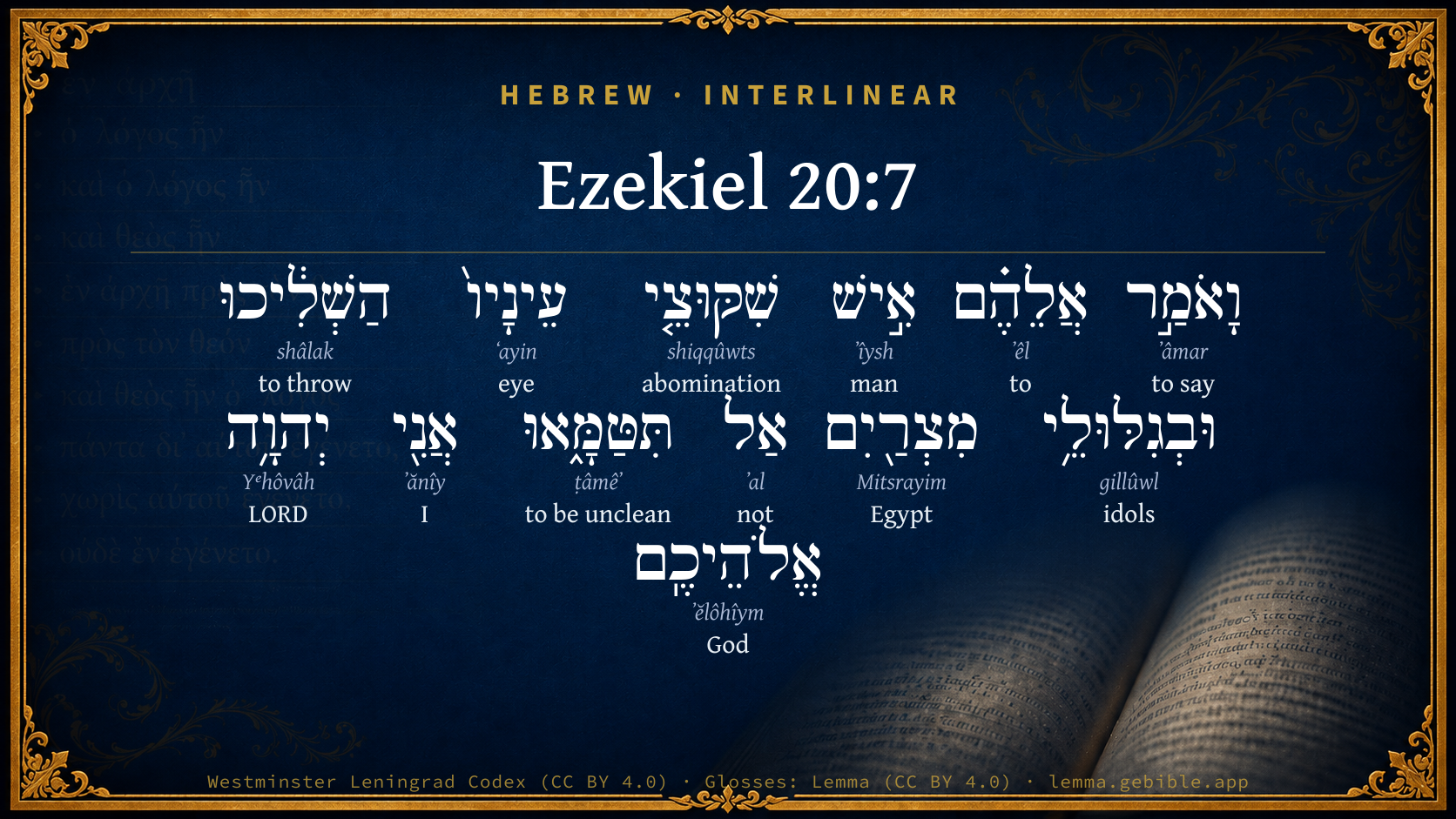
Hebrew (Westminster Leningrad Codex) Ezekiel 20:7 appears in the Hebrew Old Testament. The text above is from the Westminster Leningrad Codex. Each word links to its Strong’s number, a concise gloss, and parsing drawn from the Open Scriptures Hebrew Bible morphology. Click any word for its full Brown-Driver-Briggs (BDB) entry.
Download image
Cite this verse

Ezekiel 20:7 (World English Bible). Public Domain. Lemma interlinear Bible study tool, https://lemma.gebible.app/v/ezekiel/20/7.

Show BibTeX & RIS
BibTeX
RIS
English Translation
I said to them, Cast you away every man the abominations of his eyes, and don't defile yourselves with the idols of Egypt; I am Yahweh your God.
World English Bible · Public Domain
Download a study sheet

One document with this verse’s original text, its word-by-word gloss line, the meaning frame, cross-references with their text, attributed commentary, and full source and license credits — printable, and it pastes into notes with its structure intact.

This verse Autodidact and up

Study sheet (.html) Plain text (.txt)

A passage Seminary Student

Up to 50 verses in one chapter. A passage sheet keeps up to 6 commentary sources and 12 cross-references per verse, in the order this page ranks them, and says so on the sheet whenever that leaves anything out. Ask for a single verse and you get the Autodidact verse sheet above.

Everything on this page stays free to read, with no account — the sheet is a download of what is already on screen, not access to it.

Want to remove ads? Support Godless Engineer
Compare translations 3

The same verse in 3 English versions, stacked beneath the original-language interlinear above. Click any original word for its lexicon entry.

Each is an independent rendering of the whole verse — the interlinear is not word-aligned to these translations.

Highlighted words mark where these versions differ — a whole-verse word diff, not a word-by-word alignment.

  • World English Bible Public Domain
    I said to them, Cast you away every man the abominations of his eyes, and don't defile yourselves with the idols of Egypt; I am Yahweh your God.
  • King James Version Public Domain
    Then said I unto them, Cast ye away every man the abominations of his eyes, and defile not yourselves with the idols of Egypt: I am the LORD your God.
  • unfoldingWord Literal Text CC BY-SA 4.0
    I said to them, “Let each man throw away the detestable things from before his eyes and the idols of Egypt. Do not make yourselves unclean; I am Yahweh your God.”

unfoldingWord Literal Text — © unfoldingWord, licensed CC BY-SA 4.0. Word-aligned USFM3 via Door43 (git.door43.org/unfoldingWord/en_ult).

Versions to compare (up to 4)

3 of 4 selected

Show all 18 translations

Every available English version of this verse, each an independent rendering of the whole verse.

  • World English Bible Public Domain
    I said to them, Cast you away every man the abominations of his eyes, and don't defile yourselves with the idols of Egypt; I am Yahweh your God.
  • Berean Standard Bible Public Domain
    And I said to them: ‘Each of you must throw away the abominations before his eyes, and you must not defile yourselves with the idols of Egypt. I am the LORD your God.’
  • Majority Standard Bible Public Domain
    And I said to them: ‘Each of you must throw away the abominations before his eyes, and you must not defile yourselves with the idols of Egypt. I am the LORD your God.’
  • King James Version Public Domain
    Then said I unto them, Cast ye away every man the abominations of his eyes, and defile not yourselves with the idols of Egypt: I am the LORD your God.
  • American Standard Version (1901) Public Domain
    And I said unto them, Cast ye away every man the abominations of his eyes, and defile not yourselves with the idols of Egypt; I am Jehovah your God.
  • Revised Version (1885) Public Domain
    And I said unto them, Cast ye away every man the abominations of his eyes, and defile not yourselves with the idols of Egypt; I am the LORD your God.
  • Geneva Bible (1599) Public Domain
    Then sayd I vnto them, Let euery man cast away the abominations of his eyes, and defile not your selues with the idols of Egypt: for I am the Lord your God.
  • Douay-Rheims (1899) Public Domain
    And I said to them: Let every man cast away the scandals of his eyes, and defile not yourselves with the idols of Egypt: I am the Lord your God.
  • Young's Literal Translation Public Domain
    And I say unto them, Let each cast away the detestable things of his eyes, And with the idols of Egypt be not defiled, I `am' Jehovah your God.
  • Literal Standard Version CC BY-SA 4.0
    And I say to them, Let each cast away the detestable things of his eyes, || And do not be defiled with the idols of Egypt, || I [am] your God YHWH.
  • Unlocked Literal Bible CC BY-SA 4.0
    I said to them, “Let each man throw away the detestable things from before his eyes and the idols of Egypt. Do not make yourselves unclean; I am Yahweh your God.”
  • unfoldingWord Literal Text CC BY-SA 4.0
    I said to them, “Let each man throw away the detestable things from before his eyes and the idols of Egypt. Do not make yourselves unclean; I am Yahweh your God.”
  • Darby Bible Public Domain
    and I said unto them, Cast ye away every man the abominations of his eyes, and defile not yourselves with the idols of Egypt: I [am] Jehovah your God.
  • World Messianic Bible Public Domain
    I said to them, ‘Each of you throw away the abominations of his eyes. Don’t defile yourselves with the idols of Egypt. I am the LORD your God.’
  • Webster's Bible Public Domain
    Then said I to them, Cast ye away every man the abominations of his eyes, and defile not yourselves with the idols of Egypt: I am the LORD your God.
  • Free Bible Version CC BY-SA 4.0
    I told them: ‘All of you have to get rid of your disgusting pagan images. Don't make yourselves unclean by worshiping the idols of Egypt. I am the Lord your God.’
  • Bible in Basic English Public Domain
    And I said to them, Let every man among you put away the disgusting things to which his eyes are turned, and do not make yourselves unclean with the images of Egypt; I am the Lord your God.
  • JPS Tanakh (1917) Public Domain
    and I said unto them: Cast ye away every man the detestable things of his eyes, and defile not yourselves with the idols of Egypt; I am the LORD your God.

Literal Standard Version (2020), Covenant Press — licensed CC BY-SA 4.0. Text via the HelloAO Bible API (eBible.org). Unlocked Literal Bible (unfoldingWord) — licensed CC BY-SA 4.0. Text via the HelloAO Bible API (eBible.org). unfoldingWord Literal Text — © unfoldingWord, licensed CC BY-SA 4.0. Word-aligned USFM3 via Door43 (git.door43.org/unfoldingWord/en_ult). Free Bible Version, Dr. Jonathan Gallagher — licensed CC BY-SA 4.0. Text via the HelloAO Bible API (eBible.org).

Word by word

More ways to search: Search by grammar → Find every occurrence → Compare this word →

Practice this passage: Drill this verse → Learn its vocabulary →

שִׁקּוּצֵ֤י
shiqqûwts
H8251
“abominations of”
Noun, Common, Masculine, Plural, Construct
Part of Speech
Noun
Type
Common
Gender
Masculine
Number
Plural
State
Construct
Full BDB Definition

Origin: from H8262

TWOT: 2459b

detestable thing or idol, abominable thing, abomination, idol, detested thing
  1. וָאֹמַ֣ר ʼâmar H559 “and · to say” Conjunction + Verb, Qal, Sequential Imperfect, 1st Person, Common, Singular
  2. אֲלֵהֶ֗ם ʼêl H413 “to · them” Preposition + Suffix, Personal, 3rd Person, Masculine, Plural
  3. אִ֣ישׁ ʼîysh H376 “man” Noun, Common, Masculine, Singular, Absolute
  4. עֵינָיו֙ ʻayin H5869 “eyes · his” Noun, Common, Both, Dual, Construct + Suffix, Personal, 3rd Person, Masculine, Singular
  5. הַשְׁלִ֔יכוּ shâlak H7993 “throw” Verb, Hiphil, Imperative, 2nd Person, Masculine, Plural
  6. וּבְגִלּוּלֵ֥י gillûwl H1544 “and · in/at · idols of” Conjunction + Preposition + Noun, Common, Masculine, Plural, Construct
  7. מִצְרַ֖יִם Mitsrayim H4714 “Egypt” Noun, Proper
  8. אַל ʼal H408 “not” Particle, Negative
  9. תִּטַּמָּ֑אוּ ṭâmêʼ H2930 “to be unclean” Verb, Hithpael, Jussive, 2nd Person, Masculine, Plural
  10. אֲנִ֖י ʼănîy H589 “I” Pronoun, Personal, 1st Person, Common, Singular
  11. יְהוָ֥ה Yᵉhôvâh H3068 “LORD” Noun, Proper
  12. אֱלֹהֵיכֶֽם ʼĕlôhîym H430 “God(s) · your” Noun, Common, Masculine, Plural, Construct + Suffix, Personal, 2nd Person, Masculine, Plural

About this verse

These counts appear in no published source. They are computed here, from the morphology-tagged text and Lemma’s own curated glosses. What Lemma adds →

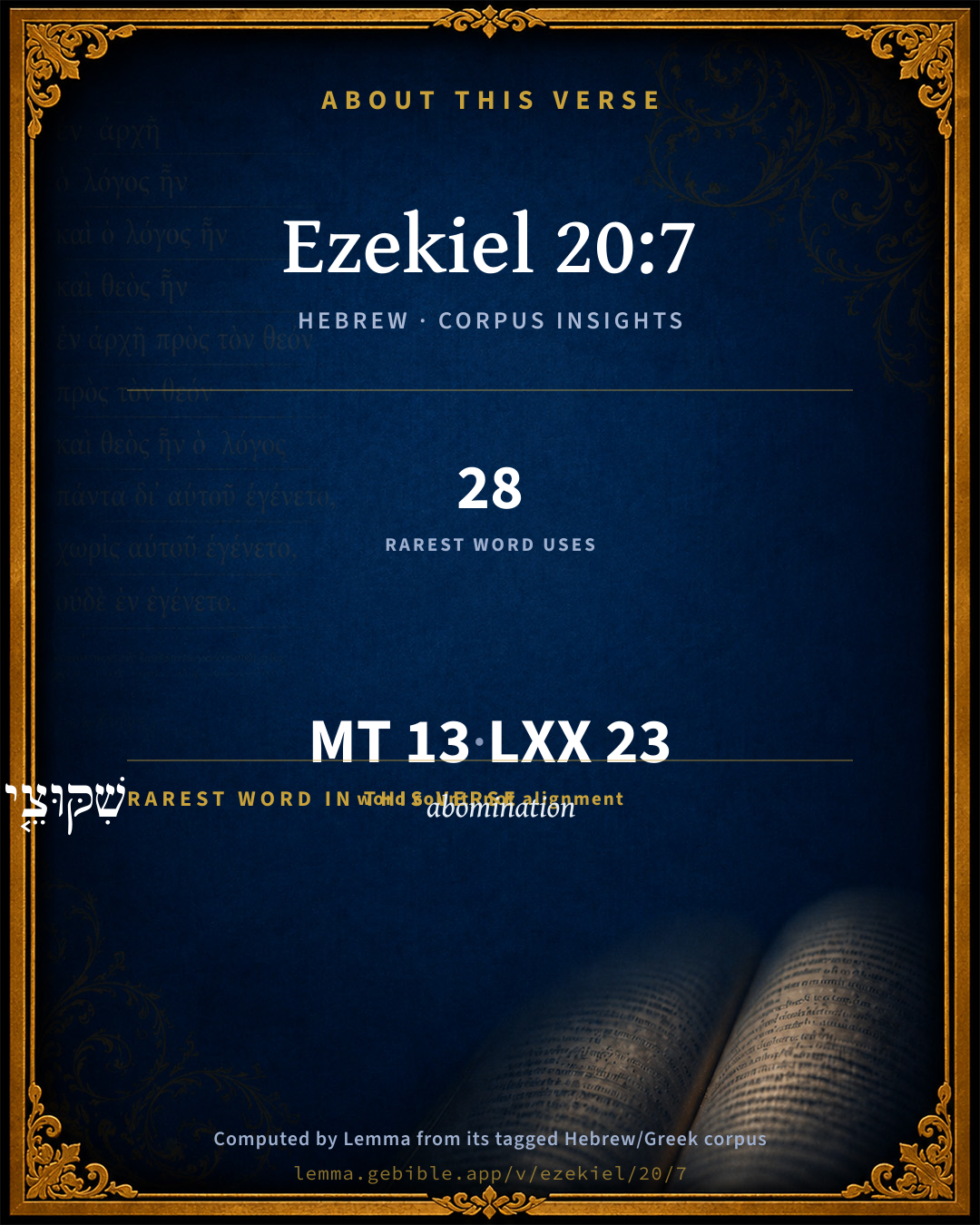
13
words
13
distinct lemmas
Prophets
section

Shared distinctive vocabulary

שִׁקּוּצֵ֤י abomination H8251 occurs in 26 verses of the Hebrew Bible. Also found in:

Grammatical profile

  • 3 verbs
  • 7 nouns
  • 1 pronoun
  • 1 preposition
  • 1 particle

Verb forms

  • וָאֹמַ֣ר Qal · Sequential Imperfect
  • הַשְׁלִ֔יכוּ Hiphil · Imperative
  • תִּטַּמָּ֑אוּ Hithpael · Jussive

Hebrew & Septuagint length

In English translation the verse runs 28 words from the Hebrew and 30 from the Septuagint (LXX English) — closely comparable.

A rough comparison of the two English renderings, which tokenize alike — not a word-level alignment.

Word counts can differ between the Hebrew and the Greek without any difference in meaning — e.g. the Hebrew direct-object marker אֵת has no separate Greek word, and Greek often adds the article ὁ.

In the original languages it is 13 Hebrew tokens and 23 Greek tokens — but the two are counted differently (Hebrew bundles its prefixes and suffixes into one token; the Greek is in lemma form), so that isn’t a like-for-like length.

Cross-references

21

Topical passages linked to Ezekiel 20:7 in the Treasury of Scripture Knowledge — connected by theme and wording, ordered by reader-vote popularity; previews shown in the World English Bible.

  • Leviticus 18:3 You shall not do as they do in the land of Egypt, where you lived: and you shall not do as they do in the land of Canaan, where I am bringing you; neither shall you walk in their statutes.
  • Ezekiel 20:8 But they rebelled against me, and would not listen to me; they did not every man cast away the abominations of their eyes, neither did they forsake the idols of Egypt. Then I said I would pour out my wrath on them, to accomplish my anger against them in the midst of the land of Egypt.
  • Leviticus 11:44 For I am Yahweh your God. Sanctify yourselves therefore, and be holy; for I am holy: neither shall you defile yourselves with any kind of creeping thing that moves on the earth.
  • Deuteronomy 29:16–18 (for you know how we lived in the land of Egypt, and how we came through the midst of the nations through which you passed;
  • Ezekiel 18:31 Cast away from you all your transgressions, in which you have transgressed; and make you a new heart and a new spirit: for why will you die, house of Israel?
  • Exodus 16:12 "I have heard the murmurings of the children of Israel. Speak to them, saying, 'At evening you shall eat meat, and in the morning you shall be filled with bread: and you shall know that I am Yahweh your God.'"
  • Exodus 20:2 "I am Yahweh your God, who brought you out of the land of Egypt, out of the house of bondage.
  • Exodus 20:4 "You shall not make for yourselves an idol, nor any image of anything that is in the heavens above, or that is in the earth beneath, or that is in the water under the earth:
  • Leviticus 17:7 They shall no more sacrifice their sacrifices to the goat idols, after which they play the prostitute. This shall be a statute forever to them throughout their generations.'
  • Joshua 24:14 Now therefore fear Yahweh, and serve him in sincerity and in truth; and put away the gods which your fathers served beyond the River, and in Egypt; and serve you Yahweh.
  • 2 Chronicles 15:8 When Asa heard these words, and the prophecy of Oded the prophet, he took courage, and put away the abominations out of all the land of Judah and Benjamin, and out of the cities which he had taken from the hill-country of Ephraim; and he renewed the altar of Yahweh, that was before the porch of Yahweh.
  • Isaiah 2:20–21 In that day, men shall cast away their idols of silver, And their idols of gold, Which have been made for themselves to worship, To the moles and to the bats;
  • Isaiah 31:7 For in that day they shall cast away every man his idols of silver, and his idols of gold, which your own hands have made to you for a sin.
  • Ezekiel 6:9 Those of you that escape shall remember me among the nations where they shall be carried captive, how that I have been broken with their lewd heart, which has departed from me, and with they eyes, which play the prostitute after their idols: and they shall loathe themselves in their own sight for the evils which they have committed in all their abominations.
  • Ezekiel 14:6 Therefore tell the house of Israel, Thus says the Lord Yahweh: Return you, and turn yourselves from your idols; and turn away your faces from all your abominations.
  • Ezekiel 18:6 and has not eaten on the mountains, neither has lifted up his eyes to the idols of the house of Israel, neither has defiled his neighbor's wife, neither has come near to a woman in her impurity,
  • Ezekiel 18:15 who has not eaten on the mountains, neither has lifted up his eyes to the idols of the house of Israel, has not defiled his neighbor's wife,
  • Ezekiel 20:19 I am Yahweh your God: walk in my statutes, and keep my ordinances, and do them;
  • Ezekiel 23:3 and they played the prostitute in Egypt; they played the prostitute in their youth; there were their breasts pressed, and there was handled the bosom of their virginity.
  • Ezekiel 23:8 Neither has she left her prostitution since [the days of] Egypt; for in her youth they lay with her, and they handled the bosom of her virginity; and they poured out their prostitution on her.
  • Leviticus 20:7 "'Sanctify yourselves therefore, and be holy; for I am Yahweh your God.

Cross-references courtesy of OpenBible.info (CC BY 4.0).

Hebrew and Greek witnesses Masoretic Hebrew ↔ Greek Septuagint

The same verse in the two great witnesses to the Old Testament, shown verse-for-verse.

These are two independent witnesses, not word-aligned to each other, and the Septuagint is shown in lemma (dictionary) form.

Hebrew Ezekiel 20:7 Masoretic · Westminster Leningrad Codex

וָאֹמַ֣ר אֲלֵהֶ֗ם אִ֣ישׁ שִׁקּוּצֵ֤י עֵינָיו֙ הַשְׁלִ֔יכוּ וּבְגִלּוּלֵ֥י מִצְרַ֖יִם אַל תִּטַּמָּ֑אוּ אֲנִ֖י יְהוָ֥ה אֱלֹהֵיכֶֽם

I said to them, Cast you away every man the abominations of his eyes, and don't defile yourselves with the idols of Egypt; I am Yahweh your God.

World English Bible · Public Domain

Greek LXX Ezekiel 20:7 Septuagint · lemma form

καί εἶπον πρός αὐτός ἕκαστος ὁ βδέλυγμα ὁ ὀφθαλμός αὐτός ἀποῥίπτω καί ἐν ὁ ἐπιτήδευμα αἴγυπτος μή μιαίνω ἐγώ κύριος ὁ θεός σύ

And I said to them, Let every one cast away the abominations of his eyes, and defile not yourselves with the devices of Egypt: I am the Lord your God.

LXX2012 (modern English Septuagint) · Public Domain

Hebrew: Westminster Leningrad Codex (CC BY 4.0). Greek: Septuagint (public domain); English from LXX2012 (modern English Septuagint) (Public Domain). How the Septuagint differs from the Hebrew →

Targum (Aramaic paraphrase)

1

The Targum is the ancient Jewish Aramaic paraphrase of the Hebrew Scriptures — an interpretive translation, not the Hebrew text itself. Onkelos (literal) and Pseudo-Jonathan (expansive) render the Torah, and Jonathan the Prophets. Coverage is partial: where no permissively-licensed English translation exists for a verse, only the Aramaic is shown. This is verse-level text, not a word-by-word alignment to the Hebrew.

  1. Targum Jonathan Prophets (Joshua–Malachi)
    וַאֲמָרֵית לְהוֹן גְבַר יַת שִׁקוּצוֹהִי אַרְחִיקוּ מִקֳבֵיל עֵינוֹהִי וּבְפוּלְחַן טַעֲוַת מִצְרָאֵי לָא תִּסְתַּאֲבוּן אֲנָא יְיָ אֱלָהָכוֹן:

    (no public-domain English translation for this verse)

    Targum Jonathan — Aramaic: “Mikraot Gedolot” (public domain). English: “Sefaria Community Translation” (CC0 1.0 (public-domain dedication)); “London "Chaldee Paraphrase," 1871” (public domain). Text via Sefaria.

Commentary

Notes on Ezekiel 20:7 from classic Christian and Jewish commentators (each source and its license shown beneath its notes). The classic Christian expositions comment on the surrounding passage and are grouped to its opening verse, so a note may address several verses; the Jewish commentaries on the Tanakh (Rashi and others) are per-verse, so they appear only where the commentator wrote on this verse.

Lemma curates 59 commentaries, every one of them public domain or Creative Commons licensed, each selected and text-cleaned for this edition rather than reprinted as found. About our sources →

Trapp's Complete Commentary

John Trapp

Eze 20:7 Then said I unto them, Cast ye away every man the abominations of his eyes, and defile not yourselves with the idols of Egypt: I [am] the LORD your God.

Ver. 7. Then said I unto them,] viz., While yet in Egypt. This we find not in Exodus; it is enough that we find it here. See Job 5:9. {See Trapp on "Job 5:9"}

Cast ye away every man the abominations of his eyes.] The idols to which your eyes are lifted up, {Eze 18:6} and which are, or should be, to you, as Alexander called the Persian maids, dolores oculorum, eye griefs.

John Trapp, A Commentary or Exposition upon All the Books of the Old and New Testament (1647–1656) — public domain. Text from a community e-Sword module.

Joseph Benson's Commentary

Eze 20:7-9. Cast ye away every man the abominations of his eyes — The idols to which your eyes are lifted up. One of the chief allurements to the worship of images is, that by way of indulgence to men’s imagination, they exhibit a visible object of adoration. This was what the Israelites were so fond of, when they said to Aaron, Make us gods to go before us, Exo 32:1. And defile not yourselves with the idols of Egypt — It is generally supposed that the Israelites, while they dwelt in Egypt, learned the idolatry of that country: the fact indeed is not recorded in the books of Moses; but it may be collected from their proneness to that sin in the wilderness. But they rebelled against me — The history of the rebellions of the children of Israel begins as early as their beginning. So does the history of man’s apostacy from his Maker. No sooner have we read the story of his creation than we meet with that of his rebellion. So we see here it was with Israel; a people designed to represent the body of mankind, both in their dealings with God, and in God’s dealings with them. Then I said, I threatened, I will pour out my fury upon them — Such a threatening as this is nowhere recorded in the Scriptures no more than that which follows Eze 20:23 of this chapter. Without question God might have justly cut them off in Egypt for their idolatries and other sins which they had committed, and never exerted his power for their deliverance. But I wrought for my name’s sake — For the glory of my mercy and faithfulness. That it should not be polluted before the heathen — Reproached and blasphemed. This is elsewhere assigned as the reason why God did not punish the Israelites according to their deserts, namely, because it would have turned to God’s dishonour in the judgment of the heathen world, as if he had not been able to make good those promises which he had given them. This was a proper consideration to check the vain presumption of the Jews, who imagined that God’s gracious dealings with them were owing to their own merits.

Joseph Benson's Commentary on the Old and New Testaments (1811–1818) — public domain. Text from a community e-Sword module.

Geneva Bible (1599)

Geneva Bible translators

God had forbidden them to make mention of the idols, Exod. 23:13; Ps. 16:4.

Geneva Bible (1599) marginal notes — public domain. Text via Bolls.life.

Jamieson, Fausset & Brown

Robert Jamieson, A. R. Fausset & David Brown

Moses gives no formal statement of idolatries practised by Israel in Egypt. But it is implied in their readiness to worship the golden calf (resembling the Egyptian ox, Apis) (Exo 32:4), which makes it likely they had worshipped such idols in Egypt. Also, in Lev 17:7, "They shall no more offer their sacrifices unto devils (literally, seirim, 'he-goats,' the symbol of the false god, Pan), after whom they have gone awhoring." The call of God by Moses was as much to them to separate from idols and follow Jehovah, as it was to Pharaoh to let them go forth. Exo 6:6-7 and Jos 24:14, expressly mention their idolatry "in Egypt." Hence the need of their being removed out of the contagion of Egyptian idolatries by the exodus.

every man--so universal was the evil.

of his eyes--It was not fear of their Egyptian masters, but their own lust of the eye that drew them to idols (Eze 6:9; Eze 18:6).

Jamieson, Fausset & Brown — Commentary Critical and Explanatory on the Whole Bible (1871) — public domain (CC PDM 1.0). Text via the HelloAO Bible API.

Adam Clarke's Commentary

Verse 7. Cast ye away - the abominations] Put away all your idols; those incentives to idolatry that ye have looked on with delight.

Adam Clarke's Commentary on the Bible (1810–1826) — public domain. Text from a community e-Sword/MySword module.

The Cambridge Bible for Schools and Colleges

gen. ed. J. J. S. Perowne

7. abominations of his eyes] Those to which his eyes and desires were directed, the idols, cf. Eze_18:6; Num_15:39. The prophet charges Israel with idolatry in Egypt (ch. Eze_23:3). Though history as we have it says little of such a thing, it may be assumed as certain, considering the people’s receptivity to the worship of their neighbours throughout their history. The same view, Jos_24:14; cf. Lev_18:3.

The question how far Jehovah was known and worshipped in Egypt is an obscure one. The name could not have been altogether unknown or the people could not have been rallied by Moses to his service nor induced to put themselves under his protection. That his worship, however, was mixed with impurities may be assumed. How far the people partook in the worship of Egyptian deities cannot be ascertained.

The Cambridge Bible for Schools and Colleges (gen. ed. J. J. S. Perowne; Cambridge University Press, 1878–1918) — public domain. Text from a community e-Sword module.

John Gill's Exposition

Then I said unto them,.... Having promised and swore to do such great and good things for them; which must lay them under an obligation to regard what he should command them: promises and blessings of goodness are great incentives to duty, and lay under great obligation to it:

cast ye away every man the abominations of his eyes; which should be so, meaning idols; but which his eyes were taken with, and were lifted up unto, as his gods; though they ought to have been rejected with the utmost abhorrence, as abominable:

and defile not yourselves with the idols of Egypt; their "dunghill gods", as the word (f) signifies; which to worship, as it was an abomination to God, was defiling to themselves; yet these they were fond of, and prone to worship them; their eyes and their hearts were after them; and they needed such cautions and instructions as these, backed with the following strong reason against such idolatry:

I am the Lord your God; their Creator and Benefactor, their covenant God; the only Lord God, and whom only they ought to serve and worship; to whom they were under ten thousand obligations; and who was infinitely above all the idols of Egypt.

(f) "stercoreis diis", Junius & Tremellius, Polanus; "stercoribus", Piscator, Cocceius.

John Gill's Exposition of the Whole Bible (1746–1763) — public domain (CC PDM 1.0). Text via the HelloAO Bible API.

Haydock's Catholic Bible Commentary

Scandals, &c., (offensiones) that is, the abominations or idols, to the worship of which they were allured by their eyes. (Challoner) --- Moses found them in this condition in Egypt, and he could not entirely reclaim them. (Calmet) --- Many still secreted their idols, chap. xxiii. 1., and Acts vii. 42. (Haydock)

George Leo Haydock (1774–1849), Haydock's Catholic Family Bible and Commentary, 1859 edition — public domain. Excludes Psalms (Douay-Rheims chapter numbering differs from Protestant) and Deuterocanonical books (Catholic canon only).

Matthew Poole's English Annotations

Then, Heb. And, which connects the words; and though we read it then, this doth not point out the time when God spake this, though it is certain, when he had brought them out of Egypt he gave them his ordinances and laws of worship; nay, it is sufficiently included, in that they were to go out that they might serve the Lord.

Cast ye away every man; let every one of you, man by man, and family by family, cast away with abhorrence and indignation; the word is used Eze 18:31.

The abominations of his eyes; which your eyes should have abhorred, but you rather lifted up your eyes to them, and looked for help from them; and it includes their own voluntary act in this idolatry.

Defile not yourselves with the idols: this explains the former passage.

Of Egypt; which were in veneration among the Egyptians, and with whose worship too many of them had been insnared and polluted while they were in Egypt.

I am the Lord your God; the only true God, and therefore you should worship none other. See Eze 20:6. You are my covenant people, and therefore ought to have no other God as Exo 20:3. Thus God prepared them, by his mercies and by his law, for himself.

Matthew Poole's English Annotations on the Holy Bible (1683–1685) — public domain. Text from a community e-Sword/MySword module.

Whedon's Commentary on the Bible

Daniel D. Whedon

7. Defile not yourselves with the idols of Egypt — The animal worship of Egypt, with its unexampled multitude of “graven images,” ought to have been a most offensive abomination to the eyes of the Hebrews, but, instead of this, the people who had been especially chosen by Jehovah to champion the cause of monotheism on the earth fell headlong into Egyptian idolatry (Eze_23:3; Lev_18:3; Jos_24:14). It is a significant fact, illustrating the meaning of the “golden calf” in the wilderness (Exodus 32) that there has recently been discovered a hieroglyphic inscription stating that at Pithom (the frontier city built by the Israelites, Exo_1:11, and probably the last city to be seen by them as they fled from Egypt) it was the custom to dedicate annually to the god of the city a silver statue of six hundred pounds’ weight (Brugsch, Steininschrift und Bibelwort).

Daniel D. Whedon (gen. ed.), Commentary on the Old and New Testaments (1874–1909) — public domain. Text from a community e-Sword module.

The Pulpit Commentary

Vers. 7-10. No special mention of the idols of Egypt occurs in the Pentateuch, but it lies, in the nature of the case, that this was the form of idolatry implied in the second commandment, and the history of the "golden calf" (Exo_32:4) shows that they had caught the infection of the Mnevis or Apis worship while they sojourned in Egypt. Here apparently the prophet speaks of that sojourn prior to the mission of Moses. In bold anthropomorphic speech he represents Jehovah as half purposing to make an end of the people there and then, and afterwards repenting. He wrought for his Name"s sake, that the deliverance of the Exodus might manifest his righteousness and might, the attributes specially implied in that Name, to Egypt and the surrounding nations. They should not have it in their power to say that he had abandoned the people whom he had chosen.

The Pulpit Commentary (1880–1919), ed. H.D.M. Spence-Jones & Joseph S. Exell — public domain. Text from a community e-Sword module.

John Wesley's Explanatory Notes

Of his eyes - To which you have looked for help.

John Wesley, Explanatory Notes Upon the Whole Bible (1754–1765) — public domain. Text via the GEBible commentary corpus.

unfoldingWord translationNotes

Door43 World Missions Community

General Information:

Yahweh continues giving Ezekiel his message to the elders of Israel.

to them

"to the descendants of the house of Jacob"

the detestable things from before his eyes

Yahweh speaks of the people worshiping the detestable things as if they had placed those idols in front of their eyes. AT: "the detestable things that he worships" (See: Metaphor)

the idols of Egypt

"throw away the idols of Egypt"

Do not make yourselves unclean

A person who is not acceptable for God's purposes is spoken of as if the person were physically unclean. (See: Metaphor)

translationWords

false god

Egypt

clean

God

unfoldingWord translationNotes — © Distant Shores Media and the Door43 World Missions Community, licensed CC BY-SA 4.0. Source: git.door43.org/Door43/en_tn.

Rashi

Rabbi Shlomo Yitzchaki (Rashi)

And I said to them Aaron proclaimed this prophecy to them before the Holy One, blessed be He, revealed Himself to Moses in the thorn bush. This is what was said to Eli (I Sam. 2:27): “Did I appear to the house of your father when they were in Egypt, etc.?”

Rashi on the Tanakh — English translations: “The Judaica Press complete Tanach with Rashi, translated by A. J. Rosenberg” (CC BY 4.0); “Pentateuch with Rashi's commentary by M. Rosenbaum and A.M. Silbermann, 1929-1934” (public domain); “The Metsudah Tanach series, Lakewood, N.J” (CC BY 4.0); and “The Book of Joshua, Metsudah Publications, 1997” (CC BY 4.0). Text via Sefaria.

Lesson kit

Teaching starters — assembled from the data on this page, not authored interpretation. Every prompt links to the verse data it draws on. Edit before teaching.

Ezekiel, in the Prophets, opens this verse with 13 words (13 distinct Hebrew lemmas). Its most distinctive word is shiqqûwts (“abomination”). A historical commentator’s framing appears above. Read the whole chapter for the surrounding context.

Discussion questions

  1. What does “abomination” (shiqqûwts) contribute to the verse as a whole?
  2. Deuteronomy 29:17 shares the word «abomination» with this verse. How do the two illuminate each other?
  3. These translations render this verse differently; the difference is in the English rendering, not the original. What questions does that raise?
  4. The verb «וָאֹמַ֣ר» is Qal Sequential Imperfect. How does its form color the action?
  5. Reading how Trapp's Complete Commentary and Joseph Benson's Commentary read this verse, where do the two commentators agree and where do they part?

Things to notice

Reading settings

Reading text

Shown beneath each verse's original-language words.

Old Testament
Old Testament edition

Read the OT as the Masoretic Hebrew (MT) or the Greek Septuagint (LXX).

English shown for the Greek Septuagint (in the Hebrew ↔ Greek comparison).

Comparing translations? Open the Compare panel on any verse page to stack up to four side by side.