
Ezekiel 23:27

Hebrew (Westminster Leningrad Codex) Ezekiel 23:27 appears in the Hebrew Old Testament. The text above is from the Westminster Leningrad Codex. Each word links to its Strong’s number, a concise gloss, and parsing drawn from the Open Scriptures Hebrew Bible morphology. Click any word for its full Brown-Driver-Briggs (BDB) entry.
Download image
Cite this verse

Ezekiel 23:27 (World English Bible). Public Domain. Lemma interlinear Bible study tool, https://lemma.gebible.app/v/ezekiel/23/27.

Show BibTeX & RIS
BibTeX
RIS
English Translation
Thus will I make your lewdness to cease from you, and your prostitution [brought] from the land of Egypt; so that you shall not lift up your eyes to them, nor remember Egypt any more.
World English Bible · Public Domain
Download a study sheet

One document with this verse’s original text, its word-by-word gloss line, the meaning frame, cross-references with their text, attributed commentary, and full source and license credits — printable, and it pastes into notes with its structure intact.

This verse Autodidact and up

Study sheet (.html) Plain text (.txt)

A passage Seminary Student

Up to 50 verses in one chapter. A passage sheet keeps up to 6 commentary sources and 12 cross-references per verse, in the order this page ranks them, and says so on the sheet whenever that leaves anything out. Ask for a single verse and you get the Autodidact verse sheet above.

Everything on this page stays free to read, with no account — the sheet is a download of what is already on screen, not access to it.

Want to remove ads? Support Godless Engineer
Compare translations 3

The same verse in 3 English versions, stacked beneath the original-language interlinear above. Click any original word for its lexicon entry.

Each is an independent rendering of the whole verse — the interlinear is not word-aligned to these translations.

Highlighted words mark where these versions differ — a whole-verse word diff, not a word-by-word alignment.

  • World English Bible Public Domain
    Thus will I make your lewdness to cease from you, and your prostitution [brought] from the land of Egypt; so that you shall not lift up your eyes to them, nor remember Egypt any more.
  • King James Version Public Domain
    Thus will I make thy lewdness to cease from thee, and thy whoredom brought from the land of Egypt: so that thou shalt not lift up thine eyes unto them, nor remember Egypt any more.
  • unfoldingWord Literal Text CC BY-SA 4.0
    So I will remove your shameful behavior from you and your acts of prostitution from the land of Egypt. You will not lift up your eyes toward them with longing, and you will think of Egypt no longer.’

unfoldingWord Literal Text — © unfoldingWord, licensed CC BY-SA 4.0. Word-aligned USFM3 via Door43 (git.door43.org/unfoldingWord/en_ult).

Versions to compare (up to 4)

3 of 4 selected

Show all 18 translations

Every available English version of this verse, each an independent rendering of the whole verse.

  • World English Bible Public Domain
    Thus will I make your lewdness to cease from you, and your prostitution [brought] from the land of Egypt; so that you shall not lift up your eyes to them, nor remember Egypt any more.
  • Berean Standard Bible Public Domain
    So I will put an end to your indecency and prostitution, which began in the land of Egypt, and you will not lift your eyes to them or remember Egypt anymore.’
  • Majority Standard Bible Public Domain
    So I will put an end to your indecency and prostitution, which began in the land of Egypt, and you will not lift your eyes to them or remember Egypt anymore.’
  • King James Version Public Domain
    Thus will I make thy lewdness to cease from thee, and thy whoredom brought from the land of Egypt: so that thou shalt not lift up thine eyes unto them, nor remember Egypt any more.
  • American Standard Version (1901) Public Domain
    Thus will I make thy lewdness to cease from thee, and thy whoredom `brought' from the land of Egypt; so that thou shalt not lift up thine eyes unto them, nor remember Egypt any more.
  • Revised Version (1885) Public Domain
    Thus will I make thy lewdness to cease from thee, and thy whoredom brought from the land of Egypt: so that thou shalt not lift up thine eyes unto them, nor remember Egypt any more.
  • Geneva Bible (1599) Public Domain
    Thus wil I make thy wickednes to cease from thee and thy fornication out of the land of Egypt: so that thou shalt not lift vp thine eyes vnto them, nor remember Egypt any more.
  • Douay-Rheims (1899) Public Domain
    And I will put an end to thy wickedness in thee, and thy fornication brought out of the land of Egypt: neither shalt thou lift up thy eyes to them, nor remember Egypt any more.
  • Young's Literal Translation Public Domain
    And I have caused thy wickedness to cease from thee, And thy whoredoms out of the land of Egypt, And thou liftest not up thine eyes unto them, And Egypt thou dost not remember again.
  • Literal Standard Version CC BY-SA 4.0
    And I have caused your wickedness to cease from you, || And your whoredoms out of the land of Egypt, || And you do not lift up your eyes to them, || And you do not remember Egypt again.
  • Unlocked Literal Bible CC BY-SA 4.0
    So I will remove your shameful behavior from you and your acts of prostitution from the land of Egypt. You will not lift up your eyes toward them with longing, and you will think of Egypt no longer.'
  • unfoldingWord Literal Text CC BY-SA 4.0
    So I will remove your shameful behavior from you and your acts of prostitution from the land of Egypt. You will not lift up your eyes toward them with longing, and you will think of Egypt no longer.’
  • Darby Bible Public Domain
    And I will make thy lewdness to cease from thee, and thy whoredom [brought] from the land of Egypt; and thou shalt not lift up thine eyes unto them, nor remember Egypt any more.
  • World Messianic Bible Public Domain
    Thus I will make your lewdness to cease from you, and remove your prostitution from the land of Egypt, so that you will not lift up your eyes to them, nor remember Egypt any more.’
  • Webster's Bible Public Domain
    Thus will I make thy lewdness to cease from thee, and thy adultery brought from the land of Egypt: so that thou shalt not lift up thy eyes to them, nor remember Egypt any more.
  • Free Bible Version CC BY-SA 4.0
    I'm going to put a stop to your immorality and prostitution, which started in Egypt. You won't think longingly about those times, and you'll forget all about Egypt.
  • Bible in Basic English Public Domain
    So I will put an end to your evil ways and your loose behaviour which came from the land of Egypt: and your eyes will never be lifted up to them again, and you will have no more memory of Egypt.
  • JPS Tanakh (1917) Public Domain
    Thus will I make thy lewdness to cease from thee, and thy harlotry brought from the land of Egypt, so that thou shalt not lift up thine eyes unto them, nor remember Egypt any more.

Literal Standard Version (2020), Covenant Press — licensed CC BY-SA 4.0. Text via the HelloAO Bible API (eBible.org). Unlocked Literal Bible (unfoldingWord) — licensed CC BY-SA 4.0. Text via the HelloAO Bible API (eBible.org). unfoldingWord Literal Text — © unfoldingWord, licensed CC BY-SA 4.0. Word-aligned USFM3 via Door43 (git.door43.org/unfoldingWord/en_ult). Free Bible Version, Dr. Jonathan Gallagher — licensed CC BY-SA 4.0. Text via the HelloAO Bible API (eBible.org).

Word by word

More ways to search: Search by grammar → Find every occurrence → Compare this word →

Practice this passage: Drill this verse → Learn its vocabulary →

זְנוּתֵ֖ךְ
zᵉnûwth
H2184
“harlotry · your”
Noun, Common, Feminine, Singular, Construct + Suffix, Personal, 2nd Person, Feminine, Singular
Part of Speech
Noun
Type
Common
Gender
Feminine
Number
Singular
State
Construct
Full BDB Definition

Origin: from H2181

TWOT: 563b

fornication, harlotry
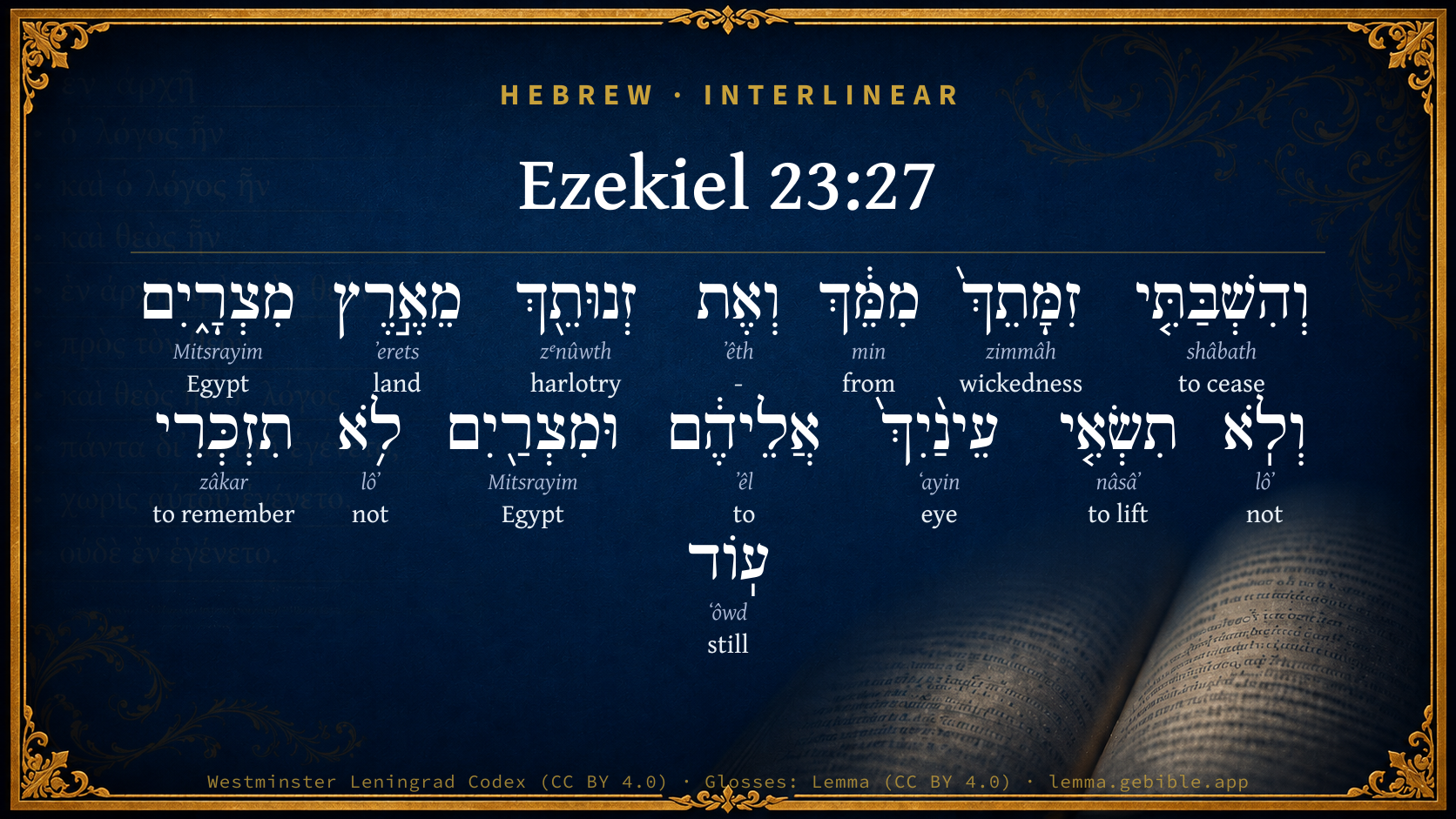
  1. וְהִשְׁבַּתִּ֤י shâbath H7673 “and · to cease” Conjunction + Verb, Hiphil, Sequential Perfect, 1st Person, Common, Singular
  2. זִמָּתֵךְ֙ zimmâh H2154 “wickedness · your” Noun, Common, Feminine, Singular, Construct + Suffix, Personal, 2nd Person, Feminine, Singular
  3. מִמֵּ֔ךְ min H4480 “from · you” Preposition + Suffix, Personal, 2nd Person, Feminine, Singular
  4. וְאֶת ʼêth H853 “and · -” Conjunction + Particle, Direct Object
  5. מֵאֶ֣רֶץ ʼerets H776 “from · land of” Preposition + Noun, Common, Both, Singular, Construct
  6. מִצְרָ֑יִם Mitsrayim H4714 “Egypt” Noun, Proper
  7. וְלֹֽא lôʼ H3808 “and · not” Conjunction + Particle, Negative
  8. תִשְׂאִ֤י nâsâʼ H5375 “to lift” Verb, Qal, Imperfect, 2nd Person, Feminine, Singular
  9. עֵינַ֨יִךְ֙ ʻayin H5869 “eyes · your” Noun, Common, Both, Dual, Construct + Suffix, Personal, 2nd Person, Feminine, Singular
  10. אֲלֵיהֶ֔ם ʼêl H413 “to · them” Preposition + Suffix, Personal, 3rd Person, Masculine, Plural
  11. וּמִצְרַ֖יִם Mitsrayim H4714 “and · Egypt” Conjunction + Noun, Proper
  12. לֹ֥א lôʼ H3808 “not” Particle, Negative
  13. תִזְכְּרִי zâkar H2142 “to remember” Verb, Qal, Imperfect, 2nd Person, Feminine, Singular
  14. עֽוֹד ʻôwd H5750 “still” Adverb

About this verse

These counts appear in no published source. They are computed here, from the morphology-tagged text and Lemma’s own curated glosses. What Lemma adds →

15
words
13
distinct lemmas
Prophets
section

Notable vocabulary

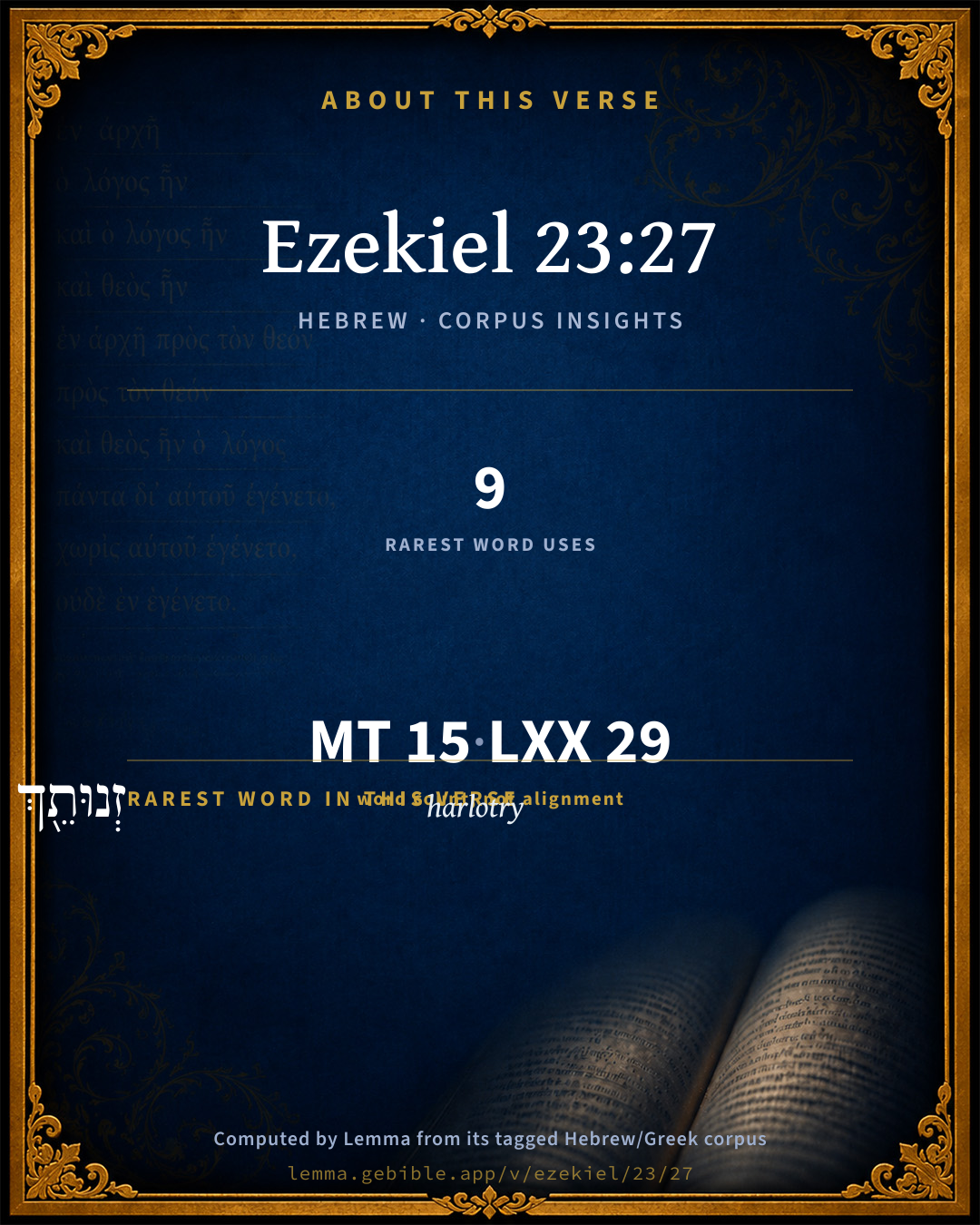
The rarest word here is זְנוּתֵ֖ךְ harlotry H2184 — appearing just 9 times in the whole Hebrew Bible.

Shared distinctive vocabulary

זְנוּתֵ֖ךְ harlotry H2184 occurs in 9 verses of the Hebrew Bible. Also found in:

Grammatical profile

  • 3 verbs
  • 6 nouns
  • 2 prepositions
  • 1 adverb
  • 3 particles

Verb forms

  • וְהִשְׁבַּתִּ֤י Hiphil · Sequential Perfect
  • תִשְׂאִ֤י Qal · Imperfect
  • תִזְכְּרִי Qal · Imperfect

Repetition

Words recur within this verse — often emphatic in Hebrew:

  • מִצְרָ֑יִם Egypt H4714 ×2
  • וְלֹֽא not H3808 ×2

Hebrew & Septuagint length

In English translation the verse runs 35 words from the Hebrew and 33 from the Septuagint (LXX English) — closely comparable.

A rough comparison of the two English renderings, which tokenize alike — not a word-level alignment.

Word counts can differ between the Hebrew and the Greek without any difference in meaning — e.g. the Hebrew direct-object marker אֵת has no separate Greek word, and Greek often adds the article ὁ.

In the original languages it is 15 Hebrew tokens and 29 Greek tokens — but the two are counted differently (Hebrew bundles its prefixes and suffixes into one token; the Greek is in lemma form), so that isn’t a like-for-like length.

Cross-references

7

Topical passages linked to Ezekiel 23:27 in the Treasury of Scripture Knowledge — connected by theme and wording, ordered by reader-vote popularity; previews shown in the World English Bible.

  • Ezekiel 16:41 They shall burn your houses with fire, and execute judgments on you in the sight of many women; and I will cause you to cease from playing the prostitute, and you shall also give no hire any more.
  • Ezekiel 23:3 and they played the prostitute in Egypt; they played the prostitute in their youth; there were their breasts pressed, and there was handled the bosom of their virginity.
  • Ezekiel 23:19 Yet she multiplied her prostitution, remembering the days of her youth, in which she had played the prostitute in the land of Egypt.
  • Isaiah 27:9 Therefore by this shall the iniquity of Jacob be forgiven, and this is all the fruit of taking away his sin: that he makes all the stones of the altar as chalk stones that are beaten in sunder, [so that] the Asherim and the sun-images shall rise no more.
  • Ezekiel 22:15 I will scatter you among the nations, and disperse you through the countries; and I will consume your filthiness out of you.
  • Micah 5:10–14 "It will happen in that day," says Yahweh, "That I will cut off your horses out of the midst of you, And will destroy your chariots.
  • Zechariah 13:2 It will come to pass in that day, says Yahweh of Hosts, that I will cut off the names of the idols out of the land, and they will no more be remembered; and also I will cause the prophets and the spirit of impurity to pass out of the land.

Cross-references courtesy of OpenBible.info (CC BY 4.0).

Hebrew and Greek witnesses Masoretic Hebrew ↔ Greek Septuagint

The same verse in the two great witnesses to the Old Testament, shown verse-for-verse.

These are two independent witnesses, not word-aligned to each other, and the Septuagint is shown in lemma (dictionary) form.

Hebrew Ezekiel 23:27 Masoretic · Westminster Leningrad Codex

וְהִשְׁבַּתִּ֤י זִמָּתֵךְ֙ מִמֵּ֔ךְ וְאֶת זְנוּתֵ֖ךְ מֵאֶ֣רֶץ מִצְרָ֑יִם וְלֹֽא תִשְׂאִ֤י עֵינַ֨יִךְ֙ אֲלֵיהֶ֔ם וּמִצְרַ֖יִם לֹ֥א תִזְכְּרִי עֽוֹד

Thus will I make your lewdness to cease from you, and your prostitution [brought] from the land of Egypt; so that you shall not lift up your eyes to them, nor remember Egypt any more.

World English Bible · Public Domain

Greek LXX Ezekiel 23:27 Septuagint · lemma form

καί ἀποστρέφω ὁ ἀσέβεια σύ ἐκ σύ καί ὁ πορνεία σύ ἐκ γῆ αἴγυπτος καί οὐ μή αἴρω ὁ ὀφθαλμός σύ ἐπί αὐτός καί αἴγυπτος οὐ μή μιμνήσκω οὐκέτι

So I will turn back your ungodliness from you, and your fornication from the land of Egypt: and you shall not lift up your eyes upon them, and shall no more remember Egypt.

LXX2012 (modern English Septuagint) · Public Domain

Hebrew: Westminster Leningrad Codex (CC BY 4.0). Greek: Septuagint (public domain); English from LXX2012 (modern English Septuagint) (Public Domain). How the Septuagint differs from the Hebrew →

Targum (Aramaic paraphrase)

1

The Targum is the ancient Jewish Aramaic paraphrase of the Hebrew Scriptures — an interpretive translation, not the Hebrew text itself. Onkelos (literal) and Pseudo-Jonathan (expansive) render the Torah, and Jonathan the Prophets. Coverage is partial: where no permissively-licensed English translation exists for a verse, only the Aramaic is shown. This is verse-level text, not a word-by-word alignment to the Hebrew.

  1. Targum Jonathan Prophets (Joshua–Malachi)
    וַאֲבַטֵל חוֹבֵי עֲצַת חֶטְאָךְ מִנִיךְ וְיַת פּוּלְחַן טַעֲוָתִיךְ דַהֲוַת עִמִיךְ כַּד הֲוֵית בְּאַרְעָא דְמִצְרַיִם וְלָא תִזְקְפִין עַיְנָךְ לְהוֹן וְטַעֲוַת מִצְרָאֵי לָא תִדְכְּרִין עוֹד:

    (no public-domain English translation for this verse)

    Targum Jonathan — Aramaic: “Mikraot Gedolot” (public domain). English: “Sefaria Community Translation” (CC0 1.0 (public-domain dedication)); “London "Chaldee Paraphrase," 1871” (public domain). Text via Sefaria.

Commentary

Notes on Ezekiel 23:27 from classic Christian and Jewish commentators (each source and its license shown beneath its notes). The classic Christian expositions comment on the surrounding passage and are grouped to its opening verse, so a note may address several verses; the Jewish commentaries on the Tanakh (Rashi and others) are per-verse, so they appear only where the commentator wrote on this verse.

Lemma curates 59 commentaries, every one of them public domain or Creative Commons licensed, each selected and text-cleaned for this edition rather than reprinted as found. About our sources →

Trapp's Complete Commentary

John Trapp

Eze 23:27 Thus will I make thy lewdness to cease from thee, and thy whoredom [brought] from the land of Egypt: so that thou shalt not lift up thine eyes unto them, nor remember Egypt any more.

Ver. 27. Then will I make thy lewdness to cease from thee.] Thy prepensed wickedness. This benefit thou shalt reap and receive of thine enemies’ cruelty.

Nor remember Egypt.] Without regret.

John Trapp, A Commentary or Exposition upon All the Books of the Old and New Testament (1647–1656) — public domain. Text from a community e-Sword module.

Jamieson, Fausset & Brown

Robert Jamieson, A. R. Fausset & David Brown

Thus . . . make . . . lewdness to cease--The captivity has made the Jews ever since abhor idolatry, not only on their return from Babylon, but for the last nineteen centuries of their dispersion, as foretold (Hos 3:4).

Jamieson, Fausset & Brown — Commentary Critical and Explanatory on the Whole Bible (1871) — public domain (CC PDM 1.0). Text via the HelloAO Bible API.

The Cambridge Bible for Schools and Colleges

gen. ed. J. J. S. Perowne

27. brought from … Egypt] i.e. continued since the time they were in the land of Egypt, cf. Eze_16:41; Eze_22:15.

The Cambridge Bible for Schools and Colleges (gen. ed. J. J. S. Perowne; Cambridge University Press, 1878–1918) — public domain. Text from a community e-Sword module.

John Gill's Exposition

Thus will I make thy lewdness to cease from thee,.... That is, their idolatry; for, after this captivity, the Jews never were guilty of idolatry any more:

and thy whoredom brought from the land of Egypt; the idolatry which they learned there, and brought from thence; so the Targum,

"the worship of thine idols, which was with thee when thou wast in the land of Egypt:''

so that thou shall not lift up thine eyes unto them; to the idols of Egypt, to pray unto them, and worship them:

nor remember Egypt any more; with any delight and pleasure, and so as to desire an alliance with them, and help from them, or to join with them in their idolatries: so the Targum,

"and the idols of the Egyptians thou shalt remember no more.''

John Gill's Exposition of the Whole Bible (1746–1763) — public domain (CC PDM 1.0). Text via the HelloAO Bible API.

Matthew Poole's English Annotations

By these destroying judgments, which shall make thee cease to be a people, I will put an end to the lewdness thou wouldst never have put end to, thou shalt never have opportunity, if thou hadst heart, to do the like.

Thy whoredom, idolatries,

brought from the land of Egypt, when thou camest out under my hand.

Thou shalt not lift up thine eyes with desire and affection toward them, as once, when thou dotedst on them;

nor remember Egypt any more, with love, trust, imitation, and desire of commerce with her, but all thy remembrance of Egypt shall be with deep shame and loathing.

Matthew Poole's English Annotations on the Holy Bible (1683–1685) — public domain. Text from a community e-Sword/MySword module.

Whedon's Commentary on the Bible

Daniel D. Whedon

27-29. This unfaithfulness, begun in Egypt and continued ever since, shall finally cease (note Eze_22:15), but not until her old lovers “in hatred” shall take away all her wealth (labor) and leave her destitute, her nakedness publicly revealed (discovered).

Daniel D. Whedon (gen. ed.), Commentary on the Old and New Testaments (1874–1909) — public domain. Text from a community e-Sword module.

The Pulpit Commentary

Thy whoredom brought from the land of Egypt; i.e. the last political alliance between Judah and Egypt. This, together with the Egyptian cultus that accompanied it, should be made to cease. That would no longer be in the thoughts of the exiles; their hopes from that quarter were extinguished forever.

A severe judgment and its satisfactory consequences.

will! make thy lewdness to cease from thee, and thy whoredom brought from the land of Egypt," etc. The sin referred to in this verse is the idolatry of the people. Two of its clauses make this quite clear. "Thy whoredom brought from the land of Egypt; thou shalt not lift up thine eyes unto them." The form of the idols which Jeroboam set up he derived from Egypt, where he had resided for some time. In setting up the golden calves at Bethel and Dan he "translated to Israelitish soil the worship which he had seen at Memphis and Heliopolis". (1Ki 12:26-36) And, what is more important for the elucidation of our text, which is addressed to the people of Judah, the whole Israelitish people brought with them their deep-rooted tendency to idolatry when they came out of Egypt. Two chief points are presented to our notice.

I A JUDGMENT OF GREAT SEVERITY FOLLOWED BY SATISFACTORY CONSEQUENCES. God had already visited the kingdom of Israel with his judgments because of their idolatries. He had sent famine upon them; (1Ki_17:1 1Ki_18:1, 1Ki_18:2) he had allowed them to suffer by the invasions of their enemies. (2Ki_6:24-29 2Ki_10:32, 33 13:3, 4, 7) Amos the prophet forcibly sets forth these visitations of Israel by reason of their sins. (Amo_4:6-11) And as all these judgments failed to turn them from idolatry, the Lord suffered them to be carried captive into Assyria. (2Ki_17:3-6) These things should have been a warning to the people of Judah to keep clear of idolatry; yet they frequently lapsed into it. God had caused them also to suffer by reason of it. (2Ki_18:13-16 2Ki_21:1-15 2Ki_23:31-35 2Ki_24:1-4, 2Ki_24:10-16) But these judgments did not cleanse the kingdom of Judah of idolatry. Checked for a time, the- sinful practice broke out vigorously again. And in consequence, the complete destruction of Jerusalem, the utter overthrow of the kingdom, and the captivity of the people, are declared to be at hand. And the text asserts that, by means of this severe judgment, the people would be finally and forever freed from idolatry. And the result has proved the prophetic assertion true. One effect of the Captivity was the complete eradication of the tendency of the Jews to idolatry; "so that whereas, before the Captivity, no nation (all things considered) was more impetuously bent upon idols and idolatry than they were, after that Captivity no nation was more vehemently set against idols and idolatry than they were." The sin of idolatry is not limited to those who are called heathen. Dr. Thomas Guthrie says truly, "In a sense all men are idolaters. In the days of old, it is said that Egypt had more gods than men. Elsewhere than in Egypt, everywhere, as the Bible says, "there be lords many and gods many." The Hindu reckons his divinities by thousands and tens of thousands; yet the world has a larger pantheon as many gods as it has objects, be they innocent or guilty, which usurp the place of Jehovah, and dethrone him in the creature"s heart. Nor are men less idolaters if drunkards, though they pour out no libation to Bacchus, the god of wine; nor less idolaters, if impure, that they burn no incense at the shrine of Venus; nor less idolaters, if lovers of wealth, that they do not mould their god into an image of Plutus, and, giving a shrine to what lies hoarded in their coffers, offer it their morning and evening prayers. He has been an idolater, who, rebelling against Providence, follows the hearse of a coffined god; he made an idol of wife or child; and now, when the robber of all our homes has stolen these his gods away, and bears off his plunder to the grave, the feelings of that man"s heart may be expressed in Micah"s complaint to the Danite robbers, "Ye have taken away my gods which I made, and what have I more? and what is this that ye say unto me, What aileth thee?" "Let no one deem it strange if God should visit him for his idolatries. He may do so by forcibly removing the idol, by depriving the idolater of the riches which he has worshipped, or by taking to himself the child or other relative which has been made an idol. Or he may visit those who sin thus by making the idol the occasion of sharp sorrow or bitter trial, as when a child has been idolized by his parents, and grows up to "bring down their grey hairs with sorrow to the grave." Blessed will it be if such visitation leads to the turning of the heart entirely to God.

II A PROPHETIC PREDICTION WHICH WAS REMARKABLY FULFILLED. "Thus will I make thy lewdness to cease from thee," etc. "This prediction is frequently repeated; and the accomplishment of it has been most wonderful. It might have been expected that a nation, ever prone to idolatry in a country where the worship of the true God was established and none else tolerated, would have readily conformed to the idolatrous usages of the nations among whom they were scattered by the Captivity, and so have been incorporated with them. Yet neither the authority, the frowns, the examples, or the favor of their conquerors or powerful neighbors; nor their own fears, hopes, interests, or predilection for the sensual, jovial worship of idols, could prevail with them to run into gross idolatry, during the Captivity or afterwards! Nay, they were instrumental to the proselyting of numbers of idolaters to the worship of Jehovah, in the countries where they were dispersed" (Scott). This is certainly a remarkable fulfillment of prophetic prediction; and it furnishes:

1. Evidence of the omniscience of God. He clearly and certainly foresaw what the result of the Captivity would be in this respect. Such foreknowledge points to the omniscience of him who possesses it. "O Lord, thou hast searched me and known me," etc.. (Psa_139:1-4) This knowledge should prove:

(1) A restraint to the evildoer. There is no possibility of sinning in secret. (Job_34:21, Job_34:22; Psa_90:8; Heb_4:13)

(2) An inspiration and consolation to every one who trusts in God. "Our individual life," to use the words of Dr. Parker, "is all understood by him. That life is but dimly known to ourselves. We catch glimpses of it here and there, but its scope and meaning are still unrevealed to us. We are often in shadow. There are scattered rays of light, but no steady shining of the sun which protects us from the mystery of much darkness. It is enough that God knows our life, and that his wisdom is pledged as our defense. Tomorrow is coming upon us, and we know not with what messages and revelations, with what joys and troubles; but God is coming with it, and in his path is the brightness of all-sufficient wisdom.

2. Evidence of the Divine inspiration of the prophet. The influence of past judgments upon the people could not have led Ezekiel to have predicted such a result of the Captivity, but one of an opposite character. The character of the people and the circumstances of their captivity were not calculated to inspire a declaration like this. It could not have been the product of mere human genius in an exalted mood, or human foresight in a condition of intense activity. Such a prediction must have been communicated to the prophet by him to whom all things are known.

CONCLUSION. "Guard yourselves from idols. W.J.

The Pulpit Commentary (1880–1919), ed. H.D.M. Spence-Jones & Joseph S. Exell — public domain. Text from a community e-Sword module.

Lesson kit

Teaching starters — assembled from the data on this page, not authored interpretation. Every prompt links to the verse data it draws on. Edit before teaching.

Ezekiel, in the Prophets, opens this verse with 15 words (13 distinct Hebrew lemmas). Its most distinctive word is zᵉnûwth (“harlotry”). A historical commentator’s framing appears above. Read the whole chapter for the surrounding context.

Discussion questions

  1. The word zᵉnûwth carries the sense “harlotry.” How does it shape the verse?
  2. How does Numbers 14:33, which shares the word «harlotry», read alongside this verse?
  3. What does the repetition of “Egypt” (2× in this one verse) do in this verse?
  4. These translations render this verse differently. What is at stake in choosing one wording over another?
  5. «וְהִשְׁבַּתִּ֤י» is a Hiphil Sequential Perfect verb. How does that grammatical form shape the action described?
  6. Compare how Trapp's Complete Commentary and Jamieson, Fausset & Brown read this verse. Where do they agree or differ?

Things to notice

Reading settings

Reading text

Shown beneath each verse's original-language words.

Old Testament
Old Testament edition

Read the OT as the Masoretic Hebrew (MT) or the Greek Septuagint (LXX).

English shown for the Greek Septuagint (in the Hebrew ↔ Greek comparison).

Comparing translations? Open the Compare panel on any verse page to stack up to four side by side.