Deuteronomy 26:8

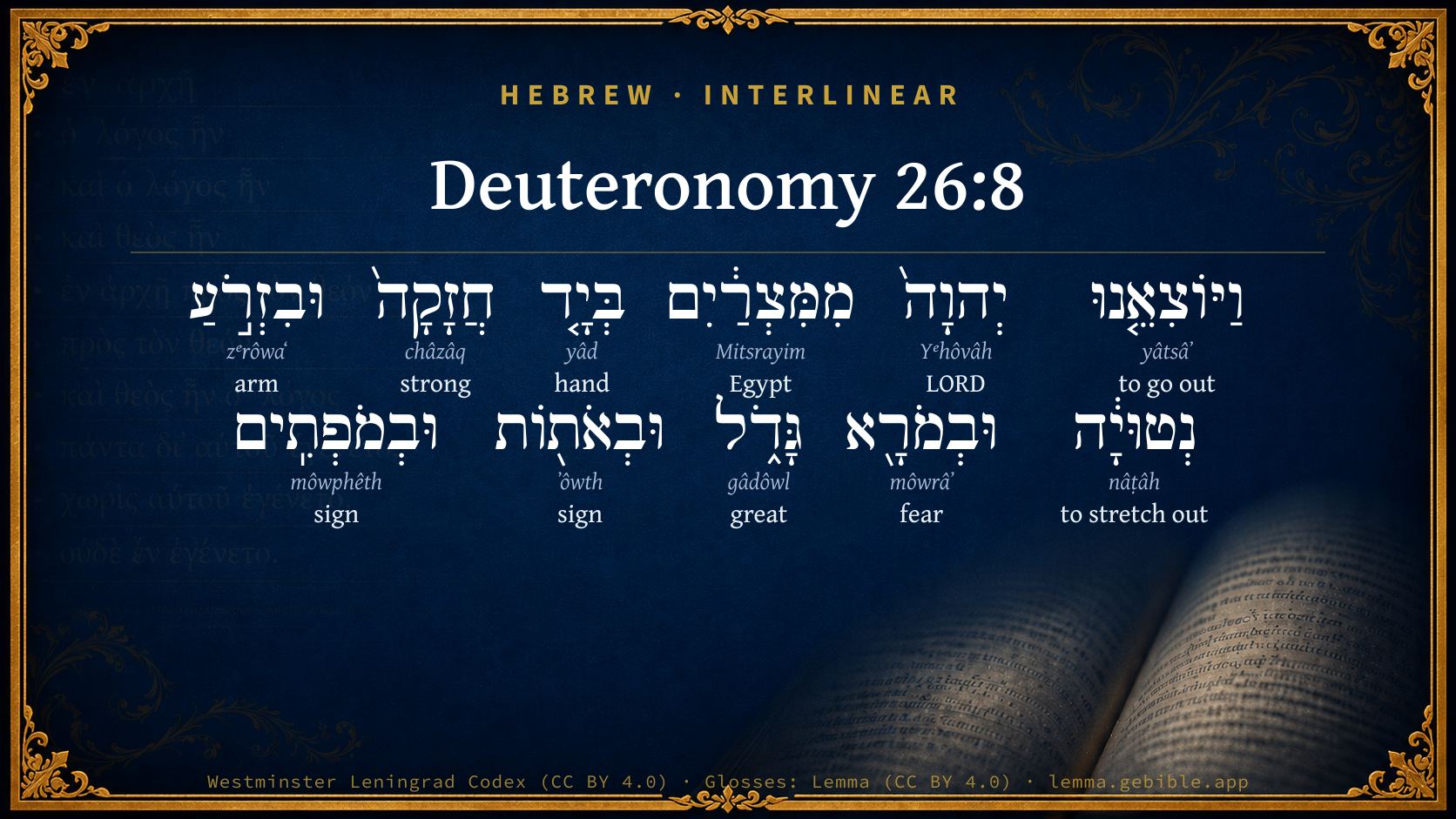
Hebrew (Westminster Leningrad Codex) Deuteronomy 26:8 appears in the Hebrew Old Testament. The text above is from the Westminster Leningrad Codex. Each word links to its Strong’s number, a concise gloss, and parsing drawn from the Open Scriptures Hebrew Bible morphology. Click any word for its full Brown-Driver-Briggs (BDB) entry.
Download image
Cite this verse

Deuteronomy 26:8 (World English Bible). Public Domain. Lemma interlinear Bible study tool, https://lemma.gebible.app/v/deuteronomy/26/8.

Show BibTeX & RIS
BibTeX
RIS
English Translation
and Yahweh brought us forth out of Egypt with a mighty hand, and with an outstretched arm, and with great terror, and with signs, and with wonders;
World English Bible · Public Domain
Download a study sheet

One document with this verse’s original text, its word-by-word gloss line, the meaning frame, cross-references with their text, attributed commentary, and full source and license credits — printable, and it pastes into notes with its structure intact.

This verse Autodidact and up

Study sheet (.html) Plain text (.txt)

A passage Seminary Student

Up to 50 verses in one chapter. A passage sheet keeps up to 6 commentary sources and 12 cross-references per verse, in the order this page ranks them, and says so on the sheet whenever that leaves anything out. Ask for a single verse and you get the Autodidact verse sheet above.

Everything on this page stays free to read, with no account — the sheet is a download of what is already on screen, not access to it.

Want to remove ads? Support Godless Engineer
Compare translations 3

The same verse in 3 English versions, stacked beneath the original-language interlinear above. Click any original word for its lexicon entry.

Each is an independent rendering of the whole verse — the interlinear is not word-aligned to these translations.

Highlighted words mark where these versions differ — a whole-verse word diff, not a word-by-word alignment.

  • World English Bible Public Domain
    and Yahweh brought us forth out of Egypt with a mighty hand, and with an outstretched arm, and with great terror, and with signs, and with wonders;
  • King James Version Public Domain
    And the LORD brought us forth out of Egypt with a mighty hand, and with an outstretched arm, and with great terribleness, and with signs, and with wonders:
  • unfoldingWord Literal Text CC BY-SA 4.0
    And Yahweh brought us out from Egypt with a mighty hand and with an outstretched arm and with great fearsomeness and with signs and with wonders;

unfoldingWord Literal Text — © unfoldingWord, licensed CC BY-SA 4.0. Word-aligned USFM3 via Door43 (git.door43.org/unfoldingWord/en_ult).

Versions to compare (up to 4)

3 of 4 selected

Show all 17 translations

Every available English version of this verse, each an independent rendering of the whole verse.

  • World English Bible Public Domain
    and Yahweh brought us forth out of Egypt with a mighty hand, and with an outstretched arm, and with great terror, and with signs, and with wonders;
  • Berean Standard Bible Public Domain
    Then the LORD brought us out of Egypt with a mighty hand and an outstretched arm, with great terror, signs, and wonders.
  • Majority Standard Bible Public Domain
    Then the LORD brought us out of Egypt with a mighty hand and an outstretched arm, with great terror, signs, and wonders.
  • King James Version Public Domain
    And the LORD brought us forth out of Egypt with a mighty hand, and with an outstretched arm, and with great terribleness, and with signs, and with wonders:
  • American Standard Version (1901) Public Domain
    and Jehovah brought us forth out of Egypt with a mighty hand, and with an outstretched arm, and with great terribleness, and with signs, and with wonders;
  • Revised Version (1885) Public Domain
    and the LORD brought us forth out of Egypt with a mighty hand, and with an outstretched arm, and with great terribleness, and with signs, and with wonders:
  • Geneva Bible (1599) Public Domain
    And the Lord brought vs out of Egypt in a mightie hande, and a stretched out arme, with great terriblenesse, both in signes and wonders.
  • Young's Literal Translation Public Domain
    and Jehovah bringeth us out from Egypt, by a strong hand, and by a stretched-out arm, and by great fear, and by signs, and by wonders,
  • Literal Standard Version CC BY-SA 4.0
    and YHWH brings us out from Egypt by a strong hand, and by an outstretched arm, and by great fear, and by signs, and by wonders,
  • Unlocked Literal Bible CC BY-SA 4.0
    Yahweh brought us out of Egypt with a mighty hand, with an outstretched arm, with great fearsomeness, with signs, and with wonders;
  • unfoldingWord Literal Text CC BY-SA 4.0
    And Yahweh brought us out from Egypt with a mighty hand and with an outstretched arm and with great fearsomeness and with signs and with wonders;
  • Darby Bible Public Domain
    and Jehovah brought us forth out of Egypt with a powerful hand, and with a stretched-out arm, and with great terribleness, and with signs, and with wonders;
  • World Messianic Bible Public Domain
    The LORD brought us out of Egypt with a mighty hand, with an outstretched arm, with great terror, with signs, and with wonders;
  • Webster's Bible Public Domain
    And the LORD brought us out of Egypt with a mighty hand, and with an out-stretched arm, and with great terribleness, and with signs, and with wonders;
  • Free Bible Version CC BY-SA 4.0
    The Lord led us out of Egypt with his great power and incredible strength and terrifying actions, signs and miracles.
  • Bible in Basic English Public Domain
    And the Lord took us out of Egypt with a strong hand and a stretched-out arm, with works of power and signs and wonders:
  • JPS Tanakh (1917) Public Domain
    And the LORD brought us forth out of Egypt with a mighty hand, and with an outstretched arm, and with great terribleness, and with signs, and with wonders.

Literal Standard Version (2020), Covenant Press — licensed CC BY-SA 4.0. Text via the HelloAO Bible API (eBible.org). Unlocked Literal Bible (unfoldingWord) — licensed CC BY-SA 4.0. Text via the HelloAO Bible API (eBible.org). unfoldingWord Literal Text — © unfoldingWord, licensed CC BY-SA 4.0. Word-aligned USFM3 via Door43 (git.door43.org/unfoldingWord/en_ult). Free Bible Version, Dr. Jonathan Gallagher — licensed CC BY-SA 4.0. Text via the HelloAO Bible API (eBible.org).

Word by word

More ways to search: Search by grammar → Find every occurrence → Compare this word →

Practice this passage: Drill this verse → Learn its vocabulary →

וּבְמֹרָ֖א
môwrâʼ
H4172
“and · in/at · fear”
Conjunction + Preposition + Noun, Common, Masculine, Singular, Absolute
Part of Speech
Conjunction + Preposition + Noun
Type
Common
Gender
Masculine
Number
Singular
State
Absolute
Full BDB Definition

Origin: from H3372

TWOT: 907c , 907d

fear, reverence, terror - fear, terror - reverence - object of reverence - awe-inspiring spectacle or deed
  1. וַיּוֹצִאֵ֤נוּ yâtsâʼ H3318 “and · to go out · us” Conjunction + Verb, Hiphil, Sequential Imperfect, 3rd Person, Masculine, Singular + Suffix, Personal, 1st Person, Common, Plural
  2. יְהוָה֙ Yᵉhôvâh H3068 “LORD” Noun, Proper
  3. מִמִּצְרַ֔יִם Mitsrayim H4714 “from · Egypt” Preposition + Noun, Proper
  4. בְּיָ֤ד yâd H3027 “in/at · hand” Preposition + Noun, Common, Both, Singular, Absolute
  5. חֲזָקָה֙ châzâq H2389 “strong” Adjective, Adjective, Feminine, Singular, Absolute
  6. וּבִזְרֹ֣עַ zᵉrôwaʻ H2220 “and · in/at · arm” Conjunction + Preposition + Noun, Common, Both, Singular, Absolute
  7. נְטוּיָ֔ה nâṭâh H5186 “stretched out” Verb, Qal, Participle Passive, Feminine, Singular, Absolute
  8. גָּדֹ֑ל gâdôwl H1419 “great” Adjective, Adjective, Masculine, Singular, Absolute
  9. וּבְאֹת֖וֹת ʼôwth H226 “and · in/at · signs” Conjunction + Preposition + Noun, Common, Both, Plural, Absolute
  10. וּבְמֹפְתִֽים môwphêth H4159 “and · in/at · signs” Conjunction + Preposition + Noun, Common, Masculine, Plural, Absolute

About this verse

These counts appear in no published source. They are computed here, from the morphology-tagged text and Lemma’s own curated glosses. What Lemma adds →

11
words
11
distinct lemmas
Pentateuch
section

Notable vocabulary

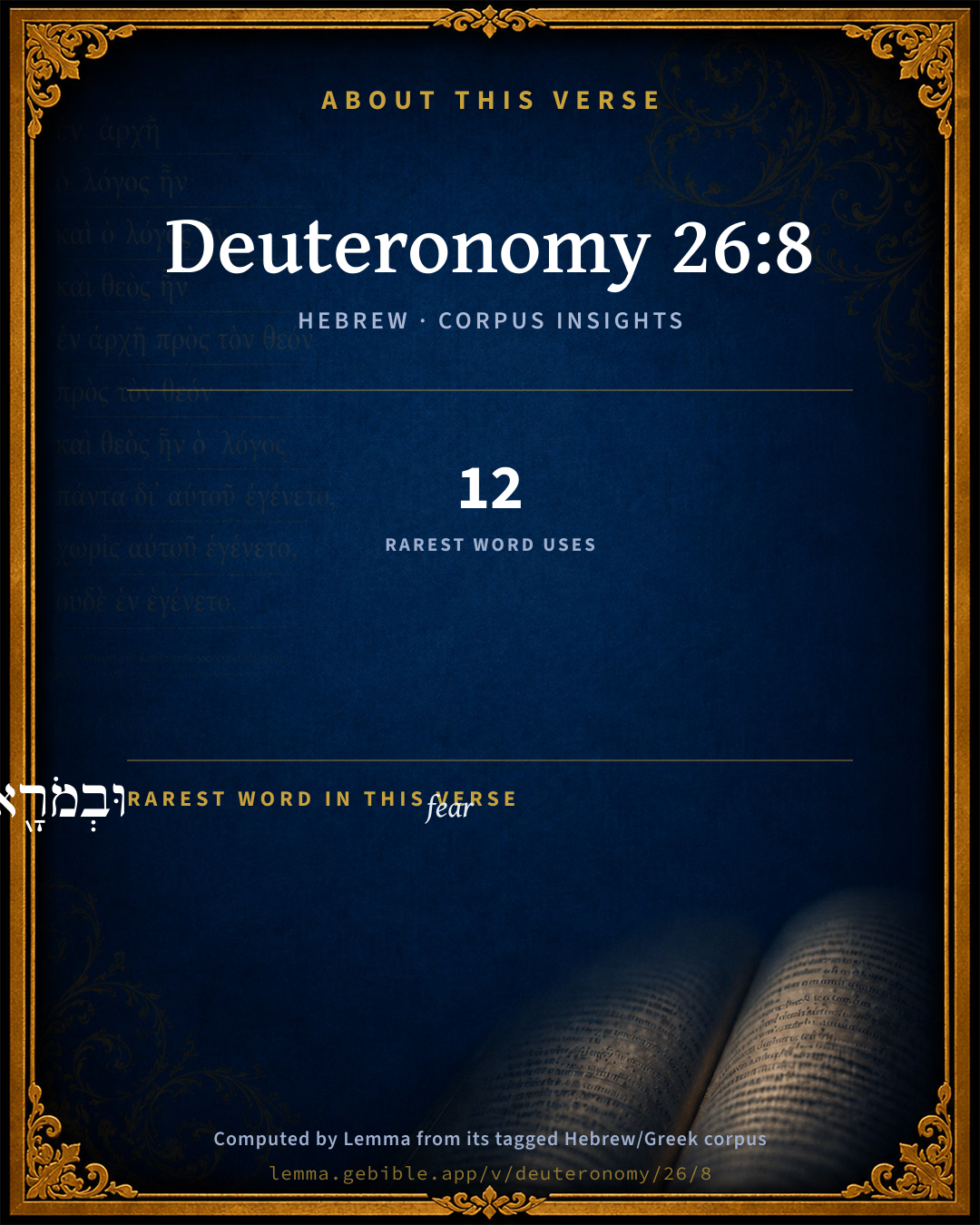
The rarest word here is וּבְמֹרָ֖א fear H4172 — appearing just 12 times in the whole Hebrew Bible.

Shared distinctive vocabulary

וּבְמֹרָ֖א fear H4172 occurs in 12 verses of the Hebrew Bible. Also found in:

Grammatical profile

  • 2 verbs
  • 7 nouns
  • 2 adjectives

Verb forms

  • וַיּוֹצִאֵ֤נוּ Hiphil · Sequential Imperfect
  • נְטוּיָ֔ה Qal · Participle Passive

Hebrew & Septuagint length

In English translation the verse runs 27 words from the Hebrew and 31 from the Septuagint (LXX English) — closely comparable.

A rough comparison of the two English renderings, which tokenize alike — not a word-level alignment.

Word counts can differ between the Hebrew and the Greek without any difference in meaning — e.g. the Hebrew direct-object marker אֵת has no separate Greek word, and Greek often adds the article ὁ.

Cross-references

11

Topical passages linked to Deuteronomy 26:8 in the Treasury of Scripture Knowledge — connected by theme and wording, ordered by reader-vote popularity; previews shown in the World English Bible.

  • Deuteronomy 4:34 Or has God tried to go and take him a nation from the midst of [another] nation, by trials, by signs, and by wonders, and by war, and by a mighty hand, and by an outstretched arm, and by great terrors, according to all that Yahweh your God did for you in Egypt before your eyes?
  • Exodus 12:37 The children of Israel traveled from Rameses to Succoth, about six hundred thousand on foot who were men, besides children.
  • Exodus 12:41 It happened at the end of four hundred thirty years, even the same day it happened, that all the hosts of Yahweh went out from the land of Egypt.
  • Exodus 12:51 It happened the same day, that Yahweh brought the children of Israel out of the land of Egypt by their hosts.
  • Exodus 13:3 Moses said to the people, "Remember this day, in which you came out from Egypt, out of the house of bondage; for by strength of hand Yahweh brought you out from this place. No leavened bread shall be eaten.
  • Exodus 14:16–31 Lift up your rod, and stretch out your hand over the sea, and divide it: and the children of Israel shall go into the midst of the sea on dry ground.
  • Deuteronomy 5:15 You shall remember that you were a servant in the land of Egypt, and Yahweh your God brought you out of there by a mighty hand and by an outstretched arm: therefore Yahweh your God commanded you to keep the Sabbath day.
  • Psalms 78:12–13 He did marvelous things in the sight of their fathers, In the land of Egypt, in the field of Zoan.
  • Psalms 105:27–38 They performed miracles among them, And wonders in the land of Ham.
  • Psalms 106:7–10 Our fathers didn't understand your wonders in Egypt. They didn't remember the multitude of your loving kindnesses, But were rebellious at the sea, even at the Red Sea.
  • Isaiah 63:12 who caused his glorious arm to go at the right hand of Moses? who divided the waters before them, to make himself an everlasting name?

Cross-references courtesy of OpenBible.info (CC BY 4.0).

Hebrew and Greek witnesses Masoretic Hebrew ↔ Greek Septuagint

The same verse in the two great witnesses to the Old Testament, shown verse-for-verse.

These are two independent witnesses, not word-aligned to each other, and the Septuagint is shown in lemma (dictionary) form.

Hebrew Deuteronomy 26:8 Masoretic · Westminster Leningrad Codex

וַיּוֹצִאֵ֤נוּ יְהוָה֙ מִמִּצְרַ֔יִם בְּיָ֤ד חֲזָקָה֙ וּבִזְרֹ֣עַ נְטוּיָ֔ה וּבְמֹרָ֖א גָּדֹ֑ל וּבְאֹת֖וֹת וּבְמֹפְתִֽים

and Yahweh brought us forth out of Egypt with a mighty hand, and with an outstretched arm, and with great terror, and with signs, and with wonders;

World English Bible · Public Domain

Greek LXX Deuteronomy 26:8 Septuagint · lemma form

καί ἐκἄγω ἐγώ κύριος ἐκ αἴγυπτος αὐτός ἐν ἰσχύς μέγας καί ἐν χείρ κραταιός καί ἐν βραχίων αὐτός ὁ ὑψηλός καί ἐν ὅραμα μέγας καί ἐν σημεῖον καί ἐν τέρας

And the Lord brought us out of Egypt himself with his great strength, and his mighty hand, and his high arm, and with great visions, and with signs, and with wonders.

LXX2012 (modern English Septuagint) · Public Domain

On this verse, Haydock's Catholic Bible Commentary discusses the Septuagint’s reading. Read the note in Commentary ↓

Hebrew: Westminster Leningrad Codex (CC BY 4.0). Greek: Septuagint (public domain); English from LXX2012 (modern English Septuagint) (Public Domain). How the Septuagint differs from the Hebrew →

Targum (Aramaic paraphrase)

2

The Targum is the ancient Jewish Aramaic paraphrase of the Hebrew Scriptures — an interpretive translation, not the Hebrew text itself. Onkelos (literal) and Pseudo-Jonathan (expansive) render the Torah, and Jonathan the Prophets. Coverage is partial: where no permissively-licensed English translation exists for a verse, only the Aramaic is shown. This is verse-level text, not a word-by-word alignment to the Hebrew.

  1. Targum Onkelos Torah (Genesis–Deuteronomy)
    וְאַפְּקָנָא יְיָ מִמִצְרַיִם בִּידָא תַקִיפָא וּבִדְרָעָא מְרַמְמָא וּבְחֶזְוָנָא רַבָּא וּבְאָתִין וּבְמוֹפְתִין

    (no public-domain English translation for this verse)

    Targum Onkelos — Aramaic: “Onkelos Genesis” (public domain); “Onkelos Exodus” (public domain); “Onkelos Leviticus” (public domain); “Onkelos Numbers” (public domain); “Onkelos Deuteronomy” (public domain). English: “Sefaria Community Translation” (CC0 1.0 (public-domain dedication)); “J.W. Etheridge. The Targums of Onkelos and Jonathan Ben Uzziel on the Pentateuch. London: Longmans, Green, 1862” (public domain). Text via Sefaria.

  2. Targum Pseudo-Jonathan Torah (Genesis–Deuteronomy)
    וְהַנְפָקָנָא יְיָ מִמִצְרַיִם בִּידָא תַקִיפְתָּא וּבִדְרַע מְרַמְמָא וּבְחֶזְוָונָא רַבָּא וּבְאָתִין וּבְתִמְהִין

    And the Lord brought us out of Mizraim with a mighty hand and uplifted arm, and with great visions, signs, and wonders,

    Targum Pseudo-Jonathan — Aramaic: “Targum Jonathan on Genesis” (public domain); “Targum Jonathan on Exodus” (public domain); “Targum Jonathan on Leviticus” (public domain); “Targum Jonathan on Numbers” (public domain); “Targum Jonathan on Deuteronomy” (public domain). English: “The Targum of Jonathan ben Uzziel, trans. J. W. Etheridge, London, 1862” (public domain). Text via Sefaria.

Commentary

Notes on Deuteronomy 26:8 from classic Christian and Jewish commentators (each source and its license shown beneath its notes). The classic Christian expositions comment on the surrounding passage and are grouped to its opening verse, so a note may address several verses; the Jewish commentaries on the Tanakh (Rashi and others) are per-verse, so they appear only where the commentator wrote on this verse.

Lemma curates 59 commentaries, every one of them public domain or Creative Commons licensed, each selected and text-cleaned for this edition rather than reprinted as found. About our sources →

Adam Clarke's Commentary

Verse 8. With a mighty hand, &c.] See Clarke on De 4:34.

Adam Clarke's Commentary on the Bible (1810–1826) — public domain. Text from a community e-Sword/MySword module.

The Cambridge Bible for Schools and Colleges

gen. ed. J. J. S. Perowne

8. with a mighty hand, etc.] Deu_4:34, Deu_8:14.

The Cambridge Bible for Schools and Colleges (gen. ed. J. J. S. Perowne; Cambridge University Press, 1878–1918) — public domain. Text from a community e-Sword module.

John Gill's Exposition

And the Lord brought us forth out of Egypt,.... After some time:

with a mighty hand and with an outstretched arm; by his almighty power, of which full proof was given by what he then did, Deu 5:15,

and with great terribleness: to Pharaoh and his people, through the plagues that were inflicted on them, especially the last, the slaying of their firstborn; see Deu 4:34,

and with signs and with wonders; wrought by the hands of Moses and Aaron, meaning the ten plagues, often so called.

John Gill's Exposition of the Whole Bible (1746–1763) — public domain (CC PDM 1.0). Text via the HelloAO Bible API.

Haydock's Catholic Bible Commentary

Terror. Septuagint, "with surprising visions," (Hebrew) or "with astonishing prodigies," &c. (Calmet)

George Leo Haydock (1774–1849), Haydock's Catholic Family Bible and Commentary, 1859 edition — public domain. Excludes Psalms (Douay-Rheims chapter numbering differs from Protestant) and Deuterocanonical books (Catholic canon only).

Whedon's Commentary on the Bible

Daniel D. Whedon

8. And the Lord brought us forth — On the deliverance from Egypt, see Exodus 12, 13.

With signs, and with wonders — Comp. Deu_4:34.

Daniel D. Whedon (gen. ed.), Commentary on the Old and New Testaments (1874–1909) — public domain. Text from a community e-Sword module.

The Pulpit Commentary

cf. Deu_4:34

The Pulpit Commentary (1880–1919), ed. H.D.M. Spence-Jones & Joseph S. Exell — public domain. Text from a community e-Sword module.

unfoldingWord translationNotes

Door43 World Missions Community

General Information:

This continues what the Israelite must say when he brings his first crops to Yahweh.

Yahweh brought us

Here "us" refers to the people of Israel that were living in Egypt. The speaker includes himself as one of the people whether he lived in Egypt or not. (See: Inclusive "We")

with a mighty hand, with an outstretched arm

Here "a mighty hand" and "an outstretched arm" are metaphors for Yahweh's power. See how you translated these words in Deuteronomy 4:34. AT: "by showing his mighty power" (See: Metaphor)

with great fearsomeness

"with acts that terrified the people who saw them"

a land that flows with milk and honey

This is an idiom. See how you translated this in Deuteronomy 6:3. AT: "a land where plenty of milk and honey flow" or "a land that is excellent for cattle and farming"

translationWords

Egypt

might

hand

power

miracle

honey

unfoldingWord translationNotes — © Distant Shores Media and the Door43 World Missions Community, licensed CC BY-SA 4.0. Source: git.door43.org/Door43/en_tn.

Lesson kit

Teaching starters — assembled from the data on this page, not authored interpretation. Every prompt links to the verse data it draws on. Edit before teaching.

Deuteronomy, in the Pentateuch, opens this verse with 11 words (11 distinct Hebrew lemmas). Its most distinctive word is môwrâʼ (“fear”). A historical commentator’s framing appears above. Read the whole chapter for the surrounding context.

Discussion questions

  1. The word môwrâʼ carries the sense “fear.” How does it shape the verse?
  2. How does Genesis 9:2, which shares the word «fear», read alongside this verse?
  3. These translations render this verse differently; the difference is in the English rendering, not the original. What questions does that raise?
  4. «וַיּוֹצִאֵ֤נוּ» is a Hiphil Sequential Imperfect verb. How does that grammatical form shape the action described?
  5. Compare how Adam Clarke's Commentary and The Cambridge Bible for Schools and Colleges read this verse. Where do they agree or differ?

Things to notice

Reading settings

Reading text

Shown beneath each verse's original-language words.

Old Testament
Old Testament edition

Read the OT as the Masoretic Hebrew (MT) or the Greek Septuagint (LXX).

English shown for the Greek Septuagint (in the Hebrew ↔ Greek comparison).

Comparing translations? Open the Compare panel on any verse page to stack up to four side by side.