
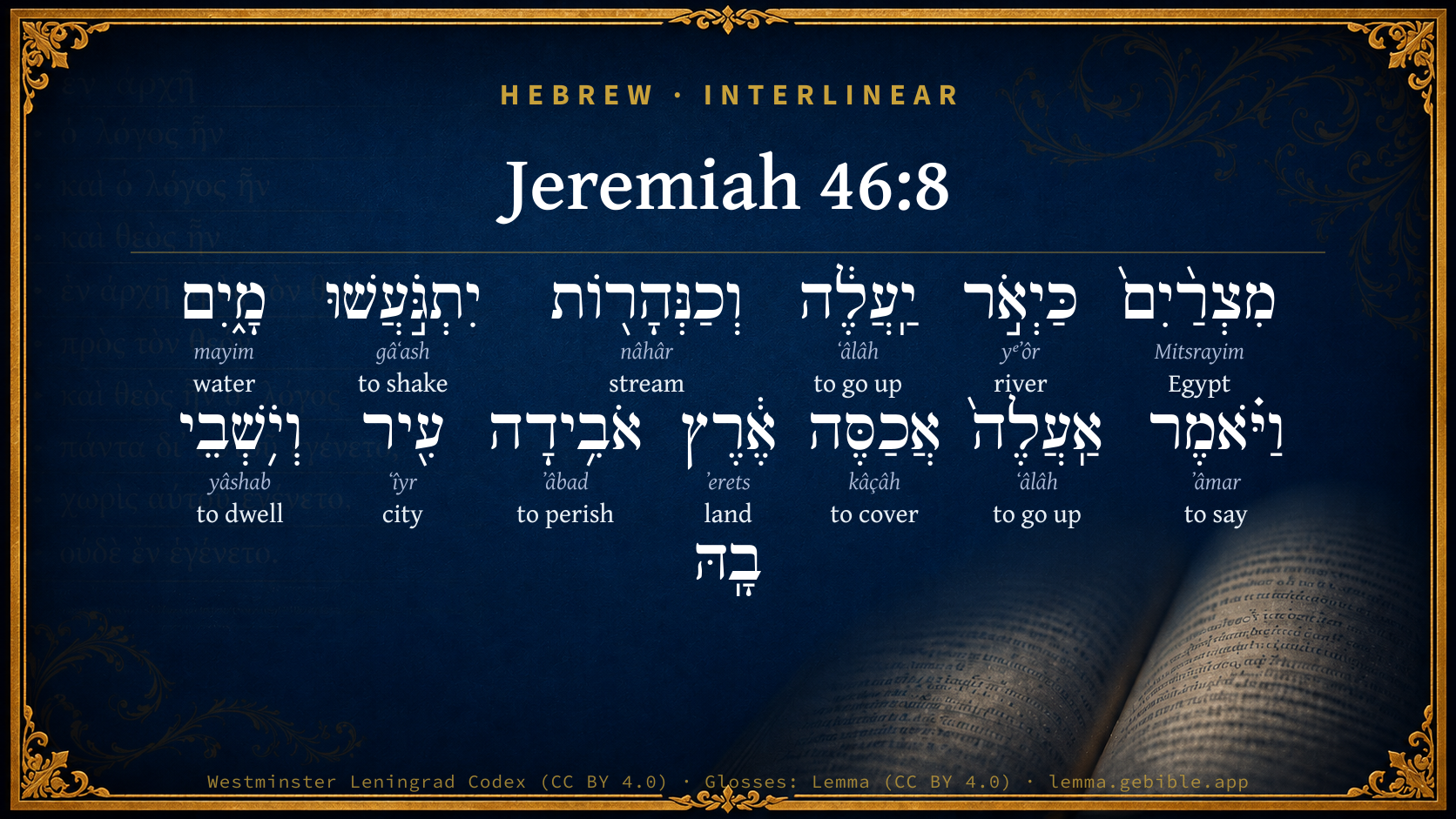
Jeremiah 46:8

Hebrew (Westminster Leningrad Codex) Jeremiah 46:8 appears in the Hebrew Old Testament. The text above is from the Westminster Leningrad Codex. Each word links to its Strong’s number, a concise gloss, and parsing drawn from the Open Scriptures Hebrew Bible morphology. Click any word for its full Brown-Driver-Briggs (BDB) entry.
Download image
Cite this verse

Jeremiah 46:8 (World English Bible). Public Domain. Lemma interlinear Bible study tool, https://lemma.gebible.app/v/jeremiah/46/8.

Show BibTeX & RIS
BibTeX
RIS
English Translation
Egypt rises up like the Nile, and his waters toss themselves like the rivers: and he says, I will rise up, I will cover the earth; I will destroy cities and the inhabitants of it.
World English Bible · Public Domain
Download a study sheet

One document with this verse’s original text, its word-by-word gloss line, the meaning frame, cross-references with their text, attributed commentary, and full source and license credits — printable, and it pastes into notes with its structure intact.

This verse Autodidact and up

Study sheet (.html) Plain text (.txt)

A passage Seminary Student

Up to 50 verses in one chapter. A passage sheet keeps up to 6 commentary sources and 12 cross-references per verse, in the order this page ranks them, and says so on the sheet whenever that leaves anything out. Ask for a single verse and you get the Autodidact verse sheet above.

Everything on this page stays free to read, with no account — the sheet is a download of what is already on screen, not access to it.

Want to remove ads? Support Godless Engineer
Compare translations 3

The same verse in 3 English versions, stacked beneath the original-language interlinear above. Click any original word for its lexicon entry.

Each is an independent rendering of the whole verse — the interlinear is not word-aligned to these translations.

Highlighted words mark where these versions differ — a whole-verse word diff, not a word-by-word alignment.

  • World English Bible Public Domain
    Egypt rises up like the Nile, and his waters toss themselves like the rivers: and he says, I will rise up, I will cover the earth; I will destroy cities and the inhabitants of it.
  • King James Version Public Domain
    Egypt riseth up like a flood, and his waters are moved like the rivers; and he saith, I will go up, and will cover the earth; I will destroy the city and the inhabitants thereof.
  • unfoldingWord Literal Text CC BY-SA 4.0
    Egypt rises like the Nile, like rivers of water that rise and fall. Egypt says, ‘I will go up and I will cover the earth. I will destroy cities and their inhabitants.

unfoldingWord Literal Text — © unfoldingWord, licensed CC BY-SA 4.0. Word-aligned USFM3 via Door43 (git.door43.org/unfoldingWord/en_ult).

Versions to compare (up to 4)

3 of 4 selected

Show all 18 translations

Every available English version of this verse, each an independent rendering of the whole verse.

  • World English Bible Public Domain
    Egypt rises up like the Nile, and his waters toss themselves like the rivers: and he says, I will rise up, I will cover the earth; I will destroy cities and the inhabitants of it.
  • Berean Standard Bible Public Domain
    Egypt rises like the Nile, and its waters churn like rivers, boasting, ‘I will rise and cover the earth; I will destroy the cities and their people.’
  • Majority Standard Bible Public Domain
    Egypt rises like the Nile, and its waters churn like rivers, boasting, ‘I will rise and cover the earth; I will destroy the cities and their people.’
  • King James Version Public Domain
    Egypt riseth up like a flood, and his waters are moved like the rivers; and he saith, I will go up, and will cover the earth; I will destroy the city and the inhabitants thereof.
  • American Standard Version (1901) Public Domain
    Egypt riseth up like the Nile, and his waters toss themselves like the rivers: and he saith, I will rise up, I will cover the earth; I will destroy cities and the inhabitants thereof.
  • Revised Version (1885) Public Domain
    Egypt riseth up like the Nile, and his waters toss themselves like the rivers: and he saith, I will rise up, I will cover the earth; I will destroy the city and the inhabitants thereof.
  • Geneva Bible (1599) Public Domain
    Egypt riseth vp like the flood, and his waters are mooued like the riuers, and he sayth, I wil goe vp, and will couer the earth: I wil destroy the citie with them that dwell therein.
  • Douay-Rheims (1899) Public Domain
    Egypt riseth up like a hood, and the waves thereof shall be moved as rivers, and he shall say: I will go up and will cover the earth: I will destroy the city, and its inhabitants.
  • Young's Literal Translation Public Domain
    Egypt, as a flood cometh up, And as rivers the waters shake themselves. And he saith, I go up; I cover the land, I destroy the city and the inhabitants in it.
  • Literal Standard Version CC BY-SA 4.0
    Egypt comes up as a flood, || And the waters shake themselves as rivers. And he says, I go up; I cover the land, I destroy the city and the inhabitants in it.
  • Unlocked Literal Bible CC BY-SA 4.0
    Egypt rises like the Nile, like rivers of water that rise and fall. Egypt says, 'I will go up and I will cover the earth. I will destroy cities and their inhabitants.
  • unfoldingWord Literal Text CC BY-SA 4.0
    Egypt rises like the Nile, like rivers of water that rise and fall. Egypt says, ‘I will go up and I will cover the earth. I will destroy cities and their inhabitants.
  • Darby Bible Public Domain
    It is Egypt that riseth up as the Nile, and [his] waters toss themselves like the rivers; and he saith, I will rise up, I will cover the earth; I will destroy the city and the inhabitants thereof.
  • World Messianic Bible Public Domain
    Egypt rises up like the Nile, like rivers whose waters surge. He says, ‘I will rise up. I will cover the earth. I will destroy cities and its inhabitants.’
  • Webster's Bible Public Domain
    Egypt riseth up like a flood, and his waters are moved like the rivers; and he saith, I will go up, and will cover the earth; I will destroy the city and its inhabitants.
  • Free Bible Version CC BY-SA 4.0
    Egypt is rising like the Nile; its waters swirl like flooding rivers, boasting, “I will rise and sweep over the earth; I will destroy towns and the people in them.”
  • Bible in Basic English Public Domain
    Egypt is coming up like the Nile, and his waters are lifting their heads like the rivers, and he says, I will go up, covering the earth; I will send destruction on the town and its people.
  • JPS Tanakh (1917) Public Domain
    Egypt is like the Nile that riseth up, and like the rivers whose waters toss themselves; and he saith: 'I will rise up, I will cover the earth, I will destroy the city and the inhabitants thereof.'

Literal Standard Version (2020), Covenant Press — licensed CC BY-SA 4.0. Text via the HelloAO Bible API (eBible.org). Unlocked Literal Bible (unfoldingWord) — licensed CC BY-SA 4.0. Text via the HelloAO Bible API (eBible.org). unfoldingWord Literal Text — © unfoldingWord, licensed CC BY-SA 4.0. Word-aligned USFM3 via Door43 (git.door43.org/unfoldingWord/en_ult). Free Bible Version, Dr. Jonathan Gallagher — licensed CC BY-SA 4.0. Text via the HelloAO Bible API (eBible.org).

Word by word

More ways to search: Search by grammar → Find every occurrence → Compare this word →

Practice this passage: Drill this verse → Learn its vocabulary →

יִתְגֹּ֣עֲשׁוּ
gâʻash
H1607
“to shake”
Verb, Hithpolel, Imperfect, 3rd Person, Masculine, Plural
Part of Speech
Verb
Stem
Hithpolel
Form
Imperfect
Person
3rd Person
Gender
Masculine
Number
Plural
Full BDB Definition

Origin: a primitive root

TWOT: 371

to shake, quake - (Qal) to shake - (Pual) to be shaken up, convulsed - (Hithpael) to shake back and forth, toss or reel to and fro - (Hithpoel) to reel to and fro
  1. מִצְרַ֨יִם֙ Mitsrayim H4714 “Egypt” Noun, Proper
  2. כַּיְאֹ֣ר yᵉʼôr H2975 “like/as the · river” Preposition, Determined + Noun, Proper
  3. יַֽעֲלֶ֔ה ʻâlâh H5927 “to go up” Verb, Qal, Imperfect, 3rd Person, Masculine, Singular
  4. וְכַנְּהָר֖וֹת nâhâr H5104 “and · like/as the · streams” Conjunction + Preposition, Determined + Noun, Common, Masculine, Plural, Absolute
  5. מָ֑יִם mayim H4325 “water(s)” Noun, Common, Masculine, Plural, Absolute
  6. וַיֹּ֗אמֶר ʼâmar H559 “and · to say” Conjunction + Verb, Qal, Sequential Imperfect, 3rd Person, Masculine, Singular
  7. אַֽעֲלֶה֙ ʻâlâh H5927 “to go up” Verb, Qal, Imperfect, 1st Person, Common, Singular
  8. אֲכַסֶּה kâçâh H3680 “to cover” Verb, Piel, Imperfect, 1st Person, Common, Singular
  9. אֶ֔רֶץ ʼerets H776 “land” Noun, Common, Both, Singular, Absolute
  10. אֹבִ֥ידָה ʼâbad H6 “to perish” Verb, Hiphil, Cohortative, 1st Person, Common, Singular
  11. עִ֖יר ʻîyr H5892 “city” Noun, Common, Feminine, Singular, Absolute
  12. וְיֹ֥שְׁבֵי yâshab H3427 “and · dwelling” Conjunction + Verb, Qal, Participle Active, Masculine, Plural, Construct

About this verse

These counts appear in no published source. They are computed here, from the morphology-tagged text and Lemma’s own curated glosses. What Lemma adds →

14
words
12
distinct lemmas
Prophets
section

Notable vocabulary

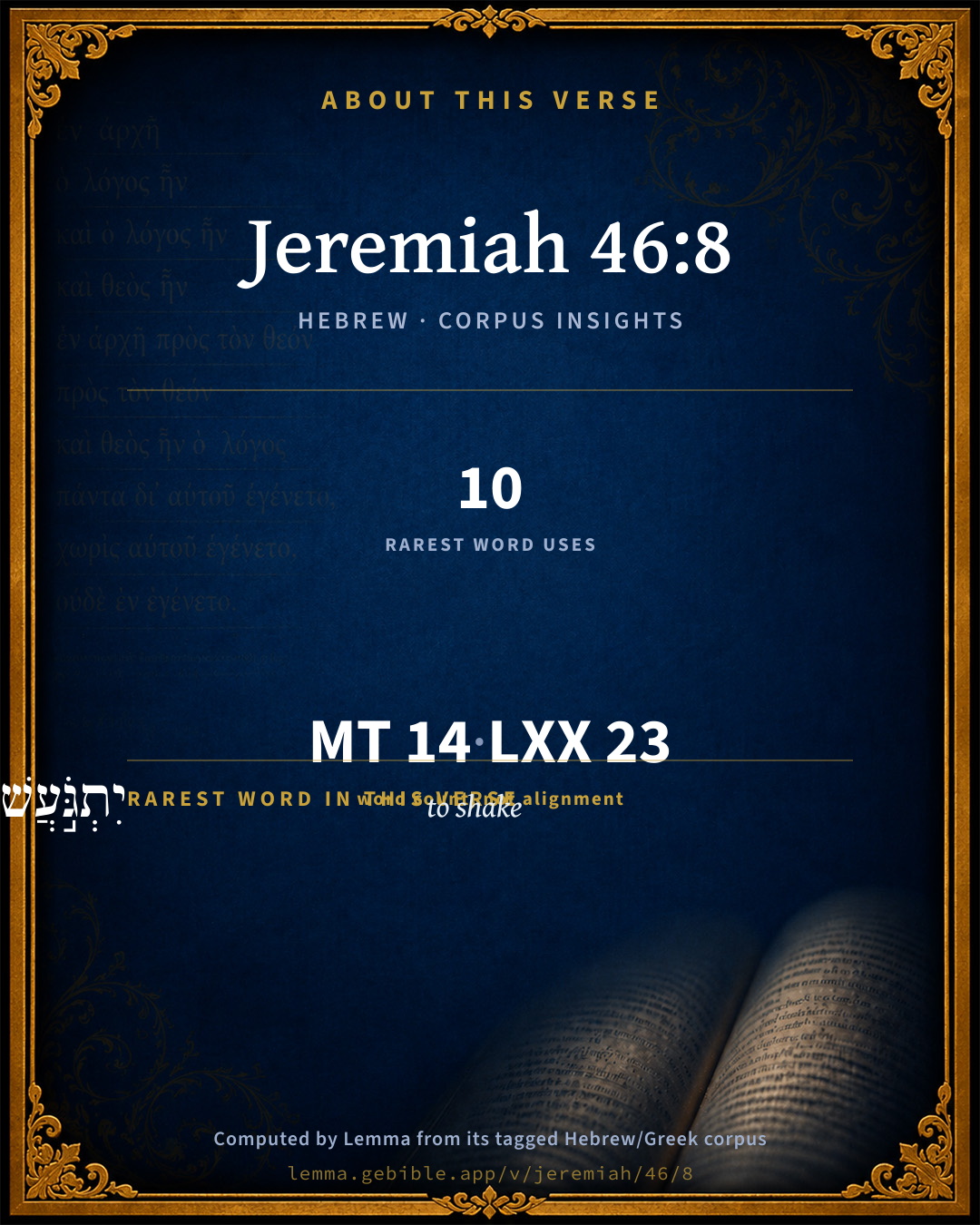
The rarest word here is יִתְגֹּ֣עֲשׁוּ to shake H1607 — appearing just 10 times in the whole Hebrew Bible.

Shared distinctive vocabulary

יִתְגֹּ֣עֲשׁוּ to shake H1607 occurs in 7 verses of the Hebrew Bible. Also found in:

Grammatical profile

  • 7 verbs
  • 6 nouns
  • 1 preposition

Verb forms

  • יַֽעֲלֶ֔ה Qal · Imperfect
  • יִתְגֹּ֣עֲשׁוּ Hithpolel · Imperfect
  • וַיֹּ֗אמֶר Qal · Sequential Imperfect
  • אַֽעֲלֶה֙ Qal · Imperfect
  • אֲכַסֶּה Piel · Imperfect
  • אֹבִ֥ידָה Hiphil · Cohortative
  • וְיֹ֥שְׁבֵי Qal · Participle Active

Repetition

A word recurs within this verse — often emphatic in Hebrew:

  • יַֽעֲלֶ֔ה to go up H5927 ×2

Hebrew & Septuagint length

In the original languages it is 14 Hebrew tokens and 23 Greek tokens — but the two are counted differently (Hebrew bundles its prefixes and suffixes into one token; the Greek is in lemma form), so that isn’t a like-for-like length.

Cross-references

5

Topical passages linked to Jeremiah 46:8 in the Treasury of Scripture Knowledge — connected by theme and wording, ordered by reader-vote popularity; previews shown in the World English Bible.

  • Exodus 15:9–10 The enemy said, 'I will pursue, I will overtake, I will divide the spoil. My desire shall be satisfied on them. I will draw my sword, my hand shall destroy them.'
  • Isaiah 10:13–16 For he has said, By the strength of my hand I have done it, and by my wisdom; for I have understanding: and I have removed the bounds of the peoples, and have robbed their treasures, and like a valiant man I have brought down those who sit [on thrones]:
  • Isaiah 37:24–26 By your servants have you defied the Lord, and have said, With the multitude of my chariots am I come up to the height of the mountains, to the innermost parts of Lebanon; and I will cut down the tall cedars of it, and the choice fir trees of it; and I will enter into its farthest height, the forest of its fruitful field;
  • Ezekiel 29:3 speak, and say, Thus says the Lord Yahweh: Behold, I am against you, Pharaoh king of Egypt, the great monster that lies in the midst of his rivers, that has said, My river is my own, and I have made it for myself.
  • Ezekiel 32:2 Son of man, take up a lamentation over Pharaoh king of Egypt, and tell him, You were likened to a young lion of the nations: yet are you as a monster in the seas; and you did break forth with your rivers, and troubled the waters with your feet, and fouled their rivers.

Cross-references courtesy of OpenBible.info (CC BY 4.0).

Hebrew and Greek witnesses Masoretic Hebrew ↔ Greek Septuagint

The same verse in the two great witnesses to the Old Testament, shown verse-for-verse.

These are two independent witnesses, not word-aligned to each other, and the Septuagint is shown in lemma (dictionary) form.

Hebrew Jeremiah 46:8 Masoretic · Westminster Leningrad Codex

מִצְרַ֨יִם֙ כַּיְאֹ֣ר יַֽעֲלֶ֔ה וְכַנְּהָר֖וֹת יִתְגֹּ֣עֲשׁוּ מָ֑יִם וַיֹּ֗אמֶר אַֽעֲלֶה֙ אֲכַסֶּה אֶ֔רֶץ אֹבִ֥ידָה עִ֖יר וְיֹ֥שְׁבֵי בָֽהּ

Egypt rises up like the Nile, and his waters toss themselves like the rivers: and he says, I will rise up, I will cover the earth; I will destroy cities and the inhabitants of it.

World English Bible · Public Domain

Greek LXX Structure differs

In the Septuagint, Jeremiah is about an eighth shorter than the Hebrew and arranges its material differently — the Oracles Against the Nations (Hebrew chapters 46–51) appear in the middle of the Greek book, after 25:13. Because the chapter and verse boundaries do not line up, a verse-for-verse comparison with the Hebrew is not shown.

A verse-for-verse comparison isn’t shown here because the chapters and verses don’t line up. Switch to the LXX edition with the MT / LXX toggle above to read the Greek directly.

On this verse, The Cambridge Bible for Schools and Colleges discusses the Septuagint’s reading. Read the note in Commentary ↓

Hebrew: Westminster Leningrad Codex (CC BY 4.0). Greek: Septuagint (public domain); English from a public-domain English Septuagint. How the Septuagint differs from the Hebrew →

Targum (Aramaic paraphrase)

1

The Targum is the ancient Jewish Aramaic paraphrase of the Hebrew Scriptures — an interpretive translation, not the Hebrew text itself. Onkelos (literal) and Pseudo-Jonathan (expansive) render the Torah, and Jonathan the Prophets. Coverage is partial: where no permissively-licensed English translation exists for a verse, only the Aramaic is shown. This is verse-level text, not a word-by-word alignment to the Hebrew.

  1. Targum Jonathan Prophets (Joshua–Malachi)
    מַלְכָּא דְמִצְרַיִם דִסְלֵיק בְּמַשִׁרְיָתֵיהּ כַּעֲנָנָא דְסָלֵיק חָפֵי יַת אַרְעָא כְּמַבּוּעֵי דְמַיִין דִמְטָרְפִין מוֹהִי וַאֲמַר אֱסַק אֲחַפֵּי אַרְעָא וּמְלוֹאָהּ אוֹבִיד קִרְוַיָא וּדְיַתְבִין בְּהוֹן:

    (no public-domain English translation for this verse)

    Targum Jonathan — Aramaic: “Mikraot Gedolot” (public domain). English: “Sefaria Community Translation” (CC0 1.0 (public-domain dedication)); “London "Chaldee Paraphrase," 1871” (public domain). Text via Sefaria.

Commentary

Notes on Jeremiah 46:8 from classic Christian and Jewish commentators (each source and its license shown beneath its notes). The classic Christian expositions comment on the surrounding passage and are grouped to its opening verse, so a note may address several verses; the Jewish commentaries on the Tanakh (Rashi and others) are per-verse, so they appear only where the commentator wrote on this verse.

Lemma curates 59 commentaries, every one of them public domain or Creative Commons licensed, each selected and text-cleaned for this edition rather than reprinted as found. About our sources →

Trapp's Complete Commentary

John Trapp

Jer 46:8 Egypt riseth up like a flood, and [his] waters are moved like the rivers; and he saith, I will go up, [and] will cover the earth; I will destroy the city and the inhabitants thereof.

Ver. 8. Egypt riseth up like a flood.] Like the Nile. The Egyptians were an ancient, proud, luxurious people.

And he saith, I will go up and cover the earth.] See the like vain vaunts of this proud people, Exo 15:9-10.

John Trapp, A Commentary or Exposition upon All the Books of the Old and New Testament (1647–1656) — public domain. Text from a community e-Sword module.

Jamieson, Fausset & Brown

Robert Jamieson, A. R. Fausset & David Brown

Answer to the question in Jer 46:7.

waters . . . moved like the rivers--The rise of the Nile is gentle; but at the mouth it, unlike most rivers, is much agitated, owing to the sandbanks impeding its course, and so it rushes into the sea like a cataract.

Jamieson, Fausset & Brown — Commentary Critical and Explanatory on the Whole Bible (1871) — public domain (CC PDM 1.0). Text via the HelloAO Bible API.

John Calvin's Commentaries

Then he adds, Egypt is like rivers and like a lake: it made a noise with its forces, as though a river were rolling along its waters. But all this would be nothing, as he afterwards tells us he adds, he hath said, I will ascend, I will cover the land, I will destroy the city, etc. He puts city in the singular instead of the plural number; I will destroy cities, he says, and all who dwell in them. He in short sets forth Pharaoh here as one who triumphed before he fought, because he could cover the land with the multitude of his footmen and horsemen. It now follows, —

John Calvin's Commentaries (1540-1563) — public domain. Text from the Calvin Translation Society English edition (1840s-50s) via the Christian Classics Ethereal Library (ccel.org). Calvin's coverage is partial (roughly two-thirds of the Bible); uncommented books and verses are honest gaps, never fabricated. The 19th-century editor's footnotes and remarks are omitted so the notes are faithfully Calvin's own voice.

The Cambridge Bible for Schools and Colleges

gen. ed. J. J. S. Perowne

8. and his waters toss themselves like the rivers] The LXX omit, but, as the v. stands in MT., this clause is wanted for the parallelism.

he saith] viz. Pharaoh, addressing his army.

the city and] Unless, with LXX, we omit these words, we should probably understand the Hebrew substantive collectively, cities.

The Cambridge Bible for Schools and Colleges (gen. ed. J. J. S. Perowne; Cambridge University Press, 1878–1918) — public domain. Text from a community e-Sword module.

John Gill's Exposition

Egypt riseth up as a flood, and his waters are moved like the rivers,.... This is the answer to the above question; that it was Egypt that was seen; the king of Egypt, as the Syriac version; he with his army, as the Targum; and which was so numerous, that it seemed as if the whole country of Egypt, all the inhabitants of it, were come along with him; these rose up like the Nile, and moved like the several sluices of it, with great velocity and force, as if they would carry all before them:

and he saith, I will go up; Pharaohnecho king of Egypt said, I will go up from my own land to the north, to meet the king of Babylon:

and will cover the earth; with his army: even all, the north country, the whole Babylonish empire; which he affected to be master of, grasping at, universal monarchy:

I will destroy the city, and the inhabitants thereof; which Abarbinel restrains to the city Carchemish, where his army was smitten: but it is better to interpret, the singular by the plural, as the Targum does, "I will destroy cities"; since it was not a single city he came up to take, nor would this satisfy his ambitious temper.

John Gill's Exposition of the Whole Bible (1746–1763) — public domain (CC PDM 1.0). Text via the HelloAO Bible API.

Haydock's Catholic Bible Commentary

City; Babylon, and every fort which shall oppose my progress. (Calmet)

George Leo Haydock (1774–1849), Haydock's Catholic Family Bible and Commentary, 1859 edition — public domain. Excludes Psalms (Douay-Rheims chapter numbering differs from Protestant) and Deuterocanonical books (Catholic canon only).

Matthew Poole's English Annotations

The prophet compareth the Egyptians, fleshed with their former victory obtained against Josiah at Megiddo, and now preparing to another expedition, to a flood, (with allusion probably to the river Nilus, whose waters used to rise to a great height,) both for the multitude of their soldiers, and for their rage; they were resolved to carry such numbers as should cover the earth, and to take Carchemish, or some other city which their design was against. It should seem both by this text, and that Exo 15:9,10, that the Egyptians were a people much given to vaunt and boast of the great things they would do, boasting when they were putting on their harness as if they were putting it off, not considering how uncertain the events of war were, nor yet that wherein they talked proudly there was one that could be above them.

Matthew Poole's English Annotations on the Holy Bible (1683–1685) — public domain. Text from a community e-Sword/MySword module.

The Pulpit Commentary

Egypt riseth up, etc. The answer to the question in ver. 7. The city. The article is not expressed; and there can be no doubt that the word is used collectively of cities in general. (comp. Jer_47:2)

Premature glorying.

In this verse and in others we have the vain vauntings of Egypt. Thus far the judgments of God have been declared against his people. Now, having begun at the house of God, judgment goes on to the Gentile nations, one after another of whom are told of in the chapters that succeed this, and ending with the judgment on Babylon. Egypt and Babylon were the two great empires between which unhappy Judaea was "like a nut between the forceps," so that when these two drew together it went ill with the little kingdom that lay between. Now, in these chapters Egypt takes the lead and Babylon closes, the lesser nations occupying the central position. The invasion and conquest of Egypt is the subject of this forty-sixth chapter from the thirteenth verse. Its decisive defeat at Carchemish is told of in the previous portion. It was in anticipation of that disastrous battle that Egypt, persuading herself that it would issue so differently, is heard uttering the proud beastings of this eighth verse. At first it seemed as if these boastings were not vain, for at Megiddo, where King Josiah was slain, the Egyptian army did obtain a victory; but, three years after, when they had pushed on to the banks of the Euphrates, Nebuchadnezzar fell upon them there and completely vanquished them. Crestfallen and crushed, they had to make their weary way back to their own land; and shortly after we read, (2Ki_24:7) "the King of Egypt came not again any more out of his land: for the King of Babylon had taken from the river of Egypt unto the river Euphrates all that pertained to the King of Egypt." That was what came of all their vauntings, and the history is a noticeable one on many grounds. Now, it recalls to our mind the wise exhortation, "Let not him that girdeth on his harness boast himself as he that putteth it off". (1Ki_20:11) Let us note

I SOME MANIFESTATIONS OF THIS SPIRIT OF over confidence. The Bible is full of facts which illustrate this spirit. Pharaoh, in the days of Moses, asking, "Who is the Lord, that I should obey him?" Goliath of Gath striding down the valley in furious pride to meet the stripling David. He swore by all his gods he would give those young limbs as a prey for the vultures to feed upon. Rabshakeh, again, general of the host Of the King of Assyria, terrifying and dismaying the devout Hezekiah with his fearful threatenings. And we know how the distress lasted until Hezekiah took the letter of the haughty heathen and laid it before the Lord. Then, serene and strong, his spirit rose up, and he was able to make fit answer. And we know how Jehovah avenged Judah, her king, and her people upon the vast multitude of their foes who in battle array lay around them. ForLike the leaves of the forest when autumn hath blown, That host on the morrow lay withered and strewn; For the angel of death spread his wings on the blast, And breathed in the face of the foe as he passed. And the tents were all silent, the banners alone; The lances unlifted, the trumpet unblown; And the might of the Gentile, unsmote by the sword, Had melted like snow in the glance of the Lord.

And we think, too, of Haman in his rage at Mordecai, vowing vengeance, and surely reckoning on wreaking it to the full. And Samson, imagining that nothing could deprive him of his great strength, so confident that at any moment he could break through every barrier, but at length enticed, betrayed, overcome, and ruined. And, passing to the region of spiritual things, we think of Israel pledging themselves, as they stood at the foot of Mount Sinai, to perfect obedience. Of that rich "fool" of whom our Lord tells, and who made so sure of many years to enjoy his "much goods" laid up in store. And of the many who were candidates for discipleship, avowing themselves ready to follow him everywhere. And of Peter, boasting that, though all men should forsake the Lord, yet would not he. And Judas, who trembled not to take the office of apostleship though so incapable of sustaining it. And in common life how often we see this same spirit! Our Afghan disasters in 1879 were largely awing to it. But in spiritual life there is the same peril. There may not be the uttered words of vain vaunting, but the spirit may be there notwithstanding. For how little there is of the trembling, the watchful, the prayerful spirit lest we should be overcome! How far too much tampering with temptation! How few "pass the time of their sojourning here in fear" lest they should "seem to come short" of eternal life! How many are like the foolish virgins, who, all careless as to the unsupplied condition of their oil vessels, nevertheless contentedly lay down to sleep! How many are at ease in Zion, allowing themselves in a carnal security which too often is but the herald of a fearful awakening!

II INQUIRE WHAT LEADS TO THIS SPIRIT? Some are of a boastful disposition. These Egyptians evidently were. He concerning whom the cautionary words already quoted were used, "Let not him that girdeth on his harness," etc., was another such habitual boaster. And this is human nature. Our pride dies hard, but is puffed up with wonderful ease. Then:

1. False estimates have a great deal to do with it. Underestimating our adversaries", over estimating our own, resources and strength. Hence Benhadad, who thought such scorn of Israel, on the very eve of battle was, we are told, drinking himself drunk in his tent. Hence many are found dallying with danger, fluttering, mothlike, round the flame by which they are sure soon to perish miserably. The jocular way in which the devil is so generally spoken of proves that we do but little believe in him; for what men seriously believe they never joke about. And this false estimate is rendered more credible to us if we have obtained aught of success heretofore. Egypt had at Megiddo; Benhadad had. Hence their estimates.

2. Perversion of God"s truth. We encourage ourselves in this spirit of over confidence by dwelling too exclusively on promises of protection to the neglect of those which command all watchfulness and prayer. Men will read parts of the Bible only those which please them most; and without doubt many have dwelt so much on the promises of God"s upholding grace and his perfecting that which he begins, that they have laid aside their armour that indispensable armour of God. But any reading of God"s Word which leads us thus practically to disobey his command is thereby proved to be a wrong reading. For, just as the chemist"s litmus paper, plunged into a solution containing acid, at once reveals by its turning red the presence of that acid, however invisible and imperceptible it may have been before, so any interpretation of the Scriptures which leads to false security, premature and presumptuous confidence, which makes us red with this sad sin, proves that that interpretation contains the acid of falsehood. It is a sure test. God help us to heed it as we should.

III NOTE WHAT MISCHIEF IT WORKS. These are seen strewn over every pathway along which this spirit hath been; like the bleached bones in the desert show the track of the caravan.

IV Consider, therefore, SOME SAFEGUARDS AGAINST IT. God himself at times undertakes its cure. He did so with Peter. He let him go his way and fall, and in that crash the spirit of boastfulness was forever crushed. But we shall be aided by remembering the words of Christ and his apostles and of all his most faithful servants. They all warn against this spirit, and urge the spirit of watchfulness and prayer. Remember, too, that better men than ourselves have fallen. The very fact that armour is provided shows that we need it. And note that there are chinks in your armour; and that some armour is of very worthless sort.

CONCLUSION. Whilst bidding you boast not, with equal emphasis we say, "Despond not." "The gist of all this is, confide in God, but distrust yourselves. Have done with every glorying except glorying in the Lord There is nothing like full assurance for excellence, and nothing like presumption for worthlessness. Never mistake the one for the other. You cannot trust God too much nor yourself too little. I read a book one day called "Self-Made Men," and in its own sphere it was excellent; but spiritually I should not like to be a self-made man. I should think he would be an awful specimen of humanity. At any rate, a self-made Christian is one of a sort the devil very soon takes, as I have seen a child so take a bran doll and shake it all out. He likes to shake out self-made Christians till there is nothing left of them. But God-made men, these are they that do exploits; and God-made Christians, who fall back upon the eternal strength at all times and confide there, these are the men to hold on their way and to wax stronger and stronger" (Spurgeon). C.

The Pulpit Commentary (1880–1919), ed. H.D.M. Spence-Jones & Joseph S. Exell — public domain. Text from a community e-Sword module.

Keil & Delitzsch

C. F. Keil & F. Delitzsch

brings the answer to the question of astonishment: "Egypt approaches, its hosts cover the land like the waves of the Nile, to destroy cities and men." On the form אבידה (with א contracted from אא), cf. Ewald, 192, d; Gesenius, 68, Rem. 1. עיר is used in an indefinite general sense, "cities," as in Jer 8:16. - In Jer 46:9, the imperat. stands as in Jer 46:3.: "Let the formidable army approach, - cavalry, chariots, and infantry, with all their splendidly equipped auxiliaries, - nevertheless it shall perish." עלוּ הסּוּסים does not here mean "Mount the steeds," which is against the parallelism, but "Get up (i.e., prance), ye horses;" this meaning is guaranteed by the Hiphil מעלה, as used in Nah 3:3. התהללוּ הרכב is an imitation of Nah 2:5. As auxiliaries, and very brave ones too (גבּורים), are mentioned "Cush," i.e., the Ethiopians; "Phut," the Libyans; and "Ludim," i.e., Hamitic, African Lydians, as in Eze 30:5. On the double construct in תּפשׂי דר, "holding, bending bows," cf. Ew. 280, c.

Keil & Delitzsch — Biblical Commentary on the Old Testament (1861–1891) — public domain (CC PDM 1.0). Text via the HelloAO Bible API. (Old Testament only.)

Rashi

Rabbi Shlomo Yitzchaki (Rashi)

would come up like the Nile Was accustomed to coming up.

I will destroy Heb. אֹבִידָה, like אֲאַבֵּד.

Rashi on the Tanakh — English translations: “The Judaica Press complete Tanach with Rashi, translated by A. J. Rosenberg” (CC BY 4.0); “Pentateuch with Rashi's commentary by M. Rosenbaum and A.M. Silbermann, 1929-1934” (public domain); “The Metsudah Tanach series, Lakewood, N.J” (CC BY 4.0); and “The Book of Joshua, Metsudah Publications, 1997” (CC BY 4.0). Text via Sefaria.

Lesson kit

Teaching starters — assembled from the data on this page, not authored interpretation. Every prompt links to the verse data it draws on. Edit before teaching.

Jeremiah, in the Prophets, opens this verse with 14 words (12 distinct Hebrew lemmas). Its most distinctive word is gâʻash (“to shake”). A historical commentator’s framing appears above. Read the whole chapter for the surrounding context.

Discussion questions

  1. What does “to shake” (gâʻash) contribute to the verse as a whole?
  2. How does 2 Samuel 22:8, which shares the word «to shake», read alongside this verse?
  3. What does the repetition of “to go up” (2× in this one verse) do in this verse?
  4. The translations on this page render this verse differently — a whole-verse word diff, not a word-by-word alignment. What might account for the different wordings?
  5. «יַֽעֲלֶ֔ה» is a Qal Imperfect verb. How does that grammatical form shape the action described?
  6. Compare how Trapp's Complete Commentary and Jamieson, Fausset & Brown read this verse. Where do they agree or differ?

Things to notice

Reading settings

Reading text

Shown beneath each verse's original-language words.

Old Testament
Old Testament edition

Read the OT as the Masoretic Hebrew (MT) or the Greek Septuagint (LXX).

English shown for the Greek Septuagint (in the Hebrew ↔ Greek comparison).

Comparing translations? Open the Compare panel on any verse page to stack up to four side by side.