
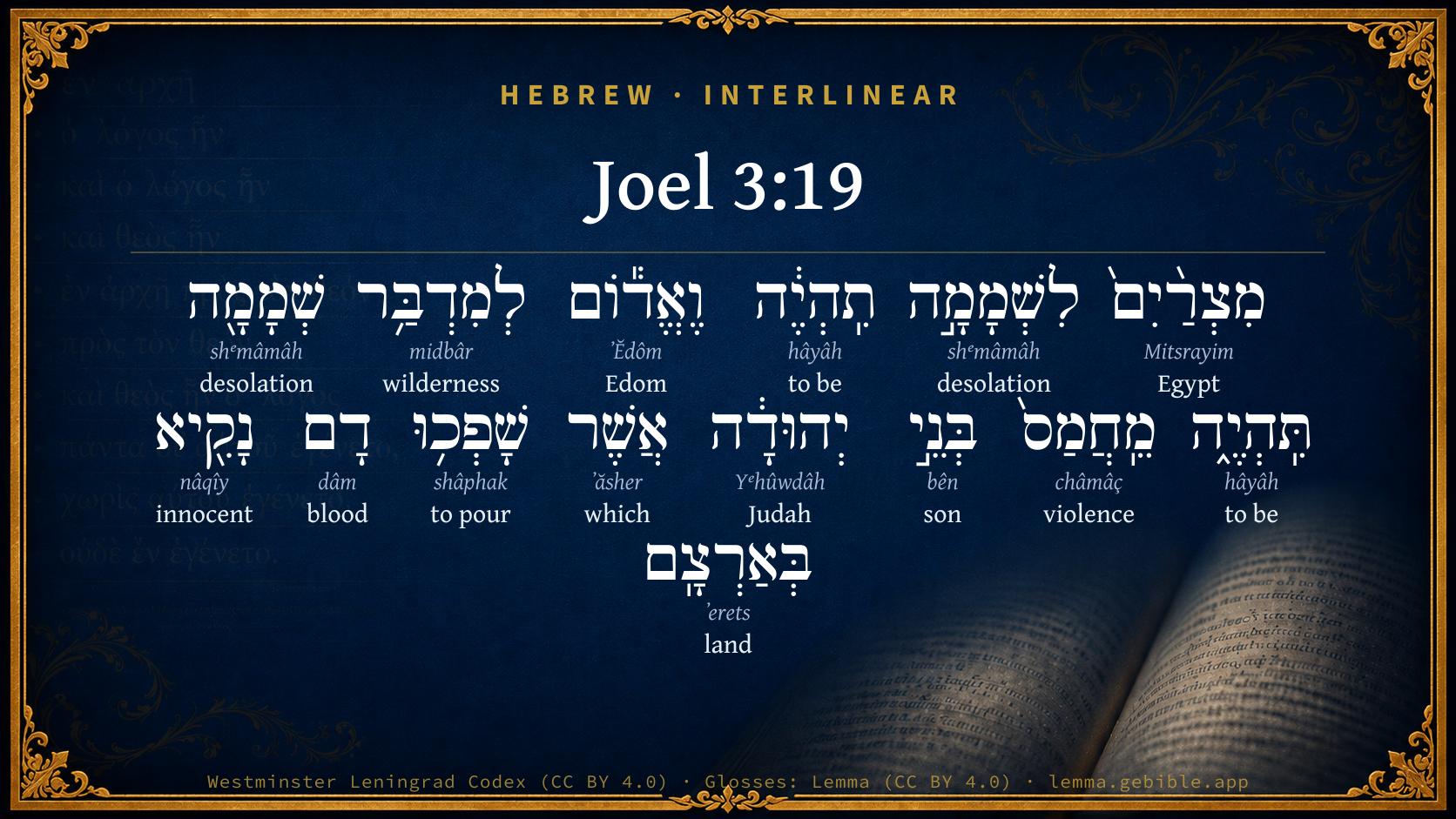
Joel 3:19

Hebrew (Westminster Leningrad Codex) Joel 3:19 appears in the Hebrew Old Testament. The text above is from the Westminster Leningrad Codex. Each word links to its Strong’s number, a concise gloss, and parsing drawn from the Open Scriptures Hebrew Bible morphology. Click any word for its full Brown-Driver-Briggs (BDB) entry.
Download image
Cite this verse

Joel 3:19 (World English Bible). Public Domain. Lemma interlinear Bible study tool, https://lemma.gebible.app/v/joel/3/19.

Show BibTeX & RIS
BibTeX
RIS
English Translation
Egypt will be a desolation, And Edom will be a desolate wilderness, For the violence done to the children of Judah, Because they have shed innocent blood in their land.
World English Bible · Public Domain
Download a study sheet

One document with this verse’s original text, its word-by-word gloss line, the meaning frame, cross-references with their text, attributed commentary, and full source and license credits — printable, and it pastes into notes with its structure intact.

This verse Autodidact and up

Study sheet (.html) Plain text (.txt)

A passage Seminary Student

Up to 50 verses in one chapter. A passage sheet keeps up to 6 commentary sources and 12 cross-references per verse, in the order this page ranks them, and says so on the sheet whenever that leaves anything out. Ask for a single verse and you get the Autodidact verse sheet above.

Everything on this page stays free to read, with no account — the sheet is a download of what is already on screen, not access to it.

Want to remove ads? Support Godless Engineer
Compare translations 3

The same verse in 3 English versions, stacked beneath the original-language interlinear above. Click any original word for its lexicon entry.

Each is an independent rendering of the whole verse — the interlinear is not word-aligned to these translations.

Highlighted words mark where these versions differ — a whole-verse word diff, not a word-by-word alignment.

  • World English Bible Public Domain
    Egypt will be a desolation, And Edom will be a desolate wilderness, For the violence done to the children of Judah, Because they have shed innocent blood in their land.
  • King James Version Public Domain
    Egypt shall be a desolation, and Edom shall be a desolate wilderness, for the violence against the children of Judah, because they have shed innocent blood in their land.
  • unfoldingWord Literal Text CC BY-SA 4.0
    Egypt will become desolation, and Edom will become a desolate wilderness for the violence of the sons of Judah, that they shed innocent blood in their land.

unfoldingWord Literal Text — © unfoldingWord, licensed CC BY-SA 4.0. Word-aligned USFM3 via Door43 (git.door43.org/unfoldingWord/en_ult).

Versions to compare (up to 4)

3 of 4 selected

Show all 18 translations

Every available English version of this verse, each an independent rendering of the whole verse.

  • World English Bible Public Domain
    Egypt will be a desolation, And Edom will be a desolate wilderness, For the violence done to the children of Judah, Because they have shed innocent blood in their land.
  • Berean Standard Bible Public Domain
    Egypt will become desolate, and Edom a desert wasteland, because of the violence done to the people of Judah, in whose land they shed innocent blood.
  • Majority Standard Bible Public Domain
    Egypt will become desolate, and Edom a desert wasteland, because of the violence done to the people of Judah, in whose land they shed innocent blood.
  • King James Version Public Domain
    Egypt shall be a desolation, and Edom shall be a desolate wilderness, for the violence against the children of Judah, because they have shed innocent blood in their land.
  • American Standard Version (1901) Public Domain
    Egypt shall be a desolation, and Edom shall be a desolate wilderness, for the violence done to the children of Judah, because they have shed innocent blood in their land.
  • Revised Version (1885) Public Domain
    Egypt shall be a desolation, and Edom shall be a desolate wilderness, for the violence done to the children of Judah, because they have shed innocent blood in their land.
  • Geneva Bible (1599) Public Domain
    Egypt shalbe waste, and Edom shall be a desolate wildernesse, for the iniuries of the childre of Iudah, because they haue shed innocent blood in their land.
  • Douay-Rheims (1899) Public Domain
    Egypt shall be a desolation, and Edom a wilderness destroyed: because they have done unjustly against the children of Juda, and have shed innocent blood in their land.
  • Young's Literal Translation Public Domain
    Egypt a desolation becometh, And Edom a desolation, a wilderness, becometh, For violence `to' sons of Judah, Whose innocent blood they shed in their land.
  • Literal Standard Version CC BY-SA 4.0
    “Egypt becomes a desolation, || And Edom becomes a desolation, a wilderness, || For violence [to] sons of Judah, || Whose innocent blood they shed in their land.
  • Unlocked Literal Bible CC BY-SA 4.0
    Egypt will become an abandoned devastation, and Edom will become an abandoned wilderness, because of the violence done to the people of Judah, because they shed innocent blood in their land.
  • unfoldingWord Literal Text CC BY-SA 4.0
    Egypt will become desolation, and Edom will become a desolate wilderness for the violence of the sons of Judah, that they shed innocent blood in their land.
  • Darby Bible Public Domain
    Egypt shall be a desolation, and Edom shall be a desolate wilderness, for the violence against the children of Judah, in that they have shed innocent blood in their land.
  • World Messianic Bible Public Domain
    Egypt will be a desolation and Edom will be a desolate wilderness, for the violence done to the children of Judah, because they have shed innocent blood in their land.
  • Webster's Bible Public Domain
    \\3:14\\Multitudes, multitudes in the valley of decision; for the day of the LORD is near in the valley of decision.
  • Free Bible Version CC BY-SA 4.0
    But Egypt will become desolate, and Edom a desert wasteland, because of the violence they did against Judah, for in their land they shed innocent blood.
  • Bible in Basic English Public Domain
    Masses on masses in the valley of decision! for the day of the Lord is near in the valley of decision.
  • JPS Tanakh (1917) Public Domain
    (4-19) Egypt shall be a desolation, and Edom shall be a desolate wilderness, for the violence against the children of Judah, because they have shed innocent blood in their land.

Literal Standard Version (2020), Covenant Press — licensed CC BY-SA 4.0. Text via the HelloAO Bible API (eBible.org). Unlocked Literal Bible (unfoldingWord) — licensed CC BY-SA 4.0. Text via the HelloAO Bible API (eBible.org). unfoldingWord Literal Text — © unfoldingWord, licensed CC BY-SA 4.0. Word-aligned USFM3 via Door43 (git.door43.org/unfoldingWord/en_ult). Free Bible Version, Dr. Jonathan Gallagher — licensed CC BY-SA 4.0. Text via the HelloAO Bible API (eBible.org).

Word by word

More ways to search: Search by grammar → Find every occurrence → Compare this word →

Practice this passage: Drill this verse → Learn its vocabulary →

נָקִ֖יא
nâqîy
H5355
“innocent”
Adjective, Adjective, Masculine, Singular, Absolute
Part of Speech
Adjective
Type
Adjective
Gender
Masculine
Number
Singular
State
Absolute
Full BDB Definition

Origin: from H5352

TWOT: 1412a , 1412b

clean, free from, exempt, clear, innocent - free from guilt, clean, innocent - free from punishment - free or exempt from obligations - innocent
  1. מִצְרַ֨יִם֙ Mitsrayim H4714 “Egypt” Noun, Proper
  2. לִשְׁמָמָ֣ה shᵉmâmâh H8077 “to/for · desolation” Preposition + Noun, Common, Feminine, Singular, Absolute
  3. תִֽהְיֶ֔ה hâyâh H1961 “to be” Verb, Qal, Imperfect, 3rd Person, Feminine, Singular
  4. וֶאֱד֕וֹם ʼĔdôm H123 “and · Edom” Conjunction + Noun, Proper
  5. לְמִדְבַּ֥ר midbâr H4057 “to/for · wilderness of” Preposition + Noun, Common, Masculine, Singular, Construct
  6. שְׁמָמָ֖ה shᵉmâmâh H8077 “desolation” Noun, Common, Feminine, Singular, Absolute
  7. תִּֽהְיֶ֑ה hâyâh H1961 “to be” Verb, Qal, Imperfect, 3rd Person, Feminine, Singular
  8. מֵֽחֲמַס֙ châmâç H2555 “from · violence of” Preposition + Noun, Common, Masculine, Singular, Construct
  9. בְּנֵ֣י bên H1121 “sons of” Noun, Common, Masculine, Plural, Construct
  10. יְהוּדָ֔ה Yᵉhûwdâh H3063 “Judah” Noun, Proper
  11. אֲשֶׁר ʼăsher H834 “which” Particle, Relative
  12. שָׁפְכ֥וּ shâphak H8210 “to pour” Verb, Qal, Perfect, 3rd Person, Common, Plural
  13. דָם dâm H1818 “blood” Noun, Common, Masculine, Singular, Absolute
  14. בְּאַרְצָֽם ʼerets H776 “in/at · land · their” Preposition + Noun, Common, Both, Singular, Construct + Suffix, Personal, 3rd Person, Masculine, Plural

About this verse

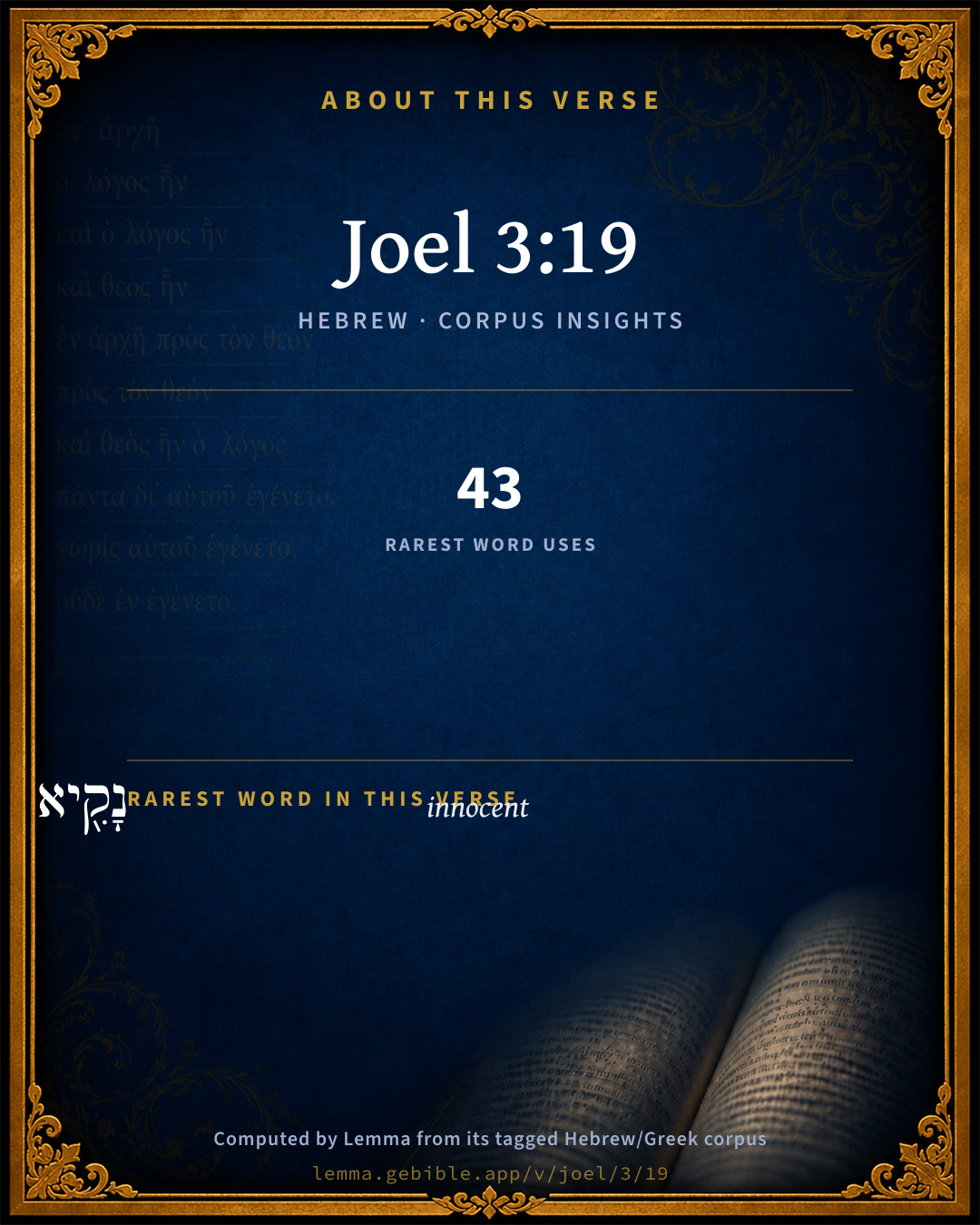
These counts appear in no published source. They are computed here, from the morphology-tagged text and Lemma’s own curated glosses. What Lemma adds →

15
words
13
distinct lemmas
Prophets
section

Shared distinctive vocabulary

נָקִ֖יא innocent H5355 occurs in 42 verses of the Hebrew Bible. Also found in:

Grammatical profile

  • 3 verbs
  • 10 nouns
  • 1 adjective
  • 1 particle

Verb forms

  • תִֽהְיֶ֔ה Qal · Imperfect
  • תִּֽהְיֶ֑ה Qal · Imperfect
  • שָׁפְכ֥וּ Qal · Perfect

Repetition

Words recur within this verse — often emphatic in Hebrew:

  • לִשְׁמָמָ֣ה desolation H8077 ×2
  • תִֽהְיֶ֔ה to be H1961 ×2

Hebrew & Septuagint length

In English translation the verse runs 30 words from the Hebrew and 30 from the Septuagint (LXX English) — the same length.

A rough comparison of the two English renderings, which tokenize alike — not a word-level alignment.

Word counts can differ between the Hebrew and the Greek without any difference in meaning — e.g. the Hebrew direct-object marker אֵת has no separate Greek word, and Greek often adds the article ὁ.

Cross-references

17

Topical passages linked to Joel 3:19 in the Treasury of Scripture Knowledge — connected by theme and wording, ordered by reader-vote popularity; previews shown in the World English Bible.

  • Isaiah 19:1–15 The burden of Egypt. Behold, Yahweh rides on a swift cloud, and comes to Egypt: and the idols of Egypt shall tremble at his presence; and the heart of Egypt shall melt in the midst of it.
  • Jeremiah 51:35 The violence done to me and to my flesh be on Babylon, shall the inhabitant of Zion say; and, My blood be on the inhabitants of Chaldea, shall Jerusalem say.
  • Zechariah 14:18–19 If the family of Egypt doesn't go up, and doesn't come, neither will it rain on them. This will be the plague with which Yahweh will strike the nations that don't go up to keep the feast of tents.
  • Psalms 137:7 Remember, Yahweh, against the children of Edom, The day of Jerusalem; Who said, "Raze it! Raze it even to its foundation!"
  • Isaiah 11:15 Yahweh will utterly destroy the tongue of the Egyptian sea; and with his scorching wind will he wave his hand over the River, and will strike it into seven streams, and cause men to march over in sandals.
  • Isaiah 34:1–17 Come near, you nations, to hear; and listen, you peoples: let the earth hear, and the fullness of it; the world, and all things that come forth from it.
  • Isaiah 63:1–6 Who is this who comes from Edom, with dyed garments from Bozrah? this who is glorious in his clothing, marching in the greatness of his strength? I who speak in righteousness, mighty to save.
  • Jeremiah 49:17 Edom shall become an astonishment: everyone who passes by it shall be astonished, and shall hiss at all the plagues of it.
  • Lamentations 4:21 Rejoice and be glad, daughter of Edom, that dwell in the land of Uz: The cup shall pass through to you also; you shall be drunken, and shall make yourself naked.
  • Ezekiel 25:1–17 The word of Yahweh came to me, saying,
  • Ezekiel 35:1–15 Moreover the word of Yahweh came to me, saying,
  • Amos 1:11–12 Thus says Yahweh: "For three transgressions of Edom, yes, for four, I will not turn away its punishment; Because he pursued his brother with the sword, And cast off all pity, And his anger raged continually, And he kept his wrath forever;
  • Obadiah 1:1 The vision of Obadiah. This is what the Lord Yahweh says about Edom. We have heard news from Yahweh, and an ambassador is sent among the nations, saying, "Arise, and let's rise up against her in battle.
  • Obadiah 1:10–16 For the violence done to your brother Jacob, shame will cover you, and you will be cut off forever.
  • Zechariah 10:10 I will bring them again also out of the land of Egypt, And gather them out of Assyria; And I will bring them into the land of Gilead and Lebanon; And there won't be room enough for them.
  • Malachi 1:3–4 but Esau I hated, and made his mountains a desolation, and gave his heritage to the jackals of the wilderness."
  • 2 Thessalonians 1:6 Since it is a righteous thing with God to repay affliction to those who afflict you,

Cross-references courtesy of OpenBible.info (CC BY 4.0).

Hebrew and Greek witnesses Masoretic Hebrew ↔ Greek Septuagint

The same verse in the two great witnesses to the Old Testament, shown verse-for-verse.

These are two independent witnesses, not word-aligned to each other, and the Septuagint is shown in lemma (dictionary) form.

Hebrew Joel 3:19 Masoretic · Westminster Leningrad Codex

מִצְרַ֨יִם֙ לִשְׁמָמָ֣ה תִֽהְיֶ֔ה וֶאֱד֕וֹם לְמִדְבַּ֥ר שְׁמָמָ֖ה תִּֽהְיֶ֑ה מֵֽחֲמַס֙ בְּנֵ֣י יְהוּדָ֔ה אֲשֶׁר שָׁפְכ֥וּ דָם נָקִ֖יא בְּאַרְצָֽם

Egypt will be a desolation, And Edom will be a desolate wilderness, For the violence done to the children of Judah, Because they have shed innocent blood in their land.

World English Bible · Public Domain

Greek LXX Joel 3:19 Septuagint · lemma form
Egypt shall be a desolation, and Idumea shall be a desolate plain, because of the wrongs of the children of Juda, because they have shed righteous blood in their land.

LXX2012 (modern English Septuagint) · Public Domain

Hebrew: Westminster Leningrad Codex (CC BY 4.0). Greek: Septuagint (public domain); English from LXX2012 (modern English Septuagint) (Public Domain). How the Septuagint differs from the Hebrew →

Commentary

Notes on Joel 3:19 from classic Christian and Jewish commentators (each source and its license shown beneath its notes). The classic Christian expositions comment on the surrounding passage and are grouped to its opening verse, so a note may address several verses; the Jewish commentaries on the Tanakh (Rashi and others) are per-verse, so they appear only where the commentator wrote on this verse.

Lemma curates 59 commentaries, every one of them public domain or Creative Commons licensed, each selected and text-cleaned for this edition rather than reprinted as found. About our sources →

Trapp's Complete Commentary

John Trapp

Joe 3:19 Egypt shall be a desolation, and Edom shall be a desolate wilderness, for the violence [against] the children of Judah, because they have shed innocent blood in their land.

Ver. 19. Egypt shall be a desolation] By Egypt and Edom are meant all Christ’s adversaries, whether they be professed open enemies, as were the Egyptians, or false brethren, as the Edomites. Romists have been both, and shall therefore be desolated, Rev 17:16; cf. Rev 11:8.

For the violence against the children of Judah] From the very cradle of the Church, Exo 1:8-14, yea, sooner; for Esau in the very womb jostled his brother Jacob, and offered violence against him, that he might lose no time.

Because they have shed innocent blood in the land] The saints’ blood is called innocent blood, 1. Because their sins are remitted; 2. Because they are causelessly killed. And this is a landdesolating sin. The innocent blood spilt by Manasseh brought the captivity: the Marian times, our late troubles. The blood of the martyrs, shed by Turk and Pope (whom the Jewish doctors understand by Egypt and Edom here), shall be the ruin of them both.

John Trapp, A Commentary or Exposition upon All the Books of the Old and New Testament (1647–1656) — public domain. Text from a community e-Sword module.

Joseph Benson's Commentary

Joe 3:19-20. Egypt shall be a desolation, and Edom, &c. — These two people were remarkable for the spite they bore to the Jews. The Egyptians were their oppressors when they first became a nation, and afterward exercised great cruelties upon them, during the reign of the Egyptian kings who were Alexander’s successors. The Idumeans are often reproved and threatened with judgments by the prophets, for the malice they took all occasions to vent against the Israelites, though nearly related to them: see the margin. These two nations, therefore, are taken, in a general sense, for the enemies of God’s people. But Judah — The redeemed of the Lord, his church, shall dwell, or continue, for ever — Free from the annoyance of enemies. The Christian Church is evidently intended, including probably the conversion and final restoration of the Jews.

Joseph Benson's Commentary on the Old and New Testaments (1811–1818) — public domain. Text from a community e-Sword module.

Tyndale Open Study Notes

Tyndale Open Resources

3:19 Even as Judah is restored, her ancient enemies Egypt and Edom would experience God’s judgment for their crimes against his people.

Tyndale Open Study Notes — © Tyndale Open Resources, licensed CC BY-SA 4.0. Text via the HelloAO Bible API.

Geneva Bible (1599)

Geneva Bible translators

The malicious enemies shall have no part of his graces.

Geneva Bible (1599) marginal notes — public domain. Text via Bolls.life.

Jamieson, Fausset & Brown

Robert Jamieson, A. R. Fausset & David Brown

Edom--It was subjugated by David, but revolted under Jehoram (Ch2 21:8-10); and at every subsequent opportunity tried to injure Judah. Egypt under Shishak spoiled Jerusalem under Rehoboam of the treasures of the temple and the king's house; subsequently to the captivity, it inflicted under the Ptolemies various injuries on Judea. Antiochus spoiled Egypt (Dan 11:40-43). Edom was made "desolate" under the Maccabees [JOSEPHUS, Antiquities, 12.11,12]. The low condition of the two countries for centuries proves the truth of the prediction (compare Isa 19:1, &c.; Jer 49:17; Oba 1:10). So shall fare all the foes of Israel, typified by these two (Isa 63:1, &c.).

Jamieson, Fausset & Brown — Commentary Critical and Explanatory on the Whole Bible (1871) — public domain (CC PDM 1.0). Text via the HelloAO Bible API.

Adam Clarke's Commentary

Verse 19. Egypt shall be a desolation] While peace, plenty, and prosperity of every kind, shall crown my people, all their enemies shall be as a wilderness; and those who have used violence against the saints of God, and shed the blood of innocents (of the holy MARTYRS) in their land, when they had political power; these and all such shall fall under the just judgments of God.

Adam Clarke's Commentary on the Bible (1810–1826) — public domain. Text from a community e-Sword/MySword module.

John Calvin's Commentaries

But he afterwards joins, that the Egyptians and Idumeans would be sterile and dry in the midst of this great abundance of blessings, for they were professed enemies to the Church. Hence God in this verse declares that they shall not be partakers of his bounty; that though all Judea would be irrigated, though it would abound in honeys milk, and wine, yet these would remain barren and empty; Mizraim, then, shall be a solitude, Edom shall be a desert of solitude. Why? Because of the troubles, he says, brought on the children of Judah. God again confirms this truth, that he has such a concern for his Church, that he will avenge wrongs done to it. God, then, does not always come to our help when we are unjustly oppressed, though he has taken us under his protection; but he suffers us for a time to endure our evils; and yet the end will show, that we have been ever dear to him and precious in his sight. So he says now, that for the harassments which the Egyptians and Idumeans occasioned to the children of Judah, they shall be destitute, notwithstanding the abundance of all good things.

Because they shed, he says, innocent blood in their (or, in their own) land. If we refer this to Egypt and Idumea, the sense will be, that they had not protected fugitives, but, on the contrary, cruelly slew them, as though they had been sworn enemies. Many, we know, during times of distress, fled to Egypt and Idumea, to seek refuge there. As, then, the Egyptians had been so inhuman towards the distressed, the Prophet threatens them with vengeance. But I prefer to view what is said as having been done in Judea; they have then shed innocent Blood, that is, in Judea itself. As God had consecrated this land to himself to pollute it with unjust slaughters was a more atrocious crime. Forasmuch then as the Egyptians and Idumeans thus treated the Jews, and slew them in their own country in a base manner, though they were abiding quietly at home, it is no wonder that God declares, that he would be the avenger of these wrongs. It follows —

John Calvin's Commentaries (1540-1563) — public domain. Text from the Calvin Translation Society English edition (1840s-50s) via the Christian Classics Ethereal Library (ccel.org). Calvin's coverage is partial (roughly two-thirds of the Bible); uncommented books and verses are honest gaps, never fabricated. The 19th-century editor's footnotes and remarks are omitted so the notes are faithfully Calvin's own voice.

Ellicott's Commentary for English Readers

(19) Egypt shall be a desolation.—Egypt and Edom always excited feelings of abhorrence in the hearts of the Jews. The memory of the exile in Egypt was always fresh and keen; no retrospect of their past history could leave it out of account. And the national detestation of the false and cruel-hearted Idumæan kinsmen is recalled by Obadiah in his prophecy and touching record; as also in Psalms 137, as rendered in the Prayer Book, “Remember the children of Edom, O Lord, in the day of Jerusalem, how they said, Down with it, down with it, even to the ground.”

A Bible Commentary for English Readers, edited by Charles John Ellicott (1878–1897) — public domain. Text from a community e-Sword module.

The Cambridge Bible for Schools and Colleges

gen. ed. J. J. S. Perowne

19. The land of Judah’s foes, on the contrary, will become a barren waste. Egypt and Edom are mentioned, probably, as typical examples of countries hostile to Israel.

The threat in the case of Egypt is the more pointed, as it was in general well-irrigated by the waters of the Nile: it may have been perhaps suggested by Eze_29:9; Eze_29:12; Eze_32:15.

a desolate wilderness] Joe_2:3.

because they have shed innocent blood in their land] The expression hardly points to blood shed in warfare, but rather to the sudden and unprovoked massacre of Jews who were settled and living peaceably in the two countries named, possibly at the time of a revolt.

The Cambridge Bible for Schools and Colleges (gen. ed. J. J. S. Perowne; Cambridge University Press, 1878–1918) — public domain. Text from a community e-Sword module.

John Gill's Exposition

Egypt shall be a desolation, and Edom shall be a desolate wilderness,.... These two nations having been the implacable enemies of Israel, are here put for the future adversaries of the church of Christ, Pagan, Papal, and Mahometan; who will all be destroyed as such, and be no more: Rome is called, spiritually or mystically, Egypt, Rev 11:8; and Edom is a name that well agrees with it, it signifying "red", as it is with the blood of the saints: and it is common, with the Jewish writers, by Edom to understand Rome; which though it may not be true of all places they so interpret, yet is of many, and so here. Kimchi, by Egypt understands the Ishmaelites, or the Turks; and, by Edom, Rome;

for the violence of the children of Judah, because they have shed innocent blood is their land; either in the land of Judah; or rather in their own land, Egypt and Edom. This respects the violences and outrages committed by the antichristian states upon the true professors of the Christian religion, the Waldenses and Albigenses, and others, whose innocent blood, in great quantities, has been spilled by them. Antichrist is represented as, drunk with the blood of the martyrs of Jesus, and in whom will be found the blood of all the prophets and saints; and for this reason ruin and destruction will come upon him and his followers, and blood will be given them to drink, for they are worthy, Rev 17:6.

John Gill's Exposition of the Whole Bible (1746–1763) — public domain (CC PDM 1.0). Text via the HelloAO Bible API.

Albert Barnes' Notes on the Bible

Egypt shall be a desolation - “Egypt” and “Edom” represent each a different class of enemies of the people of God, and both together exhibit the lot of all. Egypt was the powerful oppressor, who kept Israel long time in hard bondage, and tried, by the murder of their male children, to extirpate them. Edom was, by birth, the nearest allied to them, but had, from the time of their approach to the promised land, been hostile to them, and showed a malicious joy in all their calamities (Oba 1:10-14; Eze 25:12; Eze 35:15; Eze 36:5; Lam 4:22; Psa 137:7; see the note at Amo 1:11). “Their land,” in which Egypt and Edom shed the “innocent blood of the children of Judah,” may either be Edom, Egypt, or Judaea. If the land was Judaea, the sin is aggravated by its being God’s land, the possession of which they were disputing with God. If it was Egypt and Edom, then it was probably the blood of those who took refuge there, or, as to Edom, of prisoners delivered up to them (see the note at Amo 1:9).

This is the first prophecy of the humiliation of Egypt. Hosea had threatened, that Egypt should be the grave of those of Israel who should flee there Hos 9:6. He speaks of it as the vain trust, and a real evil to Israel Hos 7:11-12, Hos 7:16; Hos 8:13; Hos 9:3; Hos 11:5; of its own future he says nothing. Brief as Joel’s words are, they express distinctly an abiding condition of Egypt. They are expanded by Ezekiel Eze 29:9-12, Eze 29:15; particular chastisements are foretold by Isaiah Isa. 19; Isa 20:1-6, Jeremiah Jer. 46, Ezekiel Ezek. 29–32, Zechariah Zec 10:11. But the three words of Joel , “Egypt shall become desolation,” are more comprehensive than any prophecy, except those by Ezekiel. They foretell that abiding condition, not only by the force of the words, but by the contrast with an abiding condition of bliss. The words say, not only “it shall be desolated,” as by a passing scourge sweeping over it, but “it shall itself ‘pass over into’ that state;” it shall become what it had not been ; and this, in contrast with the abiding condition of God’s people. The contrast is like that of the Psalmist, “He turneth a fruitful land into barrenness for the wickedness of them that dwell therein. He turneth the wilderness into a standing water, and dry ground into water-springs” Psa 107:33-35. Judah should overflow with blessing, and the streams of God’s grace should pass beyond its bounds, and carry fruitfulness to what now was dry and barren. But what should reject His grace should be itself rejected.

Yet when Joel thus threatened Egypt, there were no human symptoms of its decay; the instruments of its successive overthrows were as yet wild hordes, (as the Chaldees, Persians, and Macedonians,) to be consolidated thereafter into powerful empires, or (as Rome) had not the beginnings of being. : “The continuous monumental history of Egypt” went back seven centuries before this, to about 1520 b.c. They had had a line of conquerors among their kings, who subdued much of Asia, and disputed with Assyria the country which lay between there . Even after the time of Joel, they had great conquerors, as Tirhaka; Psammetichus won Ashdod back from Assyria , Neco was probably successful against it, as well as against Syria and king Josiah, for he took Cadytis on his return from his expedition against Carchemish 2Ki 23:29; Pharaoh Hophra, or Apries, until he fell by his pride Eze 29:3, renewed for a time the prosperity of Psammetichus ; the reign of Amasis, even after Nebuchadnezzars conquest, was said to be “the most prosperous time which Egypt ever saw” ; it was still a period of foreign conquest , and its cities could be magnified into 20,000.

The Persian invasion was drawn upon it by an alliance with Lydia, where Amasis sent 120,000 men ; its, at times, successful struggles against the gigantic armies of its Persian conquerors betoken great inherent strength; yet it sank for ever, a perpetual desolation. “Rent, twenty-three centuries ago, from her natural proprietors,” says an unbelieving writer , “she has seen Persians, Macedonians, Romans, Greeks, Arabs, Georgians, and at length, the race of Tartars, distinguished by the name of Ottoman Turks, establish themselves in her bosom.” “The system of oppression is methodical;” “an universal air of misery is manifest in all which the traveler meets.” : “Mud-walled cottages are now the only habitations, where the ruins of temples and palaces abound. The desert covers many extensive regions, which once raised Egypt among the chief of the kingdoms.” The desolation of Egypt is the stranger, because exceeding misrule alone could have effected it.

Egypt in its largest dimensions, has been calculated to contain 123,527 square miless or 79,057,339 acres, and to be three fourths of the size of France Memoire sur le lae de Moeris. (1843). The mountains which hem in Upper Egypt, diverge at Cairo, parting, the one range, due east, the other northwest. The mountains on the west sink into the plains; those on the east retain their height as far as Suez. About 10 miles below Cairo, the Nile parted, enclosing within the outside of its seven branches, that triangle of wondrous fertility, the Delta. A network of canals, formed by the stupendous industry of the ancient Egyptians, enclosed this triangle in another yet larger, whose base, along the coast, was 235 miles, in direct distance about 181. East of the eastern-most branch of the Nile, lay the “land of Goshen,” formerly, at least for cattle, “the good of the land” Gen 47:6, Gen 47:11, a part, at least, of the present esh-Sharkiyyeh, second in size of the provinces of Egypt, but which, 1375 a.d., yielded the highest revenue of the state .

On the western side of the Nile, and about a degree south of the apex of the Delta, a stupendous work, the artificial lake of Moeris , enclosing within masonry 64 34 square miles of water, received the superfluous waters of the river, and thus at once prevented the injury incidental on any too great rise of the Nile, and supplied water during six months for the irrigation of 1724 square miles, or 1,103, 375, acres .

The Nile which, when it overflowed, spread like a sea over Egypt , encircling its cities like islands, carried with it a fertilizing power, attested by all, but which, unless so attested, would seem fabulous. Beneath a glowing heat, greater than its latitude will account for, the earth, supplied with continual moisture and an ever renewed alluvial deposit which supersedes all need of “dressing” the soil, yields, within the year, three harvests of varied produce . This system of canalising Egypt must have been of very early antiquity. That giant conception of the water system of lake Moeris is supposed to have been the work of Ammenemhes, perhaps about 1673, b.c. . But such a giant plan presupposes the existence of an artificial system of irrigation which it expanded. In the time of Moses, we hear incidentally of “the streams” of Egypt, “the canals” (that is, those used for irrigation), and “the ponds” Exo 7:19; Exo 8:1, the receptacles of the water which was left when the Nile retired.

Besides these, an artificial mode of irrigation “by the foot” Deut. 11:40 is mentioned, now no longer distinctly known, but used, like the present plans of the water-wheel and the lever , to irrigate the lands for the later harvests. This system of irrigation had, in the time of Joel, lasted probably for above 1000 years. The Egyptians ascribed the first turning of the Nile to their first king, Menes , of fabulous antiquity. But while it lasted in any degree, Egypt could not become barren except by miracle. Even now it recovers, whenever water is applied. “Wherever there is water, there is fertility.” : “The productive powers of the soil of Egypt are incalculable. Wherever water is scattered, there springs up a rapid and beautiful vegetation. The seed is sown and watered, and scarcely any other care is requisite for the ordinary fruits of the earth. Even in spots adjacent to the desert and which seem to be taken possession of by the sands, irrigation brings rapidly forth a variety of green herbs and plants.” For its first crop, there needed but to cast the seed, and have it trodden in by cattle .

Nothing then could desolate Egypt, except man’s abiding negligence or oppression. No passing storm or inroad could annihilate a fertility, which poured in upon it in everrenewing richness. For 1000 years, the Nile had brought to Egypt unabated richness. The Nile overflows still, but in vain amid depopulation, and grinding, uniform, oppression. Not the country is exhausted, but man.

“If” says Mengin , “it is true that there is no country richer than Egypt in its territorial productions, still there is perhaps no one whose inhabitants are more miserable. It is owing solely to the fertility of its soil and the sobriety of its cultivators, that it retains the population which it still has.” The marked diminution of the population had begun before the Birth of our Lord. “Of old,” says Diodorus , “it far exceeded in denseness of population all the known countries in the world, and in our days too it seems to be inferior to no other. For in ancient times it had more than 18,000 considerable villages and towns, as you may see registered in the sacred lists. In the time of Ptolemy Lagus more than 30,000 were counted, a number which has continued until now. But the whole people are said of old to have been about seven million, and in our days not less than three” .

A modern estimate supposes that Egypt, if cultivated to the utmost, would, in plentiful years, support eight million . It is difficult to calculate a population where different ranks wish to conceal it. It has been guessed however, that two centuries ago, it was four million; that, at the beginning of this century, it was two million and a half; and that, in 1845, it was 1,800,000 . The great diminution then had begun 1900 years ago. Temporary causes, plague, smallpox; conscription, have, in this last century, again halved the population; but down to that time, it had sunk to no lower level than it had already reached at least 18 centuries before. The land still, for its fruitfulness, continues to supply more than its inhabitants consume; it yields over and above cotton , for strangers to employ.

Yet its brilliant patches of vegetation are but indications how great the powers implanted in it. In vain “the rising Nile overflows (as it is thought) a larger proportion of the soil” than heretofore; in vain has the rich alluvial deposit encroached upon the gradual slope of the desert; in vain, in Upper Egypt has a third been added since about the time of the Exodus. Egypt is stricken. Canals and even arms of the Nile, were allowed to choke up. Of the seven branches of the Nile, two only, at first artificial, remain. : “The others have either entirely disappeared or are dry in summer.” The great eastern arm, the Pelusian, is nearly effaced “buried almost wholly beneath the sands of the desert.” : “The land at the mouth of the canal which represents it, is a sand waste or a marsh.” : “There is now no trace of vegetation in the whole Pelusian plain. Only one slight isolated rise has some thickets on it, and some shafts of columns lie on the sand.” : “In the midst of a plain the most fertile, they want the barest necessaries of life.”

The sand of the desert, which was checked by the river and by the reeds on its banks, has swept over lands no longer fertilized. : “The sea has not been less destructive. It has broken down the dykes wherewith man’s labor held it in, and has carried barrenness over the productive lands which it converted into lakes and marshes.” A glance at the map of Egypt will show how widely the sea has burst in, where land once was. On the east, the salt lake Menzaleh, (itself from west-northwest to southeast about 50 miles long, and above 10 miles from north to south) absorbs two more of the ancient arms of the Nile, the Tanitic and the Mendesian . The Tanitic branch is marked by a deeper channel below the shallow waters of the lake . The lake of Burlos “occupies from east to west more than half the basis of the Delta.” Further westward are a succession of lakes, Edkou, Madyeh (above 12 12 miles) Mareotis (37 12 miles). : “The ancient Delta has lost more than half its surface, of which one-filth is covered with the waters of the lakes Mareotis, Madyeh, Edkou, Bourlos, and Menzaleh, sad effects of the carelessness of the rulers or rather spoilers of this unhappy country.” Even when the lake Mareotis was, before the English invasion in 1801, allowed nearly to dry up, it was but an unhealthy lagoon; and the Mareotic district, once famous for its wine and its olives and papyrus , had become a desert. So far from being a source of fertility, these lakes from time to time, at the low Nile, inundate the country with salt water, and are “surrounded by low and barren plains” .

The ancient populousness and capabilities of the western province are attested by its ruins. : “The ruins which the French found everywhere in the military reconnaissances of this part of Egypt attest the truth of the historical accounts of the ancient population of the Province, now deserted” ; “so deserted, that you can scarce tell the numbers of ruined cities frequented only by wandering Arabs.”

According to a calculation lower than others, 13 of the land formerly tilled in Egypt has been thrown out of cultivation, i. e., not less than 1,763,895 acres or 2755.710 square miles . And this is not of yesterday. Toward the end of the 14th century, the extent of the land taxed was 3,034,179 feddans , i. e., 4,377,836.56 acres or 6840.13 square miles. The list of lands taxed by the Egyptian government in 1824 yields but a sum of 1,956, 40 feddans , or 2,822,171 acres or 4409 square miles. Yet even this does not represent the land actually cultivated. Some even of the taxed land is left wholly, some partially, uncultivated .

In an official report , 2,000,000 feddans are stated to be cultivated, when the overflow of the Nile is the most favorable, i. e., 47 only of the estimated cultivable amount. The French, who surveyed Egypt minutely, with a view to future improvement, calculated that above 1,000,000 feddans (1,012,887) might be proximately restored by the restoration of the system of irrigation, and nearly 1,000,000 more (942,810) by the drainage of its lakes, ponds and marshes, i. e., nearly as much again as is actually cultivated. One of the French surveyors sums up his account of the present state of Egypt ; “without canals and their dykes, Egypt, ceasing to be vivified throughout, is only a corpse which the mass of the waters of its river inundates to superfluity, and destroys through fullness. Instead of those ancient cultivated and fertile plains, one only finds, here and there, canals filled up or cut in two, whose numerous ramifications, crossing each other in every direction, exhibit only some scarcely distinguishable traces of a system of irrigation; instead of those villages and populous cities, one sees only masses of bare and arid ruins, remnants of ancient habitations reduced to ashes; lastly, one finds only lagoons, miry and pestilential, or sterile sands which extend themselves, and unceasingly invade a land which the industry of man had gained from the desert and the sea.”

Yet this is wholly unnatural. In the prophet’s time, it was contrary to all experience. Egypt is alike prolific in its people and in the productions of the earth. The Egyptian race is still accounted very prolific . So general is this, that the ancients thought that the waters of tim Nile must have some power of fecundity . Yet with these powers implanted in nature unimpaired, the population is diminished, the land half-desert. No one doubts that man’s abiding misgovernment is the cause of Egypt’s desolation. Under their native princes, they were happy and prosperous . Alexander, some of the Ptolemies, the Romans, saw, at least, the value of Egypt. The great conception of its Greek conqueror, Alexandria, has been a source of prosperity to strangers for above 2000 years. Prosperity has hovered around Egypt. Minds, the most different, are at one in thinking that, with a good government, internal prosperity and its farfamed richness of production might at once be restored. Conquerors of varied nations, Persians, Macedonians, Romans, Greeks, Arabs, Georgians, Tartars, or Turks have tried their hands upon Egypt. Strange that selfishness or powerlessness for good should have rested upon all; strange that no one should have developed its inherent powers! Strange contrast. One long prosperity, and one long adversity. One scarcely broken day, and one troubled night. And that doom foretold in the mid-day of its prosperity, by those three words, “Egypt shall be a desolation.”

Edom shall be a desolate wilderness - Edom, long unknown, its ancient capital, its rock-dwellings, have been, within these last forty years, anew revealed. The desolation has been so described to us, that we have seen it, as it were, with our own eyes. The land is almost the more hopelessly desolate, because it was once, artificially, highly cultivated. Once it had the “fatness of the earth and the dew of heaven from above” Gen 27:39 : it had Num 20:17 “cornfields” and “vineyards” in abundance, and “wells” of water; its vegetation, its trees, and its vineyards, attracted the dew by which they were supported. “Petra,” says Strabo, (xvi. 4, 21), “lies in a spot precipitous and abrupt without, but within possessed of abundant fountains for watering and horticulture.” The terrace-cultivation, through which each shower which falls is stored to the uttermost, clothing with fertility the mountain-sides, leaves those steep sides the more bare, when disused. “We saw,” says a traveler , “many ruined terraces, the evidences and remains of a flourishing agriculture, which, in the prosperous days of Edom and Petra, clothed many of these now sterile mountains with fertility and beauty. Fields of wheat and some agricultural villages still exist in the eastern portion of Edom; but, with very slight exceptions, the country is blighted with cheerless desolations and hopeless sterility. The hill-sides and mountains, once covered with earth and clothed with vineyards, are now bare rocks. The soil no longer supported by terraces and sheltered by trees, has been swept away by the rains. The various contrivances for irrigation, which even now might restore fertility to many considerable tracts, have all disappeared. Sand from the desert, and the debris of the soft rock of the mountains, cover the valleys which formerly smiled with plenty.”

Now “the springs have been dried up to such an extent, as to render the renewal of the general fertility of Edom (well nigh) impossible. In places along the course of the stream, reeds and shrubs grow luxuriantly, oleanders and wild figs abound, and give proof that a little cultivation would again cover the rock, and fill the cliffs with the numberless gardens which once adorned them. The traces of former fertility are innumerable; every spot capable of sustaining vegetable life was carefully watered and cultivated. There are numerous grooves in the rocks to carry rainwater to the little clefts in which even now figs are found. Every spot capable of being so protected has been walled up, however small the space gained, or however difficult the means of securing it. The ancient inhabitants seem to have left no accessible place untouched. They have exhibited equal art and industry in eliciting from the grand walls of their marvelous capital whatever the combination of climate, irrigation and botanical skill could foster in the scanty soil afforded them. The hanging gardens must have had a wondrous effect among the noble buildings of the town when it was in all its glory.” This desolation began soon after the captivity of Judah and Edom’s malicious joy in it. For Malachi appeals to Judah, that whereas God had restored him, He had “laid the mountains and the heritage” of Esau “waste for the jackals of the wilderness” Mal 1:3.

Yet Edom was the center of the conversation of nations. Occupying, as it did in its narrowest dimensions, the mountains between the south end of the Dead Sea and the Aelanitic gulf, it lay on the direct line between Egypt and Babylonia. A known route lay from Heroopolis to Petra its capital, and thence to Babylon . Elath and Ezion-geber discharged through its vally, the Arabah, the wealth which they received by sea from India or Africa. Petra was the natural halting-place of the caravans. “The Nabataeans,” says Pliny , “enclose Petra, in a valley of rather more than two miles in extent, surrounded by inaccessible mountains, through which a stream flows. Here the two roads meet of those who go to Palmyra of Syria, and of those who come from Gaza.” Eastward again, he says , “they went from Petra to Fora, and thence to Charax” on the banks of the Tigris, near the Persian gulf.

Yet further the wealth of Arabia Felix poured by a land-route through Petra. : “To Petra and Palestine, Gerraens and Minaeans and all the neighboring Arabs brought down from the upper country the frankincense, it is said, and all other fragrant merchandise.” Even after the foundation of Alexandria had diverted much of the stream of commerce from Leuce Come, the Aelanitic gulf, and Petra to Myos Hormus on the Egyptian side of the Red Sea, the Romans still connected Elath and Petra with Jerusalem by a great road, of which portions are still extant , and guarded the contact by military stations . Of these routes, that from Arabia Felix and from Egypt to Babylonia had probably been used for above 1000 years before the time of Joel. Elath and Eziongeber were well-known towns at the time of the Exodus Deu 2:8.

The contact was itself complex and manifold. The land exports of Arabia Felix and the commerce of Elath necessarily passed through Edom, and thence radiated to Egypt, Palestine, Syria. The withdrawal of the commerce of Egypt would not alone have destroyed that of Petra, while Tyre, Jerusalem, Damascus, still received merchandise through her. To them she was the natural channel; the pilgrim-route from Damascus to Mecca lies still by Petra. In Joel’s time, not the slightest shadow was cast on her future. Then Babylon destroyed her for a time; but she recovered. The Babylonian and Persian Empires perished; Alexander rose and fell; Rome, the master alike of Alexandria and Petra, meant Petra still to survive. No human eye could even then tell that it would be finally desolate; much less could any human knowledge have foreseen it in that of Joel. But God said by him, “Edom shall be a desolate wilderness,” and it is so!

As, however, Egypt and Edom are only instances of the enemies of God’s people and Church, so their desolation is only one instance of a great principle of God’s Government, that “the triumphing of the wicked is short, and the joy of the ungodly for a moment” Job 20:5; that, after their short-lived office of fulfilling God’s judgment on His people, the judgment rolls round on themselves, “and they that hate the righteous shall be desolate” Psa 34:21.

Albert Barnes' Notes on the Bible (1834–1885) — public domain. Text from a community e-Sword/MySword module.

Haydock's Catholic Bible Commentary

Desolation. Cambyses laid it waste for three years, as Ochus did afterwards. --- Edom. Judas and Hican punished them for their former barbarity, Psalm cxxxvi. 7., and 2 Machabees x. 16., and Ezechiel xxv. 12. (Calmet)

George Leo Haydock (1774–1849), Haydock's Catholic Family Bible and Commentary, 1859 edition — public domain. Excludes Psalms (Douay-Rheims chapter numbering differs from Protestant) and Deuterocanonical books (Catholic canon only).

Matthew Poole's English Annotations

Egypt: it was in Egypt that the people of God were long kept in bondage, which defiled Israel too with its idolatries, contrived the ruin of Israel by a barbarous and unparalleled cruelty, murdering all the new-born males, and with utmost obstinacy resisted the deliverer who came to fetch Israel out of bondage. By Egypt understand we then all the enemies of the church of Christ, who carry it toward the church as Egypt carried it toward Israel. Shall be a desolation; most desolate, when God shall judge and punish; so shall spiritual Egypt, Rev 11:8.

Edom; the posterity of Esau, of near kin to Israel according to the flesh, whose first father envied Jacob the blessing and vowed his death, and made him flee from his father’s house and become a servant in a strange land, and was the first who denied Israel a friendly passage and the common civility of necessaries for their money, and came out in hostile manner to fight them, Num 20:18, &c. It was Edom of whom you read in Obadiah, a most bloody, implacable enemy to Judah in his greatest distress. And all who come under Edom’s character are here intended, and threatened under this name.

Shall be a desolate wilderness; most desolate, and which art cannot repair; desolate houses or vineyards may, but wildernesses cannot, by art be repaired.

The children of Judah; the people of God, his churches.

They have shed innocent blood in their land; where distressed Jews should have found safety, they met their death; in Egypt and Judea.

Matthew Poole's English Annotations on the Holy Bible (1683–1685) — public domain. Text from a community e-Sword/MySword module.

Whedon's Commentary on the Bible

Daniel D. Whedon

19. While Judah is thus prospering, the curse of desolation (Joe_2:3) will fall upon Edom and Egypt on account of the crimes committed against the children of Israel.

Egypt — Much had Israel suffered from Egypt from the time of the Exodus to the Exile. The only time when friendly relations existed was for a brief period during the reign of Solomon (1Ki_3:1; 1Ki_9:16, etc.). The friendship during the Assyrian period, condemned by the prophet Isaiah, was not sincere. Egypt was well watered by nature and by artificial irrigation, but this will avail nothing when the blow from Jehovah will fall.

Edom — Located south and southeast of the Dead Sea. After the destruction of Jerusalem the Edomites occupied territory in southern Judah. They also were long-time enemies of the Israelites, and they are severely condemned for rejoicing over the fall of the holy city (Psa_137:7). It is quite possible that these two hostile nations are mentioned merely as types of all enemies of Israel and of the God of Israel.

Violence — This violence consisted in the shedding of innocent blood. In their land — Not in the land of the Judaeans (Wuensche), but of the Egyptians and Edomites.

Shed innocent blood — Not in time of warfare, but in unprovoked massacres of peaceable Jews dwelling in these lands (Exo_1:16; Amo_1:11; Oba_1:10).

Daniel D. Whedon (gen. ed.), Commentary on the Old and New Testaments (1874–1909) — public domain. Text from a community e-Sword module.

The Pulpit Commentary

Egypt shall be a desolation, and Edom a desolate wilderness, for the violence against the children of Judah. The curse of barrenness and utter desolation falls on the enemies of Judah the nearer and the more remote because of that very enmity and the violence which was its outcome. The Edomite enemies in the south revolted from Judah in the days of Jehoram; the Edomites compassed him in, and, by thus surrounding him, placed him in extreme peril; and though it is said he smote them, yet his expedition proved unsuccessful, for it is added by the chronicler that "the Edomites revolted from under the hand of Judah unto this day." The Egyptian enemies in the more distant south made a still more formidable attack on the capital city, Jerusalem, under the famous Shishak, in the fifth year of the reign of Rehoboam, plundering the palace and temple. What acts of violence were perpetrated in these or other wars unrecorded we know not. A more specific charge follows: Because they have shed innocent blood in their land. This is understood by some to refer to the blood of captive or fugitive Jews in the lands of their Edomite and Egyptian enemies. It seems preferable to understand the suffix answering to "their" of the laud of Judah, on the occasion of some hostile inroad into Jewish territory.

The Pulpit Commentary (1880–1919), ed. H.D.M. Spence-Jones & Joseph S. Exell — public domain. Text from a community e-Sword module.

John Wesley's Explanatory Notes

Egypt - By Egypt we may understand all the enemies of the church who carry it toward the church, as Egypt carried it toward Israel. Edom - Edom was an implacable enemy to Judah in his greatest distress. And all who come under Edom's character are here threatened under this name. Judah - The people of God.

John Wesley, Explanatory Notes Upon the Whole Bible (1754–1765) — public domain. Text via the GEBible commentary corpus.

Lesson kit

Teaching starters — assembled from the data on this page, not authored interpretation. Every prompt links to the verse data it draws on. Edit before teaching.

Joel, in the Prophets, opens this verse with 15 words (13 distinct Hebrew lemmas). Its most distinctive word is nâqîy (“innocent”). A historical commentator’s framing appears above. Read the whole chapter for the surrounding context.

Discussion questions

  1. How does “innocent” (nâqîy) shape what this verse is saying?
  2. How does Genesis 24:41, which shares the word «innocent», read alongside this verse?
  3. What does the repetition of “desolation” (2× in this one verse) do in this verse?
  4. These translations render this verse differently. What is at stake in choosing one wording over another?
  5. «תִֽהְיֶ֔ה» is a Qal Imperfect verb. How does that grammatical form shape the action described?
  6. Compare how Trapp's Complete Commentary and Joseph Benson's Commentary read this verse. Where do they agree or differ?

Things to notice

  • These translations choose different wording for 9 words in this verse.
  • “desolation” occurs 2× in this single verse.
  • 13 distinct Hebrew lemmas span 15 words in this verse.

Reading settings

Reading text

Shown beneath each verse's original-language words.

Old Testament
Old Testament edition

Read the OT as the Masoretic Hebrew (MT) or the Greek Septuagint (LXX).

English shown for the Greek Septuagint (in the Hebrew ↔ Greek comparison).

Comparing translations? Open the Compare panel on any verse page to stack up to four side by side.