Jeremiah 43:13

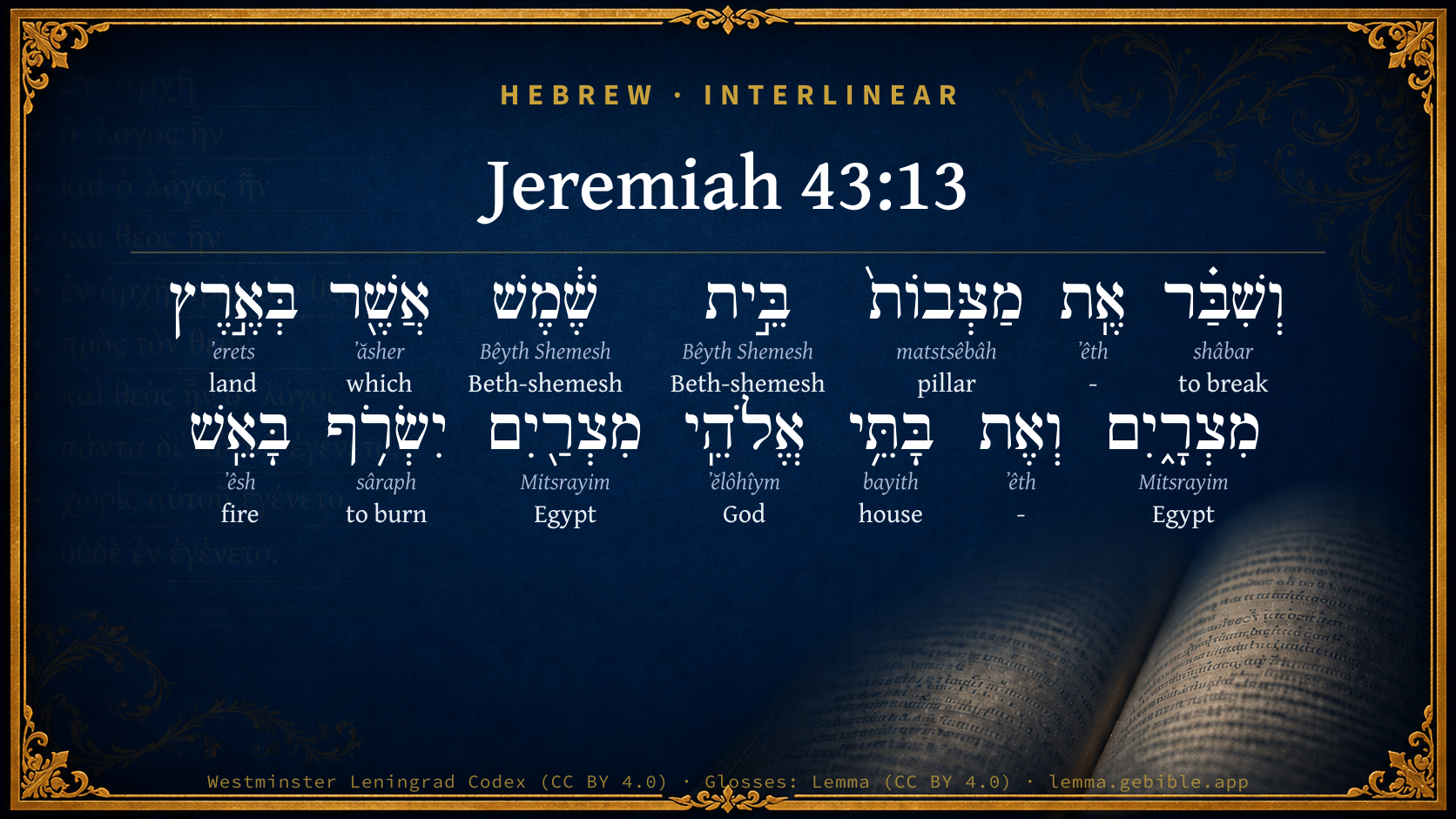
Hebrew (Westminster Leningrad Codex) Jeremiah 43:13 appears in the Hebrew Old Testament. The text above is from the Westminster Leningrad Codex. Each word links to its Strong’s number, a concise gloss, and parsing drawn from the Open Scriptures Hebrew Bible morphology. Click any word for its full Brown-Driver-Briggs (BDB) entry.
Download image
Cite this verse

Jeremiah 43:13 (World English Bible). Public Domain. Lemma interlinear Bible study tool, https://lemma.gebible.app/v/jeremiah/43/13.

Show BibTeX & RIS
BibTeX
RIS
English Translation
He shall also break the pillars of Beth-shemesh, that is in the land of Egypt; and the houses of the gods of Egypt shall he burn with fire.
World English Bible · Public Domain
Download a study sheet

One document with this verse’s original text, its word-by-word gloss line, the meaning frame, cross-references with their text, attributed commentary, and full source and license credits — printable, and it pastes into notes with its structure intact.

This verse Autodidact and up

Study sheet (.html) Plain text (.txt)

A passage Seminary Student

Up to 50 verses in one chapter. A passage sheet keeps up to 6 commentary sources and 12 cross-references per verse, in the order this page ranks them, and says so on the sheet whenever that leaves anything out. Ask for a single verse and you get the Autodidact verse sheet above.

Everything on this page stays free to read, with no account — the sheet is a download of what is already on screen, not access to it.

Want to remove ads? Support Godless Engineer
Compare translations 3

The same verse in 3 English versions, stacked beneath the original-language interlinear above. Click any original word for its lexicon entry.

Each is an independent rendering of the whole verse — the interlinear is not word-aligned to these translations.

Highlighted words mark where these versions differ — a whole-verse word diff, not a word-by-word alignment.

  • World English Bible Public Domain
    He shall also break the pillars of Beth-shemesh, that is in the land of Egypt; and the houses of the gods of Egypt shall he burn with fire.
  • King James Version Public Domain
    He shall break also the images of Bethshemesh, that is in the land of Egypt; and the houses of the gods of the Egyptians shall he burn with fire.
  • unfoldingWord Literal Text CC BY-SA 4.0
    He will break the stone pillars at Heliopolis in the land of Egypt. He will burn the temples of Egypt’s gods.’”

unfoldingWord Literal Text — © unfoldingWord, licensed CC BY-SA 4.0. Word-aligned USFM3 via Door43 (git.door43.org/unfoldingWord/en_ult).

Versions to compare (up to 4)

3 of 4 selected

Show all 18 translations

Every available English version of this verse, each an independent rendering of the whole verse.

  • World English Bible Public Domain
    He shall also break the pillars of Beth-shemesh, that is in the land of Egypt; and the houses of the gods of Egypt shall he burn with fire.
  • Berean Standard Bible Public Domain
    He will demolish the sacred pillars of the temple of the sun in the land of Egypt, and he will burn down the temples of the gods of Egypt.’”
  • Majority Standard Bible Public Domain
    He will demolish the sacred pillars of the temple of the sun in the land of Egypt, and he will burn down the temples of the gods of Egypt.’”
  • King James Version Public Domain
    He shall break also the images of Bethshemesh, that is in the land of Egypt; and the houses of the gods of the Egyptians shall he burn with fire.
  • American Standard Version (1901) Public Domain
    He shall also break the pillars of Beth-shemesh, that is in the land of Egypt; and the houses of the gods of Egypt shall he burn with fire.
  • Revised Version (1885) Public Domain
    He shall also break the pillars of Beth-shemesh, that is in the land of Egypt; and the houses of the gods of Egypt shall he burn with fire.
  • Geneva Bible (1599) Public Domain
    He shall breake also ye images of Beth-shemesh, that is in the lande of Egypt, and the houses of the gods of the Egyptians shall he burne with fire.
  • Douay-Rheims (1899) Public Domain
    And he shall break the statues of the house of the sun, that are in the land of Egypt; and the temples of the gods of Egypt he shall burn with fire.
  • Young's Literal Translation Public Domain
    and he hath broken the standing pillars of the house of the sun, that `is' in the land of Egypt, and the houses of the gods of Egypt he doth burn with fire.'
  • Literal Standard Version CC BY-SA 4.0
    and he has broken the standing pillars of the house of the sun, that [is] in the land of Egypt, and he burns the houses of the gods of Egypt with fire.”
  • Unlocked Literal Bible CC BY-SA 4.0
    He will break the stone pillars at Heliopolis in the land of Egypt. He will burn the temples of Egypt's gods.'”
  • unfoldingWord Literal Text CC BY-SA 4.0
    He will break the stone pillars at Heliopolis in the land of Egypt. He will burn the temples of Egypt’s gods.’”
  • Darby Bible Public Domain
    And he shall break the pillars of Beth-shemesh, which is in the land of Egypt; and the houses of the gods of Egypt shall he burn with fire.
  • World Messianic Bible Public Domain
    He will also break the pillars of Beth Shemesh that is in the land of Egypt; and he will burn the houses of the gods of Egypt with fire.’”
  • Webster's Bible Public Domain
    He shall break also the images of Beth-shemesh, that is in the land of Egypt; and the houses of the gods of the Egyptians shall he burn with fire.
  • Free Bible Version CC BY-SA 4.0
    He will knock down the sacred pillars of the temple of the sun in Egypt, and he will burn down the temples of the gods of Egypt.
  • Bible in Basic English Public Domain
    And the stone pillars of Beth-shemesh in the land of Egypt will be broken by him, and the houses of the gods of Egypt burned with fire.
  • JPS Tanakh (1917) Public Domain
    He shall also break the pillars of Beth-shemesh, that is in the land of Egypt; and the houses of the gods of Egypt shall he burn with fire.'

Literal Standard Version (2020), Covenant Press — licensed CC BY-SA 4.0. Text via the HelloAO Bible API (eBible.org). Unlocked Literal Bible (unfoldingWord) — licensed CC BY-SA 4.0. Text via the HelloAO Bible API (eBible.org). unfoldingWord Literal Text — © unfoldingWord, licensed CC BY-SA 4.0. Word-aligned USFM3 via Door43 (git.door43.org/unfoldingWord/en_ult). Free Bible Version, Dr. Jonathan Gallagher — licensed CC BY-SA 4.0. Text via the HelloAO Bible API (eBible.org).

Word by word

More ways to search: Search by grammar → Find every occurrence → Compare this word →

Practice this passage: Drill this verse → Learn its vocabulary →

מַצְּבוֹת֙
matstsêbâh
H4676
“pillars of”
Noun, Common, Feminine, Plural, Construct
Part of Speech
Noun
Type
Common
Gender
Feminine
Number
Plural
State
Construct
Full BDB Definition

Origin: (causatively) participle of H5324

TWOT: 1398g

pillar, mastaba, stump - pillar - as monument, personal memorial - with an altar - (Hophal) stock, stump (of tree)
  1. וְשִׁבַּ֗ר shâbar H7665 “and · to break” Conjunction + Verb, Piel, Sequential Perfect, 3rd Person, Masculine, Singular
  2. אֶֽת ʼêth H853 “-” Particle, Direct Object
  3. בֵּ֣ית Bêyth Shemesh H1053 “Beth-shemesh” Noun, Proper
  4. שֶׁ֔מֶשׁ Bêyth Shemesh H1053 “Beth-shemesh” Noun, Proper
  5. אֲשֶׁ֖ר ʼăsher H834 “which” Particle, Relative
  6. בְּאֶ֣רֶץ ʼerets H776 “in/at · land of” Preposition + Noun, Common, Both, Singular, Construct
  7. מִצְרָ֑יִם Mitsrayim H4714 “Egypt” Noun, Proper
  8. וְאֶת ʼêth H853 “and · -” Conjunction + Particle, Direct Object
  9. בָּתֵּ֥י bayith H1004 “houses of” Noun, Common, Masculine, Plural, Construct
  10. אֱלֹהֵֽי ʼĕlôhîym H430 “God(s) of” Noun, Common, Masculine, Plural, Construct
  11. מִצְרַ֖יִם Mitsrayim H4714 “Egypt” Noun, Proper
  12. יִשְׂרֹ֥ף sâraph H8313 “to burn” Verb, Qal, Imperfect, 3rd Person, Masculine, Singular
  13. בָּאֵֽשׁ ʼêsh H784 “in/at the · fire” Preposition, Determined + Noun, Common, Both, Singular, Absolute

About this verse

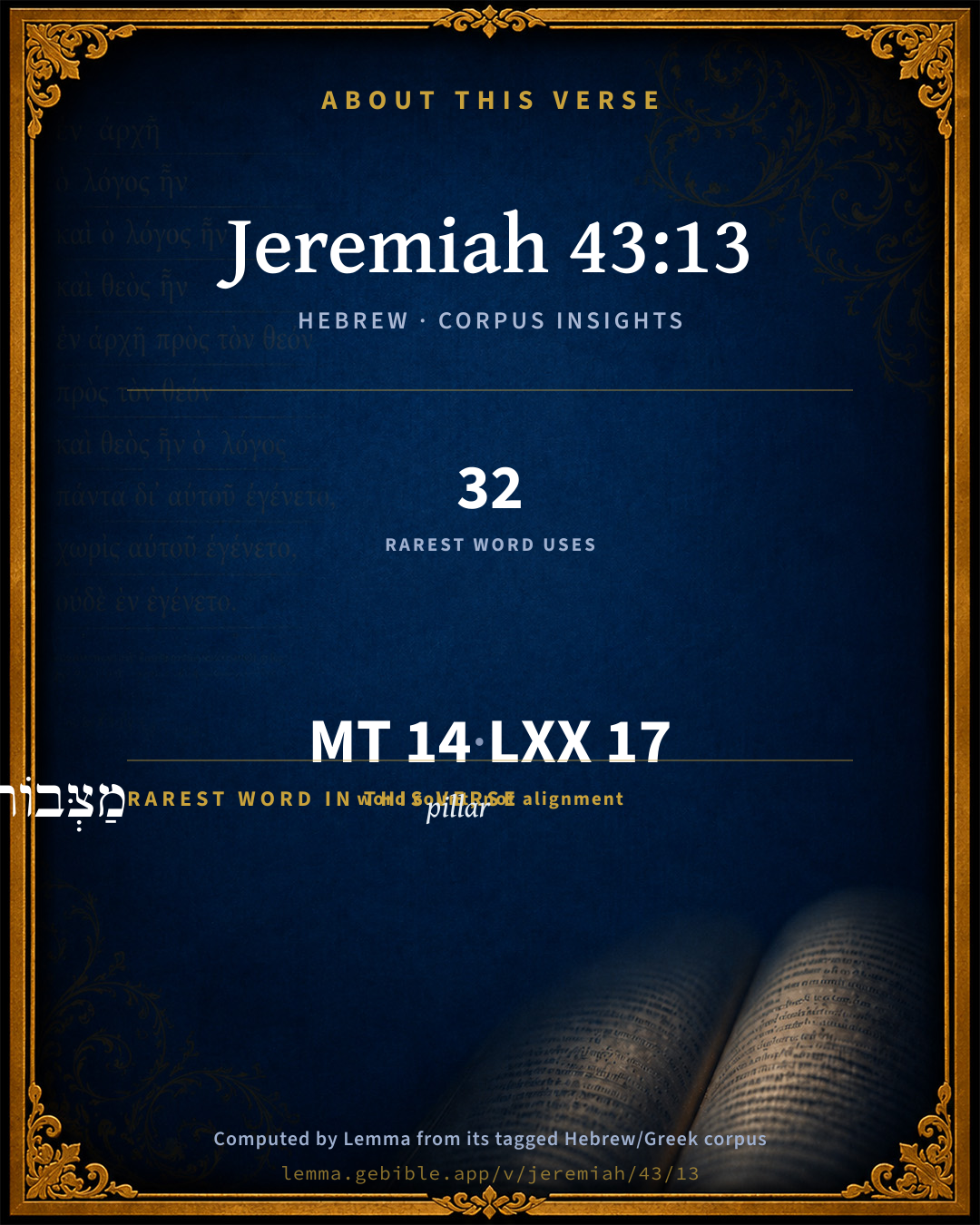
These counts appear in no published source. They are computed here, from the morphology-tagged text and Lemma’s own curated glosses. What Lemma adds →

14
words
11
distinct lemmas
Prophets
section

Shared distinctive vocabulary

מַצְּבוֹת֙ pillar H4676 occurs in 31 verses of the Hebrew Bible. Also found in:

Grammatical profile

  • 2 verbs
  • 9 nouns
  • 3 particles

Verb forms

  • וְשִׁבַּ֗ר Piel · Sequential Perfect
  • יִשְׂרֹ֥ף Qal · Imperfect

Repetition

Words recur within this verse — often emphatic in Hebrew:

  • בֵּ֣ית Beth-shemesh H1053 ×2
  • מִצְרָ֑יִם Egypt H4714 ×2

Hebrew & Septuagint length

In the original languages it is 14 Hebrew tokens and 17 Greek tokens — but the two are counted differently (Hebrew bundles its prefixes and suffixes into one token; the Greek is in lemma form), so that isn’t a like-for-like length.

Cross-references

1

Topical passages linked to Jeremiah 43:13 in the Treasury of Scripture Knowledge — connected by theme and wording, ordered by reader-vote popularity; previews shown in the World English Bible.

  • Isaiah 19:18 In that day there shall be five cities in the land of Egypt that speak the language of Canaan, and swear to Yahweh of hosts; one shall be called The city of destruction.

Cross-references courtesy of OpenBible.info (CC BY 4.0).

Hebrew and Greek witnesses Masoretic Hebrew ↔ Greek Septuagint

The same verse in the two great witnesses to the Old Testament, shown verse-for-verse.

These are two independent witnesses, not word-aligned to each other, and the Septuagint is shown in lemma (dictionary) form.

Hebrew Jeremiah 43:13 Masoretic · Westminster Leningrad Codex

וְשִׁבַּ֗ר אֶֽת מַצְּבוֹת֙ בֵּ֣ית שֶׁ֔מֶשׁ אֲשֶׁ֖ר בְּאֶ֣רֶץ מִצְרָ֑יִם וְאֶת בָּתֵּ֥י אֱלֹהֵֽי מִצְרַ֖יִם יִשְׂרֹ֥ף בָּאֵֽשׁ

He shall also break the pillars of Beth-shemesh, that is in the land of Egypt; and the houses of the gods of Egypt shall he burn with fire.

World English Bible · Public Domain

Greek LXX Structure differs

In the Septuagint, Jeremiah is about an eighth shorter than the Hebrew and arranges its material differently — the Oracles Against the Nations (Hebrew chapters 46–51) appear in the middle of the Greek book, after 25:13. Because the chapter and verse boundaries do not line up, a verse-for-verse comparison with the Hebrew is not shown.

A verse-for-verse comparison isn’t shown here because the chapters and verses don’t line up. Switch to the LXX edition with the MT / LXX toggle above to read the Greek directly.

On this verse, Ellicott's Commentary for English Readers discusses the Septuagint’s reading. Read the note in Commentary ↓

Hebrew: Westminster Leningrad Codex (CC BY 4.0). Greek: Septuagint (public domain); English from a public-domain English Septuagint. How the Septuagint differs from the Hebrew →

Targum (Aramaic paraphrase)

1

The Targum is the ancient Jewish Aramaic paraphrase of the Hebrew Scriptures — an interpretive translation, not the Hebrew text itself. Onkelos (literal) and Pseudo-Jonathan (expansive) render the Torah, and Jonathan the Prophets. Coverage is partial: where no permissively-licensed English translation exists for a verse, only the Aramaic is shown. This is verse-level text, not a word-by-word alignment to the Hebrew.

  1. Targum Jonathan Prophets (Joshua–Malachi)
    וִיתַבַּר יַת קָמַת בֵּית שֶׁמֶשׁ דִי בְּאַרְעָא דְמִצְרַיִם וְיַת בָּתֵּי טַעֲוַת מִצְרָיִם יוֹקֵיד בְּנוּרָא:

    (no public-domain English translation for this verse)

    Targum Jonathan — Aramaic: “Mikraot Gedolot” (public domain). English: “Sefaria Community Translation” (CC0 1.0 (public-domain dedication)); “London "Chaldee Paraphrase," 1871” (public domain). Text via Sefaria.

Commentary

Notes on Jeremiah 43:13 from classic Christian and Jewish commentators (each source and its license shown beneath its notes). The classic Christian expositions comment on the surrounding passage and are grouped to its opening verse, so a note may address several verses; the Jewish commentaries on the Tanakh (Rashi and others) are per-verse, so they appear only where the commentator wrote on this verse.

Lemma curates 59 commentaries, every one of them public domain or Creative Commons licensed, each selected and text-cleaned for this edition rather than reprinted as found. About our sources →

Trapp's Complete Commentary

John Trapp

Jer 43:13 He shall break also the images of Bethshemesh, that [is] in the land of Egypt; and the houses of the gods of the Egyptians shall he burn with fire.

Ver. 13. He shall break also the images of Bethshemesh.] Or, Heliopolis, where the sun was worshipped with great superstition, as Herodotus {a} writeth. The Hebrews also called this city On, or Aven - that is, vanity or iniquity - as well they might, for the abominable idolatry there committed. Josephus {b} saith, that five years after this prophecy, Nebuchadnezzar, who had Egypt given him as pay for his pains at Tyre, invaded Egypt; and the king thereof being slain, he set up another there, and took the Jews that remained alive away into Babylon.

{a} Lib. ii.

{b} Antiq., lib. x. cap. 11.

John Trapp, A Commentary or Exposition upon All the Books of the Old and New Testament (1647–1656) — public domain. Text from a community e-Sword module.

Tyndale Open Study Notes

Tyndale Open Resources

43:13 The sacred pillars were highly prized by the ancient Egyptians. • in the temple of the sun: Or in Heliopolis. The sun was the supreme deity of the Egyptian religion. The ruins of this city are about six miles northeast of modern Cairo.

Tyndale Open Study Notes — © Tyndale Open Resources, licensed CC BY-SA 4.0. Text via the HelloAO Bible API.

Geneva Bible (1599)

Geneva Bible translators

Or, the house of the Sun.

Geneva Bible (1599) marginal notes — public domain. Text via Bolls.life.

Jamieson, Fausset & Brown

Robert Jamieson, A. R. Fausset & David Brown

images--statues or obelisks.

Beth-shemesh--that is, "the house of the sun," in Hebrew; called by the Greeks "Heliopolis"; by the Egyptians, "On" (Gen 41:45); east of the Nile, and a few miles north of Memphis. Ephraim Syrus says, the statue rose to the height of sixty cubits; the base was ten cubits. Above there was a miter of a thousand pounds weight. Hieroglyphics are traced around the only obelisk remaining in the present day, sixty or seventy feet high. On the fifth year after the overthrow of Jerusalem, Nebuchadnezzar, leaving the siege of Tyre, undertook his expedition to Egypt [JOSEPHUS, Antiquities, 10.9,7]. The Egyptians, according to the Arabs, have a tradition that their land was devastated by Nebuchadnezzar in consequence of their king having received the Jews under his protection, and that it lay desolate forty years. But see on Eze 29:2; Eze 29:13.

shall he burn--Here the act is attributed to Nebuchadnezzar, the instrument, which in Jer 43:12 is attributed to God. If even the temples be not spared, much less private houses.

Next: Jeremiah Chapter 44

Jamieson, Fausset & Brown — Commentary Critical and Explanatory on the Whole Bible (1871) — public domain (CC PDM 1.0). Text via the HelloAO Bible API.

Adam Clarke's Commentary

Verse 13. He shall break also the images of Beth-shemesh] בית שמש beith shemesh is, literally, the house or temple of the sun; which was worshipped here, and whose images are said to have been of solid gold. These Nebuchadnezzar was to break and carry away; and the houses of the gods-all the temples of Egypt, he was to burn with fire. Beth-shemesh is the same as Heliopolis.

Adam Clarke's Commentary on the Bible (1810–1826) — public domain. Text from a community e-Sword/MySword module.

John Calvin's Commentaries

WE stated yesterday why Jeremiah spoke especially of the temples of the gods, even that the Jews might understand that nothing would escape destruction: for even the cruel-est enemies have usually withheld their hands from the temples of gods. If sanctity and religion would not preserve the temples, what then would become of private houses? He intimates, in short, that such would be the ruin of Egypt, that no part would escape.

But as Heliopolis was then in the greatest repute, he says, that the statues of all the gods in that city would be broken, for there the gods were especially worshipped. All heathen writers call it Heliopolis, to which the Hebrew word corresponds; for Bethsemes means the city of the sun; and Heliopolis means the same. As then this was the chief place where the gods of Egypt were found, the Prophet, in order to shew that the ruin of the whole land would be extreme, says that no temple would be there inviolate. So also Isaiah says, when speaking of the ruin of Egypt,

“Behold, God will come into Egypt, and will cut down before him all the idols.” (Isaiah 19:1)

He spoke of God’s coming, because, under his guidance it was, that Nebuchadnezzar led there his army, as it has been stated. God did not, indeed, appear from heaven, but the army of Nebuchadnezzar was a living representation of God’s power, when he punished the Egyptians. Now, he says, that when God came there armed, and carried on a warlike expedition, all the idols would be destroyed; for God would thus shew that the gods in whom the Egyptians trusted were false, that they were mere fictions, which could give no help when things came to an extremity. Now follows, —

John Calvin's Commentaries (1540-1563) — public domain. Text from the Calvin Translation Society English edition (1840s-50s) via the Christian Classics Ethereal Library (ccel.org). Calvin's coverage is partial (roughly two-thirds of the Bible); uncommented books and verses are honest gaps, never fabricated. The 19th-century editor's footnotes and remarks are omitted so the notes are faithfully Calvin's own voice.

Ellicott's Commentary for English Readers

(13) He shall break also the images of Bethshe-mesh.—This name, which means “Home of the Sun” (so the Vulgate renders it here by domus solis), was naturally not an uncommon one where sun-worship had prevailed, and we find it accordingly in Judah (Jos_15:10; 1Sa_6:9; 1Sa_6:12), in Issachar (Jos_19:22), and in Naphtali (Jos_19:38; Jdg_1:33). Here the context shows that it was the name of an Egyptian city. The LXX. renders the words “he shall break the pillars of Heliopolis, which are in On,” and so identifies it with the city of that name on the Pelusiac branch of the Nile, just below the point of the Delta, and about twenty miles north-east of Memphis. Under the name of On it appears in Gen_41:45. The “images” or “pillars” are now represented by a solitary obelisk of red granite, sixty-eight feet high, its companion having been brought to Rome and erected in the Vatican Circus in front of St. Peter’s (Herod. II., III.; Plin. Hist. Nat. xxxvi. 11). There were at one time many others, besides colossal statues. The fulfilment of the prediction, as far as it referred to the defeat and death of Pharaoh-hophra, is related by Josephus (Ant. x. 9, § 7).

A Bible Commentary for English Readers, edited by Charles John Ellicott (1878–1897) — public domain. Text from a community e-Sword module.

The Cambridge Bible for Schools and Colleges

gen. ed. J. J. S. Perowne

13. Beth-shemesh] Probably Heliopolis or On. The reference of the v. is to the temple of the sun, at the city called by the Greeks Heliopolis (city of the sun), about six miles N.E. of Cairo. The temple had in front of it an avenue of obelisks, one of which remains in situ. It was erected by Thothmes III (c. b.c. 1500). “Cleopatra’s Needle,” placed on the Thames Embankment in 1878, is another.

the houses … with fire] A fragmentary inscription of Nebuchadnezzar states that he invaded Egypt in the 37th year of his reign (b.c. 568), and defeated king Amasis (b.c. 570–526) with slaughter of men and horses. See Dr.’s note.

The Cambridge Bible for Schools and Colleges (gen. ed. J. J. S. Perowne; Cambridge University Press, 1878–1918) — public domain. Text from a community e-Sword module.

John Gill's Exposition

He shall break also the images of Bethshemesh, that is in the land of Egypt,.... Or, "of Heliopolis", as the Septuagint; the "city of the sun"; and so "Bethshemesh" here signifies the "house of the sun"; either it designs the temple of the sun, or the city where it was worshipped; as Heliopolis was famous for the worship of the sun, and for a magnificent temple in it, built for that purpose, and where abundance of persons resorted on that account, as Herodotus (l) observes; here were many images of the sun; and these now should be broke to pieces, when this city should become the city of destruction, as is foretold it should by Isaiah, Isa 19:18; where the Targum expressly calls it the city Bethshemesh, that is to be destroyed; See Gill on Isa 19:18. This is the same city that was formerly called On, and had a priest in Joseph's time, Gen 41:45;

and the houses of the gods of the Egyptians shall he burn with fire; which is repeated, that it might be taken notice of, and for the confirmation of it; though the words may be rendered, so as to remove the tautology, "and with the houses of the gods of the Egyptians shall he burn it with fire" (m); that is, Bethshemesh, or "the house of the sun", that shall not escape, being a principal temple. The gods they worshipped were Mnevis and Apis, which were oxen consecrated to the sun and moon (n). So says Porphyry (o), speaking of the Egyptians,

"they consecrate oxen to the sun and moon: that which is sacred to the sun at Heliopolis is called Mnevis, and is the greatest of them: it is very black, because much sun makes human bodies black; and the hairs of its tail, and of its whole body, contrary to other oxen, turn upwards, as the sun makes its course contrary to the pole; its testicles are the largest, because by the heat of the sun venereal desires are excited; hence the sun is said to make nature fruitful. To the moon they dedicate Taurus (or the bull), which they call Apis, and is blacker than others, bearing the signs of the sun and moon, because the light of the moon is from the sun; and the sign of the sun is the blackness of its body, and also the beetle that is under its tongue;''

and these were the images and gods of Bethshemesh or Heliopolis, that were to be destroyed by Nebuchadnezzar. Of his expedition into Egypt, whereby this prophecy was fulfilled, not only Josephus makes mention, but some Heathen writers gave plain hints of it. The Jewish historian says (p), that Nebuchadnezzar, five years after the destruction of Jerusalem, led his army into Coelesyria, and took it; and made war with the Ammonites and Moabites; and, having subdued these nations, made a push into Egypt, in order to destroy that, and slew the king of it: and Berosus says (q), that

"Nebuchadnezzar having settled his affairs in Egypt, and other countries; and having committed to his friends the captives of the Jews, Phoenicians, Syrians, and the nations about Egypt, went to Babylon:''

and Megasthenes (r) relates, that

"he conquered the greatest part of Lybia (or Africa) and Iberia;''

or, as it is elsewhere (s) expressed,

"he led his army into Lybia and Iberia; and, having subdued these, carried colonies of them to the right of Pontus.''

(l) Euterpe, sive l. 2. c. 59. (m) So Schmidt. (n) Vid. Aelian. de Animal. l. 11. c. 11. (o) Apud Euseb. Praepar. Evangel. l. 3. c. 13. p. 117. (p) Joseph. Antiqu. l. 10. c. 9. sect. 7. (q) Apud Josph. Antiqu. ib. c. 11. sect 1. & contra Apion. l. 1. sect. 19. & Euseb. Praepar. Evangel. l. 9. c. 40. p. 455. (r) Apud Joseph. Antiqu. ib. & contra Apion. l. 1. sect. 20. (s) Apud Euseb. Praepar. Evangel. l. 9. c. 41. p. 456.

Next: Jeremiah Chapter 44

John Gill's Exposition of the Whole Bible (1746–1763) — public domain (CC PDM 1.0). Text via the HelloAO Bible API.

Albert Barnes' Notes on the Bible

Images - Rather, pillars (compare the Isa 19:19 note), obelisks.

Beth-shemesh - Heliopolis, famous for its obelisks.

Albert Barnes' Notes on the Bible (1834–1885) — public domain. Text from a community e-Sword/MySword module.

Haydock's Catholic Bible Commentary

Sun. Septuagint, "of Heliopolis," where the largest temple of the sun was seen. Egypt was famous for its obelisks, erected by Pheron, successor of Sesostris. Some have been removed to Rome. --- Fire. History does not specify the particulars: but we may judge how the conqueror would treat these temples, &c., from what Xerxes and Ochus did afterwards. (Calmet)

George Leo Haydock (1774–1849), Haydock's Catholic Family Bible and Commentary, 1859 edition — public domain. Excludes Psalms (Douay-Rheims chapter numbering differs from Protestant) and Deuterocanonical books (Catholic canon only).

Matthew Poole's English Annotations

Beth-shemesh signifies the house of the sun, and it is also the name of a city in Egypt; so most take it here, as the name of a city which had its name from a famous temple builded in it to the honour of the sun. This idol is called On, Gen 41:45. By this it appears that the Egyptians, as well as other pagans, paid Divine adoration to the creature. God threatens not only the destruction of the idolatrous temples, but the houses of the inhabitants of Egypt. by the king of Babylon; from whence these Jews, would they have believed, might have understood, that they would not have the security which they promised themselves in the land of Egypt.

Matthew Poole's English Annotations on the Holy Bible (1683–1685) — public domain. Text from a community e-Sword/MySword module.

Whedon's Commentary on the Bible

Daniel D. Whedon

13. Images — Obelisks. Two of these (of which there were several before the famous “temple of the sun”) were each one hundred and fifty feet high.

Beth-shemesh — Literally, house of the sun; the name of the temple being given to the city. It is also called in the Old Testament “On:” it was also known to the Greeks as Heliopolis. It was situated about twenty miles northeast from Memphis. The one famous obelisk now marking the site of this city is dated about 2050 B.C.

Daniel D. Whedon (gen. ed.), Commentary on the Old and New Testaments (1874–1909) — public domain. Text from a community e-Sword module.

The Pulpit Commentary

The images of Beth-shemesh; rather, the pillars of Bethshemesh; i.e. the obelisks of the temple of Ra, the sun god, from Which Heliopolis derived its sacred name "Pe-Ra" "the abode of Ra." It was the custom to place obelisks in pairs at the entrance of their temples. Only one of those of Heliopolis is still standing, though that, indeed, is the oldest in Egypt, for it was "set up at least four thousand years ago" (R. S. Poole, "The Cities of Egypt," p. 131). That is in the land of Egypt. To distinguish it from the Beth-shemesh in Palestine. But we may also render "which are," etc.; comp. "the gods of Egypt" in the second verse half. The Septuagint reads, "which are in On."

The Pulpit Commentary (1880–1919), ed. H.D.M. Spence-Jones & Joseph S. Exell — public domain. Text from a community e-Sword module.

John Wesley's Explanatory Notes

Beth-shemesh - Beth-shemesh is the name of a city, which had its name from a famous temple of the sun.

John Wesley, Explanatory Notes Upon the Whole Bible (1754–1765) — public domain. Text via the GEBible commentary corpus.

Keil & Delitzsch

C. F. Keil & F. Delitzsch

In conclusion, mention is further made of the destruction of the famous temple of the Sun at Heliopolis, to show the fulfilment of the prophecy that all Egypt would fall under the power of Nebuchadnezzar. בּית שׁמשׁ, "House of the Sun," is the Hebrew rendering of the Egyptian Pe-râ, i.e., House of the Sun, the sacred name of the city vulgarly called On; see on Gen 41:45. It lay north-east from Cairo, near the modern village of Matarieh, and thus pretty far inland; it was renowned for its magnificent temple, dedicated to Râ, the Sun-god. At the entrance to this building stood several larger and smaller obelisks, of which the two larger, added to the two older ones by Pheron the son of Sesostris, were about 150 feet high. One of these the Emperor Augustus caused to be brought to Rome; the other was thrown down in the year 1160; while one of the more ancient but smaller obelisks still stands in its original position, raising its head in the midst of a beautiful garden over a mass of dense foliage. These obelisks are signified by מצּבות. The additional clause, "which is in the land of Egypt," does not belong to Beth-shemesh, as if it were appended for the purpose of distinguishing the city so named from Beth-shemesh in the land of Judah; the words are rather connected with מצּבות, and correspond with אלהי מצרים in the parallel member of the verse. The obelisks of the most famous temple of the Egyptian Sun-god are well known as the most splendid representatives of the glory of the Egyptian idolatry: the destruction of these monuments indicates the ruin of all the sanctuaries of the ancient kingdom of the Pharaohs. The last clause is a kind of re-echo from Jer 43:12; ישׂרף is strengthened by the addition of בּאשׁ for the purpose of giving a sonorous ending to the whole. - The king of Egypt is not named in the prophecy, but according to Jer 44:30 it is Pharaoh-Hophra, who is to be given into the power of Nebuchadnezzar.

When we inquire as to the fulfilment of this prediction, we find M. Duncker, in his Gesch. des Alterthums, i. 841, giving a reply in these words: "Nebuchadnezzar did not fulfil these expectations (of Jeremiah, Jer 43:8-13; Jer 44:30, and of Ezekiel, Jer 29:32). He contented himself with having repelled the renewed attack of Egypt. The establishment of his dominion in Syria did not depend on his conquering Egypt; but Syria must obey him, throughout its whole extent. The capture of Jerusalem followed the siege of the island-town of Tyre (b.c. 586), the last city that had maintained its independence. The army of the Chaldean slay thirteen years before Tyre without being able to bring the king Ethbaal (Ithobal) under subjection. At last, in the year 573, a treaty was concluded, in which the Tyrians recognised the supremacy of the king of Babylon." That Tyre was brought into subjection is inferred by Duncker (in a note, p. 682), first, from the generally accepted statement of Berosus, that the whole of Phoenicia was subdued by Nebuchadnezzar (Josephus' Ant. x. 11. 1, and contra Ap. i. 19); secondly, from Josephus' statement (contra Ap. i. 21), that the kings Merbal and Hiram had been brought by the Tyrians from Babylon; and lastly, from the fact that, with the close of the siege, the reign of Ithobal ends and that of Baal begins. "It would thus appear that Ithobal was removed, and his family carried to Babylon." These facts, which are also acknowledged by Duncker, sufficiently show (what we have already pointed out in Ezekiel) that the siege of Tyre ended with the taking of this island-city. For, unless the besieged city had been taken by storm, or at least compelled to surrender, the king would not have let himself be dethroned and carried to Babylon. - But whence has Duncker derived the information that Nebuchadnezzar had no concern with the subjugation of Egypt, but merely with the establishment of his authority in Syria? Although Nebuchadnezzar began the siege of the island-city of Tyre soon after the destruction of Jerusalem, and required thirteen years to reduce it, yet it does not by any means follow from this that he had only to do with the strengthening of his authority in Syria, and no connection with the subjugation of Egypt; all that we can safely infer is, that he thought he could not attempt the conquest of Egypt with any certain prospect of success until he had subdued the whole of Syria. Besides, so long as such an one as Pharaoh-Hophra occupied the throne of Egypt, - who had not only sent an army to Zedekiah king of Judah to raise the siege of Jerusalem, but also (according to Herodotus, ii. 161, who draws from Egyptian sources) led an army to Sidon and fought a naval battle with the Tyrians; who (as Diod. Sic. i. 68 relates, also following Egyptian tradition) set out for Cyprus with abundant war-material and a strong army and fleet, and took Sidon by storm, while the rest of the towns submitted through fear; who, moreover, had defeated the Phoenicians and Cyprians in a naval engagement, and had returned to Egypt with immense spoil; - how could Nebuchadnezzar possibly think that his rule in Syria was firmly established? Such statements as those now referred to even Duncker does not venture to reject. We must, however, view them with a regard to the usual exaggerations by which the Egyptians were accustomed to extol the deeds of their Pharaohs; but after making all due allowance, we are led to this, that, after the fall of Tyre, Hophra sought to prevent the island of Cyprus as well as Tyre from becoming a dependency of Nebuchadnezzar. Could Nebuchadnezzar leave unmolested such an enemy as this, who, on the first suitable opportunity, would attempt to wrest the whole of Syria from him? So short-sighted a policy we could not attribute to such a conqueror as Nebuchadnezzar. Much more considerate is the judgment previously expressed regarding this by Vitringa, on Isa 19: "Etiamsi omnis historia hic sileret, non est probabile, Nebucadnezarem magnum dominatorem gentium, post Palaestinam et Phoeniciam subactam, non tentasse Aegyptum, et si tentaverit, tentasse frustra; et qu parte Aegyptum occupavit, eam non vastasse et desolasse."

It is also to be borne in mind that the conquest of Egypt by Nebuchadnezzar, which is denied by Hitzig and Graf as well as Duncker, as it formerly was by Volney, is vouched for by the trustworthy testimony of Berosus (in Josephus, contra Ap. i. 19), who says that Nebuchadnezzar took Egypt (κρατῆσαι Αἰγύπτου, ̓Αραβίας, κ.τ.λ.); the denial, too, rests on a mere inference from the account given by Herodotus from the traditions of the priests regarding the reign of Apris (Hophra). If the witness of Berosus regarding the conquest of Syria and Phoenicia be trustworthy, why should his testimony concerning Egypt be unreliable? The account of Josephus (Ant. x. 9. 7), that Nebuchadnezzar, in the fifth year after the capture of Jerusalem, and the twenty-third year of his reign, invaded Egypt, killed the king (Hophra), put another in his place, and led captive to Babylon the Jews that had fled to Egypt, - this account will not admit of being brought forward (as has often been attempted, and anew, of late, by Mrc. von Niebuhr, Assur und Babel, S. 215) as sufficient testimony for a successful campaign carried on by Nebuchadnezzar against Egypt during the siege of Tyre. The difficulty in the way of proving that such a campaign actually took place is not so much that the death of Hophra in battle with Nebuchadnezzar, or his execution afterwards, contradicts all authenticated history, as that the particular statements of Josephus regarding this campaign, both as to the date and the carrying away to Babylon of the Jews that had fled to Egypt, are simply conclusions drawn from a combination of Jer 43:8-13 and Jer 44:30 with Jer 52:20; besides, the execution of King Hophra by Nebuchadnezzar is foretold neither by Jeremiah nor by Ezekiel. Ezekiel, in Jer 29-32, merely predicts the decline of the Egyptian influence, the breaking of the arm of Pharaoh, i.e., of his military power, and his fall into Sheol; but he does it in so ideal a manner, that even the words of Jer 30:13, "there shall be no more a prince out of the land of Egypt," - i.e., Egypt shall lose all her princes, just as her idols have been destroyed, - even these words cannot well be applied to the execution of Pharaoh-Hophra. But Jeremiah, in Jer 43:1-13 and in Jer 46:13., predicts merely the downfall of the pride and power of Pharaoh, and the conquest, devastation, and spoiling of Egypt by Nebuchadnezzar. And even in the words of Jer 44:30, "I (Jahveh) will deliver Pharaoh-Hophra into the hand of his enemies, and of those who seek his life, just as I delivered Zedekiah the king of Judah into the hand of Nebuchadnezzar his enemy, and of those who sought after his life," there is nothing definitely stated regarding Hophra's being executed by Nebuchadnezzar, or killed in battle with him. Such a reference cannot be made out from the words, even though we lay no emphasis on the plural "his enemies," in contrast with the expression "Nebuchadnezzar his enemy," and, according to Jer 46:26, understand Nebuchadnezzar and his servants as being included under the "enemies;" for certainly Zedekiah was not killed by Nebuchadnezzar, but merely taken prisoner and carried to Babylon. Besides, there was no need of special proof that the prophecies of Jeremiah regarding Egypt declare much more important matters than merely an expedition of Chaldean soldiers to Egypt, as well as the plunder of some cities and the carrying away of the Jews who resided there; and that, in Jer 44, what the Jews who went to Egypt against the will of God are threatened with, is not transportation to Babylon, but destruction in Egypt by sword, hunger, and pestilence, until only a few individuals shall escape, and these shall return to Judah (Jer 44:14, Jer 44:27-28).

But if we compare with the prophecy of Jeremiah in Jer 43:8-13, and in Jer 46:13-26, that of Ezekiel in Jer 29:17-21, which was uttered or composed in the twenty-seventh year of the captivity of Jehoiachin, i.e., in the year 573, it becomes abundantly evident that Nebuchadnezzar cannot have invaded and conquered Egypt before that year, and not till after the fall of Tyre, which immediately ensued. And that this was actually the case, is put beyond doubt by the statement of Herodotus, ii. 161ff., regarding Apris, that he lost his throne and his life in consequence of being defeated in battle with the Cyrenians. What Herodotus assigns as the cause of the fall of Apris, is insufficient to account for the unhappy end of this king. Herodotus himself states, ii. 169, that the Egyptians were filled with the most intense hatred against Apris; the monuments also bear witness to this fact. This bitter feeling must have had a deeper source than merely the unsuccessful issue of a war with Cyrene; it receives its explanation only when we find that Apris, by his attempts against Nebuchadnezzar, had deserved and brought on the subjugation of Egypt by the king of Babylon; cf. Hvernick on Ezekiel, p. 500. By sending an auxiliary army to Judah, for the purpose of driving back the Chaldeans, and by forming an expedition to Cyprus and the cities of Phoenicia, which was evidently directed against the establishment of the Chaldean power in Phoenicia, Apris had so provoked the king of Babylon, that the latter, immediately after the subjugation of Tyre, entered on the campaign against Egypt, which he invaded, subdued, and spoiled, without, however, killing the king; him he preferred allowing to rule on, but as his vassal, and under the promise that he would recognise his authority and pay tribute, just as had been done with King Jehoiakim when Jerusalem was first taken. If all this actually took place (which we may well assume), Apris might probably have begun another war against Cyrene, after the Chaldeans had departed, in the hope of procuring some small compensation to the Egyptians for the defeat they had suffered from the Chaldeans, by subduing that province in the west; in this war the king might have lost his life, as Herodotus relates, through want of success in his attempt. In this say, the account of Herodotus regarding the death of Apris quite agrees with the conquest of Egypt by Nebuchadnezzar. But that Herodotus makes no mention of the conquest of Egypt, is sufficiently accounted for when we remember that he derived his information from the stories of the priests, who carefully omitted all mention of a struggle between Egypt and the power of Chaldea, since this had ended in the humiliation of Egypt; hence also mention was made only of the victories and mighty deeds of Necho II, while his defeat at Carchemish was passed over in silence.

Keil & Delitzsch — Biblical Commentary on the Old Testament (1861–1891) — public domain (CC PDM 1.0). Text via the HelloAO Bible API. (Old Testament only.)

Rashi

Rabbi Shlomo Yitzchaki (Rashi)

the monuments of Beth-shemesh The altars that those who proselytized in the days of Hezekiah had made there Sennacherib’s captives whom he brought from Cush and from Egypt before Jerusalem on the day of his downfall, as it is stated “On that day there shall be five cities in the land of Egypt speaking the language of Canaan and swearing to the Lord of Hosts one of which will be called ‘the city of Heres’” (Isa. 19.18). Jonathan renders: The city of Beth-shemesh, which is destined to be destroyed, will be said to be one of them.

Rashi on the Tanakh — English translations: “The Judaica Press complete Tanach with Rashi, translated by A. J. Rosenberg” (CC BY 4.0); “Pentateuch with Rashi's commentary by M. Rosenbaum and A.M. Silbermann, 1929-1934” (public domain); “The Metsudah Tanach series, Lakewood, N.J” (CC BY 4.0); and “The Book of Joshua, Metsudah Publications, 1997” (CC BY 4.0). Text via Sefaria.

Lesson kit

Teaching starters — assembled from the data on this page, not authored interpretation. Every prompt links to the verse data it draws on. Edit before teaching.

Jeremiah, in the Prophets, opens this verse with 14 words (11 distinct Hebrew lemmas). Its most distinctive word is matstsêbâh (“pillar”). A historical commentator’s framing appears above. Read the whole chapter for the surrounding context.

Discussion questions

  1. The word matstsêbâh carries the sense “pillar.” How does it shape the verse?
  2. Genesis 28:18 shares the word «pillar» with this verse. How do the two illuminate each other?
  3. “Beth-shemesh” occurs 2× in this one verse. What is the effect of the repetition?
  4. The translations on this page render this verse differently — a whole-verse word diff, not a word-by-word alignment. What might account for the different wordings?
  5. The verb «וְשִׁבַּ֗ר» is Piel Sequential Perfect. How does its form color the action?
  6. Reading how Trapp's Complete Commentary and Tyndale Open Study Notes read this verse, where do the two commentators agree and where do they part?

Things to notice

Reading settings

Reading text

Shown beneath each verse's original-language words.

Old Testament
Old Testament edition

Read the OT as the Masoretic Hebrew (MT) or the Greek Septuagint (LXX).

English shown for the Greek Septuagint (in the Hebrew ↔ Greek comparison).

Comparing translations? Open the Compare panel on any verse page to stack up to four side by side.