
Ezekiel 29:19

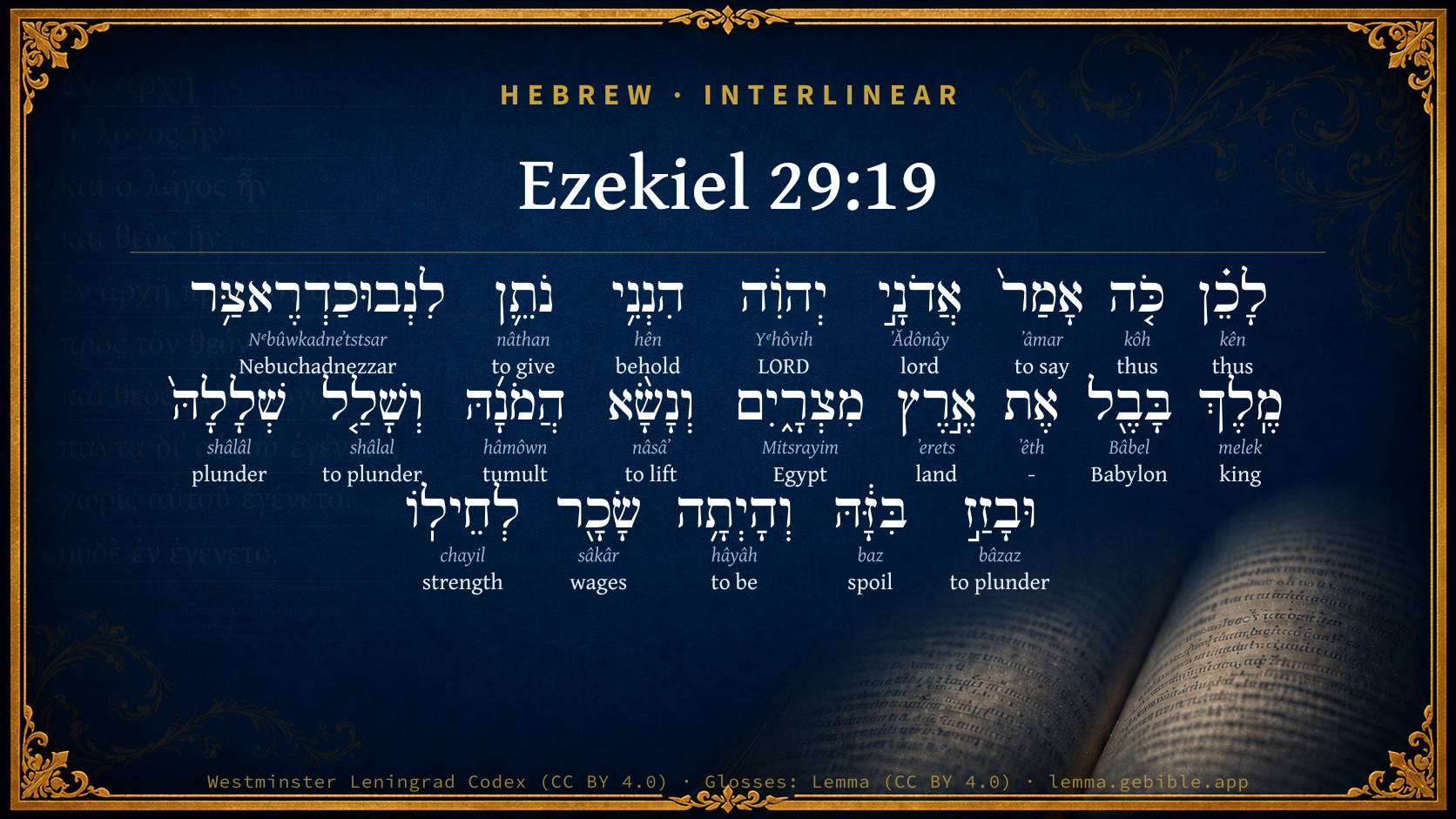
Hebrew (Westminster Leningrad Codex) Ezekiel 29:19 appears in the Hebrew Old Testament. The text above is from the Westminster Leningrad Codex. Each word links to its Strong’s number, a concise gloss, and parsing drawn from the Open Scriptures Hebrew Bible morphology. Click any word for its full Brown-Driver-Briggs (BDB) entry.
Download image
Cite this verse

Ezekiel 29:19 (World English Bible). Public Domain. Lemma interlinear Bible study tool, https://lemma.gebible.app/v/ezekiel/29/19.

Show BibTeX & RIS
BibTeX
RIS
English Translation
Therefore thus says the Lord Yahweh: Behold, I will give the land of Egypt to Nebuchadrezzar king of Babylon; and he shall carry off her multitude, and take her spoil, and take her prey; and it shall be the wages for his army.
World English Bible · Public Domain
Download a study sheet

One document with this verse’s original text, its word-by-word gloss line, the meaning frame, cross-references with their text, attributed commentary, and full source and license credits — printable, and it pastes into notes with its structure intact.

This verse Autodidact and up

Study sheet (.html) Plain text (.txt)

A passage Seminary Student

Up to 50 verses in one chapter. A passage sheet keeps up to 6 commentary sources and 12 cross-references per verse, in the order this page ranks them, and says so on the sheet whenever that leaves anything out. Ask for a single verse and you get the Autodidact verse sheet above.

Everything on this page stays free to read, with no account — the sheet is a download of what is already on screen, not access to it.

Want to remove ads? Support Godless Engineer
Compare translations 3

The same verse in 3 English versions, stacked beneath the original-language interlinear above. Click any original word for its lexicon entry.

Each is an independent rendering of the whole verse — the interlinear is not word-aligned to these translations.

Highlighted words mark where these versions differ — a whole-verse word diff, not a word-by-word alignment.

  • World English Bible Public Domain
    Therefore thus says the Lord Yahweh: Behold, I will give the land of Egypt to Nebuchadrezzar king of Babylon; and he shall carry off her multitude, and take her spoil, and take her prey; and it shall be the wages for his army.
  • King James Version Public Domain
    Therefore thus saith the Lord GOD; Behold, I will give the land of Egypt unto Nebuchadrezzar king of Babylon; and he shall take her multitude, and take her spoil, and take her prey; and it shall be the wages for his army.
  • unfoldingWord Literal Text CC BY-SA 4.0
    Therefore the Lord Yahweh says this, ‘Behold! I am giving the land of Egypt to Nebuchadnezzar the king of Babylon, and he will take away its wealth, plunder its possessions, and carry off all he finds there; that will be his army’s wages.

unfoldingWord Literal Text — © unfoldingWord, licensed CC BY-SA 4.0. Word-aligned USFM3 via Door43 (git.door43.org/unfoldingWord/en_ult).

Versions to compare (up to 4)

3 of 4 selected

Show all 18 translations

Every available English version of this verse, each an independent rendering of the whole verse.

  • World English Bible Public Domain
    Therefore thus says the Lord Yahweh: Behold, I will give the land of Egypt to Nebuchadrezzar king of Babylon; and he shall carry off her multitude, and take her spoil, and take her prey; and it shall be the wages for his army.
  • Berean Standard Bible Public Domain
    Therefore this is what the Lord GOD says: I will give the land of Egypt to Nebuchadnezzar king of Babylon, who will carry off its wealth, seize its spoil, and remove its plunder. This will be the wages for his army.
  • Majority Standard Bible Public Domain
    Therefore this is what the Lord GOD says: I will give the land of Egypt to Nebuchadnezzar king of Babylon, who will carry off its wealth, seize its spoil, and remove its plunder. This will be the wages for his army.
  • King James Version Public Domain
    Therefore thus saith the Lord GOD; Behold, I will give the land of Egypt unto Nebuchadrezzar king of Babylon; and he shall take her multitude, and take her spoil, and take her prey; and it shall be the wages for his army.
  • American Standard Version (1901) Public Domain
    Therefore thus saith the Lord Jehovah: Behold, I will give the land of Egypt unto Nebuchadrezzar king of Babylon; and he shall carry off her multitude, and take her spoil, and take her prey; and it shall be the wages for his army.
  • Revised Version (1885) Public Domain
    Therefore thus saith the Lord GOD: Behold, I will give the land of Egypt unto Nebuchadrezzar king of Babylon; and he shall carry off her multitude, and take her spoil, and take her prey; and it shall be the wages for his army.
  • Geneva Bible (1599) Public Domain
    Therefore thus sayth the Lord God, Beholde, I will giue the land of Egypt vnto Nebuchad-nezzar the King of Babel, and he shall take her multitude, and spoyle her spoyle, and take her pray, and it shall be the wages for his armie.
  • Douay-Rheims (1899) Public Domain
    Therefore thus saith the Lord God: Behold, I will set Nabuchodonosor the king of Babylon in the land of Egypt: and he shall take her multitude, and take the booty thereof for a prey, and rifle the spoils thereof: and it shall be wages for his army.
  • Young's Literal Translation Public Domain
    Therefore, thus said the Lord Jehovah, Lo, I am giving to Nebuchadrezzar king of Babylon the land of Egypt, And he hath taken away its store, And hath taken its spoil, and taken its prey, And it hath been a reward to his force.
  • Literal Standard Version CC BY-SA 4.0
    Therefore, thus said Lord YHWH: Behold, I am giving the land of Egypt to Nebuchadnezzar king of Babylon, || And he has taken away its store, || And has taken its spoil, and taken its prey, || And it has been a reward to his force.
  • Unlocked Literal Bible CC BY-SA 4.0
    Therefore the Lord Yahweh says this, 'Behold! I am giving the land of Egypt to Nebuchadnezzar the king of Babylon, and he will take away its wealth, plunder its possessions, and carry off all he finds there; that will be his army's wages.
  • unfoldingWord Literal Text CC BY-SA 4.0
    Therefore the Lord Yahweh says this, ‘Behold! I am giving the land of Egypt to Nebuchadnezzar the king of Babylon, and he will take away its wealth, plunder its possessions, and carry off all he finds there; that will be his army’s wages.
  • Darby Bible Public Domain
    Therefore thus saith the Lord Jehovah: Behold, I will give the land of Egypt unto Nebuchadrezzar king of Babylon; and he shall carry away her multitude, and seize her spoil, and take her prey; and it shall be the wages for his army.
  • World Messianic Bible Public Domain
    Therefore the Lord GOD says: ‘Behold, I will give the land of Egypt to Nebuchadnezzar king of Babylon. He will carry off her multitude, take her plunder, and take her prey. That will be the wages for his army.
  • Webster's Bible Public Domain
    Therefore thus saith the Lord GOD; Behold, I will give the land of Egypt to Nebuchadrezzar king of Babylon; and he shall take her multitude, and take her spoil, and take her prey; and it shall be the wages for his army.
  • Free Bible Version CC BY-SA 4.0
    So this is what the Lord God says: I'm going to give Egypt to Nebuchadnezzar king of Babylon who will seize everything valuable. He will loot the country, robbing it to pay his army.
  • Bible in Basic English Public Domain
    For this cause the Lord has said: See, I am giving the land of Egypt to Nebuchadrezzar, king of Babylon: he will take away her wealth, and take her goods by force and everything which is there; and this will be the payment for his army.
  • JPS Tanakh (1917) Public Domain
    Therefore thus saith the Lord GOD: Behold, I will give the land of Egypt unto Nebuchadrezzar king of Babylon; and he shall carry off her abundance, and take her spoil, and take her prey; and it shall be the wages for his army.

Literal Standard Version (2020), Covenant Press — licensed CC BY-SA 4.0. Text via the HelloAO Bible API (eBible.org). Unlocked Literal Bible (unfoldingWord) — licensed CC BY-SA 4.0. Text via the HelloAO Bible API (eBible.org). unfoldingWord Literal Text — © unfoldingWord, licensed CC BY-SA 4.0. Word-aligned USFM3 via Door43 (git.door43.org/unfoldingWord/en_ult). Free Bible Version, Dr. Jonathan Gallagher — licensed CC BY-SA 4.0. Text via the HelloAO Bible API (eBible.org).

Word by word

More ways to search: Search by grammar → Find every occurrence → Compare this word →

Practice this passage: Drill this verse → Learn its vocabulary →

וְשָׁלַ֤ל
shâlal
H7997
“and · to plunder”
Conjunction + Verb, Qal, Sequential Perfect, 3rd Person, Masculine, Singular
Part of Speech
Conjunction + Verb
Stem
Qal
Form
Sequential Perfect
Person
3rd Person
Gender
Masculine
Number
Singular
Full BDB Definition

Origin: a primitive root

TWOT: 2399 , 2400

(Qal) to draw out - to spoil, plunder, take spoil - (Qal) to spoil, plunder - (Hithpolel) to be spoiled, be plundered
  1. לָכֵ֗ן kên H3651 “to/for · thus” Preposition + Adverb
  2. כֹּ֤ה kôh H3541 “thus” Adverb
  3. אָמַר֙ ʼâmar H559 “to say” Verb, Qal, Perfect, 3rd Person, Masculine, Singular
  4. אֲדֹנָ֣י ʼĂdônây H136 “Lord · my” Noun, Common, Masculine, Plural, Construct + Suffix, Personal, 1st Person, Common, Singular
  5. יְהוִ֔ה Yᵉhôvih H3069 “LORD” Noun, Proper
  6. הִנְנִ֥י hên H2005 “behold · me” Particle, Demonstrative + Suffix, Personal, 1st Person, Common, Singular
  7. נֹתֵ֛ן nâthan H5414 “giving” Verb, Qal, Participle Active, Masculine, Singular, Absolute
  8. לִנְבוּכַדְרֶאצַּ֥ר Nᵉbûwkadneʼtstsar H5019 “to/for · Nebuchadnezzar” Preposition + Noun, Proper
  9. מֶֽלֶךְ melek H4428 “king of” Noun, Common, Masculine, Singular, Construct
  10. בָּבֶ֖ל Bâbel H894 “Babylon” Noun, Proper
  11. אֶת ʼêth H853 “-” Particle, Direct Object
  12. אֶ֣רֶץ ʼerets H776 “land of” Noun, Common, Both, Singular, Construct
  13. מִצְרָ֑יִם Mitsrayim H4714 “Egypt” Noun, Proper
  14. וְנָשָׂ֨א nâsâʼ H5375 “and · to lift” Conjunction + Verb, Qal, Sequential Perfect, 3rd Person, Masculine, Singular
  15. הֲמֹנָ֜הּ hâmôwn H1995 “tumult · her” Noun, Common, Masculine, Singular, Construct + Suffix, Personal, 3rd Person, Feminine, Singular
  16. שְׁלָלָהּ֙ shâlâl H7998 “plunder · her” Noun, Common, Masculine, Singular, Construct + Suffix, Personal, 3rd Person, Feminine, Singular
  17. וּבָזַ֣ז bâzaz H962 “and · to plunder” Conjunction + Verb, Qal, Sequential Perfect, 3rd Person, Masculine, Singular
  18. בִּזָּ֔הּ baz H957 “spoil · her” Noun, Common, Masculine, Singular, Construct + Suffix, Personal, 3rd Person, Feminine, Singular
  19. וְהָיְתָ֥ה hâyâh H1961 “and · to be” Conjunction + Verb, Qal, Sequential Perfect, 3rd Person, Feminine, Singular
  20. שָׂכָ֖ר sâkâr H7939 “wages” Noun, Common, Masculine, Singular, Absolute
  21. לְחֵילֽוֹ chayil H2428 “to/for · strength · his” Preposition + Noun, Common, Masculine, Singular, Construct + Suffix, Personal, 3rd Person, Masculine, Singular

About this verse

These counts appear in no published source. They are computed here, from the morphology-tagged text and Lemma’s own curated glosses. What Lemma adds →

22
words
22
distinct lemmas
Prophets
section

Notable vocabulary

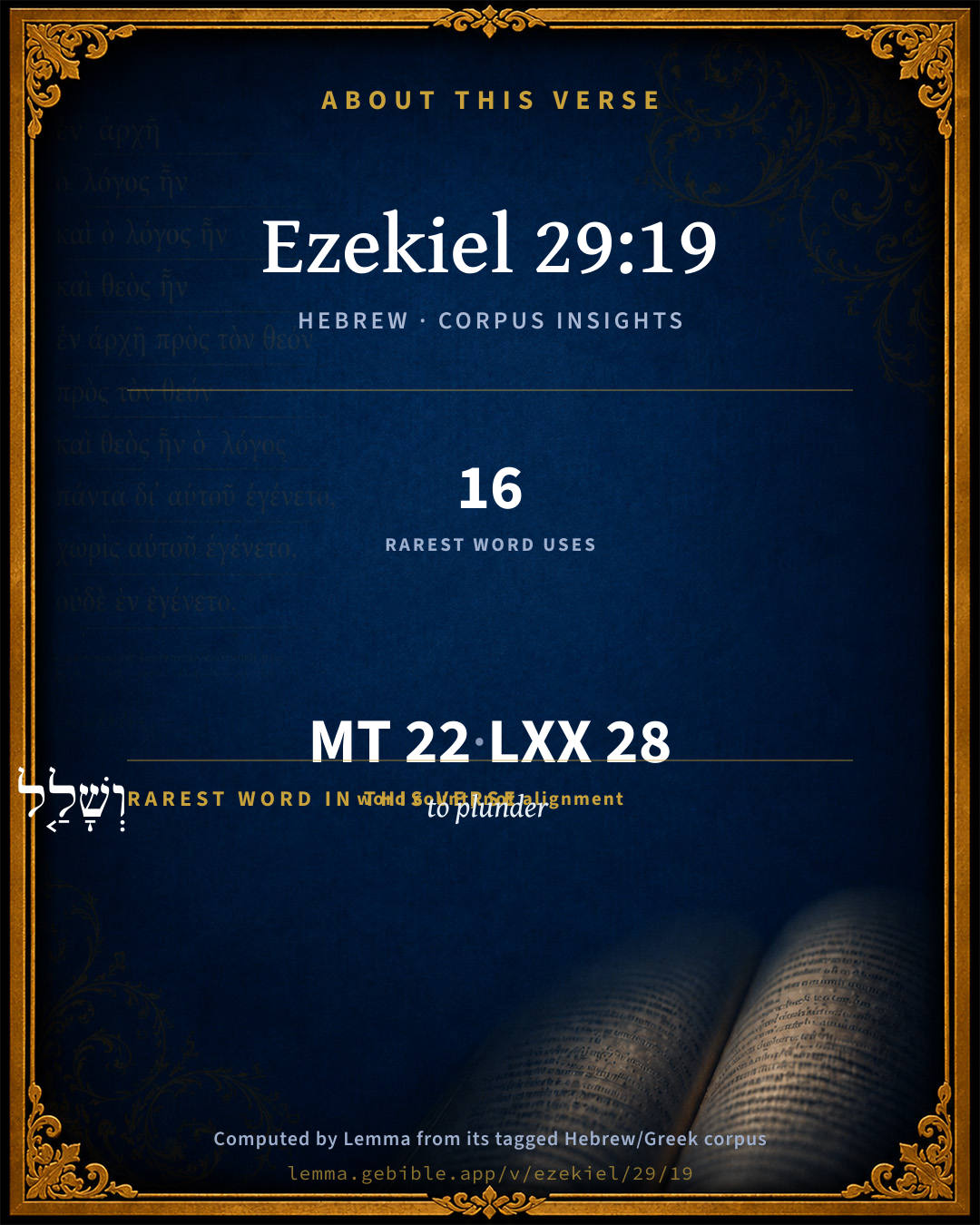
The rarest word here is וְשָׁלַ֤ל to plunder H7997 — appearing just 16 times in the whole Hebrew Bible.

Shared distinctive vocabulary

וְשָׁלַ֤ל to plunder H7997 occurs in 12 verses of the Hebrew Bible. Also found in:

Grammatical profile

  • 6 verbs
  • 12 nouns
  • 2 adverbs
  • 2 particles

Verb forms

  • אָמַר֙ Qal · Perfect
  • נֹתֵ֛ן Qal · Participle Active
  • וְנָשָׂ֨א Qal · Sequential Perfect
  • וְשָׁלַ֤ל Qal · Sequential Perfect
  • וּבָזַ֣ז Qal · Sequential Perfect
  • וְהָיְתָ֥ה Qal · Sequential Perfect

Hebrew & Septuagint length

In English translation the verse runs 43 words from the Hebrew and 39 from the Septuagint (LXX English) — closely comparable.

A rough comparison of the two English renderings, which tokenize alike — not a word-level alignment.

Word counts can differ between the Hebrew and the Greek without any difference in meaning — e.g. the Hebrew direct-object marker אֵת has no separate Greek word, and Greek often adds the article ὁ.

In the original languages it is 22 Hebrew tokens and 28 Greek tokens — but the two are counted differently (Hebrew bundles its prefixes and suffixes into one token; the Greek is in lemma form), so that isn’t a like-for-like length.

Cross-references

6

Topical passages linked to Ezekiel 29:19 in the Treasury of Scripture Knowledge — connected by theme and wording, ordered by reader-vote popularity; previews shown in the World English Bible.

  • Jeremiah 43:10–13 and tell them, Thus says Yahweh of Hosts, the God of Israel: Behold, I will send and take Nebuchadrezzar the king of Babylon, my servant, and will set his throne on these stones that I have hidden; and he shall spread his royal pavilion over them.
  • Ezekiel 30:24–25 I will strengthen the arms of the king of Babylon, and put my sword in his hand: but I will break the arms of Pharaoh, and he shall groan before him with the groanings of a deadly wounded man.
  • Ezekiel 30:10–12 Thus says the Lord Yahweh: I will also make the multitude of Egypt to cease, by the hand of Nebuchadrezzar king of Babylon.
  • Ezekiel 32:11 For thus says the Lord Yahweh: The sword of the king of Babylon shall come on you.
  • Ezekiel 30:4 A sword shall come on Egypt, and anguish shall be in Ethiopia, when the slain shall fall in Egypt; and they shall take away her multitude, and her foundations shall be broken down.
  • Ezekiel 29:8–10 Therefore thus says the Lord Yahweh: Behold, I will bring a sword on you, and will cut off from you man and animal.

Cross-references courtesy of OpenBible.info (CC BY 4.0).

Hebrew and Greek witnesses Masoretic Hebrew ↔ Greek Septuagint

The same verse in the two great witnesses to the Old Testament, shown verse-for-verse.

These are two independent witnesses, not word-aligned to each other, and the Septuagint is shown in lemma (dictionary) form.

Hebrew Ezekiel 29:19 Masoretic · Westminster Leningrad Codex

לָכֵ֗ן כֹּ֤ה אָמַר֙ אֲדֹנָ֣י יְהוִ֔ה הִנְנִ֥י נֹתֵ֛ן לִנְבוּכַדְרֶאצַּ֥ר מֶֽלֶךְ בָּבֶ֖ל אֶת אֶ֣רֶץ מִצְרָ֑יִם וְנָשָׂ֨א הֲמֹנָ֜הּ וְשָׁלַ֤ל שְׁלָלָהּ֙ וּבָזַ֣ז בִּזָּ֔הּ וְהָיְתָ֥ה שָׂכָ֖ר לְחֵילֽוֹ

Therefore thus says the Lord Yahweh: Behold, I will give the land of Egypt to Nebuchadrezzar king of Babylon; and he shall carry off her multitude, and take her spoil, and take her prey; and it shall be the wages for his army.

World English Bible · Public Domain

Greek LXX Ezekiel 29:19 Septuagint · lemma form

ὅδε λέγω κύριος κύριος ἰδού δίδωμι ὁ ναβουχοδονοσορ βασιλεύς βαβυλών γῆ αἴγυπτος καί προνομεύω ὁ προνομή αὐτός καί σκυλεύω ὁ σκῦλον αὐτός καί εἰμί μισθός ὁ δύναμις αὐτός

Thus says the Lord God; Behold, I will give to Nabuchodonosor king of Babylon the land of Egypt, and he shall take the plunder thereof, and seize the spoils thereof; and it shall be a reward for his army.

LXX2012 (modern English Septuagint) · Public Domain

On this verse, The Cambridge Bible for Schools and Colleges discusses the Septuagint’s reading. Read the note in Commentary ↓

Hebrew: Westminster Leningrad Codex (CC BY 4.0). Greek: Septuagint (public domain); English from LXX2012 (modern English Septuagint) (Public Domain). How the Septuagint differs from the Hebrew →

Targum (Aramaic paraphrase)

1

The Targum is the ancient Jewish Aramaic paraphrase of the Hebrew Scriptures — an interpretive translation, not the Hebrew text itself. Onkelos (literal) and Pseudo-Jonathan (expansive) render the Torah, and Jonathan the Prophets. Coverage is partial: where no permissively-licensed English translation exists for a verse, only the Aramaic is shown. This is verse-level text, not a word-by-word alignment to the Hebrew.

  1. Targum Jonathan Prophets (Joshua–Malachi)
    בְּכֵן כִּדְנַן אֲמַר יְיָ אֱלֹהִים הָא אֲנָא יָהֵיב לִנְבוּכַדְרֶאצַר מַלְכָּא דְבָבֶל יַת אַרְעָא דְמִצְרָיִם וְיִשְׁבֵּי אִתְרְגוּשְׁתָּהּ וְיִבּוֹז בִּזָהּ וְיַעְדֵי עֲדָאָהּ וּתְהֵי אֲגַר לְמַשִׁרְיָתֵיהּ:

    (no public-domain English translation for this verse)

    Targum Jonathan — Aramaic: “Mikraot Gedolot” (public domain). English: “Sefaria Community Translation” (CC0 1.0 (public-domain dedication)); “London "Chaldee Paraphrase," 1871” (public domain). Text via Sefaria.

Commentary

Notes on Ezekiel 29:19 from classic Christian and Jewish commentators (each source and its license shown beneath its notes). The classic Christian expositions comment on the surrounding passage and are grouped to its opening verse, so a note may address several verses; the Jewish commentaries on the Tanakh (Rashi and others) are per-verse, so they appear only where the commentator wrote on this verse.

Lemma curates 59 commentaries, every one of them public domain or Creative Commons licensed, each selected and text-cleaned for this edition rather than reprinted as found. About our sources →

Ellicott's Commentary for English Readers

(19) I will give.—In the original this is in the form of a participle; literally, I am giving. This form is often used of the future, but with especial appropriateness of the immediate future. The other tenses, according to the Hebrew usage, take the temporal meaning of the principal verb. This seems probably to have been spoken at the very time of Nebuchadnezzar’s campaign and conquest. On the evidence that he did actually conquer Egypt, see Excursus at the end of the book. He must have there found abundant booty, as the kings of the Twenty-sixth Dynasty were commercial, and greatly given to the accumulation of wealth.

EXCURSUS E: ON CHAPTER 29:19.—ON NEBUCHADNEZZAR’S CONQUEST OF EGYPT.

The fact of this conquest having been called in question, it may be well to state very briefly the points of evidence in its favour. It is admitted by all that Pharaoh-Hophra was dethroned, and died a violent death, and was succeeded by Amasis, who was at first little regarded by the people, though he afterwards won their confidence. The account given of this revolution by the Egyptian priests to Herodotus makes no mention of any foreign interference, but represents it as wholly an internal affair, caused by a revolt of the troops of Hophra, He sent Amasis to them to bring them back to their allegiance, but they saluted him as king. This authority is suspicious, since the priests were prone to cover up whatever they considered against the honour of their country; and the two facts of the popularity of Amasis with the troops and his unpopularity with the people are scarcely consistent, since it is said that he spared Hophra for a time, but afterwards, yielding to the wishes of the people, strangled him. Now against this suspicious and interested story stands the much more probable supposition that Hophra was dethroned and Amasis put into his place by the power of Nebuchadnezzar. Megasthenes and Berosus, according to Josephus, expressly testify that “Nebuchadnezzar conquered a great part of Africa, and having invaded Egypt, took many captives, who were committed to the charge of persons appointed to conduct them after him to Babylon.” This conquest, according to the dates already given, must be placed just at the time of the fall of Hophra. Besides this, there is a very full prophecy of the conquest of Egypt by Nebuchadnezzar in Jeremiah (Jeremiah 46), uttered in the first year of his reign (comp. Jer_46:1 with Jer_25:1). But Jeremiah was himself afterwards carried into Egypt, and while there uttered other prophecies to the same effect (Jeremiah 43, 44). It is altogether probable that he was still living there at the time of Nebuchadnezzar’s expedition; and, on the lowest grounds, it is inconceivable that he should have allowed these various prophecies to remain on record if they had been proved false by the event. The same thing substantially may be said also of the present prophecy of Ezekiel, and of that in Eze_30:10, although the prophet was not, like Jeremiah, living where he could be an eye-witness of the result of the attack. Other prophecies against Egypt (Isaiah 18, 19, 31; Joe_3:19) are more general, and may not have in view this particular conquest.

Again, Ezekiel represents Egypt as spoiled by Nebuchadnezzar, while both ancient history and the monuments describe the country as rich and prosperous under Amasis. There is really no inconsistency, but entire harmony between these accounts. The great drain upon the resources of Egypt for many generations had been her foreign wars with the powers of Mesopotamia. Relieved of this, and at peace with Nebuchadnezzar, under the government of his vassal, Egypt would soon have recovered her prosperity in wealth and art, while still politically desolated and no longer able to appear as a great power among the nations. From this time through all subsequent history Egypt was a base kingdom, and never again able to dispute, as in former days, the sovereignty of the world.

There is an apparent difficulty about the date of this conquest, alluded to under Eze_29:17. The prophecy of Ezekiel is in the future, and yet was spoken in the thirty-fifth year of Nebuchadnezzar (the twenty-seventh from the accession of Zedekiah). Now, Jerusalem was taken in his nineteenth year (2Ki_25:8). and an interval of sixteen years seems, at first sight, inconsistent with the statement of Josephus. But if that statement be examined, it will be found to be entirely indefinite (see under Eze_29:17), and it is hardly to be supposed that Nebuchadnezzar would have undertaken the conquest of Egypt while still engaged in the siege of Tyre; in fact, Eze_29:18-19 distinctly imply that the one was subsequent to the other. Now, the siege of Tyre appears to have been begun about two years after the capture of Jerusalem, and lasted thirteen years. It closed then fifteen years after the destruction of Jerusalem, and supposing the campaign against Egypt to have followed immediately, in the next year, we get the exact date of this prophecy. (For the references to Josephus, see Antiqq., Bk. x., cap. ix., § 7; Cont. Ap., Bk. 1, § 19, 20.)

A Bible Commentary for English Readers, edited by Charles John Ellicott (1878–1897) — public domain. Text from a community e-Sword module.

Trapp's Complete Commentary

John Trapp

Eze 29:19 Therefore thus saith the Lord GOD; Behold, I will give the land of Egypt unto Nebuchadrezzar king of Babylon; and he shall take her multitude, and take her spoil, and take her prey; and it shall be the wages for his army.

Ver. 19. Behold, I will give the land of Egypt.] As pay for his pains at Tyre. God is a liberal paymaster, and his retributions are more than bountiful; serve him, therefore, with cheerfulness.

John Trapp, A Commentary or Exposition upon All the Books of the Old and New Testament (1647–1656) — public domain. Text from a community e-Sword module.

Joseph Benson's Commentary

Eze 29:19-20. He shall take her multitude, and take her spoil — Nebuchadnezzar and his army shall have the captives and spoil of Egypt, which they shall utterly pillage and lay waste. Because they wrought for me, saith the Lord — The destruction of cities and countries is a work of God’s providence, for the effecting of which he makes use of kings and princes as his instruments. Upon this account he calls Nebuchadnezzar his servant, Jer 25:9, because he wrought for him, as it is here expressed, that is, executed his judgments upon Tyre, and the other cities and countries which God had delivered into his hands. Though Nebuchadnezzar was actuated by his own ambition to make the conquest of Tyre, yet, because in doing it he had executed God’s purposes, and that which was pleasing to him, in humbling the Tyrians, therefore God here declares that he should not go without a reward; for that he would give him the spoil of Egypt, which nation was ripe for punishment. If God is so gracious as to reward those who do but execute his designs accidentally, not intentionally, how much reason have we to expect that he will most amply reward those who intentionally obey his will!

Joseph Benson's Commentary on the Old and New Testaments (1811–1818) — public domain. Text from a community e-Sword module.

Jamieson, Fausset & Brown

Robert Jamieson, A. R. Fausset & David Brown

multitude--not as FAIRBAIRN, "store"; but, he shall take away a multitude of captives out of Egypt. The success of Nebuchadnezzar is implied in Tyre's receiving a king from Babylon, probably one of her captives there, Merbal.

take her spoil . . . prey--literally, "spoil her spoil, prey her prey," that is, as she spoiled other nations, so shall she herself be a spoil to Babylon.

Jamieson, Fausset & Brown — Commentary Critical and Explanatory on the Whole Bible (1871) — public domain (CC PDM 1.0). Text via the HelloAO Bible API.

The Cambridge Bible for Schools and Colleges

gen. ed. J. J. S. Perowne

19. take her multitude] i.e. carry away. Others: her wealth, or abundance, but wrongly, cf. Eze_30:4; Eze_30:10; Eze_30:15, Eze_31:2; Eze_31:18. The words rather disturb the vigorous “spoil her spoil” (Eze_38:12-13), and are wanting in LXX.

The Cambridge Bible for Schools and Colleges (gen. ed. J. J. S. Perowne; Cambridge University Press, 1878–1918) — public domain. Text from a community e-Sword module.

John Gill's Exposition

Therefore thus saith the Lord God,.... Since this was the case, that the king of Babylon had been working for nothing, and had spent much blood and treasure, as well as time, to little purpose and advantage to himself;

behold, I will give the land of Egypt to Nebuchadrezzar king of Babylon; which will make him a sufficient recompence for his loss of time, men, and money, before Tyre; and though the conquest of Egypt was made easy to him, by the internal divisions and wars which were among the Egyptians; yet these were suffered, and ordered by the providence of God, to bring about this his will, by way of righteous punishment of the Egyptians, for their treachery to his people, and other sins:

and he shall take her multitude, of soldiers, and of inhabitants, and carry them captive:

and take her spoil, and take her prey; that which the Egyptians had spoiled other nations of and made a prey of that should now become the spoil and prey of the Chaldeans:

and it shall be the wages for his army; with this the king of Babylon would be able to pay off the arrears of his army; which had lain so long against Tyre; or this would be a recompence to them for all the hardships they there sustained.

John Gill's Exposition of the Whole Bible (1746–1763) — public domain (CC PDM 1.0). Text via the HelloAO Bible API.

Matthew Poole's English Annotations

I will give the land of Egypt: yet it is certain that the discontents of Egypt gave occasion, and the revolts of some of the subjects from Hophra, or Apries, and their inviting Nebuchadnezzar, gave him Egypt; but these were the irregularities of men, which God did wisely and justly manage to effect what he designed, and God gave, and men gave too; as the ten tribes gave, so God gave, the kingdom to Jeroboam; so the first cause and second causes produce the same effect. Her multitude; common people, who shall be made captives by the power of the conqueror, and servants or slaves next by the will of those that buy them of the soldier.

Her spoil: much of the Egyptian riches were the spoil of other nations, or the spoils of one another in the late civil wars between Pharaoh-hophra and Areasis; and now their dishonest gains shall be a prey to Babylonians.

Her prey; that which was once another’s possession, whilst right prevailed; but became a prey when Egypt’s power mastered the possessors.

The wages for his army: his army could not have plunder of Tyre, because it was surrendered on terms, but now they shall, and this shall be their prey.

Matthew Poole's English Annotations on the Holy Bible (1683–1685) — public domain. Text from a community e-Sword/MySword module.

The Pulpit Commentary

Behold I give the land of Egypt, etc. For this disappointment, Ezekiel, writing, so to speak, the postscript which he incorporates with his earlier oracles, promises compensation. Egypt, as he had said seventeen years before, should be conquered, and its cities plundered, and so there should be wages enough for the whole thirteen years of fruitless labor in the siege of Tyre. In that labor, the prophet adds (Ver. 20), they, though they knew it not, had been working out the will of the Supreme. They also had been servants of Jehovah, as Jeremiah (Jer_25:9) had described Nebuchadnezzar himself.

The Pulpit Commentary (1880–1919), ed. H.D.M. Spence-Jones & Joseph S. Exell — public domain. Text from a community e-Sword module.

John Wesley's Explanatory Notes

Her multitude - Common people, who shall be made captives, and servants or slaves. Her prey - What she had before taken from others. The wages - God will be behind-hand with none, who do any service for him; one way or other he will recompence them. None shall kindle a fire at his altar for nought.

John Wesley, Explanatory Notes Upon the Whole Bible (1754–1765) — public domain. Text via the GEBible commentary corpus.

unfoldingWord translationNotes

Door43 World Missions Community

Behold!

"Look!" or "Listen!" This word adds emphasis to what is said next. AT: "Pay attention to what I am about to tell you!"

I am giving the land of Egypt to Nebuchadnezzar the king of Babylon

Yahweh speaks of causing the army of Babylon to defeat Egypt as if God were giving Egypt to Nebuchadnezzar. AT: "I will cause the army of Nebuchadnezzar, the king of Babylon, to defeat Egypt" (See: Metaphor)

that will be his army's wages

God speaks of these things that Nebuchadnezzar's army would take as if they were what God would pay them for working for him. AT: "his army will receive those things as if they were payment" (See: Metaphor)

this is the Lord Yahweh's declaration

Yahweh speaks of himself by name to express the certainty of what he is declaring. See how you translated this in Ezekiel 5:11. AT: "this is what the Lord Yahweh has declared" or "this is what I, the Lord Yahweh, have declared" (See: First, Second, or Third Person)

translationWords

Egypt

Nebuchadnezzar

unfoldingWord translationNotes — © Distant Shores Media and the Door43 World Missions Community, licensed CC BY-SA 4.0. Source: git.door43.org/Door43/en_tn.

Lesson kit

Teaching starters — assembled from the data on this page, not authored interpretation. Every prompt links to the verse data it draws on. Edit before teaching.

Ezekiel, in the Prophets, opens this verse with 22 words (22 distinct Hebrew lemmas). Its most distinctive word is shâlal (“to plunder”). A historical commentator’s framing appears above. Read the whole chapter for the surrounding context.

Discussion questions

  1. The word shâlal carries the sense “to plunder.” How does it shape the verse?
  2. Ruth 2:16 shares the word «to plunder» with this verse. How do the two illuminate each other?
  3. These translations render this verse differently. What is at stake in choosing one wording over another?
  4. The verb «אָמַר֙» is Qal Perfect. How does its form color the action?
  5. Reading how Ellicott's Commentary for English Readers and Trapp's Complete Commentary read this verse, where do the two commentators agree and where do they part?

Things to notice

Reading settings

Reading text

Shown beneath each verse's original-language words.

Old Testament
Old Testament edition

Read the OT as the Masoretic Hebrew (MT) or the Greek Septuagint (LXX).

English shown for the Greek Septuagint (in the Hebrew ↔ Greek comparison).

Comparing translations? Open the Compare panel on any verse page to stack up to four side by side.