Daniel 11:43

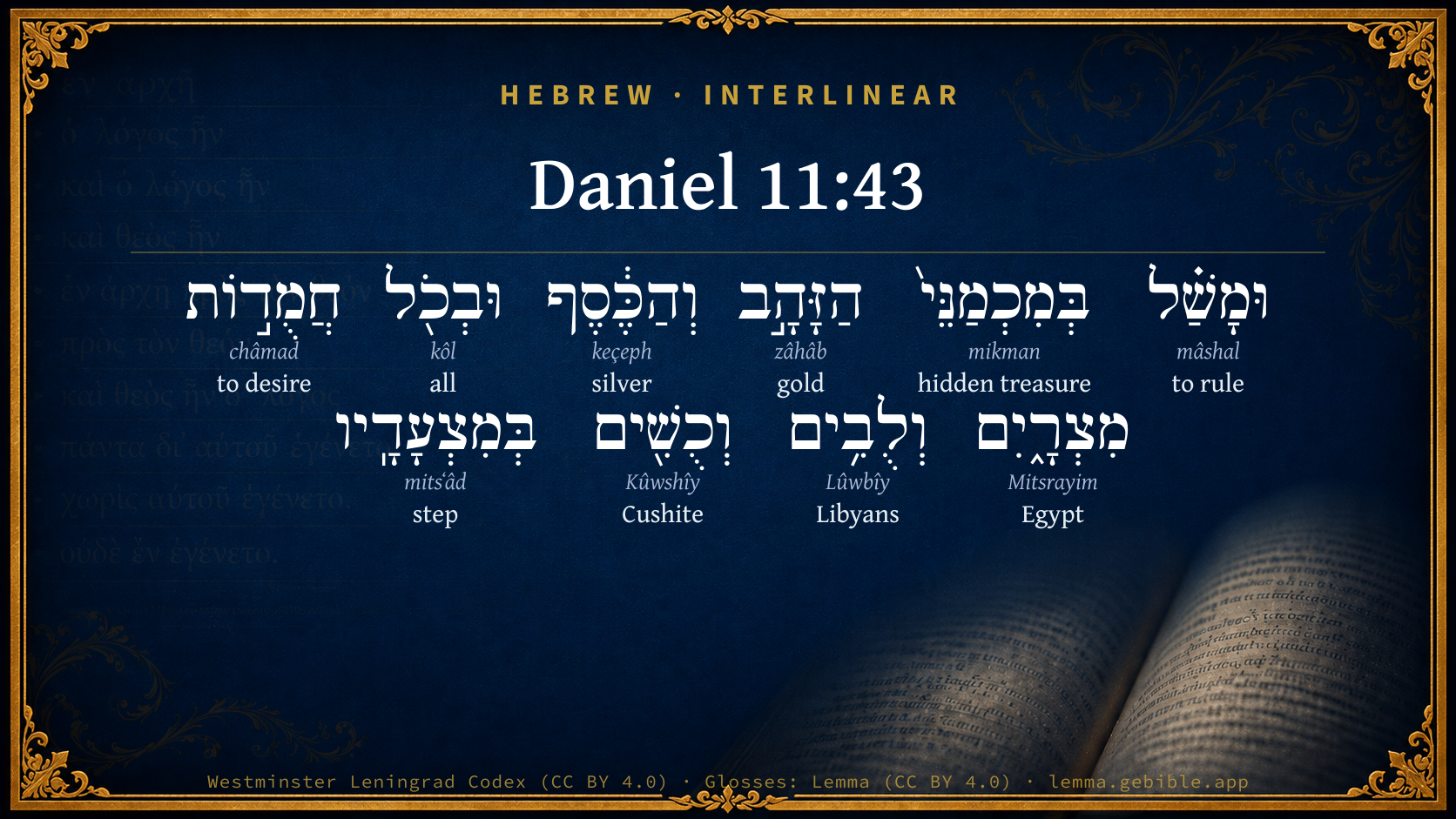
Hebrew (Westminster Leningrad Codex) Daniel 11:43 appears in the Hebrew Old Testament. The text above is from the Westminster Leningrad Codex. Each word links to its Strong’s number, a concise gloss, and parsing drawn from the Open Scriptures Hebrew Bible morphology. Click any word for its full Brown-Driver-Briggs (BDB) entry.
Download image
Cite this verse

Daniel 11:43 (World English Bible). Public Domain. Lemma interlinear Bible study tool, https://lemma.gebible.app/v/daniel/11/43.

Show BibTeX & RIS
BibTeX
RIS
English Translation
But he shall have power over the treasures of gold and of silver, and over all the precious things of Egypt; and the Libyans and the Ethiopians shall be at his steps.
World English Bible · Public Domain
Highlights
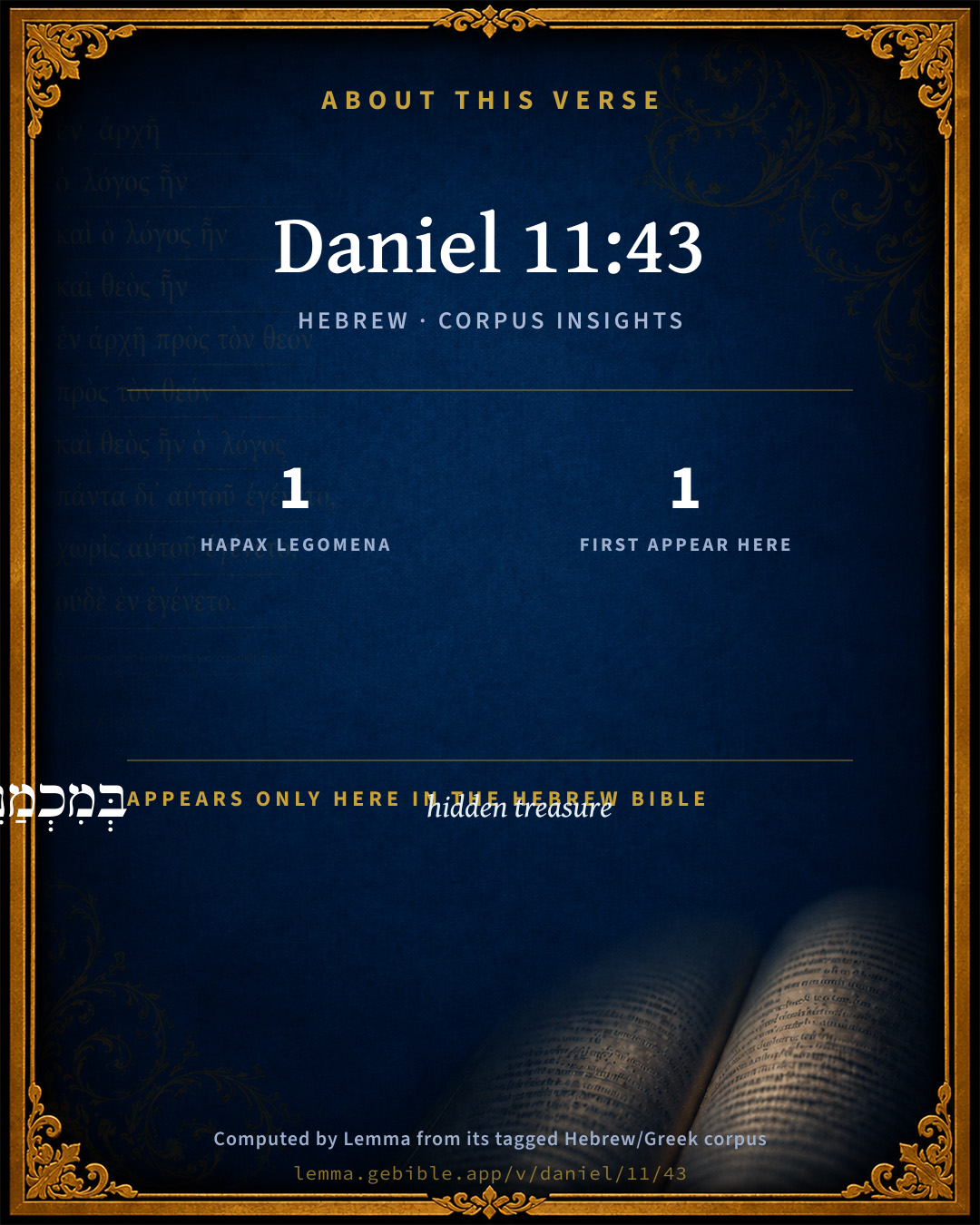
  • 1 hapax legomenon — only here in the Hebrew Bible
  • 1 first appearance in the Hebrew Bible
Full analysis ↓
Download a study sheet

One document with this verse’s original text, its word-by-word gloss line, the meaning frame, cross-references with their text, attributed commentary, and full source and license credits — printable, and it pastes into notes with its structure intact.

This verse Autodidact and up

Study sheet (.html) Plain text (.txt)

A passage Seminary Student

Up to 50 verses in one chapter. A passage sheet keeps up to 6 commentary sources and 12 cross-references per verse, in the order this page ranks them, and says so on the sheet whenever that leaves anything out. Ask for a single verse and you get the Autodidact verse sheet above.

Everything on this page stays free to read, with no account — the sheet is a download of what is already on screen, not access to it.

Want to remove ads? Support Godless Engineer
Compare translations 3

The same verse in 3 English versions, stacked beneath the original-language interlinear above. Click any original word for its lexicon entry.

Each is an independent rendering of the whole verse — the interlinear is not word-aligned to these translations.

Highlighted words mark where these versions differ — a whole-verse word diff, not a word-by-word alignment.

  • World English Bible Public Domain
    But he shall have power over the treasures of gold and of silver, and over all the precious things of Egypt; and the Libyans and the Ethiopians shall be at his steps.
  • King James Version Public Domain
    But he shall have power over the treasures of gold and of silver, and over all the precious things of Egypt: and the Libyans and the Ethiopians shall be at his steps.
  • unfoldingWord Literal Text CC BY-SA 4.0
    He will become ruler over the treasures of gold and of silver, and over all the precious things of Egypt; the Libyans and the Cushites will be in his footsteps.

unfoldingWord Literal Text — © unfoldingWord, licensed CC BY-SA 4.0. Word-aligned USFM3 via Door43 (git.door43.org/unfoldingWord/en_ult).

Versions to compare (up to 4)

3 of 4 selected

Show all 18 translations

Every available English version of this verse, each an independent rendering of the whole verse.

  • World English Bible Public Domain
    But he shall have power over the treasures of gold and of silver, and over all the precious things of Egypt; and the Libyans and the Ethiopians shall be at his steps.
  • Berean Standard Bible Public Domain
    He will gain control of the treasures of gold and silver and over all the riches of Egypt, and the Libyans and Cushites will also submit to him.
  • Majority Standard Bible Public Domain
    He will gain control of the treasures of gold and silver and over all the riches of Egypt, and the Libyans and Cushites will also submit to him.
  • King James Version Public Domain
    But he shall have power over the treasures of gold and of silver, and over all the precious things of Egypt: and the Libyans and the Ethiopians shall be at his steps.
  • American Standard Version (1901) Public Domain
    But he shall have power over the treasures of gold and of silver, and over all the precious things of Egypt; and the Libyans and the Ethiopians shall be at his steps.
  • Revised Version (1885) Public Domain
    But he shall have power over the treasures of gold and of silver, and over all the precious things of Egypt: and the Libyans and the Ethiopians shall be at his steps.
  • Geneva Bible (1599) Public Domain
    But he shall haue power ouer the treasures of golde and of siluer, and ouer all the precious things of Egypt, and of the Lybians, and of the blacke Mores where he shall passe.
  • Douay-Rheims (1899) Public Domain
    And he shall have power over the treasures of gold, and of silver, and all the precious things of Egypt: and he shall pass through Libya, and Ethiopia.
  • Young's Literal Translation Public Domain
    and he hath ruled over treasures of gold and of silver, and over all the desirable things of Egypt, and Lubim and Cushim `are' at his steps.
  • Literal Standard Version CC BY-SA 4.0
    and he has ruled over treasures of gold and of silver, and over all the desirable things of Egypt, and Lubim and Cushim [are] at his steps.
  • Unlocked Literal Bible CC BY-SA 4.0
    He will have control over the treasures of gold and of silver, and over all the riches of Egypt; the Libyans and the Cushites will be in his footsteps.
  • unfoldingWord Literal Text CC BY-SA 4.0
    He will become ruler over the treasures of gold and of silver, and over all the precious things of Egypt; the Libyans and the Cushites will be in his footsteps.
  • Darby Bible Public Domain
    And he shall have power over the treasures of gold and of silver, and over all the precious things of Egypt; and the Libyans and the Ethiopians shall be at his steps.
  • World Messianic Bible Public Domain
    But he will have power over the treasures of gold and of silver, and over all the precious things of Egypt. The Libyans and the Ethiopians will follow his steps.
  • Webster's Bible Public Domain
    But he shall have power over the treasures of gold and of silver, and over all the precious things of Egypt: and the Libyans and the Cushites shall be at his steps.
  • Free Bible Version CC BY-SA 4.0
    He will acquire the gold and silver and riches of Egypt, ruling over them and also the Libyans and Ethiopians.
  • Bible in Basic English Public Domain
    But he will have power over the stores of gold and silver, and over all the valued things of the south: and the Libyans and the Ethiopians will be at his steps.
  • JPS Tanakh (1917) Public Domain
    But he shall have power over the treasures of gold and silver, and over all the precious things of Egypt; and the Libyans and the Ethiopians shall be at his steps.

Literal Standard Version (2020), Covenant Press — licensed CC BY-SA 4.0. Text via the HelloAO Bible API (eBible.org). Unlocked Literal Bible (unfoldingWord) — licensed CC BY-SA 4.0. Text via the HelloAO Bible API (eBible.org). unfoldingWord Literal Text — © unfoldingWord, licensed CC BY-SA 4.0. Word-aligned USFM3 via Door43 (git.door43.org/unfoldingWord/en_ult). Free Bible Version, Dr. Jonathan Gallagher — licensed CC BY-SA 4.0. Text via the HelloAO Bible API (eBible.org).

Word by word

More ways to search: Search by grammar → Find every occurrence → Compare this word →

Practice this passage: Drill this verse → Learn its vocabulary →

בְּמִכְמַנֵּי֙
mikman
H4362
“in/at · hidden treasures of”
Preposition + Noun, Common, Masculine, Plural, Construct
Part of Speech
Preposition + Noun
Type
Common
Gender
Masculine
Number
Plural
State
Construct
Full BDB Definition

Origin: from the same as H3646 in the sense of hiding

TWOT: 991a

hidden stores, hidden treasure
  1. וּמָשַׁ֗ל mâshal H4910 “and · to rule” Conjunction + Verb, Qal, Sequential Perfect, 3rd Person, Masculine, Singular
  2. הַזָּהָ֣ב zâhâb H2091 “the · gold” Particle, Definite Article + Noun, Common, Masculine, Singular, Absolute
  3. וְהַכֶּ֔סֶף keçeph H3701 “and · the · silver” Conjunction + Particle, Definite Article + Noun, Common, Masculine, Singular, Absolute
  4. וּבְכֹ֖ל kôl H3605 “and · in/at · all of” Conjunction + Preposition + Noun, Common, Masculine, Singular, Construct
  5. חֲמֻד֣וֹת châmad H2530 “desirable things of” Noun, Common, Feminine, Plural, Construct
  6. מִצְרָ֑יִם Mitsrayim H4714 “Egypt” Noun, Proper
  7. וְלֻבִ֥ים Lûwbîy H3864 “and · Libyans” Conjunction + Noun, Gentilic, Masculine, Plural, Absolute
  8. וְכֻשִׁ֖ים Kûwshîy H3569 “and · Cushites” Conjunction + Noun, Gentilic, Masculine, Plural, Absolute
  9. בְּמִצְעָדָֽיו mitsʻâd H4703 “in/at · steps · his” Preposition + Noun, Common, Masculine, Plural, Construct + Suffix, Personal, 3rd Person, Masculine, Singular

About this verse

These counts appear in no published source. They are computed here, from the morphology-tagged text and Lemma’s own curated glosses. What Lemma adds →

10
words
10
distinct lemmas
Prophets
section

Notable vocabulary

1 hapax legomenon — a word that appears only here in the entire Hebrew Bible:

  • בְּמִכְמַנֵּי֙ hidden treasure H4362

First appearance in Scripture

This word makes its first canonical appearance in the Hebrew Bible here:

  • בְּמִכְמַנֵּי֙ hidden treasure H4362

Shared distinctive vocabulary

בְּמִצְעָדָֽיו step H4703 occurs in 3 verses of the Hebrew Bible. Also found in:

Grammatical profile

  • 1 verb
  • 9 nouns

Verb forms

  • וּמָשַׁ֗ל Qal · Sequential Perfect

Hebrew & Septuagint length

In English translation the verse runs 32 words from the Hebrew and 31 from the Septuagint (LXX English) — closely comparable.

A rough comparison of the two English renderings, which tokenize alike — not a word-level alignment.

Word counts can differ between the Hebrew and the Greek without any difference in meaning — e.g. the Hebrew direct-object marker אֵת has no separate Greek word, and Greek often adds the article ὁ.

Cross-references

7

Topical passages linked to Daniel 11:43 in the Treasury of Scripture Knowledge — connected by theme and wording, ordered by reader-vote popularity; previews shown in the World English Bible.

  • 2 Chronicles 12:3 with twelve hundred chariots, and sixty thousand horsemen. The people were without number who came with him out of Egypt: the Lubim, the Sukkiim, and the Ethiopians.
  • Nahum 3:9 Cush and Egypt were her boundless strength. Put and Libya were her helpers.
  • Exodus 11:8 All these your servants shall come down to me, and bow down themselves to me, saying, 'Get out, and all the people who follow you; and after that I will go out.'" He went out from Pharaoh in hot anger.
  • Judges 4:10 Barak called Zebulun and Naphtali together to Kedesh; and there went up ten thousand men at his feet: and Deborah went up with him.
  • Jeremiah 46:9–10 Go up, you horses; and rage, you chariots; and let the mighty men go forth: Cush and Put, who handle the shield; and the Ludim, who handle and bend the bow.
  • Ezekiel 30:4–5 A sword shall come on Egypt, and anguish shall be in Ethiopia, when the slain shall fall in Egypt; and they shall take away her multitude, and her foundations shall be broken down.
  • Ezekiel 38:5 Persia, Cush, and Put with them, all of them with shield and helmet;

Cross-references courtesy of OpenBible.info (CC BY 4.0).

Hebrew and Greek witnesses Masoretic Hebrew ↔ Greek Septuagint

The same verse in the two great witnesses to the Old Testament, shown verse-for-verse.

These are two independent witnesses, not word-aligned to each other, and the Septuagint is shown in lemma (dictionary) form.

Hebrew Daniel 11:43 Masoretic · Westminster Leningrad Codex

וּמָשַׁ֗ל בְּמִכְמַנֵּי֙ הַזָּהָ֣ב וְהַכֶּ֔סֶף וּבְכֹ֖ל חֲמֻד֣וֹת מִצְרָ֑יִם וְלֻבִ֥ים וְכֻשִׁ֖ים בְּמִצְעָדָֽיו

But he shall have power over the treasures of gold and of silver, and over all the precious things of Egypt; and the Libyans and the Ethiopians shall be at his steps.

World English Bible · Public Domain

Greek LXX Daniel 11:43 Septuagint · lemma form

καί κρατέω ὁ τόπος ὁ χρυσίον καί ὁ τόπος ὁ ἀργύριον καί πᾶς ὁ ἐπιθυμία αἴγυπτος καί λίβυες καί αἰθίοψ εἰμί ἐν ὁ ὄχλος αὐτός

And he shall have the mastery over the secret treasures of gold and silver, and over all the desirable possessions of Egypt, and of the Libyans and Ethiopians in their strongholds.

LXX2012 (modern English Septuagint) · Public Domain

On this verse, Whedon's Commentary on the Bible discusses the Septuagint’s reading. Read the note in Commentary ↓

Hebrew: Westminster Leningrad Codex (CC BY 4.0). Greek: Septuagint (public domain); English from LXX2012 (modern English Septuagint) (Public Domain). How the Septuagint differs from the Hebrew →

Commentary

Notes on Daniel 11:43 from classic Christian and Jewish commentators (each source and its license shown beneath its notes). The classic Christian expositions comment on the surrounding passage and are grouped to its opening verse, so a note may address several verses; the Jewish commentaries on the Tanakh (Rashi and others) are per-verse, so they appear only where the commentator wrote on this verse.

Lemma curates 59 commentaries, every one of them public domain or Creative Commons licensed, each selected and text-cleaned for this edition rather than reprinted as found. About our sources →

Trapp's Complete Commentary

John Trapp

Dan 11:43 But he shall have power over the treasures of gold and of silver, and over all the precious things of Egypt: and the Libyans and the Ethiopians [shall be] at his steps.

Ver. 43. Shall be at his steps,] i.e., Obey him as their captain.

John Trapp, A Commentary or Exposition upon All the Books of the Old and New Testament (1647–1656) — public domain. Text from a community e-Sword module.

John Calvin's Commentaries

I have previously stated that though the language applies to a single king, yet a kingdom is to be understood, and our former observations are here confirmed. Although many nations should endeavor to resist the Romans, they should yet be completely victorious, and finally acquire immense booty. Their avarice and covetousness were perfectly astonishing; for he says, they should acquire dominion over the treasures of gold and silver, and should draw to themselves all the precious things of Egypt, Libya, and Ethiopia; and that, too, in their footsteps. In these words he more clearly explains our previous remarks upon the emblem of the deluge. All lands should be laid open to them; although the cities were fortified, and would thus resist them by their closed gates, yet the way should be open to them, and none should hinder them from bursting forth over the whole east, and subduing at the same time cities, towns, and villages. This we know to have been actually accomplished. Hence there is nothing forced in the whole of this context, and the prophecy is fairly interpreted by the history. He afterwards adds, —

John Calvin's Commentaries (1540-1563) — public domain. Text from the Calvin Translation Society English edition (1840s-50s) via the Christian Classics Ethereal Library (ccel.org). Calvin's coverage is partial (roughly two-thirds of the Bible); uncommented books and verses are honest gaps, never fabricated. The 19th-century editor's footnotes and remarks are omitted so the notes are faithfully Calvin's own voice.

Ellicott's Commentary for English Readers

(43) Libyans . . . Ethiopians.—These nations are specified as allies of Egypt. (See Eze_30:5; Jer_46:9.) They are represented as following the steps of the conqueror (comp. Exo_11:8), and as submitting themselves to him.

A Bible Commentary for English Readers, edited by Charles John Ellicott (1878–1897) — public domain. Text from a community e-Sword module.

The Cambridge Bible for Schools and Colleges

gen. ed. J. J. S. Perowne

43. have power] lit. rule. He will secure great treasure from Egypt: cf. (in 170 or 169) 1Ma_1:19.

and the Libyans and the Ethiopians (shall be) at his steps] i.e. will follow in his train. The Libyans, on the W. of Egypt, and the Kushites (or Ethiopians) on the South, are both mentioned either as helping the Egyptians, or as serving in their army, in Nah_3:9, the Ethiopians also in Jer_46:9 (cf. Eze_30:4-5). Here they are represented as joining the army of the conqueror.

The Cambridge Bible for Schools and Colleges (gen. ed. J. J. S. Perowne; Cambridge University Press, 1878–1918) — public domain. Text from a community e-Sword module.

John Gill's Exposition

But he shall have power over the treasures of gold and silver, and over all the precious things of Egypt,.... The land of Egypt, as it is a very large, so a very rich country, abounding with gold, silver, and precious things; all which came into the hands of the Turk along with it; for when Selim, the ninth emperor of the Turks, conquered the Mamalucs he caused five hundred of the chiefest Egyptian families to be transported to Constantinople; as likewise a great number of Mamalucs' wives and children, besides the sultan's treasure, and other immense riches (b).

And the Lybians and the Ethiopians shall be at his steps; at his command and pleasure; shall follow him, being taken captive, or go where he orders them; that is, in all things shall be obedient to him. So we find that these very people will be in the army of Gog or the Turk, when he shall march against the land of Judea, to recover it from the Jews, when possessed of it, Eze 38:5. These people, the Africans and Ethiopians, are near to Egypt, and therefore mentioned with it, and never were under the power of Antiochus, as Jerome observes; but are now subject to the Ottoman empire, and make a part of it; which is a very strong evidence of the Turk being the king of the north here spoken of.

(b) See Dr. Newton's Dissertations on the Prophecies, p. 393.

John Gill's Exposition of the Whole Bible (1746–1763) — public domain (CC PDM 1.0). Text via the HelloAO Bible API.

Albert Barnes' Notes on the Bible

But he shall have power over the treasures of gold and of silver - See the notes at Dan 11:28. Having seized upon the most important places in Egypt, and having possession of the person of the king, he would, of course, have the wealth of Egypt at his disposal, and would return to his land laden with spoils.

And over all the precious things of Egypt - The rich lands, the public buildings, the contents of the royal palace, the works of art, and the monuments, and books, and implements of war. All these would, of course, be at the disposal of the conqueror.

And the Libyans - The word Libyans, in the Hebrew Scriptures, is everywhere joined with the Egyptians and Ethiopians. They are supposed to have been a people of Egyptian origin, and their country bordered on Egypt in the west. See Tanner’s Ancient Atlas. A conquest of Egypt was almost in itself a conquest of Libya.

And the Ethiopians - Hebrew, Cushites - כשׁים kushı̂ym. On the general meaning of the word Cush or Ethiopia in the Scriptures, see the note at Isa 11:11. The reference here, undoubtedly, is to the African Cush or Ethiopia, which bounded Egypt on the south. This country comprehended not only Ethiopia above Syene and the Cataracts, but likewise Thebais or Upper Egypt. A subjugation of Egypt would be, in fact, almost a conquest of this land.

Shall be at his steps - Gesenius renders this, “in his company.” The word means properly step, or walk. Compare Psa 37:23; Pro 20:24. The Vulgate renders this, “And he shall pass also through Libya and Ethiopia.” The Greek, “and he shall have power over all the secret treasures of gold and of silver, and over all the desirable things of Egypt, and of the Libyans, and of the Ethiopians, in their strongholds.” Lengerke renders it, “And the Libyans and Ethiopians shall follow his steps.” The proper sense of the Hebrew would be, that they accompanied him; that they marched with him or followed him; and the phrase would be applicable either to those who were allies, or who were led captive. The more probable idea would be that they were allies, or were associated with him, than that they were captives. I do not know that there are any distinct historical facts which show the truth of what is here predicted respecting Antiochus, but it cannot be considered as improbable that the prophecy was fulfilled, for

(a), as already observed, these nations, naturally allied to Egypt as being a part of the same people, bounded Egypt on the west and on the south;

(b) in the days of Ezekiel Eze 30:4-5, we find that they were actually confederated with Egypt in a “league,” and that the calamity which fell upon Egypt, also fell directly upon Ethiopia and Libya; and

(c) the possession of Egypt, therefore, would be naturally followed with the subjugation of these places, or it might be presumed that they would seek the alliance and friendship of one who had subdued it.

Albert Barnes' Notes on the Bible (1834–1885) — public domain. Text from a community e-Sword/MySword module.

Haydock's Catholic Bible Commentary

Ethiopia. Hebrew: "the Lubim and Cushim shall be at his steps." Theodot. reads, "in their fortresses." He had troops form these nations, or Egypt was guarded by them.

George Leo Haydock (1774–1849), Haydock's Catholic Family Bible and Commentary, 1859 edition — public domain. Excludes Psalms (Douay-Rheims chapter numbering differs from Protestant) and Deuterocanonical books (Catholic canon only).

Matthew Poole's English Annotations

i.e. The parts westward from Egypt along the Barbary coast, and Ethiopia, not the Abyssines, but Arabia.

Matthew Poole's English Annotations on the Holy Bible (1683–1685) — public domain. Text from a community e-Sword/MySword module.

Whedon's Commentary on the Bible

Daniel D. Whedon

43. Compare Dan_11:24; Dan_11:28.

The Libyans and the Ethiopians — The LXX. reads, “And Libyans and Ethiopians shall be in his host.” Literally, Antiochus never did dominate Egypt, and certainly never had a campaign against Libya or Ethiopia. But this is precisely in the style of oriental hyperbole which was universal to literary men of ancient times. (Compare Eze_19:8; Eze_19:13, and the Books of the Maccabees, passim.) The Jewish prophets must be allowed to tell their story in the style most agreeable and familiar to their contemporaries.

Daniel D. Whedon (gen. ed.), Commentary on the Old and New Testaments (1874–1909) — public domain. Text from a community e-Sword module.

The Pulpit Commentary

But he shall have power over the treasures of gold and of silver, and over all the precious things of Egypt; and the Libyans and the Ethiopians shall be at his steps. The rendering of the LXX is somewhat fuller, "He shall have power over the place of gold and the place of silver, and over all the desire of Egypt, and Libyans and Ethiopians shall be in his multitude." The word translated "treasures" is a late one, but evidently the Septuagint translator had ( maqom) instead of ynemkmi. (michemanay). Theodotion renders, "And he shall have power over the secret hoards of gold and silver, and over all the desirable things of Egypt, and of Libyans, and of Aethiopians in their fortresses." Theodotion has read wyrwxm (metzorayo) instead of wydxmi (mitz"adoyo). The Peshitta rendering is, "And he shall have power over the house of the treasures of gold and silver, and of the pleasant things of Egypt, and the Libyans, and the Cushites (Ethiopians) are his allies." The Vulgate follows a slightly different rendering, "And he shall rule the treasures of gold and silver, and over all the precious things of Egypt; through Libya and Aethiopia, too, shall he pass." Having a different reading in the last clause from the Massoretic, the natural Hebrew equivalent for transibit is rboy (ya"bor)a word that could scarcelv arise by mistake from that in the text. He shall have power over the treasures of gold and silcer, and over all the precious things of Egypt. Strictly speaking, this never was the case, as Antiochus never wholly conquered Egypt, although in that expedition, in which he had laid siege to Alexandria, he came very near completing his conquest. And the Libyans and the Ethiopians shall beat his steps. This certainly is not true in the sense in which Jerome takes it, "he shall pass through Libya and Ethiopia." Though Antiochus more than once invaded Egypt, he never passed further into Africa. These nationalities are associated with each other; e.g. in Jer_46:8, Jer_46:9, we have, "The Ethiopians and the Libyans that handle the shield." So in Eze_30:5 we have the countries spoken of together. It may merely mean that individuals belonging to these nationalities had joined his armies. This is altogether a more ornate and poetical passage than the rest of this chapter, and gives the feeling of a different hand; therefore, probably, it belongs to a time nearer that of Daniel, and contains more of the original prophecy. Professor Fuller remarks on a reference being made to the help Ptolemy received from Cyprus. Cyprus, or Chittim, is referred to in the earlier part of this chapter, hut not here. The Lubim and Cushim are contemporary with Edom, Moab, and the sons of Ammon.

The Pulpit Commentary (1880–1919), ed. H.D.M. Spence-Jones & Joseph S. Exell — public domain. Text from a community e-Sword module.

John Wesley's Explanatory Notes

At his steps - He had them at his foot, at his beck.

John Wesley, Explanatory Notes Upon the Whole Bible (1754–1765) — public domain. Text via the GEBible commentary corpus.

Lesson kit

Teaching starters — assembled from the data on this page, not authored interpretation. Every prompt links to the verse data it draws on. Edit before teaching.

Daniel, in the Prophets, opens this verse with 10 words (10 distinct Hebrew lemmas). Its most distinctive word is mikman (“hidden treasure”). A historical commentator’s framing appears above. Read the whole chapter for the surrounding context.

Discussion questions

  1. The word mikman carries the sense “hidden treasure.” How does it shape the verse?
  2. This verse holds 1 word here found nowhere else in the Hebrew Bible. What might the rare word draw attention to?
  3. The word “hidden treasure” first appears here in Scripture. What is being introduced at this debut?
  4. Psalms 37:23 shares the word «step» with this verse. How do the two illuminate each other?
  5. The translations on this page render this verse differently — a whole-verse word diff, not a word-by-word alignment. What might account for the different wordings?
  6. The verb «וּמָשַׁ֗ל» is Qal Sequential Perfect. How does its form color the action?
  7. Reading how Trapp's Complete Commentary and John Calvin's Commentaries read this verse, where do the two commentators agree and where do they part?

Things to notice

  • 1 word in this verse appears nowhere else in the Hebrew Bible.
  • 1 word makes its first canonical appearance in Scripture here.
  • These translations choose different wording for 10 words in this verse.
  • 10 distinct Hebrew lemmas span 10 words in this verse.

Reading settings

Reading text

Shown beneath each verse's original-language words.

Old Testament
Old Testament edition

Read the OT as the Masoretic Hebrew (MT) or the Greek Septuagint (LXX).

English shown for the Greek Septuagint (in the Hebrew ↔ Greek comparison).

Comparing translations? Open the Compare panel on any verse page to stack up to four side by side.