
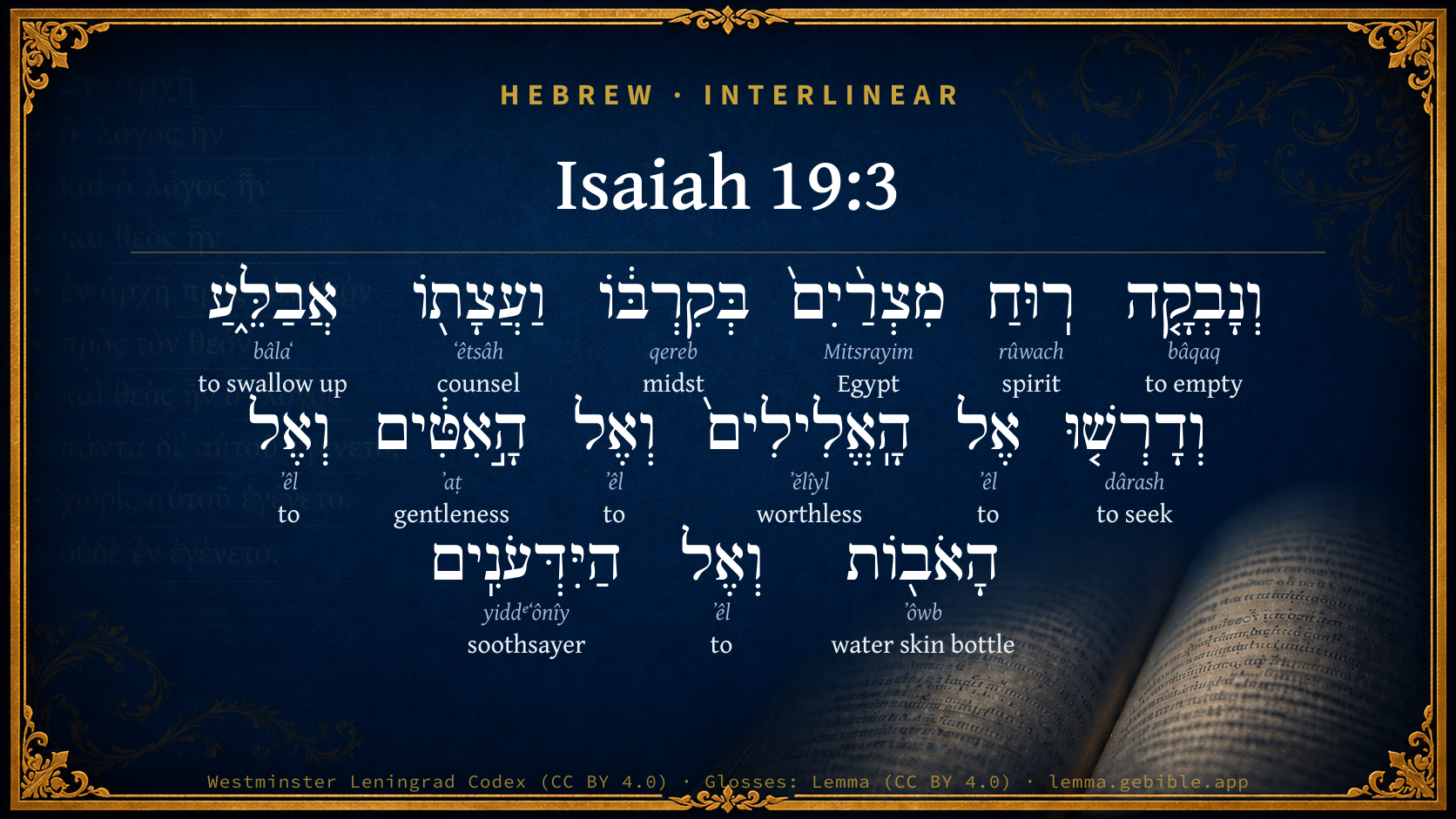
Isaiah 19:3

Hebrew (Westminster Leningrad Codex) Isaiah 19:3 appears in the Hebrew Old Testament. The text above is from the Westminster Leningrad Codex. Each word links to its Strong’s number, a concise gloss, and parsing drawn from the Open Scriptures Hebrew Bible morphology. Click any word for its full Brown-Driver-Briggs (BDB) entry.
Download image
Cite this verse

Isaiah 19:3 (World English Bible). Public Domain. Lemma interlinear Bible study tool, https://lemma.gebible.app/v/isaiah/19/3.

Show BibTeX & RIS
BibTeX
RIS
English Translation
The spirit of Egypt shall fail in the midst of it; and I will destroy the counsel of it: and they shall seek to the idols, and to the charmers, and to those who have familiar spirits, and to the wizards.
World English Bible · Public Domain
Highlights
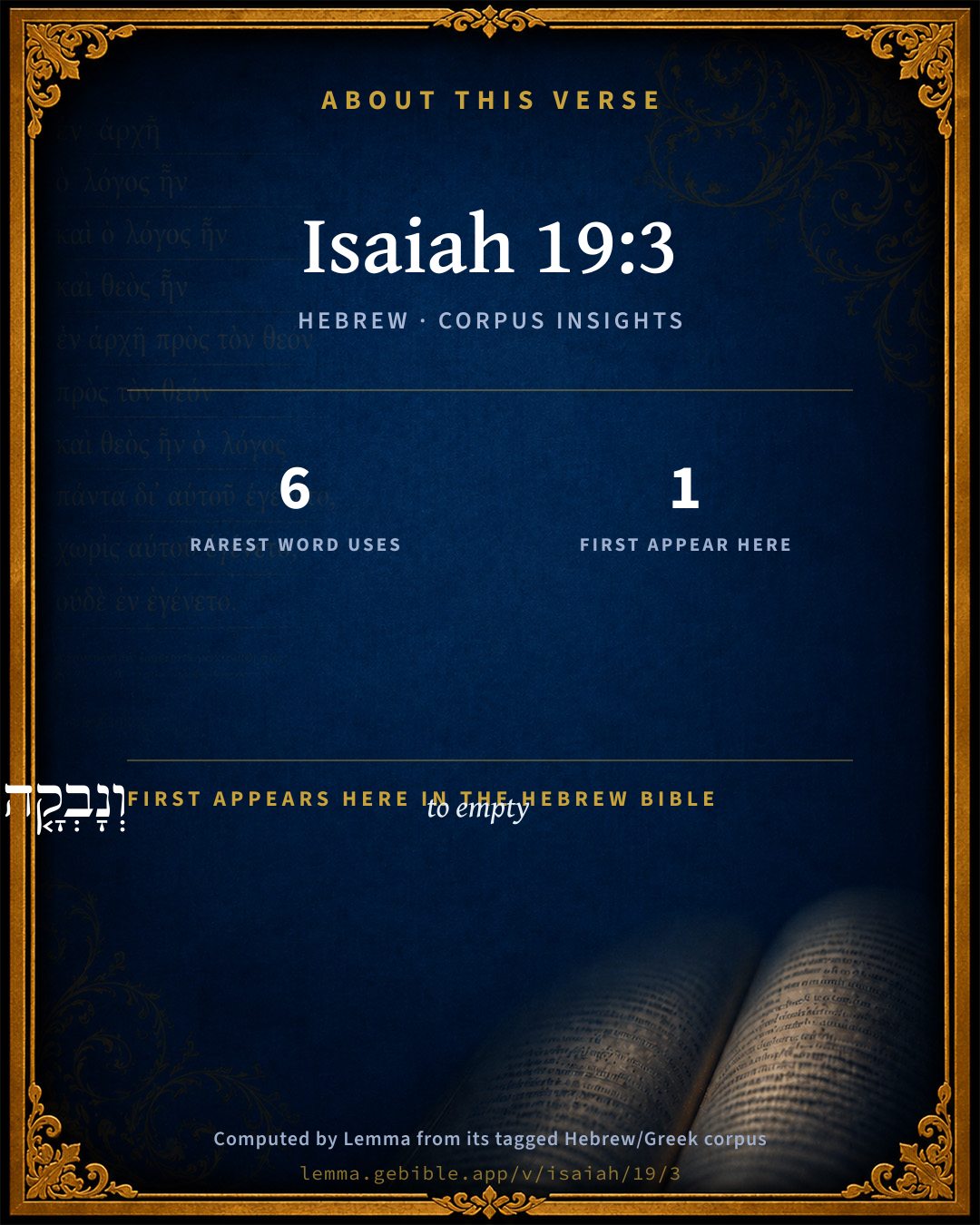
  • 1 first appearance in the Hebrew Bible
Full analysis ↓
Download a study sheet

One document with this verse’s original text, its word-by-word gloss line, the meaning frame, cross-references with their text, attributed commentary, and full source and license credits — printable, and it pastes into notes with its structure intact.

This verse Autodidact and up

Study sheet (.html) Plain text (.txt)

A passage Seminary Student

Up to 50 verses in one chapter. A passage sheet keeps up to 6 commentary sources and 12 cross-references per verse, in the order this page ranks them, and says so on the sheet whenever that leaves anything out. Ask for a single verse and you get the Autodidact verse sheet above.

Everything on this page stays free to read, with no account — the sheet is a download of what is already on screen, not access to it.

Want to remove ads? Support Godless Engineer
Compare translations 3

The same verse in 3 English versions, stacked beneath the original-language interlinear above. Click any original word for its lexicon entry.

Each is an independent rendering of the whole verse — the interlinear is not word-aligned to these translations.

Highlighted words mark where these versions differ — a whole-verse word diff, not a word-by-word alignment.

  • World English Bible Public Domain
    The spirit of Egypt shall fail in the midst of it; and I will destroy the counsel of it: and they shall seek to the idols, and to the charmers, and to those who have familiar spirits, and to the wizards.
  • King James Version Public Domain
    And the spirit of Egypt shall fail in the midst thereof; and I will destroy the counsel thereof: and they shall seek to the idols, and to the charmers, and to them that have familiar spirits, and to the wizards.
  • unfoldingWord Literal Text CC BY-SA 4.0
    And the spirit of Egypt will be emptied out in its midst, and I will swallow up its counsel. And they will seek idols and sorcerers and ritual pits and familiar spirits.

unfoldingWord Literal Text — © unfoldingWord, licensed CC BY-SA 4.0. Word-aligned USFM3 via Door43 (git.door43.org/unfoldingWord/en_ult).

Versions to compare (up to 4)

3 of 4 selected

Show all 18 translations

Every available English version of this verse, each an independent rendering of the whole verse.

  • World English Bible Public Domain
    The spirit of Egypt shall fail in the midst of it; and I will destroy the counsel of it: and they shall seek to the idols, and to the charmers, and to those who have familiar spirits, and to the wizards.
  • Berean Standard Bible Public Domain
    Then the spirit of the Egyptians will be emptied out from among them, and I will frustrate their plans, so that they will resort to idols and spirits of the dead, to mediums and spiritists.
  • Majority Standard Bible Public Domain
    Then the spirit of the Egyptians will be emptied out from among them, and I will frustrate their plans, so that they will resort to idols and spirits of the dead, to mediums and spiritists.
  • King James Version Public Domain
    And the spirit of Egypt shall fail in the midst thereof; and I will destroy the counsel thereof: and they shall seek to the idols, and to the charmers, and to them that have familiar spirits, and to the wizards.
  • American Standard Version (1901) Public Domain
    And the spirit of Egypt shall fail in the midst of it; and I will destroy the counsel thereof: and they shall seek unto the idols, and to the charmers, and to them that have familiar spirits, and to the wizards.
  • Revised Version (1885) Public Domain
    And the spirit of Egypt shall be made void in the midst of it; and I will destroy the counsel thereof: and they shall seek unto the idols, and to the charmers, and to them that have familiar spirits, and to the wizards.
  • Geneva Bible (1599) Public Domain
    And the spirite of Egypt shall faile in the middes of her, and I will destroy their counsell, and they shall seeke at the idoles, and at the sorcerers, and at them that haue spirits of diuination, and at the southsayers.
  • Douay-Rheims (1899) Public Domain
    And the spirit of Egypt shall be broken in the bowels thereof, and I will cast down their counsel: and they shall consult their idols, and their diviners, and their wizards, and soothsayers.
  • Young's Literal Translation Public Domain
    And emptied out hath been in its midst the spirit of Egypt. And its counsel I swallow up, And they have sought unto the idols, And unto the charmers, And unto those having familiar spirits, And unto the wizards.
  • Literal Standard Version CC BY-SA 4.0
    And the spirit of Egypt has been emptied out in its midst. And I swallow up its counsel, || And they have sought to the idols, || And to the charmers, || And to those having familiar spirits, || And to the wizards.
  • Unlocked Literal Bible CC BY-SA 4.0
    The spirit of Egypt will be weakened from within. I will destroy his advice, though they sought the advice of idols, dead men's spirits, mediums, and spiritualists.
  • unfoldingWord Literal Text CC BY-SA 4.0
    And the spirit of Egypt will be emptied out in its midst, and I will swallow up its counsel. And they will seek idols and sorcerers and ritual pits and familiar spirits.
  • Darby Bible Public Domain
    And the spirit of Egypt shall fail in the midst of it, and I will destroy the counsel thereof; and they shall seek unto the idols and unto the conjurers, and unto the necromancers, and unto the soothsayers.
  • World Messianic Bible Public Domain
    The spirit of the Egyptians will fail within them. I will destroy their counsel. They will seek the idols, the charmers, those who have familiar spirits, and the wizards.
  • Webster's Bible Public Domain
    And the spirit of Egypt shall fail in the midst of her, and I will destroy her counsel: and they shall seek to the idols, and to the charmers, and to them that have familiar spirits, and to the wizards.
  • Free Bible Version CC BY-SA 4.0
    I will destroy the confidence of the Egyptians. I will have their plans become all mixed up. They will ask their idols and the spirits of the dead what to do through mediums and spiritists.
  • Bible in Basic English Public Domain
    And the spirit of Egypt will be troubled in her, and I will make her decisions without effect: and they will be turning to the false gods, and to those who make hollow sounds, and to those who have control of spirits, and to those who are wise in secret arts.
  • JPS Tanakh (1917) Public Domain
    And the spirit of Egypt shall be made empty within it; and I will make void the counsel thereof; and they shall seek unto the idols, and to the whisperers, and to the ghosts, and to the familiar spirits.

Literal Standard Version (2020), Covenant Press — licensed CC BY-SA 4.0. Text via the HelloAO Bible API (eBible.org). Unlocked Literal Bible (unfoldingWord) — licensed CC BY-SA 4.0. Text via the HelloAO Bible API (eBible.org). unfoldingWord Literal Text — © unfoldingWord, licensed CC BY-SA 4.0. Word-aligned USFM3 via Door43 (git.door43.org/unfoldingWord/en_ult). Free Bible Version, Dr. Jonathan Gallagher — licensed CC BY-SA 4.0. Text via the HelloAO Bible API (eBible.org).

Word by word

More ways to search: Search by grammar → Find every occurrence → Compare this word →

Practice this passage: Drill this verse → Learn its vocabulary →

הָ֣אִטִּ֔ים
ʼaṭ
H328
“the · necromancers”
Particle, Definite Article + Noun, Common, Masculine, Plural, Absolute
Part of Speech
Particle + Noun
Type
Common
Gender
Masculine
Number
Plural
State
Absolute
Full BDB Definition

Origin: from an unused root perhaps meaning to move softly

TWOT: 72b

gentleness, softness - gently - flowing - softly - enchanter, necromancer (substantive)
  1. וְנָבְקָ֤ה bâqaq H1238 “and · to empty” Conjunction + Verb, Niphal, Sequential Perfect, 3rd Person, Feminine, Singular
  2. רֽוּחַ rûwach H7307 “spirit of” Noun, Common, Both, Singular, Construct
  3. מִצְרַ֨יִם֙ Mitsrayim H4714 “Egypt” Noun, Proper
  4. בְּקִרְבּ֔וֹ qereb H7130 “in/at · midst · his” Preposition + Noun, Common, Masculine, Singular, Construct + Suffix, Personal, 3rd Person, Masculine, Singular
  5. וַעֲצָת֖וֹ ʻêtsâh H6098 “and · counsel · his” Conjunction + Noun, Common, Feminine, Singular, Construct + Suffix, Personal, 3rd Person, Masculine, Singular
  6. אֲבַלֵּ֑עַ bâlaʻ H1104 “to swallow up” Verb, Piel, Imperfect, 1st Person, Common, Singular
  7. וְדָרְשׁ֤וּ dârash H1875 “and · to seek” Conjunction + Verb, Qal, Sequential Perfect, 3rd Person, Common, Plural
  8. אֶל ʼêl H413 “to” Preposition
  9. הָֽאֱלִילִים֙ ʼĕlîyl H457 “the · idols” Particle, Definite Article + Noun, Common, Masculine, Plural, Absolute
  10. וְאֶל ʼêl H413 “and · to” Conjunction + Preposition
  11. וְאֶל ʼêl H413 “and · to” Conjunction + Preposition
  12. הָאֹב֖וֹת ʼôwb H178 “the · water skin bottles” Particle, Definite Article + Noun, Common, Masculine, Plural, Absolute
  13. וְאֶל ʼêl H413 “and · to” Conjunction + Preposition
  14. הַיִּדְּעֹנִֽים yiddᵉʻônîy H3049 “the · soothsayers” Particle, Definite Article + Noun, Common, Masculine, Plural, Absolute

About this verse

These counts appear in no published source. They are computed here, from the morphology-tagged text and Lemma’s own curated glosses. What Lemma adds →

15
words
12
distinct lemmas
Prophets
section

Notable vocabulary

The rarest word here is הָ֣אִטִּ֔ים gentleness H328 — appearing just 6 times in the whole Hebrew Bible.

First appearance in Scripture

This word makes its first canonical appearance in the Hebrew Bible here:

  • וְנָבְקָ֤ה to empty H1238

Shared distinctive vocabulary

הָ֣אִטִּ֔ים gentleness H328 occurs in 6 verses of the Hebrew Bible. Also found in:

Grammatical profile

  • 3 verbs
  • 8 nouns
  • 4 prepositions

Verb forms

  • וְנָבְקָ֤ה Niphal · Sequential Perfect
  • אֲבַלֵּ֑עַ Piel · Imperfect
  • וְדָרְשׁ֤וּ Qal · Sequential Perfect

Repetition

A word recurs within this verse — often emphatic in Hebrew:

  • אֶל to H413 ×4

Hebrew & Septuagint length

In English translation the verse runs 41 words from the Hebrew and 44 from the Septuagint (LXX English) — closely comparable.

A rough comparison of the two English renderings, which tokenize alike — not a word-level alignment.

Word counts can differ between the Hebrew and the Greek without any difference in meaning — e.g. the Hebrew direct-object marker אֵת has no separate Greek word, and Greek often adds the article ὁ.

Cross-references

25

Topical passages linked to Isaiah 19:3 in the Treasury of Scripture Knowledge — connected by theme and wording, ordered by reader-vote popularity; previews shown in the World English Bible.

  • Isaiah 8:19 When they shall tell you, "Consult with those who have familiar spirits and with the wizards, who chirp and who mutter:" shouldn't a people consult with their God? on behalf of the living [should they consult] with the dead?
  • Daniel 2:2 Then the king commanded to call the magicians, and the enchanters, and the sorcerers, and the Chaldeans, to tell the king his dreams. So they came in and stood before the king.
  • 1 Chronicles 10:13 So Saul died for his trespass which he committed against Yahweh, because of the word of Yahweh, which he didn't keep; and also because he asked counsel of one who had a familiar spirit, to inquire [thereby],
  • Proverbs 21:30 There is no wisdom nor understanding Nor counsel against Yahweh.
  • Isaiah 44:25 who frustrates the signs of the liars, and makes diviners mad; who turns wise men backward, and makes their knowledge foolish;
  • 1 Samuel 25:37 It happened in the morning, when the wine was gone out of Nabal, that his wife told him these things, and his heart died within him, and he became as a stone.
  • 2 Samuel 15:31 One told David, saying, Ahithophel is among the conspirators with Absalom. David said, Yahweh, please turn the counsel of Ahithophel into foolishness.
  • 2 Samuel 17:14 Absalom and all the men of Israel said, The counsel of Hushai the Archite is better than the counsel of Ahithophel. For Yahweh had ordained to defeat the good counsel of Ahithophel, to the intent that Yahweh might bring evil on Absalom.
  • 2 Samuel 17:23 When Ahithophel saw that his counsel was not followed, he saddled his donkey, and arose, and got him home, to his city, and set his house in order, and hanged himself; and he died, and was buried in the tomb of his father.
  • 2 Chronicles 25:16–20 It happened, as he talked with him, that [the king] said to him, Have we made you of the king's counsel? Stop! Why should you be struck down? Then the prophet stopped, and said, I know that God has determined to destroy you, because you have done this, and have not listened to my counsel.
  • Job 5:12–13 He frustrates the devices of the crafty, So that their hands can't perform their enterprise.
  • Psalms 76:12 He will cut off the spirit of princes. He is feared by the kings of the earth.
  • Psalms 107:27 They reel back and forth, and stagger like a drunken man, And are at their wits' end.
  • Isaiah 14:27 For Yahweh of Hosts has purposed, and who shall annul it? and his hand is stretched out, and who shall turn it back?
  • Isaiah 15:2 They are gone up to Bayith, and to Dibon, to the high places, to weep: Moab wails over Nebo, and over Medeba; on all their heads is baldness, every beard is cut off.
  • Isaiah 19:1 The burden of Egypt. Behold, Yahweh rides on a swift cloud, and comes to Egypt: and the idols of Egypt shall tremble at his presence; and the heart of Egypt shall melt in the midst of it.
  • Isaiah 19:11–13 The princes of Zoan are utterly foolish; the counsel of the wisest counselors of Pharaoh is become brutish: how do you say to Pharaoh, I am the son of the wise, the son of ancient kings?
  • Isaiah 47:12 Stand now with your enchantments, and with the multitude of your sorceries, in which you have labored from your youth; if so be you shall be able to profit, if so be you may prevail.
  • Isaiah 57:16 For I will not contend forever, neither will I be always angry; for the spirit would faint before me, and the souls who I have made.
  • Jeremiah 46:15 Why are your strong ones swept away? they didn't stand, because Yahweh did drive them.
  • Daniel 4:6–7 Therefore made I a decree to bring in all the wise men of Babylon before me, that they might make known to me the interpretation of the dream.
  • Daniel 5:7 The king cried aloud to bring in the enchanters, the Chaldeans, and the soothsayers. The king spoke and said to the wise men of Babylon, Whoever shall read this writing, and show me the interpretation of it, shall be clothed with purple, and have a chain of gold about his neck, and shall be the third ruler in the kingdom.
  • Ezekiel 21:7 It shall be, when they tell you, Why do you sigh? that you shall say, Because of the news, for it comes; and every heart shall melt, and all hands shall be feeble, and every spirit shall faint, and all knees shall be weak as water: behold, it comes, and it shall be done, says the Lord Yahweh.
  • Ezekiel 22:14 Can your heart endure, or can your hands be strong, in the days that I shall deal with you? I, Yahweh, have spoken it, and will do it.
  • 1 Corinthians 3:19–20 For the wisdom of this world is foolishness with God. For it is written, "He has taken the wise in their craftiness."

Cross-references courtesy of OpenBible.info (CC BY 4.0).

Hebrew and Greek witnesses Masoretic Hebrew ↔ Greek Septuagint

The same verse in the two great witnesses to the Old Testament, shown verse-for-verse.

These are two independent witnesses, not word-aligned to each other, and the Septuagint is shown in lemma (dictionary) form.

Hebrew Isaiah 19:3 Masoretic · Westminster Leningrad Codex

וְנָבְקָ֤ה רֽוּחַ מִצְרַ֨יִם֙ בְּקִרְבּ֔וֹ וַעֲצָת֖וֹ אֲבַלֵּ֑עַ וְדָרְשׁ֤וּ אֶל הָֽאֱלִילִים֙ וְאֶל הָ֣אִטִּ֔ים וְאֶל הָאֹב֖וֹת וְאֶל הַיִּדְּעֹנִֽים

The spirit of Egypt shall fail in the midst of it; and I will destroy the counsel of it: and they shall seek to the idols, and to the charmers, and to those who have familiar spirits, and to the wizards.

World English Bible · Public Domain

Greek LXX Isaiah 19:3 Septuagint · lemma form

καί ταράσσω ὁ πνεῦμα ὁ αἰγύπτιος ἐν αὐτός καί ὁ βουλή αὐτός διασκεδάζω καί ἐπιἐρωτάω ὁ θεός αὐτός καί ὁ ἄγαλμα αὐτός καί ὁ ἐκ ὁ γῆ φωνέω καί ὁ ἐγγαστρίμυθος

And the spirit of the Egyptians shall be troubled within them; and I will frustrate their counsel: and they shall enquire of their gods and their images, and them that speak out of the earth, and them that have in them a divining spirit.

LXX2012 (modern English Septuagint) · Public Domain

On this verse, Albert Barnes' Notes on the Bible discusses the Septuagint’s reading. Read the note in Commentary ↓

Hebrew: Westminster Leningrad Codex (CC BY 4.0). Greek: Septuagint (public domain); English from LXX2012 (modern English Septuagint) (Public Domain). How the Septuagint differs from the Hebrew →

Targum (Aramaic paraphrase)

1

The Targum is the ancient Jewish Aramaic paraphrase of the Hebrew Scriptures — an interpretive translation, not the Hebrew text itself. Onkelos (literal) and Pseudo-Jonathan (expansive) render the Torah, and Jonathan the Prophets. Coverage is partial: where no permissively-licensed English translation exists for a verse, only the Aramaic is shown. This is verse-level text, not a word-by-word alignment to the Hebrew.

  1. Targum Jonathan Prophets (Joshua–Malachi)
    וְתִתְמְסֵי רוּחָא דְמִצְרָאֵי בִּמְעֵיהוֹן וְחַכִּימֵיהוֹן אֱסַלְעֵם וְיִתְבְּעוּן מִן טַעֲוָן וּמִן חֲרָשִׁין וּמִן בִּידִין וּמִן זְכוּרוּ:

    And the spirit of the Egyptians shall melt within them, and their wise men I will destroy: and they shall seek to the idols, and to the charmers, to the deceitful, and to the diviners.

    Targum Jonathan — Aramaic: “Mikraot Gedolot” (public domain). English: “Sefaria Community Translation” (CC0 1.0 (public-domain dedication)); “London "Chaldee Paraphrase," 1871” (public domain). Text via Sefaria.

Commentary

Notes on Isaiah 19:3 from classic Christian and Jewish commentators (each source and its license shown beneath its notes). The classic Christian expositions comment on the surrounding passage and are grouped to its opening verse, so a note may address several verses; the Jewish commentaries on the Tanakh (Rashi and others) are per-verse, so they appear only where the commentator wrote on this verse.

Lemma curates 59 commentaries, every one of them public domain or Creative Commons licensed, each selected and text-cleaned for this edition rather than reprinted as found. About our sources →

Trapp's Complete Commentary

John Trapp

Isa 19:3 And the spirit of Egypt shall fail in the midst thereof; and I will destroy the counsel thereof: and they shall seek to the idols, and to the charmers, and to them that have familiar spirits, and to the wizards.

Ver. 3. And the spirit of Egypt shall fail.] Fail and falter; their wits shall not serve them, but be drained and emptied, as the Hebrew word here signifieth. By spirit, here understand their wisdom, learning, and sharpness, for the which they were famous among, and frequented by other nations. Moses was skilled in their learning. {Act 7:23} Pythagoras, Plato, Solon, Anaxagoras, and other philosophers got much by them. Mercurius Trismegist saith of Egypt, that it was the image of heaven, and the temple of the whole world. By spirit here, some understand their familiar spirits. {a} See Lev 19:31.

And they shall seek to the idols.] Whereof they had great store (so that they were derided by other idolaters), but their chief deity was Latona, saith Herodotus.

And to the charmers.] Who have their name in Hebrew from their low or slow speaking.

{a} Aug. De Civit. Dei, lib. viii. cap. 14.

John Trapp, A Commentary or Exposition upon All the Books of the Old and New Testament (1647–1656) — public domain. Text from a community e-Sword module.

Tyndale Open Study Notes

Tyndale Open Resources

19:3 Idols . . . spirits, mediums, and those who consult the spirits of the dead were called upon in an attempt to ward off impending destruction (see 8:19-22; 47:12-13).

Tyndale Open Study Notes — © Tyndale Open Resources, licensed CC BY-SA 4.0. Text via the HelloAO Bible API.

Geneva Bible (1599)

Geneva Bible translators

Meaning, their policy and wisdom.

Geneva Bible (1599) marginal notes — public domain. Text via Bolls.life.

Jamieson, Fausset & Brown

Robert Jamieson, A. R. Fausset & David Brown

spirit--wisdom, for which Egypt was famed (Isa 31:2; Kg1 4:30; Act 7:22); answering to "counsel" in the parallel clause.

fail--literally, "be poured out," that is, be made void (Jer 19:7). They shall "seek" help from sources that can afford none, "charmers," &c. (Isa 8:19).

charmers--literally, "those making a faint sound"; the soothsayers imitated the faint sound which was attributed to the spirits of the dead (see on Isa 8:19).

Jamieson, Fausset & Brown — Commentary Critical and Explanatory on the Whole Bible (1871) — public domain (CC PDM 1.0). Text via the HelloAO Bible API.

Adam Clarke's Commentary

Verse 3. They shall seek to the idols, and to the charmers, and to them that have familiar spirits, and to the wizards.] And thei schul asken their symulacres, and their devynouris, and their devyl clepers, and their devyl sacristers. - Old Bible. The import of the original words has already been given where they occur in the Pentateuch. See De 18:10, &c.

Adam Clarke's Commentary on the Bible (1810–1826) — public domain. Text from a community e-Sword/MySword module.

Ellicott's Commentary for English Readers

(3) The charmers, and to them that have familiar spirits . . .—The old reputation of Egypt for magic arts (Exo_7:22; Exo_8:7) seems to have continued. The “charmers” or mutterers were probably distinguished, like “those that peep” in Isa_8:19, by some peculiar form of ventriloquism. A time of panic, when the counsels of ordinary statesmen failed, was sure there, as at Athens in its times of peril, to be fruitful in oracles and divinations.

A Bible Commentary for English Readers, edited by Charles John Ellicott (1878–1897) — public domain. Text from a community e-Sword module.

The Cambridge Bible for Schools and Colleges

gen. ed. J. J. S. Perowne

3. the spirit of Egypt shall fail] lit. be poured out, cf. Jer_19:7. “Spirit” is here used of intellectual power, as “heart” in Isa_19:1 denotes courage.

I will destroy] or “swallow up,” “annihilate,” but see on ch. Isa_3:12. In their desperation the Egyptians betake themselves to incantations, a sign in Isaiah’s view of hopeless intellectual embarrassment; ch. Isa_8:19. The word rendered charmers means “mutterers” (of magical spells). For the other expressions employed, see ch. Isa_8:19.

The Cambridge Bible for Schools and Colleges (gen. ed. J. J. S. Perowne; Cambridge University Press, 1878–1918) — public domain. Text from a community e-Sword module.

John Gill's Exposition

And the spirit of Egypt shall fail in the midst thereof,.... Meaning not the spirit of valour and courage, that is expressed before, but of wisdom, prudence, and understanding; the wisdom of Egypt, in which Moses is said to be brought up, Act 7:22 was famous all the world over; hither men of learning, as the ancient philosophers, Pythagoras, Plato, and others, travelled, to improve in knowledge, and gain a larger acquaintance with things human and divine; it was the mother and mistress of the liberal arts and sciences; but now what was before like a river full of water, was about to be "emptied", and drained dry, as the word (y) used signifies:

and I will destroy the counsels thereof; or "swallow them up" (z), so that they shall be no more seen, or take effect: this explains what is before meant by the spirit of Egypt, and which is further enlarged on, and illustrated in Isa 19:11,

and they shall seek to the idols; with which the land abounded, particularly to Osiris and Isis, to Apis, Latona, and others:

and to the charmers; that used incantations and spells; magicians and conjurers, that whispered and muttered; for the word used has the signification of speaking in a slow and drawling manner. The Targum renders it "witches"; but Jarchi takes it to be the name of an idol:

and to them that have familiar spirits, and to the wizards; See Gill on Isa 8:19.

(y) "evacuabitur", Pagninus, Montanus, Piscator, Cocceius. (z) "deglutiam", Montanus; "absorpsero", Junius & Tremellius; "absorbebo", Piscator.

John Gill's Exposition of the Whole Bible (1746–1763) — public domain (CC PDM 1.0). Text via the HelloAO Bible API.

Albert Barnes' Notes on the Bible

And the spirit of Egypt - (see Isa 19:1). They shall be exhausted with their long internal contentions and strifes; and seeing no prospect of deliverance, and anxious that the turmoils should end, they shall seek counsel and refuge in their gods and necromancers, but in vain.

Shall fail - (נבקה nâbeqâh). Margin, ‘Be emptied.’ The word means, literally, “to pour out, empty, depopulate.” Here it means that they would become disheartened and discouraged.

And I will destroy - Margin, as the Hebrew, ‘I will swallow up.’ So the word is used in Psa 107:27, ‘All their wisdom is destroyed’ (Hebrew, ‘swallowed up. ‘)

And they shall seek to the idols - According to Herodotus (ii. 152), Psammetichus had consulted the oracle of Latona at Butos, and received for answer that the sea should avenge his cause by producing brazen men. Some time after, a body of Ionians and Carians were compelled by stress of weather to touch at Egypt, and landed there, clad in brass armor. Some Egyptians, alarmed at their appearance, came to Psammetichus, and described them as brazen men who had risen from the sea, and were plundering the country. He instantly supposed that this was the accomplishment of the oracle, and entered into an alliance with the strangers, and by their aid was enabled to obtain the victory over his foes. Compare the different accounts of Diodorus in the Analysis of this chapter. The whole history of Egypt shows how much they were accustomed to consult their idols (see Herodot. ii. 54ff, 82, 83, 139, 152). Herodotus says (ii. 83), that the art of divination in Egypt was confined to certain of their deities. There were in that country the oracles of Hercules, of Apollo, of Mars, of Diana, and of Jupiter; but the oracle of Latona in Butos was held in greater veneration than any of the rest.

And to the charmers - (אטים 'ı̂ṭı̂ym). This word occurs nowhere else. The root אטט 'âṭaṭ, in Arabic, means “to mutter, to make a gentle noise;” and this word probably denotes conjurors, diviners (see the note at Isa 8:19). The Septuagint renders it, ‘Their idols.’

And to them that have familiar spirits - (see the note at Isa 8:19). The Septuagint renders this, ‘Those who speak from the ground.’

And to the wizards - Septuagint - Ἐγγαστριμύθους Engastrimuthous - ‘Ventriloquists.’ The Hebrew word means a wise man, a soothsayer, a magician (ידענים yı̂dı̂‛onı̂ym from ידע yâda‛ “to know;” see Lev 19:31; Lev 20:6; Deu 18:11). This fake science abounded in Egypt, and in most Oriental countries.

Albert Barnes' Notes on the Bible (1834–1885) — public domain. Text from a community e-Sword/MySword module.

Haydock's Catholic Bible Commentary

Egypt. Septuagint, "of the Egyptians shall be troubled within them." (Haydock) --- Soothsayers. Feeble but too common resource of superstitious people!

George Leo Haydock (1774–1849), Haydock's Catholic Family Bible and Commentary, 1859 edition — public domain. Excludes Psalms (Douay-Rheims chapter numbering differs from Protestant) and Deuterocanonical books (Catholic canon only).

Matthew Poole's English Annotations

The spirit; either

1. Their courage. But of that he spake Isa 19:1. Or,

2. Their understanding, as it is explained in the next clause; for the word spirit is oft put for the reasonable soul, as Ecc 3:21; 12:7, and for the thoughts of the mind, as Pro 29:11; Eze 13.

3. They shall seek to the idols, as not knowing what to do without the help of a higher power.

Matthew Poole's English Annotations on the Holy Bible (1683–1685) — public domain. Text from a community e-Sword/MySword module.

Whedon's Commentary on the Bible

Daniel D. Whedon

3. And the spirit of Egypt — That is, Egypt’s wisdom, its customary wisdom, shall fail, or, as in the literal Hebrew, shall be emptied or poured out, in that while overwhelmed in their troubles they look not to Jehovah for help, but to their idols. To these, rather, did they seek; and to the charmers, persons who pretended to imitate the softly suppressed voices of the under world, and to them that have familiar spirits, who employed themselves in invoking the manes of the dead by magical incantations, and to the wizards, that is, lying prophets of every kind.

Daniel D. Whedon (gen. ed.), Commentary on the Old and New Testaments (1874–1909) — public domain. Text from a community e-Sword module.

The Pulpit Commentary

They shall seek to the idols. The Egyptians believed that their gods gave them oracles. Menephthah claims to have been warned by Phthah, the god of Memphis, not to take the field in person against the Libyans when they invaded the Delta, but to leave the task of contending with them to his generals (Brugsch, "History of Egypt," vol. 2. p. 119). Herodotus speaks of there being several well-known oracular shrines in Egypt, the most trustworthy being that of Maut, at the city which he calls Buto (2. 152; comp. Isaiah 111). The charmers... them that have familiar spirits... wizards. Classes of men corresponding to the "magicians" and "wise men" of earlier times. (Gen_41:8) (On the large place which magic occupied in the thoughts of the Egyptians, see "Pulpit Commentary" on Exo_7:11) There was no diminution of the confidence reposed in them as time went on; and some remains of their practices seem to survive to the present day.

Temptation to trust in diviners.

"They shall seek... to the charmers." "A time of panic, when the counsels of ordinary statesmen failed, was sure in Egypt, as at Athens in its times of peril, to be fruitful in oracles and divinations." The most remarkable instance recorded in Scripture is that of King Saul, who in his extremity, and after having himself driven the witches out of his land, imperiled his life to consult the witch of Endor. And even in these days there are most curious survivals of the old spirit, in the consultations of fortune-tellers, and the confidence placed in the guesses of prophesiers, and the vague generalities of so-called astrologers. Large numbers of ignorant and only partly educated people hold to this day their confidence in lucky and unlucky times, and their fears of thirteen at the table, the ticking of the death-watch, and the coffin-shaped cinder. In times of national distress men who pretend to prophesy find their harvest, and trade upon the fears and hopes of men.

I THE UNIVERSAL DESIRE TO PIERCE THE UNSEEN AND THE FUTURE. On this desire rests the success of modern spiritualism. Where there is no restful confidence in God"s love and lead, men try to force aside the veils that hide God and God"s purposes from mortal view. Man can do so much in the present that he is fretted and annoyed because he can get no guarantees for tomorrow, and every day must act upon the uncertainty whether, for him, there will be any to-morrow. After this life, what then? Men are angry because no fellow-man has ever answered that question or ever can. Revelation from God can alone relieve the mystery. Show how in all ages men have peered into the dark future, and been compelled to confess that they could see nothing but the "folds of the wondrous veil.

II THE MORAL REASONS WHY THE FUTURE IS HIDDEN FROM US.

1. It is necessary for our probation.

2. It prevents procrastination by impression of the supreme value of now.

3. It keeps from the self-security which nourishes free indulgence in sin. 4. It makes our life manifestly a life of faith.

III THE REST WHICH RELIGION GIVES FROM THE CARE ABOUT THE FUTURE. Religion brings God into direct relations, and gracious relations, with the individual. Past, present, future, are all in God"s control. If the soul is in right relations with God, the present is his overruling, and the future is his provision. If we are with God, all is well, here or there. R.T.

The Pulpit Commentary (1880–1919), ed. H.D.M. Spence-Jones & Joseph S. Exell — public domain. Text from a community e-Sword module.

John Wesley's Explanatory Notes

The spirit - Their courage.

John Wesley, Explanatory Notes Upon the Whole Bible (1754–1765) — public domain. Text via the GEBible commentary corpus.

J. A. Alexander on Isaiah

Joseph Addison Alexander

“And the spirit of Egypt shall be emptied out (or exhausted) in the midst thereof, and the counsel (or sagacity) thereof I will swallow up (annihilate or render useless), and they will seek to the idols, and to the mutterers, and to the familiar spirits, and to the wizards.” By spirit, in the first clause, we are not to understand courage but intellect. As to the ancient mode of incantation, see above, Isa 8:19.

Joseph Addison Alexander, The Prophecies of Isaiah (1846–1847; New York: Scribner, 1870–1878) — public domain. Text from a community e-Sword module.

unfoldingWord translationNotes

Door43 World Missions Community

The spirit of Egypt will be weakened from within. I will destroy his advice

The nation of Egypt is spoken of here as if it was a person. (See: Personification)

The spirit of Egypt will be weakened from within

This can be expressed in active form. AT: "I will weaken the spirit of Egypt from within" (See: Active or Passive)

I will destroy his advice, though they sought the advice of ... spiritualists

"They sought the advice of ... spiritualists, but that will do them no good. It will not stop me from destroying his advice"

I will destroy his advice

Possible meanings are 1) Yahweh will cause the advice that he gives to be ineffective or 2) Yahweh will cause him to be unable to give any advice. This can be reworded so that the abstract noun "advice" is expressed as the verb "advise." AT: "I will confuse those who advise the king" (See: Abstract Nouns)

mediums ... spiritualists

These are people who claim to speak with those who have died.

I will give the Egyptians into the hand of a harsh master

Here "hand" refers to power or control. AT: "I will give the Egyptians over to the control of a harsh master" (See: Metonymy)

this is the declaration of the Lord Yahweh of hosts

Yahweh speaks of himself by name to express the certainty of what he is declaring. Translate as in Isaiah 3:15. AT: "this is what the Lord Yahweh of hosts has declared" or "this is what I, the Lord Yahweh of hosts, have declared" (See: First, Second, or Third Person)

translationWords

spirit

Egypt

advice

false god

hand

lord

king

declare

lord

Yahweh of hosts

unfoldingWord translationNotes — © Distant Shores Media and the Door43 World Missions Community, licensed CC BY-SA 4.0. Source: git.door43.org/Door43/en_tn.

Rashi

Rabbi Shlomo Yitzchaki (Rashi)

And the spirit of Egypt shall empty out Heb. וְנָבְקָה. His wisdom shall be emptied out. Comp. (infra 24:1) “Empties out (בּוֹקֵק) the land.”

sorcerers Heb. הָאִטִּים, one of the names of the idols.

Rashi on the Tanakh — English translations: “The Judaica Press complete Tanach with Rashi, translated by A. J. Rosenberg” (CC BY 4.0); “Pentateuch with Rashi's commentary by M. Rosenbaum and A.M. Silbermann, 1929-1934” (public domain); “The Metsudah Tanach series, Lakewood, N.J” (CC BY 4.0); and “The Book of Joshua, Metsudah Publications, 1997” (CC BY 4.0). Text via Sefaria.

Ibn Ezra

Rabbi Abraham ibn Ezra

ונבקה And shall fail. Root בקק to empty. Comp. בוקק maketh empty (24:1). נבקה is Niphal of בקק, and is formed like נסבה and it will be wound about (Ez. 41:7).

אטים Charmers. Comp. אט softly (1 Kings 21:27); אטים signifies things that are done secretly.

Ibn Ezra on the Tanakh — English translations: “Sefaria Community Translation” (CC0 1.0 (public-domain dedication)); “Yalkut, Sifsei Chachomim Chumash, Metsudah Publications, 2009” (CC BY 4.0); and “Commentary of Ibn Ezra on Isaiah - trans. by M. Friedlander, 1873” (public domain). Text via Sefaria.

Lesson kit

Teaching starters — assembled from the data on this page, not authored interpretation. Every prompt links to the verse data it draws on. Edit before teaching.

Isaiah, in the Prophets, opens this verse with 15 words (12 distinct Hebrew lemmas). Its most distinctive word is ʼaṭ (“gentleness”). A historical commentator’s framing appears above. Read the whole chapter for the surrounding context.

Discussion questions

  1. What does “gentleness” (ʼaṭ) contribute to the verse as a whole?
  2. The word “to empty” first appears here in Scripture. What is being introduced at this debut?
  3. Genesis 33:14 shares the word «gentleness» with this verse. How do the two illuminate each other?
  4. “to” occurs 4× in this one verse. What is the effect of the repetition?
  5. The translations on this page render this verse differently — a whole-verse word diff, not a word-by-word alignment. What might account for the different wordings?
  6. The verb «וְנָבְקָ֤ה» is Niphal Sequential Perfect. How does its form color the action?
  7. Reading how Trapp's Complete Commentary and Tyndale Open Study Notes read this verse, where do the two commentators agree and where do they part?

Things to notice

  • 1 word makes its first canonical appearance in Scripture here.
  • These translations choose different wording for 15 words in this verse.
  • “to” occurs 4× in this single verse.
  • 12 distinct Hebrew lemmas span 15 words in this verse.

Reading settings

Reading text

Shown beneath each verse's original-language words.

Old Testament
Old Testament edition

Read the OT as the Masoretic Hebrew (MT) or the Greek Septuagint (LXX).

English shown for the Greek Septuagint (in the Hebrew ↔ Greek comparison).

Comparing translations? Open the Compare panel on any verse page to stack up to four side by side.