Jeremiah 26:22

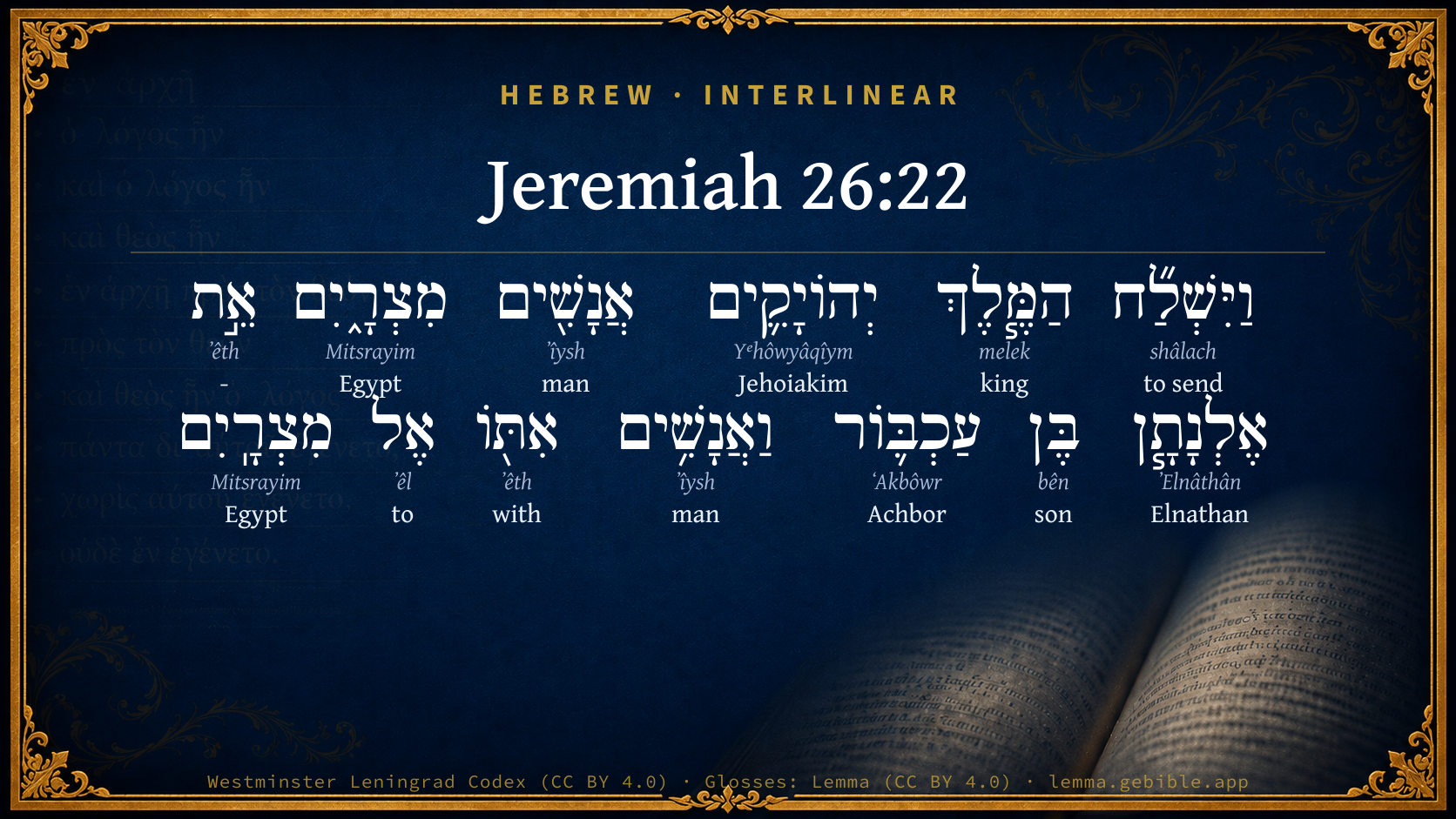
Hebrew (Westminster Leningrad Codex) Jeremiah 26:22 appears in the Hebrew Old Testament. The text above is from the Westminster Leningrad Codex. Each word links to its Strong’s number, a concise gloss, and parsing drawn from the Open Scriptures Hebrew Bible morphology. Click any word for its full Brown-Driver-Briggs (BDB) entry.
Download image
Cite this verse

Jeremiah 26:22 (World English Bible). Public Domain. Lemma interlinear Bible study tool, https://lemma.gebible.app/v/jeremiah/26/22.

Show BibTeX & RIS
BibTeX
RIS
English Translation
and Jehoiakim the king sent men into Egypt, [namely], Elnathan the son of Achbor, and certain men with him, into Egypt;
World English Bible · Public Domain
Download a study sheet

One document with this verse’s original text, its word-by-word gloss line, the meaning frame, cross-references with their text, attributed commentary, and full source and license credits — printable, and it pastes into notes with its structure intact.

This verse Autodidact and up

Study sheet (.html) Plain text (.txt)

A passage Seminary Student

Up to 50 verses in one chapter. A passage sheet keeps up to 6 commentary sources and 12 cross-references per verse, in the order this page ranks them, and says so on the sheet whenever that leaves anything out. Ask for a single verse and you get the Autodidact verse sheet above.

Everything on this page stays free to read, with no account — the sheet is a download of what is already on screen, not access to it.

Want to remove ads? Support Godless Engineer
Compare translations 3

The same verse in 3 English versions, stacked beneath the original-language interlinear above. Click any original word for its lexicon entry.

Each is an independent rendering of the whole verse — the interlinear is not word-aligned to these translations.

Highlighted words mark where these versions differ — a whole-verse word diff, not a word-by-word alignment.

  • World English Bible Public Domain
    and Jehoiakim the king sent men into Egypt, [namely], Elnathan the son of Achbor, and certain men with him, into Egypt;
  • King James Version Public Domain
    And Jehoiakim the king sent men into Egypt, namely, Elnathan the son of Achbor, and certain men with him into Egypt.
  • unfoldingWord Literal Text CC BY-SA 4.0
    And King Jehoiakim sent men Egypt -- Elnathan son of Akbor and men with him -- to Egypt.

unfoldingWord Literal Text — © unfoldingWord, licensed CC BY-SA 4.0. Word-aligned USFM3 via Door43 (git.door43.org/unfoldingWord/en_ult).

Versions to compare (up to 4)

3 of 4 selected

Show all 18 translations

Every available English version of this verse, each an independent rendering of the whole verse.

  • World English Bible Public Domain
    and Jehoiakim the king sent men into Egypt, [namely], Elnathan the son of Achbor, and certain men with him, into Egypt;
  • Berean Standard Bible Public Domain
    Then King Jehoiakim sent men to Egypt: Elnathan son of Achbor along with some other men.
  • Majority Standard Bible Public Domain
    Then King Jehoiakim sent men to Egypt: Elnathan son of Achbor along with some other men.
  • King James Version Public Domain
    And Jehoiakim the king sent men into Egypt, namely, Elnathan the son of Achbor, and certain men with him into Egypt.
  • American Standard Version (1901) Public Domain
    and Jehoiakim the king sent men into Egypt, `namely', Elnathan the son of Achbor, and certain men with him, into Egypt;
  • Revised Version (1885) Public Domain
    and Jehoiakim the king sent men into Egypt, namely, Elnathan the son of Achbor, and certain men with him, into Egypt:
  • Geneva Bible (1599) Public Domain
    Then Iehoiakim the King sent men into Egypt, euen Elnathan the sonne of Achbor, and certaine with him into Egypt.
  • Douay-Rheims (1899) Public Domain
    And king Joakim sent men into Egypt, Elnathan the son of Achobor, and men with him into Egypt.
  • Young's Literal Translation Public Domain
    And the king Jehoiakim sendeth men to Egypt -- Elnathan son of Achbor, and men with him unto Egypt --
  • Literal Standard Version CC BY-SA 4.0
    And King Jehoiakim sends men to Egypt—Elnathan son of Achbor, and men with him to Egypt—
  • Unlocked Literal Bible CC BY-SA 4.0
    Then King Jehoiakim sent out men to go to Egypt—Elnathan son of Akbor and men to go into Egypt after Uriah.
  • unfoldingWord Literal Text CC BY-SA 4.0
    And King Jehoiakim sent men Egypt -- Elnathan son of Akbor and men with him -- to Egypt.
  • Darby Bible Public Domain
    And Jehoiakim the king sent men into Egypt, Elnathan the son of Achbor, and men with him, into Egypt;
  • World Messianic Bible Public Domain
    Then Jehoiakim the king sent Elnathan the son of Achbor and certain men with him into Egypt.
  • Webster's Bible Public Domain
    And Jehoiakim the king sent men into Egypt, namely, Elnathan the son of Achbor, and certain men with him into Egypt.
  • Free Bible Version CC BY-SA 4.0
    But King Jehoiakim sent Elnathan, son of Achbor, along with some others.
  • Bible in Basic English Public Domain
    And Jehoiakim the king sent Elnathan, the son of Achbor, and certain men with him, into Egypt.
  • JPS Tanakh (1917) Public Domain
    and Jehoiakim the king sent men into Egypt, Elnathan the son of Achbor, and certain men with him, into Egypt;

Literal Standard Version (2020), Covenant Press — licensed CC BY-SA 4.0. Text via the HelloAO Bible API (eBible.org). Unlocked Literal Bible (unfoldingWord) — licensed CC BY-SA 4.0. Text via the HelloAO Bible API (eBible.org). unfoldingWord Literal Text — © unfoldingWord, licensed CC BY-SA 4.0. Word-aligned USFM3 via Door43 (git.door43.org/unfoldingWord/en_ult). Free Bible Version, Dr. Jonathan Gallagher — licensed CC BY-SA 4.0. Text via the HelloAO Bible API (eBible.org).

Word by word

More ways to search: Search by grammar → Find every occurrence → Compare this word →

Practice this passage: Drill this verse → Learn its vocabulary →

אֶלְנָתָ֧ן
ʼElnâthân
H494
“Elnathan”
Noun, Proper
Part of Speech
Noun
Type
Proper
Full BDB Definition

Origin: from H410 and H5414

TWOT: None

Elnathan = "God has given" - king Jehoiachin's maternal grandfather - three chief men in Ezra's time - son of Achbor, a military commander under Jehoiakim
  1. וַיִּשְׁלַ֞ח shâlach H7971 “and · to send” Conjunction + Verb, Qal, Sequential Imperfect, 3rd Person, Masculine, Singular
  2. הַמֶּ֧לֶךְ melek H4428 “the · king” Particle, Definite Article + Noun, Common, Masculine, Singular, Absolute
  3. יְהוֹיָקִ֛ים Yᵉhôwyâqîym H3079 “Jehoiakim” Noun, Proper
  4. אֲנָשִׁ֖ים ʼîysh H376 “men” Noun, Common, Masculine, Plural, Absolute
  5. מִצְרָ֑יִם Mitsrayim H4714 “Egypt” Noun, Proper
  6. אֵ֣ת ʼêth H853 “-” Particle, Direct Object
  7. בֶּן bên H1121 “son of” Noun, Common, Masculine, Singular, Construct
  8. עַכְבּ֛וֹר ʻAkbôwr H5907 “Achbor” Noun, Proper
  9. וַאֲנָשִׁ֥ים ʼîysh H376 “and · men” Conjunction + Noun, Common, Masculine, Plural, Absolute
  10. אִתּ֖וֹ ʼêth H854 “with · him” Preposition + Suffix, Personal, 3rd Person, Masculine, Singular
  11. אֶל ʼêl H413 “to” Preposition
  12. מִצְרָֽיִם Mitsrayim H4714 “Egypt” Noun, Proper

About this verse

These counts appear in no published source. They are computed here, from the morphology-tagged text and Lemma’s own curated glosses. What Lemma adds →

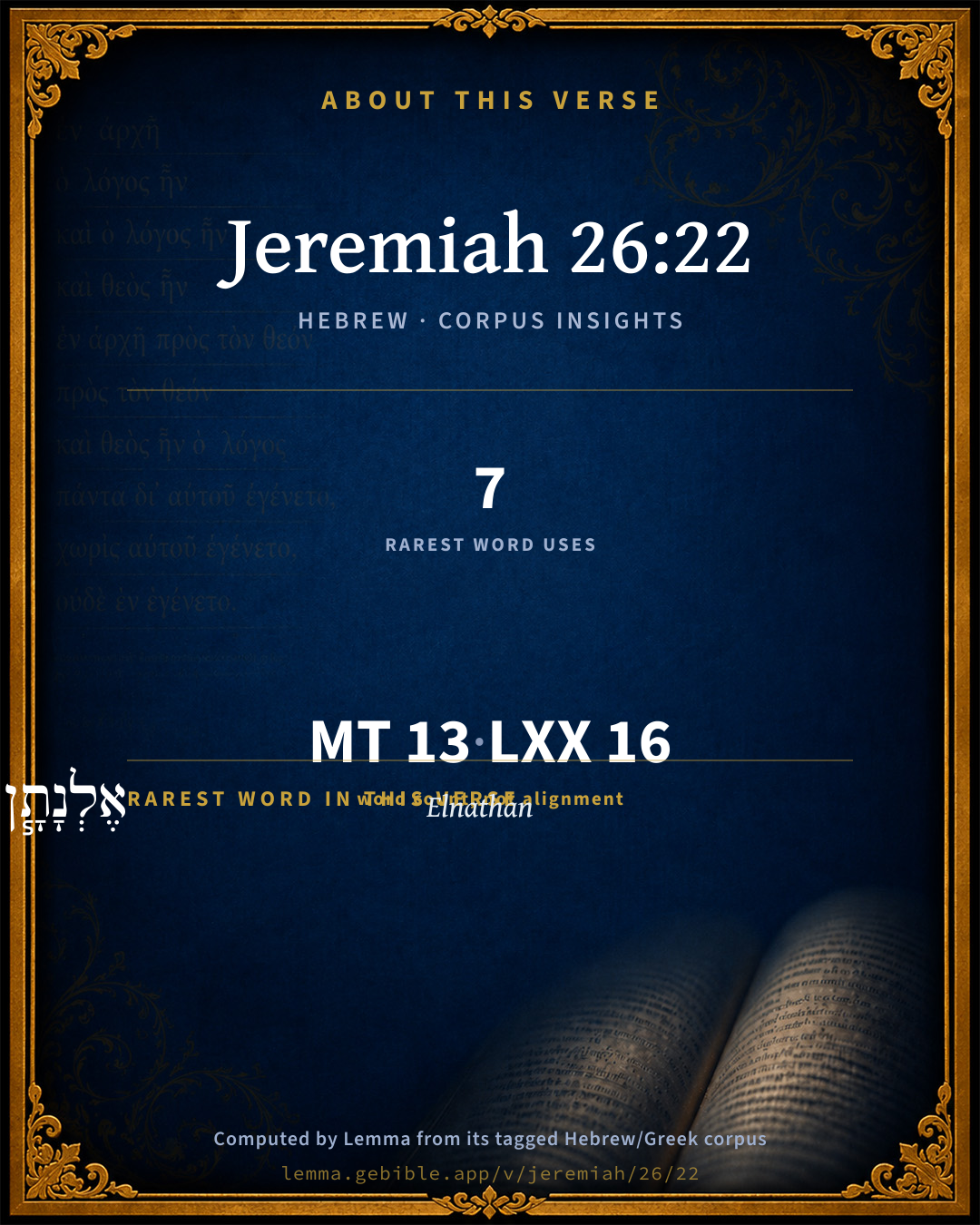
13
words
11
distinct lemmas
Prophets
section

Notable vocabulary

The rarest word here is אֶלְנָתָ֧ן Elnathan H494 — appearing just 7 times in the whole Hebrew Bible.

Shared distinctive vocabulary

אֶלְנָתָ֧ן Elnathan H494 occurs in 5 verses of the Hebrew Bible. Also found in:

Grammatical profile

  • 1 verb
  • 9 nouns
  • 2 prepositions
  • 1 particle

Verb forms

  • וַיִּשְׁלַ֞ח Qal · Sequential Imperfect

Repetition

Words recur within this verse — often emphatic in Hebrew:

  • אֲנָשִׁ֖ים man H376 ×2
  • מִצְרָ֑יִם Egypt H4714 ×2

Hebrew & Septuagint length

In the original languages it is 13 Hebrew tokens and 16 Greek tokens — but the two are counted differently (Hebrew bundles its prefixes and suffixes into one token; the Greek is in lemma form), so that isn’t a like-for-like length.

Cross-references

6

Topical passages linked to Jeremiah 26:22 in the Treasury of Scripture Knowledge — connected by theme and wording, ordered by reader-vote popularity; previews shown in the World English Bible.

  • 2 Kings 22:12 The king commanded Hilkiah the priest, and Ahikam the son of Shaphan, and Achbor the son of Micaiah, and Shaphan the scribe, and Asaiah the king's servant, saying,
  • 2 Kings 22:14 So Hilkiah the priest, and Ahikam, and Achbor, and Shaphan, and Asaiah, went to Huldah the prophetess, the wife of Shallum the son of Tikvah, the son of Harhas, keeper of the wardrobe (now she lived in Jerusalem in the second quarter); and they talked with her.
  • Jeremiah 36:12 he went down into the king's house, into the scribe's chamber: and, behold, all the princes were sitting there, [to wit], Elishama the scribe, and Delaiah the son of Shemaiah, and Elnathan the son of Achbor, and Gemariah the son of Shaphan, and Zedekiah the son of Hananiah, and all the princes.
  • Psalms 12:8 The wicked walk on every side, When what is vile is exalted among the sons of men.
  • Proverbs 29:12 If a ruler listens to lies, All of his officials are wicked.
  • Jeremiah 36:25 Moreover Elnathan and Delaiah and Gemariah had made intercession to the king that he would not burn the scroll; but he would not hear them.

Cross-references courtesy of OpenBible.info (CC BY 4.0).

Hebrew and Greek witnesses Masoretic Hebrew ↔ Greek Septuagint

The same verse in the two great witnesses to the Old Testament, shown verse-for-verse.

These are two independent witnesses, not word-aligned to each other, and the Septuagint is shown in lemma (dictionary) form.

Hebrew Jeremiah 26:22 Masoretic · Westminster Leningrad Codex

וַיִּשְׁלַ֞ח הַמֶּ֧לֶךְ יְהוֹיָקִ֛ים אֲנָשִׁ֖ים מִצְרָ֑יִם אֵ֣ת אֶלְנָתָ֧ן בֶּן עַכְבּ֛וֹר וַאֲנָשִׁ֥ים אִתּ֖וֹ אֶל מִצְרָֽיִם

and Jehoiakim the king sent men into Egypt, [namely], Elnathan the son of Achbor, and certain men with him, into Egypt;

World English Bible · Public Domain

Greek LXX Structure differs

In the Septuagint, Jeremiah is about an eighth shorter than the Hebrew and arranges its material differently — the Oracles Against the Nations (Hebrew chapters 46–51) appear in the middle of the Greek book, after 25:13. Because the chapter and verse boundaries do not line up, a verse-for-verse comparison with the Hebrew is not shown.

A verse-for-verse comparison isn’t shown here because the chapters and verses don’t line up. Switch to the LXX edition with the MT / LXX toggle above to read the Greek directly.

On this verse, The Cambridge Bible for Schools and Colleges discusses the Septuagint’s reading. Read the note in Commentary ↓

Hebrew: Westminster Leningrad Codex (CC BY 4.0). Greek: Septuagint (public domain); English from a public-domain English Septuagint. How the Septuagint differs from the Hebrew →

Targum (Aramaic paraphrase)

1

The Targum is the ancient Jewish Aramaic paraphrase of the Hebrew Scriptures — an interpretive translation, not the Hebrew text itself. Onkelos (literal) and Pseudo-Jonathan (expansive) render the Torah, and Jonathan the Prophets. Coverage is partial: where no permissively-licensed English translation exists for a verse, only the Aramaic is shown. This is verse-level text, not a word-by-word alignment to the Hebrew.

  1. Targum Jonathan Prophets (Joshua–Malachi)
    וּשְׁלַח מַלְכָּא יְהוֹיָקִים גַבְרִין לְמִצְרָיִם יַת אֶלְנָתָן בַּר עַכְבּוֹר וְגַבְרִין עִמֵיהּ לְמִצְרָיִם:

    (no public-domain English translation for this verse)

    Targum Jonathan — Aramaic: “Mikraot Gedolot” (public domain). English: “Sefaria Community Translation” (CC0 1.0 (public-domain dedication)); “London "Chaldee Paraphrase," 1871” (public domain). Text via Sefaria.

Commentary

Notes on Jeremiah 26:22 from classic Christian and Jewish commentators (each source and its license shown beneath its notes). The classic Christian expositions comment on the surrounding passage and are grouped to its opening verse, so a note may address several verses; the Jewish commentaries on the Tanakh (Rashi and others) are per-verse, so they appear only where the commentator wrote on this verse.

Lemma curates 59 commentaries, every one of them public domain or Creative Commons licensed, each selected and text-cleaned for this edition rather than reprinted as found. About our sources →

Trapp's Complete Commentary

John Trapp

Jer 26:22 And Jehoiakim the king sent men into Egypt, [namely], Elnathan the son of Achbor, and [certain] men with him into Egypt.

Ver. 22. And Jehoiakim sent men into Egypt.] Where he might have anything, for he was Pharaoh’s feudatory and vassal.

John Trapp, A Commentary or Exposition upon All the Books of the Old and New Testament (1647–1656) — public domain. Text from a community e-Sword module.

Geneva Bible (1599)

Geneva Bible translators

Here is declared the fury of tyrants, who cannot abide to hear God’s word declared, but persecute the ministers thereof, and yet in the end they prevail nothing but provoke God’s judgments so much the more.

Geneva Bible (1599) marginal notes — public domain. Text via Bolls.life.

Jamieson, Fausset & Brown

Robert Jamieson, A. R. Fausset & David Brown

Jehoiakim sent . . . into Egypt--He had been put on the throne by Pharaoh of Egypt (Kg2 23:34). This explains the readiness with which he got the Egyptians to give up Urijah to him, when that prophet had sought an asylum in Egypt. Urijah was faithful in delivering his message, but faulty in leaving his work, so God permitted him to lose his life, while Jeremiah was protected in danger. The path of duty is often the path of safety.

Jamieson, Fausset & Brown — Commentary Critical and Explanatory on the Whole Bible (1871) — public domain (CC PDM 1.0). Text via the HelloAO Bible API.

John Calvin's Commentaries

It is afterwards added that the king sent men, even Elnathan, the chief of the legation, with others. There is no doubt but that Jehoiakim sent to the king of Egypt and complained that a turbulent man had fled, and that he asked him to deliver him up as a fugitive. So then he was brought back, not through power, but through a nefarious compact, for he was betrayed by the king of Egypt.

John Calvin's Commentaries (1540-1563) — public domain. Text from the Calvin Translation Society English edition (1840s-50s) via the Christian Classics Ethereal Library (ccel.org). Calvin's coverage is partial (roughly two-thirds of the Bible); uncommented books and verses are honest gaps, never fabricated. The 19th-century editor's footnotes and remarks are omitted so the notes are faithfully Calvin's own voice.

Ellicott's Commentary for English Readers

(22) And Jehoiakim the king sent men into Egypt.—It will be remembered that the king had been appointed by Pharaoh-necho, and rested therefore on his alliance. Elnathan, the envoy employed on this mission, was the king’s father-in-law (2Ki_24:8). His father, Achbor, had taken a prominent part, together with Shaphan, the father of Ahikam, in the work of reformation under Josiah, and was sent by the king to the prophetess Huldah (2Ki_22:12). Elnathan appears again in the list of princes in Jer_36:12 as favourable to Jeremiah.

A Bible Commentary for English Readers, edited by Charles John Ellicott (1878–1897) — public domain. Text from a community e-Sword module.

The Cambridge Bible for Schools and Colleges

gen. ed. J. J. S. Perowne

22. Elnathan … into Egypt] omitted by LXX and perhaps a gloss. Gi. points out that what we read of him in Jer_36:12; Jer_36:25 would make such an act as this on his part unlikely. On the other hand it is difficult for this very reason to understand his name being inserted here by a copyist. If he is to be identified with the E. mentioned in 2Ki_24:8, he was father-in-law to Jehoiakim.

The Cambridge Bible for Schools and Colleges (gen. ed. J. J. S. Perowne; Cambridge University Press, 1878–1918) — public domain. Text from a community e-Sword module.

John Gill's Exposition

And Jehoiakim sent men into Egypt,.... To seek for him; and to require the delivery of him upon being found:

namely, Elnathan the son of Achbor; the father of this man very probably is the same we read of in Josiah's time, Kg2 22:12; who is called Abdon in Ch2 34:20;

and certain men with him, into Egypt; to assist him in taking him, whose names are not mentioned; Elnathan's is, as being the principal, and to fix an eternal infamy upon him.

John Gill's Exposition of the Whole Bible (1746–1763) — public domain (CC PDM 1.0). Text via the HelloAO Bible API.

Albert Barnes' Notes on the Bible

Elnathan - Possibly the king’s father-in-law 2Ki 24:8.

Albert Barnes' Notes on the Bible (1834–1885) — public domain. Text from a community e-Sword/MySword module.

Matthew Poole's English Annotations

The innocent prophet considered not the king of Judah’s alliance with the king of Egypt, (obliging him upon demand to deliver up any of his subjects who, being charged with capital crimes, should flee into his country for sanctuary,) and fled thither; but the king sent after him one of his great men, (mentioned also Jer 36:12) with some others to his assistance.

Matthew Poole's English Annotations on the Holy Bible (1683–1685) — public domain. Text from a community e-Sword/MySword module.

Whedon's Commentary on the Bible

Daniel D. Whedon

22. Sent men into Egypt — Jehoiakim was in close alliance with the king of Egypt, having been placed on his throne by him; hence the facility with which he seemed to recover a man who sought asylum there.

Elnathan — Whether this was the king’s father-in-law, who also had the same name, (2Ki_24:8,) cannot be decided. But he is mentioned in Jer_36:12; Jer_36:25, as among the princes favourable to Jeremiah, which bears against such identification.

Daniel D. Whedon (gen. ed.), Commentary on the Old and New Testaments (1874–1909) — public domain. Text from a community e-Sword module.

The Pulpit Commentary

Elnathan. The name occurs again in Jer_36:12, Jer_36:25. Possibly this man was the "Elnathan of Jerusalem" mentioned in 2Ki_24:8 as the father-in-law of Jehoiakim.

The Pulpit Commentary (1880–1919), ed. H.D.M. Spence-Jones & Joseph S. Exell — public domain. Text from a community e-Sword module.

unfoldingWord translationNotes

Door43 World Missions Community

Connecting Statement:

This is the end of the story of Uriah.

Elnathan ... Akbor ... Ahikam ... Shaphan

men's names (See: How to Translate Names)

corpse

dead body

the hand of Ahikam ... was with Jeremiah

The hand is a metonym for the power that the hand exercises. Ahikam was not a soldier, so he probably was able to talk to people and change their minds. AT: "Ahikam ... was able to help Jeremiah" or "Ahikam ... was able to keep the people from harming Jeremiah" (See: Metonymy)

he was not given into the hand of the people to be put to death

The hand is a metonym for the power that the hand exercises. This can be translated in active form. AT: "Ahikam did not allow the people to have the power to put Jeremiah to death" or "the people could not kill Jeremiah because Ahikam did not give them the power to" (See: Metonymy and Active or Passive)

translationWords

sword

grave

hand

unfoldingWord translationNotes — © Distant Shores Media and the Door43 World Missions Community, licensed CC BY-SA 4.0. Source: git.door43.org/Door43/en_tn.

Lesson kit

Teaching starters — assembled from the data on this page, not authored interpretation. Every prompt links to the verse data it draws on. Edit before teaching.

Jeremiah, in the Prophets, opens this verse with 13 words (11 distinct Hebrew lemmas). Its most distinctive word is ʼElnâthân (“Elnathan”). A historical commentator’s framing appears above. Read the whole chapter for the surrounding context.

Discussion questions

  1. What does “Elnathan” (ʼElnâthân) contribute to the verse as a whole?
  2. How does 2 Kings 24:8, which shares the word «Elnathan», read alongside this verse?
  3. What does the repetition of “man” (2× in this one verse) do in this verse?
  4. The translations on this page render this verse differently — a whole-verse word diff, not a word-by-word alignment. What might account for the different wordings?
  5. «וַיִּשְׁלַ֞ח» is a Qal Sequential Imperfect verb. How does that grammatical form shape the action described?
  6. Compare how Trapp's Complete Commentary and Geneva Bible (1599) read this verse. Where do they agree or differ?

Things to notice

Reading settings

Reading text

Shown beneath each verse's original-language words.

Old Testament
Old Testament edition

Read the OT as the Masoretic Hebrew (MT) or the Greek Septuagint (LXX).

English shown for the Greek Septuagint (in the Hebrew ↔ Greek comparison).

Comparing translations? Open the Compare panel on any verse page to stack up to four side by side.