
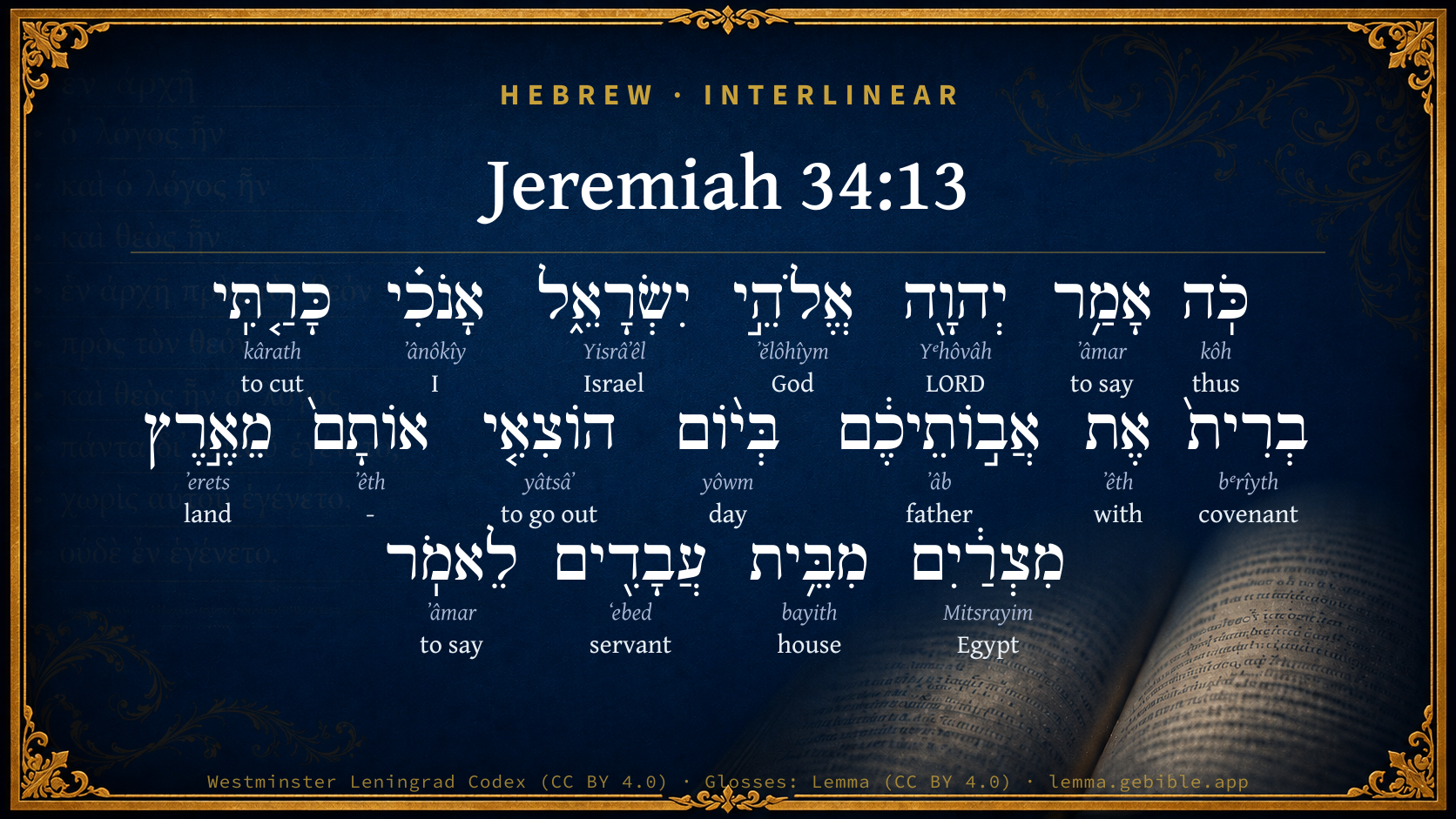
Jeremiah 34:13

Hebrew (Westminster Leningrad Codex) Jeremiah 34:13 appears in the Hebrew Old Testament. The text above is from the Westminster Leningrad Codex. Each word links to its Strong’s number, a concise gloss, and parsing drawn from the Open Scriptures Hebrew Bible morphology. Click any word for its full Brown-Driver-Briggs (BDB) entry.
Download image
Cite this verse

Jeremiah 34:13 (World English Bible). Public Domain. Lemma interlinear Bible study tool, https://lemma.gebible.app/v/jeremiah/34/13.

Show BibTeX & RIS
BibTeX
RIS
English Translation
Thus says Yahweh, the God of Israel: I made a covenant with your fathers in the day that I brought them forth out of the land of Egypt, out of the house of bondage, saying,
World English Bible · Public Domain
Download a study sheet

One document with this verse’s original text, its word-by-word gloss line, the meaning frame, cross-references with their text, attributed commentary, and full source and license credits — printable, and it pastes into notes with its structure intact.

This verse Autodidact and up

Study sheet (.html) Plain text (.txt)

A passage Seminary Student

Up to 50 verses in one chapter. A passage sheet keeps up to 6 commentary sources and 12 cross-references per verse, in the order this page ranks them, and says so on the sheet whenever that leaves anything out. Ask for a single verse and you get the Autodidact verse sheet above.

Everything on this page stays free to read, with no account — the sheet is a download of what is already on screen, not access to it.

Want to remove ads? Support Godless Engineer
Compare translations 3

The same verse in 3 English versions, stacked beneath the original-language interlinear above. Click any original word for its lexicon entry.

Each is an independent rendering of the whole verse — the interlinear is not word-aligned to these translations.

Highlighted words mark where these versions differ — a whole-verse word diff, not a word-by-word alignment.

  • World English Bible Public Domain
    Thus says Yahweh, the God of Israel: I made a covenant with your fathers in the day that I brought them forth out of the land of Egypt, out of the house of bondage, saying,
  • King James Version Public Domain
    Thus saith the LORD, the God of Israel; I made a covenant with your fathers in the day that I brought them forth out of the land of Egypt, out of the house of bondmen, saying,
  • unfoldingWord Literal Text CC BY-SA 4.0
    “Yahweh, God of Israel, says this, ‘I myself made a covenant with your ancestors on the day that I brought them out from the land of Egypt, out from the house of slavery. That was when I said,

unfoldingWord Literal Text — © unfoldingWord, licensed CC BY-SA 4.0. Word-aligned USFM3 via Door43 (git.door43.org/unfoldingWord/en_ult).

Versions to compare (up to 4)

3 of 4 selected

Show all 18 translations

Every available English version of this verse, each an independent rendering of the whole verse.

  • World English Bible Public Domain
    Thus says Yahweh, the God of Israel: I made a covenant with your fathers in the day that I brought them forth out of the land of Egypt, out of the house of bondage, saying,
  • Berean Standard Bible Public Domain
    “This is what the LORD, the God of Israel, says: I made a covenant with your forefathers when I brought them out of the land of Egypt, out of the house of slavery, saying:
  • Majority Standard Bible Public Domain
    “This is what the LORD, the God of Israel, says: I made a covenant with your forefathers when I brought them out of the land of Egypt, out of the house of slavery, saying:
  • King James Version Public Domain
    Thus saith the LORD, the God of Israel; I made a covenant with your fathers in the day that I brought them forth out of the land of Egypt, out of the house of bondmen, saying,
  • American Standard Version (1901) Public Domain
    Thus saith Jehovah, the God of Israel: I made a covenant with your fathers in the day that I brought them forth out of the land of Egypt, out of the house of bondage, saying,
  • Revised Version (1885) Public Domain
    Thus saith the LORD, the God of Israel: I made a covenant with your fathers in the day that I brought them forth out of the land of Egypt, out of the house of bondage, saying,
  • Geneva Bible (1599) Public Domain
    Thus saith the Lord God of Israel, I made a couenant with your fathers, when I brought them out of the land of Egypt, out of the house of seruants, saying,
  • Douay-Rheims (1899) Public Domain
    Thus saith the Lord the God of Israel: I made a covenant with your fathers in the day that I brought them out of the land of Egypt, out of the house of bondage, saying:
  • Young's Literal Translation Public Domain
    `Thus said Jehovah, God of Israel, I -- I made a covenant with your fathers in the day of My bringing them forth from the land of Egypt, from a house of servants, saying,
  • Literal Standard Version CC BY-SA 4.0
    “Thus said YHWH, God of Israel: I made a covenant with your fathers in the day of My bringing them forth from the land of Egypt, from a house of servants, saying,
  • Unlocked Literal Bible CC BY-SA 4.0
    “Yahweh, God of Israel, says this, 'I myself made a covenant with your ancestors on the day that I brought them out from the land of Egypt, out from the house of slavery. That was when I said,
  • unfoldingWord Literal Text CC BY-SA 4.0
    “Yahweh, God of Israel, says this, ‘I myself made a covenant with your ancestors on the day that I brought them out from the land of Egypt, out from the house of slavery. That was when I said,
  • Darby Bible Public Domain
    Thus saith Jehovah the God of Israel: I made a covenant with your fathers in the day that I brought them forth out of the land of Egypt, out of the house of bondage, saying,
  • World Messianic Bible Public Domain
    “The LORD, the God of Israel, says: ‘I made a covenant with your fathers in the day that I brought them out of the land of Egypt, out of the house of bondage, saying:
  • Webster's Bible Public Domain
    Thus saith the LORD, the God of Israel; I made a covenant with your fathers in the day that I brought them forth from the land of Egypt, out of the house of bond-men, saying,
  • Free Bible Version CC BY-SA 4.0
    This is what the Lord, the God of Israel, says: I made an agreement with your forefathers when I led them out of Egypt, out of the prison house of slavery, saying:
  • Bible in Basic English Public Domain
    The Lord, the God of Israel, has said, I made an agreement with your fathers on the day when I took them out of Egypt, out of the prison-house, saying,
  • JPS Tanakh (1917) Public Domain
    Thus saith the LORD, the God of Israel: I made a covenant with your fathers in the day that I brought them forth out of the land of Egypt, out of the house of bondage, saying:

Literal Standard Version (2020), Covenant Press — licensed CC BY-SA 4.0. Text via the HelloAO Bible API (eBible.org). Unlocked Literal Bible (unfoldingWord) — licensed CC BY-SA 4.0. Text via the HelloAO Bible API (eBible.org). unfoldingWord Literal Text — © unfoldingWord, licensed CC BY-SA 4.0. Word-aligned USFM3 via Door43 (git.door43.org/unfoldingWord/en_ult). Free Bible Version, Dr. Jonathan Gallagher — licensed CC BY-SA 4.0. Text via the HelloAO Bible API (eBible.org).

Word by word

More ways to search: Search by grammar → Find every occurrence → Compare this word →

Practice this passage: Drill this verse → Learn its vocabulary →

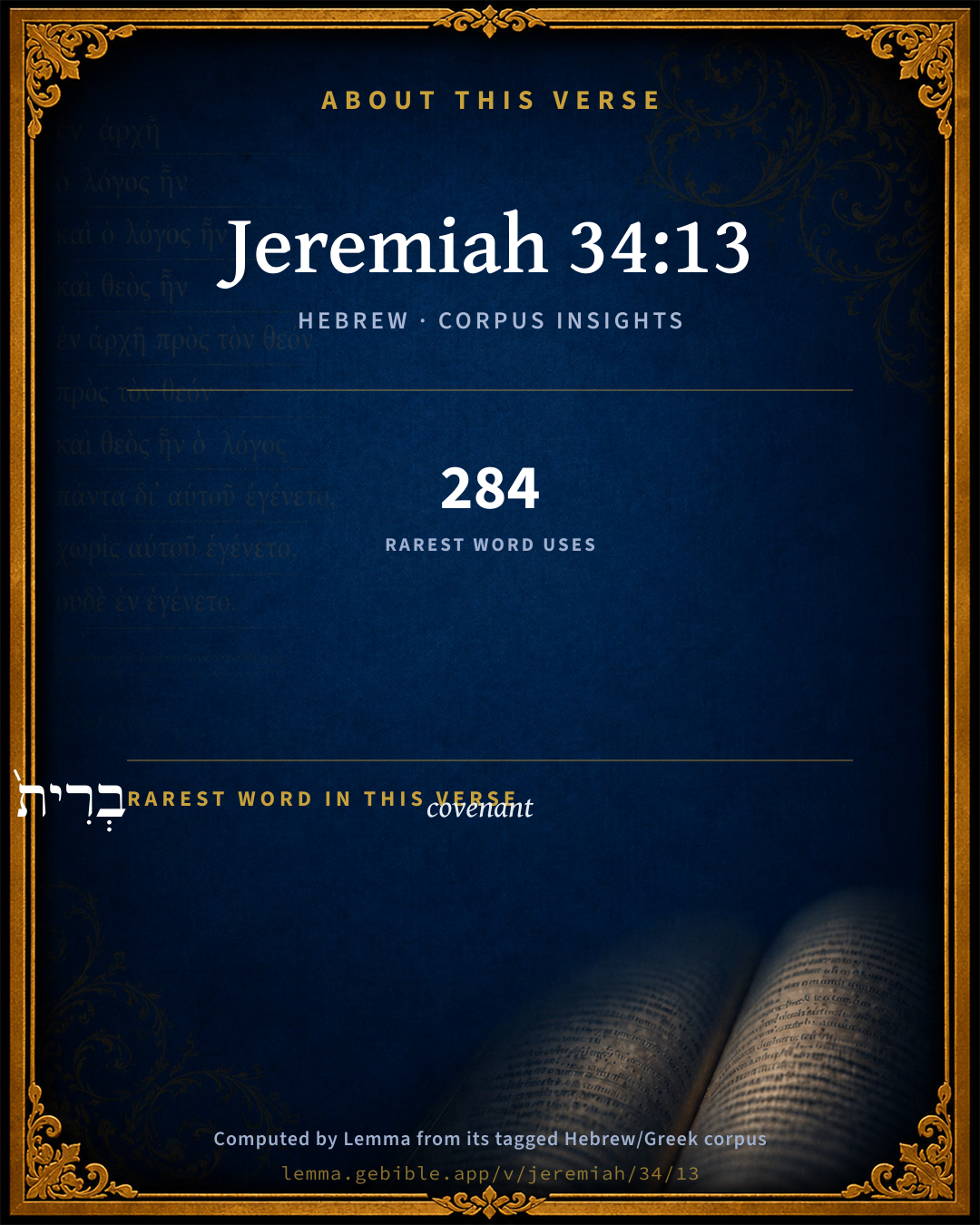
בְרִית֙
bᵉrîyth
H1285
“covenant”
Noun, Common, Feminine, Singular, Absolute
Part of Speech
Noun
Type
Common
Gender
Feminine
Number
Singular
State
Absolute
Full BDB Definition

Origin: from H1262 (in the sense of cutting [like H1254 ])

TWOT: 282a

covenant, alliance, pledge - between men - treaty, alliance, league (man to man) - constitution, ordinance (monarch to subjects) - agreement, pledge (man to man) - alliance (of friendship) - alliance (of marriage) - between God and man - alliance (of friendship) - covenant (divine ordinance with signs or pledges) - (phrases) - covenant making - covenant keeping - covenant violation
  1. כֹּֽה kôh H3541 “thus” Adverb
  2. אָמַ֥ר ʼâmar H559 “to say” Verb, Qal, Perfect, 3rd Person, Masculine, Singular
  3. יְהוָ֖ה Yᵉhôvâh H3068 “LORD” Noun, Proper
  4. אֱלֹהֵ֣י ʼĕlôhîym H430 “God(s) of” Noun, Common, Masculine, Plural, Construct
  5. יִשְׂרָאֵ֑ל Yisrâʼêl H3478 “Israel” Noun, Proper
  6. אָנֹכִ֗י ʼânôkîy H595 “I” Pronoun, Personal, 1st Person, Common, Singular
  7. כָּרַ֤תִּֽי kârath H3772 “to cut” Verb, Qal, Perfect, 1st Person, Common, Singular
  8. אֶת ʼêth H854 “with” Preposition
  9. אֲב֣וֹתֵיכֶ֔ם ʼâb H1 “fathers · your” Noun, Common, Masculine, Plural, Construct + Suffix, Personal, 2nd Person, Masculine, Plural
  10. בְּי֨וֹם yôwm H3117 “in/at · day of” Preposition + Noun, Common, Masculine, Singular, Construct
  11. הוֹצִאִ֤י yâtsâʼ H3318 “to go out · me” Verb, Hiphil, Infinitive Construct + Suffix, Personal, 1st Person, Common, Singular
  12. אוֹתָם֙ ʼêth H853 “- · them” Particle, Direct Object + Suffix, Personal, 3rd Person, Masculine, Plural
  13. מֵאֶ֣רֶץ ʼerets H776 “from · land of” Preposition + Noun, Common, Both, Singular, Construct
  14. מִצְרַ֔יִם Mitsrayim H4714 “Egypt” Noun, Proper
  15. מִבֵּ֥ית bayith H1004 “from · house of” Preposition + Noun, Common, Masculine, Singular, Construct
  16. עֲבָדִ֖ים ʻebed H5650 “servants” Noun, Common, Masculine, Plural, Absolute
  17. לֵאמֹֽר ʼâmar H559 “to say” Preposition + Verb, Qal, Infinitive Construct

About this verse

These counts appear in no published source. They are computed here, from the morphology-tagged text and Lemma’s own curated glosses. What Lemma adds →

18
words
17
distinct lemmas
Prophets
section

Grammatical profile

  • 4 verbs
  • 10 nouns
  • 1 pronoun
  • 1 preposition
  • 1 adverb
  • 1 particle

Verb forms

  • אָמַ֥ר Qal · Perfect
  • כָּרַ֤תִּֽי Qal · Perfect
  • הוֹצִאִ֤י Hiphil · Infinitive Construct
  • לֵאמֹֽר Qal · Infinitive Construct

Repetition

A word recurs within this verse — often emphatic in Hebrew:

  • אָמַ֥ר to say H559 ×2

Cross-references

23

Topical passages linked to Jeremiah 34:13 in the Treasury of Scripture Knowledge — connected by theme and wording, ordered by reader-vote popularity; previews shown in the World English Bible.

  • Joshua 24:17 for Yahweh our God, he it is who brought us and our fathers up out of the land of Egypt, from the house of bondage, and who did those great signs in our sight, and preserved us in all the way in which we went, and among all the peoples through the midst of whom we passed;
  • Judges 6:8 that Yahweh sent a prophet to the children of Israel: and he said to them, Thus says Yahweh, the God of Israel, I brought you up from Egypt, and brought you forth out of the house of bondage;
  • Exodus 24:3 Moses came and told the people all the words of Yahweh, and all the ordinances; and all the people answered with one voice, and said, "All the words which Yahweh has spoken will we do."
  • Exodus 24:7–8 He took the book of the covenant and read it in the hearing of the people, and they said, "All that Yahweh has spoken will we do, and be obedient."
  • Deuteronomy 5:2–3 Yahweh our God made a covenant with us in Horeb.
  • Deuteronomy 5:27 Go you near, and hear all that Yahweh our God shall say: and speak you to us all that Yahweh our God shall speak to you; and we will hear it, and do it.
  • Jeremiah 31:32 not according to the covenant that I made with their fathers in the day that I took them by the hand to bring them out of the land of Egypt; which my covenant they broke, although I was a husband to them, says Yahweh.
  • Exodus 13:3 Moses said to the people, "Remember this day, in which you came out from Egypt, out of the house of bondage; for by strength of hand Yahweh brought you out from this place. No leavened bread shall be eaten.
  • Exodus 13:14 It shall be, when your son asks you in time to come, saying, 'What is this?' that you shall tell him, 'By strength of hand Yahweh brought us out from Egypt, from the house of bondage;
  • Exodus 20:2 "I am Yahweh your God, who brought you out of the land of Egypt, out of the house of bondage.
  • Deuteronomy 5:6 "I am Yahweh your God, who brought you out of the land of Egypt, out of the house of bondage.
  • Deuteronomy 6:12 then beware lest you forget Yahweh, who brought you forth out of the land of Egypt, out of the house of bondage.
  • Deuteronomy 7:8 but because Yahweh loves you, and because he would keep the oath which he swore to your fathers, has Yahweh brought you out with a mighty hand, and redeemed you out of the house of bondage, from the hand of Pharaoh king of Egypt.
  • Deuteronomy 8:14 then your heart be lifted up, and you forget Yahweh your God, who brought you forth out of the land of Egypt, out of the house of bondage;
  • Deuteronomy 13:10 You shall stone him to death with stones, because he has sought to draw you away from Yahweh your God, who brought you out of the land of Egypt, out of the house of bondage.
  • Deuteronomy 15:15 You shall remember that you were a bondservant in the land of Egypt, and Yahweh your God redeemed you: therefore I command you this thing today.
  • Deuteronomy 16:12 You shall remember that you were a bondservant in Egypt: and you shall observe and do these statutes.
  • Deuteronomy 24:18 but you shall remember that you were a bondservant in Egypt, and Yahweh your God redeemed you there: therefore I command you to do this thing.
  • Deuteronomy 29:1 These are the words of the covenant which Yahweh commanded Moses to make with the children of Israel in the land of Moab, besides the covenant which he made with them in Horeb.
  • Jeremiah 7:22 For I didn't speak to your fathers, nor command them in the day that I brought them out of the land of Egypt, concerning burnt offerings or sacrifices:
  • Jeremiah 11:4 which I commanded your fathers in the day that I brought them forth out of the land of Egypt, out of the iron furnace, saying, Obey my voice, and do them, according to all which I command you: so shall you be my people, and I will be your God;
  • Jeremiah 11:7 For I earnestly protested to your fathers in the day that I brought them up out of the land of Egypt, even to this day, rising early and protesting, saying, Obey my voice.
  • Hebrews 8:10–11 "For this is the covenant that I will make with the house of Israel. After those days," says the Lord; "I will put my laws into their mind, I will also write them on their heart. I will be to them a God, And they will be to me a people.

Cross-references courtesy of OpenBible.info (CC BY 4.0).

Hebrew and Greek witnesses Masoretic Hebrew ↔ Greek Septuagint

The same verse in the two great witnesses to the Old Testament, shown verse-for-verse.

These are two independent witnesses, not word-aligned to each other, and the Septuagint is shown in lemma (dictionary) form.

Hebrew Jeremiah 34:13 Masoretic · Westminster Leningrad Codex

כֹּֽה אָמַ֥ר יְהוָ֖ה אֱלֹהֵ֣י יִשְׂרָאֵ֑ל אָנֹכִ֗י כָּרַ֤תִּֽי בְרִית֙ אֶת אֲב֣וֹתֵיכֶ֔ם בְּי֨וֹם הוֹצִאִ֤י אוֹתָם֙ מֵאֶ֣רֶץ מִצְרַ֔יִם מִבֵּ֥ית עֲבָדִ֖ים לֵאמֹֽר

Thus says Yahweh, the God of Israel: I made a covenant with your fathers in the day that I brought them forth out of the land of Egypt, out of the house of bondage, saying,

World English Bible · Public Domain

Greek LXX Structure differs

In the Septuagint, Jeremiah is about an eighth shorter than the Hebrew and arranges its material differently — the Oracles Against the Nations (Hebrew chapters 46–51) appear in the middle of the Greek book, after 25:13. Because the chapter and verse boundaries do not line up, a verse-for-verse comparison with the Hebrew is not shown.

A verse-for-verse comparison isn’t shown here because the chapters and verses don’t line up. Switch to the LXX edition with the MT / LXX toggle above to read the Greek directly.

Hebrew: Westminster Leningrad Codex (CC BY 4.0). Greek: Septuagint (public domain); English from a public-domain English Septuagint. How the Septuagint differs from the Hebrew →

Targum (Aramaic paraphrase)

1

The Targum is the ancient Jewish Aramaic paraphrase of the Hebrew Scriptures — an interpretive translation, not the Hebrew text itself. Onkelos (literal) and Pseudo-Jonathan (expansive) render the Torah, and Jonathan the Prophets. Coverage is partial: where no permissively-licensed English translation exists for a verse, only the Aramaic is shown. This is verse-level text, not a word-by-word alignment to the Hebrew.

  1. Targum Jonathan Prophets (Joshua–Malachi)
    כִּדְנַן אֲמַר יְיָ אֱלָהָא דְיִשְׂרָאֵל אֲנָא גְזָרֵית קְיָם עִם אֲבָהַתְכוֹן בְּיוֹמָא דְאַפְקֵית יַתְהוֹן מֵאַרְעָא דְמִצְרַיִם מִבֵּית עַבְדוּתָא לְמֵימָר:

    (no public-domain English translation for this verse)

    Targum Jonathan — Aramaic: “Mikraot Gedolot” (public domain). English: “Sefaria Community Translation” (CC0 1.0 (public-domain dedication)); “London "Chaldee Paraphrase," 1871” (public domain). Text via Sefaria.

Commentary

Notes on Jeremiah 34:13 from classic Christian and Jewish commentators (each source and its license shown beneath its notes). The classic Christian expositions comment on the surrounding passage and are grouped to its opening verse, so a note may address several verses; the Jewish commentaries on the Tanakh (Rashi and others) are per-verse, so they appear only where the commentator wrote on this verse.

Lemma curates 59 commentaries, every one of them public domain or Creative Commons licensed, each selected and text-cleaned for this edition rather than reprinted as found. About our sources →

Trapp's Complete Commentary

John Trapp

Jer 34:13 Thus saith the LORD, the God of Israel; I made a covenant with your fathers in the day that I brought them forth out of the land of Egypt, out of the house of bondmen, saying,

Ver. 13. I made a covenant with your fathers.] Heb., I cut a covenant. See Jer 34:18.

Out of the house of bondmen.] Such were you when there; why then should you pull up the bridge before others which yourselves have gone over? make slaves of those whom God had made free? {Lev 25:39; Lev 25:42}

John Trapp, A Commentary or Exposition upon All the Books of the Old and New Testament (1647–1656) — public domain. Text from a community e-Sword module.

Joseph Benson's Commentary

Jer 34:13-14. I made a covenant with your fathers, saying, At the end of seven years — This is the literal translation of מקצ שׁבע שׁנים; but the import of the phrase is, in the course of the seventh year; or, within the term of seven years, as Dr. Waterland renders it. “The seventh year was the year of release, (Deu 15:9,) consequently servants were to continue in service but six years, and at the beginning of the seventh were to be let go free; ibid, Jer 34:12. And the words mean no more, as appears by a like form of speech, Deu 14:28, where it is said, At the end of three years thou shalt bring forth all the tithe of thy increase that year: which is to be explained by Jer 26:12, where every third year is called the year of tithing. So Christ is said to rise again after three days, Mar 8:31, which is elsewhere explained by his rising the third day. But your fathers hearkened not unto me — Their worldly profit swaying more with them than God’s command. It appears from hence, that the law, requiring them to let their servants go free after six years’ service, had been violated by the Jews for ages before the captivity, as the law respecting the sabbatical year had also been. The consequence was, that the servants had, by long disuse, lost the benefit of the gracious provision which God, in his law, had made for them, for this trespass of them and their fathers God now justly delivered them into servitude to strangers.

Joseph Benson's Commentary on the Old and New Testaments (1811–1818) — public domain. Text from a community e-Sword module.

Geneva Bible (1599)

Geneva Bible translators

Or, bondage.

Geneva Bible (1599) marginal notes — public domain. Text via Bolls.life.

Jamieson, Fausset & Brown

Robert Jamieson, A. R. Fausset & David Brown

The last year of Zedekiah was the sabbatical year. How just the retribution, that they who, against God's law and their own covenant, enslaved their brethren, should be doomed to bondage themselves: and that the bond-servants should enjoy the sabbatical freedom at the hands of the foe (Jer 52:16) which their own countrymen denied them!

Jamieson, Fausset & Brown — Commentary Critical and Explanatory on the Whole Bible (1871) — public domain (CC PDM 1.0). Text via the HelloAO Bible API.

John Calvin's Commentaries

Now follows the message: The Prophet had, indeed, said that the word of God had been committed to him, but he interposed this narrative, that we might know for what reason God had sent this message to the Jews. For if he had thus begun, “The word came to Jeremiah from Jehovah,” and then added, “Thus saith Jehovah, the God of Israel, I have made a covenant,” etc., the passage would have been more obscure. It was therefore necessary that the narrative should come first, and with this the Prophet’s message was connected, even that the Jews had added perjury to cruelty, and thus had committed a heinous iniquity. The Prophet now then comes to close quarters with them, and introduces God as the speaker, I made a covenant with your fathers the day I brought them up from the land of Egypt, from the house of servants

God reminded the Jews of their own law; and though he might have justly required whatever he pleased, yet he proved that the Israelites were bound to him, because he brought then, out of the house of servants Who can dare to arrogate to himself dominion over others, who is himself a servant? for there cannot be dominion where there is no liberty. Any one may be free, though without a servant; but no one can be a master except he be free. So God declares that the Israelites were not once free, for they were in a miserable state of servitude, when he stretched out his hand to them. Whence then came liberty to the Israelites? even from the gratuitous mercy of God, who made them free, who brought them forth from tyranny in Egypt. It hence follows, that they could not be masters over others, since they themselves were servants. This is the reason why he says that he made a covenant the day he brought them up from the house of servants, as though he had said, that they came forth from their prisons, because he had been pleased to draw them out, not that they might domineer for ever over their brethren, but only for a time. He relates here the law given by Moses in Exodus 21, as we have stated. At the end of seven, years every one shall set free his brother, a Hebrew, who had been sold to him, and him who has served him six years he shall let free from him, that is, that he should not be with him; but your fathers hearkened not to me, nor inclined their ear The Israelites at first, no doubt, submitted to what God had commanded, but shortly after the law was disregarded. When, therefore, he complains here that his voice was not hearkened to, it ought not to be so generally understood, as that the Law had been at all times disregarded; but it is the same as though he had said, “Your fathers formerly were disobedient, because they did not set free their servants within the prescribed time, at the end of the sixth year.”

John Calvin's Commentaries (1540-1563) — public domain. Text from the Calvin Translation Society English edition (1840s-50s) via the Christian Classics Ethereal Library (ccel.org). Calvin's coverage is partial (roughly two-thirds of the Bible); uncommented books and verses are honest gaps, never fabricated. The 19th-century editor's footnotes and remarks are omitted so the notes are faithfully Calvin's own voice.

Ellicott's Commentary for English Readers

(13) Thus saith the Lord . . .—The prophet takes as his text the law which had been so flagrantly broken (Exo_21:2), reminding them under what circumstances that law had been given. Their fathers had then been delivered from the house of bondage, and this was part of the covenant which God had made with them—freedom and blessing being given by Him, obedience promised by them. They were never to forget the bitterness of the bondage they had known (comp. the form of the fourth commandment in Deu_5:15), and were to make it one of the fundamental laws of their national polity that no Israelite should ever pass, except by his own free choice, into a condition of hopeless life-long slavery.

A Bible Commentary for English Readers, edited by Charles John Ellicott (1878–1897) — public domain. Text from a community e-Sword module.

John Gill's Exposition

Thus saith the Lord, the God of Israel,.... The covenant God of Israel, their Creator, Redeemer, and Benefactor:

I made a covenant with your fathers; gave them a system of laws, among which was that of release of servants:

in the day that I brought them forth out of the land of Egypt; that is, at that time, quickly after, when they were come to Mount Sinai; this shows what fathers are meant, the Jewish ancestors that came out of Egypt, brought from thence by the mighty hand of God, and indulged with many favours by him, both in the wilderness, and in the land of Canaan, where he brought and settled them:

out of the house of bondmen; where they were bondmen, servants, and slaves: this is mentioned, to put them in mind of their former state and condition; to observe unto them the foundation and ground of the law concerning servants, how equitable and merciful it was, and to aggravate their sin; who though their fathers had been bondmen, and they must have been so too, had they not been released, yet acted such a cruel part to their servants, who were their brethren, in not discharging them in due time:

saying; giving out the following law, as a part of the covenant made with their fathers.

John Gill's Exposition of the Whole Bible (1746–1763) — public domain (CC PDM 1.0). Text via the HelloAO Bible API.

Matthew Poole's English Annotations

The law of God is called often a

covenant, because it containeth the will of God which he would have them do, to which (whether they express their consent or no), they are bound to consent and agree. But to the Jews all God’s laws given on Mount Sinai were a formal, explicit covenant, God explicitly telling them what he would have them to do, and they as explicitly promising they would do it, Exo 24:3. Here was a double aggravation of their sin, in breaking this covenant made between God and them:

1. From the consideration of God’s kindness in bringing them out of Egypt.

2. From the consideration of their having been bond-men in Egypt, which should hays taught them to know the hearts of bond-men, so as to have compassionated them whom they kept in the like distress in which they had been themselves, and from which God had delivered them. We stand concerned to remember the vows we make to God in our distress, for God will not forget them, Gen 35:1; as also to compassionate them who fall into the same distresses that we have been in, and out of which God hath saved us: God expecteth that we should show the same compassion to others, Mat 18:33.

Matthew Poole's English Annotations on the Holy Bible (1683–1685) — public domain. Text from a community e-Sword/MySword module.

Whedon's Commentary on the Bible

Daniel D. Whedon

13. Egypt… the house of bond-men — This law was more sacred because of their own history. The whole people had been slaves and had been set at liberty by God’s gracious interference; it would then be peculiarly wicked and ungrateful if they held their brethren in perpetual bondage.

Daniel D. Whedon (gen. ed.), Commentary on the Old and New Testaments (1874–1909) — public domain. Text from a community e-Sword module.

The Pulpit Commentary

Out of the house of bondmen. Egypt had been a "house of bondmen" to their fathers; (Exo_13:3 Deu_6:12, and elsewhere) let them not make the holy city thus grievous to those who were equally with themselves children of Jehovah"s redeemed ones.

The Pulpit Commentary (1880–1919), ed. H.D.M. Spence-Jones & Joseph S. Exell — public domain. Text from a community e-Sword module.

Lesson kit

Teaching starters — assembled from the data on this page, not authored interpretation. Every prompt links to the verse data it draws on. Edit before teaching.

Jeremiah, in the Prophets, opens this verse with 18 words (17 distinct Hebrew lemmas). Its most distinctive word is bᵉrîyth (“covenant”). A historical commentator’s framing appears above. Read the whole chapter for the surrounding context.

Discussion questions

  1. How does “covenant” (bᵉrîyth) shape what this verse is saying?
  2. Joshua 24:17 shares this passage’s theme. How do the two illuminate each other?
  3. “to say” occurs 2× in this one verse. What is the effect of the repetition?
  4. These translations render this verse differently. What is at stake in choosing one wording over another?
  5. The verb «אָמַ֥ר» is Qal Perfect. How does its form color the action?
  6. Reading how Trapp's Complete Commentary and Joseph Benson's Commentary read this verse, where do the two commentators agree and where do they part?

Things to notice

Reading settings

Reading text

Shown beneath each verse's original-language words.

Old Testament
Old Testament edition

Read the OT as the Masoretic Hebrew (MT) or the Greek Septuagint (LXX).

English shown for the Greek Septuagint (in the Hebrew ↔ Greek comparison).

Comparing translations? Open the Compare panel on any verse page to stack up to four side by side.