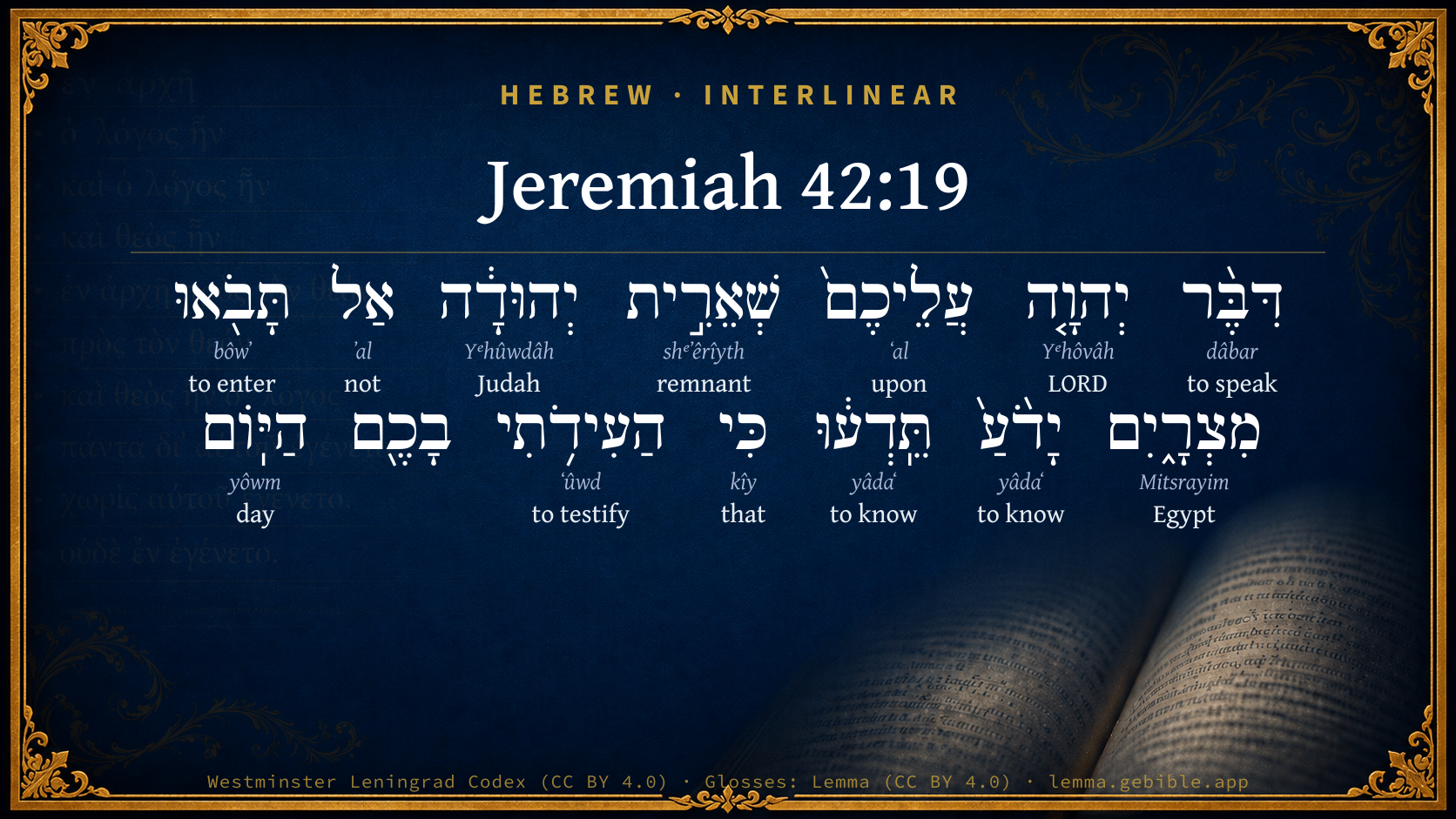
Jeremiah 42:19

Hebrew (Westminster Leningrad Codex) Jeremiah 42:19 appears in the Hebrew Old Testament. The text above is from the Westminster Leningrad Codex. Each word links to its Strong’s number, a concise gloss, and parsing drawn from the Open Scriptures Hebrew Bible morphology. Click any word for its full Brown-Driver-Briggs (BDB) entry.
Download image
Cite this verse

Jeremiah 42:19 (World English Bible). Public Domain. Lemma interlinear Bible study tool, https://lemma.gebible.app/v/jeremiah/42/19.

Show BibTeX & RIS
BibTeX
RIS
English Translation
Yahweh has spoken concerning you, remnant of Judah, Don't you go into Egypt: know certainly that I have testified to you this day.
World English Bible · Public Domain
Download a study sheet

One document with this verse’s original text, its word-by-word gloss line, the meaning frame, cross-references with their text, attributed commentary, and full source and license credits — printable, and it pastes into notes with its structure intact.

This verse Autodidact and up

Study sheet (.html) Plain text (.txt)

A passage Seminary Student

Up to 50 verses in one chapter. A passage sheet keeps up to 6 commentary sources and 12 cross-references per verse, in the order this page ranks them, and says so on the sheet whenever that leaves anything out. Ask for a single verse and you get the Autodidact verse sheet above.

Everything on this page stays free to read, with no account — the sheet is a download of what is already on screen, not access to it.

Want to remove ads? Support Godless Engineer
Compare translations 3

The same verse in 3 English versions, stacked beneath the original-language interlinear above. Click any original word for its lexicon entry.

Each is an independent rendering of the whole verse — the interlinear is not word-aligned to these translations.

Highlighted words mark where these versions differ — a whole-verse word diff, not a word-by-word alignment.

  • World English Bible Public Domain
    Yahweh has spoken concerning you, remnant of Judah, Don't you go into Egypt: know certainly that I have testified to you this day.
  • King James Version Public Domain
    The LORD hath said concerning you, O ye remnant of Judah; Go ye not into Egypt: know certainly that I have admonished you this day.
  • unfoldingWord Literal Text CC BY-SA 4.0
    Then Jeremiah said, “Yahweh has spoken concerning you—the remnant of Judah. Do not go to Egypt! You certainly know that I have been a witness against you today.

unfoldingWord Literal Text — © unfoldingWord, licensed CC BY-SA 4.0. Word-aligned USFM3 via Door43 (git.door43.org/unfoldingWord/en_ult).

Versions to compare (up to 4)

3 of 4 selected

Show all 18 translations

Every available English version of this verse, each an independent rendering of the whole verse.

  • World English Bible Public Domain
    Yahweh has spoken concerning you, remnant of Judah, Don't you go into Egypt: know certainly that I have testified to you this day.
  • Berean Standard Bible Public Domain
    The LORD has told you, O remnant of Judah, ‘Do not go to Egypt.’ Know for sure that I have warned you today!
  • Majority Standard Bible Public Domain
    The LORD has told you, O remnant of Judah, ‘Do not go to Egypt.’ Know for sure that I have warned you today!
  • King James Version Public Domain
    The LORD hath said concerning you, O ye remnant of Judah; Go ye not into Egypt: know certainly that I have admonished you this day.
  • American Standard Version (1901) Public Domain
    Jehovah hath spoken concerning you, O remnant of Judah, Go ye not into Egypt: know certainly that I have testified unto you this day.
  • Revised Version (1885) Public Domain
    The LORD hath spoken concerning you, O remnant of Judah, Go ye not into Egypt: know certainly that I have testified unto you this day.
  • Geneva Bible (1599) Public Domain
    O ye remnant of Iudah, the Lord hath said concerning you, Goe not into Egypt: knowe certeinely that I haue admonished you this day.
  • Douay-Rheims (1899) Public Domain
    This is the word of the Lord concerning you, O ye remnant of Juda: Go ye not into Egypt: know certainly that I have adjured you this day.
  • Young's Literal Translation Public Domain
    `Jehovah hath spoken against you, O remnant of Judah, do not enter Egypt: know certainly that I have testified against you to-day;
  • Literal Standard Version CC BY-SA 4.0
    YHWH has spoken against you, O remnant of Judah, do not enter Egypt: certainly know that I have testified against you today;
  • Unlocked Literal Bible CC BY-SA 4.0
    Then Jeremiah said, “Yahweh has spoken concerning you—the remnant of Judah. Do not go to Egypt! You certainly know that I have been a witness against you today.
  • unfoldingWord Literal Text CC BY-SA 4.0
    Then Jeremiah said, “Yahweh has spoken concerning you—the remnant of Judah. Do not go to Egypt! You certainly know that I have been a witness against you today.
  • Darby Bible Public Domain
    Jehovah hath said concerning you, the remnant of Judah, Go ye not into Egypt. Know certainly that I have admonished you this day.
  • World Messianic Bible Public Domain
    “The LORD has spoken concerning you, remnant of Judah, ‘Don’t go into Egypt!’ Know certainly that I have testified to you today.
  • Webster's Bible Public Domain
    The LORD hath said concerning you, O ye remnant of Judah; Go ye not into Egypt: know certainly that I have admonished you this day.
  • Free Bible Version CC BY-SA 4.0
    “The Lord has told you, survivors from Judah, ‘Don't go to Egypt,’” Jeremiah concluded. “Be absolutely clear about this warning I'm giving you today!
  • Bible in Basic English Public Domain
    The Lord has said about you, O last of Judah, Go not into Egypt: be certain that I have given witness to you this day.
  • JPS Tanakh (1917) Public Domain
    The LORD hath spoken concerning you, O remnant of Judah: Go ye not into Egypt; know certainly that I have forewarned you this day.

Literal Standard Version (2020), Covenant Press — licensed CC BY-SA 4.0. Text via the HelloAO Bible API (eBible.org). Unlocked Literal Bible (unfoldingWord) — licensed CC BY-SA 4.0. Text via the HelloAO Bible API (eBible.org). unfoldingWord Literal Text — © unfoldingWord, licensed CC BY-SA 4.0. Word-aligned USFM3 via Door43 (git.door43.org/unfoldingWord/en_ult). Free Bible Version, Dr. Jonathan Gallagher — licensed CC BY-SA 4.0. Text via the HelloAO Bible API (eBible.org).

Word by word

More ways to search: Search by grammar → Find every occurrence → Compare this word →

Practice this passage: Drill this verse → Learn its vocabulary →

הַעִידֹ֥תִי
ʻûwd
H5749
“to testify”
Verb, Hiphil, Perfect, 1st Person, Common, Singular
Part of Speech
Verb
Stem
Hiphil
Form
Perfect
Person
1st Person
Gender
Common
Number
Singular
Full BDB Definition

Origin: a primitive root

TWOT: 1576 , 1576d

to return, repeat, go about, do again - (Piel) to surround, go round and round - (Pilel) to restore, relieve - (Hithpalel) to be restored - to bear witness - (Qal) to bear witness, say again and again - (Hiphil) - to testify, bear witness - to cause to testify, take or call as witness, invoke - to protest, affirm solemnly, warn, exhort or enjoin solemnly, admonish, charge - (Hophal) to protest, give warning
  1. דִּבֶּ֨ר dâbar H1696 “to speak” Verb, Piel, Perfect, 3rd Person, Masculine, Singular
  2. יְהוָ֤ה Yᵉhôvâh H3068 “LORD” Noun, Proper
  3. עֲלֵיכֶם֙ ʻal H5921 “upon · you” Preposition + Suffix, Personal, 2nd Person, Masculine, Plural
  4. שְׁאֵרִ֣ית shᵉʼêrîyth H7611 “remnant of” Noun, Common, Feminine, Singular, Construct
  5. יְהוּדָ֔ה Yᵉhûwdâh H3063 “Judah” Noun, Proper
  6. אַל ʼal H408 “not” Particle, Negative
  7. תָּבֹ֖אוּ bôwʼ H935 “to enter” Verb, Qal, Jussive, 2nd Person, Masculine, Plural
  8. מִצְרָ֑יִם Mitsrayim H4714 “Egypt” Noun, Proper
  9. יָדֹ֨עַ֙ yâdaʻ H3045 “to know” Verb, Qal, Infinitive Absolute
  10. תֵּֽדְע֔וּ yâdaʻ H3045 “to know” Verb, Qal, Imperfect, 2nd Person, Masculine, Plural
  11. כִּי kîy H3588 “that” Conjunction
  12. הַיּֽוֹם yôwm H3117 “the · day” Particle, Definite Article + Noun, Common, Masculine, Singular, Absolute

About this verse

These counts appear in no published source. They are computed here, from the morphology-tagged text and Lemma’s own curated glosses. What Lemma adds →

14
words
12
distinct lemmas
Prophets
section

Shared distinctive vocabulary

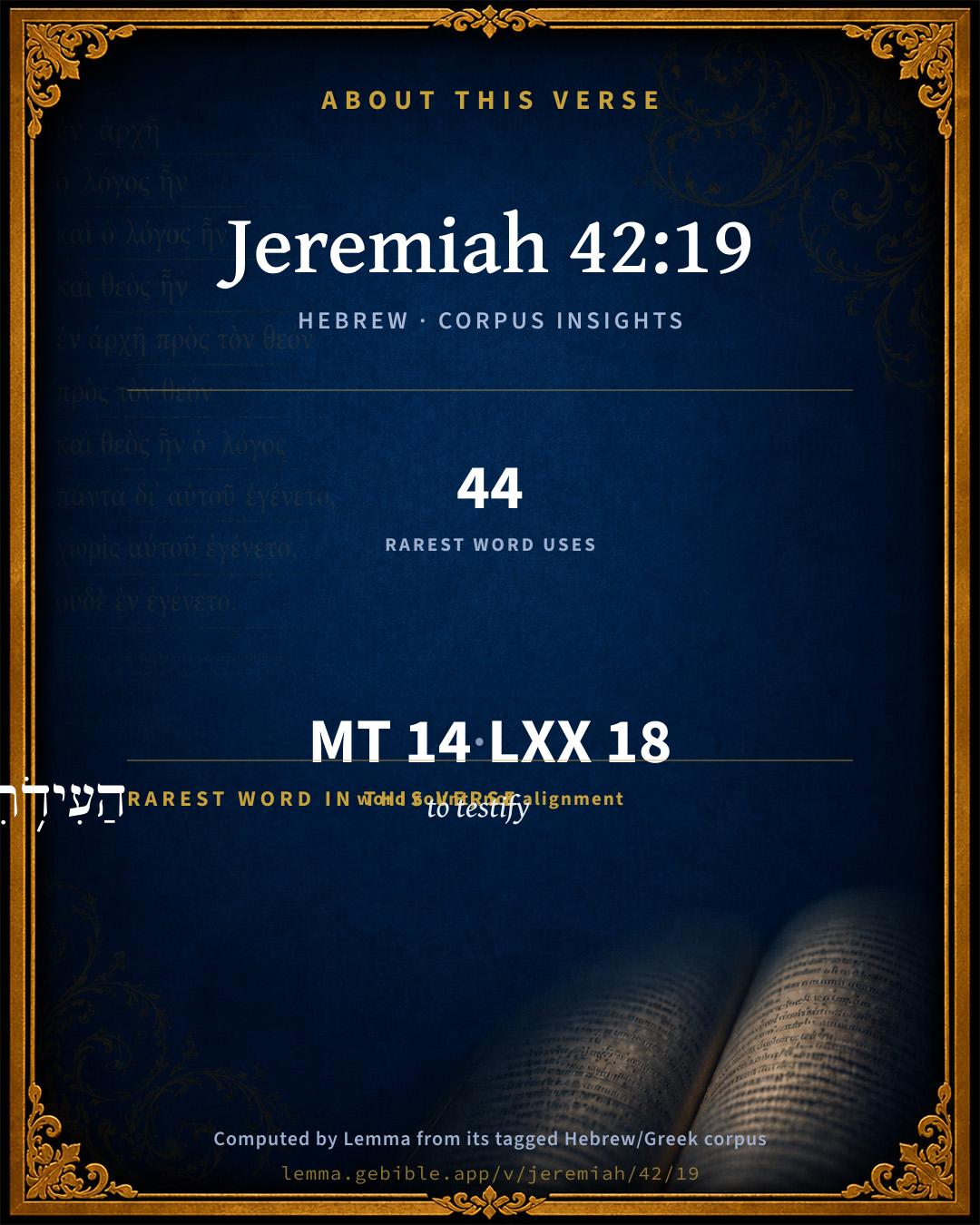
הַעִידֹ֥תִי to testify H5749 occurs in 40 verses of the Hebrew Bible. Also found in:

Grammatical profile

  • 5 verbs
  • 5 nouns
  • 2 prepositions
  • 1 conjunction
  • 1 particle

Verb forms

  • דִּבֶּ֨ר Piel · Perfect
  • תָּבֹ֖אוּ Qal · Jussive
  • יָדֹ֨עַ֙ Qal · Infinitive Absolute
  • תֵּֽדְע֔וּ Qal · Imperfect
  • הַעִידֹ֥תִי Hiphil · Perfect

Repetition

A word recurs within this verse — often emphatic in Hebrew:

  • יָדֹ֨עַ֙ to know H3045 ×2

Hebrew & Septuagint length

In the original languages it is 14 Hebrew tokens and 18 Greek tokens — but the two are counted differently (Hebrew bundles its prefixes and suffixes into one token; the Greek is in lemma form), so that isn’t a like-for-like length.

Cross-references

15

Topical passages linked to Jeremiah 42:19 in the Treasury of Scripture Knowledge — connected by theme and wording, ordered by reader-vote popularity; previews shown in the World English Bible.

  • Deuteronomy 17:16 Only he shall not multiply horses to himself, nor cause the people to return to Egypt, to the end that he may multiply horses; because Yahweh has said to you, You shall henceforth return no more that way.
  • Isaiah 30:1–7 Woe to the rebellious children, says Yahweh, who take counsel, but not of me; and who make a league, but not of my Spirit, that they may add sin to sin,
  • Nehemiah 9:26 Nevertheless they were disobedient, and rebelled against you, and cast your law behind their back, and killed your prophets that testified against them to turn them again to you, and they committed awful blasphemies.
  • Nehemiah 9:29–30 and testified against them, that you might bring them again to your law. Yet they dealt proudly, and didn't listen to your commandments, but sinned against your ordinances, (which if a man do, he shall live in them), and withdrew the shoulder, and hardened their neck, and would not hear.
  • Isaiah 31:1–3 Woe to those who go down to Egypt for help, and rely on horses, and trust in chariots because they are many, and in horsemen because they are very strong, but they don't look to the Holy One of Israel, neither seek Yahweh!
  • Ezekiel 17:15 But he rebelled against him in sending his ambassadors into Egypt, that they might give him horses and much people. Shall he prosper? shall he escape who does such things? shall he break the covenant, and yet escape?
  • Deuteronomy 31:21 It shall happen, when many evils and troubles are come on them, that this song shall testify before them as a witness; for it shall not be forgotten out of the mouths of their seed: for I know their imagination which they frame this day, before I have brought them into the land which I swore.
  • 2 Chronicles 24:19 Yet he sent prophets to them, to bring them again to Yahweh; and they testified against them: but they would not give ear.
  • Jeremiah 38:21 But if you refuse to go forth, this is the word that Yahweh has shown me:
  • Ezekiel 2:5 They, whether they will hear, or whether they will forbear, (for they are a rebellious house), yet shall know that there has been a prophet among them.
  • Ezekiel 3:21 Nevertheless if you warn the righteous man, that the righteous not sin, and he does not sin, he shall surely live, because he took warning; and you have delivered your soul.
  • Acts 20:26–27 Therefore I testify to you this day that I am clean from the blood of all men,
  • Ephesians 4:17 This I say therefore, and testify in the Lord, that you no longer walk as the rest of the Gentiles also walk, in the futility of their mind,
  • 1 Thessalonians 4:6 that no one should take advantage of and wrong a brother or sister in this matter; because the Lord is an avenger in all these things, as also we forewarned you and testified.
  • Acts 2:40 With many other words he testified, and exhorted them, saying, "Save yourselves from this crooked generation!"

Cross-references courtesy of OpenBible.info (CC BY 4.0).

Hebrew and Greek witnesses Masoretic Hebrew ↔ Greek Septuagint

The same verse in the two great witnesses to the Old Testament, shown verse-for-verse.

These are two independent witnesses, not word-aligned to each other, and the Septuagint is shown in lemma (dictionary) form.

Hebrew Jeremiah 42:19 Masoretic · Westminster Leningrad Codex

דִּבֶּ֨ר יְהוָ֤ה עֲלֵיכֶם֙ שְׁאֵרִ֣ית יְהוּדָ֔ה אַל תָּבֹ֖אוּ מִצְרָ֑יִם יָדֹ֨עַ֙ תֵּֽדְע֔וּ כִּי הַעִידֹ֥תִי בָכֶ֖ם הַיּֽוֹם

Yahweh has spoken concerning you, remnant of Judah, Don't you go into Egypt: know certainly that I have testified to you this day.

World English Bible · Public Domain

Greek LXX Structure differs

In the Septuagint, Jeremiah is about an eighth shorter than the Hebrew and arranges its material differently — the Oracles Against the Nations (Hebrew chapters 46–51) appear in the middle of the Greek book, after 25:13. Because the chapter and verse boundaries do not line up, a verse-for-verse comparison with the Hebrew is not shown.

A verse-for-verse comparison isn’t shown here because the chapters and verses don’t line up. Switch to the LXX edition with the MT / LXX toggle above to read the Greek directly.

Hebrew: Westminster Leningrad Codex (CC BY 4.0). Greek: Septuagint (public domain); English from a public-domain English Septuagint. How the Septuagint differs from the Hebrew →

Targum (Aramaic paraphrase)

1

The Targum is the ancient Jewish Aramaic paraphrase of the Hebrew Scriptures — an interpretive translation, not the Hebrew text itself. Onkelos (literal) and Pseudo-Jonathan (expansive) render the Torah, and Jonathan the Prophets. Coverage is partial: where no permissively-licensed English translation exists for a verse, only the Aramaic is shown. This is verse-level text, not a word-by-word alignment to the Hebrew.

  1. Targum Jonathan Prophets (Joshua–Malachi)
    גְזֵירַת פִּתְגָמָא דַייָ עֲלֵיכוֹן שְׁאָרָא דְבֵית יְהוּדָה לָא תַעֲלוּן לְמִצְרָיִם מֵידַע תֵּידְעוּן אֲרֵי אַסְהֵידִית בְּכוֹן יוֹמָא דֵין:

    (no public-domain English translation for this verse)

    Targum Jonathan — Aramaic: “Mikraot Gedolot” (public domain). English: “Sefaria Community Translation” (CC0 1.0 (public-domain dedication)); “London "Chaldee Paraphrase," 1871” (public domain). Text via Sefaria.

Commentary

Notes on Jeremiah 42:19 from classic Christian and Jewish commentators (each source and its license shown beneath its notes). The classic Christian expositions comment on the surrounding passage and are grouped to its opening verse, so a note may address several verses; the Jewish commentaries on the Tanakh (Rashi and others) are per-verse, so they appear only where the commentator wrote on this verse.

Lemma curates 59 commentaries, every one of them public domain or Creative Commons licensed, each selected and text-cleaned for this edition rather than reprinted as found. About our sources →

Trapp's Complete Commentary

John Trapp

Jer 42:19 The LORD hath said concerning you, O ye remnant of Judah; Go ye not into Egypt: know certainly that I have admonished you this day.

Ver. 19. Go ye not into Egypt.] Be ruled, or you will rue it when you have learned their evil manners, and shall perish in their punishments. It is better for you to be in cold irons at Babylon than to serve idols in Egypt at never so much liberty. Your fathers brought a golden calf thence; Jeroboam brought two.

John Trapp, A Commentary or Exposition upon All the Books of the Old and New Testament (1647–1656) — public domain. Text from a community e-Sword module.

Joseph Benson's Commentary

Jer 42:19. The Lord hath said, Go ye not into Egypt — The good prophet, knowing how much it concerned this people to believe and obey the message God had sent to them by him, repeats again what he had urged before, assuring them it was by the command of the Lord that he said it. Know certainly that I have admonished you this day — Hebrew, בכם העידתי, have testified to you, or, admonished you before witnesses. “God commanded the Jews, by Moses, not to have any commerce with Egypt, that they might not practise the idolatrous customs of that country, (Lev 18:3,) with whose idolatries they had been defiled during their sojourning there. Afterward he often reproved them by his prophets for making alliances with Egypt. And there were particular reasons, at this time, for so severe a prohibition, as the words here and in the context import, namely, because the Jews either learned several of their idolatrous practices from the Egyptians, or, at least were confirmed in those evil customs by their example. Besides, it was the rival kingdom that contended for empire with the Babylonians; and so the Jews going into Egypt for protection was, in effect, refusing to submit themselves to the king of Babylon, to whom God had decreed the government of Judea and all the neighbouring countries, Jer 27:6.” — Lowth.

Joseph Benson's Commentary on the Old and New Testaments (1811–1818) — public domain. Text from a community e-Sword module.

Whedon's Commentary on the Bible

Daniel D. Whedon

JEREMIAH REPROVES THEIR HYPOCRISY, Jer_42:19-22.

19. I have admonished — Protested, testified against you.

Daniel D. Whedon (gen. ed.), Commentary on the Old and New Testaments (1874–1909) — public domain. Text from a community e-Sword module.

Jamieson, Fausset & Brown

Robert Jamieson, A. R. Fausset & David Brown

I have admonished--literally, "testified," that is, solemnly admonished, having yourselves as My witnesses; so that if ye perish, ye yourselves will have to confess that it was through your own fault, not through ignorance, ye perished.

Jamieson, Fausset & Brown — Commentary Critical and Explanatory on the Whole Bible (1871) — public domain (CC PDM 1.0). Text via the HelloAO Bible API.

Adam Clarke's Commentary

Verse 19. Go ye not into Egypt] Why? Because God knew, such was their miserable propensity to idolatry, that they would there adopt the worship of the country, and serve idols.

Adam Clarke's Commentary on the Bible (1810–1826) — public domain. Text from a community e-Sword/MySword module.

John Calvin's Commentaries

Here the Prophet explains more fully their sin; for their punishment might have appeared extreme, had not their impiety been more clearly unfolded. He then says that this punishment ought not to be regarded as too rigid, because God had not once only protested against the Jews and admonished them in a solemn manner and before witnesses; but they to the last not, only despised his counsel and warnings, but proudly rejected them. And he adds, that they dealt falsely and perfidiously with God, because they pretended that they would be obedient as soon as the will of God was known; but they shewed that in reality they had no such purpose; for their own vanity and deceit took full possession of them when the Prophet answered them in God’s name; nor had they a desire to obey God.

Let us now consider the words: Jehovah hath spoken against you, the remnant of Judah He again calls them a remnant, in order that they might remember that they had no reason any more to be proud. We know how the Jews while in prosperity disregarded the Prophets; for they were inebriated with their good fortune. But God had dissipated this pride, with which they were previously filled. The Prophet had also set before them the favor through which they had been liberated, that they might learn hereafter to submit to God and his word. For this reason then he called them a remnant, even to render them more attentive and teachable. But it was done without any benefit; for though their affairs were nearly hopeless, and they were reduced almost to nothing, yet they had not laid aside their high spirits. They were then still swollen with false confidence. But this warning, however, availed to render them more inexcusable.

If ye enter into Egypt, he says, knowing know ye, or, knowing ye shall know. The verb is in the future tense, though it may be taken as an imperative. But the future tense is the most suitable, knowing ye shall know, that is, the event itself will teach you, but too late, as the foolish are never wise till after the evil has taken place. Knowing ye shall know that I have protested against you this day. God says that he had left nothing undone to bring the Jews to a right mind; for a protest is usually made in a solemn manner, witnesses being called in, so that no one can plead that. he has gone astray through ignorance. To take away then every ground of excuse, witnesses were wont to be called. Hence God speaks according to the common practice and in a forensic sense, and says that he had protested against the Jews, lest they should by chance offend through want of knowledge. It then follows, that they knowingly perished, as though they had sought their own destruction.

John Calvin's Commentaries (1540-1563) — public domain. Text from the Calvin Translation Society English edition (1840s-50s) via the Christian Classics Ethereal Library (ccel.org). Calvin's coverage is partial (roughly two-thirds of the Bible); uncommented books and verses are honest gaps, never fabricated. The 19th-century editor's footnotes and remarks are omitted so the notes are faithfully Calvin's own voice.

The Cambridge Bible for Schools and Colleges

gen. ed. J. J. S. Perowne

19. This connects well with Jer_42:14, assuming (see introd. note) that Jer_42:15-18 are by a supplementer.

The Cambridge Bible for Schools and Colleges (gen. ed. J. J. S. Perowne; Cambridge University Press, 1878–1918) — public domain. Text from a community e-Sword module.

John Gill's Exposition

For ye dissembled in your hearts,.... Did not honestly and faithfully declare their intentions; they said one thing with their mouths, and meant another in their minds; they pretended they would act according to the will of God, as it should be made known to them by him, when they were determined to take their own way. Some render it, "ye have deceived me in your hearts" (z); the prophet, so Kimchi; by that which was in their hearts, not declaring what was their real intention and design: or, "ye have deceived your souls" (a); you have deceived yourselves and one another; I have not deceived you, nor the Lord, but you have put a cheat upon your own souls: or, "you have used deceit against your souls" (b); to the hurt of them, to your present ruin and everlasting destruction:

when ye sent me unto the Lord your God; the prophet did not go of himself, they desired him to go:

saying, pray for us unto the Lord our God; to be directed in the way they should go; so that the prophet did nothing but what they desired him to do:

and according to all that the Lord our God shall say, so declare unto us, and we will do it; they pressed him to a faithful declaration of the will of God to them, and promised they would act according to it. Now he had done all this; he had been wire God, prayed unto him as they requested, and had brought them his mind and will, and made a faithful relation of it, and yet they did not attend to it; so that the deceit was not in him, but in them, as follows:

(z) "seduxistis me animis vestris", so some in Vatablus; "fefellistis me", Munster. So Ben Melech. (a) "Fecistis errare animas vestras", Pagninus; "fefellistis", Calvin. (b) "Seduxeritis vos contra animas vestras", Schmidt.

John Gill's Exposition of the Whole Bible (1746–1763) — public domain (CC PDM 1.0). Text via the HelloAO Bible API.

Albert Barnes' Notes on the Bible

The request made in Jer 42:3 has been fulfilled: Yahweh has spoken. The prophet now adds these four verses as a sort of epilogue, in which he urges upon them the several points of the divine message. In the ten days which had intervened between the request and the answer Jeremiah had become aware that neither princes nor people were prepared to obey unless the answer was in accordance with their own wishes. He does therefore his best to convince them, but as usual it was his lot to speak the truth to willful men, and gain no hearing.

Albert Barnes' Notes on the Bible (1834–1885) — public domain. Text from a community e-Sword/MySword module.

Matthew Poole's English Annotations

The good prophet, knowing how much it concerned this people to listen unto him, and to believe and obey what he said, repeats again the same thing which he had said before, assuring them that it was the Lord commanded him to say this to them. Critics note that the word which we translate admonish, in this form, signifieth to admonish before witnesses.

Matthew Poole's English Annotations on the Holy Bible (1683–1685) — public domain. Text from a community e-Sword/MySword module.

The Pulpit Commentary

Contradictory requirements.

The Jews were here required not to flee into Egypt. Joseph was warned by an angel in a dream to "arise, and take the young child and his mother, and flee into Egypt". (Mat_2:13) The Scriptures represent both commands as coming from God. Yet they are contradictory. This is but one instance of a discrepancy often to be met with. Let us consider the meaning of it.

I DIVINE REQUIREMENTS MAY BE OUTWARDLY CONTRADICTORY AND YET CONSISTENT IN PRINCIPLE. In general principle what is right once is right eternally; what is right for one man is right for all men; what is right in one place is right everywhere. The moral laws of God are eternal, immutable, universal. They are as true in Sirius as on the earth, to angels and to demons as to men. But the application of these principles necessarily varies.

1. The same act has a different character under different circumstances. Egypt was an imposing heathen power in the days of Jeremiah; it was but a Roman province in the time of our Lord. Flight to Egypt at the earlier time meant distrust in God and reliance on the arm of flesh; no such alternatives accompanied the decision of Joseph. Thus it often happens that consistency to principle will permit and require great variations of conduct according to the changing necessities and dangers of life.

2. The same act may have a different character with different persons. Identical general moral obligations apply to all of us equally. But men have different duties in the carrying out of those principles, according to their constitutional differences of capacity and disposition. One man can stand on the verge of a precipice without a tremor, another turns giddy as he approaches it. For the one to be there is harmless, but it is most dangerous for the other. The first man may do what is no risk to him, but the second will be foolish and wrong if he follow his example. So there are scenes which afford temptation to some temperaments and none to others. The duty to avoid them must vary with this variation of danger.

3. The same act may have a different character according as it is performed with a different motive. Flight may denote cowardice or prudent caution. Passive endurance may be determined by weakness and indolence, or it may result from submissive trustfulness.

II THE OUTWARD CONTRADICTION OF DIVINE REQUIREMENTS WARNS US TO ESTIMATE ACTIONS SOLELY BY THEIR INNER CHARACTER.

1. We should be careful not to condemn others because their behaviour strikes us as superficially opposed to what is right from our own point of view. Their circumstances, character, and motives may be quite different from what we suspect. The man who is condemned as a miser may be wisely thrifty. He who is regarded as a meddlesome busybody may be conscientiously discharging what to him is a public duty. The seeming devotee of pleasure may be generously laying himself out to brighten the sad world with ministries of happiness to others. The apparently ambitious despot may be an enthusiast for the regeneration of humanity.

2. We must beware of the slavish imitation of the best examples. What was wise and right in them may be positively wrong in us. Even our imitation of Christ must be spiritual rather than external. Surely in calling us to follow him, he does not require us, like St. Francis, to become homeless wanderers, because the Son of man had not where to lay his head. Because he drove out the desecrators of the temple with violence, it may not be right for us to use similar violence, when what was done by him from pure zeal might only be followed by us with angry passions.

Vers. 19-22. Carnal predispositions.

I THEY ARE THE GREAT SOURCES OF UNREALITY IN RELIGION. In sending Jeremiah to God they did not mean what they said. There was no honest willingness to do as the prophet might reveal. The only hope for them in their forlorn condition is thus tampered with and destroyed. It is possible that at first they may have meant well, but as they proceeded with their inquiry through the prophet they must have known that they had only one intention, which they had not laid aside or even held in abeyance. Yet such is the subtlety of the hypocritical heart that it continues in its hypocrisy until it deceives itself. "They inquire not to learn what is right, but only to receive encouragement to do what they wish.

II THOSE WHO INDULGE THEM ARE THEIR OWN WORST ENEMIES.

1. They deceive and injure themselves. "Ye dissembled in your hearts" (ver. 20); literally, deceived yourselves; " used deceit against your souls" (margin). Thinking they were taking counsel of God, they were really obeying their fears and lusts. Can a greater wrong be done to one"s self than this to think one"s self religious and obedient to the heavenly will when one is only selfish and sinful? Safety and happiness lay in following simply the Divine guidance; but this they could not do, for they knew not God"s message when it came. "Thinking themselves wise, they became fools." Their spiritual nature is henceforth unreliable, and their greatest perils will be encountered in their most religious hours, and when they think themselves most in agreement with God"s will.

2. The curse of God is denounced against them. What they choose will be their destruction. The very things they sought to avoid by going to Egypt are met there. And there is no mitigation; the position is one wholly wrong, and consequently the wrath of God is unceasing until they cease to occupy it. To remain in Egypt, with its idolatries and abominations, was virtually to annul the covenant. Soon every trace of true religion would disappear, and they would become like their neighbours, and be absorbed into the nations in whom God had no pleasure. He cannot tolerate falsehood, pretension, the form of godliness without the reality. And this severity is true mercy. Many a one "plucked as a brand from the burning" has had reason to thank his Saviour that "the way of transgressors is hard." "Let a man examine himself." "Be not deceived: God is not mocked. M.

Vers. 19-22. Searching the heart.

There is here a very sudden and striking turn away from the tone of the previous part of the message. God looks into the future, and, seeing what actually will happen, seeing that Egypt will maintain its attraction, he warns the people they are going towards a certain doom. Their present state was one of undue, overweening self-confidence; and God will not allow people to remain under deception as to their own weakness, if a startling and abrupt message will serve to arouse them from it. Perhaps we shall not be far wrong in assuming that the changing tone of the prophecy is occasioned by the changing mood of the audience. While the prophet is speaking of the dangers of Egypt, their deep desire after Egypt is half revealed. The one gate into which they wished to enter is peremptorily closed against them. All at once there may have been a sort of awakening to the fact that God knew their hearts better than they did themselves We must recollect, too, that Jeremiah spoke out of no short or imperfect experience. He saw that the people were disappointed; that, instead of a word pointing them towards Egypt, there was sentence upon sentence warning them against it. How hard it is to be sure of knowing the will of God! How easy to mistake for it the impulses of indulgent human prudence! God tells the people plainly they are going to seek for things they wilt never find. Instead of living in peace, they are to die by the sword. Instead of getting abundance of bread, they are to die by famine and by the pestilence that accompanies lack of bread. Here altogether is an example of the need of that prayer in Psa_139:23, Psa_139:24. Y.

The Pulpit Commentary (1880–1919), ed. H.D.M. Spence-Jones & Joseph S. Exell — public domain. Text from a community e-Sword module.

Lesson kit

Teaching starters — assembled from the data on this page, not authored interpretation. Every prompt links to the verse data it draws on. Edit before teaching.

Jeremiah, in the Prophets, opens this verse with 14 words (12 distinct Hebrew lemmas). Its most distinctive word is ʻûwd (“to testify”). A historical commentator’s framing appears above. Read the whole chapter for the surrounding context.

Discussion questions

  1. The word ʻûwd carries the sense “to testify.” How does it shape the verse?
  2. How does Genesis 43:3, which shares the word «to testify», read alongside this verse?
  3. What does the repetition of “to know” (2× in this one verse) do in this verse?
  4. The translations on this page render this verse differently — a whole-verse word diff, not a word-by-word alignment. What might account for the different wordings?
  5. «דִּבֶּ֨ר» is a Piel Perfect verb. How does that grammatical form shape the action described?
  6. Compare how Trapp's Complete Commentary and Joseph Benson's Commentary read this verse. Where do they agree or differ?

Things to notice

Reading settings

Reading text

Shown beneath each verse's original-language words.

Old Testament
Old Testament edition

Read the OT as the Masoretic Hebrew (MT) or the Greek Septuagint (LXX).

English shown for the Greek Septuagint (in the Hebrew ↔ Greek comparison).

Comparing translations? Open the Compare panel on any verse page to stack up to four side by side.