Jeremiah 2:18

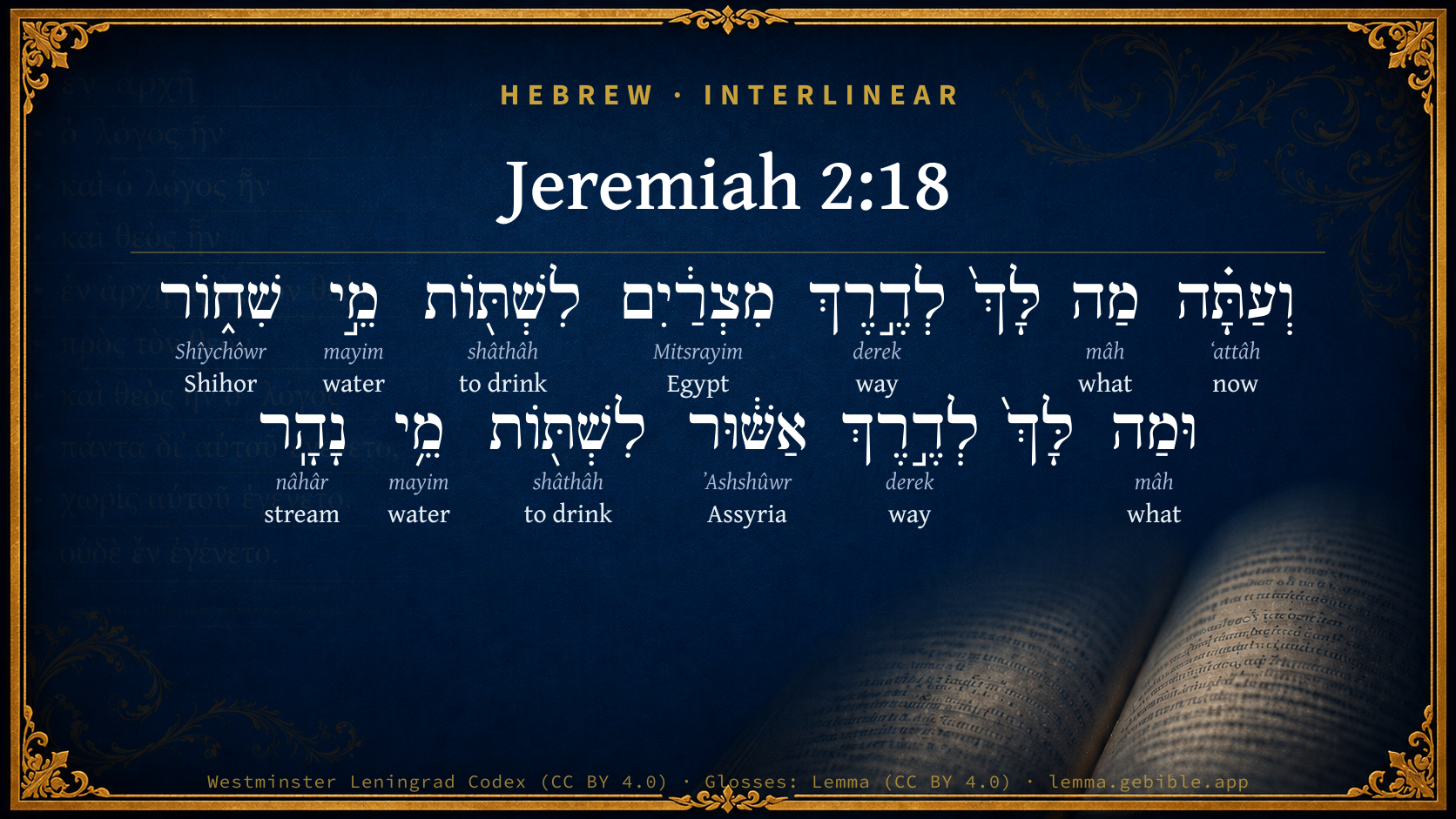
Hebrew (Westminster Leningrad Codex) Jeremiah 2:18 appears in the Hebrew Old Testament. The text above is from the Westminster Leningrad Codex. Each word links to its Strong’s number, a concise gloss, and parsing drawn from the Open Scriptures Hebrew Bible morphology. Click any word for its full Brown-Driver-Briggs (BDB) entry.
Download image
Cite this verse

Jeremiah 2:18 (World English Bible). Public Domain. Lemma interlinear Bible study tool, https://lemma.gebible.app/v/jeremiah/2/18.

Show BibTeX & RIS
BibTeX
RIS
English Translation
Now what have you to do in the way to Egypt, to drink the waters of the Shihor? or what have you to do in the way to Assyria, to drink the waters of the River?
World English Bible · Public Domain
Download a study sheet

One document with this verse’s original text, its word-by-word gloss line, the meaning frame, cross-references with their text, attributed commentary, and full source and license credits — printable, and it pastes into notes with its structure intact.

This verse Autodidact and up

Study sheet (.html) Plain text (.txt)

A passage Seminary Student

Up to 50 verses in one chapter. A passage sheet keeps up to 6 commentary sources and 12 cross-references per verse, in the order this page ranks them, and says so on the sheet whenever that leaves anything out. Ask for a single verse and you get the Autodidact verse sheet above.

Everything on this page stays free to read, with no account — the sheet is a download of what is already on screen, not access to it.

Want to remove ads? Support Godless Engineer
Compare translations 3

The same verse in 3 English versions, stacked beneath the original-language interlinear above. Click any original word for its lexicon entry.

Each is an independent rendering of the whole verse — the interlinear is not word-aligned to these translations.

Highlighted words mark where these versions differ — a whole-verse word diff, not a word-by-word alignment.

  • World English Bible Public Domain
    Now what have you to do in the way to Egypt, to drink the waters of the Shihor? or what have you to do in the way to Assyria, to drink the waters of the River?
  • King James Version Public Domain
    And now what hast thou to do in the way of Egypt, to drink the waters of Sihor? or what hast thou to do in the way of Assyria, to drink the waters of the river?
  • unfoldingWord Literal Text CC BY-SA 4.0
    And now, why—to you, to the road of Egypt to drink the waters of the Nile? And why—to you, to the road of Assyria to drink the waters of River?

unfoldingWord Literal Text — © unfoldingWord, licensed CC BY-SA 4.0. Word-aligned USFM3 via Door43 (git.door43.org/unfoldingWord/en_ult).

Versions to compare (up to 4)

3 of 4 selected

Show all 18 translations

Every available English version of this verse, each an independent rendering of the whole verse.

  • World English Bible Public Domain
    Now what have you to do in the way to Egypt, to drink the waters of the Shihor? or what have you to do in the way to Assyria, to drink the waters of the River?
  • Berean Standard Bible Public Domain
    Now what will you gain on your way to Egypt to drink the waters of the Nile? What will you gain on your way to Assyria to drink the waters of the Euphrates?
  • Majority Standard Bible Public Domain
    Now what will you gain on your way to Egypt to drink the waters of the Nile? What will you gain on your way to Assyria to drink the waters of the Euphrates?
  • King James Version Public Domain
    And now what hast thou to do in the way of Egypt, to drink the waters of Sihor? or what hast thou to do in the way of Assyria, to drink the waters of the river?
  • American Standard Version (1901) Public Domain
    And now what hast thou to do in the way to Egypt, to drink the waters of the Shihor? or what hast thou to do in the way to Assyria, to drink the waters of the River?
  • Revised Version (1885) Public Domain
    And now what hast thou to do in the way to Egypt, to drink the waters of Shihor? or what hast thou to do in the way to Assyria, to drink the waters of the River?
  • Geneva Bible (1599) Public Domain
    And what hast thou now to do in the way of Egypt? to drinke the water of Nilus? or what makest thou in the way of Asshur? to drinke the water of the Riuer?
  • Douay-Rheims (1899) Public Domain
    And now what hast thou to do in the way of Egypt, to drink the troubled water? And what hast thou to do with the way of the Assyrians, to drink the water of the river?
  • Young's Literal Translation Public Domain
    And now, what -- to thee in the way of Egypt, To drink the waters of Sihor? And what -- to thee in the way of Asshur, To drink the waters of the River?
  • Literal Standard Version CC BY-SA 4.0
    And now, why do you [go] in the way of Egypt, || To drink the waters of Sihor? And why do you [go] in the way of Asshur, || To drink the waters of the River?
  • Unlocked Literal Bible CC BY-SA 4.0
    So now, why take the road to Egypt and drink the waters of Shihor? Why take the road to Assyria and drink the waters of the Euphrates River?
  • unfoldingWord Literal Text CC BY-SA 4.0
    And now, why—to you, to the road of Egypt to drink the waters of the Nile? And why—to you, to the road of Assyria to drink the waters of River?
  • Darby Bible Public Domain
    And now, what hast thou to do with the way of Egypt, to drink the waters of Shihor? And what hast thou to do with the way of Assyria, to drink the waters of the River?
  • World Messianic Bible Public Domain
    Now what do you gain by going to Egypt, to drink the waters of the Shihor? Or why do you go on the way to Assyria, to drink the waters of the River?
  • Webster's Bible Public Domain
    And now what hast thou to do in the way of Egypt, to drink the waters of Sihor? or what hast thou to do in the way of Assyria, to drink the waters of the river?
  • Free Bible Version CC BY-SA 4.0
    Now what will you benefit as you travel back to Egypt to drink the waters of Shihor River? What will you gain on your way to Assyria to drink the waters of the Euphrates River?
  • Bible in Basic English Public Domain
    And now, what have you to do on the way to Egypt, to get your drink from the waters of the Nile? or what have you to do on the way to Assyria, to get your drink from the waters of the River?
  • JPS Tanakh (1917) Public Domain
    And now what hast thou to do in the way to Egypt, to drink the waters of Shihor? Or what hast thou to do in the way to Assyria, to drink the waters of the River?

Literal Standard Version (2020), Covenant Press — licensed CC BY-SA 4.0. Text via the HelloAO Bible API (eBible.org). Unlocked Literal Bible (unfoldingWord) — licensed CC BY-SA 4.0. Text via the HelloAO Bible API (eBible.org). unfoldingWord Literal Text — © unfoldingWord, licensed CC BY-SA 4.0. Word-aligned USFM3 via Door43 (git.door43.org/unfoldingWord/en_ult). Free Bible Version, Dr. Jonathan Gallagher — licensed CC BY-SA 4.0. Text via the HelloAO Bible API (eBible.org).

Word by word

More ways to search: Search by grammar → Find every occurrence → Compare this word →

Practice this passage: Drill this verse → Learn its vocabulary →

שִׁח֑וֹר
Shîychôwr
H7883
“Shihor”
Noun, Proper
Part of Speech
Noun
Type
Proper
Full BDB Definition

Origin: probably from H7835

TWOT: None

Shihor or Sihor = "dark" - a river or canal on east border of Egypt and a branch of the Nile
  1. וְעַתָּ֗ה ʻattâh H6258 “and · now” Conjunction + Adverb
  2. מַה mâh H4100 “what” Particle, Interrogative
  3. לְדֶ֣רֶךְ derek H1870 “to/for · way of” Preposition + Noun, Common, Both, Singular, Construct
  4. מִצְרַ֔יִם Mitsrayim H4714 “Egypt” Noun, Proper
  5. לִשְׁתּ֖וֹת shâthâh H8354 “to drink” Preposition + Verb, Qal, Infinitive Construct
  6. מֵ֣י mayim H4325 “water(s) of” Noun, Common, Masculine, Plural, Construct
  7. וּמַה mâh H4100 “and · what” Conjunction + Particle, Interrogative
  8. לְדֶ֣רֶךְ derek H1870 “to/for · way of” Preposition + Noun, Common, Both, Singular, Construct
  9. אַשּׁ֔וּר ʼAshshûwr H804 “Assyria” Noun, Proper
  10. לִשְׁתּ֖וֹת shâthâh H8354 “to drink” Preposition + Verb, Qal, Infinitive Construct
  11. מֵ֥י mayim H4325 “water(s) of” Noun, Common, Masculine, Plural, Construct
  12. נָהָֽר nâhâr H5104 “stream” Noun, Common, Masculine, Singular, Absolute

About this verse

These counts appear in no published source. They are computed here, from the morphology-tagged text and Lemma’s own curated glosses. What Lemma adds →

15
words
9
distinct lemmas
Prophets
section

Notable vocabulary

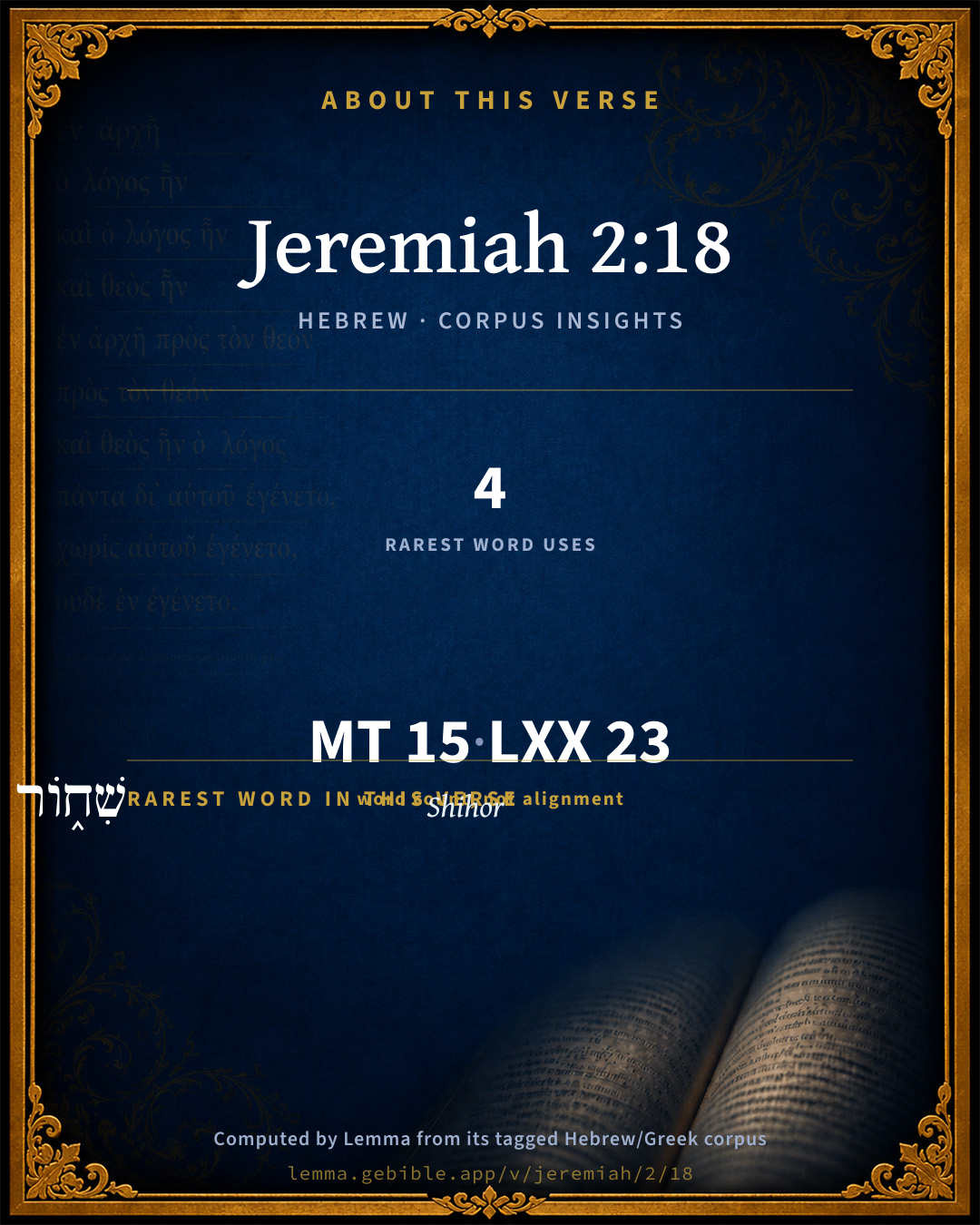
The rarest word here is שִׁח֑וֹר Shihor H7883 — appearing just 4 times in the whole Hebrew Bible.

Shared distinctive vocabulary

שִׁח֑וֹר Shihor H7883 occurs in 4 verses of the Hebrew Bible. Also found in:

Grammatical profile

  • 2 verbs
  • 8 nouns
  • 2 prepositions
  • 1 adverb
  • 2 particles

Verb forms

  • לִשְׁתּ֖וֹת Qal · Infinitive Construct
  • לִשְׁתּ֖וֹת Qal · Infinitive Construct

Repetition

Words recur within this verse — often emphatic in Hebrew:

  • לְדֶ֣רֶךְ way H1870 ×2
  • לִשְׁתּ֖וֹת to drink H8354 ×2
  • מֵ֣י water H4325 ×2
  • מַה what H4100 ×2

Hebrew & Septuagint length

In the original languages it is 15 Hebrew tokens and 23 Greek tokens — but the two are counted differently (Hebrew bundles its prefixes and suffixes into one token; the Greek is in lemma form), so that isn’t a like-for-like length.

Cross-references

11

Topical passages linked to Jeremiah 2:18 in the Treasury of Scripture Knowledge — connected by theme and wording, ordered by reader-vote popularity; previews shown in the World English Bible.

  • Joshua 13:3 from the Shihor, which is before Egypt, even to the border of Ekron northward, [which] is reckoned to the Canaanites; the five lords of the Philistines; the Gazites, and the Ashdodites, the Ashkelonites, the Gittites, and the Ekronites; also the Avvim,
  • Isaiah 31:1 Woe to those who go down to Egypt for help, and rely on horses, and trust in chariots because they are many, and in horsemen because they are very strong, but they don't look to the Holy One of Israel, neither seek Yahweh!
  • Jeremiah 2:36 Why go you about so much to change your way? you shall be ashamed of Egypt also, as you were ashamed of Assyria.
  • Hosea 7:11 "Ephraim is like an easily deceived dove, without understanding. They call to Egypt. They go to Assyria.
  • 2 Kings 16:7–9 So Ahaz sent messengers to Tiglath Pileser king of Assyria, saying, I am your servant and your son: come up, and save me out of the hand of the king of Syria, and out of the hand of the king of Israel, who rise up against me.
  • 2 Chronicles 28:20–21 Tilgath Pilneser king of Assyria came to him, and distressed him, but didn't strengthen him.
  • Isaiah 30:1–7 Woe to the rebellious children, says Yahweh, who take counsel, but not of me; and who make a league, but not of my Spirit, that they may add sin to sin,
  • Jeremiah 37:5–10 Pharaoh's army was come forth out of Egypt; and when the Chaldeans who were besieging Jerusalem heard news of them, they broke up from Jerusalem.
  • Lamentations 4:17 Our eyes do yet fail [in looking] for our vain help: In our watching we have watched for a nation that could not save.
  • Ezekiel 17:15 But he rebelled against him in sending his ambassadors into Egypt, that they might give him horses and much people. Shall he prosper? shall he escape who does such things? shall he break the covenant, and yet escape?
  • Hosea 5:13 When Ephraim saw his sickness, And Judah his wound, Then Ephraim went to Assyria, And sent to king Jareb: But he is not able to heal you, Neither will he cure you of your wound.

Cross-references courtesy of OpenBible.info (CC BY 4.0).

Hebrew and Greek witnesses Masoretic Hebrew ↔ Greek Septuagint

The same verse in the two great witnesses to the Old Testament, shown verse-for-verse.

These are two independent witnesses, not word-aligned to each other, and the Septuagint is shown in lemma (dictionary) form.

Hebrew Jeremiah 2:18 Masoretic · Westminster Leningrad Codex

וְעַתָּ֗ה מַה לָּךְ֙ לְדֶ֣רֶךְ מִצְרַ֔יִם לִשְׁתּ֖וֹת מֵ֣י שִׁח֑וֹר וּמַה לָּךְ֙ לְדֶ֣רֶךְ אַשּׁ֔וּר לִשְׁתּ֖וֹת מֵ֥י נָהָֽר

Now what have you to do in the way to Egypt, to drink the waters of the Shihor? or what have you to do in the way to Assyria, to drink the waters of the River?

World English Bible · Public Domain

Greek LXX Structure differs

In the Septuagint, Jeremiah is about an eighth shorter than the Hebrew and arranges its material differently — the Oracles Against the Nations (Hebrew chapters 46–51) appear in the middle of the Greek book, after 25:13. Because the chapter and verse boundaries do not line up, a verse-for-verse comparison with the Hebrew is not shown.

A verse-for-verse comparison isn’t shown here because the chapters and verses don’t line up. Switch to the LXX edition with the MT / LXX toggle above to read the Greek directly.

On this verse, Jamieson, Fausset & Brown discusses the Septuagint’s reading. Read the note in Commentary ↓

Hebrew: Westminster Leningrad Codex (CC BY 4.0). Greek: Septuagint (public domain); English from a public-domain English Septuagint. How the Septuagint differs from the Hebrew →

Targum (Aramaic paraphrase)

1

The Targum is the ancient Jewish Aramaic paraphrase of the Hebrew Scriptures — an interpretive translation, not the Hebrew text itself. Onkelos (literal) and Pseudo-Jonathan (expansive) render the Torah, and Jonathan the Prophets. Coverage is partial: where no permissively-licensed English translation exists for a verse, only the Aramaic is shown. This is verse-level text, not a word-by-word alignment to the Hebrew.

  1. Targum Jonathan Prophets (Joshua–Malachi)
    וּכְעַן מָה לְכוֹן לְאִתְחַבְּרָא לְפַרְעֹה מַלְכָּא דְמִצְרַיִם לְמִרְמֵי דְכוּרֵיכוֹן בְּנַהֲרָא וּמָה לְכוֹן לְמִגְזַר קְיָם עִם אַתּוּרָאָה לְאַגְלָאָה יַתְכוֹן לְהַלְאָה מַעֲבֵר פְּרָת:

    (no public-domain English translation for this verse)

    Targum Jonathan — Aramaic: “Mikraot Gedolot” (public domain). English: “Sefaria Community Translation” (CC0 1.0 (public-domain dedication)); “London "Chaldee Paraphrase," 1871” (public domain). Text via Sefaria.

Commentary

Notes on Jeremiah 2:18 from classic Christian and Jewish commentators (each source and its license shown beneath its notes). The classic Christian expositions comment on the surrounding passage and are grouped to its opening verse, so a note may address several verses; the Jewish commentaries on the Tanakh (Rashi and others) are per-verse, so they appear only where the commentator wrote on this verse.

Lemma curates 59 commentaries, every one of them public domain or Creative Commons licensed, each selected and text-cleaned for this edition rather than reprinted as found. About our sources →

Trapp's Complete Commentary

John Trapp

Jer 2:18 And now what hast thou to do in the way of Egypt, to drink the waters of Sihor? or what hast thou to do in the way of Assyria, to drink the waters of the river?

Ver. 18. And now what hast thou to do in the way of Egypt?] Why trusteth thou to carnal combinations, which thou hast formerly found to lack in success? wilt thou never be warned of these broken cisterns? or hast thou a mind to be ground to powder between those two millstones of Egypt and Assyria, after whom thou hankerest? Psa 146:3, David having entered a caveat against creature confidence, persuades people to trust in God alone. See also Psa 62:8-10.

To drink the waters of Sihor,] i.e., Of Nile, called Sihor, of its blackness or muddiness; {a} and in Greek, Mελας, black. To drink the waters of it here is to draw the Egyptian forces to thine assistance, and, as some think, to partake with them in their superstitions.

To drink of the water of the river,] i.e., Of Euphrates, that river by an eminence.

{a} Limosus est Nilus et oblimat Aegyptum.

John Trapp, A Commentary or Exposition upon All the Books of the Old and New Testament (1647–1656) — public domain. Text from a community e-Sword module.

The Biblical Illustrator

Joseph S. Exell

Jer_2:18

What hast thou to do in the way of Egypt.

Words of expostulation

I. Addressing myself to the Christian, I shall use the text in three senses, while I expostulate with you in regard to sin, to worldly pleasure, and to carnal trust.

1. O true believer, called by grace and washed in the precious blood of Christ, What hast thou to do in the way of Egypt, to drink the waters of the muddy river? What hast thou to do with the sins which once delighted thee, and which now find happy pastime for the world? A vision flits before my eye. The Lord God hath made a great feast; armies have met together; terrible slaughter has been the consequence. Mens arms have been red up to the very elbow in blood; they have fought with each other, and there they lie strewn upon the plain--thousands of carcasses bleeding. The vultures sniff the prey from far-off desert wilds; they fly, keen of scent. God hath made a great feast to the fowls of heaven, and to the ravenous beasts of the earth. But what is that I see? I see a dove flying with the same speed as the vulture towards the carrion. O dove, what hath brought thee there in dangerous connection with thy fierce enemies? Whither art thou going? Is there anything in that bloody feast that can content thee? Shall thy meek eyes glare with the fires of anger? Shah thy fair white plumage be stained with gore, and wilt thou go back to thy dove cote with thy pinions bloody red? The question then cannot be answered, because when a Christian goes into sin he commits all inconsistent act--inconsistent with the freedom which Christ has bought for him, and inconsistent with the nature which the Holy Spirit has implanted in him. Christian, what hast thou to do with sin? Hath it not cost thee enough already? What, man! hast thou forgotten the times of thy conviction? There is yet another light in which to put the sin of the believer. Let me repeat the question once again--What hast thou to do in the way of Egypt, to drink the waters of the muddy river? There is a crowd yonder. They have evidently assembled for some riotous purpose. They are attacking one man. There are very many of them. They give Him no space to take His breath, no time to rest. Let me press through the throng and look at the man, I know Him at once. He hath visage more marred than that of any other man. Tis He; it is the Crucified One, it is none other than Jesus, the Son of man, the Saviour of the world. Hark to the blasphemies which are poured into His ears! See how they spit in His face, and put Him co an open shame. Onward they bring Him, and you hear them cry, Crucify Him! crucify Him! crucify Him! They are doing it: they have nailed Him to the tree: yonder is a man with the hammer in his hand who has just now driven in the nail. Look round upon the mob. I can well comprehend why yonder drunkard, why yonder swearer, why the whoremonger, and the like of infamous notoriety, should have joined in this treacherous murder; but there is one man there--methinks I know his face. Ay, I have seen him at the sacramental table, eating the flesh and drinking the blood of Christ: I have seen him in the pulpit saying, God forbid that I should glory save in the cross of our Lord Jesus Christ: I have seen him on his knees in prayer, pleading what he called The precious blood. What hast thou to do in this counsel of the ungodly, this scene of sin without a parallel?

2. The pleasures of this world do sometimes entice the people of God, and they find some degree of mirth therein. To those Christians who can find pleasure in the common amusements of men, this question may be very pertinently put--What hast thou to do to drink the water of that muddy river? I can never understand that Christianity which alternately goes out to find joy in worldly amusements, and returns home to have fellowship with Christ. In the life of Madame Guyon I have read an anecdote something to this effect. She had been invited by some friends to spend a few days at the palace of St. Cloud. She knew it was a place full of pomp, and fashion, and, I must add, of vice also; but being over-persuaded by her friend, and being especially tempted with the idea that perhaps her example might do good, she accepted the invitation. Her experience afterwards should be a warning to all Christians. For some years that holy woman had walked in constant fellowship with Christ; perhaps none ever saw the Saviours face, and kissed His wounds more truly than she had done. But when she came home from St. Cloud she found her usual joy was departed; she had lost her power in prayer. She felt in going to the lover of her soul as if she had played the harlot against Him. She was afraid to hope that she could be received again to His pure and perfect love, and it took some months ere the equilibrium of her peace could be restored, and her heart could yet again be wholly set upon her Lord. He that wears a white garment must mind where he walks when the worlds streets are so filthy as they are.

3. We are all tried with the temptation to put our trust in things which are seen, instead of things which are not seen. The Lord hath said it--Cursed is he that trusteth in man and maketh flesh his arm, but blessed is he that trusteth in the Lord. Yet Christians often do trust in man, and then our text comes home--What hast thou to do in the way of Egypt, to drink the water of that muddy river? Some trust in horses and some in chariots, but we will stay ourselves upon the Lord God of Israel.

II. Convinced sinner, you feel your lost estate; Gods Holy Spirit has kindly looked upon you, and begun a good work in your soul. And yet during the past week you have fallen into your old sin. Ah! smarting and yet sinning! wounded and yet rebelling! pricked with the ox goad, and yet kicking against the pricks! It is hard for thee! And what was the cause of your sin after all? Was it worth sinning for--to grieve your conscience and vex the Holy Spirit? I have heard of a man who had just begun the Christian life, and he had some months of sorrow owing to a hasty temper. His neighbour had let some of his cattle stray into the field; he asked him to fetch them out again and mend the fence; his neighbour would not, and he flew into such a passion with him that afterwards he sat down and cried. Said he, Why, if all the cows in the field were sold, and I had lost the money, they were not worth the bother I made about them, nor worth one moment of the grief which I have to suffer. Oh! what fools we all are! Let us, however, write ourselves fools in capital letters, if when conscience is tender we yet go and do the very thing which we hate, and choose the very cup which was so bitter to our taste, so nauseous to us just now. You are under conviction of sin, and you have been lately--as it is a festive season--you have been frequenting the dancing room, or the theatre. Now these are amusements for worldlings; let them have them; I would not prevent them for a moment; let every man have his own amusement and his own joy. But what is this to you? What hast thou to do with it?

III. Lastly, to any who are careless. I have a hard task to bring a reasonable question to unreasonable men. Ye tell me that ye love the vanities of this world, and that they content you. I look you in the face and remind you that there have been many madmen in this world besides yourselves. Yet as there is some spark of reason left, let me see if I can kindle a flame of thought therewith. Sinner, God is angry with the wicked every day. What have you to do with joy? you are condemned already, because you believe not on the Son of God. What have you to do with peace--a condemned man dancing in his cell at Newgate with chains about his wrists? What have you to do with merriment? You! If you were sure you should live a week you might spend six days, if you would, in sin; but you are not sure you will live an hour. What have you to do with sin and its pleasures? God is furbishing his sword today; it is sharp and strong as the arm which shall wield it. That sword is meant for you except you repent. (C. H. Spurgeon.)

The believers portion superior to the worlds

Thou hast tasted of better drink than the muddy river of this worlds pleasure can give thee. If thy profession be not a lie thou hast had fellowship with Christ, thou hast had that joy which only the blessed Spirits above and the chosen ones on earth can know. Hast thou eaten the bread of angels, and canst thou live on husks? Good Rutherford once said, I have tasted of Christs own manna and it hath put my mouth out of taste with the brown bread of this worlds joy. What hast thou to do, etc.

The Biblical Illustrator, edited by Joseph S. Exell (c. 1880s–1900s) — public domain. Text from a community e-Sword module.

Joseph Benson's Commentary

Jer 2:18. And now what hast thou to do, &c. — “The kings of Egypt and Assyria were the most potent monarchs in the neighbourhood of Judea; and according as either of these was the stronger, the Jews made their court to him, and desired his assistance. This is expressed by drinking the waters of Sihor, an Egyptian river, which some suppose, and Dr. Waterland renders, the Nile; (see note on Isaiah 42; Isaiah 3;) and of the Euphrates, called here the river, by way of eminence. The expressions allude to Jer 2:13, where human assistances are styled broken cisterns, and opposed to God, who, by reason of his all-sufficiency, is called the fountain of living waters. To drink of the waters of these rivers might possibly allude, further, both to the strong propensity which the Israelites had to return to Egypt, and that which they showed for adopting the idolatrous worship of these countries. For the Egyptians worshipped the water, and particularly that of the Nile.” See Div. Leg., vol. 3., and Calmet.

Joseph Benson's Commentary on the Old and New Testaments (1811–1818) — public domain. Text from a community e-Sword module.

Tyndale Open Study Notes

Tyndale Open Resources

2:18 Israel’s alliances with Egypt and covenants with Assyria (2 Kgs 15:19–19:37) provided no benefits, only sorrow. Neither the Nile in Egypt nor the Euphrates in Assyria ever helped Israel (Isa 30:1-3; Hos 5:13).

Tyndale Open Study Notes — © Tyndale Open Resources, licensed CC BY-SA 4.0. Text via the HelloAO Bible API.

Geneva Bible (1599)

Geneva Bible translators

To seek help of man, as though God were not able enough to defend thee, which is to drink of the puddles, and to leave the fountain, read Isa. 31:1.

To wit, Euphrates.

Geneva Bible (1599) marginal notes — public domain. Text via Bolls.life.

Jamieson, Fausset & Brown

Robert Jamieson, A. R. Fausset & David Brown

now--used in a reasoning sense, not of time.

the way of Egypt--What hast thou to do with the way, that is, with going down to Egypt; or what . . . with going to Assyria?

drink . . . waters--that is, to seek reinvigorating aid from them; so Jer 2:13, Jer 2:36; compare "waters," meaning numerous forces (Isa 8:7).

Sihor--that is, the black river, in Greek, Melas ("black"), the Nile: so called from the black deposit or soil it leaves after the inundation (Isa 23:3). The Septuagint identifies it with Gihon, one of the rivers of Paradise.

the river--Euphrates, called by pre-eminence, the river; figurative for the Assyrian power. In 625 B.C., the seventeenth year of Josiah, and the fourth of Jeremiah's office, the kingdom of Assyria fell before Babylon, therefore Assyria is here put for Babylon its successor: so in Kg2 23:29; Lam 5:6. There was doubtless a league between Judea and Assyria (that is, Babylon), which caused Josiah to march against Pharaoh-necho of Egypt when that king went against Babylon: the evil consequences of this league are foretold in this verse and Jer 2:36.

Jamieson, Fausset & Brown — Commentary Critical and Explanatory on the Whole Bible (1871) — public domain (CC PDM 1.0). Text via the HelloAO Bible API.

Adam Clarke's Commentary

Verse 18. What hast thou to do in the way of Egypt] Why dost thou make alliances with Egypt?

To drink the waters of Sihor?] This means the Nile. See on Isa 23:3.

The way of Assyria] Why make alliances with the Assyrians? All such connexions will only expedite thy ruin.

To drink the waters of the river?] The Euphrates, as נהר nahar or הנהר hannahar always means Euphrates, the country between the Tigris and Euphrates, is termed to this day Maher alnahar, "the country beyond the river," i.e., Mesopotamia.

Instead of cleaving to the Lord, they joined affinity and made alliances with those two nations, who were ever jealous of them, and sought their ruin. Egypt was to them a broken reed instead of a staff; Assyria was a leaky cistern, from which they could derive no help.

Adam Clarke's Commentary on the Bible (1810–1826) — public domain. Text from a community e-Sword/MySword module.

John Calvin's Commentaries

As I have just stated, the Prophet confirms what I said, — that the people could not ascribe the cause of their evils to others; for they ought to have imputed to themselves whatever they suffered; and at the same time their sin was doubled, because they looked here and there for vain remedies, and thus accumulated for themselves new causes of misery; for they ought to have acknowledged no other remedy for their evils except reconciliation with God. If, for instance, any one being ill knew the cause of his disease, and instead of adopting the true remedy had recourse to some vain expedients injurious to his recovery, is he not deemed worthy to die for having willfully despised what might have healed him, and for indulging himself in what is deceptive and fallacious? The same thing does Jeremiah now reprove in the people of Israel. “If you carefully inquire,” saith God, “how it is that you are so miserable, you will find that this cannot be ascribed to me, but to your own sins. Now, then, what ought you to have done? what remedy ought you to have sought, except to reconcile yourselves to me, to seek pardon from me, and to strive to correct your wickedness? I would then have immediately healed you; and had you come to me, you would have found me the best physician. And why do you now act in a way quite contrary? for you run after vain helps; now you flee to Egypt, then you flee to Assyria; but you will gain nothing by these expedients.” We now understand the object of the Prophet. For after having proved the people to be guilty of impiety, and shewn that the evils which they suffered could be ascribed neither to God nor to chance, nor to any such causes, he now shews to them, that the one true remedy was to return into favor with God; but that it was an evidence of extreme madness to run now to Egypt, and then to Assyria.

Now this reproof is supported by history; for the people had at one time the Assyrians as their enemies, and at another the Egyptians; and the changes were many. God employed different scourges to awaken the sottishness of the people; at one time, he whistled for the Egyptians, as we shall presently see; at another, he blew the trumpet in Assyria: so that the Israelites might know that they could never be safe without being under the government of God. But all these things being overlooked, such was the blindness of the people, that when they were assailed by the Assyrians, they fled to Egypt and sought aid from the Egyptians, and entered into a treaty with them; afterwards, when a change occurred, they sought a treaty with the Assyrians, and also bought it at a high price.

This madness is what the Prophet now reprobates, when he says, What hast thou to do in the way of Egypt? that is, “What advantage dost thou gain? How great is thy folly, since thou knowest that God is angry with thee, and that thou art suffering many evils? God is adverse to thee, and yet thou thinkest nothing of reconciliation. Thy healing would be to flee to God and to be reconciled to him; but what dost thou now do? Thou fleest to the Assyrians and to the Egyptians. How wretched is thy condition, and how great is thy folly in thus wearying thyself without any advantage!”

Now we may learn from this passage, that whenever God chastises us for our sins, we ought to seek a remedy, and not to rest in those vain comforts which Satan often suggests; for such charms introduce drowsiness, and healable diseases are by such means rendered fatal. What then ought we to do? We ought, as soon as we feel the scourges of God, to seek to return into favor with him; and not in vain shall be our effort. But if we look around us in all directions for help, our evils shall not be lessened but increased. To drink the waters of the Nile, and to drink the waters of Euphrates, is nothing else but to seek aids here and there.

He indeed alludes to the legations which had been sent; for they who went to Egypt drank of the waters of the Nile, and others of Euphrates. He yet speaks metaphorically, as though he had said, “God was ready to help thee, hadst thou betaken thyself to his mercy as thine asylum; but having neglected him, thou thoughtest it more advantageous to have such aids as Egypt and Assyria could bring. Thou thus seekest drink in remote countries, while God could give thee waters.” And he seems to refer to the similitude which he had shortly before used: he had called God the fountain of living waters; as though he had said, “God is to thee a refreshing and perennial fountain, and there would be abundance of waters for thee wert thou satisfied with him; but thy desire is to drink the waters of the Nile, and the waters of the Euphrates.” We now then perceive the meaning of the Prophet.

He, no doubt, speaks of the waters of the Nile and of the Euphrates, because both those nations abounded apparently in wealth and power and in military forces. As, then, the people of Israel trusted in such auxiliaries, the Prophet here reproves their ingratitude, because they were not content with God’s help, though that was not so visible and conspicuous. God, indeed, has help sufficient for us; and were we content with him alone, no doubt an abundance of good things would to a full satisfaction be given to us; and as he is not wearied in doing good, he would supply us with whatever is desirable: but as we cannot see his beneficence with carnal eyes, we are therefore carried away after the allurements of the world. We may hence learn that we are not to seek drink either from the Nile or from the Euphrates, that is, from the enticing things of the world, which make a great shew and display; but that we are, on the contrary, to drink from the hidden fountain which is concealed from us, in order that we may seek it by faith. It now follows —

John Calvin's Commentaries (1540-1563) — public domain. Text from the Calvin Translation Society English edition (1840s-50s) via the Christian Classics Ethereal Library (ccel.org). Calvin's coverage is partial (roughly two-thirds of the Bible); uncommented books and verses are honest gaps, never fabricated. The 19th-century editor's footnotes and remarks are omitted so the notes are faithfully Calvin's own voice.

Ellicott's Commentary for English Readers

(18) In the way of Egypt . . .?—The rebuke becomes more and more specific. Great rivers were, in the poetry of the prophets, the natural symbols of the kingdoms through which they flowed. Sihor (= the turbid or muddy river) here, and in Isa_23:3 the Nile (though in Jos_13:3 it stands for the border stream between Palestine and Egypt), represented Egypt. The “river,” or “flood,” needing no other name as pre-eminent in its greatness (comp. Jos_24:14-15), the Euphrates, stood for Assyria (comp. Isa_8:7). The words point to the tendency to court the alliance now of one, now of the other of the great kingdoms of the world. The policy was no new one. Menahem in Israel, Ahaz in Judah, had courted Assyria (2Ki_15:19; 2Ki_16:7-8); Hezekiah, Babylon (Isaiah 39); Hoshea had sought help from Egypt (2Ki_17:4). The prophet Hosea had rebuked both policies (Hos_5:13; Hos_7:11; Hos_8:9). Even under Hezekiah there was a party seeking the Egyptian alliance (Isaiah 18, 19, 31. Under Manasseh and Amon that party was in power, and the very name of the latter probably bears witness to its influence. Josiah kept as far as possible the position of a neutral, but, when forced into action, and probably guided by the counsels of Hilkiah, resisted the advance of Pharaoh-nechoh (2Ki_23:29). On his death the Egyptian party again gained ground under Jehoiakim, while Jeremiah, opposing its strength, urged the wisdom of accepting the guidance of events, and submitting to the Chaldæans (so far continuing the line of action adopted by Hezekiah), and ultimately was accused of deserting his own people and “falling away” to their oppressors (Jer_37:13).

A Bible Commentary for English Readers, edited by Charles John Ellicott (1878–1897) — public domain. Text from a community e-Sword module.

The Cambridge Bible for Schools and Colleges

gen. ed. J. J. S. Perowne

18. what hast thou to do in the way to Egypt] The thought is the same as that expressed in Isa_30:1-3. Ever since the time when Psammetichus I (b.c. 663–610), king of Egypt, reduced under his own sway the twelve separate kingdoms into which that country had been formed, there was a party of statesmen at Jerusalem who favoured an Egyptian alliance. This party Jeremiah constantly opposed.

to drink the waters of Shihor] to hold communication with Egypt, and espouse its cause. The figure has been already suggested by the mention of fountains and cisterns (Jer_2:13).

Shihor] The word, which properly means turbid, is shewn by the context to be equivalent to the Nile, a word which itself denotes blue, or dark; so probably in Isa_23:3. Sometimes (as in Jos_13:3; 1Ch_13:5) the name is confined to the easternmost branch of the Nile.

what hast thou to do in the way to Assyria] Both Israel and Judah had vacillated for many reigns between Egypt and Assyria. Menahem king of Israel bribed Pul king of Assyria to support him, and to him also his successors Pekahiah and Pekah seem to have looked. Hoshea sought the aid of Egypt to enable him to throw off the Assyrian yoke, while Josiah met his death in fighting against it and on behalf of the Eastern empire, Assyria’s successor. Thus subservience now to one now to the other quarter was familiar to those whom Jeremiah addressed. Hosea (Jer_7:2) had likened Israel in its vacillation to “a silly dove, without understanding.”

to drink the waters of the River] Euphrates, the great river, on which was built Babylon. Cp. Isa_8:7.

The Cambridge Bible for Schools and Colleges (gen. ed. J. J. S. Perowne; Cambridge University Press, 1878–1918) — public domain. Text from a community e-Sword module.

John Gill's Exposition

Thine own wickedness shall correct thee,.... That is, either their wickedness in going to Egypt and Assyria, and the ill success they had in so doing might be an instruction to them to act otherwise, and a correction of their sin and folly; or that their wickedness was a reason, and a very just one, why they were chastened and corrected of the Lord:

and thy backslidings shall reprove thee; or be the cause why they were reproved of God; or their ill success in turning their backs on him, and going to the creature for help, was a severe rebuke of their sin and madness. The Targum is,

"I have brought afflictions upon thee, and thou hast not refrained from thy wickedness; and, because thou art not turned to the law, vengeance is taken on thee.''

Know therefore and see that it is an evil thing and bitter; or observe and take notice what evil and bitter things sin, particularly the forsaking of the Lord and his worship, brings upon persons; for not sin itself is meant, though that is exceeding sinful, and is a root of bitterness, however sweet it may be to the taste of a sinner, and produces bitter effects; but the punishment of sin is meant, or corrections and reproofs for it; which are evil things, as calamities, and captivity, and the like; and which are very ungrateful and disagreeable to flesh and blood; and yet men, going on in a course of sin, and forsaking the Lord, as it follows, are the cause of these things:

that thou hast forsaken the Lord thy God; See Gill on Jer 2:13, this is the source of all the evil and bitterness experienced by them:

and that my fear is not in thee, saith the Lord God of hosts; this was the reason of their forsaking the Lord, his ways and worship, because they had no reverence of him; his fear was not before their eyes, nor on their hearts; and both were the cause of evil coming upon them; so the Targum paraphrases the words,

"and know and see, for I have brought evil and bitterness upon thee, O Jerusalem, because thou hast forsaken the worship of the Lord thy God, and hast not put my fear before thine eyes, saith the Lord, the God of hosts.''

John Gill's Exposition of the Whole Bible (1746–1763) — public domain (CC PDM 1.0). Text via the HelloAO Bible API.

Albert Barnes' Notes on the Bible

Sihor - The Nile. To lean upon Egypt was a violation of the principles of theocracy.

The two rivers are the two empires, and to drink their waters is to adopt their principles and religion. Compare also Isa 8:6-7.

Albert Barnes' Notes on the Bible (1834–1885) — public domain. Text from a community e-Sword/MySword module.

Haydock's Catholic Bible Commentary

Troubled. Hebrew shichor, or Nile water, (Josue xiii. 3.) which was thought as good as wine, and grew better for keeping. (Strabo xvii.) --- Hence the people adored it. (Vitruvius viii.) --- God often reproached the Jews for distrusting in his protection, and seeking aid from the Egyptians, who deceived them. We know not that Josias did so. (Calmet) --- He even opposed them, and lost his life in defending the country, 4 Kings xxiii. 29. (Haydock) --- He was probably obliged to pay tribute to the Assyrians, whom Achaz had called in, 2 Paralipomenon xxviii. 23. These alliances the Lord condemned.

George Leo Haydock (1774–1849), Haydock's Catholic Family Bible and Commentary, 1859 edition — public domain. Excludes Psalms (Douay-Rheims chapter numbering differs from Protestant) and Deuterocanonical books (Catholic canon only).

Matthew Poole's English Annotations

What hast thou to do in the way of Egypt? what business hast thou there? or what dost thou expect from thence? or what need hast thou to go or send messengers thither, if thou wouldst but keep close to me?

Sihor, viz. Nilus; it signifies black, from whence called Melas by the Greeks, either from the blackness of the land it passed through, or of the soil it casteth up. See on Isa 23:3.

To drink the waters: here, and by the same words before, is meant, to seek help from either place, noting their strength, Isa 8:6. A metaphorical allegory, wherein God minds them of two of their broken cisterns, and shows them their folly to go so far when they might have been better supplied nearer home; as if God were not able to help them. Compare Jer 2:36. The river, i.e. Euphrates, often called so by way of eminency; the chief river of Assyria, Isa 7:20.

Matthew Poole's English Annotations on the Holy Bible (1683–1685) — public domain. Text from a community e-Sword/MySword module.

Whedon's Commentary on the Bible

Daniel D. Whedon

18. The way of Egypt, is the way they must go to secure the aid of Egypt. What business have you going down to Egypt for help? God’s way is from Egypt, not to it. Sihor is the Nile, so called because of its black and turbid waters.

The river — The Euphrates, upon whose banks stood Nineveh, Assyria’s capital. To “drink the waters of Sihor,” or “the river,” is to lay hold of the strength of Egypt or of Assyria. Neither the Nile nor the Euphrates could take the place of “the river of God,” which is the one unfailing source of supply to his people. Such a substitution would be like that mentioned Jer_2:13, “broken cisterns” for “living waters.”

Daniel D. Whedon (gen. ed.), Commentary on the Old and New Testaments (1874–1909) — public domain. Text from a community e-Sword module.

The Pulpit Commentary

What hast thou to do in the way of Egypt? rather, with the way to Egypt. Isaiah (Isa_30:2-5 Isa_31:1) and Hosea (Hos_7:11, Hos_7:16) had already inveighed against an Egyptian alliance. The name given by Manasseh to his son and successor (Amen) suggests that at one period in his reign an Egyptian policy was in the ascendant, which coincides with the tradition preserved in 2Ch_33:11, of an Assyrian captivity of Manasseh. Jehoiakim at a later period was a vassal of Egypt. (2Ki_23:31, 2Ki_23:35) To drink the waters; taking up the idea of the second clause of ver. 13. Sihor, or Shihor, occurs again in Isa_23:3, as a name of the Nile. It properly means, not so much "the black" as "the dark grey" (connected with shakhar, the morning grey), from the color of the water. Rosenm contrast between the muddy waters of foreign streams and the "fountain of living waters" is uncalled for; besides, the Nile water has always been held in high esteem. The Septuagint has Ghwn , i.e. Gihon, also a name of-the Nile according to Ecc 24:27. The way of rather, toAssyria. It is true that Assyria was, to say the least, powerless to interfere for good or for evil, when these words were written. But in ver. 5 the prophet has already warned us that his complaints are partly retrospective. It would seem that the Assyrian party from time to time gained the upper hand over the Egyptian in the councils of the State. Or perhaps the prophet may refer to the Quixotic fidelity to Assyria of Josiah (see below on ver. 36). The river; i.e. the Euphrates, "the great river". (Gen_15:18) Babylonia it should be remembered, was in nominal subjection to Assyria; the Euphrates was the boundary between Syria and Palestine on the one hand, and Assyria here the Assyrio-Babylonian region on the other.

The unreasonableness of appealing to worldly assistance in spiritual enterprises.

This was the tendency of Israel when her faith grew weak. It is shown even now by those who trust to the arm of flesh, and who seek worldly alliances for the Church. We ought to be deterred from this when we consider

I THE OPPOSITION OF THE CHARACTER AND AIMS OF THE WORLD TO THOSE OF SPIRITUAL RELIGION.

II THE UNRELIABLENESS OF THE WORLDLY.

III THE DISHONOR AND SPIRITUAL PERIL OF SUCH ALLIANCES. M.

The Pulpit Commentary (1880–1919), ed. H.D.M. Spence-Jones & Joseph S. Exell — public domain. Text from a community e-Sword module.

John Wesley's Explanatory Notes

And now - What business hast thou there? Sihor - The Nile: it signifies black, called Melas by the Greeks, either from the blackness of the land it passed through, or of the soil it casts up. The waters - Here and by the same words before is meant, to seek help from either place. River - Euphrates, often called so by way of eminency.

John Wesley, Explanatory Notes Upon the Whole Bible (1754–1765) — public domain. Text via the GEBible commentary corpus.

unfoldingWord translationNotes

Door43 World Missions Community

So now, why take the road to Egypt and drink the waters of Shihor? Why take the road to Assyria and drink the waters of the Euphrates River?

Yahweh uses these questions to remind his people that it does not do any good to ask Egypt and Assyria to help them. AT: "It does not help you to go to Egypt and drink from the waters of the Shihor River, or to go to Assyria and drink from the waters of the Euphrates River." (See: Rhetorical Question)

why take the road to Egypt and drink the waters of Shihor ... Why take the road to Assyria and drink the waters of the Euphrates River

These are a metaphor for asking the Egyptian and Assyrian armies to help them. AT: "why ask the Egyptians to help you ... Why ask the Assyrians to help you" (See: Metaphor)

Shihor

This is the name of a stream associated with Egypt. It may have been a branch of the Nile River. Some versions call it the Nile. AT: "the Shihor Stream" or "the Shihor River" or "the Nile River" (See: How to Translate Names)

Your wickedness rebukes you, and your faithlessness punishes you

Both of these phrases mean that their punishment is the result of their wicked behavior. AT: "Because you have been wicked and unfaithful, I will punish you" (See: Personification and Parallelism)

it is wicked and bitter

Here the word "bitter" describes "wicked." AT: "it is bitterly wicked" or "it is extremely wicked" (See: Hendiadys)

translationWords

Egypt

Assyria

Euphrates River

evil

rebuke

faithless

punish

Lord Yahweh

Yahweh of hosts

unfoldingWord translationNotes — © Distant Shores Media and the Door43 World Missions Community, licensed CC BY-SA 4.0. Source: git.door43.org/Door43/en_tn.

Rashi

Rabbi Shlomo Yitzchaki (Rashi)

what have you to do in the way of Egypt Why do you leave Me and trust in Egypt?

to drink the water of the Shihor For they drowned your male children in the Nile. Shihor is the Nile, as it is said: “From the Shihor which is before Egypt,” in the Book of Joshua (13:3).

and what have you to do to rebel against Me so that you should be exiled to the way of Assyria, to the other side of the Euphrates River?

Rashi on the Tanakh — English translations: “The Judaica Press complete Tanach with Rashi, translated by A. J. Rosenberg” (CC BY 4.0); “Pentateuch with Rashi's commentary by M. Rosenbaum and A.M. Silbermann, 1929-1934” (public domain); “The Metsudah Tanach series, Lakewood, N.J” (CC BY 4.0); and “The Book of Joshua, Metsudah Publications, 1997” (CC BY 4.0). Text via Sefaria.

Lesson kit

Teaching starters — assembled from the data on this page, not authored interpretation. Every prompt links to the verse data it draws on. Edit before teaching.

Jeremiah, in the Prophets, opens this verse with 15 words (9 distinct Hebrew lemmas). Its most distinctive word is Shîychôwr (“Shihor”). A historical commentator’s framing appears above. Read the whole chapter for the surrounding context.

Discussion questions

  1. How does “Shihor” (Shîychôwr) shape what this verse is saying?
  2. Joshua 13:3 shares the word «Shihor» with this verse. How do the two illuminate each other?
  3. “way” occurs 2× in this one verse. What is the effect of the repetition?
  4. The translations on this page render this verse differently — a whole-verse word diff, not a word-by-word alignment. What might account for the different wordings?
  5. The verb «לִשְׁתּ֖וֹת» is Qal Infinitive Construct. How does its form color the action?
  6. Reading how Trapp's Complete Commentary and The Biblical Illustrator read this verse, where do the two commentators agree and where do they part?

Things to notice

Reading settings

Reading text

Shown beneath each verse's original-language words.

Old Testament
Old Testament edition

Read the OT as the Masoretic Hebrew (MT) or the Greek Septuagint (LXX).

English shown for the Greek Septuagint (in the Hebrew ↔ Greek comparison).

Comparing translations? Open the Compare panel on any verse page to stack up to four side by side.