
Jeremiah 42:15

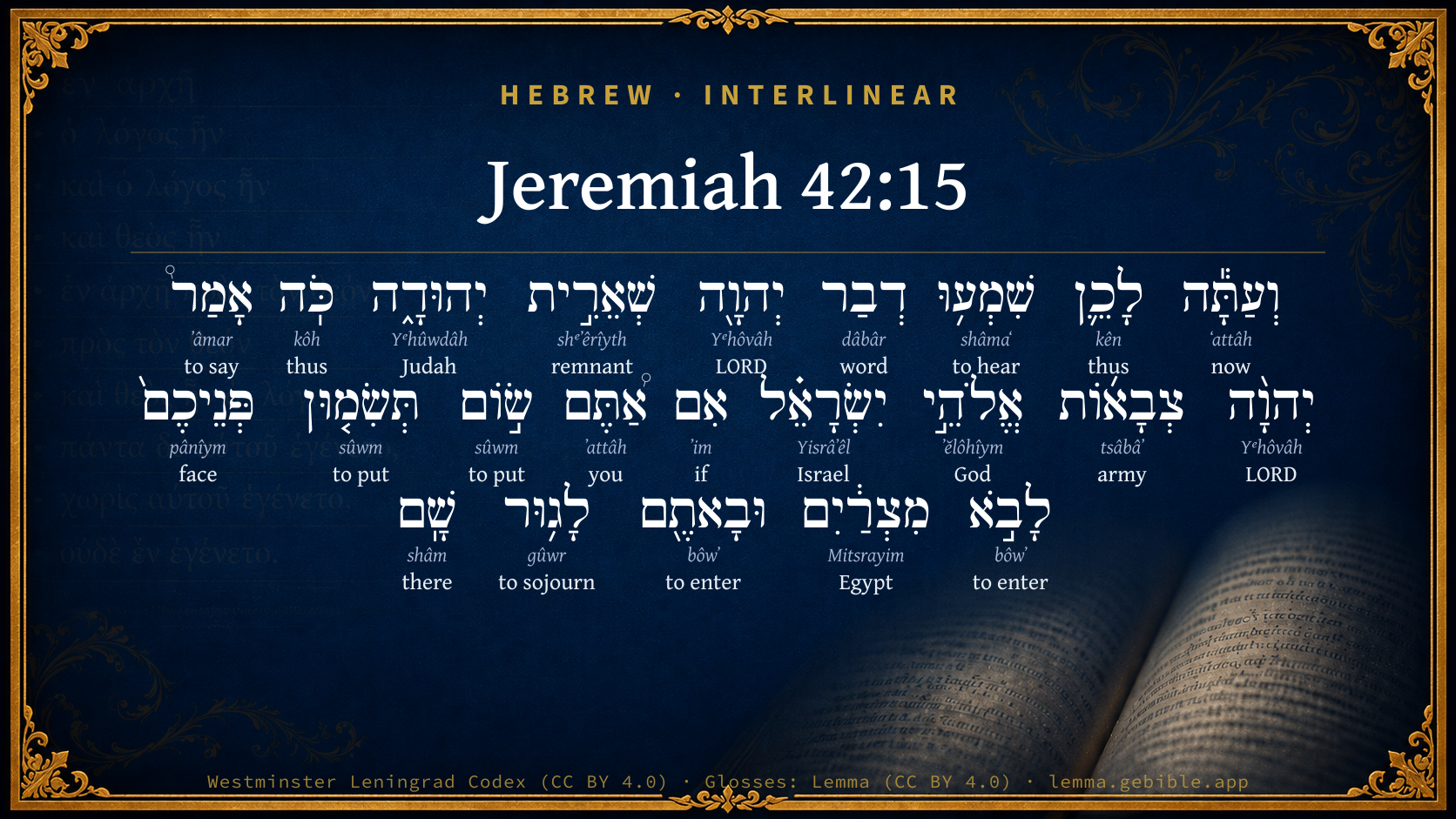
Hebrew (Westminster Leningrad Codex) Jeremiah 42:15 appears in the Hebrew Old Testament. The text above is from the Westminster Leningrad Codex. Each word links to its Strong’s number, a concise gloss, and parsing drawn from the Open Scriptures Hebrew Bible morphology. Click any word for its full Brown-Driver-Briggs (BDB) entry.
Download image
Cite this verse

Jeremiah 42:15 (World English Bible). Public Domain. Lemma interlinear Bible study tool, https://lemma.gebible.app/v/jeremiah/42/15.

Show BibTeX & RIS
BibTeX
RIS
English Translation
now therefore hear you the word of Yahweh, O remnant of Judah: Thus says Yahweh of Hosts, the God of Israel, If you indeed set your faces to enter into Egypt, and go to sojourn there;
World English Bible · Public Domain
Download a study sheet

One document with this verse’s original text, its word-by-word gloss line, the meaning frame, cross-references with their text, attributed commentary, and full source and license credits — printable, and it pastes into notes with its structure intact.

This verse Autodidact and up

Study sheet (.html) Plain text (.txt)

A passage Seminary Student

Up to 50 verses in one chapter. A passage sheet keeps up to 6 commentary sources and 12 cross-references per verse, in the order this page ranks them, and says so on the sheet whenever that leaves anything out. Ask for a single verse and you get the Autodidact verse sheet above.

Everything on this page stays free to read, with no account — the sheet is a download of what is already on screen, not access to it.

Want to remove ads? Support Godless Engineer
Compare translations 3

The same verse in 3 English versions, stacked beneath the original-language interlinear above. Click any original word for its lexicon entry.

Each is an independent rendering of the whole verse — the interlinear is not word-aligned to these translations.

Highlighted words mark where these versions differ — a whole-verse word diff, not a word-by-word alignment.

  • World English Bible Public Domain
    now therefore hear you the word of Yahweh, O remnant of Judah: Thus says Yahweh of Hosts, the God of Israel, If you indeed set your faces to enter into Egypt, and go to sojourn there;
  • King James Version Public Domain
    And now therefore hear the word of the LORD, ye remnant of Judah; Thus saith the LORD of hosts, the God of Israel; If ye wholly set your faces to enter into Egypt, and go to sojourn there;
  • unfoldingWord Literal Text CC BY-SA 4.0
    Now listen to this word of Yahweh, you remnant of Judah. Yahweh of hosts, God of Israel, says this, ‘If you actually set out to go to Egypt, to go and live there,

unfoldingWord Literal Text — © unfoldingWord, licensed CC BY-SA 4.0. Word-aligned USFM3 via Door43 (git.door43.org/unfoldingWord/en_ult).

Versions to compare (up to 4)

3 of 4 selected

Show all 18 translations

Every available English version of this verse, each an independent rendering of the whole verse.

  • World English Bible Public Domain
    now therefore hear you the word of Yahweh, O remnant of Judah: Thus says Yahweh of Hosts, the God of Israel, If you indeed set your faces to enter into Egypt, and go to sojourn there;
  • Berean Standard Bible Public Domain
    then hear the word of the LORD, O remnant of Judah! This is what the LORD of Hosts, the God of Israel, says: ‘If you are determined to go to Egypt and reside there,
  • Majority Standard Bible Public Domain
    then hear the word of the LORD, O remnant of Judah! This is what the LORD of Hosts, the God of Israel, says: ‘If you are determined to go to Egypt and reside there,
  • King James Version Public Domain
    And now therefore hear the word of the LORD, ye remnant of Judah; Thus saith the LORD of hosts, the God of Israel; If ye wholly set your faces to enter into Egypt, and go to sojourn there;
  • American Standard Version (1901) Public Domain
    now therefore hear ye the word of Jehovah, O remnant of Judah: Thus saith Jehovah of hosts, the God of Israel, If ye indeed set your faces to enter into Egypt, and go to sojourn there;
  • Revised Version (1885) Public Domain
    now therefore hear ye the word of the LORD, O remnant of Judah: thus saith the LORD of hosts, the God of Israel, If ye wholly set your faces to enter into Egypt, and go to sojourn there;
  • Geneva Bible (1599) Public Domain
    (And nowe therefore heare the worde of the Lord, ye remnant of Iudah: thus sayeth the Lord of hostes the God of Israel, If ye set your faces to enter into Egypt, and goe to dwell there)
  • Douay-Rheims (1899) Public Domain
    For this now hear the word of the Lord, ye remnant of Juda: Thus saith the Lord of hosts, the God of Israel: If you set your faces to go into Egypt, and enter in to dwell there:
  • Young's Literal Translation Public Domain
    And now, therefore, hear ye a word of Jehovah, O remnant of Judah: Thus said Jehovah of Hosts, God of Israel: If ye really set your faces to enter Egypt, and have gone in to sojourn there,
  • Literal Standard Version CC BY-SA 4.0
    And now, therefore, hear a word of YHWH, O remnant of Judah! Thus said YHWH of Hosts, God of Israel: If you really set your faces to enter Egypt, and have gone to sojourn there,
  • Unlocked Literal Bible CC BY-SA 4.0
    Now listen to this word of Yahweh, you remnant of Judah. Yahweh of hosts, God of Israel, says this, 'If you actually set out to go to Egypt, to go and live there,
  • unfoldingWord Literal Text CC BY-SA 4.0
    Now listen to this word of Yahweh, you remnant of Judah. Yahweh of hosts, God of Israel, says this, ‘If you actually set out to go to Egypt, to go and live there,
  • Darby Bible Public Domain
    -- and now, therefore, hear the word of Jehovah, ye remnant of Judah: thus saith Jehovah of hosts, the God of Israel: If ye really set your faces to enter into Egypt, and go to sojourn there,
  • World Messianic Bible Public Domain
    now therefore hear the LORD’s word, O remnant of Judah! The LORD of Hosts, the God of Israel, says, ‘If you indeed set your faces to enter into Egypt, and go to live there,
  • Webster's Bible Public Domain
    And now therefore hear the word of the LORD, ye remnant of Judah; Thus saith the LORD of hosts, the God of Israel; If ye wholly set your faces to enter into Egypt, and go to sojourn there;
  • Free Bible Version CC BY-SA 4.0
    then listen to what the Lord says, you survivors from Judah! This is what the Lord Almighty, the God of Israel, says: If you're absolutely determined to go to Egypt and live there,
  • Bible in Basic English Public Domain
    Then give ear now to the word of the Lord, O you last of Judah: the Lord of armies, the God of Israel, has said, If your minds are fixed on going into Egypt and stopping there;
  • JPS Tanakh (1917) Public Domain
    now therefore hear ye the word of the LORD, O remnant of Judah: Thus saith the LORD of hosts, the God of Israel: If ye wholly set your faces to enter into Egypt, and go to sojourn there;

Literal Standard Version (2020), Covenant Press — licensed CC BY-SA 4.0. Text via the HelloAO Bible API (eBible.org). Unlocked Literal Bible (unfoldingWord) — licensed CC BY-SA 4.0. Text via the HelloAO Bible API (eBible.org). unfoldingWord Literal Text — © unfoldingWord, licensed CC BY-SA 4.0. Word-aligned USFM3 via Door43 (git.door43.org/unfoldingWord/en_ult). Free Bible Version, Dr. Jonathan Gallagher — licensed CC BY-SA 4.0. Text via the HelloAO Bible API (eBible.org).

Word by word

More ways to search: Search by grammar → Find every occurrence → Compare this word →

Practice this passage: Drill this verse → Learn its vocabulary →

שְׁאֵרִ֣ית
shᵉʼêrîyth
H7611
“remnant of”
Noun, Common, Feminine, Singular, Construct
Part of Speech
Noun
Type
Common
Gender
Feminine
Number
Singular
State
Construct
Full BDB Definition

Origin: from H7604

TWOT: 2307b

rest, residue, remainder, remnant - rest, what is left - remainder, descendants
  1. וְעַתָּ֕ה ʻattâh H6258 “and · now” Conjunction + Adverb
  2. לָכֵ֛ן kên H3651 “to/for · thus” Preposition + Adverb
  3. שִׁמְע֥וּ shâmaʻ H8085 “hear” Verb, Qal, Imperative, 2nd Person, Masculine, Plural
  4. דְבַר dâbâr H1697 “word of” Noun, Common, Masculine, Singular, Construct
  5. יְהוָ֖ה Yᵉhôvâh H3068 “LORD” Noun, Proper
  6. יְהוּדָ֑ה Yᵉhûwdâh H3063 “Judah” Noun, Proper
  7. כֹּֽה kôh H3541 “thus” Adverb
  8. אָמַר֩ ʼâmar H559 “to say” Verb, Qal, Perfect, 3rd Person, Masculine, Singular
  9. יְהוָ֨ה Yᵉhôvâh H3068 “LORD” Noun, Proper
  10. צְבָא֜וֹת tsâbâʼ H6635 “armies” Noun, Common, Both, Plural, Absolute
  11. אֱלֹהֵ֣י ʼĕlôhîym H430 “God(s) of” Noun, Common, Masculine, Plural, Construct
  12. יִשְׂרָאֵ֗ל Yisrâʼêl H3478 “Israel” Noun, Proper
  13. אִם ʼim H518 “if” Conjunction
  14. אַ֠תֶּם ʼattâh H859 “you” Pronoun, Personal, 2nd Person, Masculine, Plural
  15. שׂ֣וֹם sûwm H7760 “to put” Verb, Qal, Infinitive Absolute
  16. תְּשִׂמ֤וּן sûwm H7760 “to put” Verb, Qal, Imperfect, 2nd Person, Masculine, Plural + Suffix, n
  17. פְּנֵיכֶם֙ pânîym H6440 “face(s) · your” Noun, Common, Both, Plural, Construct + Suffix, Personal, 2nd Person, Masculine, Plural
  18. לָבֹ֣א bôwʼ H935 “to enter” Preposition + Verb, Qal, Infinitive Construct
  19. מִצְרַ֔יִם Mitsrayim H4714 “Egypt” Noun, Proper
  20. וּבָאתֶ֖ם bôwʼ H935 “and · to enter” Conjunction + Verb, Qal, Sequential Perfect, 2nd Person, Masculine, Plural
  21. לָג֥וּר gûwr H1481 “to sojourn” Preposition + Verb, Qal, Infinitive Construct
  22. שָֽׁם shâm H8033 “there” Adverb

About this verse

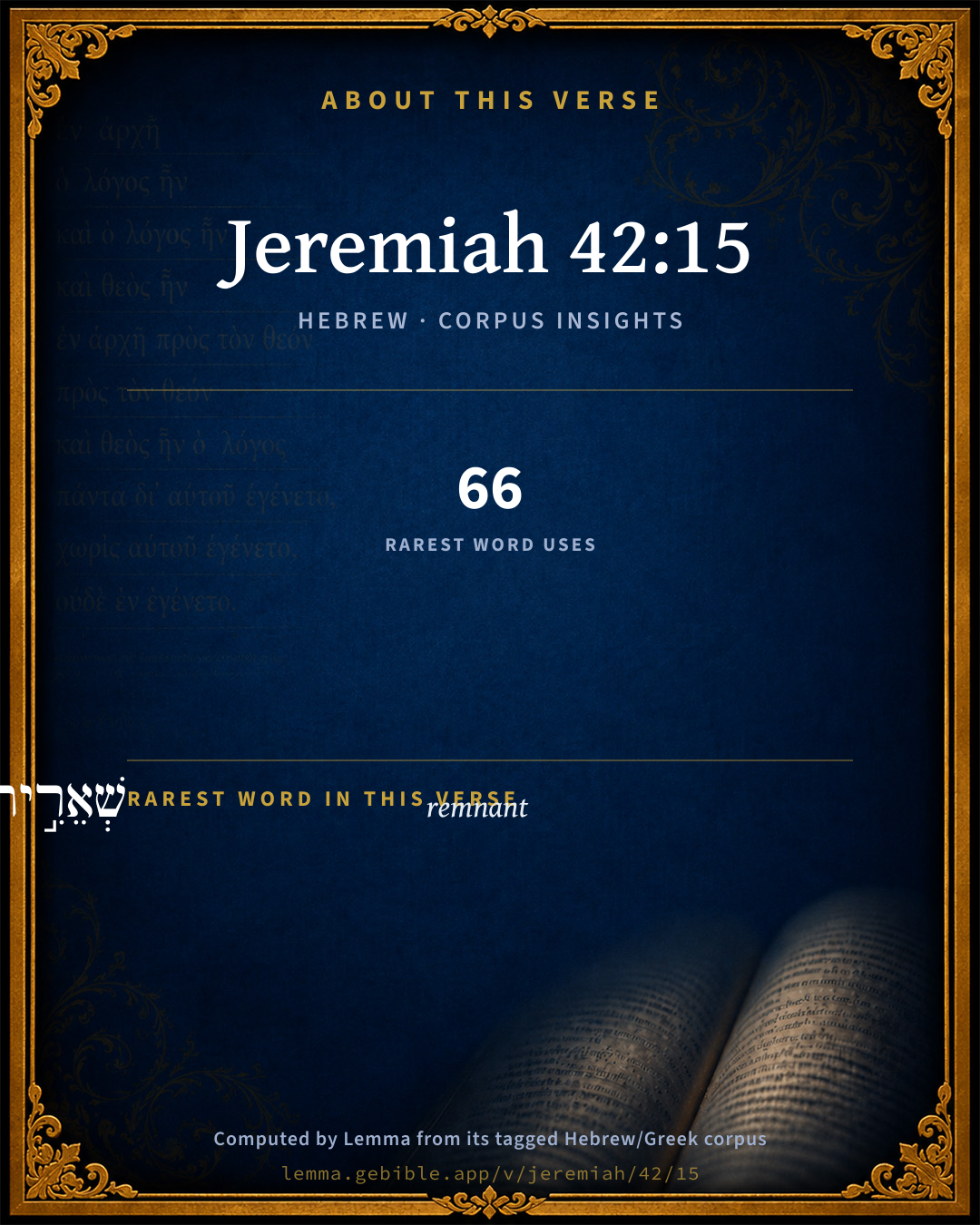
These counts appear in no published source. They are computed here, from the morphology-tagged text and Lemma’s own curated glosses. What Lemma adds →

23
words
20
distinct lemmas
Prophets
section

Grammatical profile

  • 7 verbs
  • 10 nouns
  • 1 pronoun
  • 1 conjunction
  • 4 adverbs

Verb forms

  • שִׁמְע֥וּ Qal · Imperative
  • אָמַר֩ Qal · Perfect
  • שׂ֣וֹם Qal · Infinitive Absolute
  • תְּשִׂמ֤וּן Qal · Imperfect
  • לָבֹ֣א Qal · Infinitive Construct
  • וּבָאתֶ֖ם Qal · Sequential Perfect
  • לָג֥וּר Qal · Infinitive Construct

Repetition

Words recur within this verse — often emphatic in Hebrew:

  • יְהוָ֖ה LORD H3068 ×2
  • שׂ֣וֹם to put H7760 ×2
  • לָבֹ֣א to enter H935 ×2

Cross-references

6

Topical passages linked to Jeremiah 42:15 in the Treasury of Scripture Knowledge — connected by theme and wording, ordered by reader-vote popularity; previews shown in the World English Bible.

  • Deuteronomy 17:16 Only he shall not multiply horses to himself, nor cause the people to return to Egypt, to the end that he may multiply horses; because Yahweh has said to you, You shall henceforth return no more that way.
  • Jeremiah 44:12–14 I will take the remnant of Judah, that have set their faces to go into the land of Egypt to sojourn there, and they shall all be consumed; in the land of Egypt shall they fall; they shall be consumed by the sword and by the famine; they shall die, from the least even to the greatest, by the sword and by the famine; and they shall be an object of horror, [and] an astonishment, and a curse, and a reproach.
  • Jeremiah 42:17 So shall it be with all the men who set their faces to go into Egypt to sojourn there: they shall die by the sword, by the famine, and by the pestilence; and none of them shall remain or escape from the evil that I will bring on them.
  • Genesis 31:21 So he fled with all that he had. He rose up, passed over the River, and set his face toward the mountain of Gilead.
  • Daniel 11:17 He shall set his face to come with the strength of his whole kingdom, and with him equitable conditions; and he shall perform them: and he shall give him the daughter of women, to corrupt her; but she shall not stand, neither be for him.
  • Luke 9:51 It came to pass, when the days were near that he should be taken up, he intently set his face to go to Jerusalem,

Cross-references courtesy of OpenBible.info (CC BY 4.0).

Hebrew and Greek witnesses Masoretic Hebrew ↔ Greek Septuagint

The same verse in the two great witnesses to the Old Testament, shown verse-for-verse.

These are two independent witnesses, not word-aligned to each other, and the Septuagint is shown in lemma (dictionary) form.

Hebrew Jeremiah 42:15 Masoretic · Westminster Leningrad Codex

וְעַתָּ֕ה לָכֵ֛ן שִׁמְע֥וּ דְבַר יְהוָ֖ה שְׁאֵרִ֣ית יְהוּדָ֑ה כֹּֽה אָמַר֩ יְהוָ֨ה צְבָא֜וֹת אֱלֹהֵ֣י יִשְׂרָאֵ֗ל אִם אַ֠תֶּם שׂ֣וֹם תְּשִׂמ֤וּן פְּנֵיכֶם֙ לָבֹ֣א מִצְרַ֔יִם וּבָאתֶ֖ם לָג֥וּר שָֽׁם

now therefore hear you the word of Yahweh, O remnant of Judah: Thus says Yahweh of Hosts, the God of Israel, If you indeed set your faces to enter into Egypt, and go to sojourn there;

World English Bible · Public Domain

Greek LXX Structure differs

In the Septuagint, Jeremiah is about an eighth shorter than the Hebrew and arranges its material differently — the Oracles Against the Nations (Hebrew chapters 46–51) appear in the middle of the Greek book, after 25:13. Because the chapter and verse boundaries do not line up, a verse-for-verse comparison with the Hebrew is not shown.

A verse-for-verse comparison isn’t shown here because the chapters and verses don’t line up. Switch to the LXX edition with the MT / LXX toggle above to read the Greek directly.

Hebrew: Westminster Leningrad Codex (CC BY 4.0). Greek: Septuagint (public domain); English from a public-domain English Septuagint. How the Septuagint differs from the Hebrew →

Targum (Aramaic paraphrase)

1

The Targum is the ancient Jewish Aramaic paraphrase of the Hebrew Scriptures — an interpretive translation, not the Hebrew text itself. Onkelos (literal) and Pseudo-Jonathan (expansive) render the Torah, and Jonathan the Prophets. Coverage is partial: where no permissively-licensed English translation exists for a verse, only the Aramaic is shown. This is verse-level text, not a word-by-word alignment to the Hebrew.

  1. Targum Jonathan Prophets (Joshua–Malachi)
    וּכְעַן בְּכֵן קַבִּילוּ פִּתְגָמָא דַייָ שְׁאָרָא דְבֵית יְהוּדָה כִּדְנַן אֲמַר יְיָ צְבָאוֹת אֱלָהָא דְיִשְׂרָאֵל אִם אַתּוּן שַׁוָאָה תְשַׁווּן אַפֵּיכוֹן לְמֵיעַל לְמִצְרַיִם וְתַעֲלוּן לְאִתּוֹתָבָא תַמָן:

    (no public-domain English translation for this verse)

    Targum Jonathan — Aramaic: “Mikraot Gedolot” (public domain). English: “Sefaria Community Translation” (CC0 1.0 (public-domain dedication)); “London "Chaldee Paraphrase," 1871” (public domain). Text via Sefaria.

Commentary

Notes on Jeremiah 42:15 from classic Christian and Jewish commentators (each source and its license shown beneath its notes). The classic Christian expositions comment on the surrounding passage and are grouped to its opening verse, so a note may address several verses; the Jewish commentaries on the Tanakh (Rashi and others) are per-verse, so they appear only where the commentator wrote on this verse.

Lemma curates 59 commentaries, every one of them public domain or Creative Commons licensed, each selected and text-cleaned for this edition rather than reprinted as found. About our sources →

Trapp's Complete Commentary

John Trapp

Jer 42:15 And now therefore hear the word of the LORD, ye remnant of Judah; Thus saith the LORD of hosts, the God of Israel; If ye wholly set your faces to enter into Egypt, and go to sojourn there;

Ver. 15. If ye wholly set your faces.] As now I see ye do, and shall therefore tell you what to trust unto; with the froward God will wrestle. {Psa 18:26}

John Trapp, A Commentary or Exposition upon All the Books of the Old and New Testament (1647–1656) — public domain. Text from a community e-Sword module.

Jamieson, Fausset & Brown

Robert Jamieson, A. R. Fausset & David Brown

wholly set your faces--firmly resolve (Luk 9:51) in spite of all warnings (Jer 44:12).

Jamieson, Fausset & Brown — Commentary Critical and Explanatory on the Whole Bible (1871) — public domain (CC PDM 1.0). Text via the HelloAO Bible API.

Adam Clarke's Commentary

Verse 15. If ye - set your faces to enter into Egypt, &c.] Every evil that ye dreaded by staying in your own land shall come upon you in Egypt.

Adam Clarke's Commentary on the Bible (1810–1826) — public domain. Text from a community e-Sword/MySword module.

John Calvin's Commentaries

He adds, Hear the word of Jehovah, ye remnant of Judah Jeremiah, by thus addressing them, no doubt endeavored to lead them to obedience. We indeed know that men in prosperity are in a manner inebriated, so that they are not easily induced to obey sound counsels. For whence comes it that kings and princes of the world indulge themselves so much, and allow such license to their lusts? even because the splendor of their fortune inebriates them. So also private men, when all things succeed according to their wishes, they lodge in their own dregs; hence it is that they are difficult to be ruled. The Prophet, on the other hand, shews that there is no reason for them to be proud. Ye are, he says, a small number, and God has wonderfully saved you. Hear, then, ye remnant of Judah In short, they are reminded of their humble and miserable condition, that they might be more teachable. But this also was done without any fruit, as we shall hereafter see.

This saith Jehovah of hosts, the God of Israel Of these words we have spoken elsewhere. God is often called the God of hosts on account of his power: so by this term God sets forth his own greatness. Afterwards when he is said to be the God of Israel, we know that the benefit of adoption was thus brought to the recollection of the people; for God had them especially as his people, and bound them as it were to himself. This ought then to have been a most holy bond of faithfulness and obedience. It was not, then, by way of honor that the Prophet thus spoke, but in order to reprove the Israelites for their hardness and ingratitude towards God. If, he adds, ye set your faces to go into Egypt, and ye enter in there to sojourn, it shall be that the sword which ye fear shall meet you, etc. Here is their punishment described, and there is nothing obscure in the words. God shows that they were greatly deceived, if they thought that they would be prosperous in Egypt; for no prosperity can be hoped except through the favor and blessing of God; and God pronounced a curse on all their perverse counsels when he saw that they would not be restrained by his word. If, then, we attempt anything contrary to the prohibition of God, it must necessarily end unsuccessfully; and why? because the cause of all prosperity is the favor of God, and so his curse always renders all issues sad and unhappy: and however prosperous at first may be what we undertake against God’s will, yet the end will be wretched and miserable, according to what the Prophet teaches here.

John Calvin's Commentaries (1540-1563) — public domain. Text from the Calvin Translation Society English edition (1840s-50s) via the Christian Classics Ethereal Library (ccel.org). Calvin's coverage is partial (roughly two-thirds of the Bible); uncommented books and verses are honest gaps, never fabricated. The 19th-century editor's footnotes and remarks are omitted so the notes are faithfully Calvin's own voice.

John Gill's Exposition

Then it shall come to pass,.... That the various judgments following should come upon them:

that the sword, which ye feared, shall overtake you there in the land of Egypt; that is, the sword; of Nebuchadnezzar king of Babylon, which they feared they should fall by in Judea; this should come after them in Egypt, and there overtake them, as it did; Egypt being destroyed by the king of Babylon, as it was foretold it should, Jer 46:25;

and the famine, whereof you were afraid, shalt follow close after you there in Egypt; the famine they were afraid would come upon them in Judea, should pursue them, overtake them, seize on them, and cleave unto them, in Egypt; thus the evils they thought to escape, by moving from one place, should befall them in another; there is no fleeing from the presence, power, and hand of God:

and there ye shall die; either by the sword, or by famine, or by pestilence, as in the Jer 42:17.

John Gill's Exposition of the Whole Bible (1746–1763) — public domain (CC PDM 1.0). Text via the HelloAO Bible API.

Haydock's Catholic Bible Commentary

Faces; obstinately, ver. 17., and chap. xliv. 12.

George Leo Haydock (1774–1849), Haydock's Catholic Family Bible and Commentary, 1859 edition — public domain. Excludes Psalms (Douay-Rheims chapter numbering differs from Protestant) and Deuterocanonical books (Catholic canon only).

Matthew Poole's English Annotations

This verse is wholly prefatory. to what followeth. If, saith God, all your mind be upon Egypt, and you he resolved thither you will go,

Matthew Poole's English Annotations on the Holy Bible (1683–1685) — public domain. Text from a community e-Sword/MySword module.

The Pulpit Commentary

And now therefore. Omit "and;" the vau simply marks the apodosis of the two previous verses.

The Pulpit Commentary (1880–1919), ed. H.D.M. Spence-Jones & Joseph S. Exell — public domain. Text from a community e-Sword module.

unfoldingWord translationNotes

Door43 World Missions Community

Now

The word "now" does not mean "at this moment," but is used to draw attention to the important point that follows.

to this word of Yahweh

"to Yahweh's message"

Yahweh of hosts ... says this

Jeremiah often uses these words to introduce an important message from Yahweh. See how you translated this in Jeremiah 6:6.

the sword that you fear will overtake you

Here "the sword" represents war. The Israelites experiencing war even if they go to Egypt is spoken of as if the sword would chase after the people catch up with them. AT: "you will experience the terrible results of war" (See: Metonymy and Personification)

The famine that you are worrying about will pursue you to Egypt

The Israelites experiencing famine even in Egypt is spoken of as if famine would chase after them. AT: "You worry about famine in Israel but if you go to Egypt you will suffer from famine there" (See: Personification)

all the men who set out

The men are used to refer to all the people because they are the leaders in their families. AT: "anyone who sets out" (See: Synecdoche and When Masculine Words Include Women)

set out to go to

"depart for" or "leave for"

the disaster that I will bring on them

Causing a disaster is spoken of as if disaster were an object that is brought to a person. AT: "the disaster that I will cause to happen to them" (See: Metaphor)

translationWords

word of God

remnant

kingdom of Judah

Yahweh of hosts

Egypt

sword

famine

die

plague

unfoldingWord translationNotes — © Distant Shores Media and the Door43 World Missions Community, licensed CC BY-SA 4.0. Source: git.door43.org/Door43/en_tn.

Lesson kit

Teaching starters — assembled from the data on this page, not authored interpretation. Every prompt links to the verse data it draws on. Edit before teaching.

Jeremiah, in the Prophets, opens this verse with 23 words (20 distinct Hebrew lemmas). Its most distinctive word is shᵉʼêrîyth (“remnant”). A historical commentator’s framing appears above. Read the whole chapter for the surrounding context.

Discussion questions

  1. What does “remnant” (shᵉʼêrîyth) contribute to the verse as a whole?
  2. How does Deuteronomy 17:16, which shares this passage’s theme, read alongside this verse?
  3. What does the repetition of “LORD” (2× in this one verse) do in this verse?
  4. These translations render this verse differently. What is at stake in choosing one wording over another?
  5. «שִׁמְע֥וּ» is a Qal Imperative verb. How does that grammatical form shape the action described?
  6. Compare how Trapp's Complete Commentary and Jamieson, Fausset & Brown read this verse. Where do they agree or differ?

Things to notice

Reading settings

Reading text

Shown beneath each verse's original-language words.

Old Testament
Old Testament edition

Read the OT as the Masoretic Hebrew (MT) or the Greek Septuagint (LXX).

English shown for the Greek Septuagint (in the Hebrew ↔ Greek comparison).

Comparing translations? Open the Compare panel on any verse page to stack up to four side by side.