
Jeremiah 43:2

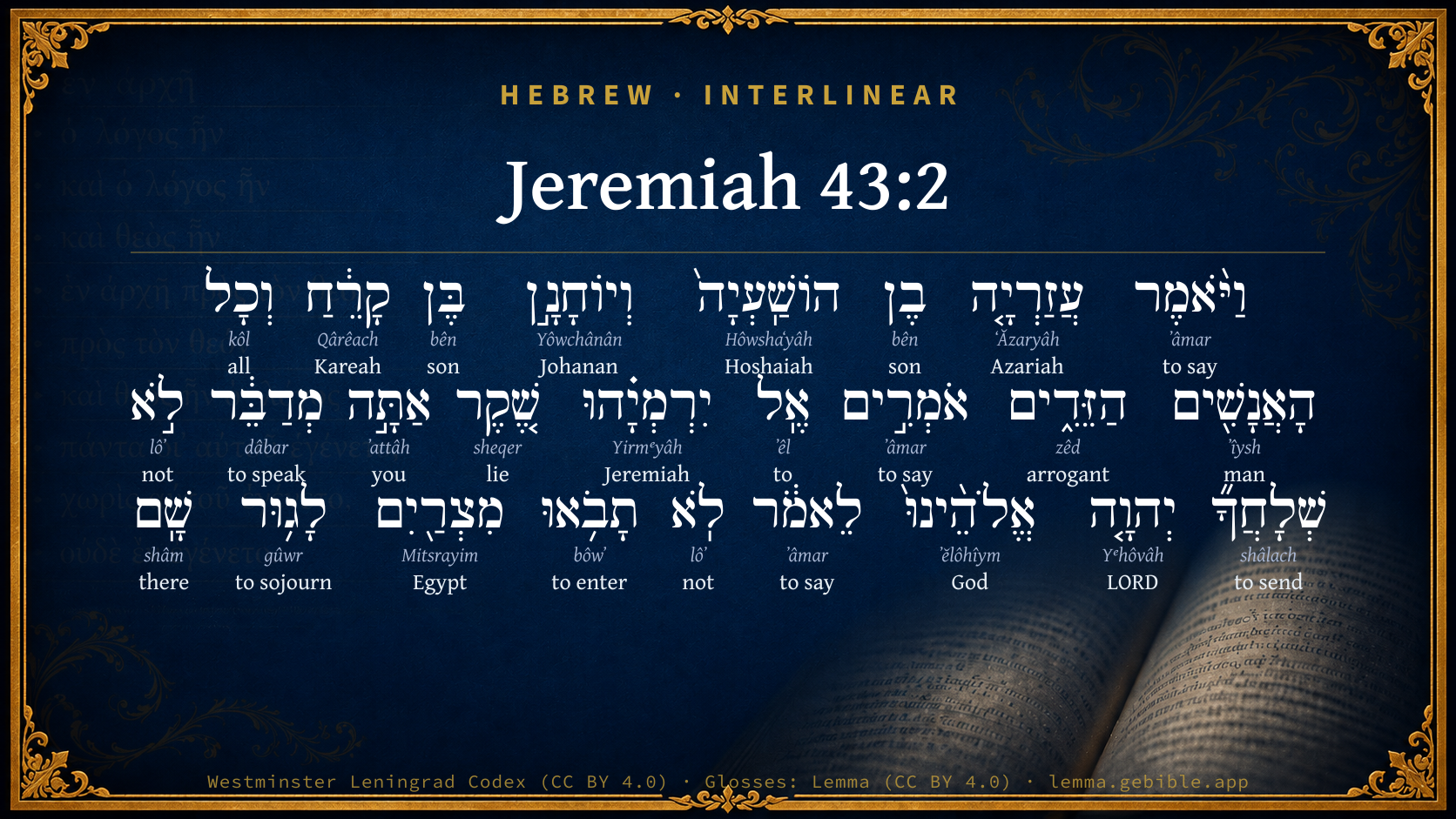
Hebrew (Westminster Leningrad Codex) Jeremiah 43:2 appears in the Hebrew Old Testament. The text above is from the Westminster Leningrad Codex. Each word links to its Strong’s number, a concise gloss, and parsing drawn from the Open Scriptures Hebrew Bible morphology. Click any word for its full Brown-Driver-Briggs (BDB) entry.
Download image
Cite this verse

Jeremiah 43:2 (World English Bible). Public Domain. Lemma interlinear Bible study tool, https://lemma.gebible.app/v/jeremiah/43/2.

Show BibTeX & RIS
BibTeX
RIS
English Translation
then spoke Azariah the son of Hoshaiah, and Johanan the son of Kareah, and all the proud men, saying to Jeremiah, You speak falsely: Yahweh our God has not sent you to say, You shall not go into Egypt to sojourn there;
World English Bible · Public Domain
Download a study sheet

One document with this verse’s original text, its word-by-word gloss line, the meaning frame, cross-references with their text, attributed commentary, and full source and license credits — printable, and it pastes into notes with its structure intact.

This verse Autodidact and up

Study sheet (.html) Plain text (.txt)

A passage Seminary Student

Up to 50 verses in one chapter. A passage sheet keeps up to 6 commentary sources and 12 cross-references per verse, in the order this page ranks them, and says so on the sheet whenever that leaves anything out. Ask for a single verse and you get the Autodidact verse sheet above.

Everything on this page stays free to read, with no account — the sheet is a download of what is already on screen, not access to it.

Want to remove ads? Support Godless Engineer
Compare translations 3

The same verse in 3 English versions, stacked beneath the original-language interlinear above. Click any original word for its lexicon entry.

Each is an independent rendering of the whole verse — the interlinear is not word-aligned to these translations.

Highlighted words mark where these versions differ — a whole-verse word diff, not a word-by-word alignment.

  • World English Bible Public Domain
    then spoke Azariah the son of Hoshaiah, and Johanan the son of Kareah, and all the proud men, saying to Jeremiah, You speak falsely: Yahweh our God has not sent you to say, You shall not go into Egypt to sojourn there;
  • King James Version Public Domain
    Then spake Azariah the son of Hoshaiah, and Johanan the son of Kareah, and all the proud men, saying unto Jeremiah, Thou speakest falsely: the LORD our God hath not sent thee to say, Go not into Egypt to sojourn there:
  • unfoldingWord Literal Text CC BY-SA 4.0
    Azariah son of Hoshaiah, Johanan son of Kareah, and all the arrogant men said to Jeremiah, “You are telling lies. Yahweh our God has not sent you to say, ‘Do not go to Egypt to live there.’

unfoldingWord Literal Text — © unfoldingWord, licensed CC BY-SA 4.0. Word-aligned USFM3 via Door43 (git.door43.org/unfoldingWord/en_ult).

Versions to compare (up to 4)

3 of 4 selected

Show all 18 translations

Every available English version of this verse, each an independent rendering of the whole verse.

  • World English Bible Public Domain
    then spoke Azariah the son of Hoshaiah, and Johanan the son of Kareah, and all the proud men, saying to Jeremiah, You speak falsely: Yahweh our God has not sent you to say, You shall not go into Egypt to sojourn there;
  • Berean Standard Bible Public Domain
    Azariah son of Hoshaiah, Johanan son of Kareah, and all the arrogant men said to Jeremiah, “You are lying! The LORD our God has not sent you to say, ‘You must not go to Egypt to reside there.’
  • Majority Standard Bible Public Domain
    Azariah son of Hoshaiah, Johanan son of Kareah, and all the arrogant men said to Jeremiah, “You are lying! The LORD our God has not sent you to say, ‘You must not go to Egypt to reside there.’
  • King James Version Public Domain
    Then spake Azariah the son of Hoshaiah, and Johanan the son of Kareah, and all the proud men, saying unto Jeremiah, Thou speakest falsely: the LORD our God hath not sent thee to say, Go not into Egypt to sojourn there:
  • American Standard Version (1901) Public Domain
    then spake Azariah the son of Hoshaiah, and Johanan the son of Kareah, and all the proud men, saying unto Jeremiah, Thou speakest falsely: Jehovah our God hath not sent thee to say, Ye shall not go into Egypt to sojourn there;
  • Revised Version (1885) Public Domain
    then spake Azariah the son of Hoshaiah, and Johanan the son of Kareah, and all the proud men, saying unto Jeremiah, Thou speakest falsely: the LORD our God hath not sent thee to say, Ye shall not go into Egypt to sojourn there:
  • Geneva Bible (1599) Public Domain
    Then spake Azariah the sonne of Hoshaiah, and Iohanan the sonne of Kareah, and all the proude men, saying vnto Ieremiah, Thou speakest falsely: the Lord our God hath not sent thee to say, Goe not into Egypt to dwell there,
  • Douay-Rheims (1899) Public Domain
    Azarias the son of Osaias, and Johanan the son of Caree, and all the proud men, made answer, saying to Jeremias: Thou tellest a lie: the Lord our God hath not sent thee, saying: Go not into Egypt, to dwell there.
  • Young's Literal Translation Public Domain
    that Azariah son of Hoshaiah, and Johanan son of Kareah, and all the proud men, speak unto Jeremiah, saying, `Falsehood thou art speaking; Jehovah our God hath not sent thee to say, Do not enter Egypt to sojourn there;
  • Literal Standard Version CC BY-SA 4.0
    that Azariah son of Hoshaiah, and Johanan son of Kareah, and all the proud men, speak to Jeremiah, saying, “You are speaking falsehood; our God YHWH has not sent you to say, Do not enter Egypt to sojourn there;
  • Unlocked Literal Bible CC BY-SA 4.0
    Azariah son of Hoshaiah, Johanan son of Kareah, and all the arrogant men said to Jeremiah, “You are telling lies. Yahweh our God has not sent you to say, 'Do not go to Egypt to live there.'
  • unfoldingWord Literal Text CC BY-SA 4.0
    Azariah son of Hoshaiah, Johanan son of Kareah, and all the arrogant men said to Jeremiah, “You are telling lies. Yahweh our God has not sent you to say, ‘Do not go to Egypt to live there.’
  • Darby Bible Public Domain
    -- then spoke Azariah the son of Hoshaiah, and Johanan the son of Kareah, and all the proud men, saying to Jeremiah, Thou speakest falsely: Jehovah our God hath not sent thee to say, Go not into Egypt to sojourn there;
  • World Messianic Bible Public Domain
    then Azariah the son of Hoshaiah, Yochanan the son of Kareah, and all the proud men spoke, saying to Jeremiah, “You speak falsely. The LORD our God has not sent you to say, ‘You shall not go into Egypt to live there;’
  • Webster's Bible Public Domain
    Then spoke Azariah the son of Hoshaiah, and Johanan the son of Kareah, and all the proud men, saying to Jeremiah, Thou speakest falsely: the LORD our God hath not sent thee to say, Go not into Egypt to sojourn there:
  • Free Bible Version CC BY-SA 4.0
    Azariah son of Hoshaiah, Johanan son of Kareah, and all the proud and rebellious men told Jeremiah, “You're lying! The Lord our God hasn't sent you to tell us, ‘You are not to go and live in Egypt.’
  • Bible in Basic English Public Domain
    Then Azariah, the son of Hoshaiah, and Johanan, the son of Kareah, and all the men of pride, said to Jeremiah, You have said what is false: the Lord our God has not sent you to say, You are not to go into the land of Egypt and make your living-place there:
  • JPS Tanakh (1917) Public Domain
    then spoke Azariah the son of Hoshaiah, and Johanan the son of Kareah, and all the proud men, saying unto Jeremiah: 'Thou speakest falsely; the LORD our God hath not sent thee to say: Ye shall not go into Egypt to sojourn there;

Literal Standard Version (2020), Covenant Press — licensed CC BY-SA 4.0. Text via the HelloAO Bible API (eBible.org). Unlocked Literal Bible (unfoldingWord) — licensed CC BY-SA 4.0. Text via the HelloAO Bible API (eBible.org). unfoldingWord Literal Text — © unfoldingWord, licensed CC BY-SA 4.0. Word-aligned USFM3 via Door43 (git.door43.org/unfoldingWord/en_ult). Free Bible Version, Dr. Jonathan Gallagher — licensed CC BY-SA 4.0. Text via the HelloAO Bible API (eBible.org).

Word by word

More ways to search: Search by grammar → Find every occurrence → Compare this word →

Practice this passage: Drill this verse → Learn its vocabulary →

הוֹשַֽׁעְיָה֙
Hôwshaʻyâh
H1955
“Hoshaiah”
Noun, Proper
Part of Speech
Noun
Type
Proper
Full BDB Definition

Origin: from H3467 and H3050

TWOT: None

Hoshaiah = "Jehovah as saved" - a prince of Judah who assisted in the dedication of the wall of Jerusalem in the time of Nehemiah - the father of Jezaniah (or Azariah) who was a man of note after the destruction of Jerusalem by Nebuchadnezzar in the time of Jeremiah
  1. וַיֹּ֨אמֶר ʼâmar H559 “and · to say” Conjunction + Verb, Qal, Sequential Imperfect, 3rd Person, Masculine, Singular
  2. עֲזַרְיָ֤ה ʻĂzaryâh H5838 “Azariah” Noun, Proper
  3. בֶן bên H1121 “son of” Noun, Common, Masculine, Singular, Construct
  4. וְיוֹחָנָ֣ן Yôwchânân H3110 “and · Johanan” Conjunction + Noun, Proper
  5. בֶּן bên H1121 “son of” Noun, Common, Masculine, Singular, Construct
  6. קָרֵ֔חַ Qârêach H7143 “Kareah” Noun, Proper
  7. וְכָל kôl H3605 “and · all of” Conjunction + Noun, Common, Masculine, Singular, Construct
  8. הָאֲנָשִׁ֖ים ʼîysh H376 “the · men” Particle, Definite Article + Noun, Common, Masculine, Plural, Absolute
  9. הַזֵּדִ֑ים zêd H2086 “the · arrogant” Particle, Definite Article + Adjective, Adjective, Masculine, Plural, Absolute
  10. אֹמְרִ֣ים ʼâmar H559 “saying” Verb, Qal, Participle Active, Masculine, Plural, Absolute
  11. אֶֽל ʼêl H413 “to” Preposition
  12. יִרְמְיָ֗הוּ Yirmᵉyâh H3414 “Jeremiah” Noun, Proper
  13. שֶׁ֚קֶר sheqer H8267 “lie” Noun, Common, Masculine, Singular, Absolute
  14. אַתָּ֣ה ʼattâh H859 “you” Pronoun, Personal, 2nd Person, Masculine, Singular
  15. מְדַבֵּ֔ר dâbar H1696 “speaking” Verb, Piel, Participle Active, Masculine, Singular, Absolute
  16. לֹ֣א lôʼ H3808 “not” Particle, Negative
  17. שְׁלָחֲךָ֞ shâlach H7971 “to send · you” Verb, Qal, Perfect, 3rd Person, Masculine, Singular + Suffix, Personal, 2nd Person, Masculine, Singular
  18. יְהוָ֤ה Yᵉhôvâh H3068 “LORD” Noun, Proper
  19. אֱלֹהֵ֨ינוּ֙ ʼĕlôhîym H430 “God(s) · our” Noun, Common, Masculine, Plural, Construct + Suffix, Personal, 1st Person, Common, Plural
  20. לֵאמֹ֔ר ʼâmar H559 “to say” Preposition + Verb, Qal, Infinitive Construct
  21. לֹֽא lôʼ H3808 “not” Particle, Negative
  22. תָבֹ֥אוּ bôwʼ H935 “to enter” Verb, Qal, Imperfect, 2nd Person, Masculine, Plural
  23. מִצְרַ֖יִם Mitsrayim H4714 “Egypt” Noun, Proper
  24. לָג֥וּר gûwr H1481 “to sojourn” Preposition + Verb, Qal, Infinitive Construct
  25. שָֽׁם shâm H8033 “there” Adverb

About this verse

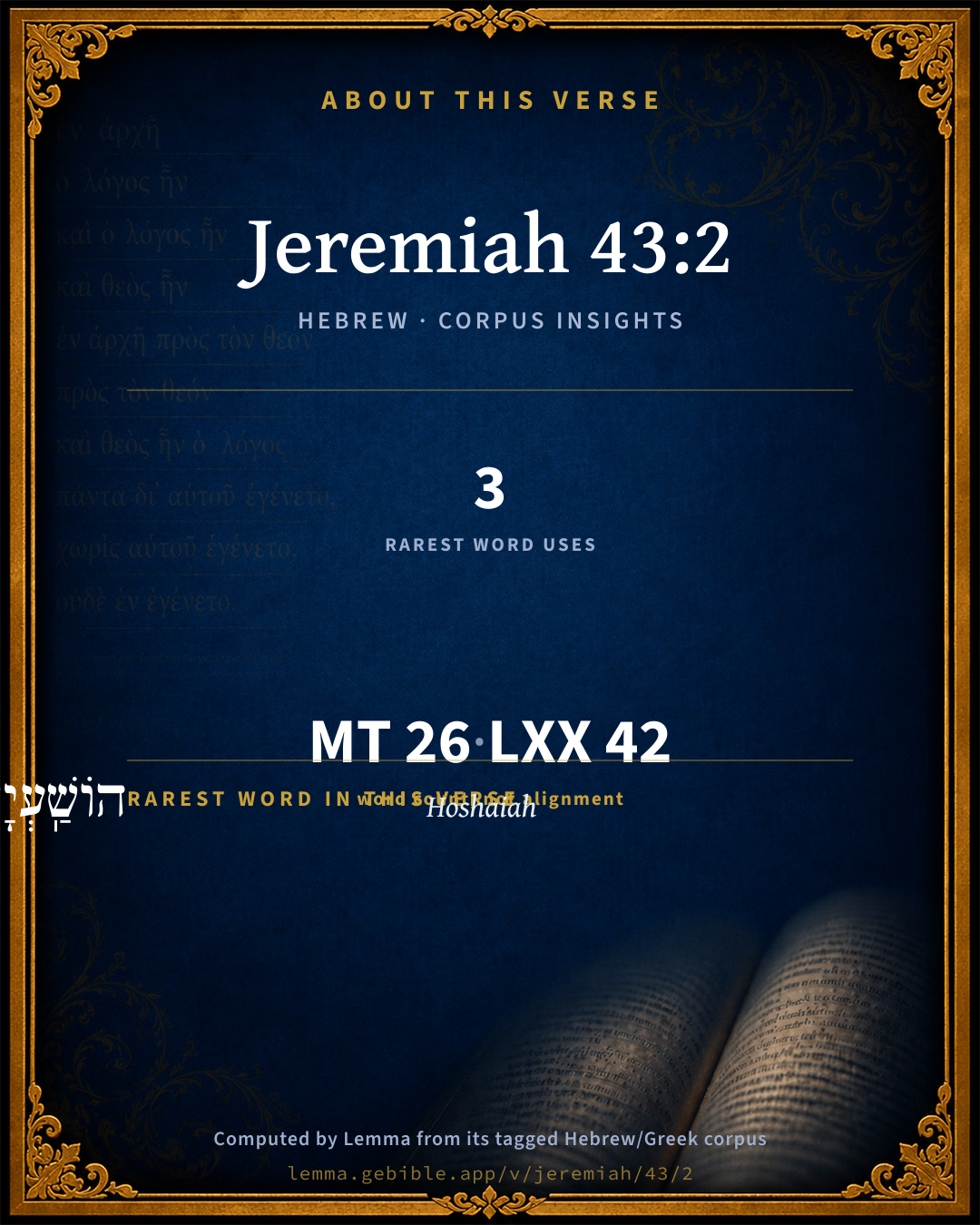
These counts appear in no published source. They are computed here, from the morphology-tagged text and Lemma’s own curated glosses. What Lemma adds →

26
words
22
distinct lemmas
Prophets
section

Notable vocabulary

The rarest word here is הוֹשַֽׁעְיָה֙ Hoshaiah H1955 — appearing just 3 times in the whole Hebrew Bible.

Shared distinctive vocabulary

הוֹשַֽׁעְיָה֙ Hoshaiah H1955 occurs in 3 verses of the Hebrew Bible. Also found in:

Grammatical profile

  • 7 verbs
  • 13 nouns
  • 1 adjective
  • 1 pronoun
  • 1 preposition
  • 1 adverb
  • 2 particles

Verb forms

  • וַיֹּ֨אמֶר Qal · Sequential Imperfect
  • אֹמְרִ֣ים Qal · Participle Active
  • מְדַבֵּ֔ר Piel · Participle Active
  • שְׁלָחֲךָ֞ Qal · Perfect
  • לֵאמֹ֔ר Qal · Infinitive Construct
  • תָבֹ֥אוּ Qal · Imperfect
  • לָג֥וּר Qal · Infinitive Construct

Repetition

Words recur within this verse — often emphatic in Hebrew:

  • וַיֹּ֨אמֶר to say H559 ×3
  • בֶן son H1121 ×2
  • לֹ֣א not H3808 ×2

Hebrew & Septuagint length

In the original languages it is 26 Hebrew tokens and 42 Greek tokens — but the two are counted differently (Hebrew bundles its prefixes and suffixes into one token; the Greek is in lemma form), so that isn’t a like-for-like length.

Cross-references

24

Topical passages linked to Jeremiah 43:2 in the Treasury of Scripture Knowledge — connected by theme and wording, ordered by reader-vote popularity; previews shown in the World English Bible.

  • 2 Chronicles 36:13 He also rebelled against king Nebuchadnezzar, who had made him swear by God: but he stiffened his neck, and hardened his heart against turning to Yahweh, the God of Israel.
  • Isaiah 7:9 and the head of Ephraim is Samaria, and the head of Samaria is Remaliah's son. If you will not believe, surely you shall not be established.'"
  • Proverbs 16:5 Everyone who is proud in heart is an abomination to Yahweh: They shall assuredly not be unpunished.
  • Proverbs 16:18–19 Pride goes before destruction, And a haughty spirit before a fall.
  • Jeremiah 5:12–13 They have denied Yahweh, and said, It is not he; neither shall evil come on us; neither shall we see sword nor famine:
  • Jeremiah 13:15 Hear you, and give ear; don't be proud; for Yahweh has spoken.
  • Jeremiah 40:8 then they came to Gedaliah to Mizpah, [to wit], Ishmael the son of Nethaniah, and Johanan and Jonathan the sons of Kareah, and Seraiah the son of Tanhumeth, and the sons of Ephai the Netophathite, and Jezaniah the son of the Maacathite, they and their men.
  • Jeremiah 42:1 Then all the captains of the forces, and Johanan the son of Kareah, and Jezaniah the son of Hoshaiah, and all the people from the least even to the greatest, came near,
  • Jeremiah 43:1 It happened that, when Jeremiah had made an end of speaking to all the people all the words of Yahweh their God, with which Yahweh their God had sent him to them, even all these words,
  • Habakkuk 2:4–5 Behold, his soul is puffed up. It is not upright in him, but the righteous will live by his faith.
  • James 4:6 But he gives more grace. Therefore it says, "God resists the proud, but gives grace to the humble."
  • 1 Peter 5:5 Likewise, you younger ones, be subject to the elder. Yes, all of you gird yourselves with humility, to subject yourselves to one another; for "God resists the proud, but gives grace to the humble."
  • Exodus 5:2 Pharaoh said, "Who is Yahweh, that I should listen to his voice to let Israel go? I don't know Yahweh, and moreover I will not let Israel go."
  • Exodus 9:17 as you still exalt yourself against my people, that you won't let them go.
  • Psalms 10:4–5 The wicked, in the pride of his face, Has no room in his thoughts for God.
  • Psalms 12:3 May Yahweh cut off all flattering lips, And the tongue that boasts,
  • Psalms 119:21 You have rebuked the proud who are cursed, Who wander from your commandments.
  • Psalms 123:4 Our soul is exceedingly filled with the scoffing of those who are at ease, With the contempt of the proud.
  • Proverbs 6:17 Haughty eyes, a lying tongue, Hands that shed innocent blood;
  • Proverbs 8:13 The fear of Yahweh is to hate evil. I hate pride, arrogance, the evil way, and the perverse mouth.
  • Proverbs 30:9 Lest I be full, deny you, and say, 'Who is Yahweh?' Or lest I be poor, and steal, And so dishonor the name of my God.
  • Jeremiah 40:13–16 Moreover Johanan the son of Kareah, and all the captains of the forces who were in the fields, came to Gedaliah to Mizpah,
  • Jeremiah 41:16 Then took Johanan the son of Kareah, and all the captains of the forces who were with him, all the remnant of the people whom he had recovered from Ishmael the son of Nethaniah, from Mizpah, after that he had killed Gedaliah the son of Ahikam, [to wit], the men of war, and the women, and the children, and the eunuchs, whom he had brought back from Gibeon:
  • Isaiah 9:9–10 All the people shall know, [even] Ephraim and the inhabitant of Samaria, who say in pride and in arrogance of heart,

Cross-references courtesy of OpenBible.info (CC BY 4.0).

Hebrew and Greek witnesses Masoretic Hebrew ↔ Greek Septuagint

The same verse in the two great witnesses to the Old Testament, shown verse-for-verse.

These are two independent witnesses, not word-aligned to each other, and the Septuagint is shown in lemma (dictionary) form.

Hebrew Jeremiah 43:2 Masoretic · Westminster Leningrad Codex

וַיֹּ֨אמֶר עֲזַרְיָ֤ה בֶן הוֹשַֽׁעְיָה֙ וְיוֹחָנָ֣ן בֶּן קָרֵ֔חַ וְכָל הָאֲנָשִׁ֖ים הַזֵּדִ֑ים אֹמְרִ֣ים אֶֽל יִרְמְיָ֗הוּ שֶׁ֚קֶר אַתָּ֣ה מְדַבֵּ֔ר לֹ֣א שְׁלָחֲךָ֞ יְהוָ֤ה אֱלֹהֵ֨ינוּ֙ לֵאמֹ֔ר לֹֽא תָבֹ֥אוּ מִצְרַ֖יִם לָג֥וּר שָֽׁם

then spoke Azariah the son of Hoshaiah, and Johanan the son of Kareah, and all the proud men, saying to Jeremiah, You speak falsely: Yahweh our God has not sent you to say, You shall not go into Egypt to sojourn there;

World English Bible · Public Domain

Greek LXX Structure differs

In the Septuagint, Jeremiah is about an eighth shorter than the Hebrew and arranges its material differently — the Oracles Against the Nations (Hebrew chapters 46–51) appear in the middle of the Greek book, after 25:13. Because the chapter and verse boundaries do not line up, a verse-for-verse comparison with the Hebrew is not shown.

A verse-for-verse comparison isn’t shown here because the chapters and verses don’t line up. Switch to the LXX edition with the MT / LXX toggle above to read the Greek directly.

On this verse, Ellicott's Commentary for English Readers discusses the Septuagint’s reading. Read the note in Commentary ↓

Hebrew: Westminster Leningrad Codex (CC BY 4.0). Greek: Septuagint (public domain); English from a public-domain English Septuagint. How the Septuagint differs from the Hebrew →

Targum (Aramaic paraphrase)

1

The Targum is the ancient Jewish Aramaic paraphrase of the Hebrew Scriptures — an interpretive translation, not the Hebrew text itself. Onkelos (literal) and Pseudo-Jonathan (expansive) render the Torah, and Jonathan the Prophets. Coverage is partial: where no permissively-licensed English translation exists for a verse, only the Aramaic is shown. This is verse-level text, not a word-by-word alignment to the Hebrew.

  1. Targum Jonathan Prophets (Joshua–Malachi)
    וַאֲמַר עֲזַרְיָה בַר הוֹשַׁעְיָה וְיוֹחָנָן בַּר קָרֵחַ וְכָל גַבְרַיָא רַשִׁיעַיָא אָמְרִין לְיִרְמְיָה שַׁקְרָא אַתְּ מִתְנַבֵי לָא שַׁלְחָךְ יְיָ אֱלָהָנָא לְמֵימָר לָא תַעֲלוּן לְמִצְרַיִם לְאִתּוֹתָבָא תַמָן:

    (no public-domain English translation for this verse)

    Targum Jonathan — Aramaic: “Mikraot Gedolot” (public domain). English: “Sefaria Community Translation” (CC0 1.0 (public-domain dedication)); “London "Chaldee Paraphrase," 1871” (public domain). Text via Sefaria.

Commentary

Notes on Jeremiah 43:2 from classic Christian and Jewish commentators (each source and its license shown beneath its notes). The classic Christian expositions comment on the surrounding passage and are grouped to its opening verse, so a note may address several verses; the Jewish commentaries on the Tanakh (Rashi and others) are per-verse, so they appear only where the commentator wrote on this verse.

Lemma curates 59 commentaries, every one of them public domain or Creative Commons licensed, each selected and text-cleaned for this edition rather than reprinted as found. About our sources →

Trapp's Complete Commentary

John Trapp

Jer 43:2 Then spake Azariah the son of Hoshaiah, and Johanan the son of Kareah, and all the proud men, saying unto Jeremiah, Thou speakest falsely: the LORD our God hath not sent thee to say, Go not into Egypt to sojourn there:

Ver. 2. Then spake Azariah.] See on Jer 42:1.

And all the proud men.] Pride is the root of rebellion. See Jer 13:15. These men’s pride budded, {as Eze 7:10} and as the leprosy, brake forth in their foreheads. See Hos 7:1. {See Trapp on "Hos 7:1"}

Saying unto Jeremiah, Thou speakest falsely.] By this foul aspersion, not proven at all, they seek to discredit his prophecy, like as the Jews do to this day the New Testament, and the Papists the Book of Martyrs and other monuments of the Church, saying of them, So many lines, so many lies.

John Trapp, A Commentary or Exposition upon All the Books of the Old and New Testament (1647–1656) — public domain. Text from a community e-Sword module.

Joseph Benson's Commentary

Jer 43:2-3. Then spake Azariah, the son of Hoshaiah — Called Jazaniah, Jer 42:1. We may observe many like instances in the books of Kings and Chronicles, of the same persons being called by two different names. And all the proud men — They who refused to obey Almighty God when his commands crossed their own inclinations. Saying unto Jeremiah, The Lord hath not spoken by thee — The constant method of hypocrites and infidels, who pretend they are not satisfied of the truth of divine revelation, when the true cause of their unbelief is, that God’s commands contradict their own lusts and appetites. But Baruch the son of Neriah setteth thee on against us — They would not directly accuse Jeremiah of partiality toward, or confederacy with the Chaldeans, as his enemies had done formerly, (Jer 37:13,) but they lay the blame upon Baruch, whom they knew to be an intimate companion of Jeremiah’s, and to have been kindly used by the Chaldeans upon Jeremiah’s account. — Lowth.

Joseph Benson's Commentary on the Old and New Testaments (1811–1818) — public domain. Text from a community e-Sword module.

Geneva Bible (1599)

Geneva Bible translators

Who was also called Jezaniah, Jer. 42:1.

This declareth that pride is the cause of rebellion: and contempt of God’s ministers.

When the hypocrisy of the wicked is discovered, they burst forth into open rage: for they can abide nothing but flattery, read Isa. 30:10.

He showeth what is the nature of the hypocrites: to wit, to feign that they would obey God and embrace his word, if they were assured that his messenger spake the truth: though indeed they be most far from all obedience.

Geneva Bible (1599) marginal notes — public domain. Text via Bolls.life.

Adam Clarke's Commentary

Verse 2. Thou speakest falsely] They had no other colour for their rebellion than flatly to deny that God had spoken what the prophet related.

Adam Clarke's Commentary on the Bible (1810–1826) — public domain. Text from a community e-Sword/MySword module.

John Calvin's Commentaries

Now he says, that when he had finished speaking to the whole people, as God had commanded, then John the son of Kareah, and Azariah the son of Hoshaiah, being the first among them, spoke against him. As to Azariah, we cannot know with any certainty what he was. But we have here in John the son of Kareah an example deserving of notice. We have seen that he was a bold, wise, and prudent man, and also of an upright mind. In short, when we consider what the Prophet has before said of him, we cannot but think he was by nature a heroic man; nay, when he is compared with Gedaliah, who, at the same time, was an excellent man, and whom the Prophet has adorned with high commendations, he yet far excelled him. Gedaliah, indeed, had a kind disposition, he was courageous in protecting the people, he was a man of integrity; and, besides, he was a father to the people, and so conducted himself when things were in a hopeless state, that, beyond the expectation of all, he gathered together the remnant of the people; and we have also seen that by his efforts the Prophet had been delivered from instant death. But John the son of Kareah had been a remarkable helper to him, having come to him of his own accord, and offered to him his assistance; and further, he faithfully and prudently warned him to beware of the perfidy of that unprincipled man, by whom he was afterwards killed. Gedaliah fell through extreme credulity. John, then, the son of Kareah, had a greater appearance of excellency than Gedaliah had exhibited. But what does the Spirit of God now declare respecting him and his associates? They are said to have been proud and obstinate. We hence see that some men excel in greatness of mind, and are yet of a refractory disposition; and this is for the most part the case during’ a disturbed state of things. For some come forth wonderfully courageous; but when things do not fall in with their wishes, they become ferocious and rebel against God and men, and besides, they will never bear to be brought under submission. Such, then, was John the son of Kareah: at one time he manifested extraordinary virtue, but at length it appeared what he really was.

The Prophet, with the authority of a judge, declares that he and his associates were proud: then Azariah the son of Hoshaiah, and John the son of Kareah, and all the proud men, said, A falsehood dost thou speak. This was extremely insolent and reproachful; for they had lately testified that they regarded Jeremiah as God’s faithful servant, and that they would receive whatever he might bring as God’s true oracle; but now they charge him with falsehood! how great was this presumption! But it hence appears how deep and various, and how tortuous are the recesses which are in the hearts of men; for at one time they announce honied words, and afterwards they utter nothing’ but virulence. So from the same mouth, as it were, almost in the same moment, comes forth what is sweet; and what is bitter.

Let us hence learn that the heart of man is full of every kind of deceit, until it be cleansed by the Spirit of God. We also see, when once impiety boils up, to what extremes it will proceed; for these men were not only insolent and reproachful towards Jeremiah, but also towards God himself. And they did not now make evasions as before, nor did they raise objections; but they openly raved against the Prophet. Thus hypocrisy has indeed for a time its coverings, but when the ungodly are urged by God, then they observe no bounds: Thou speakest what is false

John Calvin's Commentaries (1540-1563) — public domain. Text from the Calvin Translation Society English edition (1840s-50s) via the Christian Classics Ethereal Library (ccel.org). Calvin's coverage is partial (roughly two-thirds of the Bible); uncommented books and verses are honest gaps, never fabricated. The 19th-century editor's footnotes and remarks are omitted so the notes are faithfully Calvin's own voice.

Ellicott's Commentary for English Readers

XLIII.

(2) Azariah the son of Hoshaiah.—The LXX., it will be remembered, gives this name in Jer_42:1, where the Hebrew has Jezaniah. Possibly, however, as suggested above, the two names represent brothers who were both prominent as leaders of the people. Here, we may note, he takes precedence of Johanan, probably as the chief spokesman of the prevailing discontent. The special mention of “all the proud men” suggests the thought that there were some who, left to themselves, would have been willing to follow the prophet’s counsel. Those who join in the protest content themselves with a flat denial of his inspiration, and charge him, as he had been charged before (Jer_37:13), with sinister intentions. It is suggestive, in connexion with the view taken in the Note on Jer_42:17, that the LXX., following apparently a different reading of the Hebrew, gives “all the aliens” instead of “all the proud.”

A Bible Commentary for English Readers, edited by Charles John Ellicott (1878–1897) — public domain. Text from a community e-Sword module.

John Gill's Exposition

Then spake Azariah the son of Hoshaiah,.... Perhaps the same with Jezaniah, or a brother of his, Jer 42:1; he is mentioned first, it may be, because he was the contriver of this scheme to go into Egypt, advised unto it, and was most for it it. The Septuagint and Arabic versions call him the son of Maaseiah;

and Johanan the son of Kareah, and all the proud men; the great men among them, who are commonly proud of their greatness; of their descent, family and blood; of their wealth and riches, and posts of honour; perhaps the captains of the forces are meant, who elsewhere are mentioned along with Johanan, Jer 40:13; these were men full of themselves, had a high opinion of their own wisdom, and were prudent in their own eyes; and could not bear to be contradicted or advised by the prophet, nor even by the Lord himself; and are justly, by the Targum, called wicked men; and so the Syriac version renders it; their pride was the cause of their rebellion against God, and disobedience to him, and of their ungenteel and insolent behaviour to the prophet

saying unto Jeremiah, thou speakest falsely: or, "a lie" (e); it being contrary to their minds: so the prophets of the Lord, the ministers of the word, and even the word of God itself, are charged with falsehoods, when contrary to men's sentiments and lusts;

the Lord our God hath not sent thee to say, go not into Egypt to sojourn there; they did not care to own it was the word of the Lord, Whatever convictions of it they had in their minds; because they would not openly appear to be fighters against God, whom they professed to be their God; but deny that the prophet was sent by him with any such message to them; when they had all the reason to believe by former prophecies, which had had their fulfilment, that Jeremiah was a true prophet of the Lord, and that he had acted a very faithful part in the present affair: they themselves had sent him to the Lord to pray for them; he had done so, and the Lord had returned an answer by him; of which they had no reason to doubt, but their pride would not allow them to receive it.

(e) "mendacium", Schmidt.

John Gill's Exposition of the Whole Bible (1746–1763) — public domain (CC PDM 1.0). Text via the HelloAO Bible API.

Haydock's Catholic Bible Commentary

Proud and headstrong. (Calmet) --- Sinful people easily become worse. They are guilty of calumny, and comply not with their promise, chap. xlii. 5. (Worthington)

George Leo Haydock (1774–1849), Haydock's Catholic Family Bible and Commentary, 1859 edition — public domain. Excludes Psalms (Douay-Rheims chapter numbering differs from Protestant) and Deuterocanonical books (Catholic canon only).

Matthew Poole's English Annotations

Of

Johanan we have before heard, but not of

Azariah, unless under the name of Jezaniah, Jer 42:1, but that is uncertain. These men are called proud men, either because they were the great men, or because their conceit of themselves led them into this fatal error. Pride is nothing else but a man’s mind swelling in an opinion of himself, and always takes its rise from some higher ground the person possessed of it thinks he stands upon, and a very little hillock will serve the turn; those who have nothing else of pretence will make a silk coat or a piece of silver lace serve their turn. One man’s spirit swells upon account of his descent, another upon account of his riches, a third upon the account of his learning, parts, and wit, a fourth upon the account of his or her beauty. These men are called

proud men, possibly upon account of their greatness, they were captains, and the chief of the Jews now left; but chiefly upon account of the good opinion they had of their own reason and wit, by which they judged they knew better how to guide themselves for their own security than Jeremiah could teach them; which pride or good opinion men have of themselves is a great root of disobedience: all men sin either through passion or pride, or both, either to gratify their sensitive appetite, or their rational appetite, as it is in man since the fall.

Because it had been downright atheism, and a disclaiming of God, to have said they knew better what to do than God could tell them, they only tell the prophet God had not sent him. As in these times hypocrites, whose lusts will not allow them to do the will of God, think to secure themselves by denying that to be the will of God, and finding out other senses to put upon Scripture than are according to truth.

Matthew Poole's English Annotations on the Holy Bible (1683–1685) — public domain. Text from a community e-Sword/MySword module.

Whedon's Commentary on the Bible

Daniel D. Whedon

THE JOURNEY TO EGYPT, Jer_43:1-7.

2. Azariah — See note on Jer_42:1. Possibly the change in the order of the names of Johanan and Azariah or Jezaniah indicates that the latter was the leader in this opposition against the prophet. Johanan now comes before us in a new light. Before we knew him as the friend of Gedaliah and the avenger of his death, but now the opposer and persecutor of Jeremiah.

Daniel D. Whedon (gen. ed.), Commentary on the Old and New Testaments (1874–1909) — public domain. Text from a community e-Sword module.

The Pulpit Commentary

All the proud men. It would seem as if the "proud men" were distinguished from others. Jeremiah had called the whole people together; (Jer_42:8) but a few domineering men assumed to represent the rest.

Ver. 2. Moral causes of unbelief.

The causes of unbelief may be either intellectual or moral. It is not just to assume that they are of the latter character. There is an honest doubt, and many a brave soul has been forced to fight its way over a wild desert of difficulties before seeing the light of Divine revelation. Nevertheless, it is necessary for our own warning and in controversy with others to remember that there are moral causes for unbelief, and that in some cases these may be much more operative than any purely intellectual consideration. Azariah and his friends have discovered no good ground for doubting the Divine authority of Jeremiah"s message. They have seen nothing to detract from the claims of the prophet and nothing to contradict what he says. Yet they reject his message and charge him with falsehood. The palpable explanation of their conduct may serve to explain the ground of much unbelief in our own day. In the main this consists in two things.

I THE UNPOPULARITY OF THE DOCTRINE. Jeremiah had run counter to the determination of the leaders of the people. Instead of modifying their conduct in obedience to the Divine message, they preferred to reject the message and deny its authority. This was most irrational, Yet it is a sample of the commonest conduct. People test their creed by their will instead of their reason and conscience and its own evidences. They say they do not like certain ideas, as though truth were a matter of taste. But truth is the statement of facts, and facts are not altered by sentiments. In the present instance the question was as to God"s will. Was it not possible from the first that this might contradict the opinions of the people? Otherwise what was the use of the prayer for direction, that these very men had asked Jeremiah to offer, and the reply to which was his unpopular message? If God"s will and truth always agreed with our private notions, what would be the good of revelation and commandment? It is in the conflict of the two that the chief value of the Divine message is to be found.

II THE PRIDE OF MAN. We are expressly told that they were "proud men" who rejected the prophet"s message. The rest of the people seem to have been willing to acquiesce in it. There is nothing so blinding as pride. Your proud man is an inevitable bigot. By undue assurance of knowledge he closes the avenues of fresh knowledge and limits his own possession of it. Thus pride cuts away the ground beneath its own feet.

The Pulpit Commentary (1880–1919), ed. H.D.M. Spence-Jones & Joseph S. Exell — public domain. Text from a community e-Sword module.

Lesson kit

Teaching starters — assembled from the data on this page, not authored interpretation. Every prompt links to the verse data it draws on. Edit before teaching.

Jeremiah, in the Prophets, opens this verse with 26 words (22 distinct Hebrew lemmas). Its most distinctive word is Hôwshaʻyâh (“Hoshaiah”). A historical commentator’s framing appears above. Read the whole chapter for the surrounding context.

Discussion questions

  1. How does “Hoshaiah” (Hôwshaʻyâh) shape what this verse is saying?
  2. Nehemiah 12:32 shares the word «Hoshaiah» with this verse. How do the two illuminate each other?
  3. “to say” occurs 3× in this one verse. What is the effect of the repetition?
  4. The translations on this page render this verse differently — a whole-verse word diff, not a word-by-word alignment. What might account for the different wordings?
  5. The verb «וַיֹּ֨אמֶר» is Qal Sequential Imperfect. How does its form color the action?
  6. Reading how Trapp's Complete Commentary and Joseph Benson's Commentary read this verse, where do the two commentators agree and where do they part?

Things to notice

Reading settings

Reading text

Shown beneath each verse's original-language words.

Old Testament
Old Testament edition

Read the OT as the Masoretic Hebrew (MT) or the Greek Septuagint (LXX).

English shown for the Greek Septuagint (in the Hebrew ↔ Greek comparison).

Comparing translations? Open the Compare panel on any verse page to stack up to four side by side.