Ezekiel 30:16

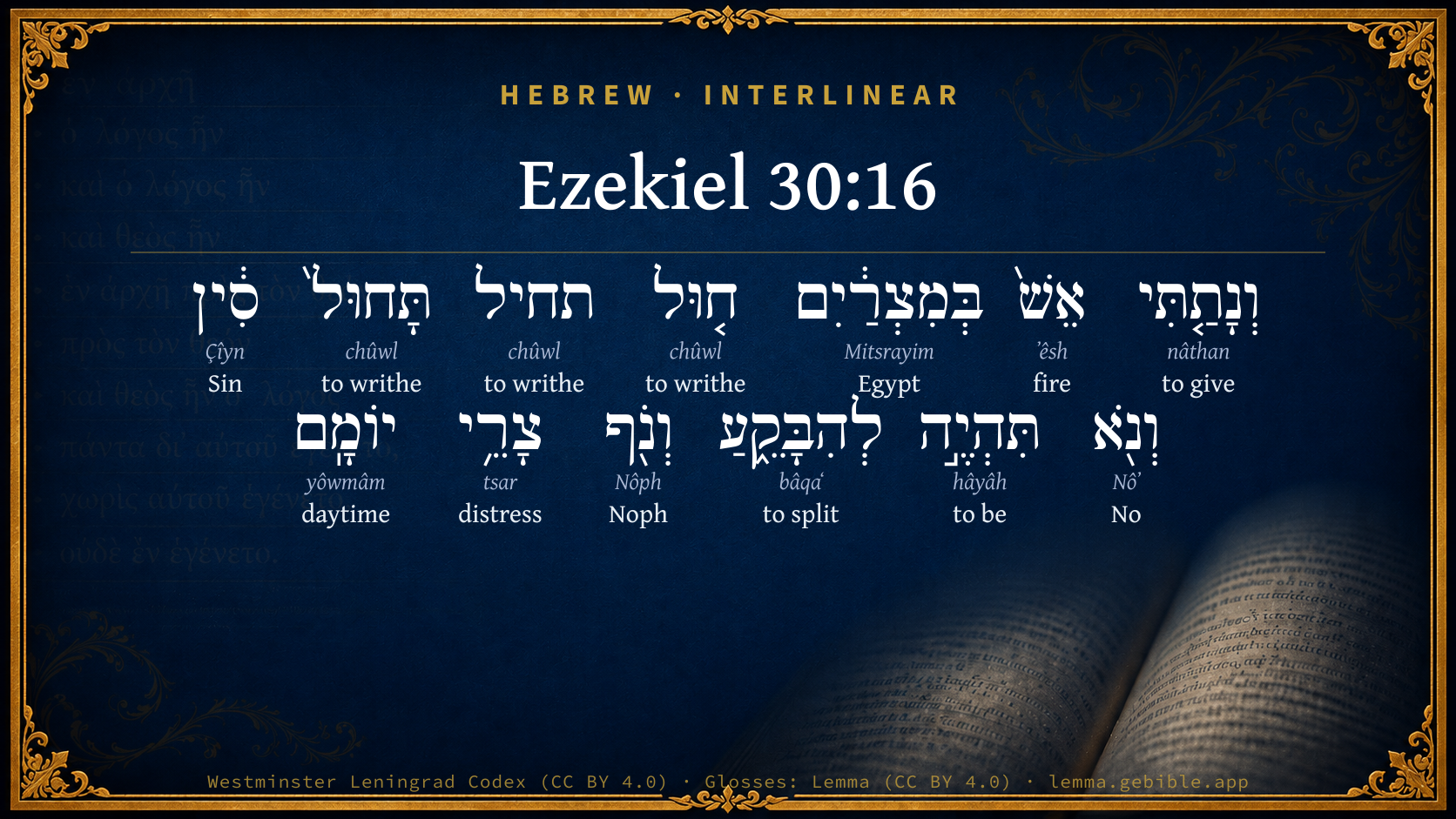
Hebrew (Westminster Leningrad Codex) Ezekiel 30:16 appears in the Hebrew Old Testament. The text above is from the Westminster Leningrad Codex. Each word links to its Strong’s number, a concise gloss, and parsing drawn from the Open Scriptures Hebrew Bible morphology. Click any word for its full Brown-Driver-Briggs (BDB) entry.
Download image
Cite this verse

Ezekiel 30:16 (World English Bible). Public Domain. Lemma interlinear Bible study tool, https://lemma.gebible.app/v/ezekiel/30/16.

Show BibTeX & RIS
BibTeX
RIS
English Translation
I will set a fire in Egypt: Sin shall be in great anguish, and No shall be broken up; and Memphis [shall have] adversaries in the day-time.
World English Bible · Public Domain
Download a study sheet

One document with this verse’s original text, its word-by-word gloss line, the meaning frame, cross-references with their text, attributed commentary, and full source and license credits — printable, and it pastes into notes with its structure intact.

This verse Autodidact and up

Study sheet (.html) Plain text (.txt)

A passage Seminary Student

Up to 50 verses in one chapter. A passage sheet keeps up to 6 commentary sources and 12 cross-references per verse, in the order this page ranks them, and says so on the sheet whenever that leaves anything out. Ask for a single verse and you get the Autodidact verse sheet above.

Everything on this page stays free to read, with no account — the sheet is a download of what is already on screen, not access to it.

Want to remove ads? Support Godless Engineer
Compare translations 3

The same verse in 3 English versions, stacked beneath the original-language interlinear above. Click any original word for its lexicon entry.

Each is an independent rendering of the whole verse — the interlinear is not word-aligned to these translations.

Highlighted words mark where these versions differ — a whole-verse word diff, not a word-by-word alignment.

  • World English Bible Public Domain
    I will set a fire in Egypt: Sin shall be in great anguish, and No shall be broken up; and Memphis [shall have] adversaries in the day-time.
  • King James Version Public Domain
    And I will set fire in Egypt: Sin shall have great pain, and No shall be rent asunder, and Noph shall have distresses daily.
  • unfoldingWord Literal Text CC BY-SA 4.0
    Then I will set fire in Egypt; Pelusium will be in great agony, Thebes will be broken up, and Memphis will face enemies every day.

unfoldingWord Literal Text — © unfoldingWord, licensed CC BY-SA 4.0. Word-aligned USFM3 via Door43 (git.door43.org/unfoldingWord/en_ult).

Versions to compare (up to 4)

3 of 4 selected

Show all 18 translations

Every available English version of this verse, each an independent rendering of the whole verse.

  • World English Bible Public Domain
    I will set a fire in Egypt: Sin shall be in great anguish, and No shall be broken up; and Memphis [shall have] adversaries in the day-time.
  • Berean Standard Bible Public Domain
    I will set fire to Egypt, Pelusium will writhe in anguish, Thebes will be split open, and Memphis will face daily distress.
  • Majority Standard Bible Public Domain
    I will set fire to Egypt, Pelusium will writhe in anguish, Thebes will be split open, and Memphis will face daily distress.
  • King James Version Public Domain
    And I will set fire in Egypt: Sin shall have great pain, and No shall be rent asunder, and Noph shall have distresses daily.
  • American Standard Version (1901) Public Domain
    And I will set a fire in Egypt: Sin shall be in great anguish, and No shall be broken up; and Memphis `shall have' adversaries in the day-time.
  • Revised Version (1885) Public Domain
    And I will set a fire in Egypt; Sin shall be in great anguish, and No shall be broken up: and Noph shall have adversaries in the day time.
  • Geneva Bible (1599) Public Domain
    And I will set fire in Egypt: Sin shall haue great sorowe and No shalbe destroyed, and Noph shall haue sorowes dayly.
  • Douay-Rheims (1899) Public Domain
    And I will make a fire in Egypt: Pelusium shall be in pain like a woman in labour, and Alexandria shall be laid waste, and in Memphis there shall be daily distresses.
  • Young's Literal Translation Public Domain
    And I have given fire against Egypt, Greatly pained is Sin, and No is to be rent, And Noph hath daily distresses.
  • Literal Standard Version CC BY-SA 4.0
    And I have given fire against Egypt, || Sin is greatly pained, and No is to be broken, || And Noph has daily distresses.
  • Unlocked Literal Bible CC BY-SA 4.0
    Then I will set fire in Egypt; Pelusium will be in great agony, Thebes will be broken up, and Memphis will face enemies every day.
  • unfoldingWord Literal Text CC BY-SA 4.0
    Then I will set fire in Egypt; Pelusium will be in great agony, Thebes will be broken up, and Memphis will face enemies every day.
  • Darby Bible Public Domain
    And I will set a fire in Egypt: Sin shall be in great anguish, and No shall be rent asunder, and at Noph [there shall be] enemies in open day.
  • World Messianic Bible Public Domain
    I will set a fire in Egypt Sin will be in great anguish. No will be broken up. Memphis will have adversaries in the daytime.
  • Webster's Bible Public Domain
    And I will set fire in Egypt: Sin shall have great pain, and No shall be rent asunder, and Noph shall have distresses daily.
  • Free Bible Version CC BY-SA 4.0
    I will set fire to Egypt, Pelusium will suffer, Thebes will be ripped apart, and Memphis will face trouble every day.
  • Bible in Basic English Public Domain
    And I will put a fire in Egypt; Syene will be twisting in pain, and No will be broken into, as by the onrush of waters.
  • JPS Tanakh (1917) Public Domain
    And I will set a fire in Egypt; Sin shall be in great convulsion, and No shall be rent asunder; and in Noph shall come adversaries in the day-time.

Literal Standard Version (2020), Covenant Press — licensed CC BY-SA 4.0. Text via the HelloAO Bible API (eBible.org). Unlocked Literal Bible (unfoldingWord) — licensed CC BY-SA 4.0. Text via the HelloAO Bible API (eBible.org). unfoldingWord Literal Text — © unfoldingWord, licensed CC BY-SA 4.0. Word-aligned USFM3 via Door43 (git.door43.org/unfoldingWord/en_ult). Free Bible Version, Dr. Jonathan Gallagher — licensed CC BY-SA 4.0. Text via the HelloAO Bible API (eBible.org).

Word by word

More ways to search: Search by grammar → Find every occurrence → Compare this word →

Practice this passage: Drill this verse → Learn its vocabulary →

וְנֹ֖א
Nôʼ
H4996
“and · No”
Conjunction + Noun, Proper
Part of Speech
Conjunction + Noun
Type
Proper
Full BDB Definition

Origin: of Egyptian origin

TWOT: None

No = "disrupting" - the ancient capital of Egypt; also 'Thebes'
  1. וְנָתַ֤תִּי nâthan H5414 “and · to give” Conjunction + Verb, Qal, Sequential Perfect, 1st Person, Common, Singular
  2. אֵשׁ֙ ʼêsh H784 “fire” Noun, Common, Both, Singular, Absolute
  3. בְּמִצְרַ֔יִם Mitsrayim H4714 “in/at · Egypt” Preposition + Noun, Proper
  4. ח֤וּל chûwl H2342 “to writhe” Verb, Qal, Infinitive Construct
  5. תחיל chûwl H2342 “to writhe” Verb, Qal, Imperfect, 3rd Person, Feminine, Singular
  6. תָּחוּל֙ chûwl H2342 “to writhe” Verb, Qal, Imperfect, 3rd Person, Feminine, Singular
  7. סִ֔ין Çîyn H5512 “Sin” Noun, Proper
  8. תִּהְיֶ֣ה hâyâh H1961 “to be” Verb, Qal, Imperfect, 3rd Person, Feminine, Singular
  9. לְהִבָּקֵ֑עַ bâqaʻ H1234 “to split” Preposition + Verb, Niphal, Infinitive Construct
  10. וְנֹ֖ף Nôph H5297 “and · Noph” Conjunction + Noun, Proper
  11. צָרֵ֥י tsar H6862 “distresses of” Noun, Common, Masculine, Plural, Construct
  12. יוֹמָֽם yôwmâm H3119 “daytime” Adverb

About this verse

These counts appear in no published source. They are computed here, from the morphology-tagged text and Lemma’s own curated glosses. What Lemma adds →

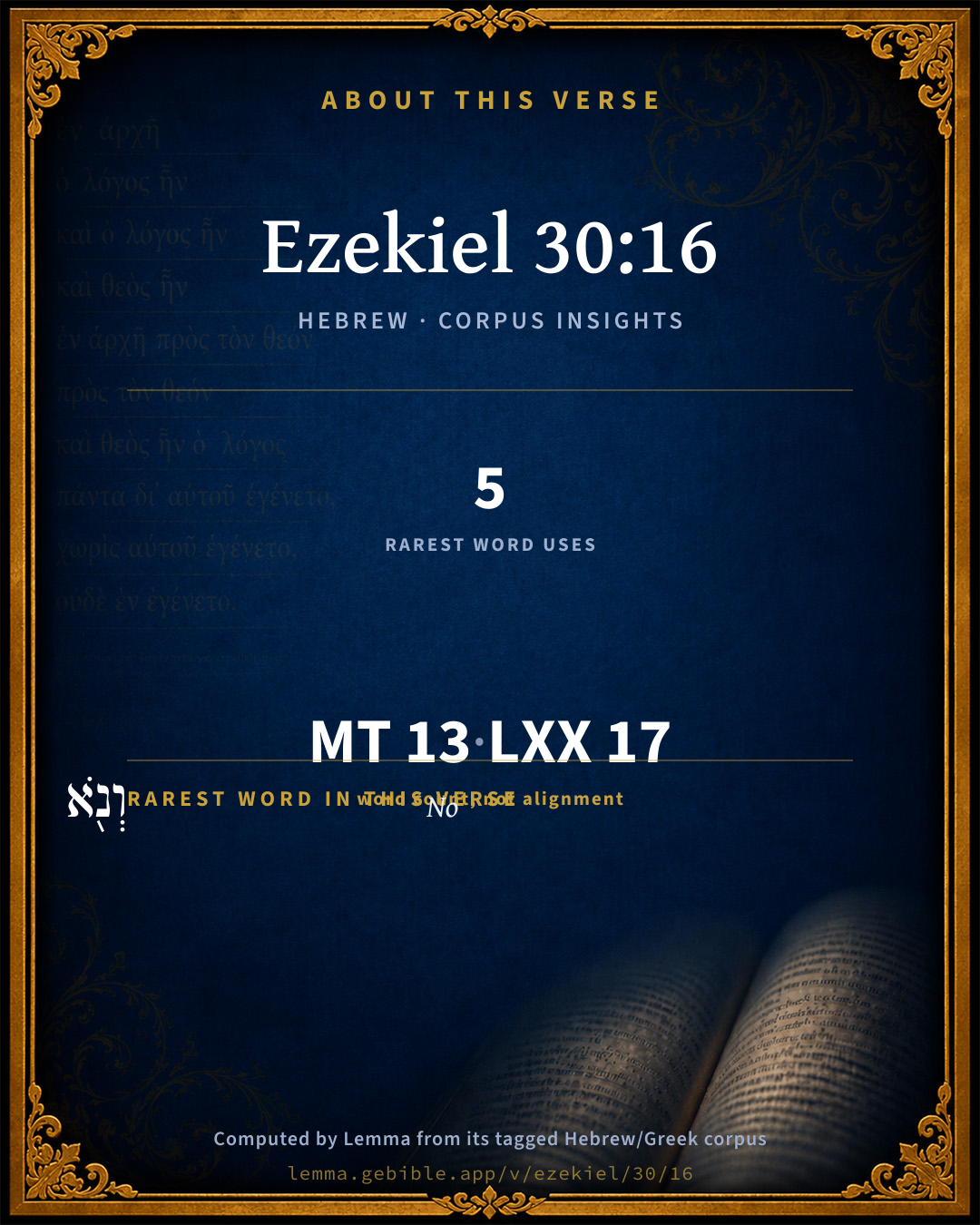
13
words
11
distinct lemmas
Prophets
section

Notable vocabulary

The rarest word here is וְנֹ֖א No H4996 — appearing just 5 times in the whole Hebrew Bible.

Shared distinctive vocabulary

וְנֹ֖א No H4996 occurs in 5 verses of the Hebrew Bible. Also found in:

Grammatical profile

  • 6 verbs
  • 6 nouns
  • 1 adverb

Verb forms

  • וְנָתַ֤תִּי Qal · Sequential Perfect
  • ח֤וּל Qal · Infinitive Construct
  • תחיל Qal · Imperfect
  • תָּחוּל֙ Qal · Imperfect
  • תִּהְיֶ֣ה Qal · Imperfect
  • לְהִבָּקֵ֑עַ Niphal · Infinitive Construct

Repetition

A word recurs within this verse — often emphatic in Hebrew:

  • ח֤וּל to writhe H2342 ×3

Hebrew & Septuagint length

In English translation the verse runs 27 words from the Hebrew and 27 from the Septuagint (LXX English) — the same length.

A rough comparison of the two English renderings, which tokenize alike — not a word-level alignment.

Word counts can differ between the Hebrew and the Greek without any difference in meaning — e.g. the Hebrew direct-object marker אֵת has no separate Greek word, and Greek often adds the article ὁ.

In the original languages it is 13 Hebrew tokens and 17 Greek tokens — but the two are counted differently (Hebrew bundles its prefixes and suffixes into one token; the Greek is in lemma form), so that isn’t a like-for-like length.

Cross-references

2

Topical passages linked to Ezekiel 30:16 in the Treasury of Scripture Knowledge — connected by theme and wording, ordered by reader-vote popularity; previews shown in the World English Bible.

  • Ezekiel 28:18 By the multitude of your iniquities, in the unrighteousness of your traffic, you have profaned your sanctuaries; therefore have I brought forth a fire from the midst of you; it has devoured you, and I have turned you to ashes on the earth in the sight of all those who see you.
  • Ezekiel 30:8–9 They shall know that I am Yahweh, when I have set a fire in Egypt, and all her helpers are destroyed.

Cross-references courtesy of OpenBible.info (CC BY 4.0).

Hebrew and Greek witnesses Masoretic Hebrew ↔ Greek Septuagint

The same verse in the two great witnesses to the Old Testament, shown verse-for-verse.

These are two independent witnesses, not word-aligned to each other, and the Septuagint is shown in lemma (dictionary) form.

Hebrew Ezekiel 30:16 Masoretic · Westminster Leningrad Codex

וְנָתַ֤תִּי אֵשׁ֙ בְּמִצְרַ֔יִם ח֤וּל תחיל תָּחוּל֙ סִ֔ין וְנֹ֖א תִּהְיֶ֣ה לְהִבָּקֵ֑עַ וְנֹ֖ף צָרֵ֥י יוֹמָֽם

I will set a fire in Egypt: Sin shall be in great anguish, and No shall be broken up; and Memphis [shall have] adversaries in the day-time.

World English Bible · Public Domain

Greek LXX Ezekiel 30:16 Septuagint · lemma form

καί δίδωμι πῦρ ἐπί αἴγυπτος καί ταραχή ταράσσω συήνη καί ἐν διόσπολις εἰμί ἔκρηγμα καί διαχέω ὕδωρ

And I will send fire upon Egypt; and Syene shall be sorely troubled; and there shall be a breaking in Diospolis, and waters shall be poured out.

LXX2012 (modern English Septuagint) · Public Domain

On this verse, The Cambridge Bible for Schools and Colleges discusses the Septuagint’s reading. Read the note in Commentary ↓

Hebrew: Westminster Leningrad Codex (CC BY 4.0). Greek: Septuagint (public domain); English from LXX2012 (modern English Septuagint) (Public Domain). How the Septuagint differs from the Hebrew →

Targum (Aramaic paraphrase)

1

The Targum is the ancient Jewish Aramaic paraphrase of the Hebrew Scriptures — an interpretive translation, not the Hebrew text itself. Onkelos (literal) and Pseudo-Jonathan (expansive) render the Torah, and Jonathan the Prophets. Coverage is partial: where no permissively-licensed English translation exists for a verse, only the Aramaic is shown. This is verse-level text, not a word-by-word alignment to the Hebrew.

  1. Targum Jonathan Prophets (Joshua–Malachi)
    וְאַיְתֵי עַמְמַיָא דְתַקִיפִין כְּאֶשְׁתָּא בְּמִצְרַיִם מִזַע תְּזוּעַ סִין וַאֲלַכְסַנְדַרְיָא תְּהֵי מְתַרְעָא מִשׁוּר וּמָפֵיס בַּעֲלֵי דְבָבוּ יִקְפוּנָהּ יוֹם יוֹם:

    (no public-domain English translation for this verse)

    Targum Jonathan — Aramaic: “Mikraot Gedolot” (public domain). English: “Sefaria Community Translation” (CC0 1.0 (public-domain dedication)); “London "Chaldee Paraphrase," 1871” (public domain). Text via Sefaria.

Commentary

Notes on Ezekiel 30:16 from classic Christian and Jewish commentators (each source and its license shown beneath its notes). The classic Christian expositions comment on the surrounding passage and are grouped to its opening verse, so a note may address several verses; the Jewish commentaries on the Tanakh (Rashi and others) are per-verse, so they appear only where the commentator wrote on this verse.

Lemma curates 59 commentaries, every one of them public domain or Creative Commons licensed, each selected and text-cleaned for this edition rather than reprinted as found. About our sources →

Trapp's Complete Commentary

John Trapp

Eze 30:16 And I will set fire in Egypt: Sin shall have great pain, and No shall be rent asunder, and Noph [shall have] distresses daily.

Ver. 16. I will set fire in Egypt.] See Eze 30:8.

John Trapp, A Commentary or Exposition upon All the Books of the Old and New Testament (1647–1656) — public domain. Text from a community e-Sword module.

Jamieson, Fausset & Brown

Robert Jamieson, A. R. Fausset & David Brown

distresses daily--MAURER translates, "enemies during the day," that is, open enemies who do not wait for the covert of night to make their attacks (compare Jer 6:4; Jer 15:8). However, the Hebrew, though rarely, is sometimes rendered (see Psa 13:2) as in English Version.

Jamieson, Fausset & Brown — Commentary Critical and Explanatory on the Whole Bible (1871) — public domain (CC PDM 1.0). Text via the HelloAO Bible API.

Adam Clarke's Commentary

Verse 16. Noph] Cairo or Kahira; see Eze 30:13.

Adam Clarke's Commentary on the Bible (1810–1826) — public domain. Text from a community e-Sword/MySword module.

The Cambridge Bible for Schools and Colleges

gen. ed. J. J. S. Perowne

16. rent asunder] i.e. broken through by armed assault, cf. Eze_26:10 (last words).

have distresses daily] distresses (or adversaries) in the day-time; cf. Zep_2:4, “they shall drive out Ashdod at noonday” (Jer_15:8). The construction is unnatural, and the text may be in some confusion. LXX. reads differently.

The Cambridge Bible for Schools and Colleges (gen. ed. J. J. S. Perowne; Cambridge University Press, 1878–1918) — public domain. Text from a community e-Sword module.

John Gill's Exposition

And I will set fire in Egypt,.... Kindle a war there, which shall consume it; see Eze 30:8,

Sin shall have great pain; as a woman in travail, seeing its destruction is just at hand; the same with Pelusium, as before:

and No shall be rent asunder, the walls of it shall be broken down by the enemy, or a breach shall be made in it, like the breach of waters which were about it; see Nah 3:8,

and Noph shall have distresses daily: that is, Memphis, as before; enemies shall surround it daily, as the Targum; shall besiege and distress it, until it is taken: or, "in the daytime"; their enemies should not come as thieves in the night, openly in the day. Abendana interprets it of their unfortunate day, their star being unlucky.

John Gill's Exposition of the Whole Bible (1746–1763) — public domain (CC PDM 1.0). Text via the HelloAO Bible API.

Matthew Poole's English Annotations

Will set fire: see Eze 30:14, and Eze 20:47.

Sin: see Eze 30:15. Great pain: see Eze 30:9.

No: Eze 30:14,15.

Rent asunder; her walls, and towers, and fortresses battered, torn, and broken through by the continued violence of engines, and by the assaults of the soldiers.

Noph: see Eze 30:13.

Distresses: being the chief city where king and councils sat, whence orders should be given, whither all intelligences were brought, all should be so bad abroad, that nothing but fears and distresses fill their ears, mouths, and hearts, beside the wants that would increase daily on them.

Matthew Poole's English Annotations on the Holy Bible (1683–1685) — public domain. Text from a community e-Sword/MySword module.

Whedon's Commentary on the Bible

Daniel D. Whedon

16. Distresses daily — R.V., “adversaries in the daytime.” It should become so feeble that there would be no need of a conspiracy or night surprise.

Daniel D. Whedon (gen. ed.), Commentary on the Old and New Testaments (1874–1909) — public domain. Text from a community e-Sword module.

John Wesley's Explanatory Notes

Shall be rent - Her walls, and towers, and fortresses broken through by the violence of engines, and by the assaults of the soldiers.

John Wesley, Explanatory Notes Upon the Whole Bible (1754–1765) — public domain. Text via the GEBible commentary corpus.

Rashi

Rabbi Shlomo Yitzchaki (Rashi)

to split Her wall will split.

adversaries [will attack her] daily [Heb. צָרֵי יוֹמָם, lit. adversaries of days.] Adversaries will come upon her every day.

Rashi on the Tanakh — English translations: “The Judaica Press complete Tanach with Rashi, translated by A. J. Rosenberg” (CC BY 4.0); “Pentateuch with Rashi's commentary by M. Rosenbaum and A.M. Silbermann, 1929-1934” (public domain); “The Metsudah Tanach series, Lakewood, N.J” (CC BY 4.0); and “The Book of Joshua, Metsudah Publications, 1997” (CC BY 4.0). Text via Sefaria.

Lesson kit

Teaching starters — assembled from the data on this page, not authored interpretation. Every prompt links to the verse data it draws on. Edit before teaching.

Ezekiel, in the Prophets, opens this verse with 13 words (11 distinct Hebrew lemmas). Its most distinctive word is Nôʼ (“No”). A historical commentator’s framing appears above. Read the whole chapter for the surrounding context.

Discussion questions

  1. The word Nôʼ carries the sense “No.” How does it shape the verse?
  2. How does Jeremiah 46:25, which shares the word «No», read alongside this verse?
  3. What does the repetition of “to writhe” (3× in this one verse) do in this verse?
  4. These translations render this verse differently; the difference is in the English rendering, not the original. What questions does that raise?
  5. «וְנָתַ֤תִּי» is a Qal Sequential Perfect verb. How does that grammatical form shape the action described?
  6. Compare how Trapp's Complete Commentary and Jamieson, Fausset & Brown read this verse. Where do they agree or differ?

Things to notice

Reading settings

Reading text

Shown beneath each verse's original-language words.

Old Testament
Old Testament edition

Read the OT as the Masoretic Hebrew (MT) or the Greek Septuagint (LXX).

English shown for the Greek Septuagint (in the Hebrew ↔ Greek comparison).

Comparing translations? Open the Compare panel on any verse page to stack up to four side by side.