
Ezekiel 32:15

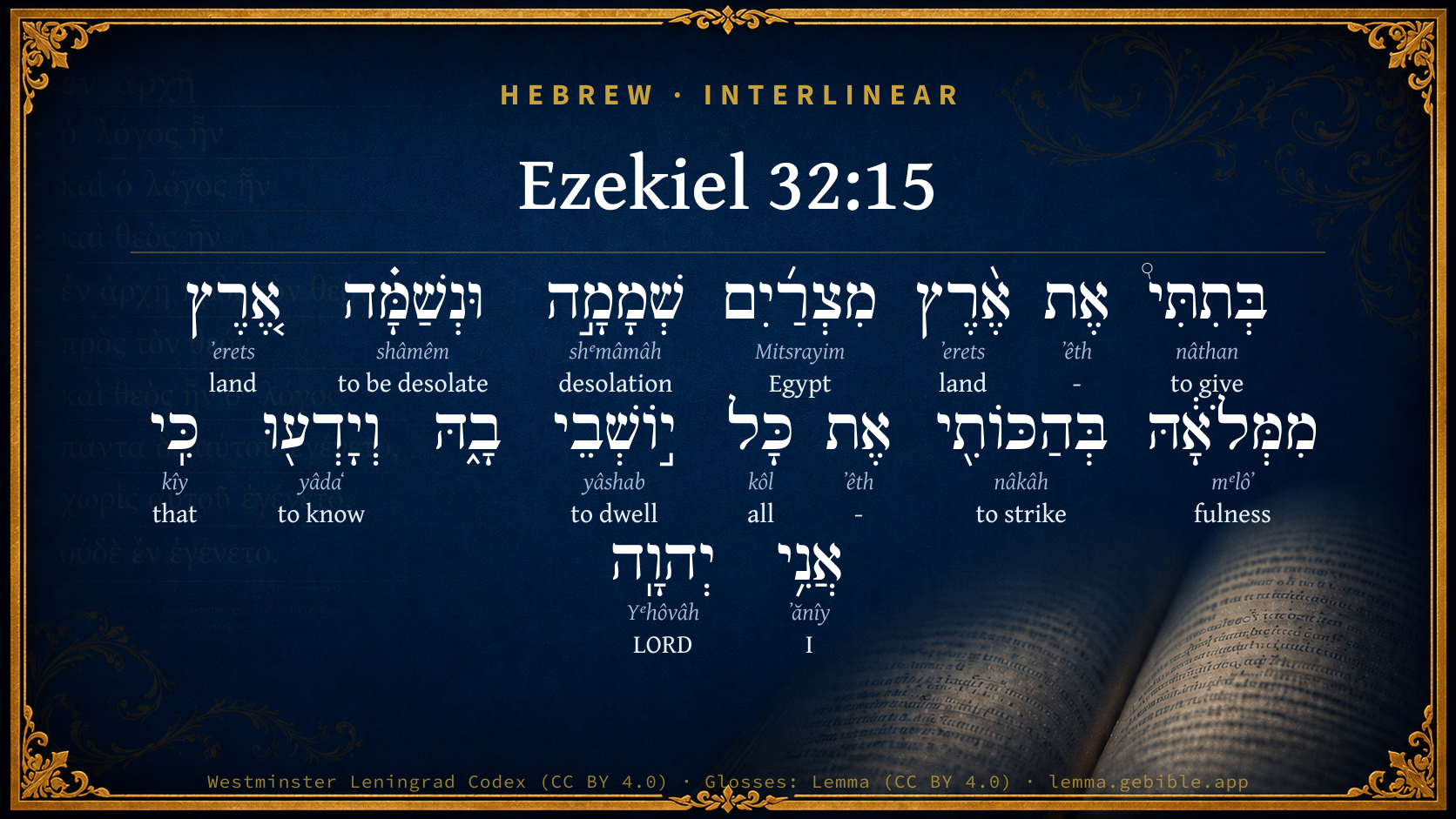
Hebrew (Westminster Leningrad Codex) Ezekiel 32:15 appears in the Hebrew Old Testament. The text above is from the Westminster Leningrad Codex. Each word links to its Strong’s number, a concise gloss, and parsing drawn from the Open Scriptures Hebrew Bible morphology. Click any word for its full Brown-Driver-Briggs (BDB) entry.
Download image
Cite this verse

Ezekiel 32:15 (World English Bible). Public Domain. Lemma interlinear Bible study tool, https://lemma.gebible.app/v/ezekiel/32/15.

Show BibTeX & RIS
BibTeX
RIS
English Translation
When I shall make the land of Egypt desolate and waste, a land destitute of that of which it was full, when I shall strike all those who dwell therein, then shall they know that I am Yahweh.
World English Bible · Public Domain
Download a study sheet

One document with this verse’s original text, its word-by-word gloss line, the meaning frame, cross-references with their text, attributed commentary, and full source and license credits — printable, and it pastes into notes with its structure intact.

This verse Autodidact and up

Study sheet (.html) Plain text (.txt)

A passage Seminary Student

Up to 50 verses in one chapter. A passage sheet keeps up to 6 commentary sources and 12 cross-references per verse, in the order this page ranks them, and says so on the sheet whenever that leaves anything out. Ask for a single verse and you get the Autodidact verse sheet above.

Everything on this page stays free to read, with no account — the sheet is a download of what is already on screen, not access to it.

Want to remove ads? Support Godless Engineer
Compare translations 3

The same verse in 3 English versions, stacked beneath the original-language interlinear above. Click any original word for its lexicon entry.

Each is an independent rendering of the whole verse — the interlinear is not word-aligned to these translations.

Highlighted words mark where these versions differ — a whole-verse word diff, not a word-by-word alignment.

  • World English Bible Public Domain
    When I shall make the land of Egypt desolate and waste, a land destitute of that of which it was full, when I shall strike all those who dwell therein, then shall they know that I am Yahweh.
  • King James Version Public Domain
    When I shall make the land of Egypt desolate, and the country shall be destitute of that whereof it was full, when I shall smite all them that dwell therein, then shall they know that I am the LORD.
  • unfoldingWord Literal Text CC BY-SA 4.0
    When I make the land of Egypt an abandoned place, when the land is made bare of all its fullness, when I attack all the inhabitants in her, they will know that I am Yahweh.

unfoldingWord Literal Text — © unfoldingWord, licensed CC BY-SA 4.0. Word-aligned USFM3 via Door43 (git.door43.org/unfoldingWord/en_ult).

Versions to compare (up to 4)

3 of 4 selected

Show all 18 translations

Every available English version of this verse, each an independent rendering of the whole verse.

  • World English Bible Public Domain
    When I shall make the land of Egypt desolate and waste, a land destitute of that of which it was full, when I shall strike all those who dwell therein, then shall they know that I am Yahweh.
  • Berean Standard Bible Public Domain
    ‘When I make the land of Egypt a desolation and empty it of all that filled it, when I strike down all who live there, then they will know that I am the LORD.’
  • Majority Standard Bible Public Domain
    ‘When I make the land of Egypt a desolation and empty it of all that filled it, when I strike down all who live there, then they will know that I am the LORD.’
  • King James Version Public Domain
    When I shall make the land of Egypt desolate, and the country shall be destitute of that whereof it was full, when I shall smite all them that dwell therein, then shall they know that I am the LORD.
  • American Standard Version (1901) Public Domain
    When I shall make the land of Egypt desolate and waste, a land destitute of that whereof it was full, when I shall smite all them that dwell therein, then shall they know that I am Jehovah.
  • Revised Version (1885) Public Domain
    When I shall make the land of Egypt desolate and waste, a land destitute of that whereof it was full, when I shall smite all them that dwell therein, then shall they know that I am the LORD.
  • Geneva Bible (1599) Public Domain
    When I shall make the land of Egypt desolate, and the countrey with all that is therein, shall be laid waste: when I shall smite all them which dwell therein, then shall they know that I am ye Lord.
  • Douay-Rheims (1899) Public Domain
    When I shall have made the land of Egypt desolate: and the land shall be destitute of her fulness, when I shall have struck all the inhabitants thereof: and they shall know that I am the Lord.
  • Young's Literal Translation Public Domain
    In My making the land of Egypt a desolation, And desolated hath been the land of its fulness, In My smiting all the inhabitants in it, And they have known that I `am' Jehovah.
  • Literal Standard Version CC BY-SA 4.0
    In My making the land of Egypt a desolation, || And the land has been desolated of its fullness, || In My striking all the inhabitants in it, || Then they have known that I [am] YHWH.
  • Unlocked Literal Bible CC BY-SA 4.0
    When I make the land of Egypt an abandoned place, when the land is made bare of all its fullness, when I attack all the inhabitants in her, they will know that I am Yahweh.
  • unfoldingWord Literal Text CC BY-SA 4.0
    When I make the land of Egypt an abandoned place, when the land is made bare of all its fullness, when I attack all the inhabitants in her, they will know that I am Yahweh.
  • Darby Bible Public Domain
    When I shall make the land of Egypt a desolation, and the country shall be left desolate of all that was in it, when I have smitten all them that dwell therein, then shall they know that I [am] Jehovah.
  • World Messianic Bible Public Domain
    “When I make the land of Egypt desolate and waste, a land destitute of that of which it was full, when I strike all those who dwell therein, then they will know that I am the LORD.
  • Webster's Bible Public Domain
    When I shall make the land of Egypt desolate, and the country shall be destitute of that of which it was full, when I shall smite all them that dwell in it, then shall they know that I am the LORD.
  • Free Bible Version CC BY-SA 4.0
    When I turn Egypt into a wasteland, completely emptying it out, when I kill everyone who lives there, then they will acknowledge that I am the Lord.
  • Bible in Basic English Public Domain
    When I make Egypt an unpeopled waste, cutting off from the land all the things in it; when I send punishment on all those living in it, then it will be clear to them that I am the Lord.
  • JPS Tanakh (1917) Public Domain
    When I shall make the land of Egypt desolate and waste, a land destitute of that whereof it was full, when I shall smite all them that dwell therein, then shall they know that I am the LORD.

Literal Standard Version (2020), Covenant Press — licensed CC BY-SA 4.0. Text via the HelloAO Bible API (eBible.org). Unlocked Literal Bible (unfoldingWord) — licensed CC BY-SA 4.0. Text via the HelloAO Bible API (eBible.org). unfoldingWord Literal Text — © unfoldingWord, licensed CC BY-SA 4.0. Word-aligned USFM3 via Door43 (git.door43.org/unfoldingWord/en_ult). Free Bible Version, Dr. Jonathan Gallagher — licensed CC BY-SA 4.0. Text via the HelloAO Bible API (eBible.org).

Word by word

More ways to search: Search by grammar → Find every occurrence → Compare this word →

Practice this passage: Drill this verse → Learn its vocabulary →

מִמְּלֹאָ֔הּ
mᵉlôʼ
H4393
“from · fulness · her”
Preposition + Noun, Common, Masculine, Singular, Construct + Suffix, Personal, 3rd Person, Feminine, Singular
Part of Speech
Preposition + Noun
Type
Common
Gender
Masculine
Number
Singular
State
Construct
Full BDB Definition

Origin: from H4390

TWOT: 1195b

fulness, that which fills - fulness, handful - mass, multitude - fulness, that which fills, entire contents - full length, full line
  1. בְּתִתִּי֩ nâthan H5414 “in/at · to give · me” Preposition + Verb, Qal, Infinitive Construct + Suffix, Personal, 1st Person, Common, Singular
  2. אֶת ʼêth H853 “-” Particle, Direct Object
  3. אֶ֨רֶץ ʼerets H776 “land of” Noun, Common, Both, Singular, Construct
  4. מִצְרַ֜יִם Mitsrayim H4714 “Egypt” Noun, Proper
  5. שְׁמָמָ֣ה shᵉmâmâh H8077 “desolation” Noun, Common, Feminine, Singular, Absolute
  6. וּנְשַׁמָּ֗ה shâmêm H8074 “and · desolate” Conjunction + Verb, Niphal, Participle Passive, Feminine, Singular, Absolute
  7. אֶ֚רֶץ ʼerets H776 “land” Noun, Common, Both, Singular, Absolute
  8. בְּהַכּוֹתִ֖י nâkâh H5221 “in/at · to strike · me” Preposition + Verb, Hiphil, Infinitive Construct + Suffix, Personal, 1st Person, Common, Singular
  9. אֶת ʼêth H853 “-” Particle, Direct Object
  10. כָּל kôl H3605 “all of” Noun, Common, Masculine, Singular, Construct
  11. י֣וֹשְׁבֵי yâshab H3427 “dwelling” Verb, Qal, Participle Active, Masculine, Plural, Construct
  12. וְיָדְע֖וּ yâdaʻ H3045 “and · to know” Conjunction + Verb, Qal, Sequential Perfect, 3rd Person, Common, Plural
  13. כִּֽי kîy H3588 “that” Conjunction
  14. אֲנִ֥י ʼănîy H589 “I” Pronoun, Personal, 1st Person, Common, Singular
  15. יְהוָֽה Yᵉhôvâh H3068 “LORD” Noun, Proper

About this verse

These counts appear in no published source. They are computed here, from the morphology-tagged text and Lemma’s own curated glosses. What Lemma adds →

17
words
14
distinct lemmas
Prophets
section

Shared distinctive vocabulary

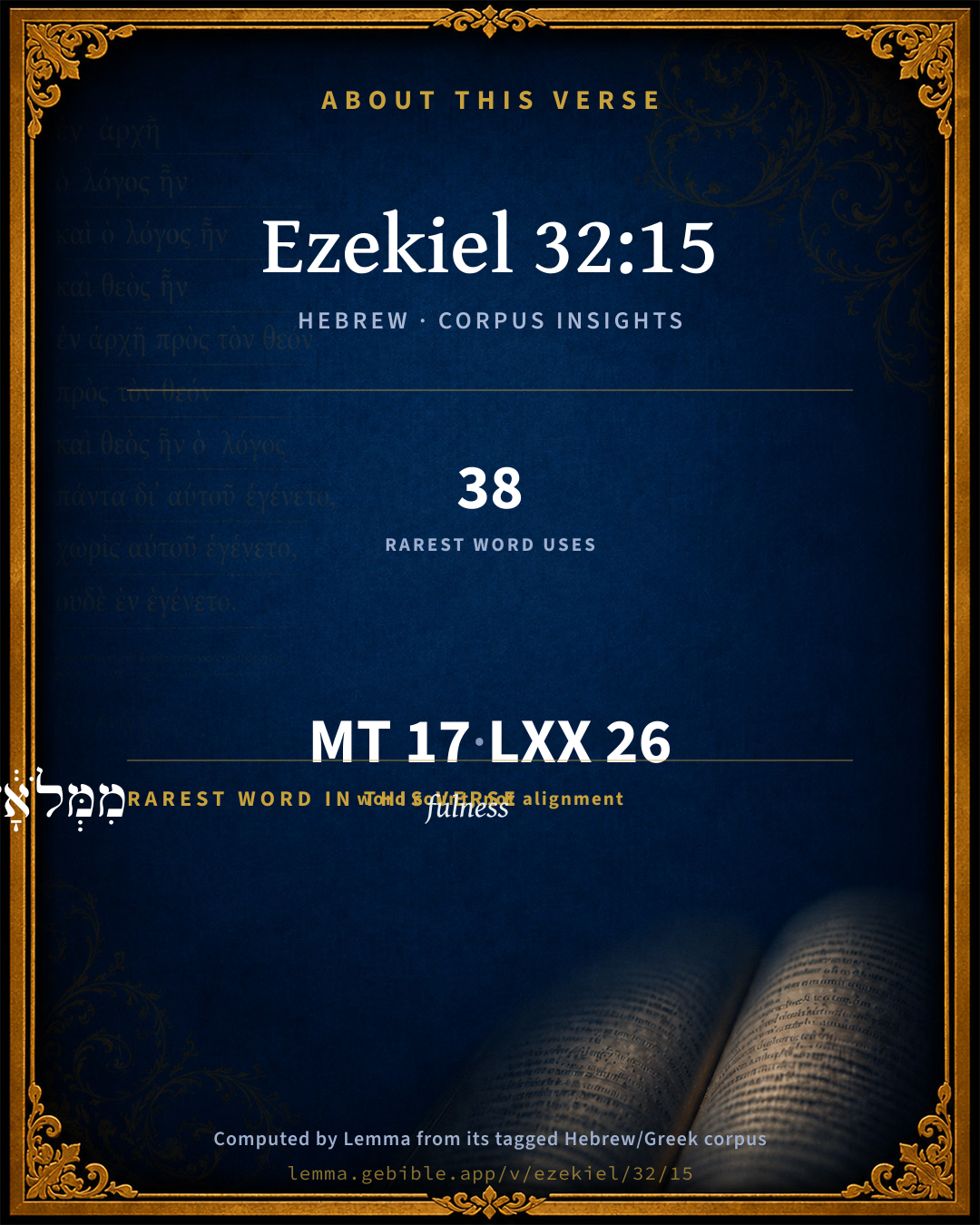
מִמְּלֹאָ֔הּ fulness H4393 occurs in 36 verses of the Hebrew Bible. Also found in:

Grammatical profile

  • 5 verbs
  • 7 nouns
  • 1 pronoun
  • 1 preposition
  • 1 conjunction
  • 2 particles

Verb forms

  • בְּתִתִּי֩ Qal · Infinitive Construct
  • וּנְשַׁמָּ֗ה Niphal · Participle Passive
  • בְּהַכּוֹתִ֖י Hiphil · Infinitive Construct
  • י֣וֹשְׁבֵי Qal · Participle Active
  • וְיָדְע֖וּ Qal · Sequential Perfect

Repetition

A word recurs within this verse — often emphatic in Hebrew:

  • אֶ֨רֶץ land H776 ×2

Hebrew & Septuagint length

In English translation the verse runs 38 words from the Hebrew and 37 from the Septuagint (LXX English) — closely comparable.

A rough comparison of the two English renderings, which tokenize alike — not a word-level alignment.

Word counts can differ between the Hebrew and the Greek without any difference in meaning — e.g. the Hebrew direct-object marker אֵת has no separate Greek word, and Greek often adds the article ὁ.

In the original languages it is 17 Hebrew tokens and 26 Greek tokens — but the two are counted differently (Hebrew bundles its prefixes and suffixes into one token; the Greek is in lemma form), so that isn’t a like-for-like length.

Cross-references

11

Topical passages linked to Ezekiel 32:15 in the Treasury of Scripture Knowledge — connected by theme and wording, ordered by reader-vote popularity; previews shown in the World English Bible.

  • Exodus 7:5 The Egyptians shall know that I am Yahweh, when I stretch forth my hand on Egypt, and bring out the children of Israel from among them."
  • Ezekiel 6:7 The slain shall fall in the midst of you, and you shall know that I am Yahweh.
  • Exodus 14:4 I will harden Pharaoh's heart, and he will follow after them; and I will get honor over Pharaoh, and over all his host; and the Egyptians shall know that I am Yahweh." They did so.
  • Exodus 14:18 The Egyptians shall know that I am Yahweh, when I have gotten myself honor over Pharaoh, over his chariots, and over his horsemen."
  • Psalms 9:16 Yahweh has made himself known. He has executed judgment. The wicked is snared by the work of his own hands. Meditation. Selah.
  • Psalms 83:17–18 Let them be disappointed and dismayed forever. Yes, let them be confounded and perish;
  • Ezekiel 29:12 I will make the land of Egypt a desolation in the midst of the countries that are desolate; and her cities among the cities that are laid waste shall be a desolation forty years; and I will scatter the Egyptians among the nations, and will disperse them through the countries.
  • Ezekiel 29:19–20 Therefore thus says the Lord Yahweh: Behold, I will give the land of Egypt to Nebuchadrezzar king of Babylon; and he shall carry off her multitude, and take her spoil, and take her prey; and it shall be the wages for his army.
  • Ezekiel 30:26 I will scatter the Egyptians among the nations, and disperse them through the countries; and they shall know that I am Yahweh.
  • Psalms 24:1 The earth is Yahweh's, with its fullness; The world, and those who dwell therein.
  • Psalms 107:33–34 He turns rivers into a desert, Water springs into a thirsty ground,

Cross-references courtesy of OpenBible.info (CC BY 4.0).

Hebrew and Greek witnesses Masoretic Hebrew ↔ Greek Septuagint

The same verse in the two great witnesses to the Old Testament, shown verse-for-verse.

These are two independent witnesses, not word-aligned to each other, and the Septuagint is shown in lemma (dictionary) form.

Hebrew Ezekiel 32:15 Masoretic · Westminster Leningrad Codex

בְּתִתִּי֩ אֶת אֶ֨רֶץ מִצְרַ֜יִם שְׁמָמָ֣ה וּנְשַׁמָּ֗ה אֶ֚רֶץ מִמְּלֹאָ֔הּ בְּהַכּוֹתִ֖י אֶת כָּל י֣וֹשְׁבֵי בָ֑הּ וְיָדְע֖וּ כִּֽי אֲנִ֥י יְהוָֽה

When I shall make the land of Egypt desolate and waste, a land destitute of that of which it was full, when I shall strike all those who dwell therein, then shall they know that I am Yahweh.

World English Bible · Public Domain

Greek LXX Ezekiel 32:15 Septuagint · lemma form

ὅταν δίδωμι αἴγυπτος εἰς ἀπώλεια καί ἐρημόω ὁ γῆ σύν ὁ πλήρωσις αὐτός ὅταν διασπείρω πᾶς ὁ καταοἰκέω ἐν αὐτός καί γιγνώσκω ὅτι ἐγώ εἰμί κύριος

when I shall give up Egypt to destruction, and the land shall be made desolate with the fullness thereof; when I shall scatter all that dwell in it, and they shall know that I am the Lord.

LXX2012 (modern English Septuagint) · Public Domain

Hebrew: Westminster Leningrad Codex (CC BY 4.0). Greek: Septuagint (public domain); English from LXX2012 (modern English Septuagint) (Public Domain). How the Septuagint differs from the Hebrew →

Targum (Aramaic paraphrase)

1

The Targum is the ancient Jewish Aramaic paraphrase of the Hebrew Scriptures — an interpretive translation, not the Hebrew text itself. Onkelos (literal) and Pseudo-Jonathan (expansive) render the Torah, and Jonathan the Prophets. Coverage is partial: where no permissively-licensed English translation exists for a verse, only the Aramaic is shown. This is verse-level text, not a word-by-word alignment to the Hebrew.

  1. Targum Jonathan Prophets (Joshua–Malachi)
    כַּד אֶתֵּן יַת אַרְעָא דְמִצְרַיִם צָדוּ וְתִצְדֵי אַרְעָא וּמְלָאָהּ בְּאַיְתָיוּתִי מְחָא עַל כָּל דְיַתְבִין בָּהּ וְיֵדְעוּן אֲרֵי אֲנָא יְיָ:

    (no public-domain English translation for this verse)

    Targum Jonathan — Aramaic: “Mikraot Gedolot” (public domain). English: “Sefaria Community Translation” (CC0 1.0 (public-domain dedication)); “London "Chaldee Paraphrase," 1871” (public domain). Text via Sefaria.

Commentary

Notes on Ezekiel 32:15 from classic Christian and Jewish commentators (each source and its license shown beneath its notes). The classic Christian expositions comment on the surrounding passage and are grouped to its opening verse, so a note may address several verses; the Jewish commentaries on the Tanakh (Rashi and others) are per-verse, so they appear only where the commentator wrote on this verse.

Lemma curates 59 commentaries, every one of them public domain or Creative Commons licensed, each selected and text-cleaned for this edition rather than reprinted as found. About our sources →

Trapp's Complete Commentary

John Trapp

Eze 32:15 When I shall make the land of Egypt desolate, and the country shall be destitute of that whereof it was full, when I shall smite all them that dwell therein, then shall they know that I [am] the LORD.

Ver. 15. When I shall make the land … desolate.] See here the sad effects of sin, and beware.

Then shall they know that I am the Lord.] Pleraque supra habuimus: ideo sum brevior, saith Lavater on Eze 32:12.

John Trapp, A Commentary or Exposition upon All the Books of the Old and New Testament (1647–1656) — public domain. Text from a community e-Sword module.

Joseph Benson's Commentary

Eze 32:15. When I shall make the land of Egypt desolate, &c. — When I shall bring the fore-mentioned dreadful calamities upon it. Then shall they know that I am the Lord — The awful and destructive visitation shall be sanctified to those that survive: it shall yield them important instruction, and they shall give glory to my power and justice, while a sensible conviction of the vanity of the world, and of the fading and perishing nature of all things in it, shall draw their affections from it, and from all that it contains, and induce them to seek an acquaintance with me as their portion and happiness.

Joseph Benson's Commentary on the Old and New Testaments (1811–1818) — public domain. Text from a community e-Sword module.

Tyndale Open Study Notes

Tyndale Open Resources

32:15-16 This total and final devastation of Egypt would result in their recognizing the power of the Lord, just as they did at the time of the Exodus.

Tyndale Open Study Notes — © Tyndale Open Resources, licensed CC BY-SA 4.0. Text via the HelloAO Bible API.

Adam Clarke's Commentary

Verse 15. Shall be destitute of that whereof it was full] Of corn, and all other necessaries of life.

Adam Clarke's Commentary on the Bible (1810–1826) — public domain. Text from a community e-Sword/MySword module.

The Cambridge Bible for Schools and Colleges

gen. ed. J. J. S. Perowne

15. The end of this desolating judgment shall be that Jehovah shall be known. This is the purpose and the effect of all his interpositions among the nations. Exo_7:5; Exo_14:4; Exo_14:18.

The Cambridge Bible for Schools and Colleges (gen. ed. J. J. S. Perowne; Cambridge University Press, 1878–1918) — public domain. Text from a community e-Sword module.

John Gill's Exposition

When I shall make the land of Egypt desolate,.... The cities being demolished, the inhabitants destroyed with the sword, or carried captive:

and the country shall be destitute of that whereof it was full; men and cattle, corn and other fruits of the earth, wealth and riches, pomp and grandeur:

when I shall smite all them that dwell therein; with the sword of the Chaldeans:

then shall they know that I am the Lord for God is known in the perfections of his nature, omnipotence, omniscience, holiness, justice, &c. by the judgments he executes; for this is not to be understood of a spiritual knowledge of him, but of a terrible conviction of the truth of his being and attributes, by the awful dispensations of his providence.

John Gill's Exposition of the Whole Bible (1746–1763) — public domain (CC PDM 1.0). Text via the HelloAO Bible API.

Haydock's Catholic Bible Commentary

Fulness, or all of it shall be desolate.

George Leo Haydock (1774–1849), Haydock's Catholic Family Bible and Commentary, 1859 edition — public domain. Excludes Psalms (Douay-Rheims chapter numbering differs from Protestant) and Deuterocanonical books (Catholic canon only).

Matthew Poole's English Annotations

The former verse assures us of what it foretold, and the assurance is the word and truth of God; this verse tells us when this shall be.

Shall be destitute: this phrase is Eze 12:19.

That whereof it was full; men and women, cattle, food, wealth, and peace. When I shall smite by the sword, the destroying sword of the Chaldeans.

Then shall they know that I am the Lord; then shall they confess it to the glory of God’s power and justice.

Matthew Poole's English Annotations on the Holy Bible (1683–1685) — public domain. Text from a community e-Sword/MySword module.

John Wesley's Explanatory Notes

Of that - Men and women, cattle, wealth, and peace.

John Wesley, Explanatory Notes Upon the Whole Bible (1754–1765) — public domain. Text via the GEBible commentary corpus.

unfoldingWord translationNotes

Door43 World Missions Community

General Information:

Yahweh continues speaking.

When I make the land of Egypt an abandoned place

This can be put into active form. AT: "When I make the land of Egypt a place where no one is living" (See: Active or Passive)

when the land is made bare of all its fullness

"when the country is made to lose all its wealth"

when I attack all the inhabitants in her

Here the idea of attacking represents destroying. AT: "when I destroy all who live in her" (See: Metonymy)

in her ... over her

It was normal in biblical language to represent countries and lands as if they were women. AT: "in it ... over it" (See: Metaphor)

know that I am Yahweh

When Yahweh says that people will know that he is Yahweh, he is implying that they will know that he is the one true God who has supreme authority and power. See how you translated this in Ezekiel 6:7. AT: "understand that I am Yahweh, the one true God" or "realize that I, Yahweh, have supreme power and authority" (See: Assumed Knowledge and Implicit Information)

the daughters of the nations

Possible meanings are 1) "the women of other nations" or 2) "people of other nations"

over Egypt, over all her multitudes

"about Egypt, about all her multitudes" or "about the disaster that happened to Egypt, about the disaster that happened to all her multitudes"

translationWords

Yahweh

lament

declare

unfoldingWord translationNotes — © Distant Shores Media and the Door43 World Missions Community, licensed CC BY-SA 4.0. Source: git.door43.org/Door43/en_tn.

Rashi

Rabbi Shlomo Yitzchaki (Rashi)

a land that is full [Heb. אֶרֶץ מִמְלוֹאָה, a land that is now full (מִמְוּלָאָה) of all goodness.

Rashi on the Tanakh — English translations: “The Judaica Press complete Tanach with Rashi, translated by A. J. Rosenberg” (CC BY 4.0); “Pentateuch with Rashi's commentary by M. Rosenbaum and A.M. Silbermann, 1929-1934” (public domain); “The Metsudah Tanach series, Lakewood, N.J” (CC BY 4.0); and “The Book of Joshua, Metsudah Publications, 1997” (CC BY 4.0). Text via Sefaria.

Lesson kit

Teaching starters — assembled from the data on this page, not authored interpretation. Every prompt links to the verse data it draws on. Edit before teaching.

Ezekiel, in the Prophets, opens this verse with 17 words (14 distinct Hebrew lemmas). Its most distinctive word is mᵉlôʼ (“fulness”). A historical commentator’s framing appears above. Read the whole chapter for the surrounding context.

Discussion questions

  1. The word mᵉlôʼ carries the sense “fulness.” How does it shape the verse?
  2. Genesis 48:19 shares the word «fulness» with this verse. How do the two illuminate each other?
  3. “land” occurs 2× in this one verse. What is the effect of the repetition?
  4. These translations render this verse differently; the difference is in the English rendering, not the original. What questions does that raise?
  5. The verb «בְּתִתִּי֩» is Qal Infinitive Construct. How does its form color the action?
  6. Reading how Trapp's Complete Commentary and Joseph Benson's Commentary read this verse, where do the two commentators agree and where do they part?

Things to notice

Reading settings

Reading text

Shown beneath each verse's original-language words.

Old Testament
Old Testament edition

Read the OT as the Masoretic Hebrew (MT) or the Greek Septuagint (LXX).

English shown for the Greek Septuagint (in the Hebrew ↔ Greek comparison).

Comparing translations? Open the Compare panel on any verse page to stack up to four side by side.