Ezekiel 29:20

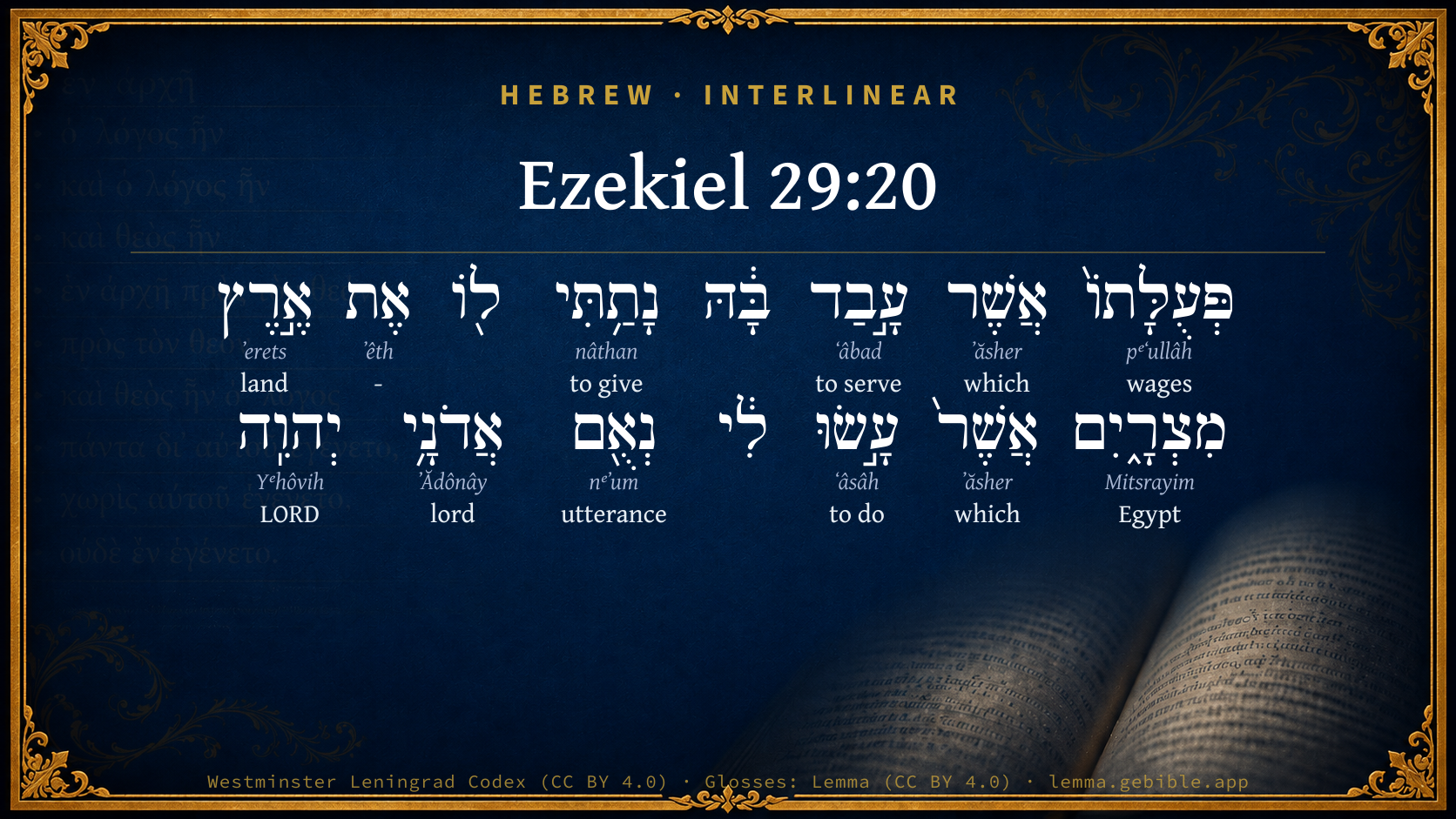
Hebrew (Westminster Leningrad Codex) Ezekiel 29:20 appears in the Hebrew Old Testament. The text above is from the Westminster Leningrad Codex. Each word links to its Strong’s number, a concise gloss, and parsing drawn from the Open Scriptures Hebrew Bible morphology. Click any word for its full Brown-Driver-Briggs (BDB) entry.
Download image
Cite this verse

Ezekiel 29:20 (World English Bible). Public Domain. Lemma interlinear Bible study tool, https://lemma.gebible.app/v/ezekiel/29/20.

Show BibTeX & RIS
BibTeX
RIS
English Translation
I have given him the land of Egypt as his recompense for which he served, because they worked for me, says the Lord Yahweh.
World English Bible · Public Domain
Download a study sheet

One document with this verse’s original text, its word-by-word gloss line, the meaning frame, cross-references with their text, attributed commentary, and full source and license credits — printable, and it pastes into notes with its structure intact.

This verse Autodidact and up

Study sheet (.html) Plain text (.txt)

A passage Seminary Student

Up to 50 verses in one chapter. A passage sheet keeps up to 6 commentary sources and 12 cross-references per verse, in the order this page ranks them, and says so on the sheet whenever that leaves anything out. Ask for a single verse and you get the Autodidact verse sheet above.

Everything on this page stays free to read, with no account — the sheet is a download of what is already on screen, not access to it.

Want to remove ads? Support Godless Engineer
Compare translations 3

The same verse in 3 English versions, stacked beneath the original-language interlinear above. Click any original word for its lexicon entry.

Each is an independent rendering of the whole verse — the interlinear is not word-aligned to these translations.

Highlighted words mark where these versions differ — a whole-verse word diff, not a word-by-word alignment.

  • World English Bible Public Domain
    I have given him the land of Egypt as his recompense for which he served, because they worked for me, says the Lord Yahweh.
  • King James Version Public Domain
    I have given him the land of Egypt for his labour wherewith he served against it, because they wrought for me, saith the Lord GOD.
  • unfoldingWord Literal Text CC BY-SA 4.0
    I have given him the land of Egypt as the wages for the work they did for me—this is the Lord Yahweh’s declaration.

unfoldingWord Literal Text — © unfoldingWord, licensed CC BY-SA 4.0. Word-aligned USFM3 via Door43 (git.door43.org/unfoldingWord/en_ult).

Versions to compare (up to 4)

3 of 4 selected

Show all 18 translations

Every available English version of this verse, each an independent rendering of the whole verse.

  • World English Bible Public Domain
    I have given him the land of Egypt as his recompense for which he served, because they worked for me, says the Lord Yahweh.
  • Berean Standard Bible Public Domain
    I have given him the land of Egypt as the reward for his labor, because it was done for Me, declares the Lord GOD.
  • Majority Standard Bible Public Domain
    I have given him the land of Egypt as the reward for his labor, because it was done for Me, declares the Lord GOD.
  • King James Version Public Domain
    I have given him the land of Egypt for his labour wherewith he served against it, because they wrought for me, saith the Lord GOD.
  • American Standard Version (1901) Public Domain
    I have given him the land of Egypt as his recompense for which he served, because they wrought for me, saith the Lord Jehovah.
  • Revised Version (1885) Public Domain
    I have given him the land of Egypt as his recompence for which he served, because they wrought for me, saith the Lord GOD.
  • Geneva Bible (1599) Public Domain
    I haue giuen him the land of Egypt for his labour, that he serued against it, because they wrought for me, sayth the Lord God.
  • Douay-Rheims (1899) Public Domain
    And for the service that he hath done me against it: I have given him the land of Egypt, because he hath laboured for me, saith the Lord God.
  • Young's Literal Translation Public Domain
    His wage for which he laboured I have given to him, The land of Egypt -- in that they wrought for Me, An affirmation of the Lord Jehovah.
  • Literal Standard Version CC BY-SA 4.0
    I have given to him his wage for which he labored—The land of Egypt, in that they worked for Me, || A declaration of Lord YHWH.
  • Unlocked Literal Bible CC BY-SA 4.0
    I have given him the land of Egypt as the wages for the work they did for me—this is the Lord Yahweh's declaration.
  • unfoldingWord Literal Text CC BY-SA 4.0
    I have given him the land of Egypt as the wages for the work they did for me—this is the Lord Yahweh’s declaration.
  • Darby Bible Public Domain
    I have given him the land of Egypt for his labour wherewith he served against it, because they wrought for me, saith the Lord Jehovah.
  • World Messianic Bible Public Domain
    I have given him the land of Egypt as his payment for which he served, because they worked for me,’ says the Lord GOD.
  • Webster's Bible Public Domain
    I have given him the land of Egypt for his labor with which he served against it, because they wrought for me, saith the Lord GOD.
  • Free Bible Version CC BY-SA 4.0
    I'm rewarding him for all his work by giving him Egypt because the work they did was for me, declares the Lord God.
  • Bible in Basic English Public Domain
    I have given him the land of Egypt as the reward for his hard work, because they were working for me, says the Lord.
  • JPS Tanakh (1917) Public Domain
    I have given him the land of Egypt as his hire for which he served, because they wrought for Me, saith the Lord GOD.

Literal Standard Version (2020), Covenant Press — licensed CC BY-SA 4.0. Text via the HelloAO Bible API (eBible.org). Unlocked Literal Bible (unfoldingWord) — licensed CC BY-SA 4.0. Text via the HelloAO Bible API (eBible.org). unfoldingWord Literal Text — © unfoldingWord, licensed CC BY-SA 4.0. Word-aligned USFM3 via Door43 (git.door43.org/unfoldingWord/en_ult). Free Bible Version, Dr. Jonathan Gallagher — licensed CC BY-SA 4.0. Text via the HelloAO Bible API (eBible.org).

Word by word

More ways to search: Search by grammar → Find every occurrence → Compare this word →

Practice this passage: Drill this verse → Learn its vocabulary →

פְּעֻלָּתוֹ֙
pᵉʻullâh
H6468
“wages · his”
Noun, Common, Feminine, Singular, Construct + Suffix, Personal, 3rd Person, Masculine, Singular
Part of Speech
Noun
Type
Common
Gender
Feminine
Number
Singular
State
Construct
Full BDB Definition

Origin: pass part of H6466

TWOT: 1792b

work, recompense, reward - work - wages
  1. אֲשֶׁר ʼăsher H834 “which” Particle, Relative
  2. עָ֣בַד ʻâbad H5647 “to serve” Verb, Qal, Perfect, 3rd Person, Masculine, Singular
  3. נָתַ֥תִּי nâthan H5414 “to give” Verb, Qal, Perfect, 1st Person, Common, Singular
  4. אֶת ʼêth H853 “-” Particle, Direct Object
  5. אֶ֣רֶץ ʼerets H776 “land of” Noun, Common, Both, Singular, Construct
  6. מִצְרָ֑יִם Mitsrayim H4714 “Egypt” Noun, Proper
  7. אֲשֶׁר֙ ʼăsher H834 “which” Particle, Relative
  8. עָ֣שׂוּ ʻâsâh H6213 “to do” Verb, Qal, Perfect, 3rd Person, Common, Plural
  9. נְאֻ֖ם nᵉʼum H5002 “utterance of” Noun, Common, Masculine, Singular, Construct
  10. אֲדֹנָ֥י ʼĂdônây H136 “Lord · my” Noun, Common, Masculine, Plural, Construct + Suffix, Personal, 1st Person, Common, Singular
  11. יְהוִֽה Yᵉhôvih H3069 “LORD” Noun, Proper

About this verse

These counts appear in no published source. They are computed here, from the morphology-tagged text and Lemma’s own curated glosses. What Lemma adds →

15
words
11
distinct lemmas
Prophets
section

Notable vocabulary

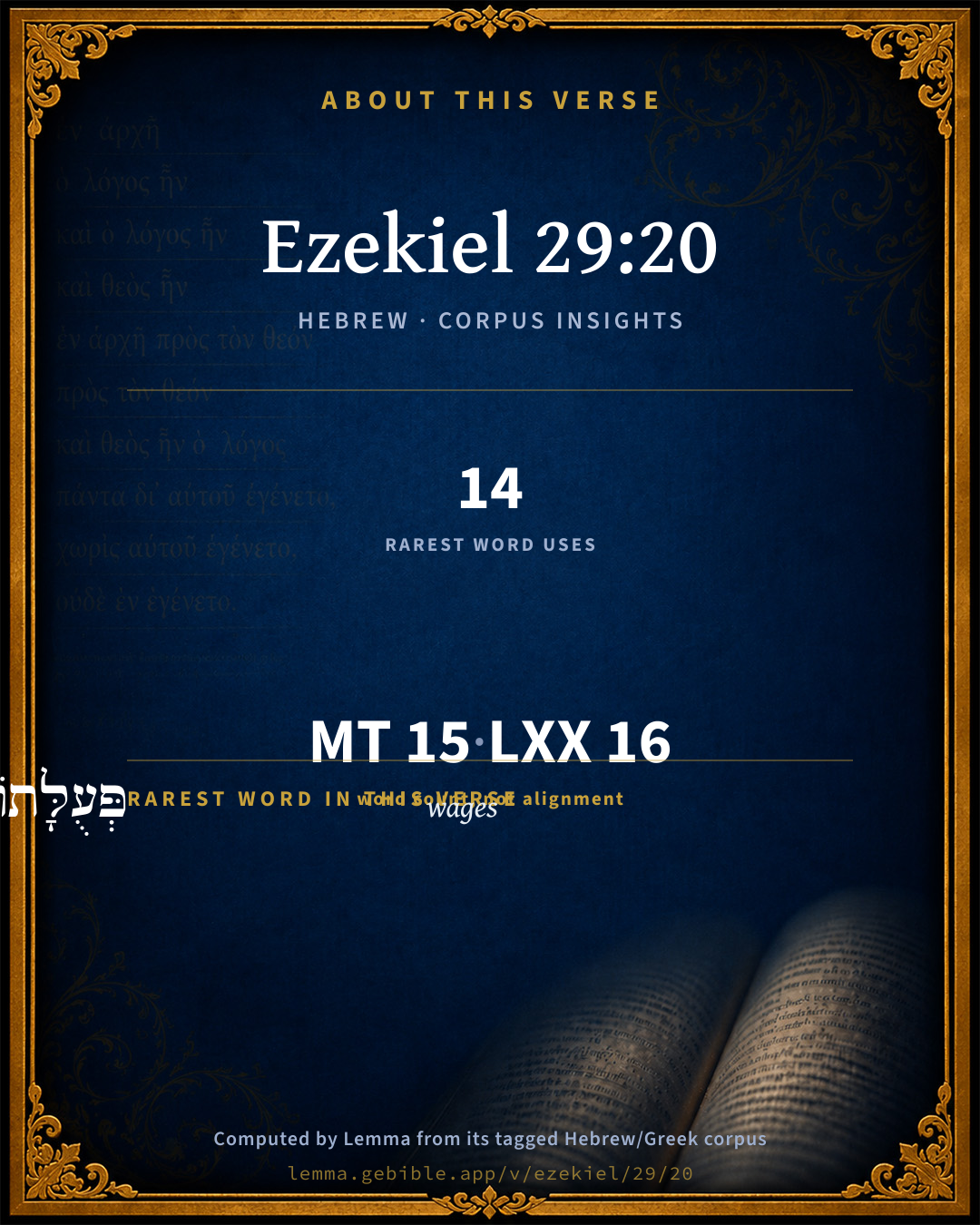
The rarest word here is פְּעֻלָּתוֹ֙ wages H6468 — appearing just 14 times in the whole Hebrew Bible.

Shared distinctive vocabulary

פְּעֻלָּתוֹ֙ wages H6468 occurs in 14 verses of the Hebrew Bible. Also found in:

Grammatical profile

  • 3 verbs
  • 6 nouns
  • 3 prepositions
  • 3 particles

Verb forms

  • עָ֣בַד Qal · Perfect
  • נָתַ֥תִּי Qal · Perfect
  • עָ֣שׂוּ Qal · Perfect

Repetition

A word recurs within this verse — often emphatic in Hebrew:

  • אֲשֶׁר which H834 ×2

Hebrew & Septuagint length

In English translation the verse runs 24 words from the Hebrew and 23 from the Septuagint (LXX English) — closely comparable.

A rough comparison of the two English renderings, which tokenize alike — not a word-level alignment.

Word counts can differ between the Hebrew and the Greek without any difference in meaning — e.g. the Hebrew direct-object marker אֵת has no separate Greek word, and Greek often adds the article ὁ.

In the original languages it is 15 Hebrew tokens and 16 Greek tokens — but the two are counted differently (Hebrew bundles its prefixes and suffixes into one token; the Greek is in lemma form), so that isn’t a like-for-like length.

Cross-references

4

Topical passages linked to Ezekiel 29:20 in the Treasury of Scripture Knowledge — connected by theme and wording, ordered by reader-vote popularity; previews shown in the World English Bible.

  • Isaiah 10:6–7 I will send him against a profane nation, and against the people of my wrath will I give him a charge, to take the spoil, and to take the prey, and to tread them down like the mire of the streets.
  • Jeremiah 25:9 behold, I will send and take all the families of the north, says Yahweh, and [I will send] to Nebuchadrezzar the king of Babylon, my servant, and will bring them against this land, and against the inhabitants of it, and against all these nations round about; and I will utterly destroy them, and make them an astonishment, and a hissing, and perpetual desolations.
  • Isaiah 45:1–3 Thus says Yahweh to his anointed, to Cyrus, whose right hand I have held, to subdue nations before him, and I will loose the loins of kings; to open the doors before him, and the gates shall not be shut:
  • 2 Kings 10:30 Yahweh said to Jehu, Because you have done well in executing that which is right in my eyes, [and] have done to the house of Ahab according to all that was in my heart, your sons of the fourth generation shall sit on the throne of Israel.

Cross-references courtesy of OpenBible.info (CC BY 4.0).

Hebrew and Greek witnesses Masoretic Hebrew ↔ Greek Septuagint

The same verse in the two great witnesses to the Old Testament, shown verse-for-verse.

These are two independent witnesses, not word-aligned to each other, and the Septuagint is shown in lemma (dictionary) form.

Hebrew Ezekiel 29:20 Masoretic · Westminster Leningrad Codex

פְּעֻלָּתוֹ֙ אֲשֶׁר עָ֣בַד בָּ֔הּ נָתַ֥תִּי ל֖וֹ אֶת אֶ֣רֶץ מִצְרָ֑יִם אֲשֶׁר֙ עָ֣שׂוּ לִ֔י נְאֻ֖ם אֲדֹנָ֥י יְהוִֽה

I have given him the land of Egypt as his recompense for which he served, because they worked for me, says the Lord Yahweh.

World English Bible · Public Domain

Greek LXX Ezekiel 29:20 Septuagint · lemma form

ἀντί ὁ λειτουργία αὐτός ὅς δουλεύω ἐπί τύρος δίδωμι αὐτός γῆ αἴγυπτος ὅδε λέγω κύριος κύριος

In return for his service wherewith he served against Tyre, I have given him the land of Egypt; thus says the Lord God:

LXX2012 (modern English Septuagint) · Public Domain

Hebrew: Westminster Leningrad Codex (CC BY 4.0). Greek: Septuagint (public domain); English from LXX2012 (modern English Septuagint) (Public Domain). How the Septuagint differs from the Hebrew →

Targum (Aramaic paraphrase)

1

The Targum is the ancient Jewish Aramaic paraphrase of the Hebrew Scriptures — an interpretive translation, not the Hebrew text itself. Onkelos (literal) and Pseudo-Jonathan (expansive) render the Torah, and Jonathan the Prophets. Coverage is partial: where no permissively-licensed English translation exists for a verse, only the Aramaic is shown. This is verse-level text, not a word-by-word alignment to the Hebrew.

  1. Targum Jonathan Prophets (Joshua–Malachi)
    אַגְרֵיהּ דְאַפְלַח בֵּיהּ יְהָבֵית לֵיהּ יַת אַרְעָא דְמִצְרָיִם דְחָבוּ קֳדָמָי לְאִתְפְּרַע מִנְהוֹן אֲמַר יְיָ אֱלֹהִים:

    (no public-domain English translation for this verse)

    Targum Jonathan — Aramaic: “Mikraot Gedolot” (public domain). English: “Sefaria Community Translation” (CC0 1.0 (public-domain dedication)); “London "Chaldee Paraphrase," 1871” (public domain). Text via Sefaria.

Commentary

Notes on Ezekiel 29:20 from classic Christian and Jewish commentators (each source and its license shown beneath its notes). The classic Christian expositions comment on the surrounding passage and are grouped to its opening verse, so a note may address several verses; the Jewish commentaries on the Tanakh (Rashi and others) are per-verse, so they appear only where the commentator wrote on this verse.

Lemma curates 59 commentaries, every one of them public domain or Creative Commons licensed, each selected and text-cleaned for this edition rather than reprinted as found. About our sources →

Trapp's Complete Commentary

John Trapp

Eze 29:20 I have given him the land of Egypt [for] his labour wherewith he served against it, because they wrought for me, saith the Lord GOD.

Ver. 20. I have given him the land of Egypt.] As the great Turk gave his soldiers the rich spoil of Constantinople; {a} and as Tamerlane never forgot the good service of his servants, nor left the same long unrewarded, often saying that day to be lost wherein he had not given them something. {b}

Because they wrought for me.] By mine instinct, though beside their own intent.

{a} Turkish History, 345.

{b} Ibid., 227.

John Trapp, A Commentary or Exposition upon All the Books of the Old and New Testament (1647–1656) — public domain. Text from a community e-Sword module.

Geneva Bible (1599)

Geneva Bible translators

Or, in it.

Or, evil against me.

Geneva Bible (1599) marginal notes — public domain. Text via Bolls.life.

Jamieson, Fausset & Brown

Robert Jamieson, A. R. Fausset & David Brown

because they wrought for me--the Chaldeans, fulfilling My will as to Tyre (compare Jer 25:9).

Jamieson, Fausset & Brown — Commentary Critical and Explanatory on the Whole Bible (1871) — public domain (CC PDM 1.0). Text via the HelloAO Bible API.

Adam Clarke's Commentary

Verse 20. I have given him the land of Egypt for his labour] Because he fulfilled the designs of God against Tyre, God promises to reward him with the spoil of Egypt.

Adam Clarke's Commentary on the Bible (1810–1826) — public domain. Text from a community e-Sword/MySword module.

The Cambridge Bible for Schools and Colleges

gen. ed. J. J. S. Perowne

20. for his labour] Rather: as his recompense for which he served.

because they wrought] Or, for that which they wrought for me. The subject is still Neb. and his army; it was Jehovah’s work in which they served against Tyre.

The Cambridge Bible for Schools and Colleges (gen. ed. J. J. S. Perowne; Cambridge University Press, 1878–1918) — public domain. Text from a community e-Sword module.

John Gill's Exposition

I have given him the land of Egypt for labour wherewith he served against it, That is, against Tyre; meaning not Nebuchadnezzar merely or only, but his army also, who did the main of the service and labour, and had the plunder of the country for it; though the kingdom itself was given to their king, and annexed to his monarchy:

because they wrought for me, saith the Lord God; not intentionally, but eventually; they did not design to do any service for God; they only sought to serve themselves with the riches and wealth of those they subdued; and yet while they besieged Tyre, and when they took it, and while they were ravaging, plundering, and subduing Egypt, they were doing the Lord's will and work, and executing his righteous judgments on these enemies of his for their sins; wherefore he rewarded them sufficiently: none ever are employed by him but he gives them their wages; even though they are wicked and ungodly men, verily they have their reward.

John Gill's Exposition of the Whole Bible (1746–1763) — public domain (CC PDM 1.0). Text via the HelloAO Bible API.

Matthew Poole's English Annotations

I have given him; it is as sure as in his possession; thought he must fight for it, and it will cost blood, yet he shall surely have success.

Against it; Tyre.

They wrought for me; the proud, revengeful, covetous, and cruel Babylonians designed themselves, and did work for themselves, but God had further, higher, and more excellent ends, his work was doing by them who thought nothing less.

Matthew Poole's English Annotations on the Holy Bible (1683–1685) — public domain. Text from a community e-Sword/MySword module.

John Wesley's Explanatory Notes

They - The Babylonians. For me - God's work was doing by them, tho' they thought nothing less.

John Wesley, Explanatory Notes Upon the Whole Bible (1754–1765) — public domain. Text via the GEBible commentary corpus.

Rashi

Rabbi Shlomo Yitzchaki (Rashi)

For his labor that he undertook against it [As] reward for the labor that he undertook against Tyre by My command, I shall give him the land of Egypt.

because of what they did to Me [Because of] the evil that Egypt [did to Me] with their prop, that they assured My people with their futile aid.

Rashi on the Tanakh — English translations: “The Judaica Press complete Tanach with Rashi, translated by A. J. Rosenberg” (CC BY 4.0); “Pentateuch with Rashi's commentary by M. Rosenbaum and A.M. Silbermann, 1929-1934” (public domain); “The Metsudah Tanach series, Lakewood, N.J” (CC BY 4.0); and “The Book of Joshua, Metsudah Publications, 1997” (CC BY 4.0). Text via Sefaria.

Lesson kit

Teaching starters — assembled from the data on this page, not authored interpretation. Every prompt links to the verse data it draws on. Edit before teaching.

Ezekiel, in the Prophets, opens this verse with 15 words (11 distinct Hebrew lemmas). Its most distinctive word is pᵉʻullâh (“wages”). A historical commentator’s framing appears above. Read the whole chapter for the surrounding context.

Discussion questions

  1. How does “wages” (pᵉʻullâh) shape what this verse is saying?
  2. Leviticus 19:13 shares the word «wages» with this verse. How do the two illuminate each other?
  3. “which” occurs 2× in this one verse. What is the effect of the repetition?
  4. These translations render this verse differently. What is at stake in choosing one wording over another?
  5. The verb «עָ֣בַד» is Qal Perfect. How does its form color the action?
  6. Reading how Trapp's Complete Commentary and Geneva Bible (1599) read this verse, where do the two commentators agree and where do they part?

Things to notice

Reading settings

Reading text

Shown beneath each verse's original-language words.

Old Testament
Old Testament edition

Read the OT as the Masoretic Hebrew (MT) or the Greek Septuagint (LXX).

English shown for the Greek Septuagint (in the Hebrew ↔ Greek comparison).

Comparing translations? Open the Compare panel on any verse page to stack up to four side by side.