
Isaiah 19:20

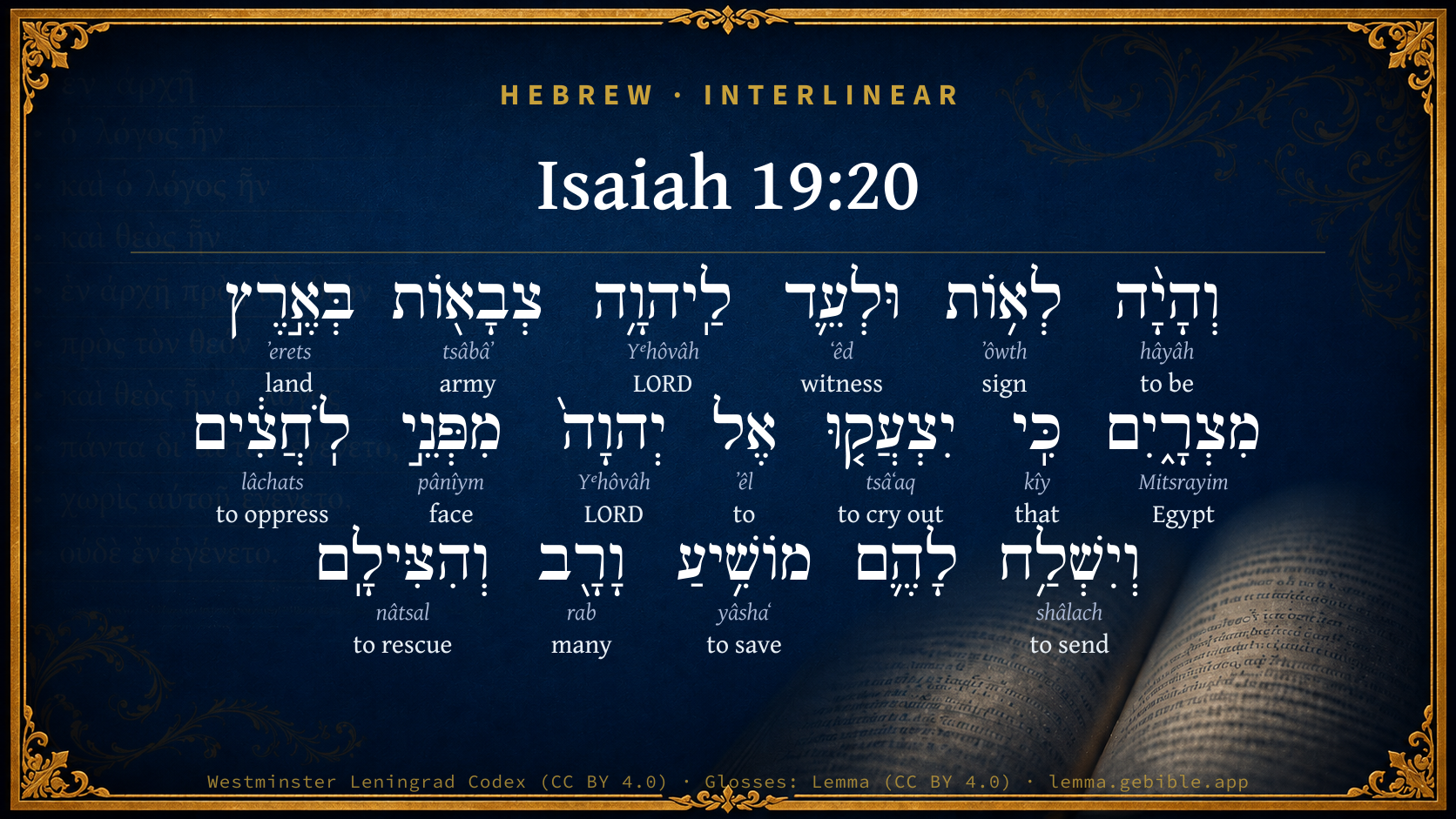
Hebrew (Westminster Leningrad Codex) Isaiah 19:20 appears in the Hebrew Old Testament. The text above is from the Westminster Leningrad Codex. Each word links to its Strong’s number, a concise gloss, and parsing drawn from the Open Scriptures Hebrew Bible morphology. Click any word for its full Brown-Driver-Briggs (BDB) entry.
Download image
Cite this verse

Isaiah 19:20 (World English Bible). Public Domain. Lemma interlinear Bible study tool, https://lemma.gebible.app/v/isaiah/19/20.

Show BibTeX & RIS
BibTeX
RIS
English Translation
It shall be for a sign and for a witness to Yahweh of Hosts in the land of Egypt; for they shall cry to Yahweh because of oppressors, and he will send them a savior, and a defender, and he will deliver them.
World English Bible · Public Domain
Download a study sheet

One document with this verse’s original text, its word-by-word gloss line, the meaning frame, cross-references with their text, attributed commentary, and full source and license credits — printable, and it pastes into notes with its structure intact.

This verse Autodidact and up

Study sheet (.html) Plain text (.txt)

A passage Seminary Student

Up to 50 verses in one chapter. A passage sheet keeps up to 6 commentary sources and 12 cross-references per verse, in the order this page ranks them, and says so on the sheet whenever that leaves anything out. Ask for a single verse and you get the Autodidact verse sheet above.

Everything on this page stays free to read, with no account — the sheet is a download of what is already on screen, not access to it.

Want to remove ads? Support Godless Engineer
Compare translations 3

The same verse in 3 English versions, stacked beneath the original-language interlinear above. Click any original word for its lexicon entry.

Each is an independent rendering of the whole verse — the interlinear is not word-aligned to these translations.

Highlighted words mark where these versions differ — a whole-verse word diff, not a word-by-word alignment.

  • World English Bible Public Domain
    It shall be for a sign and for a witness to Yahweh of Hosts in the land of Egypt; for they shall cry to Yahweh because of oppressors, and he will send them a savior, and a defender, and he will deliver them.
  • King James Version Public Domain
    And it shall be for a sign and for a witness unto the LORD of hosts in the land of Egypt: for they shall cry unto the LORD because of the oppressors, and he shall send them a saviour, and a great one, and he shall deliver them.
  • unfoldingWord Literal Text CC BY-SA 4.0
    And it will be for a sign and for a witness to Yahweh of Armies in the land of Egypt. When they cry out to Yahweh from the face of oppressors, then he will send to them a savior and one being great, and he will deliver them.

unfoldingWord Literal Text — © unfoldingWord, licensed CC BY-SA 4.0. Word-aligned USFM3 via Door43 (git.door43.org/unfoldingWord/en_ult).

Versions to compare (up to 4)

3 of 4 selected

Show all 18 translations

Every available English version of this verse, each an independent rendering of the whole verse.

  • World English Bible Public Domain
    It shall be for a sign and for a witness to Yahweh of Hosts in the land of Egypt; for they shall cry to Yahweh because of oppressors, and he will send them a savior, and a defender, and he will deliver them.
  • Berean Standard Bible Public Domain
    It will be a sign and a witness to the LORD of Hosts in the land of Egypt. When they cry out to the LORD because of their oppressors, He will send them a savior and defender to rescue them.
  • Majority Standard Bible Public Domain
    It will be a sign and a witness to the LORD of Hosts in the land of Egypt. When they cry out to the LORD because of their oppressors, He will send them a savior and defender to rescue them.
  • King James Version Public Domain
    And it shall be for a sign and for a witness unto the LORD of hosts in the land of Egypt: for they shall cry unto the LORD because of the oppressors, and he shall send them a saviour, and a great one, and he shall deliver them.
  • American Standard Version (1901) Public Domain
    And it shall be for a sign and for a witness unto Jehovah of hosts in the land of Egypt; for they shall cry unto Jehovah because of oppressors, and he will send them a saviour, and a defender, and he will deliver them.
  • Revised Version (1885) Public Domain
    And it shall be for a sign and for a witness unto the LORD of hosts in the land of Egypt: for they shall cry unto the LORD because of the oppressors, and he shall send them a saviour, and a defender, and he shall deliver them.
  • Geneva Bible (1599) Public Domain
    And it shall be for a signe and for a witnes vnto the Lord of hostes in the land of Egypt: for they shall crie vnto the Lord, because of the oppressers, and he shall send them a Sauiour and a great man, and shall deliuer them.
  • Douay-Rheims (1899) Public Domain
    It shall be for a sign, and for a testimony to the Lord of hosts in the land of Egypt. For they shall cry to the Lord because of the oppressor, and he shall send them a Saviour and a defender to deliver them.
  • Young's Literal Translation Public Domain
    And it hath been for a sign and for a testimony, To Jehovah of Hosts in the land of Egypt, For they cry unto Jehovah from the face of oppressors, And He sendeth to them a saviour, Even a great one, and hath delivered them.
  • Literal Standard Version CC BY-SA 4.0
    And it has been for a sign and for a testimony, || To YHWH of Hosts in the land of Egypt, || For they cry to YHWH from the face of oppressors, || And He sends a Savior to them, || Even a great one, and has delivered them.
  • Unlocked Literal Bible CC BY-SA 4.0
    It will be as a sign and a witness to Yahweh of hosts in the land of Egypt. When they cry to Yahweh because of oppressors, he will send them a savior and a defender, and he will deliver them.
  • unfoldingWord Literal Text CC BY-SA 4.0
    And it will be for a sign and for a witness to Yahweh of Armies in the land of Egypt. When they cry out to Yahweh from the face of oppressors, then he will send to them a savior and one being great, and he will deliver them.
  • Darby Bible Public Domain
    and it shall be for a sign and for a witness to Jehovah of hosts in the land of Egypt; for they shall cry unto Jehovah because of the oppressors, and he will send them a saviour and defender, who shall deliver them.
  • World Messianic Bible Public Domain
    It will be for a sign and for a witness to the LORD of Hosts in the land of Egypt; for they will cry to the LORD because of oppressors, and he will send them a savior and a defender, and he will deliver them.
  • Webster's Bible Public Domain
    And it shall be for a sign and for a witness to the LORD of hosts in the land of Egypt: for they shall cry to the LORD because of the oppressors, and he shall send them a savior, and a great one, and he shall deliver them.
  • Free Bible Version CC BY-SA 4.0
    This will be a sign and a witness to the presence of the Lord Almighty in the land of Egypt. When they cry out to the Lord for help because they are being oppressed, he will send them a savior to fight for them and to rescue them.
  • Bible in Basic English Public Domain
    And it will be a sign and a witness to the Lord of armies in the land of Egypt: when they are crying out to the Lord because of their cruel masters, then he will send them a saviour and a strong one to make them free.
  • JPS Tanakh (1917) Public Domain
    And it shall be for a sign and for a witness unto the LORD of hosts in the land of Egypt; for they shall cry unto the LORD because of the oppressors, and He will send them a saviour, and a defender, who will deliver them.

Literal Standard Version (2020), Covenant Press — licensed CC BY-SA 4.0. Text via the HelloAO Bible API (eBible.org). Unlocked Literal Bible (unfoldingWord) — licensed CC BY-SA 4.0. Text via the HelloAO Bible API (eBible.org). unfoldingWord Literal Text — © unfoldingWord, licensed CC BY-SA 4.0. Word-aligned USFM3 via Door43 (git.door43.org/unfoldingWord/en_ult). Free Bible Version, Dr. Jonathan Gallagher — licensed CC BY-SA 4.0. Text via the HelloAO Bible API (eBible.org).

Word by word

More ways to search: Search by grammar → Find every occurrence → Compare this word →

Practice this passage: Drill this verse → Learn its vocabulary →

לֹֽחֲצִ֔ים
lâchats
H3905
“oppressing”
Verb, Qal, Participle Active, Masculine, Plural, Absolute
Part of Speech
Verb
Stem
Qal
Form
Participle Active
Gender
Masculine
Number
Plural
State
Absolute
Full BDB Definition

Origin: a primitive root

TWOT: 1106

to squeeze, press, oppress - (Qal) - to squeeze, press - to oppress - (Niphal) to squeeze oneself
  1. וְהָיָ֨ה hâyâh H1961 “and · to be” Conjunction + Verb, Qal, Sequential Perfect, 3rd Person, Masculine, Singular
  2. לְא֥וֹת ʼôwth H226 “to/for · sign” Preposition + Noun, Common, Both, Singular, Absolute
  3. וּלְעֵ֛ד ʻêd H5707 “and · to/for · witness” Conjunction + Preposition + Noun, Common, Masculine, Singular, Absolute
  4. לַֽיהוָ֥ה Yᵉhôvâh H3068 “to/for · LORD” Preposition + Noun, Proper
  5. צְבָא֖וֹת tsâbâʼ H6635 “armies” Noun, Common, Both, Plural, Absolute
  6. בְּאֶ֣רֶץ ʼerets H776 “in/at · land of” Preposition + Noun, Common, Both, Singular, Construct
  7. מִצְרָ֑יִם Mitsrayim H4714 “Egypt” Noun, Proper
  8. כִּֽי kîy H3588 “that” Conjunction
  9. יִצְעֲק֤וּ tsâʻaq H6817 “to cry out” Verb, Qal, Imperfect, 3rd Person, Masculine, Plural
  10. אֶל ʼêl H413 “to” Preposition
  11. יְהוָה֙ Yᵉhôvâh H3068 “LORD” Noun, Proper
  12. מִפְּנֵ֣י pânîym H6440 “from · face(s) of” Preposition + Noun, Common, Both, Plural, Construct
  13. וְיִשְׁלַ֥ח shâlach H7971 “and · to send” Conjunction + Verb, Qal, Imperfect, 3rd Person, Masculine, Singular
  14. מוֹשִׁ֥יעַ yâshaʻ H3467 “saving” Verb, Hiphil, Participle Active, Masculine, Singular, Absolute
  15. וָרָ֖ב rab H7227 “and · many” Conjunction + Verb, Qal, Participle Active, Masculine, Singular, Absolute
  16. וְהִצִּילָֽם nâtsal H5337 “and · to rescue · them” Conjunction + Verb, Hiphil, Sequential Perfect, 3rd Person, Masculine, Singular + Suffix, Personal, 3rd Person, Masculine, Plural

About this verse

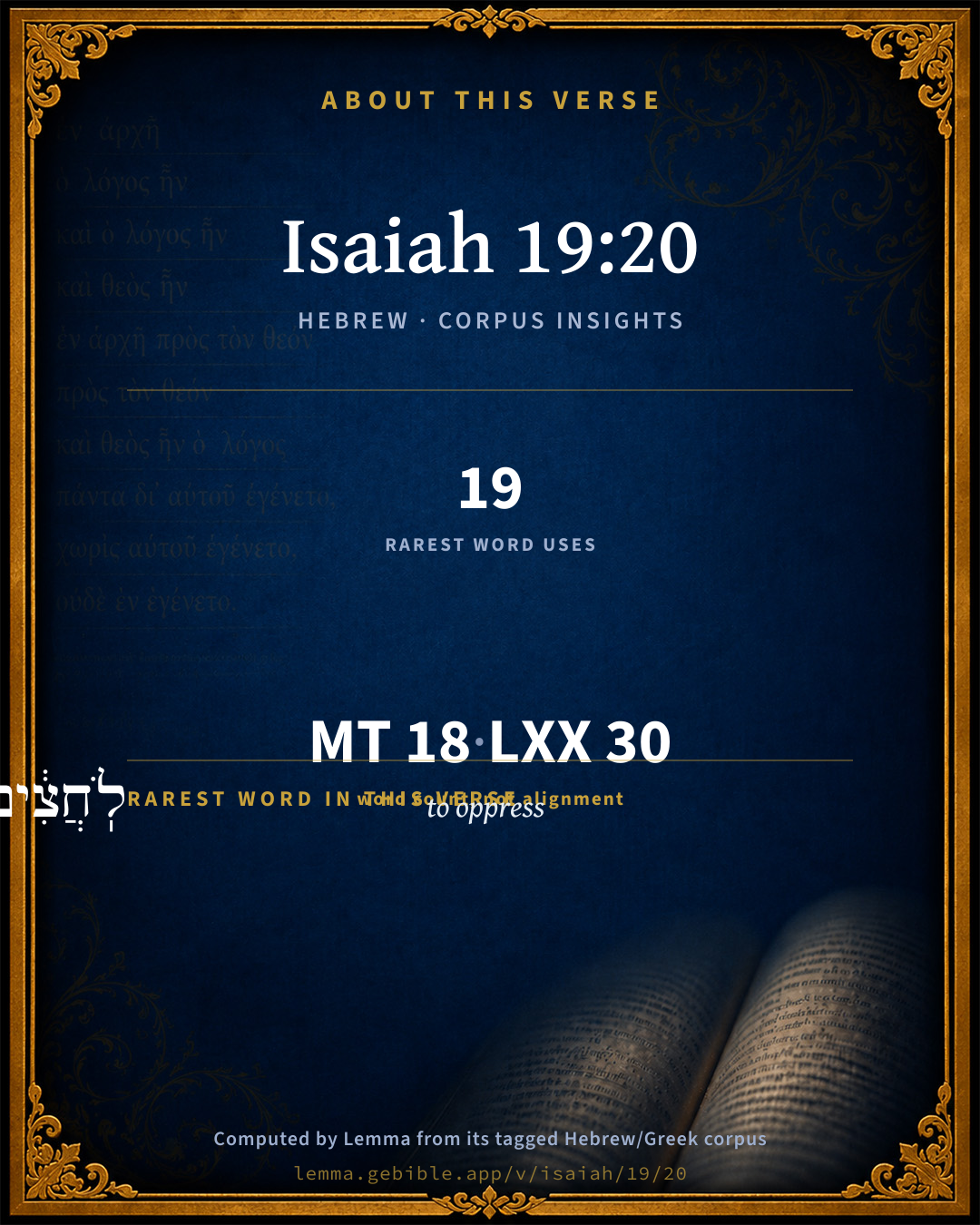
These counts appear in no published source. They are computed here, from the morphology-tagged text and Lemma’s own curated glosses. What Lemma adds →

18
words
16
distinct lemmas
Prophets
section

Notable vocabulary

The rarest word here is לֹֽחֲצִ֔ים to oppress H3905 — appearing just 19 times in the whole Hebrew Bible.

Shared distinctive vocabulary

לֹֽחֲצִ֔ים to oppress H3905 occurs in 18 verses of the Hebrew Bible. Also found in:

Grammatical profile

  • 7 verbs
  • 8 nouns
  • 2 prepositions
  • 1 conjunction

Verb forms

  • וְהָיָ֨ה Qal · Sequential Perfect
  • יִצְעֲק֤וּ Qal · Imperfect
  • לֹֽחֲצִ֔ים Qal · Participle Active
  • וְיִשְׁלַ֥ח Qal · Imperfect
  • מוֹשִׁ֥יעַ Hiphil · Participle Active
  • וָרָ֖ב Qal · Participle Active
  • וְהִצִּילָֽם Hiphil · Sequential Perfect

Repetition

A word recurs within this verse — often emphatic in Hebrew:

  • לַֽיהוָ֥ה LORD H3068 ×2

Hebrew & Septuagint length

In English translation the verse runs 43 words from the Hebrew and 49 from the Septuagint (LXX English) — closely comparable.

A rough comparison of the two English renderings, which tokenize alike — not a word-level alignment.

Word counts can differ between the Hebrew and the Greek without any difference in meaning — e.g. the Hebrew direct-object marker אֵת has no separate Greek word, and Greek often adds the article ὁ.

In the original languages it is 18 Hebrew tokens and 30 Greek tokens — but the two are counted differently (Hebrew bundles its prefixes and suffixes into one token; the Greek is in lemma form), so that isn’t a like-for-like length.

Cross-references

18

Topical passages linked to Isaiah 19:20 in the Treasury of Scripture Knowledge — connected by theme and wording, ordered by reader-vote popularity; previews shown in the World English Bible.

  • Psalms 50:15 Call on me in the day of trouble. I will deliver you, and you will honor me."
  • Titus 2:13 looking for the blessed hope and appearing of the glory of our great God and Savior, Jesus Christ;
  • Isaiah 45:21–22 Declare you, and bring [it] forth; yes, let them take counsel together: who has shown this from ancient time? who has declared it of old? Haven't I, Yahweh? and there is no God else besides me, a just God and a Savior; there is no one besides me.
  • Luke 2:11 For there is born to you, this day, in the city of David, a Savior, who is Christ the Lord.
  • Exodus 2:23 It happened in the course of those many days, that the king of Egypt died, and the children of Israel sighed because of the bondage, and they cried, and their cry came up to God because of the bondage.
  • Exodus 3:7 Yahweh said, "I have surely seen the affliction of my people who are in Egypt, and have heard their cry because of their taskmasters, for I know their sorrows.
  • Joshua 4:20–21 Those twelve stones, which they took out of the Jordan, did Joshua set up in Gilgal.
  • Joshua 22:27–28 but it shall be a witness between us and you, and between our generations after us, that we may do the service of Yahweh before him with our burnt offerings, and with our sacrifices, and with our peace-offerings; that your children may not tell our children in time to come, You have no portion in Yahweh.
  • Joshua 22:34 The children of Reuben and the children of Gad called the altar [Ed]: For, [said they], it is a witness between us that Yahweh is God.
  • Joshua 24:26–27 Joshua wrote these words in the book of the law of God; and he took a great stone, and set it up there under the oak that was by the sanctuary of Yahweh.
  • 2 Kings 13:4–5 Jehoahaz begged Yahweh, and Yahweh listened to him; for he saw the oppression of Israel, how that the king of Syria oppressed them.
  • Isaiah 19:4 I will give over the Egyptians into the hand of a cruel lord; and a fierce king shall rule over them, says the Lord, Yahweh of Hosts.
  • Isaiah 20:4 so shall the king of Assyria lead away the captives of Egypt, and the exiles of Ethiopia, young and old, naked and barefoot, and with buttocks uncovered, to the shame of Egypt.
  • Isaiah 37:36 The angel of Yahweh went forth, and struck in the camp of the Assyrians one hundred and eighty-five thousand; and when men arose early in the morning, behold, these were all dead bodies.
  • Isaiah 49:25–26 But thus says Yahweh, Even the captives of the mighty shall be taken away, and the prey of the terrible shall be delivered; for I will contend with him who contends with you, and I will save your children.
  • Isaiah 52:5 Now therefore, what do I here, says Yahweh, seeing that my people is taken away for nothing? those who rule over them do howl, says Yahweh, and my name continually all the day is blasphemed.
  • Isaiah 55:13 Instead of the thorn shall come up the fir tree; and instead of the brier shall come up the myrtle tree: and it shall be to Yahweh for a name, for an everlasting sign that shall not be cut off.
  • James 5:4 Behold, the wages of the laborers who mowed your fields, which you have kept back by fraud, cry out, and the cries of those who reaped have entered into the ears of the Lord of Hosts.

Cross-references courtesy of OpenBible.info (CC BY 4.0).

Hebrew and Greek witnesses Masoretic Hebrew ↔ Greek Septuagint

The same verse in the two great witnesses to the Old Testament, shown verse-for-verse.

These are two independent witnesses, not word-aligned to each other, and the Septuagint is shown in lemma (dictionary) form.

Hebrew Isaiah 19:20 Masoretic · Westminster Leningrad Codex

וְהָיָ֨ה לְא֥וֹת וּלְעֵ֛ד לַֽיהוָ֥ה צְבָא֖וֹת בְּאֶ֣רֶץ מִצְרָ֑יִם כִּֽי יִצְעֲק֤וּ אֶל יְהוָה֙ מִפְּנֵ֣י לֹֽחֲצִ֔ים וְיִשְׁלַ֥ח לָהֶ֛ם מוֹשִׁ֥יעַ וָרָ֖ב וְהִצִּילָֽם

It shall be for a sign and for a witness to Yahweh of Hosts in the land of Egypt; for they shall cry to Yahweh because of oppressors, and he will send them a savior, and a defender, and he will deliver them.

World English Bible · Public Domain

Greek LXX Isaiah 19:20 Septuagint · lemma form

καί εἰμί εἰς σημεῖον εἰς ὁ αἰών κύριος ἐν χώρα αἴγυπτος ὅτι κράζω πρός κύριος διά ὁ θλίβω αὐτός καί ἀποστέλλω αὐτός κύριος ἄνθρωπος ὅς σώζω αὐτός κρίνω σώζω αὐτός

And it shall be for a sign to the Lord for ever in the land of Egypt: for they shall presently cry to the Lord by reason of them that afflict them, and he shall send them a man who shall save them; he shall judge and save them.

LXX2012 (modern English Septuagint) · Public Domain

On this verse, The Biblical Illustrator discusses the Septuagint’s reading. Read the note in Commentary ↓

Hebrew: Westminster Leningrad Codex (CC BY 4.0). Greek: Septuagint (public domain); English from LXX2012 (modern English Septuagint) (Public Domain). How the Septuagint differs from the Hebrew →

Targum (Aramaic paraphrase)

1

The Targum is the ancient Jewish Aramaic paraphrase of the Hebrew Scriptures — an interpretive translation, not the Hebrew text itself. Onkelos (literal) and Pseudo-Jonathan (expansive) render the Torah, and Jonathan the Prophets. Coverage is partial: where no permissively-licensed English translation exists for a verse, only the Aramaic is shown. This is verse-level text, not a word-by-word alignment to the Hebrew.

  1. Targum Jonathan Prophets (Joshua–Malachi)
    וִיהֵי לְאָת וּלְסָהִיד קֳדָם יְיָ צְבָאוֹת בְּאַרְעָא דְמִצְרַיִם אֲרֵי יְצַלוּן קֳדָם יְיָ מִן קֳדָם דָחֲקֵיהוֹן וִישַׁלַח לְהוֹן פָּרִיק וְדַיָן וִישֵׁיזְבִינוּן:

    And it shall be for a sign, and for a witness before the Lord of hosts in the land of Egypt, when they shall pray before the Lord because of their oppressors, and He shall send unto them a Saviour, and a Judge, and He shall deliver them.

    Targum Jonathan — Aramaic: “Mikraot Gedolot” (public domain). English: “Sefaria Community Translation” (CC0 1.0 (public-domain dedication)); “London "Chaldee Paraphrase," 1871” (public domain). Text via Sefaria.

Commentary

Notes on Isaiah 19:20 from classic Christian and Jewish commentators (each source and its license shown beneath its notes). The classic Christian expositions comment on the surrounding passage and are grouped to its opening verse, so a note may address several verses; the Jewish commentaries on the Tanakh (Rashi and others) are per-verse, so they appear only where the commentator wrote on this verse.

Lemma curates 59 commentaries, every one of them public domain or Creative Commons licensed, each selected and text-cleaned for this edition rather than reprinted as found. About our sources →

Trapp's Complete Commentary

John Trapp

Isa 19:20 And it shall be for a sign and for a witness unto the LORD of hosts in the land of Egypt: for they shall cry unto the LORD because of the oppressors, and he shall send them a saviour, and a great one, and he shall deliver them.

Ver. 20. And it shall be for a sign and for a witness.] The doctrine of Christ’s death is a clear testimony of God’s great love and kindness to mankind. {Rom 5:8}

For they shall cry unto the Lord for their oppressors.] As the Israelites sometimes had done under the Egyptian servitude. {Exo 3:9}

And he shall send them a Saviour.] Not Moses but Messias, that great Saviour; {a} for God had laid his people’s "help on one that is mighty." {Psa 89:19} See Tit 2:13.

{a} Servatorem et magnatem, vel magistrum.

John Trapp, A Commentary or Exposition upon All the Books of the Old and New Testament (1647–1656) — public domain. Text from a community e-Sword module.

The Biblical Illustrator

Joseph S. Exell

Isa_19:20

He shall send them a Saviour and a great one

A Saviour and a great one

The literal coincidences between the promise of a saviour and a great one, and the titles of Alexander the Great and Ptolemy the Saviour are noticeable and interesting.

(Sir E. Strachey, Bart.)

Alexander the Great

Alexander the Great delivered them from the grievous Persian yoke, and he and his successors greatly favoured the people and improved the country. He settled a great many Jews in Alexandria, giving them equal privileges with the Macedonians; and this Hebrew immigration was still further promoted by Ptolemy Soter, so that Philo reckoned that in his time there were a million Jews in the country. The temple of Onias, the LXX version of the Bible, the books of the Apocrypha, the philosophy and theology of Philo, indicate not only what these Jews were in themselves, but enable us to infer with certainty how great must have been their example and influence in humanising the Egyptians, and bringing them to the knowledge and worship of the true God. And still more were these results apparent, still more amply was this prophecy fulfilled, when Alexandria became one of the great centres of the Christian Church. (Sir E. Strachey, Bart.)

Who was the great Saviour promised to Egypt?

Even if the language of this verse by itself might seem to point to a particular deliverer, the comprehensive language of the context would forbid its reference to any such exclusively. If the chapter is a prophecy not of a single went but of a great progressive change to be wrought in the condition of Egypt by the introduction of the true religion, the promise of the verse before us must be, that when they cried God would send them a deliverer, a promise verified not once but often, not by Ptolemy or Alexander only, but by others, and in the highest sense by Christ Himself. (J. A. Alexander.)

The Messiah a great Saviour

I. GREAT IN HIS PERSON. God over all, blessed forever:--

II. GREAT IN THE CHARACTER HE SUSTAINS.

III. GREAT IN THIS WORKS HE PERFORMS.

IV. GREAT IN THE SALVATION HE BESTOWS.

V. GREAT IN THE GLORY TO WHICH HE IS NOW EXALTED. (R. Macculloch.)

A great Saviour provided

An old Mexican monk, in his dingy cell, once painted an allegorical picture, representing a beautiful maiden standing on an island, with only room for her feet to rest upon, while all around dashed and surged a lake of fire. The angry flames almost touched her, and yet she smiled, all unconscious of danger. More dreadful still, on each billows crest rides a malignant fiend, and they are closing around the seemingly defenceless girl, seeking to fasten chains about her limbs, that they may drag her into the burning lake. The maiden still smiles serenely, for she sees them not. A golden cord of grace, descending from above, is twined amidst her sunny hair, but death appears ready to cut the slender thread. A hand of help is reaching down to her, which she must take, or be lost in the fiery abyss. A company of attending angels anxiously await her decision, and this group completes the picture. This is no fancy sketch of the old painters brain, but it is your condition unless you have laid hold on Christ Jesus to deliver you. (J. N. Norton.)

The Biblical Illustrator, edited by Joseph S. Exell (c. 1880s–1900s) — public domain. Text from a community e-Sword module.

Joseph Benson's Commentary

Isa 19:20-22. And it shall be for a sign — Namely, the altar or pillar, last mentioned; and for a witness unto the Lord of hosts — To testify that they own the Lord for their God. For they shall cry unto the Lord because of their oppressors — Being sorely distressed, and finding that their idols are unable to help them, they shall turn unto the true God. And he shall send them a saviour, and a great one — In these words the prophet sets forth the cause of this happy change in Egypt, with its immediate effects, namely, their crying to the Lord in their distress, and his sending them a saviour, who should deliver them. “Here it is clearly foretold,” says Bishop Newton, “that a great prince, sent by God, from a foreign country, should deliver the Egyptians from their Persian oppressors, and heal their country, which was smitten of God, and afflicted: and who could this be but Alexander, who is always distinguished by the name of Alexander the Great, and whose first successor in Egypt was called the great Ptolemy, and Ptolemy Soter, or the saviour? Upon Alexander’s first coming into Egypt the people all cheerfully submitted to him out of hatred to the Persians, so that he became master of the country without any opposition. For this reason he treated them with humanity and kindness, built there a city, which, after his own name, he called Alexandria, appointed one of their own country for their civil governor, and permitted them to be governed by their own laws and customs. By these changes and regulations, and by the prudent and gentle administration of some of the first Ptolemies, Egypt revived, trade and learning flourished, and, for a while, peace and plenty blessed the land. But it is more largely foretold, that, about the same time, the true religion and the worship of the God of Israel should begin to spread and prevail in the land of Egypt; and what event was ever more unlikely to happen than the conversion of a people so sunk and lost in superstition and idolatry, of the worst and grossest kind? It is certain that many of the Jews, after Nebuchadnezzar had taken Jerusalem, fled into Egypt, and carried along with them Jeremiah the prophet, who there uttered many of his prophecies concerning the conquest of Egypt by Nebuchadnezzar. “From hence,” and by the means above described, “some knowledge of God, and some notice of the prophecies, might easily be derived to the Egyptians.” “By these means, the Lord must, in some degree, have been known to Egypt, and the Egyptians must have known the Lord — And, without doubt, there must have been many proselytes among them. Among those who came up to the feast of pentecost, (Act 2:10,) are particularly mentioned the dwellers in Egypt, and in the parts of Lybia about Cyrene, Jews and proselytes. Nay, from the instance of Candace’s eunuch, (Act 8:27,) we may infer that there were proselytes even beyond Egypt, in Ethiopia. Thus were the Jews settled and encouraged in Egypt, insomuch that Philo represents their number as not less than a hundred myriads, or ten hundred thousand men.” But though this prophecy concerning Egypt might have its first accomplishment in the deliverance of the Egyptians from the Persian yoke by Alexander the Great, and in that knowledge of the true God, and of his revealed will, which many of the Egyptians received under the government of the Ptolemies, through their intercourse with the Jews, and the translation of the Jewish Scriptures into the Greek language; yet, doubtless, this prediction has a further and higher aspect, as commentators in general have understood it, and refers to that spiritual redemption and salvation which the Egyptians, among many other ignorant and idolatrous Gentiles, were to receive, and actually did receive, by the coming of Christ, the great and only Saviour of lost mankind, and by the publication of his gospel to them. This appears still more evidently from the verses which follow. But the full and final accomplishment of this, as well as of many other important prophecies, shall not take place till Mohammedanism and idolatry shall be completely overthrown, and the earth shall be full of the knowledge of the Lord, as the waters cover the sea.

Joseph Benson's Commentary on the Old and New Testaments (1811–1818) — public domain. Text from a community e-Sword module.

Tyndale Open Study Notes

Tyndale Open Resources

19:20 The altar (19:19) would be a sign and a witness of the Egyptians’ religious connection with Israel (see 19:24-25). • God answers the prayers of those who cry to the Lord for help. • The Lord is a savior; he would protect the Egyptians even as he protected Jerusalem from the Assyrians.

Tyndale Open Study Notes — © Tyndale Open Resources, licensed CC BY-SA 4.0. Text via the HelloAO Bible API.

Geneva Bible (1599)

Geneva Bible translators

This declareth that this prophecy should be accomplished in the time of Christ.

Geneva Bible (1599) marginal notes — public domain. Text via Bolls.life.

Jamieson, Fausset & Brown

Robert Jamieson, A. R. Fausset & David Brown

it--the altar and pillar.

a sign--(of the fulfilment of prophecy) to their contemporaries.

a witness--to their descendants.

unto the Lord--no longer, to their idols, but to Jehovah.

for they shall cry--or, "a sign . . . that they cried, . . . and He sent to them a saviour"; probably, Alexander the Great (so "a great one"), whom the Egyptians welcomed as a deliverer (Greek, Soter, a title of the Ptolemies) out of the hands of the Persians, who under Cambyses had been their "oppressors." At Alexandria, called from him, the Old Testament was translated into Greek for the Greek-speaking Jews, who in large numbers dwelt in Egypt under the Ptolemies, his successors. Messiah is the antitype ultimately intended (compare Act 2:10, "Egypt").

Jamieson, Fausset & Brown — Commentary Critical and Explanatory on the Whole Bible (1871) — public domain (CC PDM 1.0). Text via the HelloAO Bible API.

Ellicott's Commentary for English Readers

(20) For they shall cry unto the Lord because of the oppressors . . .—The words are almost as an anticipation of the great truth proclaimed in Joh_4:21. The prayers of the worshippers in spirit and in truth, whether Jews or proselytes, in Egypt should find as immediate an access to the ear of Jehovah as if they had been offered in the Temple at Jerusalem. If the people suffered under the oppression of a Pharaoh, or a Cambyses, or a Ptolemy, and prayed for deliverance, He would as certainly send them a saviour who should free them from the yoke as He had sent saviours to Israel of old in the persons of the judges (Jdg_3:9; Jdg_3:15; Jdg_4:4). It is open to us to see a yet higher fulfilment in the fact that the message of the Gospel brought peace and joy to those who were weary and heavy laden in Egypt, as well as in Galilee; to those who were looking for redemption in Alexandria not less than to those who were looking for it in Jerusalem.

A Bible Commentary for English Readers, edited by Charles John Ellicott (1878–1897) — public domain. Text from a community e-Sword module.

The Cambridge Bible for Schools and Colleges

gen. ed. J. J. S. Perowne

20. for a sign and for a witness unto the Lord of hosts] i.e. a reminder that He has a people in Egypt, and that by their presence the land is consecrated to Him.

The process of conversion in this and the following verses is finely conceived. First, the name of Jehovah is made known by the religious observances of the Jewish colonists and proselytes; then, in a time of trouble, the Egyptians turn to Him instead of to their false gods, and learn to know Him through His answer to their prayers (20, 21); finally this experience of Jehovah is deepened and purified by a discipline similar to that to which Israel was subjected in the time of the Judges (22).

the oppressors] Omit the art.; the reference is quite general.

a saviour] See Jdg_3:9; Jdg_3:15; 2Ki_13:5.

a great one] Better: a champion. A special allusion to Ptolemy Soter, or to the Jewish generals who served under Ptolemy Philometor is not called for.

The Cambridge Bible for Schools and Colleges (gen. ed. J. J. S. Perowne; Cambridge University Press, 1878–1918) — public domain. Text from a community e-Sword module.

John Gill's Exposition

And it shall be for a sign and for a witness unto the Lord of hosts in the land of Egypt,.... This refers either to what goes before, that the altar and pillar were signs and witnesses that the Lord was believed in, professed, and worshipped there; or to what follows after, that the Lord's hearing the cries of men, and answering them, by sending a great Saviour to them, is a token and testimony for him of his great love unto them:

for they shall cry unto the Lord because of the oppressors; as men awakened and convinced do, feeling the oppressions of a guilty conscience, and a tempting devil, and an ensnaring wicked world:

and he shall send them a Saviour, and a great one, and he shall deliver them; this is Christ, whom God sent in the fulness of time to be the Saviour of lost sinners; and he is a "great" one indeed, the great God, and our Saviour, Tit 2:13 who is the Son of God, the true God, and eternal life, who has all the perfections of deity in him; the Creator and Upholder of all things; and must have therefore great and sufficient abilities to save sinners to the uttermost; and those that come to God by him he does save and deliver from all their sins, and out of the hands of all their enemies, and from wrath, ruin, and destruction. Abarbinel (e) owns that the Messiah is here meant, as undoubtedly he is; and not the angel that destroyed Sennacherib's army, as Kimchi; for the text speaks not of the Jews, but of the Egyptians. Vitringa thinks that either Alexander, called the Great, or else Ptolemy the son of Lagus, who had the same epithet, and who was also called "Soter", the saviour, is here meant.

(e) Mashmiah Jeshua, fol. 13. 1.

John Gill's Exposition of the Whole Bible (1746–1763) — public domain (CC PDM 1.0). Text via the HelloAO Bible API.

Albert Barnes' Notes on the Bible

And it shall be for a sign - The altar, and the pillar. This shows that the altar was not to be for sacrifice, but was a “memorial,” or designed to designate a place of worship.

They shall cry to the Lord because of the oppressors - That is, oppressed and borne down under the exactions of their rulers, they shall seek deliverance from the true God - one instance among many of the effect of affliction and oppression in leading people to embrace the true religion.

And he shall send them a saviour - Who this “saviour” would be, has been a subject on which there has been a great difference of opinion. Grotius supposes that it would be “the angel” by which the army of Sennacherib would be destroyed. Gesenius thinks it was Psammetichus, who would deliver them from the tyranny of the eleven kings who were contending with each other, or that, since in Isa 19:4, he is called a ‘severe lord,’ it is probable that the promise here is to be understood of a delivering or protecting angel. But it is evident that some person is here denoted who would be sent “subsequently” to the national judgments which are here designated. Dr. Gill supposes that by the saviour here is meant the Messiah; but this interpretation does not suit the connection, for it is evident that the event here predicted, was to take place before the coming of Christ. Vitringa and Dr. Newton suppose with more probability that Alexander the Great is here referred to, who took possession of Egypt after his conquest in the East, and who might be called “a saviour,” inasmuch as he delivered them from the reign of the oppressive kings who had tyrannized there, and inasmuch as his reign and the reigns of those who succeeded him in Egypt, would be much more mild than that of the former kings of that country.

That Alexander the Great was regarded by the Egyptians as a saviour or deliverer, is apparent from history. Upon his coming to Egypt, the people submitted to him cheerfully, out of hatred to the Persians, so that he became master of the country without any opposition (Diod. Sic. xvii. 49; Arrian, iii. 3, 1; Q. Curtius, iv. 7, 8, as quoted by Newton). He treated them with much kindness; built the city of Alexandria, calling it after his own name, designing to make it the capital of his empire; and under him and the Ptolemies who succeeded him, trade revived, commerce flourished, learning was patronized, and peace and plenty blessed the land. Among other things, Alexander transplanted many Jews into Alexandria, and granted them many privileges, equal to the Macedonians themselves (Jos. “Bell. Jud.” ii. 18. 7; “Contra Ap.” ii. 4). ‘The arrival of Alexander,’ says Wilkinson (“Ancient Egyptians,” vol. i. pp. 213, 214), ‘was greeted with universal satisfaction.

Their hatred of the Persians, and their frequent alliances with the Greeks, who had fought under the same banners against a common enemy, naturally taught the Egyptians to welcome the Macedonian army with the strongest demonstrations of friendship, and to consider their coming as a direct interposition of the gods; and so wise and considerate was the conduct of the early Ptolemies, that they almost ceased to regret the period when they were governed by their native princes.’ Under the Ptolemies, large numbers of the Jews settled in Egypt. For their use, as has been remarked, the Old Testament was translated into Greek, and a temple was built by Onias, under the sixth Ptolemy. Philo represents the number of the Jews in Egypt in his time at not less than one million. They were settled in nearly all parts oF Egypt; but particularly in Heliopolis or the city of the sun, in Migdol, in Tahpanes, in Noph or Memphis, in Pathros or Thebais Jer 44:1 - perhaps the five cities referred to in Isa 19:18.

And a great one - (ורב vârâb). A mighty one; a powerful saviour. The name ‘great’ has been commonly assigned to Alexander. The Septuagint renders this, ‘Judging (κρίνων krinōn), he shall save them;’ evidently regarding רב râb as derived from ריב riyb “to manage a cause, or to judge.” Lowth renders it, ‘A vindicator.’ The word means “great, mighty;” and is repeatedly applied to a prince, chief, or captain 2Ki 25:8; Est 1:8; Dan 1:3; Dan 2:48; Dan 5:11.

Albert Barnes' Notes on the Bible (1834–1885) — public domain. Text from a community e-Sword/MySword module.

Haydock's Catholic Bible Commentary

Them. The Jews were miraculously rescued from the hands of Philopater, (Josephus, contra Apion ii.) or rather Christians are delivered from sin and Satan.

George Leo Haydock (1774–1849), Haydock's Catholic Family Bible and Commentary, 1859 edition — public domain. Excludes Psalms (Douay-Rheims chapter numbering differs from Protestant) and Deuterocanonical books (Catholic canon only).

Matthew Poole's English Annotations

And it, the altar or pillar last mentioned,

shall be for a sign and for a witness unto the Lord, to testify that they own the Lord for their God.

They shall cry unto the Lord because of the oppressors; being sorely distressed, and finding the weakness of their idols, they shall turn unto the true God.

A Saviour, and a great one; a great or mighty Saviour, by a common figure called hendiaduo, as a cloud and smoke is put for a smoking cloud, Isa 4:5; or, a Saviour and a Prince, even Christ, who is so called, Act 5:31, as is evident from the whole context, which apparently speaks of gospel times. And the emphatical phrase here used directed them to look for an extraordinary Saviour.

Matthew Poole's English Annotations on the Holy Bible (1683–1685) — public domain. Text from a community e-Sword/MySword module.

Whedon's Commentary on the Bible

Daniel D. Whedon

20. And it — The “altar,” or the “pillar.” The idea of salvation and deliverance in this verse is, without doubt, the moral rescue which the land received on being delivered from its old time besetting idolatries.

Daniel D. Whedon (gen. ed.), Commentary on the Old and New Testaments (1874–1909) — public domain. Text from a community e-Sword module.

The Pulpit Commentary

It shall be for a sign. The outward tokens of Jehovah-worship shall witness to God that he has in Egypt now a covenant people, and he will deal with them accordingly. He shall send them a savior, and a great one. This does not seem to point to any earthly deliverer, but to the Savior from the worst of all oppressors, sin and Satan, whom they will need equally with the rest of his people.

The Pulpit Commentary (1880–1919), ed. H.D.M. Spence-Jones & Joseph S. Exell — public domain. Text from a community e-Sword module.

John Wesley's Explanatory Notes

It - The altar or pillar last mentioned. A witness - To testify that they own the Lord for their God. Cry - Being sorely distressed, they shall turn unto the true God. A great one - A great or mighty saviour, even Christ.

John Wesley, Explanatory Notes Upon the Whole Bible (1754–1765) — public domain. Text via the GEBible commentary corpus.

J. A. Alexander on Isaiah

Joseph Addison Alexander

“And it shall be for a sign and for a testimony to Jehovah of Hosts in the land of Egypt, that they shall cry to Jehovah from the presence of oppressors, and He will send them a deliverer and a mighty one and save them.” This shall be a sign and a witness to (i.e., with respect to, in behalf of) Jehovah in the land of Egypt, viz. that when they cry, He will afford a providential testimony in behalf of His own being, presence, and supremacy, by saving those who cry to Him. If, as we have seen reason to believe, the chapter is a prophecy, not of a single event but of a great progressive change to be wrought in the condition of Egypt by the introduction of the true religion, the promise of the verse before us must be that when they cried God would send them a deliverer, a promise verified not once but often, not only by Ptolemy or Alexander, but by others, and in the highest sense by Christ Himself. In the language of this verse there is an obvious allusion to the frequent statement in the book of Judges, that the people cried to God and He raised them up deliverers who saved them from their oppressors (Jdg 2:16; Jdg 3:9; etc.).

Joseph Addison Alexander, The Prophecies of Isaiah (1846–1847; New York: Scribner, 1870–1878) — public domain. Text from a community e-Sword module.

Rashi

Rabbi Shlomo Yitzchaki (Rashi)

And it shall be The altar shall be for a sign and for a witness between them and the Omnipresent.

a savior and a prince Heb. מוֹשִׁיעַ וְרָב, a savior and a prince.

Rashi on the Tanakh — English translations: “The Judaica Press complete Tanach with Rashi, translated by A. J. Rosenberg” (CC BY 4.0); “Pentateuch with Rashi's commentary by M. Rosenbaum and A.M. Silbermann, 1929-1934” (public domain); “The Metsudah Tanach series, Lakewood, N.J” (CC BY 4.0); and “The Book of Joshua, Metsudah Publications, 1997” (CC BY 4.0). Text via Sefaria.

Ibn Ezra

Rabbi Abraham ibn Ezra

They shall cry unto the Lord because of the oppressors, etc. Whosoever will be in trouble will come thither to bring his offering.

ורב And a great one.: a deliverer who is also a great man; a great deliverer. It would be a more natural explanation to take רב as participle of ריב to plead; a helper and a defender. Comp. רב chief (Est. 1:8)

Ibn Ezra on the Tanakh — English translations: “Sefaria Community Translation” (CC0 1.0 (public-domain dedication)); “Yalkut, Sifsei Chachomim Chumash, Metsudah Publications, 2009” (CC BY 4.0); and “Commentary of Ibn Ezra on Isaiah - trans. by M. Friedlander, 1873” (public domain). Text via Sefaria.

Lesson kit

Teaching starters — assembled from the data on this page, not authored interpretation. Every prompt links to the verse data it draws on. Edit before teaching.

Isaiah, in the Prophets, opens this verse with 18 words (16 distinct Hebrew lemmas). Its most distinctive word is lâchats (“to oppress”). A historical commentator’s framing appears above. Read the whole chapter for the surrounding context.

Discussion questions

  1. What does “to oppress” (lâchats) contribute to the verse as a whole?
  2. How does Exodus 3:9, which shares the word «to oppress», read alongside this verse?
  3. What does the repetition of “LORD” (2× in this one verse) do in this verse?
  4. These translations render this verse differently. What is at stake in choosing one wording over another?
  5. «וְהָיָ֨ה» is a Qal Sequential Perfect verb. How does that grammatical form shape the action described?
  6. Compare how Trapp's Complete Commentary and The Biblical Illustrator read this verse. Where do they agree or differ?

Things to notice

Reading settings

Reading text

Shown beneath each verse's original-language words.

Old Testament
Old Testament edition

Read the OT as the Masoretic Hebrew (MT) or the Greek Septuagint (LXX).

English shown for the Greek Septuagint (in the Hebrew ↔ Greek comparison).

Comparing translations? Open the Compare panel on any verse page to stack up to four side by side.