
Isaiah 36:6

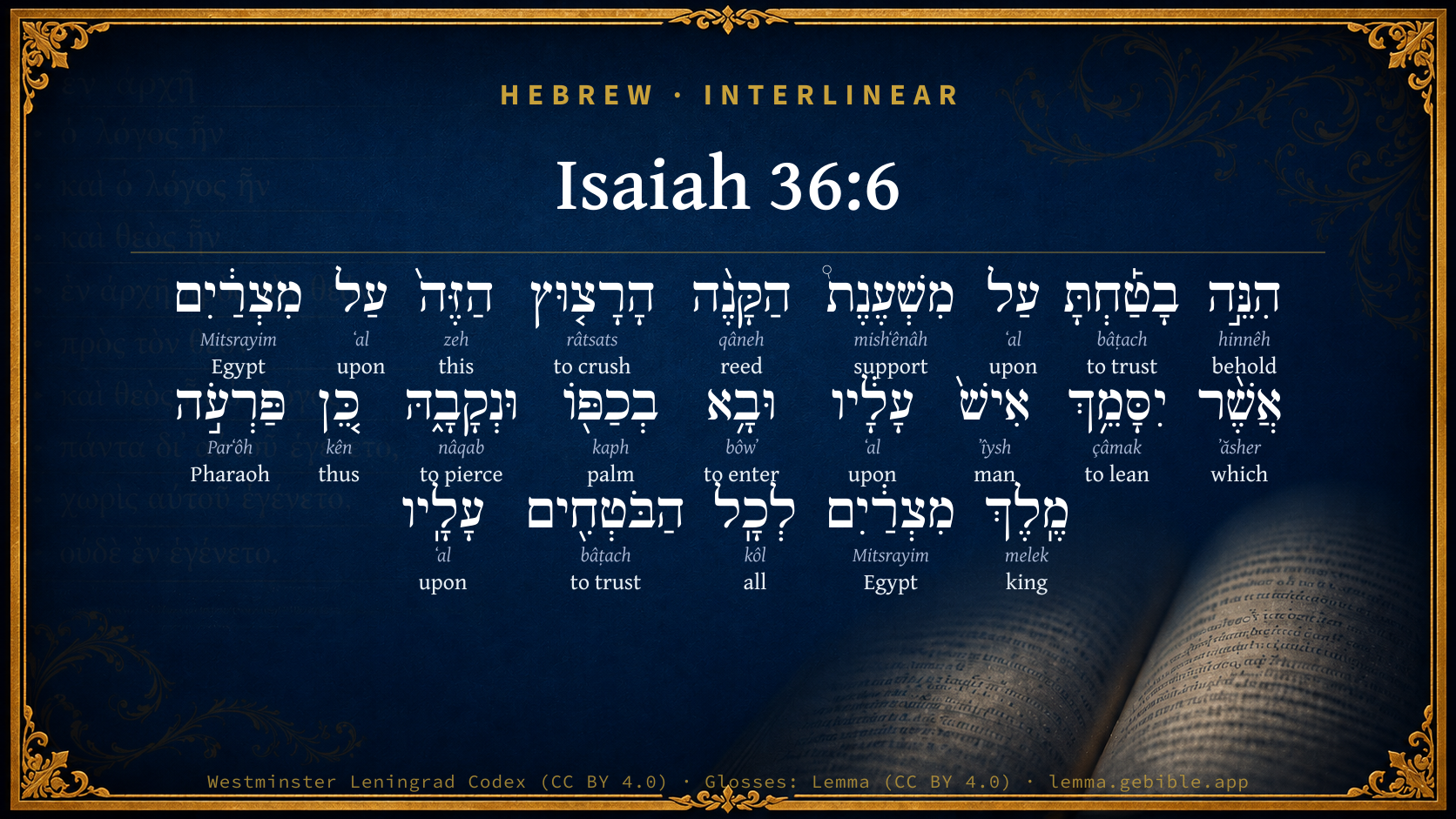
Hebrew (Westminster Leningrad Codex) Isaiah 36:6 appears in the Hebrew Old Testament. The text above is from the Westminster Leningrad Codex. Each word links to its Strong’s number, a concise gloss, and parsing drawn from the Open Scriptures Hebrew Bible morphology. Click any word for its full Brown-Driver-Briggs (BDB) entry.
Download image
Cite this verse

Isaiah 36:6 (World English Bible). Public Domain. Lemma interlinear Bible study tool, https://lemma.gebible.app/v/isaiah/36/6.

Show BibTeX & RIS
BibTeX
RIS
English Translation
Behold, you trust on the staff of this bruised reed, even on Egypt, whereon if a man lean, it will go into his hand, and pierce it: so is Pharaoh king of Egypt to all who trust on him.
World English Bible · Public Domain
Download a study sheet

One document with this verse’s original text, its word-by-word gloss line, the meaning frame, cross-references with their text, attributed commentary, and full source and license credits — printable, and it pastes into notes with its structure intact.

This verse Autodidact and up

Study sheet (.html) Plain text (.txt)

A passage Seminary Student

Up to 50 verses in one chapter. A passage sheet keeps up to 6 commentary sources and 12 cross-references per verse, in the order this page ranks them, and says so on the sheet whenever that leaves anything out. Ask for a single verse and you get the Autodidact verse sheet above.

Everything on this page stays free to read, with no account — the sheet is a download of what is already on screen, not access to it.

Want to remove ads? Support Godless Engineer
Compare translations 3

The same verse in 3 English versions, stacked beneath the original-language interlinear above. Click any original word for its lexicon entry.

Each is an independent rendering of the whole verse — the interlinear is not word-aligned to these translations.

Highlighted words mark where these versions differ — a whole-verse word diff, not a word-by-word alignment.

  • World English Bible Public Domain
    Behold, you trust on the staff of this bruised reed, even on Egypt, whereon if a man lean, it will go into his hand, and pierce it: so is Pharaoh king of Egypt to all who trust on him.
  • King James Version Public Domain
    Lo, thou trustest in the staff of this broken reed, on Egypt; whereon if a man lean, it will go into his hand, and pierce it: so is Pharaoh king of Egypt to all that trust in him.
  • unfoldingWord Literal Text CC BY-SA 4.0
    Behold, you trust in the staff of this broken reed, in Egypt, on which a man leans and it goes into his palm and pierces it. Thus Pharaoh, the king of Egypt, to all of the ones trusting in him.”’

unfoldingWord Literal Text — © unfoldingWord, licensed CC BY-SA 4.0. Word-aligned USFM3 via Door43 (git.door43.org/unfoldingWord/en_ult).

Versions to compare (up to 4)

3 of 4 selected

Show all 18 translations

Every available English version of this verse, each an independent rendering of the whole verse.

  • World English Bible Public Domain
    Behold, you trust on the staff of this bruised reed, even on Egypt, whereon if a man lean, it will go into his hand, and pierce it: so is Pharaoh king of Egypt to all who trust on him.
  • Berean Standard Bible Public Domain
    Look now, you are trusting in Egypt, that splintered reed of a staff that will pierce the hand of anyone who leans on it. Such is Pharaoh king of Egypt to all who trust in him.
  • Majority Standard Bible Public Domain
    Look now, you are trusting in Egypt, that splintered reed of a staff that will pierce the hand of anyone who leans on it. Such is Pharaoh king of Egypt to all who trust in him.
  • King James Version Public Domain
    Lo, thou trustest in the staff of this broken reed, on Egypt; whereon if a man lean, it will go into his hand, and pierce it: so is Pharaoh king of Egypt to all that trust in him.
  • American Standard Version (1901) Public Domain
    Behold, thou trustest upon the staff of this bruised reed, even upon Egypt, whereon if a man lean, it will go into his hand, and pierce it: so is Pharaoh king of Egypt to all that trust on him.
  • Revised Version (1885) Public Domain
    Behold, thou trustest upon the staff of this bruised reed, even upon Egypt; whereon if a man lean, it will go into his hand, and pierce it: so is Pharaoh king of Egypt to all that trust on him.
  • Geneva Bible (1599) Public Domain
    Loe, thou trustest in this broken staffe of reede on Egypt, whereupon if a man leane, it will goe into his hand, and pearce it: so is Pharaoh King of Egypt, vnto all that trust in him.
  • Douay-Rheims (1899) Public Domain
    Lo thou trustest upon this broken staff of a reed, upon Egypt: upon which if a man lean, it will go into his hand, and pierce it: so is Pharao king or Egypt to all that trust in him.
  • Young's Literal Translation Public Domain
    `Lo, thou hast trusted on the staff of this broken reed -- on Egypt -- which a man leaneth on, and it hath gone into his hand, and pierced it -- so `is' Pharaoh king of Egypt to all those trusting on him.
  • Literal Standard Version CC BY-SA 4.0
    Behold, you have trusted on the staff of this broken reed—on Egypt—which a man leans on, and it has gone into his hand, and pierced it—so [is] Pharaoh king of Egypt to all those trusting on him.
  • Unlocked Literal Bible CC BY-SA 4.0
    Look, you are trusting in Egypt, that splintered reed that you use as a walking staff, but if a man leans on it, it will stick into his hand and pierce it. That is what Pharaoh king of Egypt is to anyone who trusts in him.
  • unfoldingWord Literal Text CC BY-SA 4.0
    Behold, you trust in the staff of this broken reed, in Egypt, on which a man leans and it goes into his palm and pierces it. Thus Pharaoh, the king of Egypt, to all of the ones trusting in him.”’
  • Darby Bible Public Domain
    Behold, thou reliest upon the staff of that broken reed, upon Egypt, on which if a man lean, it goes into his hand, and pierces it: so is Pharaoh king of Egypt to all that rely upon him.
  • World Messianic Bible Public Domain
    Behold, you trust in the staff of this bruised reed, even in Egypt, which if a man leans on it, it will go into his hand and pierce it. So is Pharaoh king of Egypt to all who trust in him.
  • Webster's Bible Public Domain
    Lo, thou trustest in the staff of this broken reed, on Egypt; on which if a man lean, it will enter his hand, and pierce it: so is Pharaoh king of Egypt to all that trust in him.
  • Free Bible Version CC BY-SA 4.0
    Now look! You're trusting in Egypt, a walking stick that's like a broken reed that will cut the hand of anyone leaning on it. That's what Pharaoh, king of Egypt, is like to everyone who trusts in him.
  • Bible in Basic English Public Domain
    See, you are basing your hope on that broken rod of Egypt, which will go into a man's hand if he makes use of it for a support; for so is Pharaoh, king of Egypt, to all who put their faith in him.
  • JPS Tanakh (1917) Public Domain
    Behold, thou trustest upon the staff of this bruised reed, even upon Egypt; whereon if a man lean, it will go into his hand, and pierce it; so is Pharaoh king of Egypt to all that trust on him.

Literal Standard Version (2020), Covenant Press — licensed CC BY-SA 4.0. Text via the HelloAO Bible API (eBible.org). Unlocked Literal Bible (unfoldingWord) — licensed CC BY-SA 4.0. Text via the HelloAO Bible API (eBible.org). unfoldingWord Literal Text — © unfoldingWord, licensed CC BY-SA 4.0. Word-aligned USFM3 via Door43 (git.door43.org/unfoldingWord/en_ult). Free Bible Version, Dr. Jonathan Gallagher — licensed CC BY-SA 4.0. Text via the HelloAO Bible API (eBible.org).

Word by word

More ways to search: Search by grammar → Find every occurrence → Compare this word →

Practice this passage: Drill this verse → Learn its vocabulary →

מִשְׁעֶנֶת֩
mishʻênâh
H4938
“support of”
Noun, Common, Feminine, Singular, Construct
Part of Speech
Noun
Type
Common
Gender
Feminine
Number
Singular
State
Construct
Full BDB Definition

Origin: from H4937

TWOT: 2434c , 2434d

support (of every kind), staff
  1. הִנֵּ֣ה hinnêh H2009 “behold” Particle, Demonstrative
  2. בָטַ֡חְתָּ bâṭach H982 “to trust” Verb, Qal, Perfect, 2nd Person, Masculine, Singular
  3. עַל ʻal H5921 “upon” Preposition
  4. הַקָּנֶ֨ה qâneh H7070 “the · reed” Particle, Definite Article + Noun, Common, Masculine, Singular, Absolute
  5. הָרָצ֤וּץ râtsats H7533 “the · crushed” Particle, Definite Article + Verb, Qal, Participle Passive, Masculine, Singular, Absolute
  6. הַזֶּה֙ zeh H2088 “the · this” Particle, Definite Article + Pronoun, Demonstrative, Masculine, Singular
  7. עַל ʻal H5921 “upon” Preposition
  8. מִצְרַ֔יִם Mitsrayim H4714 “Egypt” Noun, Proper
  9. אֲשֶׁ֨ר ʼăsher H834 “which” Particle, Relative
  10. יִסָּמֵ֥ךְ çâmak H5564 “to lean” Verb, Niphal, Imperfect, 3rd Person, Masculine, Singular
  11. אִישׁ֙ ʼîysh H376 “man” Noun, Common, Masculine, Singular, Absolute
  12. עָלָ֔יו ʻal H5921 “upon · him” Preposition + Suffix, Personal, 3rd Person, Masculine, Singular
  13. וּבָ֥א bôwʼ H935 “and · to enter” Conjunction + Verb, Qal, Sequential Perfect, 3rd Person, Masculine, Singular
  14. בְכַפּ֖וֹ kaph H3709 “in/at · palm · his” Preposition + Noun, Common, Feminine, Singular, Construct + Suffix, Personal, 3rd Person, Masculine, Singular
  15. וּנְקָבָ֑הּ nâqab H5344 “and · to pierce · her” Conjunction + Verb, Qal, Sequential Perfect, 3rd Person, Masculine, Singular + Suffix, Personal, 3rd Person, Feminine, Singular
  16. כֵּ֚ן kên H3651 “thus” Particle, Demonstrative
  17. פַּרְעֹ֣ה Parʻôh H6547 “Pharaoh” Noun, Proper
  18. מֶֽלֶךְ melek H4428 “king of” Noun, Common, Masculine, Singular, Construct
  19. מִצְרַ֔יִם Mitsrayim H4714 “Egypt” Noun, Proper
  20. לְכָֽל kôl H3605 “to/for · all of” Preposition + Noun, Common, Masculine, Singular, Construct
  21. הַבֹּטְחִ֖ים bâṭach H982 “the · trusting” Particle, Definite Article + Verb, Qal, Participle Active, Masculine, Plural, Absolute
  22. עָלָֽיו ʻal H5921 “upon · him” Preposition + Suffix, Personal, 3rd Person, Masculine, Singular

About this verse

These counts appear in no published source. They are computed here, from the morphology-tagged text and Lemma’s own curated glosses. What Lemma adds →

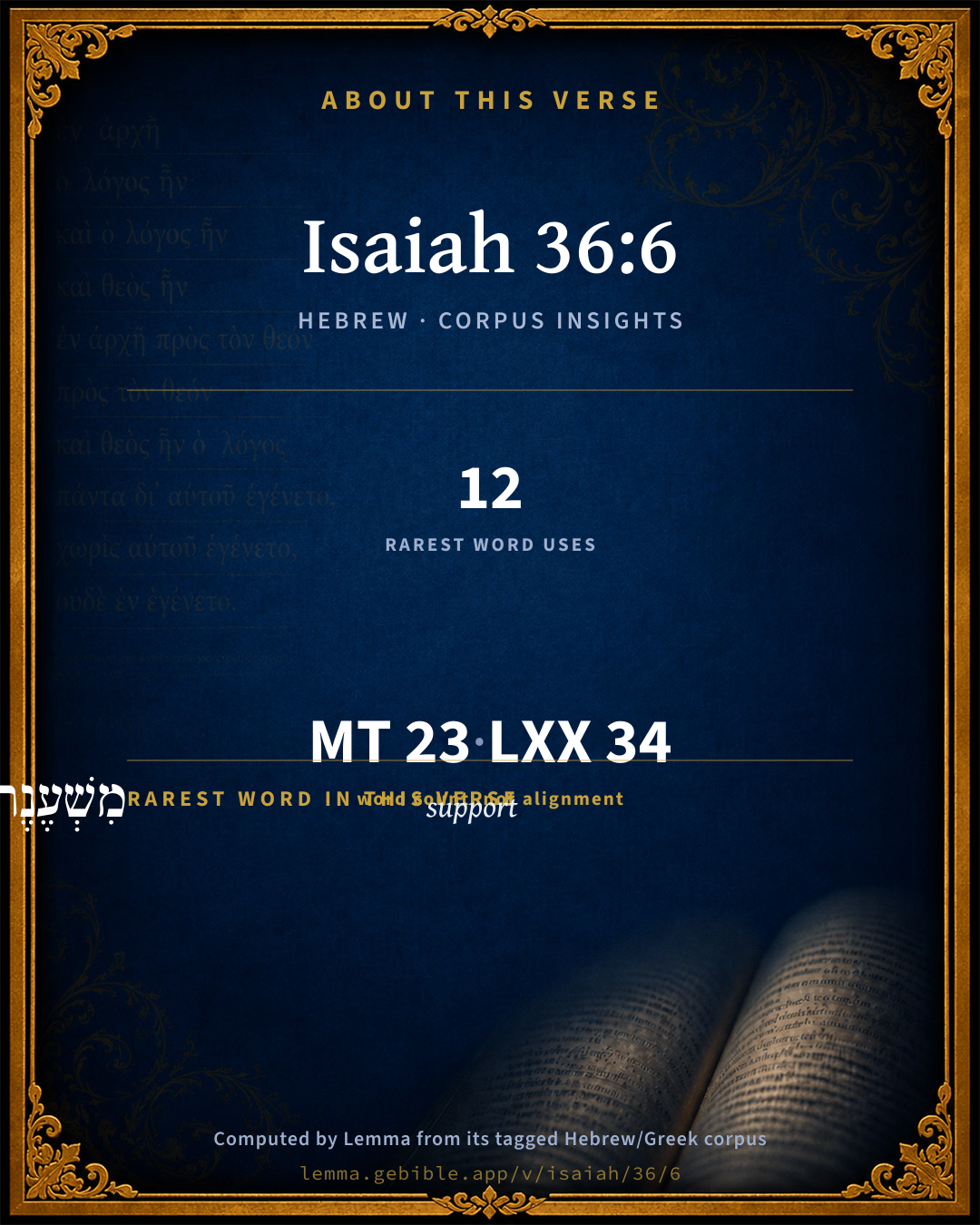
23
words
18
distinct lemmas
Prophets
section

Notable vocabulary

The rarest word here is מִשְׁעֶנֶת֩ support H4938 — appearing just 12 times in the whole Hebrew Bible.

Shared distinctive vocabulary

מִשְׁעֶנֶת֩ support H4938 occurs in 11 verses of the Hebrew Bible. Also found in:

Grammatical profile

  • 6 verbs
  • 9 nouns
  • 1 pronoun
  • 4 prepositions
  • 3 particles

Verb forms

  • בָטַ֡חְתָּ Qal · Perfect
  • הָרָצ֤וּץ Qal · Participle Passive
  • יִסָּמֵ֥ךְ Niphal · Imperfect
  • וּבָ֥א Qal · Sequential Perfect
  • וּנְקָבָ֑הּ Qal · Sequential Perfect
  • הַבֹּטְחִ֖ים Qal · Participle Active

Repetition

Words recur within this verse — often emphatic in Hebrew:

  • עַל upon H5921 ×4
  • בָטַ֡חְתָּ to trust H982 ×2
  • מִצְרַ֔יִם Egypt H4714 ×2

Hebrew & Septuagint length

In English translation the verse runs 39 words from the Hebrew and 40 from the Septuagint (LXX English) — closely comparable.

A rough comparison of the two English renderings, which tokenize alike — not a word-level alignment.

Word counts can differ between the Hebrew and the Greek without any difference in meaning — e.g. the Hebrew direct-object marker אֵת has no separate Greek word, and Greek often adds the article ὁ.

In the original languages it is 23 Hebrew tokens and 34 Greek tokens — but the two are counted differently (Hebrew bundles its prefixes and suffixes into one token; the Greek is in lemma form), so that isn’t a like-for-like length.

Cross-references

7

Topical passages linked to Isaiah 36:6 in the Treasury of Scripture Knowledge — connected by theme and wording, ordered by reader-vote popularity; previews shown in the World English Bible.

  • Ezekiel 29:6–7 All the inhabitants of Egypt shall know that I am Yahweh, because they have been a staff of reed to the house of Israel.
  • 2 Kings 18:21 Now, behold, you trust on the staff of this bruised reed, even on Egypt; whereon if a man lean, it will go into his hand, and pierce it: so is Pharaoh king of Egypt to all who trust on him.
  • 2 Kings 17:4 The king of Assyria found conspiracy in Hoshea; for he had sent messengers to So king of Egypt, and offered no tribute to the king of Assyria, as he had done year by year: therefore the king of Assyria shut him up, and bound him in prison.
  • Isaiah 20:5–6 They shall be dismayed and confounded, because of Ethiopia their expectation, and of Egypt their glory.
  • Isaiah 30:1–7 Woe to the rebellious children, says Yahweh, who take counsel, but not of me; and who make a league, but not of my Spirit, that they may add sin to sin,
  • Isaiah 31:3 Now the Egyptians are men, and not God; and their horses flesh, and not spirit: and when Yahweh shall stretch out his hand, both he who helps shall stumble, and he who is helped shall fall, and they all shall be consumed together.
  • Jeremiah 37:5–8 Pharaoh's army was come forth out of Egypt; and when the Chaldeans who were besieging Jerusalem heard news of them, they broke up from Jerusalem.

Cross-references courtesy of OpenBible.info (CC BY 4.0).

Hebrew and Greek witnesses Masoretic Hebrew ↔ Greek Septuagint

The same verse in the two great witnesses to the Old Testament, shown verse-for-verse.

These are two independent witnesses, not word-aligned to each other, and the Septuagint is shown in lemma (dictionary) form.

Hebrew Isaiah 36:6 Masoretic · Westminster Leningrad Codex

הִנֵּ֣ה בָטַ֡חְתָּ עַל מִשְׁעֶנֶת֩ הַקָּנֶ֨ה הָרָצ֤וּץ הַזֶּה֙ עַל מִצְרַ֔יִם אֲשֶׁ֨ר יִסָּמֵ֥ךְ אִישׁ֙ עָלָ֔יו וּבָ֥א בְכַפּ֖וֹ וּנְקָבָ֑הּ כֵּ֚ן פַּרְעֹ֣ה מֶֽלֶךְ מִצְרַ֔יִם לְכָֽל הַבֹּטְחִ֖ים עָלָֽיו

Behold, you trust on the staff of this bruised reed, even on Egypt, whereon if a man lean, it will go into his hand, and pierce it: so is Pharaoh king of Egypt to all who trust on him.

World English Bible · Public Domain

Greek LXX Isaiah 36:6 Septuagint · lemma form

ἰδού πείθω εἰμί ἐπί ὁ ῥάβδος ὁ καλάμινος ὁ θλάω οὗτος ἐπί αἴγυπτος ὅς ἄν ἐπί αὐτός ἐπιστηρίζω εἰςἔρχομαι εἰς ὁ χείρ αὐτός οὕτως εἰμί φαραώ βασιλεύς αἴγυπτος καί πᾶς ὁ πείθω ἐπί αὐτός

Behold, you trust on this bruised staff of reed, on Egypt: as soon as a man leans upon it, it shall go into his hand, and pierce it: so is Pharao king of Egypt and all that trust in him.

LXX2012 (modern English Septuagint) · Public Domain

Hebrew: Westminster Leningrad Codex (CC BY 4.0). Greek: Septuagint (public domain); English from LXX2012 (modern English Septuagint) (Public Domain). How the Septuagint differs from the Hebrew →

Targum (Aramaic paraphrase)

1

The Targum is the ancient Jewish Aramaic paraphrase of the Hebrew Scriptures — an interpretive translation, not the Hebrew text itself. Onkelos (literal) and Pseudo-Jonathan (expansive) render the Torah, and Jonathan the Prophets. Coverage is partial: where no permissively-licensed English translation exists for a verse, only the Aramaic is shown. This is verse-level text, not a word-by-word alignment to the Hebrew.

  1. Targum Jonathan Prophets (Joshua–Malachi)
    הָא אִיצְרַחֵיצְתָּא עַל סֶמֶךְ קַנְיָא רְעִיעָא הָדֵין עַל פַּרְעֹה מַלְכָּא דְמִצְרַיִם דְאִם יִסְתְּמֵיךְ גַבְרָא עֲלוֹהִי וְיֵעוֹל בִּידֵהּ וִיבַזְעִינֵהּ כֵּן פַּרְעֹה מַלְכָּא דְמִצְרַיִם לְכָל דְמִתְרַחֲצִין עַלוֹהִי:

    Behold, thou trustest in the support of this broken reed, in Pharaoh, the king of Egypt; on which if a man lean, it will enter his hand and wound him: so is Pharaoh the king of Egypt to all that trust in him.

    Targum Jonathan — Aramaic: “Mikraot Gedolot” (public domain). English: “Sefaria Community Translation” (CC0 1.0 (public-domain dedication)); “London "Chaldee Paraphrase," 1871” (public domain). Text via Sefaria.

Commentary

Notes on Isaiah 36:6 from classic Christian and Jewish commentators (each source and its license shown beneath its notes). The classic Christian expositions comment on the surrounding passage and are grouped to its opening verse, so a note may address several verses; the Jewish commentaries on the Tanakh (Rashi and others) are per-verse, so they appear only where the commentator wrote on this verse.

Lemma curates 59 commentaries, every one of them public domain or Creative Commons licensed, each selected and text-cleaned for this edition rather than reprinted as found. About our sources →

Tyndale Open Study Notes

Tyndale Open Resources

36:6 Egypt . . . is completely unreliable: Isaiah argued the same case, pointing to the Lord as the only reliable source of help (31:1-3, 7; 39:7). • A kind of reed that breaks easily grows near the Nile (see Ezek 29:6-7).

Tyndale Open Study Notes — © Tyndale Open Resources, licensed CC BY-SA 4.0. Text via the HelloAO Bible API.

Geneva Bible (1599)

Geneva Bible translators

Satan labored to pull the godly King from one vain confidence to another: to wit, from trust in the Egyptians, whose power was weak and would deceive them, to yield himself to the Assyrians, and so not to hope for any help of God.

Geneva Bible (1599) marginal notes — public domain. Text via Bolls.life.

Jamieson, Fausset & Brown

Robert Jamieson, A. R. Fausset & David Brown

It was a similar alliance with So (that is, Sabacho, or else Sevechus), the Ethiopian king of Egypt, which provoked the Assyrian to invade and destroy Israel, the northern kingdom, under Hoshea.

Jamieson, Fausset & Brown — Commentary Critical and Explanatory on the Whole Bible (1871) — public domain (CC PDM 1.0). Text via the HelloAO Bible API.

Adam Clarke's Commentary

Verse 6. The staff of this broken reed] A weakened, faithless ally.

On Egypt] The Bodl. MS. adds מלך melech, the king of Egypt; and so perhaps the Chaldee might read.

It will go into his hand, and pierce it] Will take subsidy after subsidy, and do nothing for it.

Adam Clarke's Commentary on the Bible (1810–1826) — public domain. Text from a community e-Sword/MySword module.

The Cambridge Bible for Schools and Colleges

gen. ed. J. J. S. Perowne

6. the staff of this broken reed] For the idea, cf. ch. Isa_30:1-5; for the figure, Eze_29:6-7.

The Cambridge Bible for Schools and Colleges (gen. ed. J. J. S. Perowne; Cambridge University Press, 1878–1918) — public domain. Text from a community e-Sword module.

John Gill's Exposition

Lo, thou trustest in the staff of this broken reed, on Egypt,.... His ally and auxiliary; and which is rightly called "the staff of a broken reed", if trusted to, and leaned upon, being weak and frail, and an insufficient ground of confidence to depend upon; the allusion seems to be to the cane or reed which grew upon the banks of the river Nile, in Egypt:

whereon if a man lean, it will go into his hand, and pierce it; the splinters of the broken reed being leaned on, will enter into a man's hand, and do him harm, instead of being a help to him to walk with:

so is Pharaoh king of Egypt to all that trust in him; pernicious and harmful, instead of being useful and helpful.

John Gill's Exposition of the Whole Bible (1746–1763) — public domain (CC PDM 1.0). Text via the HelloAO Bible API.

Albert Barnes' Notes on the Bible

Lo, thou trustest - It is possible that Sennacherib might have been apprised of the attempt which had been made by the Jews to secure the cooperation of Egypt (see the notes at Isa 30:1-7; Isa 31:1 ff), though he might not have been aware that the negotiation was unsuccessful.

In the staff of this broken reed - The same comparison of Egypt with a broken reed, or a reed which broke while they were trusting to it, occurs in Eze 29:6-7. Reeds were doubtless used often for staves, as they are now. They are light and hollow, with long joints. The idea here is, that as a slender reed would break when a man leaned on it, and would pierce his hand, so it would be with Egypt. Their reliance would give way, and their trusting to Egypt would be attended with injury to themselves (compare Isa 30:5, Isa 30:7; Isa 31:3).

Albert Barnes' Notes on the Bible (1834–1885) — public domain. Text from a community e-Sword/MySword module.

Whedon's Commentary on the Bible

Daniel D. Whedon

6. And he in effect continues: “What height of folly in you to trust in this broken reed, Egypt. Leaning on such a staff is only to be pierced by it. Pharaoh has ever proved false to those who have depended on him. He is a reed staff that first pierces, then breaks. His first essays of resistance are daring and sharp, but they soon yield in very weakness.” This may have been conceived by this Assyrian leader as about to follow in the invasion soon to be made upon Egypt by Sennacherib.

Daniel D. Whedon (gen. ed.), Commentary on the Old and New Testaments (1874–1909) — public domain. Text from a community e-Sword module.

The Pulpit Commentary

This broken reed; rather, as in 2Ki_18:21, this bruised reed. (comp. Isa_42:3) A reed may be "bruised," and wholly untrustworthy as a support, while it appears sound. A "broken" reed no one would lean on. Egypt. There had been times when Egypt was a strong power, feared and respected by her neighbours, and a terror even to Assyria. But these times were long past. For the last fifty years the country had been divided against itself, (see the comment on Isa_19:2) split up into a number of petty principalities, Recently the neighbouring kingdom of Ethiopia had claimed and exercised a species of sovereignty over the entire Nile valley, while allowing tributary princes to govern different portions of it. Of these princes the most important at the time of Rabshakeh"s embassy seems to have been Shabatok, who reigned in Memphis, probably from B.C. 712 to B.C. 698. Egypt is likened to a "bruised reed" on account of her untrustworthincss. "So" (Sabaco) had given no substantial help to Hashes. Shabatok was little likely to imperil himself in order to assist Hezekiah. Even Tirhakah would probably avoid, as long as he could, a conflict with the full power of Assyria. Pharaoh, King of Egypt. Sennacherib uses the generic term, "Pharaoh," instead of mentioning any of the petty princes by name, because he means to speak generally. The King of Egypt, under present circumstances, whoever he may be, is no better than a bruised reed. In his own inscriptions, Sennacherib about this time uses the expression, "the kings of Egypt" ("Eponym Canon," p. 133, 1.47).

HOMILIES BY W.M. STATHAM Ver. 6. The broken staff.

"Lo, thou trustest in the staff of this broken reed, in Egypt; whereon if a man lean, it will go into his hand, and pierce it." Man must lean. He is constituted to rest on some object outside himself, and it would be a wise though painful study to review the false resting-places of the human heart. Egypt stands in the Scripture for the world outside God its pleasure, its skill, its science, its entire wealth of means and appliances. For Egypt was once the repository of the world"s wealth, and skill, and science, and beauty, and glory.

I THIS IS HISTORICAL TRUTH. How eagerly the Jews turned from the true God to idols! Their life was dishonoured during a long part of their history by idolatry, for which they were punished by captivities, and against which they were warned by prophets. Still they rebelled against God, and vexed and grieved his Holy Spirit. Delivered from Egypt and its slaveries and wrongs, as their fathers were, they yet turned in heart to all that was represented by Egypt.

II THIS IS SYMOBLIC TRUTH. Men lean still on reeds, that in time become broken reeds. They trust in wealth, friendship, fortune; and these at last give way, and the reed pierces them to the heart. This is the story often told of the world"s disappointed conditions broken health and lost fortunes. Having no God to turn to, men are left desolate and deserted in the hour when heart and flesh faint and fail. We see all this in Byron and Shelley, and in the "Midases" of the world, who love wealth and all that wealth can bring. Nothing in the world answers to the deep necessities of man"s immortal nature, and the "rest under the shadow of Egypt" is not broad and deep enough for the soul of man.

III THIS IS SURPRISING TRUTH. "Lo!" we may well exclaim. Is this world a lunatic asylum, alter all, full of men and women who have lost the fine balances of judgment? or is it a blind asylum, where they have lost the clear vision of truth? After all the records of observation and of history, has it come to this that each succeeding generation takes up the old lie and forsakes the living God? Even now and here, where the Saviour says, "Come unto me and rest," how many seek "rest" out of God! Some find human love itself a broken reed, and in their hours of sad discovery turn cynical and despairing, whilst to others friendship itself has proved superficial and fickle. There are many who have drawn out the broken reed, and dressed the wound as well as they may; but it remains unhealed. What they really want is the balm of Gilead and. the great Physician of souls. W.M.S.

Treacherous trusts.

The arrogant language of Rabshakeh was full enough of falsehood, but it had one grain of truth. Egypt was but a broken reed on which to lean, and any trust reposed in its aid would be attended with disaster and humiliation. The imagery which is here used is forcible enough, and it admirably describes the character and the consequences of an ill-founded confidence. Of these treacherous trusts are

I OUR OWN UNDERSTANDING.

1. We are expressly warned of God not to lean on this. (Pro_3:5)

2. Our known weakness, our incapacity to penetrate the hearts of men and to foresee the issue of events, our liability to make deplorable and ruinous mistakes, this should teach us to forbear.

3. And the many lamentable instances, recorded in histories and witnessed by our own eyes, of the evil consequences of men trusting to their own sagacity, should also dissuade and deter us.

II HUMAN FRIENDSHIPS. The language of Scripture on this subject is remarkably, is significantly, strong. (Jer_17:5) When we consider how often it has happened, as the consequence of human insufficiency, not only that men have failed to secure what they were expecting, but that they have been thereby plunged into the deepest distress and even into irremediable ruin; that to use the image of Rabshakeh the staff has not only broken under them, but pierced the hand that leant on it; we may well feel that this scriptural language is not a whir too strong. Human friendship breaks down and wounds us by its fracture,

(1) through the limitations of our faculty;

(2) through inconstancy, and even treachery;

(3) through moral or spiritual shipwreck.

III TEMPORAL ADVANTAGES. Riches, rank, official position and the power it confers, these are things on which we are prone to place reliance. But woe unto the man who has no firmer ground on which to build! In the day of his calamity, in the hour of bereavement, in the time of desolation, in the hour of death, those things will fail him; and to have trusted in any or in all of them, to the negligence of a hope that is surer than they, will add unspeakable bitterness to the sense of failure and of need. The broken reed will pierce the hand that holds it.

Only in a Divine Saviour, whose wisdom will never be found wanting, whose faithfulness will never fail, whose power to succour and befriend in the saddest sorrows and darkest hours will continually suffice only in him will be round the support which "cannot be broken." "Our God is a Rock;" and blessed is the man who rests all the weight of his joy and of his hope on his inviolable word, on his irrefragable power. C.

Satire on our human confidences.

Evidently the Rabshakeh was informed concerning the parties that divided the people of Jerusalem at this time. Hezekiah seems to have been so far persuaded as to give his reluctant assent to sending the embassy to Egypt. The complaints which Sennacherib had to make against Hezekiah were

(1) that he had refused tribute; (2Ki_18:14)

(2) that he had opened negotiations with Babylon and Egypt, (2Ki_18:24) with a view to an alliance against Assyria;

(3) that he had helped the Philistines of Ekron to rise against their king. The second of these is dealt with in this verse. The Rabshakeh satirizes the helplessness of Egypt, likening that nation to a cracked, not broken, reed, which breaks suddenly, and pierces the hand of him who leans hard on it as a supporting staff. The keenness of the satire lies in the truth of it. Of the hopelessness of leaning on Egypt Isaiah had already warned the people. (Isa_30:7, see the true reading) Egypt, in relation to Israel, is the type of the human confidences to which men turn so readily in their distress, forgetful of the Divine confidence in which alone they can be secure.

I THE SATIRE OF GOD"S MINISTERS. Illustrate from the Prophet Isaiah, who dealt so vigorously with this trusting to Egypt. Sometimes he gave serious and solemn warnings; sometimes grave reproaches; and sometimes keen criticism and biting satire, as if he would shame them into giving up the foolish and hopeless scheme. He put the character of Egypt into a word, almost an offensive word. Cheyne suggests that he wrote this word Rahab, "utter indolence," "helpless inaction," in large characters, and set it up in a public place. That was his idea of Egypt. So, still, Christian ministers must not hesitate to wither up men"s self-trusting and man-trusting with the keenest satire. It is a fair weapon for destroying self-confidences.

II THE SATIRE OF RIVALS. Such was the satire of Assyria, through its Rabshakeh. At this time Babylon, Assyria, and Egypt were each seeking the alliance of Judah, and the jealousy of the one that did not succeed found expression in descriptions of the one that did. We can often get some self-knowledge through the things our rivals say of us in the bitterness of their disappointment. It is often surprising, it should be always helpful, to "see oursel"s as ithers see us.

III THE SATIRE OF EVENTS. Ridiculous indeed was the help Egypt afforded to Judah. The strength of Egypt at this time was one of appearance only. Egypt never has been a country that could be relied on. It did not save Judah. Its alliance only hurried on the fate of Judah. The cracked reed broke, and pierced the hand. "Experience is a dear school, but fools will learn in no other." The logic of events soon shows up the folly of all confidences in man. Impress, in conclusion, from the figures of the very striking passage, Jer_17:5-8. R.T.

The Pulpit Commentary (1880–1919), ed. H.D.M. Spence-Jones & Joseph S. Exell — public domain. Text from a community e-Sword module.

J. A. Alexander on Isaiah

Joseph Addison Alexander

“Behold, thou hast trusted in the staff (or support) of this broken reed, in Egypt, which, (if) a man lean upon it, will go into his hand and pierce it; so is Pharaoh king of Egypt to all those trusting in him.” He answers his own question. The charge of relying upon Egypt may be regarded either as a true one, or as a malicious fabrication, or as a mere inference from the analogy of other cases and the habitual relation of the parties. Egypt may be called a broken reed, either as being always weak, or in allusion to what it had already suffered from Assyria. Broken does not mean entirely divided, but so bruised or shattered as to yield no firm support but rather to do injury. (See Isa 42:3 below).

Joseph Addison Alexander, The Prophecies of Isaiah (1846–1847; New York: Scribner, 1870–1878) — public domain. Text from a community e-Sword module.

unfoldingWord translationNotes

Door43 World Missions Community

General Information:

This continues the king of Assyria's message to Hezekiah. The chief commander is speaking the message to Hezekiah's men. (See: Isaiah 36:4-5)

Look

Sennacherib uses this word to draw Hezekiah's attention to what he says next. AT: "Listen"

trusting in Egypt

Here "Egypt" refers to the Egyptian army. AT: "trusting in the Egyptian army" (See: Metonymy)

that splintered reed that you use as a walking staff, but if a man leans on it, it will stick into his hand and pierce it

This speaks of Egypt, specifically its army and its Pharaoh, as if it were a splintered reed to emphasize that relying on them would not help them but would only harm them. AT: "that is like walking with a splintered reed for a staff. If a man leans on it, it will stick into his hand and pierce it" (See: Metaphor)

splintered reed

A reed is the long, thin stem of a plant like tall grass. If it is splintered or damaged it cannot carry any weight.

walking staff

This is a stick that someone would use for support when walking, made of whatever kind of tree limb that is found along the way.

is not he the one whose high places and altars Hezekiah has taken away ... Jerusalem"?

The king of Assyria uses this question to ridicule the people and to imply that Yahweh was angry about what Hezekiah did and would not protect them. This rhetorical question can be translated as a statement. AT: "he is the one whose high places and altars Hezekiah has taken away ... Jerusalem." or "he is the one whom Hezekiah insulted by tearing down his high places and altars ... Jerusalem." (See: Rhetorical Question and Assumed Knowledge and Implicit Information)

has said to Judah and to Jerusalem, "You must worship before this altar in Jerusalem"?

This can be written as an indirect quote. "Judah" and "Jerusalem" refer to the people who live in them. AT: "has told the people of Judah and Jerusalem that they must worship only at this altar in Jerusalem." (See: Direct and Indirect Quotations and Metonymy)

translationWords

trust

Egypt

hand

Pharaoh

king

Yahweh

God

altar

Hezekiah

Judah

Jerusalem

worship

unfoldingWord translationNotes — © Distant Shores Media and the Door43 World Missions Community, licensed CC BY-SA 4.0. Source: git.door43.org/Door43/en_tn.

Rashi

Rabbi Shlomo Yitzchaki (Rashi)

upon which a man will lean On the splintered and broken reed, and the scaly envelopes enter his palm and puncture it, so is Pharaoh to those who trust him. Eventually, their aid will be to their detriment.

Rashi on the Tanakh — English translations: “The Judaica Press complete Tanach with Rashi, translated by A. J. Rosenberg” (CC BY 4.0); “Pentateuch with Rashi's commentary by M. Rosenbaum and A.M. Silbermann, 1929-1934” (public domain); “The Metsudah Tanach series, Lakewood, N.J” (CC BY 4.0); and “The Book of Joshua, Metsudah Publications, 1997” (CC BY 4.0). Text via Sefaria.

Lesson kit

Teaching starters — assembled from the data on this page, not authored interpretation. Every prompt links to the verse data it draws on. Edit before teaching.

Isaiah, in the Prophets, opens this verse with 23 words (18 distinct Hebrew lemmas). Its most distinctive word is mishʻênâh (“support”). A historical commentator’s framing appears above. Read the whole chapter for the surrounding context.

Discussion questions

  1. How does “support” (mishʻênâh) shape what this verse is saying?
  2. Exodus 21:19 shares the word «support» with this verse. How do the two illuminate each other?
  3. “upon” occurs 4× in this one verse. What is the effect of the repetition?
  4. These translations render this verse differently; the difference is in the English rendering, not the original. What questions does that raise?
  5. The verb «בָטַ֡חְתָּ» is Qal Perfect. How does its form color the action?
  6. Reading how Tyndale Open Study Notes and Geneva Bible (1599) read this verse, where do the two commentators agree and where do they part?

Things to notice

Reading settings

Reading text

Shown beneath each verse's original-language words.

Old Testament
Old Testament edition

Read the OT as the Masoretic Hebrew (MT) or the Greek Septuagint (LXX).

English shown for the Greek Septuagint (in the Hebrew ↔ Greek comparison).

Comparing translations? Open the Compare panel on any verse page to stack up to four side by side.